Most biotech executives say they allocate R&D capital rationally. Most are wrong. They favor programs with internal champions, compounds that are scientifically elegant, or assets inherited from the previous regime that nobody wants to touch. The result is a portfolio that looks balanced on a slide deck and bleeds cash in reality.
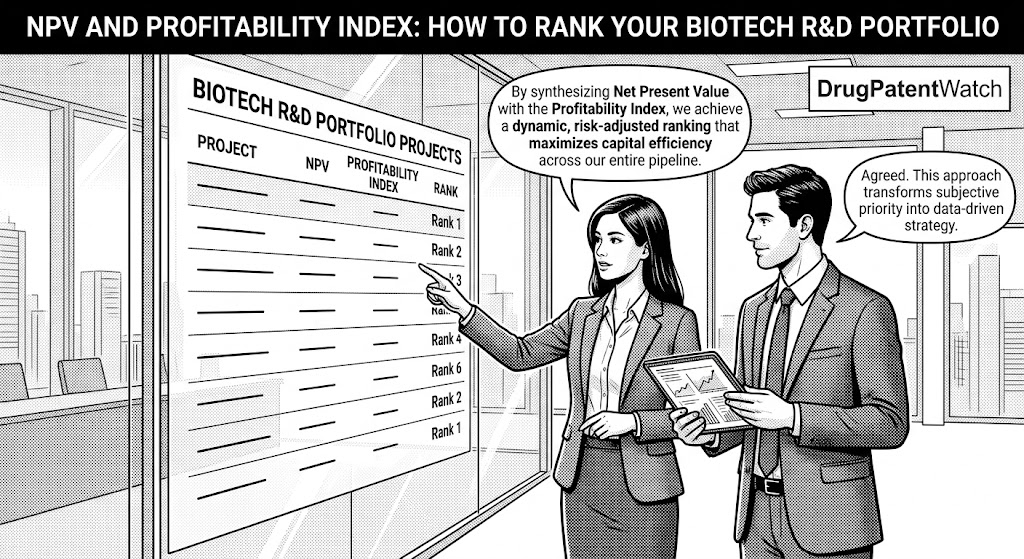
Net Present Value (NPV) and the Profitability Index (PI) are the corrective tools. Neither is complicated in theory. Both are brutally honest in practice. Used together with discipline, they force a portfolio conversation away from scientific tribalism and toward a single, answerable question: given our capital constraints and the probability that this compound actually reaches patients, does this program deserve funding over the next best alternative?
This article walks through the mechanics of both metrics, the adjustments required to make them work in a pharmaceutical context, the common modeling errors that corrupt results, and the organizational conditions under which the numbers actually change decisions. Along the way, it draws on real transactions, real pipeline failures, and real court records from patent litigation that reshaped competitive dynamics for specific drugs. Patent intelligence tools like DrugPatentWatch are woven in where they add genuine analytical leverage.
The intended reader is a VP of Business Development, a Chief Scientific Officer who has to justify a portfolio review to a board, or a portfolio analyst building models that leadership will actually use. This is not an introduction to discounted cash flow. It assumes you know what a discount rate is and want to know how to use it without lying to yourself.
Why Biotech Portfolio Decisions Break Down
The Capital Allocation Problem in Drug Development
Drug development is capital-intensive in a way that most industries are not. A Phase I trial for a novel biologic can consume $20 million to $50 million before you know whether the molecule is safe enough to dose at therapeutic levels. Phase III trials for large indications routinely exceed $200 million. The time between first-in-human dosing and an FDA decision is typically eight to twelve years for novel mechanisms, though breakthrough therapy designation and accelerated approval pathways have compressed this for some programs [1].
At any given time, a mid-sized biotech with a $500 million annual R&D budget might be running fifteen to twenty-five clinical programs simultaneously, across multiple therapeutic areas, at different stages of development. Each program requires not just cash but management attention, regulatory expertise, manufacturing capacity, and commercial planning resources. The allocation of those resources is a zero-sum game. Funding one program at a higher level means defunding another.
The problem is that most companies do not make these tradeoffs explicitly. They use incremental budgeting, carrying forward prior-year allocations with modest adjustments based on trial milestones. Programs that should be killed survive because killing them requires admitting that a previous investment decision was wrong. Programs that should be accelerated starve because their internal champions lack political capital. The result, documented repeatedly in post-hoc analyses of pharmaceutical pipelines, is a portfolio optimized for organizational comfort rather than value creation [2].
Where Scientific Merit Ends and Financial Reality Begins
There is a genuine tension in pharmaceutical R&D between scientific rigor and financial analysis. Scientists are right to resist reducing complex biology to a single number. A compound with a novel mechanism targeting an unmet need in a rare disease is not straightforwardly comparable to a me-too molecule in a crowded cardiovascular indication, even if the NPV of the latter looks higher on a spreadsheet built with optimistic assumptions.
The response to this tension is not to abandon financial modeling. It is to build models that incorporate the specific uncertainties of pharmaceutical development honestly. That means using risk-adjusted NPV (rNPV), which multiplies cash flows by the cumulative probability of reaching each stage. It means using discount rates that reflect the actual cost of capital for a company at a specific stage of development, not a corporate WACC borrowed from a general finance textbook. It means subjecting assumptions about market size, pricing, and competitive entry to sensitivity analysis that shows leadership where the model breaks.
When you do this work properly, the financial analysis does not replace scientific judgment. It structures it. It forces the question: what would have to be true about the biology, the market, and the competitive landscape for this program to be worth more than the next best use of this capital? That is a useful question. Without it, you are not making portfolio decisions; you are holding a committee meeting.
Net Present Value: The Foundation
The Basic Mechanics
NPV is the present value of all future cash inflows minus the present value of all future cash outflows, discounted at the appropriate rate. In algebraic terms:
NPV = ∑ [CFt / (1 + r)t] - Initial Investment
Where CFt is the cash flow in period t, r is the discount rate, and t is the time period in years. A positive NPV means the project generates more value than the cost of the capital used to fund it. A negative NPV means the opposite. In capital allocation, you rank projects by NPV and fund in descending order until you run out of capital.
This is taught in every MBA program and used incorrectly in most pharmaceutical companies. The errors are systematic, and they cluster around three issues: the wrong discount rate, the wrong probability adjustments, and the wrong terminal value assumptions.
Choosing the Right Discount Rate
The discount rate in an NPV model is supposed to represent the opportunity cost of capital: the return you could earn on the next best investment with a similar risk profile. For a large pharmaceutical company with a diversified portfolio and a stable revenue base, a discount rate in the range of 8% to 12% is defensible [3]. For a clinical-stage biotech with a single program and no approved products, that rate is far too low.
A single-asset clinical-stage biotech faces binary risk. The program either works or it does not, and if it does not, the company may not survive. Investors in these companies demand returns that compensate for that risk. Venture capital firms targeting biotech investments typically require internal rates of return of 25% to 35% on individual investments, reflecting the high failure rates and long time horizons involved [4]. When you build an NPV model for a program inside such a company and use a 10% discount rate, you are underestimating the cost of capital and systematically overstating value.
The practical approach is to use different discount rates for different stages of the pipeline and different types of companies. A Phase III program at a company with multiple approved products and diversified revenue deserves a lower rate than a Phase I program at a single-asset biotech. Some analysts use stage-specific discount rates: higher for early-stage programs reflecting greater uncertainty, lower for late-stage programs where the risk profile more closely resembles a real option on a commercial asset.
There is no single correct answer here, which is one reason why sensitivity analysis around the discount rate is not optional. If your NPV conclusion flips from positive to negative when you move from 12% to 15%, that tells you something important about how much of the apparent value depends on a specific financing assumption rather than the underlying program economics.
Risk-Adjusted NPV: The Pharmaceutical Standard
The defining feature of pharmaceutical NPV modeling is the need to adjust for clinical failure. Most drugs fail. The overall probability of a drug entering Phase I clinical trials ultimately gaining FDA approval has been estimated at approximately 7.9% across all therapeutic areas, though this varies significantly by indication and mechanism class [5]. Oncology drugs have historically fared worse; rare disease programs pursuing breakthrough or accelerated pathways have fared better in recent years.
Risk-adjusted NPV (rNPV) incorporates these probabilities by multiplying each stage’s cash flows by the cumulative probability of reaching that stage. If a program has a 60% probability of advancing from Phase II to Phase III, a 55% probability of Phase III success, and an 85% probability of regulatory approval given successful Phase III data, the cumulative probability of reaching the commercial stage from the start of Phase II is approximately 28% (0.60 x 0.55 x 0.85).
The inputs to this calculation are not arbitrary. Published data on phase transition probabilities, compiled by organizations including BIO, IQVIA, and academic researchers, provide benchmarks by therapeutic area and mechanism class. A program with a validated biomarker, a clean safety profile through Phase II, and a well-defined patient population warrants higher transition probabilities than a program entering Phase III with mixed efficacy signals and a broad, heterogeneous indication.
The important discipline here is to separate the probability estimate from the desire for the program to succeed. The person responsible for the scientific strategy of a program is not well-positioned to objectively estimate its probability of success. Pharmaceutical companies that have adopted rigorous portfolio processes typically involve separate groups for scientific assessment and probability estimation, using historical benchmarks as anchors that can be adjusted with documented rationale.
What rNPV Captures and What It Misses
rNPV is the right starting point for pharmaceutical program valuation, but it has known limitations. It treats the future as a single path from clinical development to commercialization, when in reality there are multiple branches: partnering a program, selling it outright, pursuing a different indication, or pivoting to a different formulation or dosing regimen. Decision tree analysis and real options valuation can capture some of this complexity, at the cost of significantly more modeling effort.
rNPV also handles competitive dynamics poorly. A market model built in 2018 for a program targeting a specific oncology indication may have assumed a favorable competitive landscape that no longer exists if three competing molecules have since received approval or entered Phase III. Updating market assumptions is obvious in principle and neglected in practice: programs accumulate NPV models that are never revised as the competitive environment changes.
This is where patent data becomes analytically useful in a way that goes beyond legal strategy. Understanding when competitor compounds are likely to face generic entry, whether patent term extensions have been granted, and what the likely exclusivity period is for competing branded products directly affects the commercial opportunity for a program entering the same market. Tools like DrugPatentWatch allow analysts to pull patent expiration data, exclusivity periods, and paragraph IV challenge histories for competing products and build that into market models with a granularity that general market research rarely provides.
For example, if you are building a commercial model for a novel oral therapy in Type 2 diabetes, knowing that a leading incumbent in the GLP-1 class has both composition-of-matter patents and formulation patents with staggered expirations, and that no paragraph IV challenges have been filed against the formulation patents, materially affects the pricing environment your program will enter. The difference between a market where you compete against a branded product at list price and a market flooded with generic or biosimilar competition can change an rNPV by hundreds of millions of dollars for programs with meaningful commercial potential.
The Profitability Index: Making NPV Work Under Capital Constraints
Why NPV Alone Is Not Enough for Portfolio Ranking
If you have unlimited capital, rank programs by NPV and fund everything with a positive value. In practice, no pharmaceutical company, not even the largest, has unlimited capital. R&D budgets are finite. The clinical organization has capacity constraints. Regulatory affairs teams can only manage a certain number of NDA submissions simultaneously. Manufacturing infrastructure imposes additional limits.
Under capital constraints, ranking by NPV alone produces suboptimal portfolio decisions because it ignores capital efficiency. A program with an rNPV of $800 million that requires $600 million in remaining development investment is not obviously better than a program with an rNPV of $400 million that requires $80 million in remaining investment, particularly if the total available budget is $700 million and you cannot fund both.
The Profitability Index (PI) corrects for this by expressing value per unit of capital invested:
PI = (NPV + Initial Investment) / Initial Investment
Or equivalently:
PI = Present Value of Future Cash Flows / Initial Investment
A PI greater than 1.0 indicates value creation. Ranking by PI rather than absolute NPV tells you which programs generate the most value per dollar of scarce capital. When the constraint is capital, PI-ranked portfolios outperform NPV-ranked portfolios in aggregate return.
Applying PI to Pharmaceutical R&D: The Investment Denominator
Defining the investment denominator is the first problem. In textbook PI calculations, you divide by the initial investment. In pharmaceutical R&D, the relevant constraint is usually not the total program cost but the incremental capital required going forward from the decision point. Sunk costs are irrelevant to the allocation decision; what matters is the cash you will spend from today through commercialization, adjusted for probability of success.
This distinction matters enormously in pharmaceutical portfolio reviews. A Phase III program that has already consumed $300 million in development costs but requires only $50 million more to reach a regulatory decision has a very different PI profile than a Phase II program requiring $400 million in future investment to reach the same decision point. The sunk cost is irrelevant to the PI calculation. The future capital requirement is the denominator.
In practice, the investment denominator should reflect:
Remaining clinical development costs (trials not yet committed)
Regulatory submission and review costs
Pre-commercial investment required before the program generates revenue
Capital opportunity cost if the investment crowds out other uses
Some practitioners include only the cash investment and exclude non-cash resource consumption like management time and shared infrastructure costs. Others allocate a proportion of fixed overhead to each program. The choice affects the denominator and therefore the PI ranking. What matters is consistency: apply the same methodology across all programs being compared so the rankings are comparable.
Capital Constraints in Reality: What Actually Limits Pharmaceutical R&D Portfolios
The assumption underlying PI analysis is that capital is the binding constraint. This is often true for smaller biotechs and for large pharma companies during periods of financial stress. But pharmaceutical portfolios face multiple simultaneous constraints, and capital is sometimes not the primary one.
Regulatory bandwidth is a real constraint. The FDA requires extensive interaction during development: pre-IND meetings, end-of-Phase II meetings, pre-NDA meetings, and post-submission queries. Companies with multiple programs in late-stage development simultaneously face genuine capacity limits in their regulatory organizations, and the quality of the regulatory strategy for each program affects transition probabilities. A company trying to file three NDAs in the same twelve-month period may produce worse submissions than the same company filing them eighteen months apart.
Clinical execution capacity is another constraint. Phase III trials require patient enrollment networks, investigator relationships, data management infrastructure, and medical monitoring resources. Companies that spread these too thin across too many concurrent trials see enrollment slow, protocol deviations increase, and data quality suffer. The PI model does not capture the degradation in transition probabilities that results from execution strain.
The appropriate response is not to abandon PI analysis but to run it alongside a resource constraint analysis. Some portfolio modeling tools allow you to define multiple constraint types (capital, FTEs, regulatory slots) and optimize the portfolio against all of them simultaneously using linear programming methods. This is operationally complex but conceptually straightforward: you are solving a multi-constraint optimization problem rather than a single-constraint one.
Building the Model: A Step-by-Step Framework
Step 1: Define the Commercial Opportunity
Every pharmaceutical NPV model starts with a revenue forecast, and most revenue forecasts are wrong in ways that are systematic and predictable. They overestimate peak market share, underestimate time to peak, and fail to model competitive entry adequately. The result is a consistent upward bias in program valuations that distorts portfolio decisions.
A defensible commercial model requires, at minimum:
An epidemiological estimate of the treatable patient population, built from disease prevalence data disaggregated by severity, prior treatment history, and diagnostic rate
A realistic pricing assumption anchored to comparator pricing, payer dynamics, and the program’s differentiation relative to existing therapies
A market penetration curve that reflects the typical adoption trajectory for drugs in the relevant therapeutic area, not an optimistic scenario
An explicit model of competitive entry: when will competing branded products enter, when will generics or biosimilars arrive, and how will this affect pricing and volume over the commercial period
On the last point, patent data is underused in commercial modeling. The competitive entry timeline for most branded pharmaceutical products is governed by patent expiration and the outcome of paragraph IV litigation, not by FDA approval timelines for new entrants. A company building a commercial model for a program targeting the same mechanism as an established brand should know whether that brand’s key patents have been challenged, what the outcome of those challenges was, and what the likely generic entry date is.
DrugPatentWatch compiles this information systematically, tracking paragraph IV certifications, litigation outcomes, and settlement agreements for virtually all branded pharmaceutical products. For a commercial analyst building a ten-year revenue model for a competitive program, this data is not peripheral. It determines the shape of the pricing environment that the new entrant will face throughout its commercial life.
Step 2: Build the Cost Model
Clinical development costs vary enormously by program type, indication, patient population, and trial design. Published benchmarks provide a starting point, but they should be replaced with program-specific estimates wherever possible.
The key cost categories for a typical drug development program include:
Clinical trial execution costs: patient recruitment, site management, CRO fees, drug supply, and data management across all planned trials
Regulatory costs: regulatory consulting, submission preparation, and ongoing post-approval commitments
Chemistry, manufacturing, and controls (CMC): process development, scale-up, and commercial manufacturing infrastructure
Medical affairs and health economics: outcomes research, publication strategy, and payer engagement pre-launch
For rNPV purposes, these costs need to be phased appropriately: spending that will only occur if the program reaches Phase III should be discounted at a lower probability than spending in the current phase. The model should reflect the fact that you stop spending if the program fails, not that you commit all future costs at the point of deciding to initiate development.
A common error is to treat Phase III costs as committed when they are not. If a program has a 45% probability of advancing from Phase II to Phase III, only 45% of Phase III costs should be included in the expected cost calculation for a decision made at the Phase II initiation point. The rest will not be spent because the program will not get there.
Step 3: Assign Transition Probabilities
Published industry data on phase transition probabilities has improved substantially over the past decade. BIO’s clinical development success rate analysis, which covers thousands of drug programs across multiple therapeutic areas, provides granular benchmarks by phase and disease category [5]. IQVIA and other data sources provide similar analyses.
These benchmarks should serve as the prior estimate, adjusted based on program-specific factors that are genuinely predictive of success. The adjustments that have empirical support include:
Validated biomarker: Programs with a validated predictive biomarker for patient selection have substantially higher Phase II-to-III transition rates and higher Phase III success rates than programs treating unselected patient populations. The difference is large enough to move a program from below-average to above-average probability in the same indication.
Mechanism novelty: Programs with first-in-class mechanisms face higher failure rates due to unknown biology but also face less direct competition. This is a double-edged adjustment that affects both the probability and the commercial opportunity estimates.
Regulatory pathway: Breakthrough therapy designation, fast-track designation, and accelerated approval pathways affect both the timeline and the probability of regulatory success. Breakthrough designation has been associated with higher approval rates, though the causality is complicated by the fact that the FDA grants the designation to programs it believes show promise.
Adjustment should be documented, not arbitrary. A program champion arguing for a 70% Phase III success probability in an indication where the historical average is 55% needs to document specifically what features of the program support that adjustment. Without documentation, the probability estimate reflects optimism rather than analysis, and the portfolio ranking inherits that optimism.
Step 4: Select the Discount Rate and Run the Model
For pharmaceutical programs evaluated by large companies with diversified revenue, a pre-tax discount rate in the range of 10% to 15% is commonly used, with higher rates applied to earlier-stage programs [3]. Some companies use a uniform rate across the portfolio for simplicity and comparability; others use stage-specific rates. Either approach is defensible if applied consistently.
For programs evaluated by clinical-stage biotechs, higher rates are appropriate. A company with a single Phase II asset and three years of cash runway is not in the same risk position as Pfizer evaluating a similar asset. The discount rate should reflect the company’s actual cost of capital, not an idealized benchmark.
Once the model is built, run it for the base case and then immediately run sensitivity analyses. The standard outputs from a well-built pharmaceutical NPV model include:
rNPV under base-case assumptions
rNPV under upside and downside commercial scenarios (peak share +/- 20%)
rNPV sensitivity to phase transition probabilities (what happens if Phase III success is 40% vs. 65%)
rNPV sensitivity to discount rate (8% vs. 12% vs. 18%)
Break-even analysis: what probability of Phase III success makes rNPV = 0
The break-even analysis is particularly useful in portfolio reviews because it translates the financial question into a scientific one that the biology team can engage with directly. If the model shows that you need a 30% Phase III success probability for rNPV to be positive and the team believes the probability is 25%, that is an explicit, debatable claim. If the model shows you need 45% and the team believes 25%, the program should not advance regardless of how compelling the science looks.
Step 5: Calculate PI and Rank the Portfolio
With rNPV estimates for each program and incremental capital requirements defined, PI calculation is arithmetic. Sort by PI in descending order. Fund programs from the top of the list until the capital budget is exhausted. Programs below the cutoff are candidates for deprioritization, out-licensing, or termination.
In a real portfolio review, this ranking will produce surprises. Programs that scientific leadership considers the most important may rank below programs that have received less internal attention. Programs in unfashionable therapeutic areas may rank above programs in areas that are generating publication excitement. This is the point. The PI ranking is a starting point for a disciplined portfolio conversation, not a machine that makes decisions without human judgment. But it forces the conversation to engage with the numbers rather than ignoring them.
The Role of Patent Expiry and Exclusivity in Portfolio Valuation
Patents Are Not Just Legal Documents: They Define the Commercial Opportunity
The commercial value of a pharmaceutical product depends critically on the period of market exclusivity it will enjoy. A product with fifteen years of patent protection and no generic competition at launch has a fundamentally different value than a product that will face generic entry three years after approval. Yet many pharmaceutical NPV models treat exclusivity as a background assumption rather than a variable to be analyzed and stress-tested.
U.S. pharmaceutical exclusivity is layered and complex. Composition-of-matter patents protect the active ingredient itself and typically provide the strongest protection, with terms of twenty years from the filing date. Formulation patents, method-of-treatment patents, and polymorph patents extend protection beyond composition-of-matter expiration but are more vulnerable to challenge. FDA-granted exclusivities, including five-year new chemical entity exclusivity, three-year data exclusivity for new indications, and seven-year orphan drug exclusivity, layer on top of patent protection and may provide exclusivity even when patents have expired or been invalidated.
For a program building a commercial model in a market with existing branded competition, analyzing the patent estate of competing products tells you when the competitive landscape will change. A market currently dominated by a branded product with robust patent protection is fundamentally different from a market where the same product’s key patents expire in two years and four paragraph IV challenges are already pending.
DrugPatentWatch maintains one of the most comprehensive databases of pharmaceutical patent information available, covering Orange Book-listed patents, patent expiration dates, paragraph IV certification histories, and litigation outcomes. For commercial modelers, this data is directly usable in building the competitive entry timeline that drives the revenue forecast [6].
Paragraph IV Litigation and Its Portfolio Implications
Paragraph IV certifications, filed by generic manufacturers claiming that a branded product’s patents are invalid or that the generic product does not infringe them, are among the most consequential events in pharmaceutical competitive dynamics. A successful paragraph IV challenge can accelerate generic entry by years, collapsing the commercial opportunity for a branded product and potentially for competing innovative products in the same market.
The AstraZeneca v. Apotex litigation over esomeprazole (Nexium) illustrates the scale of these effects. AstraZeneca’s Nexium generated peak annual sales of approximately $6.2 billion before generic entry [7]. The company pursued an extensive litigation strategy to defend its patent estate, ultimately achieving a delayed generic entry that preserved substantial exclusivity. But the litigation timeline consumed years and significant legal resources, and the outcome was never certain during the process. A competitor with a program targeting the proton pump inhibitor market during this period had to model both scenarios: continued Nexium exclusivity and accelerated generic entry following a paragraph IV success.
More recently, the litigation history around AbbVie’s Humira (adalimumab) provides the most extensively analyzed case study in pharmaceutical patent strategy. AbbVie built a thicket of more than 130 patents around Humira, covering the formulation, the manufacturing process, and methods of treatment. This thicket delayed biosimilar entry in the U.S. market until 2023, years after biosimilars were available in Europe [8]. For companies building portfolios that compete with Humira in autoimmune indications, the commercial model had to explicitly account for the possibility that Humira’s effective exclusivity would extend far beyond its core composition-of-matter protection.
These examples are not exceptional. They are representative of how patent strategy shapes competitive dynamics across therapeutic areas. Portfolio analysts who do not incorporate patent intelligence into commercial models are building valuations on incomplete information.
Exclusivity as an Asset in Portfolio Valuation
The flip side of competitor patent analysis is the assessment of your own program’s exclusivity position. A compound with a strong composition-of-matter patent filed early in its development, combined with a plausible formulation or method-of-treatment patent strategy for lifecycle management, has a longer effective exclusivity period than a compound with a weak patent position subject to obvious-type obviousness challenges.
This analysis should be part of the portfolio ranking process. Two programs with identical rNPV estimates under base-case assumptions may have very different risk profiles if one has a strong, defensible patent estate and the other has a weak position that is likely to be challenged. The probability-weighted NPV of the weaker patent position is lower once you adjust for the possibility of earlier-than-expected generic entry.
Patent freedom-to-operate (FTO) analysis is a related consideration. A program that would infringe a competitor’s patent if commercialized faces a constraint that is not captured in a standard rNPV model. The cost of licensing, designing around, or litigating a blocking patent should be included in the cost model. In some cases, an FTO problem is severe enough to make a program commercially unviable regardless of its clinical profile.
Real-World Portfolio Applications: Case Studies
Merck and the Keytruda Portfolio Decision
Merck’s decision to prioritize pembrolizumab (Keytruda) over ipilimumab-based combination strategies in the mid-2010s is one of the more consequential portfolio allocation decisions in recent pharmaceutical history. Merck was not the only company with a PD-1/PD-L1 inhibitor in development; Bristol-Myers Squibb had nivolumab (Opdivo) in the same class and a head start in some indications.
Merck’s strategic choice was to invest heavily in first-line non-small cell lung cancer (NSCLC) with a biomarker-selected population (PD-L1 expression >= 50%), a decision that produced the KEYNOTE-024 data and first-line approval in 2016 [9]. This was a portfolio decision driven by a combination of clinical data, competitive intelligence, and commercial modeling that recognized the size of the first-line NSCLC opportunity relative to the capital required to pursue it.
The NPV of the first-line NSCLC program, at the time Merck committed the trial investment, was highly uncertain. The PD-L1 biomarker hypothesis was unproven in first-line therapy. The patient population was significant but the biomarker cutoff limited the addressable fraction to roughly 25-30% of NSCLC patients. The clinical risk was real. But the probability-weighted commercial opportunity was enormous, and Merck had the capital and clinical infrastructure to execute.
Keytruda’s global revenues reached $25 billion in 2023 [10]. The PI of the first-line NSCLC program, calculated with hindsight, would have been extraordinarily high. The lesson is not that Merck had perfect foresight; it is that they made explicit, capital-allocation decisions that concentrated resources on a program with a clearly defined hypothesis, a measurable biomarker, and a large addressable market.
The AstraZeneca Portfolio Reset Under Pascal Soriot
When Pascal Soriot became CEO of AstraZeneca in 2012, the company was facing a cliff of patent expirations and a pipeline that had failed to produce blockbuster successors [11]. The stock was under pressure and at least one major shareholder was pushing for a sale. Soriot’s response was a portfolio restructuring that concentrated investment in three therapeutic areas: oncology, cardiovascular/metabolic disease, and respiratory.
This restructuring required explicit decisions to deprioritize or out-license programs in other areas. The financial discipline behind these decisions was not publicly detailed, but the logic was straightforward: given constrained capital relative to the number of active programs, concentrate resources in areas where AstraZeneca had scientific differentiation and commercial infrastructure, and where the probability-weighted returns justified the investment relative to alternatives.
The oncology bet in particular produced Tagrisso (osimertinib) for EGFR-mutated NSCLC, which has become one of the most successful targeted oncology products in history with 2023 revenues exceeding $5.8 billion [12]. Tagrisso’s commercial success is partly attributable to a strong biomarker (EGFR mutation) that allowed precise patient selection, and partly attributable to an intellectual property strategy that secured composition-of-matter protection combined with method-of-treatment claims that have been vigorously defended.
The AstraZeneca case illustrates a broader principle: portfolio restructuring toward higher-PI programs requires the organizational will to stop spending on lower-PI programs. The hardest part of portfolio optimization is not building the model; it is making the decision to terminate or out-license programs with internal champions who believe the model is wrong.
Sarepta and Rare Disease Portfolio Economics
Sarepta Therapeutics’ experience in Duchenne muscular dystrophy (DMD) offers a case study in rare disease portfolio economics where the rNPV framework requires significant adaptation. DMD affects approximately one in every 3,500 to 5,000 male births. The patient population is small, the unmet need is severe, and the regulatory pathway has been accelerated through FDA’s use of surrogate endpoint approval.
Sarepta’s eteplirsen (Exondys 51) received accelerated approval in 2016 under significant controversy regarding the clinical data supporting the surrogate endpoint [13]. The FDA’s internal review team and an external advisory committee were deeply divided. The approval decision was ultimately made by the FDA Office Director against the recommendation of the advisory committee, reflecting a judgment about the benefit-risk balance in a severe disease with no alternatives.
For a portfolio analyst trying to model programs like eteplirsen, standard rNPV calculations face a fundamental problem: the probability of regulatory approval cannot be estimated from historical benchmarks for rare disease programs with accelerated approval pathways in the same way it can be estimated for conventional drug development. The regulatory outcome depends heavily on FDA’s evolving interpretation of acceptable evidence standards, which is qualitative and difficult to model quantitatively.
The practical response is to model multiple regulatory scenarios explicitly: approval on first submission, complete response letter requiring additional evidence, and outright rejection. Each scenario has a probability weight and a cash flow timeline. This is a more complex calculation than standard rNPV but more honest about the actual uncertainty.
Sarepta’s subsequent pipeline expansion into additional DMD exon-skipping therapies and gene therapy programs illustrates another PI consideration: a company with an established rare disease commercial infrastructure has a lower incremental cost of commercializing additional programs in the same patient population than a company starting from scratch. This shared infrastructure should reduce the PI denominator for subsequent programs, improving their ranking relative to programs in different therapeutic areas that require building a new commercial operation.
Common Modeling Errors That Invalidate Portfolio Rankings
Overoptimistic Peak Market Share
The most common error in pharmaceutical commercial modeling is peak market share assumption that does not reflect the reality of drug launches. Analysis of pharmaceutical product launches shows that the median time from approval to peak market share is five to seven years for branded products in competitive markets [14]. Yet models routinely assume rapid ramp-up to high market share, compressing the time to peak and inflating NPV.
The correct approach is to use launch analogs: actual market share trajectories from drugs with similar profiles (mechanism class, indication, competitive context, pricing) launched in the past. The analog selection should be documented and challenged. A model assuming that a new drug will achieve faster market penetration than the historical median should require explicit justification.
Ignoring Pricing Erosion
U.S. pharmaceutical net pricing has faced increasing pressure from pharmacy benefit managers, formulary restrictions, and mandatory rebates. List price increases have not translated to proportional net revenue increases for several years. Additionally, the Inflation Reduction Act’s provision allowing Medicare to negotiate prices for high-expenditure drugs introduces a new pricing pressure that was not present in models built before 2022 [15].
Models that use current list prices as a proxy for future realized prices, without adjusting for the trajectory of net pricing erosion, overstate future revenue. The magnitude of the error depends on the therapy area and the payer mix, but for many programs, the difference between gross and net pricing can approach 40-50% of list price after accounting for rebates and discounts.
Using the Same Probability Estimates for All Programs Regardless of Quality
Phase transition probabilities borrowed from published benchmarks are averages across a population of programs. They do not automatically apply to a specific program with specific features. A program with a validated biomarker, a mechanism of action with proof-of-concept in multiple species, and a Phase II trial designed with pre-specified primary and secondary endpoints that were met has higher transition probabilities than an average program. A program with mixed Phase II signals, no biomarker, and a post-hoc subgroup analysis driving the advancement decision has lower ones.
Using the same average probability for both programs produces portfolio rankings that are indifferent to data quality. This is a serious error. It means that well-designed programs with clean data compete on equal terms with poorly designed programs with ambiguous data. The result is a portfolio that does not reward scientific rigor.
Double-Counting the Option Value of Flexibility
Real options analysis can capture the value of managerial flexibility in pharmaceutical R&D: the option to expand a program into additional indications if Phase II data are positive, the option to out-license a program at a defined value if internal capital becomes constrained, the option to accelerate or slow development based on competitive developments. These are genuine sources of value that rNPV understates.
The error is not in recognizing this option value but in counting it twice: once in an optimistic commercial forecast and again as a separate real options premium. If the commercial model already assumes expansion into additional indications, the real option to expand into those indications has been incorporated in the base case and should not be added again as an explicit option value.
Anchoring to Prior Investment
Sunk cost bias is the dominant psychological failure in pharmaceutical portfolio management. Programs that have consumed $200 million in historical investment are retained not because their forward-looking PI justifies the incremental capital but because the portfolio review team cannot bring itself to write off a $200 million investment. The $200 million is gone regardless of what happens next. The decision is whether the incremental capital required to continue the program generates more value than the next best use of that capital. Prior spending is irrelevant.
Building portfolio models that present only forward-looking cash flows, not historical costs, helps reduce this bias. Some companies go further and require that program review presentations not mention historical spending at all, forcing the discussion to focus on future capital requirements and expected future value.
‘The pharmaceutical industry loses an estimated $50 billion annually to R&D programs that fail in Phase III — trials that could have been stopped earlier had portfolio decision-makers had access to better financial and clinical evidence frameworks.’ — PhRMA Foundation Research Report on R&D Productivity, 2022 [16]
Organizational Conditions for Financial Discipline
When Models Change Decisions and When They Don’t
The most common criticism of NPV-based portfolio analysis in pharmaceutical companies is that the models do not actually change decisions. They are built, presented, filed, and ignored. Programs advance because the scientific leadership believes in them, not because the financial model supports them. Portfolio reviews become exercises in post-hoc rationalization of decisions already made on scientific grounds.
This critique is often accurate. But the problem is organizational, not analytical. Models change decisions when three conditions are met: leadership is genuinely committed to using financial analysis as one input to portfolio decisions; the modeling process is credible (defensible assumptions, independent probability estimates, documented sensitivity analysis); and there is an organizational consequence for ignoring the model.
The last condition is the hardest. In a company where killing a program is seen as a career risk, no model will produce terminations. The model becomes a tool for justifying continuation decisions, with assumptions that can be tuned to produce a positive NPV for any program the scientific team wants to advance. This is not a modeling failure; it is a governance failure.
Structuring the Portfolio Review Process
Pharmaceutical companies that have successfully integrated financial analysis into portfolio decisions tend to share structural features in their review processes. The first is separation between program champions and the review panel. The team responsible for running a program should present the clinical data, but probability estimates and commercial assumptions should be reviewed by a group without a stake in the outcome.
The second is explicit portfolio-level optimization rather than program-by-program review. Reviewing each program sequentially, in isolation, does not reveal the portfolio-level tradeoffs. A portfolio optimization that ranks all programs simultaneously by PI shows immediately which programs are competing for the same capital and what the opportunity cost of each funding decision is.
The third is regular review frequency. Annual portfolio reviews are not adequate for a development environment in which clinical data readouts, competitive approvals, and patent litigation outcomes can materially change the value of specific programs on a quarterly basis. Leading pharmaceutical companies conduct portfolio reviews on a rolling basis, with formal capital reallocation decisions tied to major data readouts rather than fixed calendar dates.
The Role of External Data in Reducing Model Bias
Internal models built entirely on internal assumptions are more vulnerable to bias than models that incorporate external data as anchors. External data sources that pharmaceutical portfolio teams should incorporate systematically include:
Published phase transition probability data from BIO, IQVIA, and academic sources, updated annually and applied by therapeutic area and mechanism class rather than using a single industry average.
Comparator drug launch analogs from prescription data sources, providing market share ramp trajectories that anchor commercial forecasts in historical reality rather than optimism.
Patent expiration and challenge data from DrugPatentWatch and the FDA Orange Book, used to build competitive entry timelines that reflect actual intellectual property constraints rather than assumed stability of the competitive landscape.
Transaction precedents for comparable programs, drawn from licensing databases and public deal disclosures, which provide market-based validation for rNPV estimates. If a program’s rNPV model shows $600 million in value but comparable programs in recent arm’s-length transactions have sold for $80 to $120 million, the model deserves scrutiny before the valuation drives capital allocation decisions.
Integrating Patent Intelligence into Portfolio Valuation
The Patent Estate as a Financial Asset
Pharmaceutical patent portfolios are financial assets in a direct sense: they define the duration and exclusivity of the cash flows that underpin the NPV calculation. Companies with strong patent positions command higher valuations for the same clinical assets than companies with weak positions, because the probability-weighted duration of exclusivity is higher.
Assessing the strength of a pharmaceutical patent portfolio requires domain expertise that straddles patent law and pharmaceutical science. The relevant questions include: are the composition-of-matter claims broad enough to prevent designing around? Have the patents been challenged in inter partes review proceedings, and what was the outcome? Are there formulation or dosage form patents that could extend effective exclusivity beyond composition-of-matter expiration? Has the company filed continuation patents that extend the family without providing meaningful additional protection?
This analysis should feed directly into the rNPV model through two mechanisms. First, it affects the duration of the exclusivity period in the commercial model: a program with robust patent protection justified through competitive analysis deserves a longer exclusivity assumption than one with a weak position. Second, it affects the probability estimates: a program with a composition-of-matter patent that has already survived an inter partes review challenge has higher patent security than one that has never been tested, and this higher security should be reflected in reduced probability that generic entry will occur earlier than the patent expiration date suggests.
Inter Partes Review and Portfolio Risk
The America Invents Act of 2011 created the inter partes review (IPR) process, which allows any party to challenge the validity of an issued patent before the Patent Trial and Appeal Board (PTAB). IPR has become a significant tool for generic pharmaceutical manufacturers seeking to clear patent barriers to early market entry.
PTAB IPR petitions have challenged patents for products across virtually every major therapeutic category. The pharmaceutical industry’s response has been a mix of litigation defense, settlement negotiations, and the filing of additional patent families to create redundancy in the exclusivity position. The outcomes have been varied: some patents have been invalidated entirely, clearing the path for earlier generic entry; others have survived IPR challenges, reinforcing their exclusivity value.
For portfolio analysts, the relevant information is not just whether a patent has been challenged but what the PTAB proceeding history reveals about patent strength. A patent that survived IPR with all challenged claims upheld is qualitatively different from a patent where IPR has not yet been filed. DrugPatentWatch tracks IPR petition filings, PTAB decisions, and their relationship to specific FDA Orange Book-listed patents, allowing analysts to quickly assess the litigation history of a specific patent and its implications for the competitive entry timeline [6].
Patent Cliffs and Portfolio Renewal
Every large pharmaceutical company faces a patent cliff: the point at which a significant portion of its revenue base faces generic competition as key product patents expire. Managing the patent cliff requires a portfolio with sufficient late-stage programs in development to replace revenue lost to generic entry, and the timing of those programs relative to the cliff is a central portfolio planning consideration.
The analysis is NPV-based at its core. The question is whether the rNPV of programs in development, probability-weighted by their likelihood of reaching commercialization in time to offset patent cliff revenue losses, exceeds the cost of the patent cliff itself plus the investment required to advance those programs. When the answer is no, the company faces a strategic problem that cannot be solved by internal R&D alone, which is why patent cliff pressure is one of the primary drivers of pharmaceutical M&A and licensing activity.
Pfizer’s acquisition of Wyeth in 2009 was significantly driven by the approaching patent cliff on Lipitor (atorvastatin), which generated approximately $13 billion in annual sales and faced generic entry in 2011 [17]. The rNPV of Pfizer’s internal pipeline was insufficient to replace the Lipitor revenue stream on the required timeline. The Wyeth acquisition added Prevnar and Enbrel, among other assets, to the revenue base. Whether the acquisition created or destroyed value for Pfizer shareholders has been debated, but the strategic logic of the patent cliff driver was transparent.
AstraZeneca faced a similar cliff in the early 2010s, with approximately $10 billion in annual revenue at risk from patent expirations on Nexium, Seroquel, and Crestor [18]. The decision not to sell the company and instead restructure the pipeline, described earlier, was a portfolio optimization under severe capital and revenue constraints.
Advanced Topics: Scenario Analysis, Monte Carlo Simulation, and Portfolio Optimization
Scenario Analysis Beyond the Three-Case Model
Most pharmaceutical financial models present three scenarios: base case, upside, and downside. This structure is familiar and easy to communicate, but it has a significant weakness: it suggests that the uncertainty in the model is characterized by three discrete outcomes when the actual uncertainty is a continuous distribution.
Scenario analysis is most useful when it is structured around specific uncertainties that are genuinely discrete: approval versus non-approval, first-line versus second-line indication, competitive entry within three years versus competitive entry within seven years. These are not points on a spectrum; they are qualitatively different states that produce qualitatively different commercial outcomes. Structuring scenarios around these discrete events produces a model with richer information about how specific outcomes drive value.
The clinical development outcome is inherently discrete: a Phase III trial either meets its primary endpoint or it does not. The probability of meeting the endpoint is the central input to the model. Scenario analysis around this outcome should examine not just the binary success/failure split but also the magnitude of effect: a drug that meets its primary endpoint with a small treatment effect in a large trial faces a different commercial trajectory than one with a large effect. Payer coverage and pricing power depend on the magnitude of clinical benefit relative to existing alternatives.
Monte Carlo Simulation for Portfolio-Level Risk
Monte Carlo simulation applies probability distributions to model inputs and runs the model thousands of times, producing a distribution of outcomes rather than a point estimate. For pharmaceutical program valuation, this is particularly useful for capturing the interaction between multiple uncertain variables: market size, pricing, competitive entry timing, and clinical success probability are all uncertain, and they are not independent. A market with high unmet need tends to attract more competitors, which affects pricing; a drug with large clinical effect tends to receive faster physician adoption, which affects penetration rate.
At the portfolio level, Monte Carlo simulation allows you to assess not just the expected value of the portfolio but its risk profile. Two portfolios with identical expected rNPV can have very different distributions: one highly concentrated with most of the value in one or two programs (high variance) and one diversified across many programs (lower variance). Whether the concentrated or diversified portfolio is preferable depends on the company’s risk tolerance, its financial capacity to absorb a bad outcome in the concentrated case, and its strategic flexibility if the concentrated program fails.
Implementing Monte Carlo simulation requires defining probability distributions for key inputs. For phase transition probabilities, a beta distribution is commonly used, as it is bounded between 0 and 1 and can represent varying degrees of confidence in the point estimate. For commercial assumptions, log-normal distributions are often used for peak sales, reflecting the fact that pharmaceutical sales distributions are right-skewed with occasional blockbuster outcomes.
Linear Programming for Portfolio Optimization
When the portfolio contains many programs and multiple binding constraints, manual ranking by PI produces a locally optimal solution that may not be globally optimal. Linear programming allows you to maximize portfolio-level NPV subject to all binding constraints simultaneously.
The formulation is straightforward: the objective function is the sum of probability-weighted NPVs across all funded programs. The constraints include total capital availability, FTE availability by function, regulatory slot availability, and any qualitative constraints (you may require a minimum number of programs in a specific therapeutic area, for example). The output is the portfolio allocation that maximizes expected value subject to all constraints.
In practice, implementing this for a complex pharmaceutical portfolio requires integration between the financial models and the resource planning systems, which is technically feasible but organizationally demanding. Several specialized portfolio management tools for pharmaceutical companies implement variations of this optimization approach, including portfolio planning software from IQVIA, Syneos Health, and specialized consultancies.
The output should be interpreted as a guide, not a mandate. Linear programming optimizes over the modeled constraints, but real pharmaceutical portfolios have constraints that are difficult to quantify: strategic positioning in a therapeutic area that management considers important for long-term reasons, key talent retention tied to specific programs, partner commitments, and regulatory relationships. The optimization output is the starting point for a conversation that incorporates these qualitative factors, not the end of it.
The Partnership and Out-Licensing Dimension
When Out-Licensing Improves Portfolio Value
Out-licensing a program to a partner reduces your capital requirement for that program and generates cash (through upfront and milestone payments) that can be redeployed to higher-PI programs in your portfolio. For programs with positive rNPV but low PI relative to other portfolio options, out-licensing often generates more value than self-funding development through commercialization.
The economic logic is straightforward. If a program’s rNPV is $200 million but advancing it requires $150 million in capital that could alternatively fund two programs each with rNPV of $180 million, out-licensing the first program (capturing some portion of its NPV in upfront and milestone payments while freeing the capital for redeployment) generates more portfolio value than retaining it.
The challenge is in the negotiation. The out-licensing value you capture depends on the strength of your data package, the competitive interest from potential partners, and the information asymmetry between you and the partner. A partner with better market intelligence or clinical expertise than you may value the program at a very different price than your internal model suggests. Benchmarking your deal terms against comparable transactions is essential for assessing whether you are capturing fair value in an out-licensing negotiation.
Valuing In-Licensing Opportunities Using PI
In-licensing and acquisitions are the reverse problem: you are evaluating whether to add a program to your portfolio and what price you should pay. The same rNPV framework applies, but the price you pay becomes part of the PI denominator. If the in-licensing price is set at the full rNPV of the program, the PI is approximately 1.0 and the transaction generates no value above the cost of capital. For in-licensing to create value, you need to either pay less than rNPV (by identifying programs where the seller is undervaluing the asset) or add value through your commercial infrastructure or clinical expertise that the seller could not capture independently.
Drug deals have a well-documented tendency to be completed at prices that exceed the buyer’s internal valuation, a phenomenon driven by competitive bidding processes and the organizational tendency to win deals rather than walk away from them. Maintaining discipline around the maximum price implied by the PI analysis, and walking away when the price exceeds that level, requires organizational support for the financial framework that is difficult to sustain in competitive deal processes.
Patent analysis is relevant here too. An in-licensing opportunity is more valuable when the acquired asset has a strong, defensible patent position that extends exclusivity relative to what the initial composition-of-matter filing would suggest. A program with recently filed continuation patents covering a specific dosing regimen or formulation, where those continuation patents have not been challenged and appear to add genuine differentiation, is more valuable than an otherwise identical program without that layered protection. Buyers who incorporate patent estate analysis into their in-licensing valuation have a more complete picture of the asset’s commercial value.
Applying These Tools to a Hypothetical Portfolio
A Worked Example: Five Programs, One Budget
To make the PI ranking framework concrete, consider a hypothetical mid-sized oncology biotech with five active programs and a $300 million annual R&D budget. The programs span Phase I through Phase III. The company must decide how to allocate next year’s budget across the five programs, knowing that it cannot fully fund all of them at the desired pace.
Program A: Phase III, EGFR-mutated NSCLC. Strong Phase II data with validated biomarker. rNPV estimated at $1.1 billion. Incremental capital required to reach regulatory submission: $120 million over three years. PI = ($1.1B + $120M) / $120M = 10.2.
Program B: Phase II, KRAS-mutated colorectal cancer. No validated biomarker subset. Mixed Phase II signals. rNPV estimated at $380 million under base case. Incremental capital required: $200 million over four years. PI = ($380M + $200M) / $200M = 2.9.
Program C: Phase I, novel IO combination. First-in-class mechanism with preclinical proof-of-concept but no human data yet. rNPV estimated at $650 million under optimistic assumptions. Incremental capital required: $280 million over six years. PI = ($650M + $280M) / $280M = 3.3. However, the probability-weighted rNPV under conservative transition probability assumptions is $220 million. PI = ($220M + $280M) / $280M = 1.8.
Program D: Phase II, relapsed/refractory hematologic malignancy with orphan designation. Small patient population but strong Phase II response rate. rNPV estimated at $290 million. Incremental capital required: $85 million over three years. PI = ($290M + $85M) / $85M = 4.4.
Program E: Phase III, breast cancer adjuvant. Large addressable market but entering a competitive landscape with multiple recently approved agents. rNPV estimated at $520 million but sensitive to competitive entry assumptions. Incremental capital required: $240 million over four years. PI = ($520M + $240M) / $240M = 3.2.
Ranked by PI: Program A (10.2), Program D (4.4), Program C (3.3 optimistic / 1.8 conservative), Program E (3.2), Program B (2.9).
With a $300 million budget, the company can fully fund Programs A ($120M) and D ($85M) at a total of $205 million, leaving $95 million for partial funding of remaining programs. Program C gets scrutiny: the PI depends heavily on which transition probability assumptions you accept. Under conservative assumptions, its PI of 1.8 means it barely clears the hurdle rate; under optimistic assumptions, it ranks third. The board conversation focuses on whether the Phase I data, when available, will provide sufficient evidence to raise confidence in the optimistic assumptions. If not, Program C is a candidate for slower development pace or out-licensing.
Program B’s mixed Phase II signals and moderate PI suggest a pause pending additional data. Program E’s PI is reasonable but the competitive sensitivity analysis shows that PI drops below 2.0 if competitive entry occurs two years earlier than the base case. That is worth examining against patent intelligence on when competing programs will reach commercialization.
This is not a mechanical decision. It is a structured conversation, driven by numbers that force explicit tradeoffs into the open.
The Patent Intelligence Layer: Bringing It All Together
Using DrugPatentWatch for Commercial Modeling
DrugPatentWatch aggregates FDA Orange Book patent listings, patent expiration dates, paragraph IV challenge histories, and PTAB IPR proceedings into a searchable database that pharmaceutical analysts can use directly in commercial modeling. For each branded product, the database shows which patents are Orange Book-listed, when they expire, whether paragraph IV certifications have been filed against them, and what the outcome of resulting litigation has been [6].
For a portfolio analyst building rNPV models, the most immediate use case is building competitive entry timelines. If Program E in the example above competes in the breast cancer adjuvant market against a product whose core patents expire in four years and whose formulation patents have been successfully challenged in an IPR proceeding, the competitive entry of generics in year five is more likely than the model’s base case of year eight might suggest. Pulling this information from DrugPatentWatch and incorporating it into the commercial model changes the revenue forecast and therefore the rNPV and PI of the program.
The database is also useful for companies conducting freedom-to-operate analyses for new programs. Before committing Phase II investment to a compound, understanding whether a competitor holds blocking patents in the composition-of-matter or method-of-treatment space is essential due diligence. A program that advances through Phase II only to discover an FTO problem at the Phase III investment decision is expensive in two ways: the Phase II capital already spent and the Phase III capital forgone while the FTO problem is resolved.
Tracking Competitive Threats in Real Time
Competitive intelligence for pharmaceutical portfolio management has historically been a slow, manual process. Analysts monitored competitor pipelines through ClinicalTrials.gov postings, conference abstract submissions, and investor presentations. Patent filings and challenge outcomes required specialized patent counsel to monitor and interpret.
Databases that aggregate this information allow portfolio teams to maintain a current view of the competitive landscape for each program without the lag of manual monitoring. When a competitor files a paragraph IV challenge against a product that dominates the market your program targets, you want to know quickly: the challenge, if successful, accelerates generic entry and changes the commercial model for your program. If the challenge is settled with a reverse payment that delays generic entry, that is equally important information. Both outcomes affect the PI of your program through their impact on the competitive entry timeline in the commercial model.
Integrating these patent intelligence feeds into the portfolio review cycle, rather than treating patent analysis as an annual legal exercise, makes the financial models more current and the portfolio decisions better informed. The companies that do this systematically have a genuine informational advantage over those that update commercial models once a year based on static competitive landscape assessments.
When to Override the Model
Legitimate Reasons to Deviate from PI Rankings
PI rankings are inputs to portfolio decisions, not outputs. There are legitimate reasons to fund a program with a lower PI than alternatives, provided those reasons are explicit and documented rather than implicit and political.
Strategic positioning: A program in a therapeutic area where you have no presence but believe long-term competitive positioning requires a foothold may warrant funding below its PI-implied priority level. This is a genuine strategic consideration, but it should be costed: you are accepting lower returns on this program to purchase strategic optionality, and the cost of that optionality should be explicit.
Portfolio diversification: A portfolio concentrated in a single therapeutic area faces correlated risk. If the key mechanism fails across multiple programs (as happened to many companies in Alzheimer’s disease when gamma-secretase inhibitor and BACE inhibitor programs failed in sequence), the entire portfolio loses value simultaneously. Maintaining some diversification across mechanisms and indications reduces this correlated risk, even if diversifying programs have lower individual PI values than the concentrated portfolio’s best programs.
Talent retention: Some programs are retained at least partly because terminating them would cause key scientific personnel to leave. This is a genuine organizational constraint. The cost of losing key talent is real and should be incorporated in the analysis, though it is rarely quantified. If the scientific team responsible for Program C in the example would leave if the program were terminated, and replacing them would cost $30 million and delay other programs by eighteen months, that cost should be added to the PI denominator for the decision to terminate rather than continue Program C.
Illegitimate Reasons to Deviate from PI Rankings
The flip side of legitimate deviations is equally important. Programs should not be prioritized above their PI ranking because:
The program’s champion is politically influential
The program was initiated by current leadership and terminating it is personally uncomfortable
The company has spent a lot of money on it already
The science is elegant even if the commercial opportunity is limited
These are the reasons most pharmaceutical programs that should be killed are not. Making them explicit in portfolio governance documents, and creating an organizational norm that requires PI justification for programs that advance against the ranking, reduces their influence without eliminating human judgment from the process.
Regulatory Events and Their Impact on Portfolio Valuation
How FDA Decisions Change Portfolio Economics
FDA approval decisions affect not just the approved program but the entire competitive landscape. An approval of a first-in-class program for a novel mechanism validates the mechanism for competing programs and may accelerate development timelines for programs targeting the same pathway. A complete response letter for a program with ambiguous efficacy data may signal heightened regulatory scrutiny for the mechanism class, raising the effective probability adjustment required for competing programs targeting the same target.
The FDA’s evolution in standard of evidence for accelerated approval has been particularly consequential since the Accelerated Approval Program integrity provisions enacted in 2022, which gave FDA expanded authority to withdraw accelerated approvals when post-marketing confirmatory trials fail to verify clinical benefit [19]. Programs that had relied on accelerated approval as a near-term commercial milestone now face higher uncertainty about the sustainability of that approval, which affects their PI calculation.
The withdrawal of Makena (hydroxyprogesterone caproate) in 2023 after its confirmatory trial failed to show benefit is a clear example of how post-market commitments now carry financial consequences that belong in the rNPV model [20]. A program pursuing accelerated approval should include an explicit probability-weighted scenario for withdrawal following a failed confirmatory trial, with the associated revenue disruption and potential commercial investment write-off incorporated in the expected cash flow calculation.
Medicare Drug Price Negotiation and Portfolio Valuation
The Inflation Reduction Act’s Medicare drug price negotiation provisions represent the most significant change to U.S. pharmaceutical pricing dynamics in decades. Under the law, Medicare can negotiate prices for drugs that meet specified expenditure and market exclusivity thresholds. Small molecule drugs become eligible for negotiation nine years after approval; biologics become eligible thirteen years after approval [15].
This changes the effective commercial period for high-revenue pharmaceutical products in a way that many existing NPV models do not reflect. A small molecule product that would have generated substantial Medicare revenue through year fifteen of its commercial life now faces a price reduction negotiated by the government at year nine. The magnitude of the price reduction will vary by drug, but the direction is downward. Failing to incorporate this into the commercial model overestimates revenue in years nine through the end of the exclusivity period.
The effect on PI rankings is program-specific but systematic: programs targeting large Medicare populations with high-revenue products are more affected than programs targeting pediatric populations or rare diseases predominantly covered by private payers. A portfolio review conducted without adjusting commercial models for this change is working with an upwardly biased view of program values that will affect capital allocation decisions across the portfolio.
Building a Portfolio Review Culture That Uses These Tools
The Chief Portfolio Officer Role
Some large pharmaceutical companies have created a Chief Portfolio Officer or equivalent role, distinct from the Chief Scientific Officer and the Chief Business Officer, specifically responsible for maintaining the integrity of the portfolio review process. The CPO owns the financial modeling standards, ensures that probability estimates are developed independently of program champions, and manages the portfolio optimization process.
This structural solution addresses a genuine problem: without organizational ownership of portfolio process integrity, the process degrades. Program champions optimize their own models to produce the outcomes they want. Assumptions drift in the direction of optimism. The PI ranking becomes a political document rather than an analytical one.
Smaller companies cannot justify a CPO. But they can create equivalent accountability by designating a senior financial or business development executive as the owner of portfolio modeling standards, with explicit authority to challenge assumptions and escalate disagreements to the CEO or board rather than to the scientific leadership whose programs are under review.
Integrating Portfolio Analysis with Business Development Strategy
Portfolio optimization and business development strategy are inseparable. If the PI analysis shows that Programs A and D should be fully funded and that Programs B and E are candidates for out-licensing, the business development team needs to be actively pursuing partners for B and E. If the capital constraint means the company cannot fund Program C at the desired development pace, exploring a co-development partnership that shares costs in exchange for economic rights is a portfolio solution, not just a BD opportunity.
The connection works in the other direction too. Opportunities to in-license programs that would improve the portfolio’s PI-weighted expected value should be evaluated against the same benchmark used for internal programs: does adding this program, at the in-licensing price, improve the portfolio’s aggregate expected NPV per dollar of capital invested? If yes, it is worth pursuing. If the price demanded by the seller implies a PI below the threshold of existing portfolio programs, it is not.
Discipline in in-licensing is rare. The organizational pressure in pharmaceutical business development is toward doing deals, not toward disciplined valuation. Business development teams are evaluated on deal volume as much as deal quality. Embedding PI-based evaluation criteria into in-licensing decisions, with explicit thresholds below which the company will not proceed regardless of competitive bidding pressure, is a governance change that requires CEO and board support to sustain.
Key Takeaways
Risk-adjusted NPV (rNPV), not simple NPV, is the correct valuation tool for pharmaceutical programs. Multiplying each stage’s cash flows by the cumulative probability of reaching that stage produces an expected value that reflects the reality of clinical failure rates.
The Profitability Index (PI) converts rNPV into a capital efficiency metric by dividing expected value by incremental capital required. Under capital constraints, ranking by PI rather than absolute rNPV produces a portfolio that generates more aggregate value from a finite budget.
The discount rate should reflect the actual cost of capital for the company at its current stage of development. Using a corporate WACC for a single-asset clinical-stage biotech systematically overstates program values.
Transition probabilities should be anchored to published industry benchmarks by therapeutic area and adjusted based on documented, program-specific factors: validated biomarkers, mechanism novelty, data quality, and regulatory pathway. Using a single industry average for all programs ignores information that distinguishes well-designed programs from poorly designed ones.
Commercial models must incorporate competitive entry timelines built from patent intelligence. The duration and pricing environment of a commercial opportunity depend on when competing products lose exclusivity and face generic or biosimilar competition. This analysis is available from patent databases like DrugPatentWatch and belongs in every commercial model.
Sunk costs are irrelevant to portfolio allocation decisions. The PI calculation uses only future capital requirements in the denominator. Programs with large historical investments but poor forward-looking economics should be terminated or out-licensed regardless of prior spending.
Sensitivity analysis is not optional. The key question from any NPV model is not the point estimate but where the model breaks: what probability of Phase III success makes rNPV = 0? What competitive entry assumption reduces PI below 1.0? These questions convert financial models into decision support tools that scientific and commercial teams can engage with directly.
Financial models change decisions only when organizational conditions support their use: leadership commitment to using analytics as one input to decisions, independent probability estimation separate from program champions, and explicit governance processes that require PI justification for funding decisions that deviate from the ranking.
The Inflation Reduction Act’s Medicare price negotiation provisions have changed the effective commercial period for high-revenue small molecule and biologic products. Portfolio models built before 2022 require updating to reflect this change, which systematically reduces the NPV of programs targeting large Medicare populations.
Business development and portfolio optimization are one problem, not two. In-licensing, out-licensing, and co-development decisions should be evaluated against the same PI threshold used for internal programs, with discipline maintained even under competitive deal pressure.
Frequently Asked Questions
1. How do you handle the PI calculation when a program has option value from potential additional indications not modeled in the base case?
Model the base indication rNPV in the primary calculation and treat additional indications as explicit real options with their own rNPV and required capital estimates. Add the probability-weighted value of each additional indication option to the numerator of the PI calculation, but do not include the additional indication capital in the denominator unless you are also including that capital in the constraint. The key discipline is consistency: if you add option value to the numerator, add the required capital to the denominator and to the capital constraint. Do not include option value without including its associated capital cost, which would inflate PI by counting benefits without costs.
2. When a program is simultaneously being evaluated for internal development and potential out-licensing, how do you decide which path to model?
Build both models explicitly. The internal development rNPV represents the expected value if you retain the program and fund it through commercialization. The out-licensing value represents the expected proceeds from a partnership transaction, typically including upfront payment plus probability-weighted milestone payments and royalties on future sales. Compare the two: if the out-licensing value exceeds the internal development rNPV adjusted for the capital required to develop the program internally, out-licensing generates more value for your portfolio. The comparison also clarifies your walk-away price in a negotiation: you should not accept out-licensing terms that imply a lower expected value than internal development, unless you have capital constraints that make the capital freed by out-licensing more valuable than the incremental economics of the deal.
3. How should small biotechs with only one or two programs use PI analysis if there is no meaningful portfolio to rank?
For single-asset or dual-asset companies, PI analysis serves a different function: it determines whether the program justifies the company’s cost of capital and informs financing decisions. A single-asset company whose program’s rNPV under realistic assumptions is lower than the capital required to develop it through approval faces a genuine existential question about whether to continue raising equity capital to fund development or whether to seek a strategic partner or acquirer. The PI calculation quantifies this: a PI below 1.0 at the company’s actual cost of capital means the program is value-destructive at current funding terms, which should drive either a renegotiation of those terms or a strategic transaction. This is uncomfortable analysis for single-asset companies precisely because the conclusion may be that the current course is not viable, which is why it tends to be avoided.
4. How do you incorporate the impact of a competitor’s FDA approval on your program’s rNPV mid-development?
Trigger a formal commercial model update when a competitive approval occurs. Update three components: the competitive entry timeline (the approved product now has a defined commercialization date and exclusivity period), the market share assumptions for your program (a first-mover with established physicians and payer relationships will defend share), and potentially the transition probability from Phase III to approval (a regulatory agency that has approved one agent in a mechanism class with a defined clinical benefit threshold gives you clearer guidance on the evidence bar you need to clear). The approval of a competitor generally reduces your rNPV through competitive pressure but may increase transition probabilities if the mechanism is validated and the regulatory path is clarified. Both effects belong in the updated model. The net impact on PI depends on the magnitude of each effect; running the updated model is the only way to know whether the competitor’s approval improves or worsens the investment case for your program.
5. What is the right way to think about PI for platform technologies versus individual drug programs?
Platform technologies create option value across multiple potential drug programs. The NPV of a platform is not the NPV of any single program it might generate; it is the sum of probability-weighted NPVs across all programs the platform is expected to generate, net of the cost of the platform itself. Building this calculation requires explicit enumeration of the program options the platform creates: how many programs, in what indications, with what expected transition probabilities and commercial profiles. This is difficult to do rigorously for early-stage platforms where the full scope of applications is speculative. A practical approach is to model a defined set of lead programs explicitly and then apply a multiplier or option value premium to capture the unmodeled pipeline potential, with the multiplier documented and defended rather than arbitrary. The PI for the platform investment is then the sum of lead program rNPVs plus the documented option premium, divided by the platform capital requirement. Companies acquiring platform technology companies in M&A transactions implicitly build something like this calculation in their valuation models, though the option premium is often where the most significant disagreement arises in deal negotiations.
References
DiMasi, J. A., Grabowski, H. G., & Hansen, R. W. (2016). Innovation in the pharmaceutical industry: New estimates of R&D costs. Journal of Health Economics, 47, 20-33. https://doi.org/10.1016/j.jhealeco.2016.01.012
Ringel, M., Tollman, P., Hermon, G., & Schulze, U. (2013). Does size matter in R&D productivity? If not, what does? Nature Reviews Drug Discovery, 12(12), 901-902. https://doi.org/10.1038/nrd4164
Bogdan, B., & Villiger, R. (2010). Valuation in life sciences: A practical guide (3rd ed.). Springer.
BIO, Informa Pharma Intelligence, & QLS Advisors. (2023). Clinical development success rates and contributing factors 2011-2020. Biotechnology Innovation Organization. https://www.bio.org/sites/default/files/2023-06/Clinical-Development-Success-Rates-2011-2020.pdf
DrugPatentWatch. (2024). Pharmaceutical patent and exclusivity database. DrugPatentWatch LLC. https://www.drugpatentwatch.com
AstraZeneca PLC. (2013). Annual report and Form 20-F information 2012. AstraZeneca PLC.
Feldman, R. (2018). May your drug price be evergreen. Journal of Law and the Biosciences, 5(3), 590-647. https://doi.org/10.1093/jlb/lsy022
Reck, M., Rodriguez-Abreu, D., Robinson, A. G., Hui, R., Csoszi, T., Fulop, A., Gottfried, M., Peled, N., Tafreshi, A., Cuffe, S., O’Brien, M., Rao, S., Hotta, K., Leal, T. A., Riess, J. W., Jensen, E., Zhao, B., Pietanza, M. C., & Brahmer, J. R. (2016). Pembrolizumab versus chemotherapy for PD-L1-positive non-small-cell lung cancer. New England Journal of Medicine, 375(19), 1823-1833. https://doi.org/10.1056/NEJMoa1606774
Merck & Co., Inc. (2024). 2023 annual report. Merck & Co., Inc. https://www.merck.com/investor-relations/financials/annual-report/
Garnier, J. P. (2008). Rebuilding the R&D engine in big pharma. Harvard Business Review, 86(5), 68-76.
AstraZeneca PLC. (2024). Full year and Q4 2023 results. AstraZeneca PLC. https://www.astrazeneca.com/investor-relations/annual-reports.html
U.S. Food and Drug Administration. (2016, September 19). FDA grants accelerated approval to first drug for Duchenne muscular dystrophy [Press release]. https://www.fda.gov/news-events/press-announcements/fda-grants-accelerated-approval-first-drug-duchenne-muscular-dystrophy
IQVIA Institute for Human Data Science. (2023). Global medicine spending and usage trends: Outlook to 2027. IQVIA Institute.
U.S. Congress. (2022). Inflation Reduction Act of 2022, Pub. L. No. 117-169, 136 Stat. 1818. https://www.congress.gov/bill/117th-congress/house-bill/5376
PhRMA Foundation. (2022). Research on pharmaceutical R&D productivity and attrition rates. Pharmaceutical Research and Manufacturers of America Foundation.
Pfizer Inc. (2009). Pfizer completes acquisition of Wyeth [Press release]. https://www.pfizer.com/news/press-release/press-release-detail/pfizer_completes_acquisition_of_wyeth
U.S. Congress. (2022). Food and Drug Omnibus Reform Act of 2022, Pub. L. No. 117-328, Division FF. https://www.congress.gov/bill/117th-congress/house-bill/2617
U.S. Food and Drug Administration. (2023, April 6). FDA withdraws approval of Makena [Press release]. https://www.fda.gov/news-events/press-announcements/fda-withdraws-approval-makena