Every patent portfolio in the pharmaceutical industry contains dead weight. Not metaphorically — literally. Compounds whose commercial logic evaporated years ago. Secondary filings that cover formulations no one will ever manufacture. Geographic registrations maintained in markets where the company has no sales force and no pipeline. And every single one of those patents is costing money every time a renewal deadline comes due.
The companies that understand this — and act on it with discipline — fund the next generation of innovation with the proceeds from the last. The companies that don’t end up with bloated portfolios, constrained R&D budgets, and the uncomfortable realization that they’ve been paying annuities to protect assets that will never see commercial daylight.
This is the story of the ‘keep, license, or abandon’ decision matrix: where it comes from, how the best IP strategists apply it, what the real-world evidence says about companies that get it right versus those that don’t, and why the pressure to use it intelligently has never been higher.
Part One: The Economic Pressure That Makes Portfolio Pruning Mandatory
The Revenue at Risk Is Not Theoretical
Between 2025 and 2030, nearly 200 blockbuster drugs will lose patent protection, putting approximately $400 billion in annual revenue at risk. Read that number again. Four hundred billion dollars. That is not the total market cap of the industry — that is revenue currently flowing to branded manufacturers that will, in the absence of decisive lifecycle management, migrate to generic and biosimilar competitors within five years.
For five of the top ten pharmaceutical firms, the assets at risk represent more than 50% of their total revenue. That concentration is precisely what makes patent portfolio strategy an existential function rather than a back-office legal chore.
The average cost to bring a new molecular entity to market ranges from $2.2 billion to $2.6 billion, a figure that accounts for the high attrition rate of clinical candidates. While returns on R&D have shown signs of recovery — rebounding to 5.9 percent in 2024 from a nadir of 1.2 percent in 2022 — the window to recoup this investment is structurally compressed. Although a patent grants a 20-year monopoly, the effective commercial life of a drug is often fewer than 10 years due to the decade-long regulatory review process that consumes the patent term before the first sale is ever made.
That arithmetic is brutal. Spend $2.5 billion. Wait ten years. Sell for ten years. Start paying maintenance fees to protect the whole enterprise.
What Maintenance Fees Actually Cost
Most discussions of pharmaceutical patent strategy focus on the headline numbers — blockbuster revenues, deal values, litigation settlements. The maintenance fee burden gets far less attention, which is precisely why it tends to become a chronic budget drain that nobody addresses until it’s large enough to embarrass someone at a board meeting.
The cumulative cost to maintain a single U.S. patent for its full term is $14,470 in official fees alone. For a pharmaceutical company with a portfolio of hundreds or even thousands of patents, these fees represent a significant and recurring operational expense that must be carefully managed.
The European system is more demanding still. The annual nature of the payment, however, provides a more frequent opportunity to prune the portfolio and shed assets that are no longer aligned with corporate strategy. That is one genuinely constructive feature of the European annuity model — it forces an annual reckoning that the U.S. three-interval system does not require.
Consider what a mid-sized pharmaceutical company with 500 active patent families across ten jurisdictions is actually spending on maintenance alone — before you count prosecution costs, attorney fees, and the administrative overhead of tracking deadlines across different patent offices with different payment systems, different currencies, and different grace periods. The number is not $14,470. It runs into the tens of millions annually. The decision to prune becomes much easier when you quantify the true cost of holding onto a low-value asset. This isn’t just about the direct fees.
The IRA Has Added a New Layer of Urgency
The Inflation Reduction Act of 2022 restructured the financial logic of pharmaceutical patent holding in ways that are still working through the industry’s strategy functions. The IRA empowers Medicare to negotiate prices for top-spending drugs. This effectively creates a new loss-of-exclusivity event — a ‘statutory cliff’ — that operates independently of patents.
This matters enormously to the keep-or-abandon calculus. If a drug faces government price negotiation regardless of its patent status, the financial value of maintaining broad secondary patent coverage declines. Patents that were worth holding to delay generic entry may no longer justify their annuity costs when the price negotiation clock is already running. Striking limited distribution deals with copycat drugmakers, as Celgene did with Revlimid, could also be a tactic to stave off government drug price negotiation, because the Inflation Reduction Act limits that authority to only those products with no competition.
This has created a strange new dynamic: in some cases, allowing limited generic entry could actually protect a branded manufacturer from the IRA’s negotiation provisions — an outcome that would have seemed counterintuitive five years ago.
The FTC’s Campaign Against Marginal Orange Book Listings
In 2024 and 2025, the FTC challenged over 300 patent listings, arguing they delay generic competition illegally. Listing a marginal patent is no longer a ‘no-lose’ tactic. It invites antitrust scrutiny and potential delisting, which removes the 30-month stay protection.
This regulatory posture changes the risk profile of the ‘keep’ decision for secondary patents. When maintaining a patent in the Orange Book carried no downside beyond the annuity cost, the bias was always toward keeping. Now, keeping a marginal patent listed can expose a company to active federal enforcement, antitrust litigation, and the reputational cost of being publicly identified as a participant in what the FTC explicitly frames as anti-competitive delay.
The decision matrix, in other words, has new inputs. Regulatory risk now belongs in the ‘keep’ column’s cost side.
Part Two: How the Decision Matrix Works
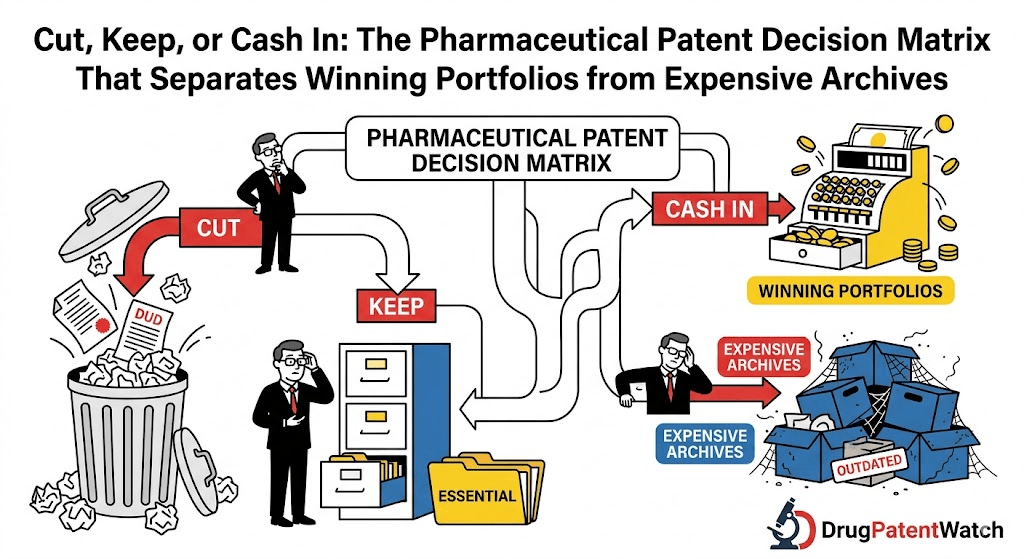
The Three Categories and What Actually Belongs in Each
The keep-license-abandon framework is deceptively simple. Most IP professionals encounter it early in their careers and assume they understand it. The companies that consistently apply it well understand that the real work is in the scoring — the discipline of assigning a patent or patent family to the right category when the internal politics of the organization are pushing toward ‘keep everything.’
A patent, once granted, isn’t ‘done.’ It has a lifecycle, costs, and strategic value that can change dramatically over time. Regular audits require continuously evaluating each patent and patent family against current business goals. Strategic pruning means making the tough but necessary decision to abandon patents that no longer serve a strategic purpose.
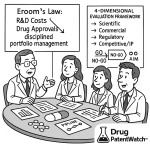
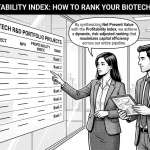
The matrix works by scoring each patent or patent family across four dimensions. The dimensions are not equally weighted — their relative importance shifts depending on the company’s stage, therapeutic focus, and geographic strategy.
Commercial Alignment asks whether the patent covers something the company actually sells, is developing to sell, or could plausibly sell within the patent’s remaining term. A patent covering a formulation for a compound the company abandoned in Phase II has zero commercial alignment, regardless of how strong the claims are.
Technical Strength asks whether the claims are broad, well-written, and likely to survive challenge. A formulation patent with narrow claims that any competent generic manufacturer can design around contributes little to exclusivity even if it nominally exists.
Competitive Relevance asks whether the patent prevents a competitor from doing something the competitor would otherwise do. Some patents are valuable purely because a competitor wants to use what they cover. Others protect a process or formulation that nobody in the industry actually needs.
Time Remaining asks how much commercial life is left. A patent with three years to expiration protecting a declining revenue product has a very different value profile than the same patent with twelve years to run.
Score each of these four dimensions on a consistent scale, weight them for your organization’s specific situation, and the category assignments become defensible rather than political.
The ‘Keep’ Category: When Holding Is Actually Strategic
Not every patent that scores well deserves to be kept. The ‘keep’ category should be reserved for patents that do one of two things: protect current commercial revenue or protect future commercial options.
The first class is straightforward. A compound patent on a drug generating $3 billion in annual revenue should be maintained in every jurisdiction where that revenue is generated, and probably several adjacent ones. The annuity cost is trivially small relative to the commercial value protected.
The second class is where discipline matters. ‘Future commercial options’ is the category that attracts organizational momentum toward keeping too much. Every patent that might cover something that might be relevant to something the company might develop can be rationalized as a ‘future option.’
The test is specificity. Can you describe concretely — not hypothetically — what commercial activity this patent protects or enables within its remaining term? If the answer requires several ‘might’ or ‘could’ qualifications, the patent is probably a candidate for licensing or abandonment, not the ‘keep’ pile.
Consequently, the management of intellectual property cannot be relegated to the legal department. It is a core function of corporate strategy, requiring the synchronization of R&D, regulatory affairs, and commercial teams. This is the practical implication of that observation: the ‘keep’ decision requires commercial input, not just legal input. Patent attorneys are well-positioned to assess claim strength. They are less well-positioned to assess commercial alignment — that requires business unit leaders who understand what the company will actually be selling.
Scoring ‘Keep’ Candidates: The Four-Quadrant Test
Strong-claim patents protecting active commercial products belong in the keep category unconditionally. But the interesting decisions involve patents that score well on some dimensions and poorly on others.
A patent with strong claims covering a compound that has been deprioritized in R&D but that a competitor is actively developing warrants careful analysis. Its commercial alignment to your pipeline is low, but its competitive relevance may be high — and that combination creates a licensing opportunity, not a ‘keep’ outcome.
A patent with weak claims covering an active product may be worth maintaining for its listing rights — the ability to put it in the Orange Book and trigger the 30-month stay — even if you wouldn’t win the litigation that might follow. But after the FTC’s 2024-2025 campaign, that calculus has changed. Listing a patent you know to be weak in order to trigger a stay is now an explicit enforcement target.
The honest version of the ‘keep’ category looks like this: compound patents on marketed products, formulation or method-of-use patents that add genuine exclusivity to your commercial timeline, platform technology patents that enable multiple products in your active pipeline, and geographical registrations in markets where you have current or near-term commercial presence.
Everything else needs to earn its place in the portfolio through a specific commercial argument — or it moves to ‘license’ or ‘abandon.’
Part Three: The Case for Strategic Licensing
Why Companies Leave Licensing Revenue on the Table
The pharmaceutical industry is far better at building patent portfolios than it is at monetizing them. The bias toward ‘keep’ is embedded in the organizational culture of most large pharma companies — legal teams are rewarded for building and maintaining IP estates, not for generating returns from them.
Sometimes, your portfolio contains assets that are not core to your own commercial strategy but may be incredibly valuable to another company. These could be patents for a different therapeutic indication, a novel drug delivery technology, or a manufacturing process. Proactively out-licensing these assets can create new, non-dilutive revenue streams from R&D that would otherwise sit idle.
The key word there is ‘proactively.’ Most pharmaceutical out-licensing happens reactively — a smaller company identifies an asset they want, approaches the patent holder, and negotiates a deal. The patent holder, caught flat-footed, negotiates from a position of incomplete information about the asset’s value to the potential licensee. Proactive out-licensing, where the patent holder has already conducted market analysis and identified the optimal licensee universe, consistently generates better terms.
Licensing agreements have transcended their traditional role as tactical, gap-filling transactions to become the central nervous system of modern biopharmaceutical strategy. The primary engine driving the current fever pitch in licensing activity is the patent cliff — the sharp revenue decline precipitating the expiration of exclusivity on major revenue-generating drugs. Between 2024 and 2030, the industry faces roughly $200 billion in revenue at risk as biologics and small molecules lose protection.
The Licensing Market Has Evolved Dramatically
The structure of pharmaceutical licensing has changed since the early 2010s. Simple royalty arrangements — pay me X percent of net sales to use this patent — remain common, but they represent the least sophisticated end of the licensing spectrum.
Pharmaceutical companies have moved away from simple transactional licensing to more integrated partnership models in 2024. Data from PharmaIntel shows that 63% of new deals now include shared development responsibilities, compared to just 38% in 2021.
That shift creates complexity for portfolio managers. A patent that might generate $5 million in straightforward royalties could participate in a co-development deal worth ten times that — but only if the patent holder has the organizational bandwidth to manage a collaborative relationship and the willingness to share control of the asset’s development trajectory.
The emergence of synthetic royalties adds another dimension. A synthetic royalty is a financing instrument. A third-party investor gives a company immediate cash in exchange for the right to receive a portion of future royalties or revenue streams. It is essentially selling a slice of future revenue to fund current operations without issuing new stock or taking out a bank loan.
Royalty Pharma, the most visible participant in this market, has built a multi-billion dollar business by acquiring royalty interests in pharmaceutical IP. For a company facing a capital crunch, selling a royalty stream on a non-core patent family can be more attractive than either maintaining the patent to expiration or executing a traditional out-license.
Finding the Right Licensee: The Analytics Problem
The licensing conversation cannot happen until you know who might want what you have. This is where tools like DrugPatentWatch earn their keep for portfolio managers. DrugPatentWatch’s patent and litigation database allows companies to identify which organizations are actively prosecuting in overlapping technology areas, which have filed Paragraph IV certifications against related patents, and which are building out pipelines that your non-core assets might fit.
That intelligence function is not optional — it is the difference between licensing an asset for fair market value and either abandoning it (leaving money on the table) or receiving an unsolicited lowball offer from a company that correctly inferred you didn’t know what you had.
The analytics process for identifying licensing candidates runs roughly as follows. First, flag patents that score poorly on commercial alignment but well on technical strength — these are the assets that have genuine value to someone other than you. Second, run a forward citation analysis to identify which organizations are building on the technology your patent covers. Third, screen those organizations for commercial stage and capital availability — a cash-rich company with a late-stage pipeline that overlaps your non-core patent is a better licensing target than an early-stage biotech that would need to raise money to pay you.
Fourth — and this step is frequently skipped — review the litigation history around the technology. If multiple companies have been challenging related patents, that tells you there is a market for the underlying technology and that competitors are willing to spend money to access it. A well-structured license may be more attractive to them than continued litigation.
Real Licensing Deals and What They Tell You
The Merck-AstraZeneca collaboration on Lynparza (olaparib) is the textbook case of what a co-development license on a non-core asset can generate for both parties. Lynparza, co-marketed by AstraZeneca and Merck, is eligible for six months of pediatric market exclusivity. What that summary obscures is the structure: AstraZeneca licensed Lynparza’s commercialization rights to Merck in a deal that gave Merck access to the PARP inhibitor market without bearing the full development cost, while AstraZeneca received substantial milestone payments and a co-commercialization structure that maintained its upside.
In January 2024, Novartis signed a $4.35 billion deal with Shanghai Argo Biopharmaceutical, securing an exclusive licence outside Greater China for a Phase I/IIa cardiovascular asset and a global licence for another Phase I asset, with options for two more. That deal structure — geographic exclusivity carved out to allow regional licensing while maintaining global rights in key markets — reflects how sophisticated the geographic dimension of the licensing calculus has become.
The Merck-Moderna partnership represents one of the most significant collaborative models of 2024. Unlike traditional licensing deals, this agreement created a jointly managed development team with shared decision-making authority across all aspects of their personalized cancer vaccine program. Their agreement includes balanced risk-sharing with a 50/50 cost split and equal profit distribution in major markets.
The BMS-Exelixis model is instructive for portfolio managers considering what licensing evolution can look like over time. This restructured deal gives Exelixis greater involvement in clinical development decisions while BMS maintains commercial leadership. This balanced approach has accelerated their immuno-oncology combination therapy development timeline by approximately 14 months.
When Licensing Is Better Than Keeping: The Quantitative Test
The decision between ‘keep’ and ‘license’ comes down to a straightforward net present value comparison — but one that most organizations perform badly because they don’t properly account for the full cost of keeping.
The ‘keep’ NPV calculation should include: the revenue protected by the patent, net of the probability that the patent gets challenged and invalidated, net of the probability that a competitor designs around it anyway, minus the annuity cost over the remaining term, minus the administrative overhead of maintaining the patent, minus the regulatory risk created by listing the patent if its validity is questionable.
The ‘license’ NPV calculation should include: the expected upfront payment and milestone payments from a licensing deal, plus the royalty stream, minus the transaction cost of executing the deal, minus the ongoing administrative cost of managing the licensing relationship.
When the ‘license’ NPV exceeds the ‘keep’ NPV — which happens more frequently than most portfolio managers acknowledge — the decision is mathematically clear. The organizational resistance to licensing is not about the numbers; it is about the discomfort of admitting that a patent you spent money to prosecute is more valuable to someone else than it is to you.
Part Four: The Case for Strategic Abandonment
Why Abandonment Feels Wrong Even When It’s Right
In the pharmaceutical industry, where a single blockbuster molecule represents a multi-billion dollar valuation, the decision to stop pursuing or maintaining a patent has immediate consequences for R&D pipelines and generic competition.
The organizational psychology of abandonment is the most underappreciated barrier to good portfolio management. Patent attorneys invested months or years prosecuting an application. R&D teams used the patent as validation of their scientific work. Business development professionals pointed to it in presentations. Abandoning it feels like admitting failure — even when the commercial reality that made the patent valuable has simply changed.
Strategic pruning is the elective termination of intellectual property rights before their legal expiration. The most difficult category for many organizations — yet one of the most critical for efficient management — are patents that score poorly across the board. They may relate to abandoned R&D projects, cover markets the company will never enter, or have been superseded by newer, stronger IP. The strategy here must be disciplined abandonment. In reality, it is one of the most strategically astute actions a portfolio manager can take.
The Two Abandonment Mechanisms
Abandonment occurs in two primary phases: during prosecution, when an application is withdrawn before issuance, or post-grant, through the non-payment of maintenance fees. Each scenario creates a different risk profile and opportunity set.
Pre-grant abandonment is cleaner in most respects. If a patent application is withdrawn during prosecution, the pending claims do not enter the public domain with the same level of legal consequence as a granted patent that lapses through non-payment. The application file remains accessible to the public, but the strategic and competitive implications are different.
Post-grant abandonment through non-payment is more visible. Once a patent lapses, competitors can and do monitor patent office records for precisely this event. Tools like DrugPatentWatch track lapsed patents in real time — the moment you stop paying, sophisticated competitors know about it and begin assessing whether the technology is now freely available to them.
This asymmetry of information has a practical implication for abandonment strategy: the timing of when you stop paying matters. If you’re abandoning a patent because the underlying technology has become genuinely obsolete or because you’ve filed stronger successor patents that supersede it, the timing of the lapse relative to your successor patent prosecution matters for how competitors interpret the strategic signal.
Calculating the Real Cost of Not Abandoning
The pharmaceutical industry operates on a high-risk model where the cost of a single drug approval ranges from $1 billion to $2.6 billion. While legal teams spend years building patent fortresses around these assets, the lifecycle of intellectual property is frequently cut short by the owners themselves.
The hidden cost of holding a low-value patent is not just the maintenance fee. It includes the legal team time required to review the patent at each annuity decision point, the administrative cost of tracking it across jurisdictions, the opportunity cost of the budget that could fund prosecution of a more valuable application, and the organizational overhead of including it in portfolio reviews, due diligence responses, and licensing negotiations where it adds noise without adding value.
A pharmaceutical company with 1,000 patents in its active portfolio that could be reduced to 600 through disciplined pruning does not just save the direct maintenance costs on 400 patents. It reduces the management surface area of the portfolio by 40%, freeing legal and business development resources to focus on assets that actually matter.
Culling low-value patents frees up resources that can be reinvested in protecting more promising innovations. That reallocation is the real return on abandonment — not the savings on the annuity fees themselves.
Abandonment as Competitive Signal: What Competitors Do With Your Lapsed Patents
When a pharmaceutical company abandons a patent, three things happen. The patent enters the public domain, making the protected technology freely available to anyone. The abandonment record becomes public and searchable. And competitors who have been monitoring the patent — which the sophisticated ones always do — begin assessing what the abandonment tells them about the patent holder’s strategy.
From there, competitors move to practical application, providing a treasure map for finding and analyzing these assets, and a playbook for leveraging them in R&D, pharmaceutical lifecycle management, and competitive intelligence.
Abandoned patents are not just strategically neutral events for the abandoning company. They can be strategic windfalls for competitors who are alert enough to identify and use them. A generic manufacturer monitoring a branded company’s annuity payments can identify which markets the branded company has decided not to defend — and can time its own market entry accordingly.
This is why the abandonment decision requires the same level of competitive intelligence that informs the keep and license decisions. Before you stop paying annuities in a particular jurisdiction, you should know who is watching, what they will do with the information, and whether the abandonment creates a competitive opening you would prefer to foreclose.
Part Five: The ‘Keep’ Decision in Practice — Evergreening, Thickets, and Their Limits
AbbVie and Humira: The Archetype and Its Lessons
No case study in pharmaceutical patent lifecycle management is discussed more frequently than AbbVie’s management of Humira (adalimumab). It represents the ‘keep everything’ strategy taken to its logical extreme — and it worked, until it created enough political and regulatory blowback to become a case study in how not to think about portfolio strategy.
AbbVie shielded Humira from biosimilar competition for 21 years by suing potential competitors with a massive portfolio of at least 105 patents. This strategy helped make it one of the highest-grossing drugs of all time.
AbbVie applied for approximately 247 patents, of which 132 were granted, creating a ‘patent thicket’ protecting Humira from competition until 2037 when the last patent will expire. Notably, 90 percent of these patent filings were after Humira was already on the market, and almost half were filed in 2014 or later, in advance of the expiration of its core patent.
Humira’s patent thicket was carefully crafted specifically to prevent biosimilar entry in advance of loss of exclusivity. The strategy exploited every dimension of the patent system: secondary patents on formulations, methods of use, dosing regimens, delivery devices, and manufacturing processes. The intent was not to protect genuine innovation — it was to multiply the number of patents any biosimilar challenger would need to design around or invalidate.
AbbVie’s management of Humira is the definitive case study in patent thicketing. Humira is the world’s best-selling drug, generating over $20 billion annually at its peak. The primary patent on the adalimumab molecule expired in 2016.
Settlement Leverage: Faced with this thicket, virtually every major biosimilar competitor — including Amgen, Sandoz, and Samsung Bioepis — chose to settle. The terms typically allowed for immediate entry in Europe in exchange for delaying U.S. entry until 2023.
That geographic split — Europe yes, U.S. no — was not an accident of litigation. Patent data suggests that Humira’s patent thicket was carefully crafted specifically to prevent biosimilar entry, with patents involving the composition of a molecule often being more challenging to litigate compared to manufacturing patents because manufacturing technology is less restrictive. AbbVie’s European patent estate was weaker, making settlement more attractive than litigation for biosimilar manufacturers who believed they could win in European courts while facing a more daunting challenge in the U.S.
The Blowback That Changes the Calculus
The Humira strategy generated extraordinary returns. It also generated:
Congressional hearings and bipartisan legislation specifically designed to prevent its repetition. Antitrust class actions alleging anticompetitive patent aggregation. FTC enforcement campaigns against Orange Book listings that followed the same playbook. A public and media narrative that made ‘patent thicket’ a term of opprobrium rather than admiration.
A wave of bipartisan legislation has been introduced in Congress with the explicit goal of curbing patent thicket abuses. The ETHIC Act (H.R. 3269 / H.R. 6986) — the ‘Ending the Term-based Harms from Evergreening and Thicketing’ Act — is perhaps the most targeted reform.
For now, a direct antitrust assault on a patent thicket remains a very difficult, if not impossible, path in the U.S. legal system. But the legislative pressure is real, and any portfolio strategy built on the Humira template needs to account for the possibility that the regulatory environment in which AbbVie executed that strategy will not exist for its entire duration.
The practical lesson for portfolio managers is not that the Humira strategy was wrong — it generated billions of dollars of protected revenue. The lesson is that the ‘keep everything’ approach to secondary patents carries escalating political and regulatory risk that needs to be quantified alongside the commercial benefit.
Revlimid and the Volume Restriction Variant
Celgene’s management of Revlimid (lenalidomide) took a different approach to the same underlying challenge: how do you extend the commercial life of a blockbuster drug whose primary patent has expired?
The primary patent on Revlimid expired in 2019. That should have opened the door for competitors to enter the market and drive down the price of branded Revlimid. But that didn’t happen because in 2022 Celgene/BMS coerced generic competitors into signing a settlement agreement that severely limits the volume of generic Revlimid they can sell until 2026. Generic drug companies that settled with Celgene/BMS were initially limited to selling no more than 7% of the total market starting in early 2022.
This was not primarily a patent thicket strategy — it was a settlement structure that used the licensing mechanism as a delay tool. By licensing generic entry rather than litigating to prevent it, Celgene/BMS created a controlled competition scenario that preserved most of the branded drug’s revenue while the secondary patent estate was maintained.
Already, Bristol Myers has benefited from such intellectual property practices with its medicine Revlimid. The blood cancer drug’s exclusivity was strong enough to keep most generic competition at bay through 2026.
The Revlimid approach is instructive precisely because it combines elements of the keep, license, and litigation decisions in a single integrated strategy. The decision to license limited generic entry — rather than fight all generic entry through comprehensive litigation — reflected a calculation that controlled competition was preferable to either full exclusivity (which the patent estate couldn’t guarantee) or unrestricted competition (which the settlement prevented until 2026).
Part Six: Using Competitive Intelligence Tools in the Decision Process
What You Need to Know Before You Decide
The keep-license-abandon decision cannot be made in isolation. It requires intelligence about what competitors are doing, what the litigation landscape looks like for related patents, what the licensing market is paying for comparable assets, and what the regulatory trajectory is for the relevant technology area.
This is where specialized platforms like DrugPatentWatch become essential infrastructure for IP strategy functions. DrugPatentWatch aggregates patent expiration data, Orange Book listings, Paragraph IV certifications, litigation records, and licensing activity across the pharmaceutical sector into a format that supports the specific intelligence questions portfolio managers need to answer.
Before you decide to keep a patent, you want to know: Has anyone filed a Paragraph IV certification against this patent? What is the litigation history of related patents in the same family? Are there pending IPR proceedings that might invalidate it? What does the forward citation record tell you about whether competitors are actively working around it?
Before you decide to license a patent, you want to know: Who is actively working in the technology area this patent covers? What have comparable licensing transactions paid? Is there a market for this asset, or would you be licensing it at the moment the technology is becoming obsolete?
Before you decide to abandon a patent, you want to know: Who is monitoring this patent? What will they do with the technology once it enters the public domain? Is the abandoned patent linked to other patents in a family that could be affected by the abandonment signal?
In this labyrinthine environment, static data is a liability. The patent landscape changes continuously — new filings, new Paragraph IV certifications, new litigation outcomes, new regulatory decisions. A portfolio review that was current six months ago may be materially outdated today.
The Intelligence Inputs for Each Decision
For the ‘keep’ decision, the most critical intelligence input is the Paragraph IV landscape. When a generic manufacturer files a Paragraph IV certification against a patent, it is publicly signaling that it believes the patent is either invalid or will not be infringed by the proposed generic product. That is valuable market intelligence. It tells you that someone with significant skin in the game has assessed your patent and concluded it is weak enough to challenge.
A patent facing no Paragraph IV certifications, in a technology area where no competitors have filed related applications, and with a forward citation record showing continued industry activity, is a genuine candidate for the ‘keep’ category. A patent facing active Paragraph IV certification from multiple generic manufacturers, with a contested history in related IPR proceedings, warrants a much more skeptical look at whether the ‘keep’ decision is actually defensible.
For the ‘license’ decision, the most critical intelligence input is the activity map of potential licensees. Who has been filing in this technology space? Who has late-stage pipeline assets that would benefit from the formulation or delivery technology your patent covers? Who has recently executed in-licensing deals in adjacent areas, signaling that they have the appetite and the capital to do a deal?
For the ‘abandon’ decision, the most critical intelligence input is the competitive monitoring landscape. Who has been tracking your portfolio? DrugPatentWatch and similar platforms are used extensively by generic manufacturers, biosimilar developers, and competitive intelligence functions at other branded companies. Your abandonment decisions are public information. The question is not whether competitors will know — they will — but whether you have assessed what they will do with that knowledge.
Portfolio Audits: Frequency and Structure
Most large pharmaceutical companies conduct formal patent portfolio audits annually. The best ones audit continuously, with formal reviews at each annuity decision point and a more comprehensive strategic review once per year.
The annual strategic review should address four questions. Which patents are approaching annuity decision points in the next 24 months? Which patents cover compounds or technologies that have been deprioritized in R&D? Which patents are generating Paragraph IV certifications or other challenges that signal weak claim quality? Which patents cover technology that competitors are actively developing — and therefore might be willing to license?
The output of that review is a prioritized action list, not a static portfolio valuation. Patents move between categories as the competitive and commercial landscape changes. A patent that warranted ‘keep’ three years ago because it covered an active late-stage compound may warrant ‘license’ or ‘abandon’ today if that compound was discontinued.
Part Seven: Geographic Strategy in the Keep-License-Abandon Matrix
The Jurisdiction-by-Jurisdiction Question
One of the most important refinements to the basic decision matrix is that it operates at the jurisdiction level, not just the patent level. A patent family covering the same compound in 40 countries does not receive a single ‘keep, license, or abandon’ designation — it receives a designation for each country, weighted by the commercial importance of that market.
The practical implication is that the right decision may be to keep a patent in the U.S. and the five largest European markets, license it in Japan and Australia, and abandon it in 25 jurisdictions where the company has no commercial presence and no near-term plans to develop one.
This requires knowing what your maintenance costs are in each jurisdiction, what the commercial revenue at stake is in each market, and what the licensing market looks like for comparable assets in each region. The European annuity system’s annual payment structure makes this analysis more tractable than the U.S. three-interval system — you get a decision point every year rather than every three and a half years.
For emerging markets, the calculus is particularly nuanced. India, Brazil, and China have pharmaceutical markets large enough to matter commercially, but patent enforcement in those markets has historically been less predictable than in the U.S. or Europe. A patent that is worth maintaining in Germany because the German courts enforce pharmaceutical patents aggressively may not be worth the annuity cost in a jurisdiction where enforcement is more uncertain.
The China Dimension
AstraZeneca followed suit in June 2025 with a $5 billion agreement with CSPC Pharmaceutical Group, which gave it access to the latter’s AI platform and a portfolio of preclinical cancer drugs. That deal reflects a broader strategic reality: China has become both a source of licensing inventory and a jurisdiction where patent rights matter enough to justify significant investment.
The China patent landscape for pharmaceuticals has changed substantially since the mid-2010s. China has strengthened its IP protection framework significantly, created specialized IP courts with pharmaceutical expertise, and increased damages awards in infringement cases. For a branded pharmaceutical company with significant China revenue, maintaining the patent portfolio in China is no longer a low-priority afterthought — it is a strategic necessity.
For out-licensing, China’s patent landscape creates an interesting asymmetry. A U.S. company holding patents on a compound it has decided not to commercialize in China may find that Chinese pharmaceutical companies are active potential licensees — companies that have the manufacturing infrastructure, the regulatory relationships, and the market access to commercialize an asset the U.S. company has deprioritized. That licensing opportunity did not exist meaningfully a decade ago.
The Geographic Licensing Carve-Out Strategy
AbbVie’s Humira settlements — allowing biosimilar entry in Europe while maintaining U.S. exclusivity — represent the geographic carve-out strategy at its most extreme. But the underlying logic applies at a much more modest scale to the routine keep-license-abandon decision.
A branded company that wants to maintain exclusivity in the U.S. and the five largest European markets may be willing to grant royalty-free licenses for a developing-market territory package in exchange for a stronger settlement agreement from a potential generic challenger. That transaction — essentially licensing geographic rights in exchange for legal security in core markets — is a form of the keep-license-abandon matrix applied at the territorial level.
The terms of those geographic licenses matter significantly for the IRA analysis discussed earlier. A drug with licensed generic competition in some markets but not others may or may not qualify as having ‘competition’ for purposes of IRA price negotiation provisions — a question that patent lawyers and government affairs teams are actively working through.
Part Eight: Pediatric Exclusivity, Patent Term Extensions, and the Lifecycle Extensions Worth Pursuing
The Extensions That Belong in the ‘Keep’ Column
Not all of the ‘keep’ decision involves maintaining existing patents. A significant component of lifecycle management involves identifying which term extensions and exclusivity periods are worth pursuing — which requires the same analytical discipline as the abandonment decision applied in reverse.
For a blockbuster drug with annual sales in the billions of dollars, an extra six months of monopoly pricing can translate into a massive amount of revenue — often one of the highest ROI activities a company can undertake in the late stage of its product’s lifecycle.
Pediatric exclusivity is the clearest example of a lifecycle extension with a calculable ROI. The Hatch-Waxman Act and the Best Pharmaceuticals for Children Act allow branded manufacturers to receive six additional months of market exclusivity in exchange for conducting FDA-requested pediatric studies. As of March 2025, the FDA had granted a total of 335 pediatric exclusivity determinations, covering 316 different drugs, underscoring how integral this strategy has become to the industry.
Pfizer’s successful use of this provision for its nerve pain drug Lyrica, by completing the requested pediatric studies, secured pediatric exclusivity, which extended its U.S. exclusivity. Six months on a drug generating $3 billion annually in U.S. revenue is worth $1.5 billion in incremental branded revenue — for the cost of the pediatric studies, which typically run in the tens of millions of dollars.
The ROI on pediatric exclusivity for a major product is extraordinary. The question is not whether to pursue it — for any product with meaningful revenue, the answer is almost always yes — but whether the pediatric studies can be designed and completed on a timeline that allows the exclusivity to attach before the primary patent expires.
Patent Term Extensions and Restoration
The Hatch-Waxman Act’s Patent Term Extension provisions allow pharmaceutical companies to restore up to five years of patent term lost during the FDA regulatory review period, subject to a maximum effective term of 14 years from approval. This extension mechanism deserves serious analytical attention in the ‘keep’ decision framework.
The extension applies only to the single patent covering the approved compound in the approved application. You cannot extend multiple patents — you select one. That selection decision has significant downstream consequences for which patents competitors will need to challenge and which will be more straightforwardly designed around.
For products with a broad secondary patent estate, the selection of which patent to extend with PTE is a strategic decision that should be made with input from litigation counsel (which patent is most likely to survive challenge?), business development (which patent covers the commercial activity competitors would most want to engage in?), and regulatory affairs (which patent’s extension creates the most complete exclusivity package?).
Part Nine: How the IRA Reshapes Every ‘Keep’ Decision
The New Exclusivity Math
The Inflation Reduction Act has introduced a structural change to pharmaceutical economics that every portfolio manager needs to internalize: for drugs that qualify for Medicare price negotiation, the value of additional years of patent exclusivity is reduced, because the negotiated price is lower than the pre-negotiation price the exclusivity was meant to protect.
This sounds obvious when stated directly. But the practical implication is less obvious: it means that for drugs in therapeutic categories most likely to face negotiation — primarily older, high-revenue small molecules with large Medicare patient populations — the NPV of secondary patent maintenance is lower than it was pre-IRA.
The IRA’s ‘small molecule penalty’ — under which small molecule drugs become eligible for negotiation nine years after approval, compared to thirteen years for biologics — has already begun to shift R&D allocation toward biologics. It is also beginning to shift portfolio management toward earlier abandonment of secondary small molecule patents whose commercial value has been reduced by the negotiation clock.
The strategic environment is being reshaped by aggressive regulatory intervention. The IRA empowers Medicare to negotiate prices for top-spending drugs. For a portfolio manager, that reshaping requires updating every ‘keep’ decision made before 2022 for drugs that might qualify for negotiation.
The Drug Selection Calendar and Portfolio Management
The IRA’s drug selection calendar creates a new set of decision points for portfolio managers. Once a drug has been selected for negotiation — CMS publishes the list publicly — the commercial logic of maintaining patents solely to delay generic entry weakens substantially, because the price reduction from negotiation may approach or exceed the price reduction that would come from generic entry anyway.
For those drugs, the ‘keep’ decision for secondary patents shifts its primary rationale from revenue protection to competitive positioning. Patents that keep competitors from launching in adjacent therapeutic areas, or that protect the manufacturing process in ways that competitors cannot easily replicate, may still warrant maintenance. Patents that exist primarily to trigger 30-month stays and delay generic entry become less valuable — and more regulatory risk — once the IRA negotiation has already reduced the price being protected.
Part Ten: The Organizational Architecture of Good Portfolio Management
Who Owns the Decision?
The keep-license-abandon decision is made badly in organizations where it is owned exclusively by the legal department. Patent attorneys are essential participants, but they are not the decision owners for a commercial strategy question.
The management of intellectual property cannot be relegated to the legal department. It is a core function of corporate strategy, requiring the synchronization of R&D, regulatory affairs, and commercial teams.
The organizational structure that produces good portfolio decisions typically has a cross-functional governance body with representation from legal/IP, R&D, business development, commercial, and regulatory affairs. The legal team provides technical input on claim strength and litigation risk. R&D provides input on pipeline alignment. Business development provides input on the licensing market. Commercial provides input on revenue at risk. Regulatory provides input on exclusivity periods and timeline considerations.
The governance body makes a recommended decision. A senior executive — typically the Chief IP Officer, General Counsel, or Chief Business Officer — owns the final call and is accountable for the portfolio’s performance against commercial objectives.
The Patent Scoring System
The scoring system used to support the decision should be simple enough to apply consistently across thousands of patents and sophisticated enough to capture the relevant dimensions.
A four-dimension scorecard — commercial alignment, technical strength, competitive relevance, remaining term — with each dimension scored from zero to five, and the dimensions weighted for your organization’s specific strategy, generates a composite score that allows meaningful comparison across heterogeneous assets.
The weighting matters. A company in a strong commercial position with significant revenue at risk from generic entry should weight competitive relevance and remaining term more heavily. A company in a growth phase with limited current commercial revenue but a rich pipeline should weight commercial alignment and technical strength more heavily.
The scoring should be updated annually at minimum, and triggered by specific events: a Paragraph IV certification, a failed clinical trial for a compound the patent covers, a competitor’s announcement of a development program in the same therapeutic area, or an in-licensing deal that brings new IP into the portfolio that supersedes existing assets.
The Audit Trigger Events
Beyond the scheduled annual review, certain events should trigger an immediate reassessment of affected patents.
A failed Phase III clinical trial for a compound covered by a patent is an obvious trigger — the commercial alignment score drops to zero immediately, and the patent should move through the license-or-abandon analysis within 30 days rather than waiting for the next annual review.
A merger or acquisition that brings a competing or superseding technology into the portfolio is another trigger. When Bristol-Myers Squibb acquired Celgene for $74 billion in 2019, it inherited a patent estate that overlapped with its existing portfolio in multiple therapeutic areas. The rational response was a rapid portfolio review to identify which assets were now redundant and could be pruned or licensed, and which were strategically complementary and should be maintained or strengthened.
A regulatory decision that changes the commercial landscape — a competitor’s approval in a previously uncontested indication, for example, or an FDA guidance that makes a particular formulation approach less commercially viable — warrants immediate reassessment of related patents.
Part Eleven: The Adjacent Opportunity — Abandoned Patents as Strategic Inputs
What Competitors’ Abandonments Tell You
Portfolio managers who focus exclusively on their own portfolio miss half the picture. Competitors’ abandonment decisions are a continuous stream of intelligence about their R&D priorities, their commercial confidence, and — sometimes — their financial condition.
When a major pharmaceutical company stops paying annuities on a patent covering a compound in a therapeutic area you care about, that tells you something specific: the company has made a judgment that the compound is not worth protecting. That judgment may be wrong. More importantly, the abandoned patent is now in the public domain, and the technology it covers is freely available.
Strategic abandonment represents a calculated extraction of value and a reallocation of finite resources rather than a simple failure of innovation. From the abandoning company’s perspective, it is a rational portfolio decision. From the monitoring competitor’s perspective, it is potentially a technology gift.
The pharmaceutical business has several well-documented examples of abandoned compounds that were subsequently developed into successful drugs by other companies. The original developer abandoned the compound for reasons that may have included insufficient commercial potential for their portfolio, a strategic pivot away from the therapeutic area, or financial constraints during a difficult period. The subsequent developer found a different indication, a different formulation approach, or simply had a lower cost basis that made the economics work.
DrugPatentWatch as an Intelligence Layer
DrugPatentWatch’s lapsed patent tracking function allows pharmaceutical intelligence teams to monitor competitor abandonment decisions in real time and assess whether abandoned technology represents a development opportunity. The platform’s integration of patent data with clinical trial records, Orange Book listings, and FDA approval history allows analysts to build a complete picture of a compound’s regulatory and commercial history — context that is essential for assessing whether an abandoned patent covers technology worth developing.
For a generic manufacturer, monitoring branded company abandonments is a core competitive intelligence function. The moment a branded company stops defending a geographic market, a well-positioned generic company can move in. For a biotech with a platform that could benefit from abandoned formulation technology, the same monitoring function identifies licensing-free development opportunities.
Part Twelve: Case Studies in Getting the Matrix Right and Wrong
Gilead and Hepatitis C: A Keep Strategy That Worked
Gilead’s management of its hepatitis C franchise — Sovaldi (sofosbuvir), Harvoni (ledipasvir/sofosbuvir), and Epclusa — represents a keep strategy executed with genuine strategic discipline. Gilead maintained aggressive patent protection on its core compounds while simultaneously pursuing combination regimens and new indications that extended the commercial life of the franchise.
The combination approach is the right application of ‘keep’ strategy for a highly innovative primary compound. Rather than building a thicket of secondary patents designed to delay generic entry, Gilead invested in genuine clinical development of new combination regimens and new indications. The resulting patents covered real innovation — new clinical outcomes, not just new packaging — and therefore commanded stronger claims and greater regulatory and commercial credibility.
The result was a franchise that generated extraordinary revenue during its peak years while maintaining sufficient patent protection to prevent the kind of immediate generic collapse that followed some earlier antiviral products.
Pfizer and Lipitor: The Cost of Late-Stage Underinvestment
Pfizer’s management of Lipitor (atorvastatin) illustrates the cost of failing to execute lifecycle management with adequate lead time. Lipitor was the best-selling drug in history at its peak, generating over $12 billion annually. When its primary compound patent expired in November 2011, Pfizer faced a revenue cliff that was larger in absolute terms than almost any patent expiry in pharmaceutical history.
Pfizer had made efforts to extend Lipitor’s commercial life — a combination with amlodipine as Caduet, extended-release formulations — but the scale of these efforts was insufficient relative to the magnitude of the revenue at risk. The lesson is not that lifecycle management was the wrong approach; it is that lifecycle management for a drug of Lipitor’s scale requires investment commensurate with the stakes, initiated years before the primary patent expires.
The Lipitor cliff was a forcing function for Pfizer’s subsequent acquisition strategy. The company spent several years after 2011 executing major acquisitions — Wyeth, King Pharmaceuticals, and ultimately Warner Chilcott — in part to fill the revenue gap left by Lipitor’s genericization. That acquisition spending, while strategically defensible, was more expensive than a more proactive lifecycle management program would have been.
AstraZeneca and Nexium: The Purple Pill as a Masterclass in Lifecycle Management
AstraZeneca’s management of the omeprazole-to-esomeprazole transition — from Prilosec (omeprazole) to Nexium (esomeprazole) — is often cited as a textbook lifecycle management case. As Prilosec’s patent protection was expiring, AstraZeneca commercialized Nexium, the S-enantiomer of omeprazole, with a multi-billion dollar marketing campaign that positioned the new drug as superior to its predecessor.
From a strict patent matrix perspective, Nexium was a formulation play. The underlying molecule was chemically closely related to the off-patent compound. The new patents covered the specific enantiomer, its formulation, and its method of use — exactly the kind of secondary patent that critics characterize as evergreening.
The commercial result was substantial. Nexium became a multi-billion dollar drug, and AstraZeneca captured enormous value from the lifecycle extension. The regulatory and scientific debate about whether esomeprazole was clinically superior to omeprazole never resolved cleanly — the evidence was mixed, which was exactly the uncertainty AstraZeneca needed to sustain the brand through patent challenges.
The lesson for portfolio managers is that the ‘keep’ decision for secondary patents on established products is not purely about patent strength — it is about the integration of IP strategy, commercial strategy, and regulatory strategy into a coherent approach that makes the secondary patents valuable even if their individual validity could be challenged.
Part Thirteen: Building the Decision-Support Infrastructure
The Technology Stack for Modern Portfolio Management
Managing a global portfolio means juggling dozens of different deadlines, currencies, and fee structures, a task that is virtually impossible without specialized software and services.
The minimum technology infrastructure for pharmaceutical portfolio management at scale includes: a docketing system that tracks annuity deadlines across all relevant jurisdictions, a patent analytics platform that integrates prosecution data with litigation records and competitive intelligence, a licensing transaction database that captures deal terms for comparable assets, and a commercial data feed that allows real-time updates of the revenue figures underlying the NPV calculations.
Most large pharmaceutical companies have invested in docketing systems — the annuity payment function is well-managed because missing a payment is an obvious catastrophe. The analytics and competitive intelligence infrastructure is more variable. Companies that have invested in platforms like DrugPatentWatch and integrated them with their portfolio management workflows make materially better decisions on the licensing and abandonment dimensions of the matrix, because they have access to the competitive intelligence that those decisions require.
The Human Infrastructure: Skills the Team Needs
The personnel requirement for good portfolio management is a specific combination of skills that is genuinely rare. You need patent attorneys with pharmaceutical domain expertise who understand both claim construction and clinical development. You need business development professionals who understand licensing deal structures and can evaluate the comparative attractiveness of different transaction formats. You need competitive intelligence analysts who can synthesize data from multiple sources into actionable strategic conclusions. And you need commercial strategists who understand the revenue implications of exclusivity decisions well enough to translate patent events into financial projections.
Most pharmaceutical companies have each of these skill types somewhere in their organization. The challenge is creating a governance structure that brings them together in a way that produces integrated decisions rather than siloed opinions.
Part Fourteen: The Future of Patent Portfolio Strategy
AI-Assisted Portfolio Management
The emergence of AI tools capable of analyzing large patent datasets is beginning to change the economics of portfolio management. Tasks that previously required significant attorney time — claim mapping, prior art searching, forward citation analysis, prosecution history review — can increasingly be automated at a fraction of the historical cost.
This has two implications for the keep-license-abandon matrix. First, it reduces the cost of conducting thorough analysis, which means decisions can be based on more complete information. Second, it increases the number of patents that can be meaningfully analyzed in a given review cycle, which allows companies to move from sampling-based reviews (which assess a subset of the portfolio) to comprehensive reviews (which assess every patent).
The productivity gains from AI-assisted patent analysis are real but uneven. The tools are most effective at tasks that involve pattern recognition across large datasets — identifying related patents, flagging prosecution anomalies, tracking citation networks. They are less effective at the judgment-intensive tasks that require contextual understanding of commercial strategy and competitive dynamics. Those tasks remain human.
Biosimilar Competition and the Biologic Portfolio
The biosimilar market has matured dramatically since the first U.S. biosimilar approval in 2015. The first generic versions of Rivaroxaban (Xarelto) 2.5 mg tablets received FDA approval in March 2025. Multiple manufacturers have obtained FDA approval for generic Sacubitril/Valsartan (Entresto). Biosimilars for Denosumab (Prolia), such as Sandoz’s Jubbonti and Wyost, were approved in March 2024 and expected to launch in May 2025.
For portfolio managers at biologic innovators, the lessons of the early biosimilar experience are now translating into more sophisticated portfolio strategy. The naive approach — build the largest possible patent thicket and fight every biosimilar challenger — has been complicated by the FTC’s enforcement posture, legislative pressure, and the experience of watching the Humira thicket ultimately fail to prevent U.S. biosimilar entry.
The more sophisticated approach involves making deliberate decisions about which elements of the biologic’s patent estate are genuinely worth defending, which might be worth licensing to biosimilar manufacturers in exchange for favorable settlement terms, and which should be allowed to lapse as not worth the cost of maintaining in the face of almost certain challenge.
A significant shift occurred in 2024/2025 regarding biosimilar ‘Interchangeability.’ Previously, biosimilars required a separate interchangeability designation to be automatically substituted at the pharmacy. The regulatory evolution of interchangeability standards changes the patent strategy calculus for biologics by affecting how quickly and completely biosimilar competition can erode branded market share once exclusivity lapses.
The Patent Cliff Class of 2025-2030
Pharmaceutical companies were confident they will be able to offset losses from upcoming patent expirations of popular drugs and zeroed in on dealmaking as a critical tool to add new revenue.
The specific drugs facing imminent loss of exclusivity include some of the industry’s most important franchises. Keytruda generated $29.48 billion in sales in 2024, which was nearly half of Merck’s total revenue for that year. Merck’s patent strategy for Keytruda — which involves both secondary patent maintenance and active development of combination regimens and new indications — is the most consequential portfolio management exercise in the industry over the next decade.
Bristol Myers Squibb has the highest exposure to the upcoming loss of exclusivity cycle, with blockbuster drugs such as the blood thinner Eliquis set to face generic competition. BMS has responded with a portfolio of acquisitions — Karuna Therapeutics for $14 billion, Mirati Therapeutics, RayzeBio — that is explicitly designed to replace the revenue at risk from Eliquis and Opdivo’s expiration with new commercial assets.
That acquisition-as-pipeline-replacement strategy is itself a version of the keep-license-abandon matrix applied at the portfolio level. BMS is effectively abandoning the defense of its LOE-exposed assets (by allowing their patents to run to expiration without a comprehensive thicket strategy) while acquiring new assets that reset the exclusivity clock.
Part Fifteen: Executing the Matrix — A Practical Implementation Guide
Step One: Build the Inventory
You cannot make keep-license-abandon decisions on a portfolio you cannot see. The first step is assembling a complete, current inventory of every patent and patent application in the portfolio, with the associated data: jurisdiction, filing date, expiration date, annuity schedule, claim summary, commercial product associations, and litigation history.
For large companies, this inventory often reveals surprises — patents in jurisdictions nobody knew were still active, applications that were filed and never prosecuted to grant, patent families where some members lapsed without being flagged for strategic review.
Step Two: Score the Inventory
Apply the four-dimension scoring system — commercial alignment, technical strength, competitive relevance, remaining term — to every patent family in the inventory. Score at the family level first, then at the jurisdiction level for families that score above threshold on the first pass.
The scoring process will surface obvious candidates for each category. High scores across all four dimensions: keep without discussion. Low scores across all four dimensions: abandon or license promptly. Mixed scores: detailed analysis required.
Step Three: Run the NPV Analysis
For patents in the ‘analyze’ category, run the NPV comparison between keep, license, and abandon scenarios. Use conservative assumptions for the ‘keep’ scenario — the probability that the patent will be challenged and invalidated should be based on the technical strength score, not on optimistic litigation assessments from the attorneys who prosecuted it.
For the ‘license’ scenario, get market data on comparable transactions. DrugPatentWatch and similar platforms maintain transaction databases that can provide realistic range estimates for licensing values for comparable assets.
For the ‘abandon’ scenario, model the competitive consequences. What does a competitor do with this technology once it enters the public domain? How quickly could they use it? What revenue impact does that have on your commercial position?
Step Four: Implement and Track
Execute the decisions. Stop paying annuities for abandon-category patents before the next payment deadline — not at the last possible moment, when the signal to competitors is clearest, but at the first opportunity after the decision is made. Initiate licensing conversations for license-category patents while they retain several years of remaining term — a patent with two years to expiration is a much less attractive licensing property than the same patent with seven years remaining.
Track the outcomes. Did abandoned patents create the competitive openings you modeled? Did licensing deals close at the values projected? Did the patents you kept maintain their commercial value through the period modeled?
The portfolio management function improves with feedback. Organizations that track their own decisions and learn from the outcomes — both the good and the bad — make better decisions over time than organizations that treat each annual review as independent of what came before. <blockquote> “Between 2025 and 2030, nearly 200 blockbuster drugs will lose patent protection, putting approximately $400 billion in annual revenue at risk. For five of the top ten pharmaceutical firms, assets at risk represent more than 50% of their total revenue.” — DrugPatentWatch, Beyond the Patent Cliff, 2026 [2] </blockquote>
Conclusion: The Portfolio as a Working Asset
The most critical mindset shift is to see your portfolio not as a static archive but as a dynamic tool that requires constant attention, curation, and strategic management.
The companies that execute this well — that regularly prune their portfolios, actively pursue licensing for non-core assets, and make disciplined abandonment decisions before annuities become sunk costs — consistently outperform their peers on R&D productivity. They do not just save money on maintenance fees. They free up management bandwidth, reduce litigation exposure, generate non-dilutive revenue from licensing, and reinvest the proceeds in assets that actually advance their commercial strategy.
The Humira playbook — keep everything, litigate every challenger, maintain every secondary patent in every jurisdiction — worked in the regulatory environment of 2010. It is not the right model for 2026. The FTC, the IRA, and the legislative pressure on patent thickets have collectively changed the risk profile of the ‘keep everything’ approach.
The companies that will win the next decade’s patent game are the ones that make the ‘keep, license, or abandon’ decision with discipline and with data — treating their patent portfolios not as monuments to past innovation, but as working assets to be actively managed in service of future commercial goals.
Key Takeaways
1. The financial stakes demand discipline. With $400 billion in branded pharmaceutical revenue at risk from patent expirations between 2025 and 2030, portfolio management is a strategic function, not an administrative one.
2. Maintenance costs are larger than they appear. The direct annuity cost of maintaining a single U.S. patent to full term is $14,470 in official fees alone. Across hundreds of patents in multiple jurisdictions, the total burden — including legal fees and administrative overhead — runs into tens of millions of dollars annually.
3. The ‘keep’ decision carries new regulatory risk. The FTC’s challenge of over 300 Orange Book listings in 2024-2025, combined with the IRA’s price negotiation provisions, means that maintaining marginal patents now carries downside risk that did not exist five years ago.
4. Out-licensing is systematically underutilized. Most pharmaceutical companies leave licensing revenue on the table by failing to proactively identify non-core assets that would be valuable to other organizations. Proactive licensing, initiated before the asset’s term is nearly exhausted, consistently generates better terms than reactive deal-making.
5. Abandonment is a strategic act, not a failure. Stopping annuity payments on patents that no longer serve a commercial purpose frees resources, reduces portfolio management burden, and sends a strategic signal to the market. Done well, it is one of the most efficient portfolio management actions available.
6. Competitor abandonment is intelligence. Your competitors’ portfolio decisions — visible through patent office records and platforms like DrugPatentWatch — provide a continuous stream of information about their R&D priorities and their assessment of technology value.
7. The IRA changes the keep-license calculus. For drugs facing Medicare price negotiation, the commercial value of additional patent protection is reduced. Portfolio managers should update their NPV models for affected assets to reflect the new revenue environment.
8. Geographic discipline matters. The right decision may be to keep a patent in your core commercial markets, license it in adjacent markets, and abandon it in jurisdictions where you have no commercial presence and no near-term plans to develop one.
FAQ
Q1: How frequently should a pharmaceutical company formally audit its patent portfolio?
At minimum, annually. The best-run operations conduct a comprehensive strategic review annually and a rolling tactical review that evaluates each patent family at its annuity decision point — which in Europe means every year per patent, and in the U.S. at 3.5, 7.5, and 11.5 years after grant. Certain trigger events — a Phase III failure, a competitor’s new approval, an M&A transaction — should prompt immediate out-of-cycle review for affected assets. Waiting for the scheduled annual review when a compound has failed clinically means paying annuities on worthless protection for potentially months before the next decision point.
Q2: What is the single biggest mistake pharmaceutical companies make in the keep-license-abandon decision?
Systematically scoring commercial alignment too generously. Organizations are prone to maintaining patents on compounds that R&D has deprioritized because the business unit that championed the compound is reluctant to acknowledge the deprioritization publicly. The solution is requiring explicit commercial input at every annuity decision point — not the IP team’s inference about commercial alignment, but a written statement from the business unit confirming that the compound covered by the patent is in the active pipeline. Silence means the patent moves to the abandon or license column.
Q3: When a branded company out-licenses a non-core patent, what deal structure typically generates the best financial return?
The answer depends on the asset’s stage and commercial potential. For a patent covering a fully characterized compound with existing clinical data, a co-development deal with milestone payments and tiered royalties typically generates more value than a simple royalty-bearing license — you capture upside from successful development without bearing the full development cost. For a patent covering platform technology or a formulation approach with broad applicability, a non-exclusive royalty-bearing license structure often generates more total value because it captures revenue from multiple licensees rather than betting on a single partner’s commercial execution. For a patent with limited remaining term — five years or fewer — a lump-sum payment for a non-exclusive license or an outright assignment may be preferable to a royalty structure whose payments will be limited by the remaining term.
Q4: How does the Inflation Reduction Act change the patent portfolio strategy for a drug like Keytruda?
Keytruda faces two distinct IRA risks: Medicare price negotiation when it meets the statutory criteria, and the ‘small molecule disadvantage’ if any of its combination therapies use small molecule partners. For the portfolio manager, the IRA creates a preference for maintaining patents that protect genuinely new clinical applications — new indications, new combination regimens — over patents that primarily extend exclusivity on existing uses. New indication patents protect against negotiation by maintaining clinical differentiation and by creating regulatory approval complexity that makes negotiation more difficult. Secondary formulation patents whose primary purpose is delaying generic entry offer less protection against the IRA’s statutory cliff and more regulatory risk from the FTC. The strategic implication is an increased emphasis on ‘keep’ decisions for clinically meaningful patents and ‘license or abandon’ decisions for the patent estate’s more marginal elements.
Q5: What intelligence capabilities are most important for executing the keep-license-abandon matrix effectively?
Three capabilities matter most. First, real-time monitoring of Paragraph IV certifications and litigation activity against your portfolio and related technology — this is the earliest signal that the market has assessed your patents as vulnerable, and it should immediately trigger a re-evaluation of the affected assets’ ‘keep’ status. Second, systematic tracking of competitor patent abandonments — the lapsed patent monitoring function available through platforms like DrugPatentWatch allows you to identify technology that competitors have decided is not worth protecting, either because it lacks commercial potential or because they have developed better alternatives. Third, licensing transaction data that allows you to benchmark the value of comparable assets in the current market — licensing decisions made without reference to current market comparables almost always leave money on the table. These three intelligence inputs, kept current and integrated into the portfolio management workflow, convert the keep-license-abandon matrix from a periodic exercise into a continuous competitive advantage.
References
[1] DrugPatentWatch. (2025, April). Best practices for drug patent portfolio management: Maximizing value in pharmaceutical innovation. https://www.drugpatentwatch.com/blog/best-practices-for-drug-patent-portfolio-management-maximizing-value-in-pharmaceutical-innovation/
[2] DrugPatentWatch. (2026, January 9). Beyond the patent cliff: 15 strategies for pharmaceutical lifecycle management. https://www.drugpatentwatch.com/blog/beyond-the-patent-cliff-15-strategies-for-pharmaceutical-lifecycle-management/
[3] DrugPatentWatch. (2026, February 12). Unlocking the potential of abandoned and expired patents: A strategic guide to competitive advantage. https://www.drugpatentwatch.com/blog/handling-drug-patent-abandonment-opportunities-and-challenges/
[4] DrugPatentWatch. (2026, January 18). Maximizing pharmaceutical patent longevity: A mechanistic and strategic guide to IP term extension and lifecycle fortification. https://www.drugpatentwatch.com/blog/how-long-do-drug-patents-last/
[5] DrugPatentWatch. (2025, July 26). Using patent filings to model branded pharmaceutical post-expiration strategies. https://www.drugpatentwatch.com/blog/using-patent-filings-to-model-branded-pharmaceutical-post-expiration-strategies/
[6] DrugPatentWatch. (2026, March 8). Turn abandoned patents into profit. https://www.drugpatentwatch.com/blog/turn-abandoned-patents-into-profit/
[7] EY. (2026, February 11). Navigating pharma loss of exclusivity. https://www.ey.com/en_us/insights/life-sciences/navigating-pharma-loss-of-exclusivity
[8] Chandon, P. (2004). Patent cliff and strategic switch: Exploring strategic design possibilities in the pharmaceutical industry. PMC. https://pmc.ncbi.nlm.nih.gov/articles/PMC4899342/
[9] American Journal of Managed Care. (n.d.). How drug life-cycle management patent strategies may impact formulary management. https://www.ajmc.com/view/a636-article
[10] Investing News Network. (2025, February 12). What is in-licensing? https://investingnews.com/daily/life-science-investing/pharmaceutical-investing/what-is-in-licensing/
[11] FasterCapital. (n.d.). Pharma licensing: Collaborations to counter the patent cliff. https://fastercapital.com/content/Pharma-licensing–Collaborations-to-Counter-the-Patent-Cliff.html
[12] Laboratorios Rubio. (2025, June 30). Licensing trends 2025: Fresh data on in vs. out for pharma. https://www.laboratoriosrubio.com/licensing-trends-2025-pharma/
[13] Bocconi Students Investment Club. (2025, October 5). Big pharma’s impeding patent cliffs. https://bsic.it/big-pharmas-impeding-patent-cliffs/
[14] CNBC. (2026, January 20). Drug pricing, patent losses, deals: Novo Nordisk, Pfizer execs weigh in. https://www.cnbc.com/2026/01/20/drug-pricing-patent-losses-deals-novo-nordisk-pfizer.html
[15] Genetic Engineering & Biotechnology News. (2025, November 25). Top 20 drugs heading for the patent cliff, 2026–2029. https://www.genengnews.com/topics/drug-discovery/top-20-drugs-heading-for-the-patent-cliff-2026-2029/
[16] DrugPatentWatch. (2025, November 26). Licensing agreements in the pharmaceutical sector. https://www.drugpatentwatch.com/blog/licensing-agreements-in-the-pharmaceutical-sector/
[17] DrugPatentWatch. (2025, July 27). How much does a drug patent cost? A comprehensive guide to pharmaceutical patent expenses. https://www.drugpatentwatch.com/blog/how-much-does-a-drug-patent-cost-a-comprehensive-guide-to-pharmaceutical-patent-expenses/
[18] DrugPatentWatch. (2025, December 9). Drug patent maintenance fees: A strategic imperative for pharma innovation and profitability. https://www.drugpatentwatch.com/blog/drug-patent-maintenance-fees-a-strategic-imperative-for-pharma-innovation-and-profitability/
[19] BioSpace. (2024, December 18). Lessons from Humira on how to tackle unjust extensions of drug monopolies with policy. https://www.biospace.com/policy/opinion-lessons-from-humira-on-how-to-tackle-unjust-extensions-of-drug-monopolies-with-policy
[20] Petrie-Flom Center, Harvard Law School. (2021, January 6). AbbVie wins first round in Humira antitrust lawsuit. https://petrieflom.law.harvard.edu/2021/01/06/abbvie-humira-antitrust-patent-thicket/
[21] Knox, R., & Tu, S. S. (2022). The Humira patent thicket, the Noerr-Pennington doctrine, and antitrust’s patent problem. SSRN. https://papers.ssrn.com/sol3/papers.cfm?abstract_id=4215822
[22] National Law Review. (2020, February 17). Humira: How far can drug makers go to protect their branded market? https://natlawreview.com/article/humira-how-far-can-drug-makers-go-to-protect-their-branded-market
[23] Mintz. (2020, June 18). AbbVie’s enforcement of its ‘patent thicket’ for Humira under antitrust scrutiny. https://www.mintz.com/insights-center/viewpoints/2231/2020-06-18-abbvies-enforcement-its-patent-thicket-humira-under
[24] DrugPatentWatch. (2026, January 16). Evergreening by lawsuit: Strategic patent actions and generic entry stagnation. https://www.drugpatentwatch.com/blog/evergreening-by-lawsuit-strategic-patent-actions-and-generic-entry-stagnation/
[25] DrugPatentWatch. (2025, November 4). The thicket maze: A strategic guide to navigating and dismantling drug patent fortresses. https://www.drugpatentwatch.com/blog/the-thicket-maze-a-strategic-guide-to-navigating-and-dismantling-drug-patent-fortresses/
[26] Science Insights. (2026). What is evergreening? How drug companies extend patents. https://scienceinsights.org/what-is-evergreening-how-drug-companies-extend-patents/
[27] I-MAK. (2025, April 4). How Celgene and Bristol Myers Squibb used volume restrictions to delay Revlimid competition. https://www.i-mak.org/2025/04/04/how-celgene-and-bristol-myers-squibb-used-volume-restrictions-to-delay-revlimid-competition/
[28] BioPharma Dive. (2023, February 21). Big pharma’s looming threat: A patent cliff of ‘tectonic magnitude.’ https://www.biopharmadive.com/news/pharma-patent-cliff-biologic-drugs-humira-keytruda/642660/
[29] Financial Content / PredictStreet. (2025, December 15). Bristol Myers Squibb: Navigating the patent cliff with a renewed pipeline and strategic acquisitions. https://markets.financialcontent.com/wral/article/predictstreet-2025-12-15-bristol-myers-squibb-bms-navigating-the-patent-cliff-with-a-renewed-pipeline-and-strategic-acquisitions