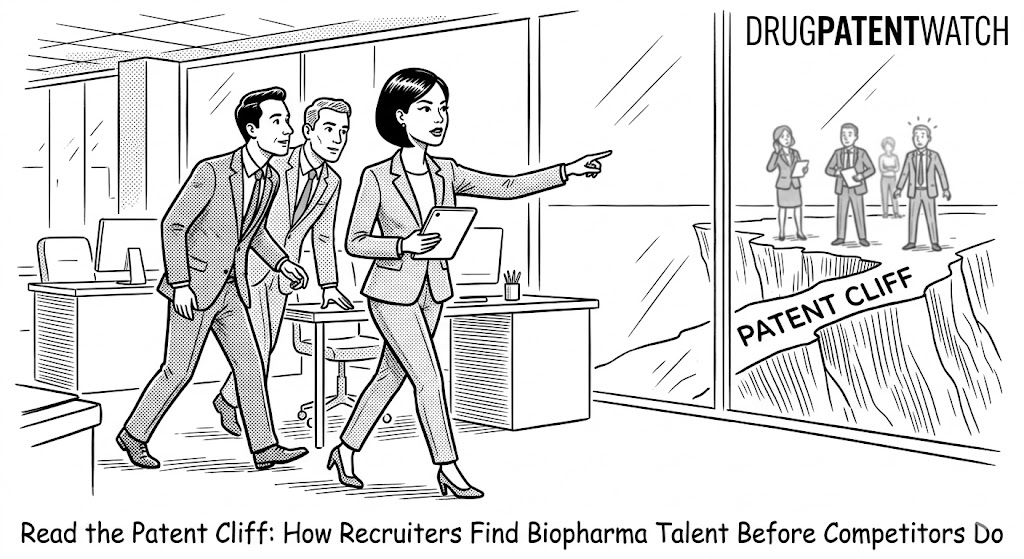
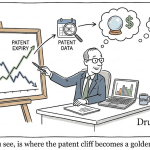
Between 2025 and 2030, the pharmaceutical industry will lose exclusivity on drugs generating more than $300 billion in annual revenue. That figure is not a market forecast — it is a workforce displacement schedule. Every dollar of revenue lost to generic competition translates into a budgeting decision, a headcount target, and eventually a candidate in the market. The recruiters who understand this mechanism will access talent six to eighteen months before competitors do.
Why Patent Data Is a Recruitment Signal, Not Just a Financial One
Most biopharma recruiters track layoffs the same way everyone else does: they monitor BioSpace, scan LinkedIn, and wait for WARN Act filings to surface. This approach works, but it puts you in the market at the same moment as every other search firm and in-house talent acquisition team. The candidate pool is visible, the competition is dense, and the best candidates — those still employed and not yet broadcasting their availability — are largely invisible.
Patent expiration data changes that equation entirely. A drug’s loss of exclusivity is not an unpredictable event. It appears in the FDA’s Orange Book years in advance. The financial consequences of that expiration — revenue decline, restructuring, headcount reduction — follow a reasonably predictable sequence. Companies announce efficiency programs. Commercial teams shrink. R&D resources get redirected. Regulatory and medical affairs staff supporting the affected drug lose their organizational rationale. If you know a company’s revenue-generating drug loses patent protection in 24 months, you can reasonably anticipate that the commercial team around that drug will contract within 12 to 18 months of that expiration.
That gap — between patent expiration and the point when affected employees become publicly available — is the window that specialized intelligence closes. It is not a small window. Takeda’s loss of Vyvanse exclusivity in August 2023 triggered a $900 million restructuring plan announced in May 2024. [89] The company had been living with the Vyvanse patent expiration date for years before the layoffs materialized. A recruiter who started building relationships with Takeda’s Cambridge, Massachusetts workforce in 2022 — when the expiration was already visible in the Orange Book — would have been first to those candidates by the time 940 Massachusetts employees were put on notice. [93]
This is not speculation. It is a reproducible methodology. And right now, in May 2026, it applies to a larger cohort of talent than any period in pharmaceutical industry history.
The $300 Billion Displacement Event
Scale and Concentration
Between 2025 and 2030, approximately 200 drugs will lose patent protection, including roughly 70 blockbusters each generating more than $1 billion annually. [72] The aggregate revenue at risk exceeds $300 billion — three times the size of the 2016 patent cliff, which eroded approximately $100 billion in branded sales. [70] That comparison matters for recruiters because the 2016 cliff was manageable. Companies absorbed it through a combination of cost discipline and M&A. The current wave is structurally different: the revenue at risk is concentrated in a narrow 2026-2028 window, involves a significant proportion of biologics (which face biosimilar competition rather than small-molecule generics), and lands on companies already carrying restructuring obligations from earlier layoff cycles.
The drugs at the center of this cliff are not obscure products. Merck’s pembrolizumab (Keytruda) generated $29.5 billion in 2024 revenue — roughly 56% of the company’s total. [73] Its core U.S. patents expire around 2028. BMS faces the steepest proportional cliff of any large pharmaceutical company, with an estimated 47% of revenues at risk by 2030 from Eliquis and Opdivo alone. [70] Amgen stands to lose more than half of its 2024 revenue from expiring patents by the same year. AbbVie, which has already worked through the post-Humira transition (Humira revenues fell from $21.2 billion in 2022 to $9 billion in 2024 following biosimilar competition), [75] shows what the adjustment looks like in practice: painful, sustained, and slower to absorb than anyone initially modeled.
Large pharmaceutical companies with at least $20 billion in 2025 revenue collectively eliminated more than 22,000 employees in 2025 alone. [62] That number came before the 2026-2028 patent cliff’s most acute phase. The actual workforce impact from now through 2030 will be substantially larger.
The Therapeutic Area Map
The current patent cliff concentrates in specific therapeutic areas that define the talent pools most affected. Understanding which areas are losing the most exclusivity helps you build the right sourcing strategy.
Oncology immunotherapy is the largest single area of exposure. Keytruda and Opdivo (nivolumab, BMS) between them represent tens of billions in annual revenue facing biosimilar competition in the 2028-2029 window. [73] The commercial, medical affairs, market access, and regulatory teams around these drugs at Merck and BMS are among the largest single concentrations of oncology commercial talent in the industry.
Cardiovascular medicine follows. Eliquis (apixaban, BMS/Pfizer) faces a patent cliff around 2026-2028. Entresto (sacubitril/valsartan, Novartis) saw its core combination patent expire in July 2025, with physicians already preparing patients for a generic switch. [76] The cardiovascular medical affairs and managed care teams at these companies are active talent pools.
Metabolic disease and endocrinology face cliff events with Farxiga (dapagliflozin, AstraZeneca), Januvia (sitagliptin, Merck), and Trulicity (dulaglutide, Eli Lilly). [73] Neuroscience is also affected: Takeda’s Trintellix (vortioxetine) faces patent expiration in December 2026, driving cuts to its neuroscience field force earlier this year. [91]
Knowing these concentrations tells you where to build your candidate pipeline. An executive search firm focused on oncology commercial roles that does not have a systematic view of the Keytruda and Opdivo expiration timelines at Merck and BMS — and what those timelines mean for headcount — is operating with a significant blind spot.
How to Read Patent Expiration Data: A Practical Primer
The FDA Orange Book: Your Primary Source
The FDA publishes the Orange Book — formally titled ‘Approved Drug Products with Therapeutic Equivalence Evaluations’ — as a public database that lists every FDA-approved drug product along with the patents and regulatory exclusivities that protect it. The Orange Book is the primary public record of pharmaceutical intellectual property in the United States. [107] It is free, updated continuously, and downloadable in structured data formats that allow systematic screening across the entire branded pharmaceutical landscape.
Every branded drug in the Orange Book has three pieces of patent information that matter for talent intelligence: the patent expiration date, the type of patent (composition-of-matter, method-of-use, or formulation), and any regulatory exclusivity that may extend market protection beyond the patent itself. [107] The distinction between patent expiration and regulatory exclusivity expiration is critical — a drug whose patents expire in 2025 but has three-year new clinical investigation exclusivity does not face generic competition until 2028. Reading the expiration date on a single patent without checking the full exclusivity picture will give you a false signal.
DrugPatentWatch takes the Orange Book’s raw data and layers additional intelligence on top of it: Paragraph IV patent challenge filings (which signal that a generic company believes a patent is invalid and is preparing to challenge it), litigation outcomes, biosimilar development activity, and patent expiration timelines across a drug’s entire portfolio of listed patents. [106] For talent intelligence purposes, the most useful single output from DrugPatentWatch is the ‘last protection date’ — the latest date among all listed patents and exclusivities — which represents the realistic outer boundary of a brand’s market exclusivity. When that date falls within a 24-month window, you are looking at a candidate pool that will begin to move.
Orange Book fields that matter for talent intelligence: Patent Expire Date — when the specific patent lapses. Exclusivity Code and Date — whether additional regulatory protection extends beyond the patent term. Paragraph IV Certifications — filed by generic competitors challenging a listed patent. When multiple generics file simultaneously, competition is imminent regardless of the nominal expiration date.
The Difference Between Patent Expiration and Loss of Exclusivity
These terms are used interchangeably in journalism but mean different things in practice. A patent expires on a specific date. Loss of exclusivity (LOE) — the point at which a branded drug actually faces generic or biosimilar competition — can occur earlier (via a successful Paragraph IV patent challenge) or later (via regulatory exclusivities or authorized generic strategies) than the nominal patent expiration date. For talent intelligence purposes, LOE is the operative date, because it is the revenue event that triggers restructuring decisions.
Hatch-Waxman patent litigation, which is fought under the Paragraph IV certification process, regularly accelerates LOE. When a generic manufacturer files an ANDA with a Paragraph IV certification asserting that the brand’s listed patents are invalid or not infringed, the brand has 45 days to sue. If it does, the FDA imposes a 30-month stay on the generic’s approval. If the generic wins the litigation — or if the brand settles — competition arrives before the nominal patent expiration date. Tracking these litigations is essential for accurate LOE forecasting.
DrugPatentWatch maintains a live database of Paragraph IV filings and litigation outcomes. [106] For a recruiter who wants to know when the commercial team at a specific company will begin contracting, watching the litigation record for that company’s flagship drugs provides early warning that LOE may arrive ahead of schedule — and that restructuring may follow faster than a reading of the patent expiration date alone would suggest.
The Timeline From LOE to Layoff
Understanding the typical sequence from patent expiration to workforce reduction gives you the lead time to act. Based on the documented experiences at Takeda (Vyvanse), BMS (Eliquis and Opdivo restructuring), AbbVie (Humira), and Novartis (Entresto), the pattern looks like this:
Phase
Timing Relative to LOE
Observable Signals
Talent Intelligence Action
Strategic Planning
24-36 months before LOE
Investor day commentary on ‘efficiency programs’; R&D pipeline diversification announcements; M&A activity to fill revenue gaps
Identify and map target employee populations at affected companies; begin relationship-building; audit LinkedIn connections
Restructuring Announcement
12-24 months before or after LOE
Earnings call language about ‘$X billion in savings by year Y’; organizational design review announcements; VP-level departures
Activate target candidates for exploratory conversations; begin presenting opportunities proactively
WARN Act Filings
60-90 days before layoff effective date
State WARN notices for facilities above threshold; BioSpace, Fierce Pharma, Xtalks reporting
Immediately contact affected employees; move fast — other recruiters will see the same notices
Active Job Market
0-6 months post-layoff
LinkedIn profile updates; ‘open to work’ banners; alumni network activation
Candidate is now competing with other laid-off peers; your relationship advantage matters most here
The recruiters who enter at Phase 1 — Strategic Planning — have the best candidates available to them and face the least competition. Those who enter at Phase 3 — WARN Act Filings — are competing on equal terms with every other sourcer in the market. The patent data enables entry at Phase 1, which is the only phase that creates a genuine competitive advantage.
Case Study: Takeda, Vyvanse, and the Cambridge Talent Exodus
What the Patent Record Said, Years in Advance
Vyvanse (lisdexamfetamine dimesylate) lost patent protection in the United States in August 2023. That date was not a surprise to anyone who followed pharmaceutical patent filings. Takeda’s Orange Book listings for Vyvanse had been public for years. The drug was the company’s largest revenue-generating product in the U.S., a blockbuster ADHD treatment with no comparable successor in the company’s late-stage pipeline at equivalent commercial scale.
A recruiter who, in 2021, built a sourcing list of Vyvanse-adjacent talent — commercial leaders, market access directors, medical science liaisons, regulatory affairs specialists, and managed care account executives across Takeda’s U.S. neuroscience organization — would have had a two-year runway before those candidates became broadly available. Takeda’s Cambridge and Lexington, Massachusetts campuses housed a significant concentration of this talent. By May 2024, Takeda had announced a $900 million restructuring plan and filed WARN notices covering 641 Massachusetts employees. [90] Additional rounds followed, bringing the Massachusetts total to 940. [93] A San Diego research facility closed, displacing approximately 340 employees. The Vyvanse commercial team contracted dramatically. More recently, as Trintellix — another key Takeda neuroscience asset — approached its December 2026 patent expiration, the company cut 243 field-based positions in its U.S. neuroscience commercial organization in January 2026. [91]
By March 2026, Takeda announced a further $1.26 billion restructuring program affecting 634 U.S. employees, filed simultaneously with a WARN notice for Massachusetts. [88] The company’s total U.S. headcount reduction since 2024 now runs into the thousands. The patent record for Vyvanse and Trintellix predicted every wave of it.
What This Talent Pool Looks Like
The employees displaced across Takeda’s neuroscience restructuring represent a specific kind of biopharma talent that is persistently in demand: individuals who have managed the full commercial lifecycle of a blockbuster CNS drug. They have experience with payer negotiations at scale, patient adherence programs in a stigmatized therapeutic area, managed care contracting for a controlled substance, and REMS program management. That combination of skills does not come from biotech startups building first-generation clinical assets. It comes from companies like Takeda that spent a decade commercializing drugs like Vyvanse at peak revenue levels.
The acquirers of this talent include specialty CNS biotechs launching their first commercial products, generic pharmaceutical companies building their brand-adjacent portfolios, and CROs that are expanding their commercial services divisions. The companies that moved first — those that had built relationships with this talent cohort before the WARN notices were filed — placed candidates faster, at better fees, and with stronger retention outcomes because the fit between candidate and employer had been thought through carefully rather than assembled under time pressure.
Case Study: Bristol Myers Squibb’s Structural Cliff and What Comes Next
The Steepest Revenue Cliff in Large-Cap Pharma
No large pharmaceutical company faces a more concentrated patent cliff than Bristol Myers Squibb. Eliquis (apixaban), co-marketed with Pfizer, generated $13.2 billion in 2024 revenue. [68] Opdivo (nivolumab) added approximately $9 billion. [70] Together, those two drugs represent roughly 45% of BMS total revenues, and both face loss of exclusivity in the 2026-2028 window. BMS estimates that approximately 47% of its revenues are at risk by 2030. [70]
The company began its restructuring response earlier than most. In March 2024, CEO Chris Boerner initiated a restructuring plan targeting $1.5 billion in cost savings by year-end 2025. By February 2025, BMS had deepened the program to add another $2 billion in savings through 2027. [80] By mid-2025, BMS had filed multiple WARN notices covering more than 1,000 employees at its Lawrenceville, New Jersey headquarters and surrounding facilities, with cuts continuing through March 2026. [81]
The BMS talent pool being released includes some of the most commercially experienced oncology professionals in the industry. Opdivo’s commercial team managed the launch of one of the first major checkpoint inhibitor approvals, built out payer access infrastructure for a transformative oncology drug class, and maintained market share in an increasingly competitive immuno-oncology landscape. Eliquis’s managed care team built the anticoagulant market access playbook that is now a template for cardiovascular drugs. These are not fungible commercial skills. They are specific, hard-won capabilities that smaller oncology biotechs and cardiovascular-focused companies will pay to acquire.
The BMS M&A Dimension
BMS has been spending aggressively on acquisitions to fill the revenue gap. The company acquired Karuna Therapeutics for $4.1 billion to strengthen its neuroscience pipeline ahead of the Eliquis expiration. [69] That acquisition created redundancies in Karuna’s existing commercial planning, regulatory, and clinical development teams as they were integrated with BMS functions. M&A-driven talent displacement is a separate but related recruitment opportunity: when a large company acquires a smaller one, the duplicate functions at the acquired company are at risk within 12-18 months of deal close, regardless of patent timelines. Tracking both acquisition activity and patent cliffs simultaneously gives you a comprehensive picture of where talent will be available.
Case Study: Merck and the Keytruda Countdown
The Largest Single-Product Cliff in History
Merck’s pembrolizumab (Keytruda) is the world’s best-selling drug. It generated $29.3 billion in 2024 revenue, more than any other drug in history for a single year. [68] Keytruda represents approximately 56% of Merck’s entire commercial revenue base. Its core U.S. patents expire around 2028, with biosimilar entrants already preparing their filings. Within 18 months of biosimilar entry, Merck could lose $15 billion in annual revenue — a revenue shock with no precedent for a company of Merck’s size. [68]
Merck is already responding. The company announced plans to reduce its global workforce by 8%, which could ultimately displace 6,000 employees over the next few years. [60] It is investing $12 billion in next-generation cancer drug development to replace the Keytruda revenue stream. [69] It closed a Pennsylvania manufacturing facility in a multiphase layoff running through 2026. [63]
The talent intelligence opportunity here is unusual because of Keytruda’s therapeutic breadth. The drug is approved for more than a dozen cancer indications, which means the commercial organization built around it spans oncology subspecialties from lung cancer to melanoma to head-and-neck to gynecologic malignancies. When that organization shrinks — and it will, as biosimilar competition erodes the Keytruda revenue base after 2028 — it will release specialized oncology commercial, medical affairs, and market access talent across every major tumor type simultaneously. No other single event in biopharma history will produce a talent dislocation at this scale in oncology commercial functions.
The recruiters who are building relationships with Merck’s Keytruda commercial organization now — in 2026, two years before the core patent expiry — will have a decisive first-mover advantage when the restructuring begins in earnest.
The WARN Act as a Talent Intelligence Layer
What WARN Notices Tell You
The Worker Adjustment and Retraining Notification (WARN) Act requires employers with 100 or more employees to provide at least 60 days’ written notice before a mass layoff affecting 50 or more workers or a qualifying plant closure. [78] That notice goes to the relevant state labor agency, to elected officials representing the affected area, and to the workers themselves. Most states post WARN filings in publicly accessible databases, typically online. Some states — including California and New York — have ‘mini-WARN’ laws that cover smaller employers or require longer notice periods. [83]
For talent intelligence purposes, WARN notices are the last early-warning signal in the sequence. By the time a WARN filing appears, the restructuring decision has already been made, the affected employees know they are losing their jobs, and you have 60 days at minimum before the layoffs take effect. That window is not large, but it is meaningful: the official layoff date in a WARN notice is typically weeks to months in the future, and employees who know their jobs are ending are often more receptive to exploratory conversations than they would be under normal circumstances.
Sites like WARNTracker.com aggregate WARN filings from state databases and make them searchable by company, location, and date. [83] BioSpace maintains a real-time biopharma layoff tracker that cross-references WARN notices with company press releases and SEC filings. [67] Xtalks produces quarterly layoff roundups that document both WARN-triggered and voluntarily disclosed workforce reductions. [80] A recruiter who monitors these feeds systematically will see biopharma layoffs within 24-48 hours of the WARN filing. That is still faster than the broader market learns about them.
Reading WARN Notices for Talent Intelligence
A WARN notice contains several fields that are useful for talent sourcing beyond the simple fact of a layoff. The facility address tells you the physical concentration of talent being displaced, which is useful if you have candidates who prefer to stay in a specific geography. The anticipated layoff start and end dates tell you the timeline for candidate availability. When a WARN notice lists layoffs occurring in waves — as BMS did across its Lawrenceville, New Jersey campus with cuts running from May 2025 through March 2026 — it signals a prolonged restructuring rather than a single clean event, and suggests that additional rounds may follow.
Some WARN notices are filed by companies that also provide press releases describing which business units or functions are being reduced. The BMS filings were accompanied by communications describing ‘commercialization and late-stage development teams’ at the Lawrenceville site. [81] That level of detail is unusual, but when it appears, it tells you exactly which functional talent pool is entering the market. When Novartis filed a WARN notice for its medical affairs organization in late 2025, a spokesperson confirmed the cuts affected staff in ‘evaluating opportunities to enhance processes, increase efficiencies’ — which is investor-relations language for ‘we are cutting a support function that was sized for a revenue base we no longer have.’ [80]
‘After shedding more than 14,000 jobs in all of 2024, the industry surpassed 13,000 layoffs by July 2025, a 31% year-over-year increase at the halfway mark. And the tide of pink slips has continued to rise.’— PharmaVoice, August 2025 [60]
Mapping the Functions: Which Roles Move When Patents Expire
The Pre-LOE Period: 24-18 Months Out
Before a drug’s patent expires, the commercial team around it is typically still intact and fully funded. The sales force is still calling on physicians. Medical science liaisons are still running advisory boards. Market access teams are managing formulary relationships. The regulatory affairs team is maintaining the NDA and managing any supplemental filings. Medical affairs is producing the scientific evidence base that supports commercial promotion.
What changes at this stage is the investment posture. Companies begin to throttle spending on patient support programs. Launch preparation for successor assets — if any exist in the pipeline — begins absorbing headcount and management attention. Senior commercial leaders start updating their LinkedIn profiles quietly. The strategic rationale for the existing organization begins to soften, and the people closest to senior leadership start to hear conversations about ‘right-sizing’ and ‘portfolio prioritization.’
This is exactly when the best candidates are available for a conversation. They are still employed, still getting paid, still embedded in their organizations — but they know the organization is changing, and they are starting to think about what comes next. A recruiter who can reach them at this stage with a thoughtful pitch tied to a genuinely relevant opportunity is not a cold call. It is a relevant professional conversation.
The 12-Month Window: The Restructuring Cascade
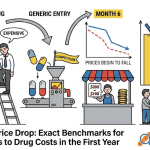
Once a drug loses exclusivity, revenue begins declining rapidly. For small-molecule drugs, generic competition typically erodes 80-90% of the branded drug’s market share within 12 months. [77] For biologics, the biosimilar uptake is typically slower — 30-70% erosion in the first year — but accelerates as additional biosimilars enter and payers implement formulary switches. [77]
The speed of revenue erosion determines the urgency of the organizational response. Companies that have been disciplined about pre-LOE planning — like AbbVie with Humira — begin their restructuring before generic entry and avoid the most dramatic cliff. Companies that were slower to plan — like those whose primary response to looming cliffs is accelerated M&A — tend to see sharper post-LOE workforce reductions as the financial pressure becomes unavoidable.
In the 12 months following LOE, these functions experience the highest disruption, in roughly this sequence:
Field sales forces are the first to contract. The rationale for a large field sales organization disappears almost immediately when a drug goes generic, because physicians are no longer making formulary-sensitive prescribing decisions based on product differentiation — pharmacies are dispensing whatever is cheapest. Takeda’s decision to cut 243 neuroscience field positions as Trintellix approached patent expiration is the clearest recent example. [91] Sales force reductions at this stage can be 50-100% of the branded product-specific headcount.
Payer-facing commercial roles follow. Market access directors, reimbursement specialists, and managed care account executives lose their primary function when formulary placement decisions are made for commodity generics rather than branded drugs. These roles contract more slowly than field sales because companies retain some managed care relationships for the generic transition and for other portfolio products, but the branded-product-specific headcount shrinks significantly.
Medical affairs and medical science liaison networks are the next to reduce. MSLs are field-based scientific communicators who serve the commercial function of KOL engagement and clinical education. When a drug goes generic, the rationale for maintaining a large MSL network at brand investment levels disappears. Some companies retain a smaller MSL footprint for the post-LOE period, particularly if the drug has multiple indications or ongoing Phase IV commitments, but the network typically contracts by 30-60%.
Regulatory affairs roles supporting the specific NDA — responsible for annual product reports, labeling changes, and post-marketing commitments — are reduced or transitioned to more junior staff as the approved drug enters its late-lifecycle maintenance phase. The clinical development team working on any lifecycle management programs around the drug (extended-release formulations, new dosing regimens) is shut down if those programs do not have a clear commercial ROI in the post-LOE environment.
The 6-18 Month Post-LOE Period: R&D Realignment
The current patent cliff is notable for heavily impacting R&D departments, which represents a shift from previous restructuring cycles that primarily hit commercial functions. [59] As companies redirect investment from maintaining a large revenue-generating asset to building the next generation of the portfolio, R&D spending decisions change. Programs that were viable at $15 billion in annual revenue become non-viable at $6 billion. Research functions that were cross-subsidized by blockbuster cash flows become candidates for outsourcing or closure.
Merck announced it is closing its research and discovery operations at the Francis Crick Institute and the London BioScience Innovation Centre, displacing 125 employees. [103] That decision is explicitly connected to resource reallocation ahead of the Keytruda cliff. Novartis closed sites in Munich and Boston that it had acquired through the MorphoSys acquisition, cutting 330 employees in December 2024. [63] BMS closed California facilities specializing in tumor microenvironment research. [58] These are not operational decisions driven by the performance of those specific research programs — they are resource reallocation decisions driven by the financial pressure of the patent cliff.
For recruiters, the R&D realignment wave releases a different talent profile than the commercial restructuring: translational researchers, early clinical development specialists, discovery biology teams, and the regulatory science and CMC (chemistry, manufacturing, and controls) professionals who support late-stage development. These candidates are in demand at clinical-stage biotechs that need to build development infrastructure and at CROs expanding their scientific services.
Building Your Patent-Intelligence Sourcing System
The 24-Month Target List
The most effective way to use patent expiration data for talent intelligence is to maintain a rolling 24-month target list: a ranked inventory of branded drugs whose last protection date falls within the next 24 months, weighted by revenue at risk and organizational size at the drug’s sponsor company. Drugs with higher revenue generate bigger organizational contractions when they lose exclusivity. Companies whose revenue is more concentrated in the expiring drug generate faster and deeper restructuring responses.
Your target list should include, for each drug: the active molecule and brand name; the NDA holder and co-marketing partners (if any); the last protection date from the Orange Book (or from DrugPatentWatch’s aggregated patent and exclusivity database); the drug’s most recently reported annual revenue; an estimate of the commercial organization size (field sales, MSLs, payer-facing roles) at the NDA-holding company; and any ongoing Paragraph IV litigation that might pull the LOE date earlier than the nominal expiration.
DrugPatentWatch’s patent expiration databases allow you to build this list systematically rather than drug by drug. Their patent cliff coverage aggregates expiration data across the full branded pharmaceutical landscape, with revenue data overlaid, so you can screen for drugs entering the 24-month LOE window and rank them by commercial impact. [72, 73]
The Three-Signal Confirmation System
Patent expiration data is a necessary but not sufficient signal. Before investing significant sourcing effort in a specific company’s talent pool, you want to confirm the signal with two additional data points. The first confirmation is an earnings call or investor day comment about ‘efficiency,’ ‘cost optimization,’ or ‘portfolio prioritization’ in the context of the expiring drug. This indicates that executive leadership has already made the restructuring decision and is beginning to execute it. The second confirmation is any SEC filing or press release announcing a specific restructuring program with a dollar target and a timeline. Once you see all three — patent cliff within 24 months, earnings language about efficiency, and a specific restructuring announcement — you have high confidence that talent displacement is imminent.
The Takeda / Vyvanse sequence hit all three signals. The Orange Book showed the expiration timeline. Earnings calls in 2022 and 2023 included language about planning for generic competition. The May 2024 restructuring announcement named specific dollar targets. A recruiter monitoring all three signals would have had the Takeda neuroscience talent pool mapped and partially relationship-building before the WARN notices were filed.
LinkedIn as a Real-Time Signal Layer
LinkedIn does not replace patent intelligence, but it is a useful real-time complement to it. When a company’s senior commercial leaders begin updating their profiles with new positions, it signals that the reorganization at the senior level is underway — and that mid-level roles will follow. When employees at a specific company begin posting content about ‘exciting new opportunities’ and ‘open to work,’ it tells you the WARN process has begun and candidates are beginning their active search.
The combination of patent-based prediction and LinkedIn-based confirmation creates a two-stage system. Patent data gives you the 24-month view. LinkedIn updates give you real-time confirmation that what the patent data predicted is actually happening. The candidates you want to target before the WARN notices file — the ones who are still employed and not yet actively searching — will not have ‘open to work’ banners. You find them by combining the patent-derived target list with proactive LinkedIn outreach timed to the restructuring announcement phase.
CRO and Specialty Pharma Hiring Patterns as Secondary Signals
When large pharma companies begin restructuring in response to a patent cliff, CROs absorb a portion of the displaced talent and also receive increased outsourcing business from the restructuring companies. [59, 104] This is a predictable pattern: companies that are cutting internal headcount often increase their outsourcing spend simultaneously, as the economics of having a fixed internal workforce become less attractive and the variable cost structure of a CRO looks more appealing. IQVIA, ICON, Medpace, and Syneos Health all benefit from this dynamic.
For recruiters working the CRO side of the market, this creates a secondary opportunity: CROs that are hiring to support expanded pharma business need candidates with brand pharma backgrounds, and the patent cliff creates the supply of those candidates at the same time it creates the demand. Watching which CROs are expanding their Life Sciences Consulting, regulatory services, and medical communications divisions in the 12 months after a major patent cliff provides a map of where displaced pharma talent is being absorbed — and where the next wave of CRO internal growth opportunities will emerge.
The Functions Most In Demand by the Companies Hiring
Where Displaced Talent Is Going
Understanding where patent cliff-displaced talent is in demand requires mapping the companies that are growing — typically those with drugs in late-stage development or recent commercial launches — against the functional skill sets most often cut from restructuring large pharma companies. The overlap between what large pharma is releasing and what growth-stage biotechs and specialty companies are buying defines the talent transactions you should be facilitating.
Oncology commercial talent is in the highest sustained demand. The number of new oncology drug approvals continues to grow, driven by cell therapy, antibody-drug conjugates, and targeted therapies. Each of those approvals requires a commercial organization. A physician-targeting commercial leader or a market access director from a BMS or Merck oncology franchise brings institutional knowledge — about payer dynamics, KOL networks, and patient support infrastructure — that a clinical-stage biotech cannot generate internally before its own launch. The misalignment between the supply of experienced oncology commercial talent (coming from patent cliff restructurings) and the demand for that talent (from biotech commercial buildouts) is the most obvious market inefficiency in biopharma talent today.
Regulatory affairs professionals with new molecular entity (NME) experience are a second high-demand category. As large pharma companies cut regulatory staff supporting established products nearing LOE, biotech companies building submission packages for first-time approvals are hiring aggressively for the same skills. The demand is particularly acute for regulatory leads with NDA experience in oncology, rare diseases, and neuroscience — exactly the therapeutic areas with the heaviest patent cliff exposure at large pharma companies.
Medical affairs professionals with payer evidence expertise are a third priority for hiring companies. As value-based coverage decisions become more complex and HEOR data becomes central to formulary access, companies launching new drugs need medical affairs leaders who understand how to build the real-world evidence base that payers require. That expertise is developed over years at large commercial-stage companies, not in biotech startups that have not yet had a drug approved.
The CRO Talent Funnel
CROs absorbing displaced pharmaceutical talent during patent cliff cycles tend to hire for specific capabilities rather than general experience. Clinical operations professionals with large-Phase III trial experience are persistently in demand. Regulatory writing and submission specialists are needed for the increased submission volume that comes from pharma companies outsourcing regulatory work. Clinical data management professionals are in demand as data complexity increases and companies prefer variable cost structures for these functions. [104]
For recruiters, the CRO hiring pattern creates a secondary market for the same candidates you are placing at biotech companies. A regulatory affairs director who left BMS during its restructuring but did not land at a biotech may be the right fit for a CRO regulatory consulting practice. Mapping both the biotech and CRO demand simultaneously against the patent cliff-derived supply list gives you a complete picture of market clearing prices and placement options for each candidate type.
Specific 2026-2028 Patent Cliff Targets for Talent Intelligence
Near-Term Opportunities
Based on publicly available patent and exclusivity data in the FDA Orange Book and DrugPatentWatch, the following drug programs represent the highest-priority targets for talent intelligence over the next 24 months.
Eliquis (apixaban, BMS/Pfizer) faces its most significant patent cliff around November 2026. [76] BMS has already been restructuring for 18 months in anticipation. The remaining headcount in the Eliquis commercial organization — cardiovascular market access, medical affairs, and the co-promote management infrastructure with Pfizer — will continue to shrink as generic entry erodes the revenue base. Cardiovascular commercial talent from this franchise is in demand at heart failure drug developers, anticoagulant generics companies, and cardiovascular CROs.
Entresto (sacubitril/valsartan, Novartis) saw its core combination patent expire in July 2025. Novartis has already filed multiple WARN notices affecting its East Hanover, New Jersey headquarters — the commercial hub for the Entresto franchise. [80] The heart failure commercial team at Novartis, including managed care specialists with experience in the heart failure formulary environment, is actively entering the market.
Trintellix (vortioxetine, Takeda) faces patent expiration in December 2026. Takeda already cut 243 neuroscience field force positions in January 2026 in direct response to the anticipated generic competition. [91] The remainder of the Trintellix commercial organization — inside sales, managed care, and a reduced MSL network — will likely contract further through 2027. CNS commercial talent from this franchise is in demand at specialty CNS biotechs, generic CNS companies building commercial infrastructure, and integrated specialty pharmacy operations.
Keytruda (pembrolizumab, Merck) has core patents expiring around 2028. The two-year horizon means the restructuring will intensify through 2026 and 2027 as Merck pre-positions for what will be the largest single revenue cliff in pharmaceutical history. [68] Merck has already announced plans to cut 8% of its global workforce, with several thousand positions potentially affected. Oncology commercial talent from the Keytruda organization — particularly in solid tumor indications, immuno-oncology market access, and oncology medical affairs — is the single most valuable target pool for any recruiter focused on oncology commercial and clinical roles.
The Biological Dimension: Biosimilar Cliffs
Biological drugs face a different competitive dynamic than small-molecule drugs. Biosimilars capture market share more slowly than small-molecule generics — 30-70% erosion in year one versus 80-90% for generics — but the trajectory is still steep and the financial impact is substantial. [77] AbbVie’s Humira lost more than $12 billion in annual revenue between 2022 and 2024 as biosimilars captured market share. [75] The Humira restructuring at AbbVie released immunology commercial talent that became the foundation of commercial organizations at multiple psoriasis and inflammatory bowel disease biotechs.
J&J’s Stelara (ustekinumab) entered its biosimilar period in 2025. Despite efforts to manage the transition and maintain branded revenue — Stelara still generated just over $6 billion in sales in 2025 through J&J’s biosimilar delay tactics — the competitive erosion is underway. [71] The immunology commercial team at J&J/Janssen that built the Stelara market in IL-12/23 and psoriasis is beginning to realign as resources shift to newer assets.
Regeneron’s Eylea (aflibercept) has faced biosimilar competition since 2024. The retinal disease commercial franchise at Regeneron is smaller than the oncology or immunology franchises at other companies, but the specialized experience — navigating ophthalmology practice economics, buy-and-bill reimbursement, and retinal disease managed care — is in demand at the multiple ophthalmology companies building commercial infrastructure for new retinal treatments.
How to Build This Into Your Recruitment Practice
The Patent Intelligence Workflow
Implementing patent expiration data as a systematic sourcing tool requires a defined workflow, not just occasional monitoring. The most efficient approach operates at three time horizons.
The 24-month horizon is where you build your target candidate list. Once a month, pull the list of drugs entering the 24-month LOE window from the FDA Orange Book data or from DrugPatentWatch’s patent cliff screening tools. Cross-reference those drugs against the annual revenues of their NDA holders using public earnings data. Any drug generating more than $1 billion in annual revenue for a company where it represents more than 20% of total revenue goes on your active monitoring list. For those companies, map the organizational structure supporting the expiring drug — who are the commercial VP and SVP titles? Who runs the relevant franchise? Who leads the payer-facing organization?
The 12-month horizon is where you activate. When a company in your monitoring list announces a restructuring program, immediately begin outreach to the candidates you identified in the 24-month horizon. Your message should be specific: you have been following the company’s portfolio situation, you have an understanding of how patent timelines typically affect commercial organizations in this therapeutic area, and you have specific opportunities that fit their background. Vague ‘reaching out about opportunities’ messages will get ignored. Messages that demonstrate you understand their professional situation — without being presumptuous about their individual circumstances — will get responses.
The 60-day horizon is WARN notice response. As soon as a pharma company files a WARN notice for a facility you have been monitoring, accelerate all outreach to candidates at that facility. The WARN notice tells you that what you predicted is happening on schedule. Candidates at the affected facility who have not yet heard from you should receive your outreach within 48 hours of the WARN notice becoming public.
Building Relationships Before the Cliff
The most effective use of patent expiration intelligence is not to send mass outreach the day a WARN notice drops. It is to have already built genuine professional relationships with candidates in target pools years before the cliff hits, so that when the organizational change occurs, your candidates think of you first.
The tools for this are not proprietary: LinkedIn content that demonstrates real knowledge of the pharma talent market (not generic ‘exciting opportunity’ posts, but content that shows you understand the patent cliff dynamics and their career implications), speaking engagements at industry conferences frequented by your target candidate pool, and introductions through existing placed candidates who can provide warm referrals. A recruiter who consistently produces intelligent commentary on patent cliffs, commercial lifecycle dynamics, and the talent implications of specific LOE events will build a following among the exact professionals most likely to need their services in the next 18 months.
The pharmaceutical industry is small enough that trust reputation matters more than sourcing volume. A medical affairs director who saw your insightful commentary about the Keytruda cliff implications for oncology commercial teams in 2026 will call you in 2027 when Merck announces the restructuring that dislocates her role. That relationship, built proactively through demonstrated expertise, is worth ten cold outreach attempts at the WARN filing stage.
Calibrating the Pitch by Function
Different functional candidates require different outreach calibrations. A field sales representative who knows her Eliquis territory will be eliminated by generic entry needs a different conversation than a VP of Market Access who built the payer infrastructure for an oncology checkpoint inhibitor. Understanding which functions move earliest, which move with the most predictable timing, and which have the widest employer demand on the other side of the cliff allows you to prioritize your outreach by both urgency and commercial value.
Commercial VPs and C-suite commercial leaders are the highest-value candidates and move first — they are often the ones designing the restructuring that will eventually affect their own organizations. Their next roles are typically at companies building new franchises or at PE-backed specialty pharma platforms. The timeline for their search is typically compressed: they may have 3-6 months of runway before their next move needs to be locked.
Mid-level MSLs and field sales professionals are the highest-volume displaced cohort and the most competitive to place because every other recruiter is pursuing them at the same time. Your advantage with this group is relationship-first: if you reached them before the WARN notice was filed, you have a genuine relationship advantage. If you are entering at the WARN stage, you need to be faster and more specific about opportunities than your competition.
Regulatory and clinical development professionals are the most specialized and have the longest search timelines — they are not making moves in 30 days. But they are also the cohort most receptive to substantive professional conversation, most likely to respond to demonstrated domain knowledge, and most likely to generate referrals to peers. One well-placed regulatory affairs VP can generate three to five referrals to peers across multiple companies in the cliff-affected cohort.
Mistakes That Kill the Opportunity
What Not to Do With Patent Data
Patent expiration intelligence creates a window. How you use that window determines whether you build a genuine competitive advantage or simply create noise. Several mistakes consistently undermine recruiters who have access to this data but apply it poorly.
The first mistake is using patent data to generate mass outreach that references a company’s specific patent situation without the candidate having any relationship with you. Sending a message that says ‘I noticed your company’s drug loses patent protection in 2027 and I wanted to reach out about opportunities’ is not demonstrating industry knowledge — it is demonstrating that you have a database and no relationship. Candidates who receive these messages will not respond. They may actively form negative impressions of your practice.
The second mistake is confusing patent expiration dates with actual LOE. A drug whose composition-of-matter patent expires in 2027 but has pediatric exclusivity running through 2028 and formulation patents through 2029 does not face competitive entry in 2027. Sending outreach to candidates at that company in 2027 based on the wrong expiration date will mark you as someone who has superficial rather than real knowledge of the patent landscape.
The third mistake is sourcing only the high-profile companies whose patent cliffs make headlines. The Keytruda cliff is not a secret. Every talent acquisition team in oncology knows Merck will be restructuring. The competitive advantage lies in the second-tier patent cliffs — drugs generating $500 million to $2 billion in annual revenue, at companies where that drug is a large fraction of the commercial portfolio, where the restructuring will be significant but is not being covered by every industry newsletter. DrugPatentWatch’s systematic screening capability is most valuable precisely because it surfaces these less-publicized cliff events alongside the blockbusters.
The Broader Market Context: What 2026 Looks Like
Industry Conditions That Make Patent Intelligence More Urgent
The biopharma talent market in 2026 has specific characteristics that make patent expiration intelligence more valuable than it would be in a stable market. First, the volume of displaced talent is historically high. After 14,010 pharma industry job cuts in 2024, the industry surpassed 13,000 layoffs by July 2025 — a 31% year-over-year increase. [60] That pace has continued. Large pharma companies collectively cut more than 22,000 employees in 2025 alone. [62] The supply of experienced biopharma talent on the market is higher than at any point in recent memory.
Second, the distribution of that talent across seniority levels and functions is unusual. Unlike previous cycles — which primarily hit commercial functions — the current wave is also heavily impacting R&D, regulatory, and clinical development roles. [59] This expands the addressable market for executive search and retained recruitment beyond purely commercial roles, into technical functions where competition for search mandates is lower and candidate quality is high.
Third, 31% of biotechs — the primary employers of patent cliff-displaced pharma talent — will run out of money within a year according to a 2024 EY Biotech report. [64] This creates a simultaneous demand contraction on the hiring side, meaning the supply of available talent exceeds the immediate hiring capacity of the most active acquirers. For recruiters, this means that placing displaced candidates requires more work — more creative matching between candidates and employers who can actually fund the hire — but also that the candidates who are placed tend to stay longer and generate stronger relationships because the placement was more thoughtful.
Fourth, the Inflation Reduction Act’s drug price negotiation mechanism is creating additional uncertainty about commercial revenue at companies whose drugs are selected for negotiation. This uncertainty accelerates restructuring decisions beyond what patent timelines alone would predict, adding an IRA-driven layoff calendar to the patent-driven one.
What Comes After the Cliff: Hiring Signals on the Other Side
Where the Industry Is Building
Patent cliff cycles release talent from legacy franchises and redirect it toward new areas of growth. Understanding where the industry is building — not just where it is cutting — completes the talent intelligence picture and allows you to match displaced candidates to growing organizations.
Obesity and metabolic disease is the most active growth area in the industry. Novo Nordisk’s GLP-1 franchise drove the company to double its headcount between 2019 and 2024, reaching 77,000 employees. [99] Even as Novo restructures in 2025-2026 following slower-than-expected sales growth and margin pressure, the GLP-1 market continues to attract commercial investment from Eli Lilly, AstraZeneca, and multiple biotech entrants. Commercial leaders with experience in primary care physician engagement at scale, managed care access for high-cost specialty drugs, and large-population patient support programs are in demand.
Cell and gene therapy continues to grow despite a funding slowdown at the clinical stage. Commercial launches of approved cell and gene therapies — CAR-T products, gene therapy for rare diseases, in vivo editing platforms — require specialized market access infrastructure that only exists at a handful of companies. Experienced rare disease commercial and medical affairs talent from companies like BMS, Novartis (which is both cutting and hiring in cell and gene therapy in different geographies), [80] and Bluebird Bio is in demand at the expanding cell and gene therapy commercial organizations.
Antibody-drug conjugates (ADCs) are receiving major investment from large pharma companies including Pfizer (which acquired Seagen for $43 billion in part to build ADC capabilities), AstraZeneca, and Roche/Genentech. The commercial organizations building out ADC oncology franchises need clinical, regulatory, and commercial talent with oncology specialty experience — exactly the talent being released from patent cliff-adjacent restructurings at BMS and Merck.
Key Takeaways
Patent expiration data is a workforce displacement calendar. The FDA Orange Book and DrugPatentWatch provide the raw material to build a 24-month forward view of which companies will be restructuring, which functional talent pools will be released, and which geographic markets will experience the highest displacement concentrations. The $300 billion revenue cliff running through 2030 is the largest talent displacement event in pharmaceutical history. Recruiters who treat it as a financial story are reading the wrong headline.
The 24-18 month pre-LOE window is where competitive advantage is built. By the time a WARN notice is filed, you are competing with every other recruiter who reads BioSpace. Building genuine relationships with candidates in patent cliff-exposed organizations 18-24 months before the restructuring begins is the only way to access the best talent before it becomes publicly available. Patent data enables entry at this stage. Nothing else does.
Different functions follow predictable displacement sequences. Field sales contracts first, within weeks of LOE announcement. Payer-facing and managed care roles follow over 3-6 months. Medical affairs and MSL networks reduce over 6-12 months. R&D roles align last, as budget reallocations are finalized. Understanding this sequence allows you to calibrate your sourcing timeline by function, not just by company.
The confirmation signal stack matters. Patent expiration data tells you where to look. Earnings call language about efficiency and restructuring confirms the decision has been made. A specific announced savings program with a dollar target tells you the timeline. WARN Act filings confirm the specific facilities and timing. Using all four together gives you a layered intelligence picture that protects against false positives from any single signal.
CROs and growth-stage biotechs are the primary employers of patent cliff talent. Contract Research Organizations consistently absorb pharmaceutical talent during cliff cycles and also receive increased outsourcing business. Growth-stage biotechs commercializing new oncology, rare disease, and CNS drugs need exactly the skills being released from Merck’s Keytruda organization, BMS’s Eliquis franchise, and Takeda’s neuroscience unit. Mapping the demand side as carefully as the supply side is the difference between a recruiter who places candidates and one who builds a practice.
DrugPatentWatch provides the systematic patent intelligence layer that makes this workflow scalable. Manual Orange Book review is feasible for a handful of targets. Systematic screening across the full branded pharmaceutical landscape — cross-referenced against revenue data, ANDA filing activity, and litigation outcomes — requires a purpose-built database. This is the function DrugPatentWatch serves for patent professionals, and it is directly applicable to the talent intelligence workflow described in this guide.
Frequently Asked Questions
Q1: How do I identify which specific teams at a large pharma company are most exposed to a patent cliff, before the company announces a restructuring?
Start with the drug’s revenue concentration: if a single drug represents 20% or more of the company’s total revenue, every function touching that drug’s commercial life cycle is at risk when it loses exclusivity. Then look at the organizational structure. Most large pharma companies publish their therapeutic area organization charts at investor days and in annual reports — these documents show which business units own the expiring drug and which SVP/VP titles are responsible. Cross-referencing those names with LinkedIn gives you the organizational map. For drugs like Keytruda, the entire Merck oncology commercial organization is connected to the franchise. For more specialized drugs like Takeda’s Vyvanse, the risk was concentrated in the U.S. neuroscience business unit at the Cambridge headquarters. The geography of the exposed talent pool is usually identifiable from the organizational chart before the company announces anything publicly.
Q2: What is the most reliable data source for knowing when a specific drug’s full exclusivity — not just the composition-of-matter patent — actually expires?
The FDA Orange Book is the authoritative public source, but it requires careful reading. The Orange Book lists each patent and regulatory exclusivity separately, and a drug may have a composition-of-matter patent expiring years before its last listed method-of-use patent or regulatory exclusivity. The operationally relevant date for talent intelligence is the ‘last protection date’ — the latest date across all listed patents and exclusivities. DrugPatentWatch aggregates this information and typically includes additional context from Paragraph IV litigation records, which can shift the effective LOE date earlier if a generic challenger successfully invalidates a patent before its nominal expiration. For biologics, the biosimilar pathway introduces additional complexity: the relevant intelligence is the biosimilar application pipeline at the FDA and the number of biosimilar manufacturers that have disclosed development activity, not just the formal patent expiration date.
Q3: How do you distinguish between a company that is restructuring purely because of a patent cliff versus one that is restructuring for other reasons — like a pipeline failure or a bad acquisition? Does the distinction matter for talent quality?
It matters significantly for talent quality and for the nature of the opportunity. Patent cliff-driven restructurings release talent that was fully engaged in a high-revenue, fully-commercialized drug franchise — people who understand large-scale market access, established payer relationships, and the discipline of protecting and extending the commercial life of a blockbuster. Pipeline failure-driven restructurings — like Atara Biotherapeutics cutting 50% of its workforce after setbacks in its T cell therapy program — release talent that was building toward a launch that never happened. That talent has different strengths: it is better at building clinical development infrastructure and pre-launch planning, and weaker in commercial execution at scale. Acquisition integration-driven restructurings release talent from the acquired company that was viable in a smaller organization but became redundant when absorbed by a larger one. All three cohorts have value, but to different employers for different reasons. Knowing which type of restructuring is occurring tells you which buyer segment to target for placement.
Q4: Is there an ethical issue with proactively approaching candidates at companies you know are facing patent cliffs, before those candidates know their jobs are at risk?
No. The patent expiration information is public and the candidates you are approaching are professionals who are capable of understanding their own organizational context. You are not telling them something they should not know — you are providing a professional perspective that helps them think proactively about their career options in a market they are already embedded in. The ethical line is disclosure and accuracy: you should not make claims about a specific company’s restructuring plans that you do not have reliable information about, and you should not imply that you have inside knowledge of specific personnel decisions. A message that says ‘given the patent timeline for [drug], I expect commercial organizations in this therapeutic area to evolve significantly over the next 18 months, and I wanted to introduce an opportunity that might be worth exploring’ is accurate, professionally respectful, and useful to the recipient. A message that says ‘I know your company is about to lay you off’ crosses a line.
Q5: Biosimilar markets are said to erode revenue more slowly than generic markets. Does that mean the talent displacement from biologic patent cliffs is slower, and does that affect how recruiters should time their sourcing?
Partly true, but the execution is more nuanced than the headline suggests. The AbbVie / Humira experience showed that even a ‘slow’ biosimilar erosion — 30-50% market share loss in year one rather than 80-90% for small molecules — still translated into a revenue decline measured in billions of dollars annually. AbbVie’s Humira revenue fell from $21.2 billion in 2022 to $9 billion in 2024, a $12 billion decline over two years. The restructuring response to that kind of revenue loss is not slow, even if the market share erosion was gradual by generic drug standards. The more important variable for timing is not the speed of generic or biosimilar erosion but the company’s pre-LOE planning horizon. Companies that were well-prepared — like AbbVie, which spent years diversifying away from Humira — began restructuring before biosimilar entry and completed most of the organizational change in the first 12-18 months of biosimilar competition. Companies that were less prepared restructure more abruptly and with less advance notice to employees. For recruiters, the practical implication is that biologic patent cliffs reward the same 24-month forward planning as small-molecule cliffs, but the confirmation signals (earnings language, restructuring announcements) may arrive slightly earlier relative to the LOE date for large, well-capitalized companies with strong planning functions.
References
PharmaVoice. (2025, March 10). What’s driving pharma’s layoffs in 2025. https://www.pharmavoice.com/news/pharma-layoff-biotech-job-cut-biogen-bms-crispr/741967/
Medpath. (2024, October 30). Pharmaceutical industry faces widespread layoffs amid patent cliffs and economic uncertainty. https://trial.medpath.com/news/a3355b42b8776cfc/pharmaceutical-industry-faces-widespread-layoffs-amid-patent-cliffs-and-economic-uncertainty
PharmaVoice. (2025, August 18). Biopharma layoffs rise as drugmakers tighten belts and reorganize. https://www.pharmavoice.com/news/biopharma-layoffs-pharma-drug-moderna-bayer-merck/757839/
PharmExec. (2025). Everything to know about pharma layoffs in 2025. https://www.pharmexec.com/view/everything-know-layoffs-2025
Fierce Pharma. (2026, March 25). Large pharma companies reduced headcounts by more than 22K in 2025 as $300B patent cliff looms. https://www.fiercepharma.com/pharma/large-pharma-companies-reduced-headcount-over-22000-2025-300b-patent-cliff-looms
Xtalks. (2026). Pharma and biotech layoffs 2025. https://xtalks.com/pharma-and-biotech-layoffs-2025-4110/
PharmaVoice. (2024, June 10). Behind big pharma’s layoffs — is there an end in sight? https://www.pharmavoice.com/news/big-pharma-layoffs-patent-cliffs-bms-takeda/718333/
Chemistry World. (2024, June 17). Job cuts sweeping across pharmaceuticals. https://www.chemistryworld.com/news/job-cuts-sweeping-across-pharmaceuticals/4019655.article
Alcimed. (2025, October 27). Patent cliff: What strategies can help biopharma stay competitive? https://www.alcimed.com/en/insights/patent-cliff/
OKBTF. (2025, December 30). Blockbuster patent expirations 2025 and beyond: Key drugs, timeline, and market impact. https://okbtf.org/blockbuster-patent-expirations-2025-and-beyond-key-drugs-timeline-and-market-impact
FDA-Approved-Rx. (2026, March 19). Blockbuster patent expirations 2025 and beyond: What’s coming and how it affects you. https://fda-approved-rx.net/blockbuster-patent-expirations-2025-and-beyond-what-s-coming-and-how-it-affects-you
DeepCeutix. (2026, February 2). $300 billion in pharma revenue loses patent protection by 2030. https://deepceutix.com/insights/patent-cliff-reformulation
PharmaVoice. (2026, January 30). How big pharma is navigating a $300 billion patent cliff. https://www.pharmavoice.com/news/big-pharma-navigating-patent-cliff-300-billion-jnj-merck-abbvie/810915/
DrugPatentWatch. (2026, February 25). Beyond the drug patent cliff: How procurement can drive immediate savings with generics and biosimilars. https://www.drugpatentwatch.com/blog/beyond-the-drug-patent-cliff-how-procurement-can-drive-immediate-savings-with-generics-and-biosimilars/
DrugPatentWatch. (2026, March 10). The patent cliff playbook: Pharmaceutical IP valuation, generic entry timing, and biosimilar strategy. https://www.drugpatentwatch.com/blog/patent-expirations-seizing-opportunities-in-the-generic-drug-market/
DrugPatentWatch. (2026, March 22). Drug patent expiration: The complete strategic guide to loss of exclusivity, lifecycle management, and the $400 billion cliff. https://www.drugpatentwatch.com/blog/the-impact-of-drug-patent-expiration-financial-implications-lifecycle-strategies-and-market-transformations/
Global Pricing Innovations. (2025, November 4). Patent cliff in pharma: Navigating disruption and creating opportunity. https://globalpricing.com/patent-cliff-in-pharma-navigating-disruption-and-creating-opportunity/
U.S. Department of Labor. WARN Act compliance assistance. https://www.dol.gov/agencies/eta/layoffs/warn
Xtalks. (2026). Pharma and biotech layoffs 2026 watch. https://xtalks.com/pharma-and-biotech-layoffs-2026-watch-4631/
BioSpace. (2025, July 10). The 5 largest biopharma layoffs of H1 2025. https://www.biospace.com/job-trends/the-5-largest-biopharma-layoffs-of-h1-2025
WARNTracker.com. Live layoffs from public WARN records. https://www.warntracker.com/
BioSpace. (2026, January 29). Biopharmas continued staff cuts in 2025. https://www.biospace.com/job-trends/biopharmas-continued-staff-cuts-in-2025
Fierce Pharma. (2026, March 30). Takeda begins US layoffs as part of massive $1.3B restructuring. https://www.fiercepharma.com/pharma/takeda-begins-us-layoffs-part-massive-13b-restructuring
BioPharma Dive. (2024, May 10). Takeda targets ‘efficiency’ in restructuring, pipeline cuts. https://www.biopharmadive.com/news/takeda-restructuring-layoffs-pipeline-first-quarter-2024/715629/
Boston Globe. (2024, May 30). Takeda Pharmaceutical’s layoffs in Massachusetts follow high-flying period. https://www.bostonglobe.com/2024/05/30/business/takeda-pharmaceutical-layoffs-massachusetts/
Fierce Pharma. (2026, January 23). Takeda’s neuroscience field force hit with layoffs as key patent loss looms for Trintellix. https://www.fiercepharma.com/pharma/takeda-cuts-243-us-workers-generic-competition-looms-trintellix
Fierce Pharma. (2026, March 25). Takeda targets $1.3B in cost savings in further restructuring. https://www.fiercepharma.com/pharma/takeda-targets-13b-cost-savings-further-restructuring
Boston Globe. (2024, October 21). Takeda announces more job cuts, bringing total layoffs in Massachusetts to 940 by next year. https://www.bostonglobe.com/2024/10/21/business/takeda-pharmaceutical-layoffs-massachusetts/
Xtalks. (2025). Top 10 biggest pharma and biotech layoffs in 2024. https://xtalks.com/top-10-biggest-pharma-and-biotech-layoffs-in-2024-3846/
BioSpace. (2026, March 30). Takeda restructuring could push more than 600 US staffers out of jobs. https://www.biospace.com/job-trends/takeda-restructuring-could-push-more-than-600-us-staffers-out-of-jobs
BioSpace. (2025). Biopharmas continued staff cuts in 2025 — Novo Nordisk departments. https://www.biospace.com/job-trends/biopharmas-continued-staff-cuts-in-2025
IntuitionLabs. (2026, March 20). Pharma and CRO layoffs 2025-2026: An industry analysis. https://intuitionlabs.ai/articles/pharma-cro-layoffs-2025-2026-analysis
GeneOnline News. (2025, March 31). Pharma layoffs: Strategic downsizing or long-term risk? https://www.geneonline.com/pharma-layoffs-strategic-downsizing-or-long-term-risk/
Rapid Trials. (2026, February 12). Biopharma layoffs in 2025: An overview of industry challenges and workforce shifts. https://www.rapidtrials.com/biopharma-layoffs-in-2025-an-overview-of-industry-challenges-and-workforce-shifts/
DrugPatentWatch. (2026, March 18). The complete expert guide to FDA Orange Book and Purple Book patent research. https://www.drugpatentwatch.com/blog/drug-patent-research-expert-tips-for-using-the-fda-orange-and-purple-books/
U.S. Food and Drug Administration. Orange Book data files. https://www.fda.gov/drugs/drug-approvals-and-databases/orange-book-data-files
U.S. Food and Drug Administration. Frequently asked questions on patents and exclusivity. https://www.fda.gov/drugs/development-approval-process-drugs/frequently-asked-questions-patents-and-exclusivity
DrugPatentWatch. (2025, April 17). Pharmaceutical patent use codes: The definitive technical and strategic guide. https://www.drugpatentwatch.com/blog/patent-use-codes-for-pharmaceutical-products-a-comprehensive-analysis/
EY Biotech Industry Report. (2024). Biotech industry outlook — 31% runway analysis. Cited via PharmaVoice, June 2024. https://www.pharmavoice.com/news/big-pharma-layoffs-patent-cliffs-bms-takeda/718333/