Business Intelligence on Biologic and Small Molecule Drugs
How to use patent expiry intelligence to reach biosimilar manufacturers at the moment their equipment decisions are live — not after they have already been made
When Humira lost its final U.S. patent protection in January 2023, more than thirty companies had already committed manufacturing capacity to produce adalimumab biosimilars. The decisions that determined whether those companies would profit or bleed were made not at launch, but 18 to 24 months before the first vial shipped. Capital equipment procurement, process validation, and regulatory filing timelines — all of it locked in long before a commercial dose was ever produced.
For suppliers of single-use bioprocessing systems, that timeline is everything. If you are calling on a biosimilar manufacturer after their BLA is filed, you have already missed the window that matters most. The business development strategy that generates real revenue in this sector requires reading patent expiry data the way a trader reads bond yields: as forward-looking signals, not historical records.
This guide is written for the VP of sales, the regional business development director, and the product manager at a biopharmaceutical equipment or manufacturing technology company. It explains how to use patent intelligence to identify biosimilar launch windows, how to map those windows to manufacturing procurement cycles, and how to build a pitch that resonates with the people who actually make the call on single-use systems.
The Biosimilar Manufacturing Inflection Point
Why Manufacturing Decisions Lock In Before Clinical Data Arrives
The biosimilar development timeline creates a peculiar dynamic for equipment suppliers. Unlike small-molecule generic drugs, where manufacturing is relatively straightforward and process decisions can be made late in development, biological medicines require extensive process development before any regulatory submission. The FDA’s expectations under the Biologics Price Competition and Innovation Act (BPCIA) mean that a biosimilar applicant must demonstrate not just analytical similarity to the reference product, but similarity in manufacturing process attributes that affect the drug’s clinical behavior. [1]
That requirement has a direct commercial implication for SUS vendors: process characterization studies, comparability protocols, and scale-up validation all happen before clinical manufacturing. A biosimilar developer who has committed to single-use bioreactors at the 200-liter scale during early development is already selecting their 2,000-liter commercial vendor by the time Phase III analog studies begin.
According to IQVIA Institute data, the average time from biosimilar BLA submission to approval is approximately 12 months for standard review. Working backward, most manufacturers require 18 to 24 months to complete process validation, technology transfer, and commercial-scale engineering runs before submission. That puts the primary equipment decision window at 30 to 36 months before a product reaches pharmacy shelves. [2]
If you are not in front of a biosimilar prospect 30 months before their projected launch, you are competing against suppliers who are already preferred vendors.
The Reference Biologic’s Shadow Over Every New Build
The reference biologic creates a manufacturing intelligence problem that SUS suppliers rarely exploit. Every approved biologic has a public manufacturing disclosure embedded in its FDA package insert and in the CMC section summaries published in approval letters. For many antibody products, the sponsor’s original stainless steel infrastructure and fermentation conditions are documented in peer-reviewed literature.
A biosimilar manufacturer cannot simply copy those conditions. They need to demonstrate their own process comparability, which typically means building a flexible process development platform that allows rapid iteration. Single-use systems offer that flexibility in ways that stainless steel cannot. But the more commercially significant point is this: if the reference biologic was made in 10,000-liter stainless steel bioreactors, a biosimilar manufacturer targeting the same molecule has every incentive to differentiate on cost structure, and a 2,000-liter single-use fed-batch process can be economically competitive when you account for reduced validation burden, faster turnaround, and lower capital expenditure.
The manufacturing literature on adalimumab biosimilars illustrates this clearly. The originator’s Humira production relied on Chinese hamster ovary (CHO) cell culture in large-scale stainless steel systems. Several biosimilar entrants, particularly those in India and South Korea, built their process development infrastructure around single-use platforms specifically because the lower capital requirement reduced their time to first commercial batch. [3]
What Single-Use Systems Actually Solve
Flexibility That Stainless Steel Cannot Match
The appeal of single-use bioprocessing in biosimilar manufacturing comes down to three measurable advantages: faster changeover, lower contamination risk, and reduced capital commitment.
Changeover speed matters enormously in a market where biosimilar developers often plan to make two or four products in a single facility. A stainless steel facility designed around one monoclonal antibody requires substantial decontamination, cleaning validation, and often physical infrastructure modification before it can produce a different molecule. A facility built around single-use bioreactors, mixing bags, and disposable filter housings can change product campaigns in days rather than weeks, with minimal cross-contamination risk.
The validation burden alone is a compelling argument. Under FDA 21 CFR Part 211, cleaning validation for multi-product stainless steel facilities requires documented evidence that product residues from Campaign A do not contaminate Campaign B at levels above established limits. That documentation program can cost several hundred thousand dollars per product transition and takes months to execute. For a biosimilar manufacturer who plans to add a second product to the pipeline within two years of their first launch, that cost is a real constraint.
Single-use systems replace cleaning validation with a simpler extractables and leachables (E&L) qualification, which the SUS supplier typically provides as part of the product documentation package. That shifts the validation burden from the manufacturer to the supplier, and reduces the manufacturer’s total regulatory overhead.
The Cost Math in a Biosimilar Context
The capital cost comparison between single-use and stainless steel systems has been documented extensively in the bioprocessing literature. A 2,000-liter single-use bioreactor setup requires approximately 40 to 60 percent less capital investment than an equivalent stainless steel installation when you include installation qualification, operational qualification, and process qualification costs. [4]
For a biosimilar manufacturer working with a cost of goods target of $50 to $200 per gram of monoclonal antibody, the capital cost advantage of single-use systems translates directly into a lower break-even threshold. A facility that costs $30 million to build and validate rather than $70 million requires fewer commercial batches to recover its investment, which means the manufacturer can enter the market at a lower price point and still generate positive returns.
That is a business case argument, not a technical one. And it is the argument that lands with CFOs and heads of manufacturing operations, the people who ultimately approve equipment capital requests.
Contamination Risk and What It Costs in a BLA Review
Cross-contamination events in biological manufacturing are not just quality incidents. They are regulatory events. A contamination finding during a pre-approval inspection can delay a biosimilar approval by six to twelve months, which in a competitive market where five other biosimilars are racing to launch, can be the difference between capturing 15 percent market share and 3 percent. The FDA issued 483 observations related to cleaning and contamination controls in biopharmaceutical manufacturing facilities at a rate of roughly one in three pre-approval inspections during 2019 through 2022. [5]
Single-use systems do not eliminate all contamination risk, but they remove the cleaning validation gap that generates the most common 483 observations. That is a regulatory risk reduction argument, and it resonates with regulatory affairs directors who sit on biosimilar program steering committees.
Scale-Down Flexibility for Development Lots
Biosimilar developers routinely need to produce small-scale characterization lots and comparability samples long before commercial manufacturing begins. Single-use systems scale down more readily than stainless steel: a 50-liter single-use bioreactor using the same impeller geometry and mass transfer characteristics as a 2,000-liter commercial unit allows meaningful process characterization at a fraction of the cost of a full-scale engineering run.
This is where a supplier who offers a complete scale-down model from 10 liters through 2,000 liters, using geometrically similar single-use hardware, can capture the development-stage relationship that later converts to a commercial supply agreement. Development lots are the entry point. Commercial supply is the revenue.
Reading the Patent Landscape to Time Your Pitch
How DrugPatentWatch Becomes a Sales Intelligence Tool
DrugPatentWatch is the standard resource for tracking pharmaceutical and biologic patent expirations, FDA exclusivity periods, and Orange Book and Purple Book listings. For an equipment supplier, it is also a prospecting database.
The logic is straightforward: every biologic product listed in the FDA’s Purple Book with an active patent or exclusivity period represents a future biosimilar market. When those protections expire, development programs will have already begun or are about to begin. DrugPatentWatch allows you to query expiry dates, filter by product class — monoclonal antibodies, fusion proteins, insulins — and identify the 12- to 36-month window before patent expiry when biosimilar manufacturing decisions are being made.
A search for monoclonal antibody products with patent expirations between 2025 and 2028 returns a list of targets whose biosimilar developers are in active manufacturing scale-up right now. That is not a list of prospects to pursue next year. It is a list of accounts that need to hear from you this quarter.
The data also shows you the competitive landscape for each molecule. If a reference biologic has five biosimilar applicants already in FDA review — visible through the Purple Book’s biosimilar application tracker — the window for new entrants to commit manufacturing capital has largely closed. But if a molecule has one or two biosimilars in development and a patent cliff in 24 months, the manufacturing decisions are still in motion.
“The first biosimilar approved for a given reference product captures on average 25 to 35 percent of the biosimilar market within its first 12 months. The second approved captures roughly half that. By the time a fifth biosimilar enters, the market share available to new entrants is in the low single digits.” – IQVIA Institute for Human Data Science, The Global Use of Medicines 2023 [2]
Patent Expiry vs. Launch Readiness: Two Different Signals
Patent expiry tells you when the market opens. Launch readiness is a different signal entirely, and conflating the two is a common error in business development planning.
A biosimilar developer cannot legally begin commercial manufacturing until FDA approves their 351(k) application. But they must begin process development, equipment procurement, and manufacturing scale-up years before approval. The gap between patent expiry and commercial launch for a first-wave biosimilar is typically 24 to 36 months for a well-resourced developer, and longer for smaller or emerging-market companies.
That gap is your sales window. You want to be active with a prospect during the period between when their development program is funded and when their manufacturing train starts. In practical terms, that means targeting companies whose pipeline molecules have patents expiring in three to five years, not two to three years. By the time a patent is 24 months from expiry, procurement decisions for the lead biosimilar developer are often already made.
The signal to watch from DrugPatentWatch is not just the primary compound patent expiry. Formulation patents, dosing patents, and device patents can extend effective market exclusivity by two to four years beyond the compound patent. A biosimilar developer who understands that landscape will time their manufacturing ramp to clear the entire patent thicket. Your pitch should account for that by anchoring the manufacturing timeline to realistic launch projections that incorporate the full patent picture.
The BLA Filing as Your Real Sales Trigger
FDA’s Purple Book shows biosimilar applications by status. When a company files a 351(k) BLA, that filing becomes publicly visible within weeks of submission. A BLA filing means the developer has completed their clinical pharmacology studies, submitted process validation data, and is now waiting on FDA review.
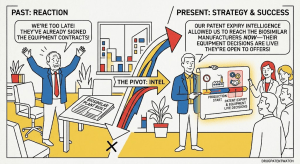
From an equipment sales perspective, a filed BLA means the commercial manufacturing line has already been committed. The applicant’s process is locked. Their equipment is in place. You are too late for the initial commercial build.
But a filed BLA also signals that the company’s pipeline planning has shifted. They are now thinking about their second product, their capacity expansion for the first product if launch goes well, or their technology transfer to a contract manufacturing partner for geographic expansion. Those are the conversations you want to be in.
The pre-BLA stage — roughly 12 to 36 months before filing — is where equipment decisions are live. Companies in that stage are completing comparability studies, finalizing their process development platform, and building out their commercial manufacturing space. That is when a single-use supplier can influence the outcome.
Orange Book and Purple Book as Prospecting Databases
The FDA’s Purple Book lists all licensed biological products including their biosimilar application status and approval dates. Cross-referencing the Purple Book with DrugPatentWatch data gives you a complete picture of which molecules are approaching their biosimilar window and which developers are already in the race.
The practical prospecting workflow looks like this. First, pull the list of biologics with patent expirations in the three- to six-year horizon from DrugPatentWatch. Second, cross-reference against the Purple Book to identify which of those molecules already have active 351(k) applications and which do not. Molecules with no active biosimilar applications but patent cliffs in three to four years represent the highest-value prospecting targets, because their manufacturing decisions are still open.
Third, identify the companies most likely to develop biosimilars for those molecules by looking at their existing biosimilar portfolio. A company that already makes two oncology biosimilars is a more likely developer of a third than a company with no oncology history. That company is your target account for a sales conversation today.
Who to Pitch and When
The Decision-Making Hierarchy in Biosimilar Manufacturing
Equipment purchasing decisions in biosimilar manufacturing involve four distinct stakeholder groups, each responding to different arguments at different times in the development timeline.
Process development scientists make the earliest decisions. They are evaluating bioreactor platforms, cell culture media systems, and downstream process equipment during the research and development phase, typically two to four years before commercial launch. They care about technical performance, scale-down fidelity, and supplier responsiveness to custom configurations. Your application specialist and field application engineer are the right relationship owners at this level.
Manufacturing engineers make the scale-up decisions. They evaluate equipment performance at 200- to 2,000-liter scale, supplier lead times, installation qualification support, and total cost of ownership. They work on 12- to 18-month procurement cycles. A supplier who has already built a relationship with the process development team has a significant advantage here, because the manufacturing engineer will ask the process scientists for their recommendation.
Regulatory affairs directors evaluate how equipment choices affect the CMC section of their BLA. They are not selecting equipment themselves, but they have veto power. A supplier whose single-use systems have an established regulatory track record, documented E&L data, and a history of successful FDA inspections is far easier to defend in a CMC package than one whose systems are novel to the FDA.
The fourth group is the CFO or head of corporate development. They approve capital budgets. The argument that lands here is total cost of ownership over the product’s commercial lifetime, break-even analysis relative to stainless steel alternatives, and capital efficiency.
When CMOs Are Your Real Customer
A large fraction of biosimilar development is outsourced to contract development and manufacturing organizations (CDMOs). Companies like Samsung Biologics, Lonza, Wuxi Biologics, Boehringer Ingelheim Biopharmaceuticals, and Fujifilm Diosynth Biotechnologies are manufacturing biosimilars on behalf of dozens of sponsors who do not have their own biologics manufacturing infrastructure.
For an SUS supplier, CDMOs offer leverage that individual biosimilar sponsors do not. A CDMO that adopts your single-use platform as a preferred system does not just buy equipment for one product. They potentially deploy your hardware across every biosimilar client program they take on for the next five to ten years. A preferred vendor relationship with a top-tier CDMO is worth more than fifty individual sponsor accounts.
The pitch to a CDMO is different from the pitch to a sponsor. A CDMO’s primary concern is not their own product portfolio. Their concern is offering clients the fastest, most cost-competitive, and most regulatory-robust manufacturing platform available. Single-use systems that reduce changeover time between client campaigns, minimize cross-contamination risk across client products, and offer a well-documented regulatory track record are directly valuable to a CDMO’s business model.
CDMOs also have procurement cycles that align with their capacity expansion plans, not individual product launch timelines. Tracking CDMO facility announcements, capacity expansion press releases, and partnership announcements with biosimilar sponsors gives you the trigger events for CDMO-focused business development.
Procurement vs. Engineering vs. Regulatory Affairs
The person who signs the purchase order at a biosimilar manufacturer is rarely the person who made the technical decision. Procurement organizations control commercial terms and supplier qualification, but they are executing decisions made upstream by engineering and process development.
The error most SUS suppliers make is working exclusively at the procurement level. Procurement can delay a deal, negotiate price, and create administrative obstacles, but they cannot create demand for your product where it does not already exist in the technical organization. Building relationships with process development and engineering teams before procurement is engaged is the approach that wins preference.
A technical preference built with process development scientists does not automatically convert to a commercial agreement if your company has not completed vendor qualification. Starting the supplier qualification process early, before the formal RFQ stage, removes a barrier that otherwise creates last-minute procurement delays.
Building the Business Case
Speed-to-Market ROI
The financial argument for single-use systems in biosimilar manufacturing is most compelling when you frame it in terms of time to first commercial batch. A biosimilar manufacturer who reduces their manufacturing scale-up timeline by four months captures four months of market exclusivity ahead of a competitor. In a market where the first two or three biosimilar entrants typically capture 70 to 80 percent of the biosimilar market share within 12 months of launch, four months can represent tens of millions of dollars in cumulative revenue difference. [6]
A single-use facility can be commissioned and validated in 12 to 18 months from groundbreaking. An equivalent stainless steel facility typically requires 24 to 36 months. The difference in time to first commercial batch, assuming parallel process development, is often 12 months or more. Translating that time advantage into a revenue impact model — specific to your prospect’s target molecule and market — is the most effective business case you can make to a biosimilar manufacturer’s leadership team.
Total Cost of Ownership vs. Upfront CapEx
A common objection to single-use systems is the recurring consumables cost. A bioreactor bag that is used once and discarded is more expensive per batch than a stainless steel vessel that is cleaned and reused thousands of times. That objection is valid for very high-volume, long-lifetime manufacturing scenarios. It is less valid for the cost structure of a biosimilar manufacturer who plans to make 50 to 200 commercial batches per year for a product with a commercial lifetime of 8 to 15 years before further biosimilar competition commoditizes the market.
The total cost of ownership model for single-use versus stainless steel must account for capital depreciation, cleaning validation and cleaning operations, cross-contamination risk mitigation, downtime costs, maintenance labor, and the cost of capital committed to the facility. When all those factors are included, single-use systems are cost-competitive for batch sizes up to approximately 2,000 liters, which covers the majority of biosimilar antibody manufacturing scenarios. [7]
Building a customized TCO model for your prospect, using their publicly disclosed pipeline, their target markets, and realistic batch cost assumptions, is more persuasive than a generic white paper comparison. It also demonstrates that your organization understands biosimilar manufacturing economics in a way that a purely technical vendor pitch does not.
Regulatory Compliance as a Product Feature
The regulatory environment for biosimilar manufacturing has tightened since the BPCIA was enacted in 2010. FDA has progressively increased its expectations for process characterization, comparability demonstration, and manufacturing control strategy documentation. The 2021 FDA guidance on comparability protocols for biological products and the 2022 guidance on analytical procedures for biosimilar development both impose higher documentation standards that translate directly into manufacturing system requirements. [8]
Single-use systems from established suppliers come with a documentation package designed to support CMC regulatory filings. That includes extractables and leachables data packages, equipment validation support protocols, regulatory support letters, and in many cases direct FDA consultation history for the specific equipment types. Position that documentation package as a feature with a measurable value: a regulatory affairs team that would otherwise spend 200 hours generating E&L data in-house, at a burdened labor cost of $150 per hour, saves $30,000 per product per manufacturing system when the supplier provides that data.
The Competitive Landscape for SUS Suppliers
Where the Big Players Focus
The large-volume single-use bioprocessing market is dominated by four suppliers: Sartorius Stedim Biotech, Cytiva, Thermo Fisher Scientific, and Merck KGaA (MilliporeSigma in North America). These companies have established preferred vendor status at most large CDMOs and major biopharma manufacturers through years of technical collaboration, regulatory documentation support, and global supply chain infrastructure.
Sartorius has positioned its Biostat STR single-use bioreactor line as a standard for CHO cell culture scale-up, particularly in the 200- to 2,000-liter range that dominates biosimilar antibody manufacturing. Cytiva’s Xcellerex platform competes directly in that range. Thermo Fisher’s HyPerforma platform has captured significant market share through bundling with cell culture media and process analytical technology.
For a smaller or specialized SUS supplier, competing head-to-head with these platforms on bioreactor performance is difficult. The regulatory documentation that the large suppliers can provide, built on decades of FDA inspection history, creates a switching cost that is not easy to overcome on technical merits alone.
Where Smaller Suppliers Can Win
The downstream processing segment of the single-use market is less concentrated than the bioreactor segment. Single-use filtration, mixing, connectors, and chromatography all have competitive landscapes where mid-size suppliers can establish meaningful market positions.
Biosimilar manufacturers also have specific process needs that the largest suppliers are sometimes slow to address. Highly concentrated antibody formulations, continuous manufacturing approaches, and novel cell culture media systems all represent technical areas where a specialized supplier with deep application expertise can displace a larger generalist.
Geographic market segmentation is another path. Biosimilar manufacturing in India, South Korea, and China involves procurement decisions that are not always controlled by the same global purchasing agreements that govern manufacturing in the United States and Europe. A supplier with strong local technical support, fast delivery from regional warehouses, and pricing adapted to emerging-market cost structures can build a position that a large global supplier with centralized service infrastructure cannot easily match.
Common Pitch Mistakes
Leading with Features Instead of Manufacturing Pain
The most common failure mode in SUS sales pitches to biosimilar manufacturers is leading with product specifications. Bioreactor volume, mixing efficiency, oxygen transfer rate, sparger design — these are important technical parameters, but they are not the arguments that create urgency or build preference in a procurement decision.
The argument that creates urgency is: here is what happens to your launch timeline and your market share if your manufacturing scale-up takes 24 months instead of 12. The argument that builds preference is: here is the documentation package that reduces your regulatory risk in the CMC section of your BLA. Start with the business problem, then connect your product’s technical features to the solution.
The same principle applies to pricing conversations. A biosimilar manufacturer who has internalized the time-to-market ROI framework is not optimizing against the unit price of a bioreactor bag. They are evaluating total cost relative to total value over the commercial manufacturing lifetime of the product. A supplier who enters pricing negotiations with a total cost of ownership model is having a different conversation than one who is defending a line-item price against a competitor.
Ignoring the Reference Biologic’s Manufacturing History
A biosimilar developer trying to replicate a monoclonal antibody originally made in a specific CHO cell line under specific process conditions has a process development challenge that shapes every manufacturing decision they make. The reference biologic’s manufacturing history — largely public through the FDA approval package, peer-reviewed literature, and patent filings — tells you what process conditions the originator used and where the biosimilar developer will likely need to deviate.
If the reference biologic was produced at low temperature with a specific dissolved oxygen setpoint that is difficult to maintain in large-scale stainless steel systems, that is a process argument for single-use bioreactors with better dissolved oxygen control. If the reference product required a specific buffer exchange process at high concentration, that is an argument for your single-use tangential flow filtration system with specific membrane geometry.
Preparing a reference biologic manufacturing analysis before your first pitch call takes perhaps four hours of research. It demonstrates a level of technical engagement that generic equipment vendors never achieve, and it positions your company as a process partner rather than a commodity supplier.
Arriving Late in the Development Cycle
The most expensive mistake is the most common: contacting a biosimilar developer after they have already selected their equipment platform. At that stage, you may win a small accessory order or establish a relationship for the next product in their pipeline. But you have not won the commercial-scale account, and you have allowed a competitor to build the preferred vendor relationship that will influence every future procurement decision.
The corrective action is systematic. Build a patent expiry-based prospecting calendar that identifies biosimilar development programs at the three- to five-year pre-launch stage. Map those programs to the companies most likely to develop them. Make first contact at the process development stage, before manufacturing scale-up begins. Sustain that relationship through technical engagement — sample kits, application data, field application engineer support — so that when the engineering team is ready to select commercial equipment, your system is the reference point.
Case Studies in Timing
Adalimumab Biosimilars and the Single-Use Opportunity
Humira (adalimumab) lost its final significant U.S. patent protection in January 2023 after AbbVie’s patent settlement agreements with biosimilar developers expired. By that date, seven adalimumab biosimilars had already received FDA approval, and several more were in the review pipeline. The manufacturers who secured commercial market share in the first 12 months of the open market had committed their manufacturing capacity in 2019 and 2020. [9]
Companies like Alvotech, Sandoz, Coherus BioSciences, and Organon used single-use manufacturing platforms in their adalimumab process development and scale-up, specifically because the lower capital requirement allowed them to build commercial capacity without the $100 million-plus investment that a stainless steel facility would have required for a product where the competitive outcome was uncertain.
The SUS suppliers who captured those accounts did so between 2018 and 2021 — not after AbbVie’s patents fell. The business development work that generated those commercial supply agreements started when adalimumab’s patent landscape was being actively litigated, long before the market opened.
Trastuzumab Biosimilars and CDMO Relationships
Herceptin (trastuzumab) biosimilars represent one of the largest biosimilar market opportunities in oncology. By 2023, multiple trastuzumab biosimilars had reached global markets, manufactured by a combination of vertically integrated developers and CDMOs. [10]
The CDMOs who captured trastuzumab biosimilar manufacturing contracts, particularly in the U.S. and European markets, built their preferred vendor relationships with SUS suppliers well before the manufacturing programs were active. In several documented cases, CDMO capacity expansion decisions timed to coincide with the trastuzumab biosimilar market opening incorporated single-use bioreactor platforms from established suppliers who had spent the previous two to three years co-developing process optimization protocols with the CDMO’s technical team.
That co-development relationship is the commercial strategy, not an incidental outcome. A SUS supplier who invests 18 to 24 months of application engineering and technical collaboration with a CDMO during the pre-launch phase of a major biosimilar market creates a switching cost that a competitor cannot overcome with a lower price at the RFQ stage.
Building a Patent-Aware Business Development Pipeline
Setting Up Monitoring and Triggers
A systematic patent-aware business development program requires three categories of monitoring: patent expiry tracking, biosimilar application status tracking, and company-level development milestone tracking.
For patent expiry, DrugPatentWatch provides email alerts for specific molecules and can be queried for all biologics with expirations in a specified timeframe. Setting up a quarterly review of all biologics with patent expirations in the three- to six-year horizon, filtered by product class and therapeutic area relevant to your equipment’s application strengths, gives you a rolling prospecting list.
For biosimilar application status, the FDA’s Purple Book is updated regularly and shows the status of all 351(k) applications. Monitoring for new biosimilar application filings for your target molecules gives you a signal that a developer has reached the commercial manufacturing stage. For those same developers, tracking earlier regulatory submissions — IND filings disclosed in SEC filings for public companies and in press releases for private companies — gives you an earlier signal still.
Company-level milestone tracking requires monitoring press releases, conference presentations, and scientific publications for biosimilar developers in your target portfolio. A company that publishes a process development abstract at BioProcess International is telling you their process development timeline. A company that announces a CDMO partnership for a specific biosimilar is telling you which CDMO to call.
Integrating Patent Intelligence with Your CRM
The value of a patent-aware prospecting calendar is realized only if it is integrated with your commercial team’s activity management. Patent expiry dates and biosimilar application status should be fields in your CRM for every biopharma account, not just notes in a spreadsheet.
Create a custom object or field set in your CRM that tracks, for each account, their disclosed biosimilar pipeline, the patent status of each pipeline molecule pulled quarterly from DrugPatentWatch, the estimated manufacturing decision window for each program, and the current relationship depth with the relevant technical and business decision-makers.
With that structure, your quarterly business review can shift from reporting on lagging indicators — deals closed, revenue booked — to leading indicators: accounts in the active manufacturing decision window, relationship stage with key decision-makers at target biosimilar developers, and the number of accounts entering the two-to-three-year pre-launch prospecting window this quarter. That shift, from reporting on what has already happened to managing what is about to happen, is the structural advantage that a patent-aware BD program creates over a reactive sales organization.
Key Takeaways
Equipment decisions for biosimilar manufacturing are made 24 to 36 months before commercial launch, not at launch. Business development activity must precede those windows.
Patent expiry data from DrugPatentWatch is a forward-looking prospecting tool. Molecules with patent cliffs three to five years out represent the active prospecting universe.
Single-use systems offer biosimilar manufacturers four measurable advantages: faster facility commissioning, lower capital expenditure, reduced cleaning validation burden, and regulatory documentation support. Lead your pitch with the business impact of those advantages, not the technical specifications.
The BLA filing date is too late for initial commercial equipment sales. The process development and manufacturing scale-up stages, which begin one to three years before BLA submission, are the target windows.
CDMOs are the highest-leverage accounts in the biosimilar SUS market. A preferred vendor relationship with a top-tier CDMO multiplies across every client program they take on.
Integrating patent expiry data and biosimilar pipeline status into your CRM converts prospecting from reactive to systematic and gives sales leadership leading indicators that reflect the actual purchase cycle in this market.
FAQ
Q1: How do I identify which biosimilar developers are making manufacturing equipment decisions right now, before they publicly announce their programs?
Cross-reference DrugPatentWatch’s patent expiry data for biologics with expirations in the two- to four-year horizon against the FDA’s Purple Book. Molecules that have no active 351(k) applications but are within two years of their patent cliff are likely to have developers in active but undisclosed process development. Company hiring data on LinkedIn, specifically posted roles for process development scientists and manufacturing engineers at biosimilar companies, is often the earliest public signal of an active manufacturing build. Developers also present early process development data at bioprocessing conferences before they disclose programs in regulatory filings.
Q2: What is the right way to approach a biosimilar developer who already has a preferred SUS supplier?
Do not try to displace the preferred supplier for the current program. Instead, enter the relationship at the process development level for the developer’s next pipeline molecule. Offer a no-cost technical collaboration — sample kits, application data, and field application engineering support — for the new program. Build the technical preference before procurement is engaged. Most biosimilar developers are not locked into a single SUS vendor contractually for new programs, even if they have a strong incumbent relationship. The switching cost is lower at the beginning of a new program than mid-stream in an existing one.
Q3: How does the regulatory documentation package from an SUS supplier reduce a biosimilar developer’s BLA preparation burden?
The manufacturing section of a biosimilar BLA requires the applicant to characterize the extractables and leachables profile of every single-use component that contacts the drug substance or drug product. An established SUS supplier provides a comprehensive E&L data package, generated using standardized extraction protocols and analytical methods, that the applicant can reference directly in their CMC submission. Without that package, the applicant’s analytical chemistry team must generate the data themselves, which requires months of method development and validation. The supplier’s package also includes a regulatory support letter that FDA reviewers recognize, which reduces the likelihood of deficiency questions in the manufacturing section of the BLA.
Q4: How should a regional or specialty SUS supplier compete against Sartorius, Cytiva, and Thermo Fisher in a biosimilar account?
Compete on specificity, not breadth. Identify the process step where your equipment has a genuine technical advantage over the large suppliers — a specific filtration application, a mixing challenge, or a formulation step. Build a case study with a reference customer that demonstrates that advantage in a documented, quantified way. Large suppliers win on standard processes. Non-standard processes, atypical molecules, continuous manufacturing approaches, and highly concentrated formulations are areas where a specialized supplier can build a defensible position. Geographic coverage in markets like India and South Korea, where large suppliers have less dense technical support infrastructure, is another viable path.
Q5: What should the first meeting with a biosimilar developer’s process development team accomplish?
The ideal first meeting is a technical exchange, not a sales presentation. Come prepared with a reference biologic manufacturing analysis that identifies the specific process challenges the developer will likely face in replicating the originator’s product attributes. Ask about their process development platform strategy and current equipment preferences without leading with your own product. The goal is to establish technical credibility and learn enough about their specific development challenges to propose a meaningful follow-up — a joint process development experiment, a sample kit evaluation, or an application engineering workshop. A first meeting that ends with a clear follow-up action tied to the developer’s actual technical problem is the foundation for a preferred vendor relationship.
References
U.S. Food and Drug Administration. (2019). Considerations in demonstrating interchangeability with a reference product: Guidance for industry. FDA. https://www.fda.gov/media/124907/download
IQVIA Institute for Human Data Science. (2023). The global use of medicines 2023: Outlook to 2027. IQVIA. https://www.iqvia.com/insights/the-iqvia-institute/reports/the-global-use-of-medicines-2023
Weise, M., Bielsky, M. C., De Smet, K., Ehmann, F., Ekman, N., Narayanan, G., Heim, H. K., & Schneider, C. K. (2011). Biosimilars: Why terminology matters. Nature Biotechnology, 29(8), 690-693. https://doi.org/10.1038/nbt.1936
Langer, E. S. (2020). Trends in single-use technologies: Adoption, applications, and economics. BioProcess International, 18(3), 12-19.
U.S. Food and Drug Administration. (2022). Pharmaceutical quality/manufacturing standards (CGMP). FDA. https://www.fda.gov/drugs/pharmaceutical-quality-resources
Association for Accessible Medicines. (2023). U.S. generic and biosimilar medicines savings report. AAM. https://accessiblemeds.org/resources/reports/2023-us-generic-biosimilar-medicines-savings-report
Jacquemart, R., Vandersluis, M., Zhao, M., Sukhija, K., Sidhu, N., & Stout, J. (2016). A single-use strategy to enable manufacturing of affordable biologics. Computational and Structural Biotechnology Journal, 14, 309-318. https://doi.org/10.1016/j.csbj.2016.08.002
U.S. Food and Drug Administration. (2022). Analytical procedures and methods validation for drugs and biologics: Guidance for industry. FDA. https://www.fda.gov/media/87801/download
U.S. Food and Drug Administration. (2023). Biosimilar product information: Adalimumab. FDA Purple Book. https://www.fda.gov/drugs/biosimilars/biosimilar-product-information
World Health Organization. (2022). Biotherapeutic products including biosimilars. WHO. https://www.who.int/teams/health-product-policy-and-standards/standards-and-specifications/biotherapeutics-including-biosimilars