How commercial manufacturing costs actually get built, what drives them, how CDMOs protect their pricing through IP assets, and what your team should do about it before the RFP goes out.
The CDMO Market in 2026: Size, Concentration, and IP Leverage
The global CDMO market sat at approximately $239 billion in 2024. By 2032, Fortune Business Insights projects it reaches $465 billion at a 9.0% CAGR. Those figures are well-circulated at this point, and they tell one part of the story: the sector is large and growing. What they obscure is the structural concentration inside the market and why that concentration gives a handful of CDMOs outsized pricing power over their clients.
The top 10 CDMOs, including Lonza, Samsung Biologics, Catalent (now absorbed into Novo Holdings after the $16.5 billion acquisition closed in late 2024), WuXi Biologics, and Thermo Fisher’s Pharma Services division, collectively control the majority of large-molecule commercial manufacturing capacity. For sterile fill-finish of biologics, that concentration is even tighter. A sponsor seeking validated commercial-scale mammalian cell culture capacity above 10,000 liters does not have dozens of viable partners. They have a short list, and those on the short list know it.
$465BGlobal CDMO market by 2032
9.0%Projected CAGR 2024-2032
13-17%Mfg. as % of biopharma R&D budget
30-50%APAC labor cost discount vs. US
Why Capacity Concentration Is a Pricing Signal, Not Just a Supply Risk
Capacity concentration matters beyond the obvious supply chain anxiety it triggers. When a CDMO holds the dominant share of validated commercial-scale stainless steel bioreactor capacity for a specific molecule class, such as CHO-derived monoclonal antibodies in the 12,000-liter range, that physical asset doubles as a pricing moat. The CDMO does not need to articulate this in a contract. The sponsor recognizes it during the feasibility phase, when the field of qualified vendors narrows to two or three, and the negotiation dynamic shifts accordingly.
Several large CDMOs have reinforced this structural advantage by embedding proprietary platform technologies into their manufacturing processes. Lonza’s IBEX Dedicate program, Samsung Biologics’ high-titer cell line development platform, and WuXi Biologics’ WuXiUP process intensification platform each create a form of technical lock-in. Once a sponsor’s BLA references a specific CDMO’s process, switching requires supplemental filings, new comparability studies, and potentially bridging clinical data. The regulatory cost of switching is real, measurable, and factors into every renegotiation.
Investment Strategy Note: Capacity as a Valuation Input
Portfolio managers evaluating CDMO stocks or private CDMO assets should treat validated commercial capacity utilization rates as a primary valuation input, not a supporting metric. A CDMO operating at 85%+ bioreactor utilization on multi-year commercial contracts has pricing power that is durable and not easily eroded by new entrants. Greenfield bioreactor capacity takes four to seven years from groundbreaking to commercial GMP readiness; that timeline is a structural barrier to new competition.
The Novo Holdings acquisition of Catalent illustrates the thesis: Novo paid a premium not just for Catalent’s fill-finish lines but for the regulatory pedigree of those lines and the BLA cross-references that make them difficult to replace mid-lifecycle.
The Shift from Transactional CMO to Platform-Embedded CDMO
A decade ago, many biopharma companies selected contract manufacturers on price and available slots. That model worked when the products in question were small-molecule generics or biosimilars with commodity-like process requirements. The pipeline has shifted. Between 2020 and 2025, the FDA approved more biologics, ADCs, and cell and gene therapies than in the prior decade combined. Each of those modalities requires manufacturing partners with deep process expertise, not just floor space.
CDMOs responded by investing ahead of demand, building out capabilities in antibody-drug conjugates, lipid nanoparticle formulation, viral vector production, and continuous bioprocessing. Those capital expenditures are not charity. They appear, predictably, in commercial manufacturing quotes. Understanding that pricing relationship, what a CDMO paid to build a capability versus what they charge you to use it, is the foundation of effective benchmarking.
Key Takeaways: Market Context
The top 10 CDMOs control the majority of large-scale biologic manufacturing capacity, creating structural pricing leverage.
Technical lock-in through BLA process references makes mid-lifecycle CDMO switching financially and regulatorily expensive.
Validated commercial-scale bioreactor utilization is a leading pricing power indicator for analysts valuing CDMO assets.
Proprietary platform technologies (Lonza IBEX, Samsung high-titer cell lines, WuXi WuXiUP) embed switching costs directly into the manufacturing relationship.
CDMO capital investment in emerging modalities (ADC, LNP, viral vectors) flows through to commercial pricing; sponsors who understand this can negotiate more precisely.
The Five Pricing Models: Architecture and Fault Lines
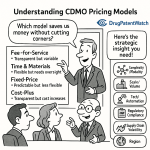
CDMOs do not use a single pricing structure. The model a CDMO proposes for a given project reflects risk allocation preferences, project stage, and how accurately both parties can define scope at the time of contracting. Each model has predictable failure modes that show up in audits, renegotiations, and arbitration proceedings.
Fee-for-Service
Fee-for-Service (FFS) bills discrete services at agreed rates: a formulation development run, a stability timepoint pull, an analytical method transfer package. The appeal is transparency at the line-item level. The risk is that FFS contracts, especially in process development stages, are difficult to scope in advance. When the scope expands, as it almost always does in novel molecule programs, each increment requires a change order. Change orders carry their own overhead, both administrative and financial. Sponsors who start an FFS engagement without a robust change order governance framework consistently report that the final invoice bears little resemblance to the original quote.
Time and Materials
Time and Materials (T&M) billing charges actual labor hours at agreed FTE rates plus pass-through material costs, often with a handling markup of 10-15%. T&M suits early-phase work where the experimental path is genuinely uncertain. It is a poor fit for commercial manufacturing, where the process is defined and labor estimates should be calculable. CDMOs occasionally propose T&M for commercial campaigns involving difficult APIs or novel processes to transfer risk back to the sponsor. Sponsors should treat a T&M proposal for commercial manufacturing as a signal that the CDMO is not confident in their cost estimate, and press for fixed-price commitment on validated unit operations.
Fixed-Price Contracts
Fixed-price contracts define a total cost for a defined scope. They provide budget certainty and are the most common structure for commercial manufacturing campaigns. The ceiling on certainty is only as good as the scope definition. CDMOs build contingency into fixed-price bids, typically 10-20% for well-characterized processes and higher for novel or complex manufacturing steps. That contingency is not disclosed as a line item. It is embedded in batch costs, overhead allocations, and QC labor rates. Sponsors who accept fixed-price proposals without challenging the assumptions behind them are, in effect, paying for the CDMO’s risk aversion.
Cost-Plus
Cost-plus structures add an agreed margin, often 15-25%, to the CDMO’s actual costs of production. The model creates theoretical transparency about underlying costs, but it requires the sponsor to have real audit rights and the will to exercise them. Without active cost auditing, cost-plus arrangements can become as opaque as any other model because overhead allocation methodologies vary widely and are rarely neutral. A CDMO can legitimately allocate facility depreciation, regulatory affairs overhead, or shared QA costs across cost-plus contracts in ways that inflate the cost base while remaining technically compliant with contract terms.
Milestone and Performance-Based Payments
Milestone-based contracts tie payments to defined deliverables: successful completion of a validation batch, PPQ execution, or regulatory submission. They are common in development-stage agreements and increasingly appear in commercial contracts for novel therapy areas where batch success rates remain variable. The design challenge is milestone definition. Vague milestones, such as ‘satisfactory completion of process development,’ generate disputes. Milestones should specify acceptance criteria, measurement methods, timelines for sponsor review, and consequences for missed timelines by either party.
Pricing Model
Best Fit
Key Risk for Sponsor
Key Risk for CDMO
Fee-for-Service
Early development, discrete analytical tasks
Scope creep via change orders
Scope under-delivery at fixed unit rate
Time & Materials
Research, novel process development
Labor hour inflation, runaway cost
Client disputes on billable hours
Fixed-Price
Commercial campaigns, validated processes
Embedded CDMO risk contingency
Scope ambiguity leading to losses
Cost-Plus
Long-term strategic partners with audit rights
Overhead allocation manipulation
Margin compression under aggressive audits
Milestone/Performance
Novel therapies, development-to-commercial bridge
Ambiguous milestone definitions
Technical failure triggers non-payment
Key Takeaways: Pricing Models
No single pricing model is appropriate for all stages of a CDMO relationship. Use milestone structures at development stage, fixed-price at commercial scale.
Fixed-price contingency buffers of 10-20% are industry standard and not disclosed. Sponsors can negotiate them down by providing thorough process documentation and validated analytical packages at RFP.
T&M for commercial manufacturing is a risk-transfer tactic by the CDMO, not a default structure. Push for fixed-price commitment on any validated unit operation.
Cost-plus contracts require real audit rights with defined audit cadence and agreed overhead allocation methodologies written into the MSA before work begins.
Nine Cost Drivers That Actually Move the Number
The factors below are not equally weighted across all programs. For a small-molecule oral solid dose product, API complexity and batch scale dominate. For a cell and gene therapy, facility type and batch release testing overhead are the primary cost drivers. Mapping the relevant drivers to your specific program before issuing an RFP is the single most effective benchmarking discipline a procurement or IP team can adopt.
API Complexity and Synthesis Route Maturity
The synthetic complexity of an active pharmaceutical ingredient is measured practically by the number of steps in the route, the use of controlled reagents, the handling requirements for intermediates, and the overall process mass intensity (PMI). A ten-step synthesis with a PMI above 100 kg/kg will cost materially more per kilogram of API than a four-step route with a PMI under 30, even at comparable batch scale. CDMOs price API manufacturing on total synthetic burden, not just end-product yield.
Route maturity matters as much as route complexity. A sponsor presenting a freshly optimized lab-scale synthesis with no demonstrated kilo-lab or pilot-scale history is asking the CDMO to assume development risk inside a commercial pricing envelope. CDMOs rarely do this without a substantial contingency premium. Sponsors who invest in kilo-lab demonstration batches before issuing a commercial manufacturing RFP get materially better pricing.
Dosage Form and Fill-Finish Requirements
Sterile injectables carry the highest manufacturing cost premium in the small-molecule space, driven by aseptic fill-finish requirements, cleanroom capital depreciation, and the extensive environmental monitoring programs mandated by FDA and EMA. Lyophilized products add a further layer of capital intensity and cycle-time cost because lyophilization is a batch-and-hold process that ties up equipment for 40-80 hours per cycle.
Highly Potent APIs (HPAPIs) require contained manufacturing at OEB4 or OEB5 levels. Those containment systems cost roughly $2,000 to $8,000 per square meter to build and operate at cGMP standard. CDMOs with dedicated HPAPI facilities amortize that capital into their unit costs. Sponsors bringing HPAPI products to CDMOs without dedicated containment should expect surcharges of 25-40% over standard facility rates, not because the CDMO is price-gouging, but because temporary containment installation and validation is genuinely expensive.
Batch Scale and Production Frequency
Economies of scale in pharmaceutical manufacturing are real but non-linear. Fixed batch costs, comprising equipment setup, CIP/SIP validation, environmental monitoring, and QC batch release testing, are largely constant regardless of batch size within a given facility class. Doubling batch size does not double those fixed costs. It roughly holds them constant while doubling the units produced, cutting per-unit cost substantially. The practical implication is that sponsors with commercial demand sufficient to support large batches and frequent campaigns have materially lower per-unit costs than those running small, infrequent batches in multi-product facilities.
The cost cliff at low volumes is steep. A commercial batch of 10,000 units of a complex biologic in a 2,000-liter bioreactor might carry the same fixed cost structure as a 100,000-unit batch. At 10,000 units, QC release testing alone can represent 15-25% of total batch cost. At 100,000 units, the same QC cost drops to 2-4% of total. This dynamic disproportionately burdens rare disease and orphan drug programs, which structurally operate at low volumes regardless of commercial success.
Technology Requirements and Facility Class
CDMOs invest in specific technological capabilities and recover those investments through pricing. A sponsor requiring single-use bioreactor manufacturing at 500 liters for Phase III scale-up and commercial launch is accessing infrastructure that a top-tier CDMO might have $40-80 million invested in, including the single-use component inventory, clean utilities, and validated process control systems. That investment appears in the batch cost, not as a separate capital charge.
Continuous bioprocessing, which several CDMOs including Lonza and Fujifilm Diosynth have invested in heavily, reduces batch cycle time and can lower per-gram protein cost by 20-35% compared to conventional fed-batch processes for high-titer mAbs. CDMOs offering continuous manufacturing can price competitively per gram while maintaining healthy margins, because their throughput per square meter of manufacturing space is substantially higher. Sponsors who know this can use continuous manufacturing capability as a negotiating fulcrum against CDMOs still operating conventional fed-batch processes.
Regulatory Compliance Overhead and Inspection History
cGMP compliance is not a binary state. A CDMO with a spotless FDA inspection record, no Warning Letters in the past ten years, and proactive compliance investment is worth a pricing premium because their regulatory risk exposure to the sponsor is low. A CDMO with a recent Form 483 citing Data Integrity observations introduces potential regulatory risk into any product they manufacture. If your BLA references their facility and they receive a Warning Letter before your approval, you have a problem that no contract clause fully solves.
Regulatory support services, including preparation for pre-approval inspections (PAIs), BLA/NDA CMC sections, and post-approval change management through Prior Approval Supplements or CBE-30 notifications, are often quoted as separate line items or bundled ambiguously. The total cost of a PAI support package from a major CDMO routinely runs $150,000 to $400,000 depending on program complexity and geographic filing scope (FDA, EMA, PMDA, Health Canada simultaneously). That cost belongs in your CDMO cost model from the outset.
Location and Labor Market
Geographic location affects CDMO pricing through labor rates, utility costs, real estate, and local regulatory compliance requirements. US-based CDMOs with cGMP manufacturing in biotech hubs such as Research Triangle Park, San Francisco Bay Area, or the Boston-Cambridge corridor operate at labor rates of $90-$160 per hour for specialized process technicians, $200-$300 per hour for regulatory affairs professionals. European CDMOs in Germany, Switzerland, and the UK operate at broadly similar rates for comparable roles. CDMOs in Ireland benefit from a lower corporate tax environment and EU market access, with labor rates moderately below the UK average.
APAC CDMOs, primarily in China and India, offer labor cost advantages of 30-50% on comparable roles. WuXi Biologics, Zhejiang Hisun, and Sun Pharma’s CDMO operations have used those cost advantages to grow market share in API manufacturing and increasingly in early-phase biologics development. The cost arbitrage is real. So is the complexity: FDA and EMA inspection coverage of APAC facilities has intensified post-COVID, IP protection frameworks differ materially from US and EU standards, and logistics lead times add 2-4 weeks to commercial supply chains. Those factors are quantifiable and should be included in any total cost of ownership analysis.
Raw Material Sourcing and Supply Chain Structure
Raw material costs in biologic manufacturing include cell culture media, single-use consumables, chromatography resins, and buffer chemicals. For a commercial mAb program, single-use bioreactor bags, filters, and tubing can represent 15-25% of variable manufacturing cost. Resin costs for Protein A affinity chromatography, the workhorse capture step for mAbs, run $5,000-$15,000 per liter of resin depending on supplier and cycle number validation. CDMOs who own preferred supplier relationships or have negotiated volume pricing from Cytiva, Sartorius, or Merck KGaA can pass those savings on, or they can use them to widen their margin. Your contract should specify whether material cost savings are shared.
Quality Control and Batch Release Testing
Batch release testing for complex biologics is not a commodity service. A full release test package for a parenteral biologic product, covering identity, purity, potency, sterility, endotoxin, particulates, and appearance, plus product-specific assays such as glycan profiling, charge variant analysis, or bioassay, routinely costs $15,000-$45,000 per batch depending on assay complexity. Biosafety testing for cell and gene therapy products, including RCL/RCA testing, mycoplasma, and adventitious agents, can push batch release costs above $80,000 per lot.
Sponsors often underestimate the recurring nature of these costs across the product lifecycle. For a commercial biologic releasing 24 batches per year, a $25,000 batch release cost is $600,000 annually, a line item that rivals some CDMO contract management fees. Challenging the CDMO to use platform analytics, automated release testing, or real-time release testing (RTRT) frameworks where FDA-accepted can yield 20-35% reductions in QC cost per batch.
Capacity Reservation and Scheduling
Commercial manufacturing capacity in high-demand modalities is a constrained resource. CDMOs sell it through capacity reservation agreements that typically require the sponsor to commit to minimum annual batch volumes and accept take-or-pay penalties for shortfalls. The financial structure of a capacity reservation agreement is often more consequential than the per-batch price. A sponsor who reserves 12 bioreactor campaigns per year at $800,000 per campaign and then only needs 7 will pay $4 million in take-or-pay penalties while also paying for actual manufacturing, a total cost that dwarfs any unit cost savings achieved in negotiation.
Key Takeaways: Cost Drivers
API route maturity at the time of RFP is a direct pricing lever; kilo-lab demonstration batches reduce CDMO contingency premiums.
HPAPI containment, lyophilization, and sterile fill-finish carry structural cost premiums of 25-40% over standard parenteral manufacturing.
Batch release testing costs for complex biologics run $15,000-$45,000 per lot; CGT products exceed $80,000. These should be modeled as recurring annual costs, not one-time items.
Capacity reservation take-or-pay penalties can exceed per-unit manufacturing cost savings. Model total financial exposure under multiple demand scenarios before signing.
Continuous bioprocessing reduces per-gram protein cost by 20-35% versus fed-batch; use CDMO capability in this area as a benchmarking and negotiation input.
Biologics Manufacturing Cost Roadmap
Biologics manufacturing has a defined technology progression from laboratory cell line development through commercial manufacturing at scale. Each stage has characteristic cost structures, regulatory requirements, and decision points that affect the downstream cost of commercial manufacturing. Teams that understand this roadmap can anticipate cost escalations before they become surprises.
Stage 1 — Cell Line Development (6-18 months)
CHO cell line generation, single-cell cloning, stability assessment, and high-titer clone selection. Typical CDMO cost: $300,000-$800,000. Platform cell lines licensed from CDMO (e.g., Lonza GS CHO, Sartorius CHOseeker) carry royalty obligations that persist into commercial manufacturing, typically 0.1-0.5% of net sales or a per-gram royalty. These terms must be negotiated at the cell line agreement stage, not the manufacturing agreement stage.
Stage 2 — Upstream Process Development (9-18 months)
Bioreactor process optimization, media screening, feed strategy development, and scale-down model qualification. Costs range from $500,000-$1.5 million for a typical mAb program. CDMOs using DoE-driven process development platforms (Ambr 250 high-throughput bioreactors, fed-batch simulation tools) complete this stage faster and with better scale-up predictability than those relying on traditional one-factor-at-a-time approaches.
Stage 3 — Downstream Process Development (6-12 months)
Purification process development covering capture chromatography (Protein A for mAbs), polishing steps (ion exchange, mixed-mode), viral inactivation and filtration, and formulation screening. Resin selection at this stage locks in recurring material costs for the product lifecycle. Protein A resin cycling performance (number of uses per resin lot) directly affects commercial cost per gram; target 100+ cycles at scale, validated with cleaning studies.
First GMP batches, typically at 200-1,000 liter scale for mAbs. Batch costs range from $1.5-$5 million depending on scale and analytical requirements. Comparability studies at each scale transition add $300,000-$600,000. Tech transfer packages for Phase III scale-up should be initiated during Phase II to avoid program-delay risk.
Stage 5 — Process Performance Qualification (PPQ)
Three consecutive PPQ batches at commercial scale demonstrating process consistency. FDA 21 CFR Part 211 and ICH Q7/Q11 requirements mandate full statistical analysis of critical quality attributes (CQAs) across PPQ batches. Cost per PPQ batch ranges from $1.5-$8 million depending on scale and product complexity. Failed PPQ batches require root cause analysis, process adjustments, and typically one or two additional PPQ runs before BLA submission, adding $2-5 million to total program cost.
Once the BLA is approved and the CDMO facility is referenced, per-batch costs stabilize. For a commercial mAb at 2,000-liter scale, total batch cost (manufacturing plus QC release) typically runs $1.5-$4 million. Per-gram costs for high-titer processes (5-10 g/L expression) at scale range from $50-$150 per gram depending on CDMO location, batch frequency, and process complexity. Post-approval manufacturing changes require Prior Approval Supplements or CBE filings; CDMO fees for change management documentation run $50,000-$200,000 per change.
The IP Cost Embedded in Biologic Platform Licensing
Every major CDMO offering biologic development services owns or licenses a portfolio of platform technologies: cell lines, process development tools, analytical platforms, and formulation know-how. These platform assets carry IP that does not expire with a single patent; they are layered portfolios with composition-of-matter claims on cell line constructs, method claims on specific purification sequences, and formulation patents on excipient combinations.
Lonza’s GS Xceed system, based on glutamine synthetase selection technology, has been a commercial cell line platform for decades. The core GS gene technology patents expired years ago, but Lonza has maintained commercial exclusivity through method improvements, CHO host cell line enhancements, and licensing structures that tie platform access to manufacturing agreements. Sponsors who develop their biologics using Lonza’s GS platform and then seek to transfer manufacturing to a competing CDMO discover that the cell line agreement contains restrictions or that the competing CDMO cannot access GS-related know-how without separate licensing. The practical effect is a manufacturing relationship that is more durable, from Lonza’s perspective, than the manufacturing agreement alone would suggest.
IP Due Diligence Point: Before executing a cell line development agreement with any CDMO, have IP counsel review all platform licensing terms, including assignment rights, sublicensing rights to third-party CDMOs, royalty escalation provisions, and change-of-control clauses. Restrictions discovered after BLA filing are expensive to remediate.
Investment Strategy: Biologic CDMO Platform IP Valuation
Analysts valuing CDMO IP portfolios should focus on three asset classes: (1) cell line development platforms with embedded royalty streams tied to commercial manufacturing revenues, (2) process patents on high-performance purification sequences that prevent direct process transfer to competitors, and (3) regulatory master files (Drug Master Files, Biological Master Files) that compress sponsor development timelines and create preferential access to the CDMO’s manufacturing slots.
The royalty stream from platform licensing is high-margin, capital-light revenue. A CDMO generating $50 million annually from platform licensing royalties at 80%+ gross margin is worth a materially different multiple than a CDMO generating the same revenue from manufacturing services at 25-35% gross margin.
Cell & Gene Therapy: The Cost Architecture Problem
Cell and gene therapy (CGT) manufacturing represents the most acute version of the cost-complexity problem in pharmaceutical outsourcing. Autologous cell therapies such as CAR-T products operate as n=1 manufacturing at commercial scale, with each patient’s apheresis product processed individually through a multi-step manufacturing chain. Viral vector manufacturing for gene therapies involves biological systems, specifically baculovirus/Sf9 or HEK293-based AAV production, that are far less predictable than mammalian cell culture for conventional biologics.
Autologous CGT Manufacturing Costs
A commercial autologous CAR-T manufacturing run begins with the sponsor paying for the closed apheresis product collection, T-cell enrichment, genetic modification (typically lentiviral or retroviral vector transduction or ex vivo CRISPR editing), cell expansion, formulation, and cryopreservation, all under patient-specific GMP conditions. The per-patient manufacturing cost for approved commercial autologous CAR-T products sits in the range of $50,000-$150,000 per lot depending on vector system, cell expansion platform, process automation level, and whether manufacturing is centralized or distributed.
CDMOs including Centre for Cellular & Genetic Medicine (at various academic sites), Cellular Dynamics, National Resilience (formerly Resilience), and Thermo Fisher’s Brammer Bio division have built out CGT manufacturing capacity. The competition for that capacity is intense. FDA-licensed commercial CGT manufacturing capacity in the US can be counted in the tens of sites, not hundreds.
Viral Vector Manufacturing: AAV and Lentiviral Cost Drivers
Adeno-associated virus (AAV) manufacturing for gene therapies is notoriously expensive. Per-dose manufacturing costs for AAV-based gene therapies approved through 2024 range from $20,000 to over $400,000 depending on serotype, target titer, patient size, and dose requirement. Yield variability in upstream AAV production, whether using transient transfection in HEK293 cells, baculovirus expression in Sf9, or producer cell line approaches, remains a primary cost driver. Transient transfection yields vary by 5-10x across production runs, directly affecting cost per dose in ways that are difficult to predict and price consistently.
CDMOs with proprietary producer cell line technology for AAV, such as Spark Therapeutics’ Genoptix platform or the producer cell line approaches being developed by companies including Asklepios and 4DMT, can offer materially more consistent batch yields than transient transfection-based CDMOs. Sponsors choosing between CDMOs for AAV manufacturing should request full yield distribution data across the CDMO’s historical production runs for the target serotype at the target scale, not just the mean yield claim in the capabilities deck.
Investment Strategy: CGT Manufacturing IP and Royalty Stack
Gene therapy products carry one of the most complex IP royalty stacks in biopharmaceuticals. A sponsor’s product may require licenses from multiple sources: the viral vector itself (AAV serotype capsid patents), the transgene expression cassette, the manufacturing process for vector production, and potentially the route of administration. CDMOs manufacturing gene therapies may themselves require sub-licenses for vector production methods, and those royalties flow through to manufacturing costs.
Analysts and IP teams should map the complete royalty stack before signing a CGT manufacturing agreement. Aggregate royalty obligations of 8-15% of net sales are common in approved gene therapy products; understanding what portion of that is manufacturing-process-related versus product-related is material to margin forecasting.
Key Takeaways: CGT Manufacturing
Autologous CAR-T per-patient manufacturing cost runs $50,000-$150,000 per lot; cost reduction to $20,000-$30,000 requires process automation and closed-system platforms that most CDMOs have not yet fully validated at commercial scale.
AAV yield variability of 5-10x across production runs makes per-dose cost forecasting unreliable without a large dataset of CDMO production history for the target serotype and scale.
CGT manufacturing royalty stacks are complex; map vector IP, transgene IP, and process method IP separately before signing manufacturing agreements.
Commercial CGT manufacturing capacity is structurally constrained; capacity reservation agreements should be executed earlier in development (Phase I/II) than in conventional biologics programs.
CDMO IP Valuation as a Pricing Lever
CDMO IP portfolios are not background assets. They are core commercial tools that allow CDMOs to defend margins, extend client relationships, and create differentiated pricing in competitive RFP processes. Understanding how a CDMO’s IP is structured, what it covers, and when key patents expire gives sponsors leverage they rarely use.
How CDMOs Protect Process Know-How Through IP
The most commercially significant CDMO IP is not always the most visible. Composition-of-matter patents on cell lines, formulation patents on excipient systems, and method patents on specific purification sequences protect discrete process elements. Trade secrets protect the accumulated know-how of process development teams, including the specific parameter space within which a process performs optimally, the cleaning validation protocols for novel single-use systems, and the scale-up models used to predict commercial-scale performance from small-scale data.
Samsung Biologics has invested significantly in proprietary analytical methods for host cell protein (HCP) detection and removal, a critical quality attribute for all biologic products. Their published patent portfolio includes methods for HCP quantification and process control that, when embedded in a BLA, make the analytical validation of an alternative CDMO’s process non-trivial. Lonza’s expression platform IP, as noted above, creates similar switching barriers. WuXi Biologics’ WuXiUP continuous bioprocessing platform has filed patents on the process configuration and control logic that would require a competitor to design around, not copy.
Drug Master Files as IP-Adjacent Commercial Assets
A CDMO holding a Type II Drug Master File (DMF) for an API or a Type III DMF for a packaging material creates a commercial relationship with every sponsor that references that DMF in an ANDA, NDA, or BLA. The DMF holder controls access to that reference, can charge access fees, and can update or close the DMF in ways that affect the sponsor’s regulatory standing. DMFs are IP-adjacent assets, not patents, but they perform a similar commercial function: they create dependency and reduce the ease of switching suppliers.
For generic ANDA filers, CDMO DMF quality is a direct competitive factor. A Paragraph IV filer whose ANDA references a CDMO DMF with outstanding FDA queries faces potential ANDA delay while their competitor using a cleaner DMF proceeds. IP and regulatory teams should audit the DMF history of any CDMO supporting an ANDA or NDA program.
Valuing CDMO IP Assets in M&A and Licensing Contexts
When a CDMO is acquired, as in the Thermo Fisher acquisition of Patheon, the Novo Holdings acquisition of Catalent, or the Lonza disposal of its specialty ingredients business, the IP portfolio is a material part of the transaction valuation. The income approach, discounting projected royalty streams from platform licensing agreements, is the most defensible method for platform IP in established CDMOs. Relief-from-royalty is appropriate for valuing specific process patents where comparable market royalty rates can be established from licensing transactions.
For CDMOs with significant regulatory master file portfolios, a cost-to-recreate approach provides a floor valuation. The cost of generating, validating, and gaining FDA acceptance of a Type II DMF for a complex API synthesis covers $500,000-$2 million in direct costs plus three to five years of development time. That is the minimum market value of a clean, FDA-accepted DMF for a commercially important molecule.
Investment Strategy: CDMO IP in Transaction Diligence
M&A teams should inventory CDMO IP assets under four categories: (1) platform technology patents with active royalty agreements, including expiry dates and renewal terms; (2) process patents referenced in customer BLAs/ANDAs, quantifying switching cost per customer; (3) Drug Master Files with reference count and FDA inspection history; and (4) trade secret portfolios documented in confidentiality agreements and employment covenants.
CDMOs with large platform royalty streams and extensive BLA references command acquisition premiums of 2-4x EV/Revenue over CDMOs competing primarily on manufacturing capacity and price. Identifying that premium before a competitive auction is the value of this analysis.
Evergreening, Patent Cliffs, and CDMO Exposure
Patent cliffs are not purely a branded pharmaceutical problem. CDMOs with significant revenue concentration in a single product or therapeutic category face their own version of the cliff when a major commercial manufacturing agreement terminates or when a product loses exclusivity and volumes decline sharply.
How Branded Pharma Evergreening Tactics Affect CDMOs
Evergreening strategies, including formulation changes, new dosage form development, pediatric extensions (taking advantage of BPCIA and Hatch-Waxman pediatric exclusivity provisions), and salt or polymorph patents, are primarily defensive tools for the branded manufacturer. For the CDMO manufacturing the evergreened product, they represent a request for additional development work, new validation batches, and potentially a new manufacturing process, each generating billable revenue and extending the commercial manufacturing relationship.
A branded manufacturer pursuing a formulation switch from tablet to modified-release capsule as a lifecycle management tactic will engage their CDMO for formulation development, scale-up, PPQ, and potentially a new NDA or sNDA submission. That program can represent $5-15 million in CDMO revenue over 18-36 months, with subsequent commercial manufacturing of the new formulation at margins comparable to the original product. CDMOs with deep relationships with innovator clients therefore benefit directly from the innovator’s evergreening activity.
Biosimilar Market Entry and Its Effect on Biologic CDMO Revenue
When a reference biologic product loses data exclusivity under the Biologics Price Competition and Innovation Act (BPCIA) and biosimilars enter the market, reference product volumes at the innovator CDMO typically decline as market share erodes. How fast that erosion occurs depends on biosimilar interchangeability designation, PBM formulary dynamics, and the specialty pharmacy channel structure for the molecule.
Humira (adalimumab) provides the reference case. Following biosimilar entry in January 2023, AbbVie’s US adalimumab volumes declined materially at their contracted manufacturing sites. CDMOs with significant Humira manufacturing exposure faced revenue headwinds. The mitigating factor for several CDMOs was that they simultaneously began picking up biosimilar manufacturing contracts from companies entering the adalimumab market. Lonza, Samsung Biologics, and Boehringer Ingelheim Biopharmaceuticals have all reported biosimilar programs as a growing component of their commercial pipeline.
The biosimilar manufacturing opportunity for CDMOs is structurally different from innovator manufacturing. Biosimilar programs have more intense cost competition, operate at lower per-unit prices, and require tight cost control in manufacturing to support the price points needed for PBM access. CDMOs competing in the biosimilar manufacturing space need lower overhead structures or higher process efficiency than those serving innovator programs at premium pricing.
Paragraph IV and CDMO Planning: Generic challengers filing Paragraph IV ANDAs against branded products should model their commercial manufacturing cost structure from pre-first-sale. At-risk launch scenarios, where a generic launches before final litigation resolution, require rapid commercial scale-up from the CDMO. That scale-up capability and the associated cost structure are negotiating points that belong in the CDMO agreement, not assumptions made after the Paragraph IV filing is made.
Key Takeaways: Evergreening and Patent Dynamics
Innovator evergreening programs generate 18-36 months of additional CDMO development and manufacturing revenue per lifecycle management initiative.
Biosimilar interchangeability designation accelerates volume erosion for reference biologic products at innovator CDMOs; CDMOs with both innovator and biosimilar program exposure are better positioned.
CDMO revenue concentration in a single blockbuster product creates cliff exposure at patent expiry. Evaluate CDMO client concentration before signing long-term agreements with small CDMOs dependent on one or two major programs.
Paragraph IV ANDA filers should negotiate rapid scale-up capability and at-risk launch support terms into CDMO agreements during the development phase.
Tech Transfer: Where Contracts Go Off the Rails
Technology transfer from sponsor to CDMO, or from a development CDMO to a commercial CDMO, is the most consistently underestimated cost and schedule risk in pharmaceutical outsourcing. The failure modes are well-documented and still routinely repeated.
The True Cost of a Biologic Tech Transfer
A comprehensive biologic tech transfer package includes process description documents (PDDs) covering upstream and downstream unit operations, analytical method transfer packages with transfer qualification protocols, characterization data for critical quality attributes, stability data for the clinical material produced at the sending site, and raw material specifications with approved supplier lists. Generating that package to the level of detail required by a competent receiving CDMO takes 6-12 months of sponsor-side effort and typically $500,000-$1.5 million in direct costs before the CDMO begins any lab work.
On the CDMO side, the receiving costs include analytical method qualification at the receiving site, engineering runs to confirm process parameter ranges at the new scale, comparability studies comparing clinical and commercial material CQAs, and regulatory documentation for the BLA CMC sections. A mid-complexity biologic tech transfer at the Phase II to Phase III scale-up transition runs $3-6 million in total (sender plus receiver) when all costs are accounted for. The development-to-commercial transfer at a different CDMO adds another $5-12 million including PPQ.
Why Scale-Up Surprises Keep Happening
Laboratory and kilo-lab processes do not always translate directly to commercial scale. The physics of mixing, oxygen transfer, and heat removal in a 2,000-liter bioreactor differ fundamentally from a 10-liter bench-scale vessel. CDMOs that accept tech transfer packages ‘as is’ from sponsor laboratory teams without evaluating scale-up predictability are setting up for process performance failures during engineering runs. The resulting repeat batches, typically costing $200,000-$800,000 each, trigger contract disputes over responsibility and cost allocation.
Contracts should specify who bears the cost of failed engineering runs attributable to inadequate process characterization in the tech transfer package versus failed runs attributable to CDMO execution errors. That distinction sounds straightforward in principle and is routinely contested in practice, particularly when the causing factor is ambiguous, such as a parameter that was never studied at the sending site and was found to be critical only at scale.
Analytical Method Transfer: The Underpriced Risk
Analytical method transfer is frequently quoted by CDMOs as a package price of $150,000-$400,000 without breaking out the individual method qualification studies. That lump sum is problematic for two reasons. First, it obscures which methods are included; potency bioassays, cell-based assays, and complex chromatographic methods require far more transfer effort than compendial wet chemistry tests. Second, it does not specify what happens when a method fails qualification at the receiving site. Repeat qualification studies can cost $20,000-$100,000 per method, and the sponsor should know upfront who pays for them and under what circumstances.
Tech Transfer Red Flags CDMO accepting a tech transfer package without conducting a gap analysis. No written process description documents covering all critical parameters. Analytical method list that omits product-specific potency assays. No defined acceptance criteria for engineering run comparability.
Contract Protections That Matter Written root-cause analysis protocol for failed engineering runs. Defined responsibility matrix for tech transfer activities. Batch failure cost allocation formula with unambiguous trigger definitions. Analytical method escalation process with timeline and cost caps.
Key Takeaways: Tech Transfer
Total biologic tech transfer cost from development to commercial scale at a new CDMO runs $8-18 million including engineering runs, comparability studies, and PPQ batches. Budget this before program start, not after.
CDMOs accepting tech transfer packages without a formal gap analysis are a red flag; the gap analysis is their method of identifying where the process is under-characterized.
Analytical method transfer lump-sum pricing masks wide variation in scope; require a method-by-method breakdown with defined acceptance criteria and explicit cost responsibility for failed qualification.
Scale-up failure cost allocation should be defined in the contract using objective criteria tied to process characterization data from the sending site, not subjective assessments of blame.
Operationalizing Price Benchmarking
Price benchmarking is not a one-time activity at the RFP stage. It is an ongoing intelligence discipline that informs renegotiations, capacity planning decisions, and CDMO portfolio management. Teams that treat it as a project, executed once and filed away, consistently leave value on the table in multi-year commercial agreements.
Defining Requirements Before the RFP
The precision of a CDMO RFP determines the quality and comparability of the responses. Vague RFPs generate vague proposals, and the variation in underlying assumptions makes cost comparison nearly impossible. A well-constructed commercial manufacturing RFP specifies: the molecule and modality with available characterization data, the manufacturing process at the level of a draft process description document, the target batch scale and range, annual volume forecasts broken into scenarios (base, upside, downside), quality and regulatory requirements including target markets and filing jurisdictions, timelines from contract execution to first commercial batch, and expectations for value-added services including supply chain management, packaging, and regulatory support.
Providing that level of detail at the RFP stage shifts the benchmarking analysis from comparing headline batch prices to comparing fully scoped proposals on a like-for-like basis. It also reduces CDMO contingency buffers because the CDMO has enough information to price with confidence rather than building in risk premiums for scope uncertainty.
Constructing a Benchmarking Dataset
Industry benchmarking data for CDMO manufacturing costs is not freely available in the way that, say, healthcare cost databases are. Several specialized sources contribute to a useful benchmarking dataset. Published academic literature, particularly work from the MIT Center for Biomedical Innovation and published cost-of-goods studies in journals such as mAbs and Biotechnology Progress, provides bottom-up cost models for mAb and biologic manufacturing at specific scales and process assumptions. These models need updating for current labor and material costs but provide a structural framework for validating CDMO quotes.
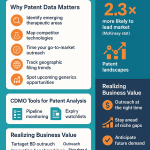
Industry intelligence platforms, including DrugPatentWatch and specialized CDMO intelligence services such as That’s Nice LLC’s PharmSource, compile transaction-level data on CDMO pricing, capacity expansions, and facility capabilities. Consultancies with active CDMO selection practices, including BioPlan Associates and PA Consulting, maintain proprietary databases of manufacturing cost benchmarks from their client work. Engaging one or more of these intelligence sources before an RFP process provides the reference framework needed to evaluate whether a CDMO’s proposal is competitive or whether the numbers need to be challenged.
Evaluating Proposals: What to Score and How
A structured proposal evaluation matrix should cover technical capability, quality and regulatory track record, manufacturing cost (both per-unit and total program), timeline and capacity commitments, and contractual terms including IP provisions and change order governance. Assigning relative weights to these categories forces an explicit prioritization that prevents price from dominating the evaluation by default while also preventing quality scores from being used to justify a commercially uncompetitive proposal.
For commercial manufacturing where the process is validated and the primary question is cost efficiency, price should carry 30-40% of the total evaluation weight. For development programs where process success depends heavily on CDMO scientific capability, weight quality and technical factors more heavily at 40-50% combined. This calibration varies by program stage and risk profile, and it should be documented before proposals are received to avoid post-hoc rationalization of a preferred outcome.
Key Takeaways: Benchmarking Operations
Benchmarking is a continuous discipline, not a one-time event. Renegotiation cycles for commercial manufacturing agreements every 3-5 years require updated market intelligence.
Detailed RFPs reduce CDMO contingency buffers. Every unit of scope ambiguity in an RFP translates to margin for the CDMO.
Published bottom-up cost models from MIT and BioPlan provide structural validation frameworks for biologic manufacturing quotes.
Evaluation matrices should assign explicit numeric weights to price, quality, technical capability, and terms before proposals arrive, preventing post-hoc rationalization.
Geographic Arbitrage: What the Rate Card Hides
The cost advantage of APAC CDMOs, particularly in China and India, is real and quantifiable at the level of direct manufacturing cost. The challenge is that direct manufacturing cost is not the same as total cost of supply. The gap between those two numbers is where geographic arbitrage decisions often fail.
The Real Cost of APAC Manufacturing: A Total Cost of Supply Framework
Freight and logistics for a biologic drug product requiring cold-chain transportation from a Chinese CDMO to a US distribution center add $3-8 per vial in variable cost, plus the risk of cold-chain excursion during transit. Regulatory site inspection costs are higher for APAC facilities when FDA or EMA field staff travel from US or European offices, and those inspection costs, while nominally borne by the regulatory agency, translate into inspection preparation overhead for the CDMO that flows back to clients. Lead time for commercial replenishment orders from APAC CDMOs is typically 12-16 weeks including QC release and shipping, versus 6-10 weeks from a US or European CDMO. That longer lead time requires higher safety stock, increasing working capital costs by an amount that is routinely not modeled in the geographic cost comparison.
Intellectual property protection in China operates under different frameworks than US or EU law. While China’s IP enforcement has improved substantially since the early 2000s, sponsors manufacturing proprietary biologics or complex novel APIs at Chinese CDMOs retain residual IP risk that is difficult to quantify but real. NDAs and trade secret protections are contractually available but enforcement in a disputed case requires navigating Chinese judicial processes. That risk is not zero, and for early-stage sponsors manufacturing a novel molecular entity with significant commercial potential, it is a risk that deserves explicit analysis in the geographic sourcing decision, not a footnote.
India’s CDMO Sector: API Strengths and Biologic Ambitions
India’s CDMO sector dominates global API supply for small-molecule generics. Sun Pharma, Dr. Reddy’s, Divi’s Laboratories, and Laurus Labs collectively supply a substantial fraction of the global generic API market. Those companies have moved aggressively into CDMO services for innovator programs, offering API synthesis and development services at rates 30-45% below US and Western European equivalents.
The Indian biologic CDMO sector, represented by companies including Biocon Biologics and Stelis Biopharma (now part of Strides Pharma), has made significant investment in mammalian cell culture and biologic fill-finish capabilities. Their primary strength remains biosimilar manufacturing for emerging market supply, where price competitiveness is paramount. For innovator biologic programs filing for US or EU approval, the regulatory inspection track record of Indian facilities, while generally improving, introduces risk relative to Tier 1 US or European CDMOs.
Total Cost of Supply Template: Direct manufacturing cost + Freight and logistics + Cold chain insurance and excursion risk provision + Safety stock carrying cost (additional inventory due to lead time) + Regulatory inspection preparation overhead + IP risk reserve + Currency hedging cost. Any geographic sourcing analysis that omits these elements understates the true cost of APAC manufacturing by 15-30% relative to a US or European alternative.
Negotiation Architecture for Volume and Multi-Asset Deals
CDMO contract negotiation for commercial manufacturing is not a procurement exercise in the commodity-sourcing sense. It is a multi-variable optimization across price, terms, flexibility, and risk allocation where getting any one variable fully optimized at the expense of others is usually a bad outcome.
Volume Leverage: How to Use It and When It Works
Volume commitments are the most direct form of sponsor leverage in CDMO negotiations. A sponsor committing to 18 commercial batches per year for five years is offering the CDMO $20-50 million in predictable revenue, depending on the product and process. CDMOs price that certainty of revenue into their rate concessions. The practical range of discount achievable through volume commitment for a large commercial program is 10-20% below the CDMO’s standard list pricing for the relevant manufacturing platform.
Volume leverage requires realistic volume forecasting. Sponsors who commit to 18 batches and consistently order 10 will trigger take-or-pay clauses, paying for manufacturing capacity they did not use. The optimal strategy is to negotiate a tiered pricing structure with a base volume at the committed price, a higher volume tier at a modest discount (5-10% below base tier), and a lower volume tier with a modest premium (10-15% above base tier) for shortfall scenarios. This structure preserves flexibility while capturing some volume discount even at reduced demand.
Multi-Asset Deals: Pipeline Discounts and Preferred Partner Status
Sponsors with a pipeline of multiple products can negotiate preferred partner agreements with CDMOs that offer pricing advantages across the portfolio in exchange for a right of first refusal or a committed percentage of outsourcing activity. These agreements are most effective for sponsors with three or more commercial or late-stage clinical programs, where the total contract value justifies the CDMO’s investment in dedicated capacity, technical staff, and program management.
The structure of a preferred partner agreement typically includes a master services agreement (MSA) with standardized terms across all programs, product-specific work orders executed under the MSA, portfolio pricing schedules with volume aggregation across all products for tiered discount calculation, and governance provisions including steering committee meetings and business reviews.
IP Provisions in Commercial Manufacturing Agreements
IP provisions in commercial manufacturing agreements are often negotiated by procurement teams with limited IP expertise and signed by lawyers with limited manufacturing knowledge. The result is language that sounds protective but fails in practice. Specific provisions that require IP counsel’s active attention include: background IP definitions (what each party owns before the engagement and retains ownership of), foreground IP (who owns improvements to the manufacturing process developed during the engagement), publication rights (whether the CDMO can publish or present on process learnings from your program), and residual knowledge provisions (what the CDMO’s scientists can use in future engagements based on experience gained from your program).
The residual knowledge provision is the most frequently underestimated IP risk in CDMO agreements. Most standard CDMO agreements allow the CDMO’s staff to use ‘residual knowledge retained in unaided memory’ in future engagements. In practice, experienced process scientists who have worked intensively on a novel manufacturing process for two to three years retain substantial tacit knowledge that benefits subsequent clients working on similar molecules or processes. This is not a hypothetical risk; it is one of the structural IP vulnerabilities of the CDMO outsourcing model. Sponsors with genuinely novel processes should negotiate explicit residual knowledge carveouts covering specific proprietary process parameters and analytical methodologies.
Key Takeaways: Negotiation
Tiered pricing structures capture volume discounts while preserving flexibility under lower-demand scenarios; flat commitments with take-or-pay penalties are the riskiest contractual structure for sponsors with uncertain commercial forecasts.
Multi-asset preferred partner agreements generate 10-20% portfolio discounts but require active governance to ensure the CDMO delivers on committed service levels across all programs, not just the anchor program.
Residual knowledge provisions are the primary IP risk in CDMO agreements; IP counsel should draft explicit carveouts for proprietary process parameters before contract execution.
Currency indexing clauses in multi-year agreements protect both parties against exchange rate movements for cross-border manufacturing relationships; their absence means one party bears all currency risk.
Hidden Costs: The Audit, the Repeat Batch, the Schedule Slip
The gap between a CDMO’s quoted price and the actual invoiced cost of commercial manufacturing is not random. It follows predictable patterns that experienced procurement and technical teams recognize but that are routinely omitted from initial cost models.
Audit-Related Costs
Sponsor audits of CDMO facilities under cGMP agreements are a regulatory obligation and a quality assurance necessity. The cost of conducting a multi-day audit at a remote CDMO facility, including travel, accommodation, sponsor audit staff time, and post-audit documentation, runs $15,000-$50,000 per audit event. Biennial audits across a portfolio of five CDMOs represent $150,000-$500,000 in annual quality assurance overhead. Many sponsors underbudget audit costs and then treat them as overhead when they belong in the CDMO program cost.
CDMO-side audit support is not free. When a CDMO prepares for and hosts a sponsor audit or an FDA pre-approval inspection, that activity consumes staff time that is either billed as a service or amortized into manufacturing overhead. AbbVie Contract Manufacturing has been explicit that truly transparent CDMO pricing includes audit support as a defined deliverable with a defined cost. CDMOs that quote audit support as a separate line item are more transparent, not more expensive in aggregate; they are surfacing a cost that less transparent CDMOs bury in overhead rates.
Repeat Batch Costs and Cost Allocation
Commercial manufacturing batch failures at established CDMOs occur at rates of 2-5% for conventional biologics and 5-15% for CGT products, based on industry data from BioPlan Associates and regulatory filing public disclosures. A single failed biologic batch costing $2-4 million in manufacturing plus an additional $15,000-$45,000 in QC release testing represents a meaningful financial event. How batch failure costs are allocated in the commercial agreement is therefore consequential.
Most standard CDMO agreements allocate failure costs based on cause: CDMO execution errors are at the CDMO’s expense; sponsor process definition failures or raw material issues are at the sponsor’s expense. In practice, cause attribution is often disputed. A robust agreement defines a time-limited root cause analysis protocol, a decision-making process for disputed attributions, and a financial settlement formula that does not require litigation to resolve. Sponsors who rely on general contract language for this will eventually face a disputed batch failure with no clear path to resolution.
Schedule Slippage and Opportunity Cost
Delayed commercial batches have costs beyond the manufacturing invoice. For a product in ramp-up phase, a four-week delay in a commercial batch worth $40 million in net sales is a $3 million revenue deferral at a 40% gross margin. That opportunity cost rarely appears in CDMO contract analysis, but it is real. Sponsors should model the revenue impact of schedule slippage scenarios (four weeks, eight weeks, and 16 weeks) against CDMO-provided delivery performance data from comparable programs. CDMOs with on-time delivery rates below 85% for committed commercial batch dates are indicating a schedule risk that should be priced into the total cost model.
Regulatory Support Cost Inflation
Post-approval manufacturing changes, whether minor efficiency improvements, raw material substitutions following a supplier issue, or equipment upgrades, require regulatory filings. The cost of CDMO regulatory affairs support for a CBE-30 supplement averages $25,000-$75,000 per filing. A Prior Approval Supplement for a more significant change runs $100,000-$300,000. Sponsors managing multiple marketed products at a single CDMO should model an annual regulatory support budget based on historical change frequency for programs of similar complexity, not assume the initial commercial agreement covers all future regulatory activity.
Transparent Pricing: What to Demand, Line by Line
Pricing transparency in CDMO agreements is not a courtesy. It is a commercial necessity for accurate budgeting, true cost comparison, and a functional audit capability. The specific cost elements that should be broken out as discrete line items in any commercial manufacturing proposal are as follows.
Manufacturing Labor
FTE rate by role category (process technician, senior scientist, quality associate), hours per batch operation, and total labor cost per batch. This enables comparison of labor efficiency across CDMOs and identification of staffing model differences.
Raw Materials and Consumables
Itemized bill of materials with unit costs for major materials (cell culture media, resins, single-use components) and a clear statement of whether material cost savings from supplier negotiations are passed through or retained by the CDMO.
Facility and Equipment Overhead Allocation
The overhead rate applied to direct costs, the cost base it is applied to (direct labor only, or total direct costs), and the methodology used to allocate shared facility costs across multiple clients and products. Overhead rates vary from 80% to 250% of direct labor depending on facility type and utilization.
Quality Control and Release Testing
Full batch release test list with per-assay costs and expected total QC cost per batch. If stability testing is included in the commercial manufacturing scope, annual stability program cost should be quoted separately from batch release cost.
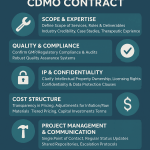
Project Management and Communication
Monthly retainer or FTE allocation for dedicated project management, client communication, and documentation management. Some CDMOs include this in their overhead rate; others bill it separately. Either is acceptable; opaque treatment is not.
Regulatory Affairs Support
Annual budget for post-approval change support, regulatory query responses, and inspection preparation. This should be an estimated annual cost range with a clear statement of what triggers additional charges beyond the estimate.
Audit Support
CDMO cost for hosting and supporting sponsor quality audits and regulatory inspections, quoted as a per-day rate or an annual estimate based on expected audit frequency. Audit support that appears ‘free’ in a CDMO proposal is being paid for somewhere.
‘Transparent pricing outlines what it will actually cost to get you to your end goal, whether it’s PPQ or a BLA. No surprises.’AbbVie Contract Manufacturing, on the value of line-item cost transparency
2026-2030 Pricing Trends: Automation, AI, and Risk-Sharing
The CDMO pricing landscape between now and 2030 will be shaped by four structural forces: automation and AI integration in manufacturing processes, the maturation of continuous bioprocessing, evolving risk-sharing partnership models between CDMOs and early-stage biotechs, and the regulatory adaptation to new manufacturing modalities in real-time release testing and digital manufacturing records.
Process Automation and Autonomous Manufacturing
CDMOs investing in robotic process automation for fill-finish, automated in-process control systems for bioreactor management, and closed-system processing platforms are achieving measurable reductions in labor cost per batch. The practical labor cost reduction from a fully automated fill-finish line versus a semi-manual line runs 15-30% depending on vial count and format. For CDMOs running 200+ commercial batches per year, that is a meaningful margin improvement, and it gives them pricing flexibility that less automated competitors lack.
Machine learning applications in process monitoring and predictive quality control are beginning to reduce out-of-spec batch rates for established processes. A CDMO deploying PAT (Process Analytical Technology) instrumentation with ML-driven control algorithms can demonstrate batch-to-batch consistency data that reduces the biostatistical burden of product quality systems. That translates to reduced QC testing costs through real-time release testing (RTRT) frameworks approved under ICH Q8, Q9, and Q10 guidelines. The FDA’s Digital Health Center of Excellence has been expanding its engagement with RTRT applications; CDMOs investing in these capabilities now are building the regulatory track record that will allow them to offer RTRT-based pricing in 2027-2030.
Risk-Sharing Partnerships Between CDMOs and Early-Stage Biotechs
The funding environment for early-stage biotech has created a new CDMO engagement model: equity stakes and milestone payments in exchange for manufacturing capacity commitments and deferred development fees. Samsung Biologics, Lonza, and National Resilience have each executed equity or milestone-linked agreements with biotech clients who need manufacturing capacity but lack the cash to pay full development-stage CDMO rates.
This model aligns CDMO incentives with sponsor success, which is genuinely valuable. It also creates conflicts of interest when the CDMO holds equity in a client competing with another client in the same therapeutic area. The governance of these arrangements requires careful attention to information barriers, pricing fairness across competing clients, and exit provisions if the equity value creates a conflict. Simon-Kucher’s 2024 State of Pricing report noted that extending contract durations and incorporating market index adjustments into pricing have become standard tools for managing these long-term risk-sharing arrangements.
Index-Based Pricing Adjustment Mechanisms
Multi-year commercial manufacturing agreements increasingly include index-based pricing adjustment clauses that link annual price changes to observable economic indices: Producer Price Index for pharmaceutical manufacturing, labor cost indices for relevant geographies, or commodity indices for major raw materials. These clauses protect both parties from the compounding distortion of fixed pricing in an inflationary environment. Sponsors should insist on two-sided index adjustment, meaning prices can move up or down with the index, not just escalate. CDMOs proposing unidirectional escalation clauses are building inflation protection for themselves while leaving the sponsor exposed to index reversals.
Key Takeaways: Future Trends
CDMOs deploying robotic fill-finish automation and closed-system processing will offer 15-30% lower labor cost per batch by 2028; use current capability investment as a forward pricing indicator.
Real-time release testing frameworks under ICH Q8/Q9/Q10 will reduce QC cost per batch by 20-35% for CDMOs with established RTRT programs; negotiate RTRT cost-sharing provisions into long-term agreements now.
Equity and milestone-linked CDMO agreements offer capacity access for cash-constrained biotechs but require governance frameworks to manage competitive conflicts between CDMO equity positions.
Two-sided index adjustment clauses in multi-year agreements are standard commercial practice; unidirectional escalation clauses are a negotiating concession that should be resisted.
Investment Strategy for Analysts
This section synthesizes the analytical framework above into a structured approach for portfolio managers, M&A analysts, and institutional investors evaluating CDMO assets or biopharma companies with significant CDMO concentration risk.
Evaluating CDMO Pricing Power and Margin Durability
Pricing power in the CDMO sector correlates with four measurable factors: validated commercial capacity utilization (above 80% is a strong signal), proprietary platform technology with embedded customer BLA references, diversity of modalities served (CDMOs capable in both large and small molecules plus CGT are less exposed to single-modality demand cycles), and geographic concentration of regulatory filings referencing the CDMO’s facilities.
A CDMO with 85% bioreactor utilization, 40+ active BLA references, a platform royalty stream of $30 million annually, and operations across both US and EU regulated facilities has pricing power that is durable over a five-year horizon. That combination of factors should support EBITDA margins of 25-35% in biologic manufacturing, higher in platform licensing.
Identifying CDMO Exposure Risk in Biopharma Portfolios
Biopharma companies with significant revenue concentrated in a single product manufactured at a single CDMO carry both manufacturing execution risk and pricing renegotiation risk. When a commercial manufacturing agreement for a blockbuster comes up for renewal, the CDMO’s pricing leverage is at its maximum: the sponsor faces either accepting the new terms or a complex, expensive, and time-consuming manufacturing transfer to an alternative. Analysts covering biopharma companies should model the revenue impact of a 15-20% manufacturing cost increase at contract renewal for products within 24 months of renegotiation.
CDMO M&A: What Acquirers Consistently Overpay For
Acquirers of CDMO assets have historically overpaid for headline revenue multiples without adequately discounting for client concentration, contract remaining life, and IP transferability. A CDMO generating $500 million in revenue where 60% is attributable to two clients with contracts expiring within 36 months is not worth the same multiple as a CDMO with the same revenue spread across 20 clients on staggered five-year contracts. The near-term renewal risk is an earnings quality discount that should be quantified, not footnoted.
IP transferability in CDMO acquisitions is the second consistently underanalyzed factor. Cell line platform licenses, manufacturing process patents, and DMF portfolios have change-of-control provisions that can require licensor consent for assignment. Acquiring a CDMO without confirming that its platform licenses and key customer contracts survive the change of control is a diligence failure that has generated costly post-close surprises in multiple transactions.
Summary Investment Checklist for CDMO Assets
Capacity utilization by modality and facility class. Revenue concentration by client (top 3 clients as % of total). Remaining contract life on top 10 revenue relationships. Platform licensing royalty stream (size, growth rate, gross margin). BLA/ANDA references per facility (switching cost metric). IP portfolio: patent expiry schedule, change-of-control provisions in platform licenses. Geographic regulatory coverage: FDA, EMA, PMDA validated sites. Capital expenditure commitments for capacity expansion relative to demand forecast. Management team CDMO-specific operating experience.
Frequently Asked Questions
What is the largest single factor in CDMO commercial manufacturing cost?
For biologics, the combination of batch scale and process titer (grams of product per liter of bioreactor volume) is typically the dominant cost driver. A process achieving 10 g/L expression in a 2,000-liter bioreactor produces 10 times more product per batch than a 1 g/L process at the same scale, at roughly the same manufacturing cost, cutting per-gram cost by an order of magnitude. For small molecules, API synthesis route length and process mass intensity are primary. For CGT products, batch success rate variability in viral vector or cell expansion steps drives per-dose cost more than any other single factor.
How do I ensure a CDMO proposal has no hidden costs?
Require a line-item cost breakdown covering all eight categories described in the Transparent Pricing section. Cross-check the inclusions list against a standard scope checklist covering QC release testing, regulatory affairs support, audit hosting, project management, tech transfer, validation batch costs, and change order governance. Any service that is not explicitly included is implicitly excluded, and excluding it means you will pay for it as a change order when it becomes necessary, typically at a higher rate than if it had been scoped upfront.
Is it worth pursuing APAC CDMOs for a complex biologic program?
For API synthesis of small molecules, APAC CDMOs, particularly in India, offer genuine cost advantages that survive a total cost of supply analysis for most programs. For commercial-scale biologic manufacturing, the answer depends on the regulatory filing strategy. US and EU-only filings require FDA and EMA facility inspections; the inspection track record of specific APAC biologic CDMOs varies considerably. WuXi Biologics has an extensive FDA inspection history and is referenced in multiple US BLAs. Other APAC biologic CDMOs have more limited US regulatory exposure. Assess the specific facility’s inspection history, not the country’s general regulatory profile.
What should a technology transfer agreement include that most do not?
Most tech transfer agreements specify deliverables but not acceptance criteria, processes but not performance ranges, and timelines but not consequences for missed milestones by either party. The specific additions that prevent most disputes: defined process parameter ranges from the sending site with statistical confidence intervals; analytical method acceptance criteria at the receiving site with a defined pass/fail protocol; a batch failure root cause analysis protocol with objective attribution criteria; and a clear definition of what constitutes satisfactory tech transfer completion triggering payment milestones.
How does a CDMO’s proprietary platform technology affect my IP rights?
Platform technology developed or owned by the CDMO remains the CDMO’s background IP. When your process uses that platform, you are typically licensing it for the term of the manufacturing agreement. If you transfer manufacturing to a different CDMO, you lose access to the platform technology. Depending on how deeply the platform is embedded in your BLA-referenced process, that loss can trigger comparability studies, supplemental filings, or, in the worst case, a requirement for additional clinical data. Have IP counsel evaluate the platform dependency of your manufacturing process before executing the initial cell line or process development agreement, not after the BLA is filed.
* * *
This analysis draws on public regulatory filings, published academic cost models, CDMO corporate disclosures, and industry intelligence sources including BioPlan Associates, PharmSource, and IQVIA. Specific cost ranges represent general market estimates for planning purposes and will vary based on program-specific factors. This content does not constitute legal, regulatory, or investment advice.