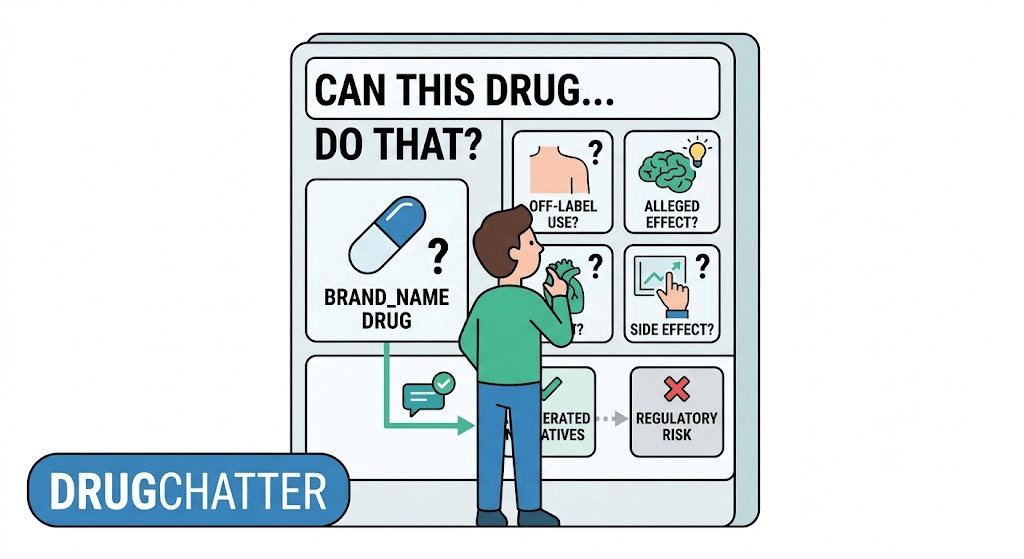
There’s a certain genre of drug question that never goes out of style: “Can this thing I’m already taking also fix this other, unrelated problem?” It’s half optimism, half biohacking, and occasionally one part desperation.
A scan through recent DrugChatter traffic shows the pattern clearly. Patients (and plenty of curious bystanders) are constantly probing the edges of labeled indications—sometimes reasonably, sometimes…creatively.
Here are a few of the best “can this drug treat something unexpected?” questions making the rounds.
1. The “Maybe It Does More Than We Think” Category
Some questions start from a plausible mechanistic foothold and then wander just a bit too far:
These are at least anchored in reality. Omega-3s, GLP-1s—there is biology here. But you can see the creep: from indication → effect → lifestyle optimization tool. That last step is where things tend to outrun the data.
2. The “Cross-Purpose Curiosity” Bucket
Then you get questions where people are essentially asking if drugs can moonlight in entirely different therapeutic areas:
This is where pharmacology usually taps the brakes. Mechanisms are specific, and while biology overlaps, most drugs are not Swiss Army knives. If they were, someone would have already run the trial—and marketed it aggressively.
3. The “Food, Supplements, and Wishful Equivalence” Zone
A personal favorite category: can you swap, stack, or hack your way to the same effect?
This is the nutritional parallel to off-label use. Sometimes there’s a kernel of truth (fatty acids are fatty acids), but dose, formulation, and bioavailability tend to matter a lot more than people hope.
4. The “Can It Fix Side Effects From Something Else?” Angle
Sometimes this works (supportive care is a whole field), but often it just turns into drug stacking, where each new addition solves one problem and introduces another.
5. The “Stretching the Mechanism Until It Snaps” Hall of Fame
And then there are the questions that feel like they were generated by pure curiosity:
Now we’re firmly in “there’s a pathway somewhere in there” territory. Which is true—but also how you end up with hypotheses that never survive contact with clinical reality.
What’s Going On Here?
Two things, mostly.
First, modern drugs are good enough that people assume they might be good for more than one thing. And sometimes they are—repurposing is real, and occasionally lucrative.
Second, patients are doing what researchers do: pattern-matching mechanisms and asking “what else could this affect?” The difference is that researchers then have to run experiments.
The Takeaway
The instinct behind these questions isn’t wrong. It’s how new uses get discovered. But between “interesting idea” and “clinically meaningful effect” lies a long stretch of failed trials, negative data, and pharmacokinetic reality.
So yes—keep asking. Just don’t be surprised when the answer is usually some variation of: “In theory, maybe. In practice, not really.”