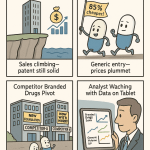
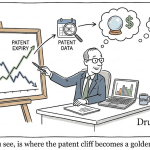
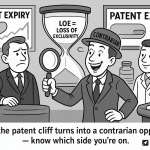
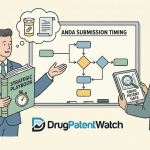
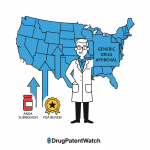
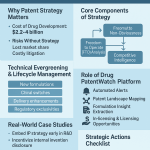
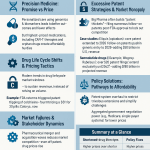
The pharmaceutical industry operates on a singular, brutal economic premise: the finite nature of exclusivity. Unlike other sectors where brand equity or trade secrets provide indefinite competitive moats, a pharmaceutical asset is a melting ice cube. The moment a drug is approved, the clock ticks toward patent expiration, after which revenues typically collapse by 90% within months of generic entry.1 Consequently, the strategic objective for incumbent firms has shifted from purely maximizing revenue during the patent term to artificially extending the term itself. This phenomenon, often termed “evergreening,” is not merely a legal maneuver; it is the central pillar of modern pharmaceutical lifecycle management.
For the business development executive or intellectual property strategist, the focus is no longer solely on the “patent cliff”—a precipitous drop in revenue. Rather, the goal is to engineer a “patent slope,” where the erosion of market share is managed, delayed, and staggered over years. The mechanics of this delay are found less in the chemistry laboratory and more in the courtroom. By leveraging the intricate machinery of the Hatch-Waxman Act, the Biologics Price Competition and Innovation Act (BPCIA), and the Food and Drug Administration (FDA) regulatory process, firms can stall generic competition for years beyond the expiration of the primary compound patent.
The return on investment (ROI) for these legal strategies is astronomical. A blockbuster drug like Humira (adalimumab) or Revlimid (lenalidomide) generates billions of dollars annually. Extending exclusivity by even a single quarter can yield hundreds of millions in free cash flow, dwarfing the legal fees required to litigate a patent infringement suit or file a citizen petition.2 As one analysis notes, the cost of developing a new drug frequently exceeds $2 billion, creating a rational incentive to spend “whatever it takes” to defend the monopoly.2 This report provides an exhaustive analysis of these mechanisms, the legal precedents that enable them, and the strategies generic challengers use to dismantle them.
1.1. The Financial Calculus of Litigation
To understand the persistence of evergreening, one must analyze the asymmetry of risk. For the innovator (the “brand”), the upside of litigation is the preservation of monopoly profits. For the challenger (the “generic”), the upside is market entry, but the downside includes substantial litigation costs and the risk of damages if they launch “at risk” and lose.
The following table illustrates the comparative financial stakes in a typical blockbuster patent dispute:
Financial Metric
Brand (Innovator)
Generic (Challenger)
Annual Revenue at Risk
$1 Billion – $20 Billion
$0 (Pre-Launch)
Litigation Cost (Est.)
$5 Million – $50 Million
$5 Million – $15 Million
Upside of Win
Continued Monopoly Pricing
Market Entry (180-day Exclusivity)
Downside of Loss
90% Revenue Erosion
Sunk Legal Costs
Strategic Goal
Delay Entry (Time = Money)
Speed to Market (First-to-File)
Data indicates that brand manufacturers win only a minority of patent cases that go to trial. However, “winning” in court is often secondary to the time gained during the litigation process. The mere filing of a lawsuit triggers a 30-month stay on FDA approval for small molecule drugs, effectively granting an automatic injunction. If a company can stack consecutive 30-month stays—or create a “thicket” of patents that takes years to unravel—they win financially, regardless of the ultimate legal verdict.3
Industry Insight
2. The Hatch-Waxman Machinery and the 30-Month Stay
The Drug Price Competition and Patent Term Restoration Act of 1984, known as Hatch-Waxman, was a legislative compromise intended to balance innovation incentives with the need for affordable generic drugs. It created the Abbreviated New Drug Application (ANDA) pathway, allowing generics to rely on the brand’s safety and efficacy data. In exchange, it granted brands patent term extensions and a mechanism to resolve patent disputes before generic launch.
2.1. The Automatic Injunction Mechanism
The core of the dispute resolution mechanism is the “Paragraph IV” certification. When a generic files an ANDA, it must certify that the brand’s patents are invalid, unenforceable, or will not be infringed. If the brand sues within 45 days, the FDA is statutorily barred from approving the generic application for 30 months, or until a court decision, whichever comes first.5
This 30-month stay was designed to provide a window for litigation. In practice, it acts as a guaranteed extension of exclusivity. Sophisticated brand strategies involve timing the listing of patents in the FDA’s “Orange Book” to maximize this delay.
Late Listings: Brands may list new patents (e.g., for a new formulation or method of use) years after the drug’s approval. If these patents are listed before the generic files its ANDA, they can trigger the stay.
Split Certifications: Generics may have to certify against multiple patents expiring at different times.
Re-triggering Stays: While the Medicare Modernization Act of 2003 attempted to limit brands to one 30-month stay per ANDA, recent FDA guidance from April 2024 suggests that loopholes remain. The Agency identified instances where 30-month stays were recognized for “new strength supplements” based on patents listed after the original ANDA submission.3
This finding is critical for forecasters. It implies that even if a generic has filed its initial application, the brand can potentially introduce new friction points by modifying the reference product (e.g., introducing a new dosage strength) and asserting new patent rights, thereby resetting the clock on specific product variations.
2.2. The Orange Book as a Strategic Weapon
The FDA’s Orange Book (Approved Drug Products with Therapeutic Equivalence Evaluations) is the register of all patents the brand claims cover the drug. Listing a patent here is the prerequisite for triggering the 30-month stay. Consequently, the definition of what can be listed is a subject of intense legal and regulatory conflict.
Statutorily, the Orange Book should contain patents on the drug substance (active ingredient), the drug product (formulation), or the method of use. It should not contain patents on manufacturing processes or packaging. However, the line is often blurred, particularly with drug-device combinations.
2.2.1. The Device Patent Controversy
In recent years, companies have listed patents covering the mechanical components of delivery devices—such as the dose counter on an asthma inhaler or the firing mechanism of an autoinjector—in the Orange Book. This effectively extends the monopoly on the drug molecule (which may be off-patent) by protecting the device used to deliver it.
In 2024 and 2025, the Federal Trade Commission (FTC) launched a coordinated enforcement campaign against this practice. The Commission sent warning letters to major pharmaceutical companies, including Teva, GSK, and AstraZeneca, challenging over 300 patent listings it deemed “improper”.6
Case Study: Teva’s 2025 Delisting
In December 2025, following sustained pressure from the FTC, Teva Pharmaceuticals requested the removal of more than 200 patent listings from the Orange Book.6 These patents covered asthma, diabetes, and COPD treatments. The significance of this move cannot be overstated. By removing these patents from the register, Teva effectively dismantled the mechanism for triggering a 30-month stay on those specific grounds. This clears a path for generic competitors to file ANDAs without facing an automatic 2.5-year delay based on device mechanics.
This enforcement trend signals a shift in the regulatory environment. Business development teams must now heavily discount the value of device patents as a barrier to entry if those patents cannot be defensibly listed in the Orange Book.
3. The Patent Thicket: Building a Fortress of IP
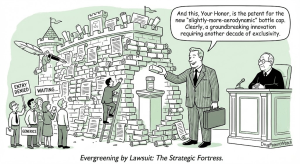
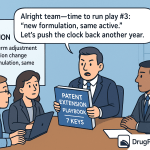
If the 30-month stay is a tactical delay, the “patent thicket” is a strategic blockade. A patent thicket involves surrounding a commercial product with a dense web of overlapping intellectual property rights. These patents do not just cover the active molecule; they cover crystalline forms (polymorphs), manufacturing steps, dissolution profiles, specific excipients, and method-of-treatment protocols.
The objective is to force a generic competitor to invalidate or design around not one, but dozens or hundreds of patents. This increases the cost and complexity of litigation exponentially. Even if a generic believes 95% of the patents are weak, the risk that one might be upheld is sufficient to deter an “at-risk” launch.8
3.1. Humira: The $20 Billion Wall
AbbVie’s management of Humira (adalimumab) is the definitive case study in patent thicketing. Humira is the world’s best-selling drug, generating over $20 billion annually at its peak.9 The primary patent on the adalimumab molecule expired in 2016. Yet, biosimilar competition did not enter the U.S. market until 2023.
How was this seven-year extension achieved?
Patent Volume: AbbVie filed over 300 patent applications related to Humira, with approximately 160 issued.10
Filing Timing: Over 90% of these applications were filed after the drug received FDA approval in 2002.10 This “drip-feed” strategy ensured that as one patent neared expiration, new ones (covering slightly modified formulations or new indications) were granted.
Settlement Leverage: Faced with this thicket, virtually every major biosimilar competitor—including Amgen, Sandoz, and Samsung Bioepis—chose to settle. The terms typically allowed for immediate entry in Europe (where the patent estate was weaker) in exchange for delaying U.S. entry until 2023.11
The economic impact of this strategy was massive. The I-MAK organization estimates that the delayed entry of generics for Humira, Eliquis, and Enbrel cost U.S. payers $167 billion compared to the costs if generics had entered at the time of primary patent expiry.11
3.2. Revlimid: Polymorphs and Volume Limits
Celgene (now Bristol Myers Squibb) employed a sophisticated variation of the thicket strategy for its cancer drug Revlimid (lenalidomide). The primary patent was set to expire, but Celgene secured numerous secondary patents on specific polymorphic (crystalline) forms of the drug.12
The litigation outcome was unique: a “volume-limited” settlement. Rather than a simple date for full entry, Celgene negotiated agreements with generics like Natco, Alvogen, and Cipla.
Phase 1 (March 2022 – Jan 2026): Generics are permitted to launch, but their market share is strictly capped (starting at single-digit percentages and gradually increasing).13
This structure is a masterstroke of lifecycle management. It avoids the “patent cliff” where prices crash by 90% overnight. By constraining supply, the “generic” price remains artificially high because the generic manufacturer has no incentive to slash prices if they cannot capture more volume. This converts the cliff into a managed slope, preserving billions in revenue for BMS while technically allowing “competition” to satisfy antitrust regulators.
3.3. Imbruvica: Extending the Tail
AbbVie and Janssen utilized a similar strategy for Imbruvica (ibrutinib). While the composition of matter patent expires in 2027, the companies secured secondary patents extending protection to 2031. Settlements with generic challengers have pushed the entry date to 2032.15 This additional five years of exclusivity is projected to generate over $7 billion in revenue.12
4. Citizen Petitions: The Regulatory Filibuster
The “Citizen Petition” process allows any interested person to petition the FDA to issue, amend, or revoke a regulation. While intended to empower consumer safety groups, it has been co-opted by pharmaceutical companies to delay the approval of rival generics.
4.1. Mechanism of Delay
A brand company files a petition raising scientific “concerns” about the safety or bioequivalence of a pending generic application. For example, they might argue that the generic’s dissolution testing is insufficient or that the labeling requirements need to be more stringent.
Timing: These petitions are often filed just before the generic is expected to receive approval (the “11th hour”).
Resource Drain: The FDA must review and respond to these petitions. Even if the petition is meritless, the administrative time required to process it can delay the generic’s approval by months.
Simultaneous Denial and Approval: In many cases, the FDA denies the petition and approves the generic on the same day, proving the petition had no merit—but by then, the delay has already occurred.17
4.2. ViroPharma and the Antitrust Response
The FTC has aggressively pursued companies that abuse this process. The landmark case involves ViroPharma (acquired by Shire). The FTC charged that ViroPharma filed 46 baseless citizen petitions and court challenges to delay generic competition for the antibiotic Vancocin.18 The company knew the FDA would not approve a generic while a petition was pending, effectively using the petition process itself as an exclusionary tool.
4.3. 2024-2025 Trends
Recent data shows that petition abuse continues, particularly in complex categories.
GLP-1 Agonists: As demand for semaglutide (Ozempic/Wegovy) exploded, petitions have been filed regarding the compounding of these drugs and the bioequivalence standards for potential generics.20
Device Petitions: Companies continue to file petitions regarding the “sameness” of generic inhalers and injectors, arguing that minor differences in the device user interface should preclude generic substitution.21
Legislative proposals like the “Stop STALLING Act” have been introduced to penalize sham petitions, but the practice remains a viable, low-cost delay tactic for brands.
5. The “Skinny Label” and Induced Infringement
One of the most disruptive legal developments in 2024 and 2025 concerns the “skinny label” or Section viii carve-out. This mechanism allows a generic to launch a drug for unpatented indications while “carving out” patented uses from its label. It was intended to be a safe harbor, allowing generics to enter the market for old uses even if the brand found a new use for the drug.
5.1. The Erosion of the Safe Harbor
The safe harbor has been severely compromised by recent court rulings, most notably GlaxoSmithKline LLC v. Teva Pharmaceuticals USA, Inc. The court found that even though Teva used a skinny label, its marketing materials, press releases, and the general knowledge it relied upon constituted “induced infringement” of GSK’s method-of-use patent.22
Impact on Strategy:
Marketing Scrutiny: Generic companies must now rigidly police their communications. A press release stating “generic equivalent to” can be weaponized as evidence that the generic intends for the drug to be used for all the brand’s indications, including the patented ones.
Amarin v. Hikma (2024): In this case involving the heart drug Vascepa, the court scrutinized website metadata and sales forecasts to determine if the generic “induced” doctors to prescribe for the protected cardiovascular indication.23
This legal environment forces generics to delay launch until method-of-use patents expire, essentially nullifying the benefit of the Section viii pathway. For brands, obtaining a new method-of-use patent (e.g., treating a new patient sub-population) has become a powerful tool to block all generic competition, not just competition for the new use.
6. The Biologics Battlefield: Eylea and the “Patent Dance”
Biologics (large molecule drugs) face a different legal framework under the BPCIA. The “patent dance” is a structured exchange of information between the biosimilar applicant and the brand sponsor. The complexity of biologic manufacturing allows for an even denser patent thicket.
6.1. Eylea (Aflibercept) Litigation
Regeneron’s Eylea, a treatment for retinal diseases, is a prime example of the current biologic defense strategy. Regeneron asserted a portfolio of nearly 50 patents, with expiration dates extending as far as 2040.25 These patents covered formulation, dosing regimens, and manufacturing processes.
2025 Settlements:
Despite the 2040 patent assertions, the sheer pressure of multiple biosimilar applicants (Amgen, Sandoz, Samsung Bioepis, Celltrion) forced a compromise.
Sandoz Settlement: Agreed to launch its biosimilar, Enzeevu, in late 2026.25
Celltrion Settlement: Agreed to a launch date of December 2026.26
While these settlements bring competition 14 years earlier than the latest patent expiry, they still grant Regeneron a significant extension beyond the primary exclusivity period. The “dance” allows the brand to trade uncertain long-term patents for guaranteed short-term monopoly.
7. Competitive Intelligence: Turning Data into Strategy
In this adversarial environment, public data sources like the FDA Orange Book are necessary but insufficient. They provide the official record but lack the tactical context required for accurate forecasting. To bridge this gap, industry professionals utilize specialized intelligence platforms such as DrugPatentWatch.
7.1. Beyond the Expiry Date
A simple expiry date is misleading. It does not account for:
Pediatric Exclusivity: A 6-month extension attached to all patents.
Patent Term Restoration: Extensions granted for regulatory review time.
Litigation Status: Whether a patent is currently being challenged or if a 30-month stay is active.
DrugPatentWatch synthesizes these data points to create a “Launch Forecast” rather than just a “Patent Expiry” list. By tracking Paragraph IV certifications and court dockets in real-time, the platform identifies “at-risk” launch opportunities and settlement signals before they become public news.27
Strategic Application:
For Generics: Identifying “weak” patent thickets where Freedom to Operate (FTO) analysis suggests a high probability of litigation success.29
For Brands: Monitoring competitor pipeline activities to anticipate challenges and fortify IP estates with continuation patents.
For Investors: Accurately valuing a pharma stock by predicting the true date of revenue erosion, rather than the nominal patent expiry.
8. Product Hopping: The Forced Migration
Product hopping (or “hard switching”) is the practice of reformulating a drug and switching patients to the new version just before the generic for the old version becomes available. Once the switch is complete, the brand withdraws the old version from the market.
Mechanism:
Since pharmacists can only substitute a generic for the exact branded product prescribed, withdrawing the old brand effectively kills the market for the new generic. The generic is “bioequivalent” to a ghost product.
Examples:
Suboxone (Buprenorphine/Naloxone): Indivior switched the market from tablets to sublingual film, citing safety concerns with the tablets. The FTC later sued, alleging the switch was purely anticompetitive.30
Namenda (Memantine): Forest Laboratories attempted to switch patients from Namenda (taken twice daily) to Namenda XR (taken once daily) and discontinue the original. A court injunction forced them to keep the original on the market to allow for generic competition.
This tactic remains a potent evergreening tool, though it now attracts significant antitrust scrutiny.
9. Future Outlook: Legislation and Enforcement
The landscape for 2025 and beyond is defined by increasing hostility toward evergreening strategies from both legislators and regulators.
9.1. The Affordable Prescriptions for Patients Act
Versions of this bill (S. 150, S. 1041) have been introduced in the 118th and 119th Congresses. The legislation aims to specifically target “patent thickets” and “product hopping”.31
Patent Limits: The bill proposes limiting the number of patents a biologic sponsor can assert in the “patent dance” to 20, with a cap of 10 patents issued post-approval.33
Hopping Penalties: It would grant the FTC express authority to prosecute product hopping as presumptive anticompetitive conduct.
9.2. FTC Enforcement Priorities
Under the current administration, the FTC has signaled a zero-tolerance policy for “improper” Orange Book listings. The agency’s success in forcing Teva to delist device patents in 2025 sets a precedent. We can expect further mass delistings, which will remove the 30-month stay protection for many drug-device combinations.6
10. Conclusion
“Evergreening by lawsuit” is not an aberration of the pharmaceutical market; it is a rational, structural adaptation to the incentives created by the current legal framework. The immense gap between the value of a monopoly and the value of a competitive commodity ensures that brands will continue to invest heavily in delay tactics.
However, the efficacy of these tactics is waning. The combination of aggressive antitrust enforcement (targeting device patents and citizen petitions), judicial scrutiny of “skinny labels,” and potential legislative caps on patent assertions suggests that the era of the “forever monopoly” is closing.
For the industry, this signals a return to fundamentals. As the legal moats become shallower, the ability to maintain premium pricing will depend less on the ingenuity of patent attorneys and more on the delivery of genuine clinical innovation. Until then, the battle for generic entry will remain a complex game of three-dimensional chess, played out in the courtroom as much as in the market.
Key Takeaways
Litigation as Revenue: Legal delay strategies are a primary revenue driver. Extending a blockbuster’s exclusivity by one year can generate more free cash flow than the discovery of a new drug.
The Thicket Effect: The “Patent Thicket” strategy, exemplified by Humira and Revlimid, successfully converted the “patent cliff” into a gradual “patent slope,” costing payers billions but stabilizing brand revenue.
Regulatory Crackdown: The FTC’s 2025 campaign against “improper” Orange Book listings (specifically device patents) has successfully dismantled a key delay mechanism for inhalers and injectors.
The “Skinny Label” Trap: Recent court rulings (GSK v. Teva) have made “skinny labeling” a high-risk strategy, exposing generics to inducement liability and forcing them to delay launch until method-of-use patents expire.
Intelligence is Critical: In this opaque environment, platforms like DrugPatentWatch are essential for forecasting true launch dates by synthesizing data on litigation, settlements, and regulatory exclusivities.
Frequently Asked Questions (FAQ)
Q1: How does a “volume-limited” settlement benefit a generic company?
A: While it restricts their market share, it allows them to enter the market years before patent expiration without the risk of litigation damages. Furthermore, because supply is limited, the price of the drug does not crash. The generic sells less volume but at a much higher margin than in a fully commoditized market.
Q2: Why did Teva delist its patents from the Orange Book in 2025?
A: Teva faced intense pressure and potential litigation from the FTC, which argued that listing patents for device components (like inhaler mechanisms) was illegal. By delisting them, Teva avoided an antitrust lawsuit but lost the ability to trigger an automatic 30-month stay on generic competitors based on those specific patents.
Q3: Can a “Citizen Petition” really stop a drug approval?
A: Directly, no. The FDA can deny the petition. However, the process of reviewing the petition takes time. If the FDA does not complete the review before the generic’s target approval date, the approval is effectively delayed. This administrative friction is the goal of “sham” petitions.
Q4: What is the difference between a “Paragraph IV” certification and a “Section viii” statement?
A: A Paragraph IV certification challenges a patent as invalid or not infringed (leading to litigation). A Section viii statement tells the FDA, “I am not seeking approval for the use covered by this patent; I am carving it out of my label.” Section viii is supposed to avoid litigation, but recent rulings have blurred this line.
Q5: How does the “Affordable Prescriptions for Patients Act” propose to stop patent thickets?
A: The Act proposes a hard cap on the number of patents a brand can assert in litigation against a biosimilar. By limiting the brand to asserting, for example, only 20 patents (instead of 100+), it reduces the cost and duration of litigation, making it easier for competitors to clear the legal path to market.