Executive Summary: The Imperative of the Data Mosaic in Biotech Investing
The biopharmaceutical market is unique, with fortunes made and lost on events such as a Phase III clinical trial outcome, a surprising regulatory decision, or the nuanced wording of a single patent claim.1 In this high-stakes environment, intellectual property (IP) is the foundational asset, and patent data has long been the primary tool for investors to evaluate a company’s defensible revenue stream and future potential. However, relying solely on this information is a fundamentally incomplete strategy that offers a “rearview mirror perspective” on a forward-looking industry.2
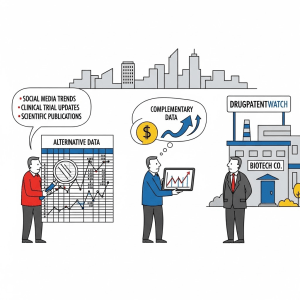
This report establishes a core thesis: to generate alpha and mitigate risk in the modern biopharma market, investors must augment traditional patent intelligence with a dynamic “mosaic” of alternative data. This is defined as any data from nontraditional sources, such as clinical trial registries, real-world prescription data, or expert commentary, that provides real-time, forward-looking insights beyond what is available in standard company filings or broker reports.3
The analysis demonstrates that specific categories of alternative data—Clinical Intelligence, Commercial & Real-World Evidence (RWE), Expert & Key Opinion Leader (KOL) insights, and broader Business Signals—each provide a unique, actionable perspective that complements and contextualizes patent data. The synergistic combination of these data streams, applied through a multi-layered due diligence framework, is the new standard for achieving a competitive advantage. Success in this domain requires navigating significant challenges related to data integration, legal compliance, and the complex ethical considerations inherent in the life sciences.
The Centrality of Patents and Their Inherent Limitations
In the biopharmaceutical sector, patents are not merely a legal shield; they are the fundamental currency of progress and the very foundation of a company’s business model.5 Unlike in the technology industry where trade secrets or network effects can provide a sustainable advantage, a drug molecule’s structure can be reverse-engineered with relative ease.5 A robust patent portfolio is the “fortress” that allows a company to recoup the massive research and development (R&D) expenditure required to bring a single drug to market, a process that can exceed $2 billion.1
The Strategic Significance of Patent Types
The value of a biopharma company’s IP is not monolithic. The type of patent protection it secures is a direct declaration of strategic intent.2
Composition of Matter Patents: These are the most valuable assets, as they protect the core new chemical entity (NCE) itself.1 Their strength and the duration of their remaining term are often the most significant drivers of a small biotech’s valuation.1
Method of Use Patents: These protect a specific way of using a compound, such as for a particular indication or disease. They are inherently weaker than a composition of matter patent, as a competitor could potentially market the same compound for a different, non-patented use, creating a potential loophole.2
Process Patents: These patents cover a specific method of manufacturing a compound. While often less critical for small molecules where alternative synthesis routes exist, they are a formidable barrier to entry for biosimilar competitors in the complex world of biologics, where the manufacturing process is intimately tied to the final product’s structure and function.2
The Limitations of Relying on Patent Data Alone
While foundational, patent data provides a limited and often ambiguous picture of a company’s true value and trajectory.
Legal Ambiguity and Enforceability Gaps: The “patent pending” status, while a strategic deterrent, does not bestow any immediate legal rights or full legal protection.6 An inventor cannot sue another party for infringement during this period. Full legal protection, including the right to prevent unauthorized use, only materializes once the patent is officially granted.6 This creates a high-stakes grey area for investors and competitors alike.
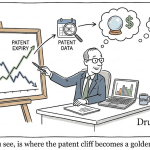
Patent Term Erosion vs. Data Exclusivity: A drug patent is typically granted for 20 years from the date of application.7 However, much of this term is eroded by the lengthy and costly clinical trials and regulatory review processes required before the drug can be commercialized.1 This phenomenon is often referred to as the “patent cliff,” a moment of profound market disruption when high-margin revenue can drop to zero almost overnight.8 A crucial distinction often overlooked by investors is “data exclusivity,” a separate regulatory mechanism that can confer market exclusivity for a specified period by limiting a generic competitor’s ability to rely on the originator’s clinical trial data for their own regulatory approval.7 This can effectively extend de facto market exclusivity even for non-patentable drugs or beyond the patent’s expiry date, a critical factor for valuation.7
The “Rearview Mirror” Problem: Patent data is a “declaration of intent”.2 It reveals what a company hopes to achieve and protect. However, it provides a “rearview mirror perspective” on the innovation landscape that is insufficient for a race that demands a clear view of the road ahead.2 It does not provide real-time information on a drug’s commercial adoption, patient usage, or the sentiment of key market influencers.
The New Frontier: A Taxonomy of Complementary Data for Biotech Investing
The most sophisticated players in the biopharma sector now view alternative data not as a supplement but as a primary, integral component of their investment research.9 This data, which is gathered from nontraditional sources, can be categorized into three main subsets: data generated by individuals, business processes, and sensors.3 For the biotech investor, this can be further refined into several actionable categories.
Clinical Intelligence: The Catalyst for Stock Movement
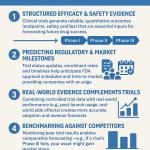
While traditional analysis focuses on the outcome of a Phase III clinical trial, a more nuanced approach leverages clinical data as a powerful predictive tool. Publicly available clinical trial registries provide a treasure trove of information that can act as a “catalyst event” for stock movements, often long before official results are announced.11
A profound discovery is that a clinical trial start can produce “highly predictable outcomes” with an accuracy of over 70% in back-testing.11 This is because the timing of a trial start is more predictable than a final outcome, providing a distinct advantage for investors with a short-term horizon. The predictive model for this catalyst uses factors such as the length of the trial, the company conducting it, the disease area, the phase, and the company’s stock price trend in the week prior to the trial start.11 This approach allows investors to build and manage a “selective portfolio” that has been shown to outperform broader market indices.11 Furthermore, aggregated clinical trial data can be used to generate “pipeline fitness reports” that provide a clear picture of a company’s development pipeline, helping to predict potential mergers and acquisitions (M&A).11
The relationship between clinical trials and intellectual property also creates a complex and risky “Catch-22” for inventors.12 Clinical trial data can be considered “prior art” that could invalidate a patent, a risk that increases as a trial progresses from Phase I to Phase III.12 This demonstrates a crucial causal link between scientific disclosure and IP protection that must be monitored closely.
Commercial & Real-World Evidence (RWE): Validating the Business Model
Real-world evidence provides a direct, real-time look at a drug’s commercial performance, allowing investors to move from projecting theoretical sales to observing actual market uptake.13 Data from sources such as Symphony Health Solutions and First Databank allow for real-time tracking of prescription volume, patient adherence, and regional sales.15 This is the most effective way to validate or challenge a company’s financial guidance and sales forecasts.13
This data can also be used to identify high-growth areas. Recent trends show that spending on specialty drugs, particularly in therapeutic areas like diabetes, oncology, and immunology, has grown significantly and is a major driver of overall drug costs.18 This information allows investors to strategically focus on sectors with proven market demand and significant growth potential.
Key Opinion Leaders (KOLs) are influential figures who shape treatment strategies, patient outcomes, and regulatory acceptance.21 Their opinions can serve as a leading indicator of a drug’s commercial viability, as a drug with strong clinical data may fail to achieve market success if key experts are unenthusiastic.23
Sentiment analysis of KOL commentary, whether from expert call transcripts, social media, or publications, provides a crucial qualitative layer to the quantitative data.23 This analysis can be used for competitor analysis, identifying potential new product launches, and anticipating shifts in the standard of care.23
Broader Business Signals: Uncovering Hidden Risks and Priorities
A company’s R&D spending is a clear proxy for its strategic priorities.24 For example, the United States accounts for nearly half of global R&D spending, and pharmaceutical giants fund over half of all biotech R&D investments.24 However, it is important to note that the relationship between R&D spending and drug approvals is complex and non-linear, with a significant time lag.25
Beyond financial and R&D metrics, investors can use alternative data to uncover operational risks. A due diligence process that goes beyond a standard checklist can reveal critical, hidden risks. For example, a case study demonstrates how an investor uncovered a potential failure risk by identifying a company’s heavy reliance on a single-source supplier for a critical manufacturing component of a gene therapy.26 This discovery, which was buried in secondary data sets and confidential interviews, allowed the investor to advise the company to diversify its supply chain, mitigating a risk that could have led to significant delays and financial losses.26
Provides a view of the operational and corporate realities behind the IP, identifying risks that could undermine the value of a patent portfolio
Synthesizing the Mosaic: A Multi-Layered Framework for Due Diligence
For a biotech investor, a successful due diligence process is guided by a “Mosaic Theory of Investing,” which involves finding investment opportunities by combining a diverse array of information sources.27 This means synthesizing traditional, dense IP data with a wide array of unstructured and real-time alternative data to create a comprehensive picture of an investment opportunity. A rigorous, multi-layered framework is essential to put this theory into practice.
Layer 1: Foundational Legal & IP Analysis
Purpose: To validate the legal standing and defensibility of a company’s core intellectual property.28
Data: This layer requires a deep dive into patent filings, court dockets, litigation databases, and IP analytics platforms such as DrugPatentWatch or IQVIA.1
Key Questions: Is the ownership (“chain of title”) of the patents clear and undisputed? Is the patent’s scope broad enough to prevent competitors from easily designing around it? Are there active challenges or litigation risks that could invalidate the patent?1 A legally strong patent portfolio may be strategically weak if it is concentrated in a jurisdiction facing new price controls or tariffs, which underscores the need to integrate geopolitical analysis into the evaluation.28
Layer 2: Scientific & Clinical Validation
Purpose: To de-risk the scientific rationale and assess the clinical efficacy of a drug candidate.30
Data: This layer relies on public and proprietary clinical trial databases, expert call transcripts, and scientific literature that may precede patent filings.1
Key Questions: Does the product candidate address a significant unmet medical need?30 Does the preclinical data support the claims, and how does that data translate to human trials? Is there a risk that the trials themselves could be considered “public use” and thus invalidate the patents?12 A case study of a venture capital firm demonstrates the value of this layer: the team went beyond a standard checklist to analyze a subtle data anomaly—inconsistent tumor regression in mice models—and discovered a potential “human-specific efficacy” that had been buried in secondary data.26 This shows that a deep, expert-led qualitative analysis of seemingly minor details can uncover a hidden breakthrough.
Layer 3: Commercial & Market Opportunity Analysis
Purpose: To quantify the market opportunity and validate the commercial viability of a product.13
Data: This layer leverages prescription and claims data, market access reports, and KOL sentiment analysis platforms.13
Key Questions: What is the true patient population and addressable market size? Is the drug’s uptake in line with company projections, or are there discrepancies between guidance and real-world prescription volume? How do its pricing and reimbursement strategies compare to those of competitors, and are there potential hurdles to market access?8
Layer 4: Corporate & Operational Health
Purpose: To assess a company’s financial health, strategic priorities, and operational risks.24
Data: This layer includes R&D spending trends, capital allocation data, and supply chain analysis.24
Key Questions: Is the company’s capital allocation aligned with its stated goals? Is its financial “burn rate” sustainable given its pipeline? Are there hidden operational dependencies, such as a reliance on a single-source supplier for a critical component, that could lead to significant delays or even failure?26
Table 2: Integrated Due Diligence Checklist
Due Diligence Layer
Key Question to Answer
Relevant Data Sources
Potential Risk Identified
Foundational Legal & IP
Is the core composition of matter patent valid, enforceable, and broad enough to prevent competitors from designing around it?
Navigating the Minefield: Challenges, Risks, and Ethical Considerations
Despite its immense potential, the use of alternative data in biopharma investing is not without significant challenges and risks.
The Challenges of Alternative Data
The first hurdle is the sheer cost and complexity associated with data integration.33 Alternative data often comes from “unconventional sources” with a “lack of consistent formats,” creating significant challenges for quality control and integration.33 The biotech sector’s data is particularly fragmented, with inconsistent data types and an absence of standardized models, which necessitates complex and costly data cleansing and transformation processes.34
Ethical and Regulatory Risks: The New Due Diligence Frontier
Beyond the technical challenges, the handling of sensitive patient and genetic data introduces significant ethical and regulatory risks that can have a direct impact on a company’s valuation and long-term viability.
Data Privacy as a Valuation Risk: The misuse of sensitive data is not just an ethical concern but a direct financial and legal risk.35 Non-compliance with stringent regulations like the Health Insurance Portability and Accountability Act (HIPAA) in the U.S. or the General Data Protection Regulation (GDPR) in the EU can result in “steep fines, legal complications, and a severe loss of trust” among patients and providers.36
The Risk of Algorithmic Bias: The widespread adoption of AI in biotech raises concerns about algorithmic bias, which occurs when AI systems produce “skewed results” due to a lack of diverse and representative training data.35 This can lead to misdiagnoses or ineffective treatments for underrepresented populations, which can erode trust and lead to legal challenges.35 For an investor, a company’s adherence to responsible AI development is no longer a secondary concern but a key component of risk management.37
Conclusion and Recommendations
The era of relying solely on traditional financial and patent data to invest in biopharma is over. The sector is defined by a unique set of risks that demand a nuanced, data-driven approach. The synergistic combination of patent intelligence with a mosaic of alternative data provides a path to identifying alpha and de-risking investments by offering a forward-looking, real-time, and holistic view of an opportunity.
The following recommendations are crucial for investors seeking to adopt this new standard:
Build a Data Strategy, Not a Data Pile: Instead of opportunistically acquiring data, a structured, repeatable process is essential. This involves understanding what information is needed to answer specific investment questions and then sourcing the data to meet those needs.
Invest in Integration: The cost and complexity of data integration are significant hurdles, but they are a necessary investment for a competitive edge. The ability to harmonize disparate datasets is a foundational requirement for a modern investment firm.
Prioritize Vendor Compliance: Investors should perform thorough and systematic due diligence on their data and AI vendors.37 A vendor’s ability to demonstrate clear data provenance and adherence to ethical and regulatory standards is a key component of mitigating legal and reputational risk.37
Cultivate In-House Expertise: Effectively interpreting and synthesizing these complex data streams requires a multidisciplinary team. A “carefully orchestrated collaboration of specialists” with legal, scientific, clinical, and technical expertise is essential to move beyond a simple checklist and uncover hidden breakthroughs and failures.28
Table 3: Key Alternative Data Providers for Biopharma
Provider
Data/Service Category
Key Use Case
DrugPatentWatch
Patent Intelligence, IP analytics
Evaluate branded and generic market opportunities, track litigation, and backtest financial models with historical data 29
IQVIA
Patent and Commercial Intelligence, RWE
Assess patent expirations and prepare for generic entry; model impact scenarios; analyze prescription and market data 15
Ozmosi
Clinical Trial Intelligence
Predict stock movements based on clinical trial starts; generate pipeline fitness reports for M&A analysis 11
Symphony Health Solutions
Prescription and Claims Data, RWE
Track prescription volume and gross sales for U.S. marketed drugs; validate revenue forecasts 15
Clarivate
Commercialization, Market Access
Streamline managed markets data, secure and optimize market access, and determine addressable patient populations 31
MiBA Analytics
Oncology RWE, AI-Powered Analytics
Gain real-time visibility into oncology care; access comprehensive, de-identified patient data across the treatment journey 40
Paragon Intel
Real-World Evidence, Patient Data
Obtain granular insights into product revenue and market share; monitor patient volumes and treatment patterns 13
Excelra
KOL Intelligence
Identify and build comprehensive databases of Key Opinion Leaders (KOLs) with a unique eminence score 22
PlexoA
Qualitative Due Diligence
Uncover hidden breakthroughs or failures through advanced qualitative analysis of subtle data anomalies during due diligence 26
Raising the Barriers to Access to Medicines in the Developing World – The Relentless Push for Data Exclusivity – PMC – PubMed Central, accessed August 20, 2025, https://pmc.ncbi.nlm.nih.gov/articles/PMC5347964/