Executive Summary: The Predictive Power of Non-Traditional Signals
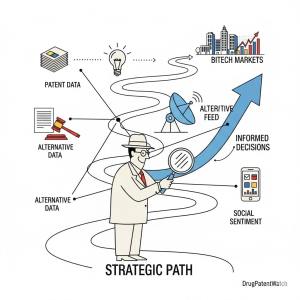
Traditional financial analysis, relying on sources such as company filings and earnings reports, provides a retrospective view of a company’s performance. For most industries, this “rearview mirror” perspective is sufficient to understand financial health and make informed decisions. However, the biotechnology sector presents a unique challenge. The value of a biotech company, particularly a small- to mid-sized firm in a pre-revenue stage, is primarily based on intangible assets: the potential of its research and development (R&D) pipeline and the strength of its intellectual property (IP).1 Traditional metrics are largely irrelevant for these companies. In this environment, an investment decision is less about past performance and more about predicting future scientific breakthroughs and market events. Alternative data, which is information gathered from non-traditional sources, offers a forward-looking, high-fidelity lens into these critical drivers of value.3
This report examines how sophisticated investors are moving beyond conventional analysis to leverage alternative data. Key data verticals, including clinical trial registries, IP filings, and digital sentiment from expert networks, provide leading indicators that can signal a company’s prospects long before they are reflected in financial statements. The strategic application of this data allows for more robust due diligence, proactive risk management, and the identification of new investment opportunities.1 However, the use of this data is not without its challenges. The information is often messy, unstructured, and fragmented, requiring advanced analytical tools like artificial intelligence (AI) and machine learning (ML) to process.6 Furthermore, navigating the complex legal and ethical landscape, particularly concerning the use of material non-public information (MNPI), is a critical component of any successful alternative data strategy.8 This report serves as a strategic guide, outlining the imperative of integrating alternative data, detailing the most impactful data types for the life sciences sector, and providing a framework for overcoming the significant technical and regulatory hurdles.
Section 1: The New Frontier of Biotech Investment Research
1.1 The Unique Challenges of Biotech Valuation
Valuing a biotechnology company fundamentally differs from valuing a firm in sectors like consumer goods or technology. While the latter can be assessed using traditional metrics such as sales, earnings, and tangible assets, pre-revenue biotech companies often have none of these.9 Their entire valuation is speculative, built on the promise of a future drug or therapy that may or may not reach the market. The value is almost entirely derived from intangible assets, specifically the potential of a drug in its R&D pipeline and the intellectual property that protects it.1 This creates a highly volatile, “winner-take-all” market. A single positive clinical trial outcome or a favorable patent decision can cause a company’s stock to surge by hundreds of percentage points, as seen with ProKidney’s 600% jump following encouraging Phase II data.10 Conversely, a negative result or a patent challenge can lead to a catastrophic plunge.10
The high volatility and complex valuation of the biotech market necessitate a different approach to investment research. Traditional financial metrics are rendered insufficient because they are retrospective. A price-to-earnings (P/E) ratio has no meaning for a company with no earnings. A cash flow statement only shows the rate at which R&D funds are being spent, not the likelihood of a return on that investment. This creates an informational vacuum for investors. The market is effectively a “black box” of speculation, where any signal that can provide a probabilistic edge becomes immensely valuable. Alternative data is uniquely positioned to fill this void. By tracking leading indicators of scientific and legal milestones, alternative data offers a glimpse inside this box, providing a critical tool for competitive advantage. The high costs and long timelines of R&D lead to pre-revenue companies with intangible assets, which in turn makes traditional analysis moot. This creates a powerful incentive to seek out predictive information from non-traditional sources.
1.2 Defining Alternative Data for the Biotech Investor
Alternative data is defined as information gathered from non-traditional sources, extending beyond traditional material such as SEC filings, company press releases, and broker research.3 This information can provide an indication of a company’s future performance that is not available through conventional channels.12
Alternative data is broadly categorized into three main subsets:
Data generated through individuals: This is often unstructured and includes social media commentary, web traffic, app usage, and transcripts from expert interviews.13 This type of data provides insights into consumer sentiment and market behavior.
Data generated through business processes: This is typically structured data, such as bank records, commercial transactions, credit card transaction records, and data from government agencies.5
Data generated by sensors: This category includes unstructured data from satellite images, weather forecasts, geolocation, and information from Internet of Things (IoT) devices.3
While many of these categories, such as credit card transactions and satellite imagery of parking lots, are powerful signals for industries like retail or consumer goods, their direct application to the biotech sector is more limited.3 A pre-commercial biotech firm does not have a consumer-facing product to track, making consumer spending data irrelevant. For life sciences investors, the most valuable alternative data types are those that align with the core value drivers of the industry: R&D progress and intellectual property. For example, an analysis of clinical trial investigator networks or a company’s patent filings provides an exclusive, high-value data point that is directly predictive of a biotech’s success.16 Therefore, a modern biotech investor must strategically filter the vast universe of alternative data and focus on the few streams that are truly predictive for this specialized sector.
1.3 The Complementary Imperative: Fusing Data for a Holistic View
Alternative data is not a replacement for traditional analysis but a crucial complement.3 The most sophisticated investment strategies fuse both data types to construct a more complete and predictive picture of a company’s prospects.4 For example, an analyst might use a company’s SEC filings to understand its cash burn rate and then incorporate clinical trial data to forecast a potential catalyst event that could impact future capital needs and valuation.5
The true power of alternative data lies in its ability to validate or challenge a thesis derived from traditional sources. This cross-referencing of information is a powerful form of risk mitigation. For instance, a company might announce positive Phase II trial data in a press release. While a traditional analyst would stop there, a sophisticated analyst would use this information as a starting point and then use alternative data sources to gauge market sentiment. They would analyze commentary on social media, review expert call transcripts, and assess the credibility of the results among key opinion leaders (KOLs).13 The ability to confirm or refute the traditional narrative with non-traditional signals significantly reduces the risk of making a decision based on incomplete or misleading information.
The following table illustrates the distinction and synergy between the two data types, highlighting why alternative data is not simply “extra” information but a fundamentally different category of information that provides a forward-looking, high-fidelity signal.
Table 1: Alternative Data vs. Traditional Data in Biotech Research
Characteristic
Traditional Data
Alternative Data
Source
SEC filings (10-K, 10-Q), Earnings Calls, Press Releases, Broker Research
Clinical trial registries, Patent filings, Social media, Expert networks, Real-world data
Timeliness
Retrospective, periodic (quarterly, annually)
Real-time, continuous
Structure
Generally structured and standardized
Often messy, unstructured, and fragmented
Focus
Financial performance and historical metrics
Predictive indicators of scientific, legal, and market events
Example
Revenue growth, cash position, GAAP net income
Clinical trial starts, Phase transition success rates, Paragraph IV filings, KOL sentiment
Section 2: Core Alternative Data Verticals for Life Sciences
A modern investor’s toolkit is incomplete without access to a strategic set of alternative data sources. For the life sciences sector, these sources are specifically chosen for their ability to provide predictive signals related to a company’s R&D and intellectual property. The most impactful data verticals are clinical trial data, intellectual property data, and digital and social sentiment analysis.
Table 2: Key Alternative Data Sources for Life Sciences Investment
Electronic health records (EHRs), Wearable device data, Patient-reported outcomes
2.1 Clinical Trial and Real-World Data (RWD): A Pipeline of Predictive Catalysts
The progression of a clinical trial is a primary catalyst for stock price movements, especially for small- to mid-sized biotech companies.5 The public availability of clinical trial data, primarily through registries such as ClinicalTrials.gov, makes it a valuable alternative data source.17 However, the raw data is often messy, unstructured, and requires significant effort to clean and process before it can be used for meaningful analysis.5 The true value proposition of a clinical trial data provider is not the raw data itself, which is often free, but the sophisticated layer of cleaning, structuring, and enhancement that makes it actionable. A provider can process this data to provide a “clean version” that can be aggregated at the company level, offering a clear picture of a company’s development pipeline and enabling the prediction of catalyst events such as trial starts and M&A opportunities.5 This process transforms a public data source into a proprietary, high-value asset.
Beyond a trial’s headline-grabbing primary outcomes, investors can gain a deeper edge by analyzing secondary outcomes, patient selection criteria, and the overall trial design.19 Furthermore, the integration of real-world data (RWD) from sources such as electronic health records (EHRs) and wearables represents a paradigm shift from a snapshot-based view to a continuous, longitudinal one.20 While a traditional trial measures a few predefined outcomes at specific intervals, RWD can continuously capture data from wearables, providing a multi-variable, real-time picture of a patient’s health. For example, a wearable-based study could provide real-time data on a drug’s impact on patient activity levels or sleep patterns, a signal that could predict commercial success long before traditional sales numbers are available. This not only improves trial outcomes but also creates a new data stream for investors, moving the analysis from a simple “Did the drug work?” to a more nuanced “How is the drug affecting the patient’s entire quality of life?”.20 This predictive power, enabled by a continuous data stream, is a significant opportunity for alpha generation.
2.2 Intellectual Property (IP) Data: Uncovering the Financial Bedrock
A biotechnology company’s patent portfolio is the bedrock of its valuation.1 For pre-revenue firms, intellectual property is often the only tangible asset, providing a “legally-enforced monopoly” that allows the company to recoup its massive R&D investments.9 It is a declaration of invention, a map of strategic intent, and a timer counting down to a moment of profound market disruption.1
A simple count of a company’s patents is a misleading metric. A deep analysis requires understanding the quality and strategic positioning of the IP.1 This includes:
Composition of Matter Patents: These are the “crown jewels” that cover the active pharmaceutical ingredient itself. The grant and remaining lifespan of a robust, early-stage patent are often the most significant drivers of a small biotech’s valuation.1
Lifecycle Management (LCM) Patents: These include method-of-use and formulation patents that form a “thicket” around a core product to extend its market exclusivity and delay generic competition.1
Process Patents: These cover the manufacturing process and are particularly critical for biologics, as they can create a formidable barrier to entry for biosimilar competitors, who find it incredibly difficult to replicate a biologic exactly.1
A company’s patent strategy reveals its long-term commercial intent. The absence of a strong LCM strategy or a weak process patent portfolio for a biologic can signal a future “patent cliff” where revenues are expected to plummet.1 This is a forward-looking risk signal that traditional financial models cannot capture. Furthermore, quantitative patent metrics, such as forward citations—the number of times a patent is cited by later patents—provide an objective measure of an invention’s technological importance and innovation quality.1 By analyzing a company’s patent portfolio, an investor is not merely assessing legal protection; they are predicting future revenue streams and potential declines. The causality is clear: a company with a strong composition of matter patent has a clear path to market exclusivity; a company with a robust “thicket” of secondary patents can extend this exclusivity; and a company with a weak or litigated portfolio is vulnerable.1 Patent litigation, as revealed by court dockets, represents a direct financial risk that the market prices in immediately.23
2.3 Digital and Social Sentiment Data: Gauging the Investor and Patient Pulse
The sheer volume of unstructured data on the internet—from social media to news articles and expert transcripts—presents a significant challenge and a massive opportunity. Natural Language Processing (NLP) and machine learning (ML) are essential tools for transforming this text-based data into quantifiable sentiment signals.25 This process is the core capability of platforms such as AlphaSense and StockGeist.ai, which make sense of the overwhelming amount of data.18
Social sentiment can serve as a leading indicator for short-term price movements.3 Positive sentiment can signal a potential rise, while negative sentiment can signal a decline.25 For biotech, the most valuable sentiment data may not be from the general public but from domain-specific communities, such as researchers, patient advocacy groups, or key opinion leaders (KOLs).16 The commentary of these domain experts is often more predictive of a drug’s commercial success than general chatter. A company’s presentation at a scientific conference is a high-profile event that can generate a significant amount of buzz. The sentiment around their presentation on social media and expert forums can signal a favorable reception from the scientific community, which can precede a rise in stock price as investors gain confidence. This causal chain is indirect but highly predictive.
Section 3: Strategic Applications and Actionable Insights
Leveraging alternative data goes beyond simple data collection; it is a strategic discipline that enhances every stage of the investment process. By integrating alternative data into their workflows, investors can enhance due diligence, gain a competitive edge, and proactively manage portfolio risk.
Table 4: Strategic Application Matrix
Due Diligence
Competitive Intelligence
Portfolio Management
M&A Forecasting
Clinical Trial Data
Validate a company’s pipeline and trial design. Analyze patient selection criteria and outcomes.
Benchmark competitors by tracking their trial starts and success rates in a therapeutic area.
Monitor ongoing trials for early signals of success or failure. Anticipate catalyst events.
Identify potential acquisition targets based on the strength and stage of their clinical pipeline.
Intellectual Property Data
Assess the legal defensibility of a company’s core asset. Analyze patent quality and grant status.
Map the competitive landscape by analyzing who is filing patents and who is a serial litigant.
Proactively manage risk by monitoring for Paragraph IV filings and patent litigation.
Identify potential acquisition targets based on patent strength and litigation history.
Digital & Social Sentiment
Gauge market and scientific reception to a company’s announcements. Analyze expert call transcripts for nuanced commentary.
Monitor the sentiment around a competitor’s drug to identify market threats or weaknesses.
Use sentiment signals to make short-term trading decisions and manage exposure to volatile stocks.
Identify companies with high market buzz or favorable KOL sentiment that may attract an acquirer.
3.1 Enhanced Due Diligence and Competitive Intelligence
Alternative data provides a powerful way to validate or invalidate an investment thesis before a major event. For instance, a fund considering an investment in a pre-clinical company could analyze the patent landscape to see which competitors are filing in that same therapeutic area.1 This analysis can reveal who is truly leading innovation and where the market is headed.
Instead of relying on a company’s own market positioning, an investor can use alternative data to benchmark competitors. By tracking clinical trial activity by therapeutic area 17 or analyzing M&A activity in a specific space 16, an investor can gain a deeper understanding of the market at large. A key application is to identify “stealth” or “under-the-radar” opportunities. A small biotech may not have a massive marketing budget, but its patent portfolio might be gaining significant forward citations from competitors.1 This signals high innovation quality and potential for a future partnership or acquisition, a signal that traditional research might miss. By tracking competitor clinical trial starts in a target company’s therapeutic area and setting up alerts for new activity 17, an investor can gain a real-time understanding of competitor strategy, enabling a more proactive, rather than reactive, investment posture.
3.2 Portfolio Management and Risk Mitigation
Alternative data provides crucial risk signals that enable proactive foresight. For example, a Paragraph IV filing is a direct signal of an impending generic challenge and a future revenue cliff.1 By monitoring for such events, investors can anticipate market shifts rather than react to them. Monitoring the sentiment around a competitor’s drug can also reveal potential market threats.
For quantitative investors, alternative data is a core input for algorithmic models that can predict short-term stock movements.3 For fundamental investors, it can generate new investment ideas and provide a competitive edge in finding catalyst events with “regularity and clarity”.5 The value of alternative data is its ability to turn reactive risk management into proactive foresight. Instead of waiting for a bad earnings report, an investor can see early signals of a trial failing to meet enrollment targets or a key patent being challenged in court.1 For instance, data from a provider could show a slow enrollment rate or a high patient dropout rate in an ongoing trial, which are early indicators of potential failure.21 This provides an investor with time to either reduce their position or open a short position before the public announcement.
3.3 Case Studies in Application (Generalized)
The Clinical Trial Catalyst: Consider a hypothetical investor tracking a small biotech company. By regularly monitoring clinical trial registries, they identify that the company has completed patient enrollment for a pivotal Phase II trial. They then use digital sentiment platforms to track the buzz and commentary around the trial from scientific and investor communities. As the company gets closer to announcing results, the investor notes a significant increase in positive sentiment from key opinion leaders at a major scientific conference. This confluence of signals, from the trial’s completion to the positive sentiment, provides a strong indication of a likely positive outcome, allowing the investor to build a position before the public announcement and benefit from the subsequent stock surge, similar to the case of ProKidney’s 600% jump.10
The Patent Cliff Foresight: A different investor is analyzing a large pharmaceutical company whose blockbuster drug is nearing the end of its primary patent term. While the company’s traditional financial filings show steady revenue, the investor uses intellectual property data to conduct a deeper analysis. They discover that the company’s secondary patent portfolio—the “thicket” designed for life-cycle management—is weak and has been the target of several Paragraph IV filings from generic competitors.1 This provides a strong signal of a future “patent cliff,” a massive and sudden drop in revenue. Based on this forward-looking risk signal, the investor can adjust their portfolio, potentially shorting the stock or shifting capital to a competitor with a stronger pipeline, long before the public market fully prices in the risk of generic competition.
Section 4: Navigating the Challenges: Technology, Ethics, and Compliance
Despite its transformative potential, the use of alternative data is not without significant challenges. These hurdles fall into three main categories: technical complexity, the need for advanced analytics, and a complex legal and ethical landscape.
4.1 The Data Minefield: Quality, Consistency, and Fragmentation
Alternative data is “by no means flawless”.3 It is often messy, unstructured, and fragmented, requiring significant time and resources to clean, validate, and structure before it can be used for meaningful analysis.6 The value of a public dataset, such as information from the U.S. Food and Drug Administration (FDA), is often limited by its lack of consistency due to changing file formats over time.6 The same drug might be referred to by different names in different datasets, or data might be incomplete or contain errors, creating inconsistencies that can lead to misleading conclusions.7
The messy nature of this data means that the value of a data provider is directly correlated to the robustness of their data infrastructure and quality control. This is a hidden cost of alternative data.7 An investor’s due diligence on a data provider must focus on their methodologies for cleaning, linking, and maintaining data, not just the content of the data itself. The process of leveraging alternative data is not as simple as “get data, analyze it.” There is a critical prerequisite step of data aggregation and cleaning.9 This necessitates either building a sophisticated internal data team or partnering with a trusted external vendor who has a proven track record of creating a clean, structured, and actionable dataset.15
4.2 The Role of AI and Machine Learning
AI and Machine Learning (ML) are not just “nice to have” but are essential for processing and deriving insights from the vast, unstructured datasets that define alternative data.28 These technologies enable everything from automated data flow in clinical trials to sentiment analysis and the prediction of drug efficacy.21
Natural Language Processing (NLP): NLP is a core technology that transforms text-based documents, such as expert call transcripts or social media posts, into structured data that can be analyzed by a computer.27 This is used for stratifying patients in trials, identifying adverse events, and uncovering shifts in commentary on relevant companies or disease areas.13
Predictive Analytics: Predictive models are highly effective in forecasting clinical trial outcomes, patient dropout rates, and adverse events.21 By leveraging historical data, these models can create “virtual patient cohorts” to simulate the effects of treatments and optimize trial design, reducing the need for costly and time-intensive traditional randomized control trials.21
The rise of AI and ML in life sciences is both a tool for investors and a trend to be invested in. A company’s embrace of these technologies in its own R&D, for example by using AI for molecule discovery, can be a positive signal for investors, as it indicates a more efficient, data-driven approach to innovation.32 The need to process large, complex datasets in life sciences is driving the adoption of these technologies, which in turn generates more structured, usable data for investors, creating a virtuous cycle of data-driven innovation and analysis.
4.3 Legal, Ethical, and Regulatory Risks
The use of alternative data presents a significant legal and ethical risk, particularly concerning the use of Material Non-Public Information (MNPI).8 The U.S. Securities and Exchange Commission (SEC) has focused on this area, emphasizing the need for robust, documented due diligence on data vendors to address the potential risk of receiving and using MNPI.8 A profitable trade based on a data source that violates compliance could lead to severe regulatory action. The value of an alternative data source is not just in its predictive power but also in its provenance—the data’s origin and collection method. If the data was obtained unethically or illegally, it transforms from a high-alpha signal into a high-liability risk.
Data vendors and investors must adhere to strict privacy laws such as the General Data Protection Regulation (GDPR) and the California Consumer Privacy Act (CCPA).14 The collection of data from mobile devices or credit card transactions requires transparency and user consent.14 The most significant risk in using alternative data is not technical but legal. The desire for predictive information leads to the use of alternative data, but some sources may skirt privacy or legal boundaries. The SEC’s increased focus on this area creates a new risk, making a legal and ethical review of the data’s provenance a crucial part of the investment process.
Table 3: Select Alternative Data Providers and Their Specialization
Provider
Specialization
DrugPatentWatch36
IP/Patent data, litigation history, regulatory status, and clinical trial information 36
AlphaSense13
NLP/Sentiment analysis, expert call transcripts, and company/regulatory document search 13
IQVIA38
Clinical trial financial management, budgeting, and forecasting 38
GlobalData16
Market data and insights, clinical trial coverage, company intelligence, and real-time sentiment analysis 16
SafeGraph31
Geolocation/foot traffic, property details, and demographic data 31
UBS Evidence Lab31
Multi-source data harvesting, cleansing, and enrichment 31
Section 5: The Future of Alternative Data in Biotech
5.1 Emerging Data Streams and Technologies
The field of alternative data is constantly evolving, with new data streams and technologies emerging to provide even greater depth and accuracy. A forward-looking view reveals several key trends:
Large Language Models (LLMs): Advancements in AI and LLMs are making it simpler and more intuitive to use these technologies for drug discovery and research.34 Researchers can use LLMs to analyze hundreds of research papers and identify trends, matching proteins with potential drug molecules without having to calculate the complex protein structure.34
Internet of Medical Things (IoMT): The proliferation of connected medical devices and wearables is generating an unprecedented amount of real-time patient data. Advanced analytics platforms can process this continuous data stream, providing immediate insights to healthcare professionals and investors alike.40 This enables continuous patient monitoring, early detection of health issues, and a deeper understanding of a drug’s impact in a real-world setting.
Decentralized Trials: The use of remote monitoring from wearables and other medical devices is enabling decentralized clinical trials, reducing patient burden and creating a more efficient data stream for investigators and investors.20 The data from these devices is transmitted in real time, where it can be continuously monitored, providing a more granular and timely view of a drug’s efficacy and safety.20
5.2 Strategic Recommendations for the Modern Investor
For the modern investor, alternative data is no longer a luxury but a competitive necessity. To successfully leverage its power, a strategic approach is required.
Build a Multi-Source Data Strategy: Relying on a single data source is insufficient. The most robust strategies fuse multiple alternative data streams—such as clinical trial data, patent filings, and digital sentiment—to build a multi-layered, holistic view of a company.4 The data can be used to either validate a thesis or to identify weaknesses in a traditional narrative.
Invest in Specialized Providers: The fragmented and messy nature of alternative data makes it difficult for a single firm to collect and clean all the data streams on its own. It is more efficient and reliable to invest in or partner with specialized data providers who have a proven track record of cleaning, structuring, and maintaining these complex datasets.6
Establish a Robust Compliance Framework: The legal and ethical risks associated with alternative data are significant and require a proactive approach. An investor’s due diligence process must extend beyond the data itself to the data provider’s collection methods, legal frameworks, and compliance procedures to mitigate the risk of using MNPI.8
By embracing alternative data, modern investors can transform their approach to the volatile and complex biotech market, turning a “rearview mirror” perspective into a forward-looking, high-fidelity lens that provides a true competitive edge.
Innovative Sentiment Analysis and Prediction of Stock Price Using FinBERT, GPT-4 and Logistic Regression: A Data-Driven Approach – MDPI, accessed August 20, 2025, https://www.mdpi.com/2504-2289/8/11/143
Find Your Next Blockbuster – Biotech & Pharmaceutical patents, sales, drug prices, litigation – DrugPatentWatch, accessed August 20, 2025, https://www.drugpatentwatch.com/about.php