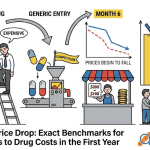
Nine months after Humira lost U.S. exclusivity, biosimilars held four percent of the market. AbbVie’s Humira still controlled ninety-six percent of prescriptions in February 2024, thirteen months after ten rival adalimumab products arrived [4][5]. Yet AbbVie’s fourth-quarter 2023 U.S. Humira revenue had already fallen 45.3 percent [4]. Almost nobody switched. Almost half the money disappeared anyway.
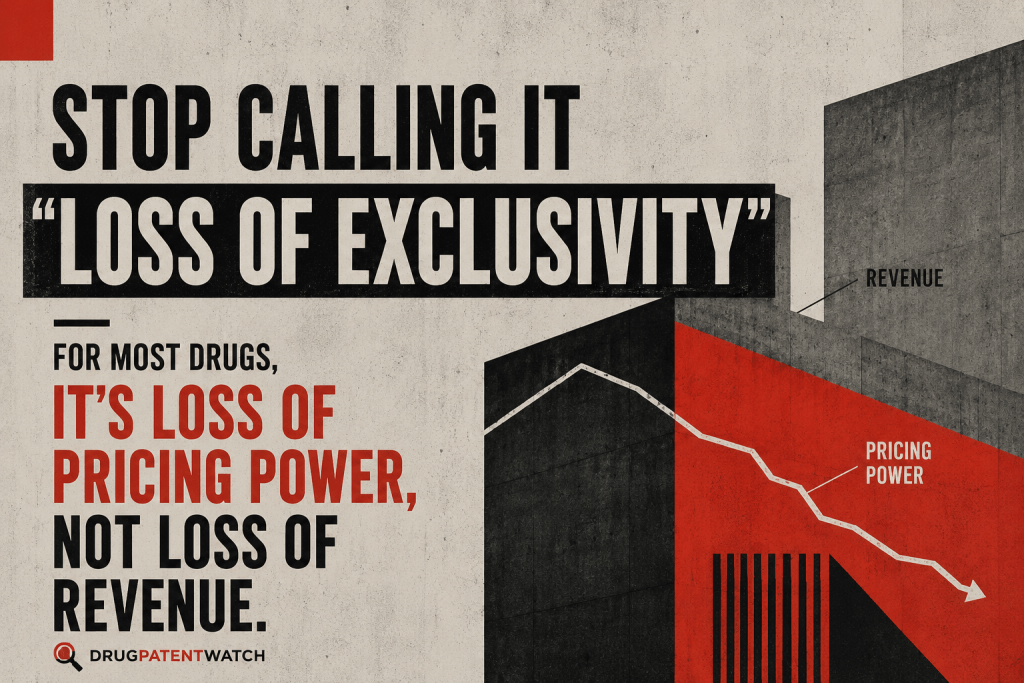
That gap is the subject of this piece. Pharma commentary treats “loss of exclusivity” (LOE) as a single event with a single outcome: the patent falls, generics flood in, revenue craters within months. That script is real for one category of drug. For a second, larger category, especially biologics and drugs with complex administration or contracting, the script is different. Volume barely moves. Price falls anyway, because the brand has to buy back its own formulary position one rebate contract at a time. The exclusivity is gone. The prescriptions are not. What is actually lost is pricing power: the ability to set a price without asking a payer’s permission.
The Short Answer
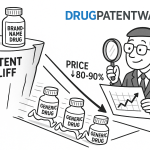
Small-molecule oral drugs with automatic pharmacy substitution lose both price and volume within months of generic entry, because state substitution laws let a pharmacist swap the brand for a cheaper AB-rated generic at the counter, with no prescriber or payer decision required. Lipitor is the textbook case: Pfizer’s most aggressive defense in pharmaceutical history preserved roughly 40 percent brand share for about six months, then it collapsed anyway [14][15][16]. Biologics have no such substitution mechanism. Interchangeability is rare, physicians and pharmacists cannot swap products automatically, and formulary access is negotiated, not mandated. Humira and Remicade show what that produces: originator volume share stayed above 90 percent for one to seven years after competition arrived, while net price fell sharply through rebates the brand had to concede to keep that shelf space [4][5][6][20][21]. A third pattern, illustrated by Revlimid, shows a brand contractually engineering its own erosion curve through volume-capped settlements, retaining enough pricing power to raise list price mid-decline [26][27][30]. A fourth, illustrated by Enbrel, shows LOE simply not happening: a patent thicket has kept a 1998-approved biologic free of U.S. biosimilar competition through at least 2029 [32][33][34].
Findings That Matter
FDA analysis of Medicare claims data found generic products facing a single competitor priced 39 percent below the pre-entry brand average manufacturer price; with six or more competitors, the reduction exceeded 95 percent [1].
A JAMA Network Open study of 50 brand drugs found generic competition produced a nearly 53 percent price decrease once three generic competitors had entered [2].
Brand-name share of standard units averaged 23 percent twelve months after first generic entry for new molecular entities that lost exclusivity between 2017 and 2019 [3].
AbbVie’s Humira retained 96 percent U.S. market share in February 2024, fell to 82 percent by July 2024, and fell again to 72 percent by November 2024, according to successive Samsung Bioepis market reports, even as AbbVie’s fourth-quarter 2023 U.S. Humira revenue had already dropped 45.3 percent [4][5][6][7].
Johnson & Johnson’s Remicade held 96 percent of U.S. infliximab unit sales in September 2017, roughly a year after the first biosimilar launched, and still held about 92 percent in 2019, per company statements and litigation filings [20][21].
Bristol Myers Squibb’s Revlimid revenue fell from $12.9 billion in 2021 to $6.0 billion in 2023, an erosion built entirely from contractual volume caps the company negotiated in patent settlements, not from open-market generic competition [26][27][31].
Amgen’s Enbrel has faced no U.S. biosimilar competition since its original patent expired in 2012, because two later patents (U.S. 8,063,182 and 8,163,522) extend exclusivity to 2028 and 2029 [33][34].
Generic drugs fill roughly 91 percent of all U.S. prescriptions yet account for a small minority of total drug spending, a gap that only exists because of how completely price, not volume, drives small-molecule LOE economics [source: FDA/CMS generic dispensing data, cited via FDA CDER, 17].
What “Loss of Exclusivity” Actually Means
Patent Expiration, Regulatory Exclusivity, and LOE Are Three Different Clocks
A drug’s commercial protection runs on two separate clocks that most coverage collapses into one word. The first clock is patent law: a composition-of-matter, formulation, or method-of-use patent, listed in the Orange Book for small molecules or the Purple Book for biologics, that blocks a generic or biosimilar from entering until it expires or is successfully challenged. The second clock is regulatory exclusivity, a statutory period, five years for a new chemical entity, seven for an orphan drug, twelve for a biologic under the Biologics Price Competition and Innovation Act, that runs independent of any patent and cannot be challenged in court. “Loss of exclusivity” is the date the later of the two clocks runs out and a competitor can legally enter. It is a regulatory and legal event. It says nothing, by itself, about what happens to revenue.
Why the Term Gets Used as a Synonym for Revenue Collapse
The assumption that LOE equals an automatic revenue cliff comes from decades of small-molecule blockbuster history: Zocor, Plavix, Lipitor, Nexium. Those drugs are oral solids, dispensed through retail pharmacy, subject to state generic-substitution laws that let a pharmacist fill an AB-rated generic without contacting the prescriber. That substitution mechanism is what makes the cliff a cliff. It has no equivalent for injectable biologics, complex delivery devices, or drugs where switching requires a clinician’s decision. An increasing share of top-selling drugs, seven of the ten best-selling drugs worldwide in recent years, are biologics, which means an increasing share of LOE events will not behave like Lipitor.
The Mechanism: How LOE Actually Moves Money
Price Erosion by Competitor Count
The single most consistent variable in small-molecule generic pricing is the number of approved competitors, not the calendar. FDA’s analysis of average manufacturer price (AMP) data found that a single generic competitor drops price roughly 39 percent below the pre-entry brand price; two competitors drop it about 54 percent; four competitors drop it about 79 percent; six or more competitors drop it more than 95 percent [1]. A separate JAMA Network Open analysis of physician-administered drugs found a similar pattern, with prices down nearly 53 percent once three generic competitors were on the market, and it modeled that treating biosimilars like generics for Medicare Part B reimbursement would have cut biologic spending by an estimated 27 percent from 2015 to 2019 [2]. That last number matters: it is a counterfactual, not an observed result, because Medicare Part B did not yet apply generic-style reimbursement rules to biosimilars during that period.
Volume Erosion Follows a Completely Different Curve
Price and volume do not erode at the same speed, and conflating them is the single most common forecasting error in LOE modeling. For small-molecule oral drugs, volume erosion is nearly instantaneous because state substitution laws automate it. An academic analysis of brand and generic drug competition trends found that brand-name share of standard units averaged only 23 percent twelve months after first generic entry for cohorts entering the market from 2017 to 2019, and only 18 percent for drugs with more than $250 million in pre-LOE sales [3]. For biologics, there is no automatic substitution step. A pharmacist cannot swap Humira for a biosimilar without an interchangeability designation and, in most states, additional notification requirements; a hospital or health system has to make an affirmative formulary decision. That is the entire reason Humira and Remicade held onto the overwhelming majority of prescriptions for years after competitors arrived, while their prices collapsed through payer negotiation instead.
Why Automatic Substitution Only Exists for Small Molecules
Every state has a generic substitution statute that lets, or in some states requires, a pharmacist to dispense an AB-rated generic in place of a prescribed brand-name small molecule, unless the prescriber specifies “dispense as written.” No equivalent default exists for biologics. The FDA’s interchangeability designation under the BPCIA lets a small number of biosimilars be substituted the same way, but most Humira and Remicade biosimilars launched without that designation, so substitution required a clinician’s choice rather than a pharmacy-counter swap.
Case Study: Lipitor and the Small-Molecule Cliff
Pfizer’s Three-Pronged Defense
Pfizer’s compound patent on atorvastatin, extended by six months of pediatric exclusivity, expired November 30, 2011 [10]. Lipitor had generated $9.6 billion in 2011 sales, about one-seventh of Pfizer’s total revenue [source: news coverage of Walgreen/retailer antitrust suit]. Pfizer ran three defenses simultaneously. It signed Watson Pharmaceuticals to distribute an authorized generic manufactured by Pfizer, under a deal that let Pfizer keep an estimated 70 percent of the product’s net sales through 2016 [12][19]. It launched a “Lipitor for You” co-pay card that cut patient out-of-pocket cost to roughly four dollars a month, undercutting the typical generic co-pay [12]. And it negotiated exclusive rebate deals with pharmacy benefit managers, including Medco and CVS Caremark, that kept some plans dispensing only branded Lipitor for months after generics existed, a practice Senators Max Baucus, Chuck Grassley, and Herb Kohl formally investigated [11][18].
What Happened Anyway
Generic atorvastatin captured 59 percent of prescriptions in its first full week on the market, despite the co-pay cards and PBM deals already in place [13]. Pfizer’s brand share held near 40 to 41 percent through the first weeks of 2012, better than the roughly 10 percent industry baseline analysts expected, but Watson’s own CEO projected it would keep sliding below 40 percent even with the promotions running [14][15]. By the week ending March 2, 2012, IMS data showed generic atorvastatin controlling 67.0 percent of the market, thirteen weeks after launch [16]. When the 180-day exclusivity period ended in late May 2012 and additional generic manufacturers entered, Pfizer’s position collapsed further. The Wall Street Journal reported Pfizer’s first-quarter 2012 Lipitor revenue at $383 million, against Ranbaxy’s generic sales of $375 million in the same quarter, a run-rate collapse from a business that had generated roughly $2.4 billion per quarter at its peak, and Pfizer told the Journal it was ending Lipitor promotion to physicians and health plans entirely [17]. Even history’s most heavily defended small-molecule LOE lost both price and volume within two quarters.
Case Study: Humira and the Modern Biologic Pattern
The Market Share That Barely Moved, at First
Humira lost U.S. exclusivity on January 31, 2023 [26 (context), pharmalive]. Ten biosimilars were expected to reach the market that year [24]. AbbVie’s own guidance going into 2023 projected roughly 37 percent U.S. revenue erosion for the year [9], later revised to about 35 percent as the company reported the erosion tracking “slightly better than our planning assumptions” [8]. Volume told a different story than that guidance implied. As of February 2024, thirteen months after biosimilars launched, Humira biosimilars held only about 4 percent of the U.S. market, according to a Samsung Bioepis report [5]. Erosion accelerated only once major pharmacy benefit managers moved biosimilars onto preferred formulary tiers: CVS Caremark’s decision to remove branded Humira from some formularies helped push Humira’s share down to 82 percent by July 2024, a 13-point drop in a few months, then to 72 percent by November 2024 [6][7].
The Revenue That Moved First
Revenue eroded well ahead of volume. AbbVie’s global Humira revenue fell from $21.24 billion in 2022 to $14.404 billion for full-year 2023, a 32 percent decline, and the U.S. business alone was down 45.3 percent year over year by the fourth quarter of 2023 [4][22]. That is the pricing-power mechanism in isolated form: net price per prescription collapsed through rebate concessions AbbVie made to defend formulary access, months before any meaningful share of patients actually switched products.
Why AbbVie Could Absorb It
AbbVie’s Humira defense worked because the company had already built Skyrizi and Rinvoq into replacement franchises before the cliff arrived. AbbVie CEO Richard Gonzalez stated the company expected to “fully absorb Humira erosion” in 2024 and return to growth in 2025, a claim borne out as combined Skyrizi and Rinvoq sales were projected to exceed Humira’s $21.23 billion peak [4][30 (context)]. The Humira case is therefore a pricing-power story with an unusually favorable ending for the incumbent, not a universal template; a company without a next-generation portfolio would have absorbed the same net-price collapse with no offsetting growth engine.
Case Study: Remicade and Seven Years of Pricing Power Erosion Without a Volume Collapse
The Rebate Wall
Pfizer launched Inflectra, the first FDA-approved infliximab biosimilar, in the United States in November 2016, priced at a 15 percent discount to Remicade’s wholesale acquisition cost [66]. Rather than losing share at anything resembling a small-molecule pace, Johnson & Johnson held 96 percent of U.S. infliximab unit sales as of September 2017, nearly a year later, according to a 2018 court ruling in Pfizer’s antitrust suit against J&J [20]. Pfizer’s complaint alleged J&J achieved that through exclusive contracts covering at least 70 percent of commercially insured patients and bundled rebates that were withdrawn if a payer allowed any Inflectra use [20]. J&J’s own explanation, given publicly by Worldwide Chairman of Pharmaceuticals Jennifer Taubert around 2019, was blunter: the company had “been able to retain about 92 percent of the volume share for infliximab,” she said, but only “at a lower and a very competitive price” [21]. J&J’s own SEC filings echo the mechanism directly. Multiple quarterly reports from 2016 through 2023 attribute lower Remicade sales to “increased discounts/rebates and biosimilar competition,” language that appears verbatim across several consecutive filings [23][24].
FDA analysis of generic drug pricing data found that products facing six or more competitors saw average manufacturer prices fall more than 95 percent below the pre-competition brand price, versus roughly 39 percent with a single competitor [1].
The Slow Bend, Eventually
Volume did eventually shift, just on a multi-year timeline rather than a multi-month one. Pfizer and J&J settled their antitrust litigation in 2021 on undisclosed terms, with Pfizer confirming it would keep selling Inflectra [25]. By a 2023 market report, third-party biosimilars had grown to 44 percent of total infliximab volume, meaning the combined originator position, branded Remicade plus Janssen’s own unbranded infliximab line launched in 2021, still held a majority but had lost the overwhelming dominance of 2017 through 2019 [22]. Seven years is the relevant span here, not seven months. That gap between the two timescales is the entire Lipitor-versus-Remicade contrast in one case.
Case Study: Revlimid and an Engineered Erosion Curve
Volume Caps by Contract, Not by Market
Revlimid’s primary composition-of-matter patent expired in 2019, which under a conventional small-molecule LOE model should have opened the door to full generic competition. Instead, Celgene, acquired by Bristol Myers Squibb in 2019, settled patent litigation with a series of generic manufacturers, Natco, Dr. Reddy’s, Sun Pharma, Cipla, and Alvogen among them, by granting each a license to sell volume-limited quantities of generic lenalidomide starting in March 2022, with unrestricted entry not permitted until January 31, 2026 [26][27][28][29]. Advocacy group I-MAK reports the earliest licensees were initially capped near single-digit percentages of total market volume, easing only gradually over the following years [29]. BMS’s own SEC filings confirm the structure: a first-quarter 2022 10-Q describes “third parties” granted “volume-limited licenses to sell generic lenalidomide,” and the company’s 2022 Revlimid guidance of $9.0 to $9.5 billion, down from a $12.8 billion 2021 peak, reflects an erosion rate the company itself had negotiated in advance [26][97].
Raising Price During “Generic Competition”
Revlimid’s global revenue fell to $6.0 billion in 2023, down from $12.9 billion in 2021, and BMS’s own 2023 annual report attributes the decline directly to Revlimid generic erosion [31][100]. Yet according to a 2026 antitrust complaint filed by Centene Corporation, BMS reported $5.2 billion in 2023 U.S. Revlimid revenue and $2.6 billion in the first half of 2024, then raised the U.S. list price by 7 percent in July 2024, a move Centene’s complaint says helped the company still report roughly $4.999 billion in 2024 U.S. Revlimid revenue [90]. A brand company raising the list price on a drug mid-way through a supposed generic-competition cycle is not something that happens to Lipitor. It happens when the brand, not the market, is still setting the terms of entry.
Case Study: Enbrel, or What Happens When LOE Never Arrives
A Natural Experiment Between Two Markets
Enbrel is the cleanest illustration that “loss of exclusivity” and “loss of pricing power” are not even guaranteed to happen together, because sometimes the first event simply does not occur. Amgen’s original etanercept patent expired in 2012, but two later patents, covering the fusion protein itself (U.S. 8,063,182) and a manufacturing process (U.S. 8,163,522), extended U.S. exclusivity to 2028 and 2029 respectively [34]. Sandoz won FDA approval for its biosimilar Erelzi in August 2016 and has still not been permitted to launch it in the United States; the Federal Circuit upheld Amgen’s patents in 2020, and the Supreme Court twice declined to review the case, most recently in 2021 [108][109][110]. A 2025 Sandoz antitrust complaint against Amgen alleges the company entrenched that position partly by acquiring related patent rights from Roche that Sandoz says would otherwise have opened the U.S. market to competition as early as 2016 [104]. Outside the United States, where biosimilars reached the market on schedule, Sandoz’s complaint alleges Enbrel’s price fell 50 percent and biosimilars captured 40 percent share within a year of Erelzi’s European launch [104]. Pfizer’s own reported figures for Enbrel sales outside the U.S. and Canada, where it markets the drug, show international sales falling from a $3.8 billion peak in 2014 to roughly $690 million more recently, tracking the biosimilar entry Amgen has kept out of the United States [104]. Amgen’s U.S. Enbrel revenue was $3.3 billion in 2024, still running at close to peak U.S. pricing power, more than two decades after approval [102][106].
An Original Taxonomy: Four Patterns of Post-Exclusivity Economics
The five cases above sort cleanly into four distinct patterns. This is an original classification built from the cases in this article, not an established industry taxonomy, and it is meant as a forecasting tool rather than a fixed rule.
Type 1: The Oral Solid Collapse
Automatic pharmacy substitution moves volume within weeks; price falls with it because generic manufacturers compete on shelf price rather than payer contracts. Lipitor is the case. Revenue and pricing power fail together, almost immediately.
Type 2: Biologic Pricing-Power Erosion
No automatic substitution exists. Volume moves slowly, over one to several years, driven by payer formulary decisions rather than pharmacy-counter swaps. Price falls fast anyway, because the brand has to concede net-price rebates to defend the formulary tier it is not automatically entitled to keep. Humira and Remicade are the cases. Pricing power fails long before volume does.
Type 3: Engineered, Contract-Staged Erosion
The brand negotiates the shape of its own decline through patent-settlement volume caps, trading a guaranteed, gradual erosion schedule for the elimination of open-market, unlimited-volume competition. Revlimid is the case. The brand can retain enough pricing power to raise list price mid-decline, something impossible under Type 1 or Type 2.
Type 4: Delayed LOE via Patent Thicket
The regulatory exclusivity clock has long since expired, but later-filed patents, sometimes covering manufacturing process rather than the drug itself, keep any competitor off the market entirely. Enbrel is the case. There is no erosion curve to model, because there is no entry to model it from, until litigation or patent expiration changes that.
Why the Typology Matters for Forecasting
Applying a Type 1 erosion curve, the FDA’s 39-to-95-percent-by-competitor-count framework, to a Type 2 or Type 3 drug will overstate near-term volume loss and understate near-term price loss, producing a forecast that gets both the timing and the mechanism wrong even if the eventual endpoint is roughly right.
Original Analysis: Volume Retention Versus Price Decline, Five Drugs
Drug
Company
Modality
Pattern Type
Brand volume share (latest data)
Time since first competitor
What actually fell
Lipitor (atorvastatin)
Pfizer
Small molecule
Type 1
~33% (67% generic, week 13) [16]
~3 months
Price and volume together
Humira (adalimumab)
AbbVie
Biologic
Type 2
72% (Nov. 2024) [6]
~22 months
Price/net revenue, well ahead of volume
Remicade (infliximab)
Johnson & Johnson
Biologic
Type 2
~56% (2023, incl. unbranded infliximab) [22]
~7 years
Price/net revenue over a multi-year span
Revlimid (lenalidomide)
Bristol Myers Squibb
Small molecule
Type 3
Contractually capped, rising by design [26][29]
~2 years to date
Revenue, on a schedule BMS negotiated; list price rose in 2024 [90]
Enbrel (etanercept), U.S.
Amgen
Biologic
Type 4
~100%, no U.S. biosimilar yet [34]
N/A through at least 2029
Nothing yet; EU comparator shows 50% price drop within a year [104]
The volume-share figures for Humira and Remicade come from third-party market-share reports (Samsung Bioepis) and company statements rather than uniform government data, so quarter-to-quarter comparisons across drugs should be read as directional, not decimal-precise. The calculated takeaway: among the three drugs with active, unrestricted generic or biosimilar competition, the two biologics kept dramatically more volume, for dramatically longer, than the one small molecule, even though all three lost substantial revenue.
What This Means for Generic and Biosimilar Challengers
A first-filer generic betting on a Lipitor-style volume swing into a biologic market will likely be disappointed on timing even if the eventual outcome is favorable. Building a commercial plan, sales force sizing, manufacturing capacity, and reimbursement strategy around a twelve-month share-capture assumption for a biosimilar launch has repeatedly proven wrong in the Humira and Remicade cases, where the real inflection point came from a payer formulary decision, not organic physician switching. The FTC’s own data on authorized generics adds a second layer of risk: when a brand launches its own authorized generic alongside the first independent filer’s 180-day exclusivity window, that first filer’s revenue during the window drops 40 to 52 percent on average, and authorized generics reach the market within 30 days of the first traditional generic more than 70 percent of the time [source: FTC 2011 authorized generics report, 7].
What This Means for Brand Manufacturers
The Humira and Enbrel cases point to two very different, both legitimate, defensive strategies. AbbVie’s approach, building Skyrizi and Rinvoq into replacement revenue before the cliff arrived, worked because the company treated LOE as a multi-year transition to manage rather than an event to defend against. Amgen’s approach, building a patent estate broad enough that no molecule-level LOE has occurred at all seventeen years after Enbrel’s original patent expired, works only as long as the later patents survive litigation, and Sandoz’s 2025 antitrust suit is a live test of exactly that durability [104]. Revlimid shows a third option: negotiating the shape of decline directly into patent settlements, trading unlimited-volume risk for a guaranteed, gradually escalating erosion schedule. IP and commercial teams modeling any of these paths need patent-status, exclusivity-date, and settlement-term data well before the nominal LOE date; platforms such as DrugPatentWatch track Orange Book and Purple Book listings, ANDA and BLA filing activity, and settlement disclosures for exactly this purpose, though that data should inform a model rather than substitute for the underlying regulatory and court filings themselves.
What This Means for Payers and PBMs
The Remicade and Humira cases both show payers holding more leverage than the “automatic generic substitution” model of small-molecule LOE implies, precisely because nothing is automatic for biologics. CVS Caremark’s decision alone moved Humira’s market share by roughly 14 points in a matter of months in 2024, a swing that took Remicade closer to seven years to approach through slower, more fragmented payer decisions [6][7][22]. That means a single large PBM’s formulary choice on a given biologic is now a more consequential lever on national drug spending than the underlying patent-expiration date, a dynamic small-molecule LOE analysis was never built to capture.
Methodology
This analysis draws on SEC filings (10-K and 10-Q disclosures from AbbVie, Johnson & Johnson, Bristol Myers Squibb, Amgen, and Pfizer), FDA and FTC published reports and data analyses, a peer-reviewed JAMA Network Open study, and contemporaneous trade and business press covering each case from the relevant company’s own earnings calls, court filings, and market-share reports, primarily Samsung Bioepis biosimilar market updates. The comparison table’s “brand volume share” figures reflect the most recent publicly reported data point available for each drug as of this writing and are not normalized to a single consistent time-since-LOE interval, because the interval itself, and how quickly it opened, is the finding under discussion. Figures drawn from active antitrust litigation (the Centene complaint against BMS and the Sandoz complaint against Amgen) are identified as allegations rather than adjudicated facts. Two calculated figures appear in this piece and are labeled as such: the implied 56 percent originator infliximab share for 2023, derived by subtracting the reported 44 percent biosimilar share from 100 percent, and the categorization of each case into one of the four original pattern types.
Frequently Asked Questions
What is the difference between loss of exclusivity and patent expiration?
Patent expiration ends one specific legal barrier to competition. Loss of exclusivity is the date the last barrier, whichever runs longer between the relevant patents and any statutory regulatory exclusivity period, expires and a competitor can lawfully enter. A drug can outlive its original patent by years if later patents or regulatory exclusivity periods still apply, as Enbrel’s case shows [34].
Does loss of exclusivity always cause a drug’s revenue to collapse?
Not on the same timeline for every drug. Revenue collapsed within two quarters for Lipitor, a small-molecule oral drug subject to automatic pharmacy substitution [17]. For biologics like Humira and Remicade, revenue fell through price and rebate concessions well before prescription volume meaningfully shifted [4][21].
Why do biologics lose market share more slowly than small-molecule drugs after generic or biosimilar entry?
State pharmacy-substitution laws let a pharmacist swap a small-molecule brand for an AB-rated generic automatically. No equivalent default exists for most biosimilars, so switching requires a clinician’s decision or a payer’s formulary change, both of which move more slowly than a pharmacy-counter substitution [3][20].
How much does an authorized generic reduce a first-filer generic’s revenue?
The FTC found that when a brand launches an authorized generic during a first filer’s 180-day Hatch-Waxman exclusivity period, the first filer’s revenue during that window falls 40 to 52 percent on average, and authorized generics reach the market within 30 days of the first independent generic more than 70 percent of the time [7].
Can a brand-name manufacturer raise its price after loss of exclusivity?
In a Type 1 small-molecule market with open, unrestricted generic competition, no; price falls with volume. Under an engineered, volume-capped settlement structure, it can happen: Bristol Myers Squibb reportedly raised Revlimid’s U.S. list price 7 percent in July 2024, according to a 2026 antitrust complaint, more than two years after generic entry began [90].
Why did Humira keep more than 90 percent market share for a year after biosimilars launched?
Because no automatic substitution mechanism existed and most Humira biosimilars launched without an interchangeability designation, so uptake depended on individual payer and provider decisions rather than pharmacy-level swaps, until major PBMs began actively repositioning formularies in 2024 [5][6][7].
What is a volume-capped or volume-limited generic settlement?
A patent-litigation settlement in which the brand grants a generic challenger the right to sell only a limited percentage of total market volume for a defined period, before allowing unrestricted entry at a later date. Bristol Myers Squibb used this structure with multiple Revlimid generic challengers, starting with single-digit-percentage caps in March 2022 and unrestricted entry not permitted until January 2026 [26][29].
How long can a patent thicket delay biosimilar competition?
Enbrel’s original patent expired in 2012, but two later patents have kept U.S. biosimilar competition off the market through at least 2029, a 17-year gap after the first patent’s expiration, following two Federal Circuit rulings and two denied Supreme Court petitions in Amgen’s favor [108][109][110].
Does automatic generic substitution apply to biologics the way it applies to small-molecule drugs?
No. Automatic pharmacy-level substitution for biologics requires an FDA interchangeability designation, which most early Humira and Remicade biosimilars did not have, meaning a physician or health system had to make an active decision to switch rather than a pharmacist substituting by default.
What should brand and generic pharma teams track to forecast LOE-era pricing power, not just LOE dates?
Beyond the nominal patent and exclusivity expiration dates, teams should track interchangeability designations, PBM formulary tier decisions, the existence and terms of any volume-capped settlements, and authorized-generic deployment history for the branded manufacturer, since each of those factors, not the LOE date alone, determines whether the outcome looks like Lipitor, Humira, Revlimid, or Enbrel.
Key Takeaways
Loss of exclusivity is a regulatory and legal event: the date a competitor may lawfully enter. It is not, by itself, a revenue forecast.
Small-molecule oral drugs subject to automatic pharmacy substitution lose price and volume together, within months; Lipitor lost roughly two-thirds of its market to generics within thirteen weeks [16].
Biologics without interchangeability designations lose pricing power first and volume much later. Humira kept 96 percent share while its U.S. revenue fell 45.3 percent in the same quarter [4][5]; Remicade held over 90 percent share for roughly three years [20][21].
Brands can engineer their own erosion curve through volume-capped patent settlements. Bristol Myers Squibb reportedly raised Revlimid’s list price mid-decline under exactly this kind of structure [90].
Patent thickets can delay loss of exclusivity indefinitely relative to the original patent’s term. Enbrel has faced no U.S. biosimilar competition since 2012 and is contracted to face none until at least 2029 [34].
Forecasting models built on small-molecule erosion curves will misprice biologic, volume-capped, and patent-thicket LOE events, because they apply a Type 1 timeline to a Type 2, 3, or 4 mechanism.
References
Pharmacy Times. (2026). Competition Lowers Drug Prices, FDA Says. Retrieved from https://www.pharmacytimes.com/view/competition-lowers-drug-prices-fda-says
Dickson, S. R., & Kent, T. (2021). Association of Generic Competition With Price Decreases in Physician-Administered Drugs and Estimated Price Decreases for Biosimilar Competition. JAMA Network Open. Retrieved from https://www.ncbi.nlm.nih.gov/pmc/articles/PMC8593762/
Continuing trends in U.S. brand-name and generic drug competition. (2021). Journal of Medical Economics / Applied Health Economics, via Taylor & Francis Online. Retrieved from https://www.tandfonline.com/doi/full/10.1080/13696998.2021.1952795
AbbVie. (2024, February 2). AbbVie Reports Full-Year and Fourth-Quarter 2023 Financial Results. Retrieved from https://news.abbvie.com/2024-02-02-AbbVie-Reports-Full-Year-and-Fourth-Quarter-2023-Financial-Results
BioPharma Dive. (2024, May 13). Biosimilars are gaining ground. The IRA could push them further next year. Retrieved from https://www.biopharmadive.com/news/biosimilars-inflation-reduction-act-humira-price-market/716024/
Yahoo Finance / GuruFocus. (2025, January 16). Humira Holds Firm at 72% Market Share-AbbVie Fends Off Biosimilar Surge. Retrieved from https://finance.yahoo.com/news/humira-holds-firm-72-market-164134395.html
Fierce Pharma. (2024, July 12). AbbVie’s Humira loses some ground in high-stakes battle against biosimilars: report. Retrieved from https://www.fiercepharma.com/pharma/shrinking-market-share-abbvies-humira-loses-ground-battle-against-biosimilars-report
Fierce Pharma. (2023, July 27). Despite big Q2 declines for Humira and Imbruvica, AbbVie still boosts earnings guidance. Retrieved from https://www.fiercepharma.com/pharma/abbvie-optimistic-halfway-point-humiras-year-biosimilar-attacks-lowers-estimate-biosimilar
AbbVie Q4 2022 Earnings Call Transcript. Retrieved from https://www.marketbeat.com/earnings/transcripts/85478
Pfizer Inc. (2011). Form 10-Q, FY2011. U.S. Securities and Exchange Commission. Retrieved from https://www.sec.gov/Archives/edgar/data/0000078003/000115752311004964/a6825454.htm
CNBC. (2011, November 30). Facing Generic Lipitor Rivals, Pfizer Battles to Protect Its Cash Cow. Retrieved from https://www.cnbc.com/2011/11/30/facing-generic-lipitor-rivals-pfizer-battles-to-protect-its-cash-cow.html
Associated Press, via Deseret News. (2011, November 29). Pfizer maneuvers to protect Lipitor from generics. Retrieved from https://www.deseret.com/2011/11/29/20234642/pfizer-maneuvers-to-protect-lipitor-from-generics/
NPR. (2011, December 19). Generic Lipitor Now At Stores Near You. Retrieved from https://www.npr.org/sections/health-shots/2011/12/19/142910333/generic-lipitor-now-at-stores-near-you
BioSpace / Bloomberg. Pfizer Inc. Strikes Pharmacy Deals to Hold Lipitor Sales. Retrieved from https://www.biospace.com/pfizer-inc-strikes-pharmacy-deals-to-hold-lipitor-sales
Fierce Pharma. (2012, January). Pfizer’s Lipitor promos won’t keep share up, Watson CEO says. Retrieved from https://www.fiercepharma.com/pharma/pfizer-s-lipitor-promos-won-t-keep-share-up-watson-ceo-says
Fein, A. (2012, March 15). Pfizer’s Lipitor Strategy and the 2012 Generic Monster. Drug Channels. Retrieved from https://www.drugchannels.net/2012/03/pfizers-lipitor-strategy-and-2012.html
NEJM Group. (2012, May 10). Atorvastatin Lifts Ranbaxy While Pfizer Abandons Its Lipitor Marketing Efforts. Retrieved from https://blogs.nejm.org/cardioexchange/?p=28927
DeGiulio, J. (2011, December 1). Pfizer’s Lipitor: A New Model for Delaying the Effects of Patent Expiration. Patent Docs. Retrieved from https://patentdocs.org/2011/12/01/pfizers-lipitor-a-new-model-for-delaying-the-effects-of-patent-expiration/
Watson Pharmaceuticals, Inc. (2011, November 30). Watson Pharmaceuticals, Inc. Launches Generic LIPITOR(R). Retrieved from https://www.biospace.com/watson-pharmaceuticals-inc-launches-generic-lipitor-r
Harness IP. (2018, August 20). Pfizer’s Biosimilar Antitrust Lawsuit Survives Johnson & Johnson’s Motion to Dismiss. Retrieved from https://www.harnessip.com/blog/2018/08/20/pfizers-biosimilar-antitrust-lawsuit-survives-johnson-johnsons-motion-to-dismiss/
BioProcess International. (2024, March 5). J&J keeping Remicade biosimilars at bay through price drops. Retrieved from https://www.bioprocessintl.com/global-markets/j-j-keeping-remicade-biosimilars-at-bay-through-price-drops
NORC at the University of Chicago. Biologics vs. Biosimilars. Drug Pricing Explained. Retrieved from https://drugpricing.norc.org/content/rx-supplychain/us/en/playbooks/biologics-vs-biosimilars.html
Johnson & Johnson. (2017). Form 10-K, FY2017. U.S. Securities and Exchange Commission. Retrieved from https://www.sec.gov/Archives/edgar/data/0000200406/000020040618000005/form10-k20171231.htm
Johnson & Johnson. (2019). Form 10-Q, FY2019. U.S. Securities and Exchange Commission. Retrieved from https://www.sec.gov/Archives/edgar/data/200406/000020040619000053/a2q10q06-30×19.htm
Bloomberg Law. (2021, July 22). Pfizer, Johnson & Johnson Settle Antitrust Suit Over Remicade. Retrieved from https://news.bloomberglaw.com/health-law-and-business/pfizer-johnson-johnson-settle-antitrust-suit-over-remicade
Bristol Myers Squibb Co. (2022). Form 10-Q, FY2022. U.S. Securities and Exchange Commission. Retrieved from https://www.sec.gov/Archives/edgar/data/14272/000001427222000114/bmy-20220331.htm
Bristol Myers Squibb. (2020, September). Bristol Myers Squibb Announces Settlement of U.S. Patent Litigation for REVLIMID (lenalidomide) With Dr. Reddy’s. Retrieved from https://news.bms.com/news/details/2020/Bristol-Myers-Squibb-Announces-Settlement-of-U.S.-Patent-Litigation-for-REVLIMID-lenalidomide-With-Dr.-Reddys/default.aspx
Fierce Pharma. (2021, June 25). Bristol Myers inks another Revlimid patent settlement, this time with Sun Pharma, as copycats near. Retrieved from https://www.fiercepharma.com/manufacturing/bristol-myers-settles-sun-pharma-for-limited-revlimid-generic-launch-2022
I-MAK. (2025, April 4). How Celgene and Bristol Myers Squibb Used Volume Restrictions to Delay Revlimid Competition. Retrieved from https://www.i-mak.org/2025/04/04/how-celgene-and-bristol-myers-squibb-used-volume-restrictions-to-delay-revlimid-competition/
Courthouse News Service. (2026, May 8). Bristol Myers Squibb accused of buying off competitors to delay development of generic cancer drugs. Retrieved from https://www.courthousenews.com/bristol-myers-squibb-accused-of-buying-off-competitors-to-delay-development-of-generic-cancer-drugs/
Pharmaceutical Technology. (2024, February 2). BMS reports 2% revenue loss in 2023 after Revlimid generics hurt sales. Retrieved from https://www.pharmaceutical-technology.com/news/bms-reports-2-revenue-loss-in-2023-after-revlimid-generics-hurt-sales/
Fierce Pharma. (2025, April 14). Sandoz takes Amgen to court again, challenging its patents on decades-old Enbrel. Retrieved from https://www.fiercepharma.com/pharma/sandoz-takes-amgen-court-again-challenging-its-patents-enbrel
BioPharma Dive. (2021, November 1). A three-decade monopoly: how Amgen built a patent thicket around its top-selling drug. Retrieved from https://www.biopharmadive.com/news/amgen-enbrel-patent-thicket-monopoly-biosimilar/609042/
Center for Biosimilars. (2021, May 17). Supreme Court declines to hear Sandoz’s appeal for Enbrel biosimilar, upholds Amgen patent. Retrieved from https://www.centerforbiosimilars.com/view/sandoz-is-0-3-in-enbrel-patent-case
Pharmaceutical Technology. (2025). Sandoz challenges Amgen’s Enbrel patents in US antitrust lawsuit. Retrieved from https://www.pharmaceutical-technology.com/news/sandoz-challenges-amgens-enbrel-patents-in-us-antitrust-lawsuit/