In September 2025, the FDA sent more than 50 warning letters to compounding pharmacies and telehealth sellers of semaglutide and tirzepatide. The violation was not a manufacturing defect. It was a word. Compounders had been marketing their products as “generic” versions of Ozempic, Wegovy, and Zepbound, a claim the FDA says is false because no ANDA-approved generic of either drug exists [1][2]. The episode is a clean illustration of a system most people never think about: the multi-body, multi-year, now six-figure process that decides what a drug is legally allowed to be called, and who gets to call it that.
That system has changed substantially even in the past few years. The United States Adopted Names (USAN) Council raised its core application fee to $28,000 in 2026. The World Health Organization’s International Nonproprietary Name (INN) Programme had to cap new submissions at 30 requests per cycle in January 2026 because volume was overwhelming its review capacity. The decades-old convention of ending every monoclonal antibody name in “-mab” was retired in 2022. None of this is widely documented outside regulatory-affairs circles, and most existing overviews of drug nomenclature stop at the mechanics of stems and prefixes. This guide covers the current cost, timeline, and governance of the system, the 2021-2022 overhaul of antibody naming, the unresolved biosimilar suffix fight, and the 2025-2026 compounding cases that turned nomenclature into an enforcement issue.
What a “Generic Name” Actually Is, and Why the Semaglutide Cases Matter
Three distinct things get flattened into the word “generic” in everyday conversation, and the flattening is the source of most confusion.
The nonproprietary name (called an INN internationally and a USAN in the United States) is the standardized, public-domain label assigned to an active pharmaceutical ingredient, such as semaglutide or atorvastatin. Any company can use it, because it belongs to no one [2].
A generic drug is a specific, FDA-approved finished product that has cleared an Abbreviated New Drug Application (ANDA) by proving bioequivalence to a reference listed drug [1]. It carries the nonproprietary name on its label, but not every product containing a given nonproprietary ingredient is a generic drug in this regulatory sense.
A compounded drug is prepared by a licensed pharmacy or outsourcing facility for an individual patient or under a shortage exception. It has not gone through ANDA review, has no FDA finding of bioequivalence, and is legally barred from being marketed as “generic” or “equivalent” to an approved product.
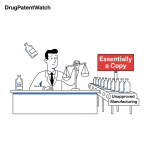
Semaglutide sat in FDA shortage status from 2022 through February 21, 2025, when the agency declared the shortage resolved [2]. State-licensed 503A compounding pharmacies had until April 22, 2025 to stop producing copies, and 503B outsourcing facilities until May 22, 2025; tirzepatide 503B compounding was cut off earlier, by March 19, 2025 [3]. By April 30, 2025, the FDA had logged 520 adverse event reports tied to compounded semaglutide, part of a total exceeding 1,000 across compounded GLP-1 products industry-wide by mid-2025 [4]. The FDA’s September 2025 enforcement wave, more than 50 letters issued mostly on September 9, targeted sellers for calling their unapproved compounds “generic” or claiming the “same active ingredient” as the approved brands, and for implying bioequivalence data that no compounder had generated [1][5].
“I do not believe that the naming convention should be used to advance these goals if it could come at the expense of the ability to ensure patient safety.” — FDA Commissioner Scott Gottlieb, on the agency’s decision to retain mandatory suffixes for new biologics despite industry pressure to drop them [6]
The compounded-semaglutide episode shows what happens when the legal machinery behind a name gets treated as a marketing suggestion. The rest of this guide covers that machinery.
The Naming Pipeline: From IND Filing to the USP Dictionary
A nonproprietary name is not assigned at launch. It is negotiated years earlier, typically once a sponsor has filed an Investigational New Drug (IND) application and entered clinical testing, so the name is in place before pivotal trial data is published [7][8].
The sequence, end to end
Stage
What happens
Typical timing
USAN application filed
Sponsor submits Form A (or the relevant form) with chemical structure, pharmacology, proposed names, and rationale for the stem
After IND filing, often during Phase I/II
USAN negotiation
A USAN staff negotiator checks for name conflicts and stem accuracy; a ballot goes to the five-member Council
Deadlines run 2-3 months ahead of each Council meeting [9]
Parallel INN filing
USAN staff files the WHO INN application on the sponsor’s behalf at no extra charge under the “USAN First” policy [9]
Concurrent with USAN review
Proposed INN (pINN) publication
WHO publishes the name in WHO Drug Information; opens a four-month public objection window
4 months
USAN adoption
Adoptions occur the last Wednesday of each month once USAN, the sponsor, and WHO reach consensus; a firm may use the name immediately on receiving its adoption statement
Monthly cycle [10]
Recommended INN (rINN)
If no objection is sustained, the name becomes the permanent global standard
After the 4-month window closes
Publication and deferral
Publication in the USAN Drug Finder normally follows 60 days later; sponsors may request a deferral of up to 6 months to protect confidentiality
Up to 6 months optional delay [10]
Downstream distribution
The adopted name is forwarded to the USP Dictionary of USAN and International Drug Names, the CAS Registry, and the FDA for UNII code assignment
Automatic on adoption [10]
What it costs in 2026
USAN restructured its fee schedule in 2026 and moved applications onto a dedicated online portal. The figures below are current USAN Program charges, not historical estimates [11][12]:
Application type
2026 fee
New single-entity drug USAN
$28,000
New biologic or monoclonal antibody USAN
$18,000
New contact lens polymer material
$18,000
USAN modified (name for a salt, ester, enantiomer of an existing USAN)
$10,000
USANM for an existing contact lens polymer
$8,000
USAN revised (second or later change to support information, after one free revision round starting Feb. 1, 2026)
$5,000
WHO INN request (filed by USAN on the sponsor’s behalf at no added charge)
$12,000
Refunds are not available once the USAN Council initiates review, and international applicants must pay by wire transfer [11]. Stacked with the WHO fee, a single new small-molecule name can run a sponsor roughly $40,000 in filing costs alone before legal, linguistic, and trademark-clearance work is added, none of which existed as a line item in most pharma budgeting models a decade ago.
A shrinking supply of usable names
The WHO INN Programme hit a capacity wall in January 2026. Citing “massive INN request submissions close to the deadline,” the Secretariat announced it would accept only the first 30 new requests for the 82nd INN Consultation (held April 21-24, 2026), with a public counter tracking slots remaining [13]. The 83rd Consultation is scheduled for October 12-15, 2026 [14]. At the June 2026 USAN Council meeting alone, the Council reviewed 28 USAN-sponsored INN applications and approved 7 new stems; the December 2025 winter meeting had approved 15 new stems [15][16]. With more than 300 approved stems and over 100 substems already in use, and a hard rule since July 2017 against coining new two-letter stems, the pool of short, pronounceable, trademark-clear syllables is visibly tightening [17].
Who Actually Controls the Name
Body
Jurisdiction
Governance
Output
WHO INN Programme
Global
INN Expert Group, collaborating with national committees
International Nonproprietary Name (INN)
USAN Council
United States
5 members: one nominee each from AMA, USP, and APhA, one at-large member, one non-voting FDA liaison
United States Adopted Name (USAN)
FDA
United States
Statutory authority under the Federal Food, Drug, and Cosmetic Act
“Established name” for U.S. labeling; final say over proprietary (brand) names
The USAN Council was formed in 1961 by the American Medical Association and the U.S. Pharmacopeial Convention, with the American Pharmacists Association joining in 1964 [18]. Since 1984, the FDA has deferred to the USAN as the official established name for new single-entity drugs rather than maintaining a separate list, but it keeps a non-voting seat on the Council and retains the legal power to reject any proposed name [18][19]. That combination, a professional consensus body doing the naming work with a federal regulator holding veto power, is why a USAN negotiation can stall even after WHO and the sponsor have agreed: the FDA can still block it on safety grounds, most often through the Phonetic and Orthographic Computer Analysis (POCA) tool used by the Division of Medication Error Prevention and Analysis to screen for look-alike, sound-alike conflicts [20].
The Stem System: A Name That Diagnoses Itself
A generic name is built from a meaningless, trademark-clearable prefix and a standardized stem that identifies pharmacological class. “Ator-” carries no information; “-vastatin” tells any clinician the drug is an HMG-CoA reductase inhibitor. The stem is the load-bearing part of the name for both prescribing safety and patent strategy: a new stem signals a genuinely novel mechanism, which is exactly the situation most likely to attract a method-of-use patent, a new exclusivity period, and eventual Paragraph IV litigation once the class matures.
Category
Stem
Class
Example
Cardiovascular
-sartan
Angiotensin II receptor blockers
Losartan
Cardiovascular
-grel-
Platelet aggregation inhibitors
Clopidogrel, ticagrelor
Anti-infective
-floxacin
Fluoroquinolones
Ciprofloxacin
Oncology
-tinib
Tyrosine kinase inhibitors
Imatinib, erlotinib
Oncology
-ciclib
CDK4/6 inhibitors
Palbociclib, ribociclib
Oncology
-parib
PARP inhibitors
Olaparib, niraparib
Endocrine/metabolic
-gliptin
DPP-4 inhibitors
Sitagliptin
Endocrine/metabolic
-tide
GLP-1 receptor agonist peptides
Semaglutide, liraglutide
CNS
-triptan
5-HT receptor agonists (migraine)
Sumatriptan
Respiratory
-lukast
Leukotriene receptor antagonists
Montelukast
The 2021-2022 overhaul of monoclonal antibody names
This is the most consequential nomenclature change of the past decade, and it is absent from most naming primers still in circulation. Every monoclonal antibody named since 1991 ended in “-mab,” a convention that produced roughly 879 distinct INNs sharing one stem by 2021, an untenable density for a system built on distinctiveness [21][22]. At the 73rd INN Consultation in October 2021, WHO and USAN jointly retired “-mab” for new names and replaced it with four function-specific stems, effective January 2022 [21][22][23]:
Monospecific immunoglobulins with engineered constant-region changes
-ment
Antibody fragments retaining at least one variable domain
-mig
Bispecific and multispecific immunoglobulins
Existing names were not retroactively changed. The practical effect for IP and competitive-intelligence teams: any biologic named after January 2022 that does not end in “-mab” is not a naming error, and a portfolio screen built to search for “-mab” alone will now miss an entire generation of antibody therapeutics, including bispecifics, which are concentrated almost entirely under “-mig.”
Gene and cell therapy: names built from two words
Genetically modified cell therapies use a harmonized two-word USAN/INN scheme: a first word describing the genetic payload (prefix plus a function infix plus the stem “-gene”) and a second word describing the cellular or viral vehicle (a cell-type or vector infix plus a stem like “-cel” or “-vec”) [24][25]. Tisagenlecleucel, the INN for the CAR-T therapy Kymriah, decodes as tisa-gen-lec-leucel: a gene modification delivered by leukocytes in a cellular product. This is a fundamentally different naming grammar from small-molecule stems, built to encode two independent pieces of manufacturing information in one name.
Naming, Patents, and Generic Entry Are Mechanically Linked
A drug’s nonproprietary name is filed while the molecule is still in clinical development, well before the patent estate is finalized and years before any ANDA can be submitted. That sequencing matters commercially in three ways.
Stem-level competitive intelligence. Because the stem is assigned based on mechanism, tracking new INN and USAN stem approvals functions as an early warning system for emerging drug classes, often before a single Phase III readout. The 22 new stems approved by USAN across its two 2025-2026 Council meetings are a leading indicator of which mechanisms are about to generate a wave of follow-on filings [15][16].
The name outlives the patent. Atorvastatin’s nonproprietary name was fixed in the 1990s; Lipitor’s U.S. patent did not expire until November 30, 2011. Sildenafil’s INN predates by decades the 2020 expiration of Pfizer’s erectile-dysfunction patent, which the company extended through pediatric exclusivity provisions while its separate cardiovascular-use patent (marketed as Revatio) expired in 2012. The nonproprietary name is a fixed reference point that regulatory and IP timelines are built around, not a variable that moves with litigation.
“Generic” is a legal claim, not a synonym for “cheap” or “similar.” The FDA’s 2025 enforcement against GLP-1 compounders rests on exactly this distinction: calling a compounded product “generic semaglutide” is a labeling violation because generic status requires an approved ANDA demonstrating bioequivalence, something no compounder has filed or could file for a molecule still under patent and exclusivity protection [1][5]. Any analyst tracking “generic entry” for a drug still needs to separate three dates that are often conflated in casual reporting: when the nonproprietary name was adopted, when patents and exclusivity expire, and when an ANDA is actually approved.
When Names Collide: Look-Alike, Sound-Alike Errors
Name confusion is a leading, well-quantified category of medication error. National reporting programs attribute roughly a quarter of reported medication errors to name-based confusion, and an estimated 1 in 1,000 filled prescriptions in the U.S. involves the wrong drug dispensed because of name similarity [26]. Morphine and hydromorphone account for roughly a third of opioid-related sound-alike error reports, a pairing made more dangerous because hydromorphone is several times more potent by weight and is sometimes mistaken for morphine’s generic equivalent rather than a distinct, more potent opioid [26].
The FDA’s DMEPA screens every proposed brand name before approval using orthographic and phonetic similarity analysis; the Institute for Safe Medication Practices (ISMP) separately maintains the industry-standard List of Confused Drug Names, the basis for most hospital-level “Tall Man Lettering” policies (hydrALAZINE / hydrOXYzine) [20][26][27]. Evidence on Tall Man Lettering’s real-world effectiveness is mixed, stronger in laboratory testing than in live clinical settings, but it remains one layer in a defense system that also includes barcode verification at dispensing and mandatory inclusion of the drug’s indication on high-risk orders.
The Biosimilar Suffix Fight Nobody Has Resolved
Since 2017 guidance and reaffirmed in updated guidance the agency has continued to defend, the FDA requires every new biologic, biosimilar, and interchangeable biosimilar to carry a meaningless four-letter suffix attached by a hyphen (for example, a reference product named replicamab-hjxf and a biosimilar named replicamab-cznm) [6][28]. The agency’s stated rationale is pharmacovigilance traceability and preventing any implication that a biosimilar is inferior to its reference product; it has separately walked back an earlier proposal to retroactively suffix already-licensed biologics, so legacy names were left alone [28][29].
Jurisdiction
Suffix requirement
Stated rationale
United States (FDA)
Mandatory 4-letter suffix on all new biologics and biosimilars
Pharmacovigilance; prevent inadvertent substitution absent an interchangeability designation
European Union (EMA)
No suffix requirement
Brand name and batch number considered sufficient for traceability
Canada
No suffix requirement
Similar to EMA position
Opponents, including biosimilar manufacturers, payer groups, and the U.S. Pharmacopeia in comments on the FDA’s updated guidance, argue the suffix implies a clinically meaningless difference that slows biosimilar uptake and adds confusion at the pharmacy counter [30]. The FDA’s position has not moved on new products. Any company modeling U.S. versus EU biosimilar launch strategy still needs to budget for this naming divergence as a real operational cost, not a cosmetic one.
Definitions
ANDA (Abbreviated New Drug Application): The FDA pathway for generic drug approval, relying on the innovator’s safety and efficacy findings plus bioequivalence data.
Paragraph IV certification: An ANDA filer’s assertion that a listed patent is invalid or will not be infringed, the trigger for most generic patent litigation.
NCE exclusivity: Five years of FDA-granted market exclusivity for a drug containing a new chemical entity, independent of patent status.
Orange Book: The FDA’s public list of approved drug products with therapeutic equivalence evaluations and listed patents.
Purple Book: The FDA’s equivalent listing for biologics, biosimilars, and interchangeable biosimilars.
Biosimilar: A biologic shown to be highly similar to an already-licensed reference product, with no clinically meaningful differences in safety, purity, or potency.
Interchangeable biosimilar: A biosimilar that has additionally met the FDA’s standard for substitution at the pharmacy level without prescriber intervention.
505(b)(2) application: An NDA pathway that relies in part on existing safety or efficacy data not developed by the applicant, distinct from both a full NDA and an ANDA.
Established name: The FDA’s statutory term for the official nonproprietary name used in U.S. labeling, which since 1984 the agency has set equal to the USAN for new single-entity drugs.
FAQ
Is “semaglutide” a generic drug?
No. Semaglutide is the nonproprietary (USAN/INN) name for the active ingredient in Ozempic, Wegovy, and Rybelsus. As of 2026, no ANDA-approved generic version of any semaglutide product exists; only the brand-name products and, until 2025 enforcement, compounded copies were available [2][31].
Why can’t compounded semaglutide be called “generic”?
Because “generic” is a regulatory status requiring FDA approval of an ANDA demonstrating bioequivalence, which compounded products have not undergone. The FDA issued formal warning letters in September 2025 to sellers making that claim [1][5].
What does a drug’s stem tell you that the brand name doesn’t?
The stem identifies pharmacological class and, often, mechanism of action, independent of marketing. “-tinib” signals a tyrosine kinase inhibitor regardless of which company filed it; the brand name carries no such guaranteed information.
How much does it cost to get a drug officially named?
As of 2026, a new single-entity USAN costs $28,000, a new biologic or monoclonal antibody USAN costs $18,000, and the companion WHO INN request costs an additional $12,000, filed on the sponsor’s behalf at no extra USAN charge [11][12].
How long does the naming process take?
Sponsors typically file during early clinical development. USAN adoptions occur on the last Wednesday of each month once consensus with WHO is reached, and the WHO comment period for a proposed INN runs four months before the name becomes permanent [8][10].
Do all monoclonal antibody names still end in “-mab”?
No. Since January 2022, new antibody names use one of four stems, “-tug,” “-bart,” “-ment,” or “-mig,” depending on structure and specificity; roughly 879 pre-2022 antibodies keep their original “-mab” names [21][22].
Why does the FDA require a suffix on biosimilar names but the EU does not?
The FDA prioritizes product-level traceability for adverse-event tracking and has held this position through multiple guidance updates since 2017. The EMA considers the brand name and batch number sufficient and has not adopted a suffix requirement [6][28][29].
Can a company trademark a drug stem?
No. Stems are reserved, non-trademarkable public property specifically so future drugs in the same class can use them; USAN and WHO both bar deriving brand names from protected stems [18].
What triggers the creation of a brand-new stem?
A sponsor must provide substantial chemical or pharmacological data showing a compound does not fit any existing stem. USAN actively discourages new stem creation to preserve the system’s informational value, and has barred new two-letter stems since July 2017, yet still approved 22 new stems across its two 2025-2026 Council meetings [15][16][17].
Is the supply of available drug names running out?
Not exhausted, but visibly constrained. WHO capped new INN submissions at 30 per cycle starting January 2026 due to volume, and USAN’s stem list has passed 300 entries plus over 100 substems, making conflict-free, pronounceable, trademark-clearable names measurably harder to generate than a decade ago [13][17].
Methodology Note
Fee, timeline, and stem-count figures in this analysis are drawn directly from primary sources: current AMA USAN Program fee schedules and Council meeting summaries, WHO INN Programme consultation notices, and FDA guidance documents and warning-letter disclosures, each cited inline. Where a figure changes on a regular cycle (USAN fees, stem approvals, consultation dates), the year and meeting are specified rather than presented as a static fact, since USAN revises fees and forms periodically and WHO holds two INN consultations per year.
Key Takeaways
A nonproprietary name (USAN/INN) is not the same as a generic drug; the former is a label, the latter is an FDA-approved product with its own approval pathway, a distinction the FDA enforced against GLP-1 compounders in September 2025 [1][5].
USAN’s core application fee rose to $28,000 for a new single-entity drug in 2026, with a further $12,000 WHO INN fee layered on top [11][12].
WHO capped new INN submissions at 30 per cycle beginning January 2026, and USAN’s stem list has passed 300 entries, concrete evidence that naming space is a shrinking resource [13][17].
The 2022 overhaul of monoclonal antibody naming replaced “-mab” with four structure-specific stems for all newly named antibodies, a change many existing naming references still omit [21][22][23].
The U.S. and EU remain split on whether biosimilars need a meaningless four-letter suffix, a divergence that adds direct operational cost to any global biosimilar launch plan [6][28][29][30].
References
U.S. Food and Drug Administration. (2025). Generic Drugs: Questions & Answers. https://www.fda.gov/drugs/frequently-asked-questions-popular-topics/generic-drugs-questions-answers
Wilson Sonsini Goodrich & Rosati. (2025, October 1). FDA Sends Warning Letters to More Than 50 GLP-1 Compounders and Manufacturers. https://www.wsgr.com
Gordon Feinblatt LLC. (2025, June 18). Where Do You Get Your Ozempic? Compounding Deadlines for Semaglutide and Tirzepatide. Mid-Atlantic Health Law Topics. https://www.gfrlaw.com
SingleCare. (2025). What Is Compounded Semaglutide Made Of? https://www.singlecare.com/blog/what-is-compounded-semaglutide-made-of/
My Peptide Match. (2026, March). FDA’s Crackdown on Compounded GLP-1 Drugs: What Patients Need to Know in 2026. https://www.mypeptidematch.com
Center for Biosimilars. (2019). FDA Releases Guidance on Biologic, Biosimilar, and Interchangeable Biosimilar Naming Conventions. https://www.centerforbiosimilars.com
American Medical Association. Procedure for USAN Name Selection. https://www.ama-assn.org/about/united-states-adopted-names/procedure-usan-name-selection
World Health Organization. INN Selection Process. https://www.who.int/teams/health-product-and-policy-standards/inn/selection
American Medical Association. (2026, March). USAN Insider Newsletter. https://www.ama-assn.org/system/files/usan-march-2026-newsletter.pdf
American Medical Association. Adopted Names. https://www.ama-assn.org/about/united-states-adopted-names/adopted-names
American Medical Association. (2026). United States Adopted Names Application Fees. https://www.ama-assn.org/system/files/usan-application-fee.pdf
World Health Organization. INN Online Application, Request Form. https://extranet.who.int/tools/inn_online_application/
World Health Organization. Health Products Policy and Standards: INN Online Application Notice. https://www.who.int/teams/health-product-and-policy-standards/inn/inn-online-application
American Medical Association. (2026, June). USAN Insider Newsletter. https://www.ama-assn.org/system/files/usan-june-2026-newsletter.pdf
American Medical Association. USAN Council (2025 Winter Meeting summary). https://www.ama-assn.org/about/usan-council
American Medical Association. United States Adopted Names Council (2026 Summer Meeting summary). https://www.ama-assn.org/about/united-states-adopted-names/usan-council
American Medical Association. United States Adopted Names FAQ. https://www.ama-assn.org/councils-committees/united-states-adopted-names/united-states-adopted-names-faq
American Medical Association. USAN Council (governance and history). https://www.ama-assn.org/about/united-states-adopted-names-usan/usan-council
U.S. Food and Drug Administration. Established Names. https://www.fda.gov/media/70119/download
U.S. Food and Drug Administration. Drug Name Review. https://www.fda.gov/drugs/fda-drug-info-rounds-video/drug-name-review
Guimaraes Koch, S. S., Thorpe, R., Kawasaki, N., Lefranc, M-P., Malan, S., Martin, A. C. R., Mignot, G., Plückthun, A., Rizzi, M., Shubat, S., Weisser, K., & Balocco, R. (2022). International nonproprietary names for monoclonal antibodies: an evolving nomenclature system. mAbs, 14(1), 2075078. https://doi.org/10.1080/19420862.2022.2075078
University of Illinois Chicago Drug Information Group. (2022, February). What Are the Updated Recommendations for Naming Monoclonal Antibodies? https://dig.pharmacy.uic.edu
World Health Organization. (2022). New INN Monoclonal Antibody (mAb) Nomenclature Scheme. https://www.who.int/publications/m/item/inn-22-542
American Medical Association. Gene Therapy Naming Scheme. https://www.ama-assn.org/about/united-states-adopted-names-usan/gene-therapy-naming-scheme
American Medical Association. Genetically Modified Cell-based Therapy Naming Scheme. https://www.ama-assn.org/about/united-states-adopted-names-usan/genetically-modified-cell-based-therapy-naming-scheme
Pennsylvania Patient Safety Authority. Medication Errors Linked to Drug Name Confusion Advisory. https://patientsafety.pa.gov/ADVISORIES/Pages/200412_07.aspx
Institute for Safe Medication Practices. ISMP’s List of Confused Drug Names. https://www.ismp.org
Citeline. (2019). FDA Sticks To Its Guns On Biosimilar Naming. https://invivo.citeline.com/IV124238/FDA-Sticks-To-Its-Guns-On-Biosimilar-Naming
Citeline. Policy Reversal: FDA Will No Longer Require Suffixes For Older Biologics. https://pink.citeline.com/PS124887
Center for Biosimilars. In Comment Letters, Stakeholders Call on FDA to Change Course on Biosimilar Naming. https://www.centerforbiosimilars.com
SingleCare. (2025). Is There a Generic for Ozempic? https://www.singlecare.com