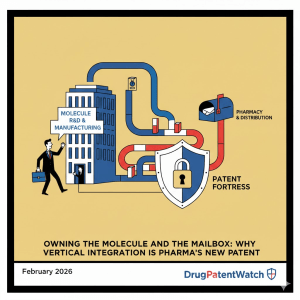
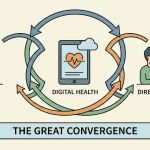
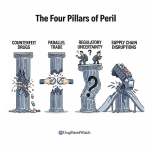
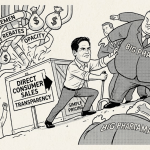
Direct-to-consumer (DTC) pharmaceutical companies are no longer just apps for convenience. Hims & Hers and Ro have spent the last several years quietly building a parallel supply chain that bypasses the friction and costs of the traditional insurance-based system. By internalizing everything from physician consultations and proprietary software to physical drug manufacturing and fulfillment, these entities are rewriting the rules of pharmaceutical competition.1 They are moving beyond simple telemedicine to become vertically integrated powerhouses that treat the supply chain itself as an intellectual property asset. This strategy allows them to capture the “middleman” margins that typically vanish into the pockets of pharmacy benefit managers (PBMs) and wholesalers.1
The End of Asynchronous Convenience: Rebuilding the Pharmacy Stack
The initial wave of digital health focused on access. Companies like Roman (now Ro) and Hims launched with a simple proposition: talk to a doctor online and get a generic prescription for hair loss or erectile dysfunction in a discreet box.3 While this model proved the market for “cash-pay” healthcare, it was structurally vulnerable. Relying on third-party pharmacies and off-the-shelf software meant that margins were thin and the customer experience was fragmented. To survive, these companies had to move “downstack” into the physical world of pills and injections.1
The Architecture of the Parallel Supply Chain
Traditional drug distribution is a relay race with too many runners. A manufacturer sells to a wholesaler, who sells to a pharmacy, while a PBM negotiates rebates that often result in high out-of-pocket costs for the patient.2 DTC platforms have replaced this with a vertically integrated stack. Ro, for example, built its own pharmacy operating system (ro.OS) and a nationwide fulfillment network to ensure that a provider’s clinical notes flow directly into the dispensing process.5 This integration ensures that the patient relationship remains “closed-loop,” allowing the company to track adherence and side effects with a granularity that traditional retail pharmacies cannot match.5
Economic Performance of Integrated Platforms
The financial impact of this integration is stark. Hims & Hers reported 2024 revenue of $1.5 billion, a 69% increase over the previous year, with net income reaching $126 million.9 Their gross margins consistently sit between 75% and 83%, levels typically reserved for software companies or innovator drug manufacturers rather than retailers.10 These margins are possible because the company captures the manufacturer’s margin, the pharmacy’s dispensing fee, and the insurer’s premium in a single transaction.1
Financial Metric (Hims & Hers)
2023 Results
2024 Results
2025 Outlook (Midpoint)
Total Revenue
$872 Million
$1.48 Billion
$2.35 Billion
Adjusted EBITDA
$49.5 Million
$176.9 Million
$295 Million
Subscriber Base
1.5 Million
2.2 Million
2.7 Million
Gross Margin
80% – 82%
80% – 83%
81% – 83%
Source: 9
The 503B Pivot: Manufacturing as a Defensive Moat
The most significant strategic move in recent years has been the acquisition of 503B outsourcing facilities. While traditional compounding pharmacies (503A) are restricted to making patient-specific prescriptions, 503B facilities are regulated as “outsourcing facilities” under the Drug Quality and Security Act (DQSA).12 These facilities can manufacture drugs in large batches without a prior prescription, provided the drug is on the FDA’s shortage list.13
From Distributor to Manufacturer
Hims & Hers transformed its business model by acquiring MedisourceRx, a 503B facility.1 This move allowed them to mass-produce compounded versions of high-demand medications, most notably GLP-1 agonists like semaglutide.1 By owning the manufacturing node, Hims & Hers can insulate itself from the price shocks and supply constraints of the wholesale market.1 It also allows for a “personalization” strategy where the company can offer micro-doses or individualized titration schedules that are not available in the mass-market, branded versions of the drugs.15
The Quality Center of Excellence and Regulatory Compliance
Operating a 503B facility is not merely a legal loophole; it is a high-stakes manufacturing commitment. These facilities must adhere to Current Good Manufacturing Practices (cGMP), the same standards followed by Big Pharma.12 The FDA established the Compounding Quality Center of Excellence in 2019 to improve the quality of these products, and platforms that can navigate this regulatory environment create a high barrier to entry for smaller competitors.13
“The rise of Hims & Hers, Ro, and Thirty Madison is not a transient trend; it is a structural correction of a market that ignored the consumer for too long. By leveraging vertical integration, these companies have exposed the massive inefficiencies of the PBM-wholesaler-pharmacy triad.” 1
The GLP-1 Singularity: Transforming Lifestyle Care into Essential Medicine
Before 2023, many investors dismissed DTC platforms as providers of “lifestyle” drugs—useful, but not critical to the healthcare system. The introduction of GLP-1 receptor agonists for obesity (semaglutide and tirzepatide) changed everything.1 These drugs moved the platforms into the management of chronic metabolic disease, a category with tens of millions of potential patients and high long-term adherence rates.1
Managing the Shortage Loophole
When the FDA placed Wegovy and Zepbound on the official shortage list, it triggered a provision in the law that allows compounding pharmacies to manufacture versions of patented drugs to meet demand.18 Hims & Hers capitalized on this by offering compounded semaglutide for $165 per month, a fraction of the $1,000+ list price for branded versions.12 This “shortage strategy” provided a massive influx of new subscribers, with Hims & Hers adding over 700,000 subscribers in 2024 alone.20
The Transition to Branded Collaboration
Ro chose a different path, focusing on a “collaborative ecosystem” strategy. Rather than manufacturing knockoffs, Ro partnered with Eli Lilly to integrate with LillyDirect.1 This allows Ro-affiliated providers to prescribe branded Zepbound, which is then fulfilled through Lilly’s own supply chain.1 This strategy provides Ro with medical legitimacy and guarantees a supply of FDA-approved medication, which is a critical differentiator for patients wary of compounded alternatives.1
GLP-1 Market Dynamics
Compounded Versions (DTC)
Branded Versions (Big Pharma)
Typical Monthly Cost
$165 – $299 12
$950 – $1,350 12
Regulatory Status
FDA-permitted during shortage 18
FDA-approved 18
Customization
High (micro-dosing, titration) 15
Fixed doses only 18
Supply Chain
Internal / 503B 1
Global Wholesale / Cold Chain 8
The IP Strategy of the Patent Cliff: Using Data as a Weapon
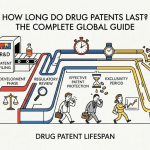
For business development and IP teams, the real value of these platforms lies in their ability to turn patent data into competitive advantage. The global pharmaceutical market is facing a $400 billion “patent cliff” between 2025 and 2030, as blockbuster drugs for blood thinners, antipsychotics, and immunology lose exclusivity.21
Anticipating Loss of Exclusivity (LOE)
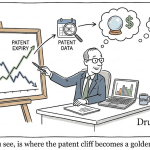
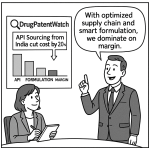
DTC platforms use patent intelligence tools like DrugPatentWatch to identify which high-margin chronic drugs will become generic three to five years in advance.1 This lead time allows them to build clinical protocols, train their affiliated physician networks, and prepare their 503B facilities to launch a generic vertical the moment the patent expires.1 While a traditional pharmacy might wait for a generic to show up on a wholesaler’s list, a vertically integrated platform is already marketing the solution to its millions of existing subscribers.11
The “Personalization” Defense Against Patent Infringement
When a drug is no longer in shortage, the legal right to compound it diminishes. However, platforms are increasingly using the “personalization exception” as a long-term IP strategy.16 By arguing that their compounded version provides a unique benefit—such as removing a specific allergen or allowing for a mid-tier dose that the manufacturer does not offer—they can continue to manufacture a version of a patented drug even when it is commercially available.16 This strategy is currently being tested in the courts, with Novo Nordisk and Eli Lilly filing suits to protect their IP.16
The Gross-to-Net Bubble: Why the Middleman is Failing
The traditional pharmacy system is currently trapped in the “gross-to-net bubble.” This is the ever-widening gap between the list price of a drug and the actual revenue a manufacturer receives after paying PBM rebates and wholesaler fees.2 In 2024, this bubble reached a record $356 billion.2
The Economics of Disintermediation
PBMs and wholesalers have long claimed that their scale reduces costs for consumers. However, pharmaceutical manufacturers argue that PBMs retain a massive portion of these rebates rather than passing them to patients.2 DTC platforms prove this by selling medications at a “cash price” that is often lower than the patient’s insurance co-pay.1 For many emerging pharma companies, the cost of paying these “channel tolls” is no longer viable, making direct-to-patient (DTP) programs more attractive.8
Wholesaler Resilience and the “Core Plumbing”
Despite the rise of DTC, the “Big Three” wholesalers—Cencora, McKesson, and Cardinal Health—remain essential. They provide the “core plumbing” of the industry: cold-chain storage, DSCSA serialization, and logistics for complex specialty drugs.8 DTC platforms generally do not want to manage warehouse operations for the entire country; they want to control the “last mile” of the patient relationship.8 This creates a “re-intermediation” where manufacturers own the consumer journey, while wholesalers provide the regulated back-end infrastructure.8
Component of the “Bubble”
Impact of Traditional PBM Model
Impact of Vertically Integrated DTC
PBM Rebate Retention
High / Opaque 2
Eliminated (Cash Pay) 1
Patient Out-of-Pocket
High (Deductibles/Co-pays) 2
Flat / Predictable 5
Data Collection
Fragmented (Lost at retail) 6
Holistic (Integrated EMR/Rx) 5
Marketing Efficiency
Low (Physician-focused)
High (Direct Digital) 11
Risk and Litigation: The High Stakes of “Personalized” Compounding
The aggressive tactics of Hims & Hers and Ro have invited significant legal challenges. In 2025, Novo Nordisk terminated its collaboration with Hims & Hers, accusing the company of “illegal sham compounding” under the guise of personalization.16 This led to a series of securities class action lawsuits from investors who felt the company had downplayed the regulatory risks of its GLP-1 business.19
The “Personalization” Legal Battle
The core of the dispute is whether “trivial adjustments” to a commercially available drug qualify for the personalization exemption.16 If the courts decide that offering a custom dose is enough to bypass a patent, it would open the floodgates for compounding across many other drug categories.16 However, the FDA has already begun a crackdown on deceptive marketing that implies compounded drugs are “FDA-approved” equivalents to branded versions.12
SEC and Investor Scrutiny
Investors are increasingly skeptical of the “razor-thin” margins and high customer acquisition costs (CAC) associated with these platforms.20 Hims & Hers reported that its CAC rose significantly in 2024 due to intense competition in the weight loss space.11 While the company has been able to recoup these costs through long-term subscription plans, any regulatory change that restricts compounding could cripple their growth engine.16
Turning Patent Data into Competitive Advantage
For biopharma IP teams and investors, the lesson of Hims & Hers and Ro is that data is the most powerful offensive weapon. Platforms like DrugPatentWatch allow companies to see the “market markers” of the next five years.1
The Strategic Imperative for R&D
Successful platforms do not just react to patent expirations; they anticipate them. They use patent intelligence to decide which biological targets to focus on and which drug delivery technologies to develop.24 By aligning their R&D pipeline with upcoming patent cliffs, they can ensure a constant stream of new, high-margin products that can be sold directly to their captive subscriber base.23
Consolidation and M&A Activity
The sheer magnitude of the revenue gaps created by patent cliffs is driving industry consolidation.23 Big Pharma companies are increasingly looking to acquire mid-size biotechs with de-risked assets to fill their pipelines before their flagship drugs lose exclusivity.23 At the same time, telehealth platforms are acquiring diagnostic labs and manufacturing facilities to deepen their vertical integration.11
Strategy Element
Traditional Innovator Pharma
Integrated DTC Platform
Patent Protection
Strong (Composition of Matter)
Weak (Process / Personalization) 1
Distribution Power
Low (Dependent on PBMs)
High (Owns the mailbox) 1
Patient Data Access
Secondary (Via 3rd parties)
Primary (Direct via ro.OS) 5
Market Entry Speed
Slow (Years of Clinical Trials)
Rapid (Leveraging 503B) 1
The Impact on the Broader Healthcare Ecosystem
The rise of these platforms is not happening in a vacuum. It is being driven by broader policy shifts, including the Inflation Reduction Act (IRA) and the Most Favored Nation (MFN) executive orders.6 These policies aim to cap the prices Americans pay for drugs, often by bypassing the PBMs that the government blames for high costs.6
Policy Winds Strengthening the DTC Model
The Trump administration’s executive orders directed pharmaceutical companies to adopt DTC sales models as a way to implement “most-favored-nation” pricing.6 By selling directly to consumers, manufacturers can prove that they are offering the lowest possible price, free from the distortions of the rebate system.6 This political support provides a significant tailwind for the DTC model, even as it faces legal challenges from established players.6
The Future of the Neighborhood Pharmacy
For traditional retail pharmacies, the outlook is more challenging. They risk becoming “collateral damage” as more high-margin business moves to vertically integrated mail-order platforms.34 As the “gross-to-net bubble” deflates, pharmacies that rely on PBM reimbursements will see their profits evaporate, leading to more closures and further consolidation in the retail space.34
Key Takeaways
Vertical integration is the primary driver of 80%+ gross margins for DTC platforms, allowing them to capture manufacturing and dispensing profits.10
503B facilities are being used as a strategic bridge to manufacture high-demand drugs like GLP-1s during shortages and beyond.1
The “personalization exemption” is the new IP battlefield, as platforms attempt to defend the continued manufacturing of patented drugs once shortages end.16
Patent intelligence platforms like DrugPatentWatch are essential for identifying future revenue streams 3-5 years before patent cliffs occur.1
The traditional pharmaceutical distribution model is in a state of “re-intermediation,” where manufacturers own the consumer journey and wholesalers provide the back-end logistics.8
Regulatory and litigation risks are at an all-time high, with Big Pharma and investors closely watching the outcome of compounding-related lawsuits.16
FAQ
Q1: How do Hims & Hers and Ro manage to sell drugs for so much less than traditional pharmacies? A1: They bypass the “middlemen” (PBMs and wholesalers) and operate on a cash-pay basis. This eliminates the need for complex insurance negotiations and rebate payments, allowing them to set prices based on their internal manufacturing costs rather than inflated list prices.1
Q2: What is the legal difference between a 503A and a 503B pharmacy? A2: A 503A pharmacy must have a patient-specific prescription before it can compound a medication. A 503B facility is an “outsourcing facility” that can manufacture drugs in large batches for office use or for dispensing during shortages, provided they meet cGMP quality standards.12
Q3: Can these companies continue to sell compounded GLP-1s now that the shortage is ending? A3: This is currently being litigated. Platforms argue that they can continue under the “personalization exemption” by offering custom doses or formulations. However, manufacturers like Novo Nordisk argue that these are “illegal knockoffs” that violate their IP.16
Q4: How does DrugPatentWatch help a telehealth company’s business strategy? A4: It provides a roadmap of “patent cliffs,” allowing companies to see which blockbuster drugs will become generic years in advance. This allows them to build the necessary clinical protocols and manufacturing capacity to launch a direct-to-consumer generic version the day the patent expires.1
Q5: Are there any risks to patients using these integrated platforms? A5: The primary risks involve the use of non-FDA-approved compounded medications, which may have differences in potency or sterility compared to branded versions. Additionally, the asynchronous nature of the care can lead to less oversight compared to in-person physician visits.12
Provider Super Power #6: Frictionless care coordination between telehealth providers and Ro’s national pharmacy network, accessed February 2, 2026, https://ro.co/dtp/superpowers-six/