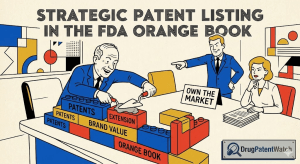
The Food and Drug Administration (FDA) Orange Book is the primary financial barrier between a blockbuster drug and its generic rivals. Officially titled Approved Drug Products with Therapeutic Equivalence Evaluations, this publication serves as the authoritative register of patents that brand-name manufacturers claim protect their drug products.1 For an investigative analyst or IP strategist, the Orange Book is not a directory; it is a tactical map used to navigate the transition from monopoly to competition. Listing a patent in this register allows a brand company to trigger an automatic 30-month stay of approval for generic applicants, effectively granting a multi-year injunction without the need for a preliminary hearing.3
The economic value of this administrative tool is immense. The cost to bring a single prescription drug to market reaches $2.6 billion, and the failure rate for clinical candidates exceeds 90%.4 When a drug achieves blockbuster status, a single day of additional exclusivity represents millions in revenue. For instance, AbbVie’s defense of Humira preserved approximately $383 million in revenue for every week competition was delayed.5 This creates a powerful incentive for brand companies to populate the Orange Book with as many patents as the law permits, and sometimes, with patents that stretch the definition of the drug itself.3
Statutory Framework of the Hatch-Waxman System
The current regulatory landscape exists because of the Drug Price Competition and Patent Term Restoration Act of 1984, known as the Hatch-Waxman Act.1 This legislation established a compromise intended to reward innovation while facilitating lower-cost generic entry.1 Brand companies file a New Drug Application (NDA) containing clinical trial data to prove safety and efficacy.1 Generic firms utilize the Abbreviated New Drug Application (ANDA) pathway, proving bioequivalence to the brand drug rather than repeating expensive clinical trials.4
The Orange Book links these two pathways by requiring NDA holders to list patents that claim the drug or a method of using it.1 These listings provide the transparency needed for generic firms to plan their market entry.8 However, the process operates on an honor system. The FDA takes a ministerial role and does not substantively review the validity or listability of patents when they are submitted.9 This lack of oversight has led to a proliferation of listed patents, with manufacturers using the register to build what analysts call patent thickets.3
The Three Pillars of Listable Patents
Federal regulations under 21 CFR 314.53 strictly define which patents belong in the Orange Book. If a patent does not fall into one of three specific categories, its listing is improper.12
Category
Definition
Coverage
Drug Substance
The active pharmaceutical ingredient (API).1
Chemical structures, salts, or specific polymorphic forms of the molecule.13
Drug Product
The finished dosage form.6
Formulations, compositions, and specific delivery systems like pre-filled syringes.12
Method of Use
Specific approved indications.12
Ways to use the drug to treat a disease approved in the NDA.12
The regulations explicitly exclude manufacturing processes, packaging, metabolites, and intermediates.1 This exclusion prevents brand companies from blocking competition based on secondary techniques that do not define the drug’s therapeutic identity.10 Despite these rules, companies often list patents that border on these categories to gain the procedural advantages provided by the register.3
The 30-Month Stay: A Statutory Injunction
The primary benefit of an Orange Book listing is the 30-month stay.3 When a generic manufacturer files an ANDA, it must certify against every patent listed for the reference drug.4 A Paragraph IV certification states that the listed patent is invalid, unenforceable, or will not be infringed.16 This act is an artificial act of infringement that lets the brand company sue before the generic product launches.3
If the brand company sues within 45 days of receiving a Paragraph IV notice, the FDA cannot approve the ANDA for 30 months.1 This stay provides a predictable window of continued exclusivity.4 While the stay is a tactical delay, its cumulative effect across multiple patents creates a strategic blockade.3 Research shows that while stays generally expire before generic launch, they remain a primary tool for lifecycle management, allowing brand companies to maximize revenue from mature products.4
Evergreening and Lifecycle Management Strategies
Brand companies use the Orange Book to implement evergreening, where they extend market protection by filing follow-on patents on minor modifications.3 Instead of a sudden loss of revenue at patent expiration, this creates a patent slope, gradually transitioning the market while protecting high margins.5
Strategic maneuvers include:
Late Listings: Manufacturers list new patents for formulations or uses years after the initial approval.3 If listed before a generic files its ANDA, these can trigger a stay.3
Product Hopping: A brand introduces a reformulated version, such as a once-daily capsule, and shifts patients to it before the original version’s patent expires.3
New Strength Supplements: The FDA recently identified that 30-month stays were being recognized for new strength supplements based on patents listed after the original ANDA submission.3
These tactics rely on the administrative friction of the Hatch-Waxman system. By stacking stays or creating a thicket of patents, companies win financially regardless of the ultimate legal verdict.3
Building the Thicket: The Humira Case Study
AbbVie’s defense of Humira (adalimumab) is the definitive example of a patent thicket strategy.5 The primary molecule patent expired in 2016, but biosimilar competition in the U.S. was delayed until 2023.5 AbbVie constructed a wall of over 130 patents covering formulations, dosing regimens, and manufacturing processes.5
Feature
U.S. Portfolio
E.U. Portfolio
Total Patents Asserted
130+ 5
~8 20
Nature of Patents
80% Duplicative 20
Non-duplicative 20
Competition Timing
7-year delay 5
Launch at API expiry 20
Impact on System
$7.6 Billion cost 20
Lower drug costs 20
The density of this thicket forced biosimilar developers into settlements with staggered entry dates throughout 2023.5 This shows that patent thickets allow companies to delay competition by relying on the high cost of challenging dozens of duplicative patents rather than the quality of the underlying invention.22
The Device Patent Conflict: Inhalers and Injectors
A major controversy involves listing patents for drug-delivery devices in the Orange Book.3 Companies have listed patents for mechanical parts of inhalers or autoinjectors, even when those patents do not claim the active drug.3 Because these devices are sold as combination products, brands argue they qualify as drug product patents.6
The Federal Trade Commission (FTC) argues these listings are improper.11 The FDA defines a drug product as the finished dosage form containing a drug substance.6 Critics claim that listing a patent on a spring or a dose counter allows a company to trigger a 30-month stay on a drug where the chemical patents have already expired.3 This practice is prevalent in markets for asthma, diabetes, and COPD treatments.11
GLP-1 Agonists: The New Patent Fortress
The market for GLP-1 receptor agonists, including Ozempic and Wegovy, is currently defined by aggressive device patent listing.26 Analysis shows that a majority of patents listed for these products cover the injection device rather than the drug itself.26
Metric
GLP-1 Drug-Device Patents
Median Patents per Product
20.5 27
Device Patents
57% 27
Device Patents with API Claims
0% 27
Potential Entry Delay
1.5 to 2.6 Years 27
Novo Nordisk has listed over 20 patents for Ozempic, with many focusing on the injector device and extending into the late 2030s.26 By creating a differentiated product, such as a longer-acting injectable or an oral liquid, firms try to bypass these fortresses.26 However, the mechanical parts of the injector remain a significant hurdle for generic entry.26
FTC Enforcement and the Crackdown on Junk Listings
The FTC has launched an offensive against improper Orange Book listings to lower drug prices.11 Under Chair Lina Khan and later under Andrew Ferguson, the agency issued warning letters to pharmaceutical manufacturers challenging over 400 patents.11 These challenges targeted listings for asthma inhalers, epinephrine autoinjectors, and GLP-1 products.11
The agency’s position is that improper listings constitute unfair methods of competition.11 This enforcement pressure led to major delistings. In December 2025, Teva Pharmaceuticals requested the removal of more than 200 patent listings from the Orange Book.28 These removals pave the way for competition in markets for 30 different drugs.28 The FTC continues to monitor the industry, using the FDA’s regulatory dispute process to challenge patents it deems junk.29
Judicial Precedent: Teva v. Amneal and Section 112
The judicial system has recently clarified the boundaries of Orange Book listability. The U.S. Court of Appeals for the Federal Circuit ruled that patents must distinctly claim the drug approved in the NDA to be listed.9 In a dispute over albuterol inhalers, the court found that Teva’s patents were not listable because they claimed mechanical components rather than the active ingredient.9
The court invoked the definiteness requirement of 35 U.S.C. § 112, stating that a patent claims the drug only when it particularly points out the drug as the invention.9 This ruling supports the FTC’s efforts to remove device-only patents from the register.11 For manufacturers, this means that device patents without claims referencing the active pharmaceutical ingredient are now highly vulnerable to delisting counterclaims in Paragraph IV litigation.9
The Polymorph Paradox and Formulations
Drug substance patents often focus on specific polymorphic forms, which are different crystalline structures of the same molecule.20 Innovators conduct extensive screens to patent every commercially viable version of a drug.20 This creates a trap for generic firms: to get FDA approval, a generic must be bioequivalent to the brand drug, but if the brand has patented the only stable polymorph, the generic cannot copy it without infringing.20
Celgene used this strategy with Revlimid (lenalidomide), using patents on specific polymorphic forms to secure its position.20 If a generic manufacturer cannot replicate the patented formulation, it fails to receive an AB rating, which is required for automatic substitution at the pharmacy.20 This effectively blocks the generic from capturing the high-volume market.20
Volume-Limited Launches: The Revlimid Model
A sophisticated evolution in settlement strategy is the volume-limited license.5 In these agreements, a generic is allowed to enter the market before patent expiration but is capped at a small percentage of total market demand.5
Phase 1: Generics launch with market share capped at single-digit percentages until 2026.3
Phase 2: Full, unlimited entry is permitted after early 2026.3
This mechanism prevents the price collapse that follows unrestricted entry.20 Because generic firms cannot capture significant volume, they have no incentive to slash prices, allowing the brand company to maintain high revenues.5 This creates a gradual revenue erosion rather than a sudden cliff.5
Economic Impact: The Cost of Delay
Delayed generic competition has a documented impact on drug spending. Generic drugs typically offer savings of 80% to 85% compared to brand-name versions.32
Market Condition
Price Reduction (vs. Brand)
First Generic Entry
15% to 25% 4
3 Competitors
20% to 50% 33
10+ Competitors
70% to 90% 4
One study found that patent thickets on four top-selling drugs led to $3.5 billion in excess spending over two years.35 Most of this avoidable spending occurs in the first year after generic entry, when the brand drug still retains a large market share.35 Policy interventions that limit patent extensions could significantly reduce this financial burden on patients and insurers.35
180-Day Exclusivity and First-to-File Incentives
The ultimate prize for a generic manufacturer is the 180-day exclusivity period.4 The first company to file a Paragraph IV certification receives six months of market exclusivity upon launch, creating a temporary duopoly with the brand.4 During this window, the generic can price its product at a moderate discount, typically 15-25% below brand levels.4
This exclusivity can be worth hundreds of millions of dollars for blockbuster drugs.4 Paragraph IV challenges have a high success rate, reaching 76% when including settlements and dropped cases.4 This high success rate suggests that for generic manufacturers, the risk of high-stakes litigation is often justified by the potential payoff.4
At-Risk Launches: The Nuclear Option
A generic manufacturer can launch its product at risk before patent litigation concludes.38 This occurs when the generic company has strong confidence in its legal position and is willing to risk massive damages if found to infringe.38 These launches are high-stakes decisions that reveal a company’s internal risk tolerance.39
Cases such as Protonix (pantoprazole) and Tarka (trandolapril) show the outcomes of this strategy.39 In the Protonix case, Teva and Sun launched at risk, believing the patents were invalid.39 The courts ultimately disagreed, leading to significant damages.39 These cases demonstrate that while at-risk launches can accelerate competition, they carry the potential for financial liabilities that dwarf the profits from early entry.3
Using Data for Competitive Advantage
Intelligence platforms are now essential for tracking Orange Book changes and predicting market entry.15 Tools like DrugPatentWatch transform raw patent and litigation data into a competitive edge for portfolio managers and IP strategists.37 These platforms track 505(b)(2) clinical trials, helping firms identify future entrants well before they file drug applications.41
By monitoring the global IP landscape, generic manufacturers gain a view of the patent fortresses they intend to breach.10 This involves looking beyond the Orange Book to process patents and international filings that might impede market entry.10 Sophisticated firms use these analytics to identify soft targets and plan their Paragraph IV strategies years in advance.33
Future Outlook: The End of the Patent Cliff
The traditional concept of a patent cliff is becoming obsolete.5 Brand companies have mastered the art of creating a patent slope through settlements and thickets.3 However, increased scrutiny from the FTC and clarifying rulings from the Federal Circuit are beginning to dismantle some of the more aggressive listing tactics.11
As the industry moves toward 2030, an estimated $200 billion to $400 billion in annual revenue is at risk due to expiring patents.4 The focus is shifting toward biological drugs and the Purple Book, where patent transparency remains lower than in the small-molecule market.15 For savvy investors and competitors, the ability to interpret Orange Book listings and litigation outcomes remains the primary driver of pharmaceutical valuation.4
Key Takeaways
The Orange Book functions as a strategic lever for brand companies, using the 30-month stay mechanism to delay generic competition and preserve monopoly revenue.
Patent thickets and evergreening tactics extend market exclusivity long after the original chemistry of a drug has lost its novelty, often through duplicative patents and product hopping.
The FTC is actively challenging improper listings, specifically targeting device patents that do not claim the active drug substance, leading to major delistings for blockbuster products.
Judicial rulings now require patents to distinctly claim the approved drug product to be eligible for Orange Book listing, providing a new legal avenue for generic challengers.
The 180-day exclusivity period is the most significant financial driver for generic firms, incentivizing the high-stakes litigation required to breach brand monopolies.
Effective use of competitive intelligence platforms like DrugPatentWatch allows professionals to identify patent vulnerabilities and forecast market entry with higher precision.
FAQ
What patents are excluded from the Orange Book? Manufacturing process patents, packaging patents, and patents on metabolites or intermediates are explicitly excluded by 21 CFR 314.53 and must not be submitted to the FDA.1
How does a Paragraph IV certification lead to a 30-month stay? A Paragraph IV certification is treated as an act of infringement. If the patent owner sues within 45 days of notice, an automatic stay is triggered, barring the FDA from approving the generic for 30 months while the case is litigated.3
What is the “honor system” in Orange Book listings? The FDA does not substantively review the accuracy or validity of patents submitted for listing. It takes a ministerial role, meaning brand companies are responsible for ensuring their listings meet statutory requirements.9
What are the consequences of an improper patent listing? Improper listings can attract FTC enforcement actions under Section 5 of the FTC Act and provide grounds for delisting counterclaims in patent litigation. They can also lead to antitrust liability if they are found to illegally maintain a monopoly.11
How do volume-limited settlements affect generic prices? By capping the amount of product a generic can sell, these settlements reduce the incentive for competitors to cut prices. This allows the brand to maintain high prices for a longer period compared to an unrestricted generic launch.5