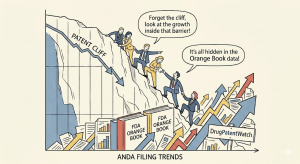
The FDA Approved Drug Products with Therapeutic Equivalence Evaluations, commonly known as the Orange Book, is the primary trade ledger for the pharmaceutical industry. For the analyst, it is a map of where multi-billion-dollar monopolies are vulnerable to disruption. This registry does not just list medications; it documents the exact parameters of the legal and chemical architecture that maintains drug prices in the United States. I have analyzed the technical data within this registry to identify how generic manufacturers arbitrage these listings to secure market entry.1
The Technical Architecture of FDA Registry Data
The Orange Book provides the foundational data for every Abbreviated New Drug Application (ANDA) in the United States. This registry identifies drug products approved on the basis of safety and effectiveness under the Federal Food, Drug, and Cosmetic Act. While a cursory search reveals therapeutic equivalence ratings, the downloadable data files contain the actual structural intelligence required for a competitive launch. These files are typically delivered in tilde-delimited ASCII format, structured to be ingested by sophisticated intelligence platforms.1
Columnar Intelligence and Data Fields
Each record in the Orange Book contains specific fields that dictate the feasibility of a generic alternative. The ingredient field lists active components in alphabetical order, while the dosage form and route of administration define the exact “sameness” a generic must achieve. The registry distinguishes between New Drug Applications (innovator products marked with an “N”) and Abbreviated New Drug Applications (generic versions marked with an “A”).4
The Reference Listed Drug (RLD) column identifies the specific brand product that the FDA uses as the standard for seeking an ANDA. A related marker, the Reference Standard (RS), indicates the specific drug product an applicant must use in bioequivalence studies. I find that the distinction between an RLD and an RS is often where first-time filers fail, leading to a Refuse to Receive (RTR) decision. An RTR results in the immediate loss of 25 percent of the filing fee.4
Patent and Exclusivity Coding
The addendum to the Orange Book contains the most valuable intelligence: the patent and exclusivity lists. Patent numbers are submitted by the NDA holder and include expiration dates that incorporate any pediatric extensions. The registry uses specific flags to denote what a patent claims. A “Drug Substance” (DS) flag indicates the patent covers the active ingredient, while a “Drug Product” (DP) flag indicates a patent on the formulation. Method-of-use patents are identified by Patent Use Codes (U), which correspond to specific indications on the drug’s label.1
Regulatory exclusivities operate on a separate timeline from patents. These include:
New Chemical Entity (NCE) exclusivity: Five years of protection from generic filing.
Orphan Drug Exclusivity (ODE): Seven years of protection for rare disease treatments.
Pediatric Exclusivity (PED): A six-month extension added to existing patents or exclusivities.
Competitive Generic Therapy (CGT) exclusivity: 180 days for the first approved generic of a drug with inadequate competition.6
The 236 Billion Dollar Opportunity
The global pharmaceutical industry is entering a historic loss-of-exclusivity cycle. Between 2025 and 2030, an estimated 236 billion dollars to 400 billion dollars in annual brand-name revenue will be exposed to generic or biosimilar competition. I track nearly 70 high-revenue products losing exclusivity during this window, a concentration of value that is unprecedented in the modern market.8
Blockbuster Expiry Roster 2025-2030
Drug Name
Company
Estimated Expiry
Peak Annual Sales
Therapeutic Category
Keytruda
Merck
2028
$30 Billion
Oncology
Eliquis
BMS / Pfizer
2026-2028
$18 Billion
Cardiovascular
Humira
AbbVie
2023
$21.2 Billion
Immunology
Stelara
J&J
2025
$10.9 Billion
Immunology
Eylea
Regeneron
2025
$9 Billion
Ophthalmology
Trulicity
Eli Lilly
2027
$7 Billion
Diabetes
Xarelto
Bayer / J&J
2025-2026
$6.4 Billion
Cardiovascular
Opdivo
BMS
2028
$9 Billion
Oncology
9
The financial impact of this wave is immediate for small-molecule drugs. These products typically lose 80 to 90 percent of their market share within months of generic entry. Biologics experience a slower decline, with revenue reductions ranging from 30 to 70 percent as biosimilars enter the market. I have observed that companies like Merck are attempting to mitigate these losses by shifting focus to oncology, vaccines, and newer cardiometabolic therapies.9
The Oncology Pivot
Oncology is the most vulnerable sector in this cycle. Merck’s Keytruda, which dominates the immunotherapy market with 29 billion dollars in 2024 sales, is the primary target. In 2023, the FDA approved 16 cancer drugs, representing 29 percent of all novel approvals. Most of these were tyrosine kinase inhibitors or monoclonal antibodies. I have seen Merck triple its late-phase assets in the last four years to prepare for the Keytruda cliff.14
Arbitraging Paragraph IV Certifications
The Paragraph IV (PIV) certification is the central instrument of generic strategy. When a company files an ANDA, it must certify its position on every patent listed in the Orange Book. A Paragraph IV certification states that a listed patent is invalid, unenforceable, or will not be infringed. Under the law, filing a PIV certification is an artificial act of infringement that allows the brand to sue before any product is sold.8
The 180-Day Bounty
The incentive for this legal risk is the 180-day market exclusivity period awarded to the first applicant to file a substantially complete ANDA with a PIV certification. This window is often the most profitable period of a drug’s life cycle. For a drug with 2 billion dollars in annual sales, the first-filer can generate 200 million to 400 million dollars in revenue during these six months. Litigation costs rarely exceed 30 million dollars, making the expected value calculation positive for most high-revenue drugs.8
Eligibility Rates and Filing Peaks
Analysis of PIV filings from 2020 to 2024 shows that roughly half of the ANDA applications are deemed eligible for market entry. I identified a peak in eligible submissions in 2023, signaling a surge in generic competition as manufacturers raced to secure first-to-file status ahead of the patent cliff. Leading challengers include Teva, Apotex, and Actavis.18
Metric
2020
2021
2022
2023
2024
PIV Applications Filed
~250
~270
~290
~310
~280
Eligibility Rate
48%
49%
51%
53%
50%
Average Patents Challenged
2.1
2.4
2.8
3.1
3.2
17
The 30-Month Stay Mechanic
If a brand company files suit within 45 days of receiving a PIV notice, the FDA automatically stays approval of the ANDA for 30 months. This stay preserves the brand’s monopoly while the court adjudicates the patent dispute. I have found that filing suit is almost reflexive for brand manufacturers because the alternative is commercially unthinkable for any drug with more than 100 million dollars in annual sales.8
Forfeiture Triggers and the Tentative Approval Race
The 180-day exclusivity is not a guaranteed right; it can be forfeited. A first applicant loses its bounty if it fails to obtain tentative approval within 30 months of filing its application. Tentative approval means the drug meets all scientific and manufacturing standards but cannot receive final approval due to existing patents.8
The 30-Month Deadline
Missing the 30-month clock by even a single day generally leads to forfeiture. The law provides a safety valve if the failure is caused by a change in FDA requirements for approval that occurred after the filing date. I track this as a high-risk regulatory bottleneck. For example, the entire generic market for atorvastatin was paralyzed because the first-filer could not receive approval, creating a multi-billion dollar bottleneck.8
Refuse to Receive (RTR) Risks
The FDA performs a strict review of ANDA dossiers before filing them. If the application is incomplete or contains scientific errors, the FDA issues a Refuse to Receive decision. I have noted that an RTR immediately forfeits 25 percent of the filing fee. For a large manufacturer in 2026, this represents a loss of nearly 90,000 dollars per application.5
Skinny Labels and the Inducement Minefield
Generic manufacturers use Section viii carve-outs, or skinny labels, to enter the market before all method-of-use patents expire. This mechanism allows a generic to be approved for indications that are off-patent while omitting indications that are still protected. This pathway does not require a PIV certification and does not trigger a 30-month stay.20
The Post-Teva Liability Landscape
Recent court decisions have turned skinny labels into a multi-billion dollar liability. In the case of GlaxoSmithKline v. Teva, the court reinstated a 235 million dollar verdict against Teva despite its skinny label. The court found that Teva induced infringement through its press releases and marketing materials that described the drug as a generic version of the brand.20
Amarin v. Hikma and SCOTUS Review
A similar dispute involves the cardiovascular drug Vascepa. Hikma launched a generic with a skinny label that carved out the cardiovascular risk reduction indication. Amarin sued for induced infringement, citing Hikma’s public statements to investors. The Supreme Court agreed to hear this case in January 2026, a move that will likely redefine the boundaries of generic marketing.21
Strategic Countermeasures for Carve-outs
Innovators are now constructing patent thickets specifically designed to defeat skinny labels. I identify two primary strategies:
Patenting the Label: Brands secure patents on the exact wording required for safety warnings, making it impossible to carve out the information without violating FDA sameness requirements.
Weaponizing Use Codes: Brands use broad Orange Book use codes that force the FDA to require the patented indication on the generic label.20
GDUFA III and the Price of Participation
The third iteration of the Generic Drug User Fee Amendments (GDUFA III) has standardized the financial requirements for market participation. These fees fund the FDA’s review process and research into complex generics. For fiscal year 2026, the cost of filing a single ANDA has risen to 358,247 dollars.11
Fee Schedule for FY 2026
Fee Category
FY 2026 Rate
Abbreviated New Drug Application (ANDA)
$358,247
Drug Master File (DMF)
$102,584
Domestic FDF Facility
$238,943
Foreign FDF Facility
$253,943
Large Size Operation Program Fee
$1,534,701
Small Business Program Fee
$191,838
25
The program fee is assessed annually based on the number of approved ANDAs a company holds. Large operations, defined as those with 20 or more approved ANDAs, must pay over 1.5 million dollars annually. I find that these rising costs act as a strategic filter, ensuring that only calculated, high-return investments reach the filing stage.5
Refunding and Withdrawal Rules
An applicant can avoid the program fee if it submits a request to withdraw approval of an ANDA by April 1 of the previous fiscal year. I have analyzed the data on withdrawals and found that many firms consolidate their portfolios each spring to drop into lower fee tiers. For example, dropping from six approved ANDAs to five can move a company from the medium tier to the small tier.26
The FTC Campaign Against Junk Patents
The Federal Trade Commission (FTC) has launched a significant campaign against improper patent listings in the Orange Book. These junk listings can trigger 30-month stays for patents that do not actually cover the drug substance or its formulation.27
Targeted Device Patents
In 2024, the FTC expanded its challenges to include more than 300 patents across 20 brand-name products, including blockbusters for diabetes and weight loss like Ozempic. The focus is on drug-device combinations, such as inhalers and autoinjectors. The FTC argues that patents covering minor mechanical tweaks to an inhaler should not be listed in the Orange Book and should not delay generic entry.28
Antitrust and Private Litigation
Courts have begun to uphold the FTC’s position. Teva recently agreed to pay 35 million dollars to settle an antitrust lawsuit involving improper Orange Book listings for its ProAir HFA inhaler. I track this as the beginning of a new era of private antitrust enforcement, where generic manufacturers use FTC warning letters as the foundation for multi-million dollar damage claims.27
Citizen Petitions as Blockades
Section 505(q) of the FD&C Act governs citizen petitions that request the FDA to take action on a pending drug approval. While these are intended for public health concerns, I have found that they are often used by brand manufacturers to delay competitors. The FDA is required to prioritize these petitions and respond within 150 days.30
Statutory Deadlines and Resource Redirection
The FDA has generally met the statutory deadlines for 505(q) petitions, but it does so by redirecting resources from other work, including the review of ANDAs. In fiscal year 2023, the number of these petitions decreased. I attribute this to stricter FDA guidance on what constitutes a petition filed for the primary purpose of delay. If the FDA determines a petition is frivolous, it can note that in its response, creating legal liability for the brand in antitrust court.27
ROI and Financial Performance Models
The pharmaceutical industry is experiencing a rebound in R&D returns. After a record low internal rate of return (IRR) of 1.2 percent in 2022, the average IRR for the top 20 biopharma companies rose to 5.9 percent in 2024. This growth is driven by the surge in high-value GLP-1 therapies for obesity and diabetes.32
The GLP-1 Effect
I have analyzed the data on R&D returns and found that GLP-1 drugs are currently the primary engine of industry growth. If GLP-1s are excluded from the calculation, the average IRR drops to 3.8 percent. Furthermore, the average forecast peak sales for new assets falls from 510 million dollars to 370 million dollars when these drugs are removed.34
R&D Costs vs. Shareholder Returns
The cost of developing a single drug asset rose to 2.23 billion dollars in 2024. Despite these rising costs, brand manufacturers maintain net profit margins that are 10 times higher than other sectors of the drug supply chain. I find that 15 of the biggest drug companies reported nearly 29 billion dollars in net profits in the first quarter of 2024 alone.32
Company
Q1 2024 Net Profit
Q1 2024 Shareholder Rewards
R&D Spending
Merck
$4.76 Billion
$1.95 Billion
$4.00 Billion
J&J
$5.35 Billion
$2.97 Billion
$3.57 Billion
Eli Lilly
$2.24 Billion
$1.17 Billion
$2.52 Billion
Pfizer
$3.11 Billion
$2.39 Billion
$2.48 Billion
36
Complex Generics: The New Margin Frontier
As traditional oral solid medications become commoditized, the generic industry is pivoting toward complex products. These segments are defined by high technical barriers, expensive development programs, and less competition.3
Segment Growth Projections
The global generic drug market is projected to grow to over 800 billion dollars by the early 2030s. However, this growth is not uniform. Traditional small-molecule generics are growing at 4 to 5 percent, while complex generics and biosimilars are targeting 8 percent or higher.3
Inhalable Generics: Fastest-growing segment with a CAGR of 9.89 percent through 2030.
Injectable Generics: Large and rapidly expanding, driven by the biologics patent cliff.
Online Pharmacies: fastest-growing distribution channel, valued at over 107 billion dollars in 2024.37
De-averaging Growth Strategies
I have found that companies deriving more than 40 percent of their revenue from sterile injectables or inhalation products carry structurally higher margins. These firms are less vulnerable to the immediate price erosion seen in oral solids. For strategic advantage, I monitor ANDA filing activity on platforms like DrugPatentWatch to identify which firms are moving into these complex spaces before the market fully prices in their value.3
Quantitative Price Erosion Models
The number of generic competitors in a market is the most accurate predictor of price erosion.
Competitor Counts vs. Discount Rates
Number of Competitors
Average Price Reduction
Savings Opportunity
1
5% – 10%
Low
3
20% – 30%
Moderate
6
50% – 60%
High
10+
80% – 90%
Maximum
38
Most price reductions occur in the first eight months after generic entry. I find that markets with 15,000 or more monthly users are the most competitive, averaging close to 10 labelers per drug. In contrast, 60 percent of drugs in the market have less than 5,000 users and average only 3 labelers.38
Global IP Strategy Beyond the Orange Book
The Orange Book is a snapshot of U.S. patents, but it is not a complete picture of the global intellectual property landscape. Manufacturing and process patents are explicitly excluded from the Orange Book, yet they can still block market entry if a generic manufacturer is found to infringe them during production.2
International Patent Data Integration
I use international patent data from Europe, China, and Japan to identify weak points in a brand’s global IP fortress. By examining the patent landscape in these markets, a generic manufacturer can identify potential vulnerabilities years before a U.S. patent is even granted. This allows teams to prioritize R&D targets that offer a clearer path to market.2
The Impact of Manufacturing Sites
The CDER site catalog shows that 41 percent of drug manufacturing sites are located in the U.S. However, India and China have seen site growth exceeding 15 percent in the last five years. Of all sites on quality-related import alert, 65 percent are manufacturers of OTC products. I monitor these demographics to predict supply chain vulnerabilities that could lead to generic shortages.41
Key Takeaways
The Orange Book is the trade ledger for pharmaceutical arbitrage. It defines the ingredients, dosage forms, and patents that generic manufacturers must dismantle to capture market share.1
A 236 billion dollar patent cliff is approaching. Between 2025 and 2030, nearly 70 high-revenue drugs like Keytruda and Eliquis will lose exclusivity, shifting billions of dollars to generic competitors.9
Paragraph IV certifications drive the most profitable generic launches. The 180-day market exclusivity period is the primary incentive for challenging brand patents, potentially yielding 400 million dollars in six months.8
Skinny labels are now a major liability minefield. Generic companies can be held liable for induced infringement even if their label is perfect, provided their marketing suggests the drug is a substitute for patented uses.20
Complex generics and biosimilars offer the highest margins. The industry is moving away from oral solids toward injectables and inhalables, which have higher technical barriers and faster growth rates.37
FAQ
How can I determine if a patent listed in the Orange Book is vulnerable to a Paragraph IV challenge? I deconstruct the patent types into load-bearing composition-of-matter patents and secondary formulation patents. Most successful challenges target secondary patents, as composition-of-matter patents are the most robustly defended. Checking the Patent Listing Dispute List and FTC warning letters can also identify patents that regulators consider improperly listed.1
What is the financial cost of a Refuse to Receive (RTR) decision from the FDA? An RTR decision results in the immediate forfeiture of 25 percent of the ANDA filing fee. In 2026, this represents a loss of nearly 90,000 dollars. It also delays the filing date, which can cause a generic manufacturer to lose its first-to-file status and the associated 180-day exclusivity.5
Does a 30-month stay always delay generic market entry? Recent data suggests the 30-month stay has less impact than previously thought. Because the FDA often takes more than 30 months to grant final approval for an ANDA, the stay often expires before the drug is ready for market anyway. Furthermore, 40 percent of brand patentees decline to file suit within the 45-day window, failing to trigger the stay at all.42
What is the difference between an authorized generic and a standard generic? An authorized generic is the brand-name drug sold without the brand label. It is typically marketed by the brand company or a partner. Brands launch authorized generics during the 180-day exclusivity period of the first generic filer to reduce that filer’s market share and preserve brand revenue.8
How do manufacturers use Section 505(q) to delay competitors? Manufacturers file citizen petitions requesting the FDA to take specific actions, such as requiring new bioequivalence studies for a pending generic. This forces the FDA to prioritize the petition and respond within 150 days, which can consume reviewer resources and potentially delay the approval of the competing generic.30
Sixteenth Annual Report on Delays in Approvals of Applications Related to Citizen Petitions and Petitions for Stay of Agency Action – Food and Drug Administration, accessed February 26, 2026, https://www.fda.gov/media/184951/download
Thirteenth Annual Report on Delays in Approvals of Applications Related to Citizen Petitions and Petitions for Stay of Agency Action for – FDA, accessed February 26, 2026, https://www.fda.gov/media/151706/download