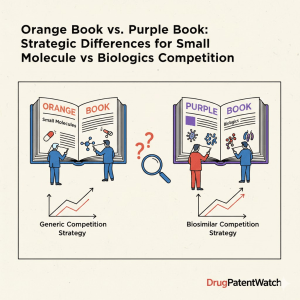
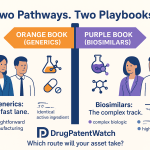
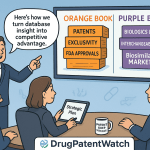
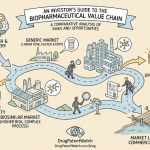
The strategic landscape of the modern pharmaceutical and biotechnology industries is bifurcated by two distinct regulatory and legal architectures that mirror the fundamental scientific chasm between small-molecule drugs and large-molecule biologics. At the center of this competitive ecosystem are two definitive U.S. Food and Drug Administration (FDA) publications: the Approved Drug Products with Therapeutic Equivalence Evaluations, colloquially known as the Orange Book, and the Lists of Licensed Biological Products with Reference Product Exclusivity and Biosimilarity or Interchangeability Evaluations, referred to as the Purple Book.1 These volumes represent the formal ledgers of market protection, serving as the essential roadmaps for both innovator companies seeking to defend their market share and follow-on manufacturers aiming to introduce lower-cost generic and biosimilar alternatives.1
This divergence in regulatory management is not an arbitrary bureaucratic choice but a necessary response to the molecular realities of therapeutic agents. Small-molecule drugs are typically characterized by their simplicity, chemical synthesis, and high degree of replicability.5 In contrast, biologics are vast, complex proteins derived from living systems, possessing inherent variability—often termed microheterogeneity—that renders exact replication scientifically impossible.5 This biological complexity has necessitated separate legislative foundations: the Drug Price Competition and Patent Restoration Act of 1984, known as the Hatch-Waxman Act, for small molecules, and the Biologics Price Competition and Innovation Act (BPCIA) of 2009 for biologics.1
For industry professionals, navigating these two “books” requires a nuanced understanding of patent linkage, regulatory stays, and informational asymmetries. While the Orange Book provides proactive transparency, listing patents and exclusivity data to provide a clear roadmap for generic challengers, the Purple Book has historically operated under a more reactive and private regime.5 Recent legislative shifts, such as the Orange Book Transparency Act of 2020 and the Purple Book Continuity Act of 2020, have begun to bridge some of these gaps, yet the strategic playbooks for small molecules and biologics remain fundamentally different.7 Furthermore, the introduction of the Inflation Reduction Act (IRA) has introduced a “small molecule penalty,” a structural misalignment that threatens to reshape investment incentives across the biopharmaceutical value chain.12
Scientific Foundations and the Manufacturing Imperative
The molecular blueprint of a therapeutic agent dictates its entire lifecycle, from synthesis and manufacturing to regulatory approval and patent litigation. Small-molecule drugs are the “bicycles” of pharmacology—simple, stable, and composed of a relatively small number of atoms, typically fewer than 100, with a molecular weight often under 900 Daltons.5 Examples such as aspirin or Lipitor illustrate this paradigm; their chemical structures are well-defined and can be replicated identically through standardized laboratory synthesis.6 This replicability allows for a straightforward regulatory standard of bioequivalence, where a generic version must simply demonstrate that it delivers the same amount of active ingredient to the bloodstream over the same period as the branded drug.5
Biologics, by contrast, are “living ecosystems” rather than static chemical formulas. These therapeutic giants are often 200 to 1,000 times larger than their small-molecule counterparts and are coaxed from living cells, such as yeast, bacteria, or mammalian cell lines.6 Products like Humira or Keytruda are vast proteins with intricate three-dimensional folding patterns and post-translational modifications like glycosylation.6 Because these molecules are grown rather than synthesized, they are highly sensitive to their manufacturing environment. Minor changes in temperature, nutrient media, or even the stir speed of a bioreactor can alter the final product’s safety or efficacy.5 This reality is captured in the industry mantra “the process is the product,” a concept that has no equivalent in the synthesis of small molecules.5
Molecular Feature
Small-Molecule Drugs (Orange Book)
Biological Products (Purple Book)
Origin
Chemical Laboratory Synthesis 5
Living Cells/Microorganisms 5
Molecular Size
Small (~20-100 atoms) 6
Large/Complex (>20,000 atoms) 6
Molecular Weight
Typically <900 Daltons 6
Often >150,000 Daltons 6
Structure
Well-defined and Simple 1
Complex, 3D, and Heterogeneous 1
Manufacturing
Predictable replication 5
Process-dependent (Living systems) 5
Stability
Generally stable at room temperature 6
Fragile, require cold chain 6
Purity Standard
Identical Copy (Generic) 5
Highly Similar (Biosimilar) 5
This scientific chasm creates vastly different economic equations. Developing a generic small-molecule drug is primarily an engineering challenge, costing between $1 million and $5 million and taking approximately 3 to 5 years.5 Conversely, developing a biosimilar is a massive undertaking, requiring development costs of $100 million to $250 million and timelines of 8 to 10 years.16 Furthermore, biosimilars require comparative clinical trials to prove there are “no clinically meaningful differences” in safety and potency, whereas generic drugs can usually bypass such trials in favor of simpler bioequivalence studies.5
Legislative Blueprints: Hatch-Waxman vs. BPCIA
The legal frameworks governing these products were designed to resolve the same core tension: the need to incentivize high-risk, costly innovation while ensuring public access to affordable medicine. However, the solutions adopted for each class of drug reflect the maturity and complexity of their respective technologies.
The Hatch-Waxman Act of 1984
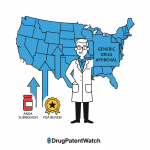
The Hatch-Waxman Act established the abbreviated approval pathway for generic drugs (the 505(j) application), allowing them to rely on the safety and efficacy data of the innovator’s original New Drug Application (NDA).5 In exchange for this abbreviated pathway, innovators were granted patent term restoration to compensate for time lost during regulatory review and a five-year period of data exclusivity for new chemical entities (NCE).1 This “grand compromise” transformed the FDA’s “Orange Book” into the central ledger for the industry, mandating that innovators list all relevant patents—including drug substance, drug product, and method of use patents—at the time of approval.1
The Biologics Price Competition and Innovation Act (BPCIA) of 2009
The BPCIA was enacted 26 years later as part of the Affordable Care Act, reflecting a more cautious approach to the nascent biosimilar industry.5 It created the 351(k) abbreviated licensure pathway for biosimilars, shown to be highly similar to an FDA-licensed reference biological product.20 To encourage the development of these complex molecules, Congress granted innovator biologics a significantly longer period of data exclusivity: 12 years of market protection from the date of first licensure, compared to the 5 years granted to small molecules.16 Unlike Hatch-Waxman, the BPCIA did not initially require proactive patent listing in the Purple Book, leading to a more opaque and reactive litigation landscape.5
Regulatory Parameter
Hatch-Waxman (Small Molecule)
BPCIA (Biologic)
Abbreviated Pathway
ANDA (Section 505(j)) 19
351(k) BLA 20
Innovator Exclusivity
5 years (NCE) 16
12 years 16
Patent Listing
Proactive (Orange Book) 3
Historically Reactive (Purple Book) 5
Litigation Trigger
Paragraph IV Certification 21
Patent Dance (Private Exchange) 1
FDA Approval Stay
Automatic 30-month stay 21
No automatic stay 26
Market Share (US)
~90% of prescriptions 28
<20% of prescriptions 30
The Orange Book Infrastructure: Mandatory Disclosure and Patent Linkage
For any professional involved in the lifecycle of a small-molecule drug, the Orange Book is the foundational text. It is more than a list; it is a detailed map of the competitive terrain, outlining the fortifications of patent and exclusivity protection and the established pathways for generic challengers.1 The system operates on the principle of “patent linkage,” where the FDA’s approval of a generic drug is legally tethered to the patent status of the reference listed drug (RLD).9
Listing Requirements and the Orange Book Transparency Act
NDA holders must list patents that claim the drug substance (active ingredient), the drug product (formulation or composition), or a method of using the drug for an approved indication.3 Explicitly excluded from the Orange Book are patents claiming manufacturing processes, packaging, or metabolites.1 The Orange Book Transparency Act of 2020 further refined these rules, codifying the distinctions between listed patent types and requiring that innovators notify the FDA within 14 days of any final court decision invalidating a patent so the registry can be updated.11
Paragraph IV Certification and the 30-Month Stay
The most sophisticated strategic use of the Orange Book involves Paragraph IV (PIV) certifications. When a generic manufacturer submits an ANDA, they must certify against every patent listed for the RLD in the Orange Book.21 A PIV certification asserts that a listed patent is invalid, unenforceable, or will not be infringed by the generic product.25 This certification constitutes a technical act of “artificial infringement,” allowing the brand manufacturer to sue the generic applicant before the product enters the market.21
If the brand manufacturer files an infringement suit within 45 days of receiving notice of the PIV certification, the FDA is automatically prohibited from granting final approval to the ANDA for 30 months.21 This 30-month stay acts as a powerful defensive tool for innovators, often extending market exclusivity while litigation proceeds.21 To balance this, the first generic applicant to file a “substantially complete” ANDA containing a PIV certification is eligible for 180 days of market exclusivity against later-filed ANDAs.21 This period of generic exclusivity is the “treasure awarded to the victor,” providing a massive financial incentive to challenge weak or overbroad patents.21
The Purple Book Evolution: Opacity to Transparency
While the Orange Book was born in an era of transparency, the Purple Book emerged from a more reactive paradigm. For its first decade, the Purple Book was a simple list of licensed biological products, including their biosimilarity or interchangeability status and their reference product exclusivity dates.4 It notably lacked patent information, a reflection of the “patent dance” mechanism established by the BPCIA.9
The Patent Dance and 351(l) Mechanics
The BPCIA created a private, choreographed exchange of patent information between the biosimilar applicant and the reference product sponsor (Sponsor).1 This “patent dance” begins within 20 days of the FDA’s acceptance of a biosimilar application, when the applicant must provide the Sponsor with their 351(k) application and details of their manufacturing process.1 The parties then exchange lists of patents believed to be infringed and statements regarding their validity and non-infringement.1 This process is designed to narrow the issues for litigation, but it remains an optional engagement; in the landmark Amgen v. Sandoz case, the Supreme Court ruled that a biosimilar applicant cannot be compelled to participate in the dance, although declining to do so allows the Sponsor to immediately file a declaratory judgment action.1
The Purple Book Continuity Act and Modern Listings
The Purple Book Continuity Act of 2020 significantly changed the role of the FDA in biologics regulation, mandating that the Purple Book be maintained as a single, searchable electronic database that includes patent lists.11 However, the listing requirement for biologics remains reactive compared to small molecules. A Sponsor is only required to provide the FDA with their “initial list” of patents and corresponding expiry dates within 30 days after they have provided that list to a 351(k) applicant during the patent dance.11 This ensures that once a patent has been asserted in litigation, it becomes public knowledge for subsequent biosimilar filers, but it does not provide the same proactive roadmap found in the Orange Book.5
As of 2023, this reactive system has resulted in a staggering informational asymmetry. Only approximately 2% of unique BLA listings for prescription brand biologics in the Purple Book identify at least one patent, compared to over 42% for small-molecule drugs in the Orange Book.10 This “fog of war” forces biosimilar developers to make massive investments in the dark, often spending hundreds of millions of dollars without knowing exactly which patents the innovator will assert until late in the development cycle.5
Strategic Lifecycle Management: Thickets, Slopes, and Slumps
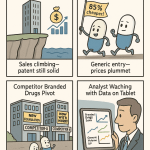
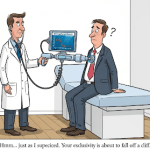
As the pharmaceutical industry faces a “super-cliff” of patent expirations between 2026 and 2030, innovators have mastered the art of “lifecycle fortification” to preserve their revenue streams.33 These strategies aim to convert the traditional vertical drop in revenue—the patent cliff—into a gradual “patent slope”.35
The Architecture of the Patent Thicket
A patent thicket is a sophisticated, deliberately constructed legal edifice characterized by a dense web of overlapping intellectual property rights.37 While a blockbuster drug may have only one primary patent covering its active ingredient, innovators frequently file dozens or hundreds of secondary patents after the drug has already received FDA approval.38 A 2024 study of the ten top-selling U.S. drugs found that 72% of their patents were filed post-approval.38
The case of Humira (adalimumab) serves as the industry archetype for this strategy. AbbVie obtained over 130 patents on Humira, with approximately 80% found to be “non-patentably distinct” or duplicative.37 These patents were linked together by “terminal disclaimers,” a procedural mechanism where the innovator agrees to let a newer patent expire at the same time as an older one.37 While this does not prolong the overall duration of protection, it creates a formidable litigation landscape where a biosimilar challenger must “bat one thousand,” winning every single patent challenge to launch their product.39 This strategy allowed AbbVie to maintain exclusivity for 21 years, costing the U.S. system an estimated $7.6 billion in lost savings.36
Volume-Limited Settlements and Revlimid
Innovators have also pioneered the “volume-limited settlement” to manage competition. For the oncology drug Revlimid (lenalidomide), Bristol Myers Squibb (BMS) settled with multiple generic manufacturers, allowing them to launch their products before the primary patents expired but strictly capping their market share at single-digit percentages until 2026.35 This structure avoids the 90% price crash that typically occurs when multiple generics enter a market; because the generic supply is constrained, the generic price remains artificially high, and the innovator retains the vast majority of market share and revenue.35
Product Hopping and the Subcutaneous Pivot
“Product hopping” involves switching patients to a newer, patented formulation just before the older version faces competition.31 A critical manifestation of this for biologics is the “subcutaneous pivot”.42 Many blockbuster biologics were initially approved for intravenous (IV) infusion, which is time-consuming and requires administration in a clinical setting.9 By developing a subcutaneous (SC) version that can be administered more quickly or even at home, innovators can migrate the entire patient population to a new, protected formulation, rendering the impending biosimilar versions of the IV product commercially irrelevant.9
Strategic Tactic
Mechanism of Action
Intended Outcome
Patent Thicket
Filing 100+ overlapping patents 38
Deterrence by litigation cost 38
Evergreening
New formulations/indications 31
Extension of market monopoly 31
Product Hopping
Switching patients to SC formulation 36
Stranding follow-on competitors 36
Volume Limits
Settlement caps on generic supply 35
Prevention of price erosion 35
Skinny Labeling
Carving out patented indications 35
Immediate launch for unpatented uses 44
The Legal Frontier: GSK v. Teva and Amgen v. Sanofi
The strategic landscape is being rapidly redefined by landmark court decisions that challenge decades of established patenting strategy.
The Erosion of the Skinny Label Shield
For decades, generic manufacturers relied on the “skinny label” or Section viii carve-out to enter markets early.35 This mechanism allows a generic to launch a drug for unpatented indications while “carving out” and omitting patented uses from its label.35 However, the Federal Circuit’s decision in GlaxoSmithKline (GSK) v. Teva has destabilized this assumption. The court found that Teva was liable for “inducing infringement” of GSK’s heart failure patent even though Teva’s label explicitly excluded that indication.43
The court “weaponized” industry-standard terms, finding that Teva’s press releases calling its product an “AB-rated generic equivalent” implied it was equivalent for all uses, including the patented one.43 This ruling represents the “death knell” for the belief that following FDA labeling regulations provides a safe harbor from liability.43 Generic manufacturers now face a multi-billion-dollar “liability minefield” and must adhere to strict communication hygiene to avoid inducing infringement.43
The Amgen v. Sanofi Enablement Earthquake
In the biologics realm, the Supreme Court’s 2023 ruling in Amgen v. Sanofi has fundamentally reset the “patent bargain”.15 The case centered on Amgen’s “genus” patents, which claimed an entire class of antibodies based on their function (binding to PCSK9) rather than their specific sequence.47 The Court invalidated these broad claims, affirming the principle that “the more one claims, the more one must enable”.47
The Court ruled that Amgen’s “roadmap” for making antibodies was insufficient, effectively turning scientists into “research assistants” who would need to undertake painstaking trial-and-error experimentation.49 This decision limits companies to claiming only what they have actually invented and disclosed, rather than claiming a broad territory that someone else might later populate.15 For IP strategists, this means the era of broad functional antibody patents is over; robust biologic portfolios must now be built on specific “species” claims and extensive working examples.15
The Inflation Reduction Act: The “Pill Penalty” and Investment Shifts
The Inflation Reduction Act (IRA) has introduced a profound structural misalignment in the pharmaceutical market, frequently cited as the “small molecule penalty” or “pill penalty”.12 The act grants the Centers for Medicare & Medicaid Services (CMS) the authority to negotiate “maximum fair prices” for top-selling drugs, but it establishes two different timelines based on the type of molecule.24
The Discrepancy in Negotiation Timelines
Small-molecule drugs are subject to price negotiation selection only 7 years after FDA approval, with the price taking effect in year 9.14 Biological products, however, are protected for 11 years before selection, with prices taking effect in year 13.14 This creates a 4-year revenue gap that innovators must account for in their development models.12
Consequences for Research and Development
This discrepancy is justified by a “fundamental misunderstanding” that biologics need longer to recoup costs.14 Empirical evidence shows that development times are nearly identical: 12.6 years for biologics vs. 12.7 years for small molecules.24 Furthermore, biologics actually have higher clinical trial success rates and are protected by more patents (median 14 vs. 3 for small molecules).24
The result is a distortion of investment incentives. Venture capital funding for small molecules has dropped by 70% since the introduction of the IRA, while biologics funding is now 10 times larger.12 Because small molecules are often easier for patients to access (oral pills) and can cross the blood-brain barrier for neurological treatments, this “pill penalty” may disincentivize the development of the most convenient and effective therapies for chronic diseases.12
IRA Feature
Small-Molecule “Pills”
Large-Molecule Biologics
Negotiation Trigger
7 years post-approval 24
11 years post-approval 24
Price Cut Effective
9 years post-approval 14
13 years post-approval 14
Revenue Loss Window
3-4 years before generic entry 14
Aligned with 12-yr exclusivity 14
VC Funding Change
-70% drop since 2021 12
Now 10x small molecule funding 12
Regulatory Standards: Bioequivalence vs. Biosimilarity
The core of competition remains the standard for proving “sameness” or “similarity.” In the Orange Book world, bioequivalence is the “scientific cornerstone” of generic approval.5 A generic must deliver the same amount of active ingredient over the same period as the RLD, ensuring that the generic is “therapeutically equivalent” and safe to substitute.5
The Totality of the Evidence for Biologics
For biosimilars, “sameness” is scientifically impossible. Instead, the BPCIA requires a “totality of the evidence” approach to demonstrate that the biosimilar is “highly similar” with “no clinically meaningful differences”.5 This involves a rigorous stepwise process: extensive analytical characterization, animal studies, human pharmacokinetic (PK) and pharmacodynamic (PD) studies, and typically comparative clinical trials.5
The Evolution of Interchangeability
To align biosimilars more closely with the generic substitution model, the BPCIA created a second tier of regulation: the “interchangeable” designation.23 Historically, achieving this required additional “switching studies” to prove that patients could alternate between products multiple times without risk.57 However, the FDA has recently moved to collapse this distinction. In 2024, the FDA issued draft guidance stating that “switching studies” are generally no longer recommended for therapeutic proteins, as accumulated data shows that switching is not associated with increased risk.30 This shift aims to reduce the clinical burden on developers and combat the “misperception” that non-interchangeable biosimilars are inferior.58
Market Realities: Hyper-competition vs. Measured Entry
The market dynamics resulting from these two frameworks are profoundly different. The generic drug industry operates on a high-volume, low-margin model.54 Generics now account for 90% of U.S. prescriptions but only 12% of total prescription drug spending.28 When multiple generics enter a market, price erosion is rapid and severe, with prices often falling by 80-85% within months.54
The biosimilars market is more “measured and oligopolistic”.5 High development costs and manufacturing complexities limit the number of competitors for any given reference product. While generics save the system hundreds of billions annually, biosimilar savings are more modest, totaling $56.2 billion since 2015.28 However, biosimilars are projected to post a higher growth rate (8-9% CAGR) than traditional generics as more biologics lose exclusivity.62
Economic Variable
Small-Molecule Generic
Large-Molecule Biosimilar
Development Cost
$1 million – $5 million 5
$100 million – $250 million 16
Development Time
3 – 5 years 5
8 – 10 years 16
Typical Price Erosion
80% – 95% 54
15% – 30% typically 17
Savings (US 2024)
$447 billion (combined) 28
$20.2 billion 28
Success Probability
Very High 17
65% – 75% 17
Conclusion: The New Strategic Intelligence Paradigm
The traditional “binary” model of pharmaceutical competition—where a drug was either on patent or off—has been replaced by a “strategic labyrinth” of regulatory and legal maneuvers.15 Success in this environment requires the integration of deep scientific knowledge with granular operational and legal data.
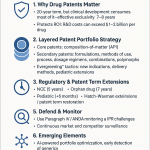
For innovators, the Orange Book and Purple Book are not just registries; they are the architectural blueprints for a “layered defense”.34 By utilizing a combination of primary API patents, secondary formulation patents, and manufacturing process patents, companies can extend market protection far beyond the initial discovery of a molecule.34 However, they must now navigate the “enablement” standards set by Amgen and the pricing “cliffs” introduced by the IRA.33
For challengers, the ability to decode patent filings and anticipate legal shifts is critical. Platforms like DrugPatentWatch have become “crucial for pharma,” connecting patent data directly to FDA regulatory records, litigation histories, and clinical trial info.55 Competitive intelligence has transcended its traditional boundaries, leveraging AI to conduct “white space analysis” and predict loss of exclusivity (LOE) with surgical precision.33
The divergence between the Orange and Purple Books is likely to persist as long as the molecular divide remains, but the “Great Compromise” of the 21st century will involve reconciling the speed of generic competition with the scientific complexity of biologics to ensure the long-term sustainability of the global healthcare system.1
Paucity of intellectual property rights information in the US biologics system a decade after passage of the Biosimilars Act – NIH, accessed January 31, 2026, https://pmc.ncbi.nlm.nih.gov/articles/PMC11081489/
Scientific Considerations in Demonstrating Biosimilarity to a Reference Product: Updated Recommendations for Assessing the Need for Comparative Efficacy Studies – FDA, accessed January 31, 2026, https://www.fda.gov/media/189366/download