Pharmaceutical companies treat time as their most expensive commodity. In an industry where a patent clock starts ticking long before a drug reaches the shelf, every day lost to administrative friction is a day of lost revenue. For years, the procurement office was seen as a cost center, a necessary hurdle that research and development teams had to clear. This narrow view is failing. Legacy enterprise resource planning (ERP) systems, once the “central nervous system” of the firm, are now more like a clogged artery.1 They struggle with real-time inventory visibility, rely on manual data entry, and cannot scale when demand spikes.2
The move toward cloud-based e-procurement is not a trend; it is a structural shift. Approximately 83% of pharmaceutical companies now leverage cloud computing to mitigate the complexity of traditional clinical trials and fragile supply chains.3 Yet, while the cloud promises agility, only 40% of firms have fully migrated their operations.3 The rest remain in a hybrid state, caught between the desire for control and the need for speed. For the skeptical executive, the question is not whether the cloud works, but how to turn this infrastructure into a measurable competitive advantage.
The high cost of maintaining legacy friction
Legacy ERP systems are often described by chief financial officers as being “paid off.” This is a financial illusion. While the capital expenditure for on-premise hardware may have been depreciated years ago, the operating costs are rising. These systems require constant patching, manual workarounds, and a heavy IT staff to maintain connectivity that was never meant to be there.2 Most legacy platforms were built before the rise of modern logistics platforms and analytics tools; they do not speak the language of today’s APIs.2
The results of this technological debt are measurable. When a legacy system fails to provide real-time inventory visibility, the firm must carry “safety stock.” In the pharmaceutical world, inventory carrying costs—including warehousing, insurance, and capital—range from 10% to 35% of the inventory’s value every year.5 When items are perishable or require cold-chain storage, these costs climb even higher.
Infrastructure Metric
Legacy On-Premise Performance
Cloud-Based E-Procurement Advantage
Inventory Visibility
Delayed; manual updates 2
Real-time; sensor-integrated 6
Integration Speed
Months of custom coding 7
Hours via standard APIs 2
Scaling Capability
Limited by physical hardware 8
Infinite; pay-per-use elasticity 3
Maintenance Focus
80% on “keeping lights on” 8
80% on innovation and data 8
Total Cost of Ownership
High hidden operational costs 4
Lower; predictable subscription 4
A legacy system that cannot handle demand spikes or integrate with external suppliers creates a strategic bottleneck. During the COVID-19 pandemic, companies with modern ERP systems could pivot instantly, reassigning inventory and updating production plans.2 Those on legacy systems were left scrambling, relying on spreadsheets and phone calls to manage global vaccine rollouts.9
Uncovering the iceberg of total cost of ownership
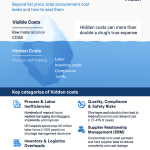
In pharma procurement, the purchase price is merely the tip of a financial iceberg. Most of the costs are submerged. This is the Total Cost of Ownership (TCO) model. Beyond the invoice price, there are process costs, labor burdens, supply chain frictions, and the astronomical costs of quality failures.5
Consider the labor involved in managing drug shortages. In the United States, managing these shortages costs hospitals roughly 20 million labor hours annually, which translates to a $900 million drain on human capital.5 This time is spent sourcing alternatives, updating systems, and managing physician expectations—time that could be spent on patient care. On the manufacturing side, manual logistics tasks like package creation can take 15 minutes per box.5 For a global distributor, these small inefficiencies compound into millions of dollars in wasted wages.
“The true cost of pharmaceutical procurement extends far beyond the sticker price. It is a multi-layered calculus of direct expenditures and submerged operational burdens. For example, 7.1% of all pharmaceutical stock is lost within the supply chain, representing over $10 billion in annual waste.” 5
Another submerged cost is maverick spending. When a research lab or a regional office bypasses the e-procurement system to buy supplies directly, they often pay a 10% to 20% premium over negotiated contract rates.10 They also increase the administrative burden on accounts payable teams who must now reconcile non-standard invoices with unvetted vendors. Cloud systems solve this by making the “compliant path” the easiest one for the employee to follow.
The regulatory mandate: 21 CFR Part 11 and GxP
Pharmaceutical procurement is not just a commercial activity; it is a regulatory one. Every time a firm buys an active pharmaceutical ingredient (API), it must ensure the supplier is qualified and the record of the transaction is immutable. The Food and Drug Administration (FDA) through 21 CFR Part 11 sets the rules for electronic records and signatures.11 These regulations ensure that a digital signature is as legally binding as a pen-on-paper signature.13
Regulatory Requirement
Procurement System Control
Benefit to the Organization
Audit Trails
Secure, time-stamped logs 14
Faster audits; proven data integrity 15
Access Controls
Unique user IDs; MFA 14
Prevention of unauthorized buys 14
System Validation
IQ/OQ/PQ protocols 16
Guaranteed performance per specs 16
Electronic Signatures
Linked to specific records 14
Remote approvals; faster cycle times 7
Record Retention
2-year minimum retrieval 18
Long-term inspection readiness 19
Compliance is often seen as a burden, but it can be a competitive lever. A cloud system that is pre-validated for GxP (Good Manufacturing, Clinical, or Laboratory Practices) allows a firm to onboard new suppliers faster.20 It also simplifies the audit process. Rather than spending weeks gathering paper records for an FDA inspector, a firm can provide a digital audit trail that shows who approved a purchase, when they did it, and what quality certificates were attached to the material.15
The “GxP” umbrella is broad. It includes Good Distribution Practices (GDP) and Good Storage Practices (GSP), which focus on temperature control and stock rotation to prevent product degradation.17 Modern e-procurement systems integrate with Internet of Things (IoT) sensors to track the cold chain in real-time. If a batch of vaccines exceeds a certain temperature during shipping, the system can automatically flag it for quarantine before it ever reaches the hospital.9
Strategic sourcing through patent intelligence
The most sophisticated procurement teams do not just buy materials; they buy time. In the generics and biosimilars market, the goal is to be the first to file (FTF) an Abbreviated New Drug Application (ANDA).25 Being the first to challenge an innovator’s patent can grant a firm 180 days of market exclusivity—a window where margins are high and competition is minimal.26
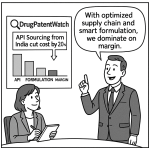
This is where platforms like DrugPatentWatch become essential.20 Procurement teams use patent intelligence to monitor “Paragraph IV” certification windows. To win the race to market, a firm must secure its API supply years before the brand-name patent expires.20 The supplier must be “document ready,” possessing a Drug Master File (DMF) that supports the regulatory filing.20
Sourcing Stage
Role of Patent Intelligence
Procurement Action
Target Identification
Monitor LOE (Loss of Exclusivity) 28
Shortlist potential high-value APIs 26
Supplier Vetting
Check DMF availability 25
Audit suppliers for non-infringing routes 20
Contract Negotiation
Establish “skinny label” carve-outs 20
Limit promotional liability 20
Launch Preparation
Track Paragraph IV windows 20
Lock in API volume for market launch 20
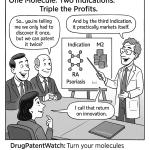
Without this data, procurement is reactive. By the time a patent cliff is common knowledge, the best API suppliers have already been locked into exclusive contracts by competitors.25DrugPatentWatch helps firms identify Section viii carve-out opportunities—situations where a generic can launch for unpatented indications while the brand retains protection for others.20 This “skinny labeling” is a legal maneuver that requires procurement to ensure the supply agreement includes robust indemnification clauses to protect against patent infringement claims.20
The transition to cloud: A phased roadmap
A common mistake in pharma digital transformation is trying to “boil the ocean.” Successful firms follow a structured, three-phase roadmap to modernize their procurement office.
Phase 1: Visibility and foundational control
The first six months are about establishing a “single source of truth”.5 Most pharma companies struggle with “dirty data”—different names for the same chemical or varying price points for the same service across different regions.10 Phase 1 focuses on consolidating this data into a unified e-procurement platform. The goal is to see exactly what is being spent, where, and with whom.5
Phase 2: Strategic sourcing and supplier management
From months 6 to 18, the focus shifts to partnership. Once you have visibility, you can begin to rationalise your supplier base. For a bioscience company like Royal DSM N.V. (DSM), this meant digitizing the purchase-to-pay process to eliminate payment delays and financial risk.30 In this phase, firms move beyond unit-price negotiation and start looking at value-add services like faster delivery or improved quality agreements.31
Phase 3: Predictive optimization
After 18 months, the system is mature enough for advanced analytics. Firms use clean data from the first two phases to deploy AI-powered demand forecasting.5 This reduces inventory waste and prevents stockouts. Predictive tools can also flag potential disruptions, such as a geopolitical event in a region that produces a critical raw material, allowing the team to switch to a secondary supplier before the shortage hits.33
Navigating the data migration minefield
Migrating data for GxP systems is not a simple technical exercise. Regulatory bodies like the FDA and EMA require that every migrated record remain unaltered, complete, and traceable.19 If a firm moves its quality records to a new cloud system and loses the timestamp of the original approval, it has committed a major compliance failure.
Migration Strategy
Technical Mechanism
Compliance Impact
Symmetric Migration
Both systems stay active; live sync 19
Minimal downtime; continuous validation 19
Asymmetric Migration
Extraction, transformation, and load (ETL) 19
Risk of data clash or format loss 19
Read-Only Legacy
Old system stays for audits only 19
Low migration cost; cumbersome for users 19
The planning stage must identify which data is “active” and which is “archival.” Data mapping—showing exactly how a field in the old system corresponds to a field in the new cloud platform—is essential to prevent entries from being lost.19 Many firms find that their old data is inconsistent or contains duplicates; cleaning this data before the move is critical.6
Managing the beast of indirect spend
While direct spend on APIs is managed by specialized teams, indirect spend is often the “wild west” of pharma finance. This includes everything from office supplies and IT services to facilities maintenance and marketing.35 Because indirect spend is spread across hundreds of departments, it often lacks structure and visibility.29
For an urgent care center or a physician group, indirect spend is a major driver of margin erosion. Small primary care offices have different needs than high-volume surgical centers, and their indirect spend should be categorized accordingly.10 Cloud ERP systems like SAP Ariba or Coupa allow these organizations to centralize control.35 Employees can submit purchase requests through a simple interface, and the system automatically checks them against the budget and routes them to the correct manager for approval.35
Indirect Category
Common Efficiency Gap
Cloud Optimization Tactic
IT & Cyber
Duplicate software subscriptions 35
Centralized contract repository 35
Facilities
Reactive, high-cost repairs 35
Predictive maintenance scheduling 35
Lab Supplies
Last-minute, non-contract buys 10
Guided buying via approved catalogs 37
Travel & Expense
Poor policy adherence 35
Automated spend alerts and auditing 37
Strategic firms are now using “Master Vendors” for indirect categories.29 By consolidating spend with a few key providers, they can negotiate significant discounts. Kearney reports that using AI to analyze indirect spend can identify double-digit savings (often 10% or more) in just a few weeks.29
The AI revolution: From tools to autonomous agents
The pharmaceutical supply chain is entering what analysts call the “Agentic Era”.40 We are moving past simple automation to a world where AI agents can perform procurement tasks independently. By the end of 2025, 74% of chief procurement officers plan to integrate AI into their operations.42
These agents do not just analyze data; they take action. An AI agent might negotiate payment terms with a cohort of hundreds of suppliers simultaneously, finding the optimal balance between cash flow and supplier health.37 In sourcing, AI-powered marketplaces are replacing lengthy, manual RFP processes. Instead of a procurement officer spending weeks vetting vendors, the AI engages users in a conversation to define the scope and then automatically scores and compares vendor bids.37
AI Use Case in 2026
Legacy Approach
Agentic Approach
Sourcing
3-month manual RFP process 37
Real-time matchmaking & scoring 37
Risk Management
Periodic manual assessments 40
Continuous, event-triggered monitoring 34
Negotiations
One-on-one manual calls 37
Automated cohort-based term setting 37
Spend Analysis
Monthly spreadsheet reviews 29
Real-time anomaly detection & flagging 37
One massive challenge in pharma is ensuring that essential medicines are available exactly when they are needed. Traditional models struggle with real-time fluctuations. AI-powered machine learning can now analyze patient demand patterns, geopolitical risks, and production schedules to anticipate shortages before they happen.24 For a firm, this means lower carrying costs and fewer stockouts—a direct win for both the bottom line and patient care.34
Case study: The precision of cloud integration
Unilever and Ford are often cited as leaders in digital procurement, but the pharmaceutical industry has its own success stories that provide a blueprint for ROI.
Sikich and Pharma Cloud Migration: Many pharma manufacturers have used cloud ERP to overcome the constraints of legacy systems.4 By shifting to a pay-as-you-go model, these firms reduced their upfront IT capital investments and gained the ability to scale their storage as clinical trial data exploded. This predictable cost model was credited with helping firms expedite the delivery of vaccine candidates during global health crises.4
SureCost and Pharmacy Savings: In 2024, pharmacies using smart e-procurement platforms saved over $255 million.43 By looking beyond the “Top 200” most frequently purchased generic drugs, these pharmacies reduced their cost of goods sold (COGS) by approximately 10.11%.43 The software also caught “unnotified vendor substitutions”—situations where a supplier sends a different (and often more expensive) product than ordered without telling the pharmacy. In some cases, these mismatches cost high-volume pharmacies nearly $2 million a year.43
Building resilience against the patent cliff
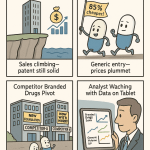
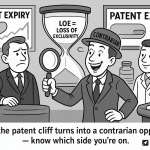
The “patent cliff” is the single most predictable disruptive event in a drug’s lifecycle.28 When a blockbuster drug loses exclusivity, revenue can erode by 80% or more within months. Procurement teams are now expected to mitigate this erosion by driving post-merger integration and rationalizing supplier bases for new acquisitions.44
For innovator companies, the cliff means they must find new ways to fund the next generation of therapies. They often turn to procurement to strip costs out of mature product lines to protect R&D budgets.44 For generic companies, the cliff is the ultimate revenue driver. Success depends on how well they can coordinate their API sourcing with the legal challenges to innovator patents.25
Platforms like DrugPatentWatch allow firms to track patent term adjustments (PTA) and extensions (PTE) that can add years of protection to a branded drug.28 For a procurement lead, knowing that a competitor’s patent has been extended by six months means they must adjust their API sourcing timeline to avoid holding expensive inventory that cannot be sold.20
The human side of the cloud transition
Technology is only half the battle. Change management is the real hurdle. About 89% of procurement leaders report they are not “fully ready” for AI, citing concerns about data privacy, data quality, and the replacement of human judgment.46
Successful rollouts require a “culture of accountability”.15 Employees need to understand that the new e-procurement system is not just another tool to learn, but a way to protect the firm’s license to operate. Training should be role-specific; a lab researcher needs different training than an accounts payable clerk.16 When Royal DSM N.V. (DSM) rolled out its system, it offered training and local language support to ensure global adoption.30
Adoption Barrier
Root Cause
Mitigation Strategy
Resistance to Change
Organizational power & politics 47
Strong C-suite mandate & vision 47
Lack of Skilled Personnel
Budget constraints for IT 48
Partner with SaaS vendors for support 49
Complicated Systems
Poor user experience (UX) 36
Prioritize platforms with intuitive design 39
Data Privacy Concerns
Fear of unauthorized access 46
Focus on “Zero Knowledge Proof” tech 50
Sustainability: The new procurement mandate
By 2026, sustainability will move from a “nice-to-have” to a core strategic priority. About 82% of procurement leaders already consider sustainability a strategic priority.51 Regulators and customers are demanding transparency around material traceability and carbon emissions.52
Procurement teams are embedding sustainability into their supplier evaluations.52 This isn’t just about ethics; it’s about risk management. A supplier with poor environmental practices is at higher risk of a regulatory shutdown, which can disrupt your entire supply chain. Forward-thinking firms are moving toward “circular solutions”—recyclable materials, low-carbon manufacturing, and modular equipment upgrades.52
Key Takeaways
Legacy Debt is Real: On-premise ERP systems carry hidden costs in the form of manual labor, inventory waste, and a lack of real-time visibility.2
Compliance as a Lever: 21 CFR Part 11 and GxP compliance are easier to maintain in the cloud through automated audit trails and pre-validated vendor environments.14
Data Powers Sourcing: Integrating patent intelligence from platforms like DrugPatentWatch allows firms to proactively manage the “patent cliff” and win the “first-to-file” race.20
Total Cost Matters: The “sticker price” is less important than the total cost of ownership, including the cost of drug shortages and maverick spending.5
The Future is Agentic: AI is shifting from a data analysis tool to an autonomous agent capable of independent negotiation and risk mitigation.37
Change is Human: Technology adoption succeeds only when supported by a clear C-suite mandate, role-specific training, and a focus on data integrity.16
FAQ
Q: Why is pharmaceutical cloud adoption slower than in other industries? A: Regulatory caution is the primary driver. Firms must prove that cloud systems meet strict 21 CFR Part 11 and GxP requirements. Unlike retail, where a system glitch is an inconvenience, in pharma, it can be a patient safety issue or a regulatory violation.3
Q: How does a cloud ERP system reduce “maverick spending”? A: By providing a “guided buying” experience that is easier to use than going off-contract. When the e-procurement platform offers an intuitive user experience and approved catalogs, employees naturally choose the compliant path.10
Q: What is the benefit of “zero knowledge proof” technology in pharma procurement? A: It allows firms to share data across a blockchain network for traceability (like DSCSA compliance) without revealing proprietary or confidential business information. It provides the proof of a transaction without exposing the underlying data.50
Q: Can small biotech startups afford these enterprise-grade cloud systems? A: Yes. Because cloud systems are subscription-based (SaaS), startups can avoid massive upfront capital expenditures. They can start with basic procurement modules to manage their “burn rate” and scale as they move from R&D to clinical trials.38
Q: How does DrugPatentWatch assist in mitigating the risks of “skinny labeling”? A: DrugPatentWatch helps identify which specific indications are off-patent. This allows procurement to source APIs specifically for those indications, while legal teams ensure that supply agreements include indemnification to protect the firm from infringement claims on protected uses.20
Estimating the Value of Adding 30 Days to the 180-Day Market Exclusivity of the First-to-File Generic Drug Manufacturer – PMC – NIH, accessed January 31, 2026, https://pmc.ncbi.nlm.nih.gov/articles/PMC12796020/