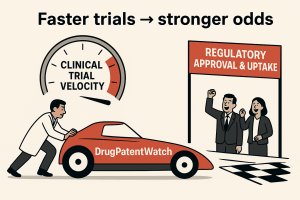
Clinical trial velocity is not a measure of how fast a sponsor pushes a molecule through regulatory gates. It is a composite signal, a set of operational and strategic indicators that reflect a program’s structural health before the first patient is dosed. A program with high velocity moves fast because it has already done the work to remove friction, not because it has cut corners.
This distinction matters enormously from an IP and commercial valuation standpoint. A 20-year patent term sounds like ample runway. It is not. By the time a drug completes discovery, preclinical work, three phases of clinical testing, and FDA review, the remaining effective patent life averages between 7 and 12 years. The entire commercial thesis for a branded pharmaceutical depends on what happens in that compressed window. Every week of clinical delay is a week of peak-sales revenue that never materializes.
This report builds a granular framework for identifying high-velocity programs, connecting operational metrics to patent IP valuation, approval probability, and commercial uptake. It is designed for pharma and biotech IP counsel, portfolio managers running biopharmaceutical equity exposure, R&D leads evaluating pipeline de-risking strategies, and institutional investors who need a more precise tool than Phase designation to assess pipeline quality.
II. Defining the Metric: A Technical Framework for Clinical Trial Velocity
The term ‘velocity’ has no single standardized definition across the industry. Some CROs use it to describe site start-up speed. Sponsors use it to benchmark enrollment rates. Regulators care about it only insofar as speed creates quality risk. For the purposes of IP and commercial analysis, velocity must be defined as a composite of specific, measurable KPIs that collectively reveal whether a program is operationally de-risked.
The framework has two layers. The first is administrative velocity, which covers the cycle times for tasks like budget finalization, IRB submission-to-approval, and contract execution. These metrics are necessary but insufficient on their own. A program that clears its IRB in 30 days but then fails to enroll a single patient for six months has not demonstrated velocity; it has demonstrated administrative efficiency followed by operational failure.
The second layer is clinical velocity: sustained enrollment rate, patient retention through trial completion, and time from contract execution to first patient enrolled. This second layer is where program health is most legibly expressed. It reflects whether the sponsor understood its patient population before drafting the protocol, whether site selection was based on demonstrated enrollment capacity rather than historical relationships, and whether the eligibility criteria were designed to be met by real patients or to serve scientific elegance at the expense of practicality.
High administrative velocity without high clinical velocity is a false positive. It draws attention and capital without the underlying program quality to justify either.
III. The Five KPIs That Actually Predict Program Health
The following KPIs are the most operationally and prognostically relevant for evaluating clinical trial velocity from an IP and commercial standpoint.
Cycle Time from Draft Budget to Finalization. Measured in calendar days from receipt of the first sponsor budget draft to final executed approval. Long cycle times here indicate site-level administrative dysfunction or a sponsor pushing non-standard contract terms that require escalation. Benchmarking across a site’s portfolio of studies reveals whether delays are sponsor-specific or systemic.
Cycle Time from IRB Submission to Protocol Approval. The duration between the initial submission packet and the date of IRB or ethics committee approval. Sites with a consistent record of sub-30-day IRB cycles have a genuine competitive advantage when competing for sponsor business, particularly for oncology programs where sponsor urgency is highest.
Cycle Time from Contract Execution to First Patient Enrolled. This is arguably the most predictive single operational metric. It measures the duration between all contract signatures being complete and the first patient being consented and enrolled. It isolates the site’s patient access infrastructure from the administrative process that precedes it.
Sustained Enrollment Rate. Defined as the number of patients enrolled per site per month, measured at regular intervals across the enrollment period rather than only at initiation. Programs that open fast and then decelerate dramatically at months 3 and 6 reveal a reliance on screen-fail-heavy recruitment tactics, insufficient patient population depth, or eligibility criteria that are too restrictive to sustain throughput.
Screen Failure Rate. Often overlooked in velocity analyses, the screen failure rate reveals whether the inclusion and exclusion criteria were calibrated against the actual patient population available at participating sites. A screen failure rate above 40% in a Phase 2 oncology trial should prompt an immediate protocol review. Every screen failure is both a direct cost and a signal that the enrollment rate projection used to justify the development timeline was based on flawed assumptions.
Key Takeaways: KPI Framework
The five KPIs above form the minimum viable velocity scorecard for any program evaluation. Administrative cycle times reveal site-level process maturity. Sustained enrollment rate and screen failure rate reveal whether the clinical design was grounded in patient population reality. A portfolio manager or IP team evaluating a pipeline asset should request these data points before assigning a timeline to a DCF model.
IV. Patient Recruitment: The Bottleneck That Erases Patent Value
Approximately 80% of clinical trials experience delays or premature termination attributable to recruitment problems. Eleven percent of investigational sites fail to enroll a single patient. These figures have remained stubbornly consistent across the industry for over a decade despite repeated pledges from sponsors to ‘fix enrollment.’ They have not fixed it, because enrollment failure is usually a design problem, not a recruitment problem.
The failure begins at the protocol level. A Phase 3 trial with 22 inclusion criteria and 14 exclusion criteria may have scientific merit, but it is almost guaranteed to produce chronic enrollment shortfalls at any site that does not specialize exclusively in that narrow indication. The academic centers that generated the Phase 2 data often have pre-screened patient registries that make enrollment look deceptively easy. When the Phase 3 study expands to 120 sites across 18 countries, most of those sites face a genuine patient access gap that no amount of recruitment advertising can close.
From an IP valuation perspective, chronic enrollment shortfall has a compounding effect on asset value. The direct mechanism is timeline extension, which consumes additional effective patent life. The indirect mechanism is data quality degradation: when sponsors respond to shortfalls by lowering eligibility standards or adding sites in geographies with different patient profiles, the Phase 3 dataset becomes harder to interpret and regulatory negotiations become more complex.
A program with a credible, protocol-embedded patient identification strategy, including pre-screened registry partnerships, eConsent infrastructure, and digital biomarker eligibility screening, reduces the probability of enrollment-driven delay. For an asset with 10 years of effective patent life at Phase 3 initiation, eliminating 12 months of enrollment delay is equivalent to adding approximately 8 to 10% to the total present value of the asset’s commercial projection, depending on the peak-year sales curve.
Key Takeaways: Patient Recruitment
Recruitment failure is a protocol design failure, not a marketing problem. The five-figure monthly retainer paid to a patient recruitment firm cannot compensate for eligibility criteria written without reference to available patient populations. IP teams and portfolio managers should treat a sponsor’s patient identification strategy as a primary due diligence question, not an operational afterthought.
V. Protocol Complexity as a Velocity Tax
Between 2013 and 2020, the number of trial objectives per protocol grew by 15.9% in Phase 1, 11.6% in Phase 2, and 17.6% in Phase 3. This trajectory reflects a rational response to a real problem: sponsors want more data to de-risk regulatory submissions, KOLs advocate for exploratory endpoints that might generate follow-on publications, and biomarker teams want tissue samples collected at every timepoint.
The problem is that each incremental objective imposes a direct velocity cost. More objectives require more complex eligibility criteria to ensure the enrolled population is relevant to all endpoints. More complex eligibility criteria produce higher screen failure rates. Higher screen failure rates extend enrollment timelines. Extended enrollment timelines consume effective patent life.
The velocity tax imposed by protocol complexity also operates through patient dropout. Protocols with dense visit schedules, frequent biosampling, and complex patient-reported outcome instruments generate higher dropout rates, particularly in chronic disease indications where patients have competing healthcare demands. A Phase 3 study that plans for 5% dropout but experiences 18% dropout midstream faces either a statistical power deficit, which requires protocol amendment and enrollment extension, or a regulatory discussion about per-protocol population versus intent-to-treat analysis.
The discipline of protocol simplification is not a concession to laziness. It is a strategic decision about where to concentrate scientific precision. A Phase 2b study with one primary endpoint, two pre-specified secondary endpoints, and a clearly defined patient population is more likely to generate a clean, interpretable dataset that supports a registrational Phase 3 design than a Phase 2b study with 11 endpoints, half of which were added in the third draft to satisfy investigator requests.
VI. Approval Probability: What the Success Rate Data Actually Shows
The headline figure that gets cited most often in pharma development discussions is 90% attrition: roughly nine of ten drug candidates that enter Phase 1 do not reach market. That figure is accurate as a population statistic but misleading as a program-level signal, because it aggregates across all therapeutic areas, all molecular modalities, and all sponsor types, including small companies advancing single-candidate programs with inadequate Phase 2 data packages.
The phase-transition success rates are more useful for program-level analysis. Phase 1 to Phase 2 transition rates average 60 to 70%, driven primarily by early safety signals. Phase 2 to Phase 3 transition rates average 30 to 33%, driven by efficacy signals that fail to clear statistical significance or that produce efficacy-toxicity tradeoff profiles that make a registrational study commercially indefensible. Phase 3 to approval rates average 50 to 57.8%, reflecting late-stage failures in demonstrating the effect size needed for labeling or encountering safety events not observed in smaller earlier populations.
For oncology, the trajectory has been improving. Clinical success rates for new cancer drugs rose from 9.9% in the mid-1990s to 19.8% in the early 2000s, a near-doubling driven by the shift toward molecularly targeted therapies in enriched biomarker-selected populations. The approval rate continues to run higher for oncology programs that use a validated predictive biomarker as an eligibility criterion, because the patient population is more homogeneous and the effect size is larger.
IQVIA’s 2025 Global Trends in R&D report indicates that the overall R&D program duration peaked at 10.1 years and has since declined to 9.3 years as of 2024. The refreshed Clinical Program Productivity Index showed improvement in 2024 relative to 2023, driven specifically by higher Phase 3 success rates. This suggests that upstream de-risking investments, better target validation and patient selection, are beginning to reduce late-stage failure rates at scale.
Key Takeaways: Approval Probability
Blanket attrition rates obscure the program-level predictors of success. Oncology programs with validated biomarker eligibility criteria run materially higher approval probability than the asset-class average. A portfolio manager assigning discount rates to pipeline assets should use indication-specific and modality-specific success rate distributions, not the 10% headline figure. Phase 3 success rate improvement in the 2024 data is the most meaningful trend signal for pipeline valuation in the near term.
VII. The ‘Quality is Speed’ Equation in Regulatory Practice
The framing that quality and speed are competing objectives is wrong. The correct framing is that quality is a necessary precondition for sustained speed. Programs that invest in rigorous Phase 2 design execute faster Phase 3 programs because they have already eliminated the most likely failure modes. Programs that rush through Phase 2 to accelerate into Phase 3 occasionally reach Phase 3 faster, but they face a much higher probability of late-stage failure, which adds years to the total development timeline and eliminates the patent life advantage that motivated the acceleration.
The FDA’s own data on Phase 2 to Phase 3 divergence makes this concrete. Of 22 case studies examined by the FDA where Phase 2 and Phase 3 results diverged, 14 cases involved Phase 3 studies that failed to confirm the Phase 2 efficacy finding. One involved a safety failure. Seven involved programs where both efficacy and safety signals reversed. The mean characteristic in the failed programs was an underpowered Phase 2 study that produced a nominally positive result driven by a small patient subgroup that did not represent the intended Phase 3 population.
Regulatory intervention is the other quality-speed intersection point. The FDA has been explicit about its expectation that oncology pivotal trials include representative U.S. patient populations. In some oncology pivotal studies submitted for approval, U.S. patients represented only 8% of the enrolled population. The FDA’s Complete Response Letter process allows the agency to publicly cite this deficiency, which forces sponsors back into additional enrollment, often a 12 to 24 month process, before resubmission. The commercial and IP cost of a CRL is substantial: each month of post-CRL delay is a month of lost exclusivity for a drug that may have only 8 years of effective patent life remaining at approval.
VIII. The Financial Calculus: Effective Patent Life and What Delays Cost
A drug patent runs 20 years from the date of application. This is the nominal term. The relevant term for commercial and IP valuation purposes is the effective patent life: the number of years of post-approval market exclusivity remaining at launch. For most drugs, effective patent life runs between 7 and 12 years. For drugs with long development programs or late-filed patents, it can be shorter.
The economics of the patent cliff illustrate why this matters. At loss of exclusivity, branded drug revenues typically decline 80 to 90% within 12 to 24 months as generic entrants enter the market at price points 80 to 90% below the branded price. A drug with 10 years of effective patent life generates a fundamentally different net present value than a drug with 6 years of effective patent life, holding peak year sales and market penetration constant. The difference in NPV is not linear; it is concentrated in the peak sales years, which typically occur in years 3 through 7 post-launch as payer formulary coverage reaches its maximum breadth.
The per-day cost of clinical trial delay has been estimated at $600,000 to $8 million, depending on the indication, the complexity of the trial, and the commercial potential of the drug. For a drug with projected peak year sales of $2 billion, a 12-month enrollment delay costs approximately $180 million in NPV at a 10% discount rate. For a drug projected at $5 billion in peak year sales, the same 12-month delay approaches $450 million in NPV loss.
IP Valuation Sub-Section: Effective Patent Life as a Core Asset Variable
When valuing a drug patent portfolio, effective patent life is the single variable that most directly translates clinical program performance into financial terms. A one-year reduction in effective patent life produced by a clinical delay has a calculable impact on the rNPV of the asset. The standard pharma rNPV model adjusts projected cash flows by probability of technical success at each phase, then discounts the result at the cost of capital. A delay does not change the probability of technical success, but it compresses the cash flow stream into fewer post-approval years at the same discount rate, reducing rNPV.
IP counsel valuing a portfolio for licensing, litigation, or M&A purposes should account for program velocity as a qualitative modifier on the timeline assumption embedded in the rNPV model. A high-velocity program warrants a tighter confidence interval around the assumed launch date. A low-velocity program with a history of enrollment shortfalls warrants a wide interval and, in some cases, a scenario analysis that includes a delayed-launch scenario with commensurate rNPV impact.
IX. IP Valuation Through the Velocity Lens
Drug patent portfolios are not monolithic assets. A typical large-cap pharmaceutical NDA submission is covered by a web of patents filed at different dates covering different aspects of the molecule: the composition of matter (the primary patent, typically the most valuable), the formulation, the method of treatment, the manufacturing process, and, for biologics, the glycosylation pattern or specific amino acid sequence variants that support product differentiation.
The composition-of-matter patent is the foundational asset. It is the hardest to design around and typically commands the largest scope of protection. Under the Hatch-Waxman Act, a patent holder can apply for Patent Term Restoration to compensate for time lost during the regulatory review process, with a maximum extension of 5 additional years, provided the total post-approval patent life does not exceed 14 years. This extension applies exclusively to one patent per NDA, and only to a patent that has not previously been extended under the same provision.
The velocity dimension of IP valuation is this: a drug that reaches approval in year 10 post-filing has a different Patent Term Restoration application than a drug that reaches approval in year 13. The faster program uses less of its nominal patent term during development, leaving more effective patent life available at launch regardless of the Hatch-Waxman extension. A drug approved in year 10 can apply for up to 5 years of extension, potentially reaching 15 years of effective protection. A drug approved in year 13 starts with only 7 years remaining before the nominal term expires, and the Hatch-Waxman extension ceiling (14 years post-approval) may not apply because the post-approval life is already below 14 years.
For biologics, the IP valuation complexity is greater. Biologic programs typically carry composition patents, use patents, and, critically, FDA-granted 12-year data exclusivity under the Biologics Price Competition and Innovation Act (BPCIA). The BPCIA exclusivity runs independently of patent rights and bars biosimilar sponsors from relying on the originator’s clinical data for 12 years from the date of first licensure. A biologic with a high-velocity development program not only arrives at approval with more effective patent life, it also triggers the 12-year BPCIA exclusivity clock earlier, compounding the commercial advantage.
X. Regulatory Exclusivity Architecture: A Layered Defense Strategy
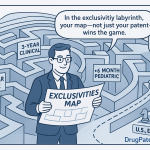
The U.S. regulatory exclusivity system provides several independent layers of market protection that run concurrently with, or independently of, patent rights. Structuring a development program to maximize the stack of applicable exclusivity periods is a core IP lifecycle management function.
New Chemical Entity (NCE) Exclusivity provides 5 years of protection from FDA approval of any application that relies on the innovator’s safety or efficacy data. This applies to drugs with active moieties not previously approved. During the first 4 years of NCE exclusivity, the FDA will not accept an ANDA or 505(b)(2) application. After year 4, it will accept but not approve such applications until the 5-year period expires, unless the generic sponsor files a Paragraph IV certification, which can trigger a 30-month stay and patent litigation.
New Clinical Study Exclusivity grants 3 years when a sponsor submits new clinical investigations conducted by or for the sponsor as the basis of a new indication, new dosage form, new strength, or new route of administration. This is the primary instrument for approved-drug lifecycle extension and is the most commonly used evergreening mechanism. A sponsor with a drug facing patent expiration in 3 years that successfully completes a study for a new indication and files an NDA supplement can secure 3 additional years of exclusivity on the supplemented portion of the label, extending payer and formulary protection beyond the original patent cliff.
Orphan Drug Exclusivity (ODE) provides 7 years of market exclusivity for drugs designated for rare diseases affecting fewer than 200,000 U.S. patients. ODE bars the FDA from approving a competing application for the same drug in the same indication for the full 7-year period, regardless of patent status. For programs pursuing rare disease indications, ODE is often more valuable than any individual patent because it cannot be challenged via Paragraph IV, it runs independently of patent rights, and it provides a known, hard-edged exclusivity window that simplifies commercial planning.
Pediatric Exclusivity adds 6 months to the end of each existing patent and regulatory exclusivity period covering a drug, in exchange for conducting FDA-requested pediatric studies under the Best Pharmaceuticals for Children Act. For a drug with multiple overlapping patents, each maturing at different dates, pediatric exclusivity extends each of them by 6 months. For a blockbuster drug generating $3 billion annually, a 6-month pediatric exclusivity extension is worth approximately $1.5 billion in incremental revenue. The investment required to conduct the pediatric studies is typically $50 to $100 million. The ROI is obvious, which is why nearly all large-cap pharmaceutical companies pursue pediatric exclusivity as a standard program deliverable.
Key Takeaways: Exclusivity Architecture
NCE exclusivity protects the initial approval. New Clinical Study exclusivity drives the lifecycle extension. ODE provides the hardest protection available in the rare disease space. Pediatric exclusivity is the highest-ROI spend in pharmaceutical IP strategy for any drug with peak year sales above $500 million. A development program that fails to plan for each applicable exclusivity layer before Phase 2 initiation is leaving significant commercial value unprotected.
Investment Strategy: Exclusivity Stack Analysis
Portfolio managers evaluating biopharmaceutical equities should map the full exclusivity stack for every commercial-stage asset in a company’s portfolio, not just the composition patent expiration date. The expiration date of the last active exclusivity layer is the true loss-of-exclusivity (LOE) date. For drugs with multiple evergreening measures in place, the LOE date may be 5 to 7 years later than the headline patent expiration suggests. Conversely, a drug with no ODE, no pediatric exclusivity, no pending NCS filings, and a composition patent expiring in 3 years has a materially shorter effective runway than the nominal patent term implies.
XI. Decentralized Clinical Trials (DCTs): The Velocity Multiplier
Decentralized clinical trials use digital health technologies to allow patients to participate in research without traveling to an investigational site for every visit. The technology stack includes eConsent platforms, direct-to-patient drug shipping, telehealth visit infrastructure, wearable biosensor data collection, and remote electronic patient-reported outcomes (ePRO). The FDA issued formal guidance on DCT conduct in 2023, providing regulatory clarity that has accelerated sponsor adoption.
DCTs address two of the most significant velocity inhibitors simultaneously: patient recruitment reach and patient retention.
On recruitment, traditional site-based trials are geographically constrained to the patient populations within reasonable travel distance of participating sites. In rare disease programs, where there may be only 30,000 patients in the entire United States, geographic constraints can make enrollment projections aspirational rather than achievable. DCT infrastructure removes the geography constraint, allowing a patient in rural Arkansas or suburban Montana to participate in a study that would otherwise be conducted exclusively at academic medical centers in Boston, San Francisco, and New York. Broader geographic access also improves trial population diversity, directly addressing the FDA’s heightened scrutiny of under-representative oncology trial populations.
On retention, the single largest driver of patient dropout in chronic disease trials is the burden of site visits. A patient managing type 2 diabetes, heart failure, or a chronic inflammatory condition has competing healthcare appointments and work obligations. A trial that requires monthly clinic visits for 24 months will lose more patients to dropout than a trial where monthly assessment data is collected via a wearable device and a 20-minute telehealth consult. DCT-enabled retention improvement is not theoretical: published data from Trial Innovation Network studies show DCT components improving completion rates in chronic disease populations.
From an IP valuation perspective, a DCT-enabled program in a rare disease indication has a materially different timeline probability distribution than a traditional site-based program. The mean enrollment duration is shorter. The variance in enrollment duration is lower. And the probability of enrollment-driven delay, which is the primary source of timeline variance in Phase 2 and Phase 3, is reduced. A lower-variance timeline translates directly into a more defensible rNPV calculation and a lower required discount rate for the timeline risk component.
Key Takeaways: DCTs
DCTs are not just a patient convenience measure. They are an IP and commercial value protection tool. For any program where enrollment geography is a constraint, where the target population has high comorbidity burden, or where the FDA has signaled interest in population diversity, DCT infrastructure is the most efficient available investment in timeline de-risking.
XII. AI-Driven Patent Intelligence: Proactive IP Risk Removal
Artificial intelligence has shifted the temporal orientation of pharmaceutical IP strategy. The traditional model was reactive: a compound advanced through preclinical testing, generated sufficient data to justify a development investment decision, and then IP counsel assessed patentability and freedom-to-operate. This approach exposed programs to the risk that significant resources had been allocated to a compound before the IP landscape had been fully mapped.
AI platforms trained on patent corpora, scientific literature, and clinical trial databases now allow patentability assessment and freedom-to-operate analysis at the earliest stages of lead optimization. These platforms can identify structurally similar compounds with existing patent coverage, forecast the likelihood that a proposed composition claim will survive examination given existing prior art, and flag regulatory exclusivity periods held by competitors in the target indication.
For velocity purposes, the AI-driven IP assessment has a direct operational impact. Programs that identify patent risk early can redirect medicinal chemistry investment toward structurally distinct analogs that achieve the same therapeutic mechanism without the freedom-to-operate problem. Programs that discover freedom-to-operate concerns late, after a Phase 2 dataset has been generated and a Phase 3 program planned, face a more limited set of options: licensing, design-around, or litigation.
The litigation option is the most expensive form of late-stage IP risk management available. A Hatch-Waxman Paragraph IV challenge litigation, for example, costs $5 to $20 million per case, takes 18 to 36 months to resolve at the district court level, and carries an outcome uncertainty that no amount of legal expenditure can eliminate. AI-enabled early IP risk identification converts what would have been a litigation cost into a much smaller early-stage R&D redirection cost.
IP Valuation Sub-Section: AI as a Patent Portfolio Quality Signal
Investors evaluating early-stage biopharmaceutical companies should ask whether the company has conducted AI-assisted freedom-to-operate analysis on its lead programs. A company that can demonstrate this has reduced the probability of late-stage IP-related program termination, which is one of the more common and financially catastrophic events in early-stage biopharmaceutical development. The absence of AI-assisted IP analysis in a company with a non-obvious composition of matter claim in a crowded chemical space is an underappreciated portfolio risk.
XIII. AZT and the Accelerated Approval Archetype: An IP Valuation Case Study
The development of zidovudine (AZT) as a treatment for HIV/AIDS remains the clearest archetype of how regulatory pathway selection interacts with velocity to produce an IP and commercial outcome. The AIDS epidemic created conditions of medical emergency that the traditional approval timeline could not accommodate. Patient advocates, clinicians, and public health authorities collectively forced a regulatory rethink that resulted in the FDA creating the accelerated approval pathway.
AZT received accelerated provisional approval based on a surrogate endpoint: its ability to increase CD4+ T cell counts, a measurable laboratory marker that predicted reduction in AIDS-defining infections. This approval came without a complete Phase 3 dataset demonstrating clinical outcome benefits. The surrogate endpoint approach reduced the time required to generate a registrational dataset by an estimated 3 to 4 years relative to the traditional endpoint pathway.
From an IP valuation standpoint, the AZT case demonstrates a specific mechanism by which pathway selection directly increases effective patent life. Burroughs Wellcome (later absorbed into GlaxoSmithKline) held the composition patent on zidovudine. Accelerated approval delivered those years of peak-market exclusivity that would have been consumed in continued clinical development.
The contemporary relevance of the AZT case is in oncology, rare diseases, and, increasingly, CNS. The FDA’s accelerated approval framework has been extended to oncology programs using objective response rate (ORR) as a surrogate endpoint, rare disease programs using biomarker-validated surrogate measures, and CNS programs where traditional clinical outcome endpoints require multi-year observation windows. For sponsors with assets that qualify for accelerated approval, the pathway selection decision is as consequential as any element of clinical design.
The post-marketing confirmatory trial requirement attached to accelerated approvals introduces IP planning complexity. The confirmatory trial must be underway at the time of accelerated approval. If the confirmatory trial fails, the FDA can withdraw the approval under the Omnibus Appropriations Act provisions enacted in 2022, which strengthened the FDA’s withdrawal authority for accelerated approvals without confirmed clinical benefit. Sponsors must therefore plan the confirmatory trial as a parallel-track investment, not a sequential post-approval project.
Key Takeaways: Accelerated Approval
Accelerated approval is the single most powerful regulatory tool for converting clinical velocity into IP value preservation. It delivers approval years earlier than the traditional outcome-endpoint pathway while protecting effective patent life. The post-marketing confirmatory requirement creates ongoing regulatory and IP risk, but a well-designed confirmatory trial in a biomarker-selected population with the same surrogated endpoint characteristic as the pivotal study mitigates most of this risk. IP counsel should account for accelerated approval eligibility in the patent filing strategy: earlier approval means earlier generic challenge risk, which means Paragraph IV exposure begins sooner.
XIV. Phase 3 Attrition as a Value Destruction Event: The 22-Case Study Analysis
The FDA compiled 22 case studies where Phase 3 results diverged from Phase 2 findings, and the analysis reveals a consistent pattern with direct IP valuation implications.
Of the 22 cases, 14 involved Phase 3 programs that failed to confirm the Phase 2 efficacy signal. One involved a safety failure that was not detected in the smaller Phase 2 population. Seven involved programs where both efficacy and safety results reversed from Phase 2 expectations. The composite picture is a set of programs that moved fast through Phase 2, generated nominally positive results, and committed to multi-hundred-million-dollar Phase 3 investments before establishing that the Phase 2 signal was robust.
The financial destruction in a Phase 3 failure is not limited to the direct cost of the failed trial. The patent clock does not stop when a Phase 3 fails. A program that runs a 3-year Phase 3 study that fails has consumed 3 additional years of effective patent life with no recoverable value. If the sponsor then conducts a Phase 2b redesign and initiates a second Phase 3, the total timeline may extend by 6 to 8 years relative to a program that conducted a rigorous Phase 2 the first time and proceeded to a single successful Phase 3.
The Phase 3 failure scenario is also the context in which the FDA’s Complete Response Letter process has its most severe IP consequences. A CRL does not terminate an application, but it requires the sponsor to address the deficiencies identified by the FDA, conduct additional studies or analyses, and resubmit. Resubmission review timelines run 6 months for Class 1 CRLs and 12 months for Class 2 CRLs. Each of those months is effective patent life consumed without revenue.
Investment Strategy: Phase 3 Risk Pricing
Portfolio managers should apply a Phase 2 quality discount to the probability of Phase 3 success assigned in pipeline NPV models. An asset with a Phase 2 study that was underpowered (below 80% power at the assumed effect size), used a composite endpoint where individual component effects were unbalanced, or enrolled a patient population with different baseline characteristics than the planned Phase 3 population warrants a lower Phase 3 probability of success than the population average of 50 to 57.8%. A Phase 2 study with pre-specified secondary endpoints confirming mechanism, a pre-registered statistical analysis plan, and a blinded data safety monitoring board warrants a higher-than-average Phase 3 success probability.
XV. Lifecycle Management Through Late-Stage Velocity: Evergreening Tactics
Evergreening is the practice of extending effective market exclusivity for an established drug through regulatory, IP, and clinical strategies applied after initial approval. The term is often used pejoratively in policy contexts. From a commercial and IP standpoint, it describes the legitimate use of available legal and regulatory tools to protect a portfolio asset from generic erosion.
The primary evergreening tactics and their velocity requirements are as follows.
New Indication Development uses the 3-year New Clinical Study exclusivity framework. The sponsor conducts at least one adequate and well-controlled clinical investigation for a new indication or new patient population and submits it as an NDA supplement. The velocity requirement here is executing the new indication study before the composition patent expiration, so that the 3-year exclusivity period provides protection that would otherwise be unavailable after patent expiry.
New Formulation Patents cover extended-release formulations, new delivery systems (transdermal, subcutaneous, inhalation), and fixed-dose combinations. These patents can run independent of the composition patent and are frequently the last line of IP defense before generic entry. The clinical velocity component is the comparative bioavailability and PK studies that support the new formulation NDA, typically faster programs than full Phase 3 registrational studies.
Pediatric Exclusivity has been addressed in Section X. The velocity component is initiating the pediatric study program early enough that the 6-month exclusivity addition applies to patents with meaningful remaining life. A pediatric program completed in the year before composition patent expiration adds 6 months to the final period; a pediatric program completed 5 years before patent expiration adds 6 months to a period that still has 5 years of additional protection, compounding the value.
Paragraph IV First-Filer Strategy is a defensive variation relevant for innovators entering a generic space through authorized generic programs. When the innovator knows a Paragraph IV challenge is coming, it can launch an authorized generic immediately upon generic entry, splitting the market with the first-filer and diluting the economic value that motivated the Paragraph IV challenge. This strategy requires a commercial and manufacturing readiness program that runs on a velocity timeline driven by Paragraph IV certification dates, not clinical milestones.
Key Takeaways: Evergreening Tactics
Evergreening is not a single strategy; it is a sequenced set of clinical, regulatory, and IP actions that must be planned years in advance of patent expiration. The most common failure mode is a sponsor that waits until the composition patent cliff is imminent before initiating lifecycle extension work, leaving insufficient time to generate the clinical data needed for NCS exclusivity. IP teams and R&D leads should begin lifecycle extension planning at the Phase 3 initiation stage, when the regulatory approval pathway and composition patent expiration date are both known.
XVI. Investment Strategy for Portfolio Managers
Portfolio managers running biopharmaceutical equity exposure or evaluating licensing deals and M&A transactions need a velocity-based analytical framework that integrates clinical, IP, and commercial dimensions. The following framework provides a practical starting point.
Step 1: Calculate True Effective Patent Life. For each asset in the portfolio, identify the composition patent filing date, the current stage of development, and the projected approval date based on the program’s historical enrollment and study completion velocity. Map the Patent Term Restoration eligibility and the projected remaining effective patent life at approval. For biologics, overlay the BPCIA 12-year exclusivity clock and identify whether it or the patent provides the later LOE date.
Step 2: Apply Velocity Discounts to Timeline Assumptions. Programs with chronic enrollment shortfalls, high screen failure rates, or a history of protocol amendments should have their projected approval dates adjusted outward by a risk factor derived from the magnitude of past delays. A program that has missed its enrollment completion date by 12 months in Phase 2 should not have its Phase 3 enrollment projection treated as highly reliable without evidence of structural change.
Step 3: Assess the Exclusivity Stack. Map every applicable exclusivity period for each asset: NCE, NCS, ODE, pediatric, and any BPCIA or orphan biologics equivalents. Calculate the latest expiration date in the stack. This is the true LOE date. The difference between the true LOE date and the composition patent expiration date is the incremental commercial value generated by the lifecycle extension program.
Step 4: Score AI and DCT Adoption. Programs with evidence of AI-assisted patent landscape monitoring, AI-driven protocol design optimization, and DCT infrastructure deployment have lower timeline variance and lower late-stage IP risk than programs managed with traditional tools. A program velocity scorecard should include a qualitative rating for technology adoption maturity. This rating adjusts the confidence interval applied to the projected approval date in the rNPV model.
Step 5: Compare Against Sector Benchmarks. Phase-transition probability benchmarks, effective patent life averages, and enrollment velocity benchmarks all have sector-specific and indication-specific distributions. Applying oncology benchmarks to a CNS program, or applying large-cap benchmarks to a single-asset biotech, produces unreliable valuations. Use indication-specific data where available.
XVII. Playbook for R&D and IP Teams
For R&D and IP teams at pharmaceutical and biotechnology companies, the velocity framework translates into a set of operational commitments that begin at Phase 1 initiation and run through the commercial lifecycle of the asset.
At Phase 1: Conduct AI-assisted patent landscape analysis to identify freedom-to-operate risks. File composition patents. Initiate biomarker strategy development to support patient selection criteria. Begin ODE evaluation. Assess accelerated approval pathway eligibility based on mechanism of action and available surrogate endpoints.
At Phase 2 initiation: Design the protocol with Phase 3 power calculations in mind. Establish a pre-registered statistical analysis plan. Set primary and secondary endpoints based on endpoints that the FDA has accepted in prior applications in the same indication. Identify the patient identification infrastructure for enrollment. Begin exploring DCT components that could be embedded in Phase 3 to reduce enrollment variance.
At Phase 2 completion: Conduct an internal Phase 2 quality audit before Phase 3 commitment. Assess whether the enrolled population matches the planned Phase 3 population. Assess whether the effect size is sufficient to power a Phase 3 with a reasonable sample size. Calculate the effective patent life remaining at projected Phase 3 completion and assess whether the commercial window justifies the Phase 3 investment. Initiate lifecycle extension planning, including new indication identification, new formulation R&D, and pediatric study planning.
At Phase 3 initiation: File all applicable patents covering formulation, method of use, and process that have not yet been filed. Initiate pediatric study program. File ODE application if not already active. Establish the authorized generic strategy if Paragraph IV challenges are anticipated.
At NDA/BLA submission: List all applicable patents in the Orange Book or Purple Book. File Patent Term Restoration application. Assess PDUFA date against patent expiration dates to determine Paragraph IV challenge risk window.
XVIII. Key Takeaways by Segment
For IP Counsel and Patent Teams
Clinical trial velocity is not a separate domain from patent strategy. The timing of protocol completion, enrollment, and FDA submission directly determines effective patent life at approval, Patent Term Restoration eligibility, and the Paragraph IV risk window. AI-driven patent landscape monitoring, filed at the beginning of Phase 1 rather than at NDA submission, is the most cost-effective form of IP risk management available. Every month of enrollment delay is a month of post-approval exclusivity lost before it is earned.
For Portfolio Managers and Institutional Investors
The composition patent expiration date is not the loss-of-exclusivity date. The true LOE date is the last date in the exclusivity stack. Velocity discounts applied to projected approval dates should reflect actual historical enrollment performance, not sponsor projections. Phase 2 quality is the most predictive leading indicator of Phase 3 success. A high-velocity program with an advanced DCT infrastructure and AI-assisted protocol design has a demonstrably different risk profile than a traditional site-based program in the same indication.
For R&D Leaders
Enrollment delay is a design failure before it is an operational failure. The screen failure rate, the patient identification strategy, and the eligibility criteria complexity are all controllable design variables. Committing to Phase 3 without a rigorous Phase 2 quality audit is the single most common source of late-stage value destruction in pharmaceutical development. DCT adoption is no longer optional for programs targeting chronic disease populations or rare diseases with geographically dispersed patients.
For Business Development and Licensing Teams
When valuing an in-licensing target or an acquisition candidate, the velocity metrics of the clinical program are direct inputs into rNPV. A high-velocity program with documented enrollment performance, AI-assisted IP risk management, and a clean Phase 2 dataset justifies a different valuation multiple than a program with the same indication and phase designation but a history of enrollment shortfalls and a Phase 2 study with unregistered endpoints. The due diligence checklist must include an operational velocity audit alongside the standard IP landscape review.
This report was prepared for pharmaceutical IP teams, portfolio managers, R&D leads, and institutional investors. The data cited reflects publicly available clinical development benchmarks, FDA guidance documents, Hatch-Waxman Act provisions, and peer-reviewed analyses of clinical trial operational performance. It does not constitute legal, regulatory, or investment advice.