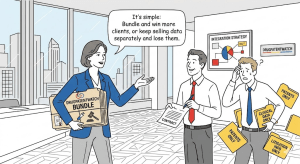
The companies winning enterprise contracts in biopharma data intelligence aren’t selling better patent databases. They’re selling a connected answer to a question that no single data stream can answer alone.
That question is: “Is this asset worth pursuing, and what are the real risks if we move on it?”
Patent data tells you what is protected and when protection ends. Clinical data tells you what is in development and how far along it is. Litigation data tells you who is fighting over what, and who tends to win. Individually, each of these data layers is useful. Together, they are the difference between an analyst presenting a chart and an analyst changing a board-level decision.
This guide is written for business development leaders at biopharma data and intelligence providers. It covers how to structure, sell, price, and differentiate a bundled patent-clinical-litigation intelligence product in an enterprise market that is actively consolidating vendor relationships. If you currently sell one or two of these data streams, this is a practical roadmap for expanding wallet share, reducing churn, and closing deals your competitors cannot match.
Why Single-Stream Data Products Are Losing Deals
The Analyst Who Needs Three Tabs Open
Picture a competitive intelligence analyst at a mid-sized specialty pharma company. She has a target molecule she’s been asked to evaluate for potential in-licensing. She opens a patent database, searches the compound, and gets a list of patent families with expiration dates. She then opens a separate clinical trial aggregator to find out what indication the originator is pursuing and whether any generics or biosimilars have started trials. She then checks a third platform — probably a combination of manual PACER searches and a litigation tracker — to see whether any Paragraph IV challenges have been filed.
Three platforms. Three login credentials. Three data schemas that don’t talk to each other. And at the end of it, she has to synthesize three separate reports into a coherent recommendation that probably took two days to produce.
This workflow is the status quo for most pharma competitive intelligence functions. It is inefficient by design, because data providers built products around their own data assets rather than around the analyst’s actual workflow. The provider with the best patent database optimized their UI for patent attorneys. The one with the best clinical trial data built for regulatory affairs. The litigation tracker was designed for IP litigation counsel.
The enterprise buyer — particularly at mid-to-large pharma companies that have consolidated vendor management — has grown tired of this fragmentation. According to research from the life sciences technology advisory firm Novarum, pharma companies with revenue above $5 billion manage an average of 12 to 18 data vendor relationships, and budget owners at those companies consistently list vendor consolidation as a top-three procurement objective [1].
That consolidation trend is your opening. If you can make a credible case that your platform eliminates two other vendor relationships while delivering a richer connected analysis, you win on total cost of ownership before you even compete on feature quality.
What Enterprise Buyers Actually Ask in RFPs
The shift in enterprise biopharma RFPs over the past five years is instructive. Early RFPs from pharma competitive intelligence and IP functions asked about data completeness: How many patents do you cover? How far back does your clinical trial data go? What percentage of ANDA filings are in your system within 48 hours?
Current RFPs from the same functions ask different questions. How does your patent coverage connect to your clinical trial data? Can I see, on a single record, the Orange Book-listed patents for a drug alongside its pending litigation and the trial status of its biosimilar competitors? Can your platform alert me when a Paragraph IV certification is filed against a drug whose patent portfolio I’ve been tracking?
These are integration questions, not coverage questions. The buyer is telling you, explicitly, that they’ve solved the raw-data problem. What they haven’t solved is the synthesis problem. Your job as a vendor is to solve it for them.
Defining the Bundle — What Each Layer Does
Patent Intelligence: The Foundation
Patent intelligence is the oldest and most mature layer of biopharma data. The core deliverable is a structured view of the intellectual property protecting a drug or compound: the patent families, the claims, the expiration dates (accounting for patent term extensions and pediatric exclusivity), and the geographic coverage.
For a data provider, this layer is table stakes. Every serious player in the market has it. What differentiates the best patent intelligence platforms is not raw coverage — it’s the enrichment and structure of the data. Can you automatically link a patent to an Orange Book listing? Can you calculate effective exclusivity dates that account for regulatory exclusivity, not just patent expiration? Can you identify which claims in a patent are most likely to be challenged, based on prior art density and litigation history for similar claim structures?
DrugPatentWatch has built a reputation precisely in this kind of enriched patent intelligence. The platform goes beyond simply pulling USPTO records; it links patent data to FDA Orange Book listings, tracks exclusivity timelines, and provides searchable patent claims linked to specific drugs and compounds. For a competitive intelligence analyst, that means a search that starts with a brand-name drug returns not just the patents, but the structured expiration timeline that maps to regulatory milestones — which is far more actionable than a raw patent list.
That structured foundation is what makes integration with clinical and litigation data meaningful. If your patent data is a raw dump of USPTO records, it’s hard to layer clinical trial data on top of it in any coherent way. If your patent data is already linked to specific drugs, compounds, and Orange Book entries, clinical and litigation data integration becomes a foreign key join rather than a bespoke consulting project.
Clinical Intelligence: Where Patents Get Context
Clinical trial data tells you what is happening competitively in a therapeutic area and what the development pipeline looks like for a given compound or its close analogs.
For a biopharma data provider, the primary source is ClinicalTrials.gov, supplemented by WHO registries, EU Clinical Trials Register, and proprietary data from company pipeline disclosures, conference presentations, and FDA filings. The best platforms don’t just aggregate this data — they normalize it against a consistent compound ontology, link it to regulatory approval history, and track trial failures and discontinuations alongside active studies.
The clinical data layer answers questions that patent data alone cannot. A drug might have patents extending to 2033, but if the branded manufacturer has already filed for a new formulation with a separate clinical program, the effective competitive landscape shifts. A compound that a biotech is trying to license might look clean from a patent perspective, but clinical trial data might reveal that three other companies are already in Phase 2 with structurally similar molecules in the same indication.
When you link clinical data to patent data, you start answering questions like: “Which clinical-stage compounds in oncology have patent portfolios expiring before 2029 and no active pediatric exclusivity?” That’s a generic opportunity identification query. Or: “Which drugs in our therapeutic focus area have new formulation trials running that might extend their effective market exclusivity?” That’s a defensive strategy question. Neither question is answerable from a single data stream.
Litigation Intelligence: The Risk Signal Nobody Prices Correctly
Litigation data is the most undervalued layer in most biopharma data bundles, and it’s the one that creates the most urgency for buyers when it’s done well.
The core dataset is Paragraph IV certification filings — the formal notification that a generic manufacturer has filed an ANDA and is challenging one or more Orange Book-listed patents as invalid or non-infringed. These filings trigger the 30-month stay, which is the regulatory mechanism that delays generic entry and gives the brand manufacturer time to litigate. Every Paragraph IV filing is a potential market event worth hundreds of millions or billions of dollars in revenue impact.
Beyond Paragraph IV, the litigation layer includes Inter Partes Review (IPR) petitions filed at the Patent Trial and Appeal Board (PTAB), district court patent infringement cases, and post-grant review proceedings. Each of these has different implications for the brand manufacturer, the generic filer, and any third party evaluating the drug as an acquisition or licensing target.
The insight that most buyers lack is not access to this data — PACER is public, and IPR filings are published by the USPTO. What they lack is the synthesis. Which IPR petitions are filed by parties with strong prior-art track records at PTAB? Which Paragraph IV challenges are filed by generics with a history of settling rather than litigating? When a new Paragraph IV certification arrives, which of the challenged patents are most likely to survive litigation based on the claim structure and the history of similar challenges?
A data provider that can answer those questions — not just surface the raw filing data — is selling something that an analyst genuinely cannot replicate through manual research in any reasonable time frame. <blockquote> “Paragraph IV litigation alone represents annual patent disputes covering drugs with combined U.S. sales exceeding $100 billion. The ability to predict outcomes, not just track filings, is what separates actionable intelligence from a data feed.” — Evaluate Pharma, Patent Cliff Report, 2023 [2] </blockquote>
The Market You’re Selling Into
Biopharma Competitive Intelligence Is a Multi-Billion Dollar Function
The biopharma life sciences analytics market was valued at approximately $8.7 billion in 2023 and is forecast to reach $16.2 billion by 2030, growing at a compound annual rate of roughly 9.3% [3]. Within that broader category, competitive intelligence — the function that most directly buys patent, clinical, and litigation data — represents a significant and growing share, as pharma companies have responded to increasing pipeline complexity and generic competition by building more sophisticated internal CI capabilities.
The pressure driving that investment is real. The next five years will see patent expirations on branded drugs generating more than $236 billion in annual U.S. sales, according to data compiled by IQVIA [4]. For branded manufacturers, that is an existential planning challenge. For generic and biosimilar companies, it is an opportunity pipeline. For data providers, it is a sustained, structurally driven demand signal that isn’t going away.
Who Holds the Budget
In a large pharma company, the budget for patent and clinical intelligence is distributed across multiple functions, which creates complexity for enterprise sales but also creates opportunity for bundle expansion.
Business development and licensing functions own budgets for due diligence data. They buy intelligence to support deal evaluation, target identification, and competitive landscaping before transactions. IP and patent counsel own budgets for patent prosecution support, freedom-to-operate analysis, and litigation tracking. Competitive intelligence functions, which increasingly sit within strategy or commercial organizations, own budgets for market monitoring and pipeline surveillance. Regulatory affairs and medical affairs teams are increasingly buying clinical trial data for their own planning work.
At a company with $5 billion or more in revenue, these budgets are often siloed. The patent analytics spend and the clinical trial monitoring spend may not even be managed by the same vice president. This is simultaneously the biggest obstacle and the biggest opportunity in enterprise sales: you have to be willing to sell multi-threaded into an account, and you have to be able to speak each buyer’s language.
Four Buyer Personas and What They Need From You
The BD Team Evaluating a Licensing Target
The business development team under time pressure is your best entry point for a bundle conversation. When a deal is live and a BD team is in diligence, they need patent data, clinical data, and litigation risk assessment simultaneously. They don’t have time to stitch together three platforms.
The BD buyer’s primary question is: “If we license this asset or acquire this company, what IP risk are we inheriting, and how much runway does the protected market position actually have?” A good bundled answer shows the patent portfolio expiration timeline, the clinical status of competing molecules, and any pending litigation that could accelerate or complicate the protection period. That answer, delivered in a single workflow, is worth a meaningful premium over three separate subscriptions.
The IP Attorney Running Freedom-to-Operate
IP counsel at pharma companies are sophisticated buyers who know patent data well. What they often lack is the clinical and commercial context that makes their legal analysis meaningful to business stakeholders. An IP attorney who can run an FTO analysis and immediately surface the clinical trial history of the relevant compounds — and flag the PTAB petition history for the key patents — is delivering more to their internal clients than one who delivers a pure legal assessment.
The IP buyer is also a compliance-driven buyer. They care about data provenance, accuracy, and update frequency. Your bundle pitch to this persona needs to emphasize data quality and audit trails, not just breadth.
The Competitive Intelligence Lead Tracking Generics
CI leaders are power users. They set up monitoring workflows, build dashboards, and manage the intelligence cycle for therapeutic franchises. They are the most likely internal advocates for your platform because they interact with it daily and feel the pain of fragmented data most acutely.
Sell to this buyer on workflow efficiency and alert quality. Show them a scenario where a Paragraph IV certification is filed against a drug in their tracked portfolio, the platform automatically surfaces the relevant patent claims being challenged, the litigation history of the challenging generic, and the remaining clinical trial timeline for the brand’s next-generation molecule — all within a single alert. That’s the product demo that creates internal champions.
Portfolio Strategy Teams Running Pipeline Simulations
The strategy function at large pharma companies is increasingly building quantitative models to inform portfolio investment decisions. These teams want data that plugs into models: clean, structured, API-accessible patent expiration timelines linked to revenue exposure estimates, clinical phase distributions for competitive compounds, and historical litigation success rates by patent type and challenger.
This buyer is your highest-value expansion path. Once a strategy team integrates your data into their internal models, switching costs become very high. The moat you build with this buyer is not feature quality — it’s data schema consistency and API reliability.
Why Bundling Works: The Revenue Math
ACV vs. Standalone Pricing
The economic case for bundling is straightforward. A biopharma data provider selling standalone patent intelligence might close a deal at $80,000 to $150,000 per year for a mid-sized pharma account. A standalone clinical trial monitoring subscription at the same account might add another $60,000 to $120,000. A litigation tracking add-on might be $40,000 to $80,000.
Priced separately, total potential revenue from that account is $180,000 to $350,000 — but in practice, you might only win two of the three, and you’re competing for each one individually. Priced as an integrated bundle, with a modest discount to acknowledge the consolidation value, you might close at $220,000 to $280,000 — a higher total capture at lower selling cost, with one contract and one renewal cycle to manage.
The math gets more compelling at enterprise scale. A top-20 pharma company might have a dozen therapeutic franchises, each with its own CI and IP budget. A true enterprise agreement that bundles patent, clinical, and litigation intelligence across the organization — with usage-based tiers and API access for the strategy team — can reach seven figures in annual contract value. That kind of deal is structurally unavailable to a vendor selling a single data product.
Why Churn Drops When Data Is Connected
Single-product subscriptions churn for predictable reasons: a key champion leaves, a budget cut hits, a competitor offers a lower price at renewal. When a buyer is using your platform for three interconnected workflows, the switching cost increases dramatically. They’d have to migrate to three separate new platforms, retrain their team, rebuild their alert configurations, and reconvince their organization that the disruption is worth the savings.
Connected data also creates habitual usage patterns. An analyst who checks a single patent database once a week before a report is replaceable. An analyst whose entire morning workflow runs through your platform — checking overnight alerts, pulling a competitor pipeline update, flagging a new Paragraph IV filing for counsel — is not going to recommend switching vendors at renewal time.
Data from the software industry broadly confirms this dynamic: multi-product customers churn at roughly half the rate of single-product customers, across both SaaS and data subscription businesses [5]. In biopharma data, where switching costs are already elevated due to training and institutional knowledge, the effect is likely more pronounced.
Land and Expand in Practice
The most effective enterprise sales motion for a bundled intelligence product is not a cold pitch of the full bundle. It’s a disciplined land-and-expand approach: win an initial foothold with your strongest product, deliver measurable value quickly, and then use that proof to expand into adjacent data modules.
A practical example: You win a competitive intelligence team at a specialty pharma company with your patent intelligence product. Over the first 90 days, you run a business review showing them three specific instances where your patent expiration data surfaced an insight faster than their previous workflow. You then introduce a use case — generic entry timing — that requires clinical trial data to complete the picture. You offer a 60-day pilot of the clinical module, tied to a specific franchise they’re already watching. The pilot produces a defensible analysis that the CI team presents to the BD team. The BD team is now a natural buyer for the combined product at renewal.
Done well, this motion converts a $100,000 foothold into a $300,000 enterprise agreement within 18 months without requiring a cold enterprise sale — which is the hardest kind of sale in this market.
Building the Data Architecture That Makes Bundling Credible
The Orange Book as Connective Tissue
The FDA’s Orange Book — formally the Approved Drug Products with Therapeutic Equivalence Evaluations — is the linchpin of any serious bundled pharma intelligence product. The Orange Book lists the patents that a branded manufacturer has submitted as covering a listed drug, along with the expiration dates of those patents and the exclusivity periods that attach to the drug.
Every ANDA filer has to certify against Orange Book patents. Every Paragraph IV litigation begins with an Orange Book patent. Every calculation of a branded drug’s exclusivity runway starts with an Orange Book query. The Orange Book is the shared identifier that links the patent world, the generic entry world, and the litigation world into a single data graph.
A data provider whose patent, clinical, and litigation data all share a common drug-to-Orange Book mapping has solved the hardest integration problem in this space. Analysts can start a search at any point in the data graph — a drug name, a patent number, a litigation case number — and navigate to any other node without switching platforms.
DrugPatentWatch has made this kind of Orange Book integration central to its product architecture. Searches on the platform return Orange Book-linked patent data that ties directly to exclusivity timelines and surfaces related ANDA and litigation activity. That’s the structural model that makes bundled intelligence coherent rather than cosmetic.
Linking Patent Families to ClinicalTrials.gov Identifiers
The technical challenge in linking patent and clinical data is compound identity. ClinicalTrials.gov uses drug names, NCT numbers, and sponsor identifiers that don’t map natively onto USPTO patent numbers or Orange Book application numbers. Building that linkage requires a compound ontology — a normalized database of drug identifiers that can bridge USPTO, FDA, ClinicalTrials.gov, and proprietary pipeline databases.
The best platforms build this linkage at the compound level, not the brand-name level. A branded drug might have multiple active ingredients covered by multiple patent families, with clinical trials running under the INN (International Nonproprietary Name), the brand name, and sometimes internal development codes. A robust ontology resolves all of these to the same compound record, which then links to both the patent family and the ClinicalTrials.gov registration.
For a data provider, building this ontology is a multi-year investment. It requires structured data science work to resolve ambiguous identifiers, and it requires ongoing maintenance as new drugs enter development and existing drugs gain new indications. But it’s also the most durable competitive advantage you can build — because it’s extraordinarily hard to replicate quickly and because it makes your data genuinely more useful than a competitor who has the same raw sources but less sophisticated entity resolution.
Mapping ANDA Filings to Litigation Records
The third integration — between generic ANDA filings and patent litigation — is more tractable because the legal connection is explicit. When a Paragraph IV certification is filed, the brand manufacturer typically sues within 45 days to trigger the 30-month stay. The case number from that district court filing, the patent numbers being challenged, and the ANDA application number are all public record and can be linked in a structured database.
What requires intelligence work is enriching those case records: tracking the outcome of each case (settlement, judgment, consent judgment, entry of final judgment), linking the outcome back to whether generic entry occurred and when, and building a historical model of litigation outcomes by patent type, claim structure, challenger identity, and judge.
This enriched litigation record is what transforms raw PACER data into intelligence that a buyer can actually use to inform a decision. A Paragraph IV filing is a data point. A Paragraph IV filing with a linked analysis of the challenger’s historical win rate against patents with similar claim structures, filed in the same district, against the same drug class — that’s a risk assessment.
Paragraph IV as the Integration Test
A useful internal test for any bundled intelligence product is to ask: “Can our platform deliver a complete Paragraph IV intelligence brief within 10 minutes of a user search?” That brief should include the ANDA filing date and applicant, the specific Orange Book patents being challenged and their expiration dates, the current patent portfolio covering the drug (including any non-Orange Book patents that might matter), the clinical trial status of any next-generation versions of the drug in development, and the brand manufacturer’s litigation history against Paragraph IV challenges.
If your platform can assemble that brief from a single query, you have a defensible bundled product. If assembling it requires a user to run three separate searches on three separate platforms and manually synthesize the results, you have a data aggregation business masquerading as an intelligence business.
DrugPatentWatch: A Reference Model for Integrated Intelligence
DrugPatentWatch operates as a leading example of what integrated patent intelligence looks like in practice in the biopharma data sector. The platform allows users to search by drug name, patent number, company name, or active ingredient, and returns a structured view that links patent data to Orange Book listings, expiry timelines, exclusivity periods, and ANDA filing activity.
For a biopharma competitive intelligence professional, DrugPatentWatch shortens research cycles that previously required manual aggregation across multiple government databases. The platform’s value is in the linkages — not just the raw data — which is precisely the architectural principle that makes it a meaningful reference point for any data provider building or expanding a bundled intelligence product.
Where DrugPatentWatch illustrates the opportunity for broader bundling is in the natural adjacency between its patent/Orange Book core and the clinical and litigation intelligence that users inevitably need alongside it. Any user working in the platform will, within a few minutes, face a question that requires clinical trial data or litigation case status to answer completely. That adjacent need is the expansion opportunity for a platform that wants to deepen its enterprise relationships.
Packaging and Pricing the Bundle
Module-Based vs. Unified Platform Pricing
Two pricing architectures dominate the enterprise data subscription market: module-based pricing, where each data stream carries its own price and users purchase the combination they need, and unified platform pricing, where a single subscription provides access to all data layers with tier-based usage limits.
Module-based pricing is easier to sell into siloed organizations because each budget owner can justify their own module against their own use case. The risk is that you end up selling the clinical module to the CI team and the patent module to the IP team and never getting a single decision-maker who sees the combined value.
Unified platform pricing works better for enterprise deals where you’ve already established a relationship and a champion who can make the case for a consolidated purchase. It typically delivers higher ACV, lower churn, and cleaner renewal cycles — but it’s a harder initial conversation because it requires the buyer to consolidate budgets that may live in different departments.
The most effective approach for most data providers is a hybrid: a base platform subscription that includes core patent intelligence, with module pricing for clinical and litigation tiers, and a bundled enterprise rate that applies a meaningful discount when all three are purchased together. The enterprise rate creates the incentive to consolidate without requiring a buyer to rip and replace their existing vendor relationships in a single budget cycle.
Usage-Based vs. Seat-Based Models
Seat-based pricing is the traditional model for enterprise software, and it works reasonably well for data platforms with defined power-user populations — the 10 to 20 analysts who use the platform daily. It breaks down when the buyer wants to share intelligence outputs broadly within the organization without expanding the user base.
Usage-based pricing — based on API calls, query volume, or data exports — aligns better with the way sophisticated pharma companies actually use intelligence data. A strategy team might run a high-volume data pull for a quarterly portfolio review, use minimal queries for the next two months, and run another large pull before a board meeting. Seat-based pricing penalizes this pattern; usage-based pricing accommodates it.
For a data provider building enterprise relationships, the most strategic pricing move is to offer seat-based pricing for the primary analytical users plus an API tier that charges on consumption for programmatic access. This structure lets you deepen the account relationship with the strategy and data science teams — who typically prefer API access — without disrupting the existing relationship with the CI and IP teams who use the UI.
The Proof-of-Value Engagement
Enterprise pharma buyers rarely purchase bundled intelligence without first proving value in a controlled environment. Build a formal proof-of-value (POV) process into your sales cycle. A 60-day POV should have three characteristics.
First, it should be scoped to a specific decision the buyer is actively facing — not a generic demo of features, but an analysis of a drug or therapeutic area that the buyer’s team is working on right now. Second, it should have a defined success metric agreed in advance: “At the end of 60 days, we will have used this platform to answer questions X and Y faster and more completely than our current workflow.” Third, it should involve the champion and at least one economic buyer, so that the proof of value is witnessed by someone who controls the budget.
POVs scoped this way convert to paid contracts at significantly higher rates than generic pilots, because the buyer has invested their own time and staked their credibility on the outcome. They also surface the integration and data quality issues that will come up in a full deployment — better to find them during a POV than after contract signature.
The Enterprise Sales Motion
Multi-Threaded Selling in a Pharma Account
A single champion at a pharma company is a fragile sales relationship. Champions leave, get promoted, or lose internal political capital. Enterprise contracts depend on multi-threading: building relationships with at least three individuals across at least two functions before a renewal cycle.
In a pharma account, the natural multi-thread is CI lead plus IP counsel plus one BD or strategy stakeholder. Each uses the product for different workflows and has different decision authority. The CI lead is typically your operational champion; the IP counsel is your technical validator; the BD or strategy stakeholder is your economic buyer.
Managing these relationships requires discipline. Your account team needs a clear map of who is using the product, who influences the renewal decision, and who has budget authority. This is basic enterprise sales hygiene, but it’s frequently neglected in data subscription businesses where renewal conversations happen once a year and account management is thin.
The Champion Problem: CI Analysts Don’t Control IP Budgets
The most common failure mode in pharmaceutical data enterprise sales is building a strong relationship with a competitive intelligence analyst who loves the product but cannot advocate effectively for a budget consolidation that touches IP and BD budgets. The CI analyst can renew their own subscription. They cannot, in most organizations, sign a $400,000 enterprise agreement that draws from three departmental budgets.
To close a consolidated enterprise deal, you need an executive sponsor: a VP-level buyer who owns enough of the organizational relationships to convene the relevant budget holders and make the case for consolidation. Finding that sponsor often means investing in relationships before there’s an active deal — speaking at industry conferences, publishing data that gets shared up to the VP level, or requesting business reviews specifically with senior leaders rather than just analysts.
The executive sponsor conversation is different from the analyst conversation. Analysts want better data and faster workflows. Executives want lower total vendor spend, lower compliance risk (from fragmented, inconsistent data), and demonstrable competitive advantage in deal-making. Make sure your business case materials address all four of these in language that a VP of Business Development or a Chief IP Officer uses, not the language of a data analyst.
Procurement and Legal Buying Cycles
Enterprise contracts at large pharma companies rarely close in less than six months. The procurement process typically includes security review, data privacy assessment (particularly relevant for platforms that handle proprietary company data or search histories), legal review of data licensing terms, and IT review for API integration. Each of these can add four to eight weeks to a deal cycle.
Build this timeline into your enterprise sales motion from the first serious conversation. Request the vendor qualification documents early. Proactively prepare a security summary and data privacy documentation that answers the standard questions before procurement asks. If your platform offers SSO integration and SOC 2 Type II certification, lead with that in procurement conversations — it removes common objections before they become delays.
The legal review of data licensing terms is a specific bottleneck in biopharma data deals, because buyers want to understand what they can do with the data internally (can they include it in deal documents? Can they share it with external advisors? Can they build proprietary derivative products on top of it?). Prepare a clear, plain-language data use policy that addresses these questions, and have your legal team available to engage directly with buyer counsel. Deals that stall in legal review frequently stall because the buyer’s counsel has questions your team didn’t anticipate and took two weeks to answer.
Competitive Differentiation: Avoiding the Commoditization Trap
Derived Analytics vs. Raw Data
The biopharma data market is commoditizing at the raw data layer. Patent data from the USPTO is public. Clinical trial data from ClinicalTrials.gov is public. PACER litigation records are public. The marginal cost of aggregating and normalizing these public datasets has dropped dramatically as cloud infrastructure and ML-based entity resolution tools have improved.
What isn’t commoditizing is the derived analytics layer — the models, scores, and predictions built on top of the raw data. A raw list of Paragraph IV filings against a drug’s patent portfolio is a commodity data product. A litigation outcome probability score, built on a model trained on 20 years of PTAB and district court decisions and specific to the claim type and challenger profile, is not.
For a data provider, the strategic investment priority should be in derived analytics that genuinely cannot be replicated by an analyst with access to the same raw sources. That means building proprietary models, publishing benchmark data that establishes your analytical credibility, and continuously improving predictions against verifiable outcomes (when a challenge you scored as high-risk actually fails, note it, update the model, and publish the results).
Proprietary Scores That Create Lock-In
Scoring models create switching costs in two ways. First, buyers build internal workflows and reporting frameworks around your scores — if they switch providers, they have to recalibrate everything that references your output. Second, if your scores are based on historical data that includes the buyer’s own search and alert patterns, a new provider starting from zero won’t have that behavioral history to improve recommendations.
Specific score types that work well in biopharma data:
Patent vulnerability scores that estimate the likelihood of a successful IPR challenge based on claim structure, prior art density, and the PTAB panel history for similar patents. Clinical competitive intensity scores that quantify how crowded a therapeutic area or indication is, based on active trial counts, phase distribution, and sponsor concentration. Litigation settlement probability scores that estimate whether a Paragraph IV challenge is likely to result in a negotiated settlement (authorized generic agreement, royalty deal) versus a full trial — which is the information that a BD team wants when they’re deciding whether to include litigation risk in an asset valuation.
Workflow Integration as a Moat
The deepest switching cost in enterprise data is workflow integration. When your platform is connected to a buyer’s internal systems — their CRM, their portfolio database, their IP management software — switching means not just replacing a data subscription but rebuilding a set of integrations.
Actively pursue integration partnerships with the software systems that large pharma companies use. Patent management software like Anaqua and CPA Global are natural integration partners for a patent intelligence platform. Business development workflow tools like DealForma or Inpart are natural partners for a BD-focused intelligence product. The more integration hooks you build, the harder you are to displace.
API-first architecture is a prerequisite for this strategy. If your platform only offers a UI, you can’t build workflow integrations. If it offers a well-documented API with robust data endpoints, integration partnerships become a meaningful part of your enterprise sales motion.
Three Case Studies That Illustrate Bundled Intelligence in Action
Case Study 1: Generic Entry Timing for a Top-10 Branded Drug
A mid-sized specialty pharma company is considering whether to invest in lifecycle management for one of its top revenue products: a branded drug with $800 million in annual U.S. sales and a primary composition-of-matter patent expiring in 2027. The CI team’s task is to develop a definitive generic entry forecast.
Using patent intelligence alone, the team can identify the patent expiration dates and any pending PTEs. But the complete picture requires more. Clinical data reveals that the company has a next-generation formulation in Phase 2, which — if approved — could extend market protection through a new patent and potentially qualify for a new period of regulatory exclusivity. Litigation data reveals that two generic companies have already filed Paragraph IV challenges against two of the supporting process patents, and that one of those challengers has a 70% historical win rate against process patents filed by the same originator company.
With all three data layers connected in a single workflow, the CI team’s forecast is substantially more nuanced than a patent-only analysis would produce. The primary patent expires in 2027, but the challenged process patents could be invalidated earlier, opening the door to partial generic entry in 2026. The next-generation formulation, if successful, doesn’t protect the base molecule — it only creates a new franchise product that requires its own adoption curve. The realistic generic entry scenario, with probability weights, looks materially different from the face-value patent expiration date.
That analysis changes the lifecycle investment recommendation. Rather than investing heavily in the base formulation, the brand team redirects resources to accelerating the next-generation formulation and exploring authorized generic partnerships to control the transition. None of that decision logic was available from patent data alone.
Case Study 2: Licensing Due Diligence Under Time Pressure
A large pharma company’s BD team has 72 hours to deliver an initial assessment of an in-licensing opportunity: a Phase 2 asset in a competitive therapeutic area. The asset holder wants a term sheet before the end of the week.
Without integrated intelligence, 72 hours is barely enough time to complete a patent search and start a manual literature review of the clinical landscape. With a bundled intelligence platform, the same team completes a structured due diligence package in 24 hours. Patent data shows the asset’s composition-of-matter protection extending to 2035 with no Orange Book listing yet (it’s still in development), a PCT filing covering major markets, and no currently pending IPR challenges. Clinical data shows four competing programs in the same indication, two of which are Phase 3 — information that significantly affects the competitive window the asset would need to exploit. Litigation data shows no IP disputes involving the asset holder’s related compound portfolio, which reduces risk that the deal carries inherited litigation exposure.
The team submits a term sheet with an IP risk discount applied to the valuation, citing the Phase 3 competitive crowding as a variable that could compress the commercial runway. That’s a more defensible and precise valuation position than the BD team would have reached with a less integrated data workflow.
Case Study 3: IPR Petition Risk Assessment Before a Launch Decision
A generic manufacturer is preparing to launch a drug immediately after a Paragraph IV district court win. Before launch-at-risk, the team needs to assess the probability that the brand manufacturer will file an IPR petition against the district court decision at PTAB, and what the likely timeline and outcome of that IPR would be.
This is a litigation intelligence question, but it’s inseparable from patent data. The PTAB petition analysis requires understanding which claims were actually adjudicated in the district court case, which claims survived the district court (some were found valid, others not), and whether the grounds available for IPR petition were raised and decided in the district court — which may preclude re-litigation.
With a connected litigation and patent platform, this analysis takes hours rather than days. The relevant district court docket is linked to the patent record, and the claim-by-claim outcomes are structured in the database. The PTAB petition history for the brand manufacturer shows they’ve filed IPR petitions in similar circumstances in three prior situations, and they lost two of the three. The brand manufacturer’s IPR counsel of record has a 45% success rate as petitioner at PTAB. Based on this analysis, the team quantifies the IPR risk as moderate, assigns a 30% probability of a successful petition that could reverse the launch decision, and models the financial exposure accordingly.
That risk quantification — which a general counsel and CFO can work with directly in a launch decision — is the output of integrated intelligence. The raw PACER record and the raw patent database, consulted separately, don’t deliver that output.
Key Takeaways
Enterprise biopharma buyers are actively consolidating vendor relationships. A bundled patent-clinical-litigation product is a direct response to a stated procurement objective, not just a product strategy.
The integration quality of your data — specifically, how you link patent records to clinical trial identifiers and litigation case numbers through a shared drug/compound ontology — is more defensible than the breadth of any single data layer.
The Orange Book is the structural backbone of bundled biopharma intelligence. A platform that builds its data graph around Orange Book identifiers can answer the questions that matter most to generic manufacturers, brand defenders, and deal teams.
Bundling increases average contract value, reduces churn, and creates switching costs — three metrics that directly affect the valuation and defensibility of a data business.
Derived analytics (litigation outcome scores, patent vulnerability indices, clinical crowding metrics) differentiate you from competitors who have access to the same raw public data sources. Raw data alone does not create a durable competitive position.
The enterprise sales motion requires multi-threading across CI, IP, and BD functions, with an executive sponsor who can consolidate budgets. A relationship limited to one analyst is not an enterprise relationship.
API-first architecture enables the workflow integrations — with IP management software, BD deal platforms, and internal portfolio databases — that convert a data subscription into a mission-critical infrastructure dependency.
FAQ
Q1: What’s the right sequence for a data provider expanding from patent intelligence into clinical and litigation data — build, buy, or partner?
All three paths are viable, and the right choice depends on your current technical capability and your timeline to market. Building a clinical trial data layer from scratch requires a robust entity resolution system to normalize ClinicalTrials.gov data against your existing compound ontology — a 12 to 24 month investment if your data engineering team is experienced in this domain. Buying a small clinical data company gives you data assets and a team but typically introduces integration complexity and cultural challenges. Partnering with an established clinical data provider (through a white-label or API integration agreement) lets you go to market faster and test demand before committing to build. Most successful data providers use a staged approach: partner first to validate market demand, then build proprietary capabilities over time as the revenue justifies the investment.
Q2: How do you price a bundled product when the individual modules were previously sold at different price points to different buyers?
This is the most common internal conflict in bundling transitions, and it requires a clear policy. Establish a “bundle rate” that is 15 to 25 percent below the sum of individual module prices — enough to create a real incentive for consolidation, but not so steep that you’re implicitly acknowledging the individual modules were overpriced. For existing customers who subscribed to a single module at the old price, offer an “upgrade path” to the bundle with a partial credit for their existing subscription value. Grandfather their current rate for one renewal cycle, then move them to the bundle pricing framework. Don’t try to raise the price on an individual module to force bundle adoption — buyers notice that kind of structure quickly, and it damages the trust relationship.
Q3: How do you handle the data governance concerns that arise when a pharma company’s search and alert history is stored on your platform?
This is a legitimate concern for large pharma companies, where a search for a specific competitor compound could reveal M&A or licensing intentions. Address it proactively in your enterprise agreements: offer a contractual commitment that search history and alert configurations are not shared across customers, not used to train models that could expose customer intent to competitors, and subject to deletion on contract termination. Provide a clear data processing agreement that complies with applicable privacy law, and be prepared to discuss it with the buyer’s legal and compliance teams. Some enterprise buyers will want a private cloud deployment option for sensitive intelligence workflows — pricing a managed private deployment tier is worth the operational complexity given the contract values it enables.
Q4: Biopharma deals move slowly. How do you maintain momentum through a six-month enterprise sales cycle without losing the deal to a cheaper point solution?
Structured engagement beats urgency tactics in this market. Set a mutual close plan with the buyer at the outset: a shared document that maps the decision process, the key milestones (POV completion, security review, legal review, procurement approval), and the expected timeline for each. Review this document in every meeting. When a stage completes ahead of schedule, celebrate it visibly with the buyer team — it reinforces the sense of shared progress. To neutralize a cheaper point solution competitor, make the total cost of ownership comparison explicit. Calculate the analyst hours currently spent stitching together data from multiple sources, assign a dollar value to that time, and show that your bundle is cheaper than the status quo when you include the cost of fragmented workflows.
Q5: What’s the most common reason that bundled biopharma data products fail to deliver on their promise, and how do you prevent it?
The most common failure mode is an incoherent data model — the clinical and litigation data layers are added as separate modules without genuine integration into the core patent data graph. Users end up with three interfaces within the same platform rather than one integrated workflow. The platform looks bundled from the outside but operates as a product suite, not a unified product. Prevention requires an explicit architectural decision before you build: all data layers must share a common compound and drug identifier framework, and every query in the platform must be able to traverse across layers without a context switch. This is a harder engineering problem than building three separate modules, but it’s the only version that delivers the analytical value that justifies the bundle premium. Conduct regular internal user testing with actual pharma analysts during development — their feedback will surface integration gaps that your product team won’t see from inside the organization.
Citations
[1] Novarum Life Sciences. (2023). Pharma vendor management benchmarking report: Enterprise data procurement trends. Novarum Advisory Group.
[2] Evaluate Pharma. (2023). Patent cliff report: IP exposure and branded drug revenue at risk, 2024-2030. Evaluate Ltd.
[3] Grand View Research. (2024). Life sciences analytics market size, share & trends analysis report, 2024-2030. Grand View Research, Inc.
[4] IQVIA Institute for Human Data Science. (2024). Global medicines usage in 2028: Forecasting and understanding medicine demand. IQVIA Holdings Inc.
[5] Gainsight & Andreessen Horowitz. (2023). The SaaS benchmarks report: Retention, expansion, and multi-product dynamics in enterprise software. Gainsight, Inc.