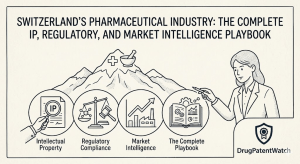
Switzerland generates more patent applications per capita than any other country on earth. In 2024, the European Patent Office received 9,966 Swiss applications, roughly 40 percent more than in 2015, at a rate of 1,140 per million inhabitants — a figure that puts Sweden (472) and Germany (300) in a distant second tier. For a nation of 8.8 million people, that is not an accident. It is the output of a deliberate, decades-long system of IP law, regulatory architecture, capital incentives, and academic-industrial proximity that has no precise equivalent anywhere else in the world.
This guide examines every structural layer of that system: its historical origins, the specific IP portfolios and valuation mechanics of its anchor corporations, the regulatory machinery that controls market access, the pricing regime that is currently fracturing under political pressure, the supply-chain ecosystem of specialized manufacturers that most institutional investors ignore entirely, and the technology roadmaps that will determine where Swiss pharma sits by 2035.
1. Historical Foundations: From Synthetic Dyes to Patent Fortress
The Dye-to-Drug Transition and Its Structural Legacy
Switzerland’s pharmaceutical industry did not emerge from a national health strategy. It grew out of the Basel textile trade. In the mid-nineteenth century, Basel sat at the intersection of French, German, and Swiss rail networks, making it a natural hub for chemical imports and exports. When Alexander Clavel established a synthetic dye operation in 1859, he was responding to demand from silk weavers — not pharmaceutical markets. The company that grew from that factory eventually became part of CIBA, one of the two firms that merged in 1970 to form Ciba-Geigy, which itself merged with Sandoz in 1996 to create Novartis.
That lineage matters for IP analysis. The same chemical synthesis competencies that produced aniline dyes also produced the first sulfonamide antibiotics and, later, imatinib (Gleevec), the BCR-ABL kinase inhibitor that redefined oncology pricing and IP strategy simultaneously. The technical infrastructure, the trained chemists, the laboratory culture — all of it carried forward from the dye era into the pharmaceutical one.
The Patent Law Pivot of the 1970s
For roughly a century, Swiss firms operated in an environment of deliberately weak pharmaceutical patent protection. Swiss law did not recognize product patents on chemical compounds until 1978. Before that date, Swiss companies could freely replicate foreign chemical formulations, reverse-engineer competitor drugs, and launch them domestically without licensing fees. Critics in other countries called it industrial piracy. Swiss firms called it competitive necessity.
The 1978 transition to full pharmaceutical product patent protection aligned Switzerland with the requirements of the Paris Convention and, later, the TRIPS Agreement under the World Trade Organization. The effect on R&D strategy was immediate. Because Swiss firms could no longer free-ride on foreign innovation, they had to generate their own. The investment in original research that followed created the institutional base Novartis and Roche sit on today.
That structural history explains something that confuses observers when they look at Switzerland’s current aggressive IP enforcement posture: the country learned the value of patents by first living without them.
Key Takeaways: Historical Foundations
The chemical-to-pharmaceutical transition gave Swiss companies a century of synthetic chemistry competence before the modern patent era began. The 1978 product patent adoption forced genuine R&D investment, producing the innovation infrastructure that now generates CHF 9.6 billion in annual Swiss R&D spend from Novartis and Roche alone. Any analyst modeling the long-term resilience of Swiss pharma IP needs to account for the fact that this system was built under constraint, not abundance, and has been tested by multiple competitive shocks.
2. The Basel Cluster: Novartis and Roche as IP Assets
Basel is the highest-density pharmaceutical hub in the world. Both Novartis and Roche have their global headquarters within a few kilometers of each other, and both operate R&D campuses that function as magnets for specialized talent, contract research organizations, and specialized legal counsel. The city’s concentration of pharma employment, IP filing activity, and capital allocation makes it the correct unit of analysis for anyone modeling Swiss pharmaceutical value — not the country as a whole.
Novartis: IP Valuation, Platform Strategy, and the Patent Cliff Ahead
Novartis reported 2024 revenues of $51.7 billion, up 10.8 percent year-over-year, with a market capitalization that reached approximately $210 billion as of early 2025. The company’s IP portfolio spans its entire innovative medicines division, which covers oncology, immunology, cardiovascular, and neuroscience — built around brands including Cosentyx (secukinumab), Kisqali (ribociclib), Entresto (sacubitril/valsartan), and Pluvicto (lutetium vipivotide tetraxetan).
The IP valuation for each of these assets does not reside in the primary composition-of-matter patent alone. In every case, Novartis has constructed layered patent thickets that include formulation patents, manufacturing process patents, pediatric extensions, and method-of-treatment claims for new indications. Entresto, for example, carries claims on the specific sacubitril/valsartan co-crystal structure, on the specific dosing regimen for heart failure with reduced ejection fraction, and on new indications including heart failure with preserved ejection fraction — each layer adding months or years of exclusivity beyond the base compound patent.
Novartis’s own disclosures identify 2026 to 2027 as the window in which primary patent protection erodes on several key revenue drivers, including Entresto and Tasigna (nilotinib). Analysts who value Novartis purely on current cash flows without modeling the post-exclusivity revenue trajectory for those two assets will systematically overestimate forward earnings.
Novartis’s Five-Platform Technology Bet
The company has publicly committed its capital allocation to five technology platforms: established small-molecule chemistry and biotherapeutics (the existing revenue base), plus three advanced platforms it expects to drive future growth: xRNA (which covers both siRNA and mRNA modalities), radioligand therapy, and cell and gene therapy. Each platform carries a distinct IP valuation methodology.
For xRNA assets, IP value concentrates in delivery mechanism patents, particularly lipid nanoparticle formulation claims, which are subject to active litigation globally. For radioligand therapy, Pluvicto’s success has drawn competitors into the PSMA-targeting space, and the relevant IP competition now centers on targeting vector claims and isotope conjugation processes rather than the small-molecule scaffold. For cell and gene therapy, the acquisition of Avidity Biosciences in October 2025 for approximately $12 billion gave Novartis access to antibody-oligonucleotide conjugate technology, a platform with a relatively uncrowded IP landscape that provides meaningful exclusivity runway.
In 2025, Novartis announced a $23 billion commitment to build and expand ten manufacturing facilities in the United States — a capital allocation decision that reflects both commercial strategy and IP positioning. Domestic manufacturing generates a stronger position in any dispute about import restrictions on patented drugs, and it insulates the company from the category of geopolitical risk that offshore API sourcing creates.
Investment Strategy Note: Novartis
The two variables that will determine whether Novartis’s current valuation holds through 2028 are: first, whether the late-stage pipeline (more than 30 programs, with 15 key readouts due by 2027) generates at least two or three commercially significant approvals before Entresto’s patent erosion peaks; and second, whether the radioligand therapy franchise sustains growth velocity as competitors enter the PSMA space. Analysts should model the Entresto exclusivity cliff carefully. The primary U.S. patent on the sacubitril/valsartan combination expires in 2025, with secondary patents potentially extending exclusivity, but generic manufacturers have filed Paragraph IV certifications challenging those secondary claims. A successful Paragraph IV invalidation moves the revenue cliff substantially earlier than consensus models assume.
Roche: Diagnostics Integration, Biologic Complexity, and the Post-LOE Playbook
Roche’s IP strategy runs through a different logic than Novartis’s. Where Novartis bets on platform diversification, Roche bets on diagnostic-therapeutic integration. The company holds approximately 7,959 patent families and more than 80,000 granted patents worldwide across the 2009-to-2023 period, including more than 10,000 European patents. Roche sits as Switzerland’s largest EPO applicant and ranks among Europe’s most active corporate filers.
The loss-of-exclusivity (LOE) story at Roche is well-documented and instructive for IP valuation methodology. Primary patents for Avastin (bevacizumab), Herceptin (trastuzumab), MabThera/Rituxan (rituximab), Lucentis (ranibizumab), and Actemra/RoActemra (tocilizumab) have all expired globally. Biosimilar competition against each of these products has proceeded along a predictable pattern: rapid market share erosion in European markets where biosimilar interchangeability policies are more permissive, slower erosion in the United States where reference product-biosimilar substitution requires pharmacist-level biosimilar interchangeability designation from the FDA.
Roche’s response to this LOE wave demonstrates how a company with deep biologic manufacturing competence defends residual value after primary patent expiry. For Herceptin, Roche converted a substantial proportion of the IV patient population to Phesgo (pertuzumab/trastuzumab subcutaneous), a fixed-dose combination with a distinct delivery mechanism patent and meaningful clinical convenience advantage. For Actemra, despite primary U.S. and EU patent expiry and biosimilar entry in 2024, global sales held at CHF 1.276 billion in H1 2024 — essentially flat year-over-year — because the brand retained share in the chronic rheumatoid arthritis setting through physician preference. That outcome is only possible when the originator’s clinical data package is robust enough to create genuine prescriber inertia.
The company projects CHF 1.0 billion in LOE impact for full-year 2025 at constant exchange rates, a figure it reduced from an earlier CHF 1.2 billion estimate after better-than-expected retention in key markets.
Roche’s Companion Diagnostic Patent Architecture
Roche’s structural advantage over most oncology competitors comes from owning both the biologic and the companion diagnostic. The HER2-positive breast cancer franchise is the clearest example. Roche developed trastuzumab (Herceptin), pertuzumab (Perjeta), and the PATHWAY HER2 IHC 4B5 diagnostic assay. In the U.S., the companion diagnostic is subject to separate FDA clearance or approval requirements and to separate IP protection through diagnostic assay patents. That closed-loop model, in which the drug and the test are co-protected, creates a revenue stream that biosimilar manufacturers cannot easily replicate. A biosimilar of Herceptin can copy the biologic. It cannot simultaneously reproduce Roche’s diagnostic infrastructure or the commercial relationships Roche has built with hospital pathology labs over two decades.
The company’s acquisition of Poseida Therapeutics in January 2025 for approximately $1 billion at closing, with up to $1.5 billion total including milestones, extended this logic into CAR-T cell therapy. Poseida’s piggybac transposon manufacturing technology produces non-viral CAR-T constructs, which carry a distinct manufacturing patent architecture from the viral-vector-based approaches used by Kymriah (Novartis) and Yescarta (Kite/Gilead). Roche is betting that non-viral manufacturing IP will prove more defensible at scale.
Investment Strategy Note: Roche
Roche’s near-term valuation depends on two things that are hard to model from public disclosures: the rate of Phesgo uptake in markets where Herceptin biosimilars are gaining share, and the performance of the new growth assets (suzetrigine’s ophthalmology indication, subcutaneous Ocrevus for MS, and the oncology pipeline). The diagnostic division provides meaningful revenue stability that analysts sometimes underweight when comparing Roche to pure-play biologic companies. Roche’s diagnostics segment is not a hedge — it is a durable revenue stream that reduces the effective volatility of the overall business. Investors who model Roche as a pharma company that happens to have a diagnostics division are modeling it incorrectly.
CRISPR Therapeutics: IP Valuation for a Gene-Editing Platform
CRISPR Therapeutics is headquartered in Zug, Switzerland, though its clinical operations are headquartered in the United States and United Kingdom. Its co-development with Vertex Pharmaceuticals of Casgevy (exagamglogene autotemcel) produced the first CRISPR-based therapy approved by the FDA and EMA, for sickle cell disease and transfusion-dependent beta-thalassemia. Casgevy’s regulatory approval in late 2023 and early 2024 makes it the most commercially significant gene-editing IP asset in the world at this moment.
The IP landscape for CRISPR-based therapeutics is contested at a fundamental level. The foundational CRISPR-Cas9 intellectual property is the subject of ongoing interference proceedings and litigation primarily between the Broad Institute (Harvard/MIT) and the UC Berkeley group led by Jennifer Doudna and Emmanuelle Charpentier. CRISPR Therapeutics licensed its core technology from Charpentier’s team, which means its right to use CRISPR-Cas9 in human therapeutic applications depends partly on the final resolution of that underlying IP dispute. This is not a peripheral risk; it is the core IP risk for the company’s entire platform.
Beyond that foundational dispute, CRISPR Therapeutics has built product-specific IP around the ex vivo editing protocol for Casgevy, the specific guide RNA sequences used to disrupt BCL11A enhancer elements, the cell manufacturing process, and the conditioning regimen that precedes cell infusion. Each of these layers can, in principle, maintain exclusivity even if the foundational CRISPR-Cas9 patent landscape shifts. The product-specific IP ring-fence matters precisely because the foundational patents are contested.
3. Swissmedic: Regulatory Architecture and Market Authorization Mechanics
The Role of Swissmedic in Swiss Market Access
Swissmedic is Switzerland’s Institute for Therapeutic Products and the central regulatory authority for human and veterinary medicinal products. It operates under the Therapeutic Products Act (TPA), administers the market authorization system, conducts GMP inspections, and manages the Swiss Medicinal Products Database. Unlike the European Medicines Agency, Swissmedic is a national authority that makes independent scientific assessments — it does not accept EMA decisions as automatically binding, though in practice the two bodies maintain close procedural alignment.
For companies seeking Swiss market authorization, the standard pathway involves a scientific assessment of the quality, safety, and efficacy dossier in CTD format. Swissmedic accepts Common Technical Document submissions and runs parallel procedures with EMA assessments where possible, which reduces duplication cost for companies that are seeking simultaneous EU and Swiss authorization. The mutual recognition of GMP inspections between Switzerland and the EU under the bilateral mutual recognition agreement further reduces friction for manufacturers.
Swissmedic vs. EMA: Procedural Differences That Matter
The two agencies are not interchangeable. Swissmedic operates on an independent scientific clock. Swiss authorization does not follow automatically from EMA approval; there is a separate assessment period that Swissmedic targets at approximately 100 days for standard applications reviewed in parallel with EMA. For products that receive EMA approval but where the Swiss application was not submitted in parallel, the standalone Swissmedic review adds roughly 12 to 18 months to Swiss market entry.
The more commercially significant difference is the treatment of generic drug applications. Switzerland uses the Swissmedic Simplified Procedure (Art. 12 TPA) for generics, which requires demonstration of bioequivalence with the Swiss-authorized reference product. The key regulatory distinction is that a Paragraph IV equivalent challenge mechanism does not exist in Switzerland in the same form it does under U.S. Hatch-Waxman. Generic applicants cannot file a Swiss authorization application before the reference product’s data exclusivity period expires. Switzerland grants ten years of data exclusivity from the date of the originator’s Swiss authorization, with a two-year extension possible for new indications — a materially longer exclusivity runway than the EU’s standard eight-plus-two-plus-one scheme.
Key Takeaways: Regulatory Architecture
Switzerland’s regulatory system provides longer data exclusivity than the EU standard, independent scientific review that requires parallel application strategy, and GMP mutual recognition that reduces manufacturing compliance cost. The regulatory environment structurally favors originator companies over generic challengers in ways that are not always obvious from reading the TPA surface-level.
4. The Innovation Ecosystem: Biologics, ATMPs, and the University Pipeline
Biologics as the Structural Core of Swiss Pharma Output
Nearly half of Swiss-developed drugs in active development are biologics. This is not a product-mix statistic — it is a strategic moat. Biologic molecules, including monoclonal antibodies, fusion proteins, ADCs (antibody-drug conjugates), and cell-based therapies, are orders of magnitude harder to reverse-engineer than small-molecule drugs. The complexity of the manufacturing process, the sensitivity of the protein structure to production conditions, and the regulatory burden of demonstrating biosimilar interchangeability all act as barriers that generic manufacturers cannot overcome through chemistry alone.
For IP valuation, biologic complexity translates into extended effective market exclusivity beyond what the patent certificate states. A small-molecule drug might face meaningful generic competition within six months of primary patent expiry, as generic manufacturers have pre-positioned their ANDAs under Hatch-Waxman and have FDA-approved products ready to ship. A biologic faces a different competitive dynamic. Biosimilar development typically requires three to five years and $100 million to $250 million in development cost, which filters out all but the most well-capitalized generic manufacturers. The FDA’s biosimilar interchangeability designation — which allows automatic substitution at the pharmacy level without prescriber intervention — requires additional switching studies beyond basic biosimilarity demonstration, adding further cost and time.
The Swiss advantage in biologics is upstream: manufacturing scale, process analytical technology (PAT) expertise, and CHO cell line know-how that have been built over decades of producing Herceptin, Avastin, and Rituxan. That manufacturing IP, embedded in process patents and trade secrets, does not expire on the same schedule as product composition patents.
Advanced Therapy Medicinal Products (ATMPs): The New IP Frontier
ATMPs — which include gene therapies, somatic cell therapies, and tissue-engineered products — represent the segment of the Swiss pipeline where IP valuation is most complex and most contested. Novartis’s Kymriah (tisagenlecleucel) is a CAR-T cell therapy that targets CD19 for pediatric ALL and certain adult B-cell lymphomas. It was the first CAR-T approved by the FDA, in 2017. The IP architecture supporting Kymriah is layered across CAR construct patents (the CD19-targeting chimeric antigen receptor design), manufacturing process patents (the lentiviral transduction and expansion protocol), and clinical method-of-treatment patents tied to specific patient selection criteria and dosing schedules.
Kymriah’s commercial performance has been constrained not by IP challenges but by manufacturing complexity and administration logistics. The manufacturing process for autologous CAR-T therapies is patient-specific: T-cells are extracted from the individual patient, engineered at a centralized facility, and returned for infusion. The logistics of that process, combined with the need for specialized treatment centers certified by the manufacturer, limit the addressable market in ways that no patent strategy can solve. This creates a counterintuitive IP situation: Novartis has strong, layered IP protection on an asset whose market penetration is limited by operational constraints rather than competitive erosion.
For ATMPs as a category, the IP valuation framework differs from conventional drugs. The relevant questions are: What is the manufacturing process patent coverage, and how reproducible is the manufacturing process without access to proprietary cell line or vector production technology? What indication expansion potential exists, and what method-of-treatment patent filings has the company made to capture revenue from those expansions? And critically: what is the cost-of-goods trajectory as the company scales, and does the IP position hold if a lower-cost competing ATMP enters the same indication?
The University-to-Industry Pipeline: ETH Zurich, EPFL, and University Spin-Out Velocity
Switzerland has two institutions that produce the vast majority of the pharma and biotech intellectual property that migrates from academia into commercial development: ETH Zurich (the Swiss Federal Institute of Technology) and EPFL (Ecole Polytechnique Federale de Lausanne). Both rank in the top fifteen globally for natural sciences research output, and both operate technology transfer offices with specific expertise in life sciences commercialization.
In 2024, capital investment into Swiss biotech companies increased by 22 percent to CHF 2.5 billion, a figure that reflects the sustained appetite of institutional investors for Swiss-origin assets even as global biotech financing contracted. The university spin-out ecosystem contributes to that capital flow because it produces companies with clean IP chains, credible scientific founders, and regulatory advisory relationships that reduce early-stage development risk.
The ETH Zurich domain covers most of the computational biology, protein engineering, and structural biology platforms that underpin the next generation of drug discovery tools. EPFL contributes heavily in medical device-adjacent fields — implantable sensors, brain-machine interfaces, and digital biomarkers — that are becoming increasingly relevant to pharma companies building digital therapeutics or companion device strategies into their product development.
Key Takeaways: Innovation Ecosystem
The Swiss biologic manufacturing competence provides effective market exclusivity extension that patent certificates alone cannot capture. ATMPs require a valuation framework distinct from small-molecule drugs: manufacturing process IP and indication expansion patents matter more than composition patents. The university pipeline feeds commercially ready assets at a pace that sustained CHF 2.5 billion in biotech investment in 2024 despite adverse global financing conditions.
5. Economic Weight: GDP Contribution, Employment, and Export Architecture
Pharmaceuticals account for 5.4 percent of Switzerland’s GDP, with total value-added effects reaching CHF 74.5 billion. That figure includes direct sector output plus the multiplier effects through logistics, academic research funding, and professional services. The sector directly employs approximately 46,000 people in Switzerland and supports an estimated 250,000 jobs nationwide through those indirect channels.
The export concentration is the most striking economic characteristic: over 98 percent of Swiss pharma production is exported, generating more than CHF 100 billion annually, which represents roughly 40 percent of Switzerland’s total goods exports. No other major pharmaceutical country runs an export concentration anywhere near that level. Germany, the next-largest European pharmaceutical exporter, generates a much higher share of domestic pharma revenues from domestic consumption.
This export orientation creates a structural vulnerability that is often underweighted in analysis of Swiss pharma. Swiss pharma revenue and employment are highly exposed to international regulatory decisions, pricing policies, and trade conditions in markets the country does not control. The U.S. Medicare drug price negotiation provisions under the Inflation Reduction Act, the EU’s Pharmaceutical Strategy revision, and any deterioration in bilateral Swiss-EU relations all translate directly into Swiss export revenue risk — without any meaningful domestic demand buffer.
6. Hidden Champions: The SME Supply Chain Institutional Investors Miss
The SME Layer That Keeps Swiss Pharma Running
The narrative around Swiss pharma concentrates on Novartis and Roche because they generate the largest revenues and carry the most visible IP portfolios. But the operational resilience of Swiss pharmaceutical production depends substantially on a dense network of specialized SMEs that do not appear in equity research coverage and do not file prominent patent portfolios.
Medistri, based in Fribourg, is the clearest example. The company specializes in contract sterilization for medical devices and pharmaceutical packaging, using gamma radiation and ethylene oxide sterilization processes. Its value proposition is not product innovation — it is regulatory compliance reliability. Medistri holds ISO 13485 certification and operates under FDA 21 CFR Part 820, EU MDR, and EU GMP frameworks simultaneously. For any drug manufacturer that needs contract sterilization of combination products or primary packaging, Medistri provides the kind of compliance credibility that cannot be replicated quickly by a competitor entering the market.
Cicor, a high-precision industrial component manufacturer, ranked first in the ‘hidden champions’ category of a Swiss media reputation study. Cicor’s relevance to pharma is in the electronics and precision mechanics that go into manufacturing equipment, diagnostic instruments, and drug delivery devices. As pharmaceutical manufacturing shifts toward more automated, digitally monitored production lines, the companies that produce the precision subcomponents for those systems hold a quiet but material position in the value chain.
CordenPharma, a contract development and manufacturing organization (CDMO) with significant Swiss operations, occupies the most commercially visible position among Swiss pharmaceutical SMEs. Its value proposition is explicitly about supply chain risk mitigation: domestic European production capacity for APIs and finished dosage forms, at a cost premium that clients accept in exchange for reduced geopolitical supply chain exposure. CordenPharma’s positioning in lipid nanoparticle manufacturing, built on experience with mRNA vaccine components, makes it one of the more strategically positioned CDMOs in the post-COVID supply chain reconfiguration.
IP Considerations for Contract Manufacturers
CDMOs and contract research organizations in Switzerland operate in a specific IP environment. Swiss IP law protects process patents aggressively, which means that a CDMO that develops a novel manufacturing process for a client may, depending on contract terms, have a legitimate claim to process patent ownership. Most sophisticated pharma-CDMO agreements in Switzerland include explicit IP ownership provisions that assign process improvements to the client, but disputes do arise. IP counsel working on Swiss CDMO agreements need to audit the assignment provisions specifically for process patent rights, particularly for biologic manufacturing processes where the CDMO’s contribution to process development may be substantial.
Key Takeaways: SME Supply Chain
The SME layer below Novartis and Roche provides regulatory compliance infrastructure, precision manufacturing components, and contract production capacity that the large companies depend on but do not own. For supply chain analysts, Medistri and CordenPharma represent the kind of single-source dependency risks that need to appear in business continuity assessments even though neither company is publicly traded.
7. Pricing Architecture: Managed Entry Agreements and the Transparency Fault Line
How Swiss Drug Pricing Works
Switzerland prices prescription drugs through a two-step mechanism. First, Swissmedic authorizes the drug for sale. Second, the Federal Office of Public Health (FOPH) conducts a separate assessment of therapeutic benefit, manufacturing cost, and comparator pricing to determine the price at which the drug will be reimbursed under the compulsory basic health insurance scheme (AOS, assurance obligatoire des soins). Drugs on the FOPH Specialities List carry the approved reimbursement price, which is published and publicly accessible.
Switzerland uses external reference pricing, benchmarking the price of each drug against the same drug’s price in nine comparator countries: Germany, France, Austria, Belgium, the UK, the Netherlands, Finland, Sweden, and Denmark. The published list price in Switzerland is supposed to reflect competitive parity with those markets. That mechanism works as long as comparator market prices are transparent.
Managed Entry Agreements: Three Types, One Controversy
The 2020 legislation formalized by the Ministry of the Interior established three types of managed entry agreements that the FOPH can now execute with pharmaceutical companies. Price refund models return a proportion of the reimbursed price to the government after sales exceed a specified threshold. Volume cap models limit reimbursement to a defined quantity of treatment courses per year. Pay-for-performance models tie reimbursement to defined clinical outcome criteria in the treated population.
All three models can include a confidentiality clause that hides the net price from public disclosure. The pharmaceutical industry’s argument for confidentiality is procedurally coherent: if a drug is sold in Switzerland at a net price of CHF X after a 30 percent rebate, and that net price is published, then every other country that references Switzerland in its external reference pricing benchmark will immediately demand the same effective price. The originator manufacturer would have negotiated the Swiss rebate in exchange for some other concession — faster access, volume commitment, or outcomes data generation — and the global ripple effect of publishing that net price could destabilize pricing structures across multiple markets simultaneously.
The counterargument, articulated by University of Zurich law and medicine expert Kerstin Noelle Vokinger, who described it as ‘a prisoner’s dilemma,’ is that secret rebates structurally advantage pharmaceutical companies at the expense of payers. If every country negotiates confidential discounts, none of them can use external reference pricing as an effective cost-containment tool, because no country knows what any other country is actually paying. The reference prices remain anchored to high list prices, and the effective prices paid by each national payer depend entirely on that payer’s individual negotiating leverage.
Patrick Durisch of Public Eye put the manufacturer-side benefit plainly: pharmaceutical companies with secret rebates keep list prices high everywhere because no jurisdiction has visibility into actual net pricing. A 2020 study led by Vokinger found that the number of drugs with rebates in Switzerland grew from one in 2012 to 51 by October 2020, with at least 14 of those having no publicly accessible information about the rebate amount or the net price paid.
The International Reference Pricing Cascade
The pricing transparency debate has consequences that extend far beyond Switzerland. Switzerland’s Specialities List has historically been one of the most transparent drug price databases in the world, making it a reference standard for health technology assessment bodies in smaller markets that lack the resources to conduct full economic evaluations. Countries across Central and Eastern Europe, Southeast Asia, and parts of the Middle East use Swiss published list prices as an input to their own price-setting negotiations. When those list prices stop reflecting actual net prices, the downstream reference pricing function breaks down for every market in the cascade.
Switzerland’s 2020 MEA legislation, by institutionalizing confidentiality at scale, effectively converted Switzerland from a transparency anchor into a confidentiality participant — the exact structural shift that the WHO advised against in its 2019 resolution on drug pricing transparency, which Switzerland voted to support.
Key Takeaways: Pricing Architecture
Switzerland now operates three formal MEA structures, all of which can include confidentiality provisions. The external reference pricing mechanism that other countries rely on is becoming less reliable as Swiss net prices diverge from list prices. The political and legal trajectory — with parliament actively considering broader codification of confidential pricing — suggests this divergence will widen, not narrow. For market access teams, the practical implication is that Swiss list prices are increasingly unreliable as reference anchors, and direct net-price intelligence is now essential for any company or competitor using Switzerland in its pricing benchmark set.
Investment Strategy Note: Pricing Policy
Pharma companies that depend heavily on Swiss list prices to justify reimbursement levels in smaller reference-pricing markets face a structural risk as Swiss list prices become increasingly detached from actual transaction prices. Market access teams at mid-sized specialty pharma companies should audit which of their market access strategies rely on Swiss external reference pricing inputs, and should model scenarios in which those inputs are replaced with observed transaction prices from more transparent markets.
8. Intellectual Property Strategy: Patent Thickets, Evergreening, and Exclusivity Defense
Swiss Patent Law Architecture
The Swiss federal patent system operates through the Federal Institute of Intellectual Property (IPI), which is the national authority for patent grants, trademark registration, and copyright matters. Switzerland is a member of the European Patent Convention; Swiss companies routinely file patents via the EPO and designate Switzerland, but the IPI also processes domestic Swiss patent applications.
The IPI’s operating environment is friendly to secondary patent filings. Swiss patent examination does not apply the same obviousness doctrine as the U.S. Patent and Trademark Office, and the standard for inventive step in Swiss and European patent practice allows pharmaceutical companies to obtain secondary patents on formulations, polymorphs, dosing regimens, and method-of-treatment claims for new patient subpopulations with a relatively manageable evidentiary burden. This creates the structural conditions for evergreening: the practice of filing successive secondary patents that collectively extend the effective market exclusivity of a drug well beyond the life of the original composition-of-matter patent.
The most commercially significant Swiss evergreening case in recent history is the Gleevec/Glivec litigation in India. Novartis filed for patent protection on a specific polymorph (the beta-crystalline form) of imatinib mesylate in India, arguing that the polymorph’s improved bioavailability made it a patentable new drug form. The Indian Supreme Court rejected that claim in 2013 under Section 3(d) of the Indian Patents Act, which explicitly prohibits patents on new forms of known substances unless a significant improvement in efficacy is demonstrated. Novartis argued its position for seven years. The case became a landmark in global access-to-medicines litigation — not because of its outcome in India, but because it exposed the full commercial logic of polymorph patent strategy and its downstream effect on generic drug pricing.
The Swiss Evergreening Toolkit: A Technical Roadmap
Swiss-based pharmaceutical companies deploy a consistent set of secondary IP strategies. The table below maps each strategy to its IP mechanism, its typical exclusivity extension potential, and its primary vulnerability to challenge.
Formulation patents protect novel delivery systems: extended-release capsules, subcutaneous formulations of previously IV-only drugs (as Roche executed with Phesgo), or co-formulations of two previously separate drugs. The exclusivity extension depends on whether the formulation improvement confers a clinically meaningful benefit that prescribers and payers value. Formulations without a clinical benefit story are vulnerable to challenge on obviousness grounds and to regulatory pressure from HTA bodies.
Polymorph patents protect specific crystalline forms of the active compound. The IP rationale is that different crystal forms may exhibit different bioavailability, stability, or processing characteristics. The India/Gleevec litigation established that courts in multiple jurisdictions now scrutinize polymorph patents for genuine therapeutic differentiation rather than accepting the formal novelty of the crystal structure as sufficient.
Method-of-treatment patents cover the use of a known compound in a new patient population, for a new indication, or in a new combination. These patents are particularly valuable for oncology compounds that may have activity across multiple tumor types. Entresto’s method-of-treatment patent for heart failure with preserved ejection fraction (HFpEF) is an example of indication expansion generating a new patent layer after the core heart failure with reduced ejection fraction indication was established.
Dosing regimen patents protect specific dosing schedules, titration protocols, or monitoring requirements that are associated with improved outcomes or reduced adverse effects. The IP strategy relies on demonstrating that the specific regimen, not just the molecule, produces the clinical result.
Pediatric use patents are generated in conjunction with FDA Pediatric Research Equity Act (PREA) or EMA pediatric investigation plan (PIP) requirements, which mandate pediatric studies for new drugs. Completing those studies generates six additional months of exclusivity in the U.S. under the Best Pharmaceuticals for Children Act, and a two-year extension in the EU. Both incentives are widely used by Swiss originators as a final extensión mechanism when the core patent cliff approaches.
Paragraph IV Challenges Against Swiss Originator Assets: The U.S. Front
For Swiss originator drugs sold in the U.S. market, the primary IP threat mechanism is the Paragraph IV certification under Hatch-Waxman. A generic manufacturer that files an ANDA with a Paragraph IV certification asserts that the listed patents are invalid, unenforceable, or will not be infringed by the generic product. Filing the certification triggers a 45-day window in which the originator can file a patent infringement suit, which automatically stays FDA approval of the ANDA for 30 months.
Novartis has been on the receiving end of multiple Paragraph IV challenges. Cosentyx (secukinumab) and Kisqali (ribociclib) carry multiple listed patents in the FDA Orange Book, and the strategic question for Novartis IP counsel at each patent expiry window is which patents to enforce, which to license, and which to allow to expire without litigation. The economics of Paragraph IV litigation favor the originator when the patent in question has sufficient revenue at stake to justify litigation cost — the 30-month stay provides additional exclusivity that has a calculable present value at any given revenue run rate.
Key Takeaways: IP Strategy
Swiss pharmaceutical companies deploy formulation, polymorph, method-of-treatment, dosing regimen, and pediatric use patents systematically as a multi-layered exclusivity defense. The Swiss and European patent systems are more permissive to secondary patent grants than the U.S. system when operating under domestic law, but Swiss-origin companies face the same Paragraph IV challenge dynamics in the U.S. as any other originator. IP litigation outcomes in India (Gleevec) and evolving USPTO and EPO examination standards on obviousness have tightened the defensibility of polymorph and formulation patents. The most durable IP positions in the Swiss portfolio are those backed by genuine clinical differentiation data, not formal novelty alone.
9. Challenges: EU Relations, Generic Penetration, and Healthcare Cost Pressure
The EU Bilateral Relations Problem
Switzerland is not an EU member and has never adopted the EEA Agreement. Its relationship with the EU is governed by a complex set of bilateral agreements covering specific sectors: free movement of persons, land and air transport, technical trade barriers, and research participation (Horizon Europe), among others. The Medicinal Products Agreement (Heilmittelabkommen) is the most commercially relevant of these for pharma, as it provides for mutual recognition of GMP inspections and regulatory collaboration.
That agreement has operated smoothly for years, but the broader Swiss-EU institutional relationship has become structurally fragile. The failure of negotiations on a framework agreement (‘Rahmenabkommen’) between 2018 and 2021 created uncertainty across all bilateral relations, and some Horizon Europe participation rights have been suspended pending resolution of the institutional dispute. A deterioration in the bilateral relationship that disrupts the Medicinal Products Agreement would impose significant regulatory duplication costs on Swiss manufacturers who currently benefit from mutual GMP recognition.
The more immediate commercial risk is market access timing. Because Switzerland is not part of the EU’s centralized procedure, EMA-approved drugs require a separate Swissmedic authorization for Swiss market access. For drugs that receive EMA authorization but are not submitted to Swissmedic simultaneously, Swiss patients wait longer. For drug manufacturers, delayed Swiss authorization delays Swiss revenues. The bilateral regulatory cooperation frameworks are designed to minimize this delay, but they function at full efficiency only when the underlying political relationship between Switzerland and the EU is stable.
Switzerland has one of the lowest generic drug substitution rates in Europe. Generics account for roughly 20 percent of pharmaceutical volume in Switzerland, compared to approximately 70 percent in the UK and Germany. The reasons are structural: Swiss pharmacists have historically had limited financial incentive to substitute generics for branded drugs, the price differential between originator and generic brands in Switzerland is smaller than in markets with more aggressive reference pricing, and prescribing culture has favored brand loyalty.
A 2024 estimate from Interpharma and independent analysts suggests that broader generic adoption could reduce Swiss pharmaceutical spending by approximately CHF 200 million annually. The Federal Council’s ongoing cost-containment discussions have included incentive reforms for generic substitution, but progress has been incremental. The pharmaceutical industry — dominated by originator companies — has predictable structural interests in preventing aggressive substitution incentive reform, and its lobbying resources in Bern substantially exceed those of the generic manufacturing sector.
Healthcare Cost Pressure and Premium Politics
Swiss health insurance premiums are set annually and have increased consistently for over a decade. The compulsory AOS system covers a defined benefit set including most prescription drugs on the Specialities List. Rising drug costs — particularly from high-cost biologics, oncology drugs, and newly approved gene therapies — put upward pressure on premiums, which are politically visible because Swiss citizens pay them directly rather than through employer contributions.
The Federal Council’s target of CHF 400 million in savings through cost-containment measures, including volume discounts and MEAs, is politically significant but economically modest relative to total pharmaceutical spending. The tension between premium payers (who want lower drug prices) and the pharmaceutical industry (which argues that price controls reduce R&D incentives) runs through every parliamentary debate on drug pricing in Switzerland, and there is no resolution in sight.
10. Technology Roadmap: AI Drug Discovery, Multi-Omics, and Green Pharma to 2035
AI-Driven Drug Discovery: From Target Identification to Clinical Candidate
Roche’s R&D Excellence program has achieved an 11-month reduction in the cycle time from lead identification and lead optimization to end of Phase 3, against a 2030 ambition of approximately 50 months of total cycle time reduction. That performance improvement is partially attributable to computational biology investments at the Basel pRED (Pharmaceutical Research and Early Development) center, which opened in 2024, and to the integration of Foundation Medicine’s genomic database into Roche’s oncology drug discovery pipeline.
Novartis’s Institutes for BioMedical Research (NIBR) in Cambridge, Massachusetts, have been deploying generative AI for molecule design since 2021. The specific application areas are: target deconvolution for phenotypic screens, ADMET (absorption, distribution, metabolism, excretion, toxicity) prediction to eliminate late-stage attrition, and lead optimization for bispecific antibody formats where the design space is too large for conventional chemistry to explore manually.
For IP strategy, the emergence of AI in drug discovery creates a new category of IP contest: who owns the IP in an AI-generated molecule? Swiss patent law, like U.S. and EU patent law, requires a human inventor. AI systems cannot be listed as inventors. If a molecule is designed by an AI system and then synthesized and tested by human researchers who did not contribute inventive concept to the design, the inventorship question is genuinely contested. Several national patent offices — including the USPTO and EPO — have rejected applications naming AI systems as inventors, and have required the listing of human contributors. The IP strategy implication for Swiss pharma companies is that they need to structure their AI-enabled discovery workflows to ensure that human researchers make documentable inventive contributions at each stage, and that those contributions are recorded in laboratory notebooks and version-controlled computational records that can support inventorship claims in litigation.
Multi-Omics and Digital Biomarkers
The convergence of genomics, proteomics, metabolomics, and transcriptomics into integrated multi-omics data platforms is changing the standard for what counts as clinical evidence in regulatory submissions. Swissmedic has signaled alignment with EMA guidance on the use of real-world data and digital endpoints, which opens the door for Swiss companies to incorporate biomarker-stratified patient selection criteria into their clinical development plans.
CRISPR Therapeutics’ Casgevy is the most advanced Swiss-origin example of this approach: the therapy is developed for patients with sickle cell disease or beta-thalassemia, conditions defined by specific genetic mutations, and the patient selection criteria are themselves IP-relevant because method-of-treatment patents covering the genotype-defined patient population are separable from the core gene-editing technology patents.
The extension of this logic into complex diseases — Roche’s oncology franchise is already building toward genotype-defined treatment subpopulations through Foundation Medicine — will generate additional layers of IP that protect revenue streams long after the first-generation biologic or cell therapy patent expires. A method-of-treatment patent covering patients with a specific KRAS mutation variant, or patients with dMMR (mismatch repair deficient) tumors, can anchor reimbursement exclusivity in high-value niches even when biosimilar competition enters the broader indication.
Green Pharma: ESG Compliance as Regulatory Risk Management
Switzerland’s pharmaceutical sector has adopted Sustainable Development Goal alignment as a formal strategic commitment, but the commercial driver for green pharma investment is regulatory rather than reputational. EU pharmaceutical regulation and EMA guidance are increasingly embedding environmental risk assessment requirements into marketing authorization applications. The EU Green Deal’s impact on pharmaceutical chemicals regulation — specifically on emissions standards for manufacturing effluents and solvent recovery requirements — creates compliance costs that disadvantage manufacturers without established environmental management infrastructure.
Swiss pharmaceutical companies, particularly those operating under EU market authorization, are investing in API synthesis routes that reduce solvent consumption, in biological production platforms that replace synthetic chemistry for small-molecule analogs, and in supply chain carbon accounting systems that will be required for disclosure under the EU Corporate Sustainability Reporting Directive (CSRD). These investments are not altruistic; they are cost management and regulatory compliance under a disclosure regime that will impose material penalties for non-compliance.
Key Takeaways: Technology Roadmap
AI-driven discovery is compressing development timelines but introducing new IP inventorship complexity that Swiss pharma legal teams need to manage now, not when the first disputes arise. Multi-omics enables genotype-stratified method-of-treatment patents that extend effective exclusivity beyond composition patent expiry. Green pharma investment is primarily EU regulatory compliance preparation, not voluntary ESG, and companies that treat it as optional will face material cost and delay in EU market authorizations by 2030.
11. Investment Strategy: A Framework for Analysts
Valuing Swiss Pharmaceutical Assets: What the Standard Models Miss
Discounted cash flow models applied to Swiss pharma assets routinely underestimate the effective exclusivity period of biologic drugs by treating primary composition patent expiry as the revenue cliff. The correct model treats biosimilar interchangeability designation, physician inertia, REMS requirements, and companion diagnostic lock-in as independent variables that each extend effective market exclusivity beyond the primary patent date. Roche’s Actemra revenue trajectory after primary patent expiry in the U.S. and EU is the clearest recent example: despite biosimilar entry, the drug retained substantial market share through the first post-expiry year because prescribers in the chronic RA setting were not motivated to switch stable patients.
Standard models also underweight the value of the Swiss regulatory system as a barrier to entry. The ten-year data exclusivity period, the absence of a U.S.-style Paragraph IV challenge mechanism, and the independent Swissmedic assessment requirement collectively add twelve to twenty-four months of effective exclusivity versus the EU standard for most drug categories. That time value is real but does not appear on balance sheets.
Monitoring the MEA Disclosure Trajectory
The confidentiality expansion under Swiss MEA legislation creates an intelligence gap for analysts who rely on Swiss list prices as reference data. As net prices diverge from list prices, Swiss list prices become noise rather than signal for cost-of-goods and net price benchmarking. The practical alternative is to track actual reimbursement decisions in transparent markets (Germany, the UK through NICE appraisals, Australia through PBAC) and model the implicit net price that those decisions imply, using published willingness-to-pay thresholds and ICER (incremental cost-effectiveness ratio) estimates as calibration inputs.
The Novartis-to-Sandoz Separation: Monitoring a New Biosimilar Player
Novartis completed the spin-off of Sandoz as an independent company in October 2023. Sandoz is now the world’s largest off-patent and biosimilar pharmaceutical company by volume. For analysts covering Swiss pharma, Sandoz’s independence creates a new market dynamic: a well-capitalized, technically sophisticated biosimilar manufacturer with deep knowledge of Novartis’s own manufacturing processes, now pursuing biosimilar market share against both Novartis legacy products and Roche products. The strategic intelligence advantage that Sandoz carries from its years as Novartis’s generics division is not quantifiable but is real. Roche and Novartis IP teams are aware of this.
The Exchange Rate Overlay
Approximately 50 percent of Novartis’s revenues are denominated in currencies other than CHF, primarily USD and EUR. A strengthening CHF reduces translated revenues and reported earnings in CHF terms. The SNB’s (Swiss National Bank’s) historically interventionist posture on CHF appreciation means that currency risk for Swiss pharma stocks is not simple to hedge, because the SNB’s own actions are a variable in the exchange rate path. Analysts covering Novartis and Roche on a total-return basis need a CHF scenario model that is independent of standard USD/EUR forecasts.
Final Investment Framework
Four variables determine the investment quality of Swiss pharmaceutical assets over a five-year horizon. First: the gap between primary patent expiry dates and effective biosimilar interchangeability timelines for the largest revenue assets. Second: the number and strength of late-stage pipeline assets that can replace LOE revenue before the cliff hits. Third: the degree to which the company’s pricing in Switzerland is protected by MEA confidentiality from international reference pricing pressure, and whether that protection holds politically. Fourth: the rate at which AI-enabled discovery is compressing internal development timelines relative to peers, which determines how quickly the next generation of patented assets can reach the clinic.
Switzerland does not produce pharmaceutical companies that trade at discount valuations. The premium is real, and it is warranted by the regulatory environment, the IP infrastructure, and the manufacturing competence that this analysis has traced. The question for investors is whether specific companies are priced correctly given the specific patent cliff timelines, pipeline data readout schedules, and MEA policy trajectory that will determine actual cash flows through 2030.
‘Society and patients have a right to know how much a treatment costs,’ Kerstin Noelle Vokinger of the University of Zurich said. That statement defines the fault line in Swiss pharmaceutical policy — and until that fault line resolves, the pricing visibility that analysts need will remain structurally incomplete.
All CHF figures are approximate and sourced from Interpharma BAK Economics reports, company annual reports, and Swissinfo.ch reporting. Patent portfolio statistics from EPO Patent Index 2024 and CapiWell analysis of LexisNexis PatentSight data. MEA statistics from Vokinger et al. (2021) published in Lancet Regional Health Europe and EVERSANA market access analysis.