Every major pharmaceutical revenue event, from a blockbuster’s first generic competitor to a biosimilar’s delayed U.S. launch, traces back to a handful of legal and regulatory terms that most industry professionals understand only at surface level. The difference between surface-level familiarity and genuine fluency is measured in billions.
This guide goes deeper than the standard glossary. Each term is dissected for its IP valuation implications, strategic mechanics, litigation risk, and real-world enforcement history. The audience here is not a law school seminar; it is an IP portfolio team preparing a brief, a portfolio manager modeling a patent cliff, or an R&D lead deciding whether to fund a secondary indication study. Every section adds specific, operational knowledge that a shallow overview cannot deliver.
Term 1: The Pharmaceutical Patent — An Asset With a Shrinking Clock
What a Patent Actually Protects
A patent is not a right to sell. It is the right to exclude. The U.S. Patent and Trademark Office (USPTO) grants a patent holder the ability to prevent any third party from making, using, selling, offering for sale, or importing the patented invention in the United States for a fixed period. That distinction matters enormously in pharmaceutical IP strategy, because exclusionary rights are only commercially valuable when paired with an FDA marketing authorization. A patent on a molecule that never clears the FDA is a litigation asset at best.
The societal bargain behind the patent grant requires full public disclosure: the specification must be enabling, meaning a person having ordinary skill in the art (PHOSITA) could reproduce the invention without undue experimentation once the patent expires. That disclosure is permanently in the public domain. The pharmaceutical patent system is therefore designed to accelerate long-run innovation by making short-run monopoly profits the price of full technical transparency.
The Three Pillars of Patentability — and Where Drug Patents Fail
To be patentable, an invention must satisfy novelty, utility, and non-obviousness. In pharmaceutical prosecution, each of these creates distinct vulnerability.
Novelty fails when a competitor’s prior art reference, a published paper, or even the company’s own prior disclosure predates the application. The absolute novelty standard under 35 U.S.C. § 102 has no grace period for third-party disclosures outside the one-year safe harbor for the inventor’s own publications. Utility is rarely a blocking issue for drugs that have already cleared Phase II, but it trips up early-stage applications claiming efficacy against a disease when only in vitro data exists. Non-obviousness is the battleground most generic challengers target during Paragraph IV litigation: if a PHOSITA could have derived the claimed compound from prior art with a reasonable expectation of success, the patent is invalid.
The 20-Year Term vs. Effective Patent Life: Where the Money Lives
The statutory term is 20 years from earliest priority date under 35 U.S.C. § 154. Under TRIPS, this is the global minimum for all WTO member states. The industry reality is that a compound patent is typically filed during lead optimization, well before an Investigational New Drug (IND) application. FDA review adds another 10 to 15 years of clock-burning before commercial launch. The result is an effective patent life, defined as the period of post-approval market exclusivity under that specific patent, averaging between 7 and 12 years.
That compression is the foundational economic pressure of the entire industry. A drug requiring $2 billion in development capital must generate a return in that window before generic entry destroys pricing power. This is not a crisis unique to small molecules: biologics, protected by the BPCIA’s 12-year data exclusivity, face the same arithmetic when the exclusivity runs out and biosimilars arrive.
IP Valuation Implications
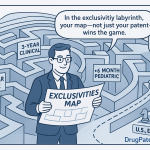
When valuing a pharma IP portfolio for M&A, licensing, or litigation finance purposes, the relevant metric is not the nominal patent expiration date but the effective commercial exclusivity date, which accounts for patent term adjustments (PTAs), patent term extensions (PTEs), regulatory exclusivity, and the likelihood of a successful Paragraph IV challenge. Analysts using discounted cash flow models need to probability-weight each of these variables. A composition of matter patent expiring in 2031 backed by a five-year NCE exclusivity running until 2028, a PTE adding 30 months, and pediatric exclusivity adding six months yields a very different exclusivity map than the nominal date suggests.
Key Takeaways
A patent’s commercial value is determined by its effective patent life post-approval, not its 20-year statutory term. Novelty and non-obviousness are the primary grounds on which generic challengers invalidate pharmaceutical patents in Paragraph IV litigation. IP valuation models must map every applicable exclusivity layer, including PTAs, PTEs, NCE exclusivity, and pediatric exclusivity, to compute an accurate loss-of-exclusivity (LOE) date.
Investment Strategy
When screening pharmaceutical companies for IP durability, prioritize those with staggered exclusivity profiles across multiple products. A company whose entire revenue base sits behind a single composition of matter patent with no secondary protection and an NCE exclusivity period already expired is approaching a binary event. Portfolio managers should short patent cliff exposure 18 to 24 months before the first anticipated generic entry date, not at the moment the FDA approves the generic.
Term 2: Regulatory Exclusivity — The FDA’s Separate Grant of Market Protection
Defining the Second Track
Regulatory exclusivity is independent of the patent system. The USPTO issues patents. The FDA issues exclusivity. A company can lose its patent, either through expiration, invalidation, or a covenant not to sue, and still block generic entry via regulatory exclusivity. Conversely, a patent that survives decades of litigation provides no commercial benefit once the FDA approves a competing generic after exclusivity expires. These two systems run concurrently, but neither is additive; the longer-running protection wins.
The FDA’s Orange Book records both patent listings and exclusivity grants, but they are mechanically distinct. A generic’s ANDA faces Orange Book-listed patents via the Paragraph IV certification process. Regulatory exclusivity, by contrast, is a direct statutory bar: during an active exclusivity period, the FDA simply cannot approve a competing ANDA or 505(b)(2) application, regardless of patent status.
New Chemical Entity Exclusivity: The Five-Year Fortress
NCE exclusivity applies when a drug contains an active moiety that has never before been approved by the FDA. It provides five years of protection during which the FDA cannot even accept an ANDA or 505(b)(2) application referencing the NCE’s data. There is one exception: a generic seeking Paragraph IV certification may file its ANDA one year early, at the four-year mark, triggering litigation one year sooner. This creates a strategic tension for brand companies. Filing a Paragraph IV one year early gives the generic a head start on the 30-month stay clock, potentially exposing the brand to earlier generic entry even if the litigation ultimately favors the innovator.
NCE exclusivity is particularly valuable for the first compound approved in a novel mechanism class. Before competitors file ANDAs, the brand has a clean five-year window in which the FDA itself acts as a gatekeeper. This is the most direct and certain form of market protection available, more reliable than a patent whose validity is always contestable.
Orphan Drug Exclusivity: Seven Years for Rare Disease Focus
Orphan drug exclusivity runs seven years from approval for drugs treating conditions affecting fewer than 200,000 U.S. patients. The FDA cannot approve the same drug for the same orphan indication during that window, even if the drug has no remaining patent coverage. For rare disease-focused companies, ODE is often the primary exclusivity pillar. Several monoclonal antibodies approved for rare hematologic conditions have traded at premium valuations driven almost entirely by their ODE runway.
One critical nuance: ODE is indication-specific. A second company can obtain approval for the same drug treating a different orphan condition. The exclusivity applies only to the approved indication. Companies that fail to protect subsequent indications with additional ODE filings create openings for competitors to occupy adjacent disease spaces using the same molecule.
New Clinical Investigation Exclusivity: Three Years for Incremental Data
Three-year exclusivity rewards companies for generating new clinical data. This applies when an NDA supplement or 505(b)(2) application requires new clinical investigations to support approval of a new indication, dosage form, dosing regimen, or route of administration. The three-year period protects only the new aspect that required the data; a generic can still reference the original approval data. This form of exclusivity is the primary engine of incremental product lifecycle management, providing the regulatory incentive to fund new indication trials.
Pediatric Exclusivity: Six Months, Maximum Leverage
Pediatric exclusivity is an add-on, not a standalone protection. The FDA issues a Written Request (WR) asking a company to conduct pediatric studies on a drug. If the company conducts the studies and submits the data, the FDA grants six additional months of market protection attached to all existing patents and exclusivities for that drug’s active moiety. Every listed patent, every regulatory exclusivity period, all of them extend by six months.
On a blockbuster generating $5 billion annually, six months of exclusivity is worth approximately $2.5 billion in gross revenue. The cost of a pediatric study package typically runs $10 to $50 million. The return-on-investment calculation is straightforward and explains why almost every major brand drug with an active WR pursues pediatric exclusivity aggressively.
Key Takeaways
Regulatory exclusivity and patent protection are legally independent. NCE exclusivity is the most reliable five-year market barrier available because it operates as a direct FDA statutory bar rather than a litigable patent right. Orphan drug exclusivity is indication-specific and must be pursued separately for each orphan condition. Pediatric exclusivity multiplies across all concurrent protections, making it one of the highest-ROI regulatory investments in the industry.
Investment Strategy
When analyzing a brand drug’s exclusivity profile, build a timeline that maps each patent expiration against each regulatory exclusivity expiration. The controlling LOE date is the latest date on which any protection (patent or exclusivity) expires for the lead indication. Drugs with stacked exclusivities, for example NCE exclusivity running to 2027, pediatric exclusivity extending to late 2027, and a PTE-extended composition of matter patent running to 2029, are insulated from generic entry for materially longer than any single protection implies.
Term 3: Composition of Matter Patent — The Crown Jewel and Its IP Valuation
What It Covers and Why Breadth Matters
A composition of matter patent claims the chemical or biological entity itself. For a small molecule, this is the specific molecular structure of the active pharmaceutical ingredient (API). For a biologic, it is the protein sequence or amino acid structure of the therapeutic antibody or protein. The protection extends to the molecule regardless of the application in which it is used, the formulation in which it is delivered, or the process by which it is manufactured.
This breadth is what makes the composition of matter patent the most commercially decisive IP asset a pharmaceutical company can hold. A competitor who wants to market any product containing that molecule, for any therapeutic indication, must either wait for the patent to expire, invalidate the patent, or license it. There is no design-around that preserves the identical active moiety.
The Patent Cliff Defined
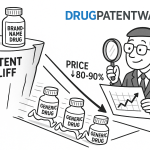
The expiration of the composition of matter patent is the patent cliff. When Lipitor’s atorvastatin composition of matter patent expired in November 2011, Pfizer’s U.S. atorvastatin revenue collapsed from approximately $5 billion annually to near zero within 12 months as generic atorvastatin captured market share at prices 80 to 90 percent below the brand. This dynamic repeats across every major small-molecule product that lacks durable secondary patent coverage or regulatory exclusivity to bridge the cliff.
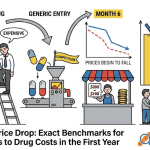
The cliff itself is not instantaneous. The rate of brand revenue erosion after generic entry depends on the number of generic entrants. The first generic, operating within its 180-day exclusivity window, may price at a 15 to 25 percent discount. Once the 180-day period ends and multiple generics enter, price erosion accelerates. By the time five or more generics are on the market, the brand typically retains less than 10 percent of its unit volume, though its higher price maintains some dollar share.
IP Valuation of Composition of Matter Patents
For M&A due diligence and licensing negotiations, the composition of matter patent carries the highest valuation weight of any patent in a drug’s portfolio. Analysts typically assign a probability-adjusted net present value (pNPV) to each patent, discounting cash flows by the probability that the patent survives litigation. Composition of matter patents issued with strong prosecution histories, narrow prior art, and validated clinical differentiation tend to carry survival probabilities of 60 to 80 percent in Paragraph IV litigation. Weak claims, those with crowded prior art or papers published by the inventors themselves close to the priority date, may carry survival probabilities below 40 percent.
The practical implication: in a Paragraph IV challenge targeting a composition of matter patent versus a formulation patent, the expected litigation outcome and the probability of generic entry differ materially. An IP valuation that treats all listed Orange Book patents as equally durable is analytically wrong.
The Role of Composition of Matter Patents in Licensing
When a drug company out-licenses a molecule to a partner for development in a specific indication, the composition of matter patent is typically what is being licensed. Royalty rates in pharma licensing agreements track directly to the patent coverage: a licensee paying a double-digit royalty on a molecule with a clean, high-quality composition of matter patent and 12 years of remaining term accepts that rate because the protection is real. A licensee negotiating on a molecule whose composition of matter patent has three years left and has already survived two Paragraph IV challenges is in a very different position.
Key Takeaways
The composition of matter patent is the single IP asset most directly tied to a drug’s revenue durability. Its expiration defines the patent cliff. IP valuations that fail to distinguish composition of matter patents from formulation or method-of-use patents are unreliable. Royalty rates and licensing economics track to composition of matter patent quality and remaining term.
Term 4: The Orange Book — How to Read the Battlefield Map
Structure and Purpose
The FDA’s publication, Approved Drug Products with Therapeutic Equivalence Evaluations, universally called the Orange Book, is not a static registry. It is the operative document connecting FDA drug approval to patent enforcement. Under the Hatch-Waxman framework, every patent that claims the approved drug product, the drug substance (API), or a method of using the approved drug is submitted by the NDA holder and listed in the Orange Book as a condition of ANDA-based competition.
The FDA updates the Orange Book daily. The annual print edition is a formality; the electronic database is what patent litigators, generic manufacturers, and competitive intelligence analysts track in real time. When a new patent is listed, every pending and previously approved generic ANDA for that reference listed drug (RLD) must address the new patent via a new certification. This creates an ongoing obligation, not a one-time clearance.
The Ministerial Role of the FDA and Its Strategic Consequences
The FDA does not verify the substantive accuracy of patent listings. It applies what courts have described as a purely ministerial role: if a patent holder submits a patent for listing that meets the facial statutory requirements, the FDA lists it. This design has two direct consequences.
Brand companies have a structural incentive to list every potentially applicable patent, including borderline cases, because a listed patent forces every generic filer to address it via certification. Even if the patent would not withstand a full invalidity analysis, its presence in the Orange Book guarantees that any generic entry will require either waiting for its expiration (Paragraph III) or filing a Paragraph IV challenge and potentially triggering a 30-month stay.
The second consequence is that the FDA’s ministerial role created a systemic problem with improper listings, which the courts ultimately had to address.
Teva v. Amneal: The Delisting Weapon and Its Antitrust Dimensions
In 2024, the U.S. Court of Appeals for the Federal Circuit issued a ruling in Teva v. Amneal that reshaped Orange Book practice. Teva had listed patents in the Orange Book for its ProAir HFA albuterol inhaler that claimed dose counter components of the device but did not claim the active ingredient, albuterol sulfate. The Federal Circuit held that a patent must claim at least the active ingredient, the drug product itself, or the approved method of using the drug to be properly listable. Device-only patents do not qualify.
The implications extend beyond this specific dispute. Generic manufacturers can now file counterclaims demanding delisting of improperly listed patents, and the FTC has signaled that abusive Orange Book listings carry antitrust exposure. A brand company that knowingly lists a device patent to trigger a 30-month stay it knows it is not entitled to faces potential Walker Process fraud liability and tortious interference claims. The Orange Book listing strategy that worked for two decades without meaningful pushback now requires a defensible legal basis, not just a plausible facial argument.
For IP teams at brand companies, the post-Teva environment demands a listing audit for every listed patent. For generic companies, delisting counterclaims are now a standard first-response tool, not an exotic procedural maneuver.
Reading Competitive Intelligence from the Orange Book
The Orange Book is the most direct window into a brand company’s defensive IP strategy. A drug with 12 patents listed covering formulations, methods of use, and device components around a molecule whose composition of matter patent expired two years ago is signaling an evergreening strategy. The density and nature of the listing tells the competitive story. Analysts who track Orange Book listings longitudinally can identify when a brand is adding new secondary patents, when a patent is approaching expiration without replacement, and when a generic company has filed an ANDA and made a Paragraph IV certification that has yet to trigger litigation.
Key Takeaways
The Orange Book is the legal architecture connecting patent law to drug competition. Its ministerial listing system creates strategic incentives that the Federal Circuit’s 2024 Teva ruling has begun to constrain. Delisting counterclaims are now a standard generic litigation tool. Patent listing audits are a non-optional compliance activity for brand companies operating post-Teva. The Orange Book is also the primary source for competitive patent expiration intelligence.
Term 5: The Hatch-Waxman Act — The Rules of Small-Molecule Competition
The 1984 Grand Bargain and Its Long-Run Effects
The Drug Price Competition and Patent Term Restoration Act of 1984 solved two problems simultaneously. Generic manufacturers could not afford to replicate full NDA clinical trial packages for molecules already proven safe and effective, so almost no generic drugs were commercially available. Simultaneously, innovator companies were watching patent life disappear during FDA review, eroding the commercial window they needed to recoup R&D costs.
Hatch-Waxman’s solution was structurally elegant. It gave generic companies the ANDA pathway, allowing them to substitute bioequivalence data for new clinical trials. It gave innovators patent term extensions and formalized NCE exclusivity. The mechanism that made the whole system work was the certification framework, which forced pre-commercial resolution of patent disputes rather than leaving the legal question open until a generic actually launched.
Forty years later, the market consequences are measurable. Generic drugs account for roughly 90 percent of U.S. prescription volume, generating savings estimated at over $300 billion annually compared to brand pricing. The ANDA pathway and the Paragraph IV mechanism are directly responsible for that market structure.
The ANDA Pathway: Bioequivalence as the Legal Standard
An ANDA relies on the reference listed drug’s (RLD) original safety and efficacy data. The generic applicant need only demonstrate pharmacokinetic bioequivalence: that its product is absorbed into the body at a rate and extent similar to the RLD, within an 80 to 125 percent confidence interval for AUC and Cmax in a crossover pharmacokinetic study under fasting and fed conditions. The FDA does not require the generic applicant to prove the drug works. That question was answered by the brand’s NDA. The Bolar safe harbor at 35 U.S.C. § 271(e)(1) permits all activities reasonably related to the development and submission of FDA applications before the relevant patent expires, meaning generic companies can conduct bioequivalence studies during the brand’s patent life without incurring infringement liability.
Patent Term Extension: Mechanics and Limits
Hatch-Waxman’s Patent Term Extension (PTE) allows a company to apply to the USPTO for extension of one patent per product to compensate for regulatory review time. The extension calculation is based on half of the IND phase plus the full NDA review period, capped at five years. The remaining patent life post-approval cannot exceed 14 years. Only one patent per product can receive a PTE, and only one PTE can be granted per regulatory review period. This single-patent limitation is often the most consequential strategic decision a company makes during NDA prosecution: choosing which patent receives the PTE determines which protection is longest-lived.
The Deliberate Design of Pre-Market Conflict
Hatch-Waxman did not accidentally create patent litigation. Its architects intended the certification framework to force patent disputes before generic launch. The “artificial act of infringement” created by ANDA filing with a Paragraph IV certification, the mandatory notice letter, the 45-day window to sue, and the automatic 30-month stay form a deliberately sequenced process that channels disputes into federal court before any product ships. This pre-commercial conflict resolution is what makes the U.S. generic entry timeline generally predictable. When the brand wins, the generic waits for patent expiration. When the generic wins, it enters on the litigation outcome date. The 180-day exclusivity is the incentive that drives the first filer to absorb the litigation cost.
Key Takeaways
Hatch-Waxman’s core architecture, ANDA bioequivalence in exchange for patent challenge litigation, is the mechanism that produced a 90 percent generic share of U.S. prescription volume. PTE grants cover one patent per product and are capped at five additional years with a 14-year post-approval ceiling. The 30-month automatic stay is a de facto preliminary injunction obtained by statute, not by meeting the legal elements required in ordinary patent litigation. Every element of the Hatch-Waxman system was designed to produce pre-market patent resolution.
Investment Strategy
For generic-focused companies, the strategic question before filing an ANDA is not whether a patent can be challenged but whether the expected litigation cost, duration, and probability of success, when probability-weighted against the 180-day exclusivity value, yields a positive expected return. For brand companies approaching the Hatch-Waxman litigation phase, the 30-month stay is the baseline defensive position. The question is whether secondary patents are strong enough to extend protection beyond the stay’s expiration.
Term 6: Paragraph IV Certification — The Formal Declaration of Patent War
What the Certification Means Legally
When a generic company files an ANDA, it must certify against every patent listed in the Orange Book for the reference drug. A Paragraph I certification states no relevant patent is listed. A Paragraph II certification states the relevant patent has expired. A Paragraph III certification states the company will not market until the patent expires. A Paragraph IV certification states the listed patent is either invalid, unenforceable, or will not be infringed by the proposed generic.
That Paragraph IV certification is, by statute, an act of patent infringement. Congress defined it as such to give the patent holder an immediate cause of action even though no product has been sold and no harm to market share has yet occurred. This legal fiction, the “artificial act of infringement,” is the mechanism that brings the case into federal court immediately upon ANDA filing, rather than waiting for the generic to actually launch.
The Notice Letter: The Starting Gun
Within 20 days of the FDA notifying the generic that its ANDA is substantially complete, the generic must send a detailed notice letter to every NDA holder and patent owner for each Paragraph IV-certified patent. The notice letter is not a perfunctory formality. It must provide a detailed statement of the factual and legal bases for the Paragraph IV certification, a claim-by-claim analysis of why each claim is invalid or not infringed. The adequacy of this notice letter has itself been litigated; an inadequate letter can fail to trigger the 30-month stay clock, which is a significant tactical risk for the brand and a strategic opportunity for the generic to reset timelines.
The 30-Month Automatic Stay: Mechanics and Strategic Weight
If the patent holder files a patent infringement suit within 45 days of receiving a valid notice letter, the FDA is automatically prohibited from granting final ANDA approval for 30 months from the date of the notice letter. This stay requires no judicial finding. The brand does not have to show likelihood of success on the merits, irreparable harm, or any of the other preliminary injunction factors required under eBay Inc. v. MercExchange. The statute grants the stay automatically, converting every timely-filed Hatch-Waxman lawsuit into a guaranteed 30-month blocking period.
The asymmetry of this protection is significant. A brand company with a weak patent it knows may not survive litigation still receives 30 months of monopoly protection by suing within the 45-day window. This economic reality shapes settlement dynamics: even if the generic believes it will win at trial, losing two and a half years of exclusivity by continuing to litigate rather than settling early is a material consideration. Many pay-for-delay settlements, which the FTC has characterized as anticompetitive under the Supreme Court’s FTC v. Actavis standard, reflect exactly this dynamic.
Filing Strategy: Which Patents to Assert
Brand companies asserting multiple patents in Hatch-Waxman litigation must make case-by-case decisions about which patents to assert. Asserting every listed patent maximizes the number of invalidity and non-infringement issues the generic must address but also increases litigation complexity and the risk that at least one patent is found invalid or not infringed on procedural grounds. A focused assertion strategy that leads with the strongest patents, typically the composition of matter patent and the most clinically relevant method-of-use patent, tends to produce more defensible litigation postures and cleaner settlement negotiations.
Key Takeaways
The Paragraph IV certification is a statutory act of infringement designed to force pre-market litigation. The adequacy of the notice letter is litigated and has real procedural consequences. The 30-month automatic stay is a statutory preliminary injunction that requires no judicial threshold showing. Settlement economics are heavily influenced by the stay’s value to the brand and the 180-day exclusivity value to the first-filer generic.
Term 7: 180-Day Exclusivity — The Jackpot and Its Dilution
The Economics of First-Filer Status
The 180-day exclusivity period is the primary economic incentive for generic manufacturers to file Paragraph IV challenges against on-patent drugs. The first ANDA applicant to file a substantially complete application with a Paragraph IV certification against at least one listed patent earns an exclusive 180-day window during which the FDA cannot approve any subsequent ANDAs for the same drug. This window creates a temporary duopoly: the brand and one generic.
During those 180 days, the first-filer typically prices at a 15 to 25 percent discount to the brand. Brand insurers and pharmacy benefit managers respond by shifting formulary tier status to incentivize generic substitution, driving rapid market share gains without the catastrophic price erosion that occurs when five or more generics compete simultaneously. The financial returns can be substantial. For a drug generating $3 billion in annual U.S. sales, a 50 percent market share gain at a 20 percent discount during 180 days generates approximately $700 million in gross revenue. Studies of Paragraph IV challenge economics estimate average 180-day exclusivity values in the $60 to $200 million range, with outliers for major blockbusters reaching into the billions.
The Authorized Generic: The Brand’s Counter-Move
The authorized generic (AG) is the brand’s most powerful tool for degrading the value of the first-filer’s 180-day exclusivity. An authorized generic is the brand drug, sold under a generic label, distributed by a generic manufacturer under license from the NDA holder or directly by the brand’s own generics subsidiary. Because it launches under the existing NDA rather than a new ANDA, the AG does not require separate FDA approval and is not subject to the 180-day exclusivity restriction.
When an AG enters during the first-filer’s exclusivity window, the duopoly becomes a three-way market: brand, first-filer generic, and AG. This market structure drives faster price erosion, often forcing the first-filer to price at 30 to 40 percent below brand rather than 15 to 25 percent. Studies estimate that AG entry cuts the first-filer’s exclusivity revenue by 40 to 60 percent. The mere threat of an AG, credibly communicated during settlement negotiations, is a powerful lever for brand companies negotiating Paragraph IV settlements, because it reduces the litigation risk-adjusted value of the first-filer’s position materially.
Forfeiture: The Hidden Risk for First Filers
First-filer status can be forfeited. The ANDA applicant loses its 180-day exclusivity if it fails to market within 75 days of certain triggering events, including a final court decision finding the patent invalid or not infringed, a settlement that permits generic entry before patent expiration, or the patent’s expiration. Failure-to-market forfeiture is a real operational risk: a first-filer that wins litigation but fails to have commercial product ready within 75 days of the triggering court decision loses its exclusivity without compensation. This is why generic manufacturers who win Paragraph IV litigation invest heavily in manufacturing scale-up and supply chain readiness in parallel with the litigation.
Stacking Strategies: Multiple First-Filers
The “first filer” designation can sometimes be shared by multiple generic companies if they file on the same day. In that case, all same-day filers share the 180-day exclusivity, and the window does not begin until all of them are ready to market or until a triggering event occurs. Shared exclusivity arrangements reduce each individual company’s expected return but allow smaller generics to participate in blockbuster challenges without the full capital risk of a solo filing.
Key Takeaways
The 180-day exclusivity creates a duopoly structure that generates materially higher margins than post-exclusivity multi-generic competition. Authorized generic entry during the exclusivity window destroys its financial logic. Forfeiture provisions impose an operational readiness obligation that must be planned for in parallel with litigation. Shared first-filer arrangements reduce individual returns but lower the barrier to challenging major brands.
Investment Strategy
Generic manufacturers targeting Paragraph IV challenges should model three scenarios: no AG, AG entering at day 1 of exclusivity, and AG entering at day 91. Probability-weighting these scenarios against the cost of bioequivalence studies, patent litigation, and commercial launch readiness produces an expected value for the challenge. Drugs where the brand has historically launched AGs in prior Paragraph IV contests deserve a heavier AG probability weighting.
Term 8: The BPCIA — Biologics Get a Separate Legal Universe
Why Small-Molecule Law Cannot Govern Biologics
A small-molecule drug like atorvastatin has a molecular weight under 1,000 daltons and a defined, reproducible chemical structure. A biosimilar manufacturer can demonstrate that its copy is chemically identical to the reference drug using standard analytical techniques. Bioequivalence testing then confirms that the two behave identically in vivo. The entire Hatch-Waxman system is built on this scientific premise.
Biologics break this premise. Adalimumab, the active ingredient in Humira, has a molecular weight of approximately 148,000 daltons and a complex three-dimensional structure that includes glycosylation patterns determined by the specific cell line, culture conditions, and purification process used in manufacturing. Two companies using different cell lines to express the same amino acid sequence will produce products with different glycan profiles. “Identical” biologics do not exist; even sequential manufacturing batches from the same facility exhibit some variation. This scientific reality required a new legal framework.
BPCIA Architecture: Data Exclusivity, Biosimilar Pathway, and the No-Orange-Book Problem
The Biologics Price Competition and Innovation Act of 2010 created the 351(k) abbreviated licensure pathway for biosimilars. To earn approval as a biosimilar, an applicant must demonstrate through a “totality of the evidence” approach that its product is “highly similar” to the reference biologic and has “no clinically meaningful differences” in safety, purity, and potency. This standard requires extensive analytical characterization, preclinical data, and often at least one clinical pharmacokinetic or pharmacodynamic study. Unlike the ANDA bioequivalence standard, it is not a binary pass/fail but a scientific argument built from multiple evidence streams.
The BPCIA provides 12 years of data exclusivity from the date of first FDA licensure for the reference product. This is substantially more generous than the five-year NCE exclusivity for small molecules, reflecting the higher cost and complexity of biologic development, and the fact that a biosimilar cannot replicate the reference product exactly regardless of how sophisticated its analytical characterization becomes.
Crucially, the BPCIA did not create a public patent registry equivalent to the Orange Book. Patent disputes between reference product sponsors (RPS) and biosimilar applicants are managed through a private, structured information exchange called the patent dance.
IP Valuation: Twelve-Year Exclusivity as a Valuation Anchor
For biotech companies built around a single reference biologic, the 12-year data exclusivity is the primary valuation anchor. A monoclonal antibody approved in 2022 has a data exclusivity runway extending to 2034. Portfolio managers valuing that asset need to project biosimilar entry starting in 2034, then probability-weight the timeline based on the RPS’s patent estate, the number of biosimilar programs in development, and the FDA’s approval pace for that molecular class.
Unlike small-molecule patent expirations, which can be predicted with reasonable precision from Orange Book data, the biologic LOE date is a compound estimate that must account for the 12-year exclusivity floor, patent litigation outcomes, and the historically slow pace of biosimilar market penetration in the U.S.
Key Takeaways
Biologics and biosimilars operate under the BPCIA, not Hatch-Waxman. Biosimilar approval requires demonstrating “highly similar” characteristics across multiple evidence streams, not just bioequivalence. The 12-year data exclusivity is the primary market protection for reference biologics. There is no Orange Book for biologics; patent disputes use the patent dance mechanism.
Term 9: Biosimilar Interchangeability — The FDA’s 2024 Policy Reversal
The Two-Tiered System and Its Commercial Consequences
The BPCIA created two distinct approval categories for follow-on biologics. A biosimilar met the “highly similar, no clinically meaningful differences” standard. An interchangeable biosimilar met an additional requirement: it must be expected to produce the same clinical result in any given patient, and for multi-dose products, switching between the reference product and the biosimilar must not present greater risk than staying on the reference product.
The commercial consequence of interchangeability was pharmacy-level substitution. An interchangeable biosimilar could be dispensed by a pharmacist without prescriber approval, subject to state pharmacy laws. Standard biosimilars required prescriber intervention for substitution. This distinction created a significant market access advantage for interchangeable products and, until 2024, was the basis for a two-tiered biosimilar market with very different reimbursement and formulary placement dynamics.
Achieving interchangeability historically required dedicated switching studies, clinical trials in which patients were alternated between the reference product and the biosimilar to generate the additional data the FDA required. These studies added cost, time, and complexity to the development pathway, and the number of biosimilars that achieved interchangeable designation remained relatively small compared to the total biosimilar approvals.
The June 2024 FDA Guidance: Collapsing the Two Tiers
In June 2024, the FDA issued draft guidance signaling that dedicated switching studies will generally no longer be required to support an interchangeability designation. The agency’s position, based on approximately a decade of biosimilar approval data and real-world evidence, is that the risk of switching between a biosimilar and its reference product is not meaningful for most product classes and does not require dedicated switching trial data to establish.
This policy shift has structural consequences for the biosimilar market. When interchangeability is achievable without switching study investment, most biosimilar developers will pursue it as a standard label feature rather than a premium differentiator. As the designation becomes near-universal, it ceases to be a competitive advantage in formulary negotiations. The basis for competition in the biosimilar market will then shift almost entirely to manufacturing cost, supply reliability, net pricing after rebates, and payer contracting strategy, mirroring the dynamics that define the mature small-molecule generic market.
For reference product sponsors, the 2024 guidance accelerates the effective competitive threat from biosimilar entry. A biosimilar that can achieve interchangeable status without a multi-year switching study program will reach market faster and penetrate the pharmacy substitution channel more rapidly. This compresses the effective commercial exclusivity runway even within the 12-year data exclusivity window, because market penetration builds more quickly once substitution at the pharmacy counter is operationally identical to the small-molecule generic experience.
Key Takeaways
The FDA’s 2024 guidance eliminating the switching study requirement for interchangeability will effectively collapse the two-tier biosimilar market over the next several years. Interchangeability will shift from competitive differentiator to baseline label feature. Competition in the biosimilar market will migrate toward price, supply chain, and payer contracting. Reference product sponsors face faster market penetration by biosimilars post-LOE than historical penetration rates would imply.
Term 10: The Patent Dance — Structured Information Exchange as Pre-Litigation Strategy
Why the Dance Exists
Because no Orange Book equivalent exists for biologics, the BPCIA created a private, structured mechanism for biosimilar applicants and reference product sponsors to exchange patent information and tee up disputes before market entry. Courts and practitioners nicknamed this process the “patent dance,” though the statute’s actual requirements are precise and the strategic stakes are substantial.
The dance is a sequential exchange of confidential documents that progressively narrows the universe of patent disputes requiring pre-launch resolution. Its structure reflects a policy goal of avoiding the situation that would otherwise occur without a centralized patent registry: a biosimilar launch followed by immediate patent litigation on dozens of patents, with the legal outcome uncertain and the commercial impact of any injunction catastrophic.
The Sequence of the Dance
Within 20 days of FDA acceptance of its 351(k) application, the biosimilar applicant provides the reference product sponsor with a copy of the application and detailed manufacturing process information. The RPS then has 60 days to produce its list of patents it believes could reasonably be asserted. The applicant responds within 60 days with a claim-by-claim analysis of why each patent is invalid, unenforceable, or not infringed. The RPS then provides a detailed rebuttal within 60 days. Following that exchange, the parties have 15 days to negotiate a list of patents for the first wave of litigation. If they cannot agree, the statute provides a formula for determining which patents are in the first wave. The RPS files the initial lawsuit within 30 days of that list being finalized.
Patents identified during the dance but not litigated in the first wave can be litigated in a second wave triggered by the biosimilar’s 180-day commercial marketing notice.
The Opt-Out Decision: Amgen v. Sandoz
The Supreme Court’s 2017 decision in Amgen v. Sandoz established that the patent dance is not mandatory. A biosimilar applicant can opt out of providing its application and manufacturing information. The tradeoff is loss of control over the scope of the first-wave litigation: without the dance’s information exchange narrowing the dispute, the RPS can sue on any patent in its portfolio immediately. The applicant also loses certain statutory protections against damages.
For biosimilar developers with manufacturing processes they regard as trade secrets, the opt-out creates a genuine tension. The dance requires disclosing detailed manufacturing information to a direct competitor under a confidentiality framework. If that information is relevant to a trade secret dispute years later, its early disclosure may weaken the applicant’s position. These strategic considerations must be weighed against the loss of procedural control that comes with opting out.
Key Takeaways
The patent dance is a structured pre-litigation process that replaces the Orange Book patent linkage system for biologics. It is optional under Amgen v. Sandoz, but opting out shifts first-wave litigation control to the RPS. Participation in the dance requires disclosing manufacturing process details that biosimilar developers may regard as competitively sensitive. The strategic decision of whether to dance, and how to engage at each step, requires coordination between IP counsel, regulatory affairs, and commercial strategy teams.
Term 11: Evergreening — The Complete Lifecycle Management Playbook
Defining Evergreening Beyond the Pejorative
Evergreening describes any strategy by which an innovator company obtains new IP protections or regulatory exclusivities that extend a drug’s commercial exclusivity past the expiration of its original composition of matter patent. The term carries a normative charge in most popular usage, implying abuse of the patent system. The technical reality is more nuanced: some evergreening strategies represent genuine scientific and clinical advances; others are incremental modifications that offer minimal patient benefit and exist primarily as competitive barriers.
IP teams, portfolio managers, and R&D leads need to evaluate evergreening strategies on their specific merits, because the legal durability, regulatory success rate, and commercial payoff vary substantially across different tactics.
Formulation Patents: The Extended-Release Playbook
New formulation patents cover changes to how a drug is delivered: extended-release tablets, abuse-deterrent formulations, transdermal delivery systems, or oral solutions of drugs previously available only by injection. AstraZeneca’s Nexium strategy, converting omeprazole to the single-enantiomer esomeprazole, is the textbook chiral switch. Purdue Pharma’s abuse-deterrent OxyContin reformulation is a case study in formulation patent strategy combined with regulatory withdrawal of the original product to prevent generic substitution.
Formulation patents are the most common evergreening tool and the most commonly challenged in Paragraph IV litigation. Their vulnerability lies in non-obviousness: if a PHOSITA would have found the modification obvious in light of the prior art, the patent fails. The Patent Trial and Appeal Board (PTAB), through inter partes review (IPR) proceedings, has developed a track record of invalidating formulation patents at higher rates than composition of matter patents. Generic manufacturers use IPR as a parallel track to ANDA litigation, invalidating secondary patents without requiring full district court litigation.
Method-of-Use Patents: The Indication Expansion Strategy
Method-of-use patents claim the use of a drug for a specific therapeutic purpose. They allow a brand company to patent new clinical findings about its existing molecule. If a drug approved for rheumatoid arthritis is found through additional trials to be effective in ankylosing spondylitis, a new method-of-use patent on the ankylosing spondylitis indication can extend IP protection for that specific use.
The critical limitation is that method-of-use patents can only be asserted against generics that specifically label their product for the patented indication. A generic ANDA with a “skinny label” that omits the patented indication, known as a section viii carve-out, is not infringing the method-of-use patent even if physicians prescribe the generic for that indication off-label. The validity of skinny label carve-outs was tested in GlaxoSmithKline v. Teva, where the Federal Circuit found Teva liable for induced infringement based on its marketing despite the carve-out. That decision was subsequently reheard and reconsidered, leaving the law in a state of tension that practitioners continue to navigate.
Polymorph Patents: Crystal Form Protections
Polymorphs are different solid-state crystalline arrangements of the same API. Different polymorphic forms can have different solubility, stability, and bioavailability properties. A company that identifies and patents a superior polymorph, one that is more stable or more bioavailable than the originally approved form, creates a legal barrier for generic manufacturers who must typically use the approved crystalline form. If the patented polymorph is the approved form, any generic referencing the approved product would be using the patented structure.
The patentability of polymorphs varies by jurisdiction. India’s Section 3(d), at issue in the landmark Novartis v. Union of India case, explicitly bars patents on new forms of known substances unless they demonstrate enhanced efficacy, not just improved solubility or bioavailability. The Indian Supreme Court rejected Novartis’s patent on the beta crystalline form of imatinib (Gleevec) in 2013 on this basis, establishing a “patient benefit” test that several other jurisdictions have since considered. For global IP strategies, the enforceability of polymorph patents must be evaluated country by country.
Product Hopping: Hard and Soft Switches
Product hopping is the practice of transitioning the market from an older, soon-to-be-genericized product to a newer, still-patent-protected version. A hard switch involves withdrawing the original product from the market or from formulary coverage before generics enter, eliminating the substitutable brand against which generics would compete. A soft switch involves aggressive marketing of the new product and promotion incentives to prescribers to shift patient volumes voluntarily.
Product hopping has attracted antitrust scrutiny in several contexts. In Abbott Laboratories v. Teva Pharmaceuticals (the TriCor litigation), a court found that Abbott’s pattern of hard switching from one formulation to another specifically to defeat generic substitution was a potential antitrust violation. Biologic product hopping, moving from an originator biologic to a next-generation molecule with enhanced clinical data, is generally on firmer legal ground because it involves genuine clinical differentiation requiring years of development investment.
The Novartis/Section 3(d) Standard as a Global Benchmark
The Novartis v. Union of India decision established what practitioners call the “enhanced efficacy” or “patient benefit” test. The Indian Supreme Court held that an improved crystalline form only deserves patent protection if it demonstrates enhanced therapeutic efficacy, not merely improved physical or chemical properties. While Section 3(d) is specific to Indian patent law, its analytical framework, asking whether the modification provides a demonstrable patient benefit rather than just incremental chemical novelty, has influenced regulatory and legislative debates globally. The European Patent Office applies a similar, though not identical, analysis through its “technical effect” requirement for claims directed at new forms of known substances.
For R&D leads and patent counsel evaluating whether a lifecycle management innovation deserves filing, this patient-benefit test is the correct strategic lens. Modifications that fail it are legally vulnerable in multiple jurisdictions and provide weaker ROI than modifications with clear clinical differentiation.
IP Valuation of Secondary Patents
Secondary patents, formulation, method-of-use, polymorph, and device patents, trade at a discount to composition of matter patents in IP valuation models because their validity risk is higher and their enforcement reach is narrower. A standard approach assigns each patent a probability of survival in Paragraph IV litigation, derived from prosecution history, prior art landscape, and litigation track record for the specific patent examiner art unit. Typical survival probabilities for secondary patents range from 30 to 55 percent in district court litigation, lower than the 60 to 80 percent range for high-quality composition of matter patents. IPR invalidation risk adds an additional overlay: since the Patent Trial and Appeal Board instituted IPR in 2012, secondary patents have faced institution rates and final written decision invalidation rates substantially higher than composition of matter patents.
Key Takeaways
Evergreening encompasses a range of tactics with materially different legal durability, regulatory success rates, and commercial outcomes. Formulation and polymorph patents face higher IPR invalidation risk than composition of matter patents. Method-of-use patents are partially circumvented by skinny-label ANDA carve-outs. Product hopping attracts antitrust scrutiny when structured to defeat rather than complement generic entry. The global enforceability of secondary patents must be evaluated jurisdiction by jurisdiction. IP valuation models should discount secondary patents relative to composition of matter patents based on their higher litigation vulnerability.
Investment Strategy
When assessing the durability of a brand drug’s IP franchise post-composition-of-matter-patent expiration, examine the secondary patent portfolio not just by count but by type and quality. A drug with 15 formulation patents all on the same release mechanism is less protected than one with a formulation patent, a validated method-of-use patent on its primary indication, and an abuse-deterrent patent backed by an FDA-mandated REMS. Count the layers, not just the patents.
Term 12: Patent Thicket — Building the Impenetrable Fortress
What a Thicket Actually Is
A patent thicket is a dense cluster of overlapping patents surrounding a single commercial product, designed to make the cost and complexity of clearing a path to market prohibitively expensive for competitors. The individual patents in a thicket need not be strong. Many are narrow, incremental, or of borderline patentability. The thicket’s power is not legal; it is economic. A biosimilar or generic developer facing 130 listed patents must evaluate each one, decide which to challenge, and litigate each challenge to conclusion, or risk launching at-risk with potential liability for infringement of any unchallenged patent.
Litigation cost per patent in a complex pharmaceutical dispute runs from $5 to $25 million through trial. A thicket of 50 patents imposes a potential litigation burden of $250 million to $1.25 billion to clear fully. That number alone deters entry regardless of the underlying legal merit of any individual patent.
AbbVie’s Humira: The Archetypal Case Study
AbbVie’s Humira (adalimumab) is the reference case study for biologic patent thicket strategy. AbbVie filed over 247 patent applications on adalimumab in the United States, securing more than 130 granted patents covering the antibody’s formulations, manufacturing methods, dosing regimens, delivery devices, and clinical applications. The composition of matter patent on adalimumab itself expired years before AbbVie’s U.S. market exclusivity effectively ended.
Biosimilar adalimumab launched in Europe in October 2018, where AbbVie had substantially fewer patents. The U.S. market remained Humira-exclusive until January 2023, when AbbVie’s settlement agreements with multiple biosimilar developers allowed staggered U.S. entry. The five-year gap between European and U.S. biosimilar entry is a direct measure of the thicket’s commercial effect, estimated to have cost the U.S. healthcare system more than $19 billion in foregone savings.
Antitrust plaintiffs challenged the thicket as an illegal monopolization scheme. The U.S. Court of Appeals for the Seventh Circuit dismissed those claims in 2022, reasoning that patent law imposes no limit on the number of patents an inventor may obtain for legitimately patentable inventions, and that the accumulation of legitimately obtained patents does not by itself constitute antitrust liability absent fraud on the patent office or other independent anticompetitive conduct.
The FTC’s Evolving Position
The Federal Trade Commission has signaled a more aggressive posture toward patent thickets than the Seventh Circuit’s 2022 Humira decision might suggest. The FTC’s 2023 report on pharmaceutical patent thickets documented systematic patterns of late-filing secondary patents, identified specific product families where the thicket appears constructed specifically to delay biosimilar competition, and recommended legislative action. Executive Order 14036 directed the FTC to consider using its existing unfair competition authority to challenge abusive patent thickets. The agency’s current leadership has made pharmaceutical patent reform a stated enforcement priority.
The legislative landscape is also shifting. The Affordable Prescriptions for Americans Act, versions of which have been introduced in multiple Congresses, would limit the number of patents a brand company can list in the Orange Book or assert in Hatch-Waxman litigation, though its biologic applicability and legislative prospects remain uncertain. IP teams at biologic manufacturers building thicket strategies must monitor both the antitrust enforcement environment and the legislative calendar.
IP Valuation of Patent Thickets
For acquirers valuing a biologic product with a dense secondary patent estate, the thicket’s value is properly understood as a deterrence asset with a finite useful life. It deters biosimilar entry by imposing litigation cost but does not legally prevent entry the way a composition of matter patent does. As biosimilar developers become more sophisticated, as litigation funders make capital available to biosimilar challengers, and as FTC scrutiny increases, the effective deterrent life of a thicket contract. A 2019 thicket was likely worth more in deterrent value than the same thicket in 2025, because the legal, regulatory, and financial environment for biosimilar entry has improved materially over that period.
M&A due diligence on biologic acquirees should assess the thicket not just by patent count but by the quality distribution of the underlying claims, the filing timeline of secondary patents relative to the composition of matter patent expiration (late-filing patterns attract more antitrust scrutiny), and the current biosimilar development pipeline for the reference product.
Key Takeaways
A patent thicket’s commercial power is economic deterrence, not legal certainty. Individual patents within a thicket may be individually weak; their power is in aggregate litigation cost. AbbVie’s Humira thicket is the benchmark case study, responsible for a five-year U.S. biosimilar entry delay. The Seventh Circuit’s 2022 ruling protects legitimately obtained thickets from antitrust liability, but FTC enforcement posture and legislative activity create ongoing uncertainty. Thicket value in M&A valuations should be time-discounted to reflect a deteriorating deterrence environment.
Investment Strategy
Institutional investors in biologic-focused companies should model thicket durability as a declining asset. Use the European biosimilar launch date as the baseline: if biosimilars are already competing in Europe, U.S. entry is a timing question, not an if question. Probability-weight U.S. biosimilar entry dates by assessing the number of FDA-approved U.S. biosimilar applications for the reference product, the settlement terms from prior biologic Paragraph IV disputes, and the FTC’s enforcement calendar.
Term 13: Patent Term Extension — Recovering Lost Patent Life
Mechanics of the PTE Calculation
A Patent Term Extension compensates for patent life lost during FDA regulatory review under 35 U.S.C. § 156. The calculation uses two components: half of the time spent in IND clinical testing, measured from IND effectiveness to NDA/BLA submission, and all of the time spent in FDA regulatory review, measured from submission to approval. The resulting extension is capped at five years. Post-PTE, the remaining patent life cannot exceed 14 years from the date of FDA approval.
Only one patent per regulatory review period qualifies for PTE, and the patent must claim the approved product or its method of use. The choice of which patent receives the PTE is permanent, which makes the selection decision one of the highest-stakes prosecution management choices in a drug’s development lifecycle. The optimal choice is typically the patent with the latest expiration date that still has room to benefit from the extension within the 14-year cap.
The Strategic Selection Problem
Selecting the wrong patent for PTE is a permanent, irreversible error. A company that applies a PTE to a formulation patent expiring in 2030 when its composition of matter patent expires in 2033 has wasted the extension on the shorter-lived asset. The composition of matter patent, which would have provided broader and more legally defensible protection, receives no extension.
In practice, PTE selection involves modeling the expected commercial contribution of each eligible patent under both the extended and unextended scenarios, then selecting the patent whose extension generates the highest risk-adjusted NPV contribution. For drugs with dense secondary patent portfolios, this can be a complex multi-variable optimization.
Key Takeaways
The PTE is a one-time, permanent election covering one patent per regulatory review period. The calculation combines half the IND phase time and the full NDA review period, capped at five years, with a 14-year post-approval limit. Selecting the wrong patent for PTE is an irreversible commercial error. Pediatric exclusivity adds six months on top of any PTE-extended patent term.
Term 14: Inter Partes Review — PTAB as the Generic’s Second Front
IPR as a Parallel Challenge Track
Inter partes review, created by the America Invents Act of 2011, allows any party to petition the Patent Trial and Appeal Board to review the validity of a granted patent based on prior art patents and printed publications. For generic manufacturers, IPR is a parallel track to Paragraph IV district court litigation, and often a more efficient one.
The PTAB applies a lower burden of proof for invalidity than district courts: the petitioner must show invalidity by preponderance of the evidence (more likely than not), compared to the district court’s clear and convincing evidence standard. Institution rates for pharmaceutical IPR petitions have historically run at 60 to 70 percent, meaning most petitions survive the threshold review. Among petitions that are instituted and reach a final written decision, approximately 75 percent result in at least one claim being found unpatentable.
For brand companies, IPR creates a multi-front war. A generic company can challenge a patent in both ANDA litigation (district court) and IPR simultaneously. If the PTAB invalidates the patent, the district court litigation typically becomes moot. The brand company loses the 30-month stay’s protective value because the underlying patent is gone. Brand companies have increasingly used IPR estoppel arguments and discretionary denial requests to push back on this parallel-challenge strategy, with mixed results.
Key Takeaways
IPR allows any party to challenge patent validity on prior art grounds at the PTAB under a preponderance of evidence standard. High institution and invalidation rates make IPR a cost-effective route for generic manufacturers to eliminate secondary patents without full district court litigation. The parallel IPR and Hatch-Waxman litigation track is now standard practice in pharmaceutical patent challenges. Brand companies must actively monitor IPR filings against their portfolios and engage PTAB proceedings with the same strategic seriousness as district court litigation.
Term 15: Pay-for-Delay Settlements (Reverse Payments) — The FTC v. Actavis Standard
The Economics of Reverse Payments
In standard Paragraph IV litigation, the first-filer generic challenges the brand’s patents, and the parties may settle on terms that allow the generic to enter before the patent’s expiration in exchange for dropping the invalidity challenge. When the settlement terms include a payment from the brand to the generic, in cash, in the form of a no-AG commitment, or as a supply agreement at above-market prices, the payment flows in the “reverse” direction from the typical plaintiff-to-defendant settlement direction. These are called reverse payments or pay-for-delay settlements.
The economic logic is straightforward. The brand pays the generic to not compete. The settlement value to the brand is the stream of monopoly profits it preserves during the delay period. The settlement value to the generic is the payment received, which may or may not exceed the expected value of continued litigation. The consumer harm is the foregone price reduction from generic entry.
FTC v. Actavis: The Antitrust Standard
The Supreme Court’s 2013 decision in FTC v. Actavis held that reverse payment settlements are subject to antitrust scrutiny under the rule of reason. The Court rejected the brand industry’s argument that any settlement within the patent’s scope was per se legal because the brand was only exercising its right to exclude. Instead, the Court held that a large, unexplained reverse payment is itself evidence of anticompetitive harm, because it suggests the brand is paying to avoid the risk of the patent being invalidated.
Post-Actavis, reverse payments remain legal, but they carry antitrust litigation risk that must be built into settlement valuation. The size of the payment relative to the expected litigation costs is the key variable: a settlement that pays the generic only its expected litigation costs is defensible; one that pays the generic a multiple of those costs, effectively sharing monopoly profits to buy silence, draws FTC scrutiny.
Key Takeaways
Reverse payment settlements are subject to rule-of-reason antitrust analysis under FTC v. Actavis. Large, unexplained payments from brand to generic are prima facie evidence of anticompetitive harm. Post-settlement legal risk must be factored into the settlement calculus. Non-AG commitments and above-market supply agreements are treated as value transfers equivalent to cash payments for Actavis purposes.
Term 16: Skinny Labels and Section viii Carve-Outs
The Mechanism
When a brand drug has multiple approved indications but only one or some are covered by Orange Book-listed method-of-use patents, a generic ANDA applicant can file a section viii statement rather than a Paragraph IV certification for those method-of-use patents. The section viii statement says: we are not seeking approval for the patented indication and we will carve that indication out of our labeling. This allows the generic to launch for the non-patented indications without triggering method-of-use patent litigation.
The carve-out label is called a “skinny label” because it is truncated relative to the brand’s full label. Physicians who prescribe the generic for the carved-out indication do so off-label, which is legal medical practice that does not ordinarily expose the prescribing physician or pharmacist to liability.
GlaxoSmithKline v. Teva and the Induced Infringement Risk
The Federal Circuit’s initial 2020 panel decision in GlaxoSmithKline v. Teva created significant uncertainty about the safety of skinny labels. The court found Teva liable for induced infringement of GSK’s method-of-use patents for carvedilol in heart failure, despite Teva’s section viii carve-out of the patented indication. The court’s reasoning focused on Teva’s promotional materials, which allegedly encouraged physicians to use carvedilol for heart failure, the very indication carved out of the label.
A subsequent 2021 Federal Circuit panel decision reheard the case and came to a different conclusion, but the legal question of when a generic manufacturer’s marketing conduct creates induced infringement liability even with a skinny label remains contested. IP teams at generic companies must ensure that promotional and medical affairs materials for skinny-label products are scrubbed for any content that could be construed as encouraging the carved-out indication.
Key Takeaways
Section viii carve-outs allow generic manufacturers to launch for non-patented indications without triggering method-of-use patent litigation. The skinny label is legally valid as a strategy for navigating multi-indication drugs with partial patent coverage. GlaxoSmithKline v. Teva introduced induced infringement risk for generic promotional conduct even with a proper carve-out. Generic IP and commercial teams must coordinate labeling and marketing strategy to minimize that risk.
Term 17: Patent Linkage in Non-U.S. Markets
Variability Across Jurisdictions
The U.S. Hatch-Waxman patent linkage system, where generic approval is directly tied to patent status, has no single global equivalent. Each jurisdiction has its own approach, and the strategic implications vary substantially. For companies operating global portfolios, understanding these differences is critical to forecasting LOE timing by country.
Canada has a patent linkage system broadly similar to Hatch-Waxman. The Patented Medicines (Notice of Compliance) Regulations require generic applicants to address listed patents and allow brand companies to seek 24-month stays pending litigation. The EU has no patent linkage system at all. European generic approvals are purely scientific assessments of bioequivalence; patent disputes are handled separately through national court systems and do not affect the regulatory timeline. A European generic can receive marketing authorization while the reference drug’s patents are in force and launch the moment the relevant patents expire or are invalidated.
In the EU context, this means brand companies cannot use regulatory delay as a patent enforcement tool. The patent must be enforced directly, country by country, in national courts. This is one reason the EU biosimilar market penetrated significantly faster than the U.S. market, even for products like Humira where the brand had substantial patent portfolios.
India, as discussed in the evergreening section, applies Section 3(d) as a substantive patentability filter for secondary pharmaceutical patents that many other jurisdictions do not employ. Brazil and China have their own compulsory licensing frameworks that create different IP risk profiles in those markets.
Key Takeaways
Patent linkage is a U.S. and Canadian regulatory feature, not a global standard. The EU has no patent linkage; generic approval and patent enforcement are entirely separate processes. India’s Section 3(d) bars secondary patents on new forms without demonstrated enhanced efficacy. Global IP strategies must be built jurisdiction by jurisdiction, accounting for local patentability standards, linkage rules, and compulsory licensing frameworks.
Term 18: Loss of Exclusivity (LOE) Modeling — Turning Patent Data into Forecasts
The LOE Date and Its Commercial Significance
The loss of exclusivity date is the date on which a drug’s last meaningful market protection expires, defined as the latest date on which either a patent or a regulatory exclusivity remains in force for the primary commercial indication. It is the single most commercially consequential date in a drug’s lifecycle because it is the date on which the first authorized generic or first-filer generic can enter the market with full FDA approval.
LOE modeling is not simply reading the Orange Book expiration dates. It requires integrating patent data, regulatory exclusivity data, litigation status, settlement terms, and competitive pipeline data into a probability-weighted forecast. The output of a rigorous LOE model is not a single date but a probability distribution: a 10 percent probability that generic entry occurs by date X, a 50 percent probability by date Y, and a 90 percent probability by date Z.
The Components of LOE Modeling
A complete LOE model integrates several data streams. The Orange Book patent listings provide the nominal patent expiration dates for the reference drug. Regulatory exclusivity dates provide the independent FDA-based protection timeline. Litigation status, tracked through court dockets and published decisions, determines whether any Paragraph IV challenges are pending and what the probability of generic success is based on the claims at issue and the current posture of the case. Settlement agreements, many of which are public under FTC reporting requirements, reveal the authorized entry date agreed between the brand and each settling generic, which is often the most precise indicator of LOE timing. Competitive pipeline data, including the number of approved ANDAs waiting behind the 180-day exclusivity period, determines how quickly prices will erode after the first generic entry.
Platforms like DrugPatentWatch aggregate and structure these data streams, allowing analysts to build LOE models that integrate all relevant variables without manually scraping multiple regulatory and court databases.
The Patent Cliff vs. the Patent Slope
The rate of revenue decline after LOE is as commercially significant as the LOE date itself. The patent cliff metaphor implies vertical collapse, which can occur when multiple generics enter simultaneously (no 180-day exclusivity, or 180-day exclusivity period ended before the model date). The patent slope, a more gradual decline, occurs when the first generic operates in a duopoly during its 180-day period, followed by a second decline when other generics enter.
For drugs with a large number of therapeutic substitutes, even the brand’s pre-LOE revenue is at risk as commercial payers steer patients to the established generic alternatives for other drugs in the same class. Brand drugs in crowded classes can see revenue declines that pre-date their LOE as payer formulary pressure builds ahead of anticipated generic entry.
Key Takeaways
LOE modeling requires integrating Orange Book data, regulatory exclusivity records, litigation status, settlement agreement terms, and competitive pipeline data. The output should be a probability distribution of entry dates, not a single date. The rate of revenue erosion post-LOE depends on the number of generic entrants, the 180-day exclusivity structure, the authorized generic strategy, and the therapeutic substitutability of other drugs in the class. Patent cliff severity is a separate analytical question from LOE date.
Investment Strategy
Portfolio managers building pharmaceutical positions should treat the LOE date as a range, not a point estimate. Model three scenarios explicitly: an early-entry scenario based on the earliest plausible Paragraph IV litigation outcome; a base-case scenario reflecting the most probable LOE given current litigation posture; and a late-entry scenario based on the brand winning all pending patent challenges. Weight each by probability and discount the resulting revenue streams to compute a probability-weighted enterprise value. Update the weighting as litigation events occur.
Putting the Pieces Together: A Practitioner’s Integration Framework
The 18 terms in this guide do not operate independently. They are components of an integrated competitive system. The composition of matter patent defines the outer boundary of exclusivity; secondary patents, regulatory exclusivities, and PTE extend individual layers; the Orange Book connects patent status to FDA approval mechanics; Paragraph IV certification and the 30-month stay govern the pre-market dispute process; the 180-day exclusivity creates the incentive for the first challenger; the patent dance creates the equivalent process for biologics under the BPCIA; evergreening strategies attempt to add layers before the cliff arrives; the patent thicket strategy concentrates deterrence value in density rather than any individual patent’s legal strength; IPR adds a PTAB channel for patent invalidation; and reverse payment antitrust risk constrains settlement structures.
Reading any single one of these mechanisms in isolation produces an incomplete picture. The brand company that understands its composition of matter patent will expire in three years, has no secondary patents with a survival probability above 40 percent in Paragraph IV litigation, has no regulatory exclusivity remaining, and has a competitor with an approved ANDA waiting behind the 180-day exclusivity clock is in a materially different position than a naive Orange Book read would suggest.
The competitive intelligence work that connects these data streams, tracking litigation outcomes, monitoring PTAB proceedings, modeling LOE probability distributions, and monitoring biosimilar approval pipelines, is the operational translation of this terminology into strategic action.
Comprehensive Key Takeaways
The 20-year statutory patent term is commercially misleading. Effective patent life averages 7 to 12 years after accounting for R&D timelines and regulatory review, and this compression drives every lifecycle management decision the industry makes.
Regulatory exclusivity and patent protection are legally independent systems administered by different agencies. A complete IP defense strategy requires stacking both. NCE exclusivity is the most reliable barrier because it is a direct statutory FDA bar, not a litigable patent right.
The Orange Book’s ministerial listing system has been constrained by the Federal Circuit’s Teva v. Amneal ruling: device-only patents do not qualify for listing, and improper listings now expose brand companies to delisting counterclaims and antitrust liability.
The Paragraph IV certification initiates the Hatch-Waxman litigation process. The automatic 30-month stay is a de facto preliminary injunction granted by statute, requiring no judicial threshold showing. This asymmetry heavily favors brand companies in pre-settlement negotiations.
The 180-day exclusivity period is the economic engine that drives Paragraph IV challenges. Authorized generic entry during this period reduces its value by 40 to 60 percent. Forfeiture provisions impose operational readiness obligations on first-filers.
Biologics and biosimilars operate under the BPCIA, not Hatch-Waxman. The 12-year data exclusivity, the absence of a centralized patent registry, and the patent dance mechanism create a fundamentally different competitive dynamic than the small-molecule generic market.
The FDA’s June 2024 guidance eliminating the switching study requirement for biosimilar interchangeability will collapse the two-tiered biosimilar market over time, accelerating market penetration by biosimilars and compressing reference product revenue durability.
Evergreening strategies range from clinically justified innovations to incremental modifications of borderline patentable novelty. Legal durability, regulatory success rate, and commercial ROI vary substantially by tactic. The “patient benefit” test, crystallized in Novartis v. Union of India, is the global analytical lens for assessing secondary patent strategy.
Patent thickets derive their commercial power from economic deterrence, not legal certainty. Individual patents within a thicket may be weak; the deterrent value comes from aggregate litigation cost. FTC enforcement posture and legislative activity create ongoing uncertainty about thicket durability.
IPR at the PTAB operates under a preponderance of evidence standard, producing high invalidity rates for pharmaceutical secondary patents. It is now a standard parallel track to Hatch-Waxman district court litigation.
LOE modeling is a probability distribution exercise, not a date-reading exercise. Integrating Orange Book data, regulatory exclusivity records, litigation status, settlement terms, and competitive pipeline data into a probability-weighted revenue model is the correct analytical approach.
Data sourced from FDA Orange Book, USPTO records, federal court decisions, and published pharmaceutical industry analyses. Non-U.S. jurisdictional analyses reflect current major market frameworks.