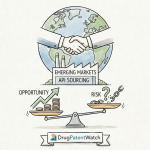
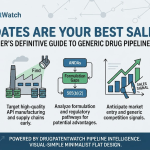
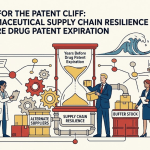
On April 2, 2026, President Trump signed a proclamation putting a 100% Section 232 tariff on patented pharmaceuticals and their active pharmaceutical ingredients, effective July 31, 2026 for the largest manufacturers and September 29, 2026 for everyone else.[1] Three weeks later, on July 21, 2026, the administration announced a second, slower-moving tariff aimed squarely at the part of the supply chain the first one skipped: generic drugs get zero tariff for two years, then 100% for a year starting August 2028, then 200% after that, unless the manufacturer commits to building a U.S. plant.[2] Generic APIs are exactly where China’s dominance is concentrated, and exactly where the first tariff round carved out an exclusion.[3] The 2026 tariff regime, in other words, was built to eventually reach the one segment of the pharmaceutical supply chain that runs almost entirely through China. It has not reached it yet.
That gap between political intent and chemical reality is the story of 2026. A January 2026 DrugPatentWatch analysis laid out why “decoupling” from Chinese active pharmaceutical ingredients is harder than trade rhetoric suggests, tracing China’s leverage down to the key starting materials (KSMs) that sit beneath the API layer.[4] Nine months later, three things have changed that report could not have anticipated: a Section 232 tariff regime is now law, the BIOSECURE Act passed and quietly narrowed its target list, and India has restarted domestic Penicillin G production for the first time in three decades.[5][6] None of it has moved China’s underlying share of the generic API supply chain in a material way. This piece updates the record, adds the primary sources the original analysis didn’t have available, and maps what actually changes for buyers, generic manufacturers, and competitive intelligence teams between now and 2030.
1. What the Original China API Analysis Got Right, and What’s Changed Since
The core argument of the earlier DrugPatentWatch report holds up: China’s dominance is concentrated in key starting materials and intermediates, not just finished APIs, and India’s API industry is structurally dependent on Chinese inputs for the “dirty chemistry” (nitration, chlorination, fluorination) that Western environmental rules pushed offshore decades ago.[4] The report’s estimate that China’s effective control over the U.S. generic supply chain approaches 80% once KSM sourcing is traced through Indian and European intermediaries is a DrugPatentWatch calculation, not an independently reported statistic, and it should be read that way.[4]
What has changed is the policy environment around that dependency. Three developments since January 2026 reshape the risk calculus for anyone sourcing generic APIs:
A 100% Section 232 tariff on patented pharmaceuticals and their APIs took effect in phases starting July 31, 2026, but it explicitly excludes generic pharmaceuticals and their associated ingredients “at this time,” with a mandated one-year review of whether to extend it.[3][7]
A separate, later-arriving generic drug tariff escalator, announced July 21, 2026, targets exactly the segment the Section 232 order carved out, but on a multi-year runway (0% for two years, 100% the year after, 200% after that) that gives manufacturers time to build U.S. capacity or absorb the eventual cost.[2]
India’s Production-Linked Incentive (PLI) scheme for bulk drugs has, as of June 2026, brought Penicillin G, clavulanic acid, and rifampicin into commercial domestic production, the first fermentation-based KSM capacity India has run since Chinese competition shut its last Penicillin G plant roughly three decades ago.[5][8]
2. The Section 232 Pharmaceutical Tariff: What It Actually Covers
2.1 The April 2026 Proclamation, Explained
On April 2, 2026, the White House issued a proclamation under Section 232 of the Trade Expansion Act of 1962, the same national-security tariff authority used for steel and aluminum, and applied it to pharmaceuticals for the first time in the statute’s 64-year history.[9] The Department of Commerce had opened the underlying Section 232 investigation into pharmaceutical imports on April 1, 2025, a year before the proclamation issued.[7]
The tariff structure is tiered by company status and country of origin rather than a flat rate:
Tariff Tier
Rate
Who It Applies To
Effective Date
Standard rate
100%
Patented pharmaceuticals and APIs from companies named in Annex III without a qualifying deal
Companies with an approved or pending U.S. manufacturing commitment
Sep. 29, 2026; escalates to 100% on Apr. 2, 2030
MFN pricing deal
0%
Companies with a most-favored-nation pharmaceutical pricing agreement with HHS/Commerce
Sep. 29, 2026 through Jan. 20, 2029
UK-origin goods
10%
Patented pharmaceuticals/APIs of United Kingdom origin
Jul. 31, 2026
EU/Japan/South Korea/Switzerland/Liechtenstein
15%
Per existing trade-deal pharmaceutical commitments
Jul. 31, 2026
Generic pharmaceuticals and ingredients
0%
FDA-approved generics not covered by a valid, unexpired U.S. patent
Excluded “at this time”; one-year review mandated
Source: proclamation summary via Thompson Hine SmarTrade and Crowell & Moring client alerts.[7][3]
Seventeen large drugmakers are named in Annex III and face the earlier, July 31 effective date; every other importer has until September 29, 2026.[10] As of May 2026, 17 companies had already reached voluntary MFN pricing agreements with the federal government, qualifying for the 0% rate.[2] Annex IV carves out more than 400 tariff lines at a zero rate, including many antibiotics, vitamins, and hormones, and U.S.-origin APIs packaged into finished doses abroad remain untariffed provided the importer can document the domestic origin of the API.[10]
2.2 Why the Generic Exclusion Is the Whole Ballgame
The proclamation’s generic carve-out is not a minor technicality. Generic pharmaceuticals and their associated ingredients are expressly excluded from Section 232 duties, and Commerce is required to report back to the President within one year of the proclamation on whether circumstances warrant extending the tariff to that segment.[3] Given that the generic API market, valued at $78.69 billion in 2024, is where China’s dominance is sharpest, this means the highest-profile 2026 tariff action leaves China’s core commercial advantage untouched for now.[4]
3. The Generic Drug Tariff Escalator: A Slower, More Direct Shot at China
On July 21, 2026, President Trump announced a second tariff track aimed specifically at generic drugs, framed explicitly as a reshoring penalty rather than a national-security tariff.[2] Under the plan as announced: generic drugs entering the U.S. continue at a 0% tariff for a two-year window starting August 1, 2026; companies that have not committed to building U.S. manufacturing capacity by the end of that window face a 100% tariff for one year (roughly August 2028 to August 2029); the rate then rises to 200% thereafter for companies that still haven’t onshored.[2]
“This is done in order to reshore generic pharmaceutical production into America, with a penalty to those companies that decide not to build plant and equipment within the stated period of time given to them.”[2]
3.1 What This Means for China-Sourced Generic APIs
The two-year runway is the important design choice. It gives generic manufacturers, most of whom source APIs or KSMs from China even when the finished dose is formulated in India, the U.S., or Vietnam, a multi-year window to either qualify for an onshoring exemption or absorb the coming cost.[4] Because the generic tariff escalator was announced after the Section 232 pharmaceutical proclamation and targets exactly the product category Section 232 excluded, the two actions read as sequential rather than redundant: patented drugs first, generics on a longer fuse.[3][2]
3.2 Analysis: The Math Doesn’t Support Fast Reshoring
Building the KSM capacity to reduce China dependency inside a two-year window is not realistic for the antibiotic and vitamin categories where China’s share is highest. A greenfield fermentation-based API plant, the kind needed for Penicillin G or its downstream derivatives, typically takes multiple years from permitting through commercial-scale validation, a timeline India’s own PLI-funded projects illustrate: the scheme was approved in 2020, and commercial Penicillin G output only became reportable in 2026.[8][11] A two-year tariff-avoidance window is enough time to announce a plant and break ground; it is not enough time to actually manufacture penicillin’s key starting material domestically at commodity-competitive cost. This is DrugPatentWatch analysis, not a government projection.
4. The BIOSECURE Act Became Law, and Quietly Narrowed
4.1 From Stalled Bill to Signed Statute
The earlier report treated the BIOSECURE Act as a proposed measure with an uncertain path to passage.[4] That changed on December 18, 2025, when President Trump signed the Fiscal Year 2026 National Defense Authorization Act (NDAA), which incorporated a revised version of the BIOSECURE Act as Section 881.[12][13] The bill’s path ran through the Senate as an amendment (adopted by voice vote on October 9, 2025, then by a 77-20 recorded vote on the full NDAA) before House and Senate negotiators reconciled it into the final defense bill signed in December.[14][15]
4.2 The Company List Got Smaller, Not Bigger
The most consequential change between the 2024 draft and the enacted 2025 law is definitional. Earlier BIOSECURE drafts named specific companies of concern, including WuXi AppTec and WuXi Biologics alongside BGI, MGI, and Complete Genomics.[16] The version signed into law instead defines a “biotechnology company of concern” by reference to the Department of Defense’s annual “1260H” list of Chinese military-linked companies. As of the January 2025 edition of that list, BGI and MGI are included, but WuXi entities are not.[17] The Department of Defense updated the 1260H list again in June 2026 under the new statutory framework.[6]
Two other changes favor industry compliance relative to earlier drafts: affiliates of a named company of concern are no longer automatically swept in solely because of a governance or ownership relationship, and the scienter standard for contractors was narrowed to require actual knowledge that performance of a federal contract would require a prohibited company’s biotechnology equipment or services, rather than the broader “know or have reason to believe” standard in earlier text.[18]
4.3 What BIOSECURE Does and Doesn’t Restrict
BIOSECURE restricts federal agencies from contracting with, or issuing grants to, entities that use biotechnology equipment or services from a designated company of concern. It does not impose a blanket import ban on Chinese small-molecule generic APIs, and it does not touch the private-sector generic drug supply chain that is the subject of this report.[19] Its practical bite falls on biologics manufacturing, genomic sequencing, and CDMO services tied to federally funded research and development, a different segment of the China relationship than the antibiotic, vitamin, and statin intermediate trade this report covers.[4]
5. FDA Enforcement in China Stayed Aggressive Through 2026
The earlier report’s data point on the 2025 inspection surge, 58 untitled letters in fiscal year 2025 versus five in 2024, described a step change in FDA scrutiny of Chinese manufacturing sites.[4] That intensity continued into 2026. Industry analysis of 2026 warning letters found that data integrity deficiencies, backdated records, shared logins that prevent attribution of who took an action, disabled audit trails, and deleted results, appear in roughly 60 to 80% of pharmaceutical GMP warning letters industry-wide, a share that has not eased through 2026.[20]
5.1 Named 2026 Enforcement Actions
FDA issued a warning letter to Yangzhou Sion Commodity, a Jiangsu Province manufacturer, after the company provided a written statement on company letterhead admitting to backdating a quality-control lab document and confirming that commercial drugs already shipped to the U.S. were not supported by original data; the firm was placed on import alert on January 15.[21] FDA also issued a warning letter to Hangzhou Glamcos Biotech following an import alert placed on September 30, citing documentation practices that FDA said raised concerns about “the integrity, authenticity, and reliability” of the company’s data.[21] These sit alongside the Zhejiang Huahai warning letter from June 2025 covered in the original report, which cited data integrity and environmental monitoring deficiencies at a manufacturer holding more than 50 active U.S. Drug Master Files.[4]
6. India’s Penicillin G Comeback: The Dependency Trap, Partially Addressed
6.1 What Changed
The earlier report’s framing of India as structurally dependent on Chinese KSMs, particularly 6-aminopenicillanic acid (6-APA) for beta-lactam antibiotics, was accurate as of early 2025.[4] It is now partially out of date. India’s last domestic Penicillin G plant closed roughly three decades ago, undercut by cheaper, subsidized Chinese production, leaving India dependent on imported 6-APA even while it remained a major exporter of finished amoxicillin.[22] A restart, funded through the PLI Scheme for Bulk Drugs (approved 2020, ₹6,940 crore outlay), had been publicly targeted for mid-2024 but only reached reportable commercial-scale output in 2026.[22][11]
As of June 2026, the Indian government reported ₹5,210.74 crore in actual investment against a ₹4,330 crore committed target, with 39 projects covering 28 distinct APIs and key starting materials commissioned, including fermentation-based Penicillin G, clavulanic acid, and rifampicin.[5][11] A September 25, 2026 Press Information Bureau update added that PLI beneficiaries had recorded ₹3,792.49 crore in sales, including ₹560.16 crore in exports, and created roughly 5,127 direct jobs, with five greenfield projects now operational.[8]
6.2 Analysis: Does This Break the Dependency Trap?
Not yet, and the scale gap is the reason. China’s 6-APA and Penicillin G fermentation capacity operates at industrial scale built up over decades, with individual Chinese fermenters reported to run 5 to 10 times the volume of Indian counterparts, a scale advantage that compounds the cost gap from cheaper domestic feedstocks and subsidized industrial energy.[4] India’s PLI-funded restart, at ₹3,792 crore in cumulative beneficiary sales as of June 2026, represents a meaningful re-entry into fermentation-based KSM manufacturing, but not yet a volume base capable of displacing China as the default global supplier. It does, however, materially change the “single point of failure” framing the earlier report applied to global beta-lactam antibiotic production: for the first time in three decades, there is now a second country with commercial 6-APA-adjacent fermentation capacity coming online, not just a country dependent on importing it.[4][8]
7. China’s Own Regulatory Moves Continued Through 2026
Two regulatory shifts inside China, both flagged in the earlier report as still developing, are now in force. The Domestic Responsible Person (DRP) rule, requiring overseas marketing authorization holders to appoint a China-based entity bearing joint liability for product quality, took effect July 1, 2025, and remains the operative rule through 2026, deepening the legal footprint foreign pharma companies must maintain inside China even as Western governments push “de-risking.”[4] China’s Anti-Monopoly Guidelines for the Pharmaceutical Sector, released January 2025, continue to apply and mark the first time Chinese antitrust regulators explicitly targeted reverse-payment (pay-for-delay) settlements, aligning China’s antitrust posture with the U.S. and EU on that specific practice.[4]
8. Rare Earths, Not APIs: Where China Actually Pulled Back in 2026
It’s worth separating China’s pharmaceutical-supply posture from its rare earth and critical minerals posture, because 2026 headlines often conflate the two. Following the Trump-Xi meeting, China suspended its October 2025 rare earth export control expansion for one year, through November 10, 2026, as part of a broader trade de-escalation package; a January 1, 2026 update to China’s Import-Export Licensing Catalogue nonetheless added new licensing requirements for several rare earth compounds, and the underlying April 2025 controls and licensing architecture remained fully intact even during the suspension.[23][24][25] None of this directly governs API or KSM exports. It illustrates, however, that China’s export-control lever, when it chooses to use one, is calibrated and reversible, a posture that has not yet been applied to pharmaceutical feedstocks the way it has to rare earths.[24]
9. The Cost Structure Nobody Has Reversed
None of the 2026 tariff or legislative action changes the underlying cost advantage the original report documented: Chinese API production costs run 20 to 30% below India’s, driven by integrated chemical parks that let one plant’s waste stream feed another’s feedstock, larger fermentation scale, and domestic sourcing of basic chemical feedstocks that spares Chinese manufacturers the foreign-exchange risk and logistics cost Indian producers absorb importing KSMs.[4] China’s December 2024 removal of the 13% export tax rebate for chemically modified oils and fats, a feedstock category covering fermentation inputs for antibiotics and vitamins, raised Chinese exporters’ effective cost base by an estimated 9 to 13%, but that increase still left a wide gap versus Indian and Western production costs.[4] A 100% U.S. tariff on patented drugs and a slow-fuse generic tariff do not close a 20 to 30% underlying production-cost gap; they add a border cost on top of it, which is a different and more easily arbitraged problem for global manufacturers with formulation options outside the U.S. market.
10. Comparison: 2026 Tariff and Legislative Tracks at a Glance
Policy Track
Status as of Sept. 2026
Covers Generic APIs?
China-Specific?
Section 232 pharmaceutical tariff
In force (phased Jul. 31 / Sep. 29, 2026)
No, explicitly excluded
No, applies by company/country tier
Generic drug tariff escalator
Announced Jul. 21, 2026; 0% until Aug. 2028
Yes, directly targeted
No, applies to all generic sourcing
BIOSECURE Act (NDAA Sec. 881)
Signed into law Dec. 18, 2025
No, targets biologics/CDMO services
Yes, via DoD 1260H list
China export tax rebate removal
In force since Dec. 1, 2024
Yes, raises Chinese export cost base
Yes, China-origin policy
China rare earth export controls
Suspended through Nov. 10, 2026
No, separate mineral category
Yes, China-origin policy
India PLI Scheme for Bulk Drugs
Active; 39 projects commissioned by Jun. 2026
Yes, targets KSM import substitution
Indirectly, reduces China KSM reliance
11. What This Means for Different Stakeholders
11.1 Generic Manufacturers
The two-year 0% window on generic drug tariffs (through August 2026) is a planning runway, not a reprieve. Manufacturers relying on Chinese KSMs for fermentation-based antibiotics or vitamin intermediates should be evaluating onshoring commitments now, since the credibility of an onshoring plan, not just its existence, is what the Section 232 framework rewards with a reduced 20% rate rather than the full 100%.[3]
11.2 Procurement and Supply Chain Teams
Annex IV’s zero-rate carve-out for many antibiotics, vitamins, and hormones under the Section 232 order means the highest-volume commodity categories are, for now, untariffed regardless of country of origin.[10] That makes the generic drug tariff escalator, not Section 232, the deadline that matters for most generic API sourcing decisions.
11.3 Competitive Intelligence and IP Teams
China’s patent linkage system, which lets a generic applicant file a Type IV certification challenging a brand patent before approval, remains a leading indicator of Chinese generic firms’ global launch intentions, since domestic development in China frequently precedes global filings by years.[4] Monitoring NMPA filings alongside U.S. Paragraph IV notices and PACER dockets gives earlier visibility into which Chinese-manufactured generics are headed for the U.S. market, a use case DrugPatentWatch’s own patent-linkage tracking is built around.[4]
12. Definitions
Key Starting Material (KSM): A chemical building block synthesized from basic feedstocks and used to produce a pharmaceutical intermediate, one step further removed from the finished API than an intermediate itself.
Active Pharmaceutical Ingredient (API): The biologically active component of a finished drug product, as distinct from excipients and other inactive ingredients.
Drug Master File (DMF): A confidential FDA filing describing the facilities, processes, or materials used in manufacturing, processing, packaging, or storing a drug, submitted to support a separate marketing application.
Section 232: A provision of the Trade Expansion Act of 1962 letting the President restrict imports found to threaten U.S. national security, historically used for steel and aluminum before its 2026 extension to pharmaceuticals.
Most-Favored-Nation (MFN) pricing agreement: A voluntary company commitment, in this context, to align U.S. drug pricing with the lowest price charged in comparable developed markets, used here as a qualifying condition for a reduced Section 232 tariff rate.
Type IV certification: Under China’s patent linkage system, a generic applicant’s formal assertion that a listed brand patent is invalid or not infringed by its product, filed before marketing approval.
Methodology
This analysis updates a January 2026 DrugPatentWatch report on China’s role in the global generic drug API market, treating that report’s figures (global API market sizing, DMF filing share data, KSM concentration estimates, and the December 2024 export tax rebate details) as source material rather than independently re-verified statistics.[4] New research for this update covered primary and near-primary sources published between October 2025 and September 2026, including the White House’s April 2026 Section 232 proclamation as summarized by trade counsel (Thompson Hine, Crowell & Moring, Arnall Golden Gregory), FDA warning letter text via RAPS and FDA.gov, congressional and legal-alert coverage of the FY2026 NDAA’s BIOSECURE provisions (Ropes & Gray, Morrison Foerster, Hogan Lovells, Greenberg Traurig, Michigan Biosciences Industry Association), and Indian government PLI scheme updates via the Press Information Bureau as reported by Business Standard and regional outlets. Where a figure originates in the underlying DPW analysis rather than this update’s independent research, it is cited to that source and flagged as such in the surrounding text. Tariff rates and effective dates reflect the proclamation and implementing guidance as understood by trade counsel as of the most recent alert available at time of writing; given the pace of 2026 trade policy, readers should confirm current rates against CBP’s Chapter 99 provisions before making sourcing decisions.
FAQ
Does the 100% Section 232 pharmaceutical tariff apply to generic drugs sourced from China?
No. The April 2026 proclamation explicitly excludes generic pharmaceuticals and their associated ingredients “at this time,” though Commerce must report within one year on whether to extend the tariff to that segment.[3] A separate generic drug tariff escalator, announced in July 2026, targets generics on a longer, multi-year timeline instead.[2]
When does the generic drug tariff actually start costing money?
Generic drugs face a 0% tariff through roughly August 2028 under the plan announced July 21, 2026. Companies that have not committed to U.S. manufacturing by then face a 100% tariff for one year, rising to 200% after that for companies still sourcing from abroad.[2]
Did the BIOSECURE Act end up naming WuXi AppTec as a company of concern?
No. The version signed into law in December 2025 defines companies of concern by reference to the Department of Defense’s 1260H list rather than naming companies directly. As of the list’s January 2025 edition, BGI and MGI are included but WuXi AppTec and WuXi Biologics are not.[17]
Has India’s PLI scheme actually restarted domestic Penicillin G production?
Yes. As of June 2026, India’s PLI Scheme for Bulk Drugs had commissioned 39 projects covering 28 APIs and key starting materials, including fermentation-based Penicillin G, clavulanic acid, and rifampicin, the country’s first domestic Penicillin G output in roughly three decades.[5][11]
Does that mean India is no longer dependent on Chinese antibiotic feedstocks?
Not fully. India’s restart addresses a portion of demand but operates at a fraction of the fermentation scale China’s antibiotic manufacturers run, so import dependence for 6-aminopenicillanic acid and related feedstocks continues alongside the new domestic capacity.[4][8]
Did China ever restrict API or KSM exports the way it restricted rare earths?
No. China’s 2025-2026 export control activity, including the October 2025 rare earth expansion later suspended through November 2026, applies to rare earth elements and related technologies, not to pharmaceutical APIs or KSMs.[23][24]
What happened to the December 2024 Chinese export tax rebate removal?
It remains in effect. The 13% VAT export rebate for chemically modified oils and fats, a category covering fermentation feedstocks for antibiotics and vitamins, was eliminated effective December 1, 2024, and has not been restored, sustaining a 9 to 13% cost increase for affected Chinese exporters.[4]
Is FDA enforcement against Chinese API manufacturers still intensifying in 2026?
Enforcement intensity has held rather than eased. Industry review of 2026 warning letters found data integrity deficiencies present in roughly 60 to 80% of pharmaceutical GMP warning letters, consistent with the elevated 2025 pace of 58 untitled letters versus five the year before.[20][4]
Does the Section 232 tariff apply to APIs manufactured in the U.S. but shipped abroad for formulation?
U.S.-origin pharmaceutical products, including U.S.-made APIs packaged into finished doses overseas, remain exempt from the tariff, provided the importer can document the domestic origin of the API through supply chain records.[10]
How can competitive intelligence teams track which Chinese generics are headed for the U.S. market?
China’s patent linkage system requires generic applicants to file a Type IV certification asserting a brand patent is invalid or not infringed before their product can be approved domestically. Because Chinese firms often pursue domestic launches before filing in the U.S., monitoring these filings alongside Paragraph IV notices provides earlier visibility into future ANDA activity, which is the core use case behind tools like DrugPatentWatch.[4]
Key Takeaways
The headline 2026 pharmaceutical tariff, a 100% Section 232 duty effective July 31 and September 29, explicitly excludes generic drugs and their ingredients, the exact segment where China’s dominance is concentrated.[3][4]
A separate generic drug tariff, announced July 21, 2026, does target that segment, but on a multi-year runway (0% until roughly August 2028) that gives manufacturers time to plan rather than an immediate cost shock.[2]
The BIOSECURE Act became law on December 18, 2025, but the enacted version defines “companies of concern” by reference to a Defense Department list that, as of its most recent public edition, does not include WuXi AppTec or WuXi Biologics.[12][17]
India restarted commercial fermentation-based Penicillin G, clavulanic acid, and rifampicin production in 2026 under its PLI scheme, a real reduction in the “single point of failure” risk the original analysis identified, though not yet a volume base that rivals Chinese fermentation scale.[5][8]
FDA data integrity enforcement against Chinese manufacturers has not eased through 2026, and China’s own regulatory changes (the Domestic Responsible Person rule, pharmaceutical antitrust guidelines) continue to deepen rather than loosen the compliance relationship foreign companies must maintain inside China.[4][20]
Works Cited
Congressional Research Service. “U.S.-China Tariff Actions Since 2018: An Overview.” Congress.gov, 2026. https://www.congress.gov/crs-product/IF12990
DCAT Value Chain Insights. “A New Round in US Pharma Tariffs: What’s at Play?” July 24, 2026. https://www.dcatvci.org/features/a-new-round-in-us-pharma-tariffs-whats-at-play/
Crowell & Moring LLP. “Trump Administration Imposes Section 232 Tariffs on Patented Pharmaceutical Imports.” July 30, 2026. https://www.crowell.com/en/insights/client-alerts/trump-administration-imposes-section-232-tariffs-on-patented-pharmaceutical-imports-tiered-rate-structure-takes-effect-beginning-july-31-2026
DrugPatentWatch. “China’s Irreplaceable Role in the Global Generic Drug API Supply Chain (2026 Report).” January 20, 2026. https://www.drugpatentwatch.com/blog/the-role-of-china-in-the-global-generic-drug-api-market/
Business Standard. “Investment of ₹5,210 cr made under PLI scheme for bulk drugs till Jun: Govt.” September 2026. https://www.business-standard.com/india-news/investment-of-5-210-cr-made-under-pli-scheme-for-bulk-drugs-till-jun-govt-126092501018_1.html
Wikipedia. “Biosecure Act.” Accessed September 2026. https://en.wikipedia.org/wiki/Biosecure_Act
Thompson Hine SmarTrade. “President Trump Announces Section 232 Tariffs on Pharmaceuticals and Active Pharmaceutical Ingredients.” April 8, 2026. https://www.thompsonhinesmartrade.com/2026/04/president-trump-announces-section-232-tariffs-on-pharmaceuticals-and-active-pharmaceutical-ingredients/
Press Information Bureau via Plutus IAS. “PLI Scheme Boosts India’s Bulk Drug Manufacturing for Self-Reliance.” September 25, 2026. https://plutusias.com/pli-scheme-boosts-indias-bulk-drug-manufacturing-for-self-reliance/
Mallory Group. “Section 232 Tariffs on Pharma Start July 31: Importer Guide.” July 31, 2026. https://www.mallorygroup.com/blog-posts/100-duties-two-deadlines-section-232-pharmaceutical-tariffs-take-effect-july-31-2026
C.H. Robinson. “CBP Implements New Section 232 Tariffs on Patented Pharmaceuticals.” July 2026. https://www.chrobinson.com/en-us/resources/insights-and-advisories/client-advisories/2026q3/07-31-26-cbp-implements-section-232-tariffs-on-patented-pharmaceuticals/
Plutus IAS. “PLI Scheme for Bulk Drugs: Boosting India’s Pharma Self-Reliance in 2026.” August 7, 2026. https://plutusias.com/pli-scheme-for-bulk-drugs-boosting-indias-pharma-self-reliance-in-2026/
Morrison Foerster. “BIOSECURE Act Update.” December 18, 2025. https://www.mofo.com/resources/insights/251218-biosecure-act-update
Duane Morris LLP. “Biosecure Act Positioned for Vote in U.S. Senate.” December 16, 2025. https://www.duanemorris.com/alerts/biosecure_act_positioned_vote_us_senate_1225.html
Ropes & Gray LLP. “Senate Passes 2026 NDAA Including BIOSECURE Act Amendment.” October 2025. https://www.ropesgray.com/en/insights/alerts/2025/10/senate-passes-2026-ndaa-including-biosecure-act-amendment
Michigan Biosciences Industry Association. “Senate Advances Revised BIOSECURE Act — What it Means for Biotech and Biopharma.” October 17, 2025. https://www.michbio.org/news/senate-advances-revised-biosecure-act–what-it-means-for-biotech-and-biopharma
Goodwin. “The BIOSECURE Act and Its Potential Implications.” 2024. https://www.goodwinlaw.com/en/insights/publications/2024/03/alerts-lifesciences-the-biosecure-act-and-its-potential-implications
Michigan Biosciences Industry Association (DoD 1260H list detail). October 17, 2025. https://www.michbio.org/news/senate-advances-revised-biosecure-act–what-it-means-for-biotech-and-biopharma
Hogan Lovells. “BIOSECURE Act included in Senate version of the 2026 NDAA.” 2025. https://www.hoganlovells.com/en/publications/biosecure-act-included-in-senate-version-of-the-2026-ndaa
Latham & Watkins. “BIOSECURE Act Becomes Law Limiting Grants With Biotechnology Companies of Concern.” https://www.lw.com/en/insights/biosecure-act-becomes-law-limiting-grants-with-biotechnology-companies-of-concern
MFLRC. “Why 60-80% of FDA Warning Letters Still Cite Data Integrity in 2026.” June 19, 2026. https://mflrc.com/article/fda-data-integrity-warning-letters-2026
RAPS (Regulatory Affairs Professionals Society). “FDA finds data integrity problems in recent warning letters.” February 16, 2026. https://www.raps.org/resource/fda-finds-data-integrity-problems-in-recent-warnin.html
The Indian Express. “India to manufacture Penicillin G again: why it was stopped.” https://www.pressreader.com/india/the-indian-express/20240308/281595245495153
China Briefing. “China’s Rare Earth Export Controls – Impact on Businesses and Industries.” Updated November 7, 2025. https://www.china-briefing.com/news/chinas-rare-earth-export-controls-impacts-on-businesses/
Andersen Institute. “China’s Export Control Architecture and Its Use of Critical Minerals as Strategic Pressure Points.” July 1, 2026. https://anderseninstitute.org/chinas-export-control-architecture-and-its-use-of-critical-minerals-as-strategic-pressure-points/
Pillsbury Winthrop Shaw Pittman LLP. “China Suspends Export Controls on Certain Critical Minerals and Related Items.” November 13, 2025. https://www.pillsburylaw.com/en/news-and-insights/china-suspends-export-controls-certain-critical-minerals-related-items.html
DrugPatentWatch tracks Paragraph IV certifications, NMPA patent linkage filings, and Drug Master File activity across the generic drug supply chain, helping IP, procurement, and competitive intelligence teams see sourcing and litigation risk before it hits the market.