Business Intelligence on Biologic and Small Molecule Drugs
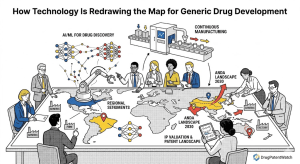
How Technology Is Redrawing the Map for Generic Drug Development: AI/ML, Continuous Manufacturing, IP Valuation, and the Competitive Dynamics Shaping the ANDA Landscape Through 2030
Generic pharmaceutical companies face a structural cost squeeze that has worsened since 2016. Teva, Mylan, and Sun Pharma each posted stretches of negative free cash flow during that period, driven by accelerating price erosion, rising API input costs, and an FDA review queue that carried over 4,000 ANDA backlog cases as recently as 2019. Technology has become the primary lever to break that cycle, not through incremental efficiency gains, but through wholesale process redesign.
The global AI in pharmaceutical market was valued at $1.94 billion in 2025 and is forecast to reach $16.49 billion by 2034, compounding at 27% annually. Applied to generic drug development, AI and machine learning reduce drug discovery costs by up to 40%, compress pre-clinical timelines from 3-6 years down to 12-18 months, and can cut total development duration by as much as 70%. Continuous manufacturing, still absent from any FDA-approved generic drug as of early 2026, cuts production cycle time from weeks to days. Automation systems have demonstrated production cost reductions of up to 60% in documented case studies.
These numbers matter most when read against the business reality: developing a generic drug costs $2 million to $10 million depending on complexity, and profit margins for commodity small-molecule generics can fall below 10%. The math only works if technology compresses development cost and time simultaneously. The first generic filer under the 180-day Hatch-Waxman exclusivity provision can capture 80% or more of the brand’s unit volume in the first six months, at 80-90% of brand price. Every week of development time saved is a week closer to that exclusivity window.
This pillar page covers the full technology roadmap from AI-driven target identification to blockchain-enabled supply chain traceability, situating each advance within the IP landscape that surrounds it. Where specific companies or drug classes are discussed, we include IP valuation subsections explaining how proprietary methodology translates into defensible intellectual property. Each major section closes with Key Takeaways for R&D teams and Investment Strategy notes for institutional analysts.
1. The Economics of the ANDA Treadmill
1.1 The Generic Business Model Under Structural Pressure
Generic drug manufacturers operate at the intersection of two compressive forces: commoditization from above and regulatory cost from below. On the revenue side, the major retail pharmacy chains and pharmacy benefit managers have consolidated buying power to a degree that allows them to extract annual price concessions on even established generic products. The 2023 GPhA savings report put U.S. generic drug savings at $408 billion for 2022 alone, a figure that represents real value for payers but margin destruction for manufacturers. On the cost side, the FDA’s ANDA review process, despite meaningful GDUFA improvements since 2012, still demands bioequivalence studies, site inspections, and patent certifications that each carry substantial price tags.
The result is a market where generic companies face what analysts at Piper Sandler have described as a ‘downward spiral’: price erosion outpaces cost reductions, and companies that fail to move up the complexity curve toward complex generics or biosimilars find their commodity portfolios slowly becoming unprofitable. Teva’s restructuring announcements between 2017 and 2022, which included eliminating roughly 14,000 positions and divesting dozens of product lines, illustrate this dynamic at scale. Smaller mid-tier generic manufacturers face the same forces without the financial cushion to absorb them.
Technology does not solve the pricing dynamic directly. What it does is alter the cost structure of development and manufacturing so the margin equation changes. A company that uses AI to cut formulation development time by 50% and adopts continuous manufacturing to run at lower batch-rejection rates spends less per approved ANDA and reaches market faster after patent expiry. That speed is worth real money. The 180-day exclusivity period under Hatch-Waxman has historically delivered hundreds of millions of dollars in revenue for a blockbuster-scale first filer.
1.2 Why the Hatch-Waxman Framework Alone No Longer Suffices
The Hatch-Waxman Act of 1984 solved the approval pathway problem for simple small-molecule generics. By establishing the ANDA framework and allowing generic companies to rely on a reference listed drug’s safety and efficacy data, it eliminated the most expensive development phases for the generic industry. The result was rapid market expansion, projected $1 billion in savings in its first year, and a generic market share that reached 90% of U.S. prescriptions by volume within three decades.
What Hatch-Waxman did not address is the growing complexity of the drug pipeline. The reference listed drugs coming off patent in 2025 and 2026 include complex inhalation products, liposomal formulations, transdermal delivery systems, and subcutaneous biologics. These are not simple tablets where bioequivalence can be demonstrated by measuring Cmax and AUC in a two-arm pharmacokinetic study. The FDA’s Office of Generic Drugs has issued product-specific guidance for hundreds of complex generics, and the development programs for these products look more like NDA filings than traditional ANDA submissions in terms of cost and timeline.
Technology bridges this gap. AI-guided formulation development, physiologically-based pharmacokinetic (PBPK) modeling, and in silico bioequivalence prediction allow generic companies to build the scientific justification for complex product approvals without running the full clinical programs that branded manufacturers required. That is the real value proposition, and it is why capital markets have begun assigning explicit technology premiums to generic companies with credible AI and advanced manufacturing capabilities.
1.3 Patent Lifecycle and the Technology-IP Interface
Understanding where technology fits in generic strategy requires a precise map of the branded pharmaceutical IP landscape that generics must navigate. A standard small-molecule blockbuster carries multiple overlapping patent layers. The compound patent typically expires first, but branded manufacturers routinely file additional patents covering specific formulations, methods of use, polymorphic forms, metabolites, and pediatric extensions. This evergreening strategy can extend effective market exclusivity by five to twelve years beyond the original compound patent.
For the generic challenger, this patent stack creates a Paragraph IV certification target list. A generic company filing an ANDA with a Paragraph IV certification declares at least one listed patent invalid, unenforceable, or not infringed. The brand company has 45 days to sue; if it does, a 30-month stay of ANDA approval triggers automatically. The litigation that follows consumes years and tens of millions of dollars. AI-powered patent landscape analysis is changing how generic companies approach this process, both by identifying which Orange Book patents are genuinely vulnerable and by surfacing prior art that supports invalidity arguments.
The technology roadmap therefore runs parallel to the IP roadmap. A generic company deploying AI for formulation development simultaneously generates data that may support design-around arguments for formulation patents, while a company using continuous manufacturing may be seeking its own process patents that protect its cost advantage. This dual-use nature of pharmaceutical technology, as both a development tool and an IP asset, runs through every section of this analysis.
KEY TAKEAWAYS • Generic profit margins on commodity small molecules can fall below 10%, making technology-driven cost reduction existential rather than optional for mid-tier manufacturers. • The 180-day exclusivity window under Hatch-Waxman concentrates disproportionate value on ANDA approval speed. AI shortens development timelines by 40-70%, directly monetizing that window. • Hatch-Waxman addressed approval pathway complexity in 1984; complex generics, liposomal formulations, inhalation products, and biosimilars require a technology solution that the statute never contemplated. • Branded manufacturers use evergreening tactics to extend effective exclusivity by five to twelve years. AI-powered patent landscape analysis enables more precise Paragraph IV strategy, improving challenge win rates. • Technology deployments generate protectable IP, making R&D infrastructure itself a balance sheet asset that compounds over time.
2. Artificial Intelligence and Machine Learning Across the Generic Development Lifecycle
The AI market in pharmaceuticals is compounding at 27% annually toward $16.49 billion by 2034. That growth is not uniform across development stages. For generic companies specifically, the highest-value applications concentrate in formulation development, bioequivalence prediction, regulatory submission preparation, and supply chain optimization. The subsections below cover each with specific tool examples, IP valuation notes, and quantified performance benchmarks.
2.1 Drug Discovery and Molecular Intelligence for Complex Generics
2.1.1 AI in Generic Target Identification and Reverse Engineering
Drug discovery in the branded pharmaceutical sense means identifying a novel molecular target and designing a compound to modulate it. For generic development, the ‘discovery’ phase has a different character: the active pharmaceutical ingredient is known, but the generic company must reconstruct the precise physicochemical behavior of a reference listed drug’s formulation without infringing the formulation patents surrounding it. AI tools originally built for de novo drug discovery are being repurposed for this reverse-engineering task with measurable results.
Generative AI models, including diffusion-based molecular generation architectures and graph neural networks trained on large molecular databases, can propose candidate co-formers, salt forms, and polymorphic variations that match the dissolution and bioavailability profile of a reference product without replicating its patented formulation. This capability is particularly important for complex generics where the difference between an FDA approval and a rejection hinges on whether the generic can demonstrate formulation- or device-equivalence through alternative means.
Beyond formulation reverse-engineering, AI accelerates target identification for generic companies pursuing 505(b)(2) applications, where a company references existing safety data for a known API while seeking approval for a new indication, route of administration, or dosage form. Bioinformatics pipelines combining transcriptomic data, protein-protein interaction networks, and phenotype-driven target scoring have reduced the time from database query to candidate nomination from months to weeks in documented cases. The resulting 505(b)(2) approval carries three to five years of market exclusivity, creating a meaningful revenue window for a product built on an off-patent active ingredient.
2.1.2 IP Valuation: Insilico Medicine and Generative AI Platform Patents
Insilico Medicine has become the benchmark case for valuing generative AI platforms in pharmaceutical development. The company used its Chemistry42 generative AI engine to advance from novel-target discovery to pre-clinical candidate nomination in 13-18 months at a reported cost of approximately $2.6 million, against an industry baseline of 3-6 years and $10-50 million for the same stage. Its lead asset, ISM001-055 for idiopathic pulmonary fibrosis, completed Phase IIa enrollment in 2024.
From an IP valuation standpoint, the Chemistry42 platform encompasses patents covering both the generative architecture, the specific graph neural network topology and training methodology, and the molecular candidates it produces, standard composition-of-matter claims. This dual-layer IP strategy creates a compounding valuation problem for competitors: they must design around both the process patents protecting the AI methodology and the composition patents on the molecules the AI generates. For generic companies licensing or building similar platforms, the lesson is that proprietary AI methodology functions as a defensible IP asset separate from the molecules it produces.
The royalty-bearing market for AI-generated molecular design tools is estimated at $2-4 billion by 2027. Generic companies that build internal generative chemistry capabilities rather than licensing external platforms accumulate an IP estate with compounding competitive and financial value. The standard 20-year patent term from filing date, with continuation applications extending specific claim coverage, provides a meaningful exclusivity window for AI-generated formulation innovations.
IP Valuation Note: AlphaFold and Structural Biology DatasetsDeepMind’s AlphaFold2 predicted three-dimensional protein structures for roughly 200 million proteins and made the database publicly available in 2021. The specific fine-tuned versions that companies build on top of it for particular disease areas or target classes carry proprietary value. Generic companies using AlphaFold-derived structural data to model protein-drug interactions for complex biologics or biosimilar comparability studies generate proprietary computational datasets that, combined with wet-lab validation, can support both regulatory submissions and patent claims on specific binding hypotheses. Valuing these datasets requires estimating their contribution to BLA approval probability and time savings, modeled as a reduction in expected development cost discounted to present value at the company’s WACC.
2.2 Formulation Development and Excipient Optimization
2.2.1 From Trial-and-Error to Predictive Formulation Design
Traditional formulation development proceeds empirically. Scientists select candidate excipients based on prior experience and published compatibility data, run bench-scale batches, test dissolution and stability, and iterate. For a standard immediate-release tablet, this process typically takes 6-12 months. For a complex formulation such as a liposomal drug, a nanocrystalline suspension, or a modified-release multiparticulate system, the empirical process can take 2-4 years with substantial material and labor costs.
AI and machine learning compress this timeline by training predictive models on historical formulation data to score excipient candidates before any physical experiments are run. The models treat formulation as a high-dimensional optimization problem: given a target dissolution profile, particle size distribution, and stability specification, identify the excipient combination and processing parameters most likely to achieve it. When trained on sufficiently large, curated datasets, these models deliver actionable formulation hypotheses in days rather than months.
The practical constraint is data quality and quantity. A generic company that has run hundreds of formulation campaigns on structurally similar APIs has the raw material for a proprietary training dataset that outperforms any off-the-shelf model. Companies that have not invested in systematic data capture and curation work with smaller, noisier datasets, degrading model performance. This creates a widening capability gap between well-capitalized, data-rich generic manufacturers and smaller players who lack the experimental history to train high-performance models.
2.2.2 Merck KGaA: AI Co-Former Prediction and IP Architecture
Merck KGaA has developed an AI-based tool to predict compatible co-formers for pharmaceutical co-crystallization, a process that modifies the crystalline structure of an API to improve its solubility, dissolution rate, and bioavailability without changing its chemical identity. The practical problem this solves is significant: a drug with poor aqueous solubility, classified as BCS Class II or IV, often faces formulation challenges that make it commercially unviable unless solubility can be improved. Identifying a compatible co-former experimentally is time-consuming and frequently unsuccessful on initial attempts.
Merck’s AI tool uses graph-based molecular representations and a trained ranking model to score co-former candidates by predicted compatibility and co-crystal stability. In internal benchmarks, the tool reduced the experimental screening campaign from several hundred experiments to a shortlist of fewer than twenty candidates, representing a 90%-plus reduction in material consumption and screening time. The IP architecture includes patents on the co-former prediction methodology, continuation applications covering model updates, and separate trade secret protection for the proprietary training dataset derived from Merck’s internal co-crystallization research.
For generic companies, the relevance is two-fold. First, co-crystallization can produce patentable new solid forms of off-patent APIs, creating fresh IP protection for a product that might otherwise face immediate generic competition. Second, if a branded manufacturer has patented a specific co-crystal form and the generic company needs to match the reference listed drug’s dissolution profile, an AI co-former prediction tool that rapidly identifies non-infringing alternative co-formers can be the difference between a viable ANDA program and an abandoned one.
2.2.3 ExPreSo and Biopharmaceutical Excipient Prediction
ExPreSo is an ML-based excipient prediction platform for biopharmaceutical formulations, published in pre-print research in 2025. It addresses the challenge of selecting stabilizing excipients for protein drug substances, a problem with higher stakes than small-molecule excipient selection because protein instability can result in aggregation, immunogenicity, and loss of biological activity. ExPreSo trains on a curated database of biopharmaceutical formulation records and predicts excipient classes, including polyols, amino acids, and surfactants, based on the target protein’s physicochemical characteristics and the intended product profile.
In benchmarking studies, ExPreSo achieved prediction accuracy above 84% for excipient class selection across a held-out test set. The model’s architecture is designed for resilience to missing data, a practical requirement given that real formulation databases rarely have uniform data completeness. For biosimilar developers, tools like ExPreSo are particularly valuable in the analytical comparability studies that FDA requires to establish biosimilarity: knowing in advance which excipients are most compatible with a given protein reduces the risk of formulation-driven analytical failures late in development.
IP Valuation Note: Formulation AI Tools as Protectable AssetsAn ML model that predicts excipient compatibility for a proprietary protein formulation database is protectable under multiple IP frameworks. The model architecture may be patentable as a computer-implemented invention if the claim language connects specific technical features to measurable technical improvements (e.g., ‘a method for predicting excipient stability comprising graph convolution operations trained on a dataset of N formulation records, yielding prediction accuracy above X%’). The training dataset carries trade secret protection as long as maintained with reasonable confidentiality measures. A company that builds a formulation AI platform on a proprietary dataset of 10,000+ internal formulation experiments holds an IP asset whose value can be estimated by discounting expected development cost savings across the pipeline to net present value at the company’s WACC.
KEY TAKEAWAYS • AI-driven formulation development cuts the empirical trial-and-error cycle from 6-12 months to days for standard generics, and from 2-4 years to months for complex generics. • Insilico Medicine’s Chemistry42 platform demonstrates that generative AI methodology is itself a patentable IP asset distinct from the molecules it produces, carrying a dual-layer protection strategy. • Merck KGaA’s co-former AI tool achieved a 90%+ reduction in experimental screening, directly converting to cost and timeline savings in solid-state formulation campaigns. • Proprietary training datasets from internal formulation history are protectable as trade secrets and drive AI model performance advantages over off-the-shelf solutions. • For Paragraph IV strategy, AI formulation tools that rapidly generate non-infringing alternative solid forms or excipient combinations reduce commercial risk on complex patent challenges.
INVESTMENT STRATEGY ■ Generic companies that have systematically digitized formulation history data from the past decade hold undervalued AI training assets. M&A due diligence on generic or CDMO targets should include an explicit audit of data infrastructure maturity and training dataset size. ■ Platform companies building specialized pharmaceutical formulation AI tools carry a valuation premium over general-purpose chemistry AI vendors because the domain-specific training data moat is harder to replicate. Estimate moat depth by total proprietary formulation records and API chemical diversity. ■ Biosimilar developers deploying ExPreSo-equivalent tools reduce Phase I analytical failure probability. Model this as a probability-weighted reduction in late-stage failure costs when building DCF models for biosimilar pipeline assets.
2.3 Bioequivalence Prediction: From PBPK Modeling to Virtual Trials
2.3.1 Why Bioequivalence Remains the Central Regulatory Bottleneck
For a standard ANDA, the pivotal study is the in vivo bioequivalence study: typically a two-period crossover pharmacokinetic study in 24-36 healthy volunteers comparing the generic product’s Cmax, AUC(0-t), and AUC(0-inf) against the reference listed drug, with the 90% confidence interval for the geometric mean ratio of each parameter required to fall within 80-125%. This study costs $500,000 to $2 million depending on study complexity and bioanalytical method development requirements.
For complex generics, the bioequivalence requirement is more demanding. Locally-acting drug products like inhalation corticosteroids or topical dermatological formulations may require pharmacodynamic endpoints or clinical endpoint bioequivalence studies in patient populations, at a cost of $10-30 million and a timeline of 2-4 years. The commercial risk is substantial: a company that invests in a complex generic ANDA program and fails its pivotal bioequivalence study must either re-formulate and repeat the study or abandon the program.
AI and computational modeling reduce this risk in two ways. First, predictive models can identify formulations likely to pass bioequivalence testing before the pivotal study is run, reducing the probability of failure. Second, in silico and in vitro approaches, when validated and accepted by FDA, can substitute for or reduce the scope of in vivo human studies. The FDA’s explicit guidance on model-informed drug development and its development of AI-based bioequivalence assessment tools signal that this substitution is becoming more accepted.
2.3.2 Machine Learning for Early Bioequivalence Risk Stratification
A random forest model published in PubMed (PMID 39490606) demonstrated 84% accuracy in predicting bioequivalence risk at an early development stage using pharmacokinetic and physicochemical parameters. The model’s highest-weight features include dose number (the ratio of drug dose to drug solubility multiplied by typical gastric volume), acid dissociation constant (pKa), effective intestinal permeability, intrasubject pharmacokinetic variability, absolute bioavailability, and elimination half-life. These are Biopharmaceutics Classification System-adjacent features that experienced formulators already consider, but the model’s value is in quantifying their combined effect on BE outcome probability in a reproducible, auditable way.
For a generic company running 20-30 ANDA programs simultaneously, pushing all of them to a pivotal BE study without early risk triage is economically irrational. A predictive BE risk score allows portfolio managers to allocate clinical development resources to programs with higher a priori BE probability and redesign formulations for higher-risk programs before committing to expensive human studies. At $1 million per in vivo BE study and a historical failure rate of 20-30% for complex generics, even a modest improvement in pre-study risk prediction has multi-million dollar annual value for a mid-sized generic company.
2.3.3 Wasserstein GANs for Virtual Bioequivalence Populations
Wasserstein Generative Adversarial Networks (WGANs) represent a more ambitious application of generative AI to bioequivalence: instead of predicting whether a specific formulation will pass a BE study, they generate synthetic virtual subjects whose pharmacokinetic profiles match the statistical properties of real human populations. Published research indicates that WGAN-generated virtual BE trials produce rejection rates and confidence interval widths consistent with real studies for well-characterized drug classes with available real-world pharmacokinetic data.
The regulatory acceptance pathway for virtual BE populations remains under active discussion at FDA and EMA. In the near term, WGANs’ practical value for generic companies is in study design optimization rather than outright replacement of human studies. By simulating thousands of virtual BE trials with different sample sizes, intrasubject variability assumptions, and formulation parameters, a generic company can identify the minimum n required to achieve a target power level and can stress-test its formulation design against realistic variability ranges before committing to a physical study. This reduces the risk of underpowered studies and the associated cost of repeating them.
2.3.4 PBPK Modeling and the Bioequivalence Safe Space
Physiologically-based pharmacokinetic (PBPK) modeling constructs mechanistic compartmental models of drug absorption, distribution, metabolism, and excretion using tissue volume, blood flow, and enzyme activity parameters derived from the physiological literature. Unlike empirical pharmacokinetic models that fit data from observed studies, PBPK models can extrapolate to conditions not directly studied, including different formulation release rates, fed versus fasted administration, and patient subgroups such as pediatric patients or those with renal impairment.
The FDA has explicitly endorsed PBPK-based ‘bioequivalence safe space’ analyses for several complex product categories. In this approach, the developer uses a validated PBPK model to simulate the pharmacokinetic consequences of formulation variability across a range of in vitro dissolution profiles, identifying the bounds of dissolution performance that predictably yield bioequivalence in silico. FDA reviewers have accepted this as a basis for setting clinically relevant dissolution specifications and, in some cases, as a substitute for specific in vivo food-effect studies.
A PBPK model validated against proprietary clinical data for a specific drug-formulation combination has value as a regulatory submission asset and as a competitive intelligence tool. A generic company that has built and validated a PBPK model for a complex inhalation product has a head start on any competitor attempting the same ANDA program because the modeling work takes 12-18 months and requires specialized expertise that is genuinely scarce in the generic industry.
KEY TAKEAWAYS • In vivo BE studies cost $500K to $30M+ for complex generics and carry historical failure rates of 20-30%. AI-driven early BE risk scoring delivers high ROI at any portfolio scale above 10 concurrent ANDA programs. • PBPK-based bioequivalence safe space analysis is FDA-accepted for select product categories and provides a path to reduced in vivo study requirements for complex products. • WGAN virtual populations show promise for study design optimization; full substitution for human BE studies requires additional regulatory framework development. • Validated PBPK models for complex drug products are protectable as regulatory submission assets with quantifiable economic value. • FDA’s BEAM tool will reduce ANDA BE assessment review time by an estimated 20-40%, accelerating approval timelines. Submissions in structured, machine-readable formats move through BEAM more efficiently.
INVESTMENT STRATEGY ■ Generic companies building in-house PBPK modeling capabilities for complex generics carry regulatory-accepted IP assets that reduce expected development cost by 20-40% on complex programs. This metric deserves explicit weighting in generic company equity analysis. ■ AI BE risk scoring tools with validated performance above 80% accuracy carry monetizable value estimated at $50M-$200M for a generic company running 20+ ANDA programs concurrently, based on expected study failure cost avoidance. ■ Biosimilar developers able to demonstrate AI-assisted totality-of-evidence packages to FDA have a path to waived clinical studies, potentially reducing a biosimilar BLA cost by $50-100M.
3. Advanced Manufacturing Technologies: The Orphan Opportunity for Generics
3.1 Continuous Manufacturing: Technology Roadmap and the Generic Adoption Gap
3.1.1 How Continuous Manufacturing Differs from Batch Processing
Traditional pharmaceutical batch manufacturing produces drug product in discrete lots. Raw materials are assembled, processed, and tested as a unit before the next batch begins. The result is a manufacturing model characterized by large inventory buffers between process steps, significant hold times for in-process testing, substantial physical footprint for staging and storage, and batch-level quality failures that can result in entire lot rejections. For a generic company manufacturing dozens of products across multiple sites, these inefficiencies compound at scale.
Continuous manufacturing integrates all unit operations, granulation, blending, compression or encapsulation, and coating, into a single uninterrupted processing stream. Raw materials enter at one end; finished dosage units emerge at the other. Real-time quality monitoring through Process Analytical Technology (PAT) instruments, including near-infrared spectroscopy for blend uniformity, Raman spectroscopy for API content, and vision systems for tablet integrity, provides continuous quality assurance rather than end-of-batch release testing.
The operational advantages for a generic manufacturer are concrete. Continuous manufacturing reduces production cycle time from weeks to days by eliminating hold times. It reduces facility footprint by 40-60% compared to equivalent batch capacity. It improves yield by catching and rejecting out-of-specification material in real time rather than at lot release, reducing full-batch rejection frequency. It provides flexibility to scale production rate by adjusting run time rather than building larger vessels.
3.1.2 The Generic CM Adoption Gap and Its Causes
As of early 2026, no generic drug in the United States has been approved using a continuous manufacturing process. Dozens of branded products have received FDA approval via CM, including Janssen’s Prezista (darunavir) and Vertex’s Orkambi, but the ANDA pathway has not yet produced a CM-approved generic. This is a striking gap given that FDA has explicitly promoted CM as a method to prevent drug shortages and improve product quality.
The reasons for this gap are structural rather than technical. The capital cost of a CM line, typically $10-30 million for a complete granulation-to-compression system, is a significant investment for a generic company operating on thin margins. The regulatory validation requirements for CM systems are more complex than for batch systems, particularly for the PAT instruments and real-time release testing models that replace traditional end-of-batch analytical release. The generic industry’s business model also traditionally favors replicating well-understood batch processes that are approved in the reference listed drug’s manufacturing section, minimizing regulatory novelty in the ANDA filing.
The company that solves this adoption problem first gains a structural manufacturing cost advantage. A generic manufacturer that converts a high-volume product line to CM and achieves a 20-30% reduction in cost of goods sold can sustain pricing below its batch-manufacturing competitors while maintaining acceptable margins, shifting market share at scale in a commoditized market.
3.1.3 Technology Roadmap: From Batch to Continuous in Generic Manufacturing
Phase
Timeline
Key Activities
Regulatory Milestones
Capital Required
Phase 1: Assessment
Months 1-6
Audit batch processes; identify CM-suitable products; evaluate equipment vendors; assess PAT data infrastructure
Pre-ANDA meeting with FDA OGD on CM strategy
$500K-$2M
Phase 2: Pilot Development
Months 7-18
Install pilot CM line; develop PAT method library; run material-sparing development batches; build RTRT models
Type C meeting; submit draft CM validation strategy
$5M-$15M
Phase 3: Validation
Months 19-30
Scale to commercial CM line; run PPQ batches; validate PAT models vs. compendial methods; generate ANDA manufacturing data
Pre-ANDA meeting; submit CMC section for CM product
$10M-$30M
Phase 4: ANDA Filing
Months 31-42
File ANDA with CM manufacturing section; respond to FDA queries on PAT validation and RTRT; prepare for pre-approval inspection
First CM generic ANDA approval; industry precedent
Included above
Phase 5: Portfolio Conversion
Ongoing
Apply validated CM platform to additional products; build proprietary CM process patents; reduce COGS across product line
Supplemental ANDA filings for CM platform products
$5M-$15M per product
3.1.4 IP Valuation: Continuous Manufacturing Process Patents
The CM space for pharmaceutical manufacturing has seen active patent filing from both equipment vendors and pharmaceutical companies. CM process patents can cover specific equipment configurations, PAT method libraries, real-time release testing algorithms, and the mathematical models used to relate in-process measurements to finished product quality attributes. For a generic company developing a proprietary CM process, each of these elements is potentially patentable.
The strategic value of a CM process patent for a generic manufacturer differs from its value for an innovator. Rather than excluding competitors from the market, a CM process patent protects the cost structure advantage that CM delivers. A competitor that cannot use the patented CM process must use a less efficient batch process, incurring higher COGS. The economic value of this moat can be estimated: if CM reduces COGS by $X per unit relative to batch processing, the present value of that competitive advantage over the patent’s remaining life, discounted at the company’s WACC and probability-weighted by the likelihood of CM market share capture, represents the IP asset’s intrinsic value.
IP Valuation Framework: CM Process PatentsStep 1: Estimate COGS reduction from CM vs. batch for the specific product (typically 15-30% for high-volume oral solid dosage forms). Step 2: Project unit volume over the patent life (20 years from filing, minus development time, minus future generic entry). Step 3: Multiply COGS reduction per unit by projected volume for cumulative cash flow benefit. Step 4: Discount at WACC (typically 8-12% for investment-grade generic companies). Step 5: Probability-weight by likelihood of patent survival in litigation (historical grant-back rates for pharmaceutical process patents: approximately 60-70%). The result is a range estimate for the patent’s intrinsic economic value, suitable for balance sheet IP valuation or M&A due diligence.
3.2 3D Printing: From Spritam to Patient-Centric Generics
3.2.1 The FDA Approval Precedent and Current Applications
The first FDA-approved 3D-printed drug product was Aprecia Pharmaceuticals’ Spritam (levetiracetam), approved in 2015 using ZipDose technology, a binder-jetting process that produces highly porous tablets capable of disintegrating in the mouth with a small sip of water. The technology addresses a real clinical need: patients with epilepsy often have difficulty swallowing conventional tablets during or immediately following a seizure. By enabling rapid oral disintegration at high doses (up to 1,000 mg) where conventional ODT formulations fail, ZipDose created a differentiated product from an off-patent API.
The Spritam case illustrates the 3D printing value proposition for generic-adjacent development: take an off-patent active ingredient, apply advanced manufacturing to create a dosage form with clinically meaningful differentiation, and file under the 505(b)(2) pathway to obtain market exclusivity for the novel formulation. This is not a standard ANDA program. It is closer to an NDA for a new dosage form, protected by formulation patents covering the ZipDose architecture. The API has no patent protection; the delivery system does.
For generic manufacturers, 3D printing is most immediately applicable in two contexts. The first is the development of complex multi-layer tablet designs for modified-release generics, where 3D printing produces spatial drug distribution patterns that conventional compression cannot replicate, enabling a design-around approach to patented modified-release formulation architectures. The second is in personalized dosing, where 3D printing enables patient-specific dose strengths from a standard API stock, potentially at the pharmacy level.
3.2.2 Personalized Generics: The Manufacturing Roadmap for 2027-2032
The pharmacy-level 3D printing model uses a standardized drug-loaded filament or printable ink formulation to produce tablets at a prescribed dose. Several academic groups and startup companies have demonstrated proof-of-concept across cardiovascular drugs, antiretrovirals, and pediatric medications where dose flexibility is particularly valuable. The regulatory framework for this model under 503A compounding exemptions versus standard drug approval pathways remains unresolved, but FDA has acknowledged 3D printing as a legitimate pharmaceutical manufacturing technology.
The near-term opportunity in 3D printing for generic companies is in using binder-jetting or direct powder extrusion to manufacture complex modified-release formulations requiring spatial drug distribution control. Companies that build 3D printing capability for complex ANDA programs now accumulate the process experience and regulatory precedent needed for the personalized medicine opportunity when the regulatory framework matures. The timeline is 2027-2032 for commercially meaningful pharmacy-level deployment, based on current FDA engagement patterns.
KEY TAKEAWAYS • No generic drug has been approved via continuous manufacturing in the U.S. as of early 2026. The first company to achieve this creates a regulatory and competitive precedent with substantial manufacturing IP value. • CM reduces production cycle time from weeks to days and facility footprint by 40-60%. COGS impact is 15-30% for high-volume oral solid dosage forms. • CM process patents covering PAT method libraries and RTRT algorithms protect cost structure advantages against batch-manufacturing competitors. • Spritam demonstrates that 3D printing applied to off-patent APIs can generate 505(b)(2)-style market exclusivity through novel formulation patents on the delivery architecture. • Pharmacy-level personalized generic dosing via 3D printing is technically feasible but lacks a complete regulatory framework. Commercial inflection is expected 2027-2032.
INVESTMENT STRATEGY ■ Generic companies with active CM development programs deserve a technology premium in equity analysis. The first to achieve a CM generic ANDA approval establishes a manufacturing IP moat worth estimating at 15-30% COGS reduction on converted product lines, compounded across the portfolio. ■ 3D printing platform companies serving pharmaceutical manufacturing (pharmaceutical-grade printers, drug-loaded printing materials) are indirect beneficiaries of complex generic growth. Evaluate on installed base, regulatory filing support capability, and drug-loaded material portfolio breadth. ■ M&A targets with validated PAT method libraries for CM are acquirable technology assets. Value at the NPV of expected COGS reduction plus the cost and time to replicate the validation independently.
4. Automation, Robotics, and Predictive Maintenance
4.1 The Manufacturing Quality Case for Automation
The FDA’s warning letter database is a useful indicator of where pharmaceutical manufacturing failures concentrate. A substantial fraction of warning letters issued to generic manufacturers cite data integrity failures, inadequate out-of-specification investigations, and contamination events linked to human error in manual production steps. Automated systems reduce this exposure at the source by removing the human element from the most critical and error-prone production operations.
In fill-finish operations, the highest-risk steps in sterile drug manufacturing, robotic systems perform aseptic manipulations with a precision and repeatability that human operators cannot match in sustained production environments. Robotic systems do not fatigue, do not introduce contamination through perspiration or skin shedding, and execute programmed procedures identically on the first and the ten-thousandth repetition. This consistency directly improves process performance qualification (PPQ) data submitted in ANDA manufacturing sections.
Vision inspection systems on high-speed tablet and capsule lines use convolutional neural networks trained on defect image libraries to classify and reject non-conforming units at rates above 99.9%. This performance exceeds what human inspectors can sustain at production line speeds. The performance qualification data for these systems, when submitted to FDA as part of an ANDA or post-approval change supplement, provides a quality argument for real-time release testing that supports the broader CM adoption narrative.
4.2 Case Studies: Antares Pharma and Dyport Laboratories
Antares Pharma implemented a fluid-filling automation system for its auto-injector product lines and reported a production cost reduction of up to 60% and a significant improvement in finished drug yield. The yield improvement alone has a direct COGS impact: every percentage point of yield improvement on a high-volume product translates to lower material and labor costs per approved unit.
The economic model for automation investment in generic manufacturing follows a standard ROI framework. The capital cost of a robotic filling or inspection system runs $2 million to $15 million depending on throughput and complexity. Operating savings through yield improvement, labor reduction, and quality event avoidance typically return the capital investment within 3-7 years for high-volume product lines. The process capability data generated by the automated system also has value in regulatory filings and in quality audits by major pharmacy chain customers, providing commercial as well as operational benefits.
Dyport Laboratories’ investment in a 100,000-square-foot fully automated manufacturing facility signals a longer-term strategic bet on automation as a competitive differentiator rather than a point solution for specific quality problems. Fully automated facilities replace variable labor COGS components with fixed capital and energy costs that scale more favorably at high volumes. For a generic company with a concentrated portfolio of high-volume products, this economics model creates a sustainable pricing advantage. For a company with a highly diversified portfolio of low-volume specialty products, the same capital investment may not be recovered across the volume profile.
4.3 AI-Powered Predictive Maintenance
Unplanned equipment failures in pharmaceutical manufacturing trigger regulatory cascades. Batch records must be reviewed for potential product impact, investigations must be completed before production resumes, and depending on when in the batch the failure occurred, the affected lot may require destruction. For a high-volume generic product with COGS of $0.50 per unit and daily production of 500,000 units, a single day of unplanned downtime represents $250,000 in foregone production plus investigation and potential lot rejection costs.
AI-powered predictive maintenance addresses this by analyzing real-time sensor data, including vibration, temperature, current draw, and acoustic signatures, to detect early indicators of impending mechanical failures. The systems train on historical failure datasets to identify the sensor patterns that preceded past failures, then apply these patterns in real time to predict remaining useful life for critical components. When a prediction falls below a defined threshold, maintenance work orders are automatically generated before the failure occurs.
In pharmaceutical manufacturing, where unplanned downtime events occur several times annually in a typical facility, the avoided cost typically exceeds the cost of the predictive maintenance system within 2-3 years. For a company operating multiple manufacturing sites, a centralized predictive maintenance AI platform amortizes its development cost across all sites, further improving the ROI.
KEY TAKEAWAYS • FDA warning letters to generic manufacturers disproportionately cite human-error-linked quality failures. Automated production systems reduce this exposure at the source. • Antares Pharma’s fluid-filling automation achieved up to 60% production cost reduction. Payback period for automation investment at high production volumes is 3-7 years. • Vision inspection systems using convolutional neural networks exceed human inspector performance at production line speeds, supporting real-time release testing arguments in ANDA filings. • AI-powered predictive maintenance converts unplanned downtime risk into a scheduled maintenance cost that is 60-80% lower in total financial impact based on pharmaceutical sector benchmarks. • Fully automated facilities replace variable labor COGS with fixed capital costs, advantageous for generic companies with concentrated high-volume product portfolios.
5. Bioinformatics and Advanced Analytics: Supply Chain, IP Intelligence, and Market Strategy
5.1 Bioinformatics Applications in Generic Drug Development
Bioinformatics has traditionally been the domain of innovative pharmaceutical companies conducting target discovery and mechanism-of-action research. Its relevance for generic drug development is less obvious but increasingly concrete. Three applications warrant detailed examination: repurposing analysis for 505(b)(2) applications, mechanism-based toxicity prediction for complex active ingredients, and biosimilar comparability analytics.
Repurposing analysis uses computational screening of transcriptomic and proteomic datasets to identify additional disease indications where a known off-patent drug may have mechanistic relevance. A generic company that identifies a credible repurposing hypothesis can pursue a 505(b)(2) application for the new indication, supporting its filing with existing safety data for the known API and a reduced clinical program for the new use. The resulting approval carries 3-5 years of exclusivity, providing a meaningful revenue window for a product built on an off-patent active ingredient.
For biosimilar development, bioinformatics tools are central to the analytical comparability work forming the foundation of a 351(k) BLA. Protein sequence analysis, glycosylation pattern characterization, and predicted immunogenicity scoring all rely on computational tools trained on reference biologic data. Companies like Amgen Biosimilars, Samsung Bioepis, and Sandoz’s independent biosimilar unit have built substantial internal bioinformatics capabilities for biosimilar comparability analysis, and the sophistication of these capabilities correlates directly with the speed and cost of their development programs.
5.2 Supply Chain Analytics: Real-World Data and the Shortage Problem
The U.S. drug shortage list has carried between 100 and 300 active shortage entries for most of the past decade. Generic drugs, particularly sterile injectables and older oral solid dosage forms, dominate the list. The causes are structural: concentrated API manufacturing in India and China, margins too thin to sustain reserve inventory, and quality events at major manufacturing sites that can remove a significant fraction of U.S. supply overnight.
Advanced analytics applied to supply chain management addresses shortage risk through three mechanisms. The first is demand forecasting: machine learning models trained on historical dispensing data, patient population trends, and seasonal patterns produce forecasts accurate enough to support appropriate safety stock decisions. The second is supplier risk scoring: real-world data on supplier quality history, API manufacturing site inspection outcomes, and geopolitical risk factors synthesize into a supplier risk score driving inventory buffer decisions. The third is real-time disruption detection: automated monitoring of FDA warning letters, import alerts, and enforcement actions provides early warning of emerging supply problems before they become shortages.
Merck (U.S.) has deployed supply chain analytics to achieve a 95% on-time-in-full delivery rate across its generic pharmaceutical distribution network, substantially above the generic industry average estimated at 85-90%. A generic company that can document a sustained 95% OTIF rate has a credible argument for a pricing premium over less reliable competitors in pharmacy chain procurement negotiations, partially offsetting commodity pricing pressure.
5.3 Competitive Intelligence: Patent Landscape and Paragraph IV Strategy
For a generic company, the decision to file an ANDA with a Paragraph IV certification is one of the highest-stakes strategic choices in the business. A successful Paragraph IV challenge for a blockbuster drug with annual U.S. sales above $1 billion can deliver hundreds of millions of dollars in revenue during the 180-day exclusivity period. A failed challenge, or one that succeeds on invalidity but loses on non-infringement, results in delayed market entry and the sunk cost of years of litigation.
Advanced analytics platforms like DrugPatentWatch provide foundational data for this analysis: Orange Book patent listings, Paragraph IV litigation history, ANDA filing dates, patent expiration dates, and prosecution history. But the analytical value is in the synthesis. A generic company evaluating a Paragraph IV strategy needs to assess four things simultaneously: the technical merits of a validity challenge based on prior art; the technical merits of a non-infringement argument based on the proposed generic formulation; the litigation risk, given the specific patent holder’s history of aggressiveness versus settleability; and the commercial opportunity, given the branded drug’s volume, price trajectory, and competitive generic landscape.
Real-world data platforms that combine patent intelligence with claims data add a further dimension: market dynamics modeling that projects how rapidly the market will genericize once a challenge succeeds and what the price erosion trajectory looks like as additional generics enter. This projection is critical for quantifying the value of the 180-day exclusivity period and for making the file-or-wait decision when a second generic filer could negate the exclusivity.
5.4 Real-World Evidence and Post-Market Generic Drug Strategy
Real-world evidence derived from insurance claims data, electronic health records, and pharmacy dispensing data is finding new utility in generic drug strategy. The first application is demonstrating therapeutic equivalence in practice for branded-generic switch campaigns. Payers and pharmacy benefit managers increasingly demand evidence that a specific generic performs therapeutically as well as the brand in real-world patient populations, particularly for narrow therapeutic index drugs like levothyroxine, warfarin, and extended-release psychiatric medications. RWE analyses comparing outcomes in patients switched from brand to generic can support formulary substitution adoption and accelerate market share capture.
The second application is post-market surveillance for safety signals in complex generics. FDA requires post-market commitment studies for certain complex generic approvals, and RWE from claims databases provides a cost-effective means of monitoring for unexpected safety signals in large patient populations over long observation periods. A generic company that maintains a systematic RWE program for its complex generic portfolio is also better positioned in renewals, label updates, and the increasingly important dialogue with FDA about real-world safety performance.
KEY TAKEAWAYS • Bioinformatics-driven repurposing analysis opens 505(b)(2) pathways for generic companies on off-patent APIs, creating 3-5 years of market exclusivity on new indications from existing compounds. • Merck’s 95% OTIF rate demonstrates that supply chain analytics generate direct commercial value through improved positioning in pharmacy chain procurement negotiations. • DrugPatentWatch-class patent intelligence platforms, combined with RWD-derived market dynamics modeling, enable Paragraph IV filing decisions with quantified ROI. • Real-world evidence programs for complex generics support formulary substitution arguments with payers and fulfill post-market commitment obligations cost-effectively. • Biosimilar comparability bioinformatics is a core competency determining the speed and cost of 351(k) BLA filing; top-tier biosimilar developers demonstrate two-year development cycles vs. industry average of four.
INVESTMENT STRATEGY ■ Generic companies with proprietary supply chain analytics platforms demonstrating OTIF above 93% deserve a supply reliability premium over peers in equity analysis. This premium is quantifiable as the revenue delta from improved pharmacy procurement positioning. ■ Patent analytics platforms serving the generic industry are positioned for revenue growth as the number of patent-heavy complex generics coming off patent accelerates through 2026-2030. The biologics patent cliff in this window is the largest in pharmaceutical history. ■ Biosimilar developers with established bioinformatics teams and proprietary comparability databases can compress 351(k) development timelines by 18-24 months relative to late entrants. Model this as an NPV advantage of $100-300M per biosimilar program.
6. IP Valuation at the Technology-Generic Interface
6.1 The Evergreening Playbook and Technology-Enabled Counter-Strategies
6.1.1 A Technical Map of Secondary Patent Types
Evergreening refers to the strategy by which branded pharmaceutical companies extend effective market exclusivity beyond the original compound patent by obtaining additional patents on aspects of the drug product that change minimally with clinical significance. Understanding this playbook in technical detail is essential for generic companies because each evergreening patent type requires a distinct response strategy, and AI/ML tools have different degrees of utility against each type.
The primary patent is the composition-of-matter patent on the API itself. Secondary patents include: formulation patents on specific excipient combinations, coating systems, or particle engineering approaches; process patents on synthetic routes or manufacturing conditions; polymorph patents on specific crystalline forms of the API; enantiomer patents isolating a single stereoisomer from a racemic mixture; metabolite patents on active degradation products; method-of-treatment patents specifying particular dosing regimens or patient populations; and pediatric exclusivity obtained by running FDA-required pediatric studies. Each layer adds exclusivity time, and the combined effect can delay generic entry by five to twelve years beyond the compound patent.
Each secondary patent type requires a specific technical response from the generic challenger. Formulation patents are vulnerable to design-around by developing a bioequivalent formulation using different excipients or a different particle engineering approach. AI formulation tools, including excipient prediction models and generative formulation AI, are directly applicable here. Polymorph patents are vulnerable to challenge based on the requirement that the claimed form be novel and non-obvious over prior art crystallographic data, and AI tools for crystal form prediction can identify alternative forms that are non-infringing while maintaining acceptable bioavailability. Process patents are vulnerable if the generic company can demonstrate its manufacturing process does not use the claimed steps; continuous manufacturing processes that differ structurally from patented batch processes are inherently non-infringing with respect to those batch process patents.
6.1.2 Orange Book Patent Listing Dynamics and IPR Strategy
The Orange Book lists patents that the branded manufacturer certifies as claiming the approved drug product or an approved method of use. A Paragraph IV certification asserts that the listed patent is invalid or will not be infringed by the generic product, triggering the litigation process and the 30-month stay.
IPR petitions filed concurrent with or shortly after ANDA Paragraph IV certifications have become standard practice. IPR petitions in pharmaceutical cases have an institution rate above 60% historically, and the invalidity rate for instituted pharmaceutical IPR petitions is substantial. AI tools from companies including Patsnap, ClearViewIP, and MaxVal use natural language processing and chemical structure search to scan global patent databases and scientific literature for prior art that anticipates or renders obvious the claims of a challenged patent. The quality of prior art found directly affects the probability of IPR institution and the likelihood of a favorable outcome. A generic company deploying sophisticated patent analytics in its Paragraph IV challenge preparation has a measurable advantage over competitors relying on manual searches.
6.2 Biosimilar IP: The Complexity of the BPCIA Patent Dance
Reference biologics are protected by patents not only on the biologic molecule but also on manufacturing cell lines, fermentation conditions, purification processes, formulation systems, device designs for pre-filled syringes or auto-injectors, and methods of use specifying particular dosing regimens. The BPCIA’s ‘patent dance,’ a structured information exchange between the biosimilar applicant and the reference product sponsor, governs which patents are litigated and in what sequence.
Technology is materially relevant to biosimilar IP strategy. AI-powered glycosylation pattern prediction tools can identify which cell line modifications are most likely to produce a glycoform profile analytically similar to the reference biologic without infringing cell line patents. Computational fluid dynamics models of bioreactor mixing can optimize fermentation conditions for biosimilar comparability without replicating patented fermentation process steps. Device engineering teams using CAD-integrated simulation tools can design auto-injector mechanisms that deliver the reference product’s device performance without infringing device patents.
AbbVie’s Humira (adalimumab) lost its U.S. compound patent in 2016 but did not face substantial biosimilar competition until 2023, primarily due to the formulation and device patent thicket AbbVie built around the franchise. The biosimilar developers that successfully entered the market in 2023 achieved this through a combination of litigation success and technical design-around work. The ones that entered earliest, with approved non-infringing formulation and device designs, captured the most favorable commercial positioning. The lesson is that technology-enabled patent navigation is not a regulatory nicety for biosimilar developers; it is a commercial survival requirement.
6.3 Technology Roadmap: Building a Generic Company’s AI IP Estate
Maturity Stage
Technology Deployments
Patentable IP Generated
Estimated Value Range
Early Stage (Yr 1-3)
Off-the-shelf AI formulation tools; basic supply chain analytics
Minimal; primarily trade secret in curated datasets; first-mover advantage in specific product classes
Embedded in development cost savings; difficult to isolate
Intermediate Stage (Yr 3-7)
Proprietary predictive BE models; in-house PBPK validation; pilot CM line
PBPK model validation datasets; CM process patents; formulation AI method patents
$50M-$300M per validated platform
Advanced Stage (Yr 7+)
Fully integrated AI pipeline; CM portfolio conversion; 3D printing for complex generics
Broad CM process patent portfolio; 3D printing formulation patents; AI-generated solid form patents; RTRT model IP
$300M-$1B+ cumulative across portfolio
KEY TAKEAWAYS • Evergreening strategies can extend effective exclusivity five to twelve years beyond compound patent expiry. AI formulation and crystal form prediction tools enable design-around responses to each major secondary patent type. • IPR petitions filed concurrent with Paragraph IV certifications have institution rates above 60% in pharmaceutical cases. AI-powered prior art search tools materially improve IPR petition quality. • Technology deployments accumulate patentable IP at each maturity stage. Estimated value of advanced-stage AI and CM IP portfolios is $300M-$1B+ cumulative for a diversified generic company. • AbbVie’s Humira patent thicket delayed biosimilar competition by seven years post-compound patent expiry, demonstrating the extreme commercial value of secondary IP in biologics. • Similar secondary patent thickets surround Keytruda (pembrolizumab), Dupixent (dupilumab), and Ozempic/Wegovy (semaglutide) with initial exclusivity windows opening 2028-2032.
INVESTMENT STRATEGY ■ Include an explicit AI IP estate audit in M&A due diligence on generic or biosimilar targets: proprietary datasets, AI method patent filings, CM process patents, and PBPK model validation records. These are frequently undervalued relative to molecule-level IP in seller-side presentations. ■ Short-list pure-play biosimilar developers with documented bioinformatics capabilities and track records of successful patent dance resolutions. Samsung Bioepis, Coherus Biosciences, and Sandoz Biosciences each represent differentiated positions on this dimension. ■ The Keytruda, Dupixent, and semaglutide patent cliffs through 2028-2032 represent a $50B+ biosimilar addressable market. Companies with early design-around programs in these asset classes deserve forward multiple expansion in institutional models.
7. Quantifying the Impact: Cost, Time, and Quality Benchmarks
7.1 Consolidated Performance Data
The performance improvements attributed to technology across generic drug development span multiple stages and carry varying levels of evidence quality. The table below consolidates the most credible quantitative claims with source categories and applicability contexts.
Technology
Stage
Reported Impact
Source Quality
Generative AI (Chemistry42 / Insilico Medicine)
Target ID to pre-clinical candidate
13-18 months and ~$2.6M vs. 3-6 years and $10-50M
Published case study (high confidence)
AI drug discovery (industry aggregate)
Drug discovery
Up to 40% cost reduction
Survey-based (moderate confidence)
Generative AI (industry aggregate)
Pre-clinical design
Up to 70% timeline reduction; up to 80% capital cost reduction
Survey-based (moderate confidence)
AI candidate screening
Library screening
10x faster candidate identification
Published benchmarks (moderate-high confidence)
ML Random Forest (PMID 39490606)
Early BE risk scoring
84% accuracy on hold-out test set
Peer-reviewed (high confidence)
Continuous Manufacturing
Production cycle time
Weeks to days (est. 60-80% reduction)
Published regulatory guidance (high confidence)
Automation (Antares Pharma)
Fill-finish manufacturing
Up to 60% production cost reduction
Company-reported (moderate-high confidence)
Supply chain analytics (Merck)
Supply chain OTIF
95% on-time-in-full delivery rate
Company-reported (moderate-high confidence)
AI clinical trial optimization
Clinical study duration
Up to 10% trial duration reduction
Survey-based (moderate confidence)
PBPK-based BE safe space
Regulatory BE justification
FDA-accepted substitute for select in vivo studies
FDA guidance documents (high confidence)
Several caveats apply. The highest figures, such as 70% timeline reduction and 80% capital cost reduction, come from industry surveys or single-company case studies rather than multi-company controlled analyses. The generalizability of novel drug discovery AI performance to generic drug development requires careful interpretation because the molecular design tasks differ. Regulatory acceptance of AI-generated data also varies substantially by product category and submission type.
The directional conclusion is consistent across all data sources: technology reduces cost, shortens timelines, and improves quality across all stages of generic drug development. The magnitude is sufficient to materially alter the economics of generic development programs and to change the competitive calculus for market entry decisions.
7.2 Quality and Consistency: The Regulatory Risk Dimension
Technology’s impact on product quality carries outsized financial significance because quality failures carry regulatory and legal consequences beyond the immediate cost of a batch rejection. A Form 483 observation can lead to a warning letter, and a warning letter can trigger import alerts that close off market access entirely. The consequences of major quality events, illustrated by Ranbaxy’s import alert history and the subsequent Sun Pharma acquisition at a distressed valuation, can permanently impair a generic company’s commercial position.
Continuous manufacturing with inline PAT instruments eliminates the discrete quality decision points where batch testing can fail and triggers iterative rejections across a production cycle. When a CM line detects an out-of-specification event via near-infrared or Raman spectroscopy, the affected product interval is automatically diverted to rejection without stopping the entire run. This contrasts with batch manufacturing, where a single failing test result triggers a full lot investigation and potential rejection of the entire batch.
AI-powered vision inspection and automated weight checking deliver defect rejection rates above 99.9%, resulting in complaint rates orders of magnitude lower than manually inspected production. In markets where drug recalls and consumer complaints carry FDA scrutiny and litigation exposure, this performance differential has direct financial value. For a generic company seeking qualification with a major pharmacy chain or hospital group buyer that maintains its own quality audit criteria, demonstrated automated inspection performance can be a differentiating qualification criterion.
8. Regulatory Adaptation: FDA, AI Governance, and the GMP Interface
8.1 FDA’s Emerging AI Framework for Drug Development
The FDA has been more proactive than most global regulatory agencies in developing frameworks for AI and ML in pharmaceutical development. Its 2024 draft guidance on the use of AI to support regulatory decision-making in drug and biological products establishes several key principles. AI systems used to generate data submitted in regulatory filings must be validated for the specific intended use, with performance benchmarks documented and reproducible. The FDA distinguishes between ‘locked’ models, whose parameters do not change after validation, and ‘adaptive’ models, whose parameters continue to change based on incoming data. Locked models are preferred for regulatory submissions; adaptive models require pre-specified change control plans and periodic performance re-validation.
The Bioequivalence Assessment Mate (BEAM), under development as of 2025, applies natural language processing to ANDA review documents to automate the extraction and classification of pharmacokinetic data, bioequivalence study design information, and formulation details from submission packages. FDA reviewers estimate BEAM can reduce review time for standard BE assessments by 20-40%. The BEAM development program also signals that FDA is investing in AI infrastructure on the regulatory side, which will require the industry to submit data in formats that are machine-readable and analytically structured.
8.2 GMP Compliance for AI/ML: The ALCOA+ Framework
AI systems deployed in manufacturing environments subject to GMP regulations must comply with data integrity requirements under the ALCOA+ framework, which FDA and EMA have endorsed. ALCOA+ requires that pharmaceutical manufacturing data be Attributable, Legible, Contemporaneous, Original, and Accurate, plus Complete, Consistent, Enduring, and Available.
Applying ALCOA+ to AI/ML systems creates specific technical requirements. Attributability requires that every data point generated by an AI system be traceable to a specific instrument, sensor, or model version. Contemporaneity requires that AI-generated quality predictions be time-stamped at the moment of generation, not retrospectively. Accuracy requires validation against a reference standard with documented performance metrics. Completeness requires that the full data lineage from raw sensor input through model inference to quality decision be maintained and auditable.
‘Black box’ AI models that generate predictions without explainable intermediate steps fail the accuracy and completeness criteria under ALCOA+ because the regulatory reviewer cannot trace the prediction to its supporting data inputs. This creates a practical requirement for Explainable AI (XAI) in GMP manufacturing contexts. XAI architectures such as SHAP (SHapley Additive exPlanations) and LIME (Local Interpretable Model-Agnostic Explanations) generate human-interpretable explanations for specific model predictions, satisfying the transparency requirement without sacrificing model performance.
8.3 Validation Requirements for Adaptive AI Models
The most technically challenging regulatory problem in AI-enabled pharmaceutical manufacturing is the validation of adaptive models, those that update their parameters based on new production data. A process model validated at time T using data from a specific manufacturing scale and equipment configuration may drift in performance as production conditions evolve, new raw material lots are introduced, or equipment ages.
FDA’s current guidance leans toward requiring a pre-specified change control plan that defines the conditions under which model parameters may be updated, the performance benchmarks that must be met post-update, and the documentation that must be generated during the update process. The industry practice emerging in 2025 distinguishes between parameter updates within a validated architectural specification, acceptable under the pre-specified change control plan without full re-validation, and architectural changes that alter the model’s fundamental structure, requiring a new validation exercise. This distinction should drive architecture design decisions during initial model development.
KEY TAKEAWAYS • FDA’s 2024 draft AI guidance requires locked models for regulatory submissions, with pre-specified change control plans for updates. Stable, explainable AI architectures in ANDA submissions are a practical regulatory preference. • BEAM will reduce ANDA review times by 20-40% for standard BE assessments. Submissions in structured, machine-readable formats move through BEAM more efficiently. • ALCOA+ compliance for AI-generated GMP data requires full data lineage traceability from raw sensor input to quality decision, prohibiting opaque black-box models in manufacturing environments. • XAI architectures (SHAP, LIME) satisfy regulatory transparency requirements while maintaining model performance, and should be default design choices for GMP-context AI deployments. • Architecture decisions made at initial model validation have long-term regulatory cost consequences. Models designed for incremental parameter updates avoid full re-validation requirements on each update cycle.
9. Challenges to Adoption: Data Security, Ethics, and Capital Constraints
9.1 The 83% Compliance Gap: Data Security in AI-Enabled Pharma
A 2024 industry survey reported that 83% of pharmaceutical companies lack automated controls to prevent sensitive data from leaking through AI platforms. The specific risk is employees using general-purpose AI tools, including large language models, publicly accessible chatbots, and cloud-based analytics platforms, to process proprietary molecular structures, clinical trial results, patient safety data, and manufacturing process parameters. When an employee pastes a novel API structure or ANDA formulation detail into a commercial AI chatbot, that data may be incorporated into the chatbot’s training dataset or logged in cloud servers subject to different regulatory and security requirements than the company’s internal systems.
HIPAA compliance requires that protected health information used in AI model training be de-identified under the Safe Harbor or Expert Determination standards before processing by external vendors. GDPR requires explicit data processing agreements with any vendor handling EU personal data, including clinical trial subject data. For pharmaceutical companies operating globally, satisfying both regulatory frameworks simultaneously while maintaining AI research productivity requires purpose-built data governance infrastructure, including data classification systems, automated data residency controls, and vendor management processes for AI tool procurement. The 83% compliance gap figure suggests most pharmaceutical companies have not yet built this infrastructure.
9.2 Algorithmic Bias, LLM Hallucinations, and Pharmaceutical AI Ethics
AI models trained on historical pharmaceutical datasets reflect the biases present in those datasets. Historical clinical trial data is systematically under-representative of women, elderly patients, pediatric populations, and non-white racial and ethnic groups. An AI model trained on this data to predict pharmacokinetic parameters or optimal dosing regimens replicates these biases, potentially producing dose recommendations appropriate for the average clinical trial subject but inappropriate for patients in underrepresented groups. For generic companies, this concern is most acute in AI tools used for biosimilar comparability prediction and patient population modeling for complex generic clinical studies.
The ‘hallucination’ problem in large language models is a more immediate concern for generic pharmaceutical applications. LLMs used for regulatory document preparation, patent claim drafting, or scientific literature synthesis can generate plausible-sounding but factually incorrect statements that, if incorporated into regulatory submissions or patent applications, create serious regulatory and legal risks. The practical solution is to deploy purpose-built LLMs fine-tuned on pharmaceutical regulatory and scientific corpora rather than general-purpose models, and to establish review workflows where AI-generated content is checked against primary sources before any regulatory or legal use.
9.3 Capital Constraints and the Small-to-Mid Cap Generic Dilemma
The technology build-out described in this document has an implicit financial prerequisite. Building proprietary formulation AI platforms, validating PBPK models for multiple product classes, installing CM pilot lines, deploying automation systems, and maintaining the data infrastructure requires $50-200 million in sustained capital investment over 5-10 years. For a large generic company with $2-5 billion in annual revenue, this is difficult but manageable. For a mid-sized generic company with $200-500 million in annual revenue, it represents a strategic bet requiring trade-offs against other capital priorities.
Small generic companies, those with annual revenues below $100 million, face a more fundamental dilemma. They cannot afford proprietary technology platforms, yet they face the same competitive pressures from technology-enabled competitors. The practical options are outsourcing through CROs and CDMOs that have built shared AI and advanced manufacturing capabilities, and selective technology adoption focused on stages where ROI is highest and capital requirement is lowest. In-silico formulation screening tools with per-project subscription pricing deliver formulation AI benefits without the capital cost of an internal platform.
Strategic M&A is a third path. Acquiring a technology-focused pharmaceutical company provides access to a platform faster than organic development. The buyer pays a control premium, but the alternative, building the same capability from scratch over five to seven years, carries a high opportunity cost in a market where technology adoption creates compounding advantages. The M&A pipeline in pharma technology has been active since 2021, with Teva, Sandoz, Dr. Reddy’s, and Aurobindo each completing technology-focused acquisitions or partnerships in the 2022-2025 period.
KEY TAKEAWAYS • 83% of pharmaceutical companies lack automated controls for AI data leakage. A single leakage event can compromise formulation IP worth years of development investment. • HIPAA Safe Harbor and GDPR simultaneously constrain how pharmaceutical clinical data can be processed by external AI vendors. Purpose-built governance infrastructure is a regulatory prerequisite. • LLM hallucination in regulatory document preparation creates submission quality risk. Purpose-built pharmaceutical LLMs with primary source verification workflows are the appropriate deployment model. • The technology investment build-out costs $50-200M over 5-10 years for mid-to-large generic companies. Small companies must rely on outsourcing, subscription AI tools, or targeted acquisitions. • Technology adoption creates compounding competitive advantages that widen over time. Early adopters accumulate data, patents, and regulatory precedent that late entrants cannot quickly replicate.
10. Future Outlook: Personalized Generics, Blockchain, and the 2026-2030 Roadmap
10.1 The Personalized Generic Drug Model
Personalized medicine in the generic context will not look like gene therapy. It will look like this: a patient with renal impairment receives a prescription for an off-patent antihypertensive at a dose strength no commercial manufacturer produces because the market is too small to justify a traditional manufacturing run. A 3D printer at the hospital pharmacy, loaded with a standardized drug-embedded printing material, produces a tablet at the exact prescribed strength within an hour. This model is technically feasible today. The regulatory framework for it is not fully established.
The commercial pathway most likely to succeed in the near term is hospital pharmacy-level 3D printing for pediatric dose optimization and geriatric polypharmacy management, both recognized areas of unmet clinical need with strong FDA interest. A regulatory pilot program specifically addressing pharmacy-level 3D printing for complex patient populations could accelerate this market faster than industry-initiated rulemaking. For generic companies and pharmaceutical 3D printing platform companies, the strategic play is to build the technical and clinical evidence package now so that a regulatory framework, when it arrives, immediately enables commercial deployment.
10.2 Blockchain for Supply Chain Transparency
The Drug Supply Chain Security Act (DSCSA), fully implemented as of 2025, requires track-and-trace capabilities for prescription drug products from manufacturer to dispenser. The pharmaceutical industry has largely met these requirements through centralized serialization databases, but blockchain technology offers an architecture that distributes the chain-of-custody record across all participants rather than centralizing it. MediLedger, a permissioned blockchain network specifically designed for pharmaceutical supply chain transactions, has been adopted by several major branded and generic manufacturers for verifying returned product legitimacy under DSCSA.
For generic drugs specifically, blockchain has relevance beyond DSCSA compliance. In markets with significant counterfeit drug exposure, including sub-Saharan Africa, Southeast Asia, and parts of Latin America, blockchain-enabled product authentication allows patients and healthcare providers to verify product origin before use. For a generic company seeking to build a premium brand on quality and authenticity in these markets, blockchain-enabled authentication is a differentiating capability worth the implementation investment.
10.3 Convergence of Generic and Innovative Drug Development
The technology-enabled evolution of generic drug development is gradually blurring the boundary between generic and innovative pharmaceutical R&D. Generic companies that build AI formulation platforms, PBPK modeling capabilities, and advanced manufacturing infrastructure increasingly possess the technical prerequisites for 505(b)(2) applications. The 505(b)(2) pathway allows a company to rely on existing safety and efficacy literature for a known API while innovating on dosage form, route, or indication. This is a natural extension of the generic technology skillset, and several large generic companies have already made the transition explicit.
Teva’s branded specialty division builds on the company’s generic API and formulation expertise. Dr. Reddy’s has a branded specialty portfolio in dermatology and oncology built on the same technical infrastructure as its generic business. Hikma Pharmaceuticals operates a generic injectable business and a branded specialty injectable business sharing manufacturing, quality, and regulatory functions. The convergence is structural rather than strategic: the same capabilities that make a generic company competitive in complex generics are the capabilities required to develop novel drug products.
For institutional investors, this convergence has valuation implications. A large generic company with a credible complex generic and 505(b)(2) pipeline, backed by AI formulation, PBPK, and advanced manufacturing capabilities, deserves a multiple that reflects its hybrid character rather than pure-play commodity generic multiples. The comps should include specialty pharmaceutical companies with manufacturing-embedded innovation models.
KEY TAKEAWAYS • Pharmacy-level 3D printing for personalized drug dosing is technically feasible but lacks a complete regulatory framework. Hospital pharmacy pilots in pediatric and geriatric dosing are the most viable near-term pathway. • MediLedger demonstrates blockchain’s technical viability for pharmaceutical supply chain verification. DSCSA compliance requirements provide a commercial pull for broader adoption. • Generic companies with AI, PBPK, and CM capabilities have the technical prerequisites for 505(b)(2) innovation programs, blurring the generic/innovative company distinction. • The global AI pharmaceutical market grows from $1.94B in 2025 to $16.49B by 2034 at 27% CAGR. Generic drug applications are a growing share, driven by complex generic and biosimilar development demand. • The biologics patent cliff accelerating through 2028-2032 creates a $50B+ biosimilar addressable market; technology-capable generic companies are best positioned to capture it.
INVESTMENT STRATEGY ■ Generic companies with active 505(b)(2) pipelines supported by AI formulation and PBPK capabilities should be valued at specialty pharma multiples (4-8x revenue) rather than commodity generic multiples (1-3x revenue) for the 505(b)(2) revenue contribution. ■ 3D printing platform companies with pharmaceutical-grade material portfolios and FDA-submitted technical documentation represent early-stage infrastructure bets on the personalized generic model. Timeline to commercial inflection is 5-10 years; risk-adjusted position sizing is appropriate. ■ Screening criterion for 2026-2030: generic companies allocating more than 4% of revenue to technology R&D (AI platforms, CM, advanced analytics) should command a development pipeline multiple premium over peers at or below 2%. This metric is not yet widely tracked in sell-side analysis.
11. Strategic Conclusions and Recommendations
11.1 For Generic Drug R&D and IP Teams
The generic pharmaceutical company that will be competitively relevant in 2030 is building its technology infrastructure now. The lead time between initial technology investment and the point at which that investment generates competitive ANDA filings, approved products, and lower COGS is 5-7 years for a full build-out. A company that begins in 2026 will see competitive advantages emerge around 2031-2032, precisely when the biologics patent cliff creates the largest biosimilar opportunity in pharmaceutical history.
R&D teams should treat AI formulation platforms and PBPK modeling capabilities as capital infrastructure, not as R&D expenses, because their value compounds over time as training datasets grow and regulatory precedents accumulate. The IP team’s role is to capture that value systematically: filing patents on AI-generated formulation inventions, protecting training datasets under trade secret frameworks, and monitoring the competitive landscape for early-stage technology patent filings that signal competitors’ build-out strategies.
In order of near-term ROI: first, deploy AI for BE risk scoring across the existing ANDA pipeline to reduce expected study failure costs; second, build or license PBPK modeling capabilities for complex generic products; third, deploy predictive maintenance AI across manufacturing facilities to reduce unplanned downtime; fourth, implement structured supply chain analytics for demand forecasting and supplier risk scoring; fifth, begin capital planning for a continuous manufacturing pilot line on a high-volume product. This sequencing reflects both the speed of value realization and the capital intensity of each investment.
11.2 For Institutional Investors
Technology adoption in the generic pharmaceutical industry is a structural transformation that will redistribute market share from technology-laggard to technology-leading companies over the next decade. The redistribution occurs through two channels: the economic channel (lower COGS allowing price competition while maintaining margins) and the competitive channel (faster ANDA approvals and stronger complex generic capabilities creating revenue concentration).
The valuation framework for technology-enabled generic companies requires metrics beyond the traditional generic screen of approved ANDA count, COGS as a percentage of revenue, and Paragraph IV pipeline size. Technology-specific metrics worth adding include: capital allocated to AI and advanced manufacturing as a percentage of revenue; number of technology-derived patent filings per year; PBPK model validations completed; CM development program status; and proprietary formulation dataset size. These metrics are not yet standard in sell-side analysis, creating an information gap for investors who develop them independently.
The highest-conviction position is in generic companies simultaneously building AI development capabilities and advancing up the product complexity curve toward complex generics and biosimilars. These companies benefit from both cost structure advantages and higher-value product mix. The combination produces margin expansion and revenue diversification simultaneously, which is rare in the generic pharmaceutical sector.
11.3 For Regulatory Affairs Professionals
The FDA is moving toward an AI-integrated review process, and ANDA filers that structure submissions for machine-readability will have a practical advantage as BEAM and similar tools are deployed at scale. This means structured data formats for pharmacokinetic parameters, standardized terminology in bioequivalence study reports, and eCTD-compliant document organization that allows automated data extraction.
On the AI-in-development side, the regulatory affairs team’s role is to document AI tool validations in a format that supports regulatory submissions. Every AI tool used to generate data or conclusions included in an ANDA should have a documented validation report specifying the model’s intended use, the validation dataset, performance metrics against that dataset, and the change control plan for model updates. Building these validation dossiers prospectively, as part of the AI tool adoption process, is far less expensive than reconstructing them retrospectively during a pre-approval inspection.
The international harmonization of AI regulatory frameworks is still incomplete. ICH M10 on bioanalytical method validation and ICH M13 on bioequivalence for immediate-release oral dosage forms provide partial frameworks, but AI-specific guidance across ICH member jurisdictions varies substantially. Companies filing in both U.S. and EU markets need to track EMA’s evolving AI guidance in parallel with FDA’s, as the two agencies have taken different positions on specific aspects of AI model validation and transparency requirements.