How to conduct a freedom-to-operate analysis that holds up in court, survives investor due diligence, and actually protects your pipeline
Somewhere in a conference room at a mid-size generic manufacturer, a business development team is about to recommend a $40 million investment in a new compound. They have the clinical data. They have the manufacturing capacity. They have a commercial partner lined up. What they do not have is a freedom-to-operate analysis.
Six months after the investment closes, a letter arrives from outside counsel. It cites three patents they missed — two formulation patents and a method-of-use claim filed eighteen months before — and demands immediate cessation of development activity. The litigation that follows costs twice what the product ever would have earned.
This scenario is not hypothetical. It happens regularly enough that IP veterans in large pharmaceutical companies describe it as a predictable failure mode, not an outlier. The investment in a proper freedom-to-operate (FTO) analysis is modest by pharmaceutical standards. The cost of an FTO can range from $10,000 for a preliminary search to over $100,000 for a comprehensive global analysis. Against the capital deployed in drug development — and against the litigation exposure that follows a missed patent — the cost is negligible.
This guide walks through every phase of pharmaceutical FTO analysis in the sequence a real IP team uses it: from defining scope before the first search query, to building the opinion letter, to integrating FTO findings into go/no-go decisions at every stage of a development program. It covers small molecules, biologics, drug-device combinations, and the specific complications that arise with repurposed compounds. It addresses what FTO does and does not protect against, where practitioners commonly go wrong, and how platforms like DrugPatentWatch fundamentally change the speed and depth of the work.
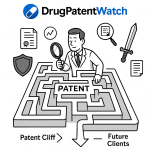
The patent cliff arriving between 2026 and 2030 makes this knowledge commercially urgent. Between 2025 and 2030, more than $300 billion in prescription drug revenues will lose patent exclusivity — about one-sixth of the industry’s annual revenue. Nearly 200 drugs will see their patents expire in this window, including about 70 blockbusters generating over $1 billion each in annual sales. Every one of those expirations represents an entry opportunity. The companies that move quickly and correctly will capture first-mover positions in multibillion-dollar generic and biosimilar markets. The companies that move without adequate FTO will be stopped at the courthouse door.
Part I: What FTO Actually Is — and What It Is Not
The Precise Legal Definition
Freedom to Operate (FTO) is the determination that a planned commercial activity — specifically the development, manufacture, and sale of a product — can proceed in a defined jurisdiction without infringing the valid and enforceable intellectual property rights of a third party. For pharmaceutical companies, this means a systematic investigation of the patent landscape to confirm a new drug does not fall within the scope of active third-party patent claims. The question FTO answers is not whether you can invent something, but whether you can sell it without getting sued.
That last sentence is the one most executives in non-IP roles misread. Patentability and freedom to operate are legally distinct questions, and confusing them is expensive. A molecule can be novel, clinically active, and patentable in its own right, and still infringe an underlying compound or formulation patent held by a competitor.
The standard analogy in pharmaceutical IP circles works: patentability is like obtaining a deed to a new piece of land. FTO is about confirming you have the right to travel the roads that lead to it. You can own the land and still lack a legal right of passage.
The Four Things FTO Does Not Cover
FTO analysis also does not address trade secret infringement, regulatory data exclusivity periods, antitrust exposure from pay-for-delay agreements, or contractual obligations from prior collaboration agreements. All four of those can block market entry independently of patent status. True commercial clearance requires a coordinated assessment across all four vectors, and the regulatory exclusivity question is where pharmaceutical practitioners most frequently leave risk on the table.
Each of those deserves a sentence of its own.
Trade secret claims can arise when a formulation scientist moves between companies, taking knowledge of proprietary processes. Courts have granted injunctions based on trade secret misappropriation even where no patent was infringed. Regulatory exclusivity — five-year NCE protection, three-year new clinical investigation exclusivity, twelve-year biologic exclusivity — is a separate legal barrier that delays FDA approval regardless of patent status. A product can be fully patent-clear and still be blocked from FDA approval for years. Pay-for-delay exposure arises when settlement terms between brand and generic manufacturers raise antitrust scrutiny under FTC v. Actavis, 570 U.S. 136 (2013). And existing collaboration agreements — particularly out-licensing arrangements signed during early-stage development — frequently contain field-of-use restrictions and right-of-first-refusal clauses that can create contractual bars on commercialization. A complete commercial clearance review touches all four.
FTO vs. Patent Clearance vs. Patent Landscape: The Distinction Matters
These three terms are used interchangeably in casual conversation and should not be. A patent landscape is a broad survey of all patenting activity in a technology area — useful for strategic planning and identifying competitor R&D trends, not for making a specific commercialization decision. Patent clearance (also called a clearance opinion) is a formal legal conclusion about whether a specific product, in a specific form, in a specific jurisdiction, infringes any valid and enforceable claim. FTO analysis is the process that produces a clearance opinion. You do a landscape to understand the territory. You do FTO to decide whether you can cross it.
The distinction matters because each task consumes different resources, has different evidentiary weight in litigation, and needs different personnel. A landscape search is often appropriate at Phase I or early Phase II to help select candidate compounds and design-around strategies. A formal clearance opinion from a registered patent attorney is what courts and due diligence reviewers scrutinize when the money is actually on the table.
Part II: Timing — When to Start FTO and Why Most Companies Start Too Late
The Investment Trap
The single most common FTO failure mode in pharmaceutical development is not conducting a flawed analysis. It is delaying the analysis until enough capital has been committed that commercial pressure distorts the conclusions.
When an FTO is commissioned after $20 million in CMC work is complete, there is a powerful organizational incentive to interpret ambiguous claims narrowly, to weight non-infringement arguments more favorably than they deserve, and to downgrade the significance of potentially blocking patents. The analyst’s independence erodes under commercial pressure even when no one is explicitly asking them to shade the opinion.
The answer is to start earlier. An initial FTO screen — what practitioners call a preliminary or first-pass FTO — should happen at the candidate selection stage, before significant capital is committed. That preliminary work does not need to be exhaustive; its purpose is to identify obvious blocking patents quickly and flag them before sunk-cost dynamics take over. A thorough FTO involves defining the scope of the analysis by both geography and product attributes, identifying all relevant patents, and assessing the risk posed by each one. This analysis should be initiated at the earliest possible stage of development to avoid investing significant resources in a product that cannot be legally marketed.
The Staged FTO Model
Sophisticated pharmaceutical IP programs use staged FTO reviews that correspond to development decision points:
Pre-IND / Candidate Selection: First-pass FTO on compound patents and composition claims. Scope is intentionally narrow: does any in-force claim cover this specific molecule or a structurally obvious variant? The goal is to screen out fatal blockers before process development begins.
IND Filing / Phase I Entry: Expanded FTO that adds formulation patents, manufacturing process patents, and method-of-use claims for the target indication. This is also when the FTO team should begin monitoring competitor patent applications — published applications represent pending claims that may not be in force yet but will need to be addressed before commercial launch.
Phase II / Go/No-Go on Late-Stage Investment: Comprehensive FTO opinion covering all patent categories, all relevant jurisdictions in the commercial plan, and a full claim chart analysis for any identified blocking patents. This is the opinion that a licensor, acquirer, or co-development partner will scrutinize in due diligence. It needs to be defensible and comprehensive.
NDA/ANDA Filing: Final pre-commercial FTO update that checks for any newly issued patents or newly published applications since the Phase II opinion. In the United States, this includes a fresh search of the Orange Book for any new listings and a review of recent PTAB decisions that may have invalidated or narrowed blocking claims.
Post-Launch Monitoring: FTO is not a one-time event. New patents issue continuously, and a patent that was not relevant to the initial launch product may become relevant if the company expands into new indications, new dosage forms, or new geographic markets. Ongoing monitoring — ideally using a platform that tracks new issuances and patent assignments in the relevant technology space — is standard practice in programs with significant commercial exposure.
The ‘Comfortable Window’ That Does Not Exist
Some development teams operate on the implicit assumption that they can wait for FDA approval before commissioning a serious FTO. The thinking: why spend money on a patent analysis before you know the drug works? This logic is understandable and wrong.
By the time a drug reaches NDA review — roughly ten years and $1–2 billion after the original discovery investment for a novel compound — the cost of identifying a fatal blocking patent is catastrophically high. The alternatives are equally bad: you can challenge the patent in an inter partes review (IPR) at PTAB, negotiate a license, or attempt a design-around, but each of those paths takes years and millions of dollars that the original FTO investment would have made unnecessary. Early FTO is not cautious conservatism. It is standard commercial practice.
Part III: Scoping the Analysis — The Decisions That Determine Everything
The Four Dimensions of FTO Scope
Every FTO analysis requires four threshold decisions before the first search query runs:
1. Product Scope. What, exactly, are you seeking clearance for? The active pharmaceutical ingredient in its specific form? The finished dosage form? The manufacturing process? The method of use in a specific indication? Each of these is a legally distinct object of analysis, and each may be covered by a different patent or set of patents. The FTO team cannot run a meaningful analysis without a precise technical definition of the product they are evaluating. Vague scope is the second most common FTO failure mode; it produces opinions that look comprehensive but leave large gaps.
2. Geographic Scope. IP laws can still be a giant mess. Patent rights only count in a country or a region, and outside of them you have the freedom to operate to do whatever you want. A patent granted by the USPTO covers the United States. It does not cover Germany, Japan, or Brazil. A U.S.-clear product can still be blocked in every other major market. The commercial plan needs to specify the relevant markets before the FTO scope is defined. For a product targeting global launch, the minimum relevant jurisdictions are typically the United States, the European Union (or the major EU national jurisdictions — Germany, France, the UK, and Italy account for a large majority of EU pharmaceutical revenue), Japan, and either Canada or Australia. Programs with significant emerging-market ambitions need to add those jurisdictions explicitly.
3. Temporal Scope. Since only live patents may affect FTO, a time period of the past 20 years is ordinarily used for searching patents. For pharmaceutical patents, an additional 5 years can be added to the time period considering patent term extension or supplementary protection certificate provided to orphan drug patents. The U.S. patent term is 20 years from filing, extendable by up to 5 years under patent term extension (PTE) for FDA regulatory delay — making some pharmaceutical patents effectively enforceable for up to 25 years from filing. European Supplementary Protection Certificates (SPCs) provide comparable extensions. Any FTO that ignores extended terms will miss blocking patents that appear nominally expired.
4. Claim Type Scope. Only granted patents are searched for an FTO since only patent claims affect FTO. Hence, non-patent documents are not considered for FTO. The compound itself must be considered: crystalline form, amorphous form, enantiomers, metabolites or prodrugs. Pharmaceutical composition types such as delivery systems, vehicles, adjuvants must also be considered. The methods, steps and components involved in the product synthesis are also critical: steps and the reagents and techniques that compose each step, intermediates, reagents, purification techniques and protocols, handling techniques and procedures.
The Product Deconstruction Checklist
Before running a single search, the FTO team and the lead scientist should work through a product deconstruction exercise. For a small-molecule oral drug, the checklist looks roughly like this:
API compound (free base, salt forms, specific polymorphs, amorphous form, hydrates, solvates)
Enantiomers, racemates, and specific stereoisomers
Dosage form (tablet, capsule, liquid, injectable, topical)
Manufacturing process (synthesis route, specific steps, purification methods, intermediates, reagents)
Method of use in each target indication
Dosage regimen (specific dose, dosing interval, route of administration)
Drug-device combination, if applicable (autoinjector, inhaler, patch)
Packaging and container closure system, if relevant
Each item on that list is an independent FTO vector. A patent claim covering one item does not cover the others, but missing any item means leaving risk unchecked. For biologics, the list expands significantly: cell line, expression system, purification process, glycosylation pattern, biosimilar characterization methods, and in some cases the formulation patents covering stabilizers and buffering agents are each independent patent targets.
Part IV: The Search — Building a Patent Landscape That Actually Finds Blocking Claims
Why Keyword Search Alone Is Not Enough
The most common technical failure in pharmaceutical FTO is relying on keyword searches without cross-referencing by chemical structure, IPC/CPC classification codes, and patent family data. Keyword searches miss patents whose claims use different terminology for the same compound or process. A patent claiming ‘the compound of Formula I wherein R is selected from the group consisting of…’ will not appear in a keyword search for the drug’s generic name or brand name.
A competent pharmaceutical FTO search runs on at least three independent axes, then cross-references the results:
Chemical structure search. Tools like SciFinder, Reaxys, and STN allow searching by structure and substructure, identifying patents that claim the compound itself or structurally similar compounds without naming it. This is mandatory for any new compound FTO, and it is the axis that keyword searchers most commonly skip.
Classification code search. The USPTO’s Cooperative Patent Classification (CPC) and the European Patent Office’s International Patent Classification (IPC) assign numeric codes to every patent by technology area. A search on the appropriate CPC/IPC codes for the relevant drug class, delivery mechanism, and therapeutic area will surface patents that would never appear in a keyword search.
Text keyword search. Even with structure and classification searches, keyword searches on the generic name, brand name, synonyms, IUPAC name, CAS number, and relevant mechanism of action terms are necessary to catch patents that discuss the compound without claiming it by structure — including method-of-use patents.
The three axes will produce overlapping results. That overlap is a quality check; gaps between the axes signal search terms that need refinement.
The Primary Search Databases
For U.S. FTO, the starting databases are:
USPTO Patent Full-Text Database. Full text search of issued U.S. patents and published applications. Mandatory, but the interface is rudimentary for complex pharmaceutical searches.
Google Patents. Useful for rapid preliminary searching and for identifying patent families across jurisdictions. The ‘Prior Art Finder’ feature is useful for mapping related documents.
Espacenet (EPO). The European Patent Office’s database covers patents from more than 100 countries and is the primary tool for mapping international patent families.
DrugPatentWatch. A specialized pharmaceutical patent intelligence platform that links patents directly to FDA Orange Book listings, ANDA filings, Paragraph IV certification history, and patent litigation records. DrugPatentWatch is particularly valuable for identifying the complete patent family around a reference listed drug, mapping all Orange Book-listed and non-listed patents for a product, and tracking the litigation history around specific patents — critical intelligence for assessing which patents have been challenged and survived versus those that were never contested.
FDA Orange Book. For U.S. market FTO on a product with an existing branded reference, the Orange Book is mandatory reading. It lists all patents the brand manufacturer has submitted as covering the approved product. Orange Book listings do not capture process patents, device patents, or any patent the brand chose not to list — so the Orange Book is the start of the search, not the end.
The FDA Orange Book is the mandatory starting point for U.S. FTO analysis of small molecules. Innovators are required to list all patents covering the approved drug product — the compound, formulation, and method-of-use patents — in the Orange Book. A Paragraph IV certification (the generic’s legal assertion that listed Orange Book patents are invalid or not infringed) is the formal trigger for Hatch-Waxman patent litigation. However, Orange Book listings are not comprehensive FTO coverage: process patents and device component patents are typically not Orange Book-listed but can still block manufacturing or sale.
The European and Japanese Equivalents
In Europe, no single ‘orange book’ equivalent exists. The European patent landscape for a drug product requires parallel searches of the European Patent Register, individual national patent registers for key EU markets, and the SPC databases maintained by national patent offices. A European patent granted by the EPO may have individual national validations in different EU states, and the enforceability and claim scope of the same granted patent can vary by national validation. This means a product can be clear in Germany while blocked in France under what started as the same European patent application. The EU is moving toward a Unitary Patent system, but adoption is gradual and the national validation structure remains dominant for the patent portfolios most relevant to current FTO work.
In Japan, the Japan Platform for Patent Information (J-PlatPat) is the primary search tool. Japanese pharmaceutical patents are notable for their use of Markush structures in compound claims — broad genus claims that can read on specific species without explicitly naming them. Japanese Markush claims are a frequent source of missed blockers in FTO analyses conducted by teams without experience in the Japanese patent system.
Published Patent Applications: The Forward-Looking Risk
Published patent applications are not yet granted and cannot currently be infringed. But they represent what a competitor is trying to patent, and a pending application that issues before commercial launch will become an active blocking patent at the moment it grants.
Best practice is to include published applications in the FTO search with a risk-tiering notation: distinguish clearly between in-force granted patents and pending applications, assess the likelihood that the pending claims will be allowed as filed or in a significantly narrowed form, and note the expected grant timeline. For a product with a 36-month development timeline, any pending application in the relevant space is a material risk that needs active monitoring.
Part V: Claim Analysis — Reading the Patent the Right Way
Only Claims Matter
The most consequential principle in FTO analysis, and the one most commonly misapplied by non-attorneys, is this: only the patent claims determine the scope of the patent right. The title, the abstract, the summary, the detailed description, and the drawings are all context — they cannot expand or contract what the claims say, and they cannot be infringed.
Only claims matter for FTO. Statements made elsewhere in a patent document are of no concern unless covered by a formal claim in the claims section, even though they may compromise novelty for your own patenting.
This principle has a practical consequence: reading the abstract and concluding the patent is ‘about’ something similar to your product is not a claim analysis. It is not even close. A patent abstract can describe a broad conceptual framework while the actual claims are narrow species claims that read on a completely different technology. The reverse is equally common: a narrowly titled patent in a seemingly unrelated field can contain broad independent claims that cover a technology area far beyond what the title suggests. Read the claims. Read all of them — independent claims and dependent claims both.
The Anatomy of a Claim Analysis
For each potentially relevant patent identified in the search phase, the FTO analyst conducts a claim-by-claim analysis. The standard structure:
Step 1: Identify independent claims. Independent claims stand alone without reference to other claims. They define the broadest scope of protection. If a product does not fall within any independent claim, it does not infringe that patent — full stop.
Step 2: Parse each element of the independent claims. Patent claims are written as a preamble plus a series of elements. For a product to infringe a claim, every element of the claim must be present in the accused product, process, or use (this is the ‘all elements rule’). If even one element is absent, there is no literal infringement of that claim. This parsing step must be done element-by-element, with the product’s technical specifications mapped against each claim element.
Step 3: Apply the doctrine of equivalents. Even if a product does not literally meet every claim element, it may still infringe under the doctrine of equivalents if the accused element performs the same function, in the same way, to achieve the same result as the claimed element. Doctrine-of-equivalents analysis is where FTO opinions most often get contested in litigation, and where competent patent counsel is non-negotiable. The doctrine of equivalents is not an unlimited expansion of claim scope; prosecution history estoppel limits its application based on amendments made during patent prosecution.
Step 4: Analyze the prosecution history. The prosecution history (also called the file wrapper) is the complete record of communications between the applicant and the patent examiner during prosecution. Applicants who narrow their claims during prosecution to overcome prior art rejections are estopped from later arguing that the doctrine of equivalents extends back to the scope they surrendered. A product that sits in the surrendered territory is typically safe from doctrine-of-equivalents infringement. Reading the prosecution history is mandatory for any patent that survives Step 2 with a non-infringement conclusion that relies on claim construction rather than literal absence of an element.
Step 5: Assess validity. An FTO opinion that concludes a patent is not infringed is complete. But where infringement cannot be ruled out, the next question is validity. An invalid patent cannot be infringed — there is nothing to infringe. Validity challenges focus on prior art (anticipation under 35 U.S.C. § 102 and obviousness under § 103), written description and enablement (35 U.S.C. § 112), and, for claims to biological targets, the additional enablement requirement reinforced in Amgen Inc. v. Sanofi, 598 U.S. 594 (2023).
Claim Types in Pharmaceutical Patents: A Practical Guide
Pharmaceutical patents use a distinct vocabulary of claim types, and the FTO analyst needs to know how each type applies to a development program:
Composition claims cover the compound itself — the API in a specific structural form, or a pharmaceutical composition comprising the API and one or more excipients. These are the broadest and most economically valuable patent claims. A composition claim covering the API is a blocking patent regardless of what you do with the compound: make it, sell it, use it.
Method-of-use claims cover the use of a compound to treat a specific condition, in a specific patient population, at a specific dose, or via a specific route. These claims are narrower than composition claims. A generic manufacturer can obtain clearance from method-of-use patents by using a ‘skinny label’ — an FDA-approved label that carves out the patented indication and covers only unpatented uses. The skinny label defense has been actively litigated in recent years, and its scope is not unlimited; the leading case is GlaxoSmithKline LLC v. Teva Pharmaceuticals USA, Inc., which created significant uncertainty about when skinny labels are legally sufficient.
Formulation patents cover the pharmaceutical composition in a specific dosage form: an extended-release tablet, a specific particle size range, a pH-adjusted aqueous solution, a liposomal formulation. These are secondary patents that innovators use to extend commercial exclusivity after the primary compound patent expires. They are also the category most commonly missed in FTO analyses focused on the API rather than the finished product.
Process patents cover the method of manufacturing the API or the finished product. They do not appear in the FDA Orange Book and are therefore systematically missed by analysts who rely on Orange Book searches. A product that is fully clear on compound, formulation, and method-of-use claims can still infringe a process patent covering the synthetic route. Under 35 U.S.C. § 271(g), importing a product made by a patented process can constitute infringement in the United States even if the manufacturing took place outside U.S. territory. This matters enormously for generic manufacturers sourcing API from India or China.
Drug-device combination patents cover the delivery device: autoinjectors, inhalers, transdermal patches, implantable systems. AbbVie’s defense of Humira’s injectable format included device patents covering the specific autoinjector design that many patients preferred. A biosimilar with cleared compound and formulation patents could still face litigation over the device if the device design was not independently cleared.
Part VI: The Risk Triage Matrix — Turning Analysis into Decisions
From Findings to Risk Ratings
The output of claim analysis is a set of findings: patents that, on the basis of the claim analysis, present varying degrees of infringement risk. The FTO analyst needs to translate those findings into a risk rating that a business team can act on.
A standard four-tier risk framework:
Tier 1: No Infringement — Clearance Confirmed. No in-force patent claim reads on the product as defined. The FTO opinion can conclude clearance for this product vector. This conclusion needs to be revisited at each stage of development as the product specification is refined.
Tier 2: Non-Infringement Analysis Required. One or more claims are potentially relevant but can be analyzed out on the basis of literal non-infringement or prosecution history estoppel. This tier requires a detailed claim chart and prosecution history analysis. A written opinion from a qualified patent attorney is needed. Good-faith reliance on this opinion is the primary defense against willful infringement findings if litigation follows.
Tier 3: Validity Challenge Required. One or more claims appear to read on the product but are potentially invalid based on prior art or other grounds. The FTO opinion notes the specific invalidity arguments, assesses their strength, and gives the business team a probability-weighted view of the risk. This is also the tier that informs IPR petition strategy if the company decides to proactively challenge the patent at PTAB.
Tier 4: Blocking Patent — Material Risk. One or more claims appear to read on the product, validity arguments are weak, and a design-around is not feasible without changing the product in commercially significant ways. This tier triggers a strategic-level discussion: seek a license, redesign the product, abandon this product in this jurisdiction, or factor the litigation risk into the investment decision.
The Role of a Written Opinion in Litigation
A formal, written FTO opinion prepared by a qualified patent attorney is the primary evidentiary defense against a willful infringement finding. The opinion documents the company’s good-faith belief that it was not infringing before it launched its product. Courts have consistently held that a company that sought and relied upon competent legal advice prior to commercialization is far less likely to face an enhanced damages award under 35 U.S.C. §284.
The enhanced damages risk is real. Under 35 U.S.C. § 284, willful infringement allows courts to award up to three times actual damages. In a pharmaceutical context where the actual damages from lost brand sales can be in the hundreds of millions, treble damages is an existential exposure. The FTO opinion is the primary evidence that the company acted in good faith — and thus should not face the willful infringement multiplier.
The opinion must be from a qualified professional — ideally an attorney with both technical expertise in the relevant science and litigation experience in the relevant jurisdiction. The credibility of the opinion author matters in court. An opinion from a general practitioner with no pharmaceutical background carries less weight than one from a registered patent attorney who has litigated ANDA cases or Hatch-Waxman disputes.
The opinion letter must be written, dated, and comprehensive. Oral opinions have no evidentiary weight. The opinion should identify the patents searched, the methodology used, the claim analysis for each identified potentially relevant patent, and a clear legal conclusion. It should also disclose its limitations: the patents that were not searched, the jurisdictions not covered, and any aspects of the product that were assumed but not confirmed by the analyst.
Part VII: The Hatch-Waxman Framework — FTO Under the ANDA System
How Hatch-Waxman Changes the FTO Calculus
The Drug Price Competition and Patent Term Restoration Act of 1984 (Hatch-Waxman) created a unique legal environment in which FTO analysis intersects directly with the regulatory approval pathway. Understanding the Hatch-Waxman framework is not optional for any FTO professional working on small-molecule generics in the United States.
A Paragraph IV certification treats a generic’s legal assertion that Orange Book-listed patents are invalid or not infringed as a permissible act of infringement that the brand manufacturer may challenge in court within 45 days of filing. This is an unusual legal construct: the act of filing a regulatory document — the ANDA — constitutes technical patent infringement before a single tablet is manufactured. The purpose is to allow patent disputes to be resolved in court before the generic product enters the market, rather than after.
The consequence for FTO analysis is that the Paragraph IV certification letter is, in effect, a published FTO opinion. The ANDA applicant must provide the patent holder with a detailed statement of the factual and legal basis for the conclusion that the listed patents are either invalid or not infringed. The Notice Letter must include a detailed statement of the factual and legal bases for the applicant’s opinion that the listed patent will not be infringed and/or is invalid or unenforceable.
The 30-Month Stay Mechanism
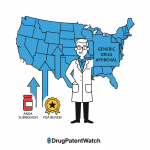
When a brand manufacturer receives a Paragraph IV notice letter and files an infringement suit within 45 days, an automatic 30-month stay of FDA approval kicks in. The generic cannot receive final FDA approval until either the 30-month period expires or the court rules in the generic’s favor, whichever comes first. For NDA products that have been deemed New Chemical Entities by FDA, the 30-month stay will actually extend for a longer period of time, approximately 40 months, arising from a quirk in the five-year regulatory exclusivity for NCE products.
From an FTO perspective, this mechanism means that the timeline from ANDA filing to commercial availability is not just a function of FDA review speed — it is heavily dependent on litigation scheduling, settlement negotiations, and court docket congestion. An ANDA filer should model the most likely litigation timeline into the commercial plan from day one, not as an afterthought.
The 180-Day Exclusivity Prize
The Hatch-Waxman Act awards 180 days of marketing exclusivity to the first ANDA filer who successfully challenges an Orange Book-listed patent with a Paragraph IV certification. The first applicant to file a substantially complete ANDA containing a paragraph IV certification to a listed patent will be eligible for a 180-day period of exclusivity beginning either from the date it begins commercial marketing, or from the date of a court decision finding the patent invalid, unenforceable, or not infringed, whichever is first.
This prize is the commercial engine that drives generic patent challenges. In a high-revenue drug market, 180 days of effective monopoly on the generic can be worth hundreds of millions of dollars. For Lipitor (atorvastatin), the first generic filer earned over $600 million in that window before additional generics could enter. That economic incentive is why FTO work for large generic manufacturers is not merely defensive — it is a revenue-generating activity when conducted aggressively and successfully.
Orange Book-Listed vs. Non-Listed Patents
The Hatch-Waxman Paragraph IV mechanism applies only to Orange Book-listed patents. But as noted earlier, not all patents covering a pharmaceutical product are Orange Book-listed. Process patents are virtually never listed. Device patents for combination products are frequently not listed. Some formulation patents are listed; others covering non-approved dosage forms or methods are not.
Non-listed patents remain blocking patents that can support infringement litigation after launch. The Hatch-Waxman stay mechanism does not apply to them — the generic can receive FDA approval but still face an injunction based on a non-listed process patent. This gap is well-known in the industry and is a specific area where DrugPatentWatch’s cross-referencing of listed and non-listed patents against product portfolios provides practical intelligence that a raw USPTO search alone cannot efficiently generate.
Part VIII: The Biologics Pathway — FTO Under the BPCIA
A Different Legal Framework
The Biologics Price Competition and Innovation Act of 2010 (BPCIA) created an approval pathway for biosimilars analogous to what Hatch-Waxman did for small-molecule generics. But the legal structure is meaningfully different, and the FTO implications for biosimilar developers are substantially more complex.
Under Hatch-Waxman, the brand manufacturer is required to list all relevant compound, formulation, and method-of-use patents in the Orange Book. The generic developer knows, at minimum, which patents are ‘on the table.’ Under the BPCIA, the brand manufacturer has no equivalent listing obligation — there is no biosimilar Orange Book. The BPCIA’s ‘patent dance’ (a structured information-exchange process between the biosimilar applicant and the reference product sponsor) is designed to surface relevant patents, but it has been litigated extensively, and many brand manufacturers have chosen to bypass parts of the dance rather than engage in the full exchange.
The result is that a biosimilar developer commencing FTO work cannot assume the brand manufacturer’s patent estate is knowable without comprehensive searching. Every relevant patent the brand holds — compound, formulation, manufacturing process, cell line, purification, method of use for each indication — needs to be found through independent searching.
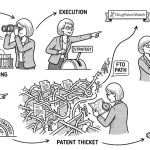
Patent Thickets and What They Mean for FTO
Research has found that biosimilar developers in the United States face simultaneous litigation on anywhere from 11 to 65 patents per reference product, a number that dramatically exceeds the complexity of small-molecule Hatch-Waxman litigation, where the average contested patent count is typically in the single digits.
AbbVie was able to assert over 60 patents against a single biosimilar challenger, a scale of litigation that would be procedurally difficult, if not impossible, under the Hatch-Waxman framework. AbbVie accumulated over 130 U.S. patents on Humira covering the molecule, formulation, manufacturing process, methods of use for different indications, and high-concentration subcutaneous formulation variants. Biosimilar manufacturers were able to expedite their launches to 2023 — 11 years prior to brand patent expiration — due to patent settlements. Without settlements, biosimilar manufacturers simply could not have navigated the 136-patent estate owned by AbbVie and achieved successful entry across the board.
The Humira situation is instructive for anyone doing biosimilar FTO: the commercial question is not simply ‘does my product infringe any of these patents?’ It is ‘which patents can I clear, which can I challenge, and at what cost does it make more economic sense to settle for a deferred-entry license than to litigate through the thicket?’ The FTO analysis is the foundation for that economic calculation, but it is insufficient alone without a strategy for what to do with each tier of risk. <blockquote> ‘An independent analysis by legal and scientific experts concluded that approximately 80% of the patents in Humira’s U.S. portfolio were secondary patents filed after the drug was already on the market.’ — DrugPatentWatch, The Thicket Maze: A Strategic Guide to Navigating and Dismantling Drug Patent Fortresses (2025) </blockquote>
That figure defines the nature of the problem. The majority of the blocking estate was not the foundational science — it was strategic IP accumulation designed to extend commercial exclusivity past any single patent’s expiration. FTO analysis in the biologic space must account for this reality.
The BPCIA Patent Dance in Practice
Under the BPCIA, once a biosimilar application is filed, the applicant must disclose its application and manufacturing process information to the reference product sponsor. The sponsor then identifies patents it believes could be infringed. The parties are supposed to engage in structured negotiations about which patents to litigate. In practice, approximately 67% of terminated BPCIA litigations end in settlements or stipulated voluntary dismissals rather than full judicial resolution. These settlements often involve delayed launch dates for biosimilars, a pragmatic approach to mitigate the risks and costs of protracted litigation.
The ‘patent dance’ was intended to streamline biosimilar patent disputes. Its practical effect has been to create a negotiation framework that brand manufacturers often use to secure delayed entry licenses rather than to provide meaningful acceleration toward unencumbered launch. Biosimilar FTO work must account for this: the realistic commercial timeline is often determined more by settlement negotiation strategy than by the underlying legal merits of the patent claims.
Part IX: Regulatory Exclusivity — The Non-Patent Barrier FTO Misses
The Exclusivity Table
FTO analysis does not address regulatory data exclusivity periods. Regulatory exclusivity is where pharmaceutical practitioners most frequently leave risk on the table.
The FDA grants several forms of regulatory exclusivity independent of patent status. Each can block generic or biosimilar entry regardless of FTO conclusions:
New Chemical Entity (NCE) Exclusivity: Five years from approval date for drugs approved under an NDA for a new molecular entity. During this period, FDA cannot accept an ANDA or 505(b)(2) application for the same drug — with a limited exception allowing Paragraph IV-certifying ANDAs to be filed one year before the five-year period ends. This means even a patent-clear generic cannot receive FDA approval until NCE exclusivity expires.
New Clinical Investigation Exclusivity: Three years for approved changes to an existing drug (new indications, new dosage forms, new routes of administration) backed by new clinical investigations. Commonly called the 3-year exclusivity, it blocks follow-on ANDAs for the specific condition of approval.
Pediatric Exclusivity: Six months of additional exclusivity added to any existing patent or exclusivity when the brand manufacturer completes FDA-requested pediatric studies. This extension applies automatically to all formulations and routes of administration for the drug.
Orphan Drug Exclusivity: Seven years from approval for drugs designated as treating rare diseases affecting fewer than 200,000 U.S. patients. A product can have expired compound patents and still be protected from generic entry for seven years under orphan exclusivity if the original approval was under an orphan designation.
Biologic Exclusivity: Twelve years of data exclusivity from approval of a reference biologic, plus four years of additional protection against FDA accepting a biosimilar application. This means a biologic can be patent-clear but still blocked from biosimilar competition for up to twelve years from the reference product’s first approval.
Exclusivity and FTO: The Integration Problem
A proper commercial clearance analysis for a pharmaceutical product integrates FTO findings with a parallel exclusivity review. The sequence matters: in many cases, a product can be patent-clear but commercially blocked for years due to unexpired exclusivity, making the patent clearance economically irrelevant to the near-term commercialization decision. In those cases, the FTO investment should be made in advance of exclusivity expiry, not held until the exclusivity period ends.
The converse is equally important: a product with a blocking patent can sometimes be commercially viable if the exclusivity period expiring creates a market entry window before the patent barrier can be effectively enforced. This is relevant primarily for 505(b)(2) applications and for generic products where the exclusivity expiry is imminent and the patent challenge strategy is well-advanced.
Part X: Design-Around Strategies — What FTO Analysis Enables
When ‘Not Clear’ Is Not the End
A Tier 3 or Tier 4 risk finding from an FTO analysis is not automatically fatal to a program. It is the beginning of a design-around analysis: a systematic evaluation of whether the product can be modified to take it outside the scope of the blocking claim without sacrificing commercial viability.
Design-around strategies in pharmaceuticals fall into several categories:
Structural Modification. If the blocking claim covers a specific compound, would a structurally modified analog perform comparably while falling outside the claim scope? This is most viable when the claim covers a specific species within a genus and the activity is not strictly dependent on the exact structure claimed. It is less viable — often non-viable — when the blocking claim uses Markush structure language broad enough to cover the modified analog as well.
Polymorph Selection. Formulation patents often claim specific polymorphs or crystal forms. If the blocking claim covers Form I and Form II of the same API, manufacturing in an amorphous or alternative crystalline form can create non-infringement if the amorphous or alternative form performs equivalently. This is not always feasible: many APIs have a single stable polymorphic form under practical manufacturing conditions, and forcing an alternative polymorph can compromise stability, bioavailability, or manufacturability.
Formulation Redesign. Blocking formulation patents often claim a specific range of excipient concentrations, specific pH ranges, specific particle size distributions, or specific release profiles. A formulation that meets clinical requirements with different excipient profiles can achieve non-infringement while maintaining therapeutic performance. This requires close coordination between the patent analyst and the formulation scientist — the analyst defines the boundaries the formulation must stay outside of; the scientist determines whether a clinically adequate product can be built within those boundaries.
Route of Synthesis Modification. If the blocking patent covers a specific process for manufacturing the API, an alternative synthetic route that does not use the claimed steps, reagents, or intermediates can achieve non-infringement. This is process patent design-around and is most common in generic API manufacturing, where Indian and Chinese contract manufacturers often develop alternative routes specifically to clear process patents held by the originator.
Indication Carve-Out. For method-of-use patents, the skinny label approach carves out the patented indication while seeking approval for unpatented uses. This is a well-established FTO tool under Hatch-Waxman, though its scope has been complicated by recent litigation. The skinny label approach requires careful FDA label negotiation and carries its own risk: generic manufacturers whose products are used off-label for the carved-out indication have faced contributory and induced infringement claims even where the label itself was carved.
Part XI: IPR Petitions as an FTO Tool
The PTAB Alternative
When a blocking patent cannot be designed around and the cost of licensing is commercially prohibitive, inter partes review (IPR) at the Patent Trial and Appeal Board (PTAB) is often the most efficient path to clearing it. An IPR petition challenges a granted patent on prior art grounds — anticipation or obviousness — and is conducted as an administrative trial before PTAB rather than in district court.
The advantages of IPR over district court invalidity challenges are substantial:
The prior art standard is applied by technically experienced PTAB judges rather than generalist district court judges and lay juries.
The IPR proceeding is significantly faster than district court litigation — typically reaching a final written decision within 18 months of institution.
The filing fee is modest relative to litigation costs (roughly $20,000 to $50,000 for the petition itself, though attorney preparation costs are higher).
Institution rates for pharmaceutical patents have historically been significant, particularly for secondary patents covering formulations, dosage regimens, and methods of use where the prior art base is dense.
The limitations matter too: IPR is limited to prior art challenges under §§ 102 and 103. Written description, enablement, and other §112 challenges must go to district court. IPR petitioners are estopped from raising in district court any ground they raised or reasonably could have raised in the IPR. And the Supreme Court in Thryv, Inc. v. Click-to-Call Technologies, LP, 140 S. Ct. 1367 (2020) and subsequent decisions has limited the reviewability of PTAB institution decisions, giving the PTAB substantial discretion to decline institution.
Integrating IPR Strategy into FTO Analysis
When FTO analysis identifies a Tier 3 or Tier 4 blocking patent, the FTO team should simultaneously assess IPR viability. That assessment asks: is there prior art that anticipates or renders obvious the blocking claims? Is the prior art in a form that PTAB will find compelling — preferably a published patent or printed publication that predates the priority date of the blocking patent? Is the petition achievable within the IPR one-year time bar (the petition must be filed within one year of being served with a complaint alleging infringement)?
The one-year bar is a critical timing constraint. A company that receives a Paragraph IV litigation complaint and delays commissioning an IPR petition will find the option foreclosed. The FTO analysis should always include an assessment of IPR viability for Tier 3 and 4 patents precisely so that, if litigation is initiated, the company can move immediately rather than spend the first months deciding whether IPR is appropriate.
Part XII: Using DrugPatentWatch for Pharmaceutical FTO
The Intelligence Gap in Standard Patent Searching
Standard patent databases — the USPTO, Espacenet, Google Patents — answer the question ‘which patents exist?’ DrugPatentWatch answers the much more commercially useful question: ‘which of those patents are actually enforced, which have been challenged, which have survived invalidity arguments, and which are covering a product that is currently generating revenue?’
For pharmaceutical FTO specifically, DrugPatentWatch integrates patent data with FDA regulatory data in ways that no general-purpose patent database does. The platform links every Orange Book patent listing directly to the corresponding NDA, the approval history, the ANDA filing history, the Paragraph IV certification history, and the litigation outcomes. This means a practitioner conducting FTO on a compound can immediately see not only which patents the brand manufacturer has listed, but which of those patents have been challenged by prior ANDA filers, what those challenges argued, and how courts and PTAB have ruled.
That prior challenge data is invaluable. A patent that has survived five Paragraph IV challenges and been upheld by the Federal Circuit is a materially different blocking risk than a patent that has never been challenged and whose claims have never been tested. DrugPatentWatch’s aggregation of this challenge and litigation history gives practitioners a risk calibration that standard patent searching cannot provide.
Patent Family Mapping and Continuation Tracking
One of the most practically dangerous scenarios in pharmaceutical FTO is missing a continuation patent — a child or grandchild application filed from the same priority document as the original patent, often with narrowed or differently structured claims that the applicant filed specifically to capture competitor products designed around the parent. Continuation patents have the same priority date as the parent but can issue years later with claims written in direct response to competitive design-around efforts.
DrugPatentWatch’s patent family mapping tools allow practitioners to see all continuations, continuations-in-part, and divisionals from a given priority application in a single view. For any blocking patent identified in the FTO search, mapping the complete family is mandatory: the blocking claim may be in a continuation, not in the original issued patent, and a search that stops at the parent will miss it.
Regulatory Exclusivity Integration
DrugPatentWatch aggregates Orange Book exclusivity data alongside patent listings, making it practical to conduct the integrated patent-plus-exclusivity analysis described in Part IX in a single workflow rather than switching between the Orange Book, the FDA approval database, and patent search tools. For a product with complex exclusivity layering — an NCE exclusivity running concurrently with a pediatric extension and multiple patent listings — this integration saves substantial time and reduces the risk of miscalculating the effective market exclusivity period.
Part XIII: International FTO — The Markets You Cannot Ignore
Why the U.S.-Only FTO Fails Commercial Reality
Most pharmaceutical products are launched in multiple markets. A drug approved by the FDA and the EMA with commercial ambitions in Japan, Canada, Brazil, and Australia needs FTO in each of those jurisdictions. Patent claims that do not block U.S. entry may block European entry, and vice versa. Process patents in India cover the API manufacturing that supplies the global generic industry. A U.S.-only FTO is not a commercial clearance — it is a partial picture with commercially dangerous gaps.
The international FTO process parallels the U.S. process but requires jurisdiction-specific expertise:
European Union: The European Patent Office grants unitary European patents, but enforcement has historically been jurisdiction-by-jurisdiction through national courts. Key markets — Germany, France, the UK, and Italy — each have their own case law on claim construction and infringement that can diverge significantly from the EPO’s own approach. The Unitary Patent and Unified Patent Court (UPC), operational since June 2023, is gradually changing this by creating a single enforcement mechanism for participating member states. FTO analysis for EU market entry now needs to address both the traditional national court landscape and UPC exposure for newly granted patents.
Japan: The Japanese patent system grants relatively broad claims in the pharmaceutical space, and Japanese courts have historically been less willing to invalidate pharmaceutical patents than U.S. courts. Japan also has a unique prior use defense that can be valuable in certain FTO scenarios. The Japan Patent Office’s examination of chemical and pharmaceutical patents uses different prior art citation practices than the USPTO, which can result in claims being granted in Japan that would have been rejected in the United States.
India: India’s Section 3(d) provision of the Patents Act, 1970 — upheld in Novartis AG v. Union of India, (2013) 6 SCC 1 — prohibits patents on new forms of known substances that do not demonstrate enhanced efficacy. This provision has substantially limited the scope of formulation and polymorph patents in India relative to the United States and Europe. For generic manufacturers sourcing API from India, this can work in their favor: the innovator’s formulation patent portfolio in India is often significantly narrower than in U.S. markets. For innovators, the same provision limits their ability to obtain secondary patent protection in India.
China: China’s pharmaceutical patent landscape has changed substantially in the past decade, driven by patent linkage reforms under the 2021 revision of the Drug Administration Law and the establishment of a pharmaceutical patent linkage system modeled loosely on Hatch-Waxman. The National Medical Products Administration (NMPA) now lists relevant drug patents in a Patent Information Registration Platform, and generic applicants must certify their product’s relationship to those listed patents. China’s CNIPA has also become more hospitable to pharmaceutical patents than it was a decade ago, with grant rates and claim scope closer to Western standards for novel compounds. FTO for China now requires the same systematic approach used for U.S. and EU markets.
Part XIV: Drug Repurposing — The FTO Complications of Known APIs
Why Repurposing FTO Is Harder Than It Looks
Drug repurposing — seeking new therapeutic uses for compounds with established safety and pharmacokinetic profiles — is commercially attractive because it shortens the development timeline and reduces clinical risk. The IP challenge is correspondingly more complex: a repurposed compound is, by definition, a known API, which means there are likely active patents somewhere in the landscape.
FTO is even more challenging in the context of drug repurposing, which by definition involves only known active pharmaceutical ingredients for which IP protection may still be in force. Drug development never takes place in a vacuum; it must navigate a complex matrix of existing intellectual property rights, of which patent rights are by far the most important. From an IP perspective alone, the purpose of an FTO analysis is to determine the ability to proceed with the research, development, and/or commercial production of a new product or process with minimal risk of infringing the unlicensed tangible IP rights of third parties.
For a repurposed compound, the FTO search must cover:
Original compound patents (still in force? What is the expiration date including any PTE?)
Formulation patents on existing approved forms
Method-of-use patents on existing indications — are they carved out or do they read broadly enough to cover new uses?
Any new method-of-use patents covering the new indication the repurposer is pursuing — has anyone already filed on the new indication?
Process patents on the API synthesis route
Any patents on the specific patient population, dosage regimen, or biomarker selection criteria for the new use
The last category is particularly important for precision medicine applications. A patent claiming ‘a method of treating NSCLC in patients with an EGFR exon 19 deletion comprising administering [compound X] at a dose of…’ can be entirely separate from any compound or formulation patent on [compound X] itself. If a repurposer identifies the same biomarker-defined population independently, the FTO must confirm that no one got there first.
Part XV: The FTO Opinion Letter — Drafting for Defensibility
What a Good Opinion Letter Contains
The FTO opinion letter is the document that, if litigation follows, will be scrutinized by the plaintiff’s counsel, the court, and potentially a jury. Its defensibility depends as much on its structure as on its substantive conclusions.
A well-structured pharmaceutical FTO opinion contains the following components:
Executive Summary. A concise statement of the product analyzed, the jurisdictions covered, the databases searched, the effective date of the opinion, and the overall FTO conclusion. The executive summary is what the board sees. It must be accurate and defensible in isolation — if the rest of the opinion is not read, the summary cannot misstate or oversimplify the underlying conclusion.
Scope Statement. An explicit definition of what was and was not analyzed. The product must be described precisely — specific compound form, specific formulation, specific indication, specific dosage regimen. The jurisdictions covered must be listed. The databases searched and the date ranges used must be disclosed. Importantly, the limitations of the analysis — what was not searched, what was assumed, what was not available — must be stated. An opinion that overstates its own comprehensiveness is a liability.
Search Methodology. A description of the search strategy: the databases accessed, the search terms used (keywords, structure searches, classification codes), the review process for managing results, and the methodology for selecting patents for detailed claim analysis. Courts have rejected FTO opinions as inadequate where the methodology was vague or clearly insufficient for the technology at issue.
Patent Analysis Section. The substantive core of the opinion: for each potentially relevant patent identified, a summary of the claims analyzed, the claim elements at issue, the claim chart mapping those elements to the product, the prosecution history review (where relevant), and the non-infringement conclusion or validity challenge analysis. This section is where the attorney’s technical and legal expertise is most visible.
Validity Analysis. For patents where the infringement analysis does not achieve clean non-infringement, a validity analysis identifies prior art and other grounds. The strength of the invalidity argument directly affects the overall risk rating.
Overall Conclusion. A clear, unambiguous statement of the FTO conclusion for each product vector in each jurisdiction. ‘The product as described does not, in our opinion, infringe any in-force patent claim in the jurisdictions analyzed’ — or the appropriate qualified equivalent where risks remain. No hedging. No burying the conclusion in qualifications. The conclusion must be readable.
Effective Date and Monitoring Recommendation. An FTO opinion is only current as of the date it is issued. New patents issue continuously. The opinion must state its effective date and recommend a monitoring schedule consistent with the product’s development timeline.
The Discoverability Question
FTO opinion letters are potentially discoverable in patent litigation. A company that obtains an opinion and then ignores it — commercially launching despite a Tier 4 blocking finding — has created a document that could actually worsen its litigation position. The opinion must either support the launch decision or prompt a change in strategy before launch. An opinion filed away and never acted upon is worse than no opinion.
The attorney-client privilege protects FTO opinions from disclosure in many circumstances, but the privilege can be waived if the company chooses to rely on the opinion as a defense to willfulness. The decision to waive is a tactical litigation choice, not a threshold compliance matter. Work with outside counsel to understand the waiver implications before the opinion is disclosed in any adversarial proceeding.
Part XVI: FTO in the Due Diligence Process — What Acquirers and Licensors Look For
The Investor Lens
An FTO opinion prepared for internal development planning purposes will be re-scrutinized under substantially higher standards when a potential acquirer or licensor reviews it as part of commercial due diligence. The investor’s question is not ‘does this opinion conclude freedom to operate?’ It is ‘can I rely on this opinion to make a $50 million investment decision?’
The gap between those two questions is significant. Investors focus on:
Opinion author credentials. Is the attorney or firm a recognized practitioner with pharmaceutical patent experience? Has the firm litigated Hatch-Waxman or BPCIA cases? An opinion from a two-partner general IP shop without pharmaceutical-specific experience will trigger immediate skepticism.
Completeness of patent family coverage. Does the opinion cover the complete patent family, including continuations and divisionals, or just the specific issued patent that appeared in the initial search? A single-patent analysis that misses a blocking continuation is a fundamental deficiency.
Methodology transparency. Can the due diligence reviewer understand exactly what was searched and what was not? Vague methodology descriptions signal either insufficient analysis or deliberate concealment of scope limitations.
Date of opinion. An opinion issued 24 months before the due diligence review, in a technology space with active prosecution activity, needs to be updated. Many due diligence standards treat any opinion older than 12 months as stale for purposes of primary reliance.
Identification of residual risks. A clean opinion that acknowledges no risk at all is often viewed as less credible than one that identifies risks and explains why they do not block commercialization. Sophisticated acquirers are alert to opinions that look comprehensive but fail to engage with the most commercially significant patents in the space.
FTO as a Term Sheet Factor
In pharmaceutical licensing transactions, FTO status directly affects commercial terms. A licensee taking on a product with a clean, comprehensive FTO opinion can typically negotiate lower upfront payments and royalty rates than one taking a product with material IP risk — because the IP risk is priced into the deal structure. Conversely, a licensor with strong FTO documentation can command premium terms. The ROI on a thorough FTO analysis extends beyond litigation protection into the economics of business development transactions.
Conclusion
The patent cliff bearing down on the industry between now and 2030 is not primarily a threat to established brands — they know their portfolios and have had years to prepare. It is primarily a challenge for the companies seeking to enter markets as those brands go off-patent. Getting the entry strategy right requires knowing exactly which patents block, which can be challenged, which have been cleared, and which are going to expire before the first tablet ships.
Freedom-to-operate analysis is the tool that answers those questions — not once, not at the moment of ANDA filing, but as an ongoing intelligence discipline integrated into every stage of development. The companies that build FTO capability as an institutional function rather than a one-time legal expense are the ones that will make faster, better-calibrated investment decisions as hundreds of billions in brand revenue becomes available to the first generic and biosimilar entrant who gets clearance right.
The cost of doing it correctly is measured in tens of thousands to hundreds of thousands of dollars. The cost of infringement — damages that can exceed $100 million, plus injunctions halting sales — is measured in orders of magnitude more. The math is not complicated.
Key Takeaways
Freedom-to-operate analysis determines whether you can sell a product without infringing third-party patents — it does not determine whether your product is patentable, and it does not cover regulatory exclusivity, trade secrets, antitrust exposure, or contractual restrictions.
FTO analysis is most valuable — and cheapest — when conducted early. Pre-IND, preliminary FTO screening prevents the sunk-cost distortion that corrupts analysis done late in development.
Every pharmaceutical FTO must cover four independent IP vectors: the API compound, the formulation, the manufacturing process, and the method of use. Covering only the API and missing a blocking process patent is a complete failure.
The Orange Book is the starting point for U.S. small-molecule FTO, not the ending point. Process patents and device patents are not Orange Book-listed and require independent searching.
Biosimilar FTO is structurally more complex than small-molecule FTO — patent thickets with 50 to 130 patents per reference product are not the exception; they are the norm for major biologics.
A written FTO opinion from a qualified patent attorney is the primary defense against treble damages under 35 U.S.C. §284. It is not optional for any commercially significant launch.
Regulatory exclusivity — NCE, biologic, orphan, pediatric — can block market entry independently of patent status. An integrated patent-plus-exclusivity review is the correct standard for commercial clearance.
IPR petitions at PTAB are a viable and often cost-effective tool for clearing Tier 3 and Tier 4 blocking patents, but the one-year time bar from receipt of a complaint makes pre-launch IPR strategy planning essential.
DrugPatentWatch provides pharmaceutical-specific patent intelligence that standard patent databases do not — linking Orange Book listings, ANDA challenge history, litigation outcomes, and patent family data in a single workflow.
Frequently Asked Questions
Q1: How is an FTO analysis different from a patentability search, and why does the difference matter commercially?
A patentability search asks whether your invention is novel and non-obvious enough to be granted a patent. An FTO analysis asks whether you can commercialize a product without infringing someone else’s existing patent. The searches overlap — both involve searching existing patents — but the analytical framework and legal conclusions are entirely different. You can have strong patentability on a new formulation while being blocked by an underlying compound patent. You can have no patentable invention at all and still have complete FTO if no in-force claims cover your product. Commercially, the difference matters because a company that invests in a patentability opinion but skips the FTO is protecting a potential future IP asset while remaining blind to existing IP liabilities that can stop the product from reaching the market.
Q2: When a blocking patent is identified, what are the realistic options — and how does a company choose between them?
There are four: design around, challenge validity (via district court litigation or IPR at PTAB), negotiate a license, or exit the product. The choice depends on the commercial stakes, the strength of the blocking claim, the availability of prior art for a validity challenge, the feasibility of a design-around that maintains product performance, and the licensor’s commercial position and negotiating posture. Design-arounds and IPR petitions are preferred where the technical change is feasible or the invalidity case is strong, because they achieve FTO without ongoing royalty obligations. Licensing is preferred where the claim is valid and strong and the commercial opportunity is large enough that a royalty is economically tolerable. Exit is the correct choice when all other paths are blocked and the product cannot be made economically viable with a licensing burden.
Q3: How does the doctrine of equivalents affect FTO conclusions, and how should practitioners account for it?
The doctrine of equivalents allows a patent claim to be infringed even where the accused product does not literally meet every claim element, if the differences are insubstantial — meaning the accused element performs the same function, in the same way, to achieve the same result. For FTO purposes, the doctrine means that a successful literal non-infringement analysis is necessary but not sufficient: the analyst must also consider whether the differences between the product and the claim would be seen by a court as insubstantial. Prosecution history estoppel limits the doctrine by preventing a patentee from recapturing through equivalents what was surrendered during prosecution. This is why prosecution history analysis is mandatory for any patent where the non-infringement conclusion relies on claim construction rather than complete element absence.
Q4: Is an FTO opinion from five years ago still useful, and when does an opinion need to be updated?
A five-year-old FTO opinion has limited current value because the patent landscape changes continuously. New patents issue, continuations emerge from existing families, IPR decisions invalidate previously blocking claims, and PTAB and court decisions interpret claim scope in ways that affect the analysis. As a general standard: any FTO opinion should be updated before a significant commercial decision — the filing of an ANDA, the signing of a licensing agreement, or the initiation of a launch. For active development programs, an annual update is the minimum. For programs approaching NDA or ANDA filing, a comprehensive update within six months of filing is standard. The update need not repeat the entire original analysis — it should focus on new patents issued in the relevant space, updates to the prosecution status of previously identified pending applications, and any new litigation or IPR outcomes affecting the key patents.
Q5: Can a company launch a product ‘at risk’ and what does that phrase actually mean?
An ‘at-risk launch’ means a company begins commercial sales of a generic product before a final court ruling in its favor on a patent challenge. Under Hatch-Waxman, once a generic receives FDA approval (which may happen while Paragraph IV litigation is ongoing if the 30-month stay has expired), the company can choose to launch commercially rather than waiting for a court decision. The risk is that if the court subsequently rules the patent valid and infringed, the company is liable for damages based on the lost profits the brand manufacturer suffered during the at-risk period. For large products, this exposure can be enormous. At-risk launches are strategic decisions made with full awareness of the litigation risk — they are not accidents. The FTO analysis and the litigation assessment inform the probability-weighted expected value calculation that drives the decision.
References
[1] DrugPatentWatch. (2025). The Definitive Pharmaceutical FTO Playbook: How to Conduct a Drug Patent Freedom to Operate Search That Holds Up in Court, Survives Due Diligence, and Actually Protects Your Pipeline. Retrieved from https://www.drugpatentwatch.com/blog/how-to-conduct-a-drug-patent-fto-search/
[2] DrugPatentWatch. (2025). Conducting a Biopharmaceutical Freedom-to-Operate (FTO) Analysis: Key Considerations for Generic Drug Stability Testing. Retrieved from https://www.drugpatentwatch.com/blog/conducting-a-biopharmaceutical-freedom-to-operate-fto-analysis-key-considerations-for-generic-drug-stability-testing/
[3] DrugPatentWatch. (2025). A Strategic Guide to Navigating Pharmaceutical Patent Litigation. Retrieved from https://www.drugpatentwatch.com/blog/a-strategic-guide-to-navigating-pharmaceutical-patent-litigation/
[4] DrugPatentWatch. (2025). The Thicket Maze: A Strategic Guide to Navigating and Dismantling Drug Patent Fortresses. Retrieved from https://www.drugpatentwatch.com/blog/the-thicket-maze-a-strategic-guide-to-navigating-and-dismantling-drug-patent-fortresses/
[5] Sagacious Research. (2024). Freedom to Operate FTO Search on Pharmaceutical Formulations. Retrieved from https://sagaciousresearch.com/blog/freedom-to-operate-fto-search-pharmaceutical-formulations
[6] Hermann, A.M. (2024). How to Conduct a Freedom-to-Operate Analysis for a Drug Repurposing Project. Drug Repurposing Central. https://doi.org/10.58647/DRUGREPO.24.1.0011
[7] Drug Price Competition and Patent Term Restoration Act, Pub. L. No. 98-417, 98 Stat. 1585 (1984).
[9] Association for Accessible Medicines. (2025). Patent Settlements Are Necessary To Help Combat Patent Thickets. Retrieved from https://accessiblemeds.org/resources/blog/patent-settlements-are-necessary-to-help-combat-patent-thickets/
[10] DeepCeutix. (2026). $300 Billion in Pharma Revenue Loses Patent Protection by 2030. Retrieved from https://deepceutix.com/insights/patent-cliff-reformulation
[11] Global Pricing Innovations. (2025). Patent Cliff in Pharma: Navigating Disruption and Creating Opportunity. Retrieved from https://globalpricing.com/patent-cliff-in-pharma-navigating-disruption-and-creating-opportunity/
[12] Drug Discovery News. (2026). Blockbuster Drugs Face a Massive Patent Cliff in 2026. Retrieved from https://www.drugdiscoverynews.com/blockbuster-drugs-face-a-massive-patent-cliff-in-2026-17019
[13] Mintz. (2020). AbbVie’s Enforcement of Its ‘Patent Thicket’ for Humira Under the BPCIA. Retrieved from https://www.mintz.com/insights-center/viewpoints/2231/2020-06-18-abbvies-enforcement-its-patent-thicket-humira-under
[14] Stanford Law School. (2010). Seaman, C.B. Willful Patent Infringement and Enhanced Damages After In re Seagate. Retrieved from https://law.stanford.edu/
[15] United States Patent and Trademark Office. 35 U.S.C. § 284 (Enhanced Damages).
[16] Supreme Court of the United States. Amgen Inc. v. Sanofi, 598 U.S. 594 (2023).
[17] LabioTech. (2026). The Next Pharma Patent Cliff: How 2026-2032 Will Reshape Revenue. Retrieved from https://www.labiotech.eu/best-biotech/pharma-patent-cliff/
[18] Wikipedia. (2025). Drug Price Competition and Patent Term Restoration Act. Retrieved from https://en.wikipedia.org/wiki/Drug_Price_Competition_and_Patent_Term_Restoration_Act
[19] WIPO International Patent Judicial Guide. (2024). Pharmaceutical Patent Case Management in the United States. Retrieved from https://www.wipo.int/patent-judicial-guide/en/full-guide/united-states/10.13.2
[20] DrugPatentWatch. (2025). Expired and Abandoned Drug Patents: The Hidden Goldmine Everyone Ignores. Retrieved from https://www.drugpatentwatch.com/blog/expired-and-abandoned-drug-patents-the-hidden-goldmine-everyone-ignores/