Business Intelligence on Biologic and Small Molecule Drugs
Sell the Line Before the Patent Breaks: A Business Development Guide for Solid Dose Equipment & Manufacturing Technology Suppliers Targeting Pre-LOE Generic Expansion
The $200 Billion Window Nobody in Sales Talks About
Between 2025 and 2030, an estimated $200 billion in annual branded small molecule drug revenue will lose patent protection globally. [1] That number has appeared in analyst decks, investor presentations, and industry white papers for years. But for biopharma equipment and manufacturing technology suppliers, the more important question is not how big the window is. It is when to walk through it.
The answer is earlier than most sales teams think.
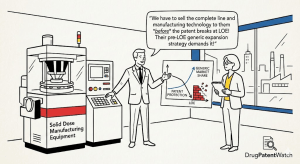
Generic drug manufacturers do not wait for a patent to expire before building capacity. They cannot afford to. The first generic filer to receive FDA approval for a drug losing exclusivity captures a 180-day exclusivity period under the Hatch-Waxman Act, [2] which can translate into hundreds of millions of dollars in revenue for a single product. Missing that window by even a few weeks can cost a manufacturer the entire economic upside of a competitive filing. That dynamic creates a pre-LOE capital expenditure surge that equipment suppliers can and should be targeting systematically.
This guide explains how to do that: which drugs to track, how to read patent data, where solid dose manufacturing investment concentrates, and how to build a sales motion that closes before the patent expires.
What Patent LOE Actually Means for a Manufacturing Line
The Exclusivity Cliff Explained
Patent loss of exclusivity (LOE) is the moment when a branded pharmaceutical’s last enforceable market exclusivity expires, opening the drug to generic competition. In practice, LOE is rarely a single date. Most small molecules carry a layered exclusivity structure that includes composition of matter patents (the core molecular patent, typically 20 years from filing), formulation patents covering the specific drug delivery mechanism, method of use patents covering approved therapeutic indications, and regulatory exclusivities granted by the FDA such as new chemical entity (NCE) exclusivity and pediatric exclusivity. [3]
For an equipment supplier, the relevant date is not when the last legal challenge resolves. It is when a generic manufacturer expects to have an approved product on the market and needs a validated production line ready to run. The delta between those two dates is the business development window.
Why Small Molecules Dominate the Target List
Solid dose manufacturing is predominantly a small molecule story. Approximately 90% of oral solid dosage forms — tablets, capsules, and oral disintegrating tablets — contain small molecule active pharmaceutical ingredients. [4] Biologics and large molecules require entirely different manufacturing infrastructure, primarily sterile fill-finish and cell culture systems, and do not factor into solid dose line expansion in any meaningful way.
The small molecule patent cliff through 2030 includes blockbuster products across therapeutic areas. Eliquis (apixaban) from Bristol-Myers Squibb and Pfizer generated immediate generic filing activity following its exclusivity events. Xarelto (rivaroxaban) and Jardiance (empagliflozin) represent different points on the complexity and revenue curve for the generics industry. [5] Solid dose equipment suppliers should filter their target list explicitly to oral small molecules, where the manufacturing translation from branded to generic production is direct and well-understood.
Reading the Patent Clock: How to Build Your Pipeline
The Data Sources That Actually Matter
Patent surveillance for business development purposes requires three types of data working together: patent expiration data, regulatory filing activity, and commercial revenue data for the branded product.
Patent expiration data tells you when the exclusivity ends. Regulatory filing activity — specifically Abbreviated New Drug Applications (ANDAs) filed with the FDA — tells you which generic manufacturers have already decided to compete. Branded revenue tells you the prize: how much revenue is available for generic capture, and therefore how much a manufacturer is likely to invest in new capacity.
The FDA’s Orange Book (Approved Drug Products with Therapeutic Equivalence Evaluations) is the official source for patent and exclusivity information for small molecules. [6] It lists every patent associated with a given drug product and every exclusivity period the FDA has granted. The problem with using the Orange Book directly for business development purposes is that it is structured for legal compliance, not for commercial intelligence.
Using DrugPatentWatch to Score Opportunities
DrugPatentWatch aggregates and synthesizes Orange Book data, ANDA filing history, patent litigation records, and exclusivity expiration timelines into a searchable platform that business development teams can actually use. [7] Where the Orange Book lists dozens of patent numbers per product without commercial context, DrugPatentWatch overlays revenue data and filing activity to produce a ranked view of what is coming off patent, when, and which generic manufacturers are positioning to compete.
For an equipment supplier, the most useful output from DrugPatentWatch is a ranked list of solid oral dose products with expiring exclusivities, filtered by U.S. branded revenue and cross-referenced against the number of ANDA filers already active for each product. A product with $3 billion in annual branded revenue and six ANDA filers on record is a materially different opportunity than a $200 million product with one filer. The former indicates a competitive, high-investment environment where multiple manufacturers need capacity simultaneously. The latter may represent a niche opportunity for a specialized supplier.
ANDA Filings as Forward Indicators
When a generic manufacturer files a Paragraph IV certification — a legal claim that a branded patent is invalid or will not be infringed by their generic product — they signal two things: they believe the market opportunity justifies the litigation risk, and they intend to be among the first to market. [8] Paragraph IV certifications typically trigger a 30-month stay on FDA approval while the brand holder and the generic manufacturer resolve the patent dispute in court.
That 30-month stay is not a delay. For an equipment supplier, it is a 30-month sales window. A generic manufacturer who filed a Paragraph IV certification in early 2024 for a product with a resolution date in mid-2026 needs a validated production line operational before that resolution date. They are spending capital now, not when the patent expires.
The FDA publishes a list of Paragraph IV certifications. DrugPatentWatch aggregates this information and makes it searchable by product, filer, and timeline. [7] A supplier who monitors this list has a two-to-three-year forward view on which manufacturers are about to invest in solid dose capacity.
The Capital Investment Cycle Behind Generic Line Expansion
When Generics Spend
The pharmaceutical equipment procurement cycle for a new solid dose line runs 18 to 36 months from initial specification through validated production. [9] This timeline breaks into four phases:
3 to 6 months for internal capital approval and vendor qualification
6 to 12 months for equipment design, manufacturing, and delivery
6 to 18 months for installation qualification (IQ), operational qualification (OQ), and process qualification (PQ) under FDA’s process validation guidance
Parallel regulatory submission preparation that must align with equipment availability
A generic manufacturer targeting a mid-2026 LOE event needs to have equipment procurement underway by late 2023 or early 2024 to be ready. Suppliers who engage in 2025 are not early. They are potentially too late for the first-wave opportunity, though follow-on capacity investments and line optimization work remain available.
The practical implication: equipment suppliers need to be in front of target accounts 24 to 36 months before the expected LOE date. That requires prospecting based on patent data, not based on inbound leads or existing customer expansion.
The 30-Month Stay as a Sales Cycle
The 30-month litigation window maps almost perfectly onto a standard solid dose equipment procurement cycle. When a Paragraph IV suit is filed and the branded manufacturer sues within 45 days, the FDA holds ANDA approval for 30 months. [2] During those 30 months, the generic manufacturer knows roughly when they might receive approval, and they need a production line ready to ship product within days of approval.
This creates a clearly defined, time-bounded sales motion for equipment suppliers. The entry trigger is the Paragraph IV filing date. The deadline is the expected resolution date. The customer’s pain is real, measurable, and time-sensitive: they need qualified capacity before the litigation clock runs out.
For complex solid dose formats like modified-release tablets, multi-layer formulations, or oral disintegrating tablets (ODTs), the validation timeline is even longer, which moves the customer’s spending trigger further forward. Suppliers specializing in complex dosage form equipment should be monitoring Paragraph IV certifications for modified-release products specifically.
Solid Dose Equipment Categories: Where the Spending Goes
High-Speed Tablet Compression
Rotary tablet presses are the central equipment investment for any high-volume solid oral dosage expansion. The market for pharmaceutical tablet presses was valued at approximately $700 million globally in 2023 and is expected to reach $1.1 billion by 2030. [10] The growth concentrates in high-speed, multi-tip tooling presses capable of producing 500,000 to over 1 million tablets per hour.
Generic manufacturers targeting blockbuster products need high-speed compression capacity because the economics of generic manufacturing require volume throughput to generate acceptable margins at generic price points. A branded manufacturer may produce a tablet at a cost of $0.30 and sell it for $4.00. A generic manufacturer competes at $0.80 or less, which requires high-volume, low-cost production.
Equipment suppliers competing in this segment compete primarily on throughput, tooling compatibility, and total cost of ownership. The ability to demonstrate validated performance at commercial scale — including deviation management and process analytical technology (PAT) integration — is a concrete competitive differentiator.
Film Coating and Modified Release
Film coating systems represent a secondary but high-margin equipment category for pre-LOE targeting. Modified-release drug products, including extended-release (ER) and delayed-release (DR) formulations, rely on coating technology to control the drug release profile. Many blockbuster oral drugs are modified-release products. Their generic equivalents must demonstrate bioequivalence to the branded product’s specific release profile, which requires precise coating process control.
This creates a technically demanding equipment requirement that favors suppliers with validated coating process expertise over commoditized alternatives. A generic manufacturer building a line for an ER product cannot use a generalist coating system and expect to pass FDA’s bioequivalence standard. They need equipment with validated process control, real-time monitoring, and documented regulatory history.
For suppliers of film coating equipment, the pre-LOE opportunity concentrates in the subset of expiring drugs with modified-release formulations. Filtering DrugPatentWatch data by dosage form to identify ER and DR products coming off patent produces a highly qualified target list where technical expertise commands a premium.
Continuous Manufacturing vs. Batch Processing
The FDA has actively promoted continuous manufacturing (CM) for oral solid dosage forms since issuing guidance in 2019. [11] Several major generic manufacturers have invested in CM infrastructure, and the economics are compelling for high-volume generic production: reduced footprint, lower in-process inventory, and real-time quality monitoring that can reduce end-product testing costs.
The adoption of CM in generics has been slower than the FDA would prefer. Capital costs for a full CM line — including integrated feeding, granulation, blending, compression, and coating — run $5 to $15 million higher than equivalent batch equipment. [12] For a generic manufacturer evaluating a pre-LOE investment, the decision between batch and continuous is driven by the projected product lifespan, the anticipated volume, and the regulatory strategy for the filing.
Equipment suppliers who can present a clear ROI model for CM adoption — accounting for reduced API waste, lower validation maintenance costs, and first-cycle approval rate improvements — have a differentiated position in the pre-LOE conversation. Suppliers who cannot quantify those benefits will compete on price with batch equipment vendors.
Granulation: Wet, Dry, and Continuous
Granulation equipment is the category most often underestimated in pre-LOE business development conversations, and it is frequently the bottleneck that determines line productivity. High-shear wet granulators, roller compactors for dry granulation, and continuous granulation systems each serve different formulation requirements.
For generic manufacturers scaling up a new product, the granulation step often requires the most process development work because API physical properties, excipient compatibility, and moisture sensitivity all influence the granulation approach. Suppliers who position themselves as formulation development partners — offering technical support during scale-up — build account relationships that survive initial procurement and generate follow-on business during line optimization.
Mapping the Decision-Making Unit at a Generic Manufacturer
Who Controls the Budget
At most generic pharmaceutical manufacturers, capital expenditure decisions for new manufacturing lines involve four distinct functions:
Business development or strategy, which identifies the product opportunity and initiates the capital request
Finance, which evaluates the ROI model and approves the capital budget
Technical operations or manufacturing, which specifies the equipment requirements
Regulatory affairs, which validates that the proposed equipment and process will support a compliant ANDA filing
Effective pre-LOE sales require engagement with all four functions, not just the procurement contact who eventually issues the purchase order. An equipment supplier who builds a relationship only with technical operations may win the technical evaluation and lose the deal when finance kills the capital request because the ROI case was never built.
The entry point for pre-LOE business development is typically business development or strategy at the target manufacturer. These are the individuals who are actively monitoring patent expirations and deciding which products to file on. They understand the revenue opportunity and have direct access to the capital approval process. A supplier who can speak the language of market opportunity, first-filer economics, and timeline risk will get a more productive first meeting than a supplier who leads with equipment specifications.
Who Controls the Technical Spec
Technical operations and formulation development teams control the equipment specification. In large generic manufacturers, this function sits within a manufacturing sciences or pharmaceutical development group. These teams care about process robustness, validation history, regulatory acceptance, and total cost of ownership.
Suppliers building relationships with technical teams should lead with process expertise, not product catalogs. The most effective technical conversations for pre-LOE opportunities center on the specific formulation challenges of the target product: What are the API’s flow and compressibility characteristics? Does the release profile require a controlled-rate coating process? What does the company’s existing tech transfer process look like, and where is equipment qualification typically the critical path?
These conversations identify where a supplier’s technical differentiation is real and where it is not. They also create the conditions for a sole-source or preferred-vendor designation early in the procurement process, before a formal RFQ opens competitive bidding.
Building the Business Case for Equipment Investment
ROI Language That Resonates
Generic pharmaceutical manufacturers are among the most financially disciplined buyers in the capital equipment market. Teva, Viatris, Amneal, and Sun Pharma all operate under intense margin pressure, and capital requests require a documented return on investment. Equipment suppliers who cannot build and present a credible ROI model will not advance past preliminary conversations.
The ROI model for pre-LOE solid dose equipment investment has four components:
Incremental revenue capture: The revenue available from generic competition on the target product, discounted by competitive intensity (number of ANDA filers) and the manufacturer’s expected market share
Time-to-market premium: The financial value of being qualified and ready to ship on day one of exclusivity versus two to four weeks later
Process efficiency gains: Throughput improvement, yield improvement, and API waste reduction versus the manufacturer’s existing equipment
Regulatory risk reduction: The cost impact of a failed validation cycle or a Complete Response Letter (CRL) from the FDA, and how equipment selection affects that probability
“The first 180 days of generic exclusivity can account for 70 to 90% of the total profit a generic manufacturer will ever earn on a product, because prices erode rapidly once multiple competitors enter the market.”Association for Accessible Medicines — U.S. Generic & Biosimilar Medicines Savings Report, 2023 [13]
That dynamic makes time-to-market the dominant variable in any pre-LOE investment ROI model. A supplier who can shorten the validation timeline by 60 to 90 days is not offering a convenience. They are offering revenue.
Regulatory Validation as a Differentiator
The FDA’s process validation guidance, published in 2011 and still the governing framework, requires manufacturers to demonstrate that a manufacturing process consistently produces a product meeting its predetermined specifications. [14] For equipment suppliers, the regulatory validation requirement creates a concrete and defensible competitive differentiator: documented IQ/OQ/PQ support, existing master validation packages, and a track record of first-cycle approval rates.
Generic manufacturers filing an ANDA for a pre-LOE product are under time pressure. Every month spent in validation is a month of potential market exclusivity revenue at risk. A supplier who provides a pre-qualified equipment platform with existing validation documentation — reducing the customer’s validation timeline from 12 months to 8 months — delivers four months of potential first-wave exclusivity revenue.
Quantify that. If the target product has $500 million in annual branded revenue and the manufacturer expects to capture 15% market share in the first 180 days, four months of revenue acceleration is worth approximately $10 million. An equipment price premium of $500,000 for a better-validated platform is not a cost. It is a $9.5 million net gain.
Competitive Intelligence: Scoring and Prioritizing Accounts
Revenue at Risk as a Proxy for CapEx Appetite
Not all LOE events justify the same level of investment, and not all generic manufacturers are equally positioned to capture a given opportunity. Effective account prioritization requires matching the size of the LOE opportunity with the specific manufacturer’s filing strategy and existing capacity.
A practical scoring framework uses four variables:
Branded revenue at risk, sourced from DrugPatentWatch or IQVIA data
Number of existing ANDA filers — a proxy for competitive intensity and market saturation
The manufacturer’s existing capacity in the relevant dosage form
The manufacturer’s regulatory history with the FDA, including any outstanding consent decrees or import alerts that would affect their ability to supply the U.S. market
A blockbuster product with $2 billion in annual revenue, four ANDA filers, and a target manufacturer with no existing capacity in the required dosage form is the ideal target for solid dose line expansion equipment. All four variables align to indicate that the manufacturer will need to invest in new equipment and that the investment will be significant.
A $150 million product with twelve ANDA filers, where the target manufacturer already has two qualified lines in the relevant format, is not a line expansion opportunity. It may be an optimization or upgrade opportunity, but it does not support a major capital investment pitch.
Capacity Gap Analysis
Capacity gap analysis requires understanding what manufacturing infrastructure a target account already has. This is harder than patent surveillance because most manufacturers do not publish their manufacturing capacity. The data sources available to a supplier include:
FDA facility inspection records, published in the FDA’s Establishment Inspection Report database
ANDA filings, which list the proposed manufacturing site and can indicate the intended production platform
Industry databases and market research reports covering generic manufacturing capacity by dosage form
Direct technical conversations with the manufacturer’s process development team, built during periods of no active procurement
A supplier who has built relationships within a target account’s technical organization has a material intelligence advantage over suppliers relying solely on public data. Those relationships, built during periods when no active procurement is underway, are the primary competitive moat for suppliers in this market.
Closing the Deal Before the Patent Breaks
Demos, Pilots, and Validation Support
The technical decision in pharmaceutical equipment procurement is rarely made at the sales meeting. It is made during a process demonstration, a formulation feasibility study, or a factory acceptance test (FAT). Suppliers who build pre-LOE pipeline need to convert early conversations into technical engagements that create switching costs before a formal RFQ.
A practical approach: offer a funded feasibility study for the target product’s specific formulation at the supplier’s demonstration facility. This gives the manufacturer’s formulation team hands-on experience with the equipment and generates the process data they need to support their ANDA development. It also creates a documented relationship between the supplier’s equipment and the manufacturer’s specific product, making substitution more difficult during formal procurement.
The cost of a demonstration study runs $10,000 to $75,000 depending on scope. For a deal with an equipment value of $2 to $10 million, it is a rational investment. The return is not just the current deal. It is a preferred-vendor position that carries across the manufacturer’s entire filing pipeline.
Financing and Leasing as Deal Accelerators
Capital availability is a genuine constraint for mid-tier generic manufacturers, even when the ROI case for pre-LOE investment is strong. A manufacturer with a leveraged balance sheet from previous acquisitions — as several mid-tier generic consolidators now carry — may not have the capital budget to fund a full line build even when the strategic case is clear.
Equipment suppliers who can offer financing or leasing arrangements, either directly or through a third-party financing partner, remove a structural barrier to closing. The most effective structure for pre-LOE situations is a deferred-payment lease where equipment delivery and installation happen immediately but principal payments begin only after the product receives FDA approval and begins generating revenue.
This structure aligns the manufacturer’s cash flows with the equipment investment. It also creates a strong supplier preference because no competing vendor is offering the same financial alignment. For a supplier willing to accept the additional credit risk, it is a durable competitive advantage that compounds over time as the manufacturer’s filing pipeline grows.
Key TakeawaysThe pre-LOE capital expenditure window opens 24 to 36 months before a drug’s exclusivity expires. Suppliers who wait for public signals are already behind.Small molecule solid dose products are the primary target category. Filter LOE opportunity lists by oral dosage form to focus resources on relevant opportunities.DrugPatentWatch and the FDA’s Orange Book provide actionable patent expiration and ANDA filing data. Paragraph IV certification filings are the most forward-looking indicator of a manufacturer’s competitive intent and near-term capital spending.The 30-month Paragraph IV litigation stay maps directly onto a standard solid dose equipment procurement and validation cycle. Use it as the defining time boundary for your sales motion.ROI language must center on time-to-market, because the 180-day first-filer exclusivity period concentrates the majority of generic profit in the first months after launch.Engage all four functions in the manufacturer’s decision-making unit: business development, finance, technical operations, and regulatory affairs. Winning only the technical evaluation is not enough.Feasibility studies and funded demonstrations are the most effective tool for converting early technical conversations into preferential procurement positions before a formal RFQ opens.Financing structures that align payment with FDA approval remove a structural constraint for capital-constrained buyers and serve as a durable competitive differentiator.
Frequently Asked Questions
1. How far in advance of a drug’s patent expiration should an equipment supplier begin outreach?
The minimum is 24 months before the expected LOE date, and 36 months is better for complex solid dose formats requiring extended validation cycles. For blockbuster products with multiple ANDA filers, some manufacturers begin capacity planning up to four years before expected LOE. Suppliers who are not in the conversation at that stage will face a pre-qualified competitor in the formal procurement process.
2. Which generic manufacturers are the highest-priority targets for solid dose line expansion?
Priority targets are manufacturers who have filed Paragraph IV ANDAs for high-revenue solid oral dose products and who have documented capacity constraints in the required dosage form. The combination of a large LOE opportunity, an active competitive filing strategy, and existing capacity gaps creates the strongest indicator of near-term equipment investment. Mid-tier manufacturers with annual revenues between $500 million and $3 billion are often underserved by large equipment companies focused on top-tier accounts, which creates a disproportionate opportunity for suppliers who invest in those relationships.
3. How does continuous manufacturing change the pre-LOE equipment sales motion?
Continuous manufacturing has a longer pre-procurement lead time than batch equipment because the technical evaluation is more complex and the capital cost is higher. For suppliers of CM systems, the sales motion needs to begin 36 to 48 months before expected LOE. The ROI case for CM in a generic setting needs to explicitly address the higher upfront cost, which is best justified by long product lifecycle projections and high-volume, chronic disease indications where throughput efficiency translates directly into margin improvement.
4. What should a supplier do when a target manufacturer has an existing preferred vendor relationship for similar equipment?
The preferred vendor relationship is rarely absolute in pharmaceutical equipment procurement. FDA’s equipment qualification requirements mean that manufacturers can and do qualify multiple vendors for the same equipment category, both for supply security and to maintain competitive leverage in procurement. The entry strategy against an established incumbent is through technical differentiation on a specific formulation challenge, not through price competition. Identify a product in the target manufacturer’s pipeline where the incumbent’s equipment has a documented limitation, and build the technical case around that specific gap.
5. How should an equipment supplier use DrugPatentWatch beyond basic patent expiration lookups?
The most underutilized capability for business development purposes is the ability to cross-reference patent expiration timelines with ANDA filer lists and revenue data simultaneously. A supplier can generate a ranked list of solid dose products expiring within a defined window, filtered by annual revenue threshold, and then overlay the ANDA filer list to identify which of their existing or target customers is already positioned to compete for each product. This workflow converts DrugPatentWatch from a research tool into a live pipeline management system, where each high-ranked product with an active ANDA filer in your account base represents a qualified, time-bounded sales opportunity.
References
[1] IQVIA Institute for Human Data Science. (2023). The global use of medicines 2023: Outlook to 2027. IQVIA. https://www.iqvia.com/insights/the-iqvia-institute/reports/the-global-use-of-medicines-2023
[2] U.S. Food and Drug Administration. (2023). Hatch-Waxman amendments: Paragraph IV drug patent certification. FDA. https://www.fda.gov/drugs/abbreviated-new-drug-applications-andas/paragraph-iv-drug-master-files
[3] U.S. Food and Drug Administration. (2022). New drug exclusivity. FDA. https://www.fda.gov/drugs/development-approval-process-drugs/new-drug-exclusivity
[4] Grand View Research. (2023). Oral solid dosage forms market size, share & trends analysis report. Grand View Research. https://www.grandviewresearch.com/industry-analysis/oral-solid-dosage-forms-market
[5] EvaluatePharma. (2023). Evaluate pharma world preview 2023: Outlook to 2028. Evaluate Ltd. https://www.evaluate.com/evaluate-pharma-world-preview-2023
[6] U.S. Food and Drug Administration. (2024). Orange book: Approved drug products with therapeutic equivalence evaluations. FDA. https://www.accessdata.fda.gov/scripts/cder/ob/
[7] DrugPatentWatch. (2024). Pharmaceutical patent and exclusivity data platform. DrugPatentWatch. https://www.drugpatentwatch.com
[8] 21 C.F.R. § 314.95. (2023). Abbreviated applications: Content and format of an ANDA — Paragraph IV certifications. Code of Federal Regulations.
[9] International Society for Pharmaceutical Engineering. (2022). Baseline guide for process equipment qualification. ISPE. https://ispe.org/publications/guidance-documents/baseline-guides/process-equipment-qualification
[10] MarketsandMarkets. (2023). Tablet presses market by type, by application, by region — Global forecast to 2030. MarketsandMarkets. https://www.marketsandmarkets.com/Market-Reports/tablet-press-machine-market
[11] U.S. Food and Drug Administration. (2019). Quality considerations for continuous manufacturing: Guidance for industry. FDA. https://www.fda.gov/regulatory-information/search-fda-guidance-documents/quality-considerations-continuous-manufacturing
[12] Deloitte. (2022). Continuous manufacturing in pharmaceutical: The business case and pathway to adoption. Deloitte Insights. https://www2.deloitte.com/insights/continuous-manufacturing-pharma
[13] Association for Accessible Medicines. (2023). The U.S. generic & biosimilar medicines savings report. AAM. https://accessiblemeds.org/resources/reports/2023-savings-report
[14] U.S. Food and Drug Administration. (2011). Process validation: General principles and practices guidance for industry. FDA. https://www.fda.gov/regulatory-information/search-fda-guidance-documents/process-validation-general-principles-and-practices