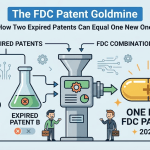
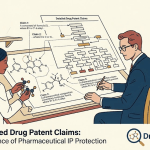
Combination drugs — pairing a biologic with a small molecule — are among the most commercially valuable assets in pharma. They are also among the hardest to protect. The IP architecture required to defend them spans two regulatory frameworks, three or four patent families, and at least a dozen claim types, each with its own litigation exposure and exclusivity clock.
This is not a theoretical problem. Keytruda combined with Lenvima, Herceptin combined with Perjeta and chemotherapy, Humira combined with methotrexate — these regimens generate billions in annual revenue. Every one of them faces the same structural IP challenge: the biologic component and the small molecule component were developed under different legal frameworks, face different generic and biosimilar threats, and expire on different timelines. Coordinating protection across both is what separates a defensible franchise from an exclusivity cliff waiting to happen.
What follows is a detailed analysis of how to build, defend, and monetize IP portfolios for combination drugs — with specific attention to patent claim architecture, regulatory exclusivity stacking, Paragraph IV litigation dynamics, and the global filing variables that determine whether exclusivity holds or collapses.
Why Combination Drug Patents Fail — and What That Means for Revenue
Most combination drug patents fail not because the science is wrong but because the claims are written for a different threat than the one that materializes. A composition claim covering the co-formulation doesn’t stop a generic entrant from launching each component separately and instructing physicians to use them together. A method-of-treatment claim covering the synergistic effect doesn’t stop a biosimilar from entering on the biologic component alone, dismantling the combination’s clinical rationale in the process.
The structural vulnerability is built into the architecture of combination drugs themselves. Biologics are protected by sequence claims, production process claims, and formulation claims under a 12-year BPCIA data exclusivity clock. Small molecules are protected by composition-of-matter claims, polymorph claims, and salt-form claims under a five-year NCE exclusivity plus patent term extension. When you combine both into a single therapeutic regimen, you inherit two completely different expiry timelines, two different sets of potential challengers, and two different regulatory agencies — CDER and CBER — with distinct views on what counts as a protected product.
The revenue exposure is real. A single successful Paragraph IV challenge against the small molecule component of a combination regimen can allow generic entry years before the biologic exclusivity expires, converting a protected franchise into a partially commoditized product almost overnight.
How the Biologic-Small Molecule IP Split Creates Litigation Risk
Why Paragraph IV Filings Target the Weakest Component First
When a generic or biosimilar developer evaluates a combination drug for market entry, it does not attack the strongest patent. It finds the weakest link — typically the small molecule component, which faces Paragraph IV ANDA challenges rather than the 12-year BPCIA exclusivity wall protecting the biologic.
A Paragraph IV filer targeting the small molecule in a biologic-small molecule combination only needs to certify that the patents covering that component are invalid, unenforceable, or will not be infringed by its ANDA product. It does not need to address the biologic patents at all. If successful, it can launch a generic version of the small molecule and undercut the branded combination’s pricing by selectively commoditizing one half of the regimen.
This dynamic played out in the Humira-methotrexate space. Methotrexate, the small molecule partner in many rheumatoid arthritis protocols, lost any meaningful patent protection decades ago. AbbVie’s exclusivity strategy for Humira was built entirely around the adalimumab biologic patents and a well-documented patent thicket of over 130 patents covering formulations, manufacturing processes, and dosing regimens. But that strategy only worked because adalimumab was the high-value component. In combination regimens where the biologic is the commodity — or where biosimilar entry has already occurred — the dynamic inverts.
What Happens When the Biologic Loses Exclusivity Before the Small Molecule
The reverse scenario is equally damaging. In oncology combinations pairing an approved checkpoint inhibitor with a proprietary small molecule kinase inhibitor, biosimilar entry on the PD-1 or PD-L1 antibody component erodes the clinical identity of the combination even if the small molecule patents remain intact. Physicians may substitute the biosimilar checkpoint inhibitor while continuing to use the branded small molecule — fragmenting the combination regimen and weakening the payer economics that justified the combination’s pricing.
Eisai’s lenvatinib (Lenvima), combined with pembrolizumab (Keytruda) in endometrial carcinoma, illustrates the timing tension. Keytruda’s core composition-of-matter patents begin expiring in the late 2020s, with meaningful biosimilar entry possible in the early 2030s. If biosimilar pembrolizumab enters before Lenvima’s key patents expire, the revenue model for the combination shifts materially — payers will press for biosimilar pembrolizumab plus branded Lenvima rather than the co-developed combination.
Claim Architecture for Biologic-Small Molecule Combinations
The Five Claim Types That Actually Protect a Combination
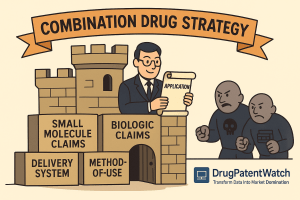
Protecting a combination drug requires filing claims across five distinct categories. Each covers a different threat vector; missing any one of them creates an exploitable gap.
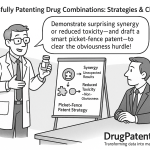
Composition claims cover the mixture or co-formulation as a single inventive unit. These are the highest-value claims but also the hardest to defend, because they require demonstrating that the combination itself — not merely the sum of its components — constitutes a novel and non-obvious invention. The EPO’s inventive step standard demands quantifiable synergy supported by dose-response data. The USPTO applies a more permissive standard, but Federal Circuit case law has tightened the non-obviousness bar for combinations since KSR International v. Teleflex in 2007.
Method-of-treatment claims cover the therapeutic use of the combination, including the specific indication, patient population, and dosing protocol. These are frequently the most durable claims in a combination drug portfolio because they capture clinical practice patterns that generic entrants cannot easily design around. A generic company can reformulate the small molecule component, but it cannot instruct physicians to use it in a different clinical context without triggering label-based infringement arguments.
Dosage regimen claims are underutilized but commercially critical. In biologic-small molecule combinations, the optimal dosing schedule for each component may differ from what either agent requires when used alone. Patents covering the specific weight-based dosing, infusion frequency, or oral dosing schedule in combination can extend effective exclusivity well beyond the underlying composition patents.
Delivery mechanism claims cover co-administration technologies, including autoinjectors, combination prefilled syringes, or drug-device combination products. AstraZeneca’s Symbicort franchise — technically a small molecule-small molecule combination — demonstrated how device patents can outlast active ingredient patents by years. The same principle applies to biologic-small molecule combinations using novel delivery platforms.
Manufacturing process claims protect the production methods for the biologic component in combination and are particularly valuable where the manufacturing process is a barrier to biosimilar entry. Amgen’s Enbrel (etanercept) franchise benefited from manufacturing complexity that slowed biosimilar entry in the U.S. long after European biosimilars launched. Similar manufacturing moats apply to any biologic in a combination where the production process is genuinely difficult to replicate.
Why Markush Structures Matter for Small Molecule Variants in Combinations
When a biologic component is combined with a small molecule from a defined chemical class — a kinase inhibitor scaffold, for example — Markush claims can cover the full range of structural variants that retain activity against the target. This matters because generic developers frequently attempt to design around specific compound claims by modifying peripheral substituents while preserving the core pharmacophore.
A well-constructed Markush claim in a combination patent covers not just the commercial compound but the structural space within which it operates, forcing any design-around into territory where therapeutic activity and safety are unproven. This is a particularly effective defensive strategy in oncology combinations where the small molecule is a kinase inhibitor — a class notorious for structural modification attempts.
Regulatory Exclusivity Stacking: How to Add Years Without New Patents
How BPCIA and Hatch-Waxman Exclusivities Interact in Combination Products
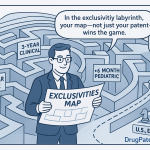
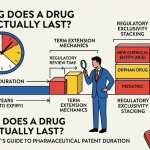
The biologics and small molecule components of a combination drug operate under different regulatory exclusivity frameworks, and understanding how these interact can add two to four years of effective market protection beyond the underlying patent term.
Under BPCIA, a reference biologic receives 12 years of data exclusivity from the date of first approval, during which no biosimilar can rely on the originator’s clinical data for approval. Under Hatch-Waxman, a new chemical entity receives five years of data exclusivity, with a 30-month stay triggered by a Paragraph IV certification. If the combination product is approved as a new product with at least one new active ingredient, it may qualify for its own exclusivity period independent of the individual component exclusivities.
The stacking opportunity arises when a combination contains a biologic that was approved years before the combination itself. The biologic’s 12-year BPCIA clock started at its original approval date, but if a manufacturer demonstrates that the combination formulation required new clinical development — new dose-finding studies, new safety data, new PK/PD characterization — the FDA may grant a new exclusivity period on the combination product separate from the biologic’s original clock.
Exclusivity Type
U.S. Duration
EU Duration
Japan Duration
Notes
Biologic data exclusivity (BPCIA / EU biosimilar)
12 years
8 years (data) + 2 years (market)
8 years
U.S. includes 12-month first-biosimilar exclusivity
New chemical entity (Hatch-Waxman)
5 years
8+2(+1) years
8 years
EU allows 1-year extension for new indication
Orphan drug designation
7 years (U.S.)
10 years (EU)
—
Can apply to combination if indication qualifies
Pediatric exclusivity
+6 months
+2 years
—
Applies to patents and exclusivities
SPC (EU / analog markets)
Up to 5 additional years
EU: up to 5 years
—
Eligibility contested for combinations post-Teva v. Gilead
Orphan Drug Designation in Combination Products: What Qualifies and What Doesn’t
Orphan drug designation grants seven years of market exclusivity in the U.S. and ten years in the EU for drugs targeting rare diseases affecting fewer than 200,000 Americans or fewer than five per 10,000 EU residents. For biologic-small molecule combinations, orphan designation can apply where the combination is developed specifically for a rare indication — even if one or both components have broader approved uses.
The FDA’s Office of Orphan Products Development has granted orphan designation to combination regimens where the clinical development program was specifically designed for the rare indication, not repurposed from a broader program. This distinction matters because it means a sponsor developing a biologic-small molecule combination for a rare oncology indication can layer orphan exclusivity on top of the BPCIA and Hatch-Waxman protections, creating a wall that no biosimilar or generic can breach for seven years regardless of patent status.
Pediatric Exclusivity and Its Strategic Value for Combination Drugs
The six-month pediatric extension under the Best Pharmaceuticals for Children Act attaches to any patent or exclusivity listed for a drug, extending every Orange Book-listed patent and every exclusivity period by six months. For a combination drug with multiple listed patents and multiple exclusivity periods, this single six-month extension can be worth hundreds of millions in revenue protection.
The catch is that FDA must request pediatric studies, and the sponsor must actually conduct and report them. For biologic-small molecule combinations targeting adult cancers or adult autoimmune disease, FDA may not issue a written request, limiting access to this extension. But in therapeutic areas where pediatric populations are plausible — certain autoimmune disorders, some oncology indications — engineering a pediatric development program early can preserve the pediatric extension option.
European SPC Strategy for Combination Products: The Post-Teva Landscape
Why Teva v. Gilead Reshaped SPC Eligibility for Combinations
The Court of Justice of the European Union’s 2018 ruling in Teva UK Ltd v. Gilead Sciences Inc. (C-121/17) fundamentally changed how SPCs are granted for combination products in Europe. The CJEU held that for an SPC covering a combination of active ingredients to be valid, the combination must be specifically identifiable, in the light of all the information in the basic patent, as the subject of the invention covered by that patent.
In practice, this means a patent that broadly claims a biologic compound and generically references combination with other therapeutic agents will not support an SPC for a specific biologic-small molecule combination. The combination must be explicitly or at least necessarily present in the patent’s claims or specification in a way that makes the specific combination identifiable. Generic disclosures of the form ‘optionally combined with other therapeutic agents’ have been held insufficient in multiple post-Teva decisions by national courts.
The implication for combination drug patent strategy is significant: if you intend to pursue SPC protection for a biologic-small molecule combination in Europe, the combination must be expressly disclosed in the basic patent used to support the SPC application. This requires coordinating the patent drafting strategy years before the SPC application — at the time the basic patent is filed, not at approval.
SPC Filing Strategy Across EU Member States
SPC law in Europe is EU-wide in theory but national in administration, and national courts continue to diverge on key questions of combination SPC validity. The UK Intellectual Property Office, even post-Brexit, applies SPC rules that track EU law for patents with pre-Brexit priority dates. Germany’s Federal Patent Court has taken a relatively strict approach to the Teva test. The Netherlands’ patent office has been more permissive on combination disclosures. France and Italy sit somewhere in between.
For a biologic-small molecule combination with major EU market exposure, the optimal strategy is to seek SPCs in all five major markets (Germany, France, UK, Italy, Spain), anticipate validity challenges in each, and structure the basic patent portfolio to provide multiple possible SPC supporting patents — each explicitly disclosing the combination — to give fallback positions if one is invalidated.
How Patent Thickets Work in Combination Drug Franchises
AbbVie’s Humira Thicket: The Architecture That Delayed Biosimilar Entry Until 2023
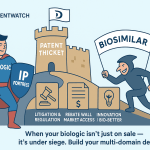
AbbVie’s Humira patent estate is the most studied patent thicket in pharmaceutical history. At peak, it comprised over 130 patents covering the adalimumab molecule, its manufacturing process, formulation, concentration, and dosing regimen. Although most of these patents would not withstand rigorous invalidity analysis individually, collectively they created a settlement dynamic that deferred U.S. biosimilar entry until January 2023 — nine years after the first European biosimilars launched.
The thicket worked through the Hatch-Waxman litigation mechanism. Each biosimilar filer faced the prospect of a 30-month stay triggered by AbbVie’s infringement suit, followed by costly patent-by-patent litigation across the full portfolio. Even if biosimilar developers were confident they could invalidate the weakest patents, the combination of litigation cost, delay risk, and settlement economics made early entry unattractive. AbbVie settled with each filer on terms that allowed U.S. entry in 2023 at the earliest.
For combination drug sponsors, the Humira model offers a strategic blueprint: build a portfolio wide enough that challengers face a cost-benefit calculation favoring settlement over litigation, even if individual patents are narrow. The key is filing secondary patents not just on the combination itself but on every commercially significant feature of the product — device, formulation, concentration, auto-injector design, dosing schedule — so that a generic or biosimilar developer cannot easily design around any single patent without triggering exposure to the others.
How Evergreening Works in Biologic-Small Molecule Combinations
Evergreening in combination drugs operates through layered secondary patent filings that extend effective market exclusivity beyond the base compound’s original expiry. The secondary patents cover features that are genuinely present in the commercial product — new formulations, new delivery mechanisms, new dosing regimens — but which were developed as incremental improvements rather than core inventions.
The commercially available co-formulation of a biologic and small molecule may be protected by patents that don’t expire until five or ten years after the original composition-of-matter patents. A biosimilar developer targeting the biologic component alone cannot replicate the co-formulation without infringing those formulation patents. This is not a legal fiction — it reflects genuine development work. But critics note that the practical effect is to deter combination product competition long past the period justified by the original innovation.
India’s Section 3(d) scrutiny is the most direct regulatory response to evergreening. Under Section 3(d) of the Patents Act, a new form of a known substance — including a new combination, salt, or formulation — is not patentable unless it demonstrates significantly enhanced efficacy compared to the known substance. This standard is higher than the U.S. or EU non-obviousness requirement and has been used to reject several secondary patents covering combination drug formulations in India, effectively accelerating generic entry into a market of 1.4 billion people.
Keytruda’s Patent Portfolio: What Merck Is Defending and When
Core Pembrolizumab Patent Expiry Dates and Revenue Exposure
Keytruda (pembrolizumab) generated approximately $25 billion in global revenue in 2023, making it the world’s top-selling drug. Its core composition-of-matter patents in the U.S. expire primarily between 2028 and 2032, depending on the specific patent family and any patent term extensions. The most important composition patent, covering the pembrolizumab antibody sequence, is expected to expire around 2028 with no extension, at which point biosimilar developers will have a clear path to BPCIA litigation or settlement.
The combination use patents — covering pembrolizumab in combination with chemotherapy, targeted therapies, or other immunotherapies — are a different story. Many of these patents were filed years after the core composition patents and carry later expiry dates. In some indications, the method-of-use patents protecting pembrolizumab combinations may not expire until the mid-2030s, providing Merck with a meaningful exclusivity tail even after biosimilar entry on the monotherapy becomes possible.
Merck’s exposure is compounded by the breadth of its combination indications. Keytruda has FDA approval in over 30 indications as of 2025, many of them in combination with chemotherapy or other targeted agents. Each combination approval carries its own patent and exclusivity structure. Biosimilar developers entering on the monotherapy pembrolizumab market will face a fragmented patent landscape where some combination indications remain protected long after others are open.
Why Merck’s Keytruda Replacement Pipeline Is Investor Priority One
Merck has committed approximately $7 billion to pipeline development specifically aimed at replacing or extending the Keytruda franchise. The pipeline includes subcutaneous pembrolizumab (MK-3475A), which received FDA approval in 2024 and carries new dosing patents; islatravir combinations in HIV; and coformulation studies with novel checkpoint inhibitors. Each of these programs is designed to migrate prescribers to reformulated or next-generation products before biosimilar pembrolizumab reaches price parity.
The pipeline replacement problem is an investor-facing issue. Buy-side analysts at major healthcare funds model Keytruda revenue erosion beginning in earnest around 2030, with the speed of erosion depending on how many of Merck’s combination indications remain under exclusivity and whether the subcutaneous formulation commands enough of a clinical preference to slow biosimilar share.
What Investors Are Watching in Combination Drug Patent Litigation
The Opdivo-Keytruda Patent War: BMS, Merck, and the Dana-Farber Dispute
The dispute between Bristol Myers Squibb and Merck over PD-1 checkpoint inhibitor patents is among the most financially significant pharmaceutical patent litigations of the past decade. Dana-Farber Cancer Institute, which holds key patents on PD-1 antibody technology licensed to BMS, filed suit against Merck in 2019, alleging that Keytruda infringes patents covering the core anti-PD-1 mechanism. The case proceeded through the USPTO Patent Trial and Appeal Board and federal courts with outcomes affecting both companies’ ability to fully capture combination drug revenues.
For investors, the key question is not whether Merck will lose the case — the probabilities are priced in — but whether an adverse outcome would require royalty payments on Keytruda’s combination revenues that are currently unmodeled in sell-side forecasts. A royalty of even 5% on Keytruda’s $25 billion revenue base represents $1.25 billion in annual cash transfer, a figure material to Merck’s earnings. The combination indications generate higher per-patient revenue than monotherapy, making the combination patent royalty exposure disproportionately significant relative to the monotherapy royalty exposure.
Key Patent Expiry Dates Across Major Combination Drug Franchises
Core composition 2019 (EU) / 2020 (U.S.); formulation/combination later
~$7B peak
Ogivri, Herzuma, multiple biosimilars
Nivolumab combinations (Opdivo)
BMS
Core composition 2026-2028; method claims later
~$9B/year
Multiple in development
Lenvatinib + pembrolizumab (Lenvima/Keytruda)
Eisai/Merck
Lenvima composition 2025-2027; combination methods later
~$2B/year
Dependent on Keytruda biosimilar timing
Semaglutide combinations (GLP-1 + others)
Novo Nordisk / Eli Lilly
Core 2031-2033; combination methods TBD
$20B+ (rising)
Generics/biosimilars 2030s
GLP-1 Combination Patents: The Next Major IP Battleground
Why GLP-1 Manufacturing Complexity Is a Barrier to Generic Entry
Semaglutide, tirzepatide, and the pipeline GLP-1/GIP dual agonists are synthetic peptide drugs — a category that occupies regulatory and IP territory between traditional small molecules and biologics. They are too large and structurally complex to be approved as generics under the Hatch-Waxman ANDA pathway, but they are not full biologics subject to BPCIA’s 12-year exclusivity. Instead, they follow the 505(b)(2) regulatory pathway in some cases, creating a non-standard exclusivity structure.
The manufacturing barrier for GLP-1 peptides is genuine and significant. Semaglutide requires solid-phase peptide synthesis at commercial scale, followed by precise fatty acid conjugation to enable the long half-life that makes once-weekly dosing possible. The manufacturing yield, purity requirements, and analytical characterization standards are substantially more demanding than standard small molecule synthesis. This manufacturing moat — not patent protection alone — is a meaningful deterrent to generic entry even after patent expiry.
Novo Nordisk’s combination patent strategy for semaglutide reflects this confidence in manufacturing barriers. Its Ozempic and Wegovy patents cover not just the active molecule but specific salt forms, specific injection device designs, and specific dosing protocols. The combination opportunity — semaglutide plus a cardiovascular agent, semaglutide plus a NASH treatment, semaglutide plus an amylin analog — is where the next generation of GLP-1 IP battles will occur.
Which GLP-1 Combination Patents Eli Lilly Is Trying to Build Around
Eli Lilly’s tirzepatide (Mounjaro, Zepbound) is the first approved GIP/GLP-1 dual agonist and competes directly with Novo Nordisk’s semaglutide in both diabetes and obesity. Lilly’s combination IP strategy diverges from Novo Nordisk’s in one significant respect: rather than defending tirzepatide’s combination use through method-of-treatment patents that broadly cover combination with any cardiovascular agent, Lilly has filed more specific combination patents covering tirzepatide with particular concomitant therapies — SGLT-2 inhibitors, insulin analogs, and cardiovascular outcomes drugs — where clinical synergy data has been generated.
This specificity makes Lilly’s combination patents harder to design around but also harder to enforce broadly. A generic developer launching tirzepatide after composition patent expiry can potentially avoid Lilly’s combination patents by restricting its label to approved monotherapy indications and relying on off-label prescribing to capture the combination use. The interplay between Orange Book listing, label carve-outs, and induced infringement doctrine will determine whether Lilly’s combination patents actually deter this behavior.
How Biosimilar Launch Timing Works in Combination Drug Markets
The 30-Month Stay, the BPCIA Patent Dance, and Settlement Dynamics
Under BPCIA, a biosimilar applicant must provide the reference biologic manufacturer with its abbreviated biologics license application (aBLA) at the time of FDA submission, initiating the ‘patent dance’ — a structured exchange in which the reference manufacturer identifies patents it intends to assert, the biosimilar applicant provides its invalidity positions, and the parties negotiate which patents to litigate immediately versus after approval.
The patent dance is optional since the Federal Circuit’s Sandoz v. Amgen decision in 2017 — biosimilar applicants can decline to participate, accepting litigation risk after approval rather than before. In practice, most biosimilar developers do participate because immediate litigation before approval is cheaper to resolve than post-approval injunction risk. The settlement economics depend on how much revenue the reference manufacturer is protecting and how confident the biosimilar developer is in its invalidity arguments.
For biologic-small molecule combinations, the patent dance covers only the biologic component. The small molecule partner, if still covered by unexpired patents, is protected through Orange Book listing and the separate Paragraph IV ANDA mechanism. This means a combination drug can simultaneously face BPCIA biosimilar litigation on the biologic and Paragraph IV litigation on the small molecule — two separate legal proceedings, two separate 30-month stays (if triggered), and two separate settlement negotiations.
What Happens to Combination Drug Revenue When the Biologic Loses Exclusivity
The revenue impact of biologic loss of exclusivity in a combination franchise depends on two variables: whether the small molecule component retains patent protection and whether the combination formulation itself is protected.
Where the small molecule loses exclusivity first — as happened with methotrexate in the Humira context decades ago — biologic exclusivity dominates the franchise economics, and the combination premium survives as long as the biologic is protected. Where the biologic loses exclusivity first, biosimilar entry fragments the combination’s clinical identity. Physicians are unlikely to use a biosimilar version of one component with a branded version of the other if the payer demands biosimilar substitution for the whole regimen.
Roche’s experience with Herceptin (trastuzumab) in HER2-positive breast cancer is instructive. Trastuzumab biosimilars launched in Europe beginning in 2017 and in the U.S. in 2019. The combination regimen of trastuzumab plus pertuzumab (Perjeta) was initially protected by separate combination patents, but payer pressure to substitute biosimilar trastuzumab for branded Herceptin within the combination eroded Roche’s pricing power faster than the standalone combination patent analysis suggested it would. Revenue from the trastuzumab franchise fell more than 30% in Europe within three years of biosimilar entry.
Manufacturing Complexity as an IP Substitute
Why Biologic Manufacturing Is a Barrier Even Without Patent Protection
The manufacturing process for monoclonal antibodies used in biologic-small molecule combinations is not replicable by reading the patent claims. It requires cell line development, upstream bioreactor optimization, downstream purification — including protein A chromatography, viral inactivation, and ultrafiltration — and complex formulation science to ensure stability in the final drug product. The FDA requires extensive analytical comparability data before approving a biosimilar, including structural characterization, functional assays, and clinical pharmacology studies.
This manufacturing barrier is a real deterrent to biosimilar entry independent of patent protection. The capital investment required to build a compliant biologic manufacturing facility runs to $200 million or more; the analytical development cost for biosimilar comparability studies runs to $50-100 million. For a biosimilar targeting a combination drug where the biologic component has limited standalone revenue (because most prescriptions are written for the combination), the economics of biosimilar development may not justify the investment.
This is a material consideration for investors modeling generic and biosimilar erosion timelines. The patent cliff analysis for combination biologics overestimates the speed of revenue erosion if it does not account for the manufacturing moat. Amgen’s etanercept biosimilar for Enbrel launched in Europe years before U.S. biosimilar entry, but U.S. market share was limited for several years partly by manufacturing scale constraints — not just by AbbVie’s patent settlements.
How Small Molecule Co-Formulation Complexity Slows Generic Entry
The small molecule component of a biologic-small molecule combination can itself carry manufacturing complexity that deters generic entry. Where the small molecule is an oral kinase inhibitor formulated for precise bioavailability control — using particle engineering, amorphous solid dispersions, or nanocrystal technology — generic developers face significant formulation development work to achieve bioequivalence.
Patents on these formulation technologies can outlast composition-of-matter patents by years. AstraZeneca’s work on Tagrisso (osimertinib) formulation and the osmotic drug delivery technologies used in extended-release tablets of various kinase inhibitors show how formulation IP can be a meaningful extension of the effective market exclusivity period — relevant for any combination drug where the small molecule partner uses a non-standard delivery platform.
Licensing Economics in Combination Drug IP
How Cross-Licensing Between Biologic and Small Molecule Innovators Works
Combination drugs that pair a biologic from one company with a small molecule from another — Merck’s Keytruda with Eisai’s Lenvima being the clearest example — require IP coordination between two companies whose commercial interests are partially aligned and partially competing. The licensing agreement must address which party controls prosecution of combination patents, how royalties are split on combination product revenues, and what happens if one party’s component faces biosimilar or generic entry.
The Merck-Eisai co-promotion agreement for the Keytruda-Lenvima combination in endometrial cancer allocates profits on a defined share basis and specifies prosecution responsibilities for patents covering the combination regimen. The economic logic is straightforward: Merck’s pembrolizumab has much higher standalone revenue than Lenvima, so Merck bears more of the IP defense cost but also captures more of the combination’s commercial upside.
Cross-licensing becomes more complex when the combination is discovered through academic research or biotech collaboration. University technology transfer offices and biotech companies frequently negotiate background IP licenses that allow co-development of combination therapies but create complex royalty stacks — the originator biologic company pays royalties to the biologic patent holder, the small molecule company pays royalties to the small molecule patent holder, and both pay royalties to the combination patent holder if that IP was developed separately.
Royalty Stacking Risk in Multi-Party Combination Patents
Royalty stacking — the accumulation of royalty obligations to multiple licensors on a single product — is a real economic risk for combination drug developers. A biologic-small molecule combination might carry royalty obligations to the university that discovered the biologic mechanism, the company that developed the manufacturing process, the biotech that developed the small molecule scaffold, and the academic hospital that ran the Phase II trial establishing the combination’s clinical proof of concept.
When these royalties are negotiated independently, each licensor uses a standard royalty rate without accounting for the other royalties the combination product will bear. The cumulative royalty burden on a single combination product can reach 15-25% of net sales in complex multi-party development arrangements — a figure that materially affects the commercial viability of the combination even at branded pricing.
Asian Market Dynamics: China’s CNIPA, India’s Section 3(d), and the Asia-Pacific Combination Patent Gap
How China Is Building Combination Drug IP Capacity
China’s CNIPA (China National Intellectual Property Administration) has made substantial progress in accepting biologic-small molecule combination patents where clear pharmacological synergy evidence is provided. Chinese patent law requires demonstration of a technical contribution beyond what the individual components provide, but the evidentiary standard has become more aligned with international norms as China has sought to attract multinational pharma R&D investment.
The commercial relevance is growing rapidly. China is the second-largest pharmaceutical market globally, and domestic Chinese pharma companies — including Henlius, BioAtla, and Zymeworks’ China operations — are developing their own combination biologics with co-formulated or combination-indicated small molecules. The IP landscape in China for combination drugs is shifting from a primarily defensive posture (protecting against Chinese generic manufacturers) to an offensive one (protecting domestic Chinese innovation from international competitors).
Multinational companies filing combination drug patents in China face a dual strategic challenge: the same composition patents that protect their products against Chinese generics can serve as prior art cited against Chinese domestic innovations in the same space. Managing this relationship requires careful coordination between the global patent portfolio and the China-specific filing strategy.
India’s Section 3(d) and What It Means for Combination Drug Access
India’s Section 3(d) of the Patents Act 1970, as interpreted by the Supreme Court in Novartis AG v. Union of India (2013), has had more impact on combination drug IP strategy than any single ruling outside U.S. or EU jurisdictions. The Novartis case involved imatinib mesylate — technically a small molecule — but the court’s reasoning about enhanced efficacy requirements applies directly to combination drug patents involving known components.
Under Section 3(d), a combination drug is not patentable in India unless it demonstrates significantly enhanced efficacy compared to the known active ingredients used separately. This is a substantive requirement, not a procedural one. It means that a biologic-small molecule combination that is patentable in the U.S., EU, and Japan on the basis of non-obviousness and synergy may still be rejected in India if the applicant cannot demonstrate that the combination’s clinical efficacy is significantly superior to either component alone.
For combination drugs targeting diseases with high prevalence in India — tuberculosis, HIV, diabetes, certain cancers — this restriction has real public health consequences that are politically significant. Voluntary licensing programs and the Medicines Patent Pool have been used to address combination drug access in some cases, particularly in HIV antiretroviral combinations, but the Section 3(d) scrutiny remains the most direct tool available to Indian authorities for limiting exclusivity on combination products.
Freedom to Operate Analysis for Combination Drug Entry
How Biosimilar Developers Navigate Combination Drug Patent Thickets
A biosimilar developer targeting the biologic component of a combination drug must conduct freedom-to-operate analysis not just on the biologic patents but on all combination patents that could limit its ability to market the biosimilar in combination with the small molecule partner. If the originator holds combination method patents that cover the biologic used with the small molecule, a biosimilar of the biologic component that is not subject to those method patents still faces induced infringement risk if physicians use it in the same combination.
The induced infringement doctrine holds that a company that sells a product knowing it will be used in an infringing manner — for example, a biosimilar pembrolizumab sold knowing it will be used in combination with lenvatinib in a manner covered by method patents — can be liable for induced infringement even if the biosimilar itself does not directly infringe. This doctrine creates a shadow over combination drug patents that extends beyond the small molecule-biologic co-formulation into the clinical use patterns of each component.
Label carve-outs are the standard tool for managing this risk. A biosimilar developer can carve out the indication covered by the combination method patent from its biosimilar label, potentially avoiding induced infringement liability for that specific use. But label carve-outs have practical limits: if the carved-out indication accounts for a significant share of prescriptions, payers may restrict the biosimilar’s formulary position, limiting its commercial viability.
What the FDA Could Do to Affect Combination Drug Exclusivity Timelines
How FDA Combination Product Designation Affects Patent Listing and Exclusivity
The FDA’s Office of Combination Products (OCP) designates combination drug products as either drug-led (regulated by CDER) or biologic-led (regulated by CBER) based on the primary mode of action. This designation affects which exclusivity framework applies, how the product is listed in Orange Book or Purple Book, and which litigation pathways are available to generic and biosimilar challengers.
A biologic-small molecule combination designated as drug-led (CDER) can list its patents in the Orange Book, triggering the Paragraph IV ANDA challenge mechanism for the small molecule component and the 30-month stay. A biologic-led combination is listed in the Purple Book, and biosimilar challengers use the BPCIA patent dance. Getting the designation right — or strategically favorable — can determine which litigation pathway competitors use and how quickly they can file for market entry.
The FDA has been inconsistent in applying combination product designation standards, and companies have used citizen petition processes to challenge adverse designations. The regulatory history around combination products containing both biologic and small molecule active ingredients is complex enough that FDA’s decisions in this area have significant downstream IP implications.
How FDA’s Real-Time Oncology Review Could Accelerate Combination Approvals — and Create IP Pressure
FDA’s Real-Time Oncology Review (RTOR) program allows FDA to review combination drug data before the formal submission date, potentially accelerating approvals for oncology combination products by three to six months. Faster approvals mean earlier market entry — but they also mean earlier start of the BPCIA exclusivity clock and earlier exposure to biosimilar competition.
For combination drug sponsors, RTOR is strategically attractive for commercial reasons (earlier revenue) but creates IP pressure if the combination approval occurs before the patent portfolio is fully optimized. A combination patent filed at the time of Phase III trial design may not issue until after approval if prosecution was not managed aggressively, creating a gap period where the product is approved but combination method patents are not yet in force.
Revenue at Risk: Which Combination Drug Franchises Face the Largest Exclusivity Cliffs Through 2030
The next five years will see more than $100 billion in combination drug revenue face meaningful exclusivity challenges — not just from patent expiry but from the interaction of patent expiry, biosimilar entry timing, and combination method patent litigation.
Keytruda’s combination franchise — accounting for the majority of its $25 billion in annual revenue — begins its most exposed period around 2028 when core composition patents expire. BMS’s Opdivo combination indications face similar timing, with core patents expiring 2026-2028. Roche’s Herceptin-Perjeta combination is already in the midst of biosimilar pressure in the U.S. and Europe. Sanofi’s Dupixent (dupilumab) is not yet at its exclusivity cliff but has drawn significant patent challenge interest given its $13 billion annual revenue in atopic dermatitis and asthma, where combination approaches with JAK inhibitors are under development.
AbbVie’s post-Humira portfolio — including Skyrizi (risankizumab) and Rinvoq (upadacitinib), which is a small molecule JAK inhibitor used in combination indications — is the most important case study in active lifecycle management. AbbVie has deliberately built both a biologic (Skyrizi) and a small molecule (Rinvoq) with overlapping therapeutic areas, creating the option to combine them in future indications while maintaining separate patent portfolios for each component. This structure is a deliberate hedge against the risk that any single patent family or exclusivity type fails to protect the franchise.
Common Investor Questions About Combination Drug Patent Exposure
How should I model revenue erosion for a combination biologic after biosimilar entry?
The historical data from Herceptin, Remicade, and Avastin shows that U.S. biosimilar entry erodes revenue by 20-40% in the first two years and 50-70% over five years, depending on how many combination indications remain under exclusivity and whether the innovator has a next-generation product in the market. European erosion is faster — biosimilar penetration in Germany and Nordic markets can reach 80% within two years of launch.
Does a combination method patent actually protect revenue after the biologic composition patent expires?
Sometimes, but less reliably than sponsors claim. Method patents covering combination use are theoretically infringed by every physician prescribing a biosimilar biologic for the patented combination indication, but enforcing these patents against hundreds of thousands of prescribing events is practically impossible. The deterrent value comes from FDA label-based induced infringement arguments against the biosimilar manufacturer, not from suing physicians. Whether this argument succeeds depends on whether the biosimilar manufacturer’s label contains language that FDA requires to match the innovator’s combination indication or whether a carve-out is approved.
What is the difference between BPCIA exclusivity and patent protection for a biologic in a combination?
BPCIA 12-year exclusivity prevents FDA from approving a biosimilar that relies on the reference biologic’s data for 12 years from the reference biologic’s first approval. It does not expire based on litigation or challenge — it runs for exactly 12 years regardless of patent status. Patent protection is independent of the exclusivity period, can be challenged through the patent dance, and may expire before or after the exclusivity period. For most major biologics in combination drugs, the practical constraint is the BPCIA exclusivity until year 12, after which patent challenges become the primary battleground.
Which combination drug companies have the most defensible IP position through 2030?
AbbVie (Skyrizi and Rinvoq combination indications), Eli Lilly (tirzepatide combinations), and Merck (Keytruda combination method patents) have the strongest combination IP positions through the decade. Roche faces the most exposure given that its major combination franchise — Herceptin plus Perjeta — is already in active biosimilar competition. BMS is in a middle position, with Opdivo combination indications facing composition patent expiry around 2026-2028 but retaining some combination method patent protection.
Investment Strategy: How to Position Around Combination Drug Patent Cliffs
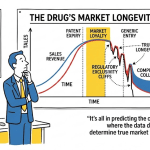
The most common investor mistake with combination drug patent analysis is conflating composition patent expiry with franchise revenue collapse. The two are related but not the same. A biologic whose composition patents expire in 2028 still benefits from BPCIA exclusivity that may run until 2032, combination method patents covering specific indications that run to 2035, and formulation patents covering specific delivery technologies that run to 2033. The actual revenue cliff depends on which of these protections FDA, courts, and payers ultimately respect.
Short positions built purely on composition patent expiry dates chronically mistime the actual revenue erosion. The better framework is to model three scenarios: an optimistic case where combination method patents are enforced and delay biosimilar combination use, a base case where label carve-outs limit combination method patent value but formulation patents provide partial protection, and a downside case where courts find key secondary patents invalid and biosimilar manufacturers receive favorable carve-out determinations.
Long positions in combination drug franchises should focus on companies that have done the work — structured genuine clinical evidence of synergy, filed combination patents with specific chemical entities rather than generic class references, coordinated SPC filings with explicit combination disclosures, and built manufacturing complexity that deters biosimilar entry independent of patent status. The companies that have invested in combination drug IP infrastructure will extract materially more value from their franchises than those that have relied on single-component patents and hoped the combination use would benefit by extension.
Key Takeaways
Combination drugs — pairing a biologic with a small molecule — generate some of the highest revenue in pharmaceutical portfolios and face some of the most complex IP defense challenges. The claim architecture required to protect them must span composition, method of treatment, dosing regimen, delivery mechanism, and manufacturing process in both the biologic and chemical patent domains.
Regulatory exclusivity stacking — combining BPCIA biologics data exclusivity, Hatch-Waxman NCE exclusivity, orphan drug protection, and pediatric extensions — can add years of market protection beyond the patent term if coordinated from the outset of clinical development. The EU SPC framework post-Teva requires explicit combination disclosure in the basic patent; retrofitting SPC eligibility after the fact is not possible.
Patent thickets built around biologic-small molecule combinations can delay biosimilar and generic entry through settlement economics, but the Humira model depends on the biologic being the dominant commercial component. Where the biologic faces early biosimilar entry, combination method patents and formulation patents become the primary defensive tools, with mixed enforcement results.
Manufacturing complexity — genuine in most monoclonal antibody-based biologics — provides a non-patent barrier to entry that analysts frequently undervalue when modeling revenue erosion post-exclusivity. Companies that combine strong IP portfolios with manufacturing moats in their combination franchises will outperform those relying on patent protection alone.
Global harmonization for combination drug IP is incomplete. Filing the same claims in the U.S., EU, Japan, China, and India requires different supporting data, different prosecution strategies, and different SPC or extension mechanisms. India’s Section 3(d) and China’s evolving CNIPA standards make Asia-Pacific a distinct strategic challenge that cannot be addressed with a U.S.-centric patent portfolio.