A deep-dive reference for IP teams, R&D leads, patent counsel, and portfolio managers navigating combination therapy exclusivity
Section 1: Executive Summary and Key Findings
Patenting a drug combination is not a legal formality appended to late-stage clinical work. It is a strategic function that must be embedded into the R&D program from the earliest stages of target identification. The patent, in practice, is the asset. Everything else, manufacturing, distribution, brand equity, is leased on the tolerance of that asset’s remaining exclusivity life.
The core challenge is structural. When a pharmaceutical company combines two known active pharmaceutical ingredients (APIs), both typically disclosed in prior art, the resulting product faces a strong presumption of obviousness under 35 U.S.C. § 103. The Supreme Court’s 2007 ruling in KSR International Co. v. Teleflex Inc. made that presumption harder to rebut by replacing the rigid Teaching-Suggestion-Motivation (TSM) test with a common-sense, flexible inquiry that gives patent examiners far more room to reject combination claims as predictable recombinations of known elements.
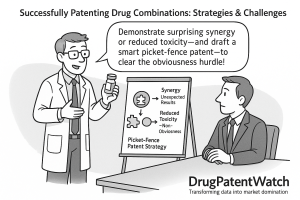
Overcoming that presumption requires data. Not assertions, not narrative arguments about unmet medical need, but quantitative, reproducible experimental evidence that the combination produces a result that a Person Having Ordinary Skill in the Art (POSITA) would not have predicted. The gold standard is rigorously demonstrated synergy, a combined effect greater than the mathematical sum of the individual components across a range of doses, validated by isobolographic analysis or comparable statistical methodology. A close second is a quantified improvement in safety, specifically a reduction in known or dose-limiting toxicities when the drugs are combined at sub-monotherapy doses. Neither argument can be constructed post hoc. The R&D protocol must be designed to generate this evidence before the first human study begins.
Beyond the science, a single patent on a combination API is commercially indefensible. Every major combination drug with sustained exclusivity, from Eliquis to Entresto to Biktarvy, is protected by a layered ‘patent fortress’: overlapping composition, formulation, method-of-use, dosing regimen, and device patents that collectively make generic market entry both legally hazardous and commercially uninviting. Bristol-Myers Squibb and Pfizer’s Eliquis portfolio alone includes 226 manufacturing patents and 213 formulation patents beyond the core composition claims. Building that fortress is a deliberate, prospective engineering project, not a reactive response to ANDA filings.
The regulatory and IP functions must operate as one team. The Primary Mode of Action (PMOA) determination the FDA requires for a combination product, under its Office of Combination Products (OCP) framework, directly dictates which patents belong in the Orange Book and which claims will survive a Paragraph IV challenge. Inconsistencies between what a company tells the FDA about the product’s mechanism and what it tells the USPTO about the source of its novelty are among the most reliably exploited vulnerabilities in Hatch-Waxman litigation.
Finally, global IP strategy cannot default to the U.S. playbook. The EPO’s problem-solution approach to inventive step demands earlier, more technically specific data than the USPTO typically requires. India’s Section 3(d) has blocked multiple lifecycle management strategies that would have cleared examination in Europe or the United States. Any company treating a combination therapy as a global product needs a jurisdiction-specific filing strategy, not a translated U.S. application.
Key Takeaways: Section 1
The non-obviousness presumption for combining known drugs is strong post-KSR; data is the only reliable rebuttal.
Synergy demonstrated via isobolographic analysis, or quantified toxicity reduction at sub-monotherapy doses, is Tier-1 non-obviousness evidence.
A single patent on a combination API is commercially insufficient; a layered fortress of 200+ related patents is the operational target for blockbuster products.
FDA’s PMOA determination and Orange Book listing strategy must be co-designed with patent counsel from the IND stage.
Global strategy requires jurisdiction-specific filing timelines and data thresholds, particularly for the EPO and India.
Section 2: The Patentability Gauntlet: Core Statutory Requirements
Every patent application for a drug combination must clear five distinct statutory hurdles, each capable of independently defeating the claim. Patent counsel and R&D leadership frequently focus almost exclusively on non-obviousness because it dominates prosecution and litigation. That focus is rational, but it can cause teams to underestimate the early-stage risks posed by § 101 eligibility, § 102 novelty, and § 112 disclosure, three requirements that can invalidate a patent before the obviousness argument is even reached.
2.1 Subject Matter Eligibility Under 35 U.S.C. § 101
A drug combination claim falls cleanly into patentable subject matter, either as a composition of matter (the physical combination of APIs) or as a method of use (a process for treating disease). The § 101 challenge for combination therapies is almost always confined to method claims that rely on a newly discovered biological correlation, a biomarker-drug relationship or a pharmacogenomic predictor of response.
The Mayo/Alice two-step framework asks first whether the claim is directed to a law of nature or abstract idea, and second whether it contains an ‘inventive concept’ that transforms the exception into a patent-eligible application. A claim framed as ‘administering Drug A and Drug B to a patient having Biomarker X’ clears the framework because it recites an affirmative treatment step that applies the discovery, not merely observes it. Contrast that with a claim that recites ‘determining a patient’s response to Drug A + Drug B by measuring the level of Biomarker X,’ which collapses into an observation of a natural correlation and fails Step 1. The practical drafting rule is straightforward: end the claim with a positive therapeutic act, not a measurement or observation.
The 2024 USPTO Guidance Update on Subject Matter Eligibility extended this framework to AI-assisted drug combination discovery, clarifying that a claim does not become patent-ineligible merely because a machine learning model identified the combination. The eligibility analysis still turns on whether the claim recites a practical therapeutic application or merely describes the discovery of a biological relationship.
2.2 Novelty Under 35 U.S.C. § 102
Novelty requires that no single prior art reference discloses every element of the claim. For a drug combination, that means the exact pairing of specific APIs, at the claimed dosage or ratio, for the claimed use, must be absent from all prior art as of the effective filing date.
A naked composition claim, ‘A pharmaceutical composition comprising Drug A and Drug B,’ will fail if both components and their combined use appear in any single prior art document. The inventive territory for novelty lies in the specifics. Three reliable routes exist. First, a novel specific ratio or fixed-dose combination (FDC) where that ratio has never been disclosed. Second, a novel formulation: a co-crystal, a specific polymorphic form of one API, an extended-release matrix design, or a nanoparticle delivery system that produces a meaningful pharmacokinetic difference. Third, a new method of use, treating a disease, patient subpopulation, or genetic subtype that the prior art never associated with the combination. Each route has trade-offs. The formulation route is often the most durable, because a competitor who invalidates the composition claim may still infringe the formulation patent. The method-of-use route is vulnerable to skinny-label carve-outs in ANDA proceedings, where the generic manufacturer simply excludes the patented indication from its labeling, though courts have increasingly scrutinized how complete that carve-out must be.
The tension between novelty and § 112 disclosure is real. A claim drafted broadly to avoid novelty-destroying prior art, for example covering ‘any kinase inhibitor in combination with any checkpoint inhibitor,’ creates an immediate enablement problem: the application almost certainly does not describe how every kinase inhibitor-checkpoint inhibitor pair works, and the PTAB and Federal Circuit have shown little tolerance for unduly speculative genus claims since Amgen v. Sanofi (2023).
2.3 Written Description and Enablement Under 35 U.S.C. § 112
The written description requirement asks whether the specification reasonably conveys that the inventor possessed the claimed invention as of the filing date. Enablement asks whether the specification teaches a POSITA to make and use the full scope of the claims without undue experimentation.
For a combination therapy claiming a narrow, specific API pair at defined doses, neither requirement is particularly difficult to satisfy if the application includes the expected pharmacology, formulation detail, and at minimum in vitro efficacy data. The challenge arises when applicants draft broad genus claims. After Amgen v. Sanofi, the Federal Circuit confirmed that claiming a functional genus, such as all antibodies that bind Epitope X and block Target Y, requires something close to an entire class of working examples to satisfy enablement. The same logic applies to combination patents. A claim to ‘a combination of a PCSK9 inhibitor and a statins class agent’ needs representative examples across the claimed class, not a single pembrolizumab-plus-ipilimumab data point dressed up as genus support.
The strategic response is to write ‘waterfall’ specifications: a broad independent claim supported by the fullest data set available at filing, a series of progressively narrower dependent claims anchored at each level by specific examples, and explicit written description of every commercially important embodiment. This structure allows prosecution amendments to narrower patentable scope without introducing new matter, which post-filing addition of new matter strictly prohibits.
2.4 The Non-Obviousness Crux Under 35 U.S.C. § 103
Non-obviousness is where combination drug patents are made or broken. Section 3 of this article treats the doctrine in full technical detail. The framing here is strategic: § 103 is not a legal threshold to clear during examination, it is the central design parameter of the R&D program. Every experimental protocol, every in vitro assay, every Phase I dose-escalation design should be planned with the explicit question: ‘Will this data prove that the result was unexpected to a POSITA who knew both drugs individually?’ If the answer is no, the program needs a different experimental design before the IND is filed, not after the Paragraph IV notice letter arrives.
Key Takeaways: Section 2
Method-of-use claims must end with a positive therapeutic act to survive Mayo/Alice Step 1; claims that end with a measurement or observation will fail.
After Amgen v. Sanofi, broad functional genus claims in biologic combination patents carry serious enablement risk; representative working examples across the full claimed class are required.
‘Waterfall’ specification architecture, broad claims supported by layered examples at progressively narrower scopes, is the correct structural response to the novelty/enablement tension.
§ 103 is a design parameter for the R&D program; data generation protocols must be structured before the IND, not reconstructed for litigation.
Section 3: Non-Obviousness Under 35 U.S.C. § 103: The Central Legal Battlefield
3.1 The KSR Revolution and Its Lasting Consequences
Before 2007, the Teaching-Suggestion-Motivation test gave pharmaceutical innovators a reasonably predictable framework for arguing non-obviousness. If no prior art reference explicitly suggested combining Drug A and Drug B, the combination was difficult to declare obvious. KSR International Co. v. Teleflex Inc. ended that predictability. The Supreme Court held that the rigid TSM test was inconsistent with the flexible, functional approach that § 103 requires, and that a POSITA is a person of ordinary creativity, not an automaton constrained to what the prior art explicitly teaches.
The practical consequences for pharmaceutical combinations were immediate and severe. An examiner no longer needs a ‘smoking gun’ reference. The argument now runs as follows: Drug A is known to treat Disease Z. Drug B is known to treat Disease Z by a different mechanism. Combining drugs with complementary mechanisms to improve therapeutic outcomes is standard medical practice. A POSITA would have been motivated to try the combination. The expected result is an additive effect. That expectation is an RES. Obviousness established. This type of argument, which would have been speculative under the old TSM framework, is now routine.
The innovator’s response must be data. The evidentiary burden shifted in 2007 and has not shifted back.
3.2 The ‘Obvious to Try’ Doctrine: Finite Options vs. Unpredictable Results
KSR revived the ‘obvious to try’ doctrine but constrained it: an invention is only obvious because it was obvious to try when there is a finite number of identified, predictable solutions to a known problem. This limitation is where pharmaceutical innovators have the most to work with.
Oncology drug development is a reliable case for arguing infinite, unpredictable solution spaces. The clinical failure rate for oncology drug combinations has historically exceeded 90% in Phase II and 70% in Phase III. Drug-drug interactions in a tumor microenvironment are notoriously difficult to predict from single-agent activity. These empirical facts, documented in the peer-reviewed literature, are legitimate arguments against ‘finite, predictable solutions.’ The POSITA in oncology combination development does not face a ‘pick one from a list of five’ problem; they face a combinatorial space of thousands of agents, hundreds of tumor subtypes, and an almost total inability to predict from in vitro data what will happen in a clinical trial.
This argument has limits. It works best in genuinely unpredictable fields and for genuinely non-obvious results. It struggles where the prior art explicitly suggests a specific combination would work, where the mechanism of synergy is already described theoretically, or where clinical data from related combinations is already available. Counsel should audit the prior art landscape before framing this argument; an examiner who finds a paper predicting synergy between the two drug classes in question will neutralize it quickly.
3.3 Reasonable Expectation of Success: The Decisive Factor in Modern Prosecution
Reasonable expectation of success (RES) is the analytical pivot point of every modern § 103 rejection. The examiner or challenger must establish that a POSITA would have had a reasonable expectation, not a hope, of achieving the claimed result by combining the prior art elements. The innovator counters by showing that the result was actually achieved was not the predictable result a POSITA would have expected.
RES is an objective, forward-looking standard measured from the perspective of the POSITA before the invention was made. It does not require certainty. It does require something more than theoretical plausibility. In highly unpredictable fields, the documented failure rates of prior art attempts and the mechanistic complexity of the biological system are both relevant to whether RES existed.
The inverse relationship between the predictability of the field and the legal weight of an ‘obvious to try’ argument is critical. In the mechanical arts at issue in KSR itself, ‘obvious to try’ carried significant legal weight because the technology was predictable and the solution space was finite. In pharmacology, particularly in oncology or neurological disease where dose-response relationships, drug-drug interactions, and off-target effects are poorly predictable from structural analogy, ‘obvious to try’ carries far less weight because RES is inherently low.
The Vanda Pharmaceuticals v. West-Ward Pharmaceuticals petition to the Supreme Court argued that the Federal Circuit’s RES standard had drifted too far from KSR‘s ‘predictable results’ language, effectively lowering the bar for finding non-obviousness. The Court did not grant certiorari, leaving the current Federal Circuit standard in place, but the debate signals that RES doctrine remains actively contested. IP teams should monitor how the Federal Circuit applies RES in combination therapy appeals over the next two to three years, particularly in oncology, where the unpredictability argument has been most successful.
3.4 The Graham v. John Deere Framework: Applying the Four Factors
Every § 103 analysis, regardless of how KSR frames the ultimate conclusion, must be grounded in the four-factor Graham v. John Deere Co. (1966) inquiry: the scope and content of the prior art; the differences between the prior art and the claims; the level of ordinary skill in the art; and objective secondary considerations. Courts and the PTAB apply this framework mechanically, and IP counsel who short-circuit it, jumping straight to unexpected results without building the Graham foundation, often produce weaker prosecution records.
The level of ordinary skill determination matters more than it appears. A POSITA defined as a PhD pharmacologist with five years of combination therapy experience in oncology will be presumed to know far more about the predictability of drug-drug interactions than a POSITA defined as a general medicinal chemist. Applicants should argue for the POSITA definition that best supports their non-obviousness case, and they should do so early, in the specification, not for the first time in a response to an obviousness rejection.
Key Takeaways: Section 3
KSR shifted the evidentiary burden permanently to the innovator; data-free legal arguments rarely overcome a well-constructed prima facie case of obviousness.
The ‘obvious to try’ doctrine is strongest against innovators in predictable fields with finite solution spaces; oncology and CNS drug combinations are most defensible on unpredictability grounds.
RES analysis is a forward-looking objective standard; documented prior art failure rates and mechanistic complexity are admissible evidence against RES.
POSITA definition is a strategic decision that should be made in the specification, not conceded by default during examination.
Section 4: Demonstrating Non-Obviousness: The Evidence Architecture
4.1 Synergy: The Gold Standard and Its Requirements
Synergy, a combined therapeutic effect greater than the additive sum of the individual components, is the most powerful non-obviousness argument available for combination drug patents. When properly demonstrated, it directly rebuts the examiner’s presumption that combining Drug A and Drug B produces a predictable, additive result. If the result is super-additive, the combination is, by definition, not doing what a POSITA predicted.
Qualitative assertions of synergy, language in a patent specification stating that ‘the combination produced a synergistic effect,’ are worthless. The USPTO and courts require quantitative demonstration. The methodological standard is isobolographic analysis, developed by Loewe and Muischnek in the 1920s and formalized in pharmacological practice since the 1980s. An isobologram plots the concentration of Drug A required to achieve a defined effect level (typically IC50) as a function of the concentration of Drug B. If the data points fall below the theoretical additive isobole, the interaction is synergistic. Points on the isobole indicate additivity. Points above indicate antagonism. The isobologram must span a range of combination ratios, not just a single fixed ratio, to establish that synergy is a property of the combination rather than an artifact of one particular dose level.
A growing body of Federal Circuit and PTAB precedent adds two further requirements. First, the synergy must be unexpected in the context of the specific prior art. If prior art papers already predict or suggest synergy between the two drug classes at issue, demonstrated synergy may not be ‘surprising’ enough to overcome obviousness. The comparison must be against what a POSITA knew, not against zero prior art. Second, the scope of the synergy evidence must match the breadth of the claims. A claim covering a ratio range of 1:1 to 1:10 requires data showing synergy across that range. Data supporting a 1:5 ratio alone supports only a claim to that specific ratio.
4.2 Reduced Toxicity as Non-Obviousness Evidence
An improved safety profile, specifically demonstrated toxicity reduction at combination doses below those required for monotherapy, is often easier to document than synergy and is an equally valid non-obviousness argument. It directly addresses one of the most concrete problems in pharmacology: every drug has a therapeutic window defined by efficacy at the low end and toxicity at the high end. A combination that achieves therapeutic effect at doses where neither agent alone is toxic has done something that a POSITA would not have predicted from the monotherapy data.
The Hatch-Waxman era case involving doxorubicin combinations illustrates this. US Patent No. 6,906,040 claimed a combination of doxorubicin with a specific co-agent and explicitly demonstrated non-obviousness by showing that the combination did not produce the cardiotoxic metabolites that doxorubicin generates when combined with taxanes. The toxicity data was the centerpiece of the non-obviousness case, not an afterthought. Preclinical and clinical safety data, particularly data addressing known adverse drug-drug interaction risks, should be treated as primary IP-generating evidence from the first animal study.
The commercial and regulatory relevance of this evidence type is particularly strong in oncology, where dose-limiting toxicities routinely terminate otherwise promising combination programs. An FDC that demonstrably allows lower doses of both agents while maintaining efficacy is a clinical, regulatory, and IP asset simultaneously.
4.3 Unexpected Mechanism and Novel Pharmacodynamic Interactions
Beyond classical synergy and toxicity reduction, a third category of unexpected results is increasingly relevant as drug combination programs move into biologics, ADCs (antibody-drug conjugates), and small molecule-biologic hybrids. If a combination produces its effect through a mechanism that neither agent produces independently, and if that mechanism was not known or predicted in the prior art, the mechanistic novelty is itself evidence of non-obviousness.
For example, a checkpoint inhibitor combined with a CDK4/6 inhibitor may produce T-cell priming effects that neither agent generates alone. If that mechanism was not described in the prior art before the invention date, data demonstrating it, via TCR sequencing, tumor infiltrating lymphocyte analysis, or cytokine profiling, is strong secondary evidence of an inventive step. The mechanism data also strengthens the written description by explaining how and why the combination works, which supports both enablement and the argument that the inventors genuinely possessed the invention.
4.4 Secondary Considerations: Building the Full Non-Obviousness Case
Secondary considerations (the ‘objective indicia of non-obviousness’ from Graham v. John Deere) supplement but do not replace Tier-1 data. They include long-felt but unsolved need, failure of others, commercial success nexus to the invention’s merits, copying by competitors, and expert skepticism.
Two of these are worth expanding because they are frequently mishandled. Commercial success is admissible evidence, but only if the patentee can establish a nexus between the commercial performance and the specific features claimed in the patent, not brand recognition, physician relationships, or marketing spend. A drug that sold well because of a blockbuster branded sales force, not because it worked better than alternatives, will generate commercial success evidence that a challenger can deflect easily.
Failure of others requires documenting, as specifically as possible, which companies or academic groups tried comparable combinations and why they abandoned the program. This documentation should be assembled prospectively, during the R&D phase, not reconstructed from memory three years later during litigation. If a competitor publicly abandoned a combination program in a clinical trial, that clinical trial report is your failure-of-others evidence, and it should be cited explicitly in the specification.
Key Takeaways: Section 4
Isobolographic analysis across a full ratio range is the minimum acceptable methodology for synergy claims; single-ratio data supports only a single-ratio claim.
Toxicity-reduction evidence is often more attainable than synergy and is equally compelling; it should be generated prospectively from the first animal safety study.
Mechanistic novelty (a new pharmacodynamic interaction not predicted by either monotherapy) is valid Tier-1 non-obviousness evidence in biologics and ADC combinations.
Commercial success evidence requires a documented nexus to the claimed invention’s specific technical merits; it cannot rest on brand or marketing factors alone.
Failure-of-others documentation should be assembled during R&D, not reconstructed for litigation.
Section 5: IP Valuation of Combination Therapy Portfolios
This section fills a gap that most patent strategy analyses omit: a direct treatment of how to value a combination therapy’s patent portfolio as a financial asset, the methodologies institutional investors and M&A teams use, and how specific patent characteristics translate into quantifiable economic value.
5.1 Why Patent Portfolio Valuation Matters to M&A and Licensing Teams
When a biotech company’s lead asset is a combination therapy in Phase II, the enterprise value is not primarily a function of the clinical data. It is a function of how defensible the exclusivity period will be and how long it will last. A combination drug with a core API composition patent expiring in 2029 and no secondary patent coverage is a fundamentally different asset from a combination with layered formulation, method-of-use, and device patents running to 2041. Both may have the same Phase II efficacy readout. The first has a five-year exclusivity window. The second has a seventeen-year window. That difference can move a valuation by hundreds of millions of dollars.
M&A analysts at large pharma companies use patent expiration mapping, the analysis of all patents in a given portfolio by claim type and expiration date, to model the probability-weighted revenue curve for a target company’s product. The IP due diligence team’s job is to assign a probability of survival to each patent given the prior art landscape, the claim breadth, and the quality of the supporting data in the specification. A patent supported by strong synergy data, a rich specification, and a layered claiming structure carries a higher survival probability than a single composition claim with no supporting data.
5.2 Valuation Methodologies for Combination Drug IP
Three principal methodologies apply to combination drug patent portfolios.
The income approach discounts projected future royalty streams or avoided generic competition revenue back to a present value, using a risk-adjusted discount rate that incorporates patent litigation risk, regulatory risk, and market risk. For a combination FDC, this requires modeling the revenue differential between the branded combination product and the sum of the available generic alternatives. A combination that cannot be easily reproduced by a patient taking two generic pills (for example, because of a specialized delivery system or because the FDC ratio is clinically essential) generates a premium that can be monetized in the income model.
The market approach benchmarks the patent portfolio against comparable transaction multiples, specifically the ratio of deal value to Orange Book-listed patent years remaining at the time of a comparable licensing deal or acquisition. This approach is most reliable when there is a rich comparable transaction set, which exists in primary care cardiovascular and metabolic disease but is sparse in rare disease combination programs.
The cost approach calculates the investment required to recreate the portfolio from scratch, including R&D spend to generate the supporting data, prosecution costs, and litigation reserve. This approach typically yields the lowest valuation and is most applicable to early-stage assets where income projection is too speculative.
5.3 The Orange Book Patent Map as a Valuation Tool
The FDA’s Orange Book is publicly available and lists every patent that an NDA holder has certified covers the approved drug. For IP valuation purposes, the Orange Book patent map answers four questions that directly affect asset value. First: how many distinct patent barriers must a generic manufacturer overcome? Second: what is the latest expiration date of any listed patent? Third: how many Paragraph IV certifications have been filed against the product, and what has the litigation outcome been? Fourth: have any listed patents been challenged in IPR proceedings at the PTAB?
A product with fifteen Orange Book-listed patents and no successful Paragraph IV challenges over ten years is a demonstrably higher-quality IP asset than a product with three listed patents and two successful invalidity rulings. Tools like DrugPatentWatch provide this litigation history and expiration mapping at the portfolio level. Investment teams that do not use this data in deal modeling are flying blind.
5.4 Patent Term Extension as a Value Multiplier
Patent Term Extension (PTE) under 35 U.S.C. § 156 compensates innovators for the regulatory review period consumed before the first commercial sale. The formula: the PTE equals half the time elapsed from the IND filing date to the NDA filing date, plus the full time elapsed from the NDA filing date to the FDA approval date, minus any time during which the applicant failed to act with due diligence. The maximum extension is five years, and the extended patent cannot run more than fourteen years beyond the approval date.
For a combination drug where the innovator files a new 505(b)(1) NDA (a full application, not a hybrid), the PTE can be substantial. Gilead’s HIV combination franchise has extracted near-maximum PTEs on several core patents by structuring clinical development timelines to maximize the reviewable period. The selection of which single patent to extend, since only one patent can be extended per regulatory review period, is among the most consequential IP decisions in the product lifecycle. Selecting the patent with the latest natural expiration date, and ensuring that patent covers the commercial formulation, not just the API, is the general principle. However, if a formulation patent expires after the composition patent and is more difficult for a generic to design around, the formulation patent may be the better selection even if the resulting extended term is nominally shorter.
5.5 Investment Strategy: Reading a Combination Drug’s Patent Portfolio
For institutional investors, the patent portfolio is the core variable in a pharmaceutical asset’s long-term revenue model. Several specific indicators signal portfolio strength or weakness.
A portfolio that lists Orange Book patents expiring across multiple years through 2035 or later, with multiple claim types (composition, formulation, method of use, dosing regimen), is structurally strong. A portfolio where all Orange Book patents expire within the same twelve-month window suggests that lifecycle management has been neglected, and generic entry will be rapid and total.
The presence of one or more PTAB IPR proceedings against a product’s patents is a red flag in early-stage modeling. A granted IPR institution (where the PTAB agrees to hear the challenge) results in invalidation of all challenged claims approximately 50-60% of the time, depending on the claim type and whether the patent involves a well-developed versus a nascent prior art landscape.
A Paragraph IV first-filer designation by a generic company earns 180 days of market exclusivity under Hatch-Waxman. When a generic company files a Paragraph IV and the brand has not sued within 45 days, no 30-month stay triggers, and the FDA can approve the ANDA immediately after technical review. Investors who track Paragraph IV filings and lawsuit timing, using public FDA and court records, can model generic entry dates more accurately than sell-side analysts who rely solely on the earliest Orange Book expiration date.
Key Takeaways: Section 5
Patent portfolio quality directly determines exclusivity window length and thus enterprise value in combination drug M&A; income-approach valuation should model revenue under multiple patent survival scenarios.
Orange Book patent count, claim type diversity, and Paragraph IV litigation history are the three most reliable proxy measures of portfolio strength.
PTE selection, choosing which single patent to extend, requires optimizing for claim coverage of the commercial formulation and latest natural expiration, not simply the longest regulatory review period.
PTAB IPR grant rates of 50-60% make any challenged combination patent a materially impaired asset; investors should haircut valuation models by the IPR grant probability.
Tracking Paragraph IV filing dates and the brand’s 45-day lawsuit response window is a more accurate predictor of generic launch timing than Orange Book expiration dates alone.
Section 6: Strategic Claim Drafting and the Fortress Architecture
6.1 The Layered Claiming Strategy
A patent application for a combination therapy should contain multiple independent claims operating at different levels of specificity. The broadest independent claim covers the core API combination for the general disease category. Narrower independent claims cover specific patient populations, specific dosage forms, and specific administration regimens. Dependent claims add further specificity at each level.
This structure serves two purposes. It maximizes the probability that at least some claims survive examination and litigation. A challenger who invalidates the broad composition claim still faces narrower formulation and method-of-use claims. It also creates prosecution history that documents the full scope of what was invented, which courts and the PTAB use to interpret claim scope.
The breadth-data alignment principle: every independent claim must be supported by data commensurate with its scope. A broad independent claim covering any combination of Class X drug with any Class Y drug needs examples across that class. A narrow claim covering Drug A plus Drug B at a 1:5 ratio needs data at that ratio. Misalignment between claim breadth and data support is the most common cause of enablement rejections in combination drug prosecution, and it is completely avoidable with competent pre-filing data planning.
6.2 The Picket Fence Strategy: Specific Claim Categories
The ‘picket fence’ is the operational architecture of sustained pharmaceutical exclusivity. Each patent in the fence guards against a different competitive entry vector. The fence should be designed by working backward from the most likely generic attack strategies: What will a competitor’s ANDA cover? What design-arounds are technically feasible? What prior art references are they likely to cite in a Paragraph IV challenge?
For a small-molecule FDC, the standard fence includes at minimum seven patent categories. The core API combination patent, typically the earliest-filed and broadest, is the fence post, but it is also the most vulnerable. The formulation patent covers the specific excipient system, particle size distribution, or release kinetics that make the commercial product work; this is usually much harder to design around than the API combination itself. The polymorph and salt patent covers the specific physical form of each API used in the commercial product, because generic manufacturers must use that form to achieve bioequivalence. The dosing regimen patent covers the specific dosing interval (e.g., once-daily versus twice-daily) and the clinical evidence supporting it. The method-of-use patent for the primary indication, and separate method-of-use patents for each additional indication as they are approved, cover the labeled uses. For drug-device combinations, the device patent on the delivery system, injector, inhaler, or auto-injector mechanism, is a separate and often very durable picket. Process and manufacturing patents, covering the specific synthetic route or formulation manufacturing process, round out the fence and are particularly relevant for biologic-containing combinations.
6.3 System Claims vs. Method Claims in Drug-Device Combinations
For FDCs involving a device component (auto-injectors for insulin combinations, inhalers for corticosteroid-LABA combinations), traditional method claims face the divided infringement problem. A method claim that requires a physician to perform Step A and a patient to perform Step B may have no single infringer who performs all steps. Federal Circuit precedent on divided infringement doctrine, including the Akamai Technologies v. Limelight Networks line of cases, requires either that all steps be performed by a single party, or that one party directs and controls another party’s performance of the remaining steps.
System claims solve this problem by claiming the device and drug as an integrated product. The company that manufactures and sells the integrated auto-injector pre-filled with the FDC is the single party who makes the claimed system. No divided infringement issue arises. As drug-device combination products become more prevalent, the auto-injector platforms for GLP-1 agonist combinations being one example, system claim drafting is increasingly the preferred approach for device-involving combination products.
6.4 Prosecution Strategy: Managing the Record for Future Litigation
Every argument made during patent prosecution, every claim amendment, every concession to an examiner’s rejection, becomes part of the prosecution history that a court will use to interpret claim scope in future litigation. This is the doctrine of prosecution history estoppel. A patentee who narrowed a claim to overcome an obviousness rejection may be estopped from arguing in infringement litigation that the claim covers the scope that was surrendered.
Claim amendments during prosecution should be made for reasons that do not unnecessarily limit the claim scope. When possible, applicants should overcome rejections through argument and evidence, submitting declarations of unexpected results rather than amending claims. When claim amendments are unavoidable, they should be made with explicit statements in the prosecution history explaining the precise reason for the amendment and its narrow scope, to minimize estoppel effect.
Key Takeaways: Section 6
Breadth-data alignment is the most critical principle in combination claim drafting; every independent claim requires commensurate experimental support.
A complete picket fence for a small-molecule FDC requires at minimum seven distinct patent categories; each category guards against a different generic entry vector.
System claims solve the divided infringement problem for drug-device combinations; they should be included in every application involving a device delivery component.
Overcoming obviousness rejections by argument and evidence declaration, rather than claim amendment, preserves broader claim scope and minimizes prosecution history estoppel.
Section 7: Lifecycle Management, Evergreening, and Secondary Patents
7.1 What Lifecycle Management Actually Means
‘Evergreening’ is the term critics apply to the pharmaceutical practice of filing secondary patents to extend exclusivity beyond the original composition patent’s expiration. The same practice, from the innovator’s perspective, is lifecycle management: the systematic development and patenting of new formulations, indications, and combination products that provide incremental but genuine clinical benefits, and that justify continued premium pricing by offering something the generic version cannot.
The distinction matters legally and commercially. A secondary patent that covers an improved extended-release formulation with demonstrated clinical benefits over the immediate-release version is a legitimate innovation, patentable on its own merits, and enforceable against a generic who copies it. A secondary patent that covers an obvious polymorph, with no demonstrated clinical advantage, filed purely to delay generic entry, is the type of claim that gets invalidated quickly, in IPR proceedings, in Paragraph IV litigation, or in the Indian Supreme Court’s Section 3(d) jurisprudence.
The commercial wisdom of genuine lifecycle management is well-documented. AstraZeneca’s transition from Prilosec (omeprazole) to Nexium (esomeprazole, the S-enantiomer) is the canonical example of both the strategy and its limits. Nexium’s patents held in the United States. The clinical benefit argument for the S-enantiomer (marginally superior acid suppression in a defined patient subgroup) was sufficient to establish non-obviousness in U.S. proceedings. The same argument would likely fail under Section 3(d) in India, which requires demonstrable enhancement of therapeutic efficacy, not marginal improvement in a subgroup.
7.2 The Next-Generation Product Launch
The most effective lifecycle management tool is launching a next-generation version of the original product, protected by its own patent fortress, before the original’s core patents expire. The goal is to migrate as much of the patient population as possible from the older version to the new one while the new version is still under full exclusivity.
Herceptin (trastuzumab) and its antibody-drug conjugate successor Kadcyla (ado-trastuzumab emtansine) illustrate this at the biologic level. Kadcyla conjugates trastuzumab to a cytotoxin, creating a fundamentally different product with its own patent estate. Patients who would have moved to trastuzumab biosimilars instead were maintained on Kadcyla at full branded pricing while Kadcyla’s own exclusivity period ran. The clinical benefit, meaningful improvement in progression-free survival in HER2-positive metastatic breast cancer, was genuine, which is what made the strategy both legally defensible and commercially durable.
For small-molecule FDCs, the next-generation strategy typically involves adding a third agent, switching to an extended-release formulation, or developing a combination co-crystal. HIV combination therapy is the clearest model: Gilead’s progression from Atripla (efavirenz/emtricitabine/tenofovir DF) to Genvoya (elvitegravir/cobicistat/emtricitabine/tenofovir AF) to Biktarvy (bictegravir/emtricitabine/tenofovir AF) represents three successive next-generation products, each with its own patent fortress, each with documented clinical improvements (reduced bone and renal toxicity for the tenofovir AF switch, higher resistance barrier for the bictegravir switch) that justified non-obviousness arguments and supported premium pricing well beyond the original Atripla patent expiration.
7.3 Continuation and Divisional Applications
Continuation applications, which claim priority to the original application and add new claims on the same disclosure, are the mechanical tool for building the picket fence over time. A company that filed a broad composition claim in Year 1 can file continuation applications adding formulation claims in Year 2, dosing regimen claims after Phase III data in Year 3, and new indication claims as label expansions are approved. Each continuation gets its own expiration date running 20 years from the earliest priority date, not the continuation filing date, but post-grant extensions and PTEs can extend individual continuations past that baseline.
Continuation strategy requires careful management of the prosecution timeline. Terminal disclaimers, which the USPTO requires when a continuation claims essentially the same invention as a parent, link the continuation’s expiration to the parent’s and may weaken it. Counsel should evaluate whether each continuation claim is genuinely distinct from parent claims before accepting terminal disclaimer requirements.
Key Takeaways: Section 7
Defensible lifecycle management requires genuine clinical improvement in the next-generation product; obvious polymorphs or salts without clinical benefit advantages are increasingly vulnerable post-Novartis v. Union of India.
The next-generation product launch strategy works best when the clinical benefit of the new version is documented before the original product’s core patents expire, allowing market migration during the transition.
HIV combination therapy (Atripla to Genvoya to Biktarvy) is the industry benchmark for executed lifecycle management; each successive FDC rested on documented improvements in safety profile, not just formulation novelty.
Continuation application strategy should be mapped alongside the clinical development program; new indication data and formulation improvements should trigger immediate continuation filings.
Section 8: The FDA-USPTO Nexus: Where Regulatory and Patent Strategy Collide
8.1 Combination Product Classification and PMOA
The FDA’s Office of Combination Products classifies products as single-entity, co-packaged, or cross-labeled combinations, based on whether the components are physically integrated, packaged together, or separately sold with cross-labeling. The classification determines which FDA center, CDER, CDRH, or CBER, serves as the lead review center, which in turn determines the regulatory pathway and the type of clinical evidence required.
The Primary Mode of Action determination is the key decision point. If the innovator argues to the FDA that the therapeutic benefit comes primarily from the drug component (PMOA = drug), CDER leads the review, and the clinical evidence standard is a full NDA. If PMOA = device, CDRH leads, and the evidence standard is typically a 510(k) or PMA. The PMOA determination is not just a regulatory process question. It defines the narrative of the product’s mechanism, and that narrative must be consistent with the patent claims.
A company that tells the FDA ‘the therapeutic benefit comes primarily from the novel sustained-release device design’ and then tells the USPTO ‘the novelty lies in the drug formulation, not the device’ has created contradictory records that a Paragraph IV challenger will exploit effectively. The FDA submission describing the PMOA is discoverable in patent litigation. Every statement made to the FDA about mechanism, pharmacology, and design rationale must be vetted by patent counsel before submission.
8.2 Clinical Trial Timing and the Public Use Bar
Under 35 U.S.C. § 102(b)(1), a patent is invalid if the claimed invention was in public use or on sale more than one year before the effective filing date. Clinical trials create public use risk when they involve administration of the inventive combination to patients under conditions that are not confidential.
Phase I trials (typically small, safety-focused studies in confined settings with confidentiality agreements) are generally not considered a public use. Phase II trials, which generate preliminary efficacy data in a larger, less controlled population, occupy a gray zone. Phase III trials, large-scale multicenter studies that may involve hundreds of investigators, are high-risk for public use arguments regardless of the confidentiality agreements in place.
The practical filing window for most combination drugs is after Phase I data is available but before the first Phase II study in a large multicenter trial. This allows the specification to include initial safety and pharmacokinetic data (which strengthens enablement) while avoiding the public use bar from Phase II and III. The FDA’s requirement that clinical trials be registered on ClinicalTrials.gov within 21 days of enrollment of the first patient adds further complexity: a ClinicalTrials.gov registration that discloses the combination, dose range, and indication can constitute a printed publication under § 102(a)(1) if it predates the patent filing by more than one year.
8.3 IND-to-NDA Data Strategy: What Goes in the Specification
The data included in the initial patent specification determines both the strength of the non-obviousness argument and the scope of claims that can be supported. Including Phase I PK data (absorption, distribution, metabolism, excretion profiles for the combination vs. each monotherapy) directly supports the argument that the combination has unexpected pharmacokinetic properties. Including in vitro synergy data supports the isobolographic argument. Including initial biomarker data supports method-of-use claims tied to patient selection.
What goes into the specification versus what is held back for a future continuation is a strategic decision that involves a real tension. Disclosing extensive data strengthens the patent against future invalidity attacks by providing rich written description support. It also hands a detailed roadmap to competitors. The decision should be made by the joint IP-R&D leadership team with explicit input from litigation counsel, who can estimate the marginal litigation risk reduction from additional data disclosure versus the competitive intelligence value surrendered.
Key Takeaways: Section 8
FDA PMOA determinations and patent claim narratives must be consistent; contradictory records are reliably exploited in Paragraph IV litigation.
ClinicalTrials.gov registration is a potential § 102(a)(1) prior art reference; patent counsel should review registration language before the 21-day filing window.
The optimal initial patent filing window for most combination drugs is post-Phase I, pre-Phase II multicenter enrollment.
Deciding what data to include in the initial specification versus save for continuations requires a formal joint decision by IP, R&D, and litigation counsel; the default should be richer specification disclosure where the additional support meaningfully reduces IPR risk.
Section 9: The Hatch-Waxman Endgame: Paragraph IV, Orange Book Listings, and Litigation
9.1 Orange Book Listing Strategy
Every patent that claims the approved drug product, a method of using it, or the approved dosage form must be listed in the Orange Book within 30 days of NDA approval. The FDA’s role in the listing process is ministerial: it does not review whether the listed patents are valid, enforceable, or genuinely cover the approved product. Responsibility for accuracy sits entirely with the NDA holder.
Over-listing (including patents that do not genuinely cover the approved product) has become a targeted enforcement risk. The FTC has actively pursued over-listing allegations under its competition authority, and the Inflation Reduction Act of 2022 added a specific provision giving the FDA authority to request delisting of patents that do not comply with the listing criteria. Under-listing carries different risks: a patent not listed in the Orange Book cannot trigger the 30-month stay, which means a generic can obtain FDA approval without litigation delay.
For combination products, the listing decision is particularly nuanced. Device patents for a drug-device combination are generally not listable in the Orange Book, which covers only drug-related patents. This creates a coverage gap: the device component of a pre-filled auto-injector or a proprietary inhaler may be the most commercially relevant defensive IP, but it does not get the 30-month stay protection. The brand must sue on device patents under standard patent infringement law (35 U.S.C. § 271), not under the Hatch-Waxman framework.
9.2 Paragraph IV Economics: Why the 30-Month Stay Matters
When a generic company files a Paragraph IV certification against an Orange Book-listed patent, the brand has 45 days to file a patent infringement lawsuit. Filing that lawsuit within 45 days triggers a 30-month automatic stay of FDA approval of the ANDA. The stay runs regardless of the ultimate merits of the infringement claim. It is a procedural entitlement, not a finding on the merits.
The commercial value of the 30-month stay is significant. For a drug generating $2 billion in annual sales, a 30-month delay in generic entry is worth approximately $5 billion in gross revenue (30 months at $2 billion annual rate, before accounting for the partial revenue retention even after generic entry due to brand loyalty). This economic reality is why brands file infringement suits within 45 days on every Paragraph IV certification received, regardless of the patent’s perceived validity. The expected value of the 30-month stay almost always exceeds the cost of litigation.
9.3 Biosimilar Considerations for Combination Biologics
For combination products involving one or more biologic components, the Biologics Price Competition and Innovation Act (BPCIA) provides a separate exclusivity framework. A biologic reference product receives 12 years of regulatory exclusivity from first approval, during which no biosimilar application can be approved (with a four-year bar on even filing a biosimilar application). This regulatory exclusivity is distinct from and supplements patent protection.
The BPCIA’s ‘patent dance’ requires the biosimilar applicant to share its abbreviated Biologics License Application (aBLA) with the reference product sponsor, triggering a negotiation over which patents will be litigated and in what sequence. This process is more complex than Hatch-Waxman and has generated its own substantial litigation, particularly over the scope of the information exchange requirement. For combination products where one component is a small molecule and one is a biologic, the applicable framework, Hatch-Waxman or BPCIA, turns on which component’s approval pathway governs the product as a whole.
Key Takeaways: Section 9
Orange Book listing accuracy is a compliance risk post-Inflation Reduction Act; listing patents that do not cover the approved product exposes the NDA holder to FTC enforcement and forced delisting.
The 30-month stay’s economic value often dwarfs litigation cost for high-revenue combination drugs; filing within 45 days is a near-universal commercial imperative.
Device patents for drug-device combinations are not listable in the Orange Book and do not trigger the 30-month stay; enforcement must proceed under standard patent infringement law.
For combinations involving a biologic component, the BPCIA’s 12-year regulatory exclusivity and patent dance process apply, generating a different, more complex litigation timeline than Hatch-Waxman.
Section 10: USPTO vs. EPO: A Bifurcated Global Filing Strategy
10.1 The Fundamental Philosophical Divide
The USPTO and EPO share a common goal, granting patents on genuine innovations, but they pursue it through different doctrinal frameworks, with different evidence standards and different attitudes toward speculative claiming. Understanding these differences is not an academic exercise. Failing to adapt to EPO requirements costs drug companies European exclusivity that is worth, on a revenue-per-year basis, frequently more than U.S. exclusivity on the same product.
The U.S. system is more permissive on the front end: broader claims, more tolerance for post-filing data, and a flexible obviousness standard that allows a skilled patent counsel to win non-obviousness arguments with creative lawyering and well-crafted declarations. The EPO is more rigorous: narrower claims, strict pre-filing data requirements, and a formalistic problem-solution approach that is harder to win through argument alone. The result is that EPO patents are often narrower than USPTO patents for the same drug, but they tend to be more robust against invalidity attacks because they were granted on stronger evidentiary foundations.
10.2 Methods of Treatment: The European Workaround
Article 53(c) EPC excludes methods for treatment of the human body by surgery or therapy from patentability. A U.S.-style method-of-treatment claim, ‘A method of treating heart failure, comprising administering sacubitril and valsartan,’ is not patentable at the EPO. The substitute is a purpose-limited product claim: ‘Sacubitril and valsartan for use in treating heart failure.’ This claim format, allowed under Article 54(5) EPC, is a product claim limited by intended use. It provides essentially equivalent commercial protection to a U.S. method-of-use claim, but the claim drafting must be deliberate. Automatically translating U.S. method claims into European applications without converting to the purpose-limited format will result in rejections.
10.3 The Problem-Solution Approach: A Detailed Technical Roadmap
The EPO’s problem-solution approach to inventive step is a three-step mandatory analysis: identify the closest prior art, formulate the objective technical problem (the technical effect achieved by the distinguishing features), and ask whether the skilled person would have modified the closest prior art to arrive at the claimed invention while expecting to solve that problem (the ‘could-would’ test).
The ‘could-would’ formulation is where the EPO’s standard is most protective of genuine innovation. It is not enough for a challenger to show that a skilled person could have made the combination. The challenger must show they would have done so, with a reasonable expectation of solving the specifically formulated objective technical problem. If the prior art provides no teaching, suggestion, or pointer toward the specific combination as a solution to the specific problem, the invention involves an inventive step. Unexpected results, synergy or toxicity reduction, function in this framework as evidence that the result was not predictable from the prior art, which in turn means the skilled person would not have expected solving the problem by that specific route.
10.4 Post-Filing Data: The G 2/21 Constraint
Enlarged Board of Appeal decision G 2/21 (2023) codified what had been EPO practice on post-filing data: a technical effect relied upon to establish inventive step must be at least ‘plausible’ on the basis of the application as filed. An applicant who files a speculative combination patent with no supporting data, planning to submit clinical trial results after approval to establish inventive step, cannot do so at the EPO. The clinical results are admissible as confirmatory evidence of an effect already plausibly disclosed in the application, not as proof of an effect first asserted after filing.
This constrains filing timelines in a way that does not exist at the USPTO. For EPO filings, the company must have, at minimum, in vitro synergy data or early in vivo safety data in hand before the application is filed. The USPTO allows post-filing declarations of unexpected results to overcome obviousness rejections, which means a U.S. application can be filed with minimal data and the non-obviousness case constructed during prosecution. That strategy will fail at the EPO.
10.5 Comparative Summary: USPTO vs. EPO for Combination Therapies
Feature
USPTO Approach
EPO Approach
Methods of treatment
Directly claimed; ‘A method of treating Disease X comprising administering Drug A + Drug B’
Excluded under Art. 53(c) EPC; use purpose-limited product claims: ‘Drug A + Drug B for use in treating Disease X’
Obviousness standard
Flexible KSR inquiry; reasonable expectation of success
Structured problem-solution approach; ‘could-would’ test
Post-filing data
Generally admissible via declaration to establish unexpected results
Admissible only to confirm technical effect plausible from application as filed (G 2/21)
Novelty, new therapeutic use
Broad inherency doctrine can block new-use claims where new property is inherent to prior art
New therapeutic use can confer novelty under Art. 54(5) if it represents a new clinical situation
Claim breadth tolerance
Broader genus claims tolerated with representative examples
Narrower claims typical; EPO scrutinizes breadth more aggressively at examination
Filing timeline implication
Earlier filing with broader claims possible; data can be supplemented post-filing
Requires plausible supporting data at filing; EPO filings typically later in development timeline
Key Takeaways: Section 10
European method-of-treatment claims must be converted to purpose-limited product claims; direct conversion of U.S. method claims to EPO applications without this conversion is a recurring costly error.
G 2/21 requires in vitro or early in vivo supporting data to be in hand before the EPO filing date; the post-filing declaration strategy that works in the U.S. does not work in Europe.
The EPO’s problem-solution ‘could-would’ test is more protective of genuine innovation than the flexible KSR standard, but it requires more precise framing of the objective technical problem; prosecution counsel should identify the closest prior art and formulate the technical problem before drafting the EPO application.
Bifurcated filing timelines, earlier and broader for USPTO, later and more data-rich for EPO, are the operational norm for large pharma combination drug programs.
Section 11: Emerging Markets and Divergent International Standards
11.1 India’s Section 3(d): The Therapeutic Efficacy Standard
India’s Section 3(d) of the Patents Act 1970, amended in 2005, prohibits the grant of patents for new forms of known substances, including salts, esters, ethers, polymorphs, and combinations, unless they demonstrate significantly enhanced efficacy over the known substance. ‘Efficacy’ under Section 3(d), as the Indian Supreme Court clarified in Novartis v. Union of India (2013), means therapeutic efficacy, not merely physical or chemical properties. Improved bioavailability data that does not translate into demonstrably better clinical outcomes is insufficient.
For combination drug patents in India, this requires that the combination, if it consists of known APIs, demonstrate enhanced therapeutic efficacy over the individual components. In vitro synergy data without clinical correlation is unlikely to satisfy the Indian patent office. Early Phase II efficacy data comparing the combination to monotherapy arms, or documented clinical outcomes evidence of superiority, is what the Section 3(d) analysis requires. Companies seeking Indian patents on FDC combinations must plan clinical comparative data into their global development program, not treat the Indian filing as an afterthought.
11.2 Brazil, China, and Southeast Asia: Varying Thresholds
Brazil’s INPI (Instituto Nacional da Propriedade Industrial) has historically applied stringent scrutiny to pharmaceutical secondary patents, and ANVISA (the Brazilian health regulatory authority) had an active role in reviewing pharmaceutical patent grants before a 2021 legal reform. The current framework is more closely aligned with international TRIPS standards, but enforcement uncertainty and case backlog remain significant risks. For combination drugs targeting Brazilian markets, the practical strategy is to focus on formulation and method-of-use patents with the strongest clinical efficacy data, and to accept that composition patents on FDCs of known APIs may face heightened scrutiny.
China’s CNIPA (China National Intellectual Property Administration) grants combination drug patents under standards broadly comparable to the EPO, with a structured examination process and explicit non-obviousness requirements. The critical practical issue in China is enforcement: even a valid Chinese patent protecting a combination drug can be difficult to enforce against domestic generic manufacturers, particularly for products targeting large public health categories. Strategy for China should weight the enforcement realism of the market alongside the patentability analysis.
11.3 The TRIPS Flexibilities Debate and its Practical Implications
The TRIPS Agreement requires all WTO member states to provide patent protection for pharmaceutical products but expressly reserves the right to use compulsory licensing and other flexibilities to protect public health. India’s Section 3(d) is one expression of those flexibilities. Several other middle-income countries, including Thailand, which issued compulsory licenses for HIV combination drugs in 2006-2007, have used TRIPS flexibilities to bypass combination drug patents in public health emergencies.
For R&D-stage combination programs targeting HIV, tuberculosis, hepatitis C, or other high-burden diseases, the realistic probability of compulsory licensing in specific markets should be incorporated into the revenue model. A combination drug with a list price of $30,000 per year will face a different compulsory licensing risk profile than one priced at $800 per year. IP strategy for high-prevalence, high-burden disease combinations should include access pricing models that reduce compulsory licensing political risk, not just maximum-exclusivity patent strategies.
Section 12: Case Studies: Lessons from Litigation
12.1 Novartis v. Union of India (Glivec): When Improved Bioavailability Is Not Enough
Imatinib mesylate, the active ingredient in Glivec (known as Gleevec in the U.S.), is one of the most successful oncology drugs ever developed. The underlying molecule was patented in the early 1990s. When Novartis sought Indian patent protection for the beta polymorph of imatinib mesylate, a specific crystalline form of the existing compound, the Indian Supreme Court rejected the application in 2013.
The technical issue was not complex. The beta polymorph showed 30% higher bioavailability than the free base form of imatinib. Novartis argued that this improved bioavailability was a property of the new form that satisfied Section 3(d)’s ‘enhanced efficacy’ requirement. The Supreme Court disagreed, holding that efficacy in the context of a therapeutic drug means therapeutic efficacy, which requires a demonstrable improvement in the drug’s ability to treat the disease in patients, not merely a pharmacokinetic property. There was no clinical evidence that patients treated with the beta polymorph experienced better outcomes than patients treated with earlier imatinib formulations.
The implications extend beyond India. The Glivec ruling reflects a global trend toward requiring demonstrable clinical benefit for secondary pharmaceutical patents, even in jurisdictions without explicit statutory provisions like Section 3(d). Any lifecycle management strategy that relies on improved bioavailability or other pharmacokinetic properties to justify non-obviousness should be designed to generate downstream clinical outcomes data. Bioavailability improvement without a corresponding efficacy or safety improvement is a patent that holds in the U.S. but loses in the markets where access cost is most politically sensitive.
IP Valuation Note: The Glivec situation illustrates a valuation risk that many pharma portfolio models fail to capture. A company that assigns geographic revenue projections for a secondary polymorph patent in India, Brazil, or Thailand based purely on U.S. patent survival rates is systematically overvaluing that asset. Jurisdiction-specific patent survival probability must be applied to geographic revenue contributions in any rigorous discounted cash flow model.
12.2 In re: Entresto (Sacubitril/Valsartan): The Broad Foundational Claim Holds
Novartis’s Entresto, approved in 2015 for heart failure with reduced ejection fraction, is the combination of sacubitril (an ARNI, angiotensin receptor-neprilysin inhibitor) and valsartan (an ARB). The commercial product is formulated as a supramolecular complex, the two molecules joined by non-covalent bonds. That complex was discovered after Novartis filed the foundational ‘659 patent, which broadly claimed ‘a pharmaceutical composition comprising sacubitril and valsartan administered in combination.’
Generic manufacturers challenged the ‘659 patent on written description grounds, arguing that because the complex did not exist when the patent was filed, the patent’s broad claim could not have described it and therefore failed § 112. The Federal Circuit rejected this argument decisively in January 2025. The court held that a patent’s written description requirement is satisfied if the specification adequately describes what is claimed, not every product that might later be found to infringe the claim. The ‘659 patent claimed ‘sacubitril and valsartan in combination.’ That combination was adequately described. The fact that a later-developed commercial embodiment, the complex, also fell within that broad claim did not retroactively invalidate the patent for failing to describe the complex.
The Entresto holding is a major asset for innovators who file broad foundational claims early, with less data, and rely on later-arising technology to generate the most commercially valuable products. The ruling confirms that the written description analysis is anchored to the filing date and the claims as written, not to every downstream product the claim might cover. This validates the strategy of filing broad combination claims as early as technically possible, even before the specific commercial formulation has been developed.
Investment Strategy Note: The Entresto ruling has measurable consequences for Novartis’s revenue projection model. With the ‘659 patent upheld, generic Entresto entry is pushed back to a later date, preserving branded revenue on a drug that generated approximately $6.8 billion in 2023 global sales. Investors who modeled early generic entry as a base case scenario based on the written description vulnerability should revise their revenue projections for the Novartis heart failure franchise accordingly.
12.3 The Eliquis Patent Thicket: 439 Patents for One Molecule
Apixaban (Eliquis), co-developed by Bristol-Myers Squibb and Pfizer, is the clearest existing example of a full-build patent thicket for a small-molecule drug. The Orange Book and international patent databases collectively list over 400 patents covering the product, including 226 manufacturing patents, 213 formulation patents, and the core composition claims. The thicket was not built overnight. It was constructed prospectively across more than a decade, with each new clinical development milestone triggering new continuation filings on the data generated.
The generic entry history is instructive. Despite numerous Paragraph IV challenges, no generic apixaban product achieved U.S. market entry before 2026, roughly 15 years after the drug’s initial approval. The thicket’s commercial function was exactly as designed: to make the cost and complexity of generic entry sufficiently high that challengers either settled for delayed-entry agreements or abandoned their challenges.
The Eliquis model requires substantial ongoing investment in prosecution and IP operations. A 400-patent portfolio requires active management, monitoring for inter partes review filings, tracking continuation deadlines, and coordinating claim strategy across dozens of related applications. Companies that attempt to build a thicket without dedicated IP resources to maintain it will find that expired continuations, missed deadlines, and unmanaged prosecution histories create gaps that generic challengers exploit.
12.4 HIV FDC Combinations: From Clinical Necessity to IP Architecture
The history of HIV fixed-dose combination development is both a public health success story and a case study in prospective IP strategy. Lopinavir/ritonavir (Kaletra) demonstrated the non-obviousness approach clearly: ritonavir’s primary therapeutic function in Kaletra is not to act as an antiviral but to inhibit cytochrome P450 3A4 and thereby boost lopinavir plasma concentrations by preventing its rapid metabolism. This pharmacokinetic boosting was, at the time of development, a non-obvious use of a known protease inhibitor, and the resulting patent coverage on the lopinavir/ritonavir combination was robust precisely because the mechanism was unexpected.
Gilead’s subsequent FDC programs, from Atripla through Biktarvy, applied a systematic IP architecture to each new combination: composition patents on the FDC tablet, formulation patents on the specific tablet architecture enabling once-daily dosing, method-of-use patents on treatment of specific patient populations (treatment-naive, virologically suppressed switch patients), and secondary patents on the co-crystal or salt forms used in the commercial product. Biktarvy (bictegravir/emtricitabine/tenofovir alafenamide), approved in 2018, is protected by a set of patents with expirations running through 2033-2036 in the U.S. That exclusivity window is not accidental; it was engineered through deliberate IP strategy across the full development timeline.
Key Takeaways: Section 12
The Glivec ruling requires clinical outcomes evidence, not just bioavailability data, to support secondary patent non-obviousness arguments in India and similarly oriented jurisdictions; this requires integrating comparative clinical data into the global development program.
The Entresto Federal Circuit holding confirms that broad foundational claims survive written description challenges from after-arising technology; file broad combination claims early.
The Eliquis thicket model (400+ patents, 15+ year exclusivity period) requires dedicated IP operations infrastructure; the strategy fails without active portfolio management.
HIV FDC pharmacokinetic boosting (ritonavir in Kaletra) is a historical model for arguing non-obviousness on unexpected mechanism grounds; the same approach applies to modern combination programs using cobicistat or other pharmacokinetic enhancers.
Section 13: The Post-Amgen v. Sanofi World: Enablement Risk for Combination Biologics
13.1 What Amgen v. Sanofi Changed
The Supreme Court’s unanimous 2023 ruling in Amgen Inc. v. Sanofi addressed the enablement requirement for functional antibody claims, specifically claims covering all antibodies that bind to a defined region of PCSK9 and block LDL receptor binding. The Court held that such claims, covering a vast and potentially unlimited class of antibodies defined by function rather than structure, failed the enablement requirement because the specification did not enable the full scope of the claimed class without undue experimentation.
The holding’s implications for combination biologic patents are direct. Any combination patent claiming ‘a combination of an anti-PD-1 antibody and an anti-CTLA-4 antibody for treating cancer’ faces the same structural problem as the Amgen antibody claims: it purports to cover a vast functional class (all anti-PD-1 antibodies, of which there are dozens of approved and investigational agents) with only specific examples (typically pembrolizumab and ipilimumab) in the specification. After Amgen, that claim is likely unenforceable for lack of enablement.
The response is narrower, structure-defined claiming: claim specific antibodies by their CDR sequences, their binding epitopes, or their structural characteristics, rather than by function alone. For small molecule-biologic combination patents, this approach preserves the combination claim while avoiding the functional genus problem.
13.2 Biologic Combination Patent Drafting After Amgen
Post-Amgen combination patent specifications for biologic-containing products should include the CDR sequences or structural coordinates of every antibody component claimed. Method-of-use claims should specify the antibody component by structural reference, not by functional description alone. Composition claims should define the biologic component with sufficient structural specificity that a POSITA can identify the claimed composition without undue experimentation.
This structural specificity requirement creates a new tension with breadth: a structurally specific combination claim is narrower and therefore easier for a competitor to design around by substituting a structurally different but functionally equivalent antibody. The response is to file multiple structurally specific claims covering each antibody in the combination class that is likely to be commercially relevant, rather than one functional genus claim. This increases filing and prosecution costs but produces a set of enforceable, specific claims rather than one broad unenforceable one.
Section 14: Combination Patent Strategy in Oncology, HIV, and CNS
14.1 Oncology: The Unpredictability Argument at Its Strongest
Oncology combination development is where the non-obviousness evidentiary case is most readily constructed on unpredictability grounds. The mechanistic complexity of tumor biology, the heterogeneity of treatment response across patient populations, and the near-total inability to predict clinical outcomes from in vitro data collectively make the POSITA’s ‘reasonable expectation of success’ for any specific combination extraordinarily low.
Immune checkpoint combinations illustrate this. The combination of pembrolizumab (anti-PD-1) and lenvatinib (a multi-kinase inhibitor) for hepatocellular carcinoma was approved based on the unexpected degree of response seen in Phase II. Neither agent alone, nor the additive effect of the two, predicted the clinical response seen in combination. The IP strategy for this combination (Merck and Eisai’s Lenvima/Keytruda collaboration) rested on method-of-use patents for the specific tumor type and patient population, precisely because the specific clinical result was not predictable from either agent’s monotherapy data.
The CDK4/6 inhibitor combinations, ribociclib plus letrozole (Kisqali + letrozole), palbociclib plus fulvestrant (Ibrance + fulvestrant), and abemaciclib plus tamoxifen (Verzenio + tamoxifen), represent a different oncology combination patent model. All three agents target the same cell cycle checkpoint. All three were combined with established hormonal therapies in breast cancer. The predictability argument for these combinations is weaker (combining a cell cycle inhibitor with a hormone therapy in hormone receptor-positive breast cancer is a mechanistically logical step), which is why the method-of-use patents focus on specific patient subpopulations, specific treatment lines, and specific biomarker-defined populations, where the clinical results were genuinely unexpected.
14.2 HIV: The Resistance Barrier Argument
HIV combination therapy’s non-obviousness argument was, in its early phase (1995-2000), primarily about synergy and the unexpected ability of triple-drug regimens to achieve viral suppression below the level of detection. More recently, as antiretroviral combinations have become more chemically predictable, the non-obviousness argument has shifted to resistance barrier, the ability of a specific FDC to prevent viral resistance mutations at a rate that is not predictable from the resistance profiles of the individual agents.
Bictegravir, the integrase strand transfer inhibitor in Biktarvy, has a demonstrably higher resistance barrier than earlier integrase inhibitors because of its unique binding mode, documented in structural crystallography and resistance selection studies. The non-obviousness argument for bictegravir-containing FDCs relied on resistance barrier data, not classical synergy, because the clinical field had by 2018 already established that triple antiretroviral combinations are effective; the unexpected result was the degree to which this specific combination resisted resistance mutations.
14.3 CNS: The Pharmacokinetic Interaction Model
CNS combination patent programs face a different non-obviousness challenge. The blood-brain barrier, CNS drug metabolism, and the notoriously poor predictability of CNS clinical trial outcomes from preclinical data all support the unpredictability argument. However, the most compelling CNS combination patent arguments tend to be pharmacokinetic rather than pharmacodynamic: demonstrating that the combination achieves CNS concentrations not achievable with either agent alone, or that it avoids a known metabolic interaction that would otherwise limit clinical utility.
Cariprazine combinations and several augmentation therapy patents in treatment-resistant depression use this pharmacokinetic argument. The combination achieves a receptor occupancy profile at clinically tolerated doses that neither agent achieves alone, and the receptor occupancy data is the specific unexpected result that drives non-obviousness.
Section 15: Investment Strategy for Analysts: Reading Patent Portfolios
15.1 The Patent Cliff Model vs. The Patent Staircase Reality
Sell-side models commonly treat a pharmaceutical product’s revenue as a cliff: full branded revenue until the last Orange Book patent expires, then rapid decline to generic prices. The reality is a staircase. Each patent type creates a separate cliff point. The core composition patent cliff triggers generic entry on the basic API combination. The formulation patent cliff triggers entry by the generic in the specific commercial formulation. Method-of-use patent expirations trigger label expansion by generics to those indications. Each step down reduces branded market share incrementally, but the total exclusivity period runs to the last valid patent, not the first.
Analysts who model the cliff (using the earliest Orange Book expiration) consistently undervalue products with well-constructed secondary patent estates, and overvalue products protected by a single composition patent. A more accurate model assigns probability-weighted revenue to each patent type and expiration cluster, adjusting for IPR grant probability and Paragraph IV litigation history.
15.2 What the Patent Record Reveals About R&D Quality
The patent portfolio is a proxy for R&D discipline. A company that files patents with rich supporting data, narrow claim scope matched to specific experimental findings, and layered continuation filings that track clinical development milestones has an R&D process that generates clean, defensible IP. A company whose patents contain broad functional claims with minimal supporting data, or whose Orange Book listing history shows frequent forced delistings, has an IP process that is generating cost, not value.
In M&A due diligence, the patent portfolio review should be as rigorous as the clinical data room review. The key questions: What is the data density of the specification? Are the claims commensurate with the supporting data? Has the portfolio been subject to IPR challenge, and what was the outcome? What do the prosecution histories reveal about the arguments made and the concessions made to examiners? How many distinct patent families cover the commercial product? What is the geographic coverage, and does it include the major markets for the drug’s indication?
15.3 Tracking Paragraph IV Filings as a Market Signal
Paragraph IV certification filings are public information, available through FDA records and court filings. The filing date of the first Paragraph IV challenge against a branded combination drug is a reliable leading indicator of generic entry timing. Under Hatch-Waxman, the first Paragraph IV filer gets 180 days of generic exclusivity before other generic competitors can enter. This means that the first filer has a strong financial incentive to file as early as possible, which means the first Paragraph IV filing often occurs when the generic company has completed its ANDA, typically three to five years before it expects to be able to enter the market.
Institutional investors who track Paragraph IV filing dates, cross-referenced against the branded company’s litigation response timing and the historical settlement patterns in the relevant therapeutic class, can estimate generic entry dates with significantly higher accuracy than models based on Orange Book expiration dates alone. DrugPatentWatch and similar competitive intelligence tools provide this litigation mapping at the portfolio level.
Investment Strategy Key Takeaways: Section 15
Model revenue as a staircase by patent type and expiration cluster, not as a single cliff at the earliest Orange Book expiration; this substantially changes the NPV of well-managed FDC portfolios.
R&D data density and prosecution history quality are measurable proxies for IP asset quality in M&A due diligence; include a structured patent quality assessment in every pharmaceutical deal review.
The first Paragraph IV filing date is a more reliable leading indicator of generic entry than the Orange Book expiration date; track these filings systematically for portfolio companies.
IPR grant rate of approximately 50-60% for challenged pharmaceutical claims should be applied as a discount factor to any patent in the portfolio that has received an IPR institution decision.
Section 16: Operational Recommendations: Building a Defensible Fortress
16.1 Embed IP Strategy in R&D Program Design
The non-obviousness argument is not a legal add-on; it is a scientific hypothesis that must be designed into the experimental protocol before the IND. From the first preclinical combination study, protocols should include control arms measuring each agent independently, at a range of doses, with the explicit objective of quantifying whether the combination produces results outside the additive confidence interval. In vitro synergy studies should be designed by biostatisticians who can plan the isobolographic analysis before the assays run. Toxicology studies should explicitly measure known adverse drug-drug interaction endpoints, generating the safety comparison data that supports the toxicity-reduction argument.
IP counsel should be embedded in the project team, not called in for a disclosure meeting after Phase II results. Early-stage project teams that include IP input make materially different experimental design choices than those that do not, choices that consistently produce richer, more defensible patent applications.
16.2 File a ‘Waterfall’ Application Before Phase II
The initial patent application should be filed before the first multicenter Phase II enrollment, using the Phase I data (PK, safety, early PD signals) available at that point. The specification should be a ‘waterfall’: broad foundational claims at the top, supported by the available data, flowing down through progressively narrower dependent claims at each level of specificity. All commercially important variations, polymorphs, formulations, dosing regimens, patient populations, should be described in the specification even if not all are claimed. They can be claimed in continuation applications as the data develops.
The Phase I data should be presented in the specification in full, including comparative monotherapy arms where available. Even if the Phase I data does not conclusively establish non-obviousness, it creates a written description foundation that is far richer than speculative language, and it begins building the prosecution record on which future non-obviousness arguments will rest.
16.3 Align FDA Submissions and Patent Narratives
Every regulatory submission describing the product’s mechanism, PMOA, clinical benefits, and design rationale should be reviewed by patent counsel before filing. The statements made to the FDA about why the combination works, what makes it clinically superior to individual agents, and what the primary therapeutic contribution of each component is, are statements that will be read at deposition and cited in court. They must be consistent with the patent claims and the arguments made in prosecution.
This alignment requires a formal joint review process, not ad hoc communication. Larger organizations should establish a standing FDA-USPTO alignment committee, meeting before each major regulatory filing, to ensure that the regulatory and IP narratives are coherent. Smaller organizations should require that a senior IP counsel review and sign off on every regulatory filing that contains mechanistic or efficacy claims.
16.4 Monitor the Competitive Landscape Continuously
Building the fortress is not a one-time event. Generic companies file Paragraph IV certifications and IPR petitions continuously. Competitor pipelines in the same combination space generate new prior art references that can be used against your existing patents. New clinical data from academic investigators may be published that changes the prior art landscape. Monitoring all of these inputs, in real time, is a competitive intelligence function that requires dedicated resources.
Tools like DrugPatentWatch provide patent expiration tracking, Paragraph IV filing alerts, ANDA monitoring, and litigation history mapping for specific products. These are not optional for any company managing a commercial combination drug portfolio. The brand that discovers a Paragraph IV certification through a news article instead of a monitoring system is already behind.
16.5 Plan for IPR Before the First Paragraph IV Letter Arrives
The PTAB’s IPR process has invalidated or substantially amended claims in approximately 60% of pharmaceutical patent cases where institution was granted. The ‘preponderance of the evidence’ standard in IPR is meaningfully lower than the ‘clear and convincing evidence’ standard in district court. Technical patent judges with deep chemistry and biology backgrounds make the decisions. All of these factors favor well-funded, technically sophisticated challengers.
Preparation for IPR begins at the prosecution stage: rich specifications, claims narrowly tailored to the supporting data, and prosecution histories that do not contain admissions that can be weaponized against the claim’s validity. Before launch of a major combination drug, the IP team should conduct a formal ‘red team’ IPR exercise: hire outside counsel to file a mock IPR petition against each Orange Book-listed patent. The weaknesses identified in that exercise are the weaknesses a generic challenger will find. Address them prospectively, through continuation claim amendments, additional data publications, or Orange Book strategy revisions, before the actual challenge arrives.
Appendix: Key Statutory References and Case Law Summary
Statute / Case
Core Holding
Combination Patent Implication
35 U.S.C. § 101
Four categories of patentable subject matter; judicial exceptions for laws of nature and abstract ideas (Mayo/Alice)
Method-of-use claims must recite a therapeutic act, not merely observe a biological correlation
35 U.S.C. § 102
Novelty: claim is anticipated if every element appears in a single prior art reference
Combination must differ from prior art in specific ratio, formulation, or method; simple recitation of two known APIs fails novelty
35 U.S.C. § 103
Non-obviousness: invention must not be obvious to a POSITA at the time of filing
Central challenge for all combination drug patents; requires quantitative unexpected results data post-KSR
35 U.S.C. § 112
Written description and enablement: specification must describe and enable the full scope of claimed invention
Broad genus claims require representative examples across the full claimed class; post-Amgen, functional biologic genus claims are high-risk
Graham v. John Deere (1966)
Established four-factor obviousness inquiry including secondary considerations
Secondary considerations (commercial success, long-felt need, failure of others) are admissible but supplementary to quantitative data
Dramatically lowered the bar for prima facie obviousness in combination drug cases; data-based rebuttal is now required
Novartis v. Union of India (2013)
India Section 3(d) requires enhanced therapeutic efficacy, not just improved physical properties, for secondary patents
Secondary patents must demonstrate clinical benefit in jurisdictions with Section 3(d)-type provisions; bioavailability alone is insufficient
Amgen v. Sanofi (2023)
Functional antibody genus claims fail enablement without enabling the full claimed class
Post-Amgen, biologic combination patents must use structural, not purely functional, claim language
In re Entresto (2025)
Written description is satisfied if the specification describes what is claimed; it need not describe after-arising technology that later infringes the claim
Broad foundational claims survive written description challenges from later-developed commercial embodiments
This article was prepared for informational purposes by a senior pharmaceutical IP analyst. It does not constitute legal advice. Patent strategy decisions should be made with qualified patent counsel who can assess the specific prior art landscape, data package, and commercial objectives for each product.