A comprehensive technical guide to building event-driven pharmaceutical cost forecasts using patent expiration data, FDA exclusivity calendars, Paragraph IV litigation signals, and biosimilar interchangeability designations.
Key Takeaways (Executive Summary)
Trend-based drug spend forecasting systematically misses the largest cost-shaping event in pharma: loss of market exclusivity (LOE). A single missed patent cliff can produce a forecast error of 80-plus percent on a line item representing tens of millions of dollars.
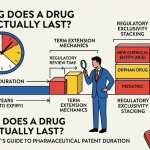
A drug’s true exclusivity end date is the later of its last-to-expire patent (adjusted for Patent Term Extension and pediatric exclusivity) and its last FDA-granted market exclusivity. Both tracks must be modeled independently and compared before any LOE date is recorded.
The Paragraph IV certification under Hatch-Waxman is the most reliable early-warning signal available to forecasters. A PIV filing, combined with the resulting 30-month stay and litigation trajectory, often sets the practical LOE date months or years ahead of the nominal patent expiry.
Biologic IP estates are categorically different from small-molecule patent estates. The 12-year BPCIA exclusivity, multi-patent “patent thicket” architecture, and the clinical and commercial barriers to biosimilar adoption require a distinct modeling framework. Applying generic erosion curves to biologic LOE events produces results that are directionally wrong.
Biosimilar interchangeability designation is the single variable with the largest swing effect on post-LOE biologic spend. An interchangeable product triggers pharmacy-level auto-substitution; a non-interchangeable biosimilar requires active prescriber intervention. Erosion curves differ by 30-50 percentage points over 24 months depending on this designation.
The 180-day first-filer generic exclusivity period creates a mandatory two-stage erosion structure for small-molecule LOE events. Any model that applies a single, immediate price drop on the day of generic entry will overstate Year 1 savings and produce a cumulative budget error that compounds across a multi-year forecast horizon.
Institutional investors and buy-side analysts who integrate patent estate valuations into DCF models consistently generate alpha versus those who rely on reported revenues alone. The patent portfolio is not a legal artifact; it is the primary asset that determines future cash flows.
Why Drug Spend Forecasting Is Broken — and Who Pays for It
Drug spend forecasting is one of the most consequential financial exercises in U.S. healthcare. Health plans use it to set premiums. PBMs use it to price administrative service contracts. Large self-insured employers use it to reserve for benefits liability. Institutional investors use it to value pharmaceutical equities. When the forecast is wrong, the consequences range from competitive pricing losses to nine-figure budget overruns.
Most organizations still forecast drug spend the same way they forecast office supply costs: take last year’s number, add a trend factor, and call it a plan. The primary inputs are historical claims data, year-over-year unit cost increases, and utilization trends. The model then applies a blended “drug trend” projection of roughly 5-8% annually, layering in a rough allowance for anticipated new-to-market high-cost agents.
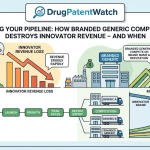
This methodology fails for one structural reason: it treats a market defined by discrete, binary competitive events as if it behaves like a smooth, continuous curve. It does not. The pharmaceutical market is punctuated by hard, foreseeable inflection points — patent expirations, exclusivity endings, first-filer generic launches, biosimilar approvals — that change price and competitive dynamics within a single quarter. When a brand loses market exclusivity and multiple generics enter, the price does not increase by 6%. It collapses by 80-90%. A trend model does not just get the magnitude wrong. It gets the direction wrong. That is a category error, not a rounding error.
The drug spend forecast gap between a trend-based model and an event-driven patent model for a single blockbuster drug commonly exceeds $20-25 million per year for a mid-sized regional health plan. Multiply that across a top-30 drug formulary over a three-year horizon, and the cumulative forecast error is measured in hundreds of millions of dollars across the U.S. payer market.
The solution is to replace trend extrapolation with event-driven forecasting anchored in patent and exclusivity data. This is not a theoretical improvement. It is the methodology used by the best-capitalized hedge funds, by sophisticated PBMs, and by the pharma manufacturers themselves when they plan lifecycle strategy. It is now accessible to any organization willing to build the competency.
Part I: The Architecture of Pharmaceutical IP Protection
What Protects a Blockbuster Drug — and For How Long
The casual shorthand of ‘drug patent’ understates the reality by an order of magnitude. A commercially successful branded drug is protected not by a single document but by a layered estate of patents and regulatory exclusivities that originate from two separate government agencies — the U.S. Patent and Trademark Office (USPTO) and the Food and Drug Administration (FDA) — operating under different legal standards, with independent expiration calendars.
To forecast when competition arrives, you must map both tracks for every drug on your watch list.
The USPTO Track: Patent Types and Their Forecasting Implications
Composition of Matter (CoM) Patents
The CoM patent covers the active pharmaceutical ingredient (API) itself — the specific chemical or biological entity. It is the broadest form of protection because it covers all uses of that molecule regardless of formulation, indication, or manufacturing method. Generic developers cannot make the same API without infringing a valid CoM patent, which makes its expiration the defining commercial event for small-molecule drugs.
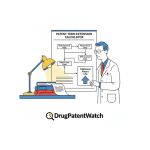
The nominal term is 20 years from the earliest priority filing date. However, no forecaster should use the raw filing-date calculation. The operative expiration date requires two adjustments: Patent Term Adjustment (PTA), which compensates for delays in USPTO examination, and Patent Term Extension (PTE), which compensates for time lost during FDA regulatory review. PTE grants up to five additional years of patent life and is only available for the first approved use of a new compound. A drug whose CoM patent was filed in 2004 might have a nominal expiry in 2024 but a PTE-adjusted expiry in 2028. Forecasters who pull the nominal date from the Orange Book without verifying PTE at the USPTO will build a four-year error into their model before the analysis begins.
The CoM patent is also the primary target of Paragraph IV challenges. When a generic developer files an ANDA with a PIV certification against the CoM patent, they are making a direct bet that the core protection is invalid or that their product does not infringe it. Every PIV filing against a CoM patent on your watch list should trigger a forecast review.
IP Valuation Note: CoM Patent as Core Asset
For portfolio managers and investors, the CoM patent is the primary determinant of a pharma asset’s risk-adjusted Net Present Value (rNPV). A drug generating $4 billion in annual revenue with a CoM patent expiring in 18 months and two active PIV challenges has a materially different risk profile than a drug generating $2 billion with a CoM patent running 8 years and no filed challenges. Standard equity research often underweights patent tail risk. The correct analytical approach discounts peak revenue for each year of the LOE transition using a probability-weighted erosion curve, not a cliff at a single future date.
Formulation Patents
Formulation patents cover specific delivery technologies rather than the molecule itself. Extended-release mechanisms, nanoparticle encapsulation, transdermal delivery matrices, lipid nanoparticle platforms, and fixed-dose combination products are all candidates for formulation patents. These are secondary protections relative to the CoM patent, but they are frequently the mechanism by which innovator companies extend the commercial life of a franchise after the core molecule patent expires.
Extended-release formulations (XR, ER, LA) deserve particular attention. If the IR (immediate-release) version loses exclusivity while the XR version remains protected, generics can only enter the IR market. Physicians who have converted their patient panels to the XR formulation may not automatically switch back. Brand erosion is slower and market segmentation persists. Lipitor’s IR formulation lost CoM exclusivity in 2011, but AstraZeneca’s extended-release cardiovascular drug Plendil faced a different competitive timeline due to its formulation patents. Forecasters must separate the revenue attributable to each formulation and apply different erosion curves.
Formulation patents are more vulnerable to design-around strategies than CoM patents, because a generic developer can sometimes manufacture the same drug using an alternative process that achieves bioequivalence without infringing the specific formulation claim. Track any ANDA filings that cite bioequivalence data using an alternative delivery mechanism; they signal that a competitor believes a design-around is viable.
Method-of-Use Patents
Method-of-use patents cover the application of a compound to treat a specific condition. They are strategically useful for lifecycle extension when an innovator discovers new indications for an approved drug, or when they attempt to block generics from marketing their product for the highest-volume indication.
The defensive limitation of method-of-use patents is the ‘skinny label.’ A generic company can receive ANDA approval for a drug while carving out the patented indication from their product label. They may still market the product for non-patented uses. Whether skinny-label marketing amounts to induced infringement of the method-of-use patent is an active area of litigation — the GlaxoSmithKline v. Teva case involving carvedilol and its heart failure indication produced years of conflicting decisions. For a forecaster, the takeaway is that method-of-use patents slow but rarely stop generic entry into the largest markets. Budget for partial erosion in the patented indication and full erosion in non-patented uses.
Process Patents
Process patents cover manufacturing methods and are generally the weakest form of pharmaceutical IP protection for exclusivity purposes. A competitor can achieve the same API through a different synthetic route without infringing. Their relevance to the forecasting model is primarily as a source of delay — they can generate expensive litigation that temporarily delays FDA approval of an ANDA even when the CoM patent is expired or invalid — rather than as a durable barrier to market entry.
The FDA Track: Market Exclusivity Types
New Chemical Entity (NCE) Exclusivity
The FDA grants five years of NCE exclusivity to any small-molecule drug whose active ingredient has never before been approved by the agency. During the first four years, the FDA cannot accept an ANDA. In the fifth year, an ANDA can be accepted but only with a PIV certification — meaning the generic developer must challenge the innovator’s patents to move forward. NCE exclusivity runs independently of and concurrently with the patent estate.
The practical forecasting implication: for recently approved blockbusters, NCE exclusivity sets an absolute floor on the generic entry date that may be more relevant than any individual patent’s expiry. A drug approved in 2022 with five years of NCE exclusivity cannot face generic competition before 2027 regardless of patent status.
Biologic Exclusivity Under the BPCIA
The Biologics Price Competition and Innovation Act grants reference product sponsors 12 years of exclusivity from the date of first FDA licensure. No biosimilar can receive FDA approval before that clock runs out. This is the hardest exclusivity date in biopharma.
The 12-year clock is the primary anchor for any biologic LOE forecast. Combine it with the patent thicket, and the effective window for biosimilar entry is typically year 12 to 14-plus from approval. Humira received FDA approval in 2002, so its 12-year exclusivity expired in 2016, but AbbVie’s dense patent estate — ultimately comprising more than 130 issued patents — delayed U.S. biosimilar entry until 2023. The exclusivity date was the legal minimum; the patent thicket determined the actual entry date. Both are required inputs for the forecast model.
Orphan Drug Exclusivity (ODE)
Seven years of market exclusivity for an approved orphan indication, granted under the Orphan Drug Act to incentivize development of treatments for conditions affecting fewer than 200,000 U.S. patients. ODE is indication-specific: it blocks approval of another sponsor’s version of the same drug for the same orphan disease, but it does not block approval for different diseases.
ODE is increasingly commercially significant. As pharma companies pursue rare disease indications to capture ODE protection, and as FDA increasingly approves drugs for rare diseases under accelerated pathways, ODE has become a routine part of the exclusivity stack for specialty drugs. A drug with seven-year ODE extending past an otherwise expired CoM patent has a materially different competitive timeline than a drug without it.
Pediatric Exclusivity
Six months of additional exclusivity added to all existing patents and exclusivities when a manufacturer completes FDA-requested pediatric studies under the Best Pharmaceuticals for Children Act. The six months attach to every relevant protection simultaneously — the CoM patent, the formulation patents, the NCE exclusivity, the ODE. For a blockbuster drug in the last stages of its protection window, pediatric exclusivity is worth hundreds of millions of dollars to the innovator and is a mandatory variable in any precise LOE calculation.
Pediatric exclusivity does not extend the underlying patent’s term beyond 20 years from its priority date in an absolute sense — it delays FDA approval of generics for six additional months. The functional result for the payer and the generic developer is identical: generic market entry is deferred by six months.
Key Takeaways: Part I
Map the USPTO patent estate and the FDA exclusivity stack as two independent tracks for every high-spend branded drug. The LOE date is the later of the last-to-expire item across both tracks.
The operative patent expiry requires USPTO verification for PTA and PTE. Orange Book dates without PTE adjustment are incorrect inputs.
Pediatric exclusivity is a universal six-month addition to all protections. It is almost always present for blockbusters and is systematically underweighted in trend-based models.
For institutional investors: patent estate depth (number and diversity of IP protections), remaining duration on the CoM patent, and PIV challenge status are the three most material variables in pharma asset valuation at LOE.
Part II: The Regulatory Frameworks That Determine When Competition Arrives
The Hatch-Waxman Architecture for Small-Molecule Drugs
The Drug Price Competition and Patent Term Restoration Act of 1984 — Hatch-Waxman — created the modern generic drug market. It set up an abbreviated approval pathway for generic drugs and a formalized process for patent disputes. Every small-molecule LOE forecast depends on understanding how its mechanisms interact.
The ANDA Pathway and Bioequivalence Standard
Generic manufacturers file Abbreviated New Drug Applications (ANDAs) with the FDA rather than full New Drug Applications. They do not repeat clinical efficacy and safety trials. Instead, they demonstrate bioequivalence to the reference listed drug (RLD) — same active ingredient, same strength, same dosage form, same route of administration, with comparable rate and extent of absorption. The FDA determines bioequivalence through pharmacokinetic studies in healthy volunteers.
Bioequivalence studies for standard oral solids cost $1-5 million and take 12-24 months. For complex generics — inhalation products, topical dosage forms, long-acting injectables, transdermal systems — bioequivalence is harder to demonstrate and can cost $50-150 million. The difficulty of bioequivalence proof is a direct predictor of how many generic entrants a market will eventually attract and therefore how steep the post-LOE erosion will be. A drug delivered by a standard tablet formulation will see 8-10 or more generic entrants within 18 months of LOE. A metered-dose inhaler or a complex nanosuspension might attract two to three generics over several years.
Paragraph IV Certifications: The Forecaster’s Early Warning Signal
When filing an ANDA, the generic company must certify its position on each Orange Book-listed patent for the reference product. A Paragraph I certification means the patent information has not been filed. Paragraph II means the patent has expired. Paragraph III means the generic company will wait for the patent to expire. None of these are market-moving events.
The Paragraph IV (PIV) certification changes everything. The generic company declares that the Orange Book patent is invalid, unenforceable, or will not be infringed by their product. This is both a legal assertion and a commercial declaration of intent to enter the market before patent expiry.
The innovator has 45 days from receipt of the PIV notice to file a patent infringement lawsuit. If it does, the 30-month stay activates automatically — the FDA cannot grant final approval to the ANDA for 30 months or until the district court issues a final judgment that the relevant patent is invalid or not infringed, whichever comes first. The 30-month stay is not indefinite protection. It is a structured timeline within which the innovator must win in court or watch the generic enter.
For the forecaster, the PIV notification date initiates a new scenario tree. The operative forecast questions shift from ‘when does the patent expire?’ to ‘what is the likely outcome of this litigation, and what is the most probable generic entry date given the litigation schedule?’ Court filings on PACER, SEC disclosures, and litigation monitoring services provide the inputs. Historical outcomes in comparable patent disputes — chemistry type, claim scope, prosecution history — can be used to assign probability weights to settlement and adjudication scenarios.
The 30-Month Stay: Practical Forecasting Mechanics
The 30-month stay calculation starts from the date the innovator receives the PIV notice, not the date the ANDA was filed. For a first-to-file challenger who receives a lawsuit response within 45 days, the stay typically expires 30 months after the notification date. This date is a concrete, calculable forecast input.
If the innovator wins at the district court, the stay can extend beyond 30 months while appellate proceedings continue — though the FDA can grant approval once the 30-month period expires regardless. If the district court rules against the innovator, FDA can grant final approval immediately even if an appeal is pending. If the case settles — the most common outcome — the settlement agreement specifies an authorized entry date that supersedes both the stay and the nominal patent expiry.
The 180-Day First-Filer Exclusivity: The Two-Stage Erosion Model
The generic developer who is first to file a substantially complete ANDA with a PIV certification against a listed Orange Book patent receives 180 days of generic market exclusivity from the date of first commercial marketing. During this period, the FDA cannot approve any other ANDA for the same drug. Only the brand and the first-filer compete.
This creates a mandatory two-stage erosion structure that any accurate small-molecule LOE model must incorporate. Stage 1 runs from the first-filer’s commercial launch date to 180 days later. During Stage 1, generic market share typically reaches 60-75% of total prescriptions, but because there is only one generic competitor, the generic price is often set at a 30-45% discount to the brand’s WAC. The blended price reduction across the molecule is moderate — roughly 30-40% versus the pre-LOE baseline.
Stage 2 begins when the 180-day exclusivity expires. Multiple generic manufacturers who have been waiting — with ANDA approvals already secured — launch simultaneously. Price competition accelerates to the equilibrium of commodity manufacturing. Within 12-18 months of Stage 2 entry, generic prices typically settle at 10-20% of the original brand WAC. Combined with near-total generic market share (95-plus percent for most oral solid drugs), the blended cost for the molecule falls to 15-25% of the pre-LOE baseline — an 75-85% effective price reduction.
A three-year forecast that models only Stage 1 dynamics for Year 1 will produce a 30-40% cost reduction estimate where the actual realized reduction is closer to 80%. That error, on a $25 million annual spend drug, is roughly $10 million in Year 1 alone — and it compounds.
Investment Strategy Note: Hatch-Waxman and Equity Positioning
The 30-month stay creates a structured uncertainty window that generates option value for both long and short equity positions. An investor who correctly identifies a weak PIV defense — based on claim scope, prosecution history estoppel, prior art analysis — can position short ahead of a court ruling invalidating the patent. Conversely, an investor who identifies a strong, narrow PIV challenge against a well-scoped CoM patent can hold the innovator’s equity through the litigation knowing the brand is likely to retain exclusivity and premium revenue. Settlement dates disclosed in SEC 8-K filings are among the most reliable inputs for building a near-term revenue model for either the generic or innovator company.
The BPCIA Framework for Biologics
The Biologics Price Competition and Innovation Act, passed as part of the Affordable Care Act in 2010, created the biosimilar approval pathway and the associated IP dispute framework. Its mechanics are structurally different from Hatch-Waxman in every dimension that matters for forecasting.
12-Year Reference Product Exclusivity as the Primary Anchor
Unlike NCE exclusivity for small molecules (5 years), the BPCIA grants reference product sponsors 12 years of data exclusivity from first FDA licensure. No biosimilar application can be approved during this period. There is also a 4-year period from licensure during which the FDA cannot even accept a biosimilar application. These are hard statutory dates. They set the absolute floor for biosimilar entry timing, earlier than which no forecast should assume competition.
The Patent Dance: Structured Pre-Launch IP Disclosure
The BPCIA mandates a multi-step information exchange between the biosimilar applicant and the reference product sponsor before litigation can be filed. This process — colloquially the ‘patent dance’ — involves the biosimilar developer sharing its Biologics License Application (BLA) and detailed manufacturing process information with the innovator. The innovator responds with a list of patents it believes would be infringed. The parties then negotiate which patents to litigate immediately versus in a second wave.
The patent dance produces a structured, if expensive and time-consuming, pre-launch litigation schedule. Biosimilar developers can opt out of portions of the dance, but doing so typically triggers litigation anyway and may accelerate it. From a forecasting standpoint, the patent dance means that biologic IP litigation is more formalized and discovery-intensive than Hatch-Waxman PIV proceedings. Cases take longer to resolve. The probability of multi-year appellate processes is higher. Scenario modeling for biologic LOE events requires wider uncertainty bands and longer tail timelines than small-molecule scenarios.
The Humira Patent Thicket: IP Architecture as Asset Valuation Case Study
AbbVie’s adalimumab (Humira) is the canonical example of biologic patent estate construction as a commercial strategy. The drug received FDA approval in December 2002. Its 12-year BPCIA exclusivity expired in 2016. AbbVie then defended the franchise through a patent thicket comprising, at its peak, more than 130 issued U.S. patents covering the molecule, manufacturing processes, formulations, and methods of use across multiple indications.
The first U.S. biosimilar approvals for adalimumab came in 2016-2017, but AbbVie negotiated settlements with Amgen, Samsung Bioepis, Sandoz, Mylan, and others that deferred U.S. commercial launch until January 2023. European biosimilar entry occurred in October 2018, four-plus years earlier, because the EU patent landscape was thinner and EU competition authorities were more aggressive in blocking settlement terms that delayed entry.
AbbVie’s Humira generated approximately $21 billion in U.S. net revenues in 2022, its final year of U.S. exclusivity. The delta between 2023 U.S. Humira revenues and 2022 revenues illustrates the ‘biosimilar slope’ in practice: not a cliff, but a gradual erosion over 18-24 months as biosimilars capture share incrementally. For payer forecasters modeling a Humira-class biologic LOE event, a three-year erosion timeline with full year-one competition priced at 15-25% discount to WAC, year-two competition at 35-50% discount, and year-three at 55-70% discount (depending on interchangeability status across the biosimilar field) is a reasonable parametric starting point.
IP Valuation Note: Humira Thicket as Benchmark
For portfolio managers, the Humira case provides a benchmark for evaluating the durability of other high-revenue biologics. The relevant questions are: how many patents does the estate contain, what proportion cover the manufacturing process versus the molecule versus methods of use, and what is the settlement track record with biosimilar challengers? An innovator with a dense, multi-category patent estate and a history of negotiating entry date settlements (rather than litigating to verdict) is more likely to maintain revenue through the LOE transition than one with a thin patent estate and a litigious posture that produces adverse rulings.
Biosimilar Interchangeability: The Variable That Changes Everything
FDA approval as a ‘biosimilar’ and FDA designation as an ‘interchangeable biosimilar’ are different regulatory achievements with different commercial implications. A standard biosimilar requires a prescriber to specifically choose it — automatic pharmacy substitution is not permitted under most state pharmacy laws without interchangeability designation.
An interchangeable biosimilar has cleared an additional evidentiary hurdle: the applicant must show that switching between the reference product and the biosimilar does not produce greater safety or efficacy risk than continued use of the reference product. Products that achieve interchangeability can be dispensed at the pharmacy without physician intervention, exactly as generics are substituted for branded small-molecule drugs under state generic substitution laws.
The market uptake difference is substantial and measurable. Non-interchangeable biosimilars in the insulin market showed uptake rates of 5-20% market share over 12-24 months before interchangeable designations were broadly available. Interchangeable biosimilars — led by Viatris/Mylan’s Semglee (insulin glargine, interchangeable with Lantus) and Hadlima (adalimumab, interchangeable designation achieved in 2023) — are demonstrating notably faster uptake curves.
For biosimilar LOE modeling: the first interchangeable biosimilar designation in a drug class triggers pharmacy-level auto-substitution and should be modeled with an erosion curve that converges toward the small-molecule generic curve over 18-24 months. A class where no product has achieved interchangeability requires the physician-driven, slower adoption curve — typically 25-40% market share loss over 24-36 months.
Key Takeaways: Part II
PIV certification is the most reliable forward-looking LOE signal for small molecules. Track every PIV filing against a high-spend drug on your watch list immediately upon public disclosure.
The 30-month stay sets a calculable generic entry date that may be earlier than the nominal patent expiry. Calculate it from the PIV notification date, not the ANDA filing date.
Model small-molecule LOE events as a two-stage erosion: Stage 1 (180-day first-filer exclusivity) delivers 30-40% blended savings. Stage 2 (multi-generic entry) delivers 75-85% savings. A single-stage model will materially overstate Year 1 savings.
Biologic LOE modeling requires the 12-year BPCIA exclusivity date, the density of the patent thicket, biosimilar settlement terms disclosed in SEC filings, and the interchangeability designation status of each competing product. These four inputs drive the erosion rate more than any other variables.
Interchangeability designation is a binary switch on the biosimilar adoption curve. Flag every interchangeability application in PDUFA calendars and FDA approval databases for drugs in your formulary’s biologic spend.
Part III: The Data Stack — Where to Get Reliable IP Information
Primary Government Sources
The FDA Orange Book
The Orange Book (‘Approved Drug Products with Therapeutic Equivalence Evaluations’) is the FDA’s official registry of approved small-molecule drugs, their associated Orange Book-listed patents, and their FDA-granted exclusivities. It is the starting point for any CoM, formulation, and method-of-use patent date retrieval, and the authoritative source for exclusivity expiration dates including NCE, ODE, and pediatric exclusivity.
The Orange Book is free and searchable at accessdata.fda.gov. Its limitations are consequential. First, patent listings are submitted by the innovator and receive no substantive FDA review — the Orange Book reflects what the innovator claims to own, not what the courts have validated. Second, the patent expiration dates shown may not incorporate USPTO-granted PTE adjustments; verification at the USPTO patent term extension database is mandatory. Third, the Orange Book provides no litigation status data. A patent could be the subject of active invalidity proceedings in district court, but the Orange Book will continue listing it at face value.
The FDA Purple Book
The Purple Book covers FDA-licensed biological products and their approved biosimilars and interchangeable products. It is the authoritative source for the reference product’s first licensure date — the starting point for the 12-year BPCIA exclusivity calculation. Amendments enacted under the Consolidated Appropriations Act of 2021 added a patent listing requirement for biologics, meaning the Purple Book now includes some patent information analogous to the Orange Book, though the biologic patent information regime is still maturing.
Cross-reference Purple Book licensure dates with the BPCIA exclusivity calculator and with company-disclosed patent settlement terms in SEC filings to build a complete biologic LOE profile.
The USPTO Patent Center and Patent Term Extension Database
The USPTO Patent Center provides full-text patent records, prosecution histories, assignment records, and legal status information. For every Orange Book-listed patent, retrieve the USPTO record to confirm: the adjusted expiration date including PTA; whether a PTE has been applied and its duration; current assignment (to confirm the listed company still owns the patent); and any inter partes review (IPR) or post-grant review (PGR) proceedings, which can invalidate claims without full district court litigation.
The USPTO’s Patent Term Extension database lists all PTE grants with their effective extension durations. This is mandatory verification for any CoM patent analysis.
PACER: Federal Court Electronic Records
The Public Access to Court Electronic Records system indexes U.S. federal court filings. Hatch-Waxman patent infringement cases are filed in federal district courts (with a significant concentration in Delaware and New Jersey, where many pharma companies are incorporated or operate). PACER provides access to complaints, answer filings, claim construction orders (Markman rulings), summary judgment decisions, final judgments, and settlement notices.
Monitoring the PACER docket for PIV cases involving your watch-list drugs gives real-time visibility into litigation trajectory — whether claim construction favored the innovator or generic, whether the case is heading toward trial or settlement, and what the likely timeline is for resolution.
SEC EDGAR: Material Disclosures and Settlement Terms
Publicly traded pharmaceutical companies are obligated to disclose material developments in their IP litigation through 8-K filings. Settlement agreements involving a grant of future license to a generic manufacturer — specifying the authorized entry date — are among the most valuable inputs available to a forecaster. AbbVie’s 2013-2014 wave of Humira biosimilar settlement agreements, all disclosed through SEC filings, revealed the January 2023 U.S. launch date years in advance.
Annual (10-K) and quarterly (10-Q) reports contain detailed litigation disclosures in the legal proceedings section and often include management’s assessment of the company’s IP position and the anticipated impact of pending challenges. These disclosures are forward-looking statements of management intent and should be read critically alongside independent patent analysis.
Commercial Intelligence Platforms
The Case for Aggregation
Manually assembling a complete drug IP profile from the Orange Book, Purple Book, USPTO, PACER, and EDGAR for a single drug takes a skilled researcher four to eight hours. For a watch list of 30 high-spend branded drugs, that is 120-240 analyst-hours per research cycle. Patent estates change continuously — new patents issue, old patents expire, PIV filings arrive, settlements get disclosed — meaning the research cycle must repeat quarterly at minimum.
Commercial platforms aggregate, normalize, and continuously refresh all of these data streams. They link patents to branded drugs, calculate adjusted expiration dates including PTA and PTE, flag PIV filings and litigation events in real time, and present the competitive landscape for each drug in a structured, queryable format.
DrugPatentWatch: Platform Architecture and Forecasting Utility
DrugPatentWatch is built specifically for this use case. Its core architecture combines Orange Book and Purple Book patent and exclusivity data with USPTO patent records, litigation monitoring, and a proprietary calculation layer that applies PTA, PTE, and pediatric exclusivity adjustments to produce final adjusted LOE dates rather than nominal filing-date expirations.
For a payer, PBM, or benefits consultant building a three-year drug spend forecast, the platform’s most operationally significant feature is the litigation alert system. When a PIV certification is filed against a drug on the user’s watch list, the platform flags it. The alert is the signal to update the LOE date assumption in the forecast model from the nominal patent expiry to the earlier possible entry date implied by the litigation timeline.
The platform also maintains historical data on generic entry dates, market share ramps, and pricing trajectories across prior LOE events — the empirical basis for calibrating erosion curve assumptions. Rather than applying a generic industry-average erosion template to every LOE event, users can query comparable historical events — same drug class, same delivery form, similar market size, similar number of first-wave entrants — and extract parametric erosion data that is specific to the product characteristics.
For institutional investors and portfolio managers, DrugPatentWatch’s patent estate profiles allow rapid IP due diligence on acquisition targets, licensing candidates, or public equity positions. The platform answers the primary question in pharma IP analysis — ‘what does this franchise look like in three years?’ — faster and with greater accuracy than any manually assembled research process.
Part IV: The Forecasting Blueprint — Step-by-Step Construction of an Event-Driven 3-Year Model
Step 1: Identify High-Risk Drugs Through Spend Stratification
Run your pharmacy claims database for the trailing 12 months. Sort by total spend per drug (not per claim). The top 20-30 branded drugs almost certainly account for 65-80% of your total pharmaceutical expenditure. These are the drugs that require event-driven analysis.
Apply an initial filter: strip out drugs that are already multi-source generics (their prices are already at commodity equilibrium) and drugs with active formulary generics already available (the LOE event has already occurred). The residual list of single-source branded drugs, ordered by spend, is your watch list.
For each watch list drug, gather these baseline data points from your claims system: total annual spend, total members utilizing the drug, average annual cost per member, trajectory of unit cost over the past 24 months, and formulary tier placement. These inputs set the ‘pre-LOE baseline’ that your erosion curve will modify.
Annotate the list with each drug’s therapeutic class, delivery form (oral solid, injectable, inhaled, biological), and whether it is a small molecule or biologic. These attributes directly determine which erosion model you will apply.
Investment Strategy Note: Watch List as Portfolio Screen
For buy-side analysts covering the pharmaceutical sector, the payer watch list logic applies directly to equity portfolio construction. Map your drug holdings to the top-20 revenue drugs at each portfolio company. For each drug, calculate the revenue at risk within your investment horizon. A drug representing 40% of a company’s revenue with a CoM patent expiring in 24 months and two active PIV challenges should trigger a position review. The patent cliff is visible in advance. Investors who fail to model it are choosing to be surprised.
Step 2: Build a Complete IP Dossier for Each Watch-List Drug
This is the core research phase. For each drug on your watch list, build a structured dossier with the following sections.
Patent Estate Map
Retrieve all Orange Book-listed patents. For each patent, go to the USPTO Patent Center and record: the patent number, the title, the claim type (CoM, formulation, method-of-use, process), the filing date, the nominal expiry date, the PTA applied, the PTE applied if any, and the final adjusted expiry date. Rank the patents by importance to the drug’s competitive protection, with the CoM patent first.
Note whether any patents are currently the subject of inter partes review (IPR) proceedings at the USPTO Patent Trial and Appeal Board (PTAB). PTAB proceedings can invalidate patent claims faster than district court litigation — average time to final written decision is 12-18 months from institution. A patent under active IPR has a materially different risk profile than one with no pending challenges.
FDA Exclusivity Schedule
From the Orange Book (for small molecules) or Purple Book (for biologics), record every active exclusivity, its type, and its expiration date. Calculate the cumulative LOE date as the later of the last patent expiry and the last exclusivity expiry. Apply the six-month pediatric exclusivity addition if the drug has received a Written Request and the manufacturer has completed or is conducting the required studies.
Litigation Status
Search EDGAR for any 8-K disclosures naming the drug in connection with PIV certifications or patent litigation. Search PACER for active case dockets. For each active case, record: the generic defendant, the patents challenged, the current stage of proceedings (pre-Markman, post-Markman, summary judgment pending, trial scheduled), and any disclosed settlement discussions.
Calculate the 30-month stay expiration date from the PIV notification date. This is your earliest-case generic entry date in the absence of a settlement with an earlier authorized entry date.
LOE Date Scenarios
Based on the litigation analysis, construct at minimum three scenarios: an innovator-prevails scenario where generic entry occurs at the last-to-expire patent or exclusivity date; a settlement scenario where entry occurs at the 30-month stay expiration or a disclosed negotiated date; and a generic-prevails scenario where entry occurs when the district court enters final judgment invalidating key patents. Assign probability weights to each scenario based on the litigation posture and comparable case outcomes.
Step 3: Build the Erosion Model
With the IP dossier complete, you have the LOE date (or probability-weighted scenario dates) and the drug’s baseline attributes. Now build the financial model.
Small-Molecule Oral Solid Erosion Parameters
Stage 1 (months 1-6, single generic): Generic captures 60-80% of prescription volume, depending on payer formulary strategy. Generic WAC at 40-60% of brand WAC. Blended price for the molecule: 55-70% of pre-LOE baseline. Net savings versus pre-LOE: 30-45%.
Stage 2 (months 7-18, multi-generic): Generic market share reaches 92-98% of prescriptions. Generic WAC falls to 10-20% of original brand WAC as commodity competition intensifies. Blended price for the molecule: 12-22% of pre-LOE baseline. Net savings versus pre-LOE: 78-88%.
Adjust Stage 2 depth upward (deeper cuts) for drugs with more than 6 generic entrants and downward for drugs with complex bioequivalence requirements that limit entrant count.
Small-Molecule Injectable and Complex Generic Erosion Parameters
Authorized generic competition from the innovator’s own subsidiary is more common for injectable drugs where manufacturing capacity is a bottleneck and fewer generic developers qualify. Initial generic discount to brand WAC is typically 20-35%. Multi-generic equilibrium takes 24-36 months rather than 12-18. Model Stage 2 generic WAC at 25-40% of brand WAC rather than 10-20%.
Biologic (Biosimilar) Erosion Parameters
Non-interchangeable biosimilar launch: Year 1 biosimilar market share of 5-20%, biosimilar WAC at 15-25% discount to reference product. Year 2 share of 20-40%, discount widening to 30-45% as additional biosimilars enter. Year 3 share of 35-55%, discount of 45-65%.
Interchangeable biosimilar designation present: Accelerate all share capture by approximately 12 months. Year 1 share of 25-45% for interchangeable products versus 5-20% for non-interchangeable.
European biosimilar market data, where the same molecule typically faces LOE 3-5 years earlier than in the U.S. due to thinner patent estates and more aggressive competition policy, can calibrate these assumptions. Track European market share and pricing data for the drug’s biosimilar field as a leading indicator.
Payer Strategy Multipliers
The erosion curve in your model reflects market-wide dynamics, but your actual savings realization depends on how aggressively you convert members to the generic or biosimilar. Apply a formulary strategy multiplier.
If you place the generic immediately on Tier 1 with $0 cost share and the brand on Tier 3 with full non-preferred cost sharing, your plan’s generic capture rate will exceed the market average. If you have a rebate contract with the innovator that makes keeping the brand in a preferred position economically rational, your capture rate will be below market average.
Model the rebate offset explicitly. If the brand’s rebate is worth $2M annually to your plan and generic conversion would eliminate it, the net savings from LOE is not the gross price difference but the gross price difference minus the lost rebate. For drugs where innovator contracting is aggressive — PCSK9 inhibitors, biologics in competitive therapeutic classes — the rebate calculus can materially change the LOE savings estimate.
Step 4: Assemble the Multi-Drug Forecast
With individual erosion models for each watch-list drug, the aggregate three-year forecast is constructed by summing the brand-equivalent spend across drugs expected to remain exclusively branded in each forecast year, the eroded spend across drugs that reach LOE within the forecast window, and the genericized spend (stable, low-cost) for drugs already at LOE equilibrium.
Overlay the pipeline additions — new high-cost agents expected to launch during the forecast window, priced from clinical trial pipeline data, FDA PDUFA dates, and clinical-stage competitive intelligence — as additive line items.
The result is a bottom-up, drug-by-drug forecast where each line item has a specific, documented rationale: either a trend assumption for stable drugs or an event-driven LOE model for drugs in the patent transition window. The aggregate model is testable, auditable, and defensible to finance leadership in a way that a blended trend factor never can be.
Part V: Applied Case Analysis — The $27.5 Million Forecast Gap
Baseline Scenario Setup
To make the methodology concrete, apply it to a hypothetical but representative scenario. A regional health plan has a $25 million annual spend on a branded cardiovascular drug — call it CardioX — which is an oral small-molecule tablet currently without generic competition. A trend-based forecast projects spend on CardioX at $26.25M in Year 1, $27.56M in Year 2, and $28.94M in Year 3 — a total of $82.75M over three years.
CardioX IP dossier (after Step 2 research):
CoM patent expires in April of Year 2. Pediatric exclusivity adds six months, adjusting the final date to October 15 of Year 2. One formulation patent for an extended-release version expires in December of Year 4 (with pediatric extension) but applies to less than 20% of market volume. No active ODE. A leading generic manufacturer filed a PIV certification three years ago against the CoM patent. The resulting lawsuit triggered a 30-month stay. The stay expired six months before the current forecast baseline. SEC filings from the innovator disclosed a settlement granting the PIV filer an authorized entry date of October 16 of Year 2 — the day after CoM patent plus pediatric exclusivity expiration.
Year 1: No LOE Event, but Formulary Preparation Begins
No generic enters during Year 1. Spend follows the trend. Year 1 projected spend: $26.25M.
The Year 1 strategic output is not a different spend number — it is the intelligence that a $25M drug will undergo a full LOE event in 11 months. Use Year 1 to: secure formulary committee approval for the generic tier placement strategy on day one of generic availability; begin member and provider communication about the incoming generic option; issue RFPs to potential authorized generic suppliers or confirm the PIV filer’s distribution strategy; and build the Year 2 and Year 3 models.
Year 2: Two-Stage LOE Event
Year 2 is split into two periods. October 16 is the generic entry date.
Period 1 (January through October 15, 9.5 months): Brand-only. Monthly spend at trend rate = $2.1875M. Spend for 9.5 months = $20.78M.
Period 2 (October 16 through December 31, 2.5 months): Single-generic market (180-day first-filer exclusivity period begins October 16, runs through mid-April of Year 3). Generic captures 75% of prescription volume with aggressive formulary placement. Generic WAC at 55% of brand WAC. Blended cost = (0.25 x 1.0) + (0.75 x 0.55) = 0.66. Spend on 2.5 months of pre-LOE baseline = $5.47M. Eroded spend = $5.47M x 0.66 = $3.61M.
Total Year 2 Spend: $20.78M + $3.61M = $24.39M.
Traditional forecast had predicted $27.56M. The event-driven model generates $24.39M — $3.17M less than predicted.
Year 3: Multi-Generic Equilibrium
The 180-day first-filer exclusivity expires in mid-April of Year 3. At that point, six additional generic manufacturers with approved ANDAs launch simultaneously.
Year 3 is modeled as a full year at multi-generic equilibrium after mid-April. For the first 3.5 months (January through mid-April), the single-generic Stage 1 dynamics continue: blended cost at 66% of pre-LOE baseline.
From mid-April through December (8.5 months), multi-generic Stage 2 dynamics apply: generic WAC at 15% of original brand WAC, generic market share at 96%, brand retains 4% of volume. Blended cost = (0.04 x 1.0) + (0.96 x 0.15) = 0.184. Spend at pre-LOE run rate for this period ($2.1875M x 8.5 months = $18.59M baseline) x 0.184 = $3.42M.
Period 1 (January through mid-April): 3.5 months at $2.1875M baseline x 0.66 = $5.05M. Period 2 (mid-April through December): $3.42M.
Total Year 3 Spend: $5.05M + $3.42M = $8.47M.
Traditional forecast had predicted $28.94M. The event-driven model generates $8.47M — $20.47M less.
Three-Year Forecast Comparison
Period
Trend-Based Forecast
Event-Driven Forecast
Difference
Year 1
$26.25M
$26.25M
$0
Year 2
$27.56M
$24.39M
$3.17M savings
Year 3
$28.94M
$8.47M
$20.47M savings
Three-Year Total
$82.75M
$59.11M
$23.64M savings
This $23.64M gap represents not forecast error — it represents the value of acting on available information. Every dollar of that difference was visible in the patent and litigation record two years before it materialized.
Part VI: Advanced Variables That Refine the Model
Evergreening: How Innovators Extend Franchise Life
Evergreening is the systematic use of secondary patents to extend a drug franchise’s market exclusivity beyond the CoM patent expiration. IP teams at major pharma companies design evergreening strategies explicitly as part of lifecycle planning. Forecasters who ignore these strategies will systematically overestimate the speed of post-LOE competition.
The primary evergreening mechanisms are: new formulations (extended-release conversions, combination products); new indications covered by method-of-use patents; new patient populations covered by separate clinical trials and new patents; polymorph patents covering different crystalline forms of the same API; and metabolite patents covering the active metabolite if it differs from the parent compound.
AstraZeneca’s esomeprazole (Nexium) is the textbook case. When omeprazole’s (Prilosec) CoM patent expired, AstraZeneca introduced the S-enantiomer of the same molecule under new formulation and method-of-use patents, extending the franchise by approximately a decade. Forecasters who modeled only the omeprazole CoM expiry underestimated revenue durability substantially.
Evaluate evergreening risk for each watch-list drug by examining the patent estate beyond the CoM patent. If formulation or method-of-use patents extend more than three years beyond the CoM expiry and cover the dominant market formulation, extend your LOE date assumption accordingly. If secondary patents cluster around a particular indication that represents 60-plus percent of the drug’s revenue, treat those patents as co-primary and model them as binding on that revenue segment.
IP Valuation Note: Evergreening as Asset Durability Signal
For investors, the density and strategic coherence of a drug’s secondary patent portfolio is a direct measure of revenue durability. A company that files formulation patents on its leading product five to seven years before the CoM expiry is demonstrating active lifecycle management. A company that allows the CoM patent to expire without a secondary protection strategy is signaling that it has already moved capital to the next pipeline stage and is prepared to surrender the franchise. Both are valid strategies with different valuation implications.
Authorized Generics and Their Impact on Stage 1 Dynamics
An authorized generic (AG) is a generic version of a branded drug manufactured or licensed by the innovator itself, launched to compete with the PIV first-filer during the 180-day exclusivity period. The innovator captures a share of the generic market rather than surrendering all volume to the first-filer.
AG launches change Stage 1 dynamics in two ways. First, they increase price competition during the 180-day window — the first-filer must reduce its price further to compete with the AG, accelerating Stage 1 erosion toward Stage 2 depth faster than a single-generic market would. Second, they can reduce the profitability of the 180-day exclusivity prize for the first-filer, which affects whether first-filers are willing to settle PIV litigation on terms that include early authorized generic competition (because the prize is worth less).
For forecasting purposes: if there is public indication that the innovator plans an AG launch — either through press releases, SEC disclosures, or historical precedent for the company — adjust Stage 1 blended price toward Stage 2 depth. Blended price with two competing generics is typically 50-60% of pre-LOE brand WAC rather than the single-generic 60-65%.
Inter Partes Review at PTAB: The Patent Invalidation Shortcut
Inter partes review is a post-grant administrative proceeding at the USPTO’s Patent Trial and Appeal Board. Any party — including generic manufacturers — can petition for IPR challenging the validity of issued patent claims on the basis of prior art. The process is faster and less expensive than district court litigation, and PTAB institutions have historically shown higher rates of claim invalidation than district courts.
A patent under IPR should be risk-adjusted in your LOE model. If PTAB institutes a trial on a CoM patent, the probability distribution for the LOE date shifts earlier. Standard assumptions: if PTAB institutes review, assign 35-50% probability to successful invalidation of at least some claims within 18-24 months. If claims are invalidated, the FDA can grant immediate final approval to pending ANDAs.
Track IPR petition filings and institution decisions at the PTAB’s PRPS (Patent Review Processing System) for every Orange Book patent on your watch list.
Global Patent Calendars as Leading Indicators
Pharmaceutical patent protection periods vary by country. European patent terms are generally shorter than U.S. terms because patent term extension under European patent law is calculated differently and is capped at five years with a total term not exceeding 15 years from first marketing authorization. As a result, European biosimilar and generic markets often precede the U.S. market by three to six years.
This creates a natural leading indicator. When tracking a biologic approaching U.S. LOE, analyze the European biosimilar market for the same reference product. How many biosimilar entrants are there? What is the pricing discount relative to the reference product? What market share have biosimilars captured after two and four years? Use this data to calibrate your U.S. erosion curve assumptions, accounting for structural differences in reimbursement, contracting, and substitution policy between the EU and U.S. markets.
State Pharmacy Substitution Laws and Biosimilar Adoption
Biosimilar interchangeability designation at the FDA level permits auto-substitution, but the actual ability to substitute without physician authorization depends on state pharmacy law. As of 2024, all 50 states have enacted biosimilar substitution laws, but they vary in notification requirements, patient consent conditions, and prescriber opt-out mechanisms. States with more permissive substitution frameworks — requiring only post-dispense notification rather than prior physician consent — will show faster biosimilar adoption rates for interchangeable products.
If your health plan covers a geographically concentrated member population, adjust your interchangeable biosimilar adoption curve upward for permissive substitution states and downward for states with more restrictive substitution rules.
Part VII: Investment Strategy — Integrating Patent Data Into Pharma Equity Analysis
Patent Estate Valuation as a Component of DCF Modeling
Standard discounted cash flow models for pharmaceutical equities project revenues to the end of a drug’s patent life and then haircut for LOE. This approach gets the structure right but almost always gets the parameters wrong — particularly the LOE timing and the post-LOE erosion rate.
The correct DCF architecture separates each major revenue-generating drug into its own revenue module with: a pre-LOE period using company guidance and consensus estimates; an LOE transition period using the event-driven erosion model described in Part IV; and a post-transition period modeling the drug’s residual branded revenue and contribution margin.
For biologics, the LOE transition period spans 36-60 months. For small-molecule oral solids with many generic entrants, it spans 12-24 months. Discounting these revenue streams at the company’s WACC produces a more accurate value than the common practice of simply stopping the revenue projection at the nominal patent expiry date.
Scenario Weighting for Litigation Outcomes
For companies with drugs under active PIV challenge or biosimilar patent litigation, build a probability-weighted revenue model across the three scenarios described in Step 2 of the forecasting blueprint: innovator prevails, generic prevails, settlement with disclosed entry date.
Assign probabilities based on: PTAB institution and outcome data for the specific patent claims at issue; district court outcomes in comparable Hatch-Waxman cases; the company’s historical settlement posture; and disclosed settlement terms for other drugs in the same patent class.
The probability-weighted LOE date is not the same as the nominal patent expiry, nor is it the same as the PIV filer’s claimed entry date. It is the expected value of the entry date distribution, which reflects the full range of litigation outcomes weighted by their probabilities.
Short-Selling on Patent Cliff Proximity
The most direct investment application of patent expiry data is identifying companies whose equity is priced as if a near-term patent cliff does not exist. When a company’s forward P/E multiple reflects consensus analyst estimates that do not adequately discount LOE revenue erosion on a drug representing 30-50% of earnings, the stock is overvalued relative to a correctly modeled LOE scenario.
Short selling pharma equities on patent cliff thesis requires precise timing and scenario analysis — the cliff is visible years in advance, but the market may not price it until litigation events force it into the consensus. The optimal short entry timing is typically 9-18 months before the LOE date, when litigation resolution becomes probable enough to affect sell-side model updates.
Long Opportunities: Generic and Biosimilar Manufacturers
Conversely, patent expiry data identifies commercial opportunity windows for generic and biosimilar manufacturers. The first-filer 180-day exclusivity prize is a concrete, short-duration but high-magnitude revenue event. A generic company with multiple first-filer exclusivity windows opening in the next 24-36 months has a calculable revenue pipeline that may not be fully reflected in its equity valuation.
Biosimilar manufacturers with interchangeability designations secured or pending for high-volume biologics approaching their 12-year BPCIA exclusivity end represent long-duration structural growth opportunities. The interchangeability designation is a hard-to-replicate regulatory moat that positions the holder favorably in pharmacy contracting for years after the initial launch.
Key Takeaways: Part VII
Patent estate analysis belongs in every pharma equity DCF model as a structural input, not a qualitative footnote. Model the LOE transition period explicitly with erosion parameters calibrated to drug type, entrant count, and interchangeability status.
Probability-weighted LOE dates derived from litigation scenario analysis are more accurate than nominal patent expiry dates for stocks with active PIV challenges. The expected value of the entry date distribution should replace the nominal date in valuation models.
Short thesis on patent cliff proximity works best with an 9-18 month lead time, when litigation events are likely to force sell-side model updates. The cliff is visible to the informed analyst far earlier than to consensus.
First-filer 180-day exclusivity windows are calculable, short-duration revenue events for generic manufacturers. Tracking ANDA first-to-file status across a generic company’s pipeline gives visibility into near-term revenue catalysts.
Part VIII: Building the Competency — Organizational Recommendations
For Health Plans and PBMs
Assign dedicated ownership of patent intelligence monitoring. The function sits at the intersection of clinical pharmacy, finance, and formulary management. It requires someone who can read an Orange Book listing, interpret a PTAB institution decision, and translate that into a formulary strategy recommendation. Many organizations split this across clinical and financial teams without anyone owning the synthesis.
Build a recurring LOE calendar that is reviewed quarterly by the formulary committee. The calendar lists every high-spend branded drug, its probability-weighted LOE date, the scenario range, and the financial exposure. Quarterly review ensures that settlement disclosures and litigation developments are incorporated into the active forecast before they become surprises.
Invest in a commercial intelligence platform. The cost-benefit case is straightforward: the research efficiency gain alone — measured in analyst hours saved — typically exceeds the platform cost within the first quarter of use. The accuracy improvement on a single watch-list drug’s LOE model can deliver forecast accuracy worth 50-100 times the annual platform fee.
For Pharma IP Teams and Lifecycle Managers
Use the same methodology your payer counterparts use to model your own drug’s LOE exposure. Know what your patent estate looks like through the eyes of a PIV challenger. Identify the weakest claims in your CoM patent before a generic developer does. Commission freedom-to-operate analyses on your secondary patent portfolio annually.
Build the LOE date and the financial impact of the LOE transition into your lifecycle planning assumptions from the first year of commercialization. The decision to invest in a next-generation formulation, a new indication, or an authorized generic strategy depends on knowing exactly when and how steeply the original product will erode. Late lifecycle investment — triggered by the first PIV filing rather than by proactive planning — consistently underperforms.
For R&D Leads and BD Teams
Patent intelligence drives M&A and licensing strategy as much as clinical data does. When evaluating an in-licensing or acquisition target, the IP due diligence is not a post-term-sheet formality — it is the primary determinant of asset value. A drug with five years of remaining CoM exclusivity and no secondary patent protection is a fundamentally different asset than a drug with three years of CoM exclusivity and a dense formulation patent estate running eight more years.
Screen acquisition targets by IP durability before screening by pipeline phase. Phase 3 assets with weak patent estates frequently destroy more value post-acquisition than they create.
Frequently Asked Questions
What is the single most common error in pharmaceutical spend forecasting?
Failing to model the 180-day first-filer generic exclusivity as a distinct Stage 1 with its own erosion parameters. Most models apply a single, immediate price drop on the day of generic entry. That approach systematically overestimates Year 1 savings — by 30-50 percentage points on a large-market drug — and underestimates long-term savings when multi-generic competition arrives in Stage 2.
How do you handle LOE forecast uncertainty when litigation is still active?
Build three scenarios weighted by probability: innovator prevails (generic entry at last patent/exclusivity expiry), settlement (entry at 30-month stay expiration or disclosed negotiated date), generic prevails (entry at court judgment invalidating key patents). Present the probability-weighted expected spend, the high-spend scenario, and the low-spend scenario as a range. Update probabilities quarterly as litigation milestones occur.
Why can’t we just apply generic drug erosion curves to biologics?
Biologics face structurally different competitive dynamics: 12-year BPCIA exclusivity floors, patent thickets covering manufacturing processes (not just the molecule), biosimilar development costs of $100-300M that limit entrant count, physician clinical inertia in stable biologic patients, payer rebate contracting that can favor the brand even post-biosimilar entry, and an interchangeability standard that determines whether pharmacy-level auto-substitution is even possible. Applying generic oral-solid erosion curves to a biologic LOE will produce cost savings estimates 50-60 percentage points higher than actual realized savings in the first two years.
What signals should trigger an immediate review of our LOE model for a specific drug?
Four events require immediate model review: a Paragraph IV certification filing disclosed in any company communication; a PTAB institution decision on an IPR petition against a key Orange Book patent; an 8-K or press release disclosing a litigation settlement with a specified authorized generic entry date; and an FDA approval or interchangeability designation for a biosimilar to a biologic on your watch list.
How far ahead can the LOE date be predicted reliably?
For small-molecule drugs, the Orange Book patent estate is public and calculable with high accuracy three to five years in advance. PIV filings, when they occur, refine the timing further. Settlement terms, when disclosed, lock in the date with near-certainty. For biologics, the 12-year BPCIA exclusivity is calculable from the FDA licensure date with no uncertainty. The uncertainty is in the patent thicket litigation and settlement negotiations, which typically resolve one to two years before the effective LOE date. A three-year forecast window is well within the reliable prediction horizon for any drug that has already entered the patent challenge phase.
Data Sources and References
FDA Orange Book: Approved Drug Products with Therapeutic Equivalence Evaluations — accessdata.fda.gov/scripts/cder/ob/
FDA Purple Book: Lists of Licensed Biological Products — purplebooksearch.fda.gov
USPTO Patent Center — patentcenter.uspto.gov
USPTO Patent Term Extension Database — fda.gov/drugs/development-approval-process-drugs/patent-term-extensions
PTAB Patent Review Processing System — patents.dol.gov
Association for Accessible Medicines, 2023 Generic Drug and Biosimilars Access and Savings in the U.S. Report
Congressional Budget Office, ‘Prices for and Spending on Specialty Drugs in Medicare Part D and Medicaid,’ 2019
IQVIA Institute for Human Data Science, ‘The Use of Medicines in the U.S. 2024: Spending and Usage Trends and Outlook to 2028’
Grabowski H, et al. ‘Implementation of the Biologics Price Competition and Innovation Act.’ Journal of Medical Economics, 2017
Beall RF, et al. ‘Is it time to re-evaluate the WHO definition of “evergreening”?’ BMJ Global Health, 2019
This analysis is intended for pharmaceutical IP professionals, portfolio managers, formulary strategists, and institutional investors. It does not constitute legal advice. For patent validity opinions or freedom-to-operate analyses, consult qualified patent counsel.
Originally sourced from DrugPatentWatch.com. Expanded and restructured for analytical depth.