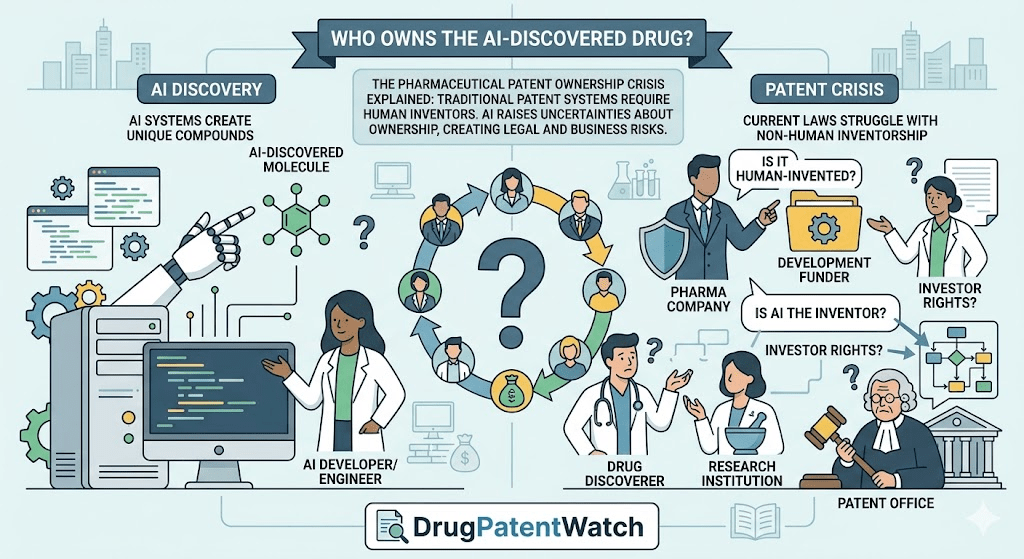
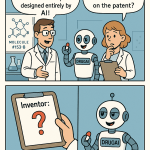
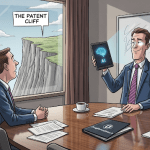
The pharmaceutical industry spent the last decade automating drug discovery. Billions went into generative chemistry platforms, phenomic screening systems, and machine-learning target-identification engines. The machines are working. The patents, in many cases, are not.
A single sentence from 35 U.S.C. § 100(f) — “The term ‘inventor’ means the individual or, if a joint invention, the individuals collectively who invented or discovered the subject matter of the invention” — is now the load-bearing legal structure supporting or collapsing the IP portfolios of Recursion Pharmaceuticals, Insilico Medicine, BenevolentAI, and the dozens of pharma majors that signed discovery partnerships with them. Congress wrote that sentence in 1952. No one in Congress was thinking about generative chemistry.
This is the central tension in pharmaceutical IP today: the technology has outrun the law, and the law, so far, has refused to move. The Federal Circuit held in August 2022 that an AI cannot be an inventor. The U.S. Supreme Court declined to hear an appeal in April 2023. The USPTO issued guidance in February 2024 clarifying what a human contribution must look like. The European Patent Office, UK Supreme Court, and German Federal Court have each weighed in. The collective result is a framework that permits AI-assisted drug patents but requires companies to prove, with documented evidence, that a human being made a “significant contribution” to the conception of each claim.
That sounds manageable. It is not, for most companies.
Over 30% of drug discovery programs incorporating AI tools lack formal inventorship documentation protocols that would survive a USPTO examination under the 2024 guidance, according to the Intellectual Property Owners Association’s 2024 AI and Biopharmaceuticals Survey. That gap is not theoretical risk. It is the reason 78% of pharmaceutical companies now mandate inventorship audits for AI projects, up from a fraction of that number before the cascade of DABUS decisions forced the issue into boardrooms.
This article covers the full landscape: the law as it stands, the decisions that created it, the technical challenges that go beyond inventorship, the strategic choices companies are making right now, and the commercial consequences for drug valuations, licensing deals, and generic entry timelines.
What the DABUS Cases Actually Decided — and What They Left Open
What Is DABUS and Why Did Stephen Thaler Test the System?
DABUS — Device for the Autonomous Bootstrapping of Unified Sentience — is a connectionist AI system developed by Dr. Stephen Thaler of the Artificial Inventor Project. In 2018 and 2019, Thaler filed patent applications in the United States, Europe, the United Kingdom, Australia, Germany, Japan, and South Africa, listing DABUS as the sole inventor on two inventions: a food container with a fractal surface geometry that improves grip and heat transfer, and a flashing neural beacon designed to attract human attention in emergencies.
Thaler’s choice to list DABUS alone was deliberate. He had the option to name himself or other human collaborators as inventors, but he refused. The goal was a clean legal test: can an AI system hold the status of inventor under current patent law? Across almost every jurisdiction, the answer was no. But the cases did not resolve the harder question that pharmaceutical companies face every day: when a human and an AI collaborate, precisely how much does the human need to contribute?
Thaler v. Vidal: What the Federal Circuit Actually Held
The Eastern District of Virginia issued its decision in September 2021, agreeing with the USPTO that the plain language of the Patent Act requires a human inventor. Thaler appealed. On August 5, 2022, the Federal Circuit affirmed, finding that the Patent Act unambiguously requires an “inventor” to be a natural person. The Supreme Court denied certiorari on April 24, 2023, leaving the Federal Circuit’s ruling as the operative law in the United States.
What the Federal Circuit did not decide is equally important. The court did not address: what percentage of inventive contribution a human must supply; whether a human who merely selects among AI-generated outputs qualifies as an inventor; how the standard applies when multiple AI systems contribute to different claims in a single patent; or whether a patent can be challenged post-grant on the ground that the human contribution was insufficient even when a human is listed as inventor.
Those questions are live. They are not theoretical. Every pharmaceutical company running generative chemistry pipelines must answer them for each application they file.
The EPO, UK Supreme Court, and German Federal Court Decisions: Where International Law Diverged
The European Patent Office decided the European DABUS cases in J 8/20 and J 9/20, holding that the requirement for an inventor to be a “natural person” under Article 81 EPC is absolute. Unlike the USPTO, the EPO did not subsequently issue guidance on what constitutes a “significant human contribution.” That silence creates a prosecution challenge: European applications involving AI-assisted inventions must be drafted with explicit documentation tying each inventive step to a named human decision, without any regulatory framework specifying what level of contribution suffices.
The UK Supreme Court upheld the rejection in October 2023 on narrow statutory grounds, finding that DABUS could not be an “inventor” under the Patents Act 1977. The court did not endorse or reject the broader proposition that AI-generated inventions are unpatentable; it simply held that the inventor designation was wrong.
Germany’s approach differed in one legally significant way. In its DABUS ruling of June 11, 2024, the German Federal Court (Bundesgerichtshof) adopted a position more permissive than the U.S. standard: any human contribution, however minor, is sufficient to justify listing a human as inventor for AI-generated inventions. This is meaningfully lower than the USPTO’s “significant contribution” threshold and creates a jurisdiction-shopping incentive that sophisticated IP teams have already begun to exploit.
Australia’s Reversal: The One Court That First Said Yes
Australia briefly stood alone. The Full Federal Court of Australia initially held in 2021 that DABUS could be listed as an inventor, accepting that the Patents Act 1990 did not explicitly restrict inventorship to natural persons. The Australian High Court reversed this decision in April 2022, aligning Australia with the global consensus. The brief period of divergence mattered because it demonstrated that the human-inventor requirement is a policy choice, not an inevitable legal conclusion — a fact that reform advocates have since used in lobbying efforts.
The USPTO’s 2024 Inventorship Guidance: A Practical Field Manual
What the February 2024 Guidance Actually Requires
Published on February 13, 2024, the USPTO’s “Inventorship Guidance for AI-Assisted Inventions” is the operative standard for U.S. patent prosecution involving AI drug discovery tools. It does not carry the force of law — as reiterated in In re: Rudy (2020), USPTO guidance documents bind examiners but cannot override statutory requirements. The guidance serves as a practical framework that tells applicants what examiners will look for.
The core standard: a human inventor must have made a “significant contribution” to the conception of each claim. The guidance draws from Pannu v. Iolab Corp. (1998), which requires that each named inventor contribute to at least one claim. It maps onto the Burroughs Wellcome Co. v. Barr Laboratories (1994) standard, which establishes that whoever conceives the idea holds inventorship rights, regardless of who reduces the conception to practice.
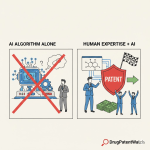
For pharmaceutical teams, the guidance creates four categories of human activity that may support inventorship. First, the person who formulates the AI query in a manner reflecting genuine domain insight — not merely entering “find a CDK4 inhibitor” but designing a prompt that incorporates specific structural constraints, selectivity requirements, and pharmacokinetic targets based on expert knowledge. Second, the person who interprets ambiguous or unexpected AI outputs and makes a non-obvious selection from among multiple candidates. Third, the person who identifies that an AI-generated compound belongs to an unpredicted structural class worth pursuing. Fourth, the person who modifies an AI-generated output based on medicinal chemistry expertise in a way that constitutes a separate inventive contribution.
Running the AI system, reviewing its outputs without exercising judgment, or simply approving a list of AI-generated candidates does not, under the guidance, constitute a significant contribution to conception.
What the November 2025 Guidance Update Changed
The USPTO updated its AI inventorship guidance again in November 2025. The revision clarified several edge cases that had generated uncertainty in the intervening 21 months. It confirmed that the inventorship analysis is claim-by-claim: a human who made a significant contribution to claims 1-5 is a proper inventor on those claims even if claims 6-10 were entirely AI-generated and those AI-generated claims are not separately patentable. It also addressed the situation where an AI system generates a lead compound and a human medicinal chemist modifies it, holding that the modification constitutes a separate inventive act if the modification was non-obvious, even if the underlying scaffold was entirely machine-generated.
The November 2025 update did not resolve the outstanding questions on non-obviousness, enablement, and written description. As of the current date, the USPTO has not issued guidance addressing how the proliferation of AI tools affects the PHOSITA standard or how much AI model detail must be disclosed to satisfy section 112.
How to Document Inventorship for an AI-Assisted Drug Patent: A Practical Protocol
Based on the 2024 guidance and the November 2025 update, pharmaceutical IP teams have developed documentation protocols that can survive examination and, more importantly, post-grant challenge. The elements that matter are:
A dated lab notebook or electronic research record documenting the specific scientific problem the AI query was designed to solve, written before the query was run.
Written records of the AI outputs considered, including the outputs not selected, with reasoning for the selection decision documented at the time of selection, not reconstructed afterward.
Documentation of any human modification to AI-generated structures, including the scientific rationale for the modification.
Identification, by name, of the individual who made each significant contribution to each claim, with supporting records.
A formal inventorship review, conducted by patent counsel, before the application is filed.
The Deloitte 2025 pharmaceutical survey found that 78% of pharmaceutical companies now mandate these audits for AI projects. That leaves 22% that do not — and those companies are accumulating patent portfolios at elevated invalidity risk.
Beyond Inventorship: The Three Technical Patent Challenges That Will Define AI Drug IP
PHOSITA Inflation: How AI Makes Every Drug Patent Easier to Challenge on Obviousness
Non-obviousness under 35 U.S.C. § 103 asks whether the claimed invention would have been obvious to a “person having ordinary skill in the art” (PHOSITA) at the time the invention was made. The PHOSITA is a legal fiction — a hypothetical expert presumed to have access to all relevant prior art and a level of ordinary creativity consistent with the field. The critical fact for pharmaceutical IP is that the PHOSITA’s assumed capabilities expand as the available tools of the field become more powerful.
As AI tools for molecular design, protein-structure prediction, and pharmacokinetic modeling become ubiquitous — with over 90% of pharmaceutical companies now investing in AI for R&D — the legal definition of “ordinary skill” will inevitably incorporate proficiency with those tools. A molecule that would have been non-obvious to a medicinal chemist without AI assistance in 2018 may be obvious to a PHOSITA with access to generative chemistry platforms in 2026.
This is not a future problem. It is a current one. Patent examiners are already applying elevated PHOSITA standards to AI-assisted applications, and inter partes review petitions have begun citing the availability of specific AI platforms as evidence that a claimed molecule was within the ordinary capabilities of the field. The DrugPatentWatch blog, which covers pharmaceutical IP in detail, noted in 2025 that companies are now being advised to generate “non-AI-obviousness” evidence — data demonstrating that AI-assisted screening of the relevant chemical space was conducted and failed to identify the claimed compound — as a defensive measure.
The Enablement Trap: When Black Box AI Fails Section 112
35 U.S.C. § 112 requires that a patent’s written description enable a person skilled in the art to make and use the claimed invention without undue experimentation. For AI drug patents, this requirement creates a structural problem: the most powerful AI discovery platforms are black-box deep learning systems. The path from input parameters to output molecule is not explicable in human-readable terms. If a company cannot describe how its AI model arrived at a specific drug candidate, the patent application may fail the disclosure standard.
A patent application that states only “an AI model was used to identify compound X” without detailing the model’s architecture, training data, and output parameters faces rejection or post-grant invalidation for lack of enablement. This forces pharmaceutical companies into a tension that has no clean resolution: disclose enough technical detail about the AI system to satisfy examiners, or protect the AI platform as a trade secret. Doing both simultaneously is structurally difficult.
Courts have already invalidated AI-related patents on section 112 grounds where the specification failed to describe how the AI algorithm performed the claimed functions. A 2024 USPTO rejection of an AI-designed mRNA vaccine adjuvant application cited exactly this failure: the application claimed the adjuvant’s activity but did not disclose the generative model parameters that produced the structure, making it impossible for a skilled formulator to replicate the discovery process. The application was abandoned rather than litigated.
Written Description: Proving You Possessed the Invention Before the AI Found It
The written description requirement — distinct from enablement — requires that the patent’s specification show the inventor was in possession of the claimed invention at the time of filing. For traditional drug patents, this is demonstrated by disclosing the compound’s structure, synthesis route, and biological activity data. For AI-generated compounds, the question is more complex: if the AI generated the compound and the human selected it, was the human “in possession” of the invention in the legal sense?
The answer depends on how broadly the claims are written. Narrow claims directed to a specific compound with disclosed synthesis and activity data are less vulnerable. Broad claims covering a genus of AI-generated compounds without adequate structural disclosure are highly vulnerable to written description challenges, particularly under the Ariad Pharmaceuticals standard from 2010, which requires that a claimed genus be described with sufficient representational species to demonstrate possession of the full scope claimed.
Generative chemistry platforms routinely identify classes of novel scaffolds. The temptation is to file broad genus claims covering the entire class. The legal risk is that a genus identified by AI, without extensive human-driven synthesis and testing of representative members, will fail written description at the Federal Circuit even if it survives initial examination.
The PHOSITA Problem in Depth: What Happens When AI Becomes Standard in Drug Discovery?
How Courts Define “Ordinary Skill” in a Field Where AI Is Now Ordinary
The Supreme Court’s 2007 decision in KSR International Co. v. Teleflex established that a PHOSITA is a person of ordinary creativity, not a rigid automaton constrained by what the prior art explicitly teaches. KSR expanded the scope of what counts as obvious by allowing examiners and courts to consider combinations of prior art references based on common sense and predictable design choices.
Applied to AI drug discovery, KSR has a specific implication: a medicinal chemist who has access to AlphaFold 3, a generative chemistry platform, and a large public compound database has ordinary skill that includes those tools. Using those tools to identify a molecule that would have been non-obvious without them does not necessarily make the molecule non-obvious, because the tools are ordinary. The relevant question becomes: was there anything in the human’s application of the AI tools, or in the AI’s output, that a skilled user of those tools would not have predicted?
This is why the DrugPatentWatch analytics team and others tracking pharmaceutical patent prosecution have observed a shift in how companies document non-obviousness: the strongest secondary consideration evidence for an AI-assisted drug patent in 2026 is not unexpected results per se, but documented evidence that AI-assisted screening specifically failed to find the claimed compound before the human inventor made a non-obvious decision that led the AI in a new direction.
AlphaFold 3, Generative Chemistry, and the Prior Art Problem
DeepMind released AlphaFold 3 in May 2024, expanding the system’s capability from protein structure prediction to modeling interactions between proteins, DNA, RNA, and small molecules. This immediately affected the obviousness analysis for drug patents in two ways. First, the prior art now includes protein-ligand complex predictions that were speculative before AlphaFold 3. Second, a PHOSITA in structure-based drug design is now presumed to have access to accurate protein-ligand binding predictions for most druggable targets.
A drug patent claiming a compound that binds a specific protein pocket is now harder to defend as non-obvious if AlphaFold 3 predicts that binding with high confidence. The compound may still be novel — AlphaFold 3 is a prediction tool, not a synthesis tool — but the prediction is now prior art that an examiner can cite as motivation to combine the protein structure knowledge with known scaffolds.
Pharmaceutical companies that did not account for this when filing applications before AlphaFold 3’s release may find those applications more vulnerable in inter partes review proceedings than their prosecution history suggests.
What This Means for Drug Patent Prosecution Strategy After AlphaFold 3
The practical response for IP teams is a set of claim drafting adjustments. Method-of-treatment claims that tie the compound to a specific patient population or dosing regimen are harder to challenge on obviousness grounds than pure composition-of-matter claims. Claims that emphasize unexpected selectivity profiles, off-target activity differences, or pharmacokinetic improvements over structurally similar compounds are more defensible if backed by comparative data. Claims that incorporate functional limitations demonstrated only by the novel compound are more durable.
The worst outcome is a broad structure-activity relationship claim filed before the AI-assisted testing data was complete. Inter partes review petitions can and do target the gap between what a generative model identified and what experimental data supports.
AI Drug Company IP Strategies: How Insilico, Recursion, and BenevolentAI Are Actually Doing This
Insilico Medicine: Rentosertib, ISM001-055, and the Patent Strategy Behind the Pipeline
Insilico Medicine is the company closest to demonstrating that an AI-designed drug can achieve clinical proof-of-concept. Its TNIK inhibitor, ISM001-055 (rentosertib), produced positive Phase IIa results in idiopathic pulmonary fibrosis — the first systematic demonstration of an AI-enabled, end-to-end discovery process yielding a therapeutic benefit in human trials, as published in Nature Medicine in 2025 and Nature Biotechnology in 2024.
Insilico’s IP strategy reflects the dual-layer approach that has become standard at the frontier of AI drug discovery. Composition-of-matter patents cover the specific drug compounds advancing through trials. Method patents and platform patents cover the generative chemistry tools — particularly Insilico’s Chemistry42 and Biology42 platforms — and the specific AI-driven methodologies used to design those compounds. Trade secret protection applies to the proprietary training datasets and model weights that make the platform difficult to replicate.
Joanna Wang of Insilico Medicine published a detailed analysis of the USPTO’s 2024 inventorship guidance in the Journal of Law and the Biosciences (August 2025), noting that the guidance creates both clarity and compliance burden: clarity because AI-assisted inventions are patentable when human contributions are documented, and burden because the documentation requirement is operationally demanding for companies running hundreds of AI-assisted discovery programs simultaneously.
Insilico’s commercial trajectory accelerated significantly in early 2026 when Eli Lilly entered a $2.75 billion research and licensing agreement with the company — one of the largest AI-driven drug discovery deals on record. The deal includes an exclusive worldwide license for a preclinical portfolio and a joint R&D program under which Insilico will discover and advance candidates against Lilly-selected targets. The IP governance structure in that agreement will become a template for the next wave of large-pharma AI partnerships.
Recursion-Exscientia: A $688 Million Bet on Integrated AI Drug Discovery IP
Recursion Pharmaceuticals completed its acquisition of Exscientia in November 2024 for $688 million, creating what the combined entity describes as a vertically integrated AI drug discovery platform. Recursion’s phenomic screening — automated high-throughput imaging of cellular responses to compounds, processed by deep learning — merges with Exscientia’s automated precision chemistry and the legacy of DSP-1181, the first fully AI-designed drug to enter clinical trials, developed in collaboration with Sumitomo Pharma for obsessive-compulsive disorder.
The IP implications of the merger are significant. Recursion holds patents on its phenomic screening methodology and the specific machine learning systems that process imaging data. Exscientia held patents on its AI-driven medicinal chemistry platform and the compound classes it had identified. Integrating two separately developed AI platforms creates a joint IP portfolio with potential claim overlap, potential inventorship questions on compounds identified using both platforms, and potential trade secret conflict where one platform’s training data is now accessible to the other’s engineers.
Exscientia’s pre-merger IP strategy combined patents for compounds with trade secrets for algorithms and datasets — the same dual-layer model Insilico uses. Whether that model survives intact in the merged entity’s portfolio management process is a question Recursion’s IP counsel is working through now. The pipeline carries substantial value: REC-1245 (an RBM39 degrader for solid tumors and lymphoma) and REC-394 (targeting C. difficile) are in Phase 1 and Phase 2 respectively, with data due in 2026.
BenevolentAI and the Knowledge Graph Patent Challenge
BenevolentAI uses a knowledge graph approach to drug discovery: a structured representation of biomedical relationships drawn from literature, clinical databases, and experimental datasets, which the AI traverses to identify non-obvious connections between targets, diseases, and candidate compounds. The IP challenge with knowledge graph-derived drugs is particularly acute on the non-obviousness dimension: the AI is specifically designed to find connections that human researchers missed, which means it is finding non-obvious solutions — but the act of traversing a knowledge graph may itself become obvious once the graph exists and the tool is widely available.
BenevolentAI’s partnership with AstraZeneca demonstrated the commercial model: the AI identifies a target or compound class, the pharmaceutical major validates and develops it, and the partnership agreement specifies how IP rights are allocated. The critical provision in modern AI discovery partnership agreements is the assignment clause for AI-generated outputs: which party owns the patent on a compound that the AI identified from one party’s data but was optimized by the other party’s chemists?
AI Drug Patents vs. Traditional Drug Patents: Key Differences That Matter for IP Strategy
Composition-of-Matter vs. Method Patents: Which Provides Stronger Protection for AI-Discovered Drugs?
Traditional pharmaceutical IP strategy centers on composition-of-matter (CoM) patents, which protect the specific chemical compound regardless of how it is made or what it is used for. CoM patents are the gold standard because they block generic entry on any use of the compound, not just the approved indication. A generic manufacturer cannot design around a CoM patent without changing the active ingredient.
For AI-discovered drugs, CoM patents remain the preferred protection for the final compound, but the prosecution challenge is higher. The written description and enablement requirements mean that a CoM patent on an AI-generated compound must include sufficient experimental data to demonstrate possession of the invention. Generative models that output thousands of candidate structures encourage premature filing before adequate experimental support exists.
The Science journal study by Freilich and Rai, published in June 2025, analyzed granted drug compound patents from over 100 AI drug companies and concluded there is a trend of premature patenting by AI drug companies — filing early, before adequate biological data, in a pattern that may result in valuable therapeutic molecules being abandoned because the patent life runs down before clinical development can be completed. The IP Kat blog disputed the analysis, arguing it reflects a misunderstanding of standard pharmaceutical patent strategy rather than an AI-specific pathology, but the data on filing-to-IND gaps at AI companies is real.
Method patents on the AI discovery process itself offer a complementary protection layer. A patent on a specific generative chemistry methodology — the way the model was configured, the training approach, the specific query framework — can block competitors from using the same approach even if they arrive at a structurally different compound. Method patents are harder to design around than they appear because the AI workflow is the competitive moat.
Platform Patents vs. Drug Patents: What Gets Valued in an M&A Deal
Merck’s 2025 acquisition of Atomwise for $2.1 billion established a precedent for how large pharma values AI drug discovery IP in transactions. The deal value was driven primarily by Atomwise’s AtomNet platform — its trained models, proprietary compound screening data, and the method patents covering its structure-based virtual screening approach — rather than by any specific drug compound in development.
The acquisition agreement included a specific IP governance clause requiring that all generative chemistry outputs from the AtomNet platform be subject to documented human oversight review before being incorporated into patent applications. This clause was a contractual protection by Merck’s IP counsel against inheriting a patent portfolio that could not survive inventorship challenges under the 2024 USPTO guidance. It also signaled that large pharma has internalized the inventorship documentation requirement as a deal-structuring concern, not just a prosecution concern.
For AI drug companies raising capital or pursuing partnerships, the implication is clear: investors and acquirers are scrutinizing inventorship documentation as part of IP due diligence. A portfolio of patents that cannot demonstrate human “significant contribution” to each claim is a liability, not an asset, regardless of how novel the underlying compounds are.
AI Drug Patents Timeline: From First Filing to Potential Challenge
Event
Typical Timeframe
Key Risk Point
AI generates lead compound; human selection decision made
Day 0
Inventorship documentation must be created at this moment, not reconstructed later
Provisional patent application filed
Days 30-180
Biological data often insufficient at this stage; broad claims risk written description problems
PCT application filed
Month 12
International filing strategy must account for EPO’s stricter prosecution environment
National phase entry (U.S., EU, China, Japan)
Month 30
Jurisdiction-specific AI inventorship rules apply; German “any human contribution” vs. U.S. “significant contribution” standard
Patent grants
Years 3-6
Post-grant IPR window opens immediately; enablement and PHOSITA challenges most likely attack vector
IND filing / Phase 1 entry
Years 4-8 from lead identification
Generic manufacturers begin prior art searches; Orange Book listing strategy becomes relevant
NDA / BLA approval
Years 10-15 from lead identification
Paragraph IV certifications possible immediately; patent term restoration under Hatch-Waxman begins calculation
Patent expiry / LOE
20 years from priority date
If provisional was filed too early (common in AI companies), effective patent life may be shorter than traditional drug
Who Owns What When Multiple Parties Build the AI: Data, Models, and Joint IP Risks
The Data Ownership Problem: Who Has Rights to What the AI Learned?
AI drug discovery models are trained on data. The data comes from somewhere: published literature, proprietary screening results, electronic health records, biobanks, clinical trial repositories, competitor filings, and partner databases. The question of who owns the model that emerges from training on multi-source data is one of the most commercially consequential unresolved issues in pharmaceutical IP.
Data itself is not patentable. Copyright protection for data compilations is limited and jurisdiction-specific. But a sufficiently unique dataset — one whose curation reflects substantial human intellectual labor and proprietary experimental work — may carry trade secret protection in most jurisdictions. The threshold question is whether the data’s value derives from it being secret, which it does when the data represents years of proprietary screening results that competitors do not have.
The 2025 litigation between BioNTech and Nucleai involving tumor imaging data used to train a cancer drug discovery AI is the most prominent example of this problem in action. The core dispute was whether Nucleai, the data provider, retained IP rights in the model trained on its data, despite a data licensing agreement that expressly assigned all model outputs to BioNTech. The legal question remains unresolved across most jurisdictions. Parties drafting AI data licensing agreements in 2025 and beyond must address this risk explicitly: specifying whether the data provider retains any trade secret rights in the dataset itself, whether the data provider has any rights in model weights derived from that data, and what happens to derived IP if the licensing agreement terminates.
Multi-Party AI Drug Discovery: Joint Ownership, Joint Inventorship, and the Assignment Problem
AI models trained on data contributed by multiple parties — academic collaborators, contract research organizations, patient biobanks, hospital health systems — create joint IP attribution risks that standard material transfer agreements (MTAs) and data licensing agreements drafted for pre-AI research frameworks do not adequately address.
Joint patent ownership in the United States carries an unusually permissive default rule: each co-owner can license the patent without the other’s consent and without sharing royalties. This rule, which differs from most other jurisdictions, creates significant problems when an AI drug discovery company and a large pharma partner jointly develop a compound. If the academic collaborator that contributed training data is later held to be a joint inventor or joint patent owner, the large pharma company’s exclusive license may be defective. AstraZeneca encountered a variant of this problem in its BenevolentAI partnership, requiring renegotiation of IP assignment terms after the discovery process generated claims that touched both parties’ proprietary data.
University-Industry AI Drug Discovery Collaborations and Bayh-Dole Act Complications
The Bayh-Dole Act of 1980 gives universities the right to own patents on federally funded inventions. When a university collaborates with a pharmaceutical company on an AI drug discovery program that uses federally funded computing infrastructure, AI models, or biological databases, the question of whether the resulting patents are subject to Bayh-Dole ownership rights by the university is non-trivial. Universities have become aggressive in asserting Bayh-Dole rights in technology licensing agreements, and AI drug discovery partnerships that involve any federal research funding create an ownership ambiguity that must be resolved in the collaboration agreement before the AI runs its first query.
Trade Secrets vs. Patents for AI Drug Platforms: The Strategic Choice Every Company Must Make
When Trade Secret Protection Is Better Than a Patent for an AI Discovery Platform
A patent requires public disclosure. A trade secret requires only reasonable efforts to maintain secrecy. For AI drug discovery platforms — where the competitive value lies in the trained model, the proprietary dataset, and the specific workflow architecture — trade secret protection is often more valuable than patent protection, for three reasons.
First, patents expire. A trade secret, if properly maintained, does not. The Coca-Cola formula has been a trade secret for over 130 years; a patent on it would have expired before World War I. An AI drug discovery platform that a company can maintain as a trade secret indefinitely provides durable competitive advantage that a 20-year patent cannot match.
Second, patents require disclosure of the exact details that make the platform valuable. Disclosing model architecture, training data composition, and query methodology in a patent specification is precisely the information competitors need to build a comparable system. Trade secret protection avoids this problem.
Third, patents on software-implemented methods face subject matter eligibility challenges under 35 U.S.C. § 101, particularly after Alice Corp. v. CLS Bank International (2014). A generative chemistry algorithm that produces drug candidates by applying mathematical transformations to chemical space may face rejection as an abstract idea, forcing companies into claim drafting contortions that narrow the patent’s scope and reduce its competitive value.
The hybrid model — patents on drug compounds, trade secrets on the discovery platform — has become the dominant strategy among pure-play AI drug companies. Exscientia’s pre-merger strategy combined compound patents with trade secrets for algorithms and datasets. Insilico’s current approach follows the same structure. Recursion’s phenomic screening methodology is protected partly by method patents and partly by proprietary biological datasets that would take years to replicate.
What Happens to Trade Secrets in an Acquisition: The Atomwise-Merck Model
When Merck acquired Atomwise for $2.1 billion in 2025, the acquisition transferred not just the company’s patent portfolio but its trained models, proprietary datasets, and the tacit knowledge of its scientific staff. Trade secrets transfer in acquisitions through employment agreements, IP assignment clauses, and specific representations and warranties about the secrecy measures in place. The Atomwise deal required extensive technical diligence to establish what trade secret protections were actually in place, a process that IP attorneys involved described as more complex than the patent diligence review.
The deal also established a governance model for post-acquisition AI drug discovery: the IP governance clause requiring documented human oversight review before AI outputs are incorporated into patent applications is now a template that several other large-pharma acquirers have adopted as standard deal language.
Trade Secret Risks for AI Drug Platforms: Employee Mobility and Reverse Engineering
Trade secret protection is only as strong as the measures used to maintain it. Pharmaceutical AI platforms face two specific threats. Employee mobility is the first: a trained AI drug discovery scientist who leaves for a competitor takes tacit knowledge that is genuinely difficult to separate from protectable trade secrets. Non-disclosure agreements and non-compete clauses provide imperfect protection, and non-competes are unenforceable in California — where several of the most significant AI drug companies are headquartered.
Reverse engineering is the second: a competitor who legally obtains a drug compound and analyzes its structure can, in principle, use that structure to infer something about the AI platform that generated it. The extent to which structure-activity relationships derived from a competitor’s compounds constitute actionable trade secret misappropriation is an open legal question that has not been fully litigated in the pharmaceutical context.
International AI Drug Patent Strategies: Filing for Competitive Advantage Across Jurisdictions
USPTO vs. EPO vs. CNIPA: A Jurisdiction-by-Jurisdiction Comparison for AI Drug Patents
Jurisdiction
Inventorship Standard for AI-Assisted Drugs
Guidance Status
Key Challenge
United States (USPTO)
“Significant contribution” by a natural person to each claim (Feb 2024 guidance; updated Nov 2025)
Detailed guidance issued; not force of law
PHOSITA inflation; enablement of black-box models
European Patent Office
Natural person required; “significant contribution” standard not explicitly defined
No post-DABUS guidance issued
No safe harbor for human contribution level; conservative prosecution required
Germany (Bundesgerichtshof)
Any human contribution sufficient (June 2024 ruling)
Court decision, no administrative guidance
Lower bar creates jurisdiction-shopping incentive; German national filings may be more defensible for borderline cases
China (CNIPA)
Natural person required; guidance closely tracks USPTO framework
Administrative guidance issued 2023-2024
Rapidly expanding AI pharma patent filings; China is the second-largest jurisdiction for AI drug patents
United Kingdom
Natural person required (UK Supreme Court, Oct 2023); new AI inventorship consultation ongoing
IPO consultation on AI and patents closed 2025; legislative reform proposed
Post-Brexit divergence from EPO creates dual filing complexity
Japan (JPO)
Natural person required; 2025 IP Strategic Program addresses AI inventorship
JPO guidance in development; Japan focused on maintaining global AI competitiveness
Most restrictive AI policy environment among major economies historically; reform underway
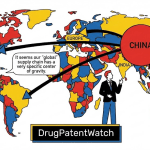
Why China’s AI Drug Patent Strategy Is Moving Faster Than the West Recognizes
The 2024 patent landscape report analyzed by Hylton Rodic Law covered 1,087 AI-driven drug discovery patents and found the United States leading, with China close behind. AI-related pharmaceutical patent filings in China are growing at approximately 23% per year — faster than in any other major jurisdiction — and China’s National Intellectual Property Administration issued AI-specific patent guidance in 2023 and 2024 that closely tracks the USPTO framework.
Chinese pharmaceutical and biotechnology companies — particularly those with state-affiliated research institutes — are filing AI drug patents at scale in a way that generates substantial prior art, compresses the novelty window for Western companies, and builds a global IP position that will matter when Chinese AI-designed drugs seek regulatory approval in Western markets. Companies that monitor only U.S. and European filings are missing a significant portion of the emerging prior art landscape for their own AI-assisted programs.
DrugPatentWatch provides coverage of international patent filings including Chinese AI drug patents, and tracking this database for competitor filings is becoming a standard part of freedom-to-operate analysis for AI drug discovery programs targeting any indication with active Chinese research.
The UK’s Post-Brexit AI Patent Reform Debate: What Legislative Changes Are Coming
Following the UK Supreme Court’s October 2023 DABUS ruling and the closure of the Intellectual Property Office’s AI and patents consultation in 2025, the UK faces a policy choice that the U.S. and EPO have so far avoided: whether to amend patent legislation to permit AI-generated inventions under specific conditions. The consultation responses included significant industry support for a framework that would permit patents on AI-generated inventions where no human inventor can be identified, with ownership vesting in the entity that owns and operates the AI system.
If the UK enacts such legislation, it would create a genuinely divergent international framework — not just a difference in inventorship threshold but a categorical difference in what can be patented. Companies building AI drug discovery platforms would have strong incentives to structure their IP strategy around UK filings for entirely AI-generated outputs, while retaining U.S. and EPO filings for compounds where human contribution is documented. That possibility is already influencing corporate structure decisions among AI drug companies with UK research operations.
The Obviousness Risk Is Growing: How Generic Manufacturers Will Use AI to Challenge AI Drug Patents
Paragraph IV Certifications and AI Drug Patents: A Coming Wave
Under the Hatch-Waxman Act, a generic manufacturer that files an abbreviated new drug application (ANDA) and certifies under Paragraph IV that the listed patent is invalid or will not be infringed triggers a 30-month stay of FDA approval and potentially a 180-day exclusivity period for the first filer. The economic incentive to challenge pharmaceutical patents via Paragraph IV is substantial, and the availability of AI tools to identify invalidating prior art is making those challenges cheaper and more targeted.
AI drug patents face a specific Paragraph IV risk that traditional drug patents do not: the prior art generated by the discovery process itself. Generative chemistry platforms produce thousands of candidate structures before arriving at the clinical compound. Internal documents showing that the AI explored and discarded structures similar to the claimed compound could be used in invalidity proceedings to argue that the claimed compound was obvious in light of its own discovery process. If that internal prior art is not managed carefully, it constitutes a trap that the drug company set for itself.
IPR Petitions Against AI Drug Patents: What Arguments Will Generic Companies Make?
Inter partes review before the Patent Trial and Appeal Board (PTAB) is the most efficient mechanism for invalidating issued patents. For AI drug patents, the most likely IPR attack vectors are:
Obviousness under § 103, arguing that the claimed compound was an obvious selection from the AI-identified chemical space and that the human contribution was merely executing the AI’s suggestion.
Lack of enablement under § 112, arguing that the patent’s failure to disclose the AI model parameters makes it impossible to replicate the inventive process without undue experimentation.
Improper inventorship, which in an IPR proceeds as a challenge to the patent’s compliance with § 100(f) and can be raised if evidence suggests the documented human contribution was not genuine.
None of these attacks has yet succeeded in a fully litigated case involving an AI-discovered drug compound. The patent portfolios protecting the most advanced AI drug candidates — Insilico’s rentosertib, Recursion’s pipeline compounds — have not yet faced Paragraph IV challenges because none of those drugs has received FDA approval. The first approval of an AI-designed drug will trigger the first serious ANDA filing and Paragraph IV certification against an AI drug patent. That is when the legal theories being developed in prosecution and academic literature will be tested in adversarial litigation.
What AI-Powered Prior Art Search Means for Drug Patent Validity After 2025
AI-powered prior art search tools are making the global body of patent and non-patent literature more accessible than at any point in the history of the patent system. A reference that required a specialized Chemical Abstracts Service search to find in 2010 can now be surfaced by a semantic search tool in seconds. This has a direct effect on the cost and effectiveness of invalidity challenges: generic manufacturers and PTAB petitioners can identify prior art combinations that human researchers would not have found, and they can do it cheaply.
For AI drug patents, the relevant prior art body now includes AI-generated papers, generative model outputs published in scientific literature, compound databases populated by AI screening programs, and the outputs of open-source generative chemistry tools. The Enamine REAL database, which contains synthetically accessible compounds generated by algorithmic methods, runs to billions of structures. If a claimed AI-generated compound is structurally similar to a compound in Enamine REAL that predates the priority date, the patent faces an anticipation or obviousness challenge from a prior art reference no human would have identified without AI assistance.
DrugPatentWatch incorporates patent analytics tools that allow pharmaceutical companies to monitor these risks across their AI-generated compound portfolios, including freedom-to-operate analysis against algorithmically generated prior art databases. Using such tools proactively — before filing rather than after challenge — is the operationally sound approach.
FDA Regulatory Implications of AI Drug Discovery: Does the Machine Matter to the Agency?
Does FDA Care Whether a Drug Was Discovered by AI? The Regulatory Pathway Analysis
The FDA’s evaluation of a new drug application focuses on whether the drug is safe and effective for its intended indication, based on adequate and well-controlled clinical trials. The discovery method — whether a human medicinal chemist, a combinatorial chemistry robot, or a generative AI platform identified the compound — is not a criterion the FDA applies in NDA review. From a regulatory approval perspective, an AI-discovered drug follows exactly the same pathway as any other small molecule.
This has an important implication for market exclusivity. New chemical entity (NCE) exclusivity under 21 U.S.C. § 355(c)(3)(E) provides five years of data exclusivity from the date of NDA approval, blocking ANDA filings that reference the innovator’s data. NCE exclusivity is not contingent on how the compound was discovered. An AI-designed drug that receives NDA approval gets the same five-year data exclusivity as a compound identified by traditional medicinal chemistry. Orphan drug designation, which provides seven years of market exclusivity, is available to AI-designed drugs treating rare diseases meeting the statutory prevalence threshold.
The FDA’s Center for Drug Evaluation and Research is engaged in separate work on the use of AI in clinical trial design, biomarker discovery, and drug manufacturing — but this work is distinct from the IP issues governing who owns the discovered compound.
AI Drug Candidates and the Orange Book: Patent Listing Strategy for AI-Designed Drugs
The Orange Book — formally, the FDA’s Approved Drug Products with Therapeutic Equivalence Evaluations — lists patents that claim an approved drug or a method of using it and for which a patent holder has submitted a claim of infringement against a generic applicant. Patent listing strategy for AI-discovered drugs requires the same analysis as for any small molecule: list composition-of-matter patents on the active ingredient, method-of-use patents for approved indications, and formulation patents where the specific formulation is claimed by the patent.
The twist for AI drug patents is the interaction between patent listing and inventorship validity. If an Orange Book-listed patent faces a Paragraph IV challenge and the invalidity argument rests on improper inventorship — specifically, that the human contribution was insufficient to satisfy the USPTO’s 2024 guidance — the litigation will require discovery into the company’s internal AI development records. Companies that maintained thorough inventorship documentation are well-positioned for this discovery. Companies that did not are facing an existential challenge to their market exclusivity position.
Patent Term Restoration for AI Drug Patents: How Hatch-Waxman PTE Applies
Patent term restoration under 35 U.S.C. § 156 allows a patent holder to apply for up to five additional years of patent term to compensate for regulatory review time consumed by FDA clinical trials and approval processes. The maximum effective patent life after restoration is 14 years from NDA approval. This provision applies to AI-discovered drugs on the same terms as any other new chemical entity.
The strategic issue for AI drug companies is the relationship between patent filing date and clinical development timeline. AI drug companies tend to file patents earlier in the development process — often before Phase 1 — because the AI generates patentable compounds faster than traditional chemistry. If the patent is filed several years before the NDA is submitted, more of the patent term is consumed by the regulatory review period, and the remaining effective patent life after approval may be shorter than for a traditional drug where filing and clinical development timelines are more closely aligned.
This is the mechanism behind the Freilich-Rai Science paper’s concern about premature patenting: early filing, driven by the speed of AI-assisted discovery, can inadvertently compress the commercial exclusivity window, giving generic manufacturers an earlier entry date regardless of whether the drug’s clinical and commercial value warrants it.
The Licensing Value Problem: What Happens to Deal Value When AI Patent Validity Is Uncertain?
How Pharmaceutical Licensing Deals Price AI Patent Risk
Pharmaceutical licensing transactions routinely include representations and warranties about the validity and enforceability of licensed patents, indemnification provisions for IP challenges, and milestone payment structures that allocate risk between licensor and licensee across the development lifecycle. AI patent uncertainty has introduced a new category of IP risk that is showing up in deal terms.
Licensing agreements for AI-generated drug compounds in 2025 and 2026 increasingly include: provisions requiring the licensor to represent that inventorship documentation exists and was created contemporaneously with the discovery process; audit rights allowing the licensee to review inventorship records on request; and milestone payment structures that defer larger payments until patent validity is confirmed by surviving an IPR or an initial prosecution hurdle.
The Lilly-Insilico $2.75 billion deal, announced in March 2026, involved an IP governance structure that required inventorship documentation as a condition of the license grant. The deal’s size suggests that properly documented AI drug patents command full commercial value in the licensing market. The question for smaller AI drug companies with less rigorous documentation is whether undocumented AI patent portfolios will be discounted in future deals or become unlicensable entirely.
How Investors Value AI Drug Companies With Uncertain Patent Portfolios
Biotech investment analysis has traditionally treated patent coverage as binary: you have a valid patent on the active ingredient, or you do not. The emergence of AI-specific patent vulnerability — particularly the inventorship documentation gap — introduces a graded uncertainty that investment analysts are beginning to price. A company with a large AI-generated compound portfolio and no inventorship audit process is not simply a company with “patent risk” in the traditional sense; it is a company whose entire IP foundation could be systematically challenged if a single well-argued IPR succeeds on inventorship grounds and establishes a precedent for challenging related applications.
Venture capital and growth equity investors in AI drug companies are now asking for inventorship audit reports as a standard element of IP due diligence. Series B and later rounds for pure-play AI drug discovery companies have been conditioned on delivery of inventorship documentation covering the entire patent portfolio. This is a market-driven response to the regulatory clarity that the DABUS decisions created: the rules are clear enough that ignorance of them is no longer a defensible position for a company seeking institutional capital.
Royalty Stacking Risks When AI Drug Discovery Uses Multiple Third-Party Platforms
A pharmaceutical company that licenses a generative chemistry platform from Company A, uses a protein structure database from Company B, and employs a machine learning pipeline from Company C to discover a drug compound may face royalty stacking claims from all three parties — each asserting that its contribution to the discovery process entitles it to a share of the drug’s commercial value. The current legal framework does not resolve this clearly. The USPTO’s 2024 guidance addresses inventorship for natural persons but does not address the commercial rights of AI platform providers whose tools contributed to the discovery.
Standard platform licensing agreements address this by specifically excluding any claim to royalties on discovered compounds. But older agreements, drafted before AI drug discovery became commercially significant, may not include such exclusions. Companies using legacy platform licenses to run current AI discovery programs should audit their agreements for this gap.
What AI-Generated Drug Patents Mean for Generic Entry Timelines and Pricing Pressure
Will AI Drug Patents Have Shorter Effective Patent Life Than Traditional Drug Patents?
The premature filing risk identified in the Freilich-Rai analysis suggests that some AI drug patents may have shorter effective commercial lives than traditional drug patents. The 20-year patent term runs from the priority date, and a provisional filing made two years before the IND submission — feasible when AI compresses discovery timelines — means two additional years of patent life consumed before the first clinical trial begins.
For a drug that takes 10 years from IND to NDA approval (roughly the current average), the total effective patent life after approval depends on whether the innovator can supplement the original composition-of-matter patent with method-of-use, formulation, or manufacturing patents filed closer to the approval date. AI drug companies that focus exclusively on early composition-of-matter filings without building a comprehensive patent estate risk earlier-than-expected generic entry.
Authorized Generics and AI Drug Market Exclusivity: Commercial Strategies After LOE
Loss of exclusivity (LOE) for an AI-discovered drug will follow the same commercial dynamics as any other small molecule. The first generic entry — whether via a Paragraph IV challenge or a standard paragraph III certification after patent expiry — typically erodes branded market share by 70-90% within 12 months. The strategies available to innovators include launching an authorized generic before or simultaneously with first generic entry, filing citizen petitions to delay ANDA approval, and pursuing follow-on compound patents that extend protection on an improved formulation or new indication.
AI drug discovery creates a specific LOE defense opportunity: because the same AI platform that discovered the original compound can be used to design improved follow-on compounds faster than traditional medicinal chemistry, innovators can potentially generate a next-generation compound with improved properties before the original drug’s LOE. This “AI reformulation” strategy — using the platform to design a successor rather than defend the original — may become a standard LOE management tool.
Biosimilar Entry for AI-Designed Biologics: A Different Patent Landscape
Not all AI-designed drugs are small molecules. AI is increasingly used to design biologics — including peptides, antibody formats, and novel protein therapeutics. The patent landscape for AI-designed biologics is more complex than for small molecules because biologics IP is not protected through Orange Book listing but through the Purple Book and the Biologics Price Competition and Innovation Act (BPCIA) 12-year reference product exclusivity, combined with patent dance provisions that govern how biosimilar applicants and reference product sponsors exchange patent information.
The inventorship and enablement challenges that apply to AI-designed small molecules apply with equal or greater force to AI-designed biologics: a machine learning model that designs a novel antibody structure must have a human inventor who made a significant contribution to the conception of the specific antibody, and the patent must enable a skilled biologist to reproduce it. Given the complexity of antibody engineering and the opacity of the generative models used in biologic design, the enablement challenge for AI-designed biologic patents may be the most significant emerging IP issue in the biopharmaceutical sector.
What AI Drug Patent Disputes Will Look Like in Practice: Litigation Scenarios
Scenario 1: A Generic Manufacturer Challenges Inventorship Documentation in Hatch-Waxman Litigation
The most plausible near-term litigation scenario: a generic manufacturer files an ANDA referencing an approved AI-designed drug, certifies under Paragraph IV that the listed patent is invalid due to improper inventorship, and triggers litigation in the District of Delaware or the Eastern District of Texas.
Discovery in that litigation will focus on the internal records of the AI drug company’s discovery process. The generic manufacturer’s counsel will seek: electronic laboratory notebooks from the time of the AI query; records showing what AI outputs were generated and what selection decisions were made; email communications discussing the compound’s origin; and any internal presentations characterizing the AI as the “discoverer” of the compound. The last category is particularly dangerous: companies that publicly described their AI as autonomously generating drug candidates — often in fundraising materials or press releases — have created admissions that can be used to argue that the human “inventor” did not conceive the invention in the legal sense.
Scenario 2: An IPR Petition on Enablement Grounds Targets an AI Biologic Patent
A biotechnology company holds an issued patent on an AI-designed bispecific antibody. The patent’s specification describes the antibody’s structure and functional activity but does not disclose the generative model’s architecture, training data, or the specific parameters that produced the structure. A competitor files an IPR petition at the PTAB arguing lack of enablement: a skilled antibody engineer cannot reproduce the discovery process from the patent’s disclosure.
The PTAB institutes the IPR. The patent holder argues that enablement requires only that a skilled engineer be able to make and use the claimed antibody, not that they be able to replicate the AI discovery process. The petitioner argues that because the antibody’s properties derive entirely from the AI’s design choices, and those choices are not disclosed, no skilled engineer can understand what makes this antibody work — and therefore cannot practice the full scope of the claims without undue experimentation.
This argument is novel and not yet resolved in PTAB precedent. The outcome will depend on how broadly the claims are written and what experimental data the specification includes. A patent that claims the specific antibody sequence with full characterization data is defensible. A patent that claims a class of AI-generated bispecific antibodies with functional limitations but no structural definition is highly vulnerable.
Scenario 3: A Collaboration Agreement Dispute Over Who Owns the AI-Discovered Compound
A large pharmaceutical company and an AI drug discovery company enter a collaboration agreement. The AI company contributes its generative chemistry platform and its proprietary training data. The pharmaceutical company contributes target identification expertise, experimental validation resources, and clinical development capability. After 18 months, the AI platform generates a candidate compound that the pharmaceutical company’s scientists then optimize through traditional medicinal chemistry, adding two substituents that improve pharmacokinetics.
The question of who owns the patent on the optimized compound is not answered by a standard collaboration agreement drafted in 2022. The AI company argues that the core scaffold is its IP, generated entirely by its platform from its proprietary data. The pharmaceutical company argues that the optimized compound — the one that actually works — reflects human inventive contribution by its medicinal chemists, making them the inventors and the pharmaceutical company the assignee. Both arguments have merit. The dispute resolves in litigation or arbitration, with outcome depending on the specific language of the assignment provision in the collaboration agreement and the documented evidence of which party made which contribution to which claim.
What This Means for Pharmaceutical IP Teams Right Now
An Action Framework for AI Inventorship Compliance
The gap between the current legal framework and current industry practice is real, quantifiable, and closing — but not fast enough. The Deloitte 2025 finding that 78% of pharmaceutical companies now mandate inventorship audits is encouraging, but it means 22% do not. Within the 78%, the quality of those audits varies significantly. A checkbox review of who was listed on a patent application is not the same as a documented analysis of what specific decision each listed inventor made, at what point in the discovery process, and what AI system was running at the time.
The framework for AI inventorship compliance that withstands adversarial scrutiny has four components. First, contemporaneous documentation: records created at the time of the discovery event, not reconstructed afterward. Second, claim-level specificity: documentation that ties each named inventor to a significant contribution to specific claims, not to the discovery program as a whole. Third, AI system transparency: records of what AI tools were used, what outputs they generated, and what human judgment was applied to those outputs. Fourth, regular audits: formal review by patent counsel before filing, not after challenge.
How DrugPatentWatch Supports AI Drug Patent Monitoring
DrugPatentWatch provides pharmaceutical companies, generic manufacturers, and investors with comprehensive patent data covering active pharmaceutical ingredients, drug products, and the full landscape of Orange Book-listed and non-Orange Book patents. For AI drug discovery teams, the platform’s patent analytics capabilities support freedom-to-operate analysis against the growing body of AI-generated prior art, competitive intelligence on competitor AI drug patent filings, and monitoring of IPR petitions and litigation events that affect the validity of AI drug patents.
The platform’s coverage of Chinese AI drug patent filings — a body of prior art that U.S.-focused teams frequently miss — is particularly relevant for companies whose AI discovery programs operate in therapeutic areas with active Chinese research. A compound that appears novel against the U.S. and European patent literature may face an anticipation or obviousness challenge based on a Chinese AI drug patent filed 18 months earlier in a different jurisdiction. Monitoring this risk proactively, before filing, is far less expensive than defending against it in litigation.
The Pricing Pressure Dimension: What Shorter Effective Patent Life Means for Drug Pricing Models
The commercial model for pharmaceutical innovation rests on pricing during the exclusivity period to recover development costs that, for traditional drugs, run to $2.6 billion per approved compound on a fully capitalized basis. AI drug discovery changes this calculation in two directions: it reduces development costs (Insilico’s IPF program reportedly advanced from target identification to clinical candidate in 18 months at a cost of $150,000 excluding wet lab validation), but it may also compress the effective patent life available to recover those costs.
If AI-designed drugs have shorter effective commercial exclusivity — due to earlier patent filing, premature generic entry enabled by AI prior art tools, or successful IPR challenges on AI-specific grounds — the pricing premium required to make the commercial model work does not necessarily decrease proportionally. Investors will price AI drug company pipelines based on the expected net present value of exclusivity periods, and uncertainty about patent durability raises the discount rate applied to those cash flows. Better inventorship documentation is not just a legal compliance exercise. It is a direct input into the company’s valuation.
The Reform Debate: Should Patent Law Change to Accommodate AI Drug Discovery?
The Case for Expanding Inventorship to AI Systems or AI Owners
The most direct reform proposal is to amend 35 U.S.C. § 100 to permit AI systems to be listed as inventors, with ownership vesting in the entity that owns the AI. This is the position advocated by Stephen Thaler and the Artificial Inventor Project, and it has gained traction in academic literature and in the UK IPO consultation responses. The argument is functional: if the patent system’s purpose is to incentivize innovation by guaranteeing a return on the investment required to produce it, then excluding AI-generated inventions from patent protection removes the incentive for companies to invest in AI drug discovery platforms.
The counter-argument is that AI systems have no interest in incentives — they are tools, not agents — and that patent protection accrues to the humans and institutions that built, trained, deployed, and funded the AI. The current framework already permits this: a company that owns an AI and uses it to discover a patentable drug gets the patent, provided a human employee made a significant contribution. The question is whether companies whose AI systems are autonomous enough that human contributions are genuinely minimal should receive patent protection at all, or whether the invention should enter the public domain.
WIPO’s International AI Patent Policy Discussions: Where Global Consensus Is Heading
The World Intellectual Property Organization has convened multiple sessions of its Conversation on IP and AI, gathering input from member states on whether international frameworks — including the Patent Cooperation Treaty — should be amended to address AI inventorship. As of 2025, there is no international consensus on reform. The major patent offices have individually reached the same conclusion (AI cannot be an inventor) by different legal routes, but the level of human contribution required to qualify varies by jurisdiction.
WIPO’s current position is to encourage member states to develop national approaches while maintaining dialogue on international harmonization. The practical effect for pharmaceutical companies filing under the PCT is that national phase prosecution requires jurisdiction-specific analysis in each country where prosecution occurs — a significant compliance cost for companies filing AI drug patents in 20 or more countries.
The “Significant Contribution” Threshold: Should It Be Defined by Statute?
Both industry groups and IP practitioners have called for Congress to codify the “significant contribution” standard in statute, replacing the current framework of case law and non-binding guidance with a definitive statutory test. The Intellectual Property Owners Association’s 2024 AI and Biopharmaceuticals Survey documented industry support for a statutory definition that would provide more certainty than the current guidance-based approach.
The difficulty is that any statutory definition must be technology-neutral — written to apply to AI systems that do not yet exist, not just to the specific generative chemistry tools available in 2026. Congress’s track record in drafting technology-neutral IP legislation is mixed. The alternative is to leave the standard to judicial development through case law, which provides adaptability at the cost of uncertainty for companies making long-term IP investment decisions.
Key Takeaways
AI cannot be listed as an inventor on a pharmaceutical patent in the United States, Europe, the UK, Japan, China, or Australia. This is settled law across all major jurisdictions, established through the cascade of DABUS cases from 2021 to 2024.
AI-assisted drug inventions are patentable when a human made a “significant contribution” to the conception of each claim. The USPTO’s February 2024 guidance and its November 2025 update define this standard operationally: query formulation reflecting domain expertise, non-obvious selection from AI outputs, and identification of unpredicted structural classes all qualify. Merely running the AI does not.
Germany’s “any human contribution” standard, established in June 2024, is materially lower than the USPTO’s threshold and creates a jurisdiction-specific prosecution option for borderline cases.
The three technical challenges beyond inventorship — PHOSITA inflation, enablement of black-box models, and written description for AI-generated genera — are unaddressed by current USPTO guidance and represent the next frontier of AI drug patent litigation.
Over 30% of AI drug discovery programs lack adequate inventorship documentation, according to the IPO Association’s 2024 survey. This documentation gap is a valuation risk, not just a compliance risk: it affects deal terms, M&A pricing, and investor due diligence.
The hybrid IP model — composition-of-matter patents on drug compounds, trade secrets on AI platforms and training data — is the dominant strategy among pure-play AI drug companies. Method patents on discovery processes provide a complementary protection layer.
Premature patent filing, driven by AI’s acceleration of discovery timelines, risks compressing effective commercial exclusivity. Companies that file provisional applications before adequate biological data exists may face written description challenges and shorter effective patent life.
Merck’s $2.1B Atomwise acquisition and Lilly’s $2.75B Insilico deal both incorporated specific IP governance clauses requiring documented human oversight of AI discovery outputs. These deal structures are templates for how large pharma will manage AI patent risk going forward.
AI-powered prior art search tools make the global body of AI-generated prior art — including billions of algorithmically generated compounds — accessible to generic manufacturers and IPR petitioners. Companies must monitor this landscape proactively using tools like DrugPatentWatch before filing, not after challenge.
The first NDA approval for an AI-designed drug will trigger the first serious Paragraph IV challenge to an AI drug patent. The legal theories in play — AI-specific obviousness arguments, enablement of black-box discovery, inventorship documentation challenges — will be tested adversarially for the first time in that litigation.
Frequently Asked Questions
1. Can an AI system be listed as an inventor on a pharmaceutical patent in the United States?
No. The Federal Circuit held in Thaler v. Vidal (2022) that the Patent Act requires an inventor to be a natural person, and the Supreme Court declined to hear an appeal in April 2023. The USPTO’s 2024 guidance reaffirmed this. AI systems are treated as tools used by human inventors, not as inventors themselves.
2. What is the “significant contribution” standard for AI-assisted drug patents?
Under the USPTO’s February 2024 guidance, a human must have made a “significant contribution” to the conception of each claimed invention. This means the human must have exercised genuine inventive judgment — designing a query that reflects domain expertise, making a non-obvious selection from AI outputs, or identifying a structural class the AI produced unexpectedly. Running an AI program and reviewing its outputs without exercising judgment does not qualify.
3. What documentation should a pharmaceutical company maintain for AI-assisted drug inventions?
Contemporaneous lab notebook entries documenting the specific scientific problem driving the AI query; records of AI outputs generated and not selected, with selection rationale; documentation of any human modification to AI-generated structures; identification by name of which human made which specific contribution; and a formal inventorship review by patent counsel before filing.
4. Can a generic manufacturer challenge an AI drug patent on inventorship grounds?
Yes. A Paragraph IV certification in an ANDA filing can allege that an Orange Book-listed patent is invalid due to improper inventorship. Discovery in the resulting litigation would focus on the drug company’s internal AI development records. Companies without contemporaneous inventorship documentation face significant exposure in this scenario.
5. How does Germany’s AI patent inventorship standard differ from the USPTO’s?
Germany’s Federal Court held in June 2024 that any human contribution, however minor, is sufficient to justify listing a human inventor on an AI-assisted patent. The USPTO requires a “significant contribution.” This gap creates a jurisdiction-shopping opportunity for borderline cases.
6. What happens to a drug patent’s commercial life if the company files a provisional application too early?
The 20-year patent term runs from the priority date. An early provisional filing means more of the patent term is consumed by clinical development and FDA review. Because patent term restoration under 35 U.S.C. § 156 caps effective patent life at 14 years post-approval, early filing cannot fully be compensated by PTE, and the result may be a shorter commercial exclusivity window than for a drug whose patent was filed closer to the IND submission date.
7. Is a trade secret better than a patent for an AI drug discovery platform?
Often yes. Trade secrets do not expire, do not require public disclosure of the platform’s architecture and training data, and avoid the § 101 subject matter eligibility challenges that software-implemented method claims face. The dominant strategy in the AI drug industry is to patent the drug compound and protect the discovery platform as a trade secret, supplemented by method patents on specific discovery methodologies where possible.
8. What AI drug patents are currently most advanced in clinical development?
Insilico Medicine’s rentosertib (ISM001-055), a TNIK inhibitor for idiopathic pulmonary fibrosis, produced positive Phase IIa results published in Nature Medicine in 2025, making it the most clinically advanced AI-designed drug with published efficacy data. Recursion’s pipeline includes multiple Phase 1 and Phase 2 compounds from the merged Recursion-Exscientia platform. DSP-1181, the first fully AI-designed drug to enter clinical trials, was developed by Exscientia and Sumitomo Pharma for OCD.
9. How does the FDA treat AI-discovered drugs differently from traditionally discovered drugs?
It does not. The FDA evaluates NDA applications based on safety and efficacy data from clinical trials, without regard to how the compound was discovered. An AI-designed drug follows the same regulatory pathway and receives the same data exclusivity protections — NCE exclusivity, orphan drug exclusivity — as any other new molecular entity.
10. What will the first major litigation over an AI drug patent look like?
The most likely scenario is a Paragraph IV challenge to an Orange Book-listed patent for the first FDA-approved AI-designed drug. The generic manufacturer’s invalidity arguments will focus on improper inventorship (insufficient human contribution), obviousness (AI-enabled PHOSITA can identify the compound from existing prior art), and lack of enablement (failure to disclose the AI model’s parameters). Discovery will target the innovator’s internal AI development records. The outcome will depend on the quality of the innovator’s contemporaneous inventorship documentation.
Citations
Thaler v. Vidal, 43 F.4th 1207 (Fed. Cir. 2022). https://caselaw.findlaw.com/court/us-court-of-appeals-for-the-federal-circuit/2518779.html
USPTO. (2024, February 13). Inventorship Guidance for AI-Assisted Inventions. United States Patent and Trademark Office. https://www.federalregister.gov/documents/2024/02/13/2024-02623/inventorship-guidance-for-ai-assisted-inventions
USPTO. (2025, November). Updated Inventorship Guidance for AI-Assisted Inventions. United States Patent and Trademark Office.
European Patent Office. (2020). J 8/20 and J 9/20 (DABUS decisions). EPO Board of Appeal.
UK Supreme Court. (2023, October). Thaler v. Comptroller-General of Patents. [2023] UKSC 49.
Bundesgerichtshof [BGH]. (2024, June 11). DABUS decision. German Federal Court of Justice.
Wang, J. (2025). Navigating the USPTO’s AI inventorship guidance in AI-driven drug discovery. Journal of Law and the Biosciences, 12. https://doi.org/10.1093/jlb/lsaf014
Intellectual Property Owners Association. (2024). AI and Biopharmaceuticals Survey. IPO Association.
Deloitte. (2025). Global Life Sciences AI Survey. Deloitte LLP.
Pannu v. Iolab Corp., 155 F.3d 1344 (Fed. Cir. 1998).
KSR International Co. v. Teleflex Inc., 550 U.S. 398 (2007).
In re: Rudy, 956 F.3d 1379 (Fed. Cir. 2020).
Ariad Pharmaceuticals, Inc. v. Eli Lilly and Co., 598 F.3d 1336 (Fed. Cir. 2010) (en banc).
Ren, F., et al. (2025). A small-molecule TNIK inhibitor targets fibrosis in preclinical and clinical models. Nature Biotechnology, 43, 63–75.
Zhavoronkov, A., et al. (2019). Deep learning enables rapid identification of potent DDR1 kinase inhibitors. Nature Biotechnology, 37, 1038–1040.
Recursion Pharmaceuticals. (2024, November 20). Recursion and Exscientia complete business combination. Globe Newswire. https://ir.recursion.com/news-releases/news-release-details/recursion-and-exscientia-two-leaders-ai-drug-discovery-space
Freilich, J., & Rai, A. (2025). What patents on AI-derived drugs reveal. Science.
DLA Piper. (2024). Generative AI, drug discovery, and US patent law. https://www.dlapiper.com/en/insights/publications/synthesis/2024/generative-ai-drug-discovery-and-us-patent-law
Foley & Lardner. (2024, December 18). AI in drug discovery: 2025 outlook. https://www.foley.com/insights/publications/2024/12/ai-drug-discovery-2025-outlook/
Finnegan, Henderson, Farabow, Garrett & Dunner. (2025). Navigating the future: Ensuring patentability for AI-assisted innovations in the pharmaceutical and chemical space. https://www.finnegan.com/en/insights/articles/navigating-the-future-ensuring-patentability-for-ai-assisted-innovations-in-the-pharmaceutical-and-chemical-space.html
DrugPatentWatch. (2026). Who owns the AI-discovered drug? The patent ownership guide pharma IP teams need now. https://www.drugpatentwatch.com/blog/ai-meets-drug-discovery-but-who-gets-the-patent/
DrugPatentWatch. (2026). Algorithms don’t own patents: How to win the AI drug race. https://www.drugpatentwatch.com/blog/algorithms-dont-own-patents-how-to-win-the-ai-drug-race/
DrugPatentWatch. (2025). AI’s breakthrough applications in pharmaceutical patent analysis and strategy. https://www.drugpatentwatch.com/blog/ais-breakthrough-applications-in-pharmaceutical-patent-analysis-and-strategy/
DrugPatentWatch. (2026). AI-developed drugs bring IP and regulatory risks. https://www.drugpatentwatch.com/blog/ai-developed-drugs-bring-ip-and-regulatory-risks-navigating-the-new-frontier-of-pharmaceutical-innovation/
PharmExec. (2026, May 15). Eli Lilly and Insilico enter $2.75 billion research and licensing agreement. https://www.pharmexec.com/view/eli-lilly-insilico-enter-2-billion-research-licensing-agreement-advance-ai-drug-discovery
International Bar Association. (2025). Artificial intelligence in drug discovery: legal status of AI-generated inventions. https://www.ibanet.org/ai-generated-inventions-drug-discovery
Hylton Rodic Law. (2026, January 15). AI-assisted drug discovery patents: From algorithm to asset. https://www.hyltonrodiclaw.com/newsroom/ai-assisted-drug-discovery-patents-inventorship
AIPPI. (2025). AI as an inventor of patents: IP High Court judgment and the 2025 IP Strategic Program. https://www.aippi.org/news/ai-as-an-inventor-of-patents-ip-high-court-judgment-and-the-2025-ip-strategic-program/
Pharma Focus America. (2025). AI drug discovery IP strategy: Navigating patent challenges. https://www.pharmafocusamerica.com/articles/ai-drug-discovery-ip-strategy-navigating-patent-challenges
Morgan Lewis. (2025, January 17). IP, licensing, and M&A in the life sciences industry: Trends to watch in 2025. https://www.morganlewis.com/blogs/asprescribed/2025/01/ip-licensing-and-m-a-in-the-life-sciences-industry-trends-to-watch-in-2025
Alice Corp. v. CLS Bank International, 573 U.S. 208 (2014).