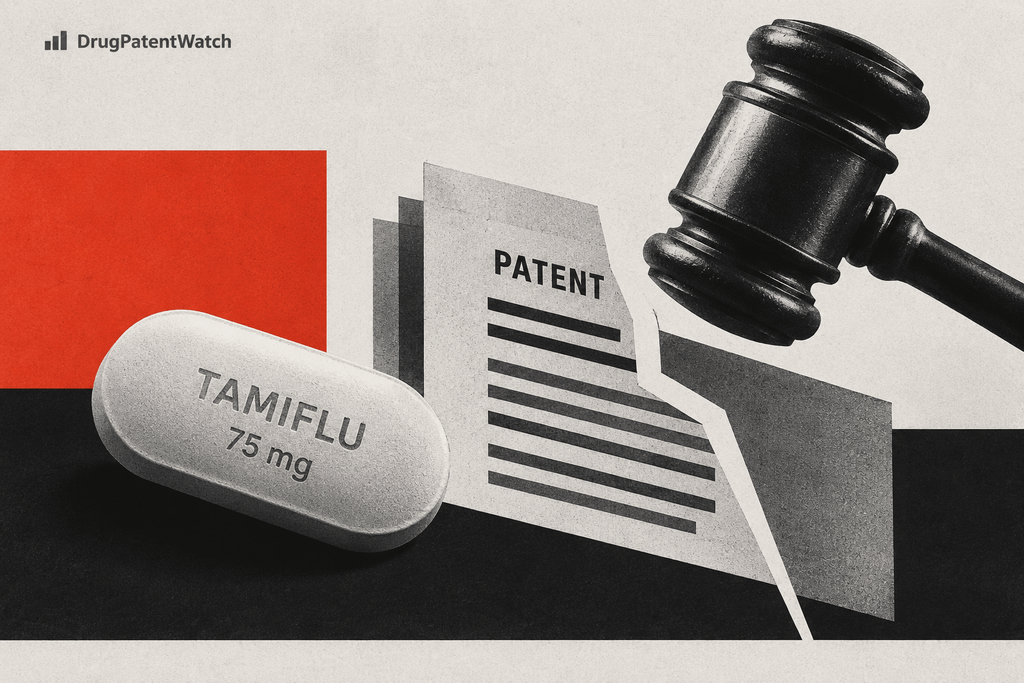
On April 22, 2014, the Federal Circuit vacated a patent infringement judgment that Gilead Sciences had already won. The drug was Tamiflu (oseltamivir phosphate), a flu antiviral that had generated more than $3 billion in worldwide sales during the 2009 H1N1 pandemic alone [19][20]. The reason for the reversal was not that Gilead’s patent was invalid. It was that Gilead owned a second patent, covering a similar invention, that expired 22 months earlier — and the court held that patent could be used to kill the first one [1].
The case, Gilead Sciences, Inc. v. Natco Pharma Ltd., became the foundational modern precedent on obviousness-type double patenting (ODP), a 19th-century judge-made doctrine that most pharmaceutical patent teams had treated as a drafting footnote. Eleven years and three major Federal Circuit decisions later, it is one of the more consequential rules in pharmaceutical patent-family strategy. DrugPatentWatch’s Orange Book and litigation datasets track the resulting patent challenges across drug categories, and the record left by Gilead, In re Cellect, and Allergan USA, Inc. v. MSN Laboratories now gives brand and generic teams an unusually clear map of where ODP risk concentrates and where it does not.
The Short Answer
Obviousness-type double patenting bars a patentee from using a second, patentably indistinct patent to extend exclusivity past the expiration of the first. Eight findings from the record:
In Gilead v. Natco, the Federal Circuit held on April 22, 2014 that a later-issued but earlier-expiring patent (U.S. Patent No. 5,952,375, expiring February 27, 2015) could serve as an ODP reference against an earlier-issued but later-expiring patent (U.S. Patent No. 5,763,483, expiring December 27, 2016), reversing the district court [1].
The disputed exclusivity window was 22 months — the exact gap between the two patents’ expiration dates, and roughly 9% of the ‘483 patent’s full 20-year term [1].
Gilead never disclosed either patent application’s existence to the examiner handling the other, and filed no terminal disclaimer for the later-expiring ‘483 patent [1].
The underlying obviousness question was never finally adjudicated. Gilead, Roche, and Genentech settled with Natco and Alvogen in December 2015, and the FDA approved the first generic Tamiflu on August 3, 2016 — about five months before the ‘483 patent’s pediatric-exclusivity-adjusted Orange Book date of February 23, 2017 [2][8].
Nine years later, In re Cellect (Fed. Cir. Aug. 28, 2023) extended the same expiration-date logic to patent term adjustment (PTA), holding that PTA-extended claims can be invalidated by earlier-expiring same-family patents [12][13].
In 2024, Allergan USA, Inc. v. MSN Laboratories (Fed. Cir. Aug. 13, 2024) carved out a limit: a first-filed, first-issued, later-expiring patent claim cannot be invalidated by a later-filed, later-issued, earlier-expiring patent sharing the same priority date [14][15].
Acadia Pharmaceuticals used that safe harbor to defend Nuplazid’s (pimavanserin) composition-of-matter patent, affirmed by the Federal Circuit in June 2025, protecting the drug into 2030 and its formulation patents into 2037-2038 [16][64].
Tamiflu’s original compound patent, U.S. Patent No. 4,732,970, had already expired on August 31, 2002 (with pediatric exclusivity to early 2003) — meaning the ‘483 and ‘375 patents at issue in Gilead v. Natco extended Orange Book protection roughly 14 years past the base compound patent through a continuation-family strategy [11].
What Obviousness-Type Double Patenting Actually Prohibits
The One-Patent-Per-Invention Bargain
ODP rests on a principle the Federal Circuit traced back to an 1819 opinion by Justice Story: a patentee cannot obtain sequential patents covering the same invention or its obvious variants, because doing so would let the patentee control the invention long after the public was supposed to be free to use it [1]. The doctrine is judge-made, not statutory — it exists to enforce the “quid pro quo” of the patent bargain, not to punish deliberate gamesmanship. Gilead’s continuation strategy in the Tamiflu case was never found to be bad-faith; the Federal Circuit majority applied ODP as a structural rule regardless of intent [1].
How the Uruguay Round Agreements Act Created a New Kind of ODP Problem
Before 1995, U.S. patents ran 17 years from the date of issuance, so issuance order and expiration order were the same thing — a later-issued patent always expired later. The Uruguay Round Agreements Act (URAA) changed patent term to 20 years from the earliest effective filing date, effective June 8, 1995 [1]. That decoupled issuance date from expiration date. A patent that issues first can now expire after a patent that issues later, if the second patent claims an earlier priority date and moves through prosecution faster. Gilead v. Natco was the Federal Circuit’s first squarely-presented case testing which date — issuance or expiration — should govern an ODP analysis under this new regime [1][4].
Terminal Disclaimers: The Statutory Fix
Congress gave patentees an escape valve in 1952: under 35 U.S.C. § 253, a patentee can file a terminal disclaimer, cutting the term of a later patent to align with an earlier one, which cures an ODP problem by collapsing two patents into a single effective exclusivity period [1]. The catch, as later cases would show, is that a disclaimer filed after a patent has already issued can forfeit term the patentee otherwise would have kept — and once the earlier-expiring reference patent has already expired, a disclaimer can no longer save the later one at all [46][47].
Inside Gilead v. Natco: The Case That Redefined the Doctrine
Two Patents, One Flu Drug, Different Expiration Dates
Gilead owned two patents covering antiviral compounds and methods related to oseltamivir phosphate, marketed by Roche as Tamiflu: U.S. Patent No. 5,763,483 (the “‘483 patent”) and U.S. Patent No. 5,952,375 (the “‘375 patent”) [1]. Both listed the same inventors and had substantially similar written descriptions, but Gilead filed them as separate patent “chains” that did not share a priority claim and were never examined together [1]. The table below reproduces the dates from the Federal Circuit’s opinion.
Patent
Application filed
Priority claim
Issued
Expires
Family
‘375 patent (5,952,375)
Feb. 26, 1996
Utility application filed Feb. 27, 1995
Sept. 14, 1999
Feb. 27, 2015
The ‘245 CIP family
‘483 patent (5,763,483)
Dec. 27, 1996
Provisional application filed Dec. 29, 1995
June 9, 1998
Dec. 27, 2016
Separate “chain,” not the ‘245 family
Source: Gilead Sciences, Inc. v. Natco Pharma Ltd., 753 F.3d 1208, 1210-11 (Fed. Cir. 2014) [1].
Notably, the ‘483 patent — filed later — issued first and expired last, a sequence that was routine before the URAA but became legally significant after it [1]. After the ‘483 patent issued, Gilead filed a terminal disclaimer on the ‘375 application, but only to disclaim any ‘375 term beyond the ‘483 expiration date — a disclaimer that turned out to be moot, since the ‘375 patent already expired first. According to the court’s review of the prosecution history, this disclaimer filing was the first point at which Gilead told either patent examiner that the other application existed. No terminal disclaimer was ever filed for the ‘483 patent [1].
Timeline of the Litigation
Date
Event
Feb. 2, 2011
Natco notifies Gilead of ANDA No. 202-595, with a Paragraph IV certification against the ‘483 patent [1][15 via 4].
Mar. 15, 2011
Gilead, Roche, and Genentech sue Natco for infringement of the ‘483 patent in the District of New Jersey [1].
Dec. 2012
District Court grants summary judgment for Gilead, holding a later-issued, earlier-expiring patent cannot be an ODP reference against an earlier-issued, later-expiring one [1][3].
Apr. 22, 2014
Federal Circuit (Chen, joined by Prost; Rader dissenting) vacates and remands, holding expiration date — not issuance date — controls [1].
2015
Gilead petitions for certiorari; the U.S. Supreme Court denies review [6].
Dec. 2015
Gilead, Roche, and Genentech settle with Natco and Alvogen [8].
Aug. 3, 2016
FDA approves ANDA 202-595, the first generic Tamiflu, and notes the underlying litigation has been dismissed [2].
What the Federal Circuit Held
Writing for the majority, Judge Chen framed the question narrowly: can a patent that issues after, but expires before, another commonly-owned patent serve as an ODP reference against it [1]? The court answered yes, reasoning that the core harm ODP is meant to prevent — the public being blocked from practicing an invention and its obvious variants after a patent covering them expires — turns on expiration date, not issuance date [1]. The opinion also flagged a gamesmanship concern: if issuance date controlled, a patentee could routinely engineer extra exclusivity by filing serial obvious variants under different priority claims and timing which one issues first [1].
“the public is free to use … obvious or patentably indistinct modifications” of an invention once the patent covering it expires — Gilead Sciences, Inc. v. Natco Pharma Ltd., 753 F.3d 1208, 1211-12 (Fed. Cir. 2014) [1].
Because the district court had never reached the underlying obviousness question — whether the ‘483 patent’s claims were, in fact, obvious variants of the ‘375 patent’s claims — the Federal Circuit assumed obviousness only for purposes of the appeal and remanded for that determination [1].
Chief Judge Rader’s Dissent
Chief Judge Rader dissented, arguing the majority had expanded ODP beyond its two recognized justifications: preventing improper term extension, and preventing harassment by multiple assignees asserting patentably indistinct patents [1]. Neither concern applied cleanly here, Rader wrote, because Gilead had actually given up roughly ten months of priority by filing the ‘483 patent as a separate chain rather than claiming the ‘375 family’s earlier priority date, and because the ‘375 patent’s terminal disclaimer already tied the two patents to common ownership, eliminating the harassment risk [1]. Rader also warned that the ruling could create unpredictable interactions with the America Invents Act’s new first-inventor-to-file regime [1].
What Happened After the Reversal: A Settlement, Not a Verdict
The FDA’s Role: Paragraph IV, the 45-Day Clock, and 180-Day Exclusivity
Natco’s Paragraph IV certification asserted the ‘483 patent was invalid, unenforceable, or would not be infringed. Under the Hatch-Waxman Act, that certification gave Gilead 45 days to sue or lose the right to an automatic stay of FDA approval; Gilead sued within that window [1][2]. Because Natco was the first ANDA applicant to submit a substantially complete Paragraph IV filing for oseltamivir phosphate capsules, it qualified for 180 days of generic marketing exclusivity once approved — a fact the FDA confirmed in its 2016 approval letter [2].
The December 2015 Settlement
After the Federal Circuit’s remand, the case did not proceed to a merits trial on obviousness. In December 2015, Natco and Alvogen settled the patent litigation with Gilead, Hoffmann-La Roche, F. Hoffmann-La Roche, and Genentech, under terms allowing Alvogen to market generic oseltamivir phosphate capsules before the February 23, 2017 expiration of the ‘483 patent’s pediatric exclusivity [8]. The settlement means the ‘483 patent’s validity under ODP was never conclusively decided by a court — a distinction that matters for anyone citing this case as an ODP “loss” for Gilead. It was a reversal on the legal standard, not a final invalidity ruling on the merits [1][8].
First Generic Approval, August 2016
The FDA approved Natco’s ANDA on August 3, 2016, confirming bioequivalence to Roche’s Tamiflu capsules and noting that the underlying infringement litigation had been dismissed [2]. Roche’s own mid-year 2016 disclosures show Tamiflu generated 410 million Swiss francs (about $421 million) in the first half of 2016 alone, down 18% year-over-year on a weak flu season, but still the company’s top-selling infectious-disease product at the time generic competition arrived [5].
Original Analysis: Quantifying What the Ruling Actually Cost
The 22-Month Gap in Context
The Federal Circuit’s opinion states the gap directly: the ‘375 patent expired February 27, 2015, and the ‘483 patent was not set to expire until December 27, 2016 — 22 months later [1]. Measured against the ‘483 patent’s full 20-year term (December 27, 1996 to December 27, 2016, 240 months), the disputed period represents approximately 9.2% of the patent’s entire statutory life. That is a modest fraction of the total term, but because it fell at the tail end of exclusivity — the highest-value period for a still-selling brand product — its commercial significance was larger than the percentage alone suggests.
What the Settlement Actually Delivered vs. What Full Invalidation Could Have Delivered
This is a finding DrugPatentWatch’s litigation-outcome data helps put in perspective: the theoretical maximum exposure from the Federal Circuit’s ruling was the full 22 months, running from the ‘375 patent’s February 2015 expiration to the ‘483 patent’s original December 2016 (or pediatric-adjusted February 2017) date. If Natco had ultimately won a full obviousness verdict on remand, generic entry could plausibly have arrived as early as early-to-mid 2015. Instead, first generic approval landed August 3, 2016 — roughly 19 months after the ‘375 patent expired, and about 5 months before the ‘483 patent’s unextended December 2016 date, or about 6.7 months before its pediatric-adjusted February 2017 date [1][2][8]. In other words, the settlement Natco and Gilead reached delivered generic entry closer to the ‘483 patent’s original schedule than to the earliest date the ODP theory could have supported. This is calculated from primary-source dates in the case record, not an independently reported industry figure, and it illustrates a pattern generic challengers should weigh: winning the legal standard on appeal is not the same as winning the case on the merits, and settlement economics can moot much of a theoretical ODP exposure window.
A Four-Category Taxonomy of ODP Exposure in Pharma Patent Families
Comparing Gilead, Cellect, Allergan, and Acadia side by side suggests an original, four-part way to classify which patent-family structures carry meaningful ODP risk today. This is DrugPatentWatch-style analysis built from the four cases discussed in this article, not an established USPTO or court classification.
Category 1: Same-Family Continuations With PTA Mismatches
Patents sharing one priority claim, where individual family members accrue different amounts of patent term adjustment due to prosecution delay. This is the fact pattern in In re Cellect, where four Samsung-litigated patents would have expired on the same day but for differing PTA grants [47].
Category 2: Parallel “Chain” Families With Independent Priority Claims
Two or more patent families from the same inventors, covering related subject matter, that do not claim priority to each other and were prosecuted separately. This is the Gilead pattern — the ‘483 and ‘375 patents were never before the same examiner [1]. It is also the riskiest category, because nothing in prosecution forces an ODP rejection to surface before issuance.
Category 3: First-Filed, First-Issued Patents (the Allergan Safe Harbor)
A patent that was filed first, issued first, and expires later only because of its own PTA — not because a later-filed sibling was manipulated to expire earlier. Allergan v. MSN held this configuration cannot be invalidated by later-filed, later-issued, earlier-expiring family members sharing the same priority date [14][15].
Category 4: Cross-Owned Patents After Licensing or M&A
Patents that end up commonly owned only after an acquisition, spin-off, or license assignment, raising the separate historical justification for ODP — preventing multiple owners from asserting patentably indistinct claims against the same accused product [1]. This category was central to older pre-URAA case law and remains relevant whenever deal structuring separates and later reunites related patent rights.
The Doctrine Keeps Expanding: In re Cellect Brings Patent Term Adjustment Into Play
What Cellect Held
In re Cellect, LLC (Fed. Cir. Aug. 28, 2023) addressed a question Gilead left open: what happens when a later-expiring patent’s extra term comes not from a separate priority claim, but from patent term adjustment awarded for USPTO prosecution delay under 35 U.S.C. § 154(b) [12][13]? Cellect’s four challenged patents all claimed priority to the same October 1997 application and would have expired on the same day but for differing individual PTA grants [47]. The Federal Circuit held that ODP must be evaluated using each patent’s expiration date after PTA is added, meaning a patent that only outlives its siblings because of a larger PTA award can still be invalidated by an earlier-expiring sibling [13][40]. Because the earlier-expiring reference patents in Cellect’s family had already expired by the time of the appeal, a curative terminal disclaimer was no longer available, and the Federal Circuit affirmed invalidation [47].
Why Cellect Matters Beyond Consumer Electronics
Cellect involved image-sensor patents asserted against Samsung, not a pharmaceutical product, but the rule it announced reaches directly into pharma patent-family practice: the same PTA-driven expiration mismatches that occurred in Cellect’s family are common in FDA-regulated drug patents, where prosecution delays are routine and PTA awards can run into hundreds or thousands of days [39][12]. Cellect also confirmed an important asymmetry that distinguishes PTA from patent term extension (PTE) granted under 35 U.S.C. § 156 for FDA regulatory review delay: courts apply ODP scrutiny to PTA before term is finalized, but PTE — which pharma companies rely on far more heavily than PTA for late-stage exclusivity — is added only after the ODP analysis is complete, and is not stripped away by a terminal disclaimer the way PTA is [44][41].
The Correction: Allergan v. MSN Laboratories Draws a New Line
The Viberzi Patent Family and the First-Filed, First-Issued Rule
Allergan’s U.S. Patent No. 7,741,356 covers eluxadoline, the active ingredient in Viberzi, an irritable-bowel-syndrome drug [51][54]. The ‘356 patent — the first-filed application to claim the eluxadoline compound — accrued 1,107 days of PTA from USPTO delay; Allergan later disclaimed all but 467 of those days in order to secure patent term extension for FDA review delay instead [54]. Allergan subsequently obtained later-filed continuation patents claiming the same priority date that did not receive PTA and therefore expired earlier [51][53]. When Sun Pharmaceutical and MSN Laboratories filed an ANDA for generic Viberzi, the District of Delaware invalidated the ‘356 patent’s asserted claim under ODP, applying Cellect [52]. The Federal Circuit reversed on August 13, 2024, holding that a first-filed, first-issued, later-expiring patent claim cannot be invalidated for ODP by a later-filed, later-issued, earlier-expiring patent claim sharing a common priority date [14][51]. The court distinguished this configuration from Gilead and Cellect, both of which involved patents whose later expiration came from something other than simply being filed and examined first [51].
Acadia v. Aurobindo: The Safe Harbor Applied to Nuplazid
Acadia Pharmaceuticals’ U.S. Patent No. 7,601,740, covering the composition of matter for pimavanserin (Nuplazid, a Parkinson’s disease psychosis treatment), issued October 13, 2009 from an application filed January 15, 2004, and received 980 days of PTA plus a separate 1,315-day patent term extension for FDA delay [63]. Generic challengers led by MSN Laboratories argued a later-filed, earlier-expiring sibling patent — U.S. Patent No. 9,566,271 — rendered the ‘740 patent’s claim invalid under ODP [63]. The District of Delaware rejected that argument in December 2023, and a Federal Circuit panel affirmed on June 9, 2025, expressly applying Allergan‘s first-filed, first-issued rule [16][58]. The ruling protects Nuplazid’s composition-of-matter patent into 2030, with related formulation patents covering the drug’s two marketed dosage forms into 2037 and 2038 [58][64]. MSN sought en banc rehearing; as of the August 2025 Patently-O analysis of the petition, the panel decision stood as the operative precedent [59][18].
Four Cases, Four Outcomes: Comparing the Post-Gilead Double Patenting Record
Case
Product / Field
Decision date
Fact pattern
Outcome for patent holder
Gilead v. Natco [1]
Tamiflu (oseltamivir phosphate)
Apr. 22, 2014 (Fed. Cir.); settled Dec. 2015
Separate patent “chains,” no shared priority claim, no cross-disclosure to examiners
Reversed on the legal standard; case settled before a merits obviousness ruling
In re Cellect [13][47]
CMOS image sensors (non-pharma)
Aug. 28, 2023 (Fed. Cir.)
Same-family continuations, mismatched PTA grants, common priority date
Invalidated; too late to file curative terminal disclaimers
Allergan v. MSN [14][51]
Viberzi (eluxadoline)
Aug. 13, 2024 (Fed. Cir.)
First-filed, first-issued parent patent with PTA vs. later-filed, earlier-expiring children sharing priority date
Reversed district court invalidation; patent upheld
Acadia v. Aurobindo [16][58]
Nuplazid (pimavanserin)
June 9, 2025 (Fed. Cir.)
First-filed, first-issued composition-of-matter patent with PTA and PTE vs. later-filed sibling
Affirmed as valid, applying the Allergan safe harbor
Read together, the four cases show the doctrine moving in a specific direction: Gilead and Cellect expanded ODP’s reach to expiration-date mismatches the pre-URAA doctrine never anticipated, while Allergan and Acadia pulled back by protecting patentees who filed and prosecuted their core patent first, even when that patent later outlived same-family siblings because of PTA. The distinguishing fact across all four cases is not company size or drug class — it is whether the challenged patent was the first-filed, first-issued member of its family, and whether its later-expiring status came from its own earned PTA or from a separately engineered priority chain.
What This Means for Brand Manufacturers Building Patent Families Today
The Cross-Referencing Problem Gilead Created
Common Examiners vs. Separate Prosecution Tracks
The Federal Circuit noted that the ‘483 and ‘375 patents were prosecuted separately and were never before the same examiner, which meant no ODP rejection was ever raised during prosecution — the conflict surfaced only in litigation, nine years after Tamiflu’s approval [1]. Filing related applications so that a common examiner (or an examiner aware of the co-pending family) can identify a potential ODP issue during prosecution gives a patentee the chance to resolve it with a timely terminal disclaimer, before an earlier-expiring reference patent has already expired and the cure is no longer available [47].
What the MPEP Instructs Examiners to Do
The Federal Circuit in Gilead pointed to the Manual of Patent Examining Procedure’s own guidance: where two co-pending applications from the same inventor would provisionally reject each other for ODP, the MPEP instructs that a terminal disclaimer is required for whichever application is expected to have the later expiration date before it can issue [1]. Applied retroactively to Gilead’s own facts, the court noted, that guidance would have required a terminal disclaimer on the ‘483 patent [1].
PTA vs. PTE: Why the Distinction Changes Filing Strategy
Because Cellect subjects PTA to ODP scrutiny before it is finalized, while PTE from FDA review delay is added only after the ODP analysis and survives a terminal disclaimer, patentees weighing whether to pursue PTA or PTE on a given patent — or how much PTA to disclaim in order to preserve PTE, as Allergan did with the ‘356 patent’s 1,107 disclaimed-to-467 days — now have a doctrinal reason to prefer PTE-eligible exclusivity where a choice exists [44][54][41].
When a Terminal Disclaimer Costs More Than It Saves
A terminal disclaimer cures an ODP problem by collapsing two patents’ expiration dates together, but Cellect confirmed that a disclaimer filed on a PTA-extended patent forfeits the disclaimed portion of that adjustment permanently — even the portion attributable to pure USPTO delay that the patentee did nothing to cause [41][47]. That makes the timing of a voluntary disclaimer, filed proactively during prosecution, materially less costly than a disclaimer forced by litigation after a reference patent has already expired, when no disclaimer can help at all [47].
What This Means for Generic and Biosimilar Challengers
How to Read a Continuation Family in the Orange Book
An Orange Book listing rarely shows whether two patents on the same drug share a priority claim — that information sits in the patents’ own front pages and prosecution histories, not the FDA’s public listing [1]. Reconstructing the actual family relationships behind a brand’s listed patents, the way DrugPatentWatch’s patent-family datasets are built to do, is the necessary first step before an ODP theory can even be evaluated, because the same-family-versus-parallel-chain distinction is what separated the outcomes in Allergan/Acadia from Gilead/Cellect [51][1].
Four Questions to Ask Before Filing a Paragraph IV Certification
Do the Patents Share a Priority Claim?
If the challenged patent and the proposed reference patent do not share a priority claim — Gilead’s fact pattern — the Allergan safe harbor does not apply, and the broader Gilead/Cellect expiration-date rule controls [1][51].
Which Patent Has the Earlier Expiration Date?
Under Gilead, expiration date — not issuance date or filing date — is the benchmark for identifying which patent can serve as the ODP reference [1].
Was a Terminal Disclaimer Filed, and When?
A disclaimer filed early, before the reference patent expires, can moot an ODP challenge entirely; one filed too late, or never filed, is what made the patents vulnerable in both Gilead and Cellect [1][47].
Is the PTA or PTE Difference Large Enough to Matter?
Where the gap between family members’ expiration dates traces to PTA on an otherwise first-filed, first-issued patent, Allergan and Acadia suggest the challenge is unlikely to succeed; where it traces to a separately engineered priority chain, as in Gilead, or to PTA differences within a shared-priority family, as in Cellect, the challenge has stronger doctrinal footing [14][13].
Methodology
This analysis is built from primary sources: the Federal Circuit’s opinion in Gilead Sciences, Inc. v. Natco Pharma Ltd., 753 F.3d 1208 (Fed. Cir. 2014), read directly from the court’s published PDF; the FDA’s August 3, 2016 ANDA approval letter; Gilead’s SEC filings; and law-firm case summaries of In re Cellect, Allergan v. MSN Laboratories, and Acadia v. Aurobindo that quote directly from those opinions [1][2][12][13][14][15][16][17]. Calculated figures — the 22-month gap as a percentage of the ‘483 patent’s full term, and the gap between actual generic entry and the theoretical earliest ODP-driven entry date — were derived from the dates stated in the Federal Circuit’s opinion and the FDA approval letter, and are labeled as analysis rather than reported statistics. The case selection covers the Federal Circuit’s major precedential ODP decisions that either involve a pharmaceutical product directly or, in Cellect’s case, established a rule the Federal Circuit itself later applied to pharmaceutical patents in Allergan and Acadia. This is not an exhaustive survey of every ODP ruling since 2014; district court decisions not reviewed by the Federal Circuit, and non-precedential rulings, are outside its scope. Sales and royalty figures for Tamiflu are drawn from Roche and Gilead’s own public disclosures and are not independently audited by this publication.
Key Takeaways
Expiration date, not issuance date, has controlled obviousness-type double patenting analysis since Gilead v. Natco (2014), a direct consequence of the URAA’s 1995 shift to 20-year-from-filing patent terms [1].
The Federal Circuit never finally ruled that Gilead’s ‘483 patent was obvious; the case settled in December 2015 before a merits trial, and the first generic Tamiflu reached the market on August 3, 2016 [1][2][8].
In re Cellect (2023) extended the same expiration-date benchmark to patent term adjustment, exposing same-family patents with mismatched PTA to ODP risk [13].
Allergan v. MSN Laboratories (2024) and Acadia v. Aurobindo (2025) limited that exposure: a first-filed, first-issued patent that outlives siblings only because of its own PTA is not a proper ODP target [14][16].
Whether a patent family shares a single priority claim, and which member was filed and issued first, now matters more to ODP outcomes than which patent has the later expiration date alone.
Frequently Asked Questions About Double Patenting in Pharma
What is obviousness-type double patenting (ODP)? ODP is a judge-made patent doctrine barring a patentee from using a second patent, claiming an obvious variant of an already-patented invention, to extend exclusivity beyond the first patent’s expiration [1].
How is ODP different from an obviousness rejection under 35 U.S.C. § 103? Section 103 obviousness compares a claim to prior art available to the public. ODP compares a claim only to the patentee’s own commonly-owned or commonly-invented patents, regardless of whether those patents count as prior art [1].
Can a terminal disclaimer always fix an ODP problem? No. A terminal disclaimer filed before the reference patent expires can align expiration dates and cure the problem, but once the earlier-expiring reference patent has already expired, a disclaimer on the later patent can no longer save it, as In re Cellect confirmed [47].
Does ODP treat patent term adjustment (PTA) and patent term extension (PTE) the same way? No. In re Cellect held that PTA is folded into the expiration date before the ODP analysis and can be stripped by a terminal disclaimer; PTE granted under 35 U.S.C. § 156 for FDA review delay is added only after the ODP analysis and survives a disclaimer [44][41].
What is the “safe harbor” from Allergan v. MSN Laboratories? A first-filed, first-issued, later-expiring patent claim cannot be invalidated for ODP by a later-filed, later-issued, earlier-expiring patent claim that shares the same priority date [14].
Why did Gilead never file a terminal disclaimer on the ‘483 patent? The Federal Circuit’s opinion does not give a stated reason; the record shows only that Gilead disclaimed ‘375 patent term beyond the ‘483 expiration date, and never disclosed either application’s existence to the other patent’s examiner until that disclaimer was filed [1].
Did Natco ultimately prove the ‘483 patent was obvious? No court ever reached a final ruling on that question. Gilead, Roche, and Genentech settled with Natco and Alvogen in December 2015 while the case was on remand [1][8].
What happened to Tamiflu’s original compound patent? U.S. Patent No. 4,732,970, covering the oseltamivir compound itself, expired August 31, 2002, with pediatric exclusivity extending protection into early 2003 — well before the ‘483 and ‘375 patents at issue in Gilead v. Natco expired [11].
How can generic or biosimilar developers identify ODP-vulnerable patent families? Check whether the patents at issue share a priority claim, compare their expiration dates rather than issuance dates, and determine whether any terminal disclaimer was filed and when — the factors that distinguished the outcomes in Gilead, Cellect, Allergan, and Acadia [1][47][14].
Is ODP a statutory doctrine or a court-created one? It is judicially created, tracing back over a century, though Congress’s 1952 addition of the terminal disclaimer provision in 35 U.S.C. § 253 gave patentees a statutory way to cure an ODP problem [1].
References
Gilead Sciences, Inc. v. Natco Pharma Ltd., 753 F.3d 1208 (Fed. Cir. 2014). U.S. Court of Appeals for the Federal Circuit. https://www.cafc.uscourts.gov/opinions-orders/13-1418.opinion.4-18-2014.1.pdf
U.S. Food and Drug Administration. (2016, August 3). ANDA 202595 Approval Letter. https://www.accessdata.fda.gov/drugsatfda_docs/appletter/2016/202595Orig1s000ltr.pdf
Gibbons Law Alert. (2012, December 27). DNJ Rejects Double-Patenting Claim. https://www.gibbonslawalert.com/2012/12/27/dnj-rejects-double-patenting-claim/
Robins Kaplan LLP. Gilead Sciences, Inc. v. Natco Pharma Ltd. (Fed. Cir.). https://www.robinskaplan.com/newsroom/insights/gilead-sciences-inc-v-natco-pharma-ltd-fed-cir
Pharmaceutical Technology. FDA Approves First Generic Version of Tamiflu. https://www.pharmtech.com/view/fda-approves-first-generic-version-tamiflu
FiercePharma. (2015, March). India’s Natco wins again with U.S. challenge to Tamiflu generic. https://www.fiercepharma.com/m-a/india-s-natco-wins-again-u-s-challenge-to-tamiflu-generic
Alvogen. Federal Circuit Agrees with Natco on Generic Tamiflu Patent. https://www.alvogen.com/newsroom/federal-circuit-agrees-with-natco-on-generic-tamiflu
Business Standard. (2016, August 4). Natco Pharma gains after receiving final approval for Tamiflu generic. https://www.business-standard.com/article/news-cm/natco-pharma-gains-after-receiving-final-approval-for-tamiflu-generic-116080400250_1.html
Gilead Sciences, Inc. (2005, June 23). Gilead Delivers Termination Notice to Roche for Tamiflu Development and Licensing Agreement [Press release]. https://www.gilead.com/news/news-details/2005/gilead-delivers-termination-notice-to-roche-for-tamiflu-development-and-licensing-agreement
Hoffmann-La Roche Inc. and Gilead Sciences, Inc. (1999, October 27). Roche Receives FDA Approval of Tamiflu [Press release]. https://www.gilead.com/news/news-details/1999/roche-receives-fda-approval-of-tamiflu-first-pill-to-treat-the-most-common-strains-of-influenza-ab
DrugPatentWatch. TAMIFLU Historic Drug Sales. https://www.drugpatentwatch.com/p/drug-sales/drugname/TAMIFLU
Norton Rose Fulbright. Obviousness-type double patenting, terminal disclaimers and best IP practices. https://www.nortonrosefulbright.com/en-us/knowledge/publications/376a1470/obviousness-type-double-patenting-terminal-disclaimers-and-best-ip-practices
DLA Piper. (2023, September). In re Cellect: Patent term adjustments cut short by obviousness-type double patenting. https://www.dlapiper.com/en/insights/publications/2023/09/in-re-cellect-patent-term-adjustments-cut-short-by-obviousness-type-double-patenting
White & Case LLP. Federal Circuit Limits the Application of Obviousness-Type Double Patenting for Patents in the Same Family. https://www.whitecase.com/insight-alert/federal-circuit-limits-application-obviousness-type-double-patenting-patents-same
Gibson Dunn. Federal Circuit Decision in Allergan v. MSN. https://www.gibsondunn.com/federal-circuit-decision-in-allergan-v-msn/
Acadia Pharmaceuticals Inc. (2025, June 9). U.S. Court of Appeals for the Federal Circuit Affirms Prior Delaware District Court Rulings in Favor of Acadia in NUPLAZID (pimavanserin) Composition of Matter Patent [Press release]. https://ir.acadia.com/news-releases/news-release-details/us-court-appeals-federal-circuit-affirms-prior-delaware-district
Robins Kaplan LLP. Acadia Pharms. Inc. v. Aurobindo Pharma Ltd. https://www.robinskaplan.com/newsroom/insights/acadia-pharms-v-aurobindo-pharma
FiercePharma. (2015, January). Roche and GSK set for sales growth in this year’s fast-spreading flu epidemic. https://www.fiercepharma.com/sales-and-marketing/roche-and-gsk-set-for-sales-growth-year-s-fast-spreading-flu-epidemic
BioPharma Dive. (2018, October). Roche’s flu drug strongly beat placebo. But could one data miss be critical? https://www.biopharmadive.com/news/roches-flu-drug-strongly-beat-placebo-but-could-one-data-miss-be-critical/538890/
Gilead Sciences Inc. (2009). Form 10-Q, Quarter Ended June 30, 2009. U.S. Securities and Exchange Commission EDGAR. https://www.sec.gov/Archives/edgar/data/0000882095/000119312509165506/d10q.htm
Gilead Sciences Inc. (2013). Form 10-K, Fiscal Year 2012. U.S. Securities and Exchange Commission EDGAR. https://www.sec.gov/Archives/edgar/data/0000882095/000088209513000015/a2012form10-k.htm
DrugPatentWatch. ACADIA Pharmaceuticals Inc. v. Aurobindo Pharma Limited drug patent litigation. https://www.drugpatentwatch.com/p/litigation/casename/ACADIA+Pharmaceuticals+Inc.+v.+Aurobindo+Pharma+Limited%7C1:20-cv-00985