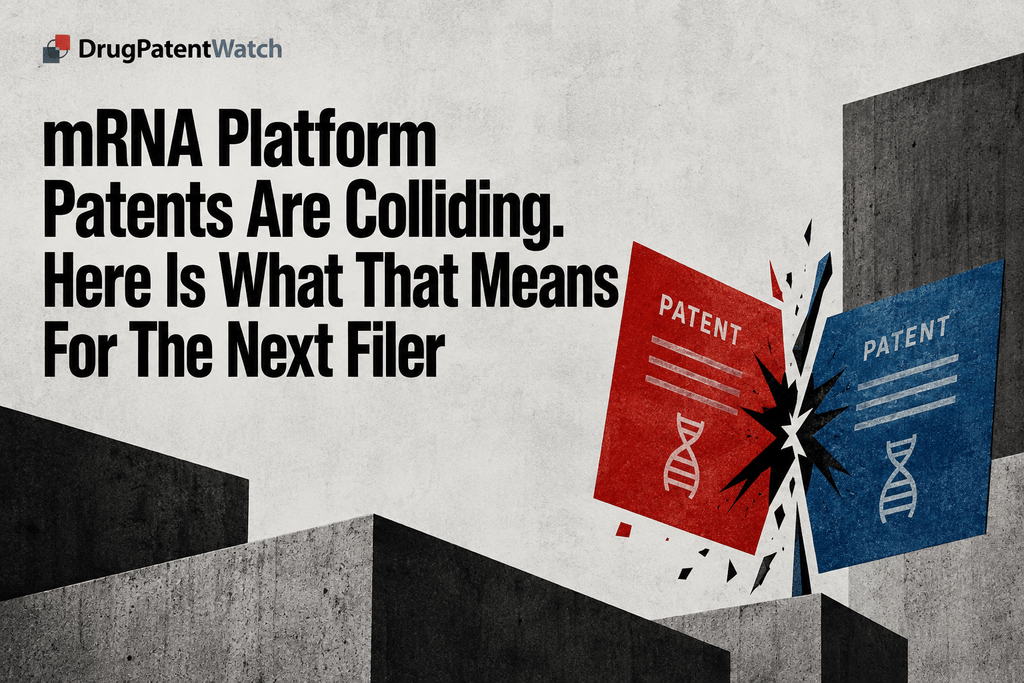
Nine separate patent holders have asserted rights against a single COVID-19 vaccine, Comirnaty, since August 2022. Two more have asserted rights against Moderna’s Spikevax and its successor shots. In March 2026, one of those disputes closed with a $2.25 billion settlement, the largest disclosed patent settlement in the pharmaceutical industry and the second largest in any industry.[1] None of this counts the newest filing, from Sanofi, which arrived in July 2026 asserting ten more patents.[2]
The mRNA platform did not have one patent problem. It had at least nine, filed across four decades, by inventors who had never worked together, protecting inventions that only became infringing in combination. Understanding why requires taking the vaccine apart.
The Short Answer
An mRNA vaccine is not one invention. It is a payload (the modified messenger RNA sequence), a delivery vehicle (the lipid nanoparticle, or LNP, that protects and transports it), and a manufacturing process (the codon and sequence optimizations that make the RNA stable and translatable). Each layer was patented separately, often decades before COVID-19 existed, by different companies and universities with no commercial relationship to each other. When Comirnaty and Spikevax combined all three layers into a single injectable product, they combined the patent risk of all three layers too. Since 2022, at least eleven distinct patent-holding parties, including a crop-science subsidiary of Bayer and two research universities, have filed claims asserting that combination infringes their rights.[3][4] DrugPatentWatch’s litigation tracking shows the docket has not slowed as COVID vaccine revenue has fallen. It has grown.
Why “mRNA Platform Patents” Means At Least Nine Separate Inventions
Patent lawyers who work in this space describe the vaccine as a stack. Pull out any one layer and the whole product stops working. Each layer, though, has its own inventors, its own filing dates, and its own courtroom.
The Payload Layer: Modified Nucleosides
Unmodified synthetic mRNA triggers a person’s innate immune system before it can do its job. In 2005, University of Pennsylvania researchers Katalin Karikó and Drew Weissman found that swapping the nucleoside uridine for a modified version called pseudouridine avoided that reaction without hurting protein production.[5] The discovery won them the 2023 Nobel Prize in Physiology or Medicine.[6]
US Patent 8,278,036 and the Cellscript Sublicenses
UPenn’s resulting patent, US 8,278,036, was filed in 2006 and issued in 2012, with claims broad enough to cover any mammalian cell producing a protein of interest from modified RNA.[5] UPenn licensed the technology to a company called Cellscript, which granted non-exclusive worldwide sublicenses to Moderna in June 2017 and to BioNTech in July 2017.[7] Both companies built their COVID-19 vaccines on that foundation, and both also patented their own variations. Moderna’s version, European Patent 3,590,949 (known in the litigation as “EP’949”), claims an mRNA in which 100 percent of the uracil is replaced with N1-methyl-pseudouridine, a molecule filed after Karikó and Weissman’s original work but distinct enough that Moderna has used it to sue BioNTech directly.[8]
The Delivery Layer: Lipid Nanoparticles
Naked mRNA degrades in seconds inside the body. Lipid nanoparticles, tiny fat bubbles that encapsulate and ferry the RNA into cells, solved that problem, and they came from an entirely different research lineage: decades of work on RNA interference (RNAi) therapeutics that had nothing to do with vaccines.
Arbutus and Genevant’s SM-102 Claims
Arbutus Biopharma and its exclusive licensee, Genevant Sciences (a Roivant Sciences subsidiary), hold a family of LNP patents covering a lipid formulation with an ionizable cationic lipid, a phospholipid, cholesterol, and a PEG-lipid conjugate designed to stop particle aggregation.[9] Moderna’s Spikevax uses an ionizable lipid called SM-102 built on exactly that formula. Arbutus and Genevant sued Moderna in February 2022 asserting US Patents 8,058,069, 8,492,359, 8,822,668, 9,364,435, 9,504,651 and 11,141,378.[9] They sued Pfizer and BioNTech over the same technology in April 2023, asserting 9,504,651, 8,492,359, 11,141,378, 11,298,320 and 11,318,098.[10]
Alnylam’s Biodegradable Cationic Lipids
Alnylam Pharmaceuticals, which built its business on RNAi drugs rather than mRNA vaccines, filed its own LNP suits against both Pfizer and Moderna in March 2022, asserting US Patent 11,246,933 and telling the court it had shared confidential lipid data with Moderna back in 2014 during collaboration talks that never became a deal.[11] Alnylam expanded the case in 2023 with four more patents, 11,590,229, 11,633,479, 11,612,657 and 11,633,480.[12]
Northwestern’s Lipoprotein-Mimicking Particles
In October 2024, Northwestern University sued Moderna, arguing that researchers at its International Institute for Nanotechnology had shown as early as 2009 how to make LNPs mimic naturally occurring lipoproteins so the body would not reject them, work covered by US Patents 9,216,155, 10,328,026 and 8,323,686.[13] Northwestern’s complaint noted that some of Moderna’s own patents cite the university’s earlier work.[14]
The Manufacturing Layer: Codon Optimization and Sequence Engineering
The least obvious layer came from outside pharma altogether.
Bayer’s 1980s Monsanto Patent
US Patent 7,741,118 was developed by Monsanto scientists in the 1980s to help genetically engineered crops produce insect-resistant proteins more efficiently, by reducing the number of polyadenylation signal sequences in a coding gene.[15] Bayer, which acquired Monsanto in 2018, filed suit against Moderna, Pfizer, BioNTech and Johnson & Johnson in January 2026, arguing the same sequence-optimization method was used to stabilize mRNA and improve protein expression in their COVID-19 vaccines.[16] The patent, issued in 2010, expires in June 2027, giving Bayer roughly a nine-month litigation window from the date this article was written.[15]
The Five Findings That Matter
At least eleven distinct patent-holding parties have filed infringement, royalty, or licensing claims against Comirnaty and/or Spikevax since 2022, spanning agricultural biotech, RNAi therapeutics, academic licensing offices, and rival vaccine makers.
The disclosed settlement total across just three resolved disputes (Arbutus/Genevant-Moderna, CureVac/GSK-BioNTech/Pfizer, and UPenn-BioNTech) exceeds $3.5 billion, a DrugChatter calculation based on the figures each party disclosed.[1][17][18]
The same European patent, Moderna’s EP’949, has been ruled valid and infringed in the United Kingdom and by the European Patent Office’s Opposition Division, and ruled invalid by the District Court of The Hague in the Netherlands, a split that remains unresolved as of September 2026.[19][20]
The Patent Trial and Appeal Board invalidated two of Moderna’s three original patents against Pfizer and BioNTech in March 2025, but left the broadest of the three, the ‘574 patent, untouched because no one filed an inter partes review against it.[21]
Remaining patent life across the disputed portfolio ranges from about nine months (Bayer’s codon-optimization patent, expiring June 2027) to five years (Moderna’s EP’949, expiring 2031), meaning the mRNA patent thicket will not fully clear on any single date.[15][22]
A Timeline Of The mRNA Patent Wars, 2020 To 2026
2020 to 2022: Two Pledges And Why They Failed
In October 2020, Moderna pledged that “while the pandemic continues,” it would not enforce its COVID-19 patents against companies making vaccines to fight it.[23] On March 7, 2022, the company narrowed that promise into an Updated Patent Pledge: a permanent commitment not to sue vaccine makers supplying 92 low- and middle-income countries in Gavi’s COVAX Advance Market Commitment, with no equivalent promise for wealthier markets.[24] Less than six months later, Moderna sued.
August 2022: The Month Everyone Sued Everyone
Moderna v. Pfizer/BioNTech: Three Patents, Three Courts
On August 26, 2022, Moderna filed suit in the US District Court for the District of Massachusetts, asserting US Patents 10,898,574, 10,702,600 and 10,933,127, and simultaneously filed parallel infringement actions in the Regional Court of Düsseldorf, Germany, over European patents EP 3,718,565 and EP 3,590,949.[25] Moderna’s CEO Stéphane Bancel said the company was moving to “protect the innovative mRNA technology platform that we pioneered.”[26]
Alnylam v. Pfizer and Moderna: The First LNP Claim
Alnylam filed its first cationic-lipid suits against both companies that same month, kicking off what would become three separate rounds of litigation against each defendant by 2023.[27] CureVac filed against BioNTech in the Düsseldorf Regional Court in July 2022 over four intellectual property rights covering the mRNA payload and formulation, a case that would eventually grow to eight German rights and ten separate US patents.[28][29]
2023 to 2024: The Second Wave
Arbutus and Genevant filed against Pfizer and BioNTech in April 2023.[10] Alnylam expanded its lipid claims twice more.[12] CureVac broadened its German case to eight rights and its US counterclaim to ten patents, including one covering split poly-A tail technology and another covering mRNA purification methods.[30][31]
GSK’s Two Suits Against Moderna
On October 15, 2024, GlaxoSmithKline filed two complaints against Moderna in the District of Delaware: one accusing Spikevax of infringing seven mRNA patents, the other accusing mRESVIA, Moderna’s RSV vaccine, of infringing six patents (three overlapping with the Spikevax case).[32] GSK had already sued Pfizer, Pharmacia & Upjohn and BioNTech over five mRNA patents in April 2024.[32]
Northwestern’s Lipoprotein Complaint
One day after GSK’s Moderna filings, on October 16, 2024, Northwestern University filed its own LNP suit, arguing Moderna “could not have made rapid progress” in vaccine development without appropriating academic breakthroughs it never licensed.[33] Weeks earlier, in August 2024, the University of Pennsylvania sued BioNTech directly, not over infringement but over royalty accounting, alleging BioNTech was underpaying on a sublicense tied to $75 billion in worldwide Comirnaty sales.[34]
2025 to 2026: Settlements, Invalidations And Fresh Filers
The pace of resolution in 2025 rivaled the pace of new filings. The PTAB invalidated two of Moderna’s three asserted patents against Pfizer/BioNTech in March 2025.[21] GSK and Pfizer dismissed their unrelated RSV vaccine dispute (Abrysvo v. Arexvy) with prejudice in April 2025.[35] UPenn and BioNTech settled for up to $467 million in March 2025.[17] Alnylam won a stipulated non-infringement judgment against Pfizer in July 2025 and settled with the company the following month.[36][37] BioNTech’s planned $1.25 billion all-stock acquisition of CureVac, announced June 12, 2025, cleared the way for an August 2025 settlement that also resolved GSK’s separate mRNA claims against Pfizer and BioNTech.[38][18] The UK Court of Appeal upheld Moderna’s EP’949 patent on August 1, 2025.[19]
Bayer’s January 2026 Filing
Bayer opened 2026 by suing Moderna, Pfizer, BioNTech and Johnson & Johnson over the Monsanto codon-optimization patent.[16]
BioNTech’s February 2026 Countersuit
On February 19, 2026, BioNTech sued Moderna in Delaware federal court, alleging that Moderna’s next-generation shot, mNEXSPIKE, infringes US Patent 12,133,899, a design covering a streamlined mRNA construct that encodes only fragments of the spike protein rather than the full-length version.[39] BioNTech’s suit noted that mNEXSPIKE was expected to generate roughly 55 percent of Moderna’s COVID-19 vaccine revenue for the 2025-26 respiratory season.[40] A BioNTech spokesperson said the company sued to “protect its mRNA-based innovations that the company has pioneered and patented.”[41]
Sanofi’s July 2026 Filings
Sanofi’s Translate Bio unit, acquired for $3.2 billion in 2021, filed suit against Moderna and Pfizer on July 14, 2026, in the District of New Jersey. The Moderna complaint asserts ten patents covering mRNA delivery methods across Spikevax, mNEXSPIKE, and mRESVIA; the Pfizer complaint asserts eight of those same patents against Comirnaty.[2][42]
Who Is Suing Whom: The mRNA/LNP Litigation Map
Plaintiff
Defendant(s)
Technology Layer
Filed
Status (Sept. 2026)
Moderna
Pfizer / BioNTech
Payload design, spike sequence
Aug. 2022
Two of three US patents invalidated by PTAB; EU patents split by country
Arbutus / Genevant
Moderna
LNP (SM-102 formulation)
Feb. 2022
Settled for $2.25B, March 2026
Arbutus / Genevant
Pfizer / BioNTech
LNP (SM-102 formulation)
Apr. 2023
Ongoing; favorable Markman ruling for plaintiffs, Sept. 2025; new UPC claim filed 2026
Alnylam
Moderna
LNP (cationic lipids)
Mar. 2022
Non-infringement finding on appeal
Alnylam
Pfizer
LNP (cationic lipids)
Mar. 2022
Non-infringement judgment July 2025; settled Aug. 2025
CureVac
Pfizer / BioNTech
Payload, poly-A tail, purification
Jul. 2022
Settled/dismissed Aug.-Sept. 2025, tied to BioNTech’s CureVac acquisition
GSK
Pfizer / BioNTech
mRNA vaccine design
Apr. 2024
Settled Aug. 2025
GSK
Moderna
mRNA vaccine design
Oct. 2024
Ongoing; UPC hearings held Sept. 2026
Northwestern University
Moderna
LNP (lipoprotein mimicry)
Oct. 2024
Ongoing
University of Pennsylvania
BioNTech
Royalty accounting on nucleoside license
Aug. 2024
Settled for up to $467M, March 2025
Bayer (Monsanto)
Moderna, Pfizer/BioNTech, J&J
Codon optimization
Jan. 2026
Ongoing; patent expires June 2027
BioNTech
Moderna
Spike-fragment mRNA design
Feb. 2026
Ongoing
Sanofi (Translate Bio)
Moderna, Pfizer
LNP delivery, purification
Jul. 2026
Ongoing
Promosome (for Scripps Research)
Pfizer / BioNTech
mRNA structure re-engineering
End 2024 (UPC)
Patent revoked as invalid, July 2026
DrugPatentWatch’s own tracking of these dockets shows a pattern: settlements have consistently arrived once a defendant lost ground on validity, either at the PTAB, at the EPO, or at trial, and rarely before.
Inside The $2.25 Billion Arbutus-Genevant Settlement With Moderna
The March 3, 2026 settlement between Moderna and Genevant/Arbutus resolved every pending dispute between the parties worldwide, including cases in Canada, Japan and Switzerland and two actions before the Unified Patent Court.[43] The structure had two parts: $950 million paid immediately in July 2026, and up to $1.3 billion more depending on the outcome of an unrelated legal question that has nothing to do with patent validity.
“This resolution with Moderna reduces uncertainty, validates our IP estate,” said Roivant CEO Matt Gline, describing a settlement his company called the largest disclosed patent payout in pharmaceutical history.[1]
Why The Section 1498(a) Government-Use Defense Is Still Live
Moderna’s defense throughout the Arbutus dispute rested partly on 28 U.S.C. § 1498(a), a statute that shields government contractors from patent infringement liability when they manufacture something exclusively for the United States government, redirecting the patent owner’s remedy to a claim against the federal government instead. Moderna argued that vaccines produced under Operation Warp Speed qualified. A district court disagreed, holding Moderna was not entitled to Section 1498 protection because the accused vaccines were not limited to government use, a ruling the Department of Justice had actually opposed in a supporting brief.[43] Moderna is appealing to the Federal Circuit, and the outcome of that appeal now directly determines whether Moderna or the US Treasury pays the additional $1.3 billion.[44] Amicus briefs on both sides of the question were filed in August 2026.[45]
What Moderna Bought With $950 Million
Beyond ending the litigation, Moderna received a global non-exclusive license to use SM-102-containing LNP technology in Spikevax, mNEXSPIKE and mRESVIA, plus a covenant not to sue over certain other Genevant/Arbutus patents.[43] The license does not clearly extend to indications outside infectious disease, a gap that matters given Moderna and Merck have reported a 49 percent reduction in melanoma recurrence risk at five years from their shared mRNA cancer vaccine program, a product that may use the same LNP chemistry for an entirely different disease category.[46][43]
How An Acquisition Ended The CureVac Fight
CureVac’s case against Pfizer and BioNTech was headed toward what would have been the first US trial over COVID-19 vaccine patents, scheduled in the Eastern District of Virginia. It never happened. On June 12, 2025, BioNTech announced it would acquire CureVac in an all-stock deal valued at $1.25 billion, with CureVac shareholders receiving BioNTech shares valued at $5.46 each.[47] Less than two months later, on August 7 and 8, 2025, the parties filed a joint settlement.[48]
The GSK Side Payment
The settlement’s complexity came from a party that was not even a named litigant in the CureVac case: GSK held royalty rights under an existing 2024 license agreement with CureVac covering exactly the technology at issue.[49] Under the final terms, BioNTech agreed to pay GSK $370 million upfront (of which $320 million in cash) plus a 1 percent royalty on US sales of licensed products from January 1, 2025 onward, with another $130 million and a matching royalty on rest-of-world sales due once the CureVac acquisition closed.[50][51] BioNTech separately agreed to pay CureVac $370 million and a 1 percent royalty, and Pfizer agreed to reimburse BioNTech $80 million plus half of the GSK royalty obligations.[52] Total disclosed payments across the settlement reached roughly $870 million before royalties.[52]
Why BioNTech Never Went To Trial
The commercial logic was straightforward: buying the plaintiff resolves the lawsuit permanently, extends BioNTech’s oncology pipeline with CureVac’s mRNA cancer programs, and converts an open-ended damages exposure into a fixed, disclosed number. The parties filed for dismissal of the Virginia case in September 2025.[53]
BioNTech v. Moderna: When Co-Developers Become Defendants
Moderna and BioNTech built competing vaccines during the same pandemic using overlapping underlying science, then spent the following four years suing each other over the differences. BioNTech’s February 2026 complaint against Moderna’s mNEXSPIKE is the clearest example of how the fight has evolved from broad foundational claims to narrow, product-specific ones.
The mNEXSPIKE Patent Claim
BioNTech’s asserted patent, US 12,133,899, covers an RNA construct with modified uridines encoding only select fragments of the SARS-CoV-2 spike protein (including the receptor binding domain), joined to a secretory signal and a transmembrane domain, rather than the full-length spike protein that first-generation vaccines used.[54] BioNTech says it developed this streamlined design while building Comirnaty with Pfizer, and that Moderna’s mNEXSPIKE, approved by the FDA in 2025, uses the same architecture at a lower dose.[55] Notably, BioNTech is not asking for an injunction, only damages, a pattern consistent across nearly every mRNA suit in this space; no plaintiff has tried to pull a vaccine off the market.[54]
Why The Same Patent Is Valid In London And Invalid In The Hague
Moderna’s EP’949 patent shows how fractured European patent enforcement remains even after years of litigation. The UK High Court ruled in July 2024 that EP’949 was valid and infringed by Comirnaty, a decision the UK Court of Appeal affirmed on August 1, 2025.[19] The European Patent Office’s Opposition Division separately upheld the patent in amended form.[20] But the District Court of The Hague reached the opposite conclusion in December 2023, ruling the Dutch portion of EP’949 invalid for lack of novelty over UPenn’s earlier work, a decision under appeal before the Hague Court of Appeal.[56] UK trial judge Justice Meade acknowledged the split directly, saying he was “glad that I have reached a consistent conclusion” with the EPO, while conceding his reasoning diverged from the Dutch court’s.[57] One patent analyst described the UK outcome as “certainly a commercial win for Moderna,” noting the patent does not expire until 2031 and, given its platform-level claims, may cover future combination vaccines Pfizer and BioNTech have not yet launched.[22]
The Academic And Agricultural Plaintiffs
Not every mRNA patent claim comes from a pharmaceutical company. Three of the most consequential plaintiffs in this space are a university, a research institute, and a crop-science company.
UPenn v. BioNTech: A Royalty Dispute Worth $467 Million
UPenn’s August 2024 lawsuit was not an infringement claim; BioNTech already held a license. It was a contract dispute over how that license should be calculated. UPenn argued its sublicense entitled it to royalties on all Comirnaty doses manufactured in a country where UPenn holds a patent, regardless of where those doses were ultimately sold, while BioNTech had been paying royalties only on doses sold into patent-holding countries.[34] Every BioNTech manufacturing site, according to the complaint, sits in a country covered by a UPenn patent, which made the distinction financially significant against $75 billion in cumulative Comirnaty sales.[34] UPenn’s own licensing revenue illustrates the scale: roughly $300 million in fiscal 2021, about $1 billion in each of fiscal 2022 and 2023, and $466 million in fiscal 2024, almost entirely traceable to the Karikó-Weissman mRNA patents.[58] The parties settled in December 2024 and finalized terms on March 27, 2025: up to $467 million, made up of $400 million in back royalties for 2020 through 2023, up to $15 million toward a three-year research-alliance extension, and additional undisclosed terms.[59][17]
Northwestern’s Lipoprotein Claim
Northwestern amended its license agreement with the inventors’ spinout company shortly before filing suit, giving the university the exclusive right to sue for and retain damages on the asserted patents itself, rather than relying on a commercial licensee to enforce them.[14] The complaint frames Northwestern’s International Institute for Nanotechnology as a research engine that has produced more than $1 billion in nanoscience research and over 40 startup companies, positioning the university as an innovation source that predates, and in the complaint’s telling enabled, Moderna’s own LNP work.[33]
Bayer’s Crop Science Patent Meets A Vaccine
Of every plaintiff in the mRNA wars, Bayer’s claim is the strangest fit and the clearest illustration of the collision this article is named for. A method developed in the 1980s to help Bt corn and cotton express insect-resistant proteins more efficiently has nothing to do with vaccines, immunology, or lipid chemistry. It concerns a purely mechanical problem: certain DNA coding sequences contain polyadenylation signals that truncate protein expression, and reducing their number by substituting synonymous codons improves how much protein a cell produces from a given gene.[15] That same mechanical problem exists whether the coding sequence sits in a corn plant or an mRNA vaccine, which is why Bayer says Moderna and Pfizer/BioNTech independently ran into it and used a patented solution to solve it.[15] Bayer has said it does not intend to disrupt commercial vaccine supply, only to collect royalties.[15]
What The PTAB Losses Actually Prove
Moderna’s March 2025 defeat at the Patent Trial and Appeal Board is often cited as evidence that the mRNA patent landscape is fragile. The details tell a more specific story about which claims survive scrutiny and which do not.
Why The ‘574 Patent Survived When ‘600 And ‘127 Did Not
Moderna’s three US patents against Pfizer/BioNTech were not equally vulnerable. The ‘600 and ‘127 patents claimed mRNA encoding a betacoronavirus spike protein specifically, narrow enough that Pfizer and BioNTech could challenge them with prior art references (a 2013 patent application known as “Schrum” and a 2012 international application known as “Geall”) showing the same design concept predated Moderna’s filing.[60] The PTAB agreed on both patents, finding the claims obvious in view of that prior art, and Moderna is appealing to the Federal Circuit.[21][8] The third patent, US 10,898,574, claims a broader formulation, an LNP containing a cationic lipid, sterol, and PEG-lipid encapsulating an mRNA where substantially all uridines are modified, without tying the claim to any specific virus.[61] No one filed an IPR against it, so it remains untested and still active in the Massachusetts litigation.[21] The lesson for any company evaluating freedom to operate against Moderna’s portfolio: narrow, disease-specific claims have proven vulnerable to invalidity challenges, while broad platform-level claims have not yet been tested the same way.
Original Analysis: How Many Patent Families Cover One Vaccine
DrugPatentWatch analysts reviewed every public infringement, royalty, or licensing claim filed against Comirnaty and Spikevax between January 2022 and September 2026 to answer a specific question: how many independently owned patent families does a single mRNA COVID-19 vaccine actually have to clear?
Methodology
We counted a distinct “patent family” as a group of patents or applications, in any jurisdiction, owned or exclusively licensed by a single commercial or academic entity, that has been the subject of an affirmative infringement complaint, royalty claim, or licensing dispute against Comirnaty and/or Spikevax. We excluded parties that appeared only as declaratory-judgment plaintiffs seeking non-infringement findings (a defensive posture, not a claim of ownership) and excluded pure IPR petitioners who never separately asserted their own patents. Settled and dismissed disputes were still counted, since a settlement is itself evidence that a claim was taken seriously enough to warrant payment. We did not attempt to weight claims by litigation outcome or by expert assessment of validity strength, since courts in different jurisdictions have already reached opposite conclusions on the same patent, as shown by the EP’949 split described above.
What Patent-Family Density Means For Freedom To Operate
By this count, at least nine outside patent-holding entities, Arbutus/Genevant, Alnylam, CureVac, GSK, Northwestern, UPenn, Bayer, Sanofi, and Promosome/Scripps, have asserted claims against Comirnaty and/or Spikevax since 2022. Add Moderna and BioNTech’s direct claims against each other, and the combined vaccine platform has faced adverse patent claims from eleven separately owned sources. This is a DrugChatter calculation, not an officially reported figure, and it will move as new suits are filed or resolved; it is not a legal opinion on the validity or strength of any individual claim. For a company evaluating a new mRNA product using comparable LNP and nucleoside-modification chemistry, the practical implication is that a freedom-to-operate search limited to Moderna’s or Pfizer/BioNTech’s own patent estates would miss the majority of the entities that have actually forced payment in this space. Nine of eleven asserting parties in our count are not vaccine manufacturers at all.
What This Means For The Next mRNA Filer
Every company now developing an mRNA flu vaccine, a combination respiratory vaccine, or a personalized cancer neoantigen therapy inherits this same layered risk, whether or not it ever competed directly with Moderna, Pfizer, or BioNTech during the pandemic.
Freedom-To-Operate Now Requires Checking At Least Five Families
Based on the litigation record above, a new mRNA filer using a lipid nanoparticle delivery system and a nucleoside-modified payload should expect to clear, at minimum, the UPenn/Cellscript nucleoside-modification family, at least one LNP family (Arbutus/Genevant, Alnylam, or Northwestern, depending on the specific lipid chemistry used), any applicable codon-optimization or sequence-engineering patents in the Bayer/Monsanto family if the manufacturing process reduces polyadenylation signals, and the incumbent vaccine maker’s own platform patents if the new product competes in the same indication. A fifth check, for any company developing RSV, flu, or combination respiratory vaccines specifically, is GSK’s mRNA vaccine patent family, which already covers both COVID-19 and RSV constructs.[32]
Litigation Risk Does Not Expire When COVID Revenue Does
COVID-19 vaccine sales have fallen sharply since their pandemic peak. Pfizer’s Comirnaty revenue fell from $37.8 billion in 2022 to $11.2 billion in 2023 to $5.3 billion in 2024 to just $232 million in the first quarter of 2026 alone, a 59 percent year-over-year decline.[62][63][64][65] Moderna’s Spikevax followed a similar arc, from $18.4 billion in 2022 to $6.7 billion in 2023 to roughly $3.1 to $3.2 billion in 2024.[62][63][15] Litigation filings have moved in the opposite direction. Bayer, BioNTech, and Sanofi all filed new claims in 2026, years after the products’ commercial peak, because patent damages calculations reach back to the date of first infringement regardless of current sales, and because falling revenue does not reduce a defendant’s accumulated exposure for past sales already made. A company entering this space should not treat declining category revenue as declining litigation risk. If anything, the two appear inversely related in this dataset: filings accelerated as sales fell.
What Happens Next
Several open questions will shape how much of this litigation resolves in the next twelve months. The Federal Circuit’s ruling on Moderna’s Section 1498(a) appeal will determine who pays the additional $1.3 billion owed to Arbutus and Genevant, and by extension will signal whether other defendants can shift COVID-era liability onto the federal government via the same government-contractor defense.[44][45] The Hague Court of Appeal’s review of EP’949’s Dutch invalidation, and the EPO Boards of Appeal’s parallel review scheduled for September 2026, will determine whether Europe’s split verdict on the same patent finally converges.[56][19] GSK’s newly filed Unified Patent Court claims against both Moderna and Pfizer/BioNTech, heard in The Hague during the first week of September 2026, mark the UPC’s growing role as a forum for mRNA disputes that used to be fought country by country.[66] And Sanofi’s suits, filed only weeks before this article, have not yet reached a scheduling order in either case, meaning the newest chapter in the mRNA patent wars is still being written.[2]
Key Takeaways
At least eleven distinct patent-holding parties have asserted rights against Comirnaty and/or Spikevax since 2022, drawn from agricultural biotech, RNAi therapeutics, academic licensing, and rival vaccine platforms.
Disclosed settlements across just three resolved disputes total more than $3.5 billion, led by Moderna’s $2.25 billion resolution with Arbutus and Genevant in March 2026.
The same Moderna patent, EP’949, is simultaneously valid in the UK and at the EPO and invalid in the Netherlands, with the conflict unresolved as of September 2026.
PTAB invalidated Moderna’s two narrower, disease-specific US patents against Pfizer/BioNTech but left its broadest platform patent untested because no one challenged it.
Litigation filings accelerated in 2026 even as COVID-19 vaccine revenue fell sharply, indicating that commercial decline does not reduce accumulated patent-damages exposure.
A new mRNA filer using LNP delivery and nucleoside-modified payloads should expect to clear at least five separately owned patent families before launch, not just the incumbent vaccine maker’s own portfolio.
FAQ
Who owns the foundational patent on modified mRNA used in COVID-19 vaccines? The University of Pennsylvania owns US Patent 8,278,036, based on Katalin Karikó and Drew Weissman’s nucleoside-modification discovery, licensed non-exclusively to both Moderna and BioNTech through Cellscript in 2017.[5][7]
How much has Moderna paid to settle mRNA patent litigation? Moderna’s disclosed settlement with Arbutus and Genevant totals up to $2.25 billion: $950 million paid immediately in July 2026, plus up to $1.3 billion contingent on a Federal Circuit ruling on Moderna’s Section 1498(a) government-use defense.[43]
Why did BioNTech acquire CureVac instead of fighting the lawsuit to trial? BioNTech’s $1.25 billion all-stock acquisition, announced June 2025, resolved the underlying patent dispute as a byproduct of the deal, converting open-ended damages exposure into a fixed, disclosed settlement of roughly $870 million plus royalties and adding CureVac’s oncology pipeline to BioNTech’s portfolio.[47][52]
Is Moderna’s EP’949 patent valid or invalid? Both, depending on jurisdiction. The UK High Court and Court of Appeal, along with the EPO Opposition Division, have found it valid and infringed by Comirnaty. The District Court of The Hague found the Dutch portion invalid for lack of novelty. The conflict remains under appeal in both the Netherlands and at the EPO as of September 2026.[19][20][56]
What is the Section 1498(a) defense that Moderna raised? 28 U.S.C. § 1498(a) shields government contractors from patent infringement liability when a product is manufactured exclusively for the US government, redirecting the patent owner’s remedy to a claim against the federal government instead. A district court ruled Moderna’s COVID-19 vaccines were not limited to government use, so Section 1498 does not apply; Moderna is appealing to the Federal Circuit.[43][44]
Why is Bayer suing COVID-19 vaccine makers over a crop-science patent? Bayer’s Monsanto subsidiary holds US Patent 7,741,118, developed in the 1980s to improve protein expression in genetically engineered crops by reducing polyadenylation signal sequences in a coding gene. Bayer alleges Moderna, Pfizer, BioNTech and Johnson & Johnson used the same codon-optimization method to stabilize their mRNA vaccine sequences.[15][16]
Which mRNA patent lawsuits are still ongoing as of September 2026? Active disputes include Arbutus/Genevant v. Pfizer/BioNTech, GSK v. Moderna (including new UPC claims), Northwestern v. Moderna, Bayer’s suits against Moderna, Pfizer/BioNTech and J&J, BioNTech v. Moderna over mNEXSPIKE, Sanofi’s July 2026 suits against Moderna and Pfizer, Alnylam v. Moderna (on appeal), and Moderna’s own case against Pfizer/BioNTech in Massachusetts.
Has any court ordered an mRNA COVID-19 vaccine off the market over patent infringement? No. Every plaintiff identified in this review, including Moderna, BioNTech, Arbutus/Genevant, Alnylam, CureVac, GSK, Northwestern, UPenn, Bayer, Sanofi and Promosome, has sought monetary damages or royalties rather than an injunction blocking sales.[54]
How does University of Pennsylvania’s licensing revenue reflect the mRNA vaccine market? UPenn’s licensing revenue rose from roughly $300 million in fiscal 2021 to about $1 billion in each of fiscal 2022 and fiscal 2023, before falling to $466 million in fiscal 2024, tracking the broader decline in global COVID-19 vaccine sales.[58]
What should a company developing a new mRNA vaccine or therapeutic check before launch? Based on the litigation record, freedom-to-operate review should cover at minimum the UPenn/Cellscript nucleoside-modification family, the relevant LNP family for the specific lipid chemistry used (Arbutus/Genevant, Alnylam, or Northwestern), any applicable codon-optimization patents in the Bayer/Monsanto family, the incumbent vaccine maker’s platform patents for the same indication, and, for respiratory vaccines specifically, GSK’s mRNA vaccine patent family. Patent-tracking tools such as DrugPatentWatch can help monitor status changes, including PTAB invalidations, settlement-driven licenses, and new filings, across this fragmented landscape.
References
Roivant Sciences. (2026, March 3). Roivant Announces Genevant Sciences’ and Arbutus Biopharma’s $2.25 Billion Global Settlement With Moderna. https://investor.roivant.com/news-releases/news-release-details/roivant-announces-genevant-sciences-and-arbutus-biopharmas-225
Bloomberg Law. (2026, July 15). Sanofi Sues Moderna, Pfizer for Vaccine-Tech Patent Royalties. https://news.bloomberglaw.com/ip-law/sanofi-sues-moderna-pfizer-for-vaccine-tech-patent-royalties
Fierce Pharma. (2026, July 16). Sanofi opens new chapters in Pfizer, Moderna mRNA patent litigation sagas. https://www.fiercepharma.com/pharma/sanofi-opens-new-chapters-pfizers-modernas-mrna-patent-litigation-sagas
Big Molecule Watch. (2026, January 20). Vaccine Patent Litigation. https://www.bigmoleculewatch.com/vaccine-patent-litigation/
Google Patents. US8278036B2: RNA containing modified nucleosides and methods of use thereof. https://patents.google.com/patent/US8278036B2/en
National Inventors Hall of Fame. Drew Weissman. https://www.invent.org/inductees/drew-weissman
Knowledge Ecology International. (2020, November 30). Foundational mRNA patents are subject to the Bayh-Dole Act provisions. https://www.keionline.org/34733
Michalski Hüttermann & Partner. (2024, August 22). University of Pennsylvania sues BioNTech. https://mhpatent.de/en/blog/university-of-pennsylvania-sues-biontech/
Patent Docs. (2026, March 9). Moderna Settles Patent Litigation with Arbutus et al. https://patentdocs.org/2026/03/09/moderna-settles-patent-litigation-with-arbutus-et-al/
BioNTech SE. (2026). Form 20-F, FY2025. U.S. Securities and Exchange Commission. https://www.sec.gov/Archives/edgar/data/0001776985/000177698526000017/bntx-20251231.htm
Alnylam Pharmaceuticals. Alnylam Pharmaceuticals Files Patent Infringement Suits against Pfizer and Moderna. https://investors.alnylam.com/press-release?id=26576
IPWatchdog. (2024, October 17). Northwestern University Sues Moderna Over Spikevax Vaccine. https://ipwatchdog.com/2024/10/17/northwestern-university-sues-moderna-spikevax-vaccine/id=182265/
ip fray. (2024, October 17). Northwestern University amended license agreement with inventors’ startup, now suing Moderna in Delaware over LNP patents. https://ipfray.com/northwestern-university-amended-license-agreement-with-inventors-startup-now-suing-moderna-in-delaware-over-lnp-patents/
Patent Docs. (2026, February 12). Bayer Files Suit Against Trio of COVID-19 Vaccine Makers. https://patentdocs.org/2026/02/12/bayer-files-suit-against-trio-of-covid-19-vaccine-makers/
Robins Kaplan LLP. (2025, April 2). Achieved $467 Million Settlement For University of Pennsylvania Relating to COVID-19 Vaccine Technology. https://www.robinskaplan.com/experience/achieved-467-million-settlement-for-university-of-pennsylvania-relating-to-covid-19-vaccine-technology
MedCity News. (2025, August 13). BioNTech to Pay CureVac, GSK $740M Plus Royalties to Settle mRNA Patent Disputes. https://medcitynews.com/2025/08/biontech-curevac-mrna-vaccine-patent-settlement-gsk-pfizer-bntx-cvac-gsk-pfe/
JUVE Patent. (2025, September 2). Moderna and Freshfields win against BioNTech and Pfizer at UK Court of Appeal. https://www.juve-patent.com/cases/moderna-and-freshfields-win-against-biontech-and-pfizer-at-uk-court-of-appeal/
Fierce Pharma. (2024, May 17). With EU agency’s ruling, Moderna tallies a win in vaccine patent war against Pfizer and BioNTech. https://www.fiercepharma.com/pharma/eu-patent-office-backing-key-patent-moderna-wins-one-battle-covid-patent-war-against-pfizer
Crowell & Moring LLP. (2025, March 24). USPTO Finds Claims of Two of Moderna’s mRNA Patents Unpatentable: What’s Next in the Vaccine Wars? https://www.crowell.com/en/insights/client-alerts/uspto-finds-claims-of-two-of-modernas-mrna-patents-unpatentable-whats-next-in-the-vaccine-wars
Global Legal Post. Partial win for Moderna in Covid-19 vaccine patent battle with Pfizer and BioNTech. https://www.globallegalpost.com/news/partial-win-for-moderna-in-covid-19-vaccine-patent-battle-with-pfizer-and-biontech-1591994159
Petrie-Flom Center (Contreras, J.L.). (2022, August 29). No Take Backs: Moderna’s Attempt to Renege on Its Vaccine Patent Pledge. https://petrieflom.law.harvard.edu/2022/08/29/no-take-backs-modernas-attempt-to-renege-on-its-vaccine-patent-pledge
Moderna, Inc. (2022, March). Moderna’s Updated Patent Pledge. https://investors.modernatx.com/statements-perspectives/modernas-updated-patent-pledge
Moderna, Inc. (2022). Form 10-Q, Q3 2022. U.S. Securities and Exchange Commission. https://www.sec.gov/Archives/edgar/data/1682852/000168285222000051/mrna-20220930.htm
CBC News. (2022, August 26). Moderna suing Pfizer, BioNTech for patent infringement in development of COVID-19 vaccine. https://amp.cbc.ca/news/health/moderna-suing-pfizer-biontech-patent-infrinngement-us-court-1.6562986
Investing.com (Reuters). (2023, May 26). Pfizer, Moderna hit with new Alnylam patent lawsuits over COVID-19 vaccines. https://www.investing.com/news/stock-market-news/pfizer-moderna-hit-with-new-alnylam-patent-lawsuits-over-covid19-vaccines-3092348
CureVac N.V. (2023, September 28). Form 6-K. U.S. Securities and Exchange Commission. https://www.sec.gov/Archives/edgar/data/1809122/000110465923104776/tm2327144d1_ex99-1.htm
CureVac N.V. (2023, May 19). Form 6-K. U.S. Securities and Exchange Commission. https://www.sec.gov/Archives/edgar/data/1809122/000110465923062688/tm2316318d1_ex99-1.htm
CureVac N.V. (2023, July 13). Form 6-K. U.S. Securities and Exchange Commission. https://www.sec.gov/Archives/edgar/data/1809122/000110465923080732/tm2321252d1_ex99-1.htm
CureVac. (2024, July 11). CureVac Provides Update on Trial Dates for Patent Litigation Across Multiple Geographies Against Pfizer/BioNTech. https://www.curevac.com/en/curevac-provides-update-on-trial-dates-for-patent-litigation-across-multiple-geographies-against-pfizer-biontech/
Goodwin / JD Supra. (2024, October 23). GlaxoSmithKline and Northwestern Sue Moderna for Patent Infringement in Trio of Lawsuits. https://www.goodwinlaw.com/en/insights/blogs/2024/10/glaxosmithkline-and-northwestern-sue-moderna-for-patent-infringement-in-trio-of-lawsuits
Chicago Business Journal / Crain’s Chicago Business. (2024, October 18). Northwestern University sues Moderna over COVID vaccine. https://www.chicagobusiness.com/health-care/northwestern-university-sues-moderna-over-covid-vaccine
Bloomberg Law. (2024, August 7). Penn Sues BioNTech for Unpaid Covid-Vaccine Patent Royalties. https://news.bloomberglaw.com/ip-law/penn-sues-biontech-for-unpaid-patent-royalties-on-covid-vaccine
Goodwin / Big Molecule Watch. (2025, April 7). GSK and Pfizer Stipulate to Dismissal of RSV Vaccines Lawsuit. https://www.bigmoleculewatch.com/2025/04/07/gsk-and-pfizer-stipulate-to-dismissal-of-rsv-vaccines-lawsuit/
Pfizer Inc. (2025). Form 10-Q, FY2025. U.S. Securities and Exchange Commission. https://www.sec.gov/Archives/edgar/data/78003/000007800325000150/pfe-20250928.htm
Pharmaceutical Commerce. (2025). BioNTech Launches Public Exchange Offer for CureVac in $1.25B All-Stock Deal. https://www.pharmaceuticalcommerce.com/view/biontech-launches-public-exchange-offer-for-curevac
Bloomberg Law. (2026, February 19). Moderna’s Covid Vaccine Targeted in New BioNTech Patent Suit. https://news.bloomberglaw.com/ip-law/modernas-mnexspike-infringes-biontech-patent-new-lawsuit-says
PharmExec. (2026). BioNTech Files Suit Against Moderna for Patent Infringement. https://www.pharmexec.com/view/biontech-files-suit-against-moderna-patent-infringement
CP24 (Reuters). (2026, February 19). BioNTech sues Moderna for patent infringement over COVID-19 shots. https://www.cp24.com/news/world/2026/02/19/biontech-sues-moderna-for-patent-infringement-over-covid-19-shots/
London Insider. (2026, July 16). Sanofi Sues Pfizer and Moderna Over mRNA Vaccine Patents In Billion-Dollar Royalty Battle. https://londoninsider.co.uk/sanofi-sues-pfizer-pfe-and-moderna-mrna-over-mrna-vaccine-patents-in-billion-dollar-royalty-battle/
Patent Docs. (2026, March 9). Moderna Settles Patent Litigation with Arbutus et al. https://patentdocs.org/2026/03/09/moderna-settles-patent-litigation-with-arbutus-et-al/
Patent Docs. (2026, August 4). Moderna Appeals District Court Infringement Judgment over COVID Vaccines. https://patentdocs.org/2026/08/04/moderna-appeals-district-court-infringement-judgment-over-covid-vaccines/
Patent Docs. (2026, August 12 & 19). Amici Address Section 1498 Scope in Moderna COVID-19 Infringement Appeal. https://patentdocs.org/2026/08/19/amici-address-section-1498-scope-in-moderna-covid-19-infringement-appeal-in-favor-of-reversal/
Fierce Biotech. Merck-Moderna cancer vaccine sustains 49% melanoma risk reduction at 5 years. https://www.fiercebiotech.com/biotech/merck-moderna-cancer-vaccine-sustains-49-melanoma-risk-reduction-5-years
Pharmaceutical Commerce. (2025). BioNTech Launches Public Exchange Offer for CureVac in $1.25B All-Stock Deal. https://www.pharmaceuticalcommerce.com/view/biontech-launches-public-exchange-offer-for-curevac
BioPharma Dive. (2025, August 8). BioNTech ends patent fight with mRNA rival CureVac ahead of buyout deal. https://www.biopharmadive.com/news/biontech-curevac-settle-patent-lawsuit-mrna-covid-vaccine-acquisition/757183/
GSK plc. (2025, August 8). GSK provides update on US settlement of CureVac/BioNTech mRNA patent litigation. https://www.gsk.com/en-gb/media/press-releases/gsk-provides-update-on-us-settlement-of-curevacbiontech-mrna-patent-litigation/
BioNTech SE. BioNTech Reaches Agreement to Receive a Non-exclusive License for mRNA-based COVID-19 and/or Influenza Products and Resolve Patent Litigation with CureVac and GSK. https://investors.biontech.de/news-releases/news-release-details/biontech-reaches-agreement-receive-non-exclusive-license-mrna
PharmExec. GSK Gains $370 Million Upfront, Reduced Royalties in CureVac mRNA Patent Settlement Agreement with Pfizer, BioNTech. https://www.pharmexec.com/view/gsk-gains-370-million-upfront-reduced-royalties-curevac-mrna-patent-settlement-agreement-pfizer-biontech
MedCity News. (2025, August 13). BioNTech to Pay CureVac, GSK $740M Plus Royalties to Settle mRNA Patent Disputes. https://medcitynews.com/2025/08/biontech-curevac-mrna-vaccine-patent-settlement-gsk-pfizer-bntx-cvac-gsk-pfe/
Big Molecule Watch. (2026, January 20). Vaccine Patent Litigation. https://www.bigmoleculewatch.com/vaccine-patent-litigation/
Patent Docs. (2026, February 26). BioNTech Sues Moderna over mRNA Vaccine Technology. https://patentdocs.org/2026/02/26/biontech-sues-moderna-over-mrna-vaccine-technology/comment-page-1/
Advancing RNA. From Pandemic Collaboration To Patent Litigation: BioNTech’s Case Against Moderna. https://www.advancingrna.com/doc/from-pandemic-collaboration-to-patent-litigation-biontech-s-case-against-moderna-0001
JUVE Patent. (2024, July 3). Moderna takes first win in UK trials with Pfizer and BioNTech. https://www.juve-patent.com/cases/moderna-takes-first-win-in-uk-trials-with-pfizer-and-biontech/
11 South Square. ModernaTX, Inc. v Pfizer Ltd & Or [2024] EWHC 1695 (Pat). https://www.11southsquare.com/notable-cases/modernatx-pfizer-2024-ewhc-1695-pat/
WHYY. (2025, January 3). Penn expecting $467M windfall from COVID-19 vaccine royalty dispute. https://whyy.org/articles/university-of-pennsylvania-467m-covid-vaccine-royalty-settlement/
WHYY / 90.5 WESA. (2025, January 6). Penn expecting $467M windfall from COVID-19 vaccine royalty dispute. https://www.wesa.fm/health-science-tech/2025-01-06/university-of-pennsylvania-covid-19-vaccine-royalty-settlement
Osha Bergman Watanabe & Burton. (2025, March 31). Moderna mRNA Vaccine Claims Invalidated: A Legal Battle With Potential Implications For Future mRNA Vaccine Development. https://www.obwb.com/newsletter/moderna-mrna-vaccine-claims-invalidated
Patent Docs. (2022, August 31). Moderna Sues Pfizer and BioNTech over mRNA Vaccine Technology. https://patentdocs.org/2022/08/31/moderna-sues-pfizer-and-biontech-over-mrna-vaccine-technology/
Osha Bergman Watanabe & Burton. (2025, March 31). Moderna mRNA Vaccine Claims Invalidated. https://www.obwb.com/newsletter/moderna-mrna-vaccine-claims-invalidated
Fierce Pharma. (2024, May 17). With EU agency’s ruling, Moderna tallies a win in vaccine patent war against Pfizer and BioNTech. https://www.fiercepharma.com/pharma/eu-patent-office-backing-key-patent-moderna-wins-one-battle-covid-patent-war-against-pfizer
Osha Bergman Watanabe & Burton. (2025, March 31). Moderna mRNA Vaccine Claims Invalidated. https://www.obwb.com/newsletter/moderna-mrna-vaccine-claims-invalidated
London Insider. (2026, July 16). Sanofi Sues Pfizer and Moderna Over mRNA Vaccine Patents In Billion-Dollar Royalty Battle. https://londoninsider.co.uk/sanofi-sues-pfizer-pfe-and-moderna-mrna-over-mrna-vaccine-patents-in-billion-dollar-royalty-battle/
JUVE Patent. (2026, September). The Hague local division faces hot week in mRNA litigation. https://www.juve-patent.com/cases/the-hague-local-division-faces-hot-week-in-mrna-litigation/