The Core Thesis: Patents as the Currency of Biopharma Value
The Grand Paradox of Biotech Valuation
The world of biotechnology and pharmaceuticals presents a unique and formidable challenge to traditional valuation principles. For most industries, the value of a company is a function of its tangible assets, its past performance, and its current revenue streams. The analysis often centers on metrics like price-to-earnings ratios, EBITDA multiples, and a straightforward discounted cash flow (DCF) model.1 However, for a burgeoning biotech firm, this framework collapses. The most valuable assets may not be manufacturing plants or a steady stream of revenue, but rather a collection of molecules in a freezer, a series of cryptic lines of code on a server, or a stack of dense, jargon-filled legal documents.2
This is the grand paradox of biotech valuation: a company’s worth is often defined not by what it has achieved, but by what it might achieve.1 Its value is a forward-looking assessment of potential, risk, and future promise. A biotech firm can be viewed not as a single entity, but as a “portfolio of experimental drugs,” where each promising drug candidate represents a distinct, high-stakes “mini-company”.3 The valuation, therefore, becomes an exercise in pricing future optionality and quantifying the strength of a narrative, a narrative that is fundamentally underpinned by its intellectual property.
From Legal Shield to Economic Engine
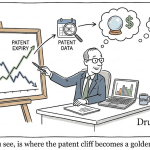
The traditional view of a patent in the pharmaceutical sector is that of a mere legal shield—a defensive document to be filed and stored in a vault. This perspective, however, captures only a fraction of its true value. A patent is, in essence, the very currency of progress in the life sciences.2 It is the single most important mechanism for a company to recoup the immense, multi-billion-dollar investments required for research and development (R&D), and it is the ultimate arbiter of a firm’s long-term viability.2
The patent’s core function is to create a period of market exclusivity, a “moat” that protects a company’s “castle” of future revenue.2 Without this temporary monopoly, the entire economic model of pharmaceutical innovation would crumble. No rational firm would invest a decade and billions of dollars in a risky endeavor if a competitor could simply copy the final product and sell it for a fraction of the cost.
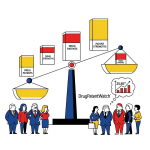
The financial significance of a patent is rooted in a fundamental legal concept: the requirement that an invention must be non-obvious to a person skilled in the art. This legal hurdle has a profound financial implication. If a patent is truly non-obvious, it signifies a genuine inventive leap, making it exceptionally difficult for a competitor to “design around” the patent without infringing it.5 This legal resilience directly translates into a durable competitive advantage, which investors and potential partners will value at a premium. The integrity of this protective moat is not static; it is a dynamic asset whose strength, breadth, and remaining lifespan are the key variables in any credible valuation.2
The Bedrock of Value: Deconstructing the Drug Pipeline
Before a patent portfolio can be valued, the asset it protects—the drug pipeline—must be rigorously deconstructed. The value of the IP is inextricably linked to the potential of the underlying science, the size of the target market, and the competence of the team steering the ship.
The High Stakes, High-Risk Game of R&D
Bringing a new drug to market is arguably one of the most capital-intensive and risk-laden endeavors in modern business. The financial stakes are staggering. The estimated cost to develop a single new therapy and bring it to market is around $3.1 billion.6 While other sources offer different figures, such as a widely cited 2014 study by the Tufts Center for the Study of Drug Development that estimated the cost at nearly $2.6 billion 7, a 2020 study provides a lower median cost of $985 million and a mean of $1.3 billion.8
The disparity in these cost estimates is not a contradiction; it is a critical insight into the economics of the industry. The cost per drug is highly skewed and depends heavily on the firm’s size and the number of drugs it successfully develops.8 A simple, single number is misleading because it fails to account for the high cost of the numerous failures required to produce a single success. The analysis must be granular, focusing on the specific pipeline and its associated risks.
The primary financial risk is the astronomical attrition rate. A drug candidate faces a gauntlet of clinical trials, where the probability of success (POS) decreases with each successive phase. Data from the industry shows that for every 10,000 compounds that enter preclinical testing, only a handful will reach human trials.3 A drug in Phase 1 has only a 10.4% likelihood of eventual FDA approval. This figure rises to 16.2% for Phase 2, and climbs to 50% for Phase 3. Once a drug completes its trials and enters the final FDA approval phase, its chances of success increase significantly to 83.2%.3 These statistical realities, combined with the immense financial outlay, underscore why traditional valuation models are inadequate for the sector.
The Non-IP Drivers of Pipeline Value
Beyond the IP, several other factors are paramount to a pipeline asset’s value. A patent is only as valuable as the market it protects, the science it embodies, and the team that can commercialize it.
Science and Data: The novelty of the drug’s mechanism of action and the strength of its preclinical and early-stage data are foundational.10 Robust data from Phase 1 and 2 trials serves as a crucial signal to investors, indicating the drug’s promise and increasing its likelihood of success in later, more expensive phases.10
Market Opportunity: The total addressable market (TAM) is a key driver of potential revenue.3 The U.S. biotechnology market alone was valued at USD 552.43 billion in 2023 and is projected to reach USD 1,785.96 billion by 2033, underscoring the immense commercial viability of the sector.6 A drug that addresses a major unmet need in a vast market will be valued far more highly than one for a niche condition with significant competition.
The Team: The experience of the management and scientific teams is a powerful indicator of a company’s ability to execute.1 Investors look for a team that has a proven track record of bringing products to market, navigating clinical trials, and successfully raising capital.1 The quality of the team directly reduces the perceived risk, which translates to a higher valuation.
The following table synthesizes the key metrics that form the foundation for any serious pipeline valuation analysis.
Measure
Statistic
Implication for Valuation
Sources
Average Drug Development Cost
From $708 million (median) to over $3.1 billion (mean)
High capital investment and significant risk must be priced into the model.
6
Overall FDA Approval Rate
9.6%
Only a small fraction of all drugs that start the process will ever reach the market.
6
Clinical Trial Success Rates
Phase 1: 10.4% Phase 2: 16.2% Phase 3: 50% Final FDA Phase: 83.2%
Each successful milestone de-risks the asset and significantly increases its value.
Hitting key milestones is the primary driver of stock value for clinical-stage companies.
6
U.S. Biotech Market Size
$552.43 billion in 2023, projected to reach $1.78 trillion by 2033
Indicates the vast potential for a successful drug to generate significant revenue.
6
The Engine Room: Core Financial Models for Pipeline Valuation
With the statistical realities of drug development understood, the focus can shift to the analytical machinery used to translate these variables into a quantifiable value. Two models dominate the discourse in biopharma: Risk-Adjusted Net Present Value (rNPV) and Real Options Analysis (ROA).
The Supremacy of Risk-Adjusted Net Present Value (rNPV)
In the life sciences sector, the standard DCF model is often inadequate for valuing clinical-stage assets. A direct cash flow forecast, which assumes a 100% chance of success, would produce a misleadingly high valuation that fails to account for the immense likelihood of failure.11 To address this, the industry has widely adopted the risk-adjusted Net Present Value (rNPV) methodology as its predominant valuation technique.10
The process of performing an rNPV analysis is a methodical, step-by-step approach that grounds potential in probabilistic reality. The steps are as follows:
Forecasting Free Cash Flows: The first step is to estimate the drug’s peak annual sales if it were to succeed and project its future revenues and costs over its typical 10-year exclusivity period.3 This includes all operating expenses, R&D costs, taxes, and capital investments.3
Adjusting for Risk: This is the critical, defining step of the rNPV model. The forecasted cash flows for each phase are multiplied by the probability of success (POS) for that phase.3 For example, the forecasted cash flow from a drug in Phase 2 would be multiplied by the POS for that phase (16.2%), and then by the POS of all subsequent phases (Phase 3: 50%, FDA: 83.2%). This adjustment effectively creates an “expected cash flow” that accounts for the high likelihood of attrition.3
Discounting to Present Value: The risk-adjusted cash flows are then discounted back to today’s dollars using a standard discount rate, such as the Weighted Average Cost of Capital (WACC).3 This discount rate reflects the time value of money and the financial risk of the investment itself.11 The research indicates that these discount rates can vary dramatically, ranging from 10% for late-stage pipelines to as high as 40% for early-stage ones.6
This high discount rate for early-stage assets is a profound, yet often overlooked, variable. It accounts for more than just the time value of money; it accounts for the broader financial risk of the endeavor. Even after adjusting for development risk with the POS, the cost of capital and investor expectations can place a massive drag on an early-stage company’s valuation.
Beyond the Formula: The Power of Real Options Analysis (ROA)
While rNPV is a powerful tool, it has a significant limitation: it treats the entire drug development process as a single, static decision.13 It fails to account for the value of managerial flexibility and the ability to make course corrections based on new information. A company doesn’t make a single decision to invest $1 billion on Day 1; it makes a series of staged investments, with the option to abandon the project at any point.14
This is where Real Options Analysis (ROA) provides a more dynamic and realistic valuation framework.14 It models each stage of the drug’s development as a “real option”—the right, but not the obligation, to move forward with the next phase.1 For example, a company invests in Phase 1 trials and, based on the results, can then choose to “exercise the option” to invest in Phase 2, or “let the option expire” by abandoning the project.14
A detailed case study demonstrates the power of ROA. A company is developing a new cancer drug. It invests $10 million in Phase 1 trials (60% success rate). If successful, it has the option to invest $20 million in Phase 2 (40% success rate). A successful Phase 2 provides the option to invest $50 million in Phase 3 (30% success rate), and so on.14 A traditional DCF model might conclude the project has a negative NPV, but an ROA model can show that the value of the flexibility to abandon at any stage significantly reduces potential losses while preserving a substantial upside.14 This approach not only provides a more nuanced financial assessment but also serves as a way to quantify the value of the management team’s strategic acumen and its ability to respond to uncertainty.13
Feature
Risk-Adjusted Net Present Value (rNPV)
Real Options Analysis (ROA)
Primary Application
Valuing early-stage drug candidates and clinical-stage pipelines.
Valuing projects with staged investment and significant managerial flexibility.
Key Inputs
Peak sales, R&D costs, commercial costs, discount rate, probability of success (POS).
All rNPV inputs, plus investment costs at each stage, and the option to abandon or pivot.
Core Assumption
Assumes a fixed, one-time investment decision.
Assumes a series of staged decisions over time.
How It Accounts for Risk
Multiplies cash flows by the probability of success (POS).
Values the option to abandon at each stage, thereby mitigating downside risk.
Strategic Insight
Provides a clear, quantitative snapshot of a project’s expected value.
Quantifies the value of managerial flexibility and strategic choices.
The Moat’s Integrity: Quantifying the Patent Portfolio’s Strength
Once the foundational valuation models are understood, the focus can turn to the central question of this report: how to quantify the strength of the patent portfolio itself. This goes far beyond a simple count of patents held. It requires a multi-dimensional analysis that assesses the qualitative and quantitative metrics that determine a portfolio’s resilience and value.
The Anatomy of a Powerful Patent Portfolio
A robust patent portfolio is not an incidental collection of legal documents; it is a “coherently designed strategic collection” of individual patents and applications meticulously curated to protect a product or technology platform.4 The strength of this portfolio depends on the strategic interplay of different patent types.
At the foundation lies the Active Pharmaceutical Ingredient (API) patent, also known as a composition of matter patent.4 This is the “gold standard” of protection, as it covers the inventive molecule itself, regardless of its final formulation or method of use.15 These are universally regarded as the strongest, broadest, and most valuable form of protection.4
The strategic brilliance of a portfolio is demonstrated by the series of secondary patents filed throughout a drug’s lifecycle. These patents protect different aspects of the product, such as new methods of use, novel formulations, or specific manufacturing processes.15 This process, often referred to as “evergreening,” creates multiple, overlapping barriers to entry for competitors.4 The presence of these secondary patents can extend a drug’s commercial lifespan, but a portfolio built solely on these patents is inherently more vulnerable. A competitor could potentially find a way to use the compound for an unpatented use, or reverse-engineer a new manufacturing process, thereby circumventing the protection.15
Quantifying the Intangible: A Patent Health Scorecard
The strength of a patent portfolio is not a subjective judgment. It can be assessed using a framework of quantifiable metrics that move beyond a simple headcount. This approach allows an analyst to transform the legal and technical data into a strategic scorecard.
Patent Family Size and Geographic Reach: The number of countries in which a patent application is filed, known as its “patent family size,” is a direct proxy for a company’s global commercial strategy.15 A patent family with filings in the U.S., Europe, China, and Japan signals a global footprint and the ambition to commercialize in the world’s largest markets, thereby increasing its value.17
Citation Analysis: This is one of the most powerful and objective metrics for assessing a patent’s value. A patent must cite all prior art—previous patents and publications—that relate to its invention.19 The number of times a patent is subsequently cited by other patents (known as “forward citations”) is a strong indicator of its technological importance and commercial value.19 A patent that is cited more frequently than its peers in the same technology field and of the same age is fundamentally more valuable.19
Claim Breadth and Enforceability: The “claims” section is the legal heart of a patent, defining the precise scope of protection.15 Broad claims provide the widest possible scope, making it difficult for competitors to “design around” the patent.5 However, this breadth can also make the patent more vulnerable to legal challenges and invalidation.5 The enforceability of the claims—the ease with which a company can defend its rights and prevent infringement—is a critical, nuanced factor in its overall valuation.24
The following scorecard illustrates a blended approach to assessing a portfolio’s strength.
Metric
Sub-Metrics & Assessment
Significance
Sources
Legal Status
Patent family size, geographic coverage, litigation history, remaining life.
A large, global family signals strong commercial intent and a durable competitive position.
16
Technological Impact
Forward citation count, relevance of citing patents, technology relevance score.
High citation count indicates the patent is a foundational innovation that others are building upon.
18
Claim Strength
Scope of independent claims, number of claims, clarity and consistency of language.
Broad claims provide powerful defensive protection, but must be well-defined to be enforceable.
5
Business Relevance
Alignment with product strategy, market position, licensability.
The patent’s value is directly tied to its ability to protect a product or technology that the market demands.
24
The Humira Playbook: Patent Thickets as a Strategic Economic Deterrent
The strategic use of a patent portfolio as a profound economic deterrent is perhaps best exemplified by the case of AbbVie’s blockbuster drug, Humira. Facing the impending expiration of its core composition of matter patent, AbbVie employed a strategic practice known as creating a “patent thicket”—a dense, overlapping web of dozens or even hundreds of patents around a single product.4
AbbVie’s strategy for Humira was a masterclass in this approach. It filed 247 patent applications in the U.S., resulting in a thicket of 73 granted patents covering the drug’s formulations, methods of use, and manufacturing processes.4 An analysis of these patents revealed that 80% were “non-patentably distinct,” meaning they did not cover new, non-obvious inventions. The entire thicket protected only 14 distinct innovations.4
The brilliance and controversy of this strategy was not rooted in the legal strength of each individual patent, but in its economic leverage. The cost for a generic competitor to challenge a single patent was estimated at $774,000, with total litigation costs reaching into the millions.4 For a would-be competitor, the prospect of engaging in a costly, protracted legal war to challenge dozens of patents was a formidable economic deterrent that effectively extended the drug’s monopoly. This strategy delayed the entry of biosimilar competitors in the U.S. by a full five years after they entered the European market, a period estimated to have cost the American healthcare system billions of dollars.4
“In the high-stakes world of pharmaceutical and biotechnology innovation, patent litigation is not merely a legal hurdle; it is a multi-million-dollar crucible where market dominance is forged and fortunes are decided”.7
The Chessboard of Competitive Advantage: Strategic Applications of Patent Data
The true value of a patent portfolio is realized when its intelligence is actively deployed to make better business decisions. The insights gleaned from patent data are not merely for valuation; they are a powerful tool for M&A, R&D strategy, and competitive positioning.
Using Patent Intelligence for M&A and Licensing Due Diligence
For a strategic acquirer or a licensing partner, a target company’s patent portfolio is often the “single most valuable asset being acquired” and the primary driver of the deal itself.4 A robust due diligence process is therefore non-negotiable and must go beyond a simple review of a patent list.
A thorough assessment requires a step-by-step approach.17 Analysts must evaluate the scope and breadth of the patent claims, confirming they provide clear, enforceable protection in all key jurisdictions.17 It is also critical to verify the chain of title—confirming that the patents are fully owned by the company and free of any third-party claims or university licensing obligations.15 A deep dive into the company’s litigation history and potential legal risks is also paramount.17
The real-world stakes of this process are high. The Gilead/Idenix litigation over hepatitis C drugs provides a sobering example. Despite winning a $2.54 billion jury verdict, Merck was ultimately barred from asserting its patents against Gilead due to a finding of “unclean hands”—business misconduct that invalidated their claim.25 This case demonstrates that a seemingly strong portfolio on paper can be rendered worthless by a hidden legal or ethical vulnerability. Conversely, the case study of a European pharmaceutical company’s litigation in the U.S. and Germany illustrates how a single, strategic legal maneuver—an intervention to join an opposition at the European Patent Office—can result in the successful revocation of a competitor’s patent and render a previous adverse court decision moot.27 These cases show that IP due diligence is not a checklist, but a nuanced legal and strategic investigation.
Leveraging Patent Landscape Analysis for Proactive R&D
For R&D teams, the global patent database is the world’s largest, most up-to-date repository of technological and commercial intelligence.15 Patent landscape analysis (PLA) is a powerful tool for systematically analyzing this data to inform future R&D strategies and de-risk the pipeline.28
PLA allows a company to:
Identify “White Spaces”: By mapping the patent activity in a specific therapeutic area, a company can identify “white spaces”—areas with limited patent coverage but significant therapeutic potential.29 This allows the firm to enter a new field with a clear path to market exclusivity, thereby boosting its potential ROI.
Track Competitor R&D: Patent applications are typically published 18 months after they are filed.28 This creates a valuable intelligence window, as a company can monitor new filings to understand a competitor’s strategic priorities, technological approach, and pipeline focus years before clinical trial data becomes public.30
Avoid Redundant Work: By analyzing prior art—patents and publications that predate an invention—a company can avoid “reinventing the wheel” and instead focus its limited R&D resources on truly novel and high-impact areas.28
This systematic monitoring provides a profound lead-time advantage. A company that proactively tracks patent filings can identify emerging competitive threats and adjust its R&D strategy years in advance of a product launch. This capability transforms R&D from a reactive endeavor into a proactive, data-driven engine of innovation.
The Alchemists’ Tools: Leveraging Modern Platforms & Data
The shift from subjective patent valuation to a data-driven, quantifiable science has been enabled by the rise of modern analytical platforms. The complexity of this analysis necessitates a new kind of professional. The ideal team is a hybrid, blending the expertise of a patent analyst/scientist with a strong scientific background and a data scientist/informatician skilled in advanced search algorithms and data visualization.15
An Essential Resource: DrugPatentWatch and Other Platforms
Platforms like DrugPatentWatch are an essential part of this modern toolkit.32 For a company seeking to leverage patent data for a competitive advantage, these resources provide real-time, actionable intelligence. The platform offers stakeholders a comprehensive view of the competitive landscape, including data on patent expiration dates, litigation histories, and regulatory exclusivity statuses for pharmaceuticals around the globe.32
The strategic applications of a tool like DrugPatentWatch are diverse and far-reaching. For generic manufacturers, it is instrumental in portfolio management and identifying market entry opportunities by providing a clear view of when branded patents will expire and which competitors are first to challenge them with Paragraph IV certifications.32 For branded pharmaceutical companies, it allows for proactive business intelligence, forecasting, and the identification of new therapeutic and market opportunities.32 This level of data access transforms what was once a subjective estimation of market dynamics into a data-backed prediction, enabling more accurate financial forecasting and risk mitigation.33
The Bottom Line: Key Takeaways & Actionable Insights
The Patent is the Primary Economic Asset: In a biotechnology company, the patent portfolio is not just a legal formality; it is the central economic engine and the single most valuable asset. Its strength, breadth, and enforceability directly influence valuation by providing market exclusivity and a durable competitive advantage.
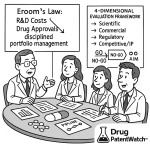
Valuation is a Blended Science: Relying on a single metric is a recipe for disaster. The most accurate valuations blend rigorous financial models like rNPV and ROA with a deep, data-driven assessment of the patent portfolio’s health, the quality of the team, and the size of the addressable market.
Quantify the Intangible: The strength of a patent can be objectively measured. Analysts should move beyond simple patent counts to assess quantifiable metrics like citation analysis, patent family size, and claim breadth. These data points provide an objective “health score” that reduces subjectivity and reveals the true value of the intellectual property.
Intelligence is the Ultimate Advantage: Patent data is a real-time repository of competitive intelligence. By systematically tracking patent filings and leveraging modern analytical tools, firms can anticipate competitor moves, identify R&D “white spaces,” and de-risk their own pipelines years in advance of product launches.
Frequently Asked Questions
Is a patent thicket an ethical strategy, and how do courts view it?
The use of patent thickets, or “evergreening,” is a legally permissible strategy under current U.S. and European law, but it has faced significant public and legal scrutiny. While companies like AbbVie successfully used this strategy to extend market exclusivity for their drugs, the courts are not blind to the intent. In the legal challenges against Humira, courts have scrutinized the claims and their relationship to the original inventions.34 The legal analysis moves beyond simply proving infringement to address whether a large volume of patents can be used as a deliberate anti-competitive strategy. Companies that employ this approach must be prepared to defend their actions, as a strong legal challenge can still invalidate the patents, even if the financial costs of litigation are a barrier to entry.4
How can a small biotech compete with a large pharma company’s patent war chest?
A small, agile biotech cannot, and should not, attempt to outspend a large pharmaceutical company in a patent war. The strategy for smaller firms is to be smarter, not bigger. This involves leveraging patent landscape analysis to identify defensible “white spaces”—areas with a high scientific and commercial potential but limited competitive patent coverage.29 Instead of building a thicket, the focus should be on creating a small number of high-quality, legally resilient patents, particularly for the core composition of matter. A portfolio with a clear title, broad claims, and a strong citation history becomes a highly attractive asset for a larger firm seeking to acquire a ready-made, de-risked innovation, thereby turning the threat of competition into a pathway for M&A or partnership.
Without revenue, how can a patent have any “real” value?
This question gets to the heart of the paradox of biotech valuation. While a prominent IP firm posits that “without revenue, there is no (real) patent value” 36, this is a perspective from outside the life sciences. For a biotech, a patent that has not yet generated revenue represents immense
potential value—it is a call option on a future revenue stream. This value is quantified through sophisticated models like rNPV and ROA, which provide a probabilistic and dynamic assessment of that potential.14 A patent on a breakthrough technology that addresses a multi-billion dollar market has a value that can be estimated and can attract significant capital long before a single dollar of sales is realized. It is not an idle fantasy; it is the foundation upon which the entire industry is built.
How do you value a pipeline asset when the probability of success is truly novel and unknown?
Valuing a truly novel, first-in-class asset with no historical precedent is one of the most challenging aspects of biopharma valuation. While baseline historical probabilities of success are a useful starting point, they are insufficient.3 For such assets, the valuation requires a subjective, expert-driven adjustment based on the strength of the preclinical data, the novelty of the mechanism, and the size of the unmet medical need.10 The value of the intellectual property here is not just its legal status, but its ability to solve a major problem that no other technology can, which can justify a higher perceived probability of success and, consequently, a higher valuation. This is where the art of valuation truly meets the science.
What is the single most important metric for IP valuation?
The report argues against a single, all-encompassing metric. The most important metric for IP valuation is the connection between the patent and a demonstrable revenue stream. As the analysis has shown, the value of a patent is only as strong as its ability to protect a product that the market wants.36 Metrics like citation count and claim breadth are proxies for this connection, but they are not the end goal. A patent that is widely cited is a powerful indicator of its technological relevance and its ability to act as a linchpin in a successful commercial strategy.19 Without a clear path to commercialization, even the most novel patent is a financial liability, not an asset.
Patent landscape analysis—Contributing to the identification of technology trends and informing research and innovation funding policy – PubMed Central, accessed August 20, 2025, https://pmc.ncbi.nlm.nih.gov/articles/PMC10034625/