Executive Market Assessment: The Sovereign Paradox
The Russian pharmaceutical sector currently operates within a paradigm of aggressive state-managed isolationism, creating a market structure that defies standard global economic logic. The fundamental thesis defining this environment is the decoupling of domestic market performance from international financial benchmarks. In 2024, the total value of the Russian pharmaceutical market reached 2.85 trillion roubles, representing a robust 10% year-on-year expansion in local currency terms.1 Superficially, this suggests a thriving industrial sector. However, when adjusted for currency devaluation and viewed through the lens of the U.S. dollar, the market remained stagnant at $30.9 billion, while contracting by 0.5% in Euro terms.1
This divergence is not an incidental byproduct of macroeconomic volatility; it is the intended outcome of a “sovereignization” strategy designed to insulate the national health system from external shocks. The driving force is high drug price inflation, recorded at 7.8% in 2024 1, combined with a deliberate government policy to substitute imported volume with domestically produced value. The result is a bifurcated economy: a retail sector that remains partially responsive to brand equity and consumer preference, and a public procurement sector—valued at approximately 940 billion roubles 1—that has been hermetically sealed against non-localized foreign competition through non-tariff barriers.
For international stakeholders, the implications are binary. The “import-and-sell” model that defined Western commercial strategy in Russia from 1991 to 2021 is obsolete. The new operating reality demands deep technological transfer, acceptance of significant intellectual property risks, and navigation of a regulatory environment where the protection of domestic industrial champions is the primary objective of the Ministry of Industry and Trade (Minpromtorg).
Macroeconomic Context and Currency Volatility
The stagnation of the market in dollar terms highlights the erosion of purchasing power for importers. With the rouble trading at elevated levels against hard currencies, the cost of imported finished dosage forms has risen, forcing a substitution effect toward cheaper generics produced within the Eurasian Economic Union (EAEU). This shift is statistically visible in the contraction of the imported drug share, which has historically hovered around 70% by value but is now aggressively shrinking in the public sector due to regulatory mandates.3
Inflationary pressure is further exacerbated by logistics costs. The suspension of direct freight routes from the European Union and the refusal of major insurers to cover Russia-bound cargo have necessitated complex transshipment via Turkey, Georgia, and the UAE.4 These logistical detours add an estimated 15-20% to the cost of goods sold, a premium that is ultimately passed to the consumer in the retail sector or absorbed by the state in the procurement sector, straining regional health budgets.
The Regulatory Architecture: From Pharma 2020 to Pharma 2030
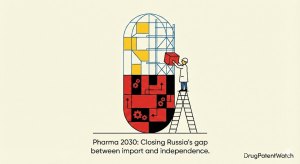
The transition from the Pharma 2020 federal program to the Pharma 2030 strategy represents a fundamental pivot in industrial policy. While Pharma 2020 focused on establishing domestic manufacturing capacity—largely satisfied by the construction of finishing and packaging plants by foreign MNCs—Pharma 2030 focuses on the depth of technological processing.6
The Doctrine of Technological Sovereignty
The core tenet of Pharma 2030 is “technological sovereignty.” This doctrine posits that national security requires the domestic control of the entire pharmaceutical value chain, from the synthesis of chemical precursors to the production of finished dosage forms. The strategy sets an explicit target: by 2030, 90% of the drugs on the “Strategically Significant Medicines” (SSM) list must be produced via a full cycle within Russia or the EAEU.7
This is a reaction to the vulnerabilities exposed by the 2022 sanctions regime. Policymakers identified that while Russia had localized the final stages of manufacturing, it remained 80-95% dependent on imported active pharmaceutical ingredients (APIs).8 The Pharma 2030 strategy aims to close this gap by incentivizing the construction of chemical synthesis plants and biological fermentation facilities.
Industry Insight: “If we consider pharmaceuticals to be an industry where we should have technological sovereignty, then we should have not only fully localized pharmaceutical manufacturing facilities, but also our own development lines for innovative drugs… The Pharma-2030 Strategy… is already outdated, as it does not meet the objectives of the industry innovative development.” — Andrey Ivashchenko, Chairman of ChemRar Group.9
The “Third Wheel” (Resolution 1289)
The primary enforcement mechanism for localization in public procurement is Government Resolution No. 1289, widely known as the “Third Wheel” or “Three’s a Crowd” rule. Implemented to force localization, this regulation mandates the automatic rejection of a bid from a foreign supplier if at least two bids are submitted by manufacturers from EAEU member states (Russia, Belarus, Kazakhstan, Armenia, Kyrgyzstan).10
Operational Mechanism:
Tender Initiation: A state purchaser requests a specific INN (International Nonproprietary Name).
Bid Evaluation: The commission checks the country of origin certificates (ST-1) of all bidders.
Exclusion: If Company A (Russian) and Company B (Belarusian) both submit bids for the drug, the bid from Company C (Swiss) is disqualified, regardless of whether its price is lower.
Price Preference: If the foreign bid is not excluded (e.g., only one local bidder exists), the local bidder still receives a 15% price preference during the auction.11
This rule has created a powerful incentive for domestic oligopolies. Russian companies often coordinate (tacitly or explicitly) to ensure at least two domestic entities participate in major tenders to trigger the exclusion of Western competitors.
The “Second Extra” Mechanism
For drugs on the Strategically Significant Medicines (SSM) list, the government has introduced an even stricter standard: the “Second Extra” rule. This regulation stipulates that if one bidder offers a full-cycle domestic product (synthesized from the API stage within the EAEU), all other bids offering products made from foreign APIs are rejected.7
While the full implementation of “Second Extra” for the entire SSM list has been delayed to January 1, 2026, to prevent immediate shortages 7, its existence serves as a clear signal: mere formulation localization is no longer sufficient. Companies must invest in API synthesis or risk total exclusion from the state market.
The 2026 Localization Point System (Decree 719)
Starting in 2026, the binary definition of “local” vs. “foreign” will be replaced by a granular scoring system under Government Decree No. 719.12 This system assigns point values to specific manufacturing operations performed within the EAEU. To qualify as a “Russian industrial product” and access procurement preferences, a drug must accumulate a minimum number of points (typically 50).
Analysis of the Scoring Matrix:
Manufacturing Stage
Strategic Weight
Estimated Points
Implication
Molecule Synthesis (API)
Critical
30-50
Without this, achieving the threshold is mathematically impossible for many drugs.
Fermentation (Biologics)
Critical
50+
Immediate qualification for mAbs and vaccines.
Finished Dosage Form
Moderate
20
The baseline capability; insufficient on its own.
Quality Control
Low
10
Mandatory compliance step.
Packaging (Primary)
Low
5
Considered low-value addition.
Packaging (Secondary)
Nominal
5
Often ignored in strategic calculation.
12
Commercial Impact:
This system is designed to penalize “screwdriver” industries—plants that simply package bulk tablets imported from abroad. For a foreign MNC, the cost to bridge the point deficit (often 15-25 points) involves transferring complex chemical processes to Russia. Given the geopolitical risk, few Western boards are willing to authorize such CAPEX. This effectively hands the long-term advantage to domestic firms like Active Component and Pharmstandard, which already possess synthesis infrastructure.13
Track & Trace: The MDLP System
Russia operates one of the world’s most comprehensive track-and-trace systems, the MDLP (Monitoring of Drug Movement). Every individual pack of medicine carries a unique Data Matrix code (crypto-code) that is scanned at every handover—from manufacturer to distributor to pharmacy.15
While ostensibly for safety and anti-counterfeiting, the MDLP provides the state with granular, real-time data on consumption patterns, stock levels, and regional deficits. This data is weaponized to enforce price controls and identify supply gaps that require compulsory licensing interventions. For foreign companies, the MDLP imposes a high compliance burden; a failure in code readability or reporting can result in the blockage of entire batches at customs.16
Intellectual Property and Legal Risks: The Erosion of Exclusivity
The legal environment for intellectual property (IP) in Russia has deteriorated significantly. The sanctity of the patent is now subordinate to the concept of “public necessity,” and the judicial system has consistently ruled against Western patent holders in favor of domestic generics in strategic sectors.
Compulsory Licensing: The Nuclear Option
Article 1360 of the Civil Code grants the government the right to authorize the use of an invention without the patent holder’s consent in cases of “extreme necessity” related to defense or security.17 In recent years, “security” has been reinterpreted to include “drug security,” allowing the mechanism to be used for economic import substitution.
Case Study: The Semaglutide (Ozempic) Precedent
The most high-profile application of this mechanism involves Novo Nordisk’s blockbuster diabetes and obesity drug, Ozempic (semaglutide). Following Novo Nordisk’s decision to suspend supplies to Russia in 2023, the Russian government issued a compulsory license in late 2023/early 2024 to two domestic companies: Geropharm and Promomed.17
Legal Justification: The Russian Supreme Court upheld the license in 2025, ruling that the withdrawal of the original drug constituted a direct threat to the health of Russian citizens, thereby satisfying the “extreme necessity” clause of Article 1360.17
Market Consequence: Within a year, Russian generics (Geropharm’s Semavic and Promomed’s Quincenta) captured nearly 100% of the domestic market volume.17
Compensation: Under the terms of the license, the manufacturers are required to pay compensation to the patent holder. However, the calculation of this payment is governed by a specific decree that discriminates based on the patent holder’s country of origin.
Decree 299: The Zero Compensation Rule
In March 2022, the Russian government adopted Decree No. 299, which amended the methodology for calculating compensation for compulsory licenses.
Friendly Nations: For patent holders from neutral or friendly countries, the compensation remains at 0.5% of actual revenue.20
Unfriendly Nations: For patent holders associated with “unfriendly states” (a list that includes the US, EU, UK, Canada, and Japan), the compensation is set at 0%.22
This decree effectively legalizes the uncompensated expropriation of IP assets from Western companies. In the case of Ozempic, while Novo Nordisk is Danish (an EU/NATO member and thus “unfriendly”), some sources indicate a 0.5% rate was applied in specific court rulings 20, suggesting a judicial inconsistency or a tactical decision to maintain a veneer of legality. However, the threat of the 0% rate remains a powerful lever in negotiations.
Parallel Imports
To combat shortages, Russia has legalized parallel imports for specific categories of goods, bypassing the trademark holder’s consent. While the Ministry of Health has been cautious about applying this to medicines due to safety concerns (the cold chain is difficult to guarantee in grey market channels), the mechanism remains available. In 2025, the list of goods allowed for parallel import was updated, and while broad pharmaceutical categories are excluded to protect local producers, specific medical devices and consumer health products are included.24
Manufacturing and Supply Chain: The API Bottleneck
The ambition of Pharma 2030 collides with the reality of Russia’s chemical industrial base. The sector’s dependence on imported chemical precursors is its most significant strategic vulnerability.
The API Deficit
Russia imports between 80% and 95% of its APIs.8 Domestic production is often limited to the final synthesis steps of “late-stage intermediates” imported from China. True “from scratch” synthesis is rare outside of simple molecules.
Chemical Precursors: The fine chemical industry in Russia was largely dismantled in the 1990s. Rebuilding it requires sourcing reagents, solvents, and catalysts that are themselves subject to Western export controls.
Equipment: The hardware for API synthesis—glass-lined reactors, centrifuges, and spray dryers—is predominantly of European origin. Sourcing replacements from China is possible but introduces quality validation challenges.
Chromatography and Bioprocessing
A critical bottleneck exists in the production of biologics (monoclonal antibodies and insulin). This process relies on chromatography resins and columns for purification. Historically, these were sourced from Western leaders like Cytiva (Danaher) or Thermo Fisher.
Sanctions Impact: These items are often dual-use (capable of being used for biological weapons production) and face strict export controls.
Shortage: Reports indicate intermittent shortages of high-quality chromatography media, forcing Russian biopharma companies like Biocad to stockpile or validate Chinese alternatives, a process that can take 12-18 months and risks yield consistency.26
Logistics: The Southern Corridor
The logistical map of Russian pharmaceutical imports has been redrawn. The traditional direct truck routes from Europe via Poland and Belarus are heavily congested or closed to Russian and Belarusian carriers.
Turkey: Istanbul has become a primary transshipment hub. Cargo is flown or shipped to Turkey, then re-exported to Russia via truck or ferry to Novorossiysk.5
UAE: Dubai serves as a financial and logistical hub, particularly for high-value, low-volume air freight.27
China: Rail routes from China are operating, but congestion is high. The “Middle Corridor” via Kazakhstan is gaining importance as an alternative to the Trans-Siberian route.5
Cost Implications:
Logistics costs for pharmaceutical importers have risen by approximately 20-30% compared to pre-2022 levels.28 Insurance premiums for cargo transiting the Black Sea have also spiked due to war risks.
Competitive Intelligence: The Domestic Champions
The beneficiaries of the state’s isolationist policies are a cadre of domestic holding companies that have consolidated market share. These “Domestic Champions” are the only entities capable of navigating the “Second Extra” and “50-point” localization rules.
Pharmstandard: The Industrial Sovereign
Profile: Pharmstandard is Russia’s largest pharmaceutical company by revenue and volume. It acts as the “manufacturer of last resort” for the state, ensuring the supply of vital generics.
Revenue: In 2023, revenue exceeded 143 billion roubles.29
Strategy: High-volume, low-margin dominance. Pharmstandard produces over 400 products, heavily skewed toward the VED list. It is the primary partner for localization, often contract manufacturing for foreign firms that wish to retain “Third Wheel” eligibility.2
Key Assets: Massive production sites in Kursk, Ufa, and Tomsk. It also owns Otisipharm, a leader in the OTC segment (e.g., Arbidol, Pentalgin).
Biocad: The Biotech Disruptor
Profile: Biocad is the technological jewel of the Russian pharma sector, focusing on high-complexity biologics.
Innovation: Unlike generic houses, Biocad invests heavily in R&D. It has developed original molecules like Ivlizi (divozilimab) for multiple sclerosis and Elsira (levilimab) for cytokine release syndrome.30
Biosimilars: Its commercial engine is a portfolio of biosimilars for blockbuster oncology drugs (Rituximab, Bevacizumab, Trastuzumab). These products dominate state tenders, often displacing the originators entirely.
Political Capital: Biocad’s alignment with state goals allows it to shape regulation. It was a vocal proponent of the “Second Extra” rule, which benefits its full-cycle fermentation capacity.31
R-Pharm: The Strategic Interlocutor
Profile: R-Pharm specializes in high-cost hospital drugs (oncology, HIV, HCV) and acts as a bridge between Western technology and Russian market needs.
Role: R-Pharm often licenses Western molecules for local production. During COVID-19, it produced the AstraZeneca vaccine under contract (branded locally) and its own antiviral Coronavir.
Vulnerability: Its model is more exposed to international relations than Pharmstandard. As Western firms pull back from licensing, R-Pharm must pivot to internal R&D or partnerships with Chinese/Indian firms.32
Geropharm: The Endocrinology Monopolist
Profile: Geropharm is the undisputed leader in the insulin market.
Market Share: By 2024, Russian insulin manufacturers (led by Geropharm) captured 44% of government procurement contracts.33
Strategy: Full-cycle insulin production. Geropharm synthesizes the insulin substance domestically, insulating it from the “Second Extra” rule.
Expansion: It is aggressively expanding into the Global South, with exports to Venezuela and production agreements in Algeria, positioning itself as an alternative to Novo Nordisk/Sanofi for non-Western markets.35
Promomed: The Rapid Response Unit
Profile: Promomed gained prominence during the pandemic and has accelerated growth by quickly targeting market gaps left by Western exits.
Agility: Promomed was instrumental in the rapid genericization of Ozempic (Quincenta). It positions itself as a guarantee of drug security, willing to use compulsory licensing aggressively.
Portfolio: Focused on endocrinology, antibiotics, and neurology. Recognized by Forbes as one of the top 10 most efficient pharma companies in Russia.36
Therapeutic Sector Analysis
Oncology: The Budget Driver
Oncology consumes the largest share of the state drug budget, driven by the Federal Oncology Program.
Trend: Shift to biosimilars. The market for mAbs like bevacizumab and rituximab is almost entirely domestic.
Innovation Gap: While biosimilars are available, access to the latest generation of Western immuno-oncology drugs (e.g., CAR-T, bispecifics) is shrinking. Russian patients increasingly rely on older protocols or clinical trials of domestic equivalents that are still in early stages.37
Diabetes: Sovereignty Achieved
The diabetes sector is the poster child for import substitution.
Insulin: Russia is self-sufficient in human and analog insulins via Geropharm and Medsintez.
GLP-1: The successful forced genericization of semaglutide demonstrates the state’s willingness to break patents to maintain access to modern diabetes treatments.17
Autoimmune & Orphan Diseases
This sector remains vulnerable. The production of complex proteins for rare diseases is technologically demanding. While the Circle of Kindness foundation (a state fund for children with rare diseases) continues to purchase expensive Western drugs, there is immense pressure to localize or switch to cheaper alternatives where possible.29
Financial Infrastructure: The Ruble-Yuan Pivot
The financial mechanics of the trade have shifted away from the US Dollar and Euro.
Yuan (CNY): The Chinese Yuan has become the settlement currency of choice for API imports and even for some trade with third parties.
Rupee (INR): Trade with India is complicated by the “Rupee Trap.” Russia has accumulated billions of Rupees from oil exports that cannot be easily converted or used. Mechanisms to use these funds for pharmaceutical imports are being developed but face friction.38
Bank Sanctions: With major banks like Sberbank and VTB cut off from SWIFT, pharma companies use smaller, non-sanctioned banks (e.g., Raiffeisen Russia, though this channel is narrowing) or intermediaries in the CIS region to process payments.39
Conclusion: The Fortress Market
By 2030, the Russian pharmaceutical market will likely resemble a “Fortress Market”—large, self-sufficient in mass-market therapies, but technologically isolated from the global frontier of biotechnology.
For the Domestic Champion, the future is bright. Guaranteed state orders, protection from foreign competition, and subsidized loans for CAPEX create a favorable environment for growth, provided they can solve the API supply chain puzzle.
For the Western Multinational, the market has shifted from a strategic growth driver to a “legacy maintenance” operation. The goal is no longer expansion but the ethical obligation to supply essential medicines while minimizing financial and reputational exposure. The “Third Wheel” and “Zero Compensation” rules effectively cap their potential market share.
For the New Entrant (China/India), Russia represents a massive vacuum. As Western firms retreat, Asian manufacturers are positioned to become the primary suppliers of technology, equipment, and advanced APIs, provided they can navigate the payment and logistics minefield.
The Russian pharmaceutical industry is not collapsing; it is mutating. It is evolving into a state-capitalist organism where market forces are secondary to the geopolitical mandate of survival.
Key Takeaways
Sovereignty Over Efficiency: The Pharma 2030 strategy prioritizes complete supply chain independence over economic efficiency. The 2026 localization point system will force companies to synthesize APIs locally or exit the state market.
The Valuation Divergence: The market is growing in Roubles (+10%) but flat in USD. Strategic planning must account for this decoupling; rouble revenue does not translate to hard currency repatriation value.
Compulsory Licensing as Policy: The Ozempic case proves that IP rights are conditional. The state will void patents to protect supply, utilizing “Zero Compensation” rules for Western originators.
The Rise of Oligopolies: Regulatory barriers like the “Third Wheel” rule favor large domestic holding companies (Pharmstandard, R-Pharm), creating a consolidated market structure.
Logistical Realignment: Supply chains have permanently shifted South and East. Turkey, UAE, and China are the new gateways, adding permanent cost and complexity to operations.
FAQ: Navigating the Russian Pharma Market
Q1: How will the 2026 Localization Point System specifically impact foreign generic manufacturers?
A: It serves as a de facto ban from public procurement for non-localized firms. A foreign generic manufacturer that only packages drugs in Russia will score approximately 10-15 points. The threshold for tender preference is 50 points. Without investing in local API synthesis (which awards ~30-40 points), these companies will be disqualified whenever a fully localized Russian competitor bids.
Q2: Is it possible for Western companies to license their drugs to Russian partners to avoid the “Zero Compensation” rule?
A: Yes, and this is the preferred “Scale Back” strategy. By voluntarily licensing a drug to a Russian partner (like R-Pharm), a Western company can negotiate a royalty stream (albeit often lower than pre-war levels) and avoid the hostile takeover of their IP via compulsory licensing. The state prefers voluntary localization over forced licensing as it ensures technology transfer.
Q3: What is the status of clinical trials for new foreign drugs in Russia?
A: New international multi-center clinical trials (IMCTs) by Western sponsors have effectively ceased. This creates a “launch gap.” Drugs approved by the FDA/EMA in 2024-2025 will not be registered in Russia for years, if ever, unless Russian companies conduct their own local trials, likely without the originator’s support.
Q4: How reliable is the “Parallel Import” mechanism for medicines?
A: It is a mechanism of last resort. The Ministry of Health restricts it for medicines because guaranteeing the cold chain and authenticity of grey-market drugs is difficult. It is mostly used for medical devices and consumer health products. For Rx drugs, the state prefers compulsory licensing of domestic production over unregulated imports.
Q5: Can Data Matrix (MDLP) codes be used for competitive intelligence?
A: Yes. The MDLP system provides granular data on stock levels and consumption. While direct access is restricted to the license holder, commercial data providers (like DSM Group or RNC Pharma) aggregate this data to offer precise insights into regional sales, allowing competitors to spot supply gaps and target regions for generic entry.
Data Appendix
Table 1: Top 10 Pharmaceutical Distributors in Russia (2024 Turnover Share)
Rank
Distributor
Market Share (%)
Strategic Note
1
Pulse
15.9%
Leader in logistics efficiency; pure distributor model.
2
Protek
15.4%
Vertically integrated: owns Sotex (manufacturing) and Rigla (pharmacy chain).
3
Katren
13.4%
Strong digital presence; owns Apteka.ru (32% of e-commerce market).
4
Grand Capital
8.0%
Aggressive growth in regional markets.
5
R-Pharm
N/A
Specialized distributor for state tenders (high value, low volume).
Russians set to lose access to imported medicines by 2030 as the country pivots to a new national healthcare development strategy – The Insider, accessed January 20, 2026, https://theins.ru/en/news/287778
How to Get More Localization Points in Russia – UCEC QUALITY LLC State-mandated registration of medical devices, consumer goods, and industrial products in Russia and EAEU – ООО ЕЦЭС «КВОЛИТИ, accessed January 20, 2026, https://certru.ru/en/how-to-get-more-localization-points-in-russia/