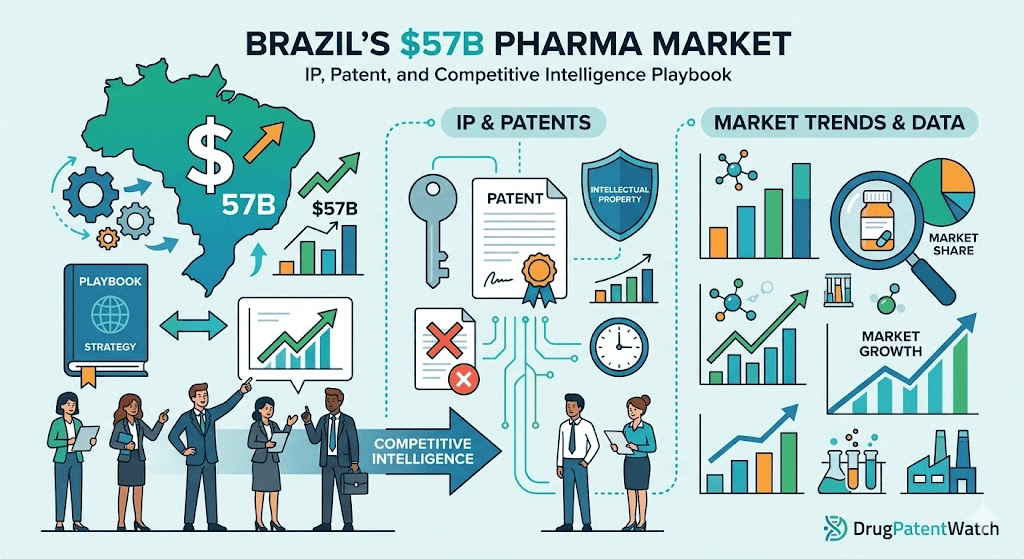
Brazil’s pharmaceutical sector has quietly become one of the most strategically interesting IP battlegrounds in the world. The country’s market is projected to reach USD 57.35 billion by 2034, growing at a CAGR of 10.20%. Four domestic companies — Hypera Pharma, EMS, Eurofarma, and Aché — now hold the top positions in a market where, in 1998, only one Brazilian firm cracked the top ten. That shift didn’t happen by accident. It happened because of a specific convergence of public policy, regulatory architecture, IP intelligence, and industrial strategy.
This analysis is built for pharma IP teams, portfolio managers, biotech executives, and institutional investors who need more than a market overview. It covers patent dynamics, ANVISA’s role as a structural moat, loss-of-exclusivity mechanics in a patent de-linked system, GLP-1 competitive entry, biosimilar licensing economics, and the proposed EMS-Hypera merger’s implications for market structure.
Why Brazil’s Patent System Creates Different Market Entry Dynamics Than the U.S. or EU
The architecture of Brazil’s pharmaceutical patent regime diverges from the U.S. Hatch-Waxman model in ways that fundamentally alter generic entry timing and competitive strategy.
The most commercially significant structural difference is the de-linkage of patent status from regulatory approval. ANVISA can review and approve a generic or biosimilar drug application regardless of whether the reference product’s patents remain in force. There is no equivalent to the 30-month stay that automatically triggers in the U.S. when an innovator files suit after receiving notice of a Paragraph IV certification. In Brazil, a company can receive ANVISA registration for a generic product and be positioned to launch the day a patent expires or is successfully challenged in court.
This creates a materially different competitive calculus. Brazilian generics manufacturers don’t need to wait until late in the patent lifecycle to initiate their regulatory filings. They begin preparation years earlier, move through ANVISA’s process concurrently with the remaining patent term, and compress the gap between exclusivity loss and competitive entry. The practical result is faster generic erosion post-loss of exclusivity (LOE) compared to markets with strong patent linkage.
For innovators operating in Brazil, this means the nominal patent expiry date is close to the real commercial LOE date. There is little buffer. The usual playbook of filing citizen petitions, pursuing 30-month stays, or leveraging patent linkage to delay generic launch doesn’t apply here. Companies that rely on those tactics in the U.S. and EU need a different strategy in Brazil.
How Brazilian Patent Law Treats Second Medical Use Claims
Brazilian patent law allows second medical use patents in the “Swiss-type” claim format, enabling companies to patent new therapeutic indications for existing compounds. For originators, this offers a pathway to extend commercial exclusivity beyond the base compound patent, provided the new indication represents genuine clinical differentiation. For generic manufacturers, it creates a layer of patent analysis that goes beyond identifying the primary compound’s expiry date. A generic applicant in Brazil must account for the full patent family associated with a reference product, including any second medical use filings that could affect specific indications even after the core molecular patent lapses.
This is an area where patent intelligence platforms like DrugPatentWatch provide material value. Tracking the full patent estate — compound, formulation, method of use, and second medical use filings — across Brazilian INPI records and correlating them with ANVISA registration timelines gives generic companies the precise entry windows they need and gives originators clarity on which exclusivities remain defensible.
What the 1999 Generic Drug Law Did to Competitive Structure (That Nobody Predicted)
Law 9.787 of 1999 was designed to lower drug prices and improve access. Its structural impact on the domestic pharmaceutical industry was something else entirely.
Before the law, Brazil had a category of “similar” drugs — copies of off-patent medicines that did not require bioequivalence testing. This low technical bar meant domestic manufacturers could operate with modest quality infrastructure. The 1999 law created a legally distinct “generic” category that required bioequivalence demonstration and compliance with Good Manufacturing Practices. Generics had to be priced at least 35% below their branded counterparts.
The firms that resisted this shift, or lacked the capital to upgrade, were marginalized. Companies like EMS and Eurofarma made the investment. Building GMP-compliant manufacturing facilities, establishing bioequivalence testing protocols, and developing the analytical chemistry capabilities to satisfy ANVISA’s requirements cost substantial capital upfront. But those investments built an infrastructure that turned out to be a durable competitive moat.
The quality systems and technical competencies constructed to satisfy ANVISA’s generics requirements are directly transferable to biologics manufacturing, biosimilar development, and contract manufacturing partnerships with multinational originators. Eurofarma’s ability to enter a vaccine manufacturing partnership with Pfizer and BioNTech for COMIRNATY — producing at least 100 million annual doses for Latin American distribution — traces directly back to the GMP infrastructure the company built or upgraded post-1999. The same applies to EMS’s capacity to pursue FDA filings for complex peptides.
The law created the industry it was regulating.
How ANVISA’s Complexity Functions as a Non-Tariff Barrier
ANVISA’s regulatory framework is among the most technically demanding in any middle-income country. Clinical trial approvals take up to 18 months, versus three to six months in many comparable jurisdictions. Generic registration applications are frequently rejected for reasons that include deficiencies in stability studies calibrated to Brazil’s tropical climatic zone (IVb), inadequate documentation for Active Pharmaceutical Ingredients, and incomplete quality control dossiers.
Foreign manufacturers seeking to supply the Brazilian market must submit to local Good Manufacturing Practice inspections of their overseas facilities. Most official regulatory communication occurs in Portuguese. The product traceability requirements are distinct from those of the FDA or EMA, requiring dedicated compliance infrastructure.
For multinationals entering Brazil for the first time, this creates material delays and costs. For the domestic champions who have spent decades mastering this system, it functions as a structural barrier to competitive entry. Eurofarma explicitly markets its ANVISA navigation capability as a commercial asset to international partners evaluating Latin American entry. The ability to manage pricing strategies, navigate non-standard approval pathways for orphan drugs, and maintain ongoing regulatory compliance is something the domestic firms have institutionalized. Foreign entrants must buy or partner their way into that capability, or build it from scratch over years.
This dynamic helps explain why multinational corporations have struggled to recapture the market share they held before the 1999 generic law took full effect. The ANVISA barrier is not insurmountable, but the time and cost required to clear it creates a meaningful first-mover advantage for incumbents.
ANVISA Generic Registration: Common Rejection Reasons
The SUS Procurement Model and Its Effect on Generic Market Structure
The Sistema Único de Saúde is the primary demand anchor for generic drug manufacturers in Brazil. Federal expenditure on medicines grew from R$2 billion in 2000 to over R$25 billion in 2021. In 2019, federal purchases represented approximately 16% of total pharmaceutical sector revenue. Procurement across federal, state, and municipal levels follows a competitive bidding model where lowest price is the dominant selection criterion.
This structure rewards manufacturers with the lowest cost base. Scale is paramount. The companies that built the largest, most efficient manufacturing platforms — EMS’s 200,000-square-meter complex, described as Latin America’s largest pharmaceutical operating facility — can bid at price points that smaller competitors cannot match profitably. The SUS model thus concentrates tender wins among the largest generics players and reinforces their market position with each procurement cycle.
High-cost specialty drugs are increasingly centralized at the federal level, giving the federal government concentrated bargaining power in the biologics and specialty segment. This is where the judicialization phenomenon creates a bypass: for drugs not on the official SUS reimbursement list, court orders compel state and municipal governments to purchase medicines at retail prices, outside the competitive tender structure. Federal spending on court-ordered medicines grew from 4% to over 7% of the federal medication budget between 2012 and 2018. In one recorded period, federal expenditure on judicially mandated drugs increased 2,000% over three years.
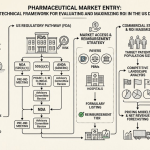
The practical implication for commercialization strategy: a pharmaceutical company launching a high-cost specialty drug in Brazil has two viable market access pathways simultaneously. The formal pathway runs through CONITEC (the National Committee for Health Technology Incorporation) evaluation and eventual SUS formulary inclusion, a process that is rigorous, slow, and price-sensitive. The informal pathway involves active detailing to physicians, whose prescriptions become the legal basis for patient-initiated lawsuits. Given the Brazilian judiciary’s historical interpretation of the constitutional right to health, those lawsuits have succeeded at high rates, creating a price-insensitive revenue channel for products that would otherwise face years of reimbursement limbo.
EMS’s GLP-1 Strategy: What a Brazilian Generic Filing for Semaglutide Means for Novo Nordisk and Eli Lilly
EMS has filed for FDA generic approval of semaglutide — the active ingredient in Ozempic and Wegovy — establishing itself as a credible participant in what will become one of the most contested generic entries in pharmaceutical history.
The commercial context matters here. Novo Nordisk’s semaglutide franchise generates over $20 billion annually at current run rates. Key U.S. composition-of-matter patents on semaglutide face expiry in the early 2030s, though Novo Nordisk has filed a network of secondary patents covering formulation, manufacturing methods, dosing regimens, and device-drug combinations. The patent litigation around semaglutide generics will be extensive, and the first generic applicants to resolve those challenges will hold 180-day exclusivity periods of enormous commercial value.
EMS’s FDA filing signals several things. First, it has developed sufficient peptide synthesis and purification capability to produce semaglutide at pharmaceutical grade — a technically demanding feat requiring specialized solid-phase or recombinant synthesis infrastructure. Second, it is prepared to navigate FDA review, which involves its own distinct regulatory demands separate from ANVISA. Third, it is positioning for a developed-market entry at the moment of maximum revenue opportunity.
Domestically, EMS already launched liraglutide analogs — Olire for obesity and Lirux for diabetes — as Brazil’s first domestically produced GLP-1 receptor agonists. Liraglutide’s core patents have expired or are near expiry in Brazil, creating the local entry window. This gave EMS its first GLP-1 manufacturing and regulatory track record before the larger semaglutide bet.
For Eli Lilly, which holds the dulaglutide (Trulicity) and tirzepatide (Mounjaro, Zepbound) franchises, the competitive threat is slightly more distant given tirzepatide’s more recent approval profile and patent estate. But the same generics infrastructure that EMS is building for semaglutide can be retooled for other GLP-1 and GIP/GLP-1 dual agonist peptides as their patents roll off.
Key Patent Expiry Timelines for GLP-1 Drugs Relevant to Brazilian and Global Generic Entry
Drug
Originator
Active Ingredient
Approx. Core Patent Expiry (U.S.)
Brazilian Generic Status
Victoza/Saxenda
Novo Nordisk
Liraglutide
Expired/near expiry
EMS launched domestic generics (Olire, Lirux)
Ozempic/Wegovy
Novo Nordisk
Semaglutide
Early 2030s (secondary patents extend)
EMS FDA filing submitted
Trulicity
Eli Lilly
Dulaglutide
Mid-2020s (core), late 2020s (formulation)
Watch for Brazilian and regional filings
Mounjaro/Zepbound
Eli Lilly
Tirzepatide
2036+ (composition), additional coverage
No imminent generic threat
Byetta/Bydureon
AstraZeneca/AZ
Exenatide
Largely expired
Generic competition active
How Eurofarma Built a Pan-Latin American Patent and Regulatory Platform
Eurofarma’s presence in 22 countries, covering 100% of Latin American markets, is not a coincidence of organic growth. It is the product of deliberate, sequenced market entry combined with strategic acquisition.
The 2023 acquisition of Genfar — Sanofi’s generics operation headquartered in Colombia, with affiliates in Ecuador and Peru — and seven additional Sanofi assets across the region gave Eurofarma an established manufacturing, regulatory, and distribution infrastructure in markets it would otherwise have needed years to build. This is the standard logic of pharmaceutical M&A applied to regional consolidation: buying time-to-market and regulatory dossiers rather than building them from scratch.
What makes Eurofarma’s model commercially distinctive is its positioning as the preferred regional partner for global originators. Licensed products account for approximately 10% of total revenue. This figure reflects a deliberate commercial strategy. By demonstrating GMP-grade manufacturing capability, ANVISA and multi-country regulatory expertise, and a commercial network reaching every Latin American market, Eurofarma offers multinationals a single point of entry to a region that many find complex and fragmented to address directly.
The biosimilar licensing deal with Shanghai Henlius Biotech illustrates this model precisely. Henlius has three oncology biosimilars in scope: rituximab, trastuzumab, and bevacizumab — targeting non-Hodgkin lymphoma, HER2-positive breast cancer, and colorectal/ovarian cancer respectively. Originator versions of these molecules (Rituxan/MabThera, Herceptin, Avastin) have faced biosimilar competition in the U.S. and EU for several years. Eurofarma’s deal gives Henlius access to 22 Latin American markets through a partner that already has the regulatory infrastructure and distribution relationships in place.
For Roche, which markets the originator versions of all three products through its own Latin American operations, this deal accelerates biosimilar price competition in markets where Roche has previously benefited from limited biosimilar entry due to the high cost of navigating fragmented regional regulations.
What the Proposed EMS-Hypera Merger Would Do to Brazil’s Generic Market Structure
The proposed merger between EMS and Hypera Pharma would create a domestic entity of unprecedented scale. EMS holds the leading position in generics. Hypera holds the leading position in OTC and consumer health, with a #2 position in branded generics and #5 in branded prescriptions. A combined entity would hold dominant positions across multiple market segments simultaneously.
The competitive implications are significant. The combined company would control a commercial infrastructure covering hospitals, pharmacies, physicians, and consumer channels. Its purchasing power with API suppliers would increase materially. Its ability to internalize manufacturing across both generics and consumer health would reduce per-unit costs. And its scale in SUS tender bids would be difficult for any other single domestic player to match.
From an antitrust standpoint, Brazilian competition authority CADE (Administrative Council for Economic Defense) would apply its standard framework for evaluating horizontal mergers in concentrated markets. Given the overlap between EMS and Hypera in branded generics specifically, CADE scrutiny is likely to focus on that segment. The resolution — whether remedies are required and in what form — will shape how much value the merger actually creates for shareholders of the combined entity.
For smaller domestic players, a completed EMS-Hypera combination would accelerate the imperative to specialize. Competing head-to-head in mass-market generics against a company of that scale would be commercially unsustainable for most mid-tier firms. The likely response is further segmentation: mid-tier companies moving into hospital specialties, biologics, or underserved therapeutic niches where the combined giant lacks focus.
For multinationals, a dominant domestic player with the distribution reach of combined EMS-Hypera would simultaneously be a more powerful potential partner and a more formidable competitor.
How Hypera’s Acquisition of MNC Brand Portfolios Works as an IP Strategy
Hypera’s playbook involves buying established OTC and prescription drug brands from multinational companies that are divesting non-core assets. The acquisitions from Sanofi (AAS, Cepacol, and others) and Takeda (Neosaldina, Dramin, and others) follow a consistent pattern: the originator no longer views these mature, off-patent brands as strategically central to its global portfolio, while for Hypera, they represent known revenue streams with existing physician relationships and consumer recognition.
The IP dimension of these deals is nuanced. The active pharmaceutical ingredients in these products are off-patent. What Hypera acquires is trademark ownership, trade dress, formulation know-how, and — critically — the manufacturing relationships and supply chain infrastructure that go with the products. The acquisition of the Boehringer Ingelheim manufacturing facility to produce the Buscopan brand family in-house illustrates how Hypera internalizes production to control costs and quality for its acquired portfolio.
From a valuation standpoint, the key risk in this model is brand erosion over time. As generic penetration deepens in Brazil, unbranded generics will exert price pressure even on well-known branded generics and OTC products. Hypera’s defense is its sales force — over 260,000 physician visits per month — which sustains prescription loyalty and brand salience. But that defense requires ongoing investment and becomes more expensive to maintain as the competitive field expands.
Hypera’s entry into biologics with its first biological drug, Hyblut, signals an awareness that the branded generics and OTC model alone will not sustain long-term growth at current margins. The pipeline of approximately 98 new products in oncology, specialty care, and biologicals, targeting a potential market of R$16 billion, represents its hedge against the commoditization of its core portfolio.
Why Blau Farmacêutica’s Institutional Specialization Is a Different Bet on Brazil’s Future
Blau Farmacêutica has built its business on a premise that most of its Brazilian peers tested only recently: that the highest-margin pharmaceutical segment in Brazil is not mass-market generics but hospital-administered high-complexity drugs.
Founded in 1987 and publicly traded with a market capitalization of approximately $393 million as of 2025, Blau focuses on oncology, immunology, and biologicals delivered through institutional channels. Its geographic footprint already extends to the U.S. and Europe — specifically the Netherlands and Hungary — making it one of the few Brazilian pharma companies with an established European manufacturing and distribution presence.
The institutional segment is structurally different from the retail generics market that EMS and Hypera dominate. Hospital purchasing committees and formulary processes involve different decision-makers, different clinical evidence requirements, and different pricing dynamics. The SUS tender process for high-cost hospital drugs is centralized federally, which means competitive intensity is high but the contracts are large. Blau’s specialization gives it deep institutional relationships and regulatory dossiers in therapeutic areas where its larger domestic peers have historically been less focused.
The biosimilar opportunity in oncology is the clearest growth vector. Rituximab, trastuzumab, bevacizumab, and pembrolizumab biosimilars represent a multi-billion-dollar accessible market globally. Brazilian patients currently face high out-of-pocket costs or complex judicial processes to access these drugs through SUS. Domestic production of oncology biosimilars at GMP-grade quality — whether through Blau’s own manufacturing or through licensing agreements — would address a significant unmet access gap while generating strong margins.
How the Bionovis Joint Venture Structures Risk in Brazilian Biosimilar Development
Aché’s participation in Bionovis — a joint venture with three other national laboratories, structured around a partnership with the Oswaldo Cruz Foundation (FIOCRUZ) — is a specific organizational response to the capital and technical requirements of biopharmaceutical development.
Developing a biosimilar from scratch requires cell line development, upstream and downstream bioprocessing, analytical characterization of the reference product, and clinical comparability studies. The total investment for a single biosimilar can range from $100 million to $250 million depending on the molecule and clinical requirements. No single mid-tier Brazilian company can absorb that cost without significantly concentrated risk. The JV structure spreads both the investment and the regulatory and clinical execution risk across multiple partners.
The FIOCRUZ partnership adds a public-sector dimension. FIOCRUZ is Brazil’s premier public health research institution and has its own manufacturing capability for vaccines and other biologicals. This partnership provides Bionovis with access to scientific expertise, public procurement networks, and government goodwill that would be difficult for a purely private venture to replicate.
The therapeutics under development within Bionovis target rheumatoid arthritis, psoriasis, multiple sclerosis, and oncology — all areas where biologic originator products carry high prices and where biosimilar competition could dramatically reduce the cost burden on SUS. The commercial logic for Brazil is straightforward: domestic biosimilar production reduces foreign exchange outflow for imported biologics and gives the government a lower-cost procurement alternative.
Revenue at Risk: What Loss of Exclusivity Means for Multinational Originators in Brazil
Multinational originators selling patented drugs in Brazil face a compressed timeline between formal patent expiry and material revenue erosion, precisely because of the patent de-linkage system described above.
When a compound patent expires, ANVISA may already have approved one or more generic versions, meaning the first generic can launch on day one of loss of exclusivity rather than after a regulatory review period. In therapeutic categories with strong SUS demand — cardiovascular, diabetes, CNS — the government tender process immediately begins incorporating lower-cost generic alternatives, and the originator brand’s tender participation becomes commercially marginal within one to two procurement cycles.
The judicialization channel provides a partial buffer. Products that have established themselves through the judicial pathway have physician advocates who continue prescribing them by name even after generic entry. But this buffer is therapeutic-area and brand-specific. OTC and low-involvement prescription categories see faster erosion than specialty drugs with strong physician engagement.
For originators managing their Brazilian revenue exposure, the relevant variables are: the date ANVISA-registered generics first appear (trackable through ANVISA’s public registry), the SUS tender cycle timing, and the extent of the product’s judicialization track record. Patent expiry alone is not the operational LOE date in Brazil — ANVISA approval of the first generic is a more accurate commercial trigger.
What Investors Are Watching: Key Value Drivers and Risk Factors for Brazilian Pharma Equities
Hypera Pharma trades publicly on B3 (Brazil’s stock exchange), and Blau Farmacêutica carries a market capitalization of approximately $393 million. EMS, Eurofarma, Aché, and Biolab are privately held, limiting direct equity exposure but creating M&A optionality.
For Hypera specifically, the market’s key concerns center on three vectors: whether R&D investment translates to a viable biologics and specialty pipeline before OTC margin pressure intensifies; whether the EMS merger proceeds, and if so, how CADE structures any required remedies; and whether the judicialization channel remains intact as a market access mechanism given ongoing Brazilian Supreme Court discussions about rationalizing health litigation.
Blau’s equity story is a pure-play bet on hospital biologics and biosimilar penetration in Latin America. Its international footprint provides some geographic diversification, but the Brazilian institutional market remains the primary revenue driver.
For investors evaluating exposure to Brazilian pharma through multinational originators, the material risk is that the patent de-linkage system, ANVISA’s increasing approval efficiency for biosimilars, and domestic manufacturing scale combine to compress the exclusivity premium faster than financial models built on U.S./EU precedent would suggest. Originator revenue in Brazil from mature biologics brands may face biosimilar erosion one to two years earlier than comparable products in Europe.
Common Investor Questions
Does Brazil have a 180-day exclusivity period for first generic filers? No. Brazil does not have an equivalent to the U.S. Hatch-Waxman 180-day exclusivity period. The first generic to receive ANVISA approval has no statutory exclusivity period ahead of other registered generics. Competition begins immediately upon registration.
How does the proposed Productive Development Partnership (PDP) program affect market entry for generics? The PDP program creates formal technology transfer agreements between international manufacturers and Brazilian state laboratories or private firms, in exchange for guaranteed SUS procurement contracts. It is particularly active in vaccines, HIV/AIDS drugs, and oncology biologics. For a foreign company with a molecule entering LOE, a PDP structure can be a channel for participating in the Brazilian market through a domestic production partner, sharing revenue while transferring manufacturing technology.
What is the current status of the EMS-Hypera merger? As of November 2025, the proposed merger was facing resistance. CADE review had not concluded. The outcome will determine whether Brazil’s market consolidates into a single dominant entity or maintains its current competitive structure among several large players.
Can foreign pharma companies own manufacturing facilities in Brazil outright? Yes. Foreign ownership of pharmaceutical manufacturing is permitted. However, all facilities supplying the Brazilian market must satisfy ANVISA’s GMP requirements, including local inspections for overseas sites. The operational and compliance burden is significant, which is why many foreign companies opt for toll manufacturing or licensing arrangements with established domestic players.
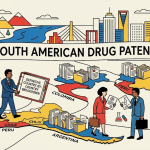
How Brazil’s Patent Filing Dynamics Compare to Other LATAM Markets
Brazil accounts for a disproportionate share of pharmaceutical patent filings in Latin America, reflecting both its market size and the relative strength of its patent examination infrastructure at INPI (Brazil’s National Institute of Industrial Property).
Key differences from other Latin American markets:
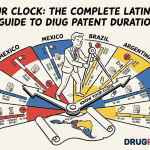
Mexico maintains a patent linkage system through its regulatory agency COFEPRIS, meaning generic approvals are formally blocked while relevant patents remain in force. This creates a longer protected revenue window for originators in Mexico than in Brazil, but it also means the pace of generic market development has been slower.
Argentina has weaker patent enforcement historically and a more complex ANMAT regulatory pathway that has created different market dynamics — domestic companies have more commonly operated in the “similar” drug space rather than the strictly regulated generics market that Brazil’s 1999 law created.
Colombia, Ecuador, and Peru — markets where Eurofarma expanded through the Genfar acquisition — have patent linkage provisions under their respective free trade agreements with the United States. This makes them somewhat more hospitable to originator products seeking full term protection, but their market sizes are substantially smaller than Brazil’s.
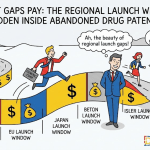
For companies building a pan-regional IP and market access strategy in Latin America, Brazil is the primary market in terms of revenue scale, but its patent de-linkage architecture means the competitive entry timeline differs materially from neighboring markets. A unified regional strategy that assumes Brazil behaves like Mexico on patent linkage will be commercially wrong.
Why Manufacturing Complexity Matters for Brazilian Biosimilar Entry
Biologic drugs are produced in living cell systems — typically Chinese hamster ovary (CHO) cells or microbial fermentation — and are inherently sensitive to manufacturing process parameters. Small variations in upstream cell culture conditions, downstream purification steps, or final formulation can produce a molecule with meaningfully different pharmacokinetics or immunogenicity profiles compared to the reference product.
This manufacturing complexity creates a durable barrier for would-be generic entrants in the biologics space. Unlike small-molecule generics, where a manufacturer must demonstrate bioequivalence through a pharmacokinetic study in a relatively small number of healthy volunteers, biosimilar development requires analytical comparability studies characterizing the molecule across dozens of structural and functional attributes, followed by clinical efficacy and safety data.
For Brazilian companies attempting to enter the biosimilar market — whether EMS, Aché through Bionovis, Blau, or Eurofarma through licensing — the manufacturing investment is the gating constraint. Brazil’s tropical climate (IVb zone) creates specific storage and cold chain demands for biologic products that add distribution cost beyond what European or North American biosimilar entrants would incur.
EMS’s GLP-1 analog launch demonstrates that domestic peptide synthesis capability now exists at commercial scale in Brazil. Peptide synthesis (solid-phase or solution-phase) is distinct from mammalian cell culture used for monoclonal antibodies, but it represents the same fundamental principle: complex molecule manufacturing as a competitive moat. The companies that build this infrastructure first will generate returns on it for years.
Key Takeaways
Brazil’s pharmaceutical patent and competitive dynamics differ from the U.S. and EU in ways that require market-specific analysis rather than extrapolation from other jurisdictions.
The de-linkage of patent status from ANVISA approval compresses the effective exclusivity period for innovators. Generic manufacturers can and do file for registration concurrently with remaining patent term, positioning for day-one launch at LOE.
ANVISA’s regulatory complexity is a genuine barrier to market entry but an asset for incumbents who have mastered it. The domestic champions — Hypera, EMS, Eurofarma, Aché — hold this as a core competitive advantage, and they market it explicitly in partnership negotiations.
EMS’s GLP-1 entry (liraglutide domestically, semaglutide at FDA) signals that Brazilian generics manufacturers are moving up the technical complexity curve in ways that will create competitive pressure for innovators in their home markets, not just in Brazil.
The judicialization channel is a structurally unusual market access mechanism that gives specialty and biologic drugs a high-margin revenue pathway parallel to formal SUS reimbursement. Its durability depends on judicial precedent that remains, as of late 2025, broadly favorable to patients.
The EMS-Hypera merger, if completed, will reshape the competitive landscape for every other participant. CADE’s handling of potential remedies in branded generics will determine whether the combined entity holds a dominant position in multiple segments simultaneously.
For investors, IP teams, and commercial strategists, the analytical discipline required is understanding that Brazil’s pharmaceutical market doesn’t just respond to patent expiry dates — it responds to the date ANVISA approves the first generic, the SUS tender calendar, and the judicial channel’s current volume and win rate. Those three variables together define revenue exposure more precisely than patent expiry alone.
Investment Strategy
Companies seeking to exploit Brazilian pharmaceutical patent dynamics should focus on three positions:
Generic entry timing in Brazil requires patent intelligence that accounts for ANVISA’s approval pipeline, not just INPI patent records. The gap between patent expiry and first generic approval is far shorter than in patent-linked markets. Building a monitoring process around ANVISA’s generic registration database alongside patent tracking closes the analytical blind spot.
Biosimilar commercialization rights in Latin America are underpriced by global standards because of the perceived complexity of regional market access. Eurofarma’s deal with Henlius is one data point. The royalty and licensing structures in these regional deals reflect that perceived complexity discount, which may not accurately capture the value of a company that has already solved the regulatory and distribution challenge.
Specialty drugs with strong judicialization track records in Brazil are not fully captured in standard revenue forecasting models. The judicial channel’s contribution to revenue is material for high-cost biologics and oncology drugs, and it operates outside the normal reimbursement negotiation process. Modeling it requires Brazilian-specific claims and court data, not standard market access frameworks.
This analysis draws on public ANVISA records, Brazilian patent filings at INPI, company financial disclosures, and market research data through November 2025.