1. The Strategic Stakes: Why Your CDMO Model Choice Determines IP Value, Not Just Cost
The question most pharmaceutical executives ask when evaluating a contract development and manufacturing partner is: ‘Who can do this work best?’ That is the wrong question. The right question is: ‘What contractual structure will best protect our IP position, align incentives over a five-year development arc, and preserve our freedom to operate at commercialization?’
Choosing a CDMO model is a legal and intellectual property decision dressed in operational clothing. A Fee-for-Service (FFS) agreement signed without explicit foreground IP assignment clauses can hand process patent rights to the CDMO by default under standard inventorship law. A Full-Time Equivalent (FTE) model without productivity benchmarks converts fixed CDMO costs into an open-ended liability. A strategic partnership with royalty-sharing provisions, structured without a clear carve-out for platform IP, can blur asset ownership in ways that impair a future M&A transaction.
These are not hypothetical risks. They are contractual failure modes that recur across the industry and that erode the value of drug assets long before an NDA is filed.
This guide goes beyond the conventional ‘pros and cons’ framing. It maps each CDMO engagement model against four dimensions that matter to IP teams, R&D leads, and institutional investors: IP ownership risk, incentive alignment over the development timeline, technology transfer optionality (i.e., the practical ability to move manufacturing elsewhere), and embedded valuation implications. Every section includes a Key Takeaways block and, where relevant, an Investment Strategy section written for the analyst who needs to read a partnership announcement and quickly assess whether it creates or destroys asset value.
The global CDMO market reached $238.92 billion in 2024 and is forecast to hit $465.24 billion by 2032 at a 9.0% CAGR, according to Fortune Business Insights. That growth rate is not driven by cost arbitrage. It is driven by the structural shift of pharmaceutical R&D toward virtual and asset-light operating models, by the increasing technical complexity of biologics and cell and gene therapies, and by the post-COVID imperative to build supply chain resilience without the capital cost of owned manufacturing infrastructure.
For investors, that $226 billion in incremental market value between now and 2032 will not be distributed evenly. CDMOs that own proprietary platform IP, hold preferred partnerships with high-value pipeline assets, and have made credible investments in digital manufacturing will capture disproportionate share. The engagement model is the mechanism through which that value accrues, or does not.
Key Takeaways: Section 1
The CDMO engagement model is an IP governance document, not just a procurement agreement.
Default inventorship rules in most jurisdictions favor the CDMO if the contract is silent on foreground IP ownership. Every contract must address this explicitly.
The $465 billion CDMO market forecast reflects a structural change in how pharmaceutical R&D is organized, not a procurement trend. Investors should read CDMO partnership announcements as signals about a drug developer’s pipeline confidence and capital strategy.
2. Decoding the Outsourcing Taxonomy: CRO, CMO, CDMO, and the Blurring of Lines
The Classic Definitions and Why They Are Now Insufficient
A Contract Research Organization (CRO) manages clinical and regulatory work: trial design, patient enrollment, data management, statistical analysis, and regulatory submissions to the FDA, EMA, and equivalent bodies. CROs do not manufacture drug product. Their core asset is regulatory and clinical operations expertise, and their IP contribution to any drug program is limited: they generate data, they do not generate compositions of matter or manufacturing processes.
A Contract Manufacturing Organization (CMO) produces drug product to a client’s existing specification. The CMO’s role begins after process development is complete. The client delivers a validated method; the CMO executes it at scale. There is no development function, no process optimization mandate, and minimal IP generation. CMO contracts are, by design, operationally focused with limited IP complexity.
A Contract Development and Manufacturing Organization (CDMO) combines formulation and process development with clinical-stage and commercial manufacturing under one organizational roof. This integration is the defining feature. The CDMO is present from pre-formulation through to commercial batch release. Because CDMOs are involved in developing the manufacturing process itself, they are active IP generators. Process patents, analytical method patents, and formulation improvement patents can arise from CDMO work. Who owns those patents depends entirely on contractual language, not on who funded the work.
The Consolidation Wave and Its IP Implications
The CDMO sector saw 244 publicly announced M&A transactions between 2017 and 2021. The consolidation continued through 2024 and 2025, with large CDMOs acquiring CRO capabilities and specialty biologics manufacturers absorbing single-use bioreactor platforms. The strategic goal is vertical integration: capture a sponsor at Phase I and own the manufacturing relationship through commercialization.
From an IP perspective, this consolidation has a specific implication for drug developers. When you partner with a large, integrated CDMO that has CRO capabilities, the number of potential IP touchpoints multiplies across the development lifecycle. Bioanalytical method development, process characterization studies, and clinical manufacturing optimization all generate potentially patentable innovations. A sponsor company that enters each phase of work with a separate, phase-specific contract, without a framework IP agreement governing the entire relationship, accumulates IP risk at every transition.
The practical response is a Master Services Agreement (MSA) with an appended framework IP clause that governs all future Statements of Work. Negotiating IP terms once, at the outset of the relationship, is far more efficient and protective than renegotiating them each time a new SOW is executed.
CRO-CDMO Hybrid Organizations: A Due Diligence Consideration
Three of the ten largest CDMOs by revenue now have integrated CRO capabilities, either through acquisition or internal build-out. Lonza, Samsung Biologics, Catalent (now part of Novo Holdings following the $16.5 billion acquisition completed in 2024), and WuXi Biologics each offer services that span from cell line development through commercial manufacturing. Covance, the CRO business historically embedded in Labcorp, has deepened its manufacturing adjacencies. When a single organization can claim involvement at every stage of a program, the IP contamination risk profile changes. A drug developer must ensure that the CDMO’s work on one client’s asset is structurally ring-fenced from work on competing programs, both in terms of personnel and in terms of which proprietary technologies and background IP are brought to bear.
Key Takeaways: Section 2
CDMOs generate IP during development work. CROs and CMOs generally do not. This distinction matters for contracting strategy.
The consolidation of CRO and CDMO functions into single organizations increases IP touchpoints across the development lifecycle.
A Master Services Agreement with a framework IP clause is the most efficient way to govern IP ownership across a multi-year, multi-phase relationship with a vertically integrated CDMO.
3. The Market in Numbers: CDMO Sector Sizing and Investment Signals
Global Market Segmentation
The $238.92 billion CDMO market is not a monolith. It segments by modality, by geography, and by development stage, and each segment has a distinct growth trajectory and competitive structure.
By modality, biologics CDMOs are growing faster than small-molecule CDMOs. The global biologic CDMO market was estimated at approximately $28 billion in 2024 and is projected to grow at a CAGR of 11-13% through 2030. Cell and gene therapy (CGT) CDMOs represent a much smaller absolute base, approximately $4 to $5 billion in 2024, but are growing at 15-18% annually. Small-molecule CDMOs, which handle the bulk of generic and branded oral solid dose production, are growing more slowly at 6-8% annually, with the primary growth driver being the HP-API (highly potent active pharmaceutical ingredient) segment, which includes oncology compounds.
By geography, North America accounts for roughly 35% of global CDMO revenue. Asia-Pacific, led by India and China, accounts for approximately 30%, with China’s CDMO sector facing selective headwinds from U.S. legislative scrutiny of WuXi AppTec and related entities under the BIOSECURE Act discussions. Europe holds approximately 25% of global market share, with particular strength in biologics manufacturing in countries including Switzerland, Germany, and Ireland.
By development stage, the split between clinical-stage manufacturing (Phase I through Phase III) and commercial manufacturing is approximately 40/60 by revenue. This ratio is shifting toward clinical-stage work as the number of INDs filed annually continues to climb, driven by the output of platform-based biotechs working on GLP-1 analogs, ADCs, bispecific antibodies, and RNA therapeutics.
The M&A Premium and IP Valuation
Private equity has been the dominant CDMO acquirer since 2017. The typical EBITDA multiple for a biologics-focused CDMO with proprietary platform technology has ranged from 18x to 26x in recent transactions. For comparison, a generic pharmaceutical manufacturer without proprietary manufacturing IP trades at 8-12x EBITDA.
The premium reflects the embedded IP value in the CDMO’s platform. A CDMO that has patented single-use bioreactor configurations, proprietary cell culture media formulations, or validated continuous manufacturing processes carries an IP asset base that justifies higher multiples. Investors evaluating CDMO equities or PE-backed CDMO assets should conduct a formal IP audit as part of due diligence, mapping patent families to specific service lines and assessing the strength of those patents against competitive CDMOs offering equivalent modality coverage.
The Novo Holdings acquisition of Catalent at $16.5 billion was, in part, an IP acquisition. Catalent’s oral bioavailability platform, including OPTIDOSE and OptiMelt modified-release technologies, represents a set of formulation patents that generate licensing-adjacent revenue from any drug product manufactured using those platforms. Novo structured the deal partly to secure manufacturing capacity for semaglutide (Ozempic/Wegovy), but the platform IP is a separate, durable asset.
Investment Strategy: Reading CDMO Sector Signals
Three market signals are worth tracking on a quarterly basis.
First, the ratio of new client wins from virtual biotechs versus Big Pharma at leading CDMOs. When virtual biotech wins accelerate, it reflects growing pipeline density in early-stage programs and often precedes an increase in IND filings 12-18 months later. This is a leading indicator for clinical-stage CDMO revenue growth.
Second, the geography of capacity expansion announcements. A CDMO breaking ground on a new biologics facility in Ireland or Singapore is signaling a multi-year capacity bet. Cross-reference those announcements against the patent expiration calendars for major biologics: if a wave of biosimilar reference products is coming off patent in 3-4 years, new biologics capacity built today will serve biosimilar commercial demand at the time it comes online.
Third, the modality focus of CDMO acquisitions. When a large CDMO acquires a cell therapy manufacturing specialist or an mRNA synthesis company, it is betting that those modalities will generate sufficient commercial volume to justify integration. Those bets are worth tracking because they reflect where the acquirer’s deal teams believe the commercial pipeline will concentrate.
Key Takeaways: Section 3
CGT CDMOs are the highest-growth CDMO sub-sector at 15-18% CAGR, but also the most capital-intensive and technically complex.
CDMO M&A premiums are materially driven by platform IP. An IP audit is a required component of any CDMO investment due diligence, not an optional enhancement.
The Novo/Catalent deal at $16.5 billion illustrates how CDMO platform patents generate value that is separable from, and additive to, the service revenue base.
4. The Core Value Drivers: Capital De-Risking, Speed, Expertise, and Regulatory Leverage
Capital Efficiency: The Real Arithmetic
The total capitalized cost of bringing a new molecular entity to market is approximately $2.6 billion when accounting for the cost of failures across a development portfolio. A dedicated cGMP biologics manufacturing facility costs $200 to $500 million to build and validate, depending on scale and modality. A sterile injectable fill-and-finish line carries a capital cost of $50 to $150 million. A CAR-T cell therapy manufacturing suite can cost $30 to $80 million for a modestly sized dedicated facility.
Outsourcing eliminates these CapEx commitments and converts them to project-based OpEx. For a publicly traded biotech with $300 million in cash, the choice between building and outsourcing is not primarily about unit economics. It is about burn rate management and investor signaling. A company that spends $150 million of its treasury on a manufacturing facility is telling its shareholders that it has committed to a single asset with sufficient confidence to fund fixed infrastructure. That commitment may accelerate manufacturing control, but it constrains optionality. If the Phase III fails, the facility is a stranded asset.
CDMOs carry that capital risk on their own balance sheets, spreading it across multiple clients and programs. From the sponsor’s perspective, the risk-adjusted cost of outsourcing is lower even if the unit cost is occasionally higher.
Speed-to-Market: The Patent Clock Is Always Running
A Hatch-Waxman small-molecule drug’s effective patent life from NDA approval to first generic entry has compressed to approximately 11-12 years when averaged across the Orange Book. For a biologic, the relevant window is the 12-year regulatory exclusivity period under the Biologics Price Competition and Innovation Act, plus any remaining compound patent life. Every month of delay in reaching market costs revenue that cannot be recovered.
CDMOs with validated, ready-to-use manufacturing platforms eliminate the lead time associated with facility construction, equipment procurement, equipment qualification (IQ/OQ/PQ), and process validation. A CDMO with an existing cGMP-validated single-use bioreactor train of appropriate scale can compress the time from tech transfer to first GMP batch from 18 months to 6-9 months relative to a greenfield build. For a drug with $1 billion in projected annual peak sales, a nine-month time advantage is worth approximately $750 million in incremental patent-protected revenue.
Specialized Technical Expertise: The Modality Gap
No single biopharmaceutical company has deep in-house expertise across the full spectrum of modern drug modalities. The technical distance between manufacturing a conventional monoclonal antibody and manufacturing an AAV gene therapy vector is enormous. AAV production requires specialized adherent or suspension cell culture platforms, ultra-high-titer clarification and purification processes, and analytical methods for measuring viral genome titer, vector particle integrity, and potency that are not required for protein-based biologics.
CDMOs that specialize in specific modalities have accumulated hundreds of batch records, developed proprietary process improvements, and trained teams who understand the failure modes specific to each platform. This accumulated process knowledge is itself an IP asset, often not formally patented but embedded in SOPs, development reports, and the tacit expertise of the scientific staff.
For a company developing its first ADC, partnering with a CDMO that has executed more than fifty ADC conjugation campaigns is not just operationally sensible. It is a risk mitigation strategy that reduces the probability of a chemistry, manufacturing, and controls (CMC) failure at regulatory review.
Regulatory Leverage: cGMP Compliance as a Durable Competitive Advantage
FDA Warning Letters to CDMOs are public and are indexed by establishment. A CDMO with a clean inspection history, zero Warning Letters in the last five years, and successful pre-approval inspections (PAIs) for multiple products is a materially lower regulatory risk than one with a recent Form 483 with multiple observations outstanding. This regulatory track record is a form of IP, in the broad sense: it is accumulated institutional knowledge and quality culture that cannot be easily replicated or transferred.
When a sponsor company selects a CDMO with strong regulatory credentials, it is partly purchasing insurance against a CMC rejection at NDA review. FDA has refused to approve NDAs because the proposed manufacturing site failed a PAI. That outcome delays approval, extends the period of clinical-stage capital outflow, and can cost a year or more of market exclusivity. The cost of that delay, measured against the incremental cost of a high-quality CDMO, almost invariably favors the higher-quality partner.
Key Takeaways: Section 4
The capital efficiency argument for CDMOs is strongest for companies managing portfolio risk across multiple assets. For a company with a single, high-conviction program, the build-versus-outsource decision is more nuanced.
Speed advantages compound against the patent clock. A nine-month acceleration for a $1 billion peak-sales drug is worth approximately $750 million in additional protected revenue.
FDA Warning Letter history is a quantifiable regulatory risk factor in CDMO selection. It belongs in any due diligence scorecard alongside technical capability assessments.
5. The Transactional Pillar: Fee-for-Service (FFS) and Its Variants
The Fee-for-Service Model: Mechanics and Contractual Architecture
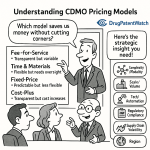
Fee-for-Service is the dominant commercial structure across the CDMO sector by transaction count, if not by total revenue. It governs the majority of analytical testing, single-batch manufacturing runs, formulation development campaigns, and discrete process optimization studies.
The FFS contract is built around a Statement of Work that defines the deliverable with precision: the specific analytical method to be developed, the specific number of GMP batches to be produced, the exact specifications the output must meet. Payment is tied to delivery of the defined output at the defined specification. The CDMO assumes the risk of executing the task within the agreed fee. The sponsor assumes the risk that the task, when completed, advances the program.
A well-constructed FFS SOW has at minimum six structural elements. It specifies the technical scope in sufficient detail that both parties could independently reproduce the experimental design. It defines acceptance criteria objectively, either as numerical pass/fail thresholds or as comparison against reference standards. It states the timeline in business days from agreed start date, not calendar weeks, to prevent ambiguity. It defines the change order process, including the maximum elapsed time for CDMO response to a change request and the pricing methodology for out-of-scope work. It specifies the data deliverables, including the format, the level of raw data included, and whether the CDMO’s electronic laboratory notebook (ELN) entries are accessible to the sponsor. And it includes IP assignment language that explicitly assigns to the sponsor all work product, inventions, and improvements arising from the scope, subject to a carve-out for CDMO background IP.
The IP Asymmetry Problem in FFS Contracts
Under U.S. patent law, an invention belongs to the inventor(s). In a CDMO context, the inventors are typically CDMO employees, because they are the ones with hands on the bench. Unless the FFS contract explicitly assigns those inventions to the sponsor, the CDMO owns any process improvements that arise from the work, regardless of who funded the research.
This is not a theoretical risk. It is a documented pattern. A CDMO that develops a new crystallization technique for a sponsor’s API during an FFS development campaign has patentable process IP. If the contract says nothing about IP ownership, that patent belongs to the CDMO. The sponsor may have a shop right, a limited license to use the process for its own product, but it does not own the IP, cannot license it to a third party, and may face a licensing demand if it wishes to transfer manufacturing to a different CDMO.
The solution is a work-for-hire clause or a broad assignment clause that captures all inventions conceived or first reduced to practice during the performance of the services. The CDMO will typically negotiate a carve-out for improvements to its background IP. That carve-out is reasonable and should be accepted, but it must be scoped narrowly to genuine platform improvements rather than product-specific innovations.
IP Valuation Implications of FFS Models
From an asset valuation perspective, a drug program developed entirely under FFS contracts without comprehensive IP assignment clauses carries a cloud on its manufacturing IP title. During a licensing transaction, M&A due diligence, or IPO prospectus review, a patent attorney will request a chain of title analysis for all IP claimed in the CMC sections of the regulatory file. If the process patents are held by the CDMO, the drug developer cannot represent clean ownership, which depresses valuation and requires negotiation of licenses before the transaction can close.
Quantifying this impairment is difficult, but advisory practice suggests that unresolved CDMO IP ownership issues require a discount to product valuations in the range of 5-15% of NPV, depending on the centrality of the disputed process to commercial manufacturing and the freedom-to-operate risk it creates.
FFS Variant: Time and Materials (T&M)
Time and Materials contracts pay the CDMO for actual labor hours at an agreed rate per FTE category (e.g., Research Scientist, Senior Scientist, Principal Scientist) plus the actual cost of materials and consumables. T&M is appropriate for early-stage, highly exploratory work where the SOW cannot be defined with sufficient precision to support a fixed-price quote.
The financial risk in a T&M arrangement rests entirely with the sponsor. There is no ceiling on cost unless one is explicitly negotiated. Best practice is to include a ‘not-to-exceed’ cap that requires a mutual written authorization to exceed, giving the sponsor budget control without eliminating the flexibility that makes T&M useful. T&M contracts should also include a monthly or bi-weekly reporting obligation from the CDMO, detailing hours expended by FTE category, materials consumed, and progress against milestones. Without this cadence, cost overruns are discovered retrospectively rather than managed proactively.
FFS Variant: Fixed-Price Contracts
Fixed-price contracts are the maximum-rigidity variant of the FFS model. A single aggregate price covers an entire defined scope, with no adjustment for labor cost variances, material cost changes, or normal experimental complexity. The CDMO must price its risk comprehensively upfront, which means the fixed price invariably includes a risk contingency that can represent 15-30% of the underlying cost estimate.
Fixed-price contracts are most appropriate for late-stage, commercial-scale manufacturing where the process is locked, analytical methods are validated, and the primary risk is execution rather than development. They are poorly suited to any work with scientific uncertainty, because the CDMO’s rational response to a fixed price and an uncertain scope is to minimize effort to protect margin, not to invest additional effort to solve hard problems.
When FFS Model Breaks Down: The Change Order Trap
Drug development programs routinely generate unexpected results that require scope changes. An analytical method that performs in preliminary development may fail validation under conditions that were not anticipated. A formulation that demonstrates acceptable stability at 25 degrees Celsius may fail the 40-degree accelerated stability test, requiring reformulation work outside the original SOW. A manufacturing step that was process-validated at 50-liter scale may require reoptimization at 500-liter scale.
Each of these deviations from the original SOW requires a change order in an FFS arrangement. Drafting, negotiating, and executing a change order takes time, sometimes weeks when the legal and procurement teams on both sides become involved. During that period, work on the affected scope either stops or proceeds at the sponsor’s risk without a governing contract. At a development-stage biotech where every week matters against a competitive clinical timeline, the change order latency associated with a rigid FFS structure is a material operational liability.
The quantitative case: if a typical FFS clinical manufacturing campaign generates three to five out-of-scope events requiring change orders, and each change order takes two to three weeks to execute, the cumulative timeline impact is six to fifteen weeks of avoidable delay. For a program racing to an IND filing or an NDA submission, that delay has a direct and calculable cost in patent-protected revenue.
Key Takeaways: Section 5
FFS contracts generate IP ownership risk by default. Without explicit assignment language, process innovations belong to the CDMO under standard inventorship rules.
Unresolved CDMO IP ownership issues can reduce drug asset NPV by 5-15% in M&A and licensing transactions.
The change order mechanism in FFS contracts is a systematic source of timeline delay. For programs with high scientific uncertainty, the accumulated delay cost can exceed any cost savings from fixed-fee pricing.
Investment Strategy: FFS as a Valuation Signal
When a small-cap biotech’s annual report or SEC filing indicates that its entire CMC program is governed by FFS contracts, investors should probe the IP ownership terms in those contracts. If the company cannot confirm clean IP title on its manufacturing processes, that is a valuation risk factor that is frequently overlooked in analyst coverage. Biosimilar developers and generic pharmaceutical companies routinely use FFS models for commercial manufacturing and are less affected by this issue because the manufacturing process for a generic is not a proprietary asset. For a novel drug program, it matters substantially.
6. The Relational Pillar: Full-Time Equivalent (FTE) and Strategic Partnership Models
The Full-Time Equivalent (FTE) Model: Mechanics and Financial Architecture
The FTE model pays the CDMO for the dedicated availability of a defined number of scientific personnel at a fixed monthly or annual rate. Payment is not tied to specific deliverables or milestones. It is tied to the CDMO’s commitment to keep the agreed headcount working exclusively on the sponsor’s program.
The commercial structure is straightforward. The sponsor and CDMO agree on a team composition: for example, two Senior Scientists, one Analytical Chemist, and one Process Engineer. The monthly rate for each FTE category is set contractually, typically at a blended all-in cost that covers salary, benefits, overhead, equipment access, and CDMO margin. The sponsor pays this rate monthly regardless of scientific outcomes. The team’s work priorities are directed by the sponsor, usually through a designated alliance manager who communicates daily or weekly project direction.
The FTE model is most commonly used for drug discovery, lead optimization, early formulation development, and process chemistry campaigns at the API synthesis stage. It is also used increasingly for platform-based biologics programs where the sponsor needs a standing team to advance multiple molecules through the same manufacturing platform in parallel.
FTE Model: IP Ownership Structure
The IP dynamics in an FTE model are structurally cleaner than in FFS, but the same default inventorship rules apply. The sponsor is paying for the team’s time, not for IP. Any inventions made by the CDMO team belong to the CDMO’s employees under patent law, and by extension to the CDMO, unless the contract explicitly assigns them to the sponsor.
Because the FTE team is working under the sponsor’s direction and on the sponsor’s molecules, the legal and commercial case for full IP assignment to the sponsor is stronger in an FTE arrangement than in an FFS arrangement. The sponsor is directing the research and providing the inventive concepts. The CDMO is providing the hands and the laboratory infrastructure. Many FTE contracts reflect this by including a full assignment clause covering all inventions developed by the FTE team in the performance of the work.
The carve-out that the CDMO will negotiate concerns genuine platform improvements, meaning improvements to their own synthesis routes, purification platforms, or analytical platforms that arise incidentally from the sponsor’s program but have broad applicability to other clients. A well-structured FTE IP clause assigns all product-specific inventions to the sponsor while allowing the CDMO to retain (and separately patent, with a license-back to the sponsor) platform improvements.
IP Valuation in FTE Arrangements: The Portfolio Consideration
For companies using an FTE arrangement to advance a portfolio of related molecules, the IP picture becomes more complex. Consider a biotech developing a series of KRAS inhibitors, where the medicinal chemistry campaign is being run by an FTE team at a CDMO. If the FTE team develops a novel synthetic route that is applicable to the entire KRAS inhibitor series, who owns that route? The sponsor, because the work was done under the FTE arrangement? Or the CDMO, because the route is a general synthetic methodology and not specific to one compound?
This ambiguity requires proactive handling. The FTE contract should include a schedule that explicitly defines the scope of the sponsor’s program, including all molecules and series being advanced. Any invention that is useful primarily for compounds within that schedule should assign to the sponsor. Any invention of broader utility that arose from work on the schedule should be jointly assessed by a technical committee, with an agreed default mechanism for resolving ownership disputes.
Managing the FTE Model: Governance and Productivity Metrics
The FTE model’s primary operational risk is invisible underperformance. A CDMO can technically comply with an FTE contract by keeping the agreed headcount in place while those individuals are working at reduced productivity, handling competing priorities, or assigned to tasks that do not advance the sponsor’s program. Because the sponsor is not purchasing specific deliverables, there is no contractual mechanism to withhold payment for substandard output.
The practical mitigation is a robust governance structure built into the contract. This includes weekly written progress reports from the FTE team lead, covering experiments conducted, results obtained, and work planned for the following week. It includes monthly key performance indicators (KPIs) that track meaningful scientific outputs: compounds synthesized per month, analytical runs completed, yields achieved versus targets. And it includes quarterly business reviews (QBRs) attended by senior leadership from both organizations, where cumulative progress is assessed against the development plan.
Some sponsors include a right to request replacement of specific FTE team members if, after a documented performance management process, an individual is not meeting productivity expectations. This provision is commercially sensitive for the CDMO but is a reasonable protection for a sponsor investing hundreds of thousands to millions of dollars annually in the arrangement.
The Strategic Partnership Model: Full Mechanics
A strategic partnership between a drug developer and a CDMO is a long-term, financially integrated collaboration where both parties share meaningful upside and downside from the program’s outcome. The defining structural feature is the risk/reward sharing mechanism.
Compensation in a strategic partnership includes some combination of milestone payments tied to specific development achievements (IND filing, Phase I completion, Phase III success, regulatory approval), reduced fee-for-service rates during the development phase in exchange for royalty rights on commercial sales, and in some cases equity stakes. The CDMO’s total compensation is materially lower in failure scenarios and materially higher in success scenarios compared to standard FFS or FTE rates.
Governance is correspondingly more complex. A Joint Steering Committee (JSC) with defined decision-making authority meets at regular intervals, typically quarterly, to review program status, approve major development decisions, resolve disputes, and align on resource allocation. Below the JSC, a Joint Project Team handles day-to-day coordination. Escalation pathways must be contractually defined to prevent minor operational disputes from festering into JSC-level conflicts.
The IP Calculus in Strategic Partnerships
Strategic partnerships create the most complex IP landscape of any CDMO engagement model, because both parties have a financial stake in the program’s success and therefore a motivation to claim ownership of innovations that increase the program’s value.
The IP provisions in a strategic partnership agreement must address at minimum four categories. First, sponsor background IP: all IP the sponsor brings to the relationship, which remains exclusively owned by the sponsor and is licensed to the CDMO only to the extent necessary to perform the services. Second, CDMO background IP: all IP the CDMO brings to the relationship, particularly platform technologies, which remains exclusively owned by the CDMO and is licensed to the sponsor to the extent necessary to manufacture and commercialize the product. Third, sponsor foreground IP: all inventions related to the product, its formulation, its indications, and its clinical uses that arise from the partnership, which should be assigned to the sponsor. Fourth, CDMO foreground IP: all inventions related to manufacturing processes, analytical methods, and process engineering improvements that arise from the partnership, where ownership must be negotiated, often resulting in CDMO ownership with a non-exclusive license to the sponsor that includes the right to sublicense to alternate manufacturers.
The license-back right on CDMO foreground IP is critical for preserving the sponsor’s freedom to operate. If the sponsor relies on a CDMO-owned process patent to manufacture its drug, and the partnership later deteriorates, the sponsor must be able to transfer manufacturing to another CDMO without requiring the original CDMO’s consent. A well-drafted strategic partnership agreement grants the sponsor a perpetual, irrevocable, royalty-bearing (at a pre-negotiated rate) license to the CDMO’s manufacturing IP, which is sublicensable to a replacement manufacturer in defined circumstances.
Key Takeaways: Section 6
FTE model IP assignment is legally more defensible than FFS model assignment, because the sponsor controls the research direction. But explicit contractual assignment is still required.
Strategic partnerships generate IP in four distinct categories, each requiring separate ownership and licensing provisions.
The single most important protective mechanism in a strategic partnership is the license-back right on CDMO manufacturing foreground IP, which preserves the sponsor’s freedom to change manufacturers without losing access to its own commercialized process.
Investment Strategy: Strategic Partnerships as Pipeline Confidence Signals
When a biotech announces a strategic partnership with a major CDMO that includes development milestones and commercial supply commitments, that announcement carries information content beyond the manufacturing deal itself. It signals that a sophisticated, operationally expert counterparty has assessed the program’s probability of success and accepted reduced current-period fees in exchange for contingent future payments. That is a credibility signal. It is not definitive, CDMOs make bad bets, but it is incremental information that the market sometimes underweights. Analysts covering early-stage biotechs should note the identity of the CDMO strategic partner and the term structure of the milestone payments as part of pipeline probability assessments.
7. The New Frontier: Hybrid and Technology-Driven CDMO Models
The Shilpa Medicare Hybrid Model: IP Creation as a Business Line
Shilpa Medicare, the India-headquartered pharmaceutical company that has positioned itself as a hybrid CDMO, launched its formal hybrid model at DCAT Week in March 2025. The model has two parallel revenue streams. On one side, Shilpa offers conventional CDMO services, covering discovery chemistry, process development, analytical development, and clinical and commercial manufacturing for sponsor-owned molecules. On the other side, Shilpa develops its own portfolio of novel formulations, drug-device combinations, and late-stage pharmaceutical products using internal R&D resources, then licenses those fully developed assets on an exclusive B2B basis to pharmaceutical companies seeking to enter new therapeutic areas without carrying development risk.
The IP valuation logic of the Shilpa model is worth unpacking. When Shilpa develops a product internally and licenses it to a pharma company, the license fee, milestone, and royalty structure reflects the full value of the development work completed, the strength of the IP protecting the formulation or process, and the market exclusivity the licensee receives. Shilpa retains the IP, collects royalty streams, and can relicense to multiple non-competing geographies. The economics are fundamentally different from fee-for-service manufacturing, where Shilpa would receive a one-time manufacturing payment with no residual value.
For pharmaceutical companies evaluating the Shilpa model as licensees, the decision calculus compares the cost of internal development, including the time cost measured against patent life, against the license fee plus royalty for an asset that is ready to file. For a small pharma company looking to add a second product to support a commercial infrastructure, licensing a developed asset at Phase III readiness can be more capital-efficient than internally developing a comparable molecule from Phase I, even accounting for the royalty tail.
IP Valuation: Shilpa Medicare’s Asset Base
Shilpa Medicare’s IP portfolio spans oncology formulations, peptide API manufacturing processes, and advanced drug delivery systems. As of early 2026, the company holds patents in multiple jurisdictions covering modified-release formulations and proprietary synthesis routes for oncology APIs. The licensing model converts this patent portfolio into a recurring revenue stream that is qualitatively different from manufacturing contract revenue: it scales with the commercial success of the licensee’s product without requiring Shilpa to invest additional manufacturing capacity.
For investors in Shilpa or comparable hybrid CDMOs, the IP portfolio is the primary long-term value driver, not the manufacturing utilization rate. Valuing a hybrid CDMO requires two separate valuation methodologies applied to the two business lines: a DCF or comparable transaction multiple for the manufacturing services revenue, and a patent portfolio valuation, using royalty relief, income approach, or comparable licensing transaction benchmarks, for the IP licensing revenue. The blended multiple should be materially higher than a pure-play manufacturing CDMO, reflecting the higher margin and more durable nature of IP licensing revenue.
The High-Science, High-Touch (HSHT) Operational Model
The HSHT model, described in detail by Applied Clinical Trials in January 2025, is an operational philosophy rather than a distinct contractual structure. It can overlay an FFS, FTE, or strategic partnership contract. The model responds to a documented pattern in sponsor feedback: that large, integrated CDMOs deliver technical capability but not the responsiveness, communication transparency, or senior scientific attention that smaller biotechs need to advance complex programs efficiently.
In practice, HSHT means that a CDMO commits to direct, senior-scientist-level engagement on every client program, rather than routing sponsor communication through project management layers. It means that a sponsor’s development team has direct access by phone or video to the principal scientist executing the work, not only to the project manager coordinating it. It means that issues are communicated proactively, with proposed solutions, rather than disclosed in scheduled progress reports.
The HSHT model requires CDMOs to manage their project loads carefully, because it is fundamentally incompatible with high-throughput, high-client-volume operations. CDMOs that credibly deliver HSHT service typically cap their concurrent client count per scientific team and charge a premium for the model relative to standard FFS rates.
For small and virtual biotechs, this premium is often justified. When a virtual company has two or three scientists on staff and its entire program depends on CDMO execution, the cost of a communication failure, a missed technical problem, or a week’s delay in receiving results can exceed the cost of the HSHT premium many times over.
Key Takeaways: Section 7
The Shilpa hybrid CDMO model generates IP licensing revenue that should be valued on a separate, higher multiple than manufacturing service revenue in any company valuation.
HSHT is a service delivery model, not a contract structure. It is most valuable for virtual and early-stage companies whose programs cannot tolerate communication latency or impersonal project management.
Investors should distinguish between CDMOs that own meaningful proprietary platform IP and those that offer manufacturing capacity alone. The former justify premium multiples; the latter do not.
8. IP Valuation Frameworks in CDMO Partnerships
Why Manufacturing IP Is Undervalued in Drug Asset Assessments
Standard pharmaceutical asset valuation models focus on compound IP: the composition of matter patent, the method-of-use patents, and the regulatory exclusivity period. Manufacturing process IP is systematically undervalued in these models for two reasons.
First, process patents are harder to assess without detailed technical review. A composition-of-matter patent is visible in the Orange Book, its expiration date is publicly tracked, and its claim scope can be assessed by a patent attorney with access to the prosecution history. A manufacturing process patent is not in the Orange Book. It may be held by the CDMO rather than the drug developer. Its relevance to commercial production may only become apparent during a technology transfer attempt.
Second, the value of manufacturing process IP is contingent rather than intrinsic. A process patent only matters if the process is commercially necessary, if equivalent alternative processes are unavailable, and if the patent owner is willing to enforce or license it. All three conditions must hold simultaneously for the IP to affect valuation. This contingency makes process IP difficult to model, so analysts ignore it.
The practical consequence is that drug asset valuations consistently undercount the embedded value of strong manufacturing process IP held by the drug developer, and fail to adequately discount valuations for programs where the manufacturing IP sits at the CDMO.
The Three-Layer IP Stack in CDMO Partnerships
Any drug program that has passed through CDMO development work has a three-layer IP stack.
The first layer is compound IP: composition of matter patents, polymorph patents, formulation patents, and method-of-use patents held primarily by the drug developer. This layer is the most visible and the most robustly valued.
The second layer is process IP: manufacturing process patents, API synthesis route patents, analytical method patents, and process parameter patents. This layer may be held by the drug developer, by the CDMO, or jointly, depending on contractual terms and inventorship. Drug developers who have negotiated comprehensive IP assignment in their CDMO contracts own this layer cleanly. Those who have not may face a licensing cost or a technology transfer obstacle at commercialization.
The third layer is platform IP: the CDMO’s proprietary technology platforms that are used in manufacturing the drug but are not specific to the drug itself. Examples include Catalent’s OPTIDOSE bioavailability enhancement platform, Lonza’s Ibex biologics production platform, and Rentschler Biotechnologie’s single-use bioreactor configurations. The drug developer does not own this layer. They access it under license as part of the manufacturing agreement. The durability of that access, specifically the terms under which the license continues if the manufacturing relationship changes, is a key IP risk factor.
Assessing the Second Layer: Process Patent Ownership Due Diligence
For institutional investors conducting due diligence on a drug asset, second-layer IP assessment requires answering four questions. Who owns the process patents used in current commercial or clinical manufacturing? If any process patents are held by the CDMO, does the drug developer have a license that is sublicensable to alternative manufacturers? Are there equivalent alternative manufacturing processes that could be used without the CDMO’s IP, and have they been technically validated? And what would the cost and timeline of technology transfer to an alternative manufacturer be, measured in months and dollars?
If the answer to the second question is ‘no’ and the answer to the third is ‘we don’t know,’ the drug developer is in a position of manufacturing IP lock-in. That is a negotiating disadvantage in any CDMO contract renewal and a potential obstacle to a pharmaceutical licensing deal or acquisition.
Evergreening Through Manufacturing Process Patents
Pharmaceutical companies with strong CMC teams and CDMO partners who assign process IP broadly use manufacturing process patents as an evergreening tool. The composition-of-matter patent on a small molecule typically expires 20 years from filing, with the effective market exclusivity period compressed by the time spent in development and regulatory review. But a new manufacturing process developed during commercial-stage process optimization, which generates a purer API, reduces impurities to new levels, or enables a new dosage form, can be patented with a new filing date.
If the new process is licensed exclusively to the drug developer and is materially superior to any publicly available alternative, a generic challenger seeking to copy the drug must either license the process or develop a non-infringing alternative. This creates a secondary barrier to generic entry that extends the commercial exclusivity period beyond the original compound patent expiration. It is not a substitute for composition-of-matter protection, but it is a supplementary tool in a comprehensive patent lifecycle management strategy.
This tactic requires that the CDMO assign process improvements to the drug developer, making the original IP assignment clause in the CDMO contract an evergreening enabler decades into the future.
Key Takeaways: Section 8
Manufacturing process IP (second-layer IP) is systematically undervalued in standard drug asset assessments. IP teams should maintain a full three-layer IP inventory for every commercial-stage program.
Manufacturing IP lock-in, where the drug developer lacks sublicensable access to the manufacturing IP, is a quantifiable valuation risk factor in M&A and licensing due diligence.
CDMO-assigned process patents can function as evergreening tools. The original IP assignment clause in a CDMO contract is an enabler of long-term patent lifecycle management strategy.
9. The Strategic Playbook: Selection, Contracting, and Ongoing Governance
A Four-Dimension CDMO Selection Framework
Standard CDMO selection processes use weighted scorecards that assess technical capability, quality systems, regulatory track record, project management capability, and cost. These dimensions are necessary but not sufficient. A complete selection framework adds four dimensions that are typically underweighted.
The first is IP ownership precedent: what is the CDMO’s standard contractual position on IP ownership, and how far are they willing to deviate from it? A CDMO that insists on retaining ownership of all process improvements as a standard commercial position is indicating a cultural IP posture that will recur in every contract renegotiation.
The second is technology transfer independence: has the CDMO successfully executed technology transfers of complex processes to alternative manufacturers on behalf of clients, and what was the timeline and cost? A CDMO that has never experienced a technology transfer out is not a reliable data point on the feasibility of exit.
The third is financial stability: a CDMO that becomes insolvent during a commercial supply arrangement creates a supply disruption that can trigger drug shortages, FDA scrutiny, and investor liability. Review audited financials, assess debt covenants, and understand the PE ownership structure and its exit timeline.
The fourth is digital manufacturing maturity: what Industry 4.0 capabilities has the CDMO deployed, and are they validated for GMP use? Digital twin capability, process analytical technology (PAT) integration, and manufacturing execution system (MES) connectivity to electronic batch records are increasingly standard expectations. A CDMO without a credible digital manufacturing roadmap is investing in a depreciating infrastructure.
CDMO Model Selection Matrix
The following matrix maps the primary engagement models against five decision variables. It is intended as a starting point for the selection decision, not a definitive algorithm.
Decision Variable
FFS
T&M
Fixed Price
FTE
Strategic Partnership
Scientific uncertainty
Low
High
Very Low
High
Medium-High
Program duration
Short
Short
Short
Medium-Long
Long
Budget certainty requirement
High
Low
Maximum
Medium
Low-Medium
IP ownership priority
Critical (requires specific clauses)
Critical (requires specific clauses)
Critical (requires specific clauses)
High (generally favorable)
Complex (requires full IP framework)
CDMO incentive alignment
Low
Low
Very Low
Medium
High
Technology transfer optionality
High
High
High
Medium
Low-Medium
Regulatory track record requirement
High
Medium
High
Medium
High
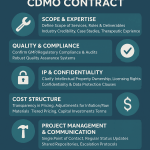
Contract Architecture: The Seven Non-Negotiable Clauses
Beyond the standard commercial terms, seven clauses require careful, specific attention in any CDMO agreement.
First: IP Assignment and Background IP Carve-Out. All foreground IP related to the product or its manufacturing assigns to the sponsor, subject to a narrowly defined carve-out for CDMO platform improvements. The carve-out must be defined in technical terms, not commercial terms.
Second: Sublicensable License to CDMO Foreground Manufacturing IP. In any arrangement where the CDMO retains manufacturing process IP, the sponsor must hold a perpetual, irrevocable, royalty-bearing (at a pre-negotiated rate), sublicensable license to use that IP in manufacturing the drug at any facility, including facilities operated by alternative manufacturers.
Third: Change Control with Defined Response Timelines. Every change order request triggers a mandatory CDMO response within a defined number of business days (typically five to ten business days), including a proposed timeline and cost impact. Failure to respond within the defined period triggers an automatic escalation protocol.
Fourth: Technology Transfer Provisions. The contract must specify that upon termination (for cause or convenience), the CDMO will provide a comprehensive technology transfer package, including all batch records, development reports, analytical methods, raw material specifications, process descriptions, and regulatory filing data, within a defined period (typically 30 to 90 days). Any CDMO IP included in the package is automatically sublicensed to the receiving manufacturer.
Fifth: Quality Agreement (QAA) Hierarchy. The QAA must clearly establish which party is the legally responsible entity (LRE) for batch release under applicable regulatory frameworks, and define dispute resolution for quality disagreements. The QAA should be executed simultaneously with the main services agreement, not as an afterthought.
Sixth: Audit Rights. The sponsor has the right to conduct (or have conducted on its behalf) GMP facility audits with reasonable notice (typically five to fifteen business days) and to review manufacturing records, deviation logs, and out-of-specification investigation reports on request. Limitations on audit scope or frequency should be explicitly negotiated and documented.
Seventh: Force Majeure and Supply Continuity. The force majeure clause must include a specific obligation for the CDMO to notify the sponsor within 48 hours of any event that may affect supply continuity, implement business continuity measures within a defined period, and facilitate technology transfer to an alternative site if the force majeure event persists beyond a defined duration.
Key Takeaways: Section 9
Four dimensions of CDMO selection are consistently underweighted: IP ownership precedent, technology transfer independence, financial stability, and digital manufacturing maturity.
Seven contract clauses are structurally critical and cannot be treated as boilerplate: IP assignment, sublicensable manufacturing IP license, change control with defined timelines, technology transfer on termination, QAA hierarchy, audit rights, and force majeure with supply continuity obligations.
The QAA is not an administrative document. It is the governing framework for GMP compliance and batch release authority and should be executed with the same care as the commercial agreement.
10. Patent Intelligence as Due Diligence: Reverse-Engineering the Sales Pitch
The Conventional Due Diligence Gap
A standard CDMO audit evaluates facility design, quality systems, equipment qualification records, regulatory inspection history, and project management processes. These are backward-looking assessments of what the CDMO has done. Patent intelligence adds a forward-looking assessment of what the CDMO has invented and how that innovation posture has changed over time.
CDMOs routinely use patent monitoring services, including DrugPatentWatch, to identify pharmaceutical companies with new patent filings that signal upcoming development and manufacturing needs. They analyze patent claims to understand the technical challenges a company faces and tailor their business development messaging accordingly. There is no reason pharmaceutical companies cannot run the same analysis in reverse.
The Reverse Patent Intelligence Protocol
A systematic patent intelligence review of a potential CDMO partner uses the following protocol.
Start with an assignee search on the CDMO’s full legal name and all known subsidiaries in patent databases including USPTO, EPO, and WIPO. Extract all patent families filed in the last ten years with the CDMO as assignee. Categorize them by technology area: synthesis processes, analytical methods, formulation technologies, manufacturing equipment modifications, process control methods, and biological manufacturing platforms.
Cross-reference the categorized patent portfolio against the CDMO’s claimed service line expertise. If the CDMO claims leadership in continuous manufacturing but holds zero patents related to continuous flow chemistry or continuous manufacturing process monitoring, their leadership claim rests on know-how and operational experience rather than protected innovation. That is not necessarily disqualifying, but it means the technology is transferable to competitors, which has implications for the CDMO’s long-term competitiveness in that service line.
Assess the recency distribution of the portfolio. A CDMO whose most recent relevant patent filings are from 2017 or 2018 has a stagnant innovation trajectory in that area. Compare to a CDMO with active filings through 2024-2025 in the same area, which is investing in keeping its IP position current.
Identify co-inventors and co-assignees. Academic co-inventors on CDMO patents indicate active research partnerships with universities, which are often a source of early-stage technology access. Co-assignees from pharmaceutical companies may indicate prior collaborative arrangements or joint development agreements, and can reveal which therapeutic areas and modalities the CDMO has worked on most intensively.
DrugPatentWatch as a CDMO Intelligence Platform
DrugPatentWatch provides structured access to pharmaceutical patent data including assignee-level searches, patent expiration tracking, and Orange Book correlation. For CDMO due diligence, the platform’s utility extends beyond traditional drug patent expiration monitoring. By searching for CDMO entities as assignees and correlating filing dates and technology classifications against public commercial announcements (new service line launches, facility expansions, partnership announcements), analysts can construct a timeline of the CDMO’s strategic investments and innovation priorities.
This is particularly valuable in biologics and CGT manufacturing, where the process IS the product in regulatory terms, and where process innovation is a primary competitive differentiator. A biologics CDMO that cannot demonstrate a proprietary, patent-protected approach to upstream process development, harvest and purification, or formulation stability for biologics is offering a commodity service.
Key Takeaways: Section 10
Patent assignee analysis reveals whether a CDMO’s claimed technology expertise is protected by IP or rests on unprotected know-how. The former is more durable; the latter is more transferable to competitors.
Recency distribution of a CDMO’s patent portfolio is an indicator of ongoing R&D investment. A stagnant portfolio suggests declining innovation capacity.
Platforms such as DrugPatentWatch enable systematic reverse-patent-intelligence analysis as part of CDMO due diligence, adding an objective layer of validation to the conventional audit and RFP process.
Investment Strategy: Patent Portfolio Density as a CDMO Quality Proxy
For investors evaluating CDMOs as acquisition targets or public company investments, patent portfolio density, measured as the number of active patent families per unit of R&D headcount, is a useful proxy for IP-generative productivity. A CDMO with high revenue and low patent density is likely competing primarily on capacity and price rather than proprietary technology. Margin erosion is the predictable long-term outcome as capacity expands industry-wide. A CDMO with high patent density relative to revenue is building IP assets that will support premium pricing and protect market share as the sector becomes more competitive.
11. The Biosimilar Imperative: How the Interchangeability Race Reshapes CDMO Model Selection
Biosimilar Interchangeability: The Regulatory and Commercial Stakes
The FDA’s framework for biosimilar interchangeability, established under the BPCIA and operationalized through the Purple Book, creates a tiered commercial hierarchy. A biosimilar designated as interchangeable with the reference biologic can be substituted at the pharmacy without physician intervention in jurisdictions with automatic substitution laws. Non-interchangeable biosimilars require a prescriber’s active decision to use the biosimilar rather than the reference product. In practice, interchangeability designation can determine whether a biosimilar achieves meaningful market penetration or remains a niche alternative.
Manufacturing is the route to interchangeability. A biosimilar candidate must demonstrate that it produces ‘no greater risk’ of immunogenicity or diminished efficacy from switching between the biosimilar and the reference product, as established in comparative pharmacokinetic and clinical studies. Achieving this requires manufacturing consistency at a level that is defined by the analytical comparability of the biosimilar to the reference biologic. The manufacturing process determines product quality attributes; product quality attributes determine the comparability data; comparability data determines the interchangeability designation.
This means that the CDMO’s ability to deliver a manufacturing process that produces highly consistent, reference-comparable product is not just a technical requirement. It is a market access requirement. A biosimilar developed with a CDMO whose manufacturing platform cannot achieve the required analytical comparability will fail interchangeability, capturing a smaller market share at a lower price than the interchangeable competitor.
CDMO Model Preferences in the Biosimilar Sector
Biosimilar development programs have distinctive CDMO model preferences driven by their competitive and economic dynamics.
Cell line development and upstream process development for biosimilars are typically executed under FTE or early-stage FFS arrangements, because the scientific uncertainty during this phase is high and the need for iterative experimentation is substantial. The sponsor needs flexibility to change the cell line strategy, modify the upstream conditions, and test multiple purification approaches before committing to a defined process.
Once the candidate process is selected and the analytical comparability to the reference product is established, the development model transitions to a more structured FFS arrangement for formal process development, method validation, and clinical batch manufacturing. The scope becomes definable and the risk profile changes from scientific uncertainty to execution risk.
Commercial manufacturing for biosimilars is almost always governed by long-term supply agreements, often with volume commitments, because biosimilar economics depend on cost-of-goods management at commercial scale. The competitive position in the biosimilar market is primarily a cost competition, and locking in favorable commercial manufacturing rates through a long-term supply agreement is a strategic priority.
The interchangeability race has also driven some biosimilar developers to enter strategic partnerships with CDMOs that specialize in reference-product analytical characterization. The ability to comprehensively characterize the reference product and then demonstrate that the biosimilar manufacturing process produces a product within the comparability window requires deep analytical capability. A CDMO with proprietary multi-attribute method (MAM) platforms and extensive reference biologic characterization databases has a specific competitive advantage in biosimilar programs that warrants partnership-level engagement rather than transactional FFS contracting.
Key Takeaways: Section 11
Biosimilar interchangeability designation is a manufacturing quality achievement, not just a regulatory process. The CDMO’s analytical comparability capabilities directly determine market access.
Biosimilar commercial manufacturing is primarily a cost competition. Long-term supply agreements with volume commitments and price reduction mechanisms are the standard commercial structure for commercial-stage biosimilar manufacturing.
CDMOs with proprietary MAM analytical platforms and reference biologic characterization capabilities command a premium for biosimilar programs and justify partnership-level contracting.
12. Cell and Gene Therapy Manufacturing: Why Standard CDMO Models Break Down
The CGT Manufacturing Problem
Cell and gene therapies impose manufacturing requirements that are fundamentally incompatible with the assumptions built into standard CDMO engagement models. Those assumptions are: that the starting material is a defined chemical or biological entity with reproducible characteristics, that the manufacturing process is scalable in a conventional sense, that batch sizes can be defined at the outset of commercial planning, and that a single contract can govern the manufacture of an effectively unlimited number of batches.
None of these assumptions hold for autologous cell therapies. For a CAR-T product like Novartis’ Kymriah (tisagenlecleucel) or Kite/Gilead’s Yescarta (axicabtagene ciloleucel), the starting material is the patient’s own peripheral blood mononuclear cells, collected via leukapheresis. Every ‘batch’ is unique to one patient. The manufacturing process operates on the patient’s specific cell population, which varies in quality, viability, and T cell composition. The output must meet release specifications before infusion into that specific patient.
This manufacturing model breaks every conventional CDMO FFS SOW structure. You cannot define the scope of work for a batch manufactured from a patient’s cells the same way you define it for a batch of monoclonal antibody produced from a stable, well-characterized CHO cell line. The starting material is inherently variable. The batch cannot be rejected on quality grounds without consequence for the patient’s treatment, which creates a ‘patient urgency’ pressure on release decisions that does not exist in conventional pharmaceutical manufacturing.
Autologous CGT Contracts: The Required Structural Changes
CGT CDMO contracts require specific structural elements that have no equivalent in conventional pharmaceutical contracts.
Chain of custody and patient sample management provisions must be extraordinarily detailed. The contract must specify the collection site qualification requirements, the leukapheresis collection kit specifications, the chain of custody tracking from collection through manufacturing and back to infusion, the temperature excursion management protocol, and the consequences of a patient sample being damaged, lost, or failing to meet manufacturing input specifications. These provisions have direct patient safety implications and must be written with clinical operations input, not just legal input.
The batch success and batch failure definition must explicitly address scenarios where the patient’s cells do not yield a product that meets release specifications. In a conventional pharmaceutical manufacturing contract, a failed batch has financial consequences. In an autologous CGT contract, a failed batch means a patient does not receive their treatment. The contract must specify the remediation pathway: is a re-manufacture attempted? What are the eligibility criteria for re-manufacture? Who bears the cost? Is there a patient notification protocol and who is responsible for it?
The manufacturing slot scheduling provisions must address the clinical urgency associated with a specific patient’s treatment timeline. A patient with relapsed/refractory diffuse large B-cell lymphoma is frequently in a deteriorating clinical condition during the manufacturing period. The contract must specify the CDMO’s obligations to prioritize manufacturing when clinical urgency requires it, including the circumstances under which the CDMO can expedite or deprioritize a manufacturing slot.
IP in CGT: Process IS Product
For cell and gene therapies, the manufacturing process is not just commercially important. It is the product in the regulatory sense. FDA’s CMC requirements for CGT products focus extensively on process characterization, consistency, and control, because the biological complexity of the product means that small changes in the manufacturing process can produce clinically meaningful changes in the product’s safety and efficacy profile.
This means that process IP in CGT manufacturing is inseparable from product IP in a way that is not true for conventional pharmaceuticals. A novel vector production process, an improved transduction efficiency protocol, or a better ex vivo expansion method is both a manufacturing innovation and a clinical value driver. The market-leading CGT CDMOs, including Lonza, Oxford Biomedica, and Thermo Fisher Scientific’s Brammer Bio unit, have built proprietary process platforms for lentiviral vector production, AAV manufacturing, and cell culture expansion that are protected by patent estates. Any CGT developer that manufactures on these platforms is using the CDMO’s IP. Ensuring sublicensable access to that IP under defined licensing terms is a contractual priority.
Key Takeaways: Section 12
Standard CDMO FFS contracts are structurally incompatible with autologous CGT manufacturing. New contract provisions addressing chain of custody, batch failure management, and patient urgency scheduling are required.
CGT process IP is inseparable from product IP in regulatory terms. CDMOs holding CGT manufacturing platform patents have unusually strong IP leverage, which must be addressed through sublicensable license provisions.
The batch failure scenario in autologous CGT has patient safety implications that conventional pharmaceutical contracts do not address. This requires clinical operations and quality leadership input into contract drafting.
Investment Strategy: CGT Manufacturing Capacity as a Scarcity Asset
Global CGT manufacturing capacity remains constrained relative to the number of CGT programs progressing through clinical trials. Industry estimates suggest that the number of approved autologous and allogeneic CGT products will more than double by 2030, while global manufacturing capacity may only grow by 50-70% during the same period. CDMOs that hold scalable, validated CGT manufacturing platforms, particularly for lentiviral and AAV vectors, are positioned to extract substantial pricing power from this supply/demand imbalance. Investors should monitor CDMO capacity expansion announcements in CGT manufacturing as a leading indicator of expected commercial demand.
13. The IDMO Roadmap: Technology-Driven Manufacturing Integration
What Is an IDMO and Why It Matters for Advanced Therapies
The Integrated Development and Manufacturing Organization (IDMO) concept extends the CDMO model by treating digital integration, not physical scale, as the primary source of manufacturing advantage. In an IDMO framework, the manufacturing process is defined in software: process parameters, equipment settings, and quality attributes are encoded in a digital process definition that can be executed on standardized, interconnected hardware at any networked facility.
This matters most for CGT manufacturing, where geographic distribution of manufacturing to patient-proximate sites is a commercial priority. An autologous CGT that requires manufacturing within 3-5 days of patient leukapheresis cannot be manufactured in a single centralized facility serving global demand. The supply chain requires geographically distributed manufacturing nodes. The IDMO model solves the consistency problem created by distributed manufacturing: if every node runs the same software-defined process on the same standardized hardware, batch consistency across sites is a software validation problem rather than a process transfer problem.
Industry 4.0 Technology Roadmap for CDMO Manufacturing
The transformation of CDMO manufacturing toward an IDMO model follows a traceable technology adoption curve across four stages.
Stage 1, which most large CDMOs have completed or are completing, is the digitization of existing manual processes: replacing paper batch records with electronic batch records (EBR), implementing laboratory information management systems (LIMS) with direct instrument integration, and deploying manufacturing execution systems (MES) that provide real-time visibility into production status.
Stage 2 is the deployment of process analytical technology (PAT) at critical process steps: inline monitoring of critical quality attributes (CQAs) such as cell viability, dissolved oxygen, pH, and glucose/lactate levels in bioreactor runs. PAT data feeds into real-time release testing (RTRT) frameworks that reduce post-production analytical testing burden and compress the time from batch completion to release.
Stage 3, currently underway at leading CDMOs, is the use of machine learning and mechanistic modeling to build digital twins of manufacturing processes. A digital twin allows the CDMO to simulate the impact of process parameter deviations on CQA outcomes before those deviations occur, enabling predictive corrective action rather than reactive investigation. It also enables in silico process development, where virtual experiments narrow the design space before physical experiments are conducted, reducing material consumption and timeline.
Stage 4, the full IDMO model, is the deployment of standardized, modular hardware platforms at multiple networked sites, governed by a unified digital process definition that can be transferred between sites as a validated software package. This stage requires substantial capital investment in hardware standardization, network security infrastructure, and regulatory validation of the digital process transfer methodology. Lonza’s Ibex Solutions platform, WuXi Biologics’ WuXiUP continuous manufacturing program, and Fujifilm Diosynth Biotechnologies’ distributed manufacturing network are early-stage implementations of IDMO-adjacent concepts.
Regulatory Implications of Digital Manufacturing
FDA and EMA are actively developing regulatory frameworks for digital manufacturing, PAT-based real-time release testing, and continuous manufacturing. FDA’s Emerging Technology Program has engaged with multiple CDMOs on the regulatory acceptability of specific digital manufacturing innovations. The agency’s guidance on PAT, published in 2004 and updated through subsequent guidance documents, encourages the use of in-process monitoring to improve understanding of manufacturing processes, but the regulatory acceptance of specific PAT implementations in commercial manufacturing requires demonstration in pre-approval inspections.
A CDMO that has successfully navigated PAI for a product manufactured with a PAT-based RTRT program has accumulated regulatory validation for its digital manufacturing capabilities that is commercially valuable. It can use that regulatory precedent to accelerate the PAI process for subsequent products using the same platform, creating a compounding advantage over CDMOs whose digital manufacturing capabilities have not been validated in a PAI context.
Key Takeaways: Section 13
The IDMO model is most relevant for CGT programs where geographically distributed manufacturing is a commercial and clinical supply requirement.
Digital manufacturing maturity follows a four-stage adoption curve. CDMOs at Stage 3 and 4, with deployed PAT and digital twin capabilities, deliver faster timelines, lower manufacturing failure rates, and better regulatory outcomes.
PAI-validated PAT and RTRT programs are regulatory IP in a practical sense: they accelerate future approval timelines for products manufactured on the same platform.
14. Investment Strategy Section: Reading CDMO Partnerships as Market Signals
What a CDMO Partnership Announcement Actually Tells the Market
When a drug developer announces a CDMO partnership, the press release almost always describes it in supply chain terms: ‘Company X has selected CDMO Y to provide manufacturing services for product Z.’ This framing obscures the information content of the announcement.
A strategic partnership announcement, where a CDMO is accepting milestones and commercial royalties in lieu of standard service fees, signals that the CDMO’s commercial team has assessed the program’s probability of success and concluded that the contingent value of milestones and royalties exceeds the present value of standard fees. This is an expert counterparty signal. It should be incorporated into pipeline probability assessments similarly to the way analysts incorporate the existence of a pharma licensing deal as a signal of asset validation.
An FFS-only announcement, where the CDMO is simply contracted to manufacture clinical trial material, is a less informative signal. It says that the drug developer needed manufacturing capacity and found a qualified partner. It does not say anything about the CDMO’s view of the program’s likely success.
The most concerning announcement is one where a drug developer is switching CDMOs mid-program, particularly for a clinical-stage asset. CDMO switches are operationally disruptive and costly. They typically require a technology transfer, a comparability study demonstrating that the product manufactured at the new site is analytically equivalent to the product manufactured at the old site, and potentially a regulatory submission to add the new manufacturing site to the IND or NDA. A mid-program switch usually signals either a quality failure at the original CDMO or a serious commercial dispute. Analysts should treat mid-program CDMO switches as a potential indicator of underlying program quality or timeline risk.
CDMO Equity Analysis: What to Look for Beyond the Revenue Multiple
For analysts covering publicly traded CDMOs or evaluating PE-backed CDMOs for investment, five factors warrant close attention beyond the standard revenue growth and EBITDA margin analysis.
Patent portfolio density relative to service line claims: does the CDMO hold meaningful IP in the modalities it claims leadership in? CDMOs with patent-backed expertise in high-growth modalities command and sustain premium pricing.
Client concentration: a CDMO deriving more than 20-25% of its revenue from a single pharmaceutical company client is exposed to concentration risk. If that client is acquired, shifts its manufacturing strategy in-house, or reduces its pipeline, the revenue impact can be material and immediate.
Capacity utilization trajectory: CDMO margins are closely tied to utilization of manufacturing capacity. Tracking capacity utilization across sites and modalities, and cross-referencing against public pipeline announcements from key clients, can provide a forward-looking estimate of utilization and margin trajectory.
Regulatory inspection record: public FDA inspection databases record both the outcomes of inspections and the substantive findings in Form 483 observations. CDMOs with recurring observations in the same categories across multiple inspections are exhibiting a systemic quality culture problem, not a series of isolated incidents. This is a leading indicator of potential Warning Letter, import alert, or consent decree risk.
Technology transfer track record: how frequently do a CDMO’s client relationships end with the client moving manufacturing to an alternative supplier? A CDMO with a high client retention rate is building sticky, relationship-dependent business. A CDMO that frequently loses clients to competitors is competing primarily on price, which is a structural margin pressure.
Key Takeaways: Section 14
Strategic partnership announcements with milestone and royalty structures are expert counterparty signals of asset quality. They carry more information than standard FFS manufacturing agreements.
Mid-program CDMO switches are a red flag for underlying program quality or timeline risk and should trigger additional investor scrutiny of the asset’s CMC profile.
CDMO equity analysis requires assessment of patent portfolio density, client concentration, capacity utilization trajectory, regulatory inspection record, and technology transfer track record, not just revenue multiple and EBITDA margin.
15. Frequently Asked Questions
When should a drug developer switch from an FTE to an FFS model?
The transition is appropriate when three conditions are simultaneously met: the manufacturing process is scientifically locked (the critical process parameters and proven acceptable ranges are defined and documented), the analytical methods are validated (they have passed all required validation assays under ICH Q2(R1) criteria), and the scope for the next phase of work can be comprehensively defined in a Statement of Work without significant residual scientific uncertainty. In practice, this transition typically occurs between Phase I and Phase II for complex biologics programs, and sometimes not until Phase II is complete for CGT programs with ongoing process optimization requirements.
What is the practical difference between IP assignment and a work-for-hire clause in a CDMO contract?
A work-for-hire clause (under U.S. copyright law) makes the commissioning party the original owner of a work. It does not apply cleanly to patent rights, which are governed by patent law, not copyright law. An IP assignment clause in a CDMO contract is a contractual agreement by the CDMO (and its employees, typically through employee IP assignment agreements that the CDMO maintains internally) to assign all inventions, discoveries, and improvements arising from the work to the sponsor. The assignment clause must be written to cover both current employees and future personnel assigned to the program, and should specify that the assignment applies to foreign patent rights as well as U.S. rights.
How do biosimilar interchangeability requirements affect manufacturing contract terms compared to standard biologic manufacturing contracts?
Three specific provisions are materially affected. First, the analytical comparability requirements are more stringent and must be explicitly built into the QAA and the process change control procedures. Any manufacturing process change, including a raw material supplier change, a bioreactor scale change, or an upstream process modification, requires a formal comparability assessment before implementation. Second, the manufacturing consistency requirements over time are more demanding: interchangeability designation requires demonstration of consistent immunogenicity outcomes across manufacturing batches, which means long-term process consistency monitoring is a contractual commitment, not just a quality aspiration. Third, technology transfer provisions must specify that comparability data generated at the original manufacturing site will be shared with any receiving CDMO to support re-establishment of interchangeability at the new site.
What does IP contamination mean in practice, and how is it mitigated contractually?
IP contamination occurs when a CDMO incorporates background IP (its own proprietary technology or a third party’s IP, potentially including IP developed for a competing client) into the product or manufacturing process for a specific sponsor’s program, without disclosure or authorization. The contamination creates a situation where the sponsor’s commercial product is dependent on IP it does not own or license, or on IP that is not available for sublicensing to alternative manufacturers.
Contractual mitigation requires four provisions. First, a CDMO representation and warranty that the services will not incorporate any IP other than clearly disclosed CDMO background IP and sponsor-provided IP. Second, an indemnification obligation from the CDMO covering any third-party IP infringement claims arising from the CDMO’s manufacturing processes or background IP. Third, a disclosure requirement obligating the CDMO to promptly notify the sponsor of any third-party IP that is or becomes relevant to the manufacturing of the product. Fourth, a right for the sponsor to audit the CDMO’s IP records to verify compliance with these representations. This last provision is frequently resisted by CDMOs on confidentiality grounds, but it can be structured as a confidential third-party audit that does not require disclosure of other client information.
How should a virtual biotech manage a strategic partnership with a CDMO that is ten times its size?
The most important protective mechanisms are structural, not relationship-based. The contract must specify governance rights (JSC seat with defined voting or decision-making authority), notification rights (mandatory advance notice before the CDMO makes any decision that affects the program), and performance standards (specific, measurable KPIs with defined consequences for underperformance, including the right to terminate for cause if KPIs are repeatedly missed). The virtual biotech should also negotiate a dedicated alliance manager role at the CDMO, a named individual with defined authority and accountability for the partnership’s performance. Having a named, accountable individual on the CDMO side is often more protective than having contractual rights that must be enforced through escalation processes.
Conclusion: The Model Is the Strategy
Choosing a CDMO engagement model is not a procurement activity delegated to supply chain operations. It is a strategic decision with direct implications for IP ownership, asset valuation, competitive positioning, and long-term manufacturing optionality.
The FFS model is efficient for executing defined, low-uncertainty tasks, but it creates IP ownership risk by default and becomes costly when the scope changes. The FTE model is appropriate for high-uncertainty early-stage work, but it transfers execution risk to the sponsor and requires active governance to prevent productivity decay. Strategic partnerships align incentives in ways that transactional models cannot, but they create dependency and require disciplined contracting to preserve freedom of action.
Hybrid models, whether the dual-revenue Shilpa model or the operationally differentiated HSHT approach, are market responses to unmet needs that neither pure transactional nor pure relational models address. Digital manufacturing integration, the path toward the IDMO model, is changing the fundamental economics of manufacturing quality and consistency, and CDMOs that are advancing this capability are building durable competitive advantages.
The company that invests in understanding these distinctions, structures its contracts accordingly, and monitors its CDMO partners with the same rigor it applies to its clinical assets will consistently outperform peers who treat manufacturing outsourcing as a commodity purchase. In a sector where patent-protected revenue windows are finite and pipeline risk is ever-present, that operational discipline is a direct contributor to long-term shareholder value.
Data sources include Fortune Business Insights CDMO Outsourcing Market Report (2025), Applied Clinical Trials, BioPharm International, Contract Pharma, PharmaSource Global, FDA establishment database, DrugPatentWatch patent intelligence platform, Precedence Research, and Mordor Intelligence. Market projections reflect published analyst estimates and are subject to revision.
Copyright DrugPatentWatch. Originally published at https://www.drugpatentwatch.com/blog/