How the five judges who control half of all ANDA litigation are reshaping patent strategy, generic timelines, and drug revenue forecasts through 2030
Every year, pharmaceutical companies file hundreds of Abbreviated New Drug Applications. Each one is a calculated bet: a generic challenger wagering that a brand’s patents are invalid, unenforceable, or simply not infringed by their formulation. Those bets are resolved not by scientists, not by the FDA, and not by market forces. They are resolved by a federal judge.
In the Hatch-Waxman framework, the judge is the terminal variable in a chain that begins with an ANDA submission and ends, years later, with a decision that either preserves or collapses hundreds of millions in branded revenue. Patent IP teams model crystalline form stability. Commercial forecasters model biosimilar penetration curves. Almost no one models judicial philosophy with the same rigor, despite that philosophy often being the single most determinative factor in whether a brand drug retains exclusivity or a generic launches at risk.
This report changes that. What follows is a primary-source, data-grounded analysis of the five judges who presided over roughly half of all ANDA complaints filed in 2024. It maps their doctrinal leanings, their procedural rules, their statistical track records, and the commercial consequences of drawing one judge over another. For pharma IP strategists, portfolio managers with branded drug exposure, hedge funds modeling loss of exclusivity timelines, and generic companies allocating litigation resources, this is the intelligence that converts judicial ambiguity into competitive advantage.
What the Hatch-Waxman Act Actually Created, and Why Litigation Is the Point
Understanding the 1984 framework before analyzing who enforces it
The Drug Price Competition and Patent Term Restoration Act did not accidentally produce a litigation-heavy industry. It deliberately designed one. Congress in 1984 was trying to solve two problems simultaneously: branded manufacturers needed longer effective patent protection to justify R&D investment, and generic manufacturers needed a faster regulatory pathway to bring lower-cost alternatives to market. The compromise that emerged from the Waxman and Hatch offices was structurally litigation-forward from its first day in force.
The ANDA pathway is the mechanism. Generic manufacturers can rely on a brand’s safety and efficacy data rather than conducting independent clinical trials, reducing time-to-market by years and cutting development cost dramatically. In exchange, the system requires that any generic seeking to launch before a brand’s patents expire must formally certify one of four positions about those patents. The Paragraph IV certification, which asserts that listed patents are either invalid or not infringed by the proposed generic product, functions as a legal tripwire.
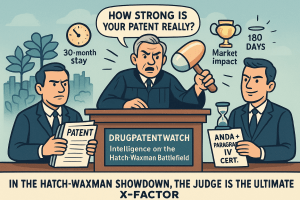
Filing a Paragraph IV certification is deemed, by statutory construction, an artificial act of patent infringement. This legal fiction is the machinery that makes the whole system work: it allows a patent dispute to be litigated and fully resolved before a single generic tablet reaches a pharmacy shelf. Once a generic files its Paragraph IV certification and serves notice on the patent holder, the brand has a 45-day window to file suit. If it does, an automatic 30-month stay on FDA approval of the generic kicks in, creating the defined litigation window that the entire system depends on.
The incentive structure pulling generics into this system is the 180-day market exclusivity period. The first generic manufacturer to file a successful Paragraph IV certification earns the right to sell its product for 180 days competing only with the brand, before any other generic can enter. On a drug with $3 billion in annual revenue, that window represents hundreds of millions in profit. The result: every drug of commercial significance faces Paragraph IV challenges, sometimes dozens of them filed by competing generic manufacturers racing to be first.
Litigation is not a side effect of this structure. It is the intended resolution mechanism. And for any drug patent dispute that reaches the federal courts, the question that carries the most commercial weight is not ‘is the patent valid?’ but rather ‘which judge will decide that question, in which court, applying which doctrinal framework?’
Why Delaware Dominated Hatch-Waxman Litigation for Four Decades
The structural reasons a single state became the epicenter of pharma IP disputes
The District of Delaware’s dominance in ANDA litigation was not accidental or arbitrary. It was built on two durable structural factors. First, Delaware’s corporate law is the most sophisticated and company-friendly in the United States, which means the majority of pharmaceutical and biotech companies are incorporated there. Incorporation in Delaware establishes patent venue, making the district a legally appropriate forum for suits involving those entities. Second, the density of prior Hatch-Waxman cases in Delaware created a self-reinforcing concentration effect: judges there developed unparalleled expertise in pharmaceutical patent law, specialized local rules emerged to handle ANDA case volume, and the Delaware bar developed deep institutional knowledge that made litigating there more predictable.
For decades, data confirmed this concentration. Delaware handled more ANDA cases annually than every other district combined. The TC Heartland decision in 2017, when the Supreme Court tightened patent venue rules by restricting suits to jurisdictions where a defendant is incorporated or maintains a regular and established place of business, was widely expected to break this dominance. The logic was clean: brands could no longer sue generic companies anywhere they intended to sell product. Venue would narrow to the generic’s state of incorporation or specific business operations.
The predicted dispersal never arrived. Delaware and New Jersey, by virtue of their concentrated ties to the pharmaceutical industry, remained the destinations for the vast majority of ANDA litigation. Generic manufacturers are heavily incorporated in Delaware or have significant operations in New Jersey, where the largest branded pharmaceutical headquarters cluster.
What has changed is the balance between these two courts. In 2024, the District of New Jersey recorded a 100% year-over-year increase in ANDA case filings, rising from 85 to 170 cases. Delaware simultaneously saw an 18% decrease, from 142 to 116 cases. This is not noise in the data. It is a directed strategic migration, driven by litigants making deliberate venue calculations in response to procedural shifts in Delaware’s judicial climate.
The primary driver of that shift is one judge.
The Connolly Effect: How One Chief Judge Restructured Delaware’s Litigation Economics
Why Chief Judge Connolly’s standing orders are the single biggest factor in the ANDA venue shift
Chief Judge Colm F. Connolly of the District of Delaware has never been among the top two or three judges for new ANDA case assignments in any recent quarter. His historical caseload is substantial, at 354 ANDA cases since 2015, but his influence on the landscape operates through a different channel: his standing orders have changed the rules of engagement for every party filing in Delaware, not just in his own courtroom.
Connolly’s background shapes his approach. He spent time as a federal prosecutor, served as U.S. Attorney for Delaware, and was a partner at Morris, Nichols, Arsht & Tunnell, the same elite IP firm that produced Judge Noreika. He arrived on the bench in 2018 with a prosecutorial instinct toward transparency and abuse-of-process concerns, and as Chief Judge he has channeled that instinct into sweeping procedural reform.
Why Connolly Targeted Litigation Funding
In April 2022, Connolly issued a standing order requiring any party appearing in his court to disclose third-party litigation funding arrangements, including the identity of the funder and whether the funder has authority to make litigation or settlement decisions. His concern was substantive: undisclosed funders may be the real parties in interest, creating potential standing problems and ethical conflicts that the court cannot evaluate without knowing who is actually driving the case.
The empirical impact was immediate and severe. A University of Utah study found patent lawsuit filings in Delaware dropped 41% in the two years following the order, against a 15% drop nationwide. Funded patent cases have largely disappeared from his docket. For the non-practicing entity segment that had treated Delaware as a preferred filing destination, the economics of Connolly’s court became hostile. For Hatch-Waxman litigants, the order’s direct impact is narrower, as most ANDA litigation involves operating companies rather than NPEs. But the signal it sent about Connolly’s broader judicial temperament reverberated across the bar.
The Corporate Disclosure Order and the IP Edge Fraud Finding
Alongside the litigation funding disclosure requirement, Connolly mandated more extensive corporate disclosures requiring LLCs, partnerships, and similar entities to identify every owner, member, and partner. The purpose was identical: the court should know exactly who stands behind the litigation. This culminated in a 2023 opinion finding that IP Edge, a patent monetization firm, had perpetrated a fraud on his court by using a network of shell companies to conceal its involvement in dozens of lawsuits. He referred the lawyers involved for disciplinary and criminal investigation. That referral sent a message that reverberated beyond NPE practice.
The Summary Judgment Ranking Order
Citing the proliferation of meritless summary judgment motions, Connolly implemented a rule requiring parties filing multiple summary judgment motions to rank them in order of preference. If the court denies the first motion on the list, it will not review any subsequent motions filed by that party, absent exceptional circumstances. This ‘one-and-done’ rule forces litigants to lead with their strongest argument. The tactic of filing four or five motions in the hope that one might create settlement leverage is gone, at least in Connolly’s courtroom.
The Case Narrowing Framework
Connolly’s form scheduling orders for Hatch-Waxman cases now limit plaintiffs to asserting no more than 10 claims per patent and 32 claims total against any one defendant. Defendants face symmetrical limits of 12 prior art references per patent and 30 total. Both sets of numbers are further reduced after claim construction. The commercial effect of this narrowing requirement is significant: a brand that has built its exclusivity defense around a thicket of overlapping claims across multiple patents must choose its battles earlier and more precisely than the system previously required. Invalidity risk is therefore concentrated rather than distributed.
Taken together, Connolly’s orders create a Delaware litigation environment that is procedurally demanding, transparency-intensive, and strategically constrained in ways that did not exist before 2022. For litigants with straightforward, well-documented cases, this is manageable. For litigants who previously relied on procedural complexity, funder anonymity, or claim volume as strategic tools, Delaware has become considerably less attractive. New Jersey has absorbed most of the resulting migration.
Delaware’s Active Docket: The Three Judges Handling the First State’s Remaining Volume
Hon. Richard G. Andrews: Why Pharmaceutical Obviousness Doctrine Is Being Rewritten at the Trial Level
481 ANDA cases, a raised bar on polymorph patents, and what brand IP teams need to rethink
Richard Andrews is the most experienced Hatch-Waxman judge in the United States. With 481 ANDA cases assigned since 2015, he has presided over more pharmaceutical patent disputes than any other active federal judge. That volume means there is essentially no technical, scientific, or procedural issue in the ANDA space that he has not encountered in multiple variations.
His path to the bench is distinctive within the Delaware judiciary. While colleagues like Noreika came from elite private IP practice, Andrews spent more than two decades as a federal prosecutor and served as the District of Delaware’s U.S. Attorney before President Obama appointed him to the bench in 2011. He took senior status in late 2023 but retained a full caseload, meaning his presence on the ANDA docket continues at full intensity.
How Andrews Has Redefined Polymorph Patent Obviousness
For years, polymorph patents were considered among the more defensible categories of pharmaceutical IP. The unpredictability of crystalline form discovery, consistently emphasized by the Federal Circuit, made it difficult for generic challengers to argue that identifying a stable polymorph was merely obvious to a skilled artisan. Andrews’ handling of Salix Pharmaceuticals v. Norwich Pharmaceuticals changed that calculus.
The case involved rifaximin, an antibiotic marketed as Xifaxan by Salix for conditions including irritable bowel syndrome with diarrhea (IBS-D) and hepatic encephalopathy. The relevant patents covered a specific polymorphic form of rifaximin. Andrews found those patents invalid as obvious. His reasoning rested on a critical factual distinction: the prior art did not merely hint at the possibility of the claimed polymorph, it disclosed specific processes and solvent systems that, according to compelling expert testimony, would have produced that polymorph as a result of known synthetic steps. Given that, Andrews found a skilled artisan would have been motivated to perform ‘routine characterization’ experiments on the resulting material, and that those experiments would have disclosed the crystalline structure claimed in the patents.
The Federal Circuit affirmed on appeal, emphasizing the fact-intensive nature of the analysis and finding no clear error in Andrews’ conclusion about the reasonable expectation of success. Legal commentary following the decision noted that it gives new viability to polymorph claim obviousness arguments by separating the question of whether finding a polymorph is unpredictable from the question of whether characterizing a polymorph that emerges from a disclosed process is merely routine. That distinction is now embedded in the doctrinal framework that Andrews applies.
This was not an isolated decision. In a separate case involving a clinical trial-stage drug, Andrews found a patent invalid for obviousness based on a combination of a published clinical study protocol and a journal article. The Federal Circuit again affirmed, agreeing that the combination of references provided a reasonable expectation of success even though clinical development generally carries high failure rates. The inference: Andrews weights the specific prior art combination over statistical base rates of clinical success when assessing obviousness.
What Investors Should Monitor in Andrews’ Court
Several commercially significant drugs have passed through Andrews’ docket. The doctrinal trajectory he has set on obviousness has direct implications for branded drugs whose exclusivity rests primarily on polymorph patents or formulation patents covering known active pharmaceutical ingredients. Key areas of exposure include solid oral dosage forms protected by crystal form patents, extended-release formulations where the active ingredient itself is off-patent, and combination products where one component is well-characterized in prior art.
For drugs with FDA Orange Book listings that include only formulation or polymorph patents, with no method-of-use patents remaining, the risk of an Andrews courtroom invalidating those patents via obviousness has risen materially since the Salix decision. Revenue at risk includes any drug in this patent profile with a Paragraph IV certification pending in Delaware.
Strategic Implications by Litigation Role
Patent holders defending polymorph claims in Andrews’ court cannot rely on the general unpredictability of polymorphism as a defense. The argument must be granular: why was the specific process required to produce this polymorph not disclosed in the prior art, and why would the characterization of the product have been non-routine given the state of the art at the filing date? Generic challengers should construct obviousness arguments around process disclosure in prior art, using expert testimony focused on what characterization steps would have been standard practice in the relevant timeframe.
Hon. Gregory B. Williams: The Post-Trial Reversal Risk That Erased a $50 Million Verdict
Amgen v. Lindis, inequitable conduct doctrine, and what it means for patent acquisition diligence
Gregory Williams joined the Delaware bench in September 2022, appointed by President Biden. Before the appointment, he spent nearly three decades in private practice at Fox Rothschild’s Wilmington office, specializing in commercial and patent litigation, and then served as a special master for the same district court where he now sits as judge. The special master role, which involved assisting district judges with complex civil case management, gave him direct exposure to judicial decision-making before he was making those decisions himself.
Williams has become the busiest judge for new ANDA filings in Q1 2025, receiving 11 new cases in that quarter alone. His emerging docket and the speed with which he has been drawn into high-stakes pharmaceutical IP disputes make him one of the most closely watched figures on the Hatch-Waxman bench.
Amgen v. Lindis Biotech: The $50 Million Verdict That Disappeared
The Amgen-Lindis dispute over Blincyto (blinatumomab) is the defining case of Williams’ early tenure, and it reveals a judicial philosophy that is coherent across its seemingly contradictory outcomes. Blincyto is a bispecific T-cell engager antibody approved for Philadelphia chromosome-negative relapsed or refractory B-cell precursor ALL. It generated roughly $800 million in 2023 revenue. Lindis Biotech held patents it claimed covered certain features of the bispecific format.
At the pleading stage, Amgen moved to dismiss, arguing that Lindis’s complaint failed to allege infringement with sufficient specificity on a key ‘trifunctional’ limitation in the patent claims. Delaware judges have increasingly required detailed, limitation-by-limitation infringement analysis in complaints for complex technology cases. Williams denied the motion, holding that Lindis had sufficiently ‘drawn significant parallels between’ and ‘connected elements from’ the claim language and the accused product, even without a fully granular claim chart. That ruling was seen as a potential signal toward more permissive pleading standards, favorable to patentees.
The case proceeded to a jury trial. The jury found in Lindis’s favor, awarding $50.3 million in damages and finding willful infringement, which opened the door to treble damages. Amgen then pursued inequitable conduct as a post-trial defense, arguing that the named inventor had made material misrepresentations to the USPTO during patent prosecution. Williams agreed, issuing a post-trial opinion finding the asserted patents unenforceable. The $50.3 million verdict was erased entirely.
Read in sequence, these two rulings define Williams’ approach with precision. He does not use procedural gatekeeping at the pleading stage to screen out imperfect complaints; he lets cases proceed and allows the merits to develop through discovery and trial. But once the full factual record is before him, he will apply the most severe available sanction, unenforceability for inequitable conduct, when the evidence supports it. The permissiveness at the front end is matched by rigor, and potential severity, at the back end.
What the Lindis Ruling Means for Patent Acquisition and Licensing Due Diligence
The inequitable conduct finding in Amgen v. Lindis should trigger a specific addition to any pharmaceutical patent acquisition or litigation preparation process. Standard IP diligence in M&A transactions examines patent validity, claim scope, prosecution history estoppel, and freedom-to-operate. It does not always include a systematic inequitable conduct audit.
Given Williams’ demonstrated willingness to apply this doctrine as a case-ending sanction after a full trial, any high-value patent portfolio being acquired for assertion or defense in his court requires independent counsel review of the prosecution history specifically for potential misrepresentations, failures to disclose material prior art, or other conduct that might support an inequitable conduct claim. The Lindis outcome makes clear that winning a jury verdict does not insulate a patent holder from post-trial unenforceability findings if the prosecution history contains vulnerabilities.
Revenue at Risk When Drawing Williams
Generic challengers with strong prosecution history arguments should treat Williams’ docket as a favorable forum. A well-documented case that a named inventor failed to disclose material prior art during prosecution, or that declarations submitted to the USPTO contained misleading technical representations, will receive a serious hearing. The Lindis case establishes that Williams will apply the inequitable conduct doctrine at its full strength.
Hon. Maryellen Noreika: The Claim Construction Enforcer and Why Preparation Margin Is Non-Negotiable
25 years of patent litigation experience on the bench, and what that means for how disputes get decided
Maryellen Noreika came to the federal bench in 2018 with 25 years of private practice experience at Morris, Nichols, Arsht & Tunnell, having personally litigated over 500 cases involving pharmaceutical, biotechnology, and medical device patents. She has litigated the cases that now come before her. That background produces a judicial style that is simultaneously demanding and predictable: demanding because she holds litigants to the standards she enforced when she was at the bar, predictable because her procedural requirements are explicit, documented, and consistently applied.
How Noreika Treats Claim Construction
Claim construction, the judicial determination of what the words of a patent claim actually mean, is the most consequential procedural event in most pharmaceutical patent cases. A favorable construction can make an infringement case substantially stronger or an invalidity defense substantially weaker. Courts often treat the claim construction process as a high-stakes preliminary skirmish, but Noreika treats it as the foundational analytical event from which everything else flows.
Her procedural rules around claim construction have become some of the most discussed in the Delaware patent bar. She requires all intrinsic evidence to be submitted in a single joint appendix with the claim construction brief, rather than piece by piece. She has issued orders in multiple cases requiring parties who propose ‘plain and ordinary meaning’ as a construction to amend their submissions and provide a specific, explicit definition of what that meaning is. Her reasoning is straightforward: if you cannot define the meaning you’re proposing, you do not have a construction, you have a placeholder, and she will not adjudicate a placeholder.
The most dramatic expression of this philosophy came in Continuous Composites, Inc. v. Markforged, Inc., where after finding that lead counsel had spent only 20 minutes in a meet-and-confer on ten disputed claim terms, she issued an order finding their ‘lack of effort shows a lack of respect for this Court’ and required lead trial counsel to physically appear in her courtroom and continue negotiations until excused by her. That order made clear that the procedural obligations in her court are not formalities.
Statistical Profile and Case Timeline Implications
Noreika has presided over 118 ANDA cases since 2015. Her front-loading of the claim construction process has a commercially significant secondary effect: by forcing parties to confront their strongest and weakest positions at the claim construction stage, rather than deferring that reckoning to discovery or trial, her process creates earlier decision points for settlement. A party that receives an adverse claim construction ruling has an updated, court-generated signal about its case’s likely trajectory. Settlement rates following unfavorable constructions in her court tend to be high.
For drugs where the commercial stakes turn on a single contested claim term, the efficiency of Noreika’s process can actually reduce total litigation cost relative to courts that allow claim construction to drift into late-stage ambiguity. The certainty premium she provides is real, but it comes at the cost of front-loaded preparation investment.
Doctrinal Profile on Invalidity and Attorney Fees
Noreika’s opinions consistently prioritize the intrinsic record over extrinsic evidence. In cases like Osteoplastics v. ConforMIS, her analysis of disputed terms proceeds methodically through the claims, the specification, and the prosecution history before any resort to external dictionaries or expert declarations about industry usage. Expert testimony that contradicts clear intrinsic evidence will receive little weight. Conversely, in the CMP Development v. Amneal Pharmaceuticals case, she declined to award attorney fees after a plaintiff lost at trial on infringement, finding that losing a fact-intensive inquiry does not make a case exceptional even if the outcome was one-sided. This balanced posture signals that she does not use fee awards as a punitive tool against parties who advanced good-faith legal theories.
Commercial Implications for Brand and Generic Strategies
For brand IP teams defending patents in Noreika’s court, the strategic imperative is claim construction preparation that begins before the case is filed, not in response to it. Knowing in advance which claim terms are likely to be disputed, and having a fully developed intrinsic record argument for each one, is the minimum threshold for effective representation. For generic challengers, the same standard applies on the other side: if your non-infringement or invalidity positions depend on a disputed claim construction, your arguments must be grounded entirely in the patent’s own language, its specification, and the prosecution history.
New Jersey’s Rise: Why the Garden State Absorbed Delaware’s Migration
The structural and judicial factors turning D.N.J. into the nation’s busiest ANDA venue
The District of New Jersey’s 100% year-over-year surge in ANDA filings in 2024 is the most significant structural development in Hatch-Waxman litigation in a decade. It is not the result of a single legal decision or a change in statute. It is the cumulative product of two factors: the increasing procedural burden of Delaware under Connolly and others, and the reputation of New Jersey’s two dominant ANDA judges for efficient, pragmatic, and predictable case management.
New Jersey’s connection to the pharmaceutical industry is organic and deep. Johnson & Johnson, Merck & Co., Becton Dickinson, and dozens of smaller biotech and specialty pharmaceutical operations are headquartered or have major operations in the state. That geographic concentration creates natural venue for ANDA suits brought against New Jersey-based generic operations and for cases where the brand plaintiff’s principal place of business is in the district.
Hon. Brian R. Martinotti: The Efficiency Engine Behind New Jersey’s 2024 Surge
Nation’s busiest ANDA judge in 2024, and the pre-motion process that made him that way
Brian Martinotti received more new ANDA case assignments than any other federal judge in the United States in 2024. That volume did not arrive by accident. It reflects a deliberate preference by litigants, on both the brand and generic sides, for the judicial management style he has developed over his decade on the federal bench.
Martinotti came to the District of New Jersey through the state court system. A Seton Hall Law graduate, he served 14 years as a New Jersey Superior Court judge before President Obama appointed him to the federal bench in 2016. That state court background, particularly experience in New Jersey’s multi-county litigation program, built skills in docket management and case resolution that translate directly to the complexity of ANDA litigation. His total ANDA caseload since 2015 is 90 cases and rising rapidly.
The Pre-Motion Conference as a Commercial Accelerant
The defining procedural feature of Martinotti’s court is the mandatory pre-motion conference. Before any party can file most categories of dispositive motion, including motions to dismiss, motions for judgment on the pleadings, or certain summary judgment motions, they must first submit a letter of no more than three pages outlining the basis for the anticipated motion and identifying the controlling legal authority. The opposing party has seven days to file a three-page response. Martinotti then holds a conference, often by phone, to assess the merits and determine whether the motion should proceed.
This process does several things simultaneously. It forces attorneys to distill their arguments to their essential core before investing in full briefing. It gives the court an early read on the legal issues without requiring the full resource expenditure of motion practice. In many cases, the court can resolve the underlying legal dispute during the conference itself, or signal strongly enough about the likely outcome that the parties resolve it by agreement. For cases where a motion clearly lacks merit, the pre-motion conference eliminates it before it consumes significant court or party resources.
For the Hatch-Waxman litigant, the commercial significance of this efficiency is real. Pharmaceutical patent disputes carry substantial daily carrying costs: outside counsel fees, expert retention, internal team time. A system that accelerates the identification of weak arguments and the resolution of core legal issues earlier in the case reduces those carrying costs materially and creates earlier opportunities for value-clearing events, whether settlement or adjudication.
What Investors Are Watching in Martinotti’s Court
Key cases on Martinotti’s docket include multiple disputes involving Caplyta (lumateperone), Intra-Cellular Therapies’ atypical antipsychotic, which generated over $700 million in 2024 revenue and faces multiple Paragraph IV challenges with settlement-timing implications for the 2028-2030 revenue window. His handling of these consolidated multi-filer cases will demonstrate how well the pre-motion conference model scales to the coordination complexity typical of heavily challenged blockbusters.
Strategic Considerations for Litigants
The pre-motion conference letter is where Martinotti cases are frequently won or narrowed. Three pages is a constraint that rewards precision, not volume. Attorneys who treat the letter as an opportunity to make their best argument, clearly and concisely, extract more value from the process than those who use it as a placeholder. Coming to the resulting conference with settlement authority matters: Martinotti’s early-dispute-resolution orientation means these conferences sometimes function as mediated negotiation sessions, and parties without decision-making authority lose leverage.
Hon. Michael A. Shipp: Bench Trial Expertise and Why Secondary Considerations Still Win Cases
142 ANDA cases since 2015, the Amgen v. Sandoz apremilast precedent, and the expert witness calculus
Michael Shipp is the elder statesman of New Jersey’s ANDA bench. Appointed in 2012 by President Obama after five years as a U.S. Magistrate Judge, he brought to the district an unusual combination of experience: high-stakes commercial litigation at Skadden, Arps, Slate, Meagher & Flom alongside federal magistrate experience that embedded resolution-oriented thinking into his judicial approach. His selection for complex multi-district litigation oversight by the Judicial Panel on Multi-District Litigation reflects peer recognition of his ability to manage sprawling, technically demanding cases.
Shipp has 142 ANDA cases since 2015, giving him one of the longest and most analytically rich case histories of any judge in the Hatch-Waxman space. His record has been reviewed and affirmed by the Federal Circuit in cases that have shaped pharmaceutical patent doctrine.
The Amgen v. Sandoz Apremilast Decision: Secondary Considerations as Outcome-Determinative
The most instructive precedent from Shipp’s docket for current commercial analysis is his bench trial ruling in Amgen v. Sandoz involving a crystalline form of apremilast, the active ingredient in Otezla, Amgen’s psoriasis drug. Sandoz challenged the polymorph patent as obvious. After a full bench trial with competing expert testimony on both sides, Shipp upheld the patent.
His analysis did not rest primarily on the technical complexity of discovering the specific crystal form. It rested on secondary considerations of non-obviousness, the legal doctrinal tools that allow courts to credit market evidence when assessing whether an invention was truly non-obvious: long-felt need for a stable crystalline form suitable for solid dosage manufacturing, commercial success of Otezla attributable to that stability, and unexpected results in terms of physical properties compared to other known forms of apremilast. The Federal Circuit affirmed in full.
The Otezla case has direct implications for any pharmaceutical IP strategy relying on polymorph or formulation patents. Secondary considerations, when well-documented and credibly presented through expert testimony, are outcome-determinative before Shipp. Brand teams defending these patents should be investing in the evidentiary infrastructure for secondary considerations before litigation begins: commercial success attributable specifically to the patented form, expert analysis of long-felt need in the relevant scientific community, and data on unexpected physical property advantages over prior art forms.
Why Summary Judgment Is Rare in Shipp’s Court
The technical complexity of pharmaceutical patent disputes, combined with the near-universal presence of competing expert witnesses on both sides, means that genuine disputes of material fact are the norm rather than the exception. Data from recent years confirms that ANDA cases rarely end at summary judgment regardless of venue, but in Shipp’s court this is especially consistent. Cases before him tend to resolve in one of two ways: negotiated settlement or full bench trial. Litigants should budget and staff accordingly.
The Expert Witness Problem in Shipp’s Court
In a courtroom where bench trial is the likely terminal event and secondary considerations are the doctrinal tools that frequently determine outcomes, expert witness quality is the most important resource allocation decision a litigant makes. Shipp is experienced at weighing competing scientific testimony from experts with similar credentials. The differentiating factor in his credibility assessments is communication clarity, not credential volume. An expert who can explain the physical significance of a crystalline form’s melting point differential in terms a non-scientist judge finds intuitive and credible will outperform a more credentialed expert who speaks primarily in technical jargon.
Comparative Patent Doctrine Across the Five Judges: The Decision Matrix
Which doctrinal preferences should drive venue analysis and Paragraph IV filing strategy
The following comparison maps doctrinal preferences, procedural characteristics, and strategic implications for each key Hatch-Waxman judge. Use it as the starting framework for venue analysis, not the end point. Every case has specific facts that will modify these general tendencies.
Factor
Andrews (D. Del.)
Williams (D. Del.)
Noreika (D. Del.)
Martinotti (D.N.J.)
Shipp (D.N.J.)
Total ANDA Cases (since 2015)
481+
55+
118+
90+
142+
Key Doctrinal Focus
Obviousness, polymorphs
Inequitable conduct, pleading standards
Claim construction, intrinsic evidence
Judicial efficiency, early resolution
Secondary considerations, bench trial management
Procedural Signature
Traditional, fact-intensive management
Permissive at pleading; severe on misconduct
Mandatory claim construction rigor
Pre-motion conference letters required
Pragmatic, MDL-style case coordination
Summary Judgment Rate
Low
Will grant on clear § 101 issues
Low
Pre-motion screens weak motions
Very low
Brand Win Tendency at Trial
Reflects D. Del. declining trend (~10% generic wins)
Polymorph claims now more vulnerable to obviousness challenge
Inequitable conduct as post-verdict risk
Inadequate claim construction preparation
Weak pre-motion arguments resolved against filer
Under-investment in secondary considerations evidence
Key Risk for Generics
Prior art combination arguments require strong expert support
Prosecution history scrutiny cuts both ways
Non-infringement positions not clearly grounded in intrinsic record
Poor pre-motion letter framing
Expert witness credibility differentials at bench trial
How the FTC’s Patent Thicket Campaign Intersects with Judicial Philosophy
What happens when federal antitrust enforcement meets the five judges who control ANDA outcomes
The Federal Trade Commission has moved aggressively in recent years against what it characterizes as improper Orange Book listings and the deployment of patent thickets to delay generic competition. Orange Book listing disputes, where the FTC challenges whether a listed patent actually claims the drug or method of using it as required by statute, have proliferated. The FTC’s authority extends to the administrative and antitrust enforcement space. Actual patent validity, infringement, and unenforceability remain the exclusive domain of the federal courts, which means the success of the FTC’s campaign ultimately depends on how these five judges respond to arguments that Orange Book listings are being used anti-competitively.
Chief Judge Connolly’s demonstrated intolerance for procedural abuse and fraud on the court suggests some philosophical alignment with the FTC’s concern that certain listing practices function as litigation weapons rather than genuine IP protections. But alignment in philosophy does not automatically translate into receptiveness to antitrust-framed patent arguments. The structure of Hatch-Waxman places specific questions before the court: is the patent valid, and does the ANDA infringe it? An argument that the listing of a patent was anticompetitive may create a separate antitrust claim, but it does not directly answer those two questions.
Judge Noreika’s focus on the intrinsic record suggests she will evaluate patent coverage questions tightly, based on what the claims actually say and what the specification actually discloses. A patent that stretches its stated claims to cover things not taught in the specification will face challenges in her court regardless of FTC interest. Judge Andrews’ evolving obviousness framework is independently making certain categories of listed patents more vulnerable, particularly polymorph and formulation patents, which is consistent with the FTC’s concern about weak patents holding exclusivity positions.
The doctrinal mechanism through which FTC pressure most directly affects patent outcomes is not through antitrust claims per se but through the tightened scrutiny on Orange Book listings that Paragraph IV filers have used as the basis for obviousness and non-infringement arguments. Where a listed patent is thin on specification support or relies on claims of questionable scope, any of the five judges analyzed here will examine those weaknesses on the merits. The FTC creates political and regulatory pressure; these judges create the legal outcomes.
Obviousness-Type Double Patenting After In re Cellect: Revenue Implications for Large Patent Families
Why patent term adjustment now interacts with OTDP doctrine in ways that threaten late-expiring portfolio patents
The Federal Circuit’s 2023 decision in In re Cellect resolved a long-standing ambiguity about obviousness-type double patenting in pharmaceutical patent families. The decision held that patent term adjustment (PTA), which extends a patent’s term to compensate for FDA-caused delays, must be considered when determining whether a later-expiring patent in a family is invalid under OTDP. The effect: a patent whose term was extended by PTA may be invalidated as obviously distinct from a related earlier-expiring patent if the extended term creates a situation where the two patents overlap in a way that OTDP prohibits.
For pharmaceutical companies with large patent families covering a single drug across multiple related inventions, the commercial implication is potentially severe. A late-filing patent that was previously expected to extend exclusivity through PTA may now be vulnerable to OTDP invalidity arguments in cases where an earlier patent in the same family expired without full extension. Blockbuster drugs with Orange Book listings spread across 10 to 20 patents in a family face the most exposure.
Judge Andrews has already applied the Cellect ruling with a bright-line approach, declining to consider equitable arguments raised by patent holders seeking to soften its effect. His position: the legal rule is clear, and the court’s role is to apply it, not to relieve parties of its consequences because they are commercially inconvenient. This makes Delaware, and Andrews’ court in particular, a more hazardous venue for brands asserting late-expiring PTA-extended patents from large families.
New Jersey’s judges have not yet published significant OTDP opinions post-Cellect, making the D.N.J. the marginally less certain venue for these arguments. That uncertainty cuts in both directions: generics cannot predict with confidence how Martinotti or Shipp will apply Cellect, and brands cannot be confident they will face the same bright-line treatment Andrews has applied.
The Skinny Label Problem: How Induced Infringement Doctrine Is Being Decided at the Trial Level
GSK v. Teva, Amarin v. Hikma, and what generic labeling decisions mean for commercial risk
The viability of generic ‘skinny labels,’ where a generic manufacturer carves out a patented indication from its label to avoid infringement while still marketing the drug for unpatented uses, was significantly complicated by the Federal Circuit’s decision in GSK v. Teva and subsequently by Amarin v. Hikma. The Amarin decision extended induced infringement liability potential by holding that a generic company’s public statements, including press releases, investor communications, and promotional materials, can constitute evidence of intent to induce infringement of the carved-out use, even when the label itself does not reference that use.
This doctrine creates a practical problem for generic manufacturers who have executed what they believed were clean skinny label strategies: the full commercial communication surrounding a launch, not just the prescribing information insert, is now potential evidence of inducement. For drugs where the patented indication is also the commercially dominant use, a skinny label strategy may not provide meaningful protection if the generic’s market positioning, therapeutic category framing, or sales force communications effectively target patients in the patented indication.
The trial-level judges in Delaware and New Jersey are on the front lines of applying this evolving doctrine. Judges who are particularly attentive to real-world commercial context, such as Williams, who let the full factual record in Amgen v. Lindis develop before making his inequitable conduct finding, may be more receptive to holistic induced infringement arguments that include non-label communications. Judges whose analytical framework centers on the four corners of the patent claims and the ANDA labeling document, a profile more consistent with Noreika’s intrinsic record focus, may be more skeptical of induced infringement claims that depend heavily on peripheral commercial communications.
Revenue at Risk: Which Drug Categories Face the Highest Judicial Outcome Sensitivity
Mapping patent type to judicial philosophy to identify where the LOE cliff could accelerate
Not all pharmaceutical patent disputes carry equal judicial outcome sensitivity. Some patent families are resilient to doctrinal shifts in specific courts because they rest on claim types and factual bases that cut across judicial philosophies. Others are acutely sensitive to which judge hears the case.
Highest Sensitivity: Polymorph and Crystal Form Patents
Drugs whose primary Orange Book defense is a polymorph or specific crystal form patent face materially elevated risk in Andrews’ Delaware courtroom following the Salix decision. The doctrinal evolution he has driven, affirmed by the Federal Circuit, makes routine-characterization-based obviousness arguments meaningfully stronger. Revenue at highest risk includes any drug in this category with:
A Paragraph IV certification outstanding in Delaware
No method-of-use patent providing parallel exclusivity protection
A crystal form patent where the prior art discloses the synthetic pathway that produces the active ingredient
For context, rifaximin’s IBS-D franchise had approximately $1.5 billion in annual revenue at the time of the Salix litigation. The polymorph patents were the last line of exclusivity defense. Their invalidation opened the market to generic competition years earlier than the brand had projected.
High Sensitivity: Method-of-Use Patents with Skinny Label Exposure
Drugs whose exclusivity defense includes method-of-use patents for a specific indication, where other uses are unpatented and could support a skinny label strategy, are now exposed to the induced infringement extension developed in Amarin v. Hikma. The commercial risk is concentrated in drugs where the patented indication is the primary revenue driver and where the therapeutic category framing in the market makes de facto separation between patented and unpatented uses difficult to maintain in practice.
Drugs whose formulation patents survive primarily because of strong secondary considerations evidence, unexpected results, long-felt need, and commercial success, are particularly exposed to the quality of how that evidence is compiled and presented. Before Shipp, who gave secondary considerations outcome-determinative weight in the Otezla case, this category has relatively high brand-protective potential. The risk is in the execution: inadequate secondary considerations evidence, or evidence presented through experts who cannot communicate its significance clearly, converts a potentially winning defense into a losing one.
How Paragraph IV First-Filer Economics Interact with Judicial Timeline Variation
Why the 180-day exclusivity prize is worth modeling court-by-court
The 180-day first-filer exclusivity period that rewards the first generic manufacturer to successfully challenge a Paragraph IV-listed patent has a time value that is directly affected by how quickly the relevant court reaches a decision. A first-filer generic that expects to capture the exclusivity period on a $2 billion revenue drug is looking at a potential prize in the range of $200-400 million, depending on the penetration rate achieved before second-wave generics enter.
The time to decision varies meaningfully across courts and judges. Martinotti’s pre-motion conference process, which accelerates the resolution of dispositive legal issues, could translate into a meaningfully earlier claim construction ruling or summary judgment decision than a more traditional court management approach. Noreika’s front-loaded claim construction process creates an early pivot point: if the brand wins a favorable construction, the generic may settle earlier in the case, forfeiting some portion of its anticipated exclusivity value but saving litigation cost. If the generic wins a favorable construction, it may accelerate toward trial with improved economics.
For generic manufacturers modeling the value of a Paragraph IV first-filer position on a specific drug, the judicial timeline is an underweighted variable in most financial models. The difference between a case that reaches trial in 18 months versus 30 months represents a meaningful change in discounted present value of the exclusivity period, particularly for drugs with large quarterly revenue figures.
What Happens After Loss of Exclusivity: The Post-LOE Revenue Erosion Curve by Drug Category
Generic penetration economics, biosimilar uptake dynamics, and what LOE timing means for portfolio positioning
Loss of exclusivity does not produce uniform revenue erosion. The shape and speed of the post-LOE curve varies substantially by drug category, distribution channel, and number of generic entrants.
For oral small molecules with multiple generic entrants, the pattern is well-documented: a branded drug typically retains 10-20% of its pre-LOE revenue within 12 months of generic market entry, declining further to roughly 5-10% at 24 months. The speed and depth of this erosion is accelerating as pharmacy benefit managers and payers have become more aggressive in driving generic substitution through tiering and step therapy requirements.
For injectables and complex formulations, the erosion is slower. Intravenous drugs administered in hospital or clinical settings have longer formulary conversion timelines. Specialty pharmacy distribution creates friction in the substitution process. A complex drug with significant manufacturing barriers to generic entry, such as sterile injectables with specific device components or complex delivery systems, can retain 30-40% of branded revenue for 24-36 months post-LOE even with multiple generic approvals.
For biologics facing biosimilar competition, the trajectory has evolved significantly since the early Humira biosimilar launches. The interchangeability designation, which allows pharmacists to automatically substitute a biosimilar without physician intervention in most states, has become a critical commercial variable. Biosimilars with interchangeability designations achieve meaningfully faster uptake than those without, particularly in pharmacy channel products. AbbVie’s Humira retained unusually high revenue share in the first 18 months post-LOE because the early biosimilar launches were priced aggressively but penetrated slowly in a market where physician prescribing inertia and patient assistance programs created switching friction.
The judicial timeline directly affects which scenario a brand faces. A drug that loses its patent litigation and faces LOE in 2026 rather than 2028, because its Paragraph IV case resolved two years earlier than the Orange Book-projected exclusivity end date, loses two additional years of the branded revenue curve. On a drug generating $500 million per year, that early resolution represents approximately $1 billion in foregone present-value revenue, adjusted for the erosion that would have occurred in the final years of exclusivity in any case.
Most Important Ongoing Litigation Categories to Monitor
Where the next major Hatch-Waxman decisions are likely to emerge
Several drug categories and patent typologies currently before the five key judges carry significant commercial and doctrinal implications for the next two to four years.
Obesity and GLP-1 Receptor Agonist Patent Defense
Novo Nordisk’s semaglutide franchise (Ozempic, Wegovy) and Eli Lilly’s tirzepatide franchise (Mounjaro, Zepbound) represent the highest-value patent protection targets in pharmaceutical IP. Both franchises generate combined revenue exceeding $30 billion annually and are expected to grow substantially through the decade. The patent landscapes covering the active molecules, formulations, delivery devices, and methods of use are extensive and overlapping.
Generic manufacturers have not yet advanced significant Paragraph IV challenges against the primary composition-of-matter patents, which for peptide drugs of this class typically have protection extending well into the 2030s. The earlier battleground will be device patents covering the prefilled autoinjector delivery systems, and eventually formulation patents covering the specific concentration, excipient profile, and pH range. The judges who will hear these cases, when they arrive, will be the same five analyzed here, or their successors in the same districts.
Oncology Immunotherapy Portfolio Transitions
Merck’s Keytruda (pembrolizumab) and Bristol Myers Squibb’s Opdivo (nivolumab) both face patent cliff dynamics in the late 2020s and early 2030s. Keytruda’s primary composition-of-matter patents are projected to expire around 2028, though a cluster of formulation, dosing regimen, and indication-specific method patents may extend effective exclusivity. The BPCIA framework, which governs biosimilar challenges to biologics including PD-1 inhibitors, operates through a separate litigation pathway from the ANDA/Hatch-Waxman system, but many of the same Delaware and New Jersey judges handle BPCIA disputes as well.
Complex Drug-Device Combination Products
A growing category of Paragraph IV disputes involves combination products where the delivery device is co-listed in the Orange Book alongside the drug formulation and the active ingredient. The scope of device patents, and their validity under the Hatch-Waxman listing requirements, is an evolving area where FTC scrutiny and judicial doctrine are both in motion. Judges who read listing requirements strictly, consistent with the statutory text, may be less receptive to broad device patent coverage that sweeps in aspects of the delivery system unrelated to the drug’s therapeutic action.
Common Investor Questions About Hatch-Waxman Litigation Risk
FAQ on patent litigation economics for portfolio managers, hedge funds, and institutional investors
How should a portfolio manager price Paragraph IV litigation risk into a pharmaceutical equity position?
The most common error in pricing Paragraph IV risk is treating it as a binary: either the brand wins and retains full exclusivity, or it loses and faces immediate generic competition. The actual economic outcome is a probability-weighted continuum that includes partial settlements (authorized generic agreements, royalty-bearing licenses with deferred entry dates), consent judgments with negotiated entry timelines, and at-risk generic launches that may be subject to preliminary injunction.
A more accurate framework models: the probability of a full patent win, the probability of a partial settlement and its likely terms, the probability of an adverse judgment, and the probability and commercial impact of at-risk launch. Each of these probabilities is affected by the specific judge assigned to the case. A judge like Andrews, who has shown willingness to invalidate polymorph patents, shifts the probability distribution toward adverse outcomes for brands defending in that category.
What is the commercial significance of a 30-month stay expiration before trial?
If the 30-month automatic stay expires before a court issues a final judgment, the FDA is no longer blocked from approving the generic ANDA. The generic manufacturer then has the legal ability to launch its product ‘at risk,’ meaning it can enter the market while litigation continues. An at-risk launch by a well-capitalized generic company, Teva, Sandoz, Mylan/Viatris, or Sun Pharma, can immediately begin eroding branded revenue even while the case remains pending. If the brand subsequently wins at trial, the generic may be required to pay damages for lost brand sales during the at-risk period, but the revenue damage to the brand during the pendency of the at-risk period has already occurred and is not fully recoverable in most scenarios.
How does biosimilar interchangeability designation affect the economic model for biologic LOE?
Biosimilar interchangeability, the FDA designation that allows automatic substitution at the pharmacy level without physician intervention, substantially accelerates penetration rates compared to non-interchangeable biosimilars. In states with automatic substitution laws, an interchangeable biosimilar can capture significant market share through pharmacy-level switching without any active prescribing change by physicians or patient consent at the point of care. The economic model for a biologic LOE event should treat interchangeable and non-interchangeable biosimilar entrants as distinct competitive scenarios with different penetration velocity assumptions.
Why do ANDA settlement terms, particularly authorized generic agreements, matter for revenue modeling?
In many Hatch-Waxman cases, the brand and the Paragraph IV first-filer settle before trial, with the generic receiving an authorized generic license: permission to market the brand’s own product under a generic label, manufactured by the brand or under the brand’s oversight. This settlement structure gives the first-filer generic a product to sell during its 180-day exclusivity period without the brand having to lose the case. The terms of the authorized generic agreement, particularly the royalty rate, the supply price, and whether an independent generic is also permitted to launch during the exclusivity period, have material revenue implications that are often not fully modeled in street consensus estimates.
Key Patent Expiry Dates and Judicial Timeline Interactions
Mapping the LOE calendar to active litigation for the 2025-2030 window
Drug
Active Ingredient
Primary Patent Expiry
Key Paragraph IV Status
Most Likely Judicial Venue
Revenue (2024 est.)
Keytruda
Pembrolizumab
~2028 (composition); method patents may extend
BPCIA pathway; biosimilar filings emerging
D. Del. / D.N.J. for related disputes
~$25B
Eliquis
Apixaban
2026-2031 (stacked)
Multiple Paragraph IV challenges settled; some ongoing
D. Del. (Andrews, Noreika history)
~$12B
Stelara
Ustekinumab
2023 (composition expired); biosimilars now entering
Biosimilar competition underway
D.N.J. (Martinotti, Shipp)
~$7B (declining)
Xarelto
Rivaroxaban
2024-2027
Multiple generics post-settlement or at-risk
D.N.J. historical
~$3B (US)
Humira
Adalimumab
LOE completed; biosimilar market active
Post-LOE commercial competition
N/A (post-litigation)
Declining from ~$21B peak
Otezla
Apremilast
2028 (crystal form; Shipp ruling affirmed)
Sandoz challenge failed; others possible
D.N.J. (Shipp)
~$2.5B
Caplyta
Lumateperone
2039 (projected)
Multiple Paragraph IV challenges active
D.N.J. (Martinotti)
~$800M
Investment Strategy: Translating Judicial Intelligence into Portfolio Decisions
How to use judicial outcome probability in pharmaceutical equity, credit, and options strategies
Judicial outcome analysis translates into portfolio strategy through several mechanisms. For long positions in branded pharmaceutical companies, the key variables to monitor are: which judge is assigned to active Paragraph IV cases involving the company’s key revenue-generating drugs, that judge’s historical disposition on the relevant patent type (polymorph, method-of-use, formulation), the current litigation timeline relative to the 30-month stay expiration date, and whether at-risk launch is economically viable for the generic challengers involved.
For hedge funds with short positions targeting branded pharmaceutical companies near LOE events, early-stage judicial assignments in Delaware and New Jersey Paragraph IV cases are undermonitored signal sources. A case assigned to Andrews involving a polymorph patent defense, where the prior art landscape is dense, carries materially higher LOE acceleration risk than the same case in front of a judge without his track record on polymorph obviousness.
For credit analysts evaluating pharmaceutical company debt, the patent cliff risk of the next five years should incorporate judicial timeline distributions, not just Orange Book-projected expiry dates. A company whose projected exclusivity through 2028 depends on polymorph patents currently being litigated in Andrews’ court faces a meaningfully different credit risk profile than its Orange Book listing alone would suggest.
Options markets in pharmaceutical equities near Paragraph IV decision dates have historically mispriced judicial outcome risk, treating case outcomes as approximately binary when they are in fact probability distributions shaped by judicial philosophy, case-specific expert witness quality, and the specific doctrinal evolution of the assigned judge. Traders who incorporate judge-specific analysis into their Hatch-Waxman event calendars can identify mispriced vol in both directions.
Key Takeaways
The five judges analyzed here presided over roughly half of all ANDA case filings in 2024. Their doctrinal tendencies, procedural rules, and case management philosophies are not abstractions. They determine whether patents stand or fall, whether generic launches are delayed or accelerated, and whether branded revenue curves extend as projected or collapse years ahead of consensus estimates.
Delaware’s judicial climate has shifted meaningfully under the influence of Chief Judge Connolly’s standing orders. The transparency requirements, claim-narrowing mandates, and summary judgment limitations he has implemented create a litigation environment that is procedurally demanding in ways that have pushed significant case volume toward New Jersey. That migration is structural, not transient.
Within Delaware, Andrews has raised the doctrinal bar for defending polymorph and formulation patents against obviousness challenges. Williams has established that inequitable conduct findings will be applied as case-ending sanctions when the prosecution history warrants them. Noreika has made thorough, intrinsic-record-based claim construction preparation the non-negotiable foundation of effective representation.
In New Jersey, Martinotti has built the most efficient ANDA case management process in the country through his pre-motion conference requirement, making his courtroom a destination for litigants on both sides who value speed and predictability. Shipp brings deep bench trial experience and a track record of giving secondary considerations evidence the weight it deserves, making the quality of expert witnesses and the strength of the secondary considerations factual record the most important variables in cases before him.
Every Hatch-Waxman case that reaches the courthouse door is decided by one of a small number of judges. The question of which one is not random, and the consequences of drawing one over another are not marginal. They are measured in hundreds of millions of dollars of branded revenue, in years of generic market exclusivity, and in patent portfolios that either hold their projected value or do not. The judge is the X-factor precisely because it is the one variable in this system that most analytical models still treat as noise.
This report draws on publicly available court filings, Federal Circuit opinions, district court standing orders, litigation analytics from WIT Legal and Saul Ewing, case data from DrugPatentWatch, and primary case law. It is intended for informational and analytical purposes. Nothing herein constitutes legal advice.