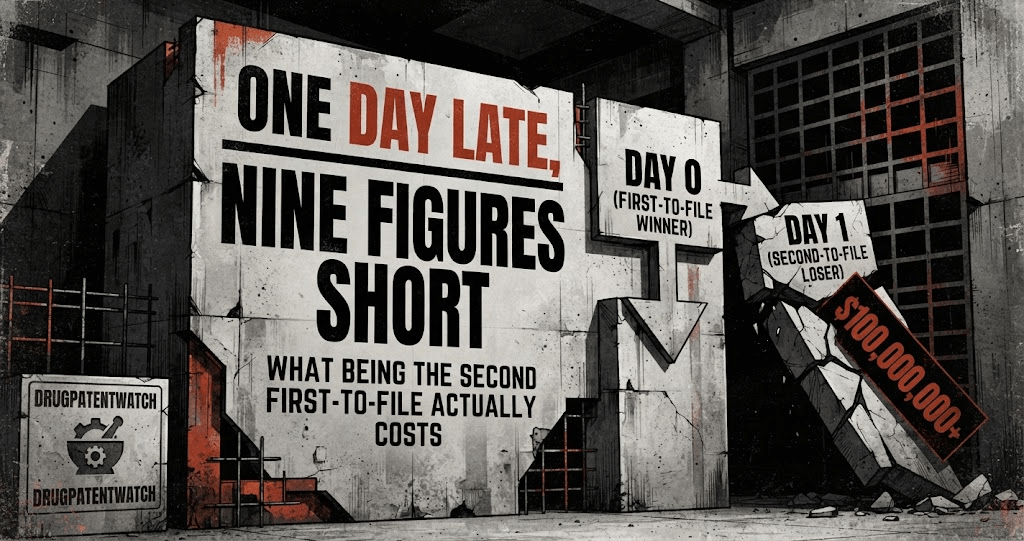
The Short Answer: Under FDA’s interpretation of the Hatch-Waxman Act, “first applicant” status on a Paragraph IV certification is determined by calendar day, not by hours or minutes. File a substantially complete ANDA with a Paragraph IV certification on the exact same calendar day as another company, and you split 180-day exclusivity with them. File it one calendar day later, and current regulation treats you no differently than a company that filed 179 days later: zero share of exclusivity, full exposure to whatever price the market has settled into once you finally launch.1,2 For a blockbuster reference drug, that one-day gap between “shared first applicant” and “everyone else” can be worth well over $100 million in foregone generic profit.
This article is about that gap: how FDA decided to draw the line at the calendar day, what generic companies have done to land on the right side of it, and what happened, in five documented cases, to the companies that landed on the wrong side.
What “First Applicant” Actually Means Under Hatch-Waxman
Section 505(j)(5)(B)(iv) of the Federal Food, Drug, and Cosmetic Act gives 180 days of generic marketing exclusivity to the first company to submit a substantially complete Abbreviated New Drug Application (ANDA) containing a Paragraph IV certification, a statement that a patent covering the branded drug is invalid, unenforceable, or will not be infringed.1 During that window, FDA cannot grant final approval to any other generic applicant’s ANDA for the same drug product and the same patent.1 DrugPatentWatch tracks this status for every open Paragraph IV filing because a single day of filing sequence can be the entire difference between a company’s generic program funding its next decade of R&D and that same program losing money.
The regulation implementing the statute, 21 CFR 314.107(c), defines the “first applicant” as the applicant whose ANDA is both substantially complete and contains a qualifying certification “prior to the submission of any other application for the same listed drug that is… substantially complete and contains the same certification.”2 For almost a decade, that language was academic. Between 1984 and 1998, only three ANDA applicants ever qualified for 180-day exclusivity, because FDA’s earlier rule required a first filer to also win its patent lawsuit before exclusivity would run.2 The D.C. Circuit’s 1998 decision in Mova Pharmaceutical Corp. v. Shalala struck down that “successful defense” requirement as inconsistent with the statute’s plain text.3 After Mova, simply being first to file, not first to win, was enough. More than 60 ANDAs earned exclusivity in the years immediately following the decision.2 That is when “first” stopped being a footnote and became the single most valuable word in generic drug law, and when the question of what happens when two companies claim to be first stopped being hypothetical.
The Same-Day Rule: How FDA Decided a Tie Goes to Everyone
Congress never anticipated that multiple companies might submit competing Paragraph IV certifications on the same calendar day.4 But once being first became this valuable, companies started trying to guarantee it, and FDA’s Rockville and Silver Spring filing rooms turned into staging grounds for a very literal race. According to FDA’s own account in a 2003 Federal Register notice, generic companies and their representatives camped outside FDA-occupied buildings for periods ranging from one day to more than three weeks to be first in line when a filing window opened.4 One applicant videotaped its arrival on government property to document that it was first.4 In May 2003, a pharmaceutical company representative maintained a 24-hour presence outside an FDA building to hold a place in line for a submission that could not even be filed until mid-December of that year; the building’s owner ultimately complained to FDA that the practice violated property rules and raised safety and liability concerns, and FDA directed the representative to leave.4
FDA considered several ways to break these ties: requiring in-person delivery with a monitored queue, date- and time-stamping mail as it was processed, even a lottery among same-day filers.4 It rejected all of them. Mail delivered to FDA’s Parklawn and Metro Park North buildings, miles apart with different zip codes, is stamped in whatever order it happens to be unpacked from the pile, which the agency itself called arbitrary.4 A submission delivered early in the day can be stamped after one delivered later, simply because of where it sat in the mail bag.4 And CDER, FDA’s Center for Drug Evaluation and Research, does not conduct business by the hour or minute: NDA review clocks, approval effective dates, and the 180-day exclusivity clock itself all run on the calendar day.4
FDA’s solution, formalized in July 2003 guidance, was to define “previous” application as one submitted on a previous day.2 Every substantially complete ANDA with a qualifying Paragraph IV certification submitted on the same first calendar day is a “first applicant,” full stop, regardless of what hour it arrived.2 All of those first applicants share the 180-day exclusivity period once any of them triggers it by commercial marketing or a favorable court decision.2 Anyone who files even one calendar day later gets nothing: not a partial share, not a shortened exclusivity, nothing.2
“CDER conducts its business by calendar day, not by the hour, minute, or second,” FDA wrote in explaining why it would not try to referee same-day filing order.4
That single administrative choice, made to solve a logistics and safety problem in FDA’s own mailroom, is the entire reason the gap between “same day” and “one day later” is worth so much money. It converts a continuous race into a binary one: tie, and you share a fortune; lose by 24 hours, and you get nothing until every other exclusivity-holder’s window closes.
What the 180-Day Prize Is Actually Worth
The value at stake is not abstract. During the exclusivity period, the branded drug and the first applicant (or applicants) form a duopoly, and the generic typically prices 20% to 40% below the brand rather than at the sub-10%-of-brand levels that prevail once four or five generics are on the market.28 DrugPatentWatch’s own analysis of generic launch economics puts 60% to 80% of a generic company’s total lifetime profit on a given molecule inside that single six-month window.28
Two forces determine how much of that prize a first applicant actually collects: how many other first applicants it has to share with, and whether the brand company launches an authorized generic of its own, a version of the brand drug sold under a generic label, which does not count as a competing ANDA and can therefore enter during the exclusivity window without waiting. The FTC’s 2011 authorized-generics study, based on IMS Health prescription data, found that competition from an authorized generic reduces the first-filing generic’s revenue during the 180-day period by 40% to 52%, and reduces its revenue in the 30 months after exclusivity ends by 53% to 62%.5 An authorized generic also lowers retail prices 4% to 8% and wholesale prices 7% to 14% compared to periods without one.5 Every one of those percentages compounds against a company that is not even a first applicant at all, one that filed a day late and therefore never had a duopoly position to defend in the first place.
Market Position
Typical Price vs. Brand
Typical Generic Volume Share
Approximate Duration
Sole first applicant (no authorized generic)
60–80% of brand
~70–90%
180 days
Shared first applicant (2 same-day filers, no AG)
60–80% of brand
~35–45% each
180 days
First applicant facing an authorized generic
55–75% of brand
Reduced 40–52% vs. no-AG case5
180 days
Subsequent applicant (filed after the first day)
10–30% of brand
Split among all late entrants
Begins only after exclusivity expires
The bottom row of that table is where a one-day-late filer lives for the entire 180 days that its same-day-filing competitors are earning duopoly margins. It is not a smaller slice of the same pie. It is a different, much smaller pie, and it does not even start baking until the first applicants’ pie is finished.
Case Study: Ticlid (Ticlopidine) — Left Standing at Final Approval
Purepac Pharmaceutical Co. v. Friedman is the clearest illustration of what “second” looks like in practice, because both sides had already done the hard part. By mid-1998, FDA had tentatively approved Purepac’s ANDA for generic ticlopidine hydrochloride, the active ingredient in Syntex and Hoffmann-La Roche’s anticlotting drug Ticlid.6 Tentative approval means FDA has confirmed the science; the drug is ready. But FDA refused to grant final approval, because TorPharm, a division of Apotex, had been the first applicant, and Purepac had to wait out TorPharm’s 180 days.6 Purepac sued, arguing TorPharm should not get exclusivity because Syntex had never actually sued TorPharm for infringement, an argument that sought to resurrect the very “successful defense” requirement the D.C. Circuit had just thrown out in Mova.6 The court disagreed and upheld FDA’s post-Mova approach: a first applicant earns exclusivity through filing sequence, not through winning or even facing a lawsuit.6 Purepac, and fellow applicant Teva, spent the better part of a year in 1998 and 1999 with FDA-approved generic ticlopidine sitting on the shelf, legally barred from shipping it, while TorPharm alone captured the duopoly-priced 180-day window.7
Case Study: Neurontin (Gabapentin) — Lost on a Technicality of Sequencing
Pfizer’s anti-seizure drug Neurontin generated $2.3 billion in U.S. sales in 2003 and $2.7 billion worldwide, and generated $1.48 billion in U.S. sales in the first half of 2004 alone.8,9 The 180-day exclusivity on generic gabapentin was accordingly one of the most contested prizes in the industry’s history, and the fight over it shows that “second” does not require filing on a different day at all. It can mean filing the right documents in the wrong order, on the very same day.
In late May 2000, Purepac amended its existing ANDA to add a Paragraph IV certification against Warner-Lambert’s gabapentin patents, but did not send the legally required notice of that certification to the patent holder until June 13, 2000.10 TorPharm amended its own ANDA and sent notice simultaneously, also on June 13.10 FDA did not receive TorPharm’s amended application until June 16.10 Two separate acts, an amendment and a notice, have to both occur, and FDA ultimately ruled that because Purepac completed both steps before TorPharm did, Purepac earned the exclusivity, even though its notice technically arrived weeks after its own amendment.10 The U.S. District Court for the District of Columbia called that a reasonable exercise of FDA discretion, and the D.C. Circuit affirmed in Purepac Pharmaceutical Co. v. Thompson, 354 F.3d 877 (2004).11 TorPharm, despite sending its notice on the same day it filed, and despite having an argument that its process was in some ways cleaner than Purepac’s, ended up as a subsequent applicant on the patent that mattered most for that phase of the litigation.11 The gabapentin fight later produced a second, separate first-to-file prize on the capsule dosage form, awarded to Alpharma in January 2003, illustrating how the same molecule can generate multiple, independently contested 180-day races across different patents and dosage forms.12
Case Study: Provigil (Modafinil) — Four Same-Day Filers, One Winner
Provigil is the case that shows even a clean, undisputed same-day filing does not guarantee you will still be a first applicant by the time exclusivity actually runs. In the early 2000s, Cephalon’s wakefulness drug, with roughly $1 billion in annual U.S. sales by 2010, drew Paragraph IV challenges from Teva, Ranbaxy, Mylan, and Barr Laboratories, all of whom filed on the same first eligible day and were therefore all first applicants entitled to share 180-day exclusivity under the same-day guidance.13,14 Cephalon settled its patent infringement suits against all four in a series of deals the FTC later characterized as reverse-payment, or “pay-for-delay,” agreements: according to the FTC’s complaint, Cephalon paid the four generic companies collectively more than $200 million in cash, active pharmaceutical ingredient purchase commitments, intellectual property licensing fees, and co-development rights, and in exchange none of the four would launch before April 2012.15,29
By the time April 2012 arrived, the competitive landscape had changed in a way none of the original settlements anticipated. Teva had acquired Cephalon outright in 2011 for roughly $6.8 billion.16 Cephalon launched an authorized generic on March 29, 2012, and on April 5, 2012, FDA determined that Teva, now Cephalon’s owner, was the sole first applicant entitled to the full 180 days of exclusivity for both Orange Book-listed patents, and that Cephalon’s authorized-generic launch had triggered that exclusivity.17,18 Mylan, one of the original four same-day first applicants, sued FDA within days, arguing the agency’s decision effectively let a single company that now controlled both the brand and one generic first-filer lock the other three original first applicants, Mylan, Ranbaxy, and Barr’s successor Teva itself, out of a window they had spent nearly a decade and real litigation risk earning a share of.19 The FTC filed an amicus brief describing the competitive harm of letting a branded company end up controlling generic exclusivity rights through corporate acquisition.20 The U.S. District Court for the District of Columbia denied Mylan’s motion for a preliminary injunction on April 23, 2012.20 Par Pharmaceutical, not one of the original four filers, was allowed to launch on April 6, 2012 only because the FTC’s earlier merger consent order with Teva specifically required Teva to supply a divestiture partner.17 Every other originally qualified first applicant sat out the entire 180-day window on a roughly $1 billion drug.14
The Provigil saga did not end there. Mylan later paid $96.5 million and Teva paid $512 million to settle separate purchaser antitrust claims over the original pay-for-delay settlements, and Teva paid the FTC $1.2 billion in 2015 to resolve the underlying reverse-payment case, by that point among the largest pharmaceutical antitrust settlements on record.21,22 None of those later payments restored the 180 days of duopoly pricing that Mylan, Ranbaxy, and the pre-acquisition Barr entity lost when a corporate transaction converted their same-day, shared first-applicant status into no status at all.
An Original Taxonomy: Four Ways to End Up “Second”
Across these cases and the broader body of 180-day exclusivity litigation, “second first-to-file” is not one failure mode. It is at least four distinct and separately addressable ones.
1. The calendar-day laggard
The straightforward case: your ANDA with a qualifying Paragraph IV certification was received by FDA’s document room on a later calendar date than the earliest qualifying submission, even by one day.2 No exclusivity, no exception, no proportional consolation prize.
2. The notice-sequencing laggard
Your ANDA or amendment was filed on the correct day, but the separate, legally required notice of the Paragraph IV certification to the patent owner and NDA holder went out later than a competitor’s, and FDA (as in the gabapentin case) treats completion of both steps, not just the filing, as the marker of “first.”10,11
3. The corporate-consolidation casualty
You were a genuine, undisputed same-day first applicant when you filed. Years later, a merger, acquisition, or corporate restructuring among the other first applicants (as in Provigil, where Teva’s acquisition of Cephalon merged a first-filer generic company with the brand owner) changes the legal analysis of who is still eligible, and FDA’s after-the-fact determination leaves you outside a group you were unquestionably inside of on the day that mattered.17,19,20
4. The patent-scope loser
You filed on the right day, but your Paragraph IV certification covered a different patent, or a narrower reading of a use code, than the certification FDA ultimately treats as controlling for exclusivity purposes. Because the 2003 Medicare Modernization Act made exclusivity determinations product-by-product rather than patent-by-patent for ANDAs filed after December 8, 2003, disputes over exactly which patent challenge “counts” as the first-in-time one, illustrated in FDA’s own citizen-petition discussion of a mirtazapine dispute among generic filers, can retroactively reshuffle who holds first-applicant status.23
Original Analysis: Sizing the Gap Between Shared and Zero
Methodology. The following is an illustrative model, not a reported figure for any specific drug. It combines three publicly documented inputs: the 60–80% share of lifetime generic profit concentrated in the 180-day window; the FTC’s documented 40–52% authorized-generic revenue reduction for first applicants;5 and the real order-of-magnitude U.S. sales bases of the branded drugs discussed above, Provigil at roughly $1 billion and Neurontin at $2.3–2.7 billion.8,9,14 It calculates a directional range, not a precise dollar figure, and should be read as one.
Take a mid-sized blockbuster with $800 million in annual U.S. brand sales, in the range between Provigil and Neurontin. Assume, consistent with the pricing table above, that two companies file same-day and share first-applicant status, that generics discount 30% versus brand, and that the two first applicants together capture roughly 75% of unit volume during the 180-day window with no authorized generic in the market. That generates a shared 180-day generic revenue pool in the rough neighborhood of $300–350 million, split roughly evenly, or $150–175 million per company. A company that filed one calendar day later earns zero dollars from that pool for the full 180 days, then enters a market that, once a handful of later generics arrive, typically prices at 10–30% of brand. Over the following 180 days, split among several late entrants, that company’s realistic take is a low double-digit millions figure at best. The gap between the roughly $150–175 million a same-day co-filer earns and the near-zero a one-day-late filer earns over the identical calendar period is, for a drug of this size, comfortably in nine figures. Scale the brand size up toward Neurontin’s $2.3–2.7 billion, or strip out the second same-day co-filer entirely so one company captures the full duopoly pool alone, as TorPharm did on ticlopidine and Teva did on Provigil, and the gap widens further.
This is why patent-intelligence teams treat the exact calendar date, not the week or the quarter, of an NCE-1 filing date or a new patent’s Orange Book listing as the single highest-leverage data point in a generic drug program. DrugPatentWatch’s Paragraph IV tracking exists specifically to surface that date early enough that a company’s regulatory and legal teams can be ready to file on day one rather than day two.
How FDA’s Same-Day Rule Has Kept Evolving
The mechanics of “same day” are not frozen in 2003. In 2024, FDA’s Paragraph IV Certifications List entries for the combination products TRALEMENT and MULTRYS changed the recorded “date of submission” of the first qualifying ANDAs to align with the Orange Book submission date of a specific later-listed patent, U.S. Patent No. 11,786,548, retroactively expanding the pool of applicants treated as first-day filers for that patent to three, three, and two ANDAs across different listings.24 Observers who track these lists closely described the change as deliberate policy, not an error, part of a broader set of recent FDA shifts in how same-day and first-applicant determinations get made.24 Separately, in 2024, generic ivabradine tablets illustrated a related but distinct trap: FDA’s Paragraph IV list initially showed a first commercial marketing date of July 18, 2024, implying exclusivity would run out January 11, 2025.25 A November 8, 2024 correction changed the recorded first-marketing date to October 5, 2022, the actual approval date of the relevant ANDA, which let FDA approve a second ANDA that same day, a net 64-day reduction in the exclusivity period from what the earlier listing had implied.25 That correction traces back to 21 CFR 314.107(c)(2), which requires a first applicant to notify FDA within 30 days of its actual first commercial marketing date; miss that notification and FDA will deem the marketing date to be the ANDA’s approval date instead, potentially shortening exclusivity retroactively regardless of when a company actually shipped its first bottle.26 A company can do everything right on the filing race and still lose real exclusivity days to a notification deadline buried in the same regulation.
What This Means for Generic Challengers
The practical response to all four failure modes above is the same: treat the filing date, the notice date, and the post-approval marketing-notification date as three separate, independently trackable deadlines, not one event called “filing the ANDA.” A company that nails the calendar-day filing but is careless about the notice sequencing can still end up in the position Purepac’s competitor TorPharm did on gabapentin. A company that filed cleanly and simultaneously with its rivals can still be knocked out years later by a rival’s acquisition, as Provigil showed, which argues for monitoring not just the initial Paragraph IV list but every subsequent corporate transaction involving co-first-applicants for the life of the exclusivity claim.
What This Means for Brand Manufacturers
The same-day rule cuts both ways for branded companies defending a patent estate. A brand that settles with multiple same-day first applicants, as Cephalon did on Provigil, is negotiating with a group whose relative bargaining power can shift dramatically after the settlement is signed, through no action of the brand’s own, if one first applicant later acquires another or if a corporate restructuring changes who counts as a first applicant. The FTC’s willingness to file amicus briefs specifically on the competitive effects of post-settlement changes in first-applicant status, as it did in the Mylan v. Sebelius litigation, signals that regulators are watching this exact fact pattern for antitrust exposure, independent of whatever the original patent settlement said.20
Key Takeaways
FDA determines “first applicant” status for 180-day exclusivity by calendar day of ANDA submission, not by hour or minute; this rule was formalized in July 2003 guidance after companies camped outside FDA buildings for as long as three weeks to secure a filing slot.2,4
Between 1984 and 1998, only three ANDAs ever earned 180-day exclusivity; after the 1998 Mova v. Shalala decision removed the requirement to win litigation first, more than 60 ANDAs earned it within a few years.2,3
Companies that file even one calendar day after the earliest qualifying Paragraph IV certification receive no share of exclusivity, as Purepac and Teva experienced while FDA-approved generic ticlopidine sat unshipped in 1998–99.6,7
“First” can turn on notice-sequencing, not just filing date: in the gabapentin (Neurontin) exclusivity dispute, FDA and the D.C. Circuit treated the company that completed both its ANDA amendment and its patent-owner notice first as the true first applicant, even when a same-day filer sent its own notice on the day it amended.10,11
Genuine same-day first-applicant status can still be lost after the fact: all four original Provigil first applicants filed the same day, but a 2011 acquisition of the brand owner by one of the four generic filers left FDA awarding sole exclusivity to that one company in 2012, worth roughly $1 billion in annual U.S. sales exposure.13,14,17
An authorized generic reduces a first applicant’s 180-day revenue by 40% to 52%, according to FTC’s 2011 study, compounding on top of, not instead of, the total loss faced by a company that was never a first applicant at all.5
FDA’s same-day determinations are still evolving: 2024 changes to Paragraph IV list dates for TRALEMENT, MULTRYS, and ivabradine show the agency continuing to adjust which applicants count as “first” and when exclusivity clocks actually start.24,25
FAQ
What happens if two companies file a Paragraph IV ANDA on the exact same day?
Both are treated as “first applicants” and share the 180-day exclusivity period once either of them triggers it through commercial marketing or a qualifying court decision, under FDA’s July 2003 same-day guidance.2
Does filing one hour earlier in the day matter?
No. FDA explicitly rejected minute- or hour-level tie-breaking as administratively unworkable and inconsistent with how CDER runs its other regulatory clocks, all of which operate on calendar days.4
Can a company lose first-applicant status after being awarded it?
Yes, through several statutory forfeiture events (failure to market, failure to obtain timely tentative approval, patent delisting, certain settlement agreements) and, as the Provigil case showed, through FDA’s after-the-fact determinations following corporate transactions among first applicants.17,20,27
How much is 180-day exclusivity typically worth?
Industry estimates place 60% to 80% of a generic company’s total lifetime profit on a molecule inside the 180-day window, with generic pricing typically 20% to 40% below brand during exclusivity versus a steep drop toward 10% of brand or lower once multiple later generics enter.
Does an authorized generic count as a “first applicant” competitor?
No. An authorized generic is the brand company’s own product sold under generic labeling, not a competing ANDA, so it does not need to wait out another company’s exclusivity, but FTC data shows it reduces the ANDA first applicant’s revenue by 40% to 52% during the exclusivity period.5
What is the difference between the 180-day exclusivity clock and the 30-month stay?
The 30-month stay is a separate mechanism that can block FDA from approving any ANDA, first applicant or not, for up to 30 months if the brand company sues within 45 days of receiving Paragraph IV notice. The 180-day exclusivity clock only starts once a first applicant begins commercial marketing or wins a qualifying court decision, and it governs competition among generics, not between the brand and the first generic.
Can exclusivity be shared by more than two companies?
Yes. All qualifying same-day filers share it; the Provigil case originally involved four same-day first applicants (Teva, Ranbaxy, Mylan, and Barr) before later events reduced the practical beneficiary to one.14
Does being a “subsequent applicant” mean you can never sell the generic?
No. A subsequent applicant can launch as soon as the first applicant’s 180-day exclusivity period ends (or is forfeited), but it enters a market with no exclusivity protection of its own and typically prices at a steep discount to both brand and the original first-applicant price.
What is the “successful defense” requirement and why does it matter historically?
It was FDA’s pre-1998 rule requiring a first applicant to win its patent infringement lawsuit before exclusivity would apply. The D.C. Circuit struck it down in Mova Pharmaceutical Corp. v. Shalala as inconsistent with the statute, which dramatically increased how often 180-day exclusivity was actually awarded.3
Why does a company’s post-approval marketing-notification date matter if it already won the filing race?
Under 21 CFR 314.107(c)(2), a first applicant must notify FDA within 30 days of its actual first commercial marketing date; missing that notice lets FDA treat the ANDA’s approval date as the marketing date instead, which can shorten the recorded exclusivity period, as occurred in the 2024 ivabradine listing correction.25,26
References
21 U.S.C. § 355(j)(5)(B)(iv); U.S. Food and Drug Administration, “Small Business Assistance | 180-Day Generic Drug Exclusivity,” FDA.gov. https://www.fda.gov/drugs/cder-small-business-industry-assistance-sbia/small-business-assistance-180-day-generic-drug-exclusivity
U.S. Food and Drug Administration, “Guidance for Industry on 180-Day Exclusivity When Multiple Abbreviated New Drug Applications Are Submitted on the Same Day; Availability,” Federal Register, August 1, 2003. https://www.federalregister.gov/documents/2003/08/01/03-19590/guidance-for-industry-on-180-day-exclusivity-when-multiple-abbreviated-new-drug-applications-are
U.S. Government Publishing Office, Federal Register, Vol. 68, No. 148 (August 1, 2003), pp. 45252–45256. https://govinfo.gov/content/pkg/FR-2003-08-01/html/03-19590.htm
Federal Trade Commission, “FTC Report Examines How Authorized Generics Affect the Pharmaceutical Market,” August 2011. https://www.ftc.gov/news-events/news/press-releases/2011/08/ftc-report-examines-how-authorized-generics-affect-pharmaceutical-market
Teva Pharmaceuticals USA, Inc. v. FDA, 182 F.3d 1003 (D.C. Cir. 1999). Justia. https://law.justia.com/cases/federal/appellate-courts/cadc/99-5022/99-5022a-2011-03-24.html
American Medical Association Journal of Ethics, “Neurontin and Off-Label Marketing,” June 2006. https://journalofethics.ama-assn.org/article/neurontin-and-label-marketing/2006-06
J. Lenzer, “Pfizer pleads guilty, but drug sales continue to soar,” BMJ 328, no. 7450 (2004): 1217. https://pmc.ncbi.nlm.nih.gov/articles/PMC416587
FDA Law Blog, “Diary of a Hatch-Waxman Addict: Day 3,655 – What About Untimely (Late) Notice?” December 2013. https://www.thefdalawblog.com/2013/12/diary-of-a-hatch-waxman-addict-day-3655-what-about-untimely-notice/
Purepac Pharmaceutical Co. v. Thompson, 354 F.3d 877 (D.C. Cir. 2004), aff’g TorPharm, Inc. v. Thompson, 260 F. Supp. 2d 69 (D.D.C. 2003). CourtListener. https://www.courtlistener.com/opinion/2578787/torpharm-inc-v-thompson/
C&EN, “Pfizer Fights Fire with Fire,” Chemical & Engineering News 82, no. 42 (2004). https://cen.acs.org/articles/82/i42/PFIZER-FIGHTS-FIRE-FIRE.html
Analysis of Agreement Containing Consent Orders To Aid Public Comment, In the Matter of Teva Pharmaceutical Industries Ltd. and Cephalon, Inc., Federal Trade Commission, October 2011. https://www.ftc.gov/sites/default/files/documents/cases/2011/10/111007tevacephalonanal.pdf
The Pharma Letter, “FDA decides Teva is sole first-to-file on Provigil; Mylan argues ruling,” April 2012. https://thepharmaletter.com/article/fda-decides-teva-is-sole-first-to-file-on-provigil-mylan-argues-ruling
In re: Modafinil Antitrust Litigation, No. 15-3475, U.S. Court of Appeals for the Third Circuit. https://www2.ca3.uscourts.gov/opinarch/153475p.pdf
HealthRX.com, “Provigil Patent History and Generic Timeline,” 2026. https://healthrx.com/modafinil/patent-generic-timeline
Teva Pharmaceutical Industries Ltd., “FDA Decides Teva is Sole First-to-File on Provigil,” press release, April 5, 2012. https://ir.tevapharm.com/news-and-events/press-releases/press-release-details/2012/FDA-Decides-Teva-is-Sole-First-to-File-on-Provigil/default.aspx
FDA Law Blog, “First Dust Up Over Generic PROVIGIL 180-Day Exclusivity Quickly Put on Hold With TRO/PI Motion Withdrawal, But is Followed Up With a Second Lawsuit,” April 2012. https://www.thefdalawblog.com/2012/04/dust-up-over-generic-provigil-180-day-exclusivity-quickly-ends-with-tropi-motion-withdrawal/
Mylan N.V., “Mylan Sues FDA Seeking Ruling That Teva Holds No Exclusivity for Its Generic Version of Provigil®,” press release, April 2012. https://investor.mylan.com/news-releases/news-release-details/mylan-sues-fda-seeking-ruling-teva-holds-no-exclusivity-its
Federal Trade Commission, “Statement of Bureau of Competition Director Richard Feinstein on the Commission’s Final Consent Order in In the Matter of Teva Pharmaceutical Industries Ltd. and Cephalon, Inc.,” July 2, 2012. https://www.ftc.gov/sites/default/files/documents/cases/2012/07/120703tevacephalonstatement.pdf
BioPharma Dive, “Mylan to pay $96.5M to settle pay-for-delay lawsuit,” 2017. https://www.biopharmadive.com/news/mylan-settlement-provigil-pay-delay-generic/435648/
FDAnews, “Teva Settles Provigil Lawsuit for $512 Million,” April 27, 2015. https://www.fdanews.com/articles/170943-teva-settles-provigil-lawsuit-for-512-million
Food and Drug Law Journal, “The Law of 180-Day Exclusivity,” 2016 (mirtazapine patent-scope discussion). https://www.fdli.org/wp-content/uploads/2016/12/FDLJ-71-3-The-Law-of-180%E2%80%93Day-Exclusivity-2522661open.pdf
FDA Law Blog, “Rules? Where We’re Going, We Don’t Need Rules: FDA Goes Back to the Future With Recent Hatch-Waxman Policy Shifts; What’s a Company to do?” September 2024. https://www.thefdalawblog.com/2024/09/rules-where-were-going-we-dont-need-rules-fda-goes-back-to-the-future-with-recent-hatch-waxman-policy-shifts-whats-a-company-to-do/
Lachman Consultants, “180-Day Exclusivity Public Service Announcement,” November 2024. https://www.lachmanconsultants.com/2024/11/180-day-exclusivity-public-service-announcement/
21 U.S.C. § 355(j)(5)(D) (forfeiture provisions); Amphastar Pharmaceuticals, Inc., Form 10-K, FY2017, U.S. Securities and Exchange Commission. https://www.sec.gov/Archives/edgar/data/0001297184/000129718418000011/amph-20171231x10k.htm
DrugPatentWatch, “How 180 Days Can Make or Break a Generic Drug Launch: The ANDA Exclusivity Playbook.” https://www.drugpatentwatch.com/blog/how-180-days-can-make-or-break-a-generic-drug-launch-the-anda-exclusivity-playbook/
Federal Trade Commission, “Overview of FTC Actions in Pharmaceutical Product and Distribution Antitrust Investigations” (Provigil/modafinil reverse-payment settlement summary). https://www.ftc.gov/system/files/ftc_gov/pdf/20220131_overview_pharma_updated.pdf