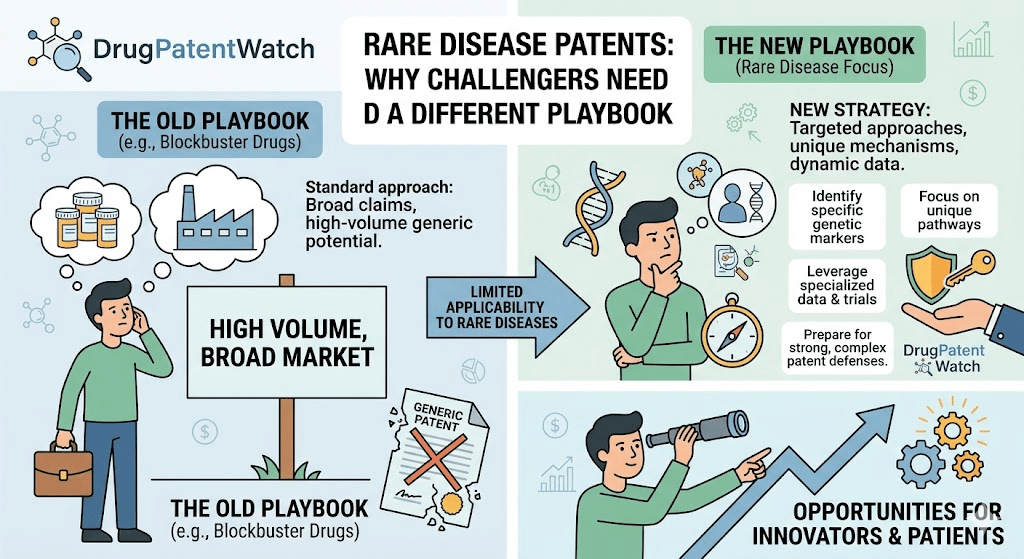
The standard Paragraph IV playbook was written for atorvastatin and metformin, not for drugs prescribed to 800 patients nationwide. When a generic or biosimilar challenger applies a mass-market approach to orphan drugs, the math breaks down before the first court filing.
The structural differences are not minor variations on a familiar theme. They alter the economics of the challenge, the litigation dynamics, the FDA regulatory overlay, the manufacturing reality, and the commercial story a challenger tells to investors. A firm that ignores those differences will spend three to five years in litigation only to discover that winning the patent fight is the easy part.
This article maps those structural differences, draws on real litigation from Soliris to Elevidys, and builds a challenger strategy calibrated to the actual constraints of the orphan drug market. It covers everything from the interaction between orphan drug exclusivity and Orange Book patents, to the bioequivalence problem in ultra-small populations, to what actually happens to pricing when generic competition arrives in a market of 10,000 patients.
What Makes Rare Disease IP Different from Standard Pharmaceutical Patents
A standard drug patent challenge operates on a reasonably predictable structure. The innovator holds a composition-of-matter patent, perhaps a formulation patent, and occasionally a method-of-use patent. The generic files a Paragraph IV certification. The innovator sues within 45 days, triggering a 30-month stay. Both parties spend two to four years in Delaware or New Jersey. The generic either wins, loses, or settles for a negotiated entry date. Revenue projections follow from the entry date, the likely price erosion, and the expected number of competing generics.
Rare disease IP breaks at nearly every one of those steps.
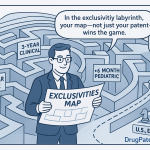
The core difference is layering. An orphan drug typically carries a composition-of-matter patent, yes, but it also carries orphan drug exclusivity (ODE), a separate statutory protection that operates independently of the patent system. Layered on top of those are method-of-use patents that may cover each indication separately, formulation patents, manufacturing process patents, and in some cases pediatric exclusivity that tacks an additional six months onto every patent and exclusivity period simultaneously.
A challenger who defeats the composition patent may still face seven years of ODE on the indication. A challenger who waits out the ODE may find new formulation patents filed in the intervening period. A challenger who navigates both may discover that ODE has been refreshed through a new indication approval, triggering a fresh seven-year clock.
The interaction between these layers, and how a challenger sequences an attack through them, determines the outcome far more than courtroom skill alone.
What Is Orphan Drug Exclusivity and How Does It Differ from Patent Protection?
Orphan drug exclusivity is a seven-year marketing exclusivity granted under the Orphan Drug Act of 1983. Congress enacted the ODA to incentivize the development and marketing of drugs for conditions affecting fewer than 200,000 people in the United States. Unlike patent protection, ODE is not granted by the USPTO based on novelty and non-obviousness. It is granted by the FDA based on a drug’s approved status as an orphan product.
The critical mechanical difference: a patent can be challenged for invalidity before its term expires. ODE cannot. There is no administrative proceeding, no IPR petition, no declaratory judgment action that can strip ODE the way an inter partes review can strip a patent claim. A challenger either waits out the seven years, seeks a different indication that ODE does not cover, or demonstrates that the innovator’s ODE does not in fact cover the specific use the challenger intends to market.
The scope of that coverage has been the subject of significant litigation. The Catalyst Pharmaceuticals v. Becerra case in the Eleventh Circuit held that the FDA should not have approved a competing product during the seven-year exclusivity period of the same orphan drug used to treat the same disease, even when indicated for a different patient population within that disease. The FDA then issued a notice in January 2023 stating it would continue applying its regulations tying ODE scope to the specific approved indication, declining to apply the Eleventh Circuit’s interpretation to other drugs.
That regulatory non-acquiescence matters to challengers. The FDA’s position is that ODE protects a specific drug for a specific use or indication, not for an entire disease. If a challenger can credibly argue its product is not “the same drug” for “the same use,” ODE may not block approval. That argument requires careful construction from the day of ANDA or BLA filing, not after receiving an FDA complete response letter.
How the Seven-Year ODE Clock Interacts with Orange Book Patent Timelines
The ODE clock starts at approval. So does the composition-of-matter patent term extension, which can extend a patent for up to five years under the Hatch-Waxman framework. The result is a potential overlap where ODE and patent protection run concurrently for part of the seven-year window and extend beyond it when process or formulation patents expire later.
Research found that orphan drug exclusivity outlasted the last expiring patent in 33 percent of cases, a figure that dropped from 50 percent for drugs approved in 1985-1994 to 35 percent for later cohorts, as innovators became more sophisticated about building multi-patent portfolios that extend beyond the ODE term. That trend has accelerated.
The practical implication: for older orphan drugs, ODE was the primary barrier and patent protection was largely academic. For drugs approved after 2010, the reverse is increasingly true. ODE may expire before the last secondary patent does. A challenger who plans entry around ODE expiration may emerge from the seven-year wait only to face an active patent thicket.
Orphan Drug Exclusivity vs. Data Exclusivity: Why Challengers Confuse the Two
Data exclusivity is a separate protection from ODE, and confusing them creates flawed entry projections.
A new chemical entity receives five years of data exclusivity, during which an ANDA sponsor cannot file an application relying on the innovator’s data. After four years, the ANDA sponsor may file if it challenges the innovator’s patents via a Paragraph IV certification. A new formulation or indication supported by clinical data gets three years of data exclusivity.
ODE is a market exclusivity, not merely a data exclusivity. It prohibits the FDA from approving a competing application entirely, regardless of whether the applicant relies on the innovator’s data. That makes it categorically more powerful from a challenger’s perspective. You can file; you may even win a patent challenge. But if ODE has not expired and the FDA’s scope determination covers your product, you cannot launch.
A precise entry-date model must account for the latest of: the last expiring patent, the ODE expiration, the data exclusivity expiration, and any pediatric exclusivity extension. In practice, that last-expiring protection date is often a formulation patent filed years after the composition patent, padded by a pediatric extension, which is exactly what innovators intend.
The Economics of Challenging a Drug with 800 Patients: Why Standard ROI Models Fail
Generic economics are a function of one variable above all others: the addressable revenue pool. A first-filer Paragraph IV challenger investing $5-10 million in litigation and $15-30 million in manufacturing scale-up needs to recover those costs from its share of post-entry market revenue. In a large market, that recovery happens in months. In an orphan drug market with a few thousand patients worldwide, it may never happen at all.
Data is stark: just over half of all orphan drugs that are completely unprotected by patents or exclusivity face any generic competition at all. This market failure stems from two primary factors: a revenue hurdle and a cost barrier.
Why Small Patient Populations Break Generic Entry Economics
The revenue hurdle is straightforward. If a drug generates $50 million per year in U.S. sales to 2,000 patients, a successful generic entrant capturing 60 percent market share at a 30 percent price discount generates roughly $10.5 million annually. Against $20-40 million in litigation and development costs, the payback period stretches beyond a decade, and that ignores the cost of capital, the possibility of settlement-triggered delayed entry, or the brand launching an authorized generic that splits the first-filer exclusivity period.
The cost barrier compounds this. Bioequivalence studies for small-molecule orphan drugs may require patients with the rare disease itself, since the pharmacokinetic profile of the drug in a normal healthy volunteer may differ materially from the profile in a patient with compromised organ function or an unusual metabolic pathway. Running a bioequivalence study in 300 patients with Fabry disease or cystinosis requires patient recruitment timelines that dwarf those for standard bioequivalence work, and the FDA may require it before accepting the ANDA.
Manufacturing presents its own barrier. Many orphan drugs involve complex active pharmaceutical ingredients synthesized from scarce or controlled starting materials. The number of qualified API suppliers may be one or two globally. Establishing an independent supply chain, scaling synthesis, and validating the manufacturing process may require capital commitments comparable to a small-molecule NDA program.
When Does Challenging an Orphan Drug Patent Make Financial Sense? A Decision Framework
The financial case for an orphan drug patent challenge only holds under a specific set of conditions. A challenger should model the decision against four tests before committing resources.
First, the revenue threshold test. Is the drug generating at least $300-500 million in annual U.S. revenue? Below that level, the economics rarely support the full litigation + development spend. The notable exceptions are drugs with expanding indications, where a successful challenger can enter a currently orphan indication and capture a fraction of a market that may grow to standard scale over time.
Second, the IP maturity test. Has the composition-of-matter patent expired, or is it clearly vulnerable to invalidity attack? If ODE has also expired and only secondary patents remain, the risk-adjusted litigation cost drops substantially. Challengers should use resources like DrugPatentWatch to map the full patent landscape, identify filing dates, assignees, and claim scopes before committing to a challenge timeline. DrugPatentWatch’s Orange Book patent tracking and patent expiration forecasting tools are purpose-built for exactly this kind of pre-filing analysis, identifying which patents are listed versus which are merely associated with the product, and flagging terminal disclaimer relationships that may indicate weak non-obviousness arguments.
Third, the manufacturing feasibility test. Can the challenger independently source API, validate manufacturing, and pass bioequivalence within a budget that leaves adequate margin after entry? This test often eliminates biologics from the small-molecule generic pathway entirely, funneling them into the biosimilar route with its different economics and longer development timelines.
Fourth, the commercial strategy test. Does the challenger have a realistic plan for physician and patient adoption? In rare disease markets, brand loyalty is structurally different. Patients and their specialists often have longstanding relationships with disease foundations partially funded by the innovator, patient assistance programs that have supported them for years, and a genuine medical risk aversion toward switching. A generic that wins market authorization but captures only 15 percent market share within three years generates a fraction of the revenue a standard generic would capture in the same window.
Orphan Drug Pricing Dynamics: Why the Generic ‘Price Cliff’ Does Not Apply
A 2023 study found that the median annual treatment cost for orphan drugs approved between 2017 and 2021 exceeded $218,000, compared to just under $13,000 for non-orphan drugs. That price differential matters to a challenger not as a moral observation but as a structural fact about how payers, physicians, and patients respond to a generic alternative.
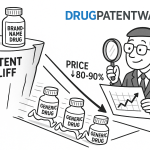
In a standard drug market, payers aggressively push generic substitution through formulary positioning, step therapy, and prior authorization requirements. The combination of payer pressure and pharmacist substitution typically delivers 80-90 percent generic market share within 12-18 months of generic launch. Prices fall 80-90 percent below branded levels once four or five generics are competing.
In an orphan drug market, that dynamic operates differently. Payers managing a drug with 100 claimants nationally apply different utilization management logic than they apply to drugs with 10 million claimants. A 30 percent price reduction on a $200,000-per-year drug saves $60,000 per patient per year, which sounds substantial until you realize that 100 patients represent only $6 million in total payer savings across the entire U.S. book of business. The administrative cost of running aggressive step therapy for that population may approach the savings achieved.
The result: generic price discounts in orphan markets are typically shallower than in standard markets, generic market penetration is slower, and the period over which a first-filer captures 180-day exclusivity economics is not the windfall it is in a large market. Challengers must model market penetration curves that reflect rare disease commercial realities, not standard-market templates.
The Orphan Drug Patent Thicket: How Innovators Build IP Fortresses Around Small Patient Populations
The architecture of an orphan drug IP estate looks different from a standard pharmaceutical patent portfolio, but it follows the same strategic logic: maximize the number of independent barriers between the innovator and competition, ensure no single court ruling can clear the entire path, and use the complexity of the thicket to impose settlement rather than fight to judgment.
How Indication-Stacking Creates Perpetual ODE Refresh
Indication expansion is one of the most powerful tools in an orphan drug innovator’s IP strategy, and it operates through a mechanism that has no analog in standard pharmaceutical markets.
Under the ODA, a sponsor who obtains approval for a new rare disease indication gets a fresh seven-year ODE clock for that specific indication. A drug approved for indication A in 2010 gets ODE on A through 2017. If the sponsor obtains approval for indication B in 2015, it gets ODE on B through 2022. If indication C follows in 2020, ODE on C runs through 2027.
The challenger who files an ANDA after 2017 hoping to capture indication A may find that the drug has been bundled commercially with indications B and C, that prescribing physicians use a single SKU for all three, and that the “carve-out” label strategy creates commercial barriers even where it creates legal clearance. Section 505(j)(2)(A)(viii) of the FDCA allows generic drug makers to launch generic versions of branded drugs with certain patents still in force, so long as the generic maker “carves out” those patented uses from its product label. In a rare disease context, where a single drug may be the only treatment across four serious conditions, a carve-out label may be commercially useless.
The Soliris story illustrates this precisely. Soliris received FDA approval for paroxysmal nocturnal hemoglobinuria in 2007, then collected additional approvals in atypical hemolytic uremic syndrome, generalized myasthenia gravis, and neuromyelitis optica spectrum disorder. Each new indication generated a new ODE period, a new suite of method-of-use patents, and a new suite of potential litigation targets for any biosimilar applicant who tried to enter.
The Eculizumab Case Study: 32 Patent Families and a 14-Year Monopoly
Eculizumab (Soliris) is the defining case study in orphan drug IP strategy, both for the sophistication of the defense and for how it ultimately unraveled.
A comprehensive patent analysis of eculizumab identified 32 patent families divided into 98 applications. The first patent was filed in 1995. The drug received approval in 2007. Alexion’s revenues from eculizumab exceeded $25 billion between 2007 and 2019, with the drug accounting for 79.1 percent of all company revenues in 2019.
The core composition-of-matter patent was set to expire in 2021, but Alexion added five additional patents through means that a subsequent antitrust complaint described as fraudulent, asserting them against biosimilar competitors to delay entry until 2025.
Amgen’s challenge through the PTAB and European patent offices eventually succeeded in stripping several key patents. The UK High Court found that an important patent related to eculizumab had to be revoked, after the EPO’s Technical Boards of Appeal had rejected Alexion’s attempt to amend claims during prosecution due to added matter objections. The ruling was consistent with a broader pattern of Alexion’s secondary patent portfolio eroding under sustained multi-jurisdictional attack.
A separate front involved Chugai Pharmaceutical, which had filed suit in the Delaware District Court alleging that Alexion’s follow-on drug Ultomiris infringed a Chugai patent. Alexion settled that dispute with a single payment of $775 million in 2022. The settlement’s size reflects both the strategic value of Ultomiris as a market transition vehicle and the genuine IP risk Alexion faced from a challenger with a credible patent portfolio of its own.
How Rare Disease Innovators Use Process Patents as Secondary Defenses
When composition-of-matter patents expire or are invalidated, the next line of defense for biologics is the manufacturing process patent. Biologics are, in a meaningful sense, defined by their manufacturing process: change the cell line, the upstream conditions, the downstream purification, and you may change the product itself. Courts and regulators have recognized this relationship, and innovators exploit it.
A biosimilar applicant who proposes a different manufacturing process does not merely face a freedom-to-operate question. It faces the possibility that the FDA will require additional comparability studies showing that the manufacturing change does not affect the drug’s safety or efficacy profile. Those studies take time and money that the standard generic pathway does not require.
In practice, this means that a successful PTAB challenge to a composition patent may clear legal space without clearing commercial space. The biosimilar applicant must still resolve process patent questions, pass FDA manufacturing site inspections, and demonstrate comparability on endpoints that may be specific to the rare disease indication.
Pediatric Exclusivity as a Stalking Horse for Orphan Drug Protection
Pediatric exclusivity deserves specific attention in the orphan drug context because the two programs overlap in ways that create compounding delays.
Many rare diseases disproportionately affect children. A pediatric program under the Best Pharmaceuticals for Children Act (BPCA) generates a six-month extension appended to every patent and exclusivity listed in the Orange Book at the time of the pediatric completion grant. If the drug has six Orange Book patents, each gets six more months. If ODE is still running, it gets six more months too.
An innovator who engineers the pediatric program to complete shortly before ODE expiration can use it to extend the effective exclusivity wall by six months. That may not sound significant, but in a drug generating $400 million per year, six additional months of exclusivity is $200 million in protected revenue, more than enough to justify a dedicated pediatric clinical program.
Paragraph IV Strategy in Rare Disease Markets: How the Standard Approach Breaks Down
Hatch-Waxman’s Paragraph IV certification system was designed for standard small-molecule generics. Its economics, its timelines, and its incentive structures all presuppose a mass-market branded product. When applied to orphan drugs, the system produces anomalous outcomes that challengers must recognize and plan around.
The 45-Day Trigger: Why Rare Disease ANDA Filers Should Expect Early Litigation
When a generic applicant files a Paragraph IV certification, the innovator has 45 days to sue and trigger a 30-month stay on FDA approval. In standard markets, innovators often evaluate the competitive landscape before deciding whether to sue. In rare disease markets, they almost always sue.
The reason: the financial stakes per patient in an orphan drug market are so high that even a small patient population generates revenue that justifies the litigation cost. A drug generating $500,000 per patient per year and serving 2,000 patients has a $1 billion annual U.S. revenue base. Even losing 20 percent of patients to a generic challenger represents $200 million in annual revenue loss. Litigation costs of $10-20 million are trivial against that exposure.
The result is that rare disease ANDA filers should budget for immediate litigation as a near-certainty rather than a probabilistic event. The 30-month stay will engage. The litigation will run to completion or settlement. The question is only whether the challenger can sustain the timeline, and whether the economics justify the wait.
First-Filer 180-Day Exclusivity in Orphan Markets: When the Prize Is Not Worth the Fight
First-filer exclusivity is the primary incentive driving Paragraph IV challenges in standard markets. The first generic applicant to file with a Paragraph IV certification gets 180 days during which no other generic can launch. In a large market, this exclusivity period may generate hundreds of millions in revenue.
In an orphan drug market, the same arithmetic produces a smaller prize. If the branded drug generates $150 million in U.S. revenue and a successful generic achieves 50 percent market penetration at a 30 percent discount within 180 days, the first-filer captures roughly $26 million in that window. Against litigation and development costs that may approach or exceed that figure, the marginal benefit of first-filer exclusivity over entering as a subsequent generic is modest.
The implication for challengers: in orphan drug markets, the first-filer advantage matters less than it does in mass markets. A second or third applicant who can free-ride on the first-filer’s litigation success while avoiding the upfront legal costs may earn a higher risk-adjusted return. This inverts the standard incentive structure in which being first is worth almost any litigation cost.
The Carve-Out Label Problem: When Skinny Labels Cannot Carry Orphan Drug Launches
The skinny label, or section viii carve-out, permits a generic applicant to omit patented indications from its label and launch only for the unpatented uses. In a standard drug market, this strategy works because different uses are prescribed by different physician populations, and a generic competitor can build a viable commercial position around the unpatented indication.
In an orphan drug market, the strategy often fails commercially even when it succeeds legally.
Rare disease specialists are few. A drug prescribed for rare blood disorders, a rare neurological condition, and a rare kidney disease may be prescribed entirely by hematologists, nephrologists, and neurologists who each know their patients individually. Those physicians are deeply familiar with the branded product, often trained by the innovator’s medical affairs team, and managing patients for whom a product switch carries real medical risk. A skinny-label generic covering one indication but not the others creates a prescribing ambiguity that conservative rare disease specialists will typically resolve by staying with the brand.
The legal clearance of a skinny label does not produce commercial traction in these markets, and a challenger who models revenue based on the full branded drug’s sales figures, then applies a haircut for the carved-out indication, will systematically overestimate the commercial opportunity.
Biosimilar Patent Challenges in Rare Disease: How the BPCIA ‘Patent Dance’ Changes the Playbook
Most blockbuster rare disease drugs are biologics. The Biologics Price Competition and Innovation Act (BPCIA) governs biosimilar entry, and its mechanics differ from Hatch-Waxman in ways that matter enormously to challengers in orphan markets.
BPCIA vs. Hatch-Waxman: Key Structural Differences for Rare Disease Challengers
The BPCIA’s “patent dance” is a multi-step information exchange between the biosimilar applicant and the reference product sponsor. The applicant provides its Biologics License Application to the reference product sponsor, who then identifies patents it believes are infringed. The parties negotiate a list of patents to litigate, and litigation proceeds in a defined sequence.
Three features of this system matter disproportionately in rare disease markets. First, the dance is optional. A biosimilar applicant who declines to provide its BLA and begins the dance exposes itself to a preliminary injunction risk, but avoids the information-sharing that might help the innovator build a broader litigation strategy. In markets where manufacturing process details are highly proprietary, some biosimilar applicants have chosen to forgo the dance and accept the litigation uncertainty.
Second, the BPCIA permits the assertion of an unlimited number of patents in the initial litigation phase, unlike the Hatch-Waxman framework which is constrained to Orange Book-listed patents. An innovator with a 98-patent portfolio, as Alexion had with eculizumab, can deploy that portfolio strategically across multiple litigation tranches, forcing the biosimilar applicant into years of sequential proceedings.
Third, interchangeability designation, which allows pharmacists to substitute the biosimilar for the reference product without physician intervention, requires an additional clinical showing beyond basic biosimilarity. In rare disease markets, interchangeability is commercially important because without it, formulary substitution by payers is more difficult to achieve. But demonstrating interchangeability requires a switching study that may be logistically difficult in a small patient population.
Amgen v. Sanofi and What It Means for Rare Disease Biologic Patent Claims
The Supreme Court’s 2023 unanimous decision in Amgen v. Sanofi represents the single most important patent ruling for biologic challengers in recent years, including in rare disease markets.
The Court held that broad, functionally defined antibody genus claims are invalid for lack of enablement when the specification provides only limited structural examples and a screening methodology. This created significant vulnerability for dozens of existing biologic patents that claim large antibody classes by function rather than by structure. For biosimilar developers, it opened a new and powerful challenge avenue: any biologic patent with broad functional claims and sparse structural examples should be reviewed for enablement vulnerability.
In the rare disease biologic context, this matters because many orphan drug antibody patents were filed in the late 1990s and early 2000s using exactly the broad functional claiming style the Court rejected. Patent claim language covering “an antibody that binds to complement protein C5 and inhibits terminal complement activity” without adequate structural definition of the antibody class now faces genuine invalidity risk under the Amgen standard.
Challengers reviewing orphan drug biologic patent portfolios should systematically screen for this vulnerability before modeling entry timelines. A patent that appeared to run through 2030 may now be challengeable under Amgen without the need for full PTAB proceedings, streamlining the litigation phase considerably.
Inter Partes Review Strategy for Orphan Drug Patents: Timing, Cost, and Estoppel Risk
IPR petitions at the Patent Trial and Appeal Board provide a cost-effective way to challenge patents before committing to full district court litigation. For rare disease challengers, IPR has particular appeal because PTAB proceedings typically resolve within 18 months and cost a fraction of district court litigation.
The estoppel risk is the critical constraint. Once an IPR petitioner receives a final written decision, it is estopped from raising in district court any invalidity ground it raised or could have raised in the IPR. In a complex orphan drug patent portfolio, a challenger who files a comprehensive IPR petition against the strongest patents may inadvertently foreclose district court arguments on related patents.
The strategic implication: rare disease challengers should file IPR petitions selectively against patents where the prior art is strong, the claims are discrete, and the estoppel risk of foreclosing district court arguments is minimal. The patents most worth attacking first in IPR are typically process patents with clean prior art arguments, not composition patents where the technical facts are complex and the estoppel exposure is broad.
“Generic entry for many orphan drugs was limited not only by exclusivity but also by continuing patent protection as well as the small patient populations and low expected profits.” — National Academies of Sciences, Engineering, and Medicine, Rare Diseases and Orphan Products: Accelerating Research and Development (NCBI Bookshelf, Chapter: Regulatory Framework for Rare Diseases)
Regulatory Strategy for Orphan Drug Challengers: FDA Pathways and Exclusivity Timing
The FDA pathway a challenger chooses, and the timing of that choice, are not merely regulatory questions. They determine the exclusivity landscape the challenger will face at the time of approval and the commercial tools available at launch.
505(b)(2) as an Alternative to Full ANDA: When It Makes Sense for Rare Disease Entrants
The 505(b)(2) pathway allows applicants to rely partly on published literature or on FDA’s prior findings of safety and effectiveness for a reference drug, without filing a full ANDA. It is typically used for new formulations, new dosage forms, or new routes of administration.
In the rare disease context, 505(b)(2) can be strategically valuable for a challenger who wants to enter with a modified formulation that avoids a specific patent, rather than seeking approval of a bioequivalent copy. A challenger who develops an improved formulation with a longer dosing interval or a subcutaneous delivery option can file under 505(b)(2), obtain its own NDA, and potentially qualify for its own ODE if the formulation improvement is significant enough to warrant a new indication application.
This approach transforms the challenger from a generic applicant into a competing innovator, with the attendant regulatory hurdles but also the attendant competitive advantages: its own ODE, its own patent estate, and a commercial differentiation story that works in rare disease markets where physicians and patients value any clinical improvement.
FDA Accelerated Approval in Rare Diseases: How Surrogate Endpoints Create IP Vulnerabilities
The FDA’s accelerated approval pathway allows rare disease drugs to gain approval based on surrogate or intermediate endpoints, with post-marketing confirmatory trials required later. This pathway has been critical in bringing treatments to patients with serious rare diseases faster than full approval timelines would allow.
From a challenger’s perspective, accelerated approval creates a specific vulnerability in the innovator’s IP position. Patents granted and listed during the accelerated approval period may be based on claim scope tied to the surrogate endpoint. If the confirmatory trial produces results that differ from what the surrogate predicted, or if the confirmatory trial is required to establish a new clinical endpoint, the patent claims may not adequately cover the actual therapeutic use as clinically validated.
A challenger reviewing orphan drug patents should identify whether key method-of-use patents were filed during the accelerated approval phase and whether the claims are tied to surrogate endpoints that differ from the post-marketing confirmatory outcomes. Claim construction arguments built around this mismatch can limit the scope of patent coverage without requiring full invalidity findings.
Priority Review Vouchers and Their Impact on Challenger Timelines
The Rare Pediatric Disease Priority Review Voucher program grants a transferable voucher to sponsors who obtain approval for treatments for serious rare pediatric diseases. That voucher can be used by any applicant to get six months of priority review from the FDA, or it can be sold on the secondary market.
For challengers, vouchers matter in two ways. First, an innovator who uses a priority review voucher for a new orphan drug formulation can shorten its approval timeline, potentially listing new patents before the challenger’s own application gets approved. Second, a challenger who obtains its own rare pediatric disease designation for a genuinely novel therapeutic approach, then receives a priority review voucher, has an asset worth $100-150 million on the secondary market even if the therapeutic program itself does not achieve commercial scale.
The Rare Pediatric Disease Priority Review Voucher program has been extended multiple times; the most recent extension continues the award of vouchers through 2026. Challengers developing modified formulations or new delivery systems for orphan drug targets should evaluate whether their programs might qualify for this designation and the associated voucher economics.
The Orphan Drug Patient Population Problem: Bioequivalence, Clinical Endpoints, and the Challenge of Small Trials
Establishing bioequivalence, the cornerstone of the ANDA pathway, becomes technically and operationally complicated when the drug target is a serious rare disease affecting thousands of patients globally.
When FDA Requires Disease-State Bioequivalence Studies for Orphan Drug ANDAs
Standard ANDA bioequivalence studies use healthy volunteers. The assumption is that the pharmacokinetics of the drug in a healthy person adequately predict its behavior in patients. For most drugs, that assumption holds. For drugs used in rare diseases where the underlying condition dramatically alters drug absorption, distribution, metabolism, or excretion, the assumption may not hold.
The FDA has required disease-state bioequivalence studies for some orphan drug ANDAs when the disease process affects the drug’s pharmacokinetic behavior in ways that cannot be modeled from healthy volunteer data. Conducting a bioequivalence study in patients with the rare disease is logistically challenging, expensive, and slow. Patient recruitment from a pool of thousands globally takes far longer than standard bioequivalence timelines. Each patient in the study must typically be managed by a specialist who understands the disease, adding investigator costs.
A challenger who underestimates the bioequivalence requirements for a specific rare disease will build an entry timeline that proves too optimistic by 12 to 24 months, which, in the context of a 30-month litigation stay, may mean the ANDA is not ready for approval even when the stay expires.
Natural History Data as a Litigation Defense Tool for Innovators
Natural history studies track the course of a disease in the absence of intervention, identifying factors that correlate with disease development and outcomes. They play an important role in drug development from discovery through clinical trial design, including identifying patient populations, validating clinical outcome assessments, and designing external controls where placebo randomization is infeasible.
Innovators have recognized that comprehensive proprietary natural history databases serve a dual purpose. They support the clinical development program for new indications, and they generate data about the disease mechanism that can support new method-of-use patents covering newly identified therapeutic targets or patient subpopulations. A challenger may defeat the original composition patent only to find that the innovator has filed a new method-of-use patent covering a patient subtype identified through natural history research, and that the most commercially valuable patients belong to that subtype.
The strategic counter for challengers: before filing, acquire or license access to natural history data for the relevant disease. Patient registries maintained by disease foundations, academic medical centers, and government programs often contain data sufficient to conduct a freedom-to-operate analysis on method-of-use claims covering patient subpopulations. If the natural history data suggests the innovator’s subpopulation claim is broad enough to cover all commercially viable patients, a method-of-use challenge becomes necessary before entry.
Rare Disease Drug Bioequivalence: When the FDA Accepts Pharmacodynamic Endpoints
For some rare disease drugs where pharmacokinetic bioequivalence is technically infeasible, the FDA may accept pharmacodynamic endpoints as a substitute bioequivalence demonstration. This is a specialized pathway that requires early and active engagement with FDA review teams.
Getting a Type B pre-ANDA meeting scheduled and navigating the FDA’s thinking on pharmacodynamic endpoints requires expertise in rare disease drug development that most standard generic manufacturers do not maintain. Challengers entering the orphan drug space for the first time may be underestimating this regulatory complexity even when they correctly anticipate the patent complexity.
Settlement Strategy in Rare Disease Patent Litigation: Different Incentives, Different Outcomes
Patent litigation settlements in standard pharmaceutical markets follow familiar patterns. The innovator grants an entry date, perhaps with an authorized generic right, perhaps with a royalty structure. The challenger accepts the negotiated date in exchange for certainty. The FTC monitors for anticompetitive reverse payment arrangements.
In rare disease markets, the settlement calculus is different.
A standard pharmaceutical company may generate revenue from dozens of products. An orphan drug company may generate 70-80 percent of its revenue from a single product for a single rare disease. For that company, the product is not merely a revenue line but the entire franchise. The settlement terms it offers a challenger reflect existential stakes, not portfolio management.
Alexion’s settlement with Amgen over Soliris biosimilar entry, which allowed Amgen’s Bkemv to launch as an interchangeable biosimilar, was structured as part of a deliberate brand migration strategy. Alexion had spent years transitioning patients from Soliris to its follow-on Ultomiris. By the time biosimilar entry occurred, the most commercially valuable patients were already on Ultomiris, which has a different dosing schedule, a different patent estate, and a separate ODE protected through a later approval date.
The settlement effectively traded Soliris biosimilar entry for breathing room on Ultomiris. A challenger who did not understand the brand transition logic would have accepted the Soliris entry date as a victory without recognizing that the innovator had already executed the defense of its next product. The same logic applies in any rare disease market where an innovator is developing a next-generation version of the original drug.
Authorized Generics in Rare Disease Markets: When the Brand Competes With Itself
Authorized generics have become a standard defensive tool in large pharmaceutical markets. The brand company licenses a generic version of its own product, typically through a wholesaler, to compete during the first-filer’s 180-day exclusivity period and thereby reduce the challenger’s revenue windfall.
In rare disease markets, authorized generics operate differently. The patient population is small, the physicians know their patients individually, and a generic version of the same drug sold at a discount may actually serve as a price-discrimination tool rather than a competitive weapon. Payers who are price-sensitive about a $400,000-per-year drug may migrate some patients to the authorized generic, while patients with superior insurance or who are enrolled in patient assistance programs remain on the brand.
A challenger must model the authorized generic scenario explicitly. If the innovator launches an authorized generic at 15 percent below brand price the day the challenger’s 180-day exclusivity begins, the challenger’s market share and pricing assumptions change materially. The innovator has both the motivation and the supply chain to execute this strategy in rare disease markets, where the per-patient revenue is large enough to make the arrangement financially worthwhile.
Reverse Payment Settlements and the Actavis Standard in Orphan Drug Cases
The Supreme Court’s 2013 decision in FTC v. Actavis held that reverse payment settlements, in which the branded company pays the generic challenger to delay entry, can violate antitrust law. The size of the payment is a proxy for market power and the likelihood that the challenged patent was weak.
In rare disease markets, reverse payments look different. The “payment” may not be cash. It may be a license to a manufacturing process, access to the innovator’s proprietary patient registry data, a co-promotion agreement for a different product, or the right to supply API. Any of these transfers has economic value and may satisfy the Actavis definition of a reverse payment even without a wire transfer.
Challengers in rare disease negotiations should be aware that the FTC monitors orphan drug settlements with the same scrutiny it applies to standard markets, even though the small patient populations and limited commercial significance might suggest these markets would escape attention. The FTC has brought enforcement actions against reverse payment arrangements for products with annual revenues well below the thresholds that characterize large-market enforcement activity.
Gene Therapy and the Next Frontier of Rare Disease Patent Strategy
Gene therapy approvals have created an entirely new category of orphan drug IP challenge. These products are not drugs in the pharmacokinetic sense that standard generic frameworks address. They are genetic constructs, viral vectors, and cellular therapies administered once, expected to produce a durable therapeutic effect, and priced accordingly.
REGENXBIO v. Sarepta: What AAV Gene Therapy Patent Litigation Teaches Challengers
In January 2024, Judge Richard Andrews of the Delaware District Court granted summary judgment for Sarepta in litigation brought by REGENXBIO, ruling that University of Pennsylvania’s patent licensed to REGENXBIO was invalid as directed to ineligible subject matter under 35 U.S.C. § 101. The underlying patent covered AAV vector technology used in Sarepta’s ELEVIDYS gene therapy for Duchenne muscular dystrophy, a rare pediatric condition. REGENXBIO had sued in September 2020.
The ruling reflects a broader pattern in gene therapy patent litigation. Many foundational AAV technology patents were filed in the early era of gene therapy research, before the field had developed the terminological precision that modern patent prosecution requires. These patents often claim engineered constructs in ways that may not meet the eligibility standards that courts have applied more rigorously since Mayo Collaborative Services v. Prometheus Laboratories and Alice Corp. v. CLS Bank International.
For challengers in the gene therapy space, § 101 eligibility challenges provide a litigation avenue that bypasses the traditional novelty and non-obviousness analysis. The argument is not that the claimed invention was obvious or previously disclosed, but that it represents a claim to a natural phenomenon or an abstract idea without sufficient inventive application. Against foundational platform technology patents, this argument can be powerful.
One-Time Gene Therapies and the IP Cliff: Why Standard LOE Models Do Not Apply
Standard loss of exclusivity models assume a drug that patients take chronically, where generic entry allows ongoing cost savings for payers. Gene therapies are, by design, one-time treatments. A patient who receives a gene therapy for spinal muscular atrophy at age two does not need a refill. The revenue model for the innovator is a single payment at time of treatment, not annual refills.
This structure changes the LOE economics for both innovators and challengers. The innovator’s revenue is front-loaded at the time of patient treatment. The patient population available for treatment by a challenger who enters after patent expiration consists only of newly diagnosed patients, not the full prevalence pool. Patients already treated by the innovator represent a permanent revenue loss to the challenger, not a market share opportunity.
The commercial case for challenging a gene therapy patent therefore requires a more nuanced patient flow model. Challengers must estimate the annual incidence of new diagnoses, the likely treatment penetration rate in that incidence population, and the price point a biosimilar gene therapy could sustain relative to the innovator. For ultra-rare conditions where annual incidence may be measured in dozens of patients globally, the numbers almost never support the challenge investment.
Cell and Gene Therapy Manufacturing Patents: The New Moat for Rare Disease Innovators
Beyond the therapeutic construct itself, gene therapy manufacturers hold proprietary manufacturing processes that are inseparable from product quality. Viral vector manufacturing, cell therapy manufacturing, and the purification processes for complex biologics all generate patentable innovations that are difficult to design around without risking product quality changes.
A challenger who replicates the therapeutic construct but independently develops the manufacturing process must demonstrate that the process produces a product with equivalent safety and efficacy. For gene therapies, where the immune response to the viral vector is a critical safety parameter, that demonstration may require a clinical program approaching the scale of the original BLA. This obliterates the standard biosimilar economic model and explains why gene therapy biosimilars remain largely theoretical despite several blockbuster programs approaching patent expiration.
Patient Advocacy Groups and Rare Disease Patent Litigation: A Stakeholder Dynamic With No Parallel in Standard Markets
Standard pharmaceutical patent litigation involves two corporate parties, their legal teams, and a federal judge. Rare disease patent litigation involves all of those, plus patient advocacy groups that may intervene directly, file amicus briefs, generate political pressure, and influence prescriber behavior in ways that affect the commercial outcome regardless of the legal outcome.
How Patient Foundations Affect Rare Disease Generic Entry Commercially
Patient foundations in rare disease communities often have financial relationships with the innovator company: research grants, disease awareness funding, patient registry support, conference sponsorship. These relationships are legal, common, and create structural loyalty to the branded product among the foundation community.
When a generic challenger files a Paragraph IV certification and begins litigation, the patient foundation does not typically remain neutral. Its communications to the patient community often emphasize brand continuity, the importance of proven treatments, and the risks of switching. Those communications reach the population of patients and caregivers who will ultimately make product decisions, and they do so through a channel the generic challenger cannot easily replicate.
A challenger who enters an orphan drug market with a superior price but no relationship with the relevant patient foundation is fighting a commercial battle with one hand tied. Building genuine relationships with patient communities, funding independent disease research, and supporting patient assistance programs are not marketing strategies grafted onto a generic economic model. They are prerequisites for commercial success in a rare disease market.
FDA Citizen Petitions in Rare Disease Patent Strategy: How Innovators Use Them and How to Counter
Citizen petitions allow any party to petition the FDA to take a specific action regarding a drug product, including delaying approval of a generic or biosimilar application. Innovators have used citizen petitions strategically to delay approval timelines, particularly in cases where the petition raises technical arguments about bioequivalence, manufacturing comparability, or safety that the FDA must formally respond to before approving a competing application.
The FDA has become more aggressive about denying dilatory citizen petitions. The agency’s guidance makes clear that it will deny petitions filed primarily to delay competition rather than to raise genuine safety concerns. But the clock time required to respond to a petition, even one that will ultimately be denied, adds months to a challenger’s approval timeline and imposes additional legal costs.
Challengers should anticipate citizen petitions as a near-certainty in orphan drug challenges. Building the petition response into the project timeline, assigning technical resources to address the petition’s likely technical arguments, and maintaining communication with FDA reviewers about the petition’s status are all components of a professional rare disease challenge program that standard generic operations may not have the infrastructure to execute.
Commercial Launch Strategy for Rare Disease Generics: Why Market Entry Is Not the Finish Line
Winning the patent case and receiving FDA approval is the starting point of a rare disease commercial challenge, not the conclusion. The commercial success of the entry depends on execution factors that differ qualitatively from standard generic markets.
Pricing Strategy for Orphan Drug Generics: The 30-Percent Discount Problem
Standard generic pricing follows a predictable erosion curve: 20-30 percent below brand at first generic entry, falling to 80-90 percent below brand as additional generics enter. Payers and pharmacy benefit managers have automated this pricing dynamic into their formulary management systems.
In orphan drug markets, the pricing curve is shallower and slower. The traditional price cliff model does not apply. A 30-percent discount on a $200,000-per-year drug leaves patients paying $140,000 per year, still well above standard drug costs and still requiring prior authorization, specialty pharmacy management, and patient support infrastructure. The payer savings from that 30-percent discount may not be large enough to justify aggressive formulary substitution.
Challengers who price at 30 percent below brand may find that payers appreciate the discount but do not actively drive switching. A more aggressive initial price discount may be required to trigger active formulary management. But a more aggressive discount that approaches the bioequivalence economics threshold may leave insufficient margin to sustain the commercial operation.
The resolution lies not in pure price competition but in demonstrating total cost of care advantages. A challenger who can offer a drug with a less burdensome administration schedule, a lower infusion reaction rate, or a reduced monitoring requirement can justify payer engagement based on clinical economics rather than unit price alone.
Specialty Pharmacy and Distribution Strategy for Rare Disease Generics
Most rare disease drugs are distributed through specialty pharmacies with rare disease expertise, not through standard retail pharmacy channels. The specialty pharmacy infrastructure for a given rare disease may consist of a handful of pharmacy partners that have built relationships with the treating specialist community over years, understand the disease, have specialty nursing support, and provide patient assistance program administration.
A generic challenger who attempts to enter through standard retail pharmacy channels will fail to reach the actual prescribing and dispensing pathway for the drug. It must contract with the same specialty pharmacy partners, develop equivalent disease expertise, and provide patient support services that match the brand’s infrastructure.
Building this infrastructure is not a post-approval problem. It requires 18-24 months of pre-launch engagement with specialty pharmacies, disease specialists, payer medical policy teams, and patient advocacy groups. A challenger who treats rare disease launch as a standard generic launch, scaling up only after approval, will arrive in the market without the commercial infrastructure to translate legal entry rights into actual patient access.
What Happens to Orphan Drug Prices 3 Years After Generic Entry? Real Data From Past Cases
Empirical data from orphan drugs that have faced generic entry supports a consistent pattern: price erosion is slower, shallower, and less complete than in standard pharmaceutical markets.
Soliris generated $2.5 billion in 2024 sales, an 18 percent decline from the prior year, after biosimilars including Amgen’s Bkemv and Teva/Samsung’s Epysqli entered the market. Teva’s biosimilar launched at a 30 percent discount to Soliris. Despite the discount and the availability of two competing biosimilars, brand retention remained substantial because the innovator had been systematically migrating its highest-revenue patients to Ultomiris for years before biosimilar entry.
The strategic implication is not that biosimilar or generic entry fails to produce value, but that the timing and sequencing of the innovator’s defense, particularly the lifecycle management to a next-generation product, determines how much market share remains for the challenger to capture. A challenger who files its ANDA or BLA without modeling the innovator’s lifecycle management trajectory will be surprised by the commercial landscape it finds at the time of entry.
Building the Rare Disease Patent Challenge Team: Skills That Standard Generic Programs Lack
The capabilities required to execute a successful rare disease patent challenge are different from those required for standard generic operations. A firm that has successfully challenged patents on blockbuster primary care drugs needs to assess honestly whether its existing team has the specific skills the orphan drug environment requires.
Scientific Expertise Requirements: When Standard Medicinal Chemistry Is Not Enough
Rare disease drugs often involve complex biology that requires scientific expertise beyond standard pharmaceutical chemistry. A monoclonal antibody complement inhibitor, an enzyme replacement therapy for a lysosomal storage disease, or an AAV-based gene therapy for a neuromuscular condition each requires scientific expertise specific to the therapeutic modality and the disease biology.
Patent claim construction in these areas requires scientists who can interpret the claim language in the context of the disease mechanism, the manufacturing process, and the regulatory pathway. A patent litigator working with a medicinal chemist who does not understand complement biology or lysosomal enzyme kinetics will construct weaker claim construction arguments than a team with the right scientific depth.
Challengers should invest in scientific advisory relationships with rare disease researchers, including academic physicians who treat the relevant conditions and understand the clinical endpoints and natural history that the patent claims may reference. Those relationships also serve the commercial launch, since the same physicians who advise on patent claim construction are the ones the challenger must educate and persuade to prescribe its product.
Using DrugPatentWatch for Rare Disease Patent Landscape Analysis
Effective rare disease patent challenge preparation requires mapping the complete IP landscape of the target product before committing to a challenge strategy. DrugPatentWatch provides structured access to Orange Book patent listings, patent expiration dates, exclusivity information, litigation history, and related ANDA filing data for FDA-approved drugs.
For orphan drug challenges specifically, the platform’s ability to track the interaction between multiple exclusivities, ODE periods, and patent expiration timelines is valuable for building accurate entry-date models. A challenger who uses DrugPatentWatch to map the latest-expiring protection for a given drug, identify whether any patents are linked through terminal disclaimers, and track the history of ANDA filings by other challengers can make a much more precise assessment of whether a challenge is worth pursuing and what timeline is realistic.
The platform’s litigation tracking also identifies cases where prior challengers have already established prior art records against specific patents, which a subsequent challenger may be able to leverage without repeating the full prior art development process.
Regulatory Affairs Expertise for Orphan Drug ANDA Programs: What Is Different
Standard ANDA regulatory affairs expertise does not translate automatically to orphan drug programs. The FDA’s Office of Orphan Products Development (OOPD) has jurisdiction over ODE determinations. The FDA’s review division may require disease-state bioequivalence data. The agency’s policies on skinny labels, carve-out strategies, and ODE scope are actively evolving, as the post-Catalyst regulatory landscape demonstrates.
A challenger needs regulatory affairs professionals with specific experience in the orphan drug approval pathway, not merely in standard ANDA processes. This expertise is less common in the generic industry than standard ANDA expertise, which partly explains why orphan drug generic challenges are less common than the revenue opportunity might suggest.
The Policy Environment: IRA, ETHIC Act, and What Regulatory Reform Means for Orphan Drug Challengers
The policy environment around pharmaceutical patents and drug pricing is changing faster than at any point since Hatch-Waxman’s passage, and those changes affect orphan drug challengers as well as large-market generics.
How the Inflation Reduction Act’s Medicare Negotiation Provisions Affect Orphan Drug IP Strategy
The Inflation Reduction Act’s Medicare drug price negotiation provisions originally included an exemption for drugs with a single orphan designation. That exemption was narrowed as the IRA was finalized, and it has been subject to ongoing legal challenge. The exemption’s current scope covers only drugs with a single rare disease indication.
For innovators, this creates a perverse incentive: a drug with multiple orphan indications may lose the IRA exemption, while a drug with a single indication retains it. The resulting innovation in orphan designation strategies by brand companies creates corresponding complexity for challengers who need to understand which indications are commercially central, which are protected by separate ODE periods, and which may qualify for ongoing IRA exemption.
For challengers, an orphan drug losing its IRA exemption and becoming subject to Medicare price negotiation will see the innovator’s commercial position weakened by pricing pressure from the government payer side, potentially making the challenger’s price point more attractive to payers even before the patent challenge resolves.
ETHIC Act and Patent Thicket Reform: What Orphan Drug Challengers Should Watch
The ETHIC Act would amend patent law so that when a company has a patent family linked by terminal disclaimers, it can only assert one of those patents in litigation against a generic or biosimilar challenger. This would directly dismantle the strategy of overwhelming a competitor with lawsuits based on a swarm of non-patentably distinct claims.
If enacted, the ETHIC Act would materially change the economics of patent thicket defense in orphan drug markets. Many of the secondary patents in large orphan drug portfolios are linked through terminal disclaimers, having been filed as continuations or divisional applications from a single parent application. Under the ETHIC Act, the innovator who currently asserts 20 continuation patents against a biosimilar applicant would be limited to asserting one from each terminally disclaimed family.
Challengers should monitor the ETHIC Act’s legislative progress and incorporate it as a scenario into long-range entry models. If the Act passes in anything close to its current form, the effective strength of patent thickets in the orphan drug space declines significantly, and the economics of challenging high-revenue orphan drugs improve across the board.
Case Studies in Rare Disease Patent Challenge Strategy: What Worked, What Did Not
Soliris Biosimilar Timeline: How Amgen Built and Executed a Multi-Year Rare Disease Challenge
Amgen’s biosimilar challenge to eculizumab represents the most thoroughly documented rare disease patent challenge in the industry. The program illustrates both the complexity of the challenge and the conditions under which it can succeed.
Amgen began its PTAB challenge against Soliris patents around 2019, with the PTAB agreeing to institute inter partes review of three key patents after finding a reasonable likelihood of success. That decision caused Alexion’s shares to fall more than 10 percent, reflecting the market’s assessment of the genuine patent risk created by Amgen’s challenge.
The challenge ran across multiple jurisdictions simultaneously. European patent offices, the EPO’s Technical Boards of Appeal, the UK High Court, and U.S. district courts all heard related proceedings. The UK High Court found that a key eculizumab patent had to be revoked, consistent with EPO proceedings that had rejected Alexion’s claim amendments.
The ultimate settlement and launch reflects a negotiated resolution rather than a complete litigated victory. Amgen’s Bkemv launched as an interchangeable biosimilar, and Teva and Samsung Bioepis launched their version, Epysqli, at a 30 percent discount to Soliris shortly thereafter.
What Amgen got right: it had the scientific expertise, the manufacturing capability, the financial resources to sustain multi-year multi-jurisdictional litigation, and a clear-eyed understanding that settlement, not courtroom victory, was the likely resolution. It also had its own patent portfolio in complement biology, which gave it negotiating leverage that a pure generic applicant would lack.
The Catalyst v. Becerra Decision: A Case Study in ODE Scope Litigation
Catalyst Pharmaceuticals’ litigation against the FDA over orphan drug exclusivity for Firdapse (amifampridine) versus Jacobus Pharmaceutical’s Ruzurgi illustrates the other side of rare disease IP strategy: the ODE scope question that affects every challenger’s entry model.
Firdapse received FDA approval in 2018 for Lambert-Eaton myasthenic syndrome (LEMS) in adults, with ODE protection. The FDA then approved Jacobus’s Ruzurgi, the same active ingredient, for pediatric patients with LEMS, treating it as a different indication based on patient age. Catalyst argued that ODE covered the entire disease, not merely the adult subpopulation.
The Eleventh Circuit agreed with Catalyst, holding that ODE covered the disease itself, not merely the approved indication. The FDA complied with the court’s order in that specific case but issued a notice in January 2023 stating it would continue applying its existing regulations and would not extend the Eleventh Circuit’s interpretation to other drugs.
The case teaches challengers that the FDA’s regulatory interpretation of ODE scope, which limits exclusivity to specific uses or indications, is the governing rule outside the Eleventh Circuit. Challengers designing around ODE by targeting patient subpopulations not covered by the original approval need to understand that the FDA, not the Eleventh Circuit, governs the approval process, and the FDA’s current position is narrower ODE scope.
REGENXBIO v. Sarepta: Gene Therapy’s Patent Eligibility Problem and What It Means for Future Challenges
The 2024 invalidity ruling in REGENXBIO v. Sarepta, applying § 101 patent eligibility analysis to AAV vector technology, signals a potential vulnerability in the gene therapy patent landscape that challengers should evaluate systematically.
Judge Andrews granted summary judgment for Sarepta, ruling that the University of Pennsylvania patent covering AAV technology licensed to REGENXBIO was invalid as directed to ineligible subject matter. A trial had been scheduled for January 2024, but the case was resolved on motion before trial, meaning the invalidity finding came without the full factual record of a trial.
The ruling’s significance extends beyond the specific patent. It establishes a blueprint for § 101 challenges to foundational gene therapy technology patents, which are often drafted in terms that claim the relationship between a viral vector and a natural disease mechanism. Any challenger reviewing an AAV-based gene therapy patent should evaluate § 101 eligibility as the first and potentially dispositive line of attack, before investing in the prior art development required for novelty and obviousness arguments.
Key Takeaways
Rare disease patent challenges require a fundamentally different economics model. The addressable revenue pool is small, manufacturing costs are high, and the standard 180-day exclusivity period produces a smaller windfall than in mass-market challenges. Financial viability requires at least $300-500 million in annual branded revenue and a clear path through both ODE and the patent estate.
Orphan Drug Exclusivity is the primary barrier that standard patent analysis misses. ODE cannot be invalidated. It can only be designed around, waited out, or limited in scope through regulatory and litigation strategy. Every entry-date model must account for ODE as the potentially governing protection, independent of patent analysis.
The Amgen v. Sanofi ruling on functional antibody claims and the REGENXBIO v. Sarepta § 101 ruling create two new and powerful challenge avenues for biologic orphan drug patents. Both should be evaluated systematically before defaulting to traditional prior art-based invalidity strategies.
Indication stacking and ODE refresh are the core lifecycle management tools in orphan drug markets. Challengers must model the innovator’s full indication history, the ODE expiration date for each indication, and the carve-out label viability for each. A challenge that clears the ODE for one indication may face fresh ODE on the indications that represent most of the commercial volume.
Commercial strategy in rare disease markets is as complex as legal strategy. Patient advocacy relationships, specialty pharmacy contracting, payer medical policy engagement, and disease community credibility are prerequisites for commercial success that must be built 18-24 months before launch, not after approval.
The brand’s lifecycle management trajectory, not the entry date, determines how much market remains for the challenger. Challengers must model the innovator’s patient migration to next-generation products and price accordingly, recognizing that the most commercially valuable patients may have already been transitioned by the time entry occurs.
Policy reform, including the ETHIC Act and IRA negotiation provisions, is materially changing the landscape. Challengers with multi-year challenge timelines should incorporate policy scenarios into their entry models and monitor legislative developments that could accelerate or decelerate the strategic value of their challenge programs.
Tools like DrugPatentWatch are essential for accurate patent landscape mapping in orphan drug challenges, particularly for tracking the interaction between ODE periods, multiple exclusivities, and patent expiration timelines that are more complex than in standard pharmaceutical markets.
FAQ: Rare Disease Patent Challenges
1. Can orphan drug exclusivity be challenged at the USPTO or PTAB?
No. Orphan drug exclusivity is a statutory marketing exclusivity granted by the FDA, not a patent right. There is no USPTO or PTAB proceeding that can invalidate or narrow ODE. Challengers can only design around it, wait for it to expire, or argue that its scope does not cover their specific product or use.
2. What is the minimum annual revenue that makes an orphan drug patent challenge financially viable?
No universal threshold exists, but most generic economic models require at least $300-500 million in annual U.S. branded revenue to justify the combined litigation, manufacturing, and commercial launch investment for a rare disease challenge program. Below that level, the challenger’s economics depend heavily on whether additional indications could expand revenue post-entry.
3. How does the Catalyst Pharmaceuticals v. Becerra ruling affect my ODE scope analysis?
The Eleventh Circuit’s Catalyst ruling, which held ODE covers the full disease rather than the specific indication, applies only within that circuit and to the specific case. The FDA has publicly stated it will continue applying its narrower indication-specific ODE scope interpretation for other drugs. Outside the Eleventh Circuit, ODE analysis should use the FDA’s regulatory interpretation: exclusivity covers the specific approved use or indication, not the entire disease.
4. Can a generic challenger use a skinny label to avoid orphan drug exclusivity?
Possibly in legal terms, but rarely in commercial terms. A carve-out label that omits the ODE-protected indication may allow FDA approval, but rare disease specialists typically prescribe across all indications using a single product. The commercial impact of a carve-out label in an orphan drug market is usually negligible, and the challenger may find the carved-out indication represents most of the commercial value.
5. How does the BPCIA patent dance affect rare disease biosimilar timelines differently from Hatch-Waxman?
The BPCIA permits assertion of an unlimited number of patents (not just Orange Book-listed patents) in biosimilar litigation, which creates significantly longer and more complex litigation for rare disease biologics with large secondary patent portfolios. The Hatch-Waxman 30-month stay is a defined endpoint; BPCIA proceedings can extend substantially longer through multiple litigation tranches.
6. What is the impact of the Amgen v. Sanofi Supreme Court ruling on orphan drug biologic patents?
The ruling invalidated broad functionally-defined antibody genus claims that lack structural enablement. Many orphan drug biologic patents filed in the early 2000s used exactly this claiming style. Any biologic orphan drug patent with broad functional antibody claims should be reviewed for enablement vulnerability under Amgen v. Sanofi as a priority first step in challenge preparation.
7. Does the IRA’s Medicare drug price negotiation apply to orphan drugs?
Drugs with a single orphan drug designation are currently exempt from IRA Medicare negotiation. Drugs with multiple orphan designations covering different rare diseases may not qualify for the exemption. This creates a strategic consideration for both innovators (who may limit indication expansion to preserve the exemption) and challengers (who may benefit from reduced branded pricing pressure if negotiation applies to their target).
8. How does a rare disease challenger build relationships with patient advocacy groups without the resources of an innovator?
By engaging early, genuinely, and independently of the commercial launch. Disease foundation relationships built on research partnerships, patient registry data sharing, and unrestricted educational grants are credible in ways that purely commercial relationships are not. A challenger who begins patient community engagement two to three years before entry has time to build genuine trust that will support prescriber and patient adoption at launch.
9. What role does the 505(b)(2) pathway play in rare disease challenger strategy?
The 505(b)(2) pathway allows a challenger to enter with a modified formulation or delivery system that may avoid specific patents, qualify for its own ODE, and offer a clinical differentiation story that supports higher pricing and better physician adoption. It transforms the challenger from a generic follower into a competing innovator, with higher development costs but also higher commercial ceiling and stronger IP position at launch.
10. How should a challenger model the branded company’s authorized generic risk in an orphan drug market?
Challengers should assume the innovator will launch an authorized generic at or near the time of challenger entry, particularly for drugs with annual revenues above $200 million. The authorized generic will capture some payer-driven substitution, reducing the challenger’s market share assumptions. The model should project authorized generic market share at 20-40 percent of total generic volume in the first 12 months, then declining as payer formulary management normalizes.
Sources
National Academies of Sciences, Engineering, and Medicine. (n.d.). Regulatory framework for drugs for rare diseases. In Rare Diseases and Orphan Products: Accelerating Research and Development. National Center for Biotechnology Information. https://www.ncbi.nlm.nih.gov/books/NBK56185/
Rogers, H.-A. (2023, August 17). The Orphan Drug Act and Catalyst Pharmaceuticals, Inc., v. Becerra (CRS Report R47653). Congressional Research Service. https://www.everycrsreport.com/reports/R47653.html
DrugPatentWatch. (2026, February 13). The dual shields: A strategic analysis of orphan drug exclusivity and patent protection in the modern pharmaceutical landscape. https://www.drugpatentwatch.com/blog/the-dual-shields-a-strategic-analysis-of-orphan-drug-exclusivity-and-patent-protection-in-the-modern-pharmaceutical-landscape/
DrugPatentWatch. (2026, January 13). The orphan drug paradox: A strategic playbook for generic entry in rare disease markets. https://www.drugpatentwatch.com/blog/the-orphan-drug-paradox-a-strategic-playbook-for-generic-entry-in-rare-disease-markets/
Grabowski, H. G., Ridley, D. B., & Schulman, K. A. (2018). Evaluating the impact of the Orphan Drug Act’s seven-year market exclusivity period. PLOS ONE. https://pubmed.ncbi.nlm.nih.gov/29733729/
Fish & Richardson. (2024, April 15). Hatch-Waxman 101. https://www.fr.com/insights/thought-leadership/blogs/hatch-waxman-101-3/
Fierce Pharma. (2025, April 17). AstraZeneca’s Alexion accused of extending Soliris monopoly through sham patents in new suit. https://www.fiercepharma.com/pharma/astrazenecas-alexion-accused-extending-soliris-monopoly-through-sham-patents-new-suit
AstraZeneca. (2022, March 17). AstraZeneca reaches settlement agreement resolving patent litigation related to Ultomiris. https://www.astrazeneca.com/media-centre/press-releases/2022/astrazeneca-reaches-settlement-agreement-resolving-patent-litigation-related-to-ultomiris.html
Goodwin Law. (2024, January 9). District court grants summary judgment and invalidates patent in REGENXBIO v. Sarepta litigation. https://www.goodwinlaw.com/en/insights/blogs/2024/01/district-court-grants-summary-judgment-and-invalidates-patent-in-regenxbio-v-sarepta-litigation
JUVE Patent. (2025, May 28). Alexion suffers defeat over Soliris patent at UK High Court. https://www.juve-patent.com/cases/alexion-suffers-defeat-over-soliris-patent-at-uk-high-court/
DrugPatentWatch. (2025, November 4). The thicket maze: A strategic guide to navigating and dismantling drug patent fortresses. https://www.drugpatentwatch.com/blog/the-thicket-maze-a-strategic-guide-to-navigating-and-dismantling-drug-patent-fortresses/
DrugPatentWatch. (2026, March 22). Drug patent evergreening works, until it doesn’t. https://www.drugpatentwatch.com/blog/does-drug-patent-evergreening-prevent-generic-entry/
DrugPatentWatch. (2026). Drug patent challenges: The complete strategic playbook for IP teams and portfolio managers. https://www.drugpatentwatch.com/blog/when-science-meets-law-the-art-and-strategy-of-challenging-drug-patents/
Premier Research. (2026, January 7). FDA new guidance on natural history studies for rare diseases. https://premier-research.com/perspectives/fda-new-guidance-natural-history-studies-rare-diseases/
Liu, F., et al. (2022). Natural history and real-world data in rare diseases: Applications, limitations, and future perspectives. The Journal of Clinical Pharmacology. https://pmc.ncbi.nlm.nih.gov/articles/PMC10107901/
Torres, L. A., et al. (2021). Dynamics of patents, orphan drug designation, licensing, and revenues from drugs for rare diseases: The market expansion of eculizumab. PubMed Central. https://www.ncbi.nlm.nih.gov/pmc/articles/PMC7935269/
Institute for Clinical and Economic Review. (2022, April 7). The next generation of rare disease drug policy. https://icer.org/wp-content/uploads/2022/04/ICER-White-Paper_The-Next-Generation-of-Rare-Disease-Drug-Policy_040722.pdf
Hagens Berman. (2025). Soliris (eculizumab) antitrust case overview. https://www.hbsslaw.com/cases/soliris-eculizumab-antitrust
Center Forward. (2024, February 6). Rare diseases and the Orphan Drug Act. https://center-forward.org/basic/rare-disease-2024/
Congress.gov. (2023). H.R. 456, Fairness in Orphan Drug Exclusivity Act, 118th Congress. https://www.congress.gov/bill/118th-congress/house-bill/456