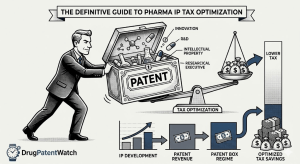
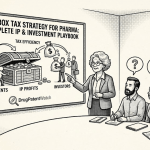
The UK Patent Box slashes the effective corporation tax rate on patented-drug profits from 25% to 10%. That 15-percentage-point gap is not a minor accounting line item. On a blockbuster generating £1 billion in qualifying IP income, it is £150 million a year that stays inside the company rather than flowing to HMRC. Over a typical five-year commercial window before biosimilar or generic entry, that is £750 million available for pipeline reinvestment, business development, or shareholder returns. Patent-focused pharma teams that treat the Patent Box as a passive compliance exercise rather than a live IP strategy tool are leaving material capital on the table.
This guide covers the full architecture of Patent Box eligibility, the nexus calculation mechanics that determine how much income actually qualifies, the interaction with R&D tax credits, real-world IP valuation implications, cross-border regime comparisons, and what the OECD’s Base Erosion and Profit Shifting (BEPS) framework means for any company routing royalty income through low-tax holding structures. It is written for IP teams, portfolio managers, and institutional analysts who need the granular mechanics, not a policy overview.
What the Patent Box Actually Does: Mechanism and Statutory Architecture
The Core Tax Mechanics
The UK Patent Box regime, governed under Part 8A of the Corporation Tax Act 2010, reduces the effective tax rate on qualifying IP profits to 10%. The standard UK corporation tax rate rose to 25% in April 2023, widening the Patent Box differential to its current 15 percentage points. That spread makes UK Patent Box relief among the highest-value IP tax incentives in any major pharmaceutical jurisdiction.
A company does not simply opt in and apply 10% to all profits. The calculation involves a streaming or standard method to isolate qualifying IP income from total revenue, then applies the nexus fraction to that income to determine how much qualifies for the reduced rate. The relief is then delivered as an additional deduction in the corporation tax return, effectively reducing taxable profits rather than applying a separate tax rate directly.
Qualifying IP income includes sales of patented products, royalties and license fees, proceeds from IP disposal, notional royalties on products where the company is both the IP owner and manufacturer, and damages or proceeds from infringement actions. That last category is one most corporate tax teams underutilise. When a company wins patent litigation and receives a settlement or court-awarded damages, those receipts can qualify for Patent Box treatment, provided the underlying patent itself is eligible.
Which Patents Qualify
Eligible IP is defined narrowly by statute. Granted patents under the UK Patents Act 1977 or the European Patent Convention qualify, as do patents granted by specified European Economic Area member states with equivalent novelty and inventive step requirements. Supplementary Protection Certificates (SPCs) that extend patent life beyond the standard 20-year term for medicinal products also qualify, which is commercially significant: SPCs can add up to five years of Patent Box-eligible protection on the highest-revenue years of a drug’s lifecycle.
Regulatory data exclusivity periods, granted by the EMA or MHRA as a separate reward for clinical trial data, do not qualify in isolation. A company must hold a granted patent or SPC, not merely a period of regulatory exclusivity, to access the Patent Box. This distinction matters for biologics, where data exclusivity under EU law lasts 8 years with an additional 2-year market exclusivity period, but where the patent landscape can be thin or contested.
Plant variety rights and certain database rights are excluded. Marketing authorisations are not IP for Patent Box purposes. The regime rewards patent ownership, not regulatory status.
The Nexus Fraction: Where Most Companies Lose Value
The nexus approach, adopted by the UK in 2016 to align with the OECD’s modified nexus approach under Action 5 of the BEPS framework, requires a company to demonstrate a proportionate link between the Patent Box income it claims and the R&D expenditure it incurs directly. The formula is:
Nexus Fraction = (D + S1) x 1.3 / (D + S1 + S2 + A)
Where:
D = qualifying R&D expenditure incurred directly by the company
S1 = qualifying R&D expenditure sub-contracted to unconnected third parties
S2 = qualifying R&D expenditure sub-contracted to connected parties (related-party outsourcing)
A = acquisition costs of the IP itself
The 1.3 uplift rewards companies that perform substantive in-house or arm’s-length R&D. If a company spends £100m on direct R&D and outsources £30m to an unaffiliated CRO, the numerator becomes £169m (130m x 1.3). If that same company also outsources £60m to a related-party affiliate, the denominator rises to £190m and the nexus fraction falls to approximately 0.89. That means 89% of qualifying IP income reaches the 10% rate rather than 100%.
For large pharma companies with centralised R&D models, where a Swiss or Irish holding company holds IP and sub-licenses to operating affiliates, the nexus fraction can compress substantially. The practical consequence is that companies designing or restructuring their IP holding model must run a forward nexus calculation, not just a current-year snapshot, to understand Patent Box value over a drug’s commercial life.
Key Takeaways: Patent Box Mechanics
The 10% rate applies to qualifying IP profits after the nexus fraction, not to gross revenue. SPCs count as eligible IP, making late-lifecycle patent strategy directly relevant to tax planning. The nexus calculation penalises related-party R&D outsourcing and IP acquisition costs, so companies that buy compounds late in development carry a structural disadvantage versus those that develop in-house. Most pharma companies can increase their Patent Box yield by tracking direct R&D expenditure at the compound or asset level from Phase I onward.
IP Valuation and the Patent Box: Treating Pharma IP as a Balance Sheet Asset
Why Patent Box Changes How You Value a Drug’s IP
Patent Box eligibility converts an intangible asset into a calculable cash flow advantage. For IP valuation purposes, the regime increases the net present value of a patented compound’s commercial income stream by reducing the tax drag on future profits. A standard DCF model for a drug generating £500m per year in UK-sourced profit, taxed at 25%, produces a materially different valuation than the same asset taxed at 10% on qualifying income.
The delta, on an after-tax NPV basis, compounds over the patent life. For a drug with 12 years of remaining patent protection, a 15-percentage-point tax rate reduction on, say, 70% of qualifying income increases the asset’s after-tax NPV by roughly 8-12% depending on discount rate assumptions. On a compound valued at £2 billion pre-Patent Box, that is £160-240 million in incremental IP value that belongs on the intangible asset register.
M&A teams routinely miss this. In pharmaceutical acquisitions where the target holds granted patents in the UK and has conducted substantive UK R&D, the Patent Box uplift should appear explicitly in the asset-by-asset IP valuation within the due diligence model. Failure to capture it understates the target’s intrinsic value.
SPC Valuation: The Highest-Value Patent Box Window
Supplementary Protection Certificates extend the patent term on medicinal products by a period equal to the time between the filing date of the marketing authorisation application and the date the first marketing authorisation was granted, minus five years, capped at five years. For a drug that took 12 years from patent filing to first EU approval, the SPC adds the maximum five years of patent protection.
Those five SPC years are typically the highest-revenue years in a drug’s lifecycle: the compound has cleared the pricing and reimbursement negotiation, has built market share, and faces no generic or biosimilar entry. The SPC’s eligibility for Patent Box treatment means those peak-revenue years carry the lowest effective tax rate. Quantifying that SPC window’s Patent Box value is now standard practice in licensing and co-development deal modelling.
A concrete example: AstraZeneca’s Farxiga (dapagliflozin) generated over £3 billion in annual global sales at peak. UK revenues represent a fraction of that total, but on UK-sourced profits eligible for Patent Box treatment, the 15-point rate reduction on peak-year income, compounded across an SPC-extended window, represents hundreds of millions in cumulative tax savings that directly increase the compound’s licensing floor price in any out-licensing negotiation.
Incremental Innovation and Evergreening: Patent Box as a Lifecycle Strategy Tool
One of the most commercially important features of the UK Patent Box is that it applies to incremental innovations, not just pioneer compounds. Improved drug delivery systems, modified release formulations, new salt forms, combination products, new indications supported by clinical data, and enhanced manufacturing processes all generate patentable IP that can qualify. This is where Patent Box intersects directly with evergreening strategy.
Evergreening refers to the practice of filing secondary patents on improvements to extend effective market exclusivity beyond the expiry of the original compound patent. Critics argue it delays generic entry. Regulators scrutinise it. From a pure IP strategy standpoint, each successfully granted secondary patent creates a new Patent Box-eligible asset with its own qualifying income stream.
The strategic roadmap for a typical oral small molecule works as follows. The molecule is covered by a compound patent, typically filed at lead candidate nomination. As the molecule advances through development, the IP team files process patents on the synthesis route, formulation patents on the drug product, dosage regimen patents based on PK/PD data, and potentially method-of-treatment patents on new indications discovered in Phase II or Phase III. Each granted patent in this thicket can independently qualify for Patent Box treatment on its attributed income.
For a company actively managing its patent portfolio with Patent Box in mind, the question at each patent filing decision is not only ‘Is this patentable?’ but ‘Does this expand our nexus-eligible R&D base and create a new qualifying IP stream?’ That reframing converts the IP team from a defensive function into a direct contributor to effective tax rate optimisation.
Royalty Income and Out-Licensing: Patent Box on Passive IP Income
Companies that out-license compounds to third parties receive royalty income rather than product revenue. That royalty income qualifies for Patent Box treatment, provided the licensor holds the relevant patent. This has direct implications for deal structure in co-development and licensing transactions.
When negotiating a licensing agreement, a UK-domiciled licensor with Patent Box eligibility should model the after-tax royalty rate rather than the headline royalty. A 12% royalty on net sales, taxed at 10%, generates more after-tax income than a 14% royalty taxed at 25%. That creates negotiating flexibility: the UK licensor can accept a lower headline royalty while maintaining equivalent after-tax returns, which may make deal terms more attractive to the licensee.
In practice, this means business development teams at UK-headquartered pharma companies should run a Patent Box overlay on every licensing term sheet before commercial negotiations begin. Most do not.
Investment Strategy: IP Valuation and Patent Box
Portfolio managers valuing pharma companies should adjust NPV models to reflect Patent Box eligibility by compound, factoring the nexus fraction based on the company’s disclosed R&D structure. Companies with predominantly UK-based R&D and a high proportion of directly filed patents will have nexus fractions close to 1.0 and receive near-full Patent Box benefit. Acquisitive companies that build pipelines through asset purchases will carry lower nexus fractions. In a screener, look for: UK corporation tax disclosures explicitly referencing Patent Box, SPC filings listed on the European Patent Register, and high in-house R&D as a percentage of total R&D spend.
R&D Tax Credits and Patent Box: The Full Innovation Tax Stack
How the Two Regimes Interact
The UK operates two parallel R&D incentive regimes: R&D tax credits, which reduce the cost of qualifying R&D expenditure at the front end, and Patent Box, which reduces the tax rate on resulting IP profits at the back end. They operate on different bases and do not conflict, but they interact in ways that compound total benefit.
R&D tax credits, restructured under the merged scheme effective April 2024, provide a credit of 20% on qualifying R&D expenditure, rising to 27% for loss-making R&D-intensive SMEs. Qualifying expenditure includes directly employed staff costs, externally provided workers, consumables used and transformed during R&D, software, and payments to clinical research organisations for contracted R&D. The merged scheme eliminated the distinction between the old RDEC and SME regimes, though the higher rate for R&D-intensive SMEs preserves preferential treatment for smaller biotech companies.
The sequencing matters. R&D credits reduce the cost base of developing a compound. The Patent Box then taxes the profits from that compound at a reduced rate. A company that runs both regimes correctly gains on the cost side during development and on the revenue side during commercialisation.
Documentation Requirements and the Cost of Non-Compliance
HMRC requires contemporaneous documentation to support both R&D tax credit claims and Patent Box elections. For Patent Box, this means a live tracking system that attributes revenue streams to specific patents, maintains the nexus calculation with supporting expenditure records, and documents the election to apply the Patent Box regime within the statutory two-year window after the end of the accounting period.
The documentation burden is substantive. For a company with ten marketed products, each covered by multiple patents and generating revenue from direct sales, royalties, and manufacturing licenses, the tracking system must be granular enough to demonstrate which income streams are attributable to which patents, which patents have been elected into the Patent Box, and what proportion of associated R&D expenditure is domestic versus outsourced versus acquired.
HMRC’s Connect system cross-references Patent Box elections against published patent registers, so elections on pending or pre-grant applications will trigger a query. The election must reference a granted patent.
One frequently overlooked compliance point is the sub-licensing structure. If a UK company licenses a patent to a subsidiary, which sub-licenses to a third-party manufacturer, and the royalty flows back up the chain, HMRC will scrutinise whether the intragroup royalty is arm’s length. Transfer pricing documentation must support the royalty rate used to attribute income to the Patent Box-eligible entity.
The Merged R&D Scheme: What Changed in 2024
The April 2024 merger of the RDEC and SME R&D tax credit schemes into a single merged scheme introduced a 20% above-the-line credit for most companies. The merged scheme also imposed new restrictions on overseas R&D expenditure: from April 2024, expenditure on R&D activities conducted outside the UK generally does not qualify, unless the conditions or regulatory requirements make it necessary to conduct the work abroad, or workers with the necessary expertise are genuinely unavailable in the UK.
For pharma companies running multi-country clinical trials, this creates a planning requirement. Phase I trials in healthy volunteers can often be conducted in the UK, preserving R&D credit eligibility. Later-phase trials requiring specific patient populations, rare disease cohorts, or international comparator sites may need to be structured carefully to capture the maximum UK-eligible portion. Companies that previously claimed R&D credits broadly across global CRO spend will need to re-examine their claim methodology under the merged scheme.
The same overseas restriction applies to the nexus fraction for Patent Box purposes. UK Patent Box legislation already required domestic R&D substance, but the merged scheme tightens the practical definition of what counts as UK-based qualifying activity.
Key Takeaways: The Full Innovation Tax Stack
The combined benefit of R&D tax credits and Patent Box is not merely additive. The R&D credit increases after-tax cash during development, which accelerates pipeline progression; the Patent Box increases after-tax profit during commercialisation, which improves the ROI on that accelerated pipeline. Companies that optimise both simultaneously generate a structurally higher return on R&D investment than those that manage each regime in isolation. The April 2024 merged scheme makes UK-based R&D spend more valuable than it was under the dual RDEC/SME structure and aligns that spend directly with Patent Box nexus fraction improvement.
Global Patent Box Regimes: A Competitive Rate Map
The Jurisdictional Landscape
Patent Box regimes now operate in over 30 countries, though their structure, eligibility criteria, and effective rates vary enough that direct comparison requires care.
The UK at 10% sits in the middle of the range. The Netherlands Innovation Box taxes qualifying profits at 9%, with broad eligibility covering patents, plant variety rights, data exclusivity, and certain software. Ireland’s Knowledge Development Box (KDB) applies a 6.25% rate, deliberately aligned with the BEPS nexus approach and with Irish corporation tax, creating an effective combined rate below 10% for KDB-eligible income. Belgium’s Innovation Income Deduction (IID) allows an 85% deduction on qualifying IP income, translating to an effective rate of roughly 3.75% at the standard Belgian rate of 25%. Luxembourg’s IP box rates qualifying income at a 5.2% effective rate. At the lowest end, Malta and Cyprus offer rates below 2.5%, though their regimes attract closer BEPS scrutiny.
Among major emerging pharma jurisdictions, Singapore’s Development and Expansion Incentive and Pioneer Status can reduce effective rates on qualifying IP income to 5% or below. Hong Kong introduced its Patent Box in 2023, offering a 5% rate on qualifying IP income, explicitly modelled on the BEPS nexus approach. China operates an accelerated depreciation regime for IP rather than a true Patent Box.
The US does not have a Patent Box. The Foreign-Derived Intangible Income (FDII) deduction under the 2017 Tax Cuts and Jobs Act provides an incentive for US companies to hold IP domestically and exploit it through exports, but it is structured as a deduction on export income rather than a reduced rate on patent profits. The FDII rate effectively taxes qualifying export IP income at 13.125% rather than 21%, a narrower differential than most European Patent Boxes.
How Pharma Companies Choose an IP Holding Jurisdiction
IP holding decisions involve rate, nexus requirements, treaty network, and operational substance. A company that holds IP in the Netherlands at 9% must demonstrate qualifying R&D substance, maintain transfer pricing documentation on intragroup royalty flows, and operate within the Dutch nexus rules. Moving IP from an operating affiliate to a Netherlands holding company for rate purposes triggers a transfer at market value, creating a capital gain or transfer pricing adjustment in the departing jurisdiction.
The substance requirement is where post-BEPS regimes diverge from their pre-2016 predecessors. Pre-BEPS IP boxes in Luxembourg and Belgium allowed IP to be held by a shell entity with no local R&D staff. Under the nexus approach, the entity holding the IP must have conducted, or directly commissioned from arm’s-length parties, the qualifying R&D that generated it. This requirement effectively ends the use of IP boxes as pure tax holding vehicles and requires genuine operational presence.
For pharma companies, genuine operational presence means R&D staff, manufacturing or formulation operations, clinical trial management, or regulatory affairs functions in the holding jurisdiction. Ireland has attracted significant pharma IP holding activity precisely because AbbVie, Johnson & Johnson, Pfizer, and others had pre-existing substantial Irish manufacturing and R&D operations that generate credible nexus substance. Their Irish IP holding entities are not shells; they have thousands of employees and substantive operations that legitimately generate IP eligible for the KDB.
For institutional investors, the cross-jurisdictional rate map has two uses. First, it explains why certain large-cap pharma companies carry persistently low effective tax rates: AbbVie’s Irish IP holding structure, Pfizer’s Irish manufacturing and IP base, and Novartis’s Swiss operations all benefit from favourable IP income treatment. These are structural tax advantages tied to IP holding decisions made years ago and are difficult for competitors to replicate quickly. Second, companies currently headquartered in high-rate jurisdictions without robust IP incentives face a structural ROI disadvantage in patent-intensive therapeutic areas. Patent Box rate differentials can shift the location decision for a new R&D facility or licensing platform.
Pharma Patent Lifecycle Strategy Through a Patent Box Lens
The Compound Patent: Filing and Patent Box Timing
A compound patent, the primary patent protecting the active pharmaceutical ingredient, is typically filed at the point of lead candidate nomination, roughly 12-15 years before expected market authorisation. The patent grants within 2-4 years of filing under normal examination timelines, though complex or contested applications can take longer. From grant, the Patent Box clock starts: the company can elect qualifying patents into the Patent Box from the date of grant.
If a compound patent is granted 3 years after filing and the drug reaches market 9 years after filing, the Patent Box regime covers the first 8 years of the standard 20-year patent term and all 5 years of any SPC. That is 13 years of potential Patent Box-eligible commercial revenue, and those 13 years overlap entirely with the high-revenue portion of the drug’s lifecycle.
Early patent filing strategy should explicitly model Patent Box timing. Divisional applications and continuation patents that extend examination and delay grant delay Patent Box eligibility and can reduce cumulative benefit, particularly if the compound reaches market before all divisionals are resolved.
Process Patents: Often Undervalued, Fully Eligible
Process patents protect the manufacturing route for an API or drug product and are frequently filed during development as the synthesis route is optimised. They are rarely the focus of competitor attention in the way compound patents are, but they are fully eligible for Patent Box treatment on income attributable to the patented process.
The attribution of income to a process patent requires a notional royalty approach: what royalty would a third-party manufacturer pay to license this process? HMRC accepts income attribution based on the cost savings the process provides versus a non-patented alternative route, which can be modelled using published manufacturing cost benchmarks or expert evidence.
For generic-facing pharma companies preparing to lose compound patent exclusivity, process patents on improved manufacturing routes can preserve Patent Box eligibility on manufacturing profits after the compound patent expires, provided no generic has yet been granted a license under the process patent. This is a specific and frequently overlooked bridging strategy between the compound patent’s expiry and the Patent Box election’s termination.
Formulation and Drug Delivery Patents: The Evergreening Roadmap
The formulation patent filing roadmap for a typical small molecule commercial product follows a predictable sequence. The immediate release formulation is typically covered by the compound patent itself. The IP team then files extended release formulation patents once PK data confirms the benefit of modified release in reducing Cmax toxicity or extending Cmin duration. Enteric coating patents follow if GI tolerability data supports the rationale. Co-formulation patents arise if combination therapy data supports a fixed-dose combination product.
Each of these formulation patents, once granted, is Patent Box-eligible. The income attributable to each is the premium the formulation commands over the non-patented alternative, modelled using price premium data or notional royalty calculations. A drug with four granted formulation patents, each covering a product that generates meaningful revenue, can maintain four simultaneous Patent Box streams even after the compound patent expires.
The practical limit on this strategy is the obviousness challenge in patent examination. Formulation improvements must be inventive, not merely obvious to a person skilled in the art. UK courts and the EPO have, in recent years, applied a relatively high inventive step threshold to formulation patents, particularly those based on modified release technology that is well-established in the prior art. The IP filing strategy must balance Patent Box value maximisation against the cost of defending weak formulation patents in Paragraph IV-equivalent proceedings under the UK’s patent linkage framework.
Method-of-Treatment Patents and New Indication Claims
Method-of-treatment patents, which protect the use of a known compound in a new indication, are patentable in the UK and EPC jurisdictions under the Swiss-type claim or the EPC 2000 purpose-limited claim format. A compound patent that expires in 2030 can be supplemented by a method-of-treatment patent covering a new oncology indication discovered in Phase IIb trials, granting exclusivity on the new indication through, say, 2038.
That new indication patent is Patent Box-eligible for its attributed income. The income attribution is relatively straightforward where the drug is marketed under a specific label indication: the revenue from that indication is the relevant stream. Where a drug is used off-label for the new indication, attribution is more complex and HMRC guidance requires a careful apportionment approach.
New indication discovery in Phase II and Phase III trials is therefore both a clinical strategy question and an IP strategy question. The Patent Box incentive provides a tax efficiency argument for pursuing label expansion programmes that might otherwise have marginal commercial returns.
Key Takeaways: Patent Lifecycle and Patent Box
A full lifecycle IP strategy, explicitly designed with Patent Box eligibility in mind, involves compound patents, SPCs, process patents, formulation patents, and method-of-treatment patents as separate but coordinated streams. The cumulative Patent Box value across a drug’s lifecycle is substantially higher than the value from the compound patent alone. Companies that track Patent Box elections by patent family and revenue stream, rather than at the product level, capture materially more of the available benefit.
Biologics, Biosimilars, and the Patent Box: A Separate Playbook
Why Biologics Are Different
Biologics, large molecule drugs produced by living cell systems, have a fundamentally different patent landscape than small molecules. A biologic’s IP protection typically rests on fewer compound patents (protein sequences are difficult to claim broadly) and a larger number of manufacturing process patents, formulation patents, and method-of-treatment patents. Data exclusivity, rather than compound patents, provides the primary market protection in many cases.
For Patent Box purposes, this means eligibility depends heavily on the process and formulation patent portfolio. The manufacturing process for a monoclonal antibody, including the cell line, fermentation parameters, purification process, and fill-finish formulation, can generate 20-40 separately patentable claims. Those process patents, if granted, are fully eligible for Patent Box treatment on their attributed income.
The attributed income from a manufacturing process patent for a biologic is calculated using the cost savings or premium attributable to the patented process over a non-patented alternative. For biologics with highly optimised manufacturing processes, this premium can be substantial: a cell line patent that increases yield by 40% has a directly quantifiable economic value attributable to the IP.
Biosimilar Entry and the Patent Box Window
Biosimilar entry into the EU and UK markets has accelerated since the expiry of early-generation biologic compound patents. Humira (adalimumab), Enbrel (etanercept), MabThera/Rituxan (rituximab), and Herceptin (trastuzumab) have all seen biosimilar competition. The originator’s Patent Box strategy post-biosimilar entry depends on whether any granted process or formulation patents remain eligible and whether they cover the commercial product format.
AbbVie’s Humira lost its compound patent in Europe in 2018 but maintained a formulation patent covering the high-concentration, citrate-free formulation used in Humira’s auto-injector, which is the commercially dominant form. That formulation patent was the subject of extensive European patent opposition proceedings. Had it been upheld through the biosimilar entry window, the high-concentration formulation’s UK income would have remained Patent Box-eligible. The litigation outcome illustrates exactly how formulation patent strength directly determines Patent Box revenue duration in the biosimilar era.
Cell and Gene Therapy: Emerging Patent Box Frontier
Advanced therapy medicinal products (ATMPs), including CAR-T therapies, gene therapies, and cell therapies, present a novel Patent Box planning question. These products are patented principally on their manufacturing vectors (viral vectors for gene delivery), the gene editing constructs (CRISPR-Cas9 guide RNA sequences and delivery systems), the cell engineering processes, and the manufacturing protocols.
Several of these patent types are granted and commercially significant. Novartis’s Kymriah (tisagenlecleucel), the first approved CAR-T therapy, is covered by patents on the chimeric antigen receptor construct, the retroviral vector manufacturing process, and the T-cell engineering protocol. Bristol Myers Squibb’s Breyanzi (lisocabtagene maraleucel) has a distinct patent portfolio covering its defined CD4/CD8 ratio manufacturing process.
For both products, UK Patent Box eligibility turns on whether UK-domiciled entities hold the relevant patents and conduct qualifying R&D in the UK. Given that CAR-T manufacturing is highly specialised and capital-intensive, with global capacity concentrated in a small number of facilities, the nexus analysis for ATMP companies will be facility-specific. Companies building UK ATMP manufacturing capacity, such as those partnering with the Cell and Gene Therapy Catapult, may generate strong nexus positions for Patent Box purposes as UK-based process R&D scales.
Key Takeaways: Biologics and Patent Box
Biologic Patent Box strategy is process-patent-driven rather than compound-patent-driven. The manufacturing process patent portfolio, the formulation portfolio, and any method-of-treatment patents on new indications are the primary eligibility levers. Biosimilar entry does not automatically terminate Patent Box eligibility if valid process or formulation patents remain. ATMP companies should model Patent Box eligibility from the point of first patent filing on their manufacturing vectors and cell engineering processes, not retrospectively at commercialisation.
Geographic Concentration, Regional Disparities, and Policy Implications
London’s 44% Share of UK Patent Box Relief
HMRC data shows that approximately 44% of all UK Patent Box relief is claimed by London-headquartered firms. This concentration reflects both the geography of large-cap pharma and biotech decision-making functions and the location of IP holding entities within UK corporate structures. It does not necessarily mean that 44% of qualifying R&D is conducted in London; the IP holding entity’s registered address and the location of qualifying IP income are what matter for relief attribution.
The regional imbalance has prompted policy debate. The UK Government’s levelling-up agenda has considered whether Patent Box incentives could be structured to reward R&D conducted in specific geographic areas, potentially through enhanced nexus treatment for expenditure at facilities in enterprise zones or Catapult centres outside London. No such modification has been enacted, but the policy conversation is active and any change would materially affect the planning calculus for companies with R&D sites across multiple UK locations.
For companies considering where to locate a new R&D facility, the current Patent Box rules are location-neutral within the UK: qualifying R&D expenditure in Edinburgh, Manchester, or Cambridge counts identically to equivalent expenditure in London for nexus fraction purposes. The geographic concentration in claimed relief is a function of corporate structure, not R&D location rules.
The Small Company Problem
Small and medium-sized biotech companies face a structural barrier to Patent Box participation that larger pharma companies do not. The standard Patent Box calculation requires streaming or allocation of IP income across patent families, which demands administrative infrastructure that many small companies lack. The alternative standard fraction method, designed to reduce compliance burden, applies a notional royalty rate to turnover, but this approach is rarely advantageous for companies whose actual IP income is a high proportion of revenue.
The result is that many small UK biotech companies, which hold commercially significant IP and generate royalties or upfront license payments from out-licensing, do not claim Patent Box relief to which they are entitled. HMRC’s R&D statistics consistently show that Patent Box take-up in the sub-£50m revenue bracket is disproportionately low relative to estimated eligible income.
Tax advisers in this space estimate that 15-25% of eligible small company IP income goes unclaimed annually. For a small biotech receiving a £20m milestone payment on a licensed asset, Patent Box treatment would reduce the tax liability by £3m. That £3m, re-invested in pipeline R&D, is the difference between initiating a Phase I study and not.
HMRC Compliance, Documentation, and Dispute Risk
Patent Box Elections and the Two-Year Window
A company must elect into the Patent Box within two years of the end of the accounting period in which qualifying IP income first arises on a newly granted patent. Missed elections cannot be backdated beyond that two-year window. For companies with large patent portfolios granted across multiple accounting periods, maintaining an election register is essential; a missed election on a high-revenue patent family results in a permanent loss of relief on that income.
HMRC does not automatically grant Patent Box treatment. The company’s self-assessment return includes the Patent Box calculation as an additional deduction, and the onus is on the company to document eligibility, calculate the nexus fraction, stream or allocate income correctly, and maintain records to support a potential enquiry. HMRC opens Patent Box enquiries routinely, focusing on four areas: the completeness of the patent election register, the nexus fraction calculation and supporting expenditure records, the attribution of income to specific patents, and the arm’s-length nature of any intragroup royalties used in the calculation.
Transfer Pricing Overlay
The Patent Box calculation and transfer pricing are inseparable for any company with intragroup IP arrangements. If a UK entity licenses patents to a non-UK affiliate and the royalty flows back to the UK, the royalty rate must be arm’s length. If the royalty is too low, HMRC will upward-adjust the UK entity’s income, but the additional income it attributes to the UK entity will be eligible for Patent Box treatment, which partially offsets the tax impact. If the royalty is too high, the non-UK jurisdiction may challenge the deduction. Getting the royalty right, documented with a comparables analysis using royalty rate databases such as RoyaltySource or ktMINE, is a pre-condition for stable Patent Box planning.
For Paragraph IV litigation outcomes, where a US generic challenges a UK-linked patent and the originator receives damages or a settlement, the transfer pricing of any IP license between the US and UK operating entities that funded the litigation affects how the damages proceeds are attributed. This is an area of active HMRC scrutiny.
Investment Strategy: Compliance Risk and Valuation
Analysts valuing pharma companies that rely materially on Patent Box for their effective tax rate should examine disclosed HMRC enquiry status. A company that reports a 12% effective tax rate with Patent Box as a primary driver, but discloses an open HMRC enquiry, carries a contingent tax liability that standard models do not capture. Companies with clean election registers, contemporaneous nexus documentation, and arm’s-length royalty structures are lower-risk from a Patent Box sustainability standpoint and should trade at a premium to equivalently structured companies with compliance gaps.
What the OECD’s Pillar Two Means for Pharmaceutical Patent Box Planning
The 15% Global Minimum and Patent Box Rate Floors
OECD Pillar Two establishes a 15% global minimum tax on the income of multinational enterprises with annual revenues above EUR 750 million. For pharma companies operating Patent Box regimes at rates below 15%, this creates a top-up mechanism: if the effective tax rate in a given jurisdiction on qualifying IP income falls below 15%, the parent jurisdiction (or a designated domestic minimum top-up tax authority) can impose a top-up charge.
The UK’s Patent Box at 10% is below the 15% Pillar Two floor. However, the UK has enacted the OECD’s Substance-Based Income Exclusion (SBIE), which carves out a portion of income from the minimum tax calculation based on payroll costs and tangible assets. For pharma companies with substantive UK R&D and manufacturing, the SBIE may reduce the effective amount of IP income subject to top-up. The precise interaction requires entity-by-entity analysis under the GloBE rules.
Ireland’s KDB at 6.25% is more exposed. AbbVie, Pfizer, and Lilly, all significant Irish IP income earners, will see some portion of Irish KDB income subject to Pillar Two top-up. Ireland has enacted a Qualified Domestic Minimum Top-Up Tax (QDMTT) that tops up affected companies domestically rather than allowing other jurisdictions to collect. The net result for these companies is that Irish IP income will be taxed at approximately 15% rather than at sub-10% rates, narrowing but not eliminating the Irish IP holding advantage. The substance-driven Irish operations at these companies preserve a meaningful after-tax return even at the higher rate.
Pillar Two Adaptation Strategies
Pharma companies responding to Pillar Two are simultaneously doing several things. IP holding entities in jurisdictions with rates below 15% are either being consolidated into higher-rate group entities or having their local substance increased to maximise the SBIE carve-out. R&D expenditure is being redirected toward higher-payroll jurisdictions where the payroll component of the SBIE is highest, which in practice favours UK, US, and German R&D centres over IP-holding entities in lower-cost jurisdictions.
Patent Box planning in the UK is relatively Pillar Two-resilient for companies with substantive UK operations. The UK effective rate of 10% on Patent Box income, when combined with SBIE carve-outs based on UK R&D payroll costs, may result in an adjusted effective rate above 15% for companies with large UK workforces. For those companies, the Patent Box’s benefit relative to the 25% standard rate remains intact; they simply will not face a top-up charge.
Key Takeaways: Pillar Two
Pillar Two does not eliminate Patent Box value for companies with genuine UK R&D substance. It materially reduces the value of low-rate Patent Box regimes in small jurisdictions that lack SBIE carve-outs. For institutional investors, companies whose effective tax rate depends on sub-10% Patent Box rates in jurisdictions with minimal substance should be modelled at higher future tax rates; those with UK or Netherlands Patent Box claims backed by substantial domestic R&D payroll have more durable effective rate profiles.
Practical Implementation Roadmap for Pharma IP Teams
Phase 1: Patent Portfolio Audit and Election Register
The first step is an audit of all granted patents held by UK-domiciled entities within the corporate group, cross-referenced against the Patent Box election register. Many large pharma companies hold hundreds of granted patents across UK and European jurisdictions and have made elections on only a fraction. The audit identifies unelected patents with live commercial income, calculates the two-year election window status, and prioritises elections by estimated qualifying income.
The output is a priority list for immediate elections and a forward calendar for patents currently in prosecution, so elections can be made within the two-year window from grant date. For companies that have never systematically tracked Patent Box elections, this audit typically reveals £5-30 million in missed annual relief, depending on the size of the patent portfolio and UK commercial revenues.
Phase 2: Nexus Fraction Calculation by Product
The second phase builds a nexus fraction model at the product and patent family level. This requires pulling qualifying R&D expenditure records for each marketed product from the point of first UK R&D activity, separating direct expenditure, arm’s-length outsourcing, related-party outsourcing, and IP acquisition costs. For products developed internally from early discovery, the nexus fraction will typically be high (above 0.85). For in-licensed compounds acquired post-Phase II, the nexus fraction will be lower, sometimes materially so.
The nexus fraction model then projects forward using the expected R&D spend by product over the remaining patent life. Companies can improve their forward nexus fraction by increasing direct UK R&D spend on existing products, including label expansion studies, post-marketing commitments, and manufacturing process improvements, and by directing outsourcing to unaffiliated CROs rather than group companies.
Phase 3: Income Attribution and Streaming
Income attribution is the technically most demanding part of Patent Box compliance. Each Patent Box-eligible product generates income from sales, royalties, manufacturing licenses, and potentially damages. Each income stream must be attributed to the relevant patent or patents. Where a product is covered by multiple patents (compound, formulation, process), income is attributed using a notional royalty approach or by reference to the specific protection each patent provides.
For a product generating £200m in UK annual sales, covered by a compound patent and two formulation patents, the attribution might allocate £150m to the compound patent (the fundamental protection), £30m to the extended-release formulation patent (the premium over the IR formulation), and £20m to the process patent (the cost saving from the proprietary synthesis route). Each stream then passes through its own nexus fraction calculation if the R&D history differs by patent family.
Phase 4: Integration with Commercial and Business Development Planning
Patent Box value should flow into commercial pricing decisions, licensing term sheets, and M&A models. A pricing team modelling the commercial launch of a UK-developed compound should include Patent Box benefit in the revenue model; it affects the after-tax profit available for reinvestment and shapes the minimum acceptable price in HTA negotiations. A business development team structuring an out-licensing deal should model the Patent Box impact on royalty income and use it to set negotiating parameters on headline rate.
In M&A, acquirers of UK pharma assets should require a Patent Box data room that includes the target’s election register, nexus fraction calculations by product, HMRC enquiry status, and documentation of any intragroup IP arrangements. Absence of this data from a UK pharma M&A process is itself a red flag.
Key Takeaways: The Full Patent Box Playbook
The Patent Box is not a passive compliance exercise. It is an active IP strategy tool that, when integrated into patent filing decisions, R&D location choices, licensing term structures, and M&A due diligence, generates material capital advantage across a drug’s full commercial lifecycle.
The 15-percentage-point rate differential versus the standard UK corporation tax rate translates directly to after-tax NPV uplift on qualifying IP assets. SPCs extend that advantage into the highest-revenue years of a drug’s life. The nexus fraction rewards companies with domestic R&D intensity and penalises those that build pipelines through acquisition. The interaction with R&D tax credits creates a full-lifecycle tax stack from discovery through commercialisation. Pillar Two narrows but does not eliminate the Patent Box advantage for companies with genuine UK operational substance.
For pharma IP teams, the immediate priorities are: auditing the election register for missed elections within the two-year window, building a nexus fraction model by product from inception, integrating Patent Box value into licensing deal models, and documenting IP attribution with contemporaneous records that survive HMRC enquiry. For institutional investors, the Patent Box is a durable effective tax rate lever for UK-substantive pharma companies and a differentiating factor in after-tax ROI on patent-intensive assets.