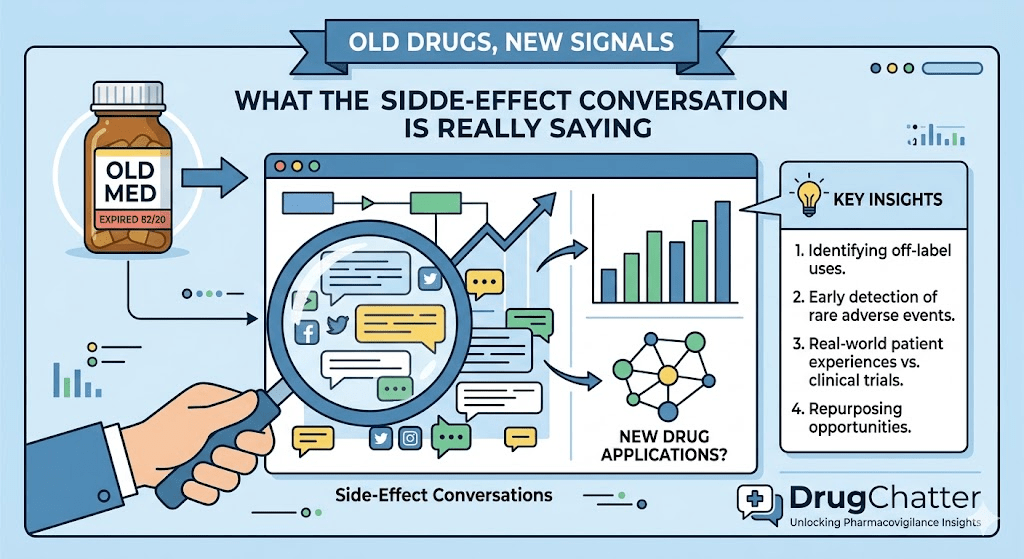
There’s a quiet shift happening in pharmacology that doesn’t show up neatly in prescribing guidelines or FDA labels. It shows up in the questions people ask.
Not “does it work?” anymore. That’s assumed.
Instead: how long do the side effects last, when do they become dangerous, and what changes when you combine it with something else I’m already taking?
In other words, we’re moving from efficacy-first medicine to tolerance-and-interaction-first medicine.
And that shift looks very different depending on whether the drug is “old” or “new.”
1. The new drugs: efficacy is given, tolerance is negotiated
Take the GLP-1 class. With semaglutide, Ozempic, Wegovy—the conversation is almost never about whether they work anymore.
The pattern is striking: efficacy is stable enough that it drops out of the question set. What remains is duration, lifestyle interaction, and persistence of side effects.
Even the success cases generate their own second-order questions:
This is a hallmark of modern biologically active chronic therapies: they behave less like “drugs you take” and more like “physiological states you negotiate with.”
2. Immunotherapy: where side effects become diagnostic categories
If GLP-1s are about tolerability, checkpoint inhibitors are about vigilance.
With drugs like Keytruda (pembrolizumab), the language changes completely. You don’t just ask about side effects—you ask which ones are emergencies:
Here, “side effect” is almost a misleading term. These are immune reprogramming events, and patients (or clinicians) are effectively being asked to monitor for system-wide deviations.
Even dermatologic or inflammatory changes become proxy signals of mechanism:
The new signal is not “does it cause toxicity?” but “do you recognize toxicity early enough to intervene before it becomes irreversible?”
That’s a very different epistemology from older drugs.
3. The middle layer: biologics that behave like adjustable systems
Cosentyx (secukinumab) sits in an interesting transitional space. It’s not a small molecule, but it’s also not an immune “event generator” like checkpoint inhibitors.
Notice what’s happening here: Cosentyx is treated like a controllable immunologic dial rather than a fixed intervention. The question is not just safety—it’s how much immunity you are willing to trade for symptom control.
That framing barely existed in older drug classes.
4. Old drugs: clarity, familiarity, and “known unknowns”
Contrast all of this with NSAIDs, acetaminophen, and statins.
For ibuprofen/Advil and aspirin, the conversation is not exploratory—it’s definitional:
These are “closed systems” in the cognitive sense. The pharmacology is well mapped enough that uncertainty is mostly about patient-specific risk, not drug novelty.
Lipitor and statins extend this pattern into chronic metabolic therapy:
Even long-established drugs start behaving “new” again once placed in modern polypharmacy environments.
6. The uncomfortable truth: “old vs new” is not about time
What these questions actually reveal is not age of molecule, but complexity of uncertainty.
Old drugs:
Known endpoints
Known risks
Stable interaction profiles
New drugs:
Mechanistic clarity paired with clinical unpredictability
Immune or metabolic systems being actively modulated
Side effects that behave like time-dependent processes, not static events
So when someone asks whether Ozempic side effects fade, or whether Keytruda toxicity is urgent, or whether Cosentyx alters infection risk, they are not just asking about drugs.
They are asking a deeper question:
“How reversible is the state this drug puts my biology into?”