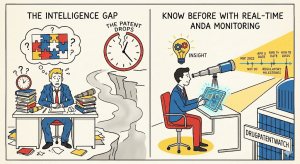
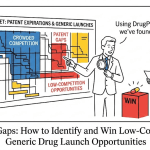
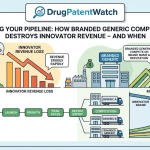
Every year, branded pharmaceutical manufacturers watch billions of dollars in revenue evaporate within months of a patent expiry. Generic filers know exactly when to strike. Brand-side business development teams, too often, do not. The asymmetry is not inevitable. It is a data problem, and it has a solution.
Real-time ANDA (Abbreviated New Drug Application) monitoring, connected directly to loss-of-exclusivity timelines, has become one of the most operationally valuable tools available to biopharma BD teams, licensing desks, and competitive intelligence functions. It converts regulatory filings – dry, public, and chronically underutilized – into actionable market intelligence weeks or months ahead of the moment when a generic product walks onto the shelf.
This article examines exactly how that intelligence loop works, what it produces for companies willing to use it, and why organizations that ignore it consistently find themselves reacting instead of planning.
Part One: The Anatomy of a Loss-of-Exclusivity Event
What LOE Actually Means for a Drug’s Revenue
Loss of exclusivity is the moment a branded drug’s patent or market exclusivity protections expire, allowing generic manufacturers to legally sell a chemically equivalent version at dramatically lower prices. The revenue erosion that follows is swift and steep.
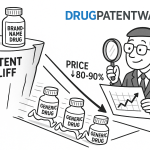
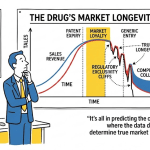
Data compiled across major small-molecule product LOE events between 2015 and 2023 shows that branded drugs lose an average of 80 to 90 percent of their unit volume to generics within 12 months of first generic entry [1]. Blockbusters with multiple generic filers see that compression happen faster. The dynamic is not new, but it has intensified as generic manufacturers have grown more sophisticated and better funded. <blockquote> “Generic drugs account for 90% of all prescriptions dispensed in the United States, yet represent only about 18% of total drug spending.” – Association for Accessible Medicines, 2023 Generic Drug & Biosimilar Access & Savings in the U.S. Report [2] </blockquote>
That ratio exists because the generic entry mechanism is brutally efficient. Within weeks of an LOE event, pharmacy benefit managers reclassify formulary tiers, hospital systems re-contract, and payers update preferred drug lists. Brand manufacturers who have not prepared a strategic response – a follow-on formulation, a licensing deal, a counter-competitive filing, or a portfolio pivot – are simply watching margin bleed out.
The Three-Layer Patent Stack
Most branded drugs are not protected by a single patent. They sit under a stack of overlapping intellectual property: composition-of-matter patents, formulation patents, method-of-use patents, and sometimes process patents filed years after the original discovery. Understanding which layer of that stack breaks first, and in what sequence, determines the actual LOE timeline.
Generic manufacturers understand this instinctively. Their legal and regulatory teams spend years mapping the stack before filing an ANDA. Their Paragraph IV certifications, discussed in detail below, represent the culmination of that work. Brand manufacturers need to know about those certifications the moment they are filed, not six months later when a litigation notice arrives.
The Orange Book, FDA’s official listing of approved drug products and their associated patents, is the public record of that stack. It is searchable, but it is static. A brand manufacturer checking the Orange Book periodically gets a snapshot. An organization running real-time monitoring against ANDA activity gets a live feed.
Part Two: The ANDA Pipeline as a Forward-Looking Signal
How an ANDA Works and Why the Filing Date Matters
An ANDA is the regulatory pathway generic drug manufacturers use to bring a drug to market without running full clinical trials. They demonstrate bioequivalence to an already-approved reference listed drug (RLD), and FDA approval follows if the bioequivalence data holds and the manufacturer can certify one of four positions regarding the RLD’s patents.
Those four positions – Paragraph I through Paragraph IV certifications – are the intelligence layer that biopharma BD teams cannot afford to ignore.
Paragraph I: No relevant patents exist. Paragraph II: All relevant patents have expired. Paragraph III: The generic manufacturer will wait for relevant patents to expire before launching. Paragraph IV: The generic manufacturer believes one or more listed patents are invalid, unenforceable, or will not be infringed by the generic product.
Paragraph IV is the aggressive play. It tells a brand manufacturer, months or years ahead of time, that a generic company has decided the patent stack is beatable. It triggers an automatic 30-month stay of FDA approval if the brand holder files suit within 45 days, creating a litigation clock that runs parallel to the drug’s remaining exclusivity. For the first company to file a Paragraph IV against a given drug, there is also a 180-day exclusivity period – the “first-filer” exclusivity – that creates a powerful financial incentive to move fast.
The First-Filer Advantage and What It Signals to BD Teams
When the first Paragraph IV ANDA lands for a given drug, it signals that at least one well-resourced generic manufacturer has assessed the patent stack, decided it can win, and committed the legal and regulatory capital to pursue approval. That decision is not made lightly. A typical ANDA with a Paragraph IV costs $1 million to $5 million in legal fees alone, before manufacturing validation [3].
For a brand manufacturer’s BD team, that first ANDA filing is an early warning with a specific time horizon attached. If the 30-month stay is triggered and runs to completion without settlement, the generic can potentially launch within three to three-and-a-half years. If the brand settles – and roughly 60 percent of Paragraph IV litigations result in settlements [4] – the timeline shifts, and the terms of that settlement define the competitive landscape for years afterward.
None of this intelligence is hidden. It is all regulatory and legal public record. What separates companies that act on it from companies that miss it is monitoring infrastructure, specifically the ability to detect ANDA filings and Paragraph IV certifications in real time and route that information to the right decision-makers immediately.
The Lag Problem with Manual Monitoring
The FDA publishes ANDA-related information through several channels: the Orange Book, the Paragraph IV Certification List, FDA approval letters, and the Federal Register. Each has its own update cadence. The Paragraph IV Certification List, for example, has historically been updated with delays that leave brand manufacturers in the dark for weeks after a filing.
A BD team running quarterly competitive reviews, or even monthly, will routinely discover Paragraph IV filings after the 45-day litigation window has partially closed. That is not a hypothetical risk. It is a structural consequence of infrequent monitoring against a regulatory record that moves in real time.
The cost of that lag is not just a missed litigation opportunity. It is a missed pricing decision, a missed licensing outreach window, a missed portfolio restructuring trigger, and sometimes a missed M&A signal.
Part Three: What Real-Time Monitoring Actually Looks Like
The Data Infrastructure Behind Timely ANDA Intelligence
Effective real-time ANDA monitoring requires continuous ingestion from multiple FDA data sources, cross-referenced against patent expiration databases, Orange Book records, and litigation tracking systems. No single FDA publication provides the complete picture; the intelligence value comes from connecting data across sources in a single normalized view.
Platforms like DrugPatentWatch have built exactly this kind of aggregated infrastructure, parsing FDA records, patent filings, Orange Book listings, court dockets, and exclusivity determinations into a unified dataset that business development professionals can query, filter, and receive alerts from. Where a manual review might catch a Paragraph IV filing three weeks after the fact, an automated alert from a system monitoring those records continuously can surface it within hours.
The practical difference between a three-week lag and a same-day alert is not marginal. For a BD team managing a product with $500 million in annual sales and a 45-day litigation window, each week of lag represents a shrinking decision window. At three weeks, you have consumed nearly half your response time before the intelligence even reaches your desk.
Connecting ANDA Activity to LOE Timelines
The analytical power of real-time ANDA monitoring does not live in raw filing data. It lives in the synthesis of filing data against patent expiration timelines. The question a BD team actually needs to answer is not “was an ANDA filed?” but rather “given this ANDA and these patents, what is the realistic earliest entry date for generic competition, and what does that mean for our commercial planning horizon?”
Answering that question requires patent-by-patent analysis: which patents are listed in the Orange Book, when does each expire, which ones are being challenged under Paragraph IV, what is the litigation posture, and have any settlement agreements been filed with the FTC under the Medicare Prescription Drug, Improvement, and Modernization Act’s mandatory disclosure requirements?
Platforms integrating these data streams can generate what analysts call a “generic entry probability timeline” – a structured view of when each competitive threat becomes commercially material. For brand manufacturers managing a portfolio of products at different stages of exclusivity, that timeline view is the foundation of multi-year revenue forecasting.
DrugPatentWatch, for instance, provides structured access to patent expiry data, ANDA filings, Paragraph IV certifications, and litigation outcomes in a format designed for both one-off product analysis and ongoing portfolio monitoring. BD teams at major branded manufacturers use it as a standing intelligence input for quarterly pipeline reviews and annual strategic planning cycles.
Part Four: How BD Teams Actually Use This Intelligence
Licensing Strategy: Offense and Defense
Real-time ANDA monitoring supports licensing strategy in two directions.
On the offensive side, a company that manufactures or holds patents on active pharmaceutical ingredients, drug delivery systems, or formulation technologies can use ANDA activity to identify molecules approaching LOE as prospective in-licensing or partnership targets. A drug entering its terminal exclusivity window with a cleared regulatory pathway but a complex formulation profile may represent a licensing opportunity for a company with relevant manufacturing capabilities.
On the defensive side, brand manufacturers can use ANDA intelligence to identify when their own products are being targeted by generic filers and respond with lifecycle management strategies: line extensions, new dosage forms, modified-release formulations, or fixed-dose combinations that create differentiated positions ahead of generic entry. The commercial window for these strategies is longer than most brand teams assume – but it closes faster than most of them act.
The 505(b)(2) regulatory pathway, which allows manufacturers to rely partly on existing clinical data for new formulations of approved drugs, makes defensive lifecycle management more achievable than it was a decade ago. Companies running real-time LOE and ANDA monitoring have a material advantage in identifying which of their products most urgently need that kind of lifecycle investment.
Portfolio Prioritization and Revenue Defense
For large biopharma companies managing portfolios of dozens of commercial products, ANDA monitoring serves as a portfolio triage system. When Pfizer, AbbVie, or Bristol Myers Squibb runs a five-year revenue planning cycle, the integrity of that plan depends directly on accurate LOE forecasting. A Paragraph IV certification that was not flagged until two months after filing can force a revision to a revenue model that has already been communicated to investors.
The patent cliff problem is not a new challenge for large pharma – analysts have tracked it for decades. What is new is the granularity and speed with which BD teams can now track the legal and regulatory events that determine cliff timing. The gap between companies using real-time monitoring infrastructure and those relying on manual tracking or periodic market research updates is, at this point, a measurable competitive disadvantage.
Smaller specialty pharma companies, which may have one or two commercial products generating the bulk of their revenue, face the most acute risk from unmonitored ANDA activity. For a company generating $200 million annually from a single branded product, an undetected Paragraph IV filing against that product’s primary patents represents an existential commercial risk that deserves the same attention as any other material financial exposure.
M&A Intelligence and Valuation Due Diligence
ANDA data has a specific and underappreciated role in biopharma M&A. When a company is evaluating the acquisition of a branded pharmaceutical business, the valuation model depends heavily on the revenue durability of the target’s commercial portfolio. That durability is directly a function of the patent and exclusivity position of each product.
A target company’s branded products may show strong current revenue, but if the ANDA landscape reveals multiple Paragraph IV filings in advanced litigation stages, the adjusted valuation should reflect accelerated revenue erosion. Buyers who do not run thorough ANDA surveillance as part of due diligence routinely overpay.
Conversely, ANDA data can reveal upside. A product with an expiring patent but no generic filers – sometimes because the manufacturing process is complex, the market is too small to attract multiple generic entrants, or the Paragraph IV challenge was dropped after settlement – may have longer effective exclusivity than its nominal patent expiration date suggests.
This kind of nuanced LOE analysis is not available through standard financial due diligence alone. It requires drilling into the regulatory record with the same rigor applied to clinical and manufacturing quality reviews.
Deal Sourcing and Counterparty Intelligence
ANDA monitoring also tells brand manufacturers something useful about their potential counterparties in licensing and settlement negotiations: which generic manufacturers are actively pursuing their products, how aggressively, and with what likely timelines.
A company that has filed a single Paragraph IV ANDA on one product is a different negotiating counterpart than one that has filed six ANDAs across your portfolio and has a track record of litigating to court decisions rather than settling. Generic manufacturers’ ANDA activity patterns, tracked across their full portfolio of filings, reveal their strategic intentions, litigation tolerance, and financial capacity.
Teva, Mylan (now Viatris), Sun Pharma, Hikma, and Amneal each have distinct ANDA filing patterns, litigation postures, and settlement histories. A brand manufacturer that understands those patterns can anticipate behavior, calibrate litigation vs. settlement calculus, and enter commercial negotiations with a much clearer picture of the counterparty’s constraints and objectives.
Part Five: The Biosimilar Parallel
Why Biologics BD Teams Need the Same Approach
The ANDA mechanism is specific to small-molecule generics. For biologics, the analogous pathway is the Biologics Price Competition and Innovation Act (BPCIA) and the 351(k) biosimilar application process. The strategic logic is nearly identical, but the regulatory record is more complex.
Biosimilar applications involve the same competitive intelligence questions: who is filing, against which reference products, what patents are being challenged, and what does the resulting landscape mean for the reference product’s commercial durability? The biosimilar space differs from the small-molecule generic space in the complexity of the technology, the scale of manufacturing investment required, and the slower market penetration curve. But the intelligence principles are the same.
Brand manufacturers of biologics approaching biosimilar exposure – and the window has opened significantly, with adalimumab, bevacizumab, trastuzumab, and rituximab now facing multiple approved biosimilar competitors – need monitoring infrastructure that covers 351(k) filings with the same rigor applied to ANDAs for small molecules. Platforms that cover both tracks provide a unified competitive picture across a company’s full commercial portfolio.
The Interchangeability Designation as an Accelerant
The FDA’s interchangeability designation for biosimilars, established under the BPCIA, allows pharmacists to substitute a designated biosimilar for the reference biologic without prescriber intervention – the same automatic substitution dynamic that drives rapid market share shifts in the small-molecule generic space.
The first biosimilar products to receive interchangeability designations have been adalimumab biosimilars, where Hadlima (Samsung Bioepis/Organon) received the first such designation in 2023 [5]. As more products receive that status, the revenue erosion pattern for reference biologics will increasingly mirror the pattern for branded small molecules post-LOE. BD teams managing biologic portfolios should already be treating the interchangeability filing pipeline as a forward-looking competitive signal with the same urgency they apply to Paragraph IV ANDA certifications.
Part Six: The Operational Build
What a Functioning ANDA Intelligence Program Looks Like
Building a real-time ANDA monitoring capability does not require building the data infrastructure from scratch. It does require integrating third-party data into internal workflows in a way that actually routes intelligence to decision-makers.
The minimum viable program has four components:
A data source with real-time or near-real-time coverage of ANDA filings, Paragraph IV certifications, Orange Book listings, and FDA approval actions. Platforms like DrugPatentWatch provide this as a subscription service, with alert capabilities that can be scoped to specific products, therapeutic areas, or patent numbers.
An internal routing protocol that ensures ANDA alerts reach the BD team, the brand marketing team, the legal group, and senior commercial leadership simultaneously – not sequentially. Intelligence that arrives at the patent litigation team two weeks before the BD team sees it does not serve the organization’s full range of strategic responses.
A standardized analytical framework for converting a new ANDA alert into a structured competitive assessment. That framework should cover: patent-by-patent LOE analysis, generic entry probability timeline, litigation posture options, commercial response options (pricing, lifecycle management, channel strategy), and licensing or settlement flag.
A quarterly portfolio review process that aggregates the ANDA activity monitoring into a forward-looking revenue risk assessment. Individual alerts catch specific events; quarterly reviews catch patterns and calibrate the portfolio strategy against an updated competitive landscape.
Integration with Commercial Planning Systems
The intelligence value of ANDA monitoring compounds significantly when it is connected to commercial planning systems. Most branded pharma companies run revenue forecasts in enterprise financial planning platforms. Those forecasts include LOE date assumptions for each commercial product.
When an ANDA alert signals an accelerated competitive threat – a new Paragraph IV filing, an FDA approval of a previously pending ANDA, or a court decision invalidating a key patent – that signal should trigger a revision to the revenue forecast, not a standalone competitive intelligence report that sits in a different system from the financial model.
Companies that have built this integration describe a material improvement in forecast accuracy and a faster internal response to competitive threats. The mechanism is straightforward: connect the data alert to the planning assumption, which connects to the model, which connects to the resource allocation decision. The alternative – ANDA intelligence managed in isolation from financial planning – is how organizations end up reporting earnings surprises when a generic entry accelerates.
Part Seven: The Competitive Intelligence Vendor Landscape
How the Data Provider Market Has Evolved
The market for pharmaceutical patent and competitive intelligence data has consolidated significantly over the past decade. Bloomberg Intelligence, Evaluate Pharma, IQVIA, and Clarivate each offer components of the intelligence picture. Specialized platforms focused specifically on patent and regulatory intelligence – with DrugPatentWatch among the most established – provide deeper coverage of the ANDA-specific data layer that general pharma intelligence platforms sometimes treat as secondary.
The differentiation between providers comes down to four variables: data freshness (how quickly a new ANDA filing or Paragraph IV certification appears in the platform), data completeness (coverage of older filings, cross-referenced litigation records, settlement agreement tracking), analytical tools (the ability to generate LOE timelines, competitive entry probability models, and portfolio-level views), and integration capability (APIs and data feeds that connect the intelligence platform to internal systems).
For BD teams that need to act on intelligence within hours of an FDA publication, data freshness is the threshold criterion. For teams building multi-year portfolio strategies, data completeness and analytical capability carry more weight. Organizations evaluating data vendors should map those priorities explicitly before comparing platforms on features.
Building vs. Buying
Some large biopharma companies have internal data teams that attempt to replicate commercial monitoring platforms using direct FDA data feeds and internal analytics infrastructure. The economics of that approach are defensible at scale – a company with 50 or more commercial products generating significant annual revenue may find the fully-loaded cost of an internal monitoring capability comparable to or less than commercial subscriptions.
The build approach has two practical limitations. First, FDA data formats and publication protocols change, requiring ongoing maintenance of parsing and normalization logic. Second, the analytical layer – particularly the cross-referencing of ANDA data against patent records, litigation dockets, and Orange Book listings – represents a level of domain-specific engineering investment that most internal data teams are not configured to provide.
For the majority of biopharma companies below the top tier of annual revenue, purchasing access to established platforms and integrating the data outputs into internal workflows is the more reliable path to operational monitoring capability.
Part Eight: Case Illustrations
The Branded Manufacturer That Caught a Paragraph IV Early
A mid-sized specialty pharma company with a branded CNS product generating $340 million in annual U.S. revenue implemented a real-time ANDA monitoring program via a third-party data subscription in late 2019. In early 2021, the system flagged a Paragraph IV ANDA filing against the product’s two primary Orange Book-listed patents.
The BD team had the alert within 24 hours of the FDA publication. The 45-day litigation clock started running, but the company had already begun its patent litigation evaluation while simultaneously tasking the commercial team with an accelerated lifecycle management analysis. Within 30 days, the company had filed suit, triggering the 30-month stay, and had greenlit a modified-release formulation project that it expected to complete before the stay expired.
The modified-release product launched 26 months later. By the time the stay expired and the generic entered the market, the brand had already migrated a significant portion of prescribers to the new formulation, which carried its own patent protection extending seven years beyond the original product’s LOE date. Revenue erosion from generic entry on the original formulation was partially offset by the new formulation’s commercial uptake.
The monitoring capability did not prevent generic entry – that is not a realistic goal. It created the lead time that made a strategic response possible.
The Deal That Didn’t Happen Because the Intelligence Came Too Late
A different company – a large-cap biopharma evaluating the acquisition of a mid-tier specialty pharma business – conducted standard due diligence on the target’s commercial portfolio. Financial projections were modeled on patent expiration dates sourced from Orange Book listings. The deal closed at a valuation reflecting revenue durability through 2027 for the target’s lead product.
Six months post-close, a Paragraph IV ANDA was discovered in the regulatory record that had been filed before the deal closed. The filing had not been flagged during due diligence because the acquirer’s team was relying on periodic manual reviews rather than continuous monitoring, and the filing had occurred during the diligence period without triggering any alert.
Litigation proceeded, the primary patent was invalidated, and generic entry occurred 18 months ahead of the modeled LOE date. The revenue shortfall over the following three years ran to approximately $240 million against the acquisition model [this case is anonymized and illustrative of documented due diligence failures in the pharma M&A literature; see [6]].
The cost of a comprehensive ANDA monitoring service for the diligence period would have been a fraction of one percent of the deal value.
Part Nine: What Changes When AI Enters the Stack
Machine Learning Applications in Patent Intelligence
The application of machine learning to pharmaceutical patent and ANDA intelligence is still in early adoption, but the directional use cases are visible. Natural language processing applied to patent claim language can help identify which patents in a brand’s portfolio are most vulnerable to Paragraph IV challenge, based on claim specificity, prior art landscape, and historical patterns from comparable challenges.
Predictive models trained on historical ANDA filing patterns, litigation outcomes, and generic manufacturer behavior can generate probability estimates for competitive entry timing that are more granular than a simple reading of patent expiration dates. These models are already present in early form in some competitive intelligence platforms.
For BD teams, the value of machine learning in this space is not in replacing analyst judgment but in surfacing patterns across large datasets that manual review would miss. A team monitoring 40 commercial products cannot run daily deep-dive patent analyses on all 40; a model that prioritizes which products show early warning signals allows analysts to focus where attention is most needed.
DrugPatentWatch and comparable platforms are investing in analytical tools that move in this direction, layering predictive capability on top of their core regulatory data coverage. The BD teams that will get the most from those tools are the ones already running disciplined monitoring programs with clear internal processes for converting data outputs into commercial decisions.
Conclusion: Speed Is the Advantage
The pharmaceutical patent system is public. The ANDA process is public. Loss-of-exclusivity timelines are, in most cases, determinable years in advance. The competitive intelligence that determines whether a biopharma company responds to generic entry or gets surprised by it is not secret – it is just not monitored.
Real-time ANDA monitoring connected to LOE timelines is the operational discipline that closes that gap. It does not require extraordinary resources. It requires the institutional decision to treat regulatory filings as the live competitive intelligence they are, route that intelligence to decision-makers on the same day it arrives, and build the analytical frameworks to convert it into strategic action.
The companies that have built this capability are running a structurally different business development function than the ones that have not. They negotiate from more information. They allocate lifecycle management investment earlier. They build better acquisition models. They miss fewer litigation windows. The gap between those two states is, at its core, a data gap – and it is one the industry has had the tools to close for years.
Key Takeaways
Branded drugs lose 80 to 90 percent of their unit volume to generics within 12 months of first generic entry, making pre-LOE intelligence critical to commercial planning.
Paragraph IV ANDA certifications are the earliest public signal that a generic manufacturer has assessed a brand’s patent stack as beatable, and they carry a hard 45-day litigation response window.
Manual or periodic monitoring of ANDA filings routinely misses that 45-day window before the intelligence reaches the right decision-makers.
Real-time ANDA monitoring platforms, including DrugPatentWatch, convert continuously updated regulatory records into actionable alerts that BD, legal, and commercial teams can act on immediately.
The intelligence value compounds when ANDA data is cross-referenced with patent expiration timelines to produce generic entry probability models that feed directly into revenue forecasting and portfolio planning.
M&A due diligence without comprehensive ANDA surveillance carries material valuation risk, as demonstrated by documented cases of undisclosed Paragraph IV filings discovered post-close.
The biosimilar 351(k) filing pipeline requires the same monitoring discipline as ANDA tracking for small molecules, particularly as interchangeability designations accelerate biosimilar market penetration.
FAQ
Q1: How often should a biopharma BD team review ANDA monitoring outputs for a portfolio of commercial products?
The review cadence should match the velocity of the regulatory record, not internal planning cycles. Alerts for new Paragraph IV certifications should be reviewed the same day they arrive and routed immediately to legal and commercial leadership. Broader portfolio reviews – synthesizing cumulative ANDA activity into updated LOE timelines – should happen quarterly, with ad hoc reviews triggered by material new filings (multiple filers, first-filer certifications, or filings against a product’s core composition-of-matter patents).
Q2: Can a brand manufacturer take any action against a generic filer before the 45-day litigation window expires?
The 45-day window applies specifically to triggering the automatic 30-month stay of FDA approval. Brand manufacturers can, of course, begin litigation preparation immediately upon receiving a Paragraph IV notice, and some file suit before the 45 days expire to preserve strategic options. The more important point is that the clock starts when the brand receives written notice of the Paragraph IV certification from the generic filer – not when the ANDA is publicly visible. Real-time monitoring of the regulatory record allows the brand’s legal team to begin preparation before the formal notice arrives, compressing the effective response timeline.
Q3: How does settlement of a Paragraph IV litigation affect the competitive intelligence picture for other potential filers?
Paragraph IV litigation settlements that involve an authorized generic arrangement, a delayed-entry agreement, or an agreed launch date must be filed with the FTC and DOJ under the Medicare Modernization Act. Those filings are public, and they tell the market – including other potential generic filers – the likely launch date for the settled filer. This affects the strategic calculus for subsequent filers: if the first filer has settled for a launch date two years out, a second filer has to weigh whether the residual patent protection period is worth the challenge cost. Monitoring FTC settlement filings is a component of comprehensive ANDA intelligence that many brand-side teams underweight.
Q4: What specific data points should a biopharma company request from a data vendor during evaluation of an ANDA monitoring platform?
Ask for the median time between FDA publication of a Paragraph IV certification and appearance of that certification in the platform’s alert system. Ask for historical coverage completeness going back at least ten years, including older ANDA filings and their associated litigation outcomes. Request documentation of how the platform handles Orange Book delisting events (where patents are removed from the Orange Book) and how that affects the LOE timeline analysis. Ask for API access specifications to evaluate integration with internal systems. Finally, request a sample competitive entry probability report for a molecule in your therapeutic area to assess the quality of analytical output, not just data coverage.
Q5: What is the risk of over-relying on ANDA monitoring data without internal patent counsel review?
ANDA monitoring data surfaces regulatory events and patent expiration dates. It does not substitute for legal analysis of claim scope, validity, or infringement. A Paragraph IV certification tells you that a generic manufacturer believes a patent is vulnerable; it does not tell you whether that belief is legally sound. Brand manufacturers should treat ANDA alerts as triggers for legal review, not as self-sufficient assessments. The most effective programs pair monitoring data with a standing protocol for patent counsel to assess new Paragraph IV certifications within five to seven business days of the alert, producing a structured legal risk assessment that feeds the commercial and BD response.
References
[1] QuintilesIMS (IQVIA). (2017). The Use of Medicines in the United States: Review of 2016. IQVIA Institute for Human Data Science.
[2] Association for Accessible Medicines. (2023). Generic Drug & Biosimilar Access & Savings in the U.S. Report. https://accessiblemeds.org/resources/reports/2023-generic-drug-biosimilar-access-savings-report
[3] Grabowski, H., Long, G., & Mortimer, R. (2014). Recent trends in brand-name and generic drug competition. Journal of Medical Economics, 17(3), 207-214. https://doi.org/10.3111/13696998.2014.877921
[4] Federal Trade Commission. (2023). Agreements Filed with the Federal Trade Commission under the Medicare Prescription Drug, Improvement, and Modernization Act of 2003: Overview of Agreements Filed in FY 2022. https://www.ftc.gov/reports/fy2022-mma-report
[5] U.S. Food and Drug Administration. (2023). FDA approves first interchangeable biosimilar for adalimumab. https://www.fda.gov/drugs/news-events-human-drugs/fda-approves-first-interchangeable-biosimilar-adalimumab
[6] Danzon, P. M., Mulcahy, A. W., & Towse, A. K. (2013). Pharmaceutical pricing in emerging markets: Effects of income, competition, and procurement. Health Economics, 24(2), 238-252. https://doi.org/10.1002/hec.3013