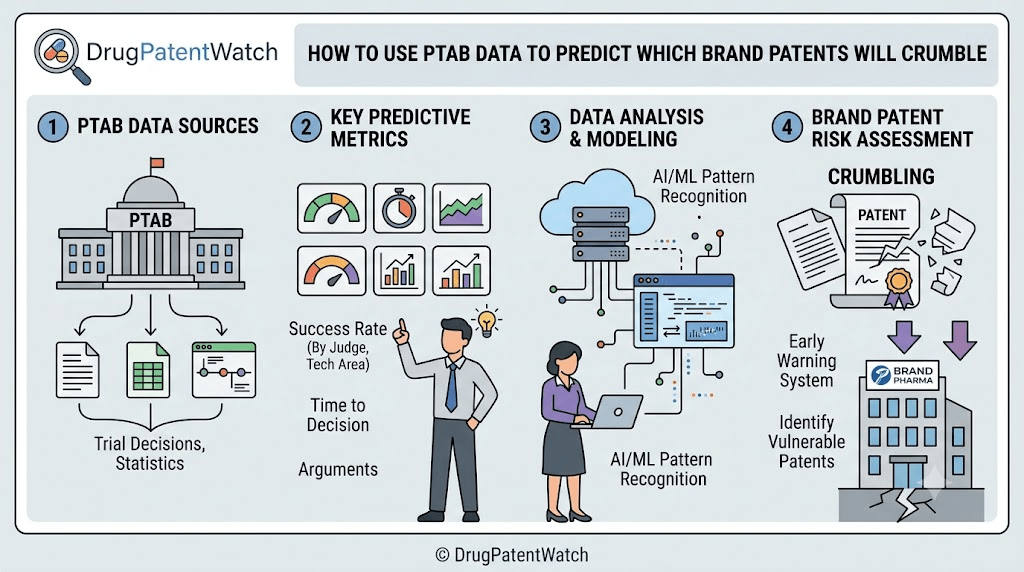
Generic and biosimilar companies used to have one venue to attack a brand patent: federal district court, under a clear-and-convincing-evidence standard that favors the patent holder. Since 2012, they have had a second venue that changes the math entirely. The Patent Trial and Appeal Board (PTAB) reviews patent validity under a lower evidentiary bar, on a faster clock, and at a fraction of the cost of a Hatch-Waxman trial. For anyone tracking generic entry timelines, PTAB’s public docket is not background noise. It is a leading indicator.
This piece walks through what the PTAB data actually says about pharmaceutical patents, how to read a petition before a final written decision comes down, and where the “PTAB kills patents” narrative overstates the real risk.
What Is the PTAB, in Plain Terms
Short answer: PTAB is the administrative tribunal inside the USPTO that decides inter partes review (IPR) and post-grant review (PGR) petitions — trial-like proceedings where a challenger asks the agency to cancel patent claims, instead of or alongside asking a district court to do the same.
The America Invents Act created IPR and PGR in 2011 as an alternative to the older inter partes reexamination process, which lacked discovery and produced fewer estoppel consequences. Congress eliminated inter partes reexamination and created the two current adversarial post-grant proceedings, establishing PTAB to administer them. For pharma specifically, the practical draw is that a generic or biosimilar maker can file an IPR petition against a brand’s Orange Book-listed patent at the same time it is fighting that patent in district court under the Hatch-Waxman framework.
Why Generic Challengers Prefer PTAB Over District Court
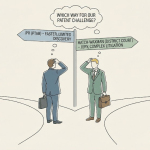
The appeal comes down to four numbers, and DrugPatentWatch’s analysis of Hatch-Waxman strategy lays them out cleanly: invalidity at the PTAB requires only a preponderance of the evidence rather than the clear-and-convincing standard used in district court, a final written decision is due within twelve months of institution versus four to six years for a district court case, and a full IPR proceeding runs roughly $300,000 to $800,000 against $8 million to $25 million for a district court trial.
Factor
District Court (Hatch-Waxman)
PTAB IPR
Burden of proof
Clear and convincing evidence
Preponderance of the evidence
Typical timeline to decision
4-6 years
12 months from institution
Typical cost
$8M-$25M
$300K-$800K
Claim construction standard
Phillips (narrower)
Broadest reasonable interpretation (historically), now largely aligned post-Phillips rulemaking
Appeal path
Federal Circuit
Federal Circuit
A lower burden of proof combined with a faster clock is why generic filers increasingly run what amounts to a two-front campaign: an ANDA and Paragraph IV certification in one venue, an IPR petition in the other.
What Do PTAB Invalidation Rates Actually Show for Pharma Patents
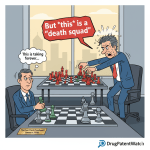
Short answer: Pharma and biotech patents survive PTAB scrutiny noticeably better than the all-technology average, and the “PTAB is a patent death squad” framing does not hold up well for Orange Book patents specifically.
Across all technology areas, the all-claims invalidation rate for instituted IPRs has run in the 55-70% range over the past several years, hitting roughly 70% in fiscal 2024 before dropping to about 64% through the first half of fiscal 2025. That headline number gets cited constantly in patent-bar commentary, but it is not the pharma number.
Biotech and pharmaceutical patents (Technology Center 1600) institute and get invalidated at meaningfully lower rates than the office-wide average. Biotech/pharma petitions have historically made up roughly 9-13% of total PTAB filings, and roughly 61% get instituted, below the roughly 70% institution rate seen in chemical, electrical, or mechanical technology areas. A separate USPTO-commissioned study focused specifically on drugs found the picture even more favorable to brands than the general pharma numbers suggest.
“The PTAB’s 89 final written decisions relate to only 44 of the 134 new drug applications targeted by invalidity petitions. Of those, just 18 were the subject of one or more written decisions in which all challenged claims were invalidated.” — IAM analysis of the USPTO Orange Book/biologics study
That same analysis found 44 of 198 challenged patents, or 49% of final written decisions, resulted in no claims being found invalid at all — a result the study’s authors argued undercuts the “death squad” framing for pharmaceutical rights specifically. Critically, active ingredient patents — the ones that actually block a generic launch outright — were rarely the target or the casualty: only seven of 198 challenged patents, about 4%, were designated as active ingredient patents, and only two of the 25 Orange Book patents fully invalidated were active ingredient claims. Most of what falls at PTAB is formulation and method-of-use protection, not the core molecule patent.
Orange Book Patents vs. Biologic Patents at PTAB: Which Fare Worse
Biologic patents take a harder hit than small-molecule Orange Book patents once a case reaches a final written decision. Roughly 25% of biologic patent petitions since September 2012 have resulted in all challenged claims being found unpatentable, compared with about 18% for Orange Book patents, and only 9% of biologic proceedings ended with all claims found patentable versus 21% for Orange Book patents over the same period. That gap matters for anyone modeling biosimilar entry risk differently from small-molecule generic risk — the biologics side of the portfolio is structurally more exposed once a petition is instituted.
Metric
Orange Book (small molecule)
Biologic patents
All claims found unpatentable
~18%
~25%
All claims found patentable
~21%
~9%
IPR institution rate against listed patents
~62%
Near 100% institution for bio/pharma broadly, per recent commentary
Method-of-Use Patents: The Weakest Link in an Orange Book Portfolio
Short answer: Method-of-use claims institute less often than composition claims but lose more often once a trial actually happens, making them the part of the portfolio worth watching first.
Method-of-use pharmaceutical patents have had an average PTAB institution rate of about 55% over the past five years, but final written decisions have invalidated the challenged claims in roughly 70% of the cases that get instituted. That is the pattern brand-side IP teams should be building into their exclusivity models: use-code patents draw fewer petitions than core composition patents, but when a use-code patent does get challenged and instituted, the odds tilt against the brand.
Reading a Live IPR Petition: What Signals Actually Predict the Outcome
The prior art cited in the petition
The strongest early signal is whether the petitioner has found art the examiner never saw during prosecution — particularly foreign-language literature, conference posters, or an earlier patent family member that was not cited against the challenged claims. Petitions built on art already distinguished during prosecution institute and succeed far less often than petitions built on genuinely new references.
Claim type being challenged
As the method-of-use data above shows, not all claims in a portfolio carry equal risk. Composition-of-matter and active-ingredient claims survive PTAB review at meaningfully higher rates than formulation or method-of-use claims layered on afterward, which is exactly the pattern behind “patent evergreening” criticism — the later-filed, narrower claims are also the ones most likely to fall.
Fintiv factors and parallel district court timing
Institution is not guaranteed even when the petition is strong. Under the Fintiv framework, PTAB has discretion to deny institution when a parallel district court case is already at an advanced stage, on the reasoning that duplicating the work would be an inefficient use of Board resources. A petition filed late relative to the ANDA litigation trial date is a weaker predictor of success than the same petition filed early, independent of the merits.
Panel composition and technology center track record
PTAB panels are not interchangeable. Some administrative patent judges assigned to biotech/pharma panels have decision histories that lean more or less institution-friendly, and tracking panel assignment against a judge’s prior final-written-decision record is standard practice at firms that model this systematically.
Case Study: Amerigen Pharmaceuticals v. UCB Pharma and the Toviaz Patent
The fesoterodine dispute over UCB’s Toviaz patent is a useful illustration of how an IPR loss does not automatically translate into a generic win. Mylan filed the original IPR petition against UCB’s patent covering fesoterodine, the active ingredient in Toviaz, with Amerigen and two others joining after institution; the Board held that modifying the prior compound 5-HMT to arrive at fesoterodine was not obvious and upheld the challenged claims. Amerigen alone appealed, arguing it had standing because invalidating the patent would clear the way for its own tentatively approved generic, which was otherwise blocked by a Paragraph III certification until patent expiry — but the Federal Circuit affirmed the Board’s decision on the merits. The case shows both sides of the coin: PTAB decisions get appealed and generic challengers can lose even after institution, and standing to appeal a PTAB loss turns on concrete commercial injury, not just competitor status.
Case Study: Jazz Pharmaceuticals v. Avadel and Orange Book Delisting
Not every brand patent fight at PTAB or in district court is really about validity — some are about whether a patent belongs in the Orange Book at all. In Jazz Pharmaceuticals v. Avadel CNS Pharmaceuticals, the Federal Circuit affirmed a district court order delisting a Jazz patent from the Orange Book, on the theory that a patent covering a REMS-style distribution restriction rather than the drug product or an approved use was not properly listable. Delisting has the same practical effect as invalidation for exclusivity purposes: the thirty-month stay tool disappears, and the generic pathway opens without PTAB ever ruling on validity. Anyone modeling loss-of-exclusivity risk purely off PTAB dockets is missing this second, quieter route to the same outcome.
How Institution Rate and Final-Decision Rate Combine to Predict Real Risk
A single “invalidation rate” number flattens two very different filters that a patent has to pass through, and treating them as one number is the most common modeling mistake.
Institution risk: will PTAB agree to hear the case at all. For Orange Book patents this runs around 62%, lower than the roughly 70% seen in other technology areas.
Final-decision risk: given institution, will all claims survive. Here the Orange Book/biologics study data above is the more reliable pharma-specific benchmark than the office-wide 64-70% figure, which is dominated by electrical, mechanical, and software patents that behave very differently.
Multiplying those two probabilities together, rather than quoting either one in isolation, is the difference between a defensible exclusivity model and a headline statistic.
Timeline: How an IPR Petition Moves From Filing to Generic Launch Impact
Month 0: Petition filed, typically alongside or shortly after ANDA/351(k) submission and Paragraph IV certification.
Months 0-6: Patent owner preliminary response; PTAB evaluates Fintiv factors if parallel litigation is pending.
~Month 6: Institution decision. Non-appealable regardless of outcome.
Month 18 (roughly 12 months post-institution): Final written decision.
Post-decision: Either party may appeal to the Federal Circuit; affirmance rates on appeal run high, which is worth building into any downstream model.
Studies of Federal Circuit review of PTAB decisions have found affirmance rates above 90%, which means a final written decision, once issued, is a fairly reliable predictor of the ultimate outcome even before an appeal concludes.
What This Means for Brand-Side Portfolio Strategy
Composition-of-matter claims are worth defending hardest and are statistically the safest part of the portfolio anyway. Method-of-use and formulation claims filed late in a product’s life cycle carry the most PTAB risk and deserve either stronger prior-art clearance before filing or a conscious decision to treat them as secondary, not primary, exclusivity.
What This Means for Generic and Biosimilar Filers
Filing timing relative to the parallel ANDA case matters as much as the underlying prior art, because of Fintiv. Targeting method-of-use and formulation claims rather than the core active-ingredient patent produces a higher expected success rate, even though a win there frequently does not clear the whole exclusivity picture the way an active-ingredient win would.
Where DrugPatentWatch-Style Data Fits Into This Analysis
None of the pattern-matching above works without patent-level data connecting Orange Book listings, IPR dockets, and ANDA/351(k) filing dates in one place. Services like DrugPatentWatch exist to compile exactly that cross-reference — which patents cover which NDA, which of those have been challenged at PTAB, and how each proceeding resolved — because the raw material sits scattered across USPTO PTAB filings, FDA Orange Book listings, and PACER district court dockets that do not talk to each other natively.
Frequently Confused Terms: IPR vs. PGR vs. Ex Parte Reexamination
Proceeding
Who can file
Grounds
Timing window
Inter Partes Review (IPR)
Any non-owner
Prior art patents/printed publications only (102/103)
After 9 months from grant, or after PGR ends
Post-Grant Review (PGR)
Any non-owner
Broader grounds including 101, 112
Within 9 months of grant
Ex Parte Reexamination
Anyone, including the owner
Prior art patents/publications
Any time during patent term
Within Orange Book patent challenges specifically, the overwhelming majority, about 96%, are filed as IPRs rather than PGRs.
Frequently Asked Questions
Does an institution decision mean the patent will be invalidated?
No. Institution only means PTAB found a reasonable likelihood the petitioner would prevail on at least one claim — it is a screening decision, not an outcome. Roughly half of pharma patents that reach a final written decision survive with all claims intact.
Can a brand company appeal a PTAB loss?
Yes, to the Federal Circuit, and either party can appeal an adverse result. Appeals take additional time but affirmance rates for PTAB decisions on appeal run high, so a final written decision is a reasonably strong predictor even before the appeal resolves.
What is the Fintiv factor and why does it matter for generics?
Fintiv is the set of discretionary-denial factors PTAB uses to decide whether to hear an IPR when a parallel district court case covering the same patent is already well advanced. A late-filed petition against a patent already close to trial in district court is more likely to be denied institution regardless of its merits.
Do IPR losses at PTAB end Hatch-Waxman litigation automatically?
No. IPR and ANDA litigation are separate proceedings that can run in parallel, and a district court is not bound to stay its own case just because an IPR is pending, though it sometimes chooses to.
Are biologic patents more vulnerable at PTAB than small-molecule Orange Book patents?
The final-decision data suggests yes. Biologic patents have a meaningfully higher rate of all-claims invalidation and a lower rate of all-claims survival than Orange Book small-molecule patents over the same period.
Which type of patent claim is most likely to survive a PTAB challenge?
Active ingredient and composition-of-matter claims survive at higher rates than method-of-use or formulation claims, and they are targeted far less often in the first place.
How much does an IPR cost compared with Hatch-Waxman litigation?
A full IPR typically runs $300,000 to $800,000, compared with $8 million to $25 million for a district court patent trial, which is the primary reason generic and biosimilar filers use IPR as a parallel or even primary attack route.
Does PTAB use the same claim construction standard as district court?
Historically PTAB applied the broader “broadest reasonable interpretation” standard, while district courts use the narrower Phillips standard; rulemaking in recent years has pushed PTAB closer to Phillips, narrowing but not eliminating the gap.
Can a patent be removed from the Orange Book without a PTAB or district court invalidity ruling?
Yes. Delisting challenges, like the Jazz Pharmaceuticals v. Avadel case, can remove a patent’s Orange Book listing on the grounds that it does not properly claim the drug product or an approved method of use, achieving a similar practical effect to invalidation without a validity ruling at all.
What percentage of Orange Book-listed patents ever face a PTAB challenge?
Challenges concentrate heavily on the small set of patents that actually matter commercially. The USPTO’s own Orange Book/biologics study tracked petitions against 134 NDA-linked patent sets over roughly a decade, a small fraction of total Orange Book listings, confirming that PTAB challenges are targeted at high-value products rather than filed indiscriminately.
Key Takeaways
Pharma and biotech patents institute and get invalidated at lower rates than the PTAB’s office-wide averages, which run closer to 65-70% for all technologies combined.
Active ingredient patents rarely fall at PTAB. Most successful challenges target formulation or method-of-use claims layered on later in a product’s life cycle.
Biologic patents are structurally more vulnerable at final decision than small-molecule Orange Book patents.
Institution risk and final-decision risk are separate filters and should be modeled separately, not collapsed into one invalidation rate.
Fintiv timing relative to parallel district court litigation can determine institution independent of the underlying merits.
Orange Book delisting is a second, PTAB-independent route to the same commercial outcome as invalidation.
References
Congressional Research Service. (2025). The Patent Trial and Appeal Board and Inter Partes Review (R48016). Library of Congress. https://crsreports.congress.gov/product/pdf/R/R48016
DrugPatentWatch. (2025). Landmark Paragraph IV patent challenge decisions: A strategic playbook for generic manufacturers. https://www.drugpatentwatch.com/blog/landmark-paragraph-iv-patent-challenge-decisions-a-strategic-playbook-for-generic-manufacturers/
DrugPatentWatch. (2026). The Paragraph IV playbook: Turning patent challenges into market dominance. https://www.drugpatentwatch.com/blog/the-paragraph-iv-playbook-turning-patent-challenges-into-market-dominance/
DrugPatentWatch. (2026). Pharmaceutical patent use codes: The definitive technical and strategic guide. https://www.drugpatentwatch.com/blog/patent-use-codes-for-pharmaceutical-products-a-comprehensive-analysis/
Eckert Seamans. (2025, March 5). To be listable in the FDA’s “Orange Book,” patents must recite the API in claims. https://www.eckertseamans.com/legal-updates/to-be-listable-in-the-fdas-orange-book-patents-must-recite-the-api-in-claims
Finnegan, Henderson, Farabow, Garrett & Dunner, LLP. Trends in PTAB trials involving drug and biologic patents. https://www.finnegan.com/en/insights/blogs/at-the-ptab-blog/trends-in-ptab-trials-involving-drug-and-biologic-patents.html
IAM. (2018, October 1). Yes, PTAB proceedings against Orange Book patents are on the up. No, they’re not wiping them out. https://iam-media.com/litigation/orange-book-ptab
IPWatchdog. (2025, July 2). Perspectives on the PTAB’s 70% all claims invalidation rate. https://ipwatchdog.com/2025/07/02/perspectives-ptabs-70-claims-invalidation-rate/
Knobbe Martens. (2024, November 17). A patent for controlling access to drugs is not listable in the Orange Book. https://www.knobbe.com/blog/patent-controlling-access-drugs-not-listable-orange-book/
Mintz. (2021, August 24). PTAB statistics show interesting trends for Orange Book and biologic patents in AIA proceedings. https://www.mintz.com/insights-center/viewpoints/2231/2021-08-24-ptab-statistics-show-interesting-trends-orange-book-and
Polsinelli on Post-Grant. (2021, August 13). A brief overview of pharmaceutical IPRs and statistical outcome. https://www.polsinellionpostgrant.com/blog/2017/6/2/a-brief-overview-of-pharmaceutical-iprs-and-statistical-outcome
PharmaPatents (Foley & Lardner LLP). (2019, January 15). Orange Book listing creates injury to support standing to appeal IPR decision. https://pharmapatentsblog.com/2019/01/15/orange-book-listing-creates-injury-to-support-standing-to-appeal-ipr-decision
PTAB Law Blog. (2025, January 6). Trial statistics trends at the PTAB: 2024 edition. https://www.ptablaw.com/2025/01/06/trial-statistics-trends-at-the-ptab-2024-edition/