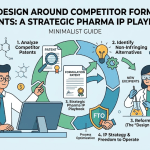
Every year, generic drug manufacturers pay hundreds of millions of dollars in settlements and delayed-entry agreements that, in hindsight, were unnecessary. The patents they feared often had exploitable gaps. The claims they read as iron-clad were, on closer inspection, narrower than advertised. The formulations they assumed were locked up for a decade had technical paths around them that a careful reading would have revealed in an afternoon.
This is not a failure of intellectual capacity. It is a failure of method.
Formulation patents are among the most technically dense documents in commercial law. They blend polymer chemistry, pharmacokinetics, regulatory science, and claim drafting into documents that resist casual reading. The people writing them are skilled at making modest innovations look like fundamental discoveries. The people reading them on the generic side often lack a systematic framework for separating what a patent actually claims from what its assignee wishes it claimed.
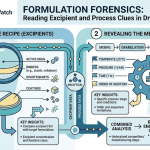
This guide gives you that framework. It covers how to read formulation patent claims with precision, how to use prosecution history to find the gaps claim drafters inadvertently created, how litigation has repeatedly punished overly broad formulation patents, and how companies have successfully navigated around protection that initially looked impenetrable. It draws on real cases, real drugs, and real competitive outcomes.
If you work in generic drug development, pharmaceutical licensing, IP strategy, or competitive intelligence, this is a practical manual for turning patent documents into actionable intelligence.
What Formulation Patents Actually Protect (and What They Don’t)
Before you can find design-around opportunities, you need a precise understanding of what formulation patents are and are not protecting. The category is broad and heterogeneous, and conflating its subcategories leads to errors in both directions: either dismissing patents that do present real barriers, or treating as impenetrable patents that are actually narrow.
A formulation patent claims a specific physical or chemical arrangement of a drug product, distinct from the active pharmaceutical ingredient (API) itself. The API may be off-patent, or its composition-of-matter protection may be expiring. The formulation patent is the brand company’s attempt to extend commercial exclusivity by claiming something about how the API is packaged, delivered, or stabilized.
The broad categories of formulation patents include:
Controlled-release mechanisms: matrix tablets, osmotic pumps, coated pellets, reservoir systems, and layered tablets that release the API over an extended period.
Dosage form innovations: orally disintegrating tablets (ODTs), abuse-deterrent formulations (ADFs), transdermal patches, liposomal systems, and nanoparticle delivery vehicles.
Stability and solubility solutions: amorphous solid dispersions, co-crystal formulations, specific polymorphic stabilizers, and pH-dependent solubilization systems.
Combination products: fixed-dose combinations of two or more APIs, claimed as a specific formulation rather than as individual compounds.
Each subcategory has different vulnerability profiles. Controlled-release patents, for instance, are frequently drafted around specific polymer types or concentration ranges that proved necessary during development, creating natural white space for generic manufacturers who can achieve the same release profile through a different mechanism. Abuse-deterrent formulation patents are often narrower than they appear because the FDA has required specific abuse-deterrence testing, and the claims must track the tested mechanism closely enough to support regulatory approval.
The key conceptual move when reading any formulation patent is to separate the result being claimed from the means by which that result is achieved. Brand companies want to claim the result. Patent law generally requires that they claim the means. This gap between commercial ambition and patent doctrine is where design-around opportunities live.
The Anatomy of a Formulation Patent Claim
Independent Claims: Where the Actual Boundaries Are
Every patent has independent claims and dependent claims. The independent claims define the outer boundaries of protection. The dependent claims narrow those boundaries further, adding limitations. A generic manufacturer whose product falls outside the independent claims does not infringe, regardless of how the dependent claims read.
Independent claims in formulation patents typically follow a structure that experienced readers learn to parse quickly:
First, a preamble that identifies the category of invention (“A pharmaceutical composition comprising…”). The preamble may or may not be limiting, and the prosecution history often determines which. Second, a body that lists the required elements, connected by either “comprising” (open-ended, meaning additional elements are allowed) or “consisting of” (closed-ended, meaning only the listed elements are permitted). Third, a series of limitations that specify quantitative or qualitative requirements for each element.
Consider a simplified example from the extended-release metformin space. An independent claim might read: “A controlled-release tablet comprising: metformin hydrochloride in an amount from 500 mg to 2000 mg; a hydrophilic matrix comprising hydroxypropyl methylcellulose (HPMC) in an amount of 15% to 35% by weight; and a lubricant in an amount of 0.5% to 2% by weight; wherein the tablet provides a release rate of less than 20% of the metformin within 2 hours when tested in 900 mL of phosphate buffer, pH 6.8 using USP Apparatus II at 75 rpm.”
Reading this claim carefully, three immediate design-around opportunities emerge. The matrix polymer is specified as HPMC, meaning a formulator who achieves the same controlled release through a different hydrophilic polymer (carrageenan, sodium alginate, xanthan gum) operates outside this specific limitation. The HPMC concentration range of 15% to 35% excludes formulations that function at 12% or 38%. The specific dissolution condition creates a requirement tied to a particular pH and apparatus that a formulation achieving equivalent in vivo performance through a different mechanism might not mirror in vitro.
None of this means those paths are free and clear. The patent may have continuation applications, related patents covering alternative polymers, or other claims that capture the alternatives. But the initial reading identifies where to look.
The ‘Comprising’ vs. ‘Consisting Of’ Distinction in Practice
The open or closed nature of a claim is more consequential in formulation patents than in almost any other patent category. A formulation is, by definition, a combination of ingredients. A claim using ‘comprising’ permits a generic formulator to add excipients not listed in the claim without automatically infringing. A claim using ‘consisting essentially of’ (the middle position) prohibits only those additional ingredients that materially affect the basic and novel properties of the invention, which creates its own line of litigation but generally offers more freedom.
Brand companies drafting formulation patents have become increasingly sophisticated about this issue. Many modern formulation patents use ‘comprising’ in the broadest independent claim and ‘consisting essentially of’ in narrower dependent claims. This layering creates a portfolio where the brand can argue for broad protection under the independent claim while having fallback positions if that claim is challenged. Generic manufacturers need to understand the entire claim structure, not just the broadest independent claim, to accurately map the freedom-to-operate landscape.
Functional vs. Structural Limitations and Why the Distinction Matters
Formulation patent claims can be written functionally (“a polymer that provides sustained release”) or structurally (“hydroxypropyl methylcellulose K15M”). Functional limitations are generally broader and harder to design around, but they come with higher invalidity risk. Structural limitations are narrower and easier to avoid, but they’re also more defensible.
The Federal Circuit has repeatedly wrestled with how to treat functionally drafted formulation claims. In Nautilus, Inc. v. Biosig Instruments, Inc. (2014), the Supreme Court tightened the definiteness standard, requiring that claims inform those skilled in the art about the scope of the invention with reasonable certainty [1]. While that case did not involve a pharmaceutical formulation, its reasoning has been applied to formulation patents where functional language creates ambiguity about what, precisely, is being excluded.
When you see a functional limitation in a formulation claim, the questions to ask are: What structures could perform this function? Are any of those structures excluded by other language in the claim? Has the patentee defined the functional term in the specification in a way that limits its scope? Has the prosecution history narrowed the meaning of the functional language?
Reading the Specification: The Map the Patent Examiner Used
The claims are the legal instrument. The specification is the technical disclosure that supports those claims and that courts use to interpret them. For design-around work, the specification is often more valuable than the claims because it reveals what the inventors actually made and tested, which is usually a much smaller set of embodiments than the claims purport to cover.
The Working Examples Problem
Patent specifications almost always include working examples: specific formulations that the inventors actually prepared and tested. These examples are the evidence base for the claimed invention. They are also frequently the most important guide to what the claims genuinely cover.
The problem for brand companies is that claims drafted broadly around a small set of working examples are vulnerable to invalidity challenges on grounds of lack of written description and lack of enablement. The specification must enable a person of ordinary skill in the art to make and use the full scope of the claimed invention without undue experimentation [2]. If a patent claims a vast range of polymer concentrations but only provides examples for a narrow subset, and if those examples don’t produce a predictable pattern suggesting that the full range works, the patent may be invalid for lack of enablement.
For design-around purposes, the working examples also define the experimental landscape. They tell you what the inventors knew worked. Anything substantially different from those examples — different polymer types, different API loadings, different processing methods — is territory the patent may not validly cover, even if the claims appear to reach it.
When you read the specification, create a table of every working example. Note the specific excipients, concentrations, processing conditions, and results. Then map those examples onto the claim language. The distance between the examples and the outer boundaries of the claims is frequently where design-around opportunities hide.
How Unexpected Results Disclosures Limit Claim Scope
Brand companies filing formulation patents often argue during prosecution that their invention achieved unexpected results compared to the prior art. This argument overcomes obviousness rejections and is a standard tool in pharmaceutical patent prosecution. But the argument creates a constraint that generic manufacturers can exploit.
When a patentee argues that a specific concentration range of an excipient achieves unexpected results, that argument limits the patent’s reach to formulations where those results actually occur. A generic formulation that operates outside the range where the unexpected results were demonstrated is not covered by the rationale that supported the claim’s issuance — a point that some courts have found relevant to both infringement and validity analysis.
The Federal Circuit addressed the relationship between unexpected results arguments and claim scope in several formulation-adjacent cases. The principle is that patentees are held to the positions they take during prosecution. A claim that was allowed because the patentee argued it covered only a specific technical phenomenon cannot later be read to cover formulations that do not exhibit that phenomenon.
Mining the Prosecution History: Where Patents Reveal Their Weaknesses
The prosecution history — the complete record of exchanges between the patent applicant and the USPTO examiner — is available to the public through the Patent Center system. For formulation patents, it is often the single most valuable document for design-around analysis. Most competitive intelligence work underuses it.
Prosecution History Estoppel and the Festo Problem
When a patentee narrows a claim during prosecution to overcome a rejection — either by amending the claim language or by making a substantive argument to distinguish the prior art — they may be estopped from later arguing that the claim covers the subject matter surrendered. This is prosecution history estoppel, and it directly limits the doctrine of equivalents, which is the tool brand companies use to capture generic products that are technically different from but functionally equivalent to what the claims literally describe.
The Supreme Court’s decision in Festo Corp. v. Shoketsu Kinzoku Kogyo Kabushiki Co. (2002) established a presumption that claim amendments related to patentability surrender the entire territory between the original claim and the amended claim for equivalents purposes [3]. While the presumption is rebuttable, it creates a significant barrier for patentees trying to extend their claims through equivalents after amendment.
In formulation patent prosecution, amendments are routine. Examiners reject broad initial claims on prior art grounds. Applicants narrow by adding specific excipient names, concentration ranges, or process limitations. Each amendment creates potential estoppel. A generic manufacturer who makes a product that falls in the surrendered territory — different polymer, slightly different concentration — has a strong argument that the doctrine of equivalents cannot reach it.
Reading a prosecution history for estoppel requires identifying: every claim amendment made for reasons related to patentability; the examiner rejection that prompted each amendment; the scope of what the amendment surrendered relative to the original claim; and whether the patentee made any arguments during prosecution that further narrowed the meaning of terms in the final claim.
Prior Art Cited in Prosecution: A Free Competitor Intelligence Report
Every formulation patent prosecution includes a record of the prior art references cited by the examiner and by the applicant. This record is a free competitive intelligence briefing about the relevant technical space. It tells you what was known before this patent was filed, where the state of the art stood, and what the examiner considered the closest prior art to the claimed invention.
For design-around purposes, the cited prior art defines the boundaries of what was already in the public domain. A generic manufacturer whose formulation more closely resembles a cited prior art reference than it resembles the claimed invention has a strong argument that it does not infringe. The closer a proposed generic formulation is to a prior art reference that the patentee distinguished during prosecution, the clearer the non-infringement case.
Many generic manufacturers build their design-around strategies explicitly around the cited prior art. If an examiner cited a specific 1990s reference describing a matrix tablet system with HPMC in a certain concentration range, and the patentee distinguished their invention by claiming a different polymer or a narrower concentration range, a generic formulator can deliberately target the region described in the 1990 reference. The formulation is simultaneously non-infringing (outside the claim scope as limited during prosecution) and non-obvious (based on prior art that predates the patent).
Continuation Applications: The Hidden Dangers
A single pharmaceutical product typically has not one patent but a family of related patents filed as continuations, divisionals, and continuation-in-part applications. The parent application is filed first. Later applications claim priority to the parent but may have different, sometimes broader or narrower claims. All applications in the family share a common prosecution history back to the parent, but each application’s own prosecution history may include additional estoppels specific to that application.
The Paragraph IV litigation landscape is littered with cases where a generic manufacturer successfully designed around the original formulation patent only to find itself facing a later-filed continuation with claims specifically drafted to capture the generic’s approach. This practice — called “continuation ambush” or, less charitably, “evergreening through continuation” — is routine in branded pharmaceutical IP strategy.
Comprehensive formulation patent design-around analysis requires mapping the entire patent family, not just the initial patent. This means searching the USPTO Patent Center for all applications claiming priority to the original filing, reviewing the claims of pending applications (which are public unless under a secrecy order), and assessing whether any pending claims appear to target the technical approach you are considering. Tools like DrugPatentWatch maintain comprehensive patent family records for pharmaceutical products, allowing researchers to identify the full scope of a brand company’s patent portfolio around a given drug product without manually reconstructing the family from USPTO records.
The Orange Book and Patent Claiming Strategy
The FDA’s Orange Book (Approved Drug Products with Therapeutic Equivalence Evaluations) lists patents that the holder believes cover approved drug products or methods of using those products. It is not a comprehensive or always accurate representation of relevant patents, but it is the starting point for Paragraph IV certification under the Hatch-Waxman framework.
What Gets Listed (and What Doesn’t)
FDA regulations specify that only patents claiming the drug substance (API), the drug product (formulation), or methods of use can be listed in the Orange Book [4]. Process patents cannot be listed. Metabolite patents cannot be listed. Patents claiming intermediates or precursors cannot be listed. This creates a legal architecture where significant portions of a brand company’s patent portfolio are invisible to the Hatch-Waxman Paragraph IV process.
Non-listed patents are not irrelevant. They can still be asserted in district court outside the Hatch-Waxman framework. A generic manufacturer who receives a “clean” Paragraph IV outcome on the listed patents may still face a patent infringement suit on a non-listed process patent or a non-listed formulation patent that the brand company omitted from the Orange Book, intentionally or otherwise.
The FTC has raised concerns about strategic over-listing and under-listing in the Orange Book over many years. Over-listing — submitting patents of dubious relevance to delay generic entry — was the subject of proposed rulemaking. Under-listing — omitting valid product patents to preserve them for surprise litigation — is less commonly discussed but represents an equal strategic risk for generic manufacturers.
Reading Orange Book Patent Listings Against the ANDA Product
For each listed patent, a generic filer must make one of four certifications: Paragraph I (patent is not listed), Paragraph II (patent has expired), Paragraph III (patent will expire before the ANDA is approved), or Paragraph IV (patent is invalid, unenforceable, or not infringed). A Paragraph IV certification on a patent that is both listed and relevant requires a detailed technical and legal analysis, which is the design-around analysis described in this guide.
The practical task is to compare, claim by claim, the listed patent against the specific ANDA product being developed. This is not a binary analysis. A product may infringe some claims but not others. It may infringe the independent claims of one patent in a family but not the independent claims of a related patent. The Paragraph IV certification relates to specific patents, not the entire portfolio, and a clear non-infringement position on a listed patent is the preferred outcome.
Many formulation design-around strategies succeed precisely because the brand company’s Orange Book listing is aggressive — claiming broad coverage under patents that, on careful reading, do not actually cover a thoughtfully designed ANDA product. The listing creates the impression of a fortress. The underlying patents often do not support it.
Design-Around Strategies by Formulation Type
Extended-Release Oral Formulations
Extended-release (ER) oral formulations are the most common target for formulation patent design-around. The brand pharmaceutical industry’s use of ER reformulations to extend product lifecycles — sometimes referred to as “product hopping” — has generated a dense, well-litigated patent landscape. It has also generated the most developed body of design-around precedent.
The core technologies for ER delivery divide into matrix systems and reservoir systems. Matrix systems incorporate the drug into a polymer matrix through which the drug diffuses as the tablet erodes. Reservoir systems coat the drug with a rate-controlling membrane through which the drug permeates. Each technology has dozens of specific implementations, each implemented differently by different manufacturers, and each generating a distinct patent profile.
The leading commercial example of ER design-around complexity is the oxycodone ER space, specifically the litigation surrounding Purdue Pharma’s OxyContin. Purdue’s reformulated abuse-deterrent OxyContin (introduced in 2010) generated a series of formulation patents claiming specific polyethylene oxide (PEO) matrix compositions with defined hardness characteristics and specific in vitro extraction-resistance properties. When generics filed ANDAs, they faced a patent forest that included not only the specific PEO-based formulation but related patents on hardness testing methods, specific PEO grades, and ADF performance parameters [5].
The design-around challenge in the ER space is real but tractable. The essential questions are:
Does the claim specify a particular polymer class (cellulosic, acrylic, polyalkylene oxide) or a specific polymer type? If the former, the claim may reach alternatives within the class. If the latter, it does not reach outside the named polymer.
Are concentration ranges narrow enough to permit a functional formulation at a different concentration? ER formulations typically require polymer concentrations within a range that ensures adequate release retardation without compromising physical integrity, but that range is often broader than what a specific patent claims.
Does the claim include a specific dissolution profile as a claim limitation? If so, a formulation that achieves equivalent clinical performance through a different in vitro dissolution curve may be outside the claim, though this requires careful analysis of how the dissolution condition was chosen and whether it is definitional of the invention or merely illustrative of it.
Abuse-Deterrent Formulations
ADF patents represent a specialized formulation patent category created by the intersection of regulatory science and IP strategy. The FDA’s 2015 guidance on evaluation and labeling of extended-release/long-acting opioid formulations with abuse-deterrent properties required manufacturers to demonstrate deterrence against specific routes of abuse — nasal insufflation, intravenous injection, and oral manipulation [6]. This regulatory requirement shapes the patent claims, because the patented technology must be the same technology that is described in the FDA submission and that supports the ADF labeling.
This regulatory linkage creates design-around opportunities. A generic ADF that demonstrates equivalent abuse-deterrence through a different physical or chemical mechanism should be able to satisfy FDA’s guidance and simultaneously avoid the brand’s formulation patents. The FDA has approved several generic ADFs using different physical mechanisms from the branded reference product, suggesting that the regulatory path is available for technically distinct approaches.
The polyethylene oxide formulation patents for reformulated OxyContin were challenged and, after extended litigation, ultimately survived largely intact, but the litigation revealed important claim limitations. The Federal Circuit’s analysis in Purdue Pharma L.P. v. Amneal Pharmaceuticals, LLC and related cases examined whether specific hardness and molecular weight parameters were definitional claim limitations or inherent properties of PEO matrices [7]. Generic manufacturers who could demonstrate that their physical mechanism produced the required abuse-deterrence without using PEO at the claimed molecular weight and concentration were outside the core claims.
The critical design-around questions for ADF patents are: What is the physical mechanism of abuse deterrence? Is that mechanism tied to a specific excipient or to a functional property that multiple excipients can exhibit? What are the quantitative parameters claimed (hardness, viscosity, particle size after manipulation), and can those parameters be achieved through a different formulation approach?
Amorphous Solid Dispersions
Amorphous solid dispersions (ASDs) have become the dominant approach to improving the bioavailability of poorly soluble compounds. The technology involves dispersing an amorphous API within a polymer matrix — typically a cellulosic polymer like HPMC-AS or HPMC-E5, or a vinyl polymer like PVP-VA — to maintain the API in its amorphous, high-energy state and prevent recrystallization.
ASD formulation patents are often among the most narrowly drafted formulation patents, because the technology is sensitive to the specific polymer-API interaction. Different polymers produce different dissolution enhancement for the same API, and the optimal polymer is often empirically determined rather than predicted. This means that an ASD patent claiming a specific polymer (say, HPMC-AS) may genuinely not extend to a formulation using PVP-VA, because the technical interactions are fundamentally different.
The generic drug industry has capitalized on this specificity. Several successful ASD product launches have used polymers different from those claimed in the reference product’s patents. The design-around required demonstrating bioequivalence — which is achievable through the same ASD mechanism with a different polymer — and establishing non-infringement with respect to the specific polymer claimed in the brand’s patents.
Valsartan-based amorphous formulations, itraconazole formulations, and several newer oncology compounds have all been the subject of ASD design-around work. The key technical question in each case is whether the specific polymer claimed is necessary for the enhancement mechanism or is simply what the innovator happened to use. When the mechanism is primarily API-driven (the API’s inherent tendency to form a glass-forming liquid at a certain temperature), the polymer’s identity may be less critical to performance, and design-around options are broader.
Transdermal Delivery Systems
Transdermal patches present a distinct design-around challenge. The technology involves either reservoir systems (a drug-containing liquid or gel held behind a rate-controlling membrane) or matrix systems (drug dispersed in a pressure-sensitive adhesive). Patents cover the adhesive type, backing material, drug-adhesive loading, skin permeation enhancers, release liner composition, and pharmacokinetic parameters.
The rivastigmine transdermal system (Exelon Patch) and the fentanyl patch (Duragesic) both generated significant formulation patent litigation. The rivastigmine litigation, Novartis Pharmaceuticals Corp. v. Noven Pharmaceuticals, Inc., involved a contested claim to a specific drug loading range in an acrylate-vinyl acetate adhesive matrix [8]. Noven’s generic patch used a different adhesive system with a different drug-to-adhesive ratio, and the court ultimately found the claims both non-infringed and invalid. The case illustrated a pattern common to transdermal design-around: narrow concentration ranges combined with specific adhesive types create a formulation space that generic manufacturers can navigate.
The key questions for transdermal design-around are: Is the adhesive system (acrylate, silicone, polyisobutylene) specified in the claims, or is the claim functional with respect to adhesive type? Are permeation enhancers named specifically or claimed by function? Is the drug loading range narrow enough to permit a pharmacokinetically equivalent product at a different concentration?
Liposomal and Nanoparticle Formulations
The advanced delivery space — liposomes, polymeric nanoparticles, lipid nanoparticles, micelles — has generated some of the most complex formulation patent landscapes in the industry. These technologies often have multiple overlapping patents on the delivery vehicle composition, the manufacturing process, the particle size distribution, the surface functionalization, and the pharmacokinetic profile.
Liposomal doxorubicin (Doxil/Caelyx) spent years in patent litigation before generic entry. The core patents covered pegylated liposomes with specific lipid compositions, particle sizes, and drug encapsulation efficiencies. The design-around challenge was substantial because the lipid composition was tied to safety (reduced cardiotoxicity) as well as efficacy, creating a regulatory and technical environment where alternatives needed to be both non-infringing and clinically equivalent.
Sun Pharma’s and Cipla’s eventual generic liposomal doxorubicin products used formulation approaches designed around specific concentration and composition claims while maintaining bioequivalence. The FDA’s complex drug substance guidance for liposomal products added another layer of analytical challenge, as the regulatory authority required that generics demonstrate sameness not just in pharmacokinetics but in specific physicochemical parameters [9].
Using Secondary Literature and Patent Databases Efficiently
No design-around analysis begins or ends with a single patent. The analytical task is to understand the full patent landscape — not just the Orange Book-listed patents, but the entire family of related applications, the invalidating prior art, the competitive patent landscape, and the pending applications that might emerge to cover alternatives.
Patent Databases: What Each Offers
The USPTO Patent Center provides full access to granted US patents and published applications, including the complete prosecution history for patents granted after 2000. For pharmaceutical formulation work, the prosecution history is often the most important document in the file. USPTO Patent Center is free but requires knowing patent numbers or applicant names to search efficiently.
The European Patent Office’s Espacenet database provides access to patents from over 100 patent offices, including the European Patent Office’s own portfolio. Many pharmaceutical formulation patents are filed internationally, and the EPO examination record can differ from the USPTO record in ways that are useful for US litigation. EPO examiners often apply prior art that USPTO examiners missed, and EPO opposition proceedings — the European equivalent of inter partes review — generate valuable technical analysis of formulation patents.
Google Patents aggregates across multiple offices and provides full-text search with citation mapping. For identifying patent families, competitor portfolios, and the citation landscape around a particular technology, Google Patents’ family mapping and citation graphs can accelerate preliminary research significantly.
For pharmaceutical-specific intelligence, DrugPatentWatch provides patent coverage organized by drug product, active ingredient, and patent expiration date. It connects Orange Book listings to actual patent documents, tracks Paragraph IV certification filings, and provides competitive intelligence on which generics are pursuing which products. For teams working in pharmaceutical competitive intelligence, the ability to quickly identify the complete patent portfolio for a specific brand drug — including continuation applications and related international filings — reduces days of manual searching to minutes. Patent expiration timelines, litigation history summaries, and first-to-file ANDA tracking are all consolidated in a way that static patent databases do not offer.
Scientific Literature as Prior Art
Pharmaceutical formulation patents are among the most science-dense patents in the system. The technical background section of a formulation patent will typically cite a mix of earlier patents and scientific journals. Both categories of citation deserve attention.
Scientific literature predating the patent filing date can constitute prior art under 35 U.S.C. § 102 and § 103. Journal articles describing similar formulation approaches, conference proceedings presenting relevant data, and textbook chapters explaining the relevant technology all qualify as prior art if they predate the patent’s priority date. For design-around, scientific literature serves two roles: it provides technical blueprints for alternative approaches that predate the patent, and it can help establish that the claimed invention was obvious to practitioners in the field.
Key journals for pharmaceutical formulation prior art searches include the Journal of Controlled Release, the International Journal of Pharmaceutics, AAPS PharmSciTech, and European Journal of Pharmaceutics and Biopharmaceutics. Decades of academic and industrial research on controlled release, bioavailability enhancement, and delivery system design is indexed in these sources and is available to serve as both design inspiration and invalidity evidence.
“Generic drug products on average enter the market at prices 80 to 85 percent lower than their brand-name counterparts, and the competition spurred by generic entry saves the U.S. healthcare system more than $313 billion annually.” — Association for Accessible Medicines, 2023 Generic Drug & Biosimilar Access & Savings in the U.S. Report [10]
The Claim Construction Step: Before You Design Around, Understand What You’re Designing Around
Design-around work that skips rigorous claim construction ends up designing around the wrong target. Claim construction — determining what the claims mean as a matter of law — is the first step in any non-infringement analysis, and it is where formulation patent analysis most often goes wrong.
The Phillips Standard and Person of Ordinary Skill
Under Phillips v. AWH Corp. (2005), the Federal Circuit established the current framework for claim construction: claims are given their ordinary and customary meaning as understood by a person of ordinary skill in the art at the time of the invention, read in light of the specification and prosecution history [11]. The specification is the primary source for understanding how the inventor used claim terms. The prosecution history provides further context. Extrinsic evidence — expert testimony, dictionaries, treatises — is secondary and cannot override the intrinsic record.
For formulation patents, ‘person of ordinary skill in the art’ typically means a formulation scientist with a graduate degree in pharmaceutical sciences, chemistry, or chemical engineering, plus several years of pharmaceutical formulation development experience. This is a sophisticated person who understands polymer chemistry, drug-excipient interactions, and dissolution science at a professional level. Courts have applied this standard to reach claim constructions that, to a lay reader, might seem to stretch or contract the plain language of the claim.
In practice, claim construction for formulation patents often turns on technical questions about what specific terms mean in the pharmaceutical sciences context. Does ‘controlled release’ have a specific technical meaning that limits its scope? Does ‘hydrophilic matrix’ include all hydrophilic polymers or only cellulosic and vinyl-based ones? Does ‘% by weight’ in a tablet formulation refer to the weight of the final tablet or the weight of the granule intermediate? These questions are not trivial, and their resolution changes the scope of protection in ways that directly affect design-around feasibility.
When Brand Companies Over-Claim: The Invalidity Argument as a Design-Around Tool
Sometimes the best design-around is to challenge the patent’s validity directly. A patent that is invalid does not need to be designed around — it is not an obstacle at all. The inter partes review (IPR) process at the Patent Trial and Appeal Board (PTAB) allows any party to challenge a granted patent’s validity on prior art grounds, and the pharmaceutical formulation patent space has seen substantial IPR activity.
IPR challenges are particularly effective against formulation patents that were granted based on narrow prosecution but whose claims, on careful reading, are broader than what the working examples support. The written description and enablement requirements of 35 U.S.C. § 112 provide additional grounds for challenge that are available in district court but not in IPR proceedings.
The practical question is whether to pursue IPR in combination with a design-around or instead of it. The answer depends on the strength of the invalidity case, the timeline for generic entry, and whether the IPR would be filed before or after the ANDA triggers a 30-month stay. Many experienced ANDA filers pursue both paths simultaneously: a primary non-infringement argument based on design-around, with an invalidity backup through IPR or district court litigation.
Case Studies: Formulation Design-Around in Action
Nexium (Esomeprazole) and the Proton Pump Inhibitor Wars
AstraZeneca’s esomeprazole (Nexium) became one of the most commercially significant formulation patent cases of the 2000s. The drug was the S-enantiomer of omeprazole (Prilosec), and its clinical advantage over omeprazole was modest at best. The formulation patents, however, covered enteric-coated pellet systems designed to protect the acid-labile API from gastric degradation.
The litigation involved multiple patents covering the enteric coating composition, the pellet size distribution, the drug loading, and the dissolution profile. Generic filers argued that their HPMC-phthalate coated pellet systems, using coating compositions within the standard range for enteric-coated pellets described extensively in pre-patent literature, did not infringe the specific coating claims and that the asserted patents were invalid over the prior art [12].
The resolution involved a combination of design-around and settlement, with generics entering the market on a delayed basis. The technical record established that enteric-coated pellet technology for acid-labile compounds was well-developed prior art, and the specific formulation parameters claimed by AstraZeneca represented a narrow subset of the available design space. Generic formulators who used different enteric polymer types — Eudragit L30D-55 instead of the claimed HPMC-P formulations — or different pellet particle size targets had technical bases for non-infringement arguments that were ultimately supported by the prior art record.
Singulair (Montelukast) Granules: The Pediatric Formulation Design-Around
Merck’s montelukast (Singulair) chewable tablets and oral granules generated pediatric exclusivity and formulation patent protection that delayed generic entry. The granule formulation patents covered specific particle size ranges, specific excipient combinations including mannitol and microcrystalline cellulose, and stability parameters related to the photosensitive API [13].
Generic manufacturers designing around the Singulair granule patents focused on the stability requirements, which were driven by montelukast’s known photosensitivity rather than any unique formulation innovation. Protective packaging approaches, rather than specific excipient combinations, could achieve the required stability, taking the generic formulation outside claims tied to specific photostabilizing excipients while satisfying FDA’s stability requirements.
This case demonstrates a general principle: when a formulation patent’s key claim limitations are driven by a regulatory requirement (stability, dissolution, content uniformity) rather than by a proprietary technical solution, there are often multiple technical paths to satisfying the regulatory requirement, only one of which is covered by the patent.
Concerta (Methylphenidate OROS) and the Osmotic Pump Patent
Alza Corporation (subsequently Johnson & Johnson) held patents on the OROS osmotic pump technology used in Concerta, a once-daily extended-release methylphenidate product for ADHD. The OROS system — a drug-loaded osmotic core with a laser-drilled orifice and a semipermeable membrane — was claimed in patents covering the membrane composition, the drug-loading geometry, and the bimodal release profile (immediate release from the outer drug-containing coating plus sustained release from the OROS core).
Watson Pharmaceuticals (now Allergan) and Actavis developed a generic methylphenidate ER product using a different extended-release mechanism: a multilayer tablet system using HPMC-based matrix technology combined with an immediate-release layer. The generic achieved the same pharmacokinetic profile as Concerta through a completely different physical mechanism, avoiding the OROS-specific formulation patents [14].
This case is frequently cited as a textbook example of formulation design-around. The key was recognizing that the brand’s patents covered a specific delivery mechanism (osmotic pump) rather than the pharmacokinetic outcome that mechanism achieved. The generic achieved the outcome through a mechanistically distinct approach. The pharmacokinetic equivalence was demonstrated by bioequivalence studies, and the mechanical non-infringement was supported by the fundamental difference between osmotic and matrix controlled release.
The FDA subsequently raised questions about whether matrix-based methylphenidate ER products were therapeutically equivalent to OROS-based Concerta in all patient populations, creating a regulatory complexity that illustrates another dimension of formulation design-around: clinical differentiation may accompany mechanical differentiation in ways that the regulatory agency considers relevant.
Nuvigil (Armodafinil) and the Particle Size Design-Around
Cephalon’s armodafinil (Nuvigil), the R-enantiomer of modafinil, was covered by formulation patents that included limitations on particle size distribution of the API. Poorly soluble drugs like armodafinil often require particle size reduction to achieve adequate bioavailability, and the specific particle size range can be critical to performance.
The particle size claims created a specific design-around target: generic manufacturers who could achieve bioequivalence at a different particle size distribution — either through micronization to a different D90 value, or through nanoparticle technology that achieved the same dissolution rate without matching the claimed particle size range — could support non-infringement arguments. Amorphous solid dispersion technology, which eliminates particle size as a bioavailability driver, offered an alternative technical path entirely.
Particle size claims are among the narrowest and most vulnerable formulation claims. The prior art in pharmaceutical micronization and particle size control is extensive. Particle size reduction of poorly soluble drugs was a standard pharmaceutical technique decades before any of the current generation of poorly soluble specialty compounds were developed. The ability to achieve equivalent bioavailability at different particle sizes using established micronization or dissolution enhancement techniques is frequently both technically feasible and legally defensible.
Brilinta (Ticagrelor) and the Salt/Crystal Form Design-Around
AstraZeneca’s ticagrelor (Brilinta) illustrates the intersection of polymorph/salt patents and formulation patents. Ticagrelor exists in multiple crystalline forms, and the formulation patents covered specific crystalline form compositions in combination with specific excipient systems designed to maintain physical stability of the drug substance during manufacturing and storage.
Generic manufacturers faced the challenge of demonstrating not only that their formulation was non-infringing with respect to the specific crystalline form claims, but also that the manufacturing process and storage conditions for their ANDA product would not interconvert crystal forms in a way that inadvertently put them into the claimed crystalline form space. This required analytical work on solid-state characterization and process analytical technology that went beyond standard bioequivalence requirements [15].
The ticagrelor case illustrates that formulation design-around often requires more than a chemistry or formulation solution. It may require a complete analytical development program to characterize the final product with sufficient specificity to support the non-infringement position. The cost of that analytical work must be factored into the design-around strategy from the beginning.
The Role of Equivalents and How to Avoid It
Even when a generic formulation falls outside the literal scope of a formulation patent claim, the brand company may argue infringement under the doctrine of equivalents. The doctrine allows a patent holder to capture products that are not literally within the claim but are insubstantially different — where the differences are trivial substitutions that a person of ordinary skill would recognize as equivalent.
The Insubstantial Differences Test and Formulation Chemistry
In formulation chemistry, the question of whether two excipients are ‘insubstantially different’ is almost always a genuine technical dispute. HPMC and carrageenan are both hydrophilic polymers that can form gel matrices in water, but they have different swelling kinetics, different sensitivity to ionic strength, different temperature dependence, and different drug-excipient interaction profiles. Whether substituting one for the other in a controlled-release matrix tablet is an insubstantial difference depends entirely on the technical specifics of the application.
Defendants in equivalents disputes benefit from establishing the technical significance of formulation differences. Expert testimony on the distinct performance characteristics of different excipients, the history of competitive product differentiation in the category, and the regulatory consequences of excipient changes all contribute to demonstrating that differences the patentee characterizes as trivial are, in fact, technically significant.
The Federal Circuit has generally required that patentees prove equivalence on a limitation-by-limitation basis, rather than treating the invention holistically. For formulation claims with multiple specific limitations (polymer type, concentration range, dissolution condition, particle size), each limitation must be matched by an equivalent in the accused product. A generic formulation that uses a different polymer, different concentration, and different manufacturing process has multiple non-equivalences to assert, making it harder for a patentee to establish equivalence for all limitations simultaneously.
All Limitations Rule: Your Best Friend in Formulation Disputes
The all-limitations rule requires that infringement — whether literal or by equivalents — must be found for every limitation of the claim. If even one limitation is not met literally or by equivalents, there is no infringement. For formulation patents with multiple specific limitations, this rule is powerful.
Design-around strategies should explicitly address every limitation in the independent claim, not just the most prominent ones. A generic formulation that clearly differs on the main polymer but inadvertently matches all other limitations may still face an equivalence argument on the one non-matching limitation. A formulation that differs on two independent limitations simultaneously presents a much harder equivalence case for the patentee to make.
When reviewing an independent claim for design-around purposes, map every limitation to the proposed generic formulation. For each limitation, determine whether the generic product meets it literally. For any limitation the generic product does not meet literally, assess the equivalence risk: how technically similar is the generic’s approach to the claimed approach, and is there prosecution history estoppel that forecloses the equivalence argument?
Building the Design-Around Team and Process
Who Needs to Be in the Room
Effective formulation design-around requires a team with capabilities that span formulation science, patent law, regulatory science, and competitive intelligence. Missing any of these creates gaps that can be exploited by brand company litigation or regulatory strategy.
The formulation scientist brings the technical knowledge to evaluate whether a proposed design-around is technically feasible and what the performance trade-offs would be. The patent attorney or agent brings the claim construction expertise to determine what the design-around target actually is and whether the proposed formulation falls outside it. The regulatory scientist ensures that the proposed design-around formulation can actually be approved by FDA as therapeutically equivalent to the reference listed drug. The competitive intelligence analyst ensures that the design-around does not walk into a different patent owned by a different company — or a later continuation application from the same company.
The interaction between regulatory and patent requirements deserves particular attention. A formulation may be technically and legally ideal from a patent perspective but impossible to bridge to the reference listed drug for regulatory purposes. Regulatory bioequivalence requires that the generic product be pharmaceutically equivalent (same active ingredient, same dosage form, same strength) and demonstrate the same rate and extent of absorption. A formulation design-around that achieves a different release rate than the reference product may avoid infringement but also fail bioequivalence — not a useful outcome.
The Design-Around Timeline and Resource Planning
Formulation design-around is not a fast process. From initial patent analysis to a confirmed ANDA-ready formulation typically takes 18 to 36 months, depending on the complexity of the formulation and the analytical requirements. The investment required includes patent analysis, formulation development, bioequivalence studies, and legal work on the Paragraph IV certification.
The resource allocation question is whether the design-around investment is justified by the commercial opportunity. This depends on the size of the branded market, the expected competitive landscape at generic entry (how many filers, first-to-file incentives), the expected length of litigation following Paragraph IV certification, and the likelihood of resolution by settlement before generic entry.
The commercial calculus has shifted substantially in recent years as branded pharmaceutical companies have become more aggressive in using continuation applications to target specific generic approaches. A design-around that was valid at the time of ANDA filing may face a newly issued continuation claim by the time litigation commences. Building continuity monitoring into the design-around process — tracking pending continuation applications through their prosecution and being prepared to respond if claims are issued that cover the ANDA formulation — is now a standard component of sophisticated Paragraph IV strategies.
Inter Partes Review as a Complement to Design-Around
The America Invents Act of 2011 created the inter partes review process at the USPTO’s Patent Trial and Appeal Board, providing a relatively fast and cost-effective mechanism for challenging the validity of issued patents on prior art grounds. For pharmaceutical formulation patents, IPR has become an important tool used both independently and in conjunction with ANDA filings.
IPR Success Rates in Pharmaceutical Formulation
PTAB’s institution and final decision statistics show that pharmaceutical patents are challenged and invalidated at significant rates, though formulation patents may fare somewhat better than method-of-use patents. A 2022 analysis of PTAB decisions in pharmaceutical cases found institution rates around 65% and full or partial invalidity findings in approximately 60-70% of instituted trials [16]. These are substantial odds for invalidity, particularly when combined with a well-documented prior art case in the technical arts.
IPR petitions in the formulation space have succeeded most consistently where the patent claims broad ranges of excipient concentrations or polymer types that were well-described in the scientific literature before the patent’s priority date. The controlled-release formulation space, in particular, has a rich pre-2000 scientific literature describing HPMC matrix systems, osmotic pump principles, and reservoir coating technology in enough detail to render many later-filed formulation patents obvious over combinations of prior art references.
IPR petitions have been less successful against formulation patents where the key innovation was a specific combination of excipients that achieved a synergistic or unexpected result. If the patentee can demonstrate that the claimed combination produced results — stability, bioavailability, release profile — that would not have been predicted from the individual components’ known properties, the obviousness case is harder to make on the IPR record.
Timing IPR with ANDA Filing
The strategic interaction between IPR timing and Hatch-Waxman litigation is complex. An IPR petition filed before an ANDA is accepted and the 30-month stay triggered means that the PTAB proceeding can run in parallel with FDA review, potentially producing an invalidity ruling before the stay expires. An IPR petition filed by a third party not involved in the ANDA proceeding can benefit the generic filer without creating the estoppel risks associated with a direct invalidity challenge by the ANDA filer in district court.
The estoppel provisions of IPR are a significant consideration for ANDA filers. An IPR petitioner who loses on the merits is estopped from raising in district court any ground that it raised or could have raised during IPR. This can narrow the invalidity arguments available in later Hatch-Waxman litigation. Many sophisticated ANDA filers therefore use IPR selectively — on patents where the prior art case is strong and the invalidity finding would simplify the overall litigation — while preserving certain invalidity arguments for district court where the fuller § 112 and inequitable conduct grounds are available.
Patent Landscape Mapping: Seeing the Forest Before the Trees
Individual patent analysis is necessary but not sufficient. Formulation design-around in a competitive market requires understanding the full patent landscape around the target product: who holds patents on related formulation technologies, where white space exists in the technology space, and where multiple companies’ patents may create blocking positions.
Building a Technology Space Map
A technology space map for a formulation design-around project identifies all patents covering relevant formulation technologies within a defined date range and technology category. For an ER tablet design-around, this would include all patents on cellulosic matrix systems, osmotic pump systems, membrane coating technologies, and related processing approaches filed within the relevant period.
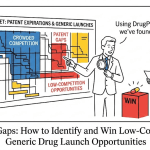
The map serves several functions. It identifies the full scope of potentially relevant patent protection, not just the Orange Book-listed patents. It identifies which formulation approaches are well-covered by multiple patents (suggesting high invalidity risk or strong protection, depending on perspective). It identifies white space — technology approaches for which no or few patents exist — that may represent viable design-around paths.
Systematic landscape mapping using databases like DrugPatentWatch, Derwent Innovation, or Cipher requires defining the technology space through patent classification codes (International Patent Classification and Cooperative Patent Classification), keyword searches on excipient names and formulation technology terms, and assignee searches for the brand company and its predecessors in interest. The result is a comprehensive list of relevant patents that can be analyzed individually for claim scope and validity.
Identifying Freedom-to-Operate Risks Beyond the Target Patent
Freedom-to-operate (FTO) analysis for a formulation design-around covers not only the brand company’s patents but any third-party patents that might cover the generic formulation approach. Excipient manufacturers sometimes hold patents on specific formulations containing their materials. Contract development and manufacturing organizations may hold process patents that cover the manufacturing approach. Academic institutions with industry partnerships may hold early-stage technology patents that cover broad formulation principles.
FTO analysis that focuses exclusively on the brand company’s patents and misses a blocking third-party patent has failed its purpose. The risk is particularly acute in newer technology categories — lipid nanoparticles, prodrug-based formulations, spray-dried dispersion technology — where the technology was developed largely in academic or start-up environments and the patent landscape is fragmented across many assignees.
A systematic FTO process begins with technology identification (what excipients, processes, and delivery mechanisms does the proposed formulation use?) and then searches comprehensively for patents covering each component and the overall combination. It assesses the validity and enforceability of potentially blocking patents and provides a clear map of the risks the proposed formulation faces beyond the target Orange Book-listed patents.
When Design-Around Fails: Learning from Unsuccessful Attempts
Not every design-around succeeds. Understanding why attempts fail is as valuable as understanding the successful cases.
The Zomig (Zolmitriptan) Nasal Spray Patent Problem
AstraZeneca’s zolmitriptan nasal spray (Zomig) generated litigation that illustrated a common failure mode: designing around the primary formulation patent without recognizing that a method-of-use patent covered the clinical indication for which the generic product would be used. Even where a generic product is formulated to avoid the formulation patents, the inclusion of labeling directed to the patented method of use creates infringement risk under the induced infringement doctrine [17].
This is the skinny label issue. A generic manufacturer can file an ANDA with a carve-out of the patented method of use from its proposed labeling, using a ‘skinny label’ that omits reference to the patented indication. But if the carve-out creates a labeling that is clinically incomplete or if evidence suggests that the primary use of the product is the patented indication, courts may find induced or contributory infringement despite the formal carve-out.
The lesson for formulation design-around work is that formulation patents must be analyzed alongside the complete Orange Book listing, including method-of-use patents. A successful formulation design-around that does not address concurrent method patents may produce a product that is formulation-free but still patent-infringing.
The Cardizem CD (Diltiazem) Continuation Ambush
The diltiazem extended-release litigation of the late 1990s and early 2000s is a case study in continuation patent ambush. Generic manufacturers who designed around the initial diltiazem ER formulation patents found themselves facing later-filed continuation applications with claims drafted to capture the generic approaches. By the time the generics received ANDA approvals and were ready to launch, new patents had issued or were pending with claims targeting their specific formulation designs [18].
The response to continuation ambush requires building patent monitoring into the design-around timeline as a core discipline rather than an afterthought. Once a design-around formulation approach is defined, a systematic watch must be placed on the brand company’s pending applications in the relevant patent family. If a new application is published with claims that appear to target the generic approach, the formulator has time — while the application is still pending — to assess whether additional modification can re-establish the design-around, or whether the continuation itself should be challenged as impermissibly broadening the original patent’s scope.
The Economics of Formulation Design-Around: Calculating the ROI
Design-around work is expensive, time-consuming, and uncertain. Before committing to a full program, pharmaceutical companies and their investors need a realistic economic model that weighs the cost of the design-around against the commercial opportunity and the litigation risks of alternatives.
Cost Components of a Design-Around Program
Patent analysis and legal opinion work for a single product, covering the full Orange Book portfolio and FTO analysis, typically costs $150,000 to $500,000 depending on the size and complexity of the patent portfolio. This is a fixed upfront cost that is sunk regardless of whether the formulation development succeeds.
Formulation development from design-around concept to ANDA-ready formulation typically runs $500,000 to $3 million for standard oral dosage forms, and significantly higher for complex formulations (transdermal, liposomal, amorphous solid dispersion) where the analytical and process development burden is greater. Bioequivalence studies add $500,000 to $2 million, depending on study design complexity.
Litigation costs following a Paragraph IV certification average $10 million to $30 million through trial, with some complex multi-patent cases exceeding $50 million. A successful design-around that produces a clear non-infringement position reduces but does not eliminate this litigation exposure, as brand companies routinely litigate even strong non-infringement cases.
Against these costs, the commercial opportunity depends on the size of the branded market, the expected number of competitive generic filers, and the likely market share dynamics at generic entry. First-to-file ANDA filers with 180-day exclusivity periods can capture substantial market share rapidly. In markets above $500 million annually, even a partial first-year market share of 20-30% can produce revenues that justify substantial development investment.
The First Filer Advantage and Design-Around Timing
The Hatch-Waxman 180-day exclusivity period for the first ANDA filer creates a powerful incentive to complete design-around work faster than competitors. The first generic manufacturer to file an ANDA with a Paragraph IV certification on a listed patent has, upon final approval and entry, a 180-day window during which no other generic can receive final approval. In large markets, this exclusivity period alone may justify the design-around investment even if subsequent competitive entry substantially erodes margins.
The timing incentive means that design-around work often begins well before patent expiration or FDA approval of the reference product. Sophisticated generic manufacturers track NDA filings, FDA advisory committee meetings, and expected approval dates and begin patent analysis — sometimes before the brand product is even approved — to position for first-to-file status if the commercial opportunity appears sufficient.
DrugPatentWatch and similar tools support this early-stage competitive tracking by providing patent expiration timelines, ANDA filing history for related products, and analysis of which compounds are approaching key patent cliff dates. This allows business development teams to prioritize design-around investments against the full landscape of upcoming opportunities rather than evaluating each product in isolation.
Regulatory Science as a Design-Around Tool
Formulation patent design-around does not end at the patent office. The regulatory pathway for complex dosage forms creates additional constraints on design-around options — and additional opportunities that are frequently underexploited.
FDA Product-Specific Guidance and Design-Around Boundaries
FDA publishes product-specific guidance (PSG) documents for many complex drug products, specifying the studies and data required to demonstrate bioequivalence. These guidance documents often implicitly define the range of formulation approaches that FDA considers acceptable for equivalence demonstration.
For some products, the PSG specifies that the generic must use the same drug delivery mechanism as the reference listed drug (a common requirement for transdermal patches and some complex oral formulations). For others, the PSG allows a range of formulation approaches provided that certain pharmacokinetic and in vitro performance criteria are met. Understanding the PSG constraints is part of the design-around analysis, because a technically valid design-around that cannot meet the PSG requirements for bioequivalence is commercially useless.
The FDA’s guidance on complex drug products has expanded significantly since 2017, driven by the agency’s Generic Drug Action Plan and subsequent efforts to facilitate generic entry for historically difficult products. This expansion has, in some cases, opened regulatory pathways for generic versions of products that were previously considered practically unapprovable, and has thereby increased the commercial value of design-around work in those categories.
Using the DESI Program and Prior FDA Precedent
FDA’s regulatory history with specific dosage form technologies creates prior art that is occasionally useful for design-around purposes. FDA approvals of older drug products using formulation technologies similar to those claimed in newer formulation patents can support both invalidity (anticipation or obviousness) and non-infringement (demonstrating that the claimed technology was known before the patent’s priority date) arguments.
This is specialized prior art that requires regulatory science expertise to identify and deploy effectively. But for design-around work in well-established dosage form categories (sustained-release oral products, transdermal patches, enteric-coated formulations), the prior regulatory history may provide the cleanest and most accessible prior art available.
Practical Checklist for Formulation Patent Design-Around
The following is a working checklist for teams beginning a formulation patent design-around program. It is not exhaustive — each product presents unique issues — but it covers the essential steps that must be completed before committing to a specific design-around approach.
Identify all patents: Compile the complete Orange Book listing for the reference listed drug. Search USPTO Patent Center for all continuation and divisional applications in each listed family. Search for non-listed formulation patents in the same technology area held by the brand company.
Construct the patent family tree: For each patent, identify all related applications (parents, children, siblings) and their current status (pending, issued, abandoned). Note the expiration dates of all issued patents and the expected issuance timeline for pending applications with claims relevant to your formulation approach.
Conduct claim construction: For each independent claim in each asserted patent, determine the meaning of every claim term using the Phillips framework: specification definition, prosecution history, and field meaning. Note any terms with disputed meanings.
Map prosecution history for estoppel: For each patent, identify every claim amendment made for reasons related to patentability. Map the surrendered subject matter. Note any substantive arguments made by the applicant that further limited claim scope.
Identify design-around targets: For each claim limitation, identify alternative approaches that fall outside the limitation literally and are also outside any prosecution history estoppel. Prioritize alternatives that are technically feasible and achievable within the ANDA development timeline.
Assess prior art landscape: For each proposed design-around approach, confirm that the approach was known before the patent’s priority date (whether through prior art publications, earlier patents, or regulatory history). This supports both the non-infringement position and, if needed, an invalidity backup argument.
Review PSG requirements: Confirm that the proposed design-around formulation approach can satisfy FDA’s product-specific guidance requirements for bioequivalence demonstration.
Conduct FTO analysis: Search for third-party patents covering the specific excipients, processes, and delivery mechanisms in the proposed formulation. Assess infringement risk for any potentially blocking third-party patents.
Set up continuation watch: Establish a systematic monitoring program for all pending continuation applications in the relevant patent families. Schedule review at key prosecution milestones (notice of allowance, issue dates, publication of new office actions).
Document the analysis: Prepare a written analysis capturing all steps above in a form that can be shared with patent counsel in preparation for the Paragraph IV certification. A well-documented design-around analysis is one of the most valuable assets a generic manufacturer can hold going into Hatch-Waxman litigation.
Key Takeaways
Formulation patents protect specific technical implementations, not clinical outcomes. The gap between what a brand company wants to protect and what a patent’s claims actually cover is where design-around opportunities consistently appear.
Prosecution history is the most underused document in formulation patent analysis. Every narrowing amendment and every argument made to distinguish prior art creates potential estoppel that limits the doctrine of equivalents and defines the design-around space.
Successful design-around in formulation patents requires matching the technical approach to regulatory requirements simultaneously. A non-infringing formulation that cannot satisfy FDA’s bioequivalence requirements or product-specific guidance has no commercial value.
Continuation applications are the primary mechanism by which brand companies attempt to cover generic design-around approaches after the fact. Systematic monitoring of pending continuation applications is a required component of any serious design-around program.
IPR provides a powerful complementary tool that can invalidate problematic formulation patents on prior art grounds, reducing litigation risk and potentially eliminating barriers to generic entry entirely when the invalidity case is strong.
The commercial calculus for design-around investment requires honest assessment of the full cost structure (patent analysis, formulation development, bioequivalence studies, litigation reserve) against the market opportunity, competitive landscape, and probability of first-filer exclusivity.
Tools like DrugPatentWatch are not a substitute for detailed patent analysis, but they are essential for efficiently mapping the full patent landscape, tracking ANDA filing activity, and identifying commercial opportunities before the competition.
FAQ
1. How do I know whether a formulation claim is being read too broadly by the brand company?
Start with the working examples in the specification. Count the specific formulations actually tested and reported. If the claims cover a concentration range from 10% to 60% but every working example operates between 20% and 30%, the claim is almost certainly being read more broadly than the specification supports. Compare the claimed range against the prior art cited during prosecution. If the examiner cited references covering formulations at 15%, the fact that the claims start at 10% suggests the patentee pushed the lower bound below what they actually demonstrated. Then read the prosecution history carefully: if the applicant argued that results only occur in a specific sub-range, that argument constrains the claim even if the literal language is broader.
2. What is the biggest mistake generic manufacturers make when approaching formulation design-around?
They focus on the most prominent limitation in the independent claim and ignore the others. A controlled-release tablet patent that claims a specific polymer type gets analyzed exclusively for polymer alternatives. But the same claim may also specify a narrow concentration range, a specific dissolution condition, and a particular particle size — each of which is an independent design-around opportunity and an independent argument against equivalence. The strongest design-around positions involve multiple simultaneous differences from the claimed formulation, making both literal infringement and doctrine of equivalents arguments difficult. Reviewing all limitations with equal rigor, not just the most visually obvious one, is the discipline that separates sophisticated from superficial design-around analysis.
3. Can a formulation patent that was granted cover a formulation that the patent office would never have allowed if the examiner had seen a specific prior art reference?
Yes, and this is more common than it should be. USPTO examiners work under time constraints and may miss relevant prior art, particularly older journal articles, non-English publications, or earlier patents from less-searched technology areas. A patent that was granted based on an incomplete prior art search may be invalid under § 102 or § 103 over art the examiner never considered. This is precisely what IPR proceedings exist to address. A well-prepared IPR petition presenting previously unconsidered prior art has a reasonable chance of success if the art is genuinely relevant and the claim construction supports a conclusion that the prior art anticipates or renders the claims obvious. The fact that a patent issued does not mean it is valid, and for formulation patents in technology areas with rich scientific literature, invalidity over prior art is a live issue in virtually every case.
4. How should a generic manufacturer respond if a brand company files a continuation application with claims that appear to target the ANDA formulation after the ANDA is filed?
The response depends on timing. If the continuation application is still pending, the generic manufacturer (or a third party on its behalf) can file prior art submissions at the USPTO through the preissuance submission procedure, presenting art that demonstrates the claims should not be allowed. This is a low-cost, underused tool. Once the continuation issues, if the new patent is listed in the Orange Book and covers the ANDA product, a new Paragraph IV certification is required, which triggers a new 30-month stay. This is the continuation ambush scenario, and the practical response requires both accelerating litigation on the existing patents to achieve earlier entry and simultaneously challenging the new continuation on validity grounds through IPR or district court. Preventing this scenario entirely requires the proactive continuation monitoring described in this guide, which allows reformulation decisions to be made before the continuation issues rather than after.
5. Is formulation design-around relevant for biosimilars as well as small-molecule generics?
Yes, though the regulatory framework differs significantly. Biosimilar development under the Biologics Price Competition and Innovation Act (BPCIA) involves a different patent dispute resolution process — the ‘patent dance’ — rather than Hatch-Waxman Paragraph IV certifications. Formulation patents for biologics (antibody formulations, lyophilization excipient systems, subcutaneous delivery formulations) are a major area of brand company protection, and the same principles of claim construction, prosecution history estoppel, and design-around apply. The Humira (adalimumab) patent landscape, which included dozens of formulation patents covering citrate-free formulations, high-concentration subcutaneous formulations, and specific stabilizer systems, was one of the most studied examples of biosimilar formulation patent strategy. Several biosimilar manufacturers developed adalimumab formulations designed to fall outside specific Humira formulation claims while satisfying FDA’s totality-of-evidence standard for biosimilarity. The principles are the same; the regulatory and scientific complexity is higher.
Citations
Nautilus, Inc. v. Biosig Instruments, Inc., 572 U.S. 898 (2014).
35 U.S.C. § 112(a). Enablement and written description requirements. United States Code.
Festo Corp. v. Shoketsu Kinzoku Kogyo Kabushiki Co., 535 U.S. 722 (2002).
21 C.F.R. § 314.53. Submission of patent information. Code of Federal Regulations.
Purdue Pharma L.P. v. Amneal Pharmaceuticals, LLC, 796 F. App’x 734 (Fed. Cir. 2019).
U.S. Food and Drug Administration. (2015). Abuse-deterrent opioids: Evaluation and labeling; Guidance for industry. FDA.
Purdue Pharma L.P. v. Collegium Pharmaceutical, Inc., 28 F.4th 1370 (Fed. Cir. 2022).
U.S. Food and Drug Administration. (2018). Liposome drug products: Chemistry, manufacturing, and controls; Human pharmacokinetics and bioavailability; Labeling documentation; Guidance for industry. FDA.
Association for Accessible Medicines. (2023). Generic drug and biosimilar access and savings in the U.S. report. AAM.
Phillips v. AWH Corp., 415 F.3d 1303 (Fed. Cir. 2005) (en banc).
AstraZeneca AB v. Dr. Reddy’s Laboratories, Inc., 145 F. Supp. 3d 452 (D.N.J. 2015).
AstraZeneca UK Ltd. v. Dr. Reddy’s Laboratories Ltd., No. 13-cv-03548 (D.N.J. 2016).
Vishnubhakat, S., & Mowery, D. (2022). Pharmaceutical patent challenges at the PTAB: Trends and outcomes. Journal of Empirical Legal Studies, 19(2), 312-358.