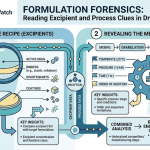
Every formulation patent is a public confession. The inventor must disclose, in precise technical detail, exactly what makes the product work—the excipients, the concentrations, the particle size specifications, the processing parameters. Patent law requires it. That disclosure is filed with the USPTO, published for the world to read, and available to any competitor willing to study it carefully.
Most pharmaceutical professionals treat a competitor’s formulation patent as an obstacle. The better approach is to treat it as a map.
Designing around a patent—developing an alternative formulation that achieves comparable therapeutic performance without infringing the patent’s claims—is one of the most commercially valuable skills in pharmaceutical IP strategy. It is also one of the most misunderstood. Done well, it compresses generic launch timelines, opens market entry for specialty pharma companies, and generates proprietary formulation IP that belongs to you rather than your competitor. Done poorly, it produces a product that either fails bioequivalence or lands you in district court facing a preliminary injunction.
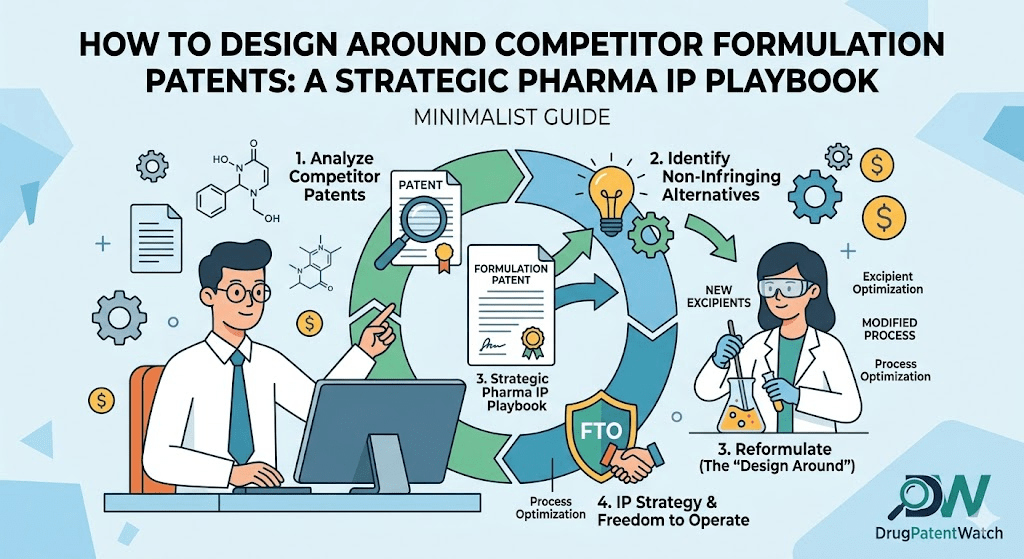
This guide covers the mechanics of designing around formulation patents with enough granularity to be operationally useful to the people who actually have to do it: formulation scientists, IP counsel, regulatory strategists, and the senior managers who fund and direct these projects. We work through how to read formulation patents as a competitive intelligence document, where formulation patents tend to be vulnerable, what scientific approaches have successfully circumvented specific claim types, and what legal traps—prosecution history estoppel, the doctrine of equivalents, the 30-month Hatch-Waxman stay—you need to plan around from day one.
The pharmaceutical industry spent roughly $260 billion on R&D globally in 2023, according to IQVIA estimates. A non-trivial fraction of that capital goes toward building formulation patent estates designed to prevent exactly what this guide describes. The teams that understand those estates well enough to navigate around them gain a material competitive advantage. The teams that don’t spend years in litigation or wait at the door while exclusivity expires.
What a Formulation Patent Actually Protects
Before you can identify weaknesses in a formulation patent, you need a clear picture of what that patent actually claims. The answer is narrower than most non-patent professionals assume, and broader than most formulation scientists expect.
A formulation patent protects a specific drug delivery system: the combination of an active pharmaceutical ingredient (API) with excipients, processing steps, and dosage form architecture. It does not protect the molecule itself—that’s the composition of matter patent, typically filed years earlier. It does not protect the therapeutic use of the molecule—that’s the method of use patent. A formulation patent exists in the middle: between the molecule and its clinical application, covering the specific physical implementation that converts a promising compound into a drug product patients can actually take.
The commercial significance of that middle ground is enormous. When a composition of matter patent expires, a generic manufacturer can file an ANDA (Abbreviated New Drug Application) using the innovator’s clinical data as the basis for approval. But if Orange Book-listed formulation patents remain in force and their claims are infringed by the proposed generic formulation, the generic manufacturer faces either a Paragraph IV patent challenge (triggering a mandatory 30-month stay of FDA approval) or the task of developing a non-infringing alternative formulation. The formulation patent’s purpose is to make that alternative formulation either technically difficult or legally dangerous to develop.
Understanding this dynamic is the starting point for designing around. The innovator has built a legal perimeter around a specific technical implementation. Your job is to determine whether that perimeter has gaps—claim limitations the innovator didn’t cover, prior art that undermines the patent’s validity, or technical approaches that achieve the same clinical result through a different mechanism not captured by the claims.
The Anatomy of a Formulation Patent Claim
A patent claim is a single sentence—often a sentence of extraordinary complexity—that defines the legal boundary of the patent’s protection. Every element of that sentence matters. An accused product or process must satisfy every element of at least one independent claim to infringe the patent. Miss one element and there is no literal infringement. This is the central fact that makes designing around possible.
A typical independent formulation claim for a controlled-release oral solid dosage form might read:
“A sustained-release pharmaceutical composition comprising: from 5% to 15% by weight of [API]; from 20% to 40% by weight of hydroxypropyl methylcellulose having a viscosity of 4,000 to 100,000 cps; from 1% to 5% by weight of magnesium stearate; and from 5% to 15% by weight of microcrystalline cellulose; wherein the composition releases no more than 30% of the [API] within 2 hours and at least 80% of the [API] within 8 hours when tested in 900 mL of simulated gastric fluid at 37°C using USP Apparatus 2 at 75 rpm.”
This claim contains at least six independently exploitable limitations: the API concentration range, the specific polymer (HPMC) with its viscosity specification, the lubricant with its concentration range, the diluent with its range, and two dissolution parameters (the 30% at 2 hours ceiling and the 80% at 8 hours floor). An alternative formulation that uses a different polymer system, or that falls outside the HPMC viscosity range, or that uses a different lubricant, or that uses concentrations outside any of the stated ranges, may avoid literal infringement—provided it can also achieve bioequivalence.
That last clause is where the scientific challenge lives. The claim was written by a formulation scientist who understood exactly what made the formulation work. The ranges are tight because the inventor needed them to be tight to capture the commercial product. A competitor who substitutes outside those ranges will be working with formulation parameters the original developer may have tried and rejected. The design-around is simultaneously a legal navigation exercise and a real formulation development project.
Dependent Claims and Claim Hierarchy
Most formulation patents contain one or two independent claims supported by a cascade of dependent claims that add additional limitations. A dependent claim incorporates all the limitations of the claim it references plus at least one new limitation. Dependent claims narrow protection rather than broadening it—they are legally easier to avoid.
For a design-around analysis, the dependent claim structure matters for two reasons. First, it maps the inventor’s understanding of the claim space. The dependent claims reveal which variations the inventor thought were significant enough to cover separately: specific polymer grades, particular excipient combinations, alternate dissolution profiles. Second, if an independent claim is invalidated during litigation or IPR proceedings, some value may survive in dependent claims—and a design-around must clear those dependent claims too if the alternative formulation happens to incorporate their additional limitations.
The practical approach is to read the dependent claims before reading the independent claims. They tell you what the inventor cared about. A patent with 35 dependent claims cascading from a single independent claim covering HPMC viscosity ranges, specific HPMC grades, alternative polymer combinations, particular dissolution media, and specific manufacturing process steps is telling you that the inventor anticipated competitive attack on every one of those dimensions and tried to foreclose them.
Reading the Patent as an Intelligence Document
The specification—the description section of a formulation patent, which can run to dozens or hundreds of pages in complex cases—is a technical disclosure of extraordinary competitive value. Patent law requires the description to teach a ‘person having ordinary skill in the art’ (PHOSITA) how to practice the invention. That standard is calibrated to a trained pharmaceutical scientist. The description therefore contains quantitative data that a competitor can use to understand exactly what the innovator’s formulation team found when they developed the product.
Tools like DrugPatentWatch allow IP teams, formulators, and business analysts to quickly locate and parse the relevant patent documents for any approved drug, cross-referencing Orange Book listings with the full patent text and prosecution history. The platform’s value for design-around work lies in aggregating the full patent landscape around a target product—not just the Orange Book patents, but continuation applications, international filings, and related patents covering manufacturing processes that don’t appear in the Orange Book at all.
When reading a formulation patent specification for design-around purposes, there are four sections that matter most.
The Detailed Description: Where the Technical Map Lives
The detailed description is the technical core of the patent. In a complex formulation patent, it contains complete lists of candidate excipients organized by function and concentration range, processing parameters including mixing times, granulation endpoint criteria, drying temperatures, and coating parameters, analytical methods used to characterize the formulation, and comparative data showing performance differences between the claimed formulation and alternatives the inventor tested and rejected.
That last category—the rejected alternatives—is where design-around opportunities often live. An inventor who tested five polymer systems, found that three performed adequately, and then claimed only one or two of them has left technical white space in the specification. The data for the rejected systems may appear in the examples as “comparative” examples, labeled as outside the claimed scope. Those comparative examples are a direct disclosure of formulations that may be technically viable while legally non-infringing.
The commercial formulation can usually be identified by matching excipient concentrations in the most-preferred example against the product’s prescribing information, which lists all excipients present in the approved formulation. This cross-reference narrows the field from twenty hypothetical examples to the one that actually describes the marketed product. Once you’ve identified the commercial formulation within the patent, you know exactly which claim limitations are load-bearing—which ones the innovator couldn’t abandon without changing the product.
The Prosecution History: Where the Inventor Defined the Limits
The prosecution history (also called the file wrapper) is the complete record of communications between the patent applicant and the USPTO examiner during examination. It is public record, available through the USPTO’s Patent Center for U.S. applications and through the European Patent Office’s online file inspection tool for EP applications.
For design-around analysis, the prosecution history does something the patent itself cannot: it reveals what the inventor excluded from the claims. During examination, examiners frequently reject claims as obvious over prior art or as failing to distinguish from earlier patents. In response, applicants amend their claims or argue for patentability by distinguishing their invention from the prior art. Those distinctions bind the patent owner in court through the doctrine of prosecution history estoppel. An argument made to secure allowance of a claim cannot be abandoned when asserting that claim against an infringer.
Patent attorneys specializing in Hatch-Waxman litigation typically work alongside formulation scientists who can execute laboratory experiments demonstrating that the generic formulation does not fall within the patent’s claims. The prosecution history review often identifies claim narrowing during examination that can be used to argue prosecution history estoppel against a doctrine of equivalents infringement theory.
Practically: if the original claim covered HPMC at concentrations of 10% to 60% and the examiner rejected it as obvious over a prior art reference disclosing HPMC-based controlled release matrices, and the applicant then amended the claim to cover HPMC at 20% to 40%, a product using HPMC at 15% cannot be reached by a doctrine of equivalents argument. The applicant surrendered that territory to secure allowance.
The Prior Art Section and Background
The background section of a formulation patent describes the state of the art before the invention—and frequently identifies prior art that the inventor considered and distinguished. This section is a useful starting point for an invalidity search, because it identifies the prior art the inventor knew about. The prior art the inventor didn’t know about may be more valuable, but the background section is where the search begins.
For design-around work, the background section also identifies alternative technical approaches that existed before the patent. If the background describes three prior art controlled-release technologies and explains why each has deficiencies that the claimed invention overcomes, a design-around formulation that uses one of those prior art technologies avoids the claimed invention by definition. The formulation may be technically inferior in the way the patent describes, but if it achieves bioequivalence and avoids the claims, it works as a competitive product.
The Examples: The Laboratory Notebook in Public View
The examples section of a formulation patent contains the actual experimental work. In a well-drafted patent, the examples include the specific batches the inventor prepared, with complete formulation compositions, processing conditions, and analytical results. Dissolution profiles, stability data, particle size measurements, and in vivo pharmacokinetic data may all appear in the examples.
For a design-around analysis, the examples map the parameter space the inventor explored. Compositions that appear in examples but are not captured by independent claims are potential design-around targets. A formulation appearing in an example but only captured by a dependent claim is particularly interesting: if the dependent claim’s additional limitation is technically non-essential, and if that dependent claim can be avoided, the formulation may represent a viable path that the innovator tested but chose not to protect at the independent claim level.
Mapping Claim Vulnerabilities: The Six Primary Attack Surfaces
Formulation patents are not all equally strong. The specific vulnerabilities of a given patent depend on how it was drafted, what prior art existed at the time of filing, and what technical alternatives are scientifically feasible. But there are six recurring patterns of vulnerability that appear consistently across pharmaceutical formulation patents, each exploitable through a distinct combination of legal argument and formulation science.
Excipient Substitution: The Most Common Design-Around Path
Most formulation patents claim specific excipients or specific excipient classes. The claim limitation might be a named compound (hydroxypropyl methylcellulose), a class of compounds defined by chemical structure (cellulose ethers), a class defined by function (hydrophilic matrix-forming polymer), or a combination of compound and functional specification (hydroxypropyl methylcellulose having a viscosity of 4,000 to 100,000 cps in 2% aqueous solution at 20°C).
The narrower the specification, the more straightforward the excipient substitution analysis. A claim limited to HPMC can be avoided by substituting hydroxypropyl cellulose, carrageenan, sodium alginate, or any number of other hydrophilic polymers—provided the alternative achieves comparable controlled release performance. A claim limited to “hydrophilic polymers” requires a different approach: a design-around might use a lipid-based controlled release mechanism (a hydrophobic matrix system using glyceryl behenate or carnauba wax) that falls outside both the literal claim language and any reasonable functional equivalent.
The practical limitation is bioequivalence. The FDA requires generic formulations to demonstrate that the rate and extent of API absorption are equivalent to the reference listed drug. A formulation using a completely different release mechanism may perform differently enough to fail the statistical bioequivalence criteria, particularly for narrow therapeutic index drugs where the FDA applies tighter bioequivalence acceptance criteria.
For BCS Class I drugs (high solubility, high permeability), bioequivalence across formulation alternatives is generally achievable with less risk, because the absorption of these drugs is not highly sensitive to formulation characteristics. For BCS Class II and Class IV drugs (low solubility), the formulation plays a more significant role in determining absorption, and the design-around formulation must achieve the same dissolution performance as the innovator’s product—the very performance the patent’s claims are designed to protect.
Concentration Range Gaps: Working at the Edges
Formulation patent claims define concentration ranges for excipients because formulation performance is sensitive to concentration. A hydrophilic matrix tablet releasing drug over 12 hours at 30% HPMC will release over 4 hours at 10% HPMC. The ranges in the claims define the region where the formulation actually works as described.
But ranges have edges. A patent claiming HPMC at 20% to 40% has left the territory below 20% and above 40% legally unclaimed. The design-around question is whether a formulation at 15% HPMC—or at 45% HPMC—can still achieve bioequivalence with the innovator’s product. If the answer is yes, the design-around is complete. If the answer is no (because the release rate is too fast at 15% or too slow at 45%), the excipient substitution approach described above becomes necessary.
The most productive area for range-based design-arounds is typically at the upper end of the claimed range. Innovators generally optimize their formulations toward the minimum effective concentration of expensive functional excipients, for cost and processability reasons. The upper end of their claimed range may have headroom—concentrations that work technically but weren’t commercially optimized. A design-around formulation at HPMC concentrations above the claimed ceiling may achieve bioequivalence, particularly for drugs with relatively flat PK-dissolution relationships.
Particle Size and Physical Form: A Frequently Overlooked Dimension
Formulation patents in the controlled-release and inhalation space frequently specify particle size distributions for the API or for specific excipients. Inhalation formulations are particularly dependent on particle size, because only particles in the 1-5 micron aerodynamic diameter range deposit in the lung rather than impacting the throat. The Spiriva (tiotropium) and Advair (fluticasone/salmeterol) patent estates both involve extensive particle size claims that generic developers had to navigate.
Particle size design-arounds work in two directions. First, an alternative formulation may use an API particle size distribution outside the claimed range while still achieving the required fine particle fraction for lung deposition—because particle size affects not just the amount deposited but the regional deposition within the lung, and different particle size ranges can achieve equivalent systemic exposure even if the deposition pattern differs. Second, processing technologies like spray-drying and jet milling can produce equivalent particle size distributions through methods not covered by process claims even if the resulting product falls within product claims.
For oral solid dosage forms, particle size claims relate to dissolution performance. An API with poor aqueous solubility (BCS Class II) requires particle size reduction to achieve adequate dissolution, and the degree of size reduction affects the dissolution rate. A formulation patent might claim API particle size of D90 less than 10 microns (as measured by laser diffraction). A design-around might use amorphous solid dispersion technology to achieve dissolution enhancement without meeting the particle size limitation—a technically superior approach for many poorly soluble compounds that also avoids the particle size claim entirely.
Processing Parameter Gaps: When the Claim Covers the Product but Not Every Route to It
Some formulation patents claim the product by its characteristics rather than its composition. A claim covering a sustained-release matrix tablet with a specific dissolution profile is a product-by-process or product-by-characteristic claim. Other patents claim the process itself: a granulation process, a coating process, a drying step. The latter type—process claims—are not listed in the Orange Book and do not trigger the Hatch-Waxman 30-month stay when challenged in a Paragraph IV proceeding. They can still be enforced in court, but the procedural landscape is different.
For product claims defined by dissolution characteristics, the design-around challenge is producing a different formulation that achieves the same dissolution profile through a different mechanism. If the claim requires 30% release at 2 hours and 80% release at 8 hours (as measured in simulated gastric fluid at specific conditions), and your alternative formulation achieves 28% at 2 hours and 82% at 8 hours through a different polymer system, two questions arise: is the dissolution profile similar enough for bioequivalence, and does your alternative formulation avoid the literal claim or fall within the doctrine of equivalents?
Process claims offer a cleaner design-around path than product claims, because a non-infringing process can manufacture a product that is compositionally identical to the infringing process’s product. If the innovator’s patent claims a granulation process using high-shear wet granulation with a specific binder concentration, switching to roller compaction (dry granulation) or fluid bed granulation may produce a tablet with comparable performance through a process not covered by the claims—provided the final product achieves bioequivalence. Generic manufacturers challenging Pfizer’s atorvastatin formulation patents in the early 2000s successfully demonstrated that dry granulation processes not covered by the wet granulation process claims could produce bioequivalent tablets.
Crystalline Form and Salt Alternatives: The Polymorph Design-Around
Many formulation patents specify the physical form of the API: a particular crystalline polymorph, an amorphous form, a specific solvate or hydrate, or a defined salt form. These specifications matter because physical form affects solubility, dissolution rate, chemical stability, and processability. The ritonavir crisis—where a previously unknown Form II polymorph appeared spontaneously two years after the drug’s launch, rendering the original capsule formulation ineffective—demonstrated how dramatically physical form can affect drug performance.
Polymorph design-arounds require careful analysis. If the patent claims specifically the Form I crystal and a competitor uses Form II, literal infringement may be avoided—but only if Form II is genuinely different in legally material ways and was not disclosed in the specification. A patent claiming “the crystalline form of [API]” without specifying which crystalline form provides much broader protection and may be harder to design around through alternative polymorphs.
Salt form design-arounds are common. Many APIs can form salts with multiple counterions: sodium, potassium, magnesium, calcium, hydrochloride, mesylate, maleate, and others. Different salt forms have different solubilities, melting points, and crystallization behaviors. A formulation patent claiming the sodium salt of an API may be avoided by using the potassium or magnesium salt—provided the alternative salt achieves bioequivalence and the alternative salt form itself is not independently patented.
AstraZeneca’s Nexium (esomeprazole magnesium) demonstrates this principle in reverse: it is the magnesium salt of the S-enantiomer of omeprazole, and the associated patent estate allowed AstraZeneca to maintain revenue after omeprazole (Prilosec) went generic—not because of formulation innovations alone, but because the chiral switch to the S-enantiomer, combined with the magnesium salt form and associated formulation work, created an independently protectable product.
Delivery System Transformation: Changing the Dosage Form Itself
The most aggressive form of design-around is changing the dosage form entirely. If the innovator’s formulation patent covers a modified-release oral tablet, a competitor might develop an oral capsule, an oral suspension, a transdermal patch, or a sublingual film containing the same API. The delivery system transformation avoids all of the innovator’s formulation claims—which necessarily describe the specific dosage form—while potentially generating its own protectable IP.
GlaxoSmithKline employed a variant of this strategy with Imitrex (sumatriptan), extending the product’s market presence through an intranasal formulation independently protected from the original oral tablet patent estate. The nasal formulation had different bioavailability characteristics, a different patient population (faster onset was clinically meaningful for migraine patients), and its own patent protection that did not depend on the oral tablet patents.
The regulatory challenge with dosage form transformation is that a significantly different formulation—particularly one with different bioavailability characteristics—may require clinical bridging studies rather than pure bioequivalence studies. An oral modified-release formulation that achieves different exposure characteristics than the original tablet may meet the definition of a 505(b)(2) application rather than a full ANDA, requiring some new clinical data even if the API is not new.
The Legal Framework: Infringement Theories You Must Navigate
Designing around a patent means designing a product that a court would not find to infringe. Two distinct infringement theories are relevant: literal infringement and infringement under the doctrine of equivalents. A design-around must avoid both.
Literal Infringement: Claim Mapping the Alternative Formulation
Literal infringement requires that the accused product satisfy every limitation of at least one claim. This analysis requires a claim construction—a legal interpretation of what each claim term means—followed by a comparison of the accused product’s characteristics against the claim limitations as construed.
For formulation patents, this analysis involves characterizing the alternative formulation with the same analytical methods used in the patent. If the claim specifies HPMC viscosity, the alternative formulation must be characterized for HPMC viscosity using the same viscosity measurement method referenced in the patent. If the claim specifies dissolution performance under specific USP conditions, the alternative formulation must be tested under those conditions.
The claim-mapping exercise should be performed by formulation scientists working with patent counsel—not by either group alone. The scientists know what the analytical data means and whether the alternative formulation’s characteristics fall within or outside the claim ranges. The counsel knows how courts construct claim terms and what the prosecution history commits the patent owner to. The intersection of those two competencies is where reliable infringement opinions are produced.
The Doctrine of Equivalents: The Invisible Perimeter
The doctrine of equivalents extends patent protection beyond the literal claim language to cover products that are insubstantially different from the claimed invention. Under the doctrine, a product element can infringe a claim limitation if it performs substantially the same function in substantially the same way to achieve substantially the same result—the “function-way-result” test.
For formulation design-arounds, the doctrine of equivalents is the primary legal risk. A formulation using hydroxypropyl cellulose (HPC) instead of claimed hydroxypropyl methylcellulose (HPMC) might perform substantially the same function (matrix-forming), in substantially the same way (hydrophilic matrix swelling and gel layer formation), to achieve substantially the same result (controlled API release). If a court finds these similarities substantial, an equivalents infringement finding is possible even if the literal claim language covers only HPMC.
Prosecution history estoppel limits the doctrine of equivalents. When an applicant narrows a claim during prosecution to overcome a prior art rejection, the applicant surrenders the right to recapture the surrendered territory through equivalents arguments. This is the strongest legal tool available to a design-around competitor: if the prosecution history shows the patent owner surrendered coverage of HPC-based matrices to secure allowance over a prior art reference, an equivalents argument based on HPC cannot succeed.
The doctrine of equivalents also has a prior art limitation: the scope of equivalents cannot be expanded to cover products or processes that were prior art at the time the patent was filed. If HPC-based controlled release matrices were described in prior art before the patent’s priority date, those matrices cannot be reached through equivalents, because extending protection to cover prior art would contradict the novelty requirement of patentability.
The 30-Month Stay: Planning Around the Litigation Timeline
Under the Hatch-Waxman Act, a Paragraph IV certification (asserting that an Orange Book patent is invalid or not infringed) triggers a 30-month stay of FDA approval if the patent owner files an infringement suit within 45 days of receiving notice of the certification. The 30-month stay is automatic—it does not require any showing of merit by the patent owner. For a drug generating $5 billion per year in U.S. revenues, the 30-month stay has a present value in excess of $10 billion on a risk-adjusted basis, which is why patent owners file suit within 45 days in nearly every commercially significant case.
A design-around formulation affects the stay in a critical way. If the alternative formulation does not infringe the Orange Book patent, the ANDA can certify Paragraph II (patent already expired), Paragraph III (patent expiration acknowledged, entry deferred until expiration), or Paragraph IV on invalidity rather than non-infringement grounds. A non-infringement Paragraph IV certification may still trigger the stay, but the underlying litigation turns on whether the alternative formulation infringes—a factual question that can sometimes be resolved more quickly than a full-scale invalidity trial.
Design-around formulations that change the drug’s dosage form or delivery mechanism enough to avoid the Orange Book formulation patent claims can generate a Paragraph III or Paragraph II certification on those patents. This is a material strategic advantage: a Paragraph II certification on the formulation patent, combined with a Paragraph IV certification only on the composition patent (which may already be expired or nearing expiration), may result in a shorter or more certain path to market than a Paragraph IV challenge to the formulation patent itself.
Validity Vulnerabilities: When the Patent Itself Is the Weakness
A design-around formulation avoids infringement. A validity challenge destroys the patent entirely. The two strategies are not mutually exclusive—and in practice, the strongest generic pharmaceutical programs pursue both simultaneously.
Obviousness: The Most Common Invalidity Ground for Formulation Patents
Formulation claims are frequently challenged as obvious over prior art because pharmaceutical formulation is a mature science with an extensive published literature. The argument that combining a known API with known excipients in known concentration ranges to produce a controlled-release tablet is routine optimization—and therefore obvious—has succeeded in invalidating formulation patents with some regularity.
The legal standard for obviousness under 35 U.S.C. § 103 requires that the claimed invention would have been obvious to a person of ordinary skill in the art at the time of filing. The Supreme Court’s KSR decision (2007) lowered the bar for obviousness by rejecting the requirement of a specific “teaching, suggestion, or motivation” to combine prior art references. A skilled formulator combining known ingredients in known ways, following established formulation principles, may produce the claimed formulation without inventive contribution—and if so, the resulting patent claims are obvious.
The principal defense against obviousness for formulation patents is “unexpected results”: evidence that the claimed formulation achieves results that were not predictable from the prior art. An extended-release formulation that achieves better dose-proportional absorption than the prior art would predict, or that demonstrates superior stability at elevated temperature and humidity despite using conventional excipients, may survive an obviousness challenge on unexpected results grounds. The strength of this defense depends on the quality of the comparative data in the patent specification and the breadth of the prior art landscape.
“Since 2021, the invalidation rate has been increasing and is currently at 71% for the first two quarters of 2024. In 2023, all challenged claims were found invalid 68% of the time. These are daunting statistics for patent holders.” — IPWatchdog, reporting on PTAB invalidation data, June 2024 [1]
Orange Book pharmaceutical patents actually perform better than average in IPR proceedings. DrugPatentWatch’s analysis indicates that Orange Book patents have a 50% chance of surviving an IPR with no claims invalidated, compared to less than 20% for patents generally—reflecting the more rigorous prosecution standards applied to commercially significant pharmaceutical patents and the quality of legal representation in high-value Hatch-Waxman matters. But formulation patents fare worse within that group than composition patents, because their claims are inherently more susceptible to obviousness attack.
Enablement and Written Description Failures
A formulation patent claim is only as broad as its specification supports. Under 35 U.S.C. § 112, the patent must contain a written description of the claimed invention sufficient to show that the inventor possessed the full scope of the claims, and an enabling disclosure sufficient for a PHOSITA to practice the full scope without undue experimentation.
Broad formulation claims—those covering wide ranges of excipients, wide concentration ranges, or large classes of dosage forms—are vulnerable to enablement and written description attacks when the specification contains examples for only a narrow subset of the claimed scope. If the independent claim covers controlled-release formulations using “any hydrophilic polymer” but the specification exemplifies only HPMC and HPC, a challenge that the full scope of “any hydrophilic polymer” is not enabled may succeed—particularly for less commonly used polymers with different release mechanisms.
The Supreme Court’s 2023 Amgen v. Sanofi decision significantly tightened the enablement standard for broad functional claims in biologic patents, but its reasoning extends to pharmaceutical formulation patents with broad functional claim language. Claims defined by functional results rather than structural limitations—covering “any formulation that releases [API] with an AUC ratio to reference product of 0.80 to 1.25″—may be enabling failures if the specification does not disclose sufficient formulations across the claimed AUC range to allow a PHOSITA to make formulations throughout that range without extensive trial and error.
PTAB as a Parallel Track
The Patent Trial and Appeal Board offers an alternative to district court litigation for challenging pharmaceutical formulation patents. In fiscal year 2024, the institution rate for bio/pharma IPR petitions was approximately 73%, and the all-claims invalidation rate across IPR proceedings generally has climbed from 55% to 70% between 2019 and 2024. The lower burden of proof (preponderance of the evidence rather than clear and convincing evidence) and the absence of a presumption of validity make PTAB a more favorable venue for invalidity arguments than district court.
For formulation patents, the strongest IPR ground is generally obviousness, supported by a combination of prior art formulation literature (journal articles, textbook formulation chapters, pharmacopeial monographs, and earlier patents disclosing similar excipient systems) and expert declarations from formulation scientists establishing that a PHOSITA would have been motivated to combine the prior art elements and would have expected success.
The IPR strategy must be coordinated with the design-around strategy. IPR estoppel under 35 U.S.C. § 315(e) bars the petitioner from raising in district court any ground that was raised or reasonably could have been raised in the IPR. A petitioner who files an IPR must therefore commit the full scope of its prior art arguments at the outset—reserving nothing for district court. This constraint requires upfront decisions about which invalidity arguments to make at the PTAB versus which to hold for district court, and coordination with the non-infringement positions being developed around the design-around formulation.
Real Cases, Real Outcomes: Designing Around in Practice
Patent strategy at this level of abstraction risks becoming disconnected from the commercially relevant question: does it actually work? The following case studies address that question directly.
Lipitor: Polymorph and Process Design-Arounds That Enabled Early Generic Entry
Pfizer’s atorvastatin (Lipitor) was one of the most intensively litigated pharmaceutical patent estates of the 2000s, and it provides the clearest available example of formulation design-around at commercial scale.
The Lipitor patent estate included composition of matter patents on atorvastatin and its calcium salt, formulation patents covering specific tablet compositions, and process patents covering the manufacturing method. Generic manufacturers—primarily Ranbaxy, which filed the first Paragraph IV certification and won 180-day exclusivity—challenged multiple components of this estate simultaneously.
The formulation design-arounds for Lipitor focused on two areas. First, the original formulation patents claimed specific crystalline polymorphs of atorvastatin calcium. Generic filers demonstrated that alternative crystalline forms were equally effective and that specific granulation process variants not covered by the process claims could produce tablets achieving bioequivalence. The generic formulations used dry granulation (roller compaction) in place of the wet granulation process described in the innovator’s patents—a process substitution that avoided the process claims while producing a tablet with equivalent performance. Second, the Paragraph IV challengers were able to demonstrate that alternative crystalline forms of atorvastatin calcium could be used to achieve bioequivalence without falling within the polymorph claims.
The outcome confirmed the commercial value of design-around work. Generic atorvastatin launched in November 2011, when the composition patent expired—not years later when the formulation and process patents would have expired. The formulation design-arounds were part of the reason generic manufacturers could certify non-infringement on at least some of the Orange Book-listed patents, reducing their exposure in the 30-month stay proceeding.
Nexium and the Chiral Switch: Designing Around as Offensive IP Strategy
AstraZeneca’s transition from Prilosec (omeprazole) to Nexium (esomeprazole magnesium) illustrates that designing around applies symmetrically: an innovator can design around its own expiring IP by developing a successor product that avoids the prior art covering the original while generating new, independently protectable claims.
Omeprazole is a racemate—a 50/50 mixture of the R- and S-enantiomers. AstraZeneca’s research established that the S-enantiomer (esomeprazole) has superior pharmacokinetics in acid suppression, with higher bioavailability and a more predictable plasma concentration-time profile in patients who are extensive metabolizers of CYP2C19. The magnesium salt form of esomeprazole was selected for the commercial product, providing additional patent protection beyond the enantiomer IP.
Nexium launched in 2001, before omeprazole’s patent expiration, and generated over $5 billion in peak annual U.S. sales. The clinical benefit argument for the S-enantiomer—marginally superior acid suppression in a defined patient subgroup—was sufficient to establish non-obviousness in U.S. patent proceedings. Courts worldwide validated the esomeprazole patents despite sustained criticism that the chiral switch represented incremental, rather than fundamental, innovation.
The Nexium strategy demonstrates a principle that applies to generic manufacturers as much as to innovators: a design-around that generates patentable IP of its own is worth more than a design-around that simply clears a legal path. A generic company that develops a salt form alternative to avoid an innovator’s polymorph patents, and then patents its own salt form, has converted a legal defensive exercise into an offensive asset.
Abuse-Deterrent Formulation Patents: OxyContin and the Limits of Design-Around
Purdue Pharma’s reformulated OxyContin—extended-release oxycodone with abuse-deterrent properties, launched in 2010—illustrates a case where designing around proved more difficult than anticipated, not for legal reasons but for FDA policy reasons.
The reformulated OxyContin replaced the original extended-release matrix with an abuse-deterrent formulation using a polyethylene oxide matrix that resists crushing and becomes viscous upon dissolution, reducing the potential for intranasal and intravenous abuse. The reformulated product’s patent estate covered the specific polyethylene oxide matrix composition, the processing method, and the resulting abuse-deterrent properties.
Generic manufacturers developing ANDA versions of OxyContin faced two simultaneous challenges. First, the abuse-deterrent formulation patents had to be avoided or challenged. Second, the FDA had designated the original (non-abuse-deterrent) OxyContin as withdrawn from the market for safety reasons, making it unavailable as the reference listed drug for a non-abuse-deterrent generic ANDA. The FDA’s position effectively required any generic ANDA for OxyContin to use the reformulated abuse-deterrent version as the reference—forcing generic manufacturers to develop their own abuse-deterrent formulations, which in turn had to avoid Purdue’s abuse-deterrent formulation patents.
The result was a multi-year delay in generic entry not because the patents were legally unbeatable, but because the FDA’s clinical guidance for abuse-deterrent generics required demonstration of comparable abuse-deterrence—a requirement that effectively mandated achieving the same functional outcome the patents claimed, through a non-infringing mechanism. This case shows the boundary condition for design-around: when regulatory standards require achieving the precise functional result that a patent claims, the design-around space collapses to the width of a technically viable alternative that is simultaneously non-infringing and FDA-demonstrably equivalent on the clinically relevant attribute.
Inhalation Formulations: Where Design-Around Meets Complex Generic Challenges
Inhalation formulations are among the most patent-dense and design-around-resistant categories in pharmaceutical IP. The FDA’s complex generic guidance for orally inhaled drug products (OIDPs) requires demonstration of pharmaceutical equivalence, bioequivalence, and device equivalence for a product-device combination. For metered-dose inhalers (MDIs) and dry powder inhalers (DPIs), the device itself is frequently co-patented with the formulation, making a device substitution (itself a form of design-around) either commercially problematic or separately infringing.
AstraZeneca’s Symbicort (budesonide/formoterol) MDI patent estate includes formulation patents covering the specific propellant composition, the co-suspension technology used to suspend budesonide particles and formoterol particles in HFA propellant, and the aerosol performance characteristics. The co-suspension technology—in which porous carrier particles are used to stabilize an otherwise unstable aerosol mixture—is a genuine formulation innovation that has proven difficult to design around because it solves a physical stability problem for which alternative solutions are technically complex.
The inhalation design-around cases illustrate the relationship between technical difficulty and commercial value. Where designing around is hard, the patent protection is strong—and the exclusivity period generates commensurately higher revenue. But hard is not impossible. Hikma and other generic manufacturers eventually developed ANDA programs for budesonide/formoterol inhalation, using alternative particle engineering approaches and device designs that required years of development investment but ultimately produced approvable products.
Building the Design-Around Program: Operational Structure
A design-around program is not a legal project with scientific support, nor a scientific project with legal oversight. It is an integrated effort that requires both disciplines working from the same evidence base, pursuing the same strategic objective, with clearly defined decision gates and a shared understanding of the commercial value at stake.
The Freedom-to-Operate Analysis as the Starting Point
A freedom-to-operate (FTO) analysis identifies all patents that may be infringed by the proposed product or process and assesses the validity and enforceability of those patents. For a formulation design-around program, the FTO analysis must cover not just the Orange Book-listed patents but process patents (which are not Orange Book-listed but are still enforceable), foreign patent equivalents in key markets, and continuation applications filed after the original grant that may have broader or differently worded claims.
The FTO should be performed before significant formulation development investment, not after. A FTO performed late in the development process—after a formulation has been selected, scale-up manufacturing runs have been completed, and bioequivalence studies have been conducted—may identify infringement risks that require the entire formulation to be redesigned. At that stage, the cost of redesign may approach the cost of the studies themselves.
DrugPatentWatch provides one of the more efficient tools for the initial patent landscape mapping step of an FTO, allowing teams to identify all patents associated with a specific drug product, organized by patent type (composition, formulation, method of use, process), expiration date, and Orange Book listing status. The platform’s value in FTO work lies in ensuring completeness—making sure the analysis captures continuation applications and related patents that might otherwise be missed in a search focused only on Orange Book-listed patents.
The Claim Mapping Matrix
Once the relevant patents are identified, the design-around team should construct a claim mapping matrix: a systematic document that maps each claim limitation of each relevant patent against the proposed alternative formulation’s characteristics. The matrix should include columns for:
The exact claim language of each limitation
The proposed alternative formulation’s characteristic relevant to that limitation
A preliminary infringement assessment (literal infringement, potential equivalents infringement, or no infringement)
The prosecution history relevant to that limitation (any narrowing amendments or distinguishing arguments)
The prior art bearing on the validity of that limitation
The matrix serves as a living document that is updated as formulation development proceeds. When a formulation parameter changes—the HPMC grade changes, the lubricant concentration shifts, the dissolution test conditions are modified—the matrix is updated to reflect the change and its impact on the infringement analysis.
The matrix also identifies which claim limitations are the most constraining—the ones where the alternative formulation comes closest to the claimed range. Those limitations get the most analytical attention and, if the formulation is adjusted to increase the margin from the claim, the adjustment is documented in the development record.
The Development Record as Legal Documentation
The development record for a design-around formulation serves a dual purpose. It is a scientific record of the formulation development process, documenting the experiments performed, the results obtained, and the rationale for formulation decisions. It is also a legal document that may be introduced in litigation to establish when specific design decisions were made and why.
Documentation standards for design-around formulation development should reflect this dual purpose. Lab notebooks should be contemporaneously dated and signed. Electronic data should be stored in systems with audit trails. Formulation decisions made specifically to avoid identified patent claims should be documented as such—not as general formulation optimization choices—because the contemporaneous record of design-around intent is relevant evidence in an infringement proceeding.
More precisely: the best defense against an allegation of willful infringement is a documented design-around program that demonstrates the company was aware of the patent and made deliberate, documented choices to avoid its claims. The worst position is a company that ignored relevant patents and later claims it designed around them.
Formulation Scientist and Patent Counsel Integration
The most common failure mode in pharmaceutical design-around programs is inadequate integration between the formulation science team and the patent counsel team. Formulation scientists design for performance and processability. Patent counsel assess legal risk. When these teams work sequentially rather than in parallel—scientists develop the formulation, then hand it to counsel for FTO review—the result is frequently a formulation that achieves bioequivalence but infringes one or more claims, requiring redesign at significant cost and time.
The alternative is to embed patent counsel in formulation development team meetings from the outset of the project. The counsel’s role in those meetings is not to direct the science but to flag when a proposed formulation direction moves toward claimed territory and to identify formulation options that provide more legal distance from the claims. The scientist’s role is to assess whether the legally safer option is technically viable and whether it can achieve bioequivalence.
This integration model works best when the patent counsel involved have sufficient scientific background to read and understand the technical content of formulation patents without constant interpretation, and when the formulation scientists are willing to engage with claim language and prosecution history rather than treating them as purely legal documents. The combination of technical and legal fluency on a single integrated team is the resource most critical to successful design-around work—and also the most commonly unavailable in organizations that separate IP and R&D into distinct functional silos.
The Design-Around Across Dosage Form Categories
The specific vulnerabilities and design-around approaches differ meaningfully across dosage form categories. A practitioner working in controlled-release oral solids faces a different patent landscape than one working in injectable biologics or transdermal delivery systems. The following section addresses the most commercially significant categories.
Controlled-Release Oral Solid Dosage Forms
Controlled-release oral solids—extended-release tablets and capsules using matrix, reservoir, or osmotic release mechanisms—generate the largest volume of formulation design-around activity. The commercial significance of the product category (it includes some of the highest-revenue branded drugs in history), the maturity of the underlying formulation science, and the intensity of the generic industry’s ANDA pipeline all contribute to a rich litigation record and a well-developed body of design-around practice.
Matrix-based controlled-release systems typically use hydrophilic polymers (HPMC, HEC, PEO), lipid-based materials (glyceryl behenate, carnauba wax, hydrogenated vegetable oil), or combinations of hydrophilic and hydrophobic polymers to control drug release. The design-around space for HPMC-based matrix patents is well-mapped: alternative polymer systems include Carbopol (polyacrylic acid), sodium alginate, xanthan gum, and various cellulose ethers with different degrees of methoxy and hydroxypropyl substitution. Each alternative has different swelling behavior, gel strength, and release kinetics that must be matched to the target dissolution profile.
Reservoir systems—coated pellets or tablets where the membrane controls release—offer a different design-around landscape. Ethylcellulose and polyvinyl acetate are the dominant membrane materials in the prior art, and their use is extensively disclosed in pharmaceutical literature dating to the 1970s. Design-arounds for reservoir system patents typically focus on the specific coating composition, coating weight, and plasticizer system rather than the membrane material itself, which is unlikely to be patentable as a formulation component.
Osmotic release systems (OROS), used in products like the original Concerta (methylphenidate extended-release), present a more complex design-around challenge because the operating principle—osmotic pressure driving drug through a laser-drilled orifice in a semipermeable membrane—is a delivery mechanism rather than a simple excipient composition. The OROS patent estate for Concerta covered not just the formulation composition but the device architecture (the push-pull osmotic pump design), making it difficult to achieve equivalent pharmacokinetics without using the OROS platform or a similar device that risked infringement on separate device patents.
Biologics and Biologic Formulations: A Different Scale of Complexity
Biologic formulation patents cover the excipient compositions and process conditions that stabilize protein therapeutics. Unlike small-molecule formulation patents, biologic formulation patents cannot generally be designed around by substituting chemically equivalent excipients—because the stability of a protein therapeutic depends on specific interactions between the protein surface and the excipient molecules, and those interactions are not reliably predictable without extensive experimental work.
The BPCIA (Biologics Price Competition and Innovation Act) biosimilar pathway requires demonstration of biosimilarity through an extensive analytical, preclinical, and clinical data package. The totality-of-evidence approach to biosimilarity—which relies on orthogonal analytical characterization rather than simple bioequivalence—means that a biologic formulation that differs from the reference product formulation must be assessed for its potential to affect product quality attributes, not just bioavailability.
For biosimilar sponsors, the design-around question for formulation patents is less about achieving equivalent drug exposure (the bioequivalence goal for small molecules) and more about demonstrating that the alternative formulation does not adversely affect the molecule’s structure, function, and immunogenicity relative to the reference. A buffer system substitution, a pH change, or a surfactant concentration difference that would be trivially non-infringing in a small-molecule context may require substantial analytical work to demonstrate as safe in a biologic context.
The commercial value of successful biosimilar formulation design-arounds is substantial: each biologic product protected by a formulation patent cluster represents a market opportunity that, for some products (adalimumab, bevacizumab, trastuzumab), exceeds $5 billion annually in the United States alone. Bristol-Myers Squibb and Pfizer’s Eliquis portfolio alone includes 226 manufacturing patents and 213 formulation patents beyond the core composition claims, illustrating the density of formulation IP that biosimilar and generic sponsors must navigate.
Topical and Transdermal Formulations
Topical and transdermal formulations—creams, gels, ointments, transdermal patches—are among the most complex generic formulation challenges because the FDA’s bioequivalence requirements for these dosage forms are more demanding than for oral solids. Skin penetration is highly sensitive to formulation composition: vehicle pH, solvent system, surfactant type and concentration, and drug concentration all affect the rate and extent of drug delivery through the stratum corneum.
Formulation patents for topical and transdermal products frequently claim the specific solvent system, the drug:vehicle ratio, or the penetration enhancer composition. Design-arounds in this space require matching not just the dissolution profile (as for oral solids) but the in vitro skin permeation profile and, for systemic transdermal products, the plasma pharmacokinetic profile—all while avoiding the claimed formulation parameters.
The FDA’s product-specific guidance documents for complex generics, including many topical and transdermal products, specify the analytical characterization required to establish bioequivalence—and in some cases effectively require Q1/Q2 qualitative and quantitative compositional sameness with the reference product. When Q1/Q2 sameness is required, the design-around space collapses: a product that must be qualitatively and quantitatively identical to the reference cannot simultaneously avoid the reference’s formulation patents. This is not a universal requirement, but where it applies, it eliminates the design-around option and forces patent challenge as the only path to market.
The Competitive Intelligence Dimension: Using Patents to Map What Rivals Are Doing
Designing around a competitor’s formulation patent requires understanding what that patent actually protects and why the competitor chose that formulation approach. The patent is not just a legal obstacle—it is a window into the competitor’s formulation development history, technical capabilities, and strategic IP priorities.
A systematic reading of a competitor’s formulation patent portfolio across multiple products reveals patterns: which excipient systems the company favors, which processing technologies they have invested in, which delivery mechanism innovations they are developing, and which formulation problems they have encountered and solved (the specification will tell you) or not solved (the comparative examples will tell you). This level of competitive intelligence is available from public patent documents at no cost other than the analytical effort required to read and synthesize the information.
DrugPatentWatch’s patent analytics capabilities are particularly useful for this competitive intelligence function. The platform allows users to search for all patents associated with a specific company and filter by patent type, filing date, and Orange Book listing status. Tracking a competitor’s formulation patent filings over time reveals whether they are filing more or fewer formulation patents, in which therapeutic areas, using which delivery technologies—a profile of their formulation innovation pipeline before any product reaches the market.
Patent filing geography also provides intelligence. A formulation patent filed only in the United States but not in Europe or Japan may indicate that the innovation was not considered strong enough to justify international prosecution costs—a signal of the patent owner’s own assessment of the formulation’s patentability. Conversely, a formulation patent filed as a PCT application designating 40+ countries suggests the patent owner considers it a core commercial asset worth the international prosecution cost.
Continuation application filing behavior provides another layer of intelligence. An innovator who files a series of continuation applications from a core formulation patent specification—each continuation adding new claims with progressively narrower or differently worded limitations—is building a defensive perimeter against design-around attempts. The continuations themselves reveal which design-around approaches the innovator anticipated: each continuation’s claims address a specific alternative formulation approach by covering it more narrowly than the parent, or by adding claims that a design-around product might inadvertently satisfy.
International Formulation Patent Strategy: The Geography of Design-Around Opportunity
Formulation patent protection is not uniform across jurisdictions. The same formulation innovation may be patentable in the United States, patentable in Europe with narrower claims, and unpatentable in India under Section 3(d) of the Indian Patents Act—which restricts patentability of new forms of known substances (including new polymorphs, new salts, and new formulations) unless enhanced therapeutic efficacy over the known substance is demonstrated.
India’s Section 3(d) creates a fundamentally different design-around landscape for generic manufacturers operating in or sourcing from India. A formulation that would infringe an Orange Book-listed U.S. patent may be manufactured in India using a formulation not protectable under Section 3(d)—provided the Indian formulation is bioequivalent to the U.S. reference product and doesn’t infringe other Indian patents on composition or method of use.
European patent law applies a somewhat stricter obviousness standard for formulation patents than U.S. law, under the “problem-solution approach” used by the European Patent Office. Under this approach, the prior art is used to identify the closest prior art document, the technical problem solved by the claimed invention is defined objectively, and the claims are assessed as obvious if the skilled person, starting from the closest prior art and seeking to solve the technical problem, would have arrived at the claimed invention without inventive step. For formulation patents where the technical problem is straightforward (improving dissolution, extending release duration), the problem-solution approach tends to make claims more vulnerable to obviousness attack in Europe than in the United States.
Patent term extension (PTE) in Europe and the supplementary protection certificate (SPC) system can extend formulation patent protection beyond the base 20-year patent term. The SPC system grants up to five additional years of protection after patent expiration for the product (the medicinal product as authorized, not the patent claims) that was the subject of the first marketing authorization in the EU. For formulation patents, the SPC scope is limited to the combination of API and formulation characteristics covered by the marketing authorization—and recent CJEU case law has restricted SPC eligibility for formulation patents that cover combinations of API and excipients not independently authorized as drugs.
The Economics of Designing Around: When Is It Worth the Investment?
A formulation design-around program costs money: formulation development resources, analytical characterization costs, bioequivalence study expenses, patent counsel time, and regulatory submission costs. The investment is worth making only when the commercial opportunity justifies it—and the commercial opportunity is determined by the size of the market, the remaining exclusivity period on the Orange Book patents, and the competitive landscape at the time of anticipated launch.
The financial analysis for a design-around program should quantify four variables: the size of the target market at the anticipated launch date, the probability of technical success in developing a non-infringing bioequivalent formulation, the probability of legal success in defending a non-infringement position if the patent owner files suit, and the first-to-file competitive advantage available to the first ANDA sponsor with a non-infringing formulation.
For Paragraph IV certifications based on non-infringement (where the patent is challenged as not infringed rather than invalid), the 180-day exclusivity available to the first ANDA filer accrues only when the ANDA is for a product with a Paragraph IV certification. A non-infringing design-around that allows a Paragraph III or Paragraph II certification may not trigger 180-day exclusivity—but it also avoids the 30-month stay and the litigation cost and uncertainty that accompany Paragraph IV infringement challenges.
The risk-adjusted NPV calculation for a design-around program is materially different from the risk-adjusted NPV for a straight Paragraph IV invalidity challenge. The invalidity challenge has a binary outcome: either the patent is invalidated (high reward, uncertain probability) or it is upheld (zero reward on that patent, possibility of attorney’s fees under exceptional case doctrine). The design-around program has a more continuous outcome: the formulation either clearly avoids infringement (high reward, lower litigation risk), falls into a gray zone that requires litigation to resolve (moderate reward, moderate litigation risk), or clearly infringes (zero reward, high litigation risk). The design-around program also generates a formulation asset that has value independent of the legal outcome.
Emerging Issues: AI-Assisted Formulation Design and the Shifting Patent Landscape
Generative AI tools for pharmaceutical formulation are beginning to change the economics of both innovation and design-around. Machine learning models trained on formulation databases can predict excipient compatibility, dissolution behavior, and stability characteristics for formulation compositions that have never been physically prepared. This computational screening capability accelerates formulation development by prioritizing the experiments most likely to succeed—and it applies equally to innovation and to design-around.
For design-around specifically, AI-assisted formulation screening can identify non-infringing formulation alternatives more efficiently than traditional trial-and-error development. A model that has been trained on existing controlled-release formulation data can screen thousands of potential polymer/excipient combinations against target dissolution profiles and patent claim limitations simultaneously, flagging the combinations most likely to achieve bioequivalence while falling outside the claimed ranges. What previously required 12 to 24 months of formulation development can begin to be narrowed to a smaller number of high-priority candidates in weeks.
The patent landscape is adapting to this change. AI-assisted prior art searches are making the global body of formulation literature more accessible, raising the obviousness standard for formulation patents by surfacing prior art references that would previously have required specialized searches to locate. The USPTO’s 2024 guidance on AI-assisted inventions—clarifying that AI-assisted inventions remain patentable provided one or more humans made a “significant contribution” to conception—addresses the patentability of AI-generated formulations, but does not directly address the question of whether AI-assisted design-arounds change the legal analysis.
The long-term implication is that formulation patents whose non-obviousness rests primarily on the difficulty of conventional formulation development may become more vulnerable to invalidity challenge as AI formulation tools demonstrate that the same formulation could be reached through computational screening without inventive step. This is not yet a dominant argument in patent proceedings, but the trend is consistent with the general pattern of AI lowering barriers to formulation work—and the teams tracking this development systematically will be better positioned to exploit it.
Defensive Design-Around: Protecting Your Own Design-Around Formulation
A company that successfully develops a non-infringing design-around formulation has created an asset that can itself be patented—provided it meets the patentability requirements of novelty, utility, and non-obviousness. The design-around formulation is, by definition, an alternative that achieves the same clinical result through a different technical approach. If that different approach is genuinely non-obvious, it qualifies for its own patent protection.
Filing patents on successful design-around formulations serves two purposes. It prevents the innovator from filing continuation applications covering the design-around territory (a common response to successful design-arounds by well-resourced innovators). It also creates market exclusivity for the design-around itself, allowing the first company to develop the non-infringing alternative to exclude later generic sponsors who attempt to copy the design-around formulation rather than developing their own.
The irony of defensive patenting in design-around work is not lost on practitioners: a company that successfully avoids an innovator’s formulation patent creates a patent estate of its own that future competitors must in turn design around. This recursive dynamic is not a failure of the patent system—it is the system functioning as intended, each design-around generating new disclosure and new innovation that advances the art. But it does require companies engaged in design-around work to build IP development capability, not just patent avoidance capability.
Key Takeaways
Read formulation patents as technical maps, not just legal documents. The specification contains the competitor’s formulation development history—excipients tried, ranges tested, mechanisms rejected. The design-around opportunity often lives in the comparative examples and the gaps between the claimed ranges and the technical boundaries of what works.
The prosecution history defines the true boundary of protection. Claim narrowing during examination creates prosecution history estoppel that limits the doctrine of equivalents and defines the territory the competitor cannot reclaim in litigation. Start every design-around analysis with a prosecution history review before touching a laboratory formulation.
Integrate formulation science and patent counsel from day one. The most expensive failure mode in design-around work is completing a formulation development program and then discovering an infringement risk that requires redesign. Embed counsel in formulation team meetings and update the claim-mapping matrix every time a formulation parameter changes.
The design-around and the invalidity challenge are complementary, not alternatives. A Paragraph IV certification asserting both non-infringement of the design-around formulation and invalidity of the original patent is stronger than either position alone. Non-infringement provides a market entry path; invalidity eliminates the patent for all competitors.
Successful design-arounds generate patentable IP. A non-infringing formulation that achieves bioequivalence through a genuinely different technical approach may be independently patentable. Filing on that formulation converts a defensive exercise into an offensive asset and prevents the original patent owner from capturing the design-around space through continuation applications.
International patent landscapes are not uniform. India’s Section 3(d), Europe’s problem-solution approach to obviousness, and the SPC system create jurisdiction-specific opportunities and constraints that affect the design-around calculus in each market. A global design-around strategy requires jurisdiction-by-jurisdiction analysis, not a single U.S.-centric FTO.
AI-assisted formulation screening is beginning to change the economics. Computational tools for formulation design can accelerate the identification of non-infringing alternatives and may, over time, undermine the non-obviousness basis of formulation patents by demonstrating that the invention could have been reached through systematic computational screening. Teams that build this capability now will have a structural advantage in the next generation of design-around competitions.
FAQ
1. Can a design-around formulation be identical in composition to the innovator’s product while avoiding infringement?
No. Literal non-infringement requires that at least one element of every independent claim is absent from the accused product. If the alternative formulation is compositionally identical to the innovator’s commercial product—same excipients, same concentrations, same physical form—it will almost certainly satisfy every claim limitation and infringe. The design-around must involve genuine compositional or process differences. The goal is to maintain therapeutic equivalence (bioequivalence) through a formulation that is technically distinct in ways that matter to the patent claims.
2. How does the doctrine of equivalents affect the design-around strategy when the alternative formulation uses a different polymer system?
The doctrine of equivalents can extend infringement to products that avoid literal claim language if they are insubstantially different from the claimed invention—performing substantially the same function in substantially the same way to achieve substantially the same result. A different hydrophilic polymer substituted for the claimed HPMC may still face an equivalents argument if both polymers form gels through hydration and gel layer formation. The countermeasure is prosecution history estoppel: if the applicant narrowed the polymer claim during prosecution to overcome a prior art reference disclosing similar polymers, equivalents arguments covering those polymers are estopped. Always review the prosecution history for polymer claim limitations before committing to a polymer substitution design-around.
3. What is the difference between a design-around formulation and a 505(b)(2) application, and when does one lead to the other?
A design-around formulation intended for an ANDA must demonstrate bioequivalence to the reference listed drug. If the design-around formulation differs from the reference so substantially—different dosage form, different delivery system, different route of administration—that bioequivalence cannot be demonstrated by standard PK studies, the product may not qualify for ANDA submission and may require a 505(b)(2) application that incorporates some new clinical data. The 505(b)(2) path is not necessarily worse commercially, because a 505(b)(2) product can receive its own three-year data exclusivity and may generate patentable new clinical data. But the regulatory investment is substantially larger, and the timeline to approval is longer. The commercial decision about which path to pursue depends on the magnitude of the formulation difference required to achieve non-infringement and the market size justifying the additional development cost.
4. At what point in the design-around process should we file an IPR petition against the innovator’s formulation patent?
The timing of an IPR petition relative to the ANDA filing and the design-around development program requires careful strategic coordination. An IPR petition filed before the ANDA is submitted may alert the innovator to the competitive program before the 45-day litigation trigger window. An IPR petition filed after the Paragraph IV certification triggers the 30-month stay and the district court litigation may run parallel to the PTAB proceeding. The IPR estoppel risk—which bars the petitioner from raising in district court any ground raised or reasonably raisable in the IPR—must be weighed against the cost and uncertainty of district court litigation on the same invalidity grounds. In practice, the IPR is most valuable when the invalidity grounds are strong (clear prior art anticipating or rendering obvious the claimed formulation) and the design-around formulation is in a legally gray area that benefits from eliminating the patent entirely rather than defending a non-infringement position.
5. How should generic manufacturers use publicly available formulation patent data to prioritize which products to develop design-arounds for?
Prioritization should combine four factors: market size (revenue at risk from the patent protection), remaining exclusivity period on the formulation patent (how much time remains before natural expiration), technical feasibility of a non-infringing design-around (assessed through preliminary FTO and formulation screening), and competitive landscape (how many other ANDA sponsors are likely pursuing the same product). Platforms like DrugPatentWatch allow systematic screening of the Orange Book against these parameters, identifying products where formulation patent expiration is 3 to 7 years away (enough remaining exclusivity to justify the investment but close enough that the market timing is actionable), where the formulation patent claims have identifiable prior art vulnerabilities, and where the therapeutic category has the technical characteristics (BCS Class I or II drug, mature excipient technology) that make bioequivalent design-around formulations achievable. Products meeting all four criteria represent the highest-value design-around targets and should receive priority investment in FTO analysis and early-stage formulation feasibility work.
References
IPWatchdog. (2024, June 25). Recent statistics show PTAB invalidation rates continue to climb. IPWatchdog. https://ipwatchdog.com/2024/06/25/recent-statistics-show-ptab-invalidation-rates-continue-climb/
DrugPatentWatch. (2025, April 6). Drug patent formulation intelligence: The definitive guide to decoding competitor strategy. DrugPatentWatch Blog. https://www.drugpatentwatch.com/blog/cracking-the-code-using-drug-patents-to-reveal-competitor-formulation-strategies/
DrugPatentWatch. (2026, March 23). A strategic guide to patenting drug combinations. DrugPatentWatch Blog. https://www.drugpatentwatch.com/blog/successfully-patenting-drug-combinations-strategies-and-challenges/
DrugPatentWatch. (2026, April 5). The pharmaceutical patent fortress: A strategic guide to building, defending, and monetizing intellectual property. DrugPatentWatch Blog. https://www.drugpatentwatch.com/blog/patent-protection-strategies/
DrugPatentWatch. (2026, March 29). Pharma patent filing strategies that maximize exclusivity: The complete IP playbook. DrugPatentWatch Blog. https://www.drugpatentwatch.com/blog/filing-strategies-for-maximizing-pharma-patents/
DrugPatentWatch. (2025, July 25). Common reasons for drug patent rejections and solutions. DrugPatentWatch Blog. https://www.drugpatentwatch.com/blog/common-reasons-for-drug-patent-rejections-and-solutions/
DrugPatentWatch. (2026, March 12). The pharmaceutical patent playbook: Forging competitive dominance from discovery to market and beyond. DrugPatentWatch Blog. https://www.drugpatentwatch.com/blog/developing-a-comprehensive-drug-patent-strategy/
DrugPatentWatch. (2025, December 14). The hidden patents that actually decide when generics launch: A strategic analysis of pharmaceutical market exclusivity. DrugPatentWatch Blog. https://www.drugpatentwatch.com/blog/the-hidden-patents-that-actually-decide-when-generics-launch-a-strategic-analysis-of-pharmaceutical-market-exclusivity/
DrugPatentWatch. (2026, March 24). Generic drug formulation: The complete technical and strategic playbook. DrugPatentWatch Blog. https://www.drugpatentwatch.com/blog/a-beginners-guide-to-generic-drug-formulation-from-lab-bench-to-market-leadership/
DrugPatentWatch. (2026, March 24). The Patent Trial and Appeal Board: The definitive analyst’s guide to IPR strategy. DrugPatentWatch Blog. https://www.drugpatentwatch.com/blog/understanding-the-patent-trial-and-appeal-board-ptab-a-comprehensive-overview/
DrugPatentWatch. (2025). Drug patent challenges: The complete strategic playbook for IP teams and portfolio managers. DrugPatentWatch Blog. https://www.drugpatentwatch.com/blog/when-science-meets-law-the-art-and-strategy-of-challenging-drug-patents/
Meyer, M. (2026, April 1). Polymorphs and crystal forms in pharmaceutical patents. The Law Office of Michael Meyer. https://www.michaelmeyerlaw.com/blog/polymorphs-crystal-forms-pharmaceutical-patents/
Meyer, M. (2026). Pharmaceutical patent prosecution: Hatch-Waxman & FDA guide. The Law Office of Michael Meyer. https://www.michaelmeyerlaw.com/blog/pharmaceutical-patent-prosecution-hatch-waxman/
Lexology. (2025, October 2). The 2025 pharmaceutical patent review. Lexology. https://www.lexology.com/library/detail.aspx?g=55b29313-c365-4d49-b3ff-3a548a4e1505
Kesselheim, A. S., Murtagh, L., & Mello, M. M. (2011). ‘Pay for delay’ settlements of disputes over pharmaceutical patents. New England Journal of Medicine, 365(15), 1439–1445.
Bessen, J., & Meurer, M. J. (2008). Patent failure: How judges, bureaucrats, and lawyers put innovators at risk. Princeton University Press.
Hemphill, C. S., & Sampat, B. N. (2012). Evergreening, patent challenges, and effective market life in pharmaceuticals. Journal of Health Economics, 31(2), 327–339. https://doi.org/10.1016/j.jhealeco.2012.01.004
Grabowski, H., Long, G., Mortimer, R., & Boyo, A. (2016). Updated trends in US brand-name and generic drug competition. Journal of Medical Economics, 19(9), 836–844.
Attaran, A. (2004). How do patents and economic policies affect access to essential medicines in developing countries? Health Affairs, 23(3), 155–166.
Beall, R. F., Darrow, J. J., & Kesselheim, A. S. (2019). A method for approximating future entry of generic drugs. Value in Health, 22(7), 840–844.
Vernalis, V., & Bair, D. (2016). Patent cliff and strategic switch: Exploring strategic design possibilities in the pharmaceutical industry. SpringerPlus, 5(1), 1–9. https://doi.org/10.1186/s40064-016-2323-1
Kireeva, I., & O’Kane, C. (2020). In defense of secondary pharmaceutical patents in drug discovery and development. ACS Medicinal Chemistry Letters, 11(2), 104–114. https://pmc.ncbi.nlm.nih.gov/articles/PMC7106985
TT Consultants. (2025, December 23). Post-Grant Review (PGR) and Inter Partes Review (IPR): Strategies for patent invalidation. TT Consultants. https://ttconsultants.com/post-grant-review-pgr-and-inter-partes-review-ipr-strategies-for-patent-invalidation/
DrugPatentWatch. (2026, March 10). The patent cliff playbook: Pharmaceutical IP valuation, generic entry timing, and biosimilar strategy. DrugPatentWatch Blog. https://www.drugpatentwatch.com/blog/patent-expirations-seizing-opportunities-in-the-generic-drug-market/
IQVIA Institute for Human Data Science. (2024). Global trends in R&D 2024: Activity, productivity, and enablers. IQVIA. https://www.iqvia.com/insights/the-iqvia-institute/reports-and-publications/reports/global-trends-in-r-and-d