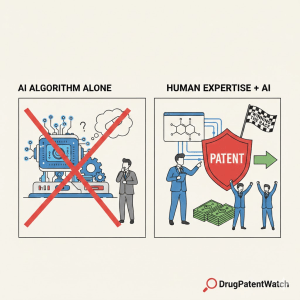
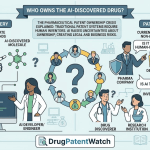
The pharmaceutical industry has a new problem it didn’t anticipate when it started pouring billions into artificial intelligence: the machines doing the most creative work can’t hold a patent. That gap between capability and legal ownership is not theoretical. It has already cost companies inventorship disputes, invalidated filings, and handed competitors an opening they didn’t earn.
Between 2015 and 2023, AI-assisted drug discovery investments exceeded $50 billion globally. The FDA approved its first drug developed with AI-assisted molecular design tools in 2023. Yet patent offices in the United States, the European Union, the United Kingdom, and Australia have each ruled, with remarkable consistency, that only human beings can be named as inventors on a patent. An algorithm, however sophisticated, cannot own intellectual property. A company that misunderstands this distinction risks building an entire pipeline on a foundation that a litigation opponent or regulatory reviewer can collapse in a single filing.
This article is a technical and strategic guide to that problem. It covers the legal terrain, the practical IP filing strategies that pharmaceutical executives and their counsel need to understand right now, and the competitive intelligence framework that separates companies building durable patent portfolios from those generating expensive paper.
The Legal Verdict Is Already In
Stephen Thaler Tried. He Lost. Twice.
The most important AI patent case of the last decade never got to examine the substance of any invention. It died on a threshold question: can a machine be an inventor?
Stephen Thaler is an AI researcher who built a system called DABUS — Device for the Autonomous Bootstrapping of Unified Sentience. DABUS generated two inventions: a food container with a fractal surface for better grip and a warning beacon with a pulsing light pattern. Thaler filed patents in multiple jurisdictions naming DABUS as the sole inventor. He argued, with philosophical consistency, that since he hadn’t conceived the inventions himself, he shouldn’t list himself as the inventor. Only the machine had done the creative work.
Every major patent jurisdiction disagreed. The United States Court of Appeals for the Federal Circuit ruled in Thaler v. Vidal (2022) that under 35 U.S.C. § 100(f), the word “inventor” refers to an “individual,” and that word means a natural person. The Supreme Court declined to hear the case in 2023. The UK Supreme Court reached the same conclusion in Thaler v. Comptroller-General of Patents (2023). The European Patent Office’s Board of Appeal rejected DABUS applications on equivalent grounds. South Africa briefly granted a DABUS patent — and was promptly criticized by IP scholars for doing so under procedural rather than substantive review.
The legal consensus is not ambiguous. No AI system can be named as an inventor. The question that actually matters for pharmaceutical companies is what follows from that constraint: who among your human team qualifies as an inventor when the machine did most of the heavy lifting?
What “Conception” Means When AI Does the Thinking
Patent law defines invention as conception plus reduction to practice. Conception is the critical legal standard. Courts have defined it as “the complete performance of the mental part of the inventive act” — the formation of a definite and permanent idea of the complete and operative invention.
When a computational chemist runs a generative AI model that proposes a novel molecular scaffold, screens it in silico, and outputs a lead compound, who conceived the invention? The answer determines who gets named on the patent, and a wrong answer can invalidate the entire filing.
The USPTO’s February 2024 guidance on AI-assisted inventions establishes the current operative standard. A human inventor must have made a “significant contribution” to the conception of each claim. Running a computer program, even one that produces novel output, is not itself inventive unless the human exercised judgment in designing the query, interpreting ambiguous results, or making a non-obvious selection from among the machine’s outputs.
The guidance draws from Pannu v. Iolab Corp. (1998), which requires that each named inventor contribute to at least one claim. It maps onto the older Burroughs Wellcome Co. v. Barr Laboratories (1994) standard that whoever conceives the idea has inventorship rights, regardless of who executes the reduction to practice.
For pharmaceutical teams using AI, this creates four categories of human activity that may support inventorship:
The person who formulates the AI query in a manner that reflects domain insight — not just “find a CDK4 inhibitor” but specifying structural constraints, selectivity requirements, or synthetic accessibility thresholds that shape what the model explores — may have contributed significantly to conception. The person who evaluates the model’s outputs and selects one compound over another based on scientific judgment exercises the kind of discretion that patent law recognizes. The person who designs the validation experiments that confirm whether the AI’s predictions correspond to actual biological activity contributes to reduction to practice, though that alone rarely establishes inventorship. And the person who modifies the AI’s output — changes a functional group, adds a linker, adjusts a stereocenter — based on their own scientific reasoning may be the clearest inventor in the traditional sense.
Teams that fail to document these contributions in real time will struggle to reconstruct them during prosecution or litigation.
Why This Is a Competitive Crisis, Not Just a Legal Technicality
The Patent Cliff Meets the AI Boom at the Worst Possible Moment
The pharmaceutical industry faces $200 billion in revenue at risk from patent expirations between 2025 and 2030. AbbVie’s Humira lost exclusivity in the US in 2023. Merck’s Keytruda faces biosimilar competition from 2028. Bristol Myers Squibb, Johnson & Johnson, and Pfizer all have blockbuster compounds approaching the end of their protection windows.
Against that backdrop, the industry has bet heavily on AI to compress the drug discovery timeline from an average of 12-15 years to something closer to 5-7. Companies including Recursion Pharmaceuticals, Exscientia, Insilico Medicine, and BenevolentAI have built business models predicated on AI-accelerated discovery. Large pharma has followed: Pfizer partnered with C4 Therapeutics on AI-assisted targeted protein degradation; Sanofi committed $1 billion to Atomwise; AstraZeneca built its own internal AI drug design platform.
The capital is deployed. The pipelines are advancing. The patent strategies, in many cases, have not kept up. <blockquote> “Over 30% of drug discovery programs that incorporate AI tools lack formal inventorship documentation protocols that would survive a USPTO examination for AI-assisted inventions under the 2024 guidance,” according to analysis published by the Intellectual Property Owners Association in their 2024 AI and Biopharmaceuticals Survey. </blockquote>
That documentation gap is not an abstract risk. A patent that is invalidated for improper inventorship cannot be corrected after litigation has begun if the correction would require adding a new inventor who wasn’t disclosed during prosecution. Courts have found inequitable conduct — an unforgivable sin in patent law that renders a patent permanently unenforceable — where inventors were deliberately omitted or misrepresented. And while there is a difference between a good-faith documentation failure and deliberate fraud, the evidentiary burden falls on the patentee to show the error was unintentional.
First-Mover Advantage Is Real but Fragile
In the AI drug race, first-mover advantage exists in two forms. The first is scientific: the company that discovers and patents a target-compound combination before competitors captures the market. The second is informational: the company that tracks its competitors’ patent filings understands the competitive landscape before products reach clinical trials. DrugPatentWatch tracks pharmaceutical patent portfolios across thousands of compounds, allowing companies to monitor competitor filings, identify gaps in coverage, and anticipate generic or biosimilar entry timelines.
The problem with first-mover advantage built on AI discovery is that the speed benefit is real but the IP protection benefit is only as durable as the underlying patent is sound. A rushed filing with inadequate inventorship documentation, or one that fails to disclose the role of AI tools in the discovery process, is faster to file than to defend.
A competitor facing a patent that blocks their own development program has every incentive to challenge inventorship. They will subpoena lab notebooks, email records, and model run logs. They will depose the named inventors and the AI system operators separately. If there is a gap between what the documentation shows and what the inventors claim to remember, that gap can destroy the patent’s priority.
The Inventorship Documentation Framework
Build the Contemporaneous Record Before You File
The single most important thing a pharmaceutical company can do to protect AI-assisted discoveries is maintain a contemporaneous record that separates human cognitive contributions from machine outputs. This is not a novel concept in patent law — laboratory notebooks have served this function for a century — but the specific requirements for AI-assisted work are not yet codified and must be constructed from the existing guidance.
The record should capture four elements for each inventor candidate. First, what specific question or constraint did the person contribute to the AI query design, and what domain expertise informed that contribution? Second, how did the person evaluate and filter the AI’s outputs, and what scientific criteria did they apply? Third, did the person modify any of the AI’s proposed structures, and if so, what reasoning drove those modifications? Fourth, did the person recognize an unexpected result or non-obvious connection in the AI’s output that would not have been apparent to a generalist?
Documentation should be dated, signed, and stored in a system with tamper-evident timestamps. Some companies are moving toward blockchain-based laboratory notebooks precisely because the immutability of the record strengthens the inventorship narrative in litigation.
A practical approach is to treat every AI model run as a two-column event: one column for machine outputs, clearly labeled as such, and one column for human observations, decisions, and modifications. The second column is where inventorship lives.
The “Significant Contribution” Test in Practice
The USPTO’s 2024 guidance does not define a bright line for what counts as a “significant contribution.” It offers examples rather than rules, which means the test will be refined through case law over the next decade. But several principles are clear enough to act on now.
Selecting one AI-generated compound from a list of ten because you recognize its structural similarity to a known pharmacophore likely qualifies as a significant contribution. Running a docking simulation and accepting its top-ranked result without exercising any independent judgment likely does not. The distinction is whether a human being applied specialized knowledge to make a non-obvious choice.
This creates a practical incentive structure that pharmaceutical R&D leaders should understand: the more you document the scientific reasoning behind selections and modifications, the stronger your inventorship position. That documentation requirement is not just legal protection — it is also a forcing function for better science. Teams that articulate why they made each design decision generate better institutional knowledge and more reproducible research.
Patent counsel working with pharmaceutical AI teams should be embedded in the discovery process, not brought in at the filing stage. By the time a compound reaches the filing stage, the documentary record that supports inventorship is either there or it isn’t. You cannot retroactively create contemporaneous evidence.
Joint Inventorship With AI Tool Vendors: A Trap to Avoid
Some AI drug discovery platforms offer co-development arrangements in which the tool vendor’s computational scientists contribute to the discovery process alongside the pharmaceutical company’s researchers. These arrangements create joint inventorship risks that are worth examining carefully before signing any collaboration agreement.
Under 35 U.S.C. § 116, all inventors on a jointly owned patent have co-equal rights to practice and license the invention unless there is an agreement to the contrary. A pharma company that names a computational biologist employed by an AI vendor as a co-inventor on a discovery-stage compound has potentially given that vendor, and through them any acquirer or licensee of the vendor, rights to the same compound.
Well-drafted collaboration agreements address this explicitly. They should specify that all inventions made using the vendor’s platform are solely owned by the pharma company, that vendor employees who contribute to the discovery process assign their inventorship rights to the pharma company as a condition of the collaboration, and that the vendor’s contribution is characterized as a service rather than a creative act that would support inventorship. Whether that characterization survives a legal challenge depends on the facts, but establishing it contractually shifts the burden significantly.
How AI Changes Patent Drafting, Not Just Discovery
Writing Claims That Cover What the Machine Found
A patent claim is only as good as the language that defines its boundaries. In traditional small-molecule drug discovery, a medicinal chemist proposes a compound class based on a known pharmacophore, synthesizes a lead, and iterates. The claim structure follows the chemistry: a Markush group covers the lead compound and its closest structural analogs, with narrower claims covering the specific compound.
AI-assisted discovery can produce compound classes that don’t fit neatly into traditional Markush groups. When a generative model explores a high-dimensional chemical space and identifies structurally diverse compounds that share a target-binding mechanism, the resulting claims need to capture that functional diversity without becoming so broad that they lack written description support.
The written description requirement under 35 U.S.C. § 112 requires that a patent application adequately describe the full scope of its claims. If a pharmaceutical company tries to claim a broad compound class based on a handful of AI-generated examples, it faces a rejection that it cannot cure without narrowing its claims — potentially to the point where competitors can design around them.
The solution is to use AI not just for compound generation but for claim scoping. If your generative model can explore a chemical space, it can also identify the boundaries of that space: which structural variations maintain target binding activity and which don’t. Using the model to map those boundaries before filing gives you the technical basis to draft broader, better-supported claims.
This approach requires close collaboration between computational chemists, medicinal chemists, and patent counsel at a stage that feels too early for most organizations — during lead optimization rather than at pre-IND filing. Companies that build this collaboration into their development process will consistently draft stronger patents than those that treat IP as a downstream activity.
Provisional Filing Strategy for AI-Driven Pipelines
The one-year priority window from a provisional filing has always been valuable in pharmaceutical patent strategy. For AI-driven discovery, it is even more important because the pace of AI-assisted discovery means competitors may be exploring similar chemical spaces simultaneously.
The standard practice of filing a provisional application quickly, then using the 12-month window to complete experimental work, requires modification when AI is involved. The provisional application must still provide adequate written description of what the invention is, but it also needs to document enough of the computational approach to establish that the human inventors conceived the invention — not just operated a computer that produced it.
A well-structured provisional for an AI-assisted pharmaceutical invention should include a description of the design parameters the inventors specified for the AI system, the selection criteria they applied to the model’s outputs, the structural and mechanistic insights that informed those criteria, and the experimental validation data available at the time of filing. The provisional does not need to be a complete patent application, but it needs to contain enough substance to support a priority claim that survives later challenge.
Some companies are filing multiple provisionals in rapid succession as their AI models produce successive generations of improved compounds. Each provisional captures the state of the invention at a specific point in the discovery timeline, creating a documentary record of inventive development that can be used both to establish priority and to demonstrate continued human involvement.
Reading the Competitive Patent Landscape
Why Patent Data Is Your Best Competitive Intelligence
A drug in clinical trials is years away from the market. A patent filing is public information 18 months after its priority date. The gap between those two timelines means that a company doing systematic patent surveillance can identify a competitor’s discovery-stage programs long before those programs generate clinical-stage press releases.
DrugPatentWatch aggregates patent data across the pharmaceutical sector, tracking compound-level patent coverage, expiry timelines, and filing activity by company and therapeutic area. For companies navigating AI-driven discovery, patent surveillance through tools like DrugPatentWatch offers three distinct advantages.
First, you can identify whether a competitor has already patented the compound class your AI is exploring. Generative models working from similar training data and similar target inputs can produce overlapping outputs. If Competitor A has filed a broad Markush group covering a kinase inhibitor scaffold that your model is also favoring, you need to know that before you invest in synthesis and biological validation.
Second, you can track the velocity of competitor filings. A company that files 20 patents in a therapeutic area over 18 months, after filing none in the preceding three years, has almost certainly deployed an AI discovery platform targeting that area. The filing velocity is a signal even when the individual patents don’t immediately reveal what’s in clinical development.
Third, patent citations tell you what prior art a competitor is relying on — and therefore which technical approaches they believe are defensible. If all of their AI-assisted compound patents cite a specific academic paper on a new binding pocket, you know the scientific premise of their program.
This kind of systematic surveillance is not optional for a company that wants to allocate R&D capital efficiently. The alternative is discovering that your lead compound is blocked by a competitor patent when you are 18 months into a program that has already cost $40 million.
Freedom-to-Operate Analysis in an AI-Accelerated World
Freedom-to-operate (FTO) analysis asks whether a specific product or process would infringe a valid, enforceable patent claim. In traditional drug discovery, FTO analysis happens at key development milestones: when a lead compound is selected, when a development candidate is nominated, and before IND filing.
AI-driven discovery compresses the timeline between those milestones and creates new ones. When your AI model is generating thousands of potential compounds per day, running a formal FTO analysis on each individual output is neither practical nor necessary. But running FTO analysis on compound classes — the structural features that your model keeps returning to — is both practical and essential.
The practical approach is to feed your AI model’s output distributions into a patent claim mapping exercise at the structural class level. If your model consistently favors 4-aminopyrimidine scaffolds with a specific substituent at the 2-position, that structural preference should trigger an FTO analysis of the patent landscape for that compound class before you prioritize any individual compound for synthesis.
This shift from compound-level FTO to class-level FTO requires computational chemistry capabilities at your patent counsel or access to a patent analytics platform that can do structural similarity searches against issued patents. The investment is modest relative to the cost of discovering an FTO problem at the pre-IND stage.
Some pharmaceutical companies are now integrating FTO data directly into their AI discovery workflows, building patent claim databases into the reward functions that guide generative models. A model trained to maximize target binding, synthetic accessibility, and patent freedom simultaneously will explore chemical space differently than one optimizing only for biological activity. The resulting compounds may be harder to synthesize but much easier to protect.
Case Studies: Who Is Winning and How
Insilico Medicine: Moving Fast With an IP Infrastructure to Match
Insilico Medicine’s INS018_055, a TNIK inhibitor for idiopathic pulmonary fibrosis, reached Phase II clinical trials in 2023 — a record timeline from AI-assisted design to human studies. The company has been explicit about its AI-driven discovery process, which uses its Pharma.AI platform for target identification, molecular generation, and synthetic route planning.
What Insilico has managed effectively is the parallel construction of an IP portfolio alongside the scientific work. The company filed composition-of-matter patents on INS018_055 and a family of related compounds before the molecule’s discovery became public. The patent applications name specific human researchers as inventors and, based on publicly available prosecution history, document the selection criteria and modification decisions that establish those researchers’ contributions to conception.
Insilico’s approach reflects a model worth adopting: treat patent filing as a scientific milestone, not a legal afterthought. When a compound advances from computational design to biological validation, the event that triggers synthesis synthesis also triggers a patent filing review. That parallel workflow requires investment in patent operations capacity — specifically, the ability to move from discovery to provisional filing in weeks rather than months.
The competitive advantage this creates is not just about protecting INS018_055. It is about establishing priority dates across a compound class before competitors who are exploring similar chemistry can file. A deep, well-timed patent family makes FTO challenges expensive for anyone trying to design around the core composition claims.
Recursion Pharmaceuticals: Volume, Breadth, and the Risk of Thin Claims
Recursion has taken a different approach. The company’s phenomics platform generates massive datasets by perturbing cells with compounds and imaging the results, then using machine learning to find compounds that produce desired phenotypic changes. The platform’s scale is extraordinary: Recursion has screened millions of compound-cell interactions and generated one of the largest proprietary biological datasets in the industry.
Its patent portfolio reflects that scale. Recursion files patents broadly, covering both the platform methodologies and specific compound-indication combinations identified by the platform. The breadth is a strength in terms of competitive moat, but it also creates vulnerability: broad claims require commensurately strong written description support, and a portfolio built at machine speed can contain thin claims that don’t survive post-grant review.
Recursion’s partnership with NVIDIA, announced in 2023, adds another layer of complexity. When two sophisticated organizations collaborate on AI-driven discovery, the question of which human employees at which company contributed significantly to any specific invention becomes genuinely difficult to answer. A compound identified by a model that runs on NVIDIA’s BioNeMo platform, using training data curated by Recursion’s biologists, with a discovery workflow designed by Recursion’s computational scientists, involves potential inventorship contributions from employees at both companies.
How that question gets answered in their collaboration agreement will determine whether Recursion’s patents covering discoveries made on that platform are clean or vulnerable to challenge. The public record does not yet reveal the details of their inventorship allocation arrangement.
BenevolentAI’s Baricitinib Pivot: Right Discovery, Wrong IP Architecture
BenevolentAI’s most publicly visible success is also a cautionary tale about IP architecture. The company’s AI platform identified baricitinib — a JAK inhibitor already approved for rheumatoid arthritis — as a potential treatment for COVID-19 in 2020. The scientific prediction was validated when the NIH ACTT-2 trial showed that baricitinib plus remdesivir reduced hospital stays. The FDA ultimately authorized baricitinib for COVID-19 treatment.
BenevolentAI correctly identified the compound’s utility. But baricitinib was already patented by Eli Lilly. BenevolentAI’s AI-driven insight into a new indication for an existing compound created no proprietary position for BenevolentAI itself — because they didn’t own the compound patent and because method-of-treatment claims covering a new indication for a known compound face a higher obviousness bar when the compound is already known to treat related indications.
This outcome illustrates a structural challenge for AI platforms that focus on compound repurposing rather than de novo discovery: identifying a new use for a patented compound generates scientific value but limited proprietary value unless you can establish a composition-of-matter position on a modified compound or a formulation that is both novel and non-obvious.
The lesson is not that repurposing is a bad strategy — it is that repurposing requires a different IP strategy than novel compound discovery. Method-of-treatment patents can be valuable, but they require careful analysis of the prior art landscape and clear articulation of what makes the identified indication non-obvious in light of existing knowledge about the compound.
The AI Disclosure Question: Tell the USPTO or Face the Consequences
The Duty of Candor and AI-Assisted Inventions
Patent applicants in the United States owe the USPTO a duty of candor and good faith under 37 C.F.R. § 1.56. This duty requires disclosing any information material to patentability. The question of whether using AI to generate or optimize an invention is material information that must be disclosed has been answered, in practice if not formally, by the USPTO’s 2024 guidance.
The guidance states that while it does not require applicants to disclose the use of AI tools as a matter of course, the existing duty of candor applies to AI-related inventorship questions. If an applicant knows that a human inventor’s contribution was limited to operating an AI system — and that the system, rather than the human, generated the creative content of the claimed invention — that information is material to whether inventorship is correctly stated.
In practical terms: if your discovery team knows that the claimed compound was generated entirely by a machine learning model without any significant human contribution to its design, and you name a team member as an inventor because they ran the model, you may be creating an inequitable conduct problem. The question is whether the named inventor’s activities meet the “significant contribution” threshold. Deliberately naming someone as an inventor who doesn’t meet that threshold, while knowing they don’t meet it, is the kind of conduct that results in unenforceability rather than merely correction.
The safe strategy is to conduct an inventorship analysis with patent counsel before filing, document the analysis, and name inventors based on a defensible conclusion about their contributions. That analysis should be retained in the file history. If the analysis was done in good faith and produced a defensible conclusion, a later challenge to inventorship is manageable. If there is no documented analysis at all, a challenger will argue that the named inventor was chosen for convenience rather than by any principled standard.
Will the USPTO Require AI Disclosure in the Future?
The USPTO issued an advance notice of proposed rulemaking in 2023 asking whether it should require applicants to disclose the use of AI in the invention process. The comment period generated over 11,000 responses. The agency has not yet issued a final rule, but the direction of policy is clear: some form of AI-use disclosure requirement is coming.
The EU’s AI Act, fully in force by 2026, includes requirements for transparency about AI-generated content in certain contexts. While patents are not directly covered, the broader regulatory trend toward AI disclosure will influence USPTO policy. Companies that establish internal disclosure protocols now will have an easier transition when formal requirements are enacted than those who wait for the rulemaking to force the issue.
A practical internal policy would require any patent filing involving AI-assisted discovery to include a signed declaration by the inventors attesting to their specific contributions and a short description of what AI tools were used and in what capacity. That documentation serves multiple purposes: it supports the inventorship analysis, creates a record for any future disclosure requirement, and forces the scientific team to articulate their own contributions clearly before filing.
Building a Patent Moat in a Crowded AI Landscape
Layered Patent Protection: Composition, Method, and Platform
The strongest pharmaceutical IP positions are layered. A composition-of-matter patent covers the compound itself. A method-of-treatment patent covers its use in a specific indication. A formulation patent covers a specific dosage form. A manufacturing process patent covers how the compound is made. Each layer adds a year or more of effective market exclusivity even after the foundational composition patent expires.
AI-driven drug discovery disrupts this layered model in one important way: it can identify uses for new compounds faster than the composition patent prosecution is completed. When a company files a composition-of-matter patent on an AI-generated compound and, in the same model run, identifies three potential indications for that compound, should all three indications be covered in the original filing or in separate method-of-treatment applications?
The answer depends on the prosecution strategy. Filing a broad composition-of-matter claim on the compound, supported by all three indications, establishes the widest possible protection but may create enablement challenges if the supporting data for each indication is thin. Filing continuation applications or continuation-in-part applications as data from each indication matures is cleaner but may allow competitors to file method-of-treatment patents on additional indications if they discover them first.
The optimal strategy for most pharmaceutical companies with AI discovery programs is a provisional-plus-continuation approach: file a broadly enabled provisional application covering the compound and its known indications, then file a non-provisional application as the priority indication data matures, with continuation applications tracking the additional indication data as it develops. That sequence locks in the priority date while allowing the claims to be refined as the scientific case strengthens.
Protecting the Platform Itself: Method and System Claims
The compound-level patent protection described above is the most commercially important layer, but the AI platform that generates those compounds is itself a valuable asset that can be protected through method and system patents.
A method patent covering a specific computational approach to drug discovery — for example, a method of identifying kinase inhibitor candidates by training a graph neural network on a specific combination of binding affinity data and cellular phenotypic data — is protectable if the method is novel and non-obvious. The challenge is that method patents on computational approaches tend to face two obstacles: they may be challenged as directed to an abstract idea under the Alice/Mayo framework if they are too high-level, and they may have limited defensive value because competitors can often achieve the same results with a differently structured method.
System patents covering specific architectures — the combination of a specific type of generative model with a specific type of validation assay and a specific type of output filtering algorithm — are somewhat stronger but also require more specific technical description. The more specific the system claim, the harder it is to enforce against a competitor who makes minor variations.
Despite these limitations, platform patents have real value as part of a broader IP strategy. They create licensing opportunities, raise the cost of imitation for competitors with less sophisticated platforms, and can be used defensively in cross-licensing negotiations. Companies like Recursion, Exscientia, and Insilico have all built platform patent portfolios alongside their compound-level portfolios, recognizing that the platform is the durable asset even as specific compounds succeed or fail in development.
Defensive Publications: When You Don’t Want to Patent
Not every AI-generated discovery should be patented. The patent system requires public disclosure in exchange for exclusivity, and that trade-off is not always favorable. If your AI generates a compound class that you have decided not to develop but that a competitor might develop, you face a choice: patent it defensively to block the competitor, or publish it to create prior art that prevents anyone from patenting it.
Defensive publications — technical disclosures that establish prior art without filing a patent — are an underused tool in pharmaceutical IP strategy. The IP.com Prior Art Database and similar platforms accept technical disclosures that are immediately citable as prior art in patent prosecutions worldwide. A defensive publication costs a fraction of a patent filing and achieves the goal of blocking competitor patents on a specific compound or method class.
For AI-driven discovery programs that generate far more compound candidates than any company can develop, the question of what to do with the remainder is strategically significant. A systematic program of defensive publications for deprioritized compounds can degrade a competitor’s ability to patent their own AI-assisted discoveries in the same chemical space. This is an aggressive but legitimate competitive strategy that several large pharmaceutical companies have adopted informally and that deserves more systematic attention.
Regulatory Complications: When AI Meets FDA and EMA
Does Your Regulator Need to Know About AI in Discovery?
The FDA’s position on AI in drug development has evolved rapidly. For AI tools used in drug discovery and early development, the FDA’s current stance is that disclosure of AI methods is required in the context of the data submitted to support an IND or NDA — not because AI raises specific safety concerns at the discovery stage, but because the agency needs to understand the methods used to generate supporting data.
In practice, this means that if you use an AI model to predict ADMET (absorption, distribution, metabolism, excretion, toxicity) properties and rely on those predictions in your IND submission, you should describe the model, its validation, and its limitations in the pharmacology/toxicology section. If you use AI to design a synthetic route and that route is reflected in your manufacturing data, the AI’s role in route design may be relevant to the chemistry, manufacturing, and controls section.
The FDA’s guidance on “Computer Software as a Medical Device” (SaMD) and its Software Precertification pilot program are focused on diagnostic and therapeutic software, not on drug discovery tools. But the underlying principle — that the FDA expects to understand the methods used to generate regulatory submissions — extends to the discovery context.
The EMA has been somewhat ahead of the FDA on AI transparency requirements, partly because the EU’s broader AI regulatory framework creates a context in which AI use in pharmaceutical development is scrutinized at multiple points. The EMA’s Reflection Paper on the Use of Artificial Intelligence in the Medicinal Product Lifecycle, published in 2023, establishes that AI use should be documented and that AI-generated data should be characterized for quality and reliability.
This regulatory landscape does not yet create specific requirements that conflict with the patent strategies described above. But as AI becomes more deeply embedded in every stage of pharmaceutical development — not just discovery but clinical trial design, patient selection, and regulatory submission preparation — the documentation requirements will compound. A company with good documentation habits built around the patent strategy described in this article will find those habits translate well to the regulatory compliance context.
Safety Signals and AI-Assisted Discovery: Who Is Responsible?
One question that both regulators and courts will eventually have to answer in detail is the liability question: when an AI-assisted drug discovery process misses a safety signal, or identifies a compound that passes computational screens but fails in the clinic for reasons the AI didn’t predict, who bears responsibility?
This question is not primarily an IP question, but it intersects with IP strategy in one important way: the same documentation that supports inventorship also supports or undermines a defense based on scientific rigor. A company that documented its AI methodology, its validation approach, and its scientific reasoning for each major decision will be in a better position to defend against a safety-related liability claim than one that cannot reconstruct its discovery process from available records.
The practical implication is that the documentation framework built for patent purposes should be designed to serve multiple downstream needs: inventorship analysis, patent prosecution, regulatory disclosure, and potential litigation defense. These needs are aligned rather than competing, which means that investing in the documentation infrastructure for any one of them produces value across all of them.
International Patent Strategy for AI-Driven Pharmaceutical Companies
The PCT System in a World of AI-Generated Claims
The Patent Cooperation Treaty system allows a single international application to establish a priority date in over 150 countries, with national phase entries typically required at 30 months from the priority date. For pharmaceutical companies with global commercial ambitions, PCT filings are standard practice.
AI-assisted discoveries create some specific considerations for PCT strategy. The international search report (ISR) prepared by the international searching authority will identify prior art, and a well-conducted prior art search is your first real test of whether the AI-generated invention is novel and non-obvious in light of the global patent database. AI models trained on public chemical and biological literature may have generated structures that were previously disclosed as intermediates, failed candidates, or research compounds without ever being patented — structures that would nonetheless be prior art for novelty purposes.
Running your own comprehensive prior art search before PCT filing, using both patent databases and scientific literature, is particularly important for AI-assisted pharmaceutical inventions because the model’s training data may include exactly the prior art that will be cited against your claims. The model doesn’t distinguish between “known compound worth developing” and “unknown compound with potential” — it optimizes for the parameters you specify, not for patent novelty. A prior art search that identifies compounds similar to your AI-generated candidate before filing allows you to either differentiate the claims clearly or redirect the discovery program.
China’s Specific AI Patent Rules
China’s National Intellectual Property Administration (CNIPA) has taken a distinct approach to AI-generated inventions that pharmaceutical companies targeting the Chinese market must understand. In 2023, China updated its examination guidelines to permit AI as a tool in the inventive process while maintaining the requirement that a natural person make the inventive contribution.
China’s approach is functionally similar to the USPTO’s current position, but the evidence standards are different. Chinese patent prosecution is more examiner-directed, with less of the adversarial character of US prosecution. An examiner who questions whether the named inventor made a significant contribution will typically ask for additional evidence of the inventor’s role rather than immediately issuing a rejection. That procedural difference means that the same documentation you build for US prosecution purposes needs to be organized to respond to a Chinese examiner’s requests rather than to anticipate a formal rejection.
China’s pharmaceutical patent linkage system, introduced in 2021, created a framework for listing patents that protect approved drugs in a manner analogous to the US Orange Book. For AI-generated compounds that reach the market in China, the quality of the patent filing and its inventorship documentation will affect whether the compound is protectable through the linkage system and whether generic manufacturers face legal challenges to their applications.
India’s patent system deserves mention here because India’s Section 3(d) of the Patents Act provides a uniquely stringent standard for pharmaceutical compounds — requiring that a new form of a known compound demonstrate enhanced efficacy to qualify for patent protection. AI-generated compounds that are novel salts, polymorphs, or enantiomers of known compounds face this Section 3(d) hurdle and require additional clinical data to support patentability. Pharmaceutical companies with AI programs generating derivative compounds from known scaffolds should include India-specific patentability analysis in their early IP review.
The Talent and Organizational Question
Who Builds the AI Drug IP Team?
The IP strategy described in this article requires talent that currently doesn’t exist in abundance at any single organization. You need people who understand generative AI models — their architecture, their training data, their output characteristics — and who can apply patent law concepts like “significant contribution to conception” to the specific workflows those models create. That combination of skills is genuinely rare.
Most pharmaceutical patent departments have lawyers with deep pharma IP experience and limited computational sophistication. Most AI drug discovery teams have computational scientists with limited patent law training. The people who span both domains are being aggressively recruited by large pharma, biotech, and IP firms simultaneously.
The organizational response to that talent scarcity can take several forms. Some companies are building hybrid roles: computational chemists with patent agent registrations who sit in the IP department but have deep relationships with the discovery team. Others are using external patent counsel firms that have specifically invested in AI pharmaceutical capabilities — a subset of the larger IP market that is growing rapidly in response to the demand.
A third approach is to build cross-functional protocols that reduce dependence on individual experts. If the documentation framework, the inventorship analysis checklist, and the patent review triggers are built into the standard operating procedures of the discovery team, you reduce the risk that a key person’s departure leaves your IP strategy undocumented.
Training Scientists to Think About IP
One underinvested area in pharmaceutical AI programs is IP education for discovery scientists. A computational biologist who understands why documenting their selection criteria matters, and who knows that a “significant contribution” is what separates their name on a patent from a colleague’s name on the same patent, will document their work more carefully than one who sees patent filings as the legal team’s problem.
Simple training — a half-day program on inventorship standards, the duty of candor, and what to write in a lab notebook when the AI produces an interesting result — produces tangible returns. It is much cheaper to run that training annually than to reconstruct the inventorship record of a compound in litigation.
The training should include concrete examples tailored to the specific AI tools your organization uses. If your team uses a generative chemistry model, walk them through a specific example: here is what the model generated, here is what the scientist did next, here is why that action did or did not constitute a significant contribution to conception. Concrete examples from your own workflows are more effective than abstract legal principles.
The Next Wave: Autonomous AI Systems and the Patent Problem They Create
When AI Proposes, Designs, and Validates Without Human Decision Points
Current AI drug discovery platforms require human judgment at multiple points in the discovery workflow. A computational chemist designs the query, evaluates the outputs, selects candidates for synthesis, and interprets the validation data. Human decision points are built into the workflow partly by technical necessity — the computational models produce candidates that still require wet-lab validation — and partly by organizational design.
The next generation of autonomous AI systems will reduce those human decision points. Fully automated synthesis robots can physically make compounds that AI models generate. AI-driven assay systems can test those compounds against targets without human intervention. A fully automated discovery-to-validation pipeline could, in principle, identify, synthesize, and validate a drug candidate without requiring any human to review the intermediate outputs.
Under current patent law, that pipeline produces no patentable invention. If no human exercised significant judgment at any step in the process, there is no human inventor, and therefore no patent.
This is not a hypothetical future problem. It is an imminent one. Several companies are developing highly automated discovery platforms that will push the boundaries of human involvement. The legal and strategic challenge is to design those platforms in ways that preserve meaningful human decision points — not to game the patent system, but because meaningful human oversight also produces better science.
The design principle is: build your AI workflows so that a human scientist makes at least one significant scientific decision at each stage where the workflow produces a result that might be claimed. That decision should be documented. It does not need to be the only decision in the workflow, but it needs to be a real one — not a rubber stamp on the machine’s output, but a judgment call informed by expertise.
Policy Is Moving, But Not Fast Enough for Your Next Filing
The World Intellectual Property Organization (WIPO) has been developing policy positions on AI and intellectual property since 2019. Its AI and IP Policy Task Force has produced multiple reports and a draft framework for member states. The direction of the framework is to maintain human inventorship requirements while adapting disclosure and documentation standards for AI-assisted inventions.
No jurisdiction has yet moved to permit AI inventorship, and the likelihood of any major jurisdiction doing so in the next decade is low. The philosophical objection is powerful: the patent system creates property rights in exchange for disclosure, and the purpose of those rights is to incentivize human innovation. Extending those rights to machine outputs does not align with that purpose.
But policy on AI disclosure requirements, platform method patent eligibility, and cross-border enforcement of AI-related patent disputes will evolve significantly over the next five years. Companies that monitor this policy evolution and build flexible IP strategies — ones that don’t depend on regulatory stability in any specific jurisdiction — will outperform those that assume the current US framework applies everywhere.
Valuing AI-Assisted Patents in Licensing and M&A
Due Diligence Has a New Dimension
When a large pharmaceutical company acquires a biotech with an AI-assisted pipeline, the standard IP due diligence process needs a new component. The traditional process examines claim scope, prosecution history, freedom to operate, and litigation history. For AI-assisted portfolios, it must also examine inventorship quality: was there a documented inventorship analysis for each patent, do the named inventors meet the significant contribution standard, and has anyone identified a risk that a specific patent’s inventorship could be challenged successfully?
An AI-assisted patent portfolio that appears broad and valuable on its face may contain specific vulnerabilities that a sophisticated acquirer’s due diligence process should identify before closing. The presence of those vulnerabilities doesn’t necessarily kill a deal — it informs the price, the representations and warranties, the indemnification provisions, and the integration plan for the target’s IP processes.
The acquirer’s IP team, or the external counsel conducting due diligence, should ask the target company for its inventorship analysis documentation for its most commercially significant patents. If no such documentation exists, that is itself information: the target has a portfolio built without rigorous inventorship analysis, which means the portfolio carries undocumented inventorship risk. Adjusting the deal valuation for that risk is appropriate, as is requiring the target to conduct and document a retrospective inventorship review as a closing condition.
Licensing AI-Assisted Drug Patents: Structuring Royalties and Milestones
Patent licensing in pharmaceutical deals typically combines upfront payments, milestone payments tied to clinical and regulatory events, and royalties on net sales. The AI-assisted drug discovery context creates two specific licensing considerations that standard licensing structures may not address adequately.
First, if the licensed patent’s validity rests on an inventorship analysis that has not been thoroughly documented, a licensee who later discovers that vulnerability has an incentive to challenge the patent’s inventorship rather than pay royalties. Licensing agreements for AI-assisted patents should include representations about the adequacy of the inventorship documentation, covenants to maintain and provide access to that documentation, and provisions addressing what happens if the patent is challenged on inventorship grounds.
Second, many AI-assisted discovery programs are built on platforms that are themselves licensed from tool vendors. The license terms governing the tool vendor relationship may affect the licensing terms available for downstream compounds. If the tool vendor’s license restricts sublicensing of discoveries made on its platform, that restriction could affect the licensor’s ability to grant a pharmaceutical partner a sublicense to commercialize a compound.
Careful review of the tool vendor license, at the time of the tool vendor engagement rather than at the time of the downstream licensing deal, prevents this problem from arising at the worst possible moment.
Building the AI Drug IP Playbook: Practical Steps
A 12-Month Implementation Plan for Pharmaceutical IP Teams
The IP strategy described in this article is not a one-time project. It is a set of processes that need to be built, institutionalized, and maintained over time. A 12-month implementation plan for a pharmaceutical company launching or scaling an AI drug discovery program might look like this.
In the first quarter, conduct an audit of existing AI-assisted patent filings to identify any that lack adequate inventorship documentation. For each patent where documentation is thin, commission a retrospective inventorship analysis and document it now. The analysis won’t create contemporaneous evidence, but it will demonstrate that the company took the question seriously. Work with patent counsel to draft a model inventorship declaration for AI-assisted inventions that reflects the USPTO’s 2024 guidance.
In the second quarter, build the documentation infrastructure. This means implementing a digital laboratory notebook system with timestamp verification, creating a template for AI model run documentation that separates machine outputs from human decisions, and establishing a protocol for converting that documentation into inventor contribution statements at the time of filing. Train the discovery team on these tools and on the concepts underlying the inventorship standard.
In the third quarter, integrate patent strategy into the discovery workflow. Establish a formal IP review trigger at the compound selection stage of each discovery program, at which point patent counsel reviews the inventorship documentation and the prior art landscape before any further investment is made in the selected compound. Implement a competitive intelligence program using patent surveillance tools to monitor competitor filings in your target therapeutic areas.
In the fourth quarter, review and refine the processes based on experience. Identify the friction points — where scientists are finding the documentation requirements burdensome, where patent counsel is struggling to understand the computational methods — and address them through training, process revision, or organizational change. Benchmark your inventorship documentation quality against the standard that a sophisticated challenger would apply in litigation.
Patent Quality Over Patent Quantity
The metric that matters in pharmaceutical IP is not the number of patents in your portfolio. It is the commercial value protected by those patents. A portfolio of 500 patents with thin inventorship documentation, broad unsupported claims, and inadequate FTO analysis is worth less than a portfolio of 100 patents with thorough documentation, carefully drafted claims, and clean prior art landscapes.
AI drug discovery creates the temptation to optimize for volume. The machine generates candidates faster than any legal or documentation process can keep up, and the impulse is to file broadly and quickly. That impulse should be resisted. A patent that cannot survive a serious IPR challenge or inequitable conduct defense at the litigation stage provides no protection at the commercial stage.
The pharmaceutical companies that will build durable competitive positions through AI drug discovery are those that treat patent quality as a non-negotiable constraint on the discovery process — not a downstream compliance task. That means investing in the human talent, the documentation infrastructure, and the organizational processes that make quality IP possible. It means accepting that some candidates the AI generates will not be pursued to patenting because the inventorship analysis doesn’t support a clean filing. And it means treating the legal and strategic rigor of the IP function as a core competency, not an overhead cost.
The Future of AI-Assisted Pharmaceutical IP
Generative AI Meets Patent Prosecution
The irony of the moment is this: the same AI tools creating the inventorship problem are also being used to address it. Large language models are being deployed by patent counsel to draft patent applications, analyze prior art, generate responses to office actions, and even predict whether specific claims will survive examination or inter partes review.
These AI-assisted prosecution tools are valuable, but they create their own version of the same problem: if an AI drafts the patent claims, who conceived them? A patent attorney who uses an LLM to generate claim language, reviews it for technical accuracy, and files it has clearly contributed more to the prosecution process than someone who simply ran a drug discovery model. But the line between legitimate use of AI as a drafting tool and an AI that is doing the substantive creative work of defining the invention is not always obvious.
The professional responsibility rules governing patent practitioners do not yet specifically address AI-assisted prosecution. The USPTO has indicated that practitioners are responsible for the accuracy and completeness of submissions regardless of how they were generated. That responsibility standard, combined with the duty of candor, means that a practitioner who submits AI-generated claims without reviewing them for accuracy, completeness, and proper claim scope is taking on significant professional risk.
For pharmaceutical companies, the implication is that AI-assisted prosecution tools are valuable accelerators but require meaningful human oversight by practitioners who understand both the technology and the law. The same principle that governs inventorship in the discovery context governs professional responsibility in the prosecution context: the human in the loop must be making real decisions, not just authorizing whatever the machine proposes.
Blockchain, NFTs, and Smart Contracts for Pharmaceutical IP
The intersection of blockchain technology and pharmaceutical IP has generated considerable hype and limited practical adoption. Smart contracts on a blockchain could theoretically automate licensing transactions, distribute royalties based on usage data, and record IP ownership transfers without requiring intermediaries. NFTs have been proposed as a mechanism for representing and trading pharmaceutical patent rights.
The practical obstacles are substantial. Patent rights are creatures of statute and court decisions — they exist because a government has granted them, and their enforceability depends on access to government courts. A smart contract cannot enforce a patent; only a court can do that. An NFT representing a pharmaceutical patent is an interesting experiment in asset tokenization, but it doesn’t change the underlying legal reality that the patent’s value depends entirely on its validity and enforceability under national law.
Where blockchain has genuine value in pharmaceutical IP is as a timestamping and documentation infrastructure. A laboratory notebook system that writes cryptographic hashes of experimental records to a blockchain creates a tamper-evident record that is much harder to challenge than a server-stored file with a modifiable timestamp. For the inventorship documentation challenge described in this article, blockchain-based timestamping is a practical tool with clear value.
Smart contracts have genuine applicability to pharmaceutical licensing if the parties are willing to structure milestone payments as triggered by on-chain data feeds — clinical trial registry data, FDA approval databases, or sales figures from agreed data providers. Several biotech companies have explored this structure, and it is more practically feasible than blockchain-based patent ownership, though it still requires careful legal review of the applicable jurisdiction’s contract law.
Competitive Intelligence as a Continuous Practice
Building the Information Advantage Into Your Strategy
Patent surveillance is not a one-time exercise. The competitive patent landscape in any active therapeutic area changes weekly. New filings, continuations, publication of previously secret provisionals, IPR petitions, and litigation filings all alter the landscape in ways that affect your freedom to operate and your competitive positioning.
A systematic patent surveillance program should include monthly monitoring of competitor filings in your target therapeutic areas, using tools like DrugPatentWatch to track not just individual patents but portfolio-level trends. It should include quarterly analysis of filing velocity and claim scope evolution — are competitors filing more patents in an area, or fewer? Are their claims narrowing, suggesting prosecution difficulties, or broadening, suggesting successful prosecution? It should include annual comprehensive FTO analyses for compounds approaching IND filing, updated at each development milestone.
The intelligence produced by this surveillance program feeds directly into R&D resource allocation. If your patent surveillance shows that a competitor has filed seven closely spaced patents covering a specific kinase target from multiple structural angles, your AI model’s exploration of that target needs to be informed by that IP landscape. The model should be optimizing not just for binding affinity and selectivity but for the white space in the patent landscape — the structural territory that remains open and patentable.
This integration of competitive intelligence into the AI discovery workflow is where the most sophisticated pharmaceutical companies are building competitive advantage. It requires a close working relationship between the patent surveillance function and the AI discovery function, which in most organizations sit in different departments and operate on different timescales. Breaking that organizational barrier is a management challenge as much as a technical one.
Reading Competitor Patent Strategies From the Filing Pattern
The timing, scope, and citation patterns of competitor patent filings tell you more about their pipeline than they may realize. A company that files a composition-of-matter patent on a specific compound, followed six months later by method-of-treatment patents covering three indications, followed two months later by a formulation patent, is almost certainly advancing that compound through preclinical development toward an IND. The filing pattern telegraphs the commercial program.
A company that files many patents with broad Markush groups but few with specific compound examples is likely still in early discovery, using broad filings to stake out territory rather than to protect specific development candidates. Their program may be years from any clinical milestone.
A company that files an IPR petition against your patent is, by definition, willing to spend the resources to challenge your IP. The IPR petition itself is a data point: the competitor believes your patent is vulnerable, and they have identified specific prior art that they think will support that challenge. Monitoring IPR filings against your patents — and against your competitors’ patents, which tells you about their vulnerabilities — is an essential part of active IP defense.
Key Takeaways
The legal position is settled: no AI system can be an inventor on a patent in any major jurisdiction, and that position will not change in the near term. The inventorship question that follows from that — which human beings made significant contributions to conception — requires a real-time documentation infrastructure that most pharmaceutical AI teams do not yet have.
The USPTO’s 2024 guidance on AI-assisted inventions establishes a “significant contribution to conception” standard that requires pharmaceutical companies to document not just what their AI models produced but what their human scientists decided and why. That documentation is the foundation of any patentable AI-assisted invention.
Patent quality matters more than patent volume in this environment. An AI-driven discovery program that files many quickly-drafted patents with thin inventorship documentation is building a portfolio that competitors can challenge. An AI-driven program that files fewer patents with thorough documentation and carefully crafted claims is building a durable competitive moat.
Competitive patent intelligence, enabled by tools like DrugPatentWatch, is the mechanism by which pharmaceutical companies can integrate IP strategy into their AI discovery workflows rather than treating it as a downstream legal task. Knowing the competitor patent landscape before your AI model starts exploring a chemical space produces better science and better IP simultaneously.
The talent infrastructure required for this strategy — people who understand both generative AI methods and pharmaceutical patent law — is scarce and expensive, but it is the investment that separates companies building real competitive advantage from those generating expensive paper.
Regulatory disclosure requirements for AI-assisted pharmaceutical inventions are evolving. Companies that build disclosure protocols now, aligned with the USPTO’s 2024 guidance and the EMA’s 2023 Reflection Paper, will find regulatory compliance easier than those who wait for formal requirements to force the issue.
The autonomous AI discovery pipeline — one that generates, synthesizes, and validates drug candidates without meaningful human decision points — is approaching technical feasibility. That pipeline will be legally incapable of producing patentable inventions under current law unless it is designed with human judgment built into its decision architecture. That design constraint, properly understood, is not an obstacle to innovation. It is a forcing function for better-documented, more accountable, and more defensible science.
FAQ
Q: If an AI system generates a drug compound that later becomes a blockbuster, and the patent on that compound is later found to have defective inventorship, can the patent be saved?
A: It depends on the nature of the defect and when it is discovered. Under 35 U.S.C. § 256, a patent can be corrected to add or remove inventors if the error was made “without deceptive intent.” A court can order correction at any time. But if a competitor raises the inventorship issue in litigation and can show that the named inventor’s contribution was negligible — or that a human with a genuine contribution was deliberately omitted — the court will scrutinize whether the error was truly unintentional. If the evidence supports a finding of deceptive intent, the patent becomes unenforceable through the inequitable conduct doctrine, and no correction is possible. The practical lesson is that defects discovered before litigation can often be corrected; defects discovered during litigation are much more dangerous.
Q: Can you patent an AI algorithm trained specifically for drug discovery, separate from any specific compound the algorithm produces?
A: Method and system patents on AI drug discovery algorithms are possible but face specific hurdles. Under the Alice/Mayo framework, a claim directed to a mathematical concept or an abstract idea — even one implemented on a computer — is not patentable subject matter. AI drug discovery algorithms that are claimed at a high level of abstraction, without specific technical structure, will likely fail this test. Claims that are tied to specific technical implementations — a particular architecture, a specific type of training data combined with a specific filtering method, or a specific physical assay system integrated with the computational method — have a better chance of surviving examination. The practical advice is to work with patent counsel who have specific experience with software-implemented invention claims under the Alice/Mayo framework, and to draft claims that are as technically specific as possible while covering enough of the inventive concept to be commercially meaningful.
Q: Do academic institutions that collaborate with pharmaceutical companies on AI drug discovery retain any IP rights to the resulting compounds?
A: Academic collaborations typically involve a sponsored research agreement (SRA) that allocates IP rights between the institution and the sponsor. Under the Bayh-Dole Act, academic institutions that receive federal funding retain rights to inventions made under that funding, with an obligation to file patents and commercialize them. A pharmaceutical company sponsoring research at a university must understand whether the university research is funded by federal grants, because if it is, Bayh-Dole governs some of the IP even if the SRA says otherwise. Beyond federal funding, the SRA itself should clearly specify who owns inventions made jointly by university and company personnel, what happens if the company declines to develop a university invention, and whether the university has the right to publish research that describes an invention before the company has had an opportunity to file a patent. Poorly drafted SRAs are a frequent source of IP disputes in academic-pharma collaborations, and the AI drug discovery context adds complexity because the question of which human being “conceived” the invention is often ambiguous when the work spans multiple institutions.
Q: How does the obviousness standard apply to AI-generated pharmaceutical compounds? Does the fact that an AI found the compound suggest it was obvious?
A: This is one of the most actively litigated and debated questions in AI patent law, and the answer is still evolving. The USPTO’s 2024 guidance acknowledged the concern that AI-generated compounds might be deemed obvious because a skilled person could have used an AI tool to find them. The guidance rejects the proposition that the availability of an AI tool makes every output of that tool obvious per se. Obviousness requires showing that a person of ordinary skill would have had a reason to combine specific prior art references with a reasonable expectation of success. The existence of AI tools generally does not supply that reason or that expectation for a specific compound. However, if the prior art landscape includes specific compounds that are close structural analogs of the AI-generated compound, and the AI model was trained on data that includes those analogs, a challenger could argue that the model’s output was the predictable result of applying a known technique to known compounds. Courts will need to work through these arguments on a case-by-case basis over the next decade.
Q: What is the best way to handle a situation where an AI model generates a compound that is identical or nearly identical to a compound previously disclosed in academic literature but never patented?
A: This situation arises regularly and represents a significant risk for AI drug discovery programs. If the AI generates a compound that was previously disclosed in academic literature — even as a synthetic intermediate, a research tool, or a failed candidate — that compound is prior art, and a patent claiming it will fail the novelty requirement. “Nearly identical” compounds face an obviousness analysis: if a skilled person would have been motivated to modify the literature compound to produce the AI-generated compound with a reasonable expectation of similar activity, the AI-generated compound is obvious. The practical solution is to conduct a comprehensive prior art search — covering both patent databases and scientific literature — before investing in synthesis and biological validation of any AI-generated lead. Tools that perform structural similarity searches against PubChem, ChEMBL, and the published patent literature can identify prior art compounds quickly and inexpensively. The search is worth running early, when redirecting the discovery program costs days, rather than late, when it costs months and millions of dollars.
The article draws on case law, statutory authority, regulatory guidance, and industry sources. Below are APA 7th edition references for each, organized by category.
Pannu v. Iolab Corp., 155 F.3d 1344 (Fed. Cir. 1998).
Thaler v. Comptroller-General of Patents, Designs and Trade Marks, [2023] UKSC 49 (U.K. Supreme Court 2023).
Thaler v. Vidal, 43 F.4th 1207 (Fed. Cir. 2022), cert. denied, 143 S. Ct. 1783 (2023).
Statutes
Leahy-Smith America Invents Act, Pub. L. No. 112-29, 125 Stat. 284 (2011) (codified as amended at 35 U.S.C. §§ 100, 112, 116, 256).
Patent Act, 35 U.S.C. § 100(f) (2012).
Patent Act, 35 U.S.C. § 112 (2012).
Patent Act, 35 U.S.C. § 116 (2012).
Patent Act, 35 U.S.C. § 256 (2012).
Patents Act 1970, § 3(d) (India), as amended by the Patents (Amendment) Act, 2005.
Stevenson-Wydler Technology Innovation Act of 1980 as amended by Bayh-Dole Act, 35 U.S.C. §§ 200–212 (2012).
Regulations
Duty of Disclosure, Candor, and Good Faith, 37 C.F.R. § 1.56 (2023).
U.S. Government Agency Guidance and Rulemaking
United States Patent and Trademark Office. (2023). Request for comments on artificial intelligence and inventorship [Advance notice of proposed rulemaking]. Federal Register, 88(23), 9492–9497.
United States Patent and Trademark Office. (2024, February 13). Inventorship guidance for AI-assisted inventions. Federal Register, 89(31), 10043–10049. https://www.federalregister.gov/documents/2024/02/13/2024-02623/inventorship-guidance-for-ai-assisted-inventions
United States Food and Drug Administration. (2021). Artificial intelligence/machine learning (AI/ML)-based software as a medical device (SaMD) action plan. U.S. Department of Health and Human Services. https://www.fda.gov/media/145022/download
International Regulatory Guidance
China National Intellectual Property Administration. (2023). Guidelines for patent examination (Rev. ed.). CNIPA.
European Medicines Agency. (2023). Reflection paper on the use of artificial intelligence (AI) in the medicinal product lifecycle (EMA/152655/2023). EMA. https://www.ema.europa.eu/en/documents/scientific-guideline/reflection-paper-use-artificial-intelligence-ai-medicinal-product-lifecycle_en.pdf
European Patent Office, Board of Appeal. (2020). Decision of the Board of Appeal: Cases J 0008/20 and J 0009/20 (DABUS applications). EPO.
European Parliament & Council of the European Union. (2024). Regulation (EU) 2024/1689 of the European Parliament and of the Council of 13 June 2024 laying down harmonised rules on artificial intelligence (Artificial Intelligence Act). Official Journal of the European Union, L, 2024/1689. https://eur-lex.europa.eu/legal-content/EN/TXT/?uri=CELEX:32024R1689
World Intellectual Property Organization. (2023). Revised issues paper on intellectual property and artificial intelligence (WIPO/IP/AI/2/GE/20/1 REV). WIPO. https://www.wipo.int/edocs/mdocs/mdocs/en/wipo_ip_ai_2_ge_20/wipo_ip_ai_2_ge_20_1_rev.pdf
International Treaties and Agreements
Patent Cooperation Treaty, opened for signature June 19, 1970, 28 U.S.T. 7645, 1160 U.N.T.S. 231 (entered into force January 24, 1978).
Industry Reports and Survey Data
Intellectual Property Owners Association. (2024). AI and biopharmaceuticals survey: Inventorship documentation practices. IPO.
Clinical Trial Data
Kalil, A. C., Patterson, T. F., Mehta, A. K., Tomashek, K. M., Wolfe, C. R., Ghazaryan, V., Marconi, V. C., Ruiz-Palacios, G. M., Hsieh, L., Kline, S., Tapson, V., Iovine, N. M., Jain, M. K., Sweeney, D. A., El Sahly, H. M., Branche, A. R., Regalado, J. J., Swaminathan, S., Bhimraj, A., … Beigel, J. H. (2021). Baricitinib plus remdesivir for hospitalized adults with COVID-19. New England Journal of Medicine, 384(9), 795–807. https://doi.org/10.1056/NEJMoa2031994
Patent Databases and Competitive Intelligence Platforms
DrugPatentWatch. (n.d.). Pharmaceutical patent and exclusivity data. DrugPatentWatch. https://www.drugpatentwatch.com
IP.com. (n.d.). Prior art database. IP.com. https://www.ip.com
Company and Pipeline Sources
Insilico Medicine. (2023). INS018_055 (TNIK inhibitor for idiopathic pulmonary fibrosis): Phase II clinical trial initiation [Press release]. https://insilico.com
Recursion Pharmaceuticals. (2023). Recursion and NVIDIA announce strategic partnership to accelerate AI-powered drug discovery [Press release]. https://ir.recursion.com
Case Law Applying Alice/Mayo Framework
Alice Corp. v. CLS Bank International, 573 U.S. 208 (2014).
Association for Molecular Pathology v. Myriad Genetics, Inc., 569 U.S. 576 (2013).
Mayo Collaborative Services v. Prometheus Laboratories, Inc., 566 U.S. 66 (2012).
Note: Where URLs lead to institutional repositories or official government registers, readers should verify current availability. Regulatory guidance documents are periodically revised; confirm version dates before citing in legal or regulatory submissions.