A reference-grade guide for generic drug IP teams, litigation counsel, portfolio managers, business development executives, and institutional investors who need to understand why U.S. patent challenges are won or lost on foreign soil.
Part 1: The Hatch-Waxman Architecture — What the Law Actually Created and Why It Still Defines Everything
The Compromise That Built a $445 Billion Industry
The Drug Price Competition and Patent Term Restoration Act of 1984, known universally as Hatch-Waxman, was not designed to be an elegant piece of legislation. It was a truce between two industries with opposite financial interests, signed into law by a president who was skeptical of price controls but equally skeptical of perpetual pharmaceutical monopolies. The result is a system whose structural tensions remain largely unresolved forty-one years later, which is precisely why the litigation it generates is so frequent and so expensive.
The act did two things simultaneously. It created the Abbreviated New Drug Application (ANDA) pathway, allowing generic manufacturers to piggyback on the FDA’s prior finding of safety and efficacy for an innovator’s reference listed drug (RLD), substituting bioequivalence data for full clinical trials. And it provided innovator companies with a mechanism for extending patent terms to recover time lost during the FDA review process. The two provisions were designed to offset each other. In practice, the innovator-friendly provisions have consistently generated more financial value per drug than the generic-friendly ones, which is why the pharmaceutical industry spends more lobbying on IP protection than on almost any other policy issue.
The ANDA process requires a generic applicant to certify against every patent listed for the RLD in the FDA’s Orange Book. The four available certifications range from the uncontroversial (Paragraph I: no patent filed; Paragraph II: patent expired) to the strategically neutral (Paragraph III: the generic will wait until the patent expires) to the commercially aggressive. Paragraph IV declares that each challenged patent is invalid, unenforceable, or will not be infringed by the generic product. Under 35 U.S.C. Section 271(e)(2), that certification is itself an artificial act of patent infringement, creating the legal standing for the brand company to sue before a single generic tablet has been sold. That construction is the linchpin of the entire system.
The 45-Day Window and the 30-Month Stay
Once an ANDA with a Paragraph IV certification is substantially complete and accepted by the FDA, the generic applicant has 20 days to send a notice letter to the innovator and each patent holder. The notice must provide a detailed statement of the factual and legal basis for each invalidity or non-infringement argument. This document is simultaneously a legal filing and an intelligence asset: its level of detail determines whether the brand company treats the challenge as a routine skirmish or an existential threat.
The brand company then has 45 days from receipt of the notice letter to file a patent infringement lawsuit. If it does, an automatic 30-month stay attaches, preventing the FDA from granting final ANDA approval regardless of how quickly the application clears scientific review. The stay expires after 30 months or when the district court enters a final judgment on the relevant patents, whichever comes first.
The 30-month stay protects hundreds of millions of dollars in brand revenue per case. Research consistently shows that for many drugs, the stay period expires years before the generic actually launches, because patent thickets, additional litigation rounds, manufacturing qualification timelines, and settlement negotiations extend the effective exclusivity well beyond the statutory minimum. The stay is the floor of protection, not the ceiling.
The Role of PTAB as a Parallel Venue
The America Invents Act of 2011 created the Patent Trial and Appeal Board (PTAB) and its inter partes review (IPR) and post-grant review (PGR) proceedings. PTAB provides a faster, cheaper, and often more patent-hostile forum for validity challenges than district court litigation. A generic company can file an IPR petition challenging the validity of an Orange Book-listed patent, typically on grounds of anticipation or obviousness based on prior art, without filing an ANDA at all.
The practical implications for Paragraph IV strategy are substantial. An IPR petition filed concurrently with an ANDA Paragraph IV certification gives the generic a second front on validity. If PTAB institutes the IPR and the district court stays the Hatch-Waxman case pending the IPR outcome, the 30-month stay clock may run more favorably. If PTAB invalidates the patent, the district court litigation typically becomes moot. The coordination of PTAB petitions with Paragraph IV certifications is now standard practice for sophisticated generic IP teams, and managing the estoppel consequences of PTAB proceedings on concurrent district court positions requires careful sequencing.
Key Takeaways: Part 1
Hatch-Waxman created structured adversarial dynamics, not a cooperative framework. Every timeline and incentive is designed around conflict, not resolution.
A Paragraph IV certification is a statutory act of infringement under 35 U.S.C. Section 271(e)(2). Understanding the legal construct matters because it shapes standing, remedies, and the strategic posture of both parties.
The 30-month stay is the minimum protection window for brand companies, not the effective exclusivity period. Patent thickets routinely extend real-world protection by years beyond the stay.
PTAB IPR proceedings are a parallel validity tool that should be sequenced with Paragraph IV filings, not treated as an independent action. Estoppel consequences affect both venues.
Part 2: The 180-Day Exclusivity Window — IP Valuation, First-Filer Economics, and Forfeiture Risk
The Financial Logic of First-Filer Status
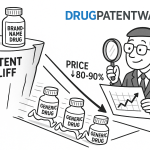
The 180-day exclusivity period for the first ANDA filer with a Paragraph IV certification is the primary economic engine of the generic drug industry’s patent challenge business. During those six months, the FDA cannot approve any subsequent ANDA for the same drug. The first filer operates in a duopoly with the brand: instead of the 80-90% price erosion that accompanies multi-source generic entry, the sole generic can price at a 15-25% discount to brand WAC and still capture substantial volume from cost-sensitive payers and formulary managers eager to show generic savings.
For a drug with $2 billion in U.S. annual sales, the financial math of the 180-day period is compelling. At a 20% WAC discount and a realistic 60% market share capture (recognizing that brand loyal patients and formulary transitions take time), the first filer generates approximately $480 million in revenue over six months. Litigation costs for a major Paragraph IV case run $5 million to $15 million per side over the full case lifecycle. The risk-adjusted return, even accounting for a 40-50% probability of patent challenge failure on some claims, consistently justifies the investment for drugs above roughly $500 million in annual U.S. sales.
Data on the distribution of surplus from Paragraph IV litigation confirms the economics. Studies of settled and litigated cases find average stakes of approximately $4.3 billion for brand firms and over $200 million for generic challengers across the case portfolio. The asymmetry reflects the fact that for the brand, every delayed entry day has revenue implications, while for the generic, the 180-day period concentrates value in a short window that must be maximized.
IP Valuation: What the First-Filer Right Is Actually Worth
The 180-day exclusivity right is a contingent, time-limited IP asset with quantifiable value. It can be licensed, assigned (with limitations), or leveraged in settlement negotiations. Brand companies frequently offer authorized generic arrangements in settlement agreements, structuring the payout as a value-equivalent alternative to the 180-day exclusivity period rather than as a cash payment, to preserve plausible compliance with Federal Trade Commission scrutiny of reverse-payment settlements.
For a portfolio manager evaluating a generic company’s pipeline, the 180-day rights on pending Paragraph IV filings represent material contingent assets. Properly valued, they require a probability-weighted discounted revenue estimate: (peak daily revenue during the 180-day window) multiplied by (probability of first-filer success) multiplied by (probability of winning sufficient patent claims to permit launch) multiplied by (probability of supply chain readiness at launch). Each variable requires independent estimation. A generic company with five pending first-filer positions targeting drugs with aggregate annual U.S. sales of $8 billion represents a meaningfully different pipeline value than a company with ten positions targeting $3 billion in aggregate sales, even though the latter has more certifications outstanding.
Forfeiture: The Ways the Prize Disappears
First-filer exclusivity is not guaranteed once obtained. The FDA’s forfeiture provisions under 21 U.S.C. Section 355(j)(5)(D) define six triggering events that strip the first filer of its exclusivity and allow subsequent ANDAs to proceed to approval.
A failure to market the drug within 75 days of the later of FDA approval or the date that all relevant patents and exclusivities expire forfeits exclusivity. A first filer that wins its patent case but cannot manufacture and launch within that window loses the prize to later filers. This is the forfeiture event most directly linked to supply chain failure, and it is the most operationally preventable. Withdrawal or amendment of the ANDA to remove the Paragraph IV certification also triggers forfeiture, as does a final court decision finding the challenged patents valid and infringed. Certain settlement agreements, particularly those that expressly or implicitly delay generic market entry, can constitute forfeiture. Failure to obtain tentative approval within 30 months of filing the ANDA, where the failure is caused by the first filer’s own actions, rounds out the list.
The forfeiture framework creates a competitive clock even before the legal case resolves. A first filer that wins at the district court level but faces an expedited appeal by the brand must track its commercial readiness timeline against the appeal schedule. A favorable appellate ruling that arrives too close to the 75-day commercial marketing deadline leaves little margin for supply chain adjustments.
Investment Strategy Note: Evaluating Generic Pipeline IP Assets
Institutional investors evaluating generic pharmaceutical companies should treat each pending first-filer Paragraph IV certification as a separately valued contingent asset rather than a binary pipeline item. The relevant inputs are U.S. brand revenue at likely launch date, estimated net price discount, projected market share capture rate during the 180-day window, litigation success probability (adjusted for the specific patent claims at issue), time-to-launch probability given current supply chain status, and the probability of forfeiture given the filer’s track record with the FDA approval process.
DrugPatentWatch’s ANDA certification database provides first-filer status, litigation status, and projected exclusivity timelines. IQVIA and Symphony Health provide the brand revenue inputs. Combining these data sources with a standard probability-weighted DCF produces a defensible contingent asset value per first-filer position.
Key Takeaways: Part 2
The 180-day exclusivity right is an IP asset with quantifiable contingent value. Model it as a probability-weighted revenue stream, not as a pipeline binary.
For drugs with annual U.S. sales above roughly $500 million, the risk-adjusted return on a well-resourced Paragraph IV challenge is consistently positive based on historical case data.
Forfeiture provisions are operationally real. The 75-day commercial marketing trigger links supply chain readiness directly to exclusivity retention. A legal win without a manufacturing-ready supply chain is a forfeiture event in waiting.
Reverse-payment settlements that transfer value to the first filer in exchange for delayed market entry remain under FTC scrutiny following the Supreme Court’s Actavis decision in 2013. Structure matters as much as economics in settlement design.
Part 3: The Global Litigation Chessboard — How Foreign Court Wins Become U.S. Leverage
Why the U.S. Patent Is Almost Never Fought Only in the U.S.
Brand pharmaceutical companies build global patent portfolios because the drugs they protect generate revenue in every major market. A blockbuster with $3 billion in U.S. sales typically generates another $2-3 billion outside the U.S. For the brand, this global revenue footprint justifies parallel patent protection in the EU, UK, Canada, Japan, Australia, and a growing list of emerging markets. For the generic challenger, that global patent portfolio is not just a barrier. It is a target.
Because the same underlying invention is typically protected by a family of patents across jurisdictions, the validity and scope of those patents can be challenged simultaneously in multiple countries. The outcomes in foreign proceedings are not binding on U.S. courts. But they are not irrelevant either. A U.S. district court judge who sees that a German federal patent court, the UK High Court, and a Canadian appellate court have all found claims in the same patent family to be obvious or insufficiently disclosed is looking at a global consensus that carries real persuasive weight, even without the formal authority of binding precedent.
The Four Tactical Functions of Foreign Litigation
Foreign patent proceedings perform four distinct strategic functions in a Paragraph IV campaign.
They generate persuasive authority. Well-reasoned decisions from technically sophisticated courts, particularly the UK High Court and the Supreme Court of Canada, are submitted to U.S. district courts as supplementary briefing material. U.S. judges cannot cite them as precedent, but they can and do consider them in evaluating complex technical arguments on claim construction and obviousness. A UK finding that a patent claim was obvious in light of specified prior art is a usable document in a U.S. case involving the same prior art.
They surface the brand’s arguments in advance. Discovery in U.S. patent litigation is extensive but takes time. Foreign litigation, where it proceeds on a faster timeline (as in Germany), can reveal the brand’s expert witness positions, its claim construction theories, and its chosen technical narrative before the U.S. case reaches the same stage. This intelligence preview allows the generic’s U.S. litigation team to anticipate and prepare counters to arguments that haven’t yet been formally raised in the American case.
They create estoppel risk for the brand. A brand company that argues for a narrow claim interpretation in a German proceeding to defeat an invalidity challenge cannot easily argue for a broad interpretation of the same claim in a U.S. infringement case. Statements made during foreign prosecution or litigation can be introduced in U.S. proceedings under principles of prosecution history estoppel and judicial estoppel. Sophisticated U.S. litigation counsel routinely monitors foreign proceedings specifically to capture brand positions that can be weaponized domestically.
They generate settlement pressure. A brand facing coordinated challenges in the UPC, the UK, Germany, and Canada simultaneously is protecting multiple billion-dollar revenue streams. A favorable ruling in any one of those jurisdictions threatens a portion of that global revenue and signals to the brand’s board and its bankers that the patent portfolio is not as defensible as previously assumed. Generic companies that run coordinated global litigation campaigns use foreign victories as explicit settlement leverage in U.S. negotiation sessions.
Forum Selection and Sequencing
The practical task for the generic’s litigation team is not whether to litigate abroad but where to litigate, in what sequence, and with what resources. The answer depends on the specific patent claims being challenged, the legal doctrine in each jurisdiction, the speed of local courts, and the commercial importance of the market.
Germany offers the fastest first-instance decisions on infringement, typically in 9 to 15 months from filing, making it the preferred venue for quickly establishing commercial pressure. Its bifurcated system creates both the ‘injunction gap’ risk (discussed in Part 5) and the corresponding opportunity: a generic that successfully invalidates a patent before the Federal Patent Court while the brand holds an infringement injunction from a regional court has produced a commercially absurd situation that typically accelerates settlement.
The UK Patents Court offers the most rigorous and technically grounded analysis of complex patent claims, making it the preferred venue for establishing persuasive authority on difficult scientific questions. Its judgments travel internationally in a way that German regional court decisions, which are less analytically detailed, do not.
Canada’s unique substantive doctrines on utility and disclosure make it an optimal testing ground for invalidity theories that are less developed in U.S. law. A successful Canadian challenge validates the legal theory at lower cost before the full U.S. litigation investment is committed.
Key Takeaways: Part 3
Foreign litigation serves four functions in a U.S. Paragraph IV campaign: persuasive authority, intelligence gathering, estoppel creation, and settlement pressure. Each requires deliberate resourcing.
The brand’s global patent portfolio is both the barrier and the target. A global challenge campaign that attacks the portfolio in multiple jurisdictions simultaneously converts that portfolio from an asset into an operational liability for the brand.
Forum selection is a sequencing decision as much as a venue decision. Germany for speed and commercial pressure; UK for technical authority and global persuasion; Canada for testing novel invalidity theories at lower cost.
Systematic monitoring of foreign proceedings is non-optional for any company with a Paragraph IV campaign running. Intelligence gathered abroad is frequently usable in U.S. proceedings.
Part 4: The UPC Inflection Point — What Europe’s New Patent Court Changes for Every Generic Strategy
What the UPC Is and Why It Changes the Calculus
The Unified Patent Court opened its doors in June 2023 after more than a decade of political negotiations and ratification delays. It provides a single judicial forum with jurisdiction over European patents in participating EU member states, currently covering seventeen countries including Germany, France, Italy, the Netherlands, and Sweden, with others expected to join over time. Before the UPC, litigating a European patent meant filing separate national proceedings in each country where the patent was being asserted or challenged. A successful invalidity action in Germany had no automatic effect on the patent’s validity in France or Italy. Brands could lose in one country and win in others, achieving a patchwork of outcomes that limited the financial damage from any single defeat.
The UPC eliminates that patchwork structure. A single UPC revocation action can invalidate a European patent across the entire participating member state bloc. For a brand generating, say, $800 million annually across covered EU markets, a single adverse UPC revocation ruling threatens that entire revenue stream in one proceeding. The risk concentration for brands is not incremental; it is structural.
The Generic Opportunity: Pan-European Revocation as Leverage
For generic challengers, the UPC’s central division handles revocation actions, and the local or regional divisions handle infringement cases. The option to file a standalone revocation action in the central division, without first being sued for infringement, gives generics a proactive tool to clear European market access before attempting a launch.
A well-funded generic company with a strong invalidity case can file a UPC central division revocation while simultaneously pursuing its U.S. Paragraph IV litigation. A successful revocation, clearing patent barriers across seventeen EU markets, accomplishes two things. It opens significant European revenue that funds the ongoing U.S. legal campaign. And it sends a clear signal to the brand’s management and institutional shareholders that the patent portfolio’s global defensibility has been materially impaired, increasing settlement pressure on the U.S. case.
The Brand Opportunity: Pan-European Injunctions as a Crushing Counter
The UPC is not uniformly favorable to generics. A brand holding a valid European patent can file for a pan-European injunction at a UPC local or regional division, potentially blocking the generic’s commercial sales across all participating member states from a single court order. For a generic company that has planned a European revenue stream to finance its U.S. litigation, a pan-European UPC injunction is existential. The European ‘bank’ that was supposed to fund the U.S. ‘war’ is frozen.
Managing UPC injunction risk requires early case assessment. If the brand’s European patent is strong on its face, particularly if it has survived national opposition proceedings without amendment, a UPC injunction filing is a credible threat that must be priced into the generic’s financial model before the litigation campaign is designed.
Opt-Out Strategy and the Transition Period
European patents issued before the UPC opened have a transition period during which patent holders can ‘opt out’ of UPC jurisdiction, keeping those patents in national courts where the patchwork system still applies. Brands with strong patent portfolios have incentive to opt out of UPC jurisdiction for their most commercially critical patents, preserving the national fragmentation that limits the financial consequences of any single invalidation.
Generic companies monitoring European patent activity should track which of a brand’s patents have been opted out. A brand that opts out its primary composition-of-matter patent for a blockbuster drug is signaling that it believes the patent is vulnerable to a UPC central division revocation challenge. That opt-out decision is itself intelligence.
Investment Strategy Note: UPC Risk Mapping for Biopharma Equity
For institutional investors in branded pharmaceutical companies, the UPC introduces a new category of IP concentration risk. Pre-UPC, even a complete European patent loss was a fragmented outcome country by country. Post-UPC, a single adverse judgment can trigger a continent-wide revenue event. Investors should assess which of their portfolio companies hold opted-in European patents on their highest-revenue products, and what the financial consequence of a central division revocation would be for those assets. DrugPatentWatch’s European patent data, cross-referenced with EMA approval and sales data, provides the building blocks for this analysis.
Key Takeaways: Part 4
The UPC created pan-European patent jurisdiction effective June 2023, replacing fragmented national litigation for opted-in patents with a single court that can invalidate or enforce across seventeen member states.
A successful UPC central division revocation removes European patent barriers across all participating states in one proceeding. This is the highest-leverage single action available to a generic challenger in Europe.
Pan-European UPC injunctions are equally powerful for brands. A generic relying on European revenue to fund U.S. litigation must assess UPC injunction risk before committing to the campaign financial model.
Brand opt-out decisions during the transition period are intelligence signals. An opt-out on a commercially critical patent suggests the brand’s internal patent counsel believes that patent is vulnerable in the UPC’s validity-skeptical central division.
Part 5: Germany’s Injunction Gap — Exploiting Bifurcation as a Tactical Weapon
How the Bifurcated System Creates Structural Asymmetry
Germany’s patent litigation system separates infringement proceedings from validity proceedings into two completely different courts on two completely different timelines. Infringement actions are filed in the regional civil courts, with Dusseldorf, Munich, and Mannheim as the dominant venues for pharmaceutical cases. These courts produce first-instance judgments on infringement in 9 to 15 months from filing. Validity challenges are filed as nullity actions before the Federal Patent Court in Munich, where first-instance judgments typically arrive 18 to 24 months after filing, sometimes longer.
The temporal gap between infringement and validity rulings is where the structural asymmetry lives. A brand company can file an infringement action the day a generic launches in Germany, obtain a preliminary or final injunction within 12 to 15 months, and have that injunction enforced while the Federal Patent Court is still evaluating whether the underlying patent is valid at all. If the Federal Patent Court later finds the patent invalid, the injunction is lifted, but the commercial damage to the generic’s German launch has already occurred.
The Injunction Gap as a Brand Weapon
Sophisticated brand companies use this dynamic deliberately. By filing infringement proceedings immediately upon generic launch or even upon detection of an ANDA filing with a Paragraph IV certification covering a German equivalent patent, the brand can threaten the generic with rapid injunctive relief. In many cases, this threat alone is sufficient to delay a German launch pending the outcome of the validity proceeding, because the commercial cost of an injunction to the generic exceeds the cost of delay.
The structural risk for the generic is most acute when the regional court decides to maintain the injunction pending appeal to the Federal Court of Justice, which can extend the effective injunction period substantially. A generic that launches in Germany with an infringement action pending is accepting the risk of having its product pulled from shelves mid-launch if the regional court grants a preliminary injunction, disrupting supply chains, damaging pharmacy relationships, and eliminating the revenue stream that was supposed to fund U.S. litigation.
The Generic Counter: Parallel Nullity Actions and Suspension Applications
The generic’s tactical response to the injunction gap involves two parallel actions. Filing a nullity action with the Federal Patent Court immediately upon or before the German launch establishes the validity challenge formally and begins the clock on the validity proceeding. A critical secondary filing is an application to the regional court to suspend the infringement proceedings pending the Federal Patent Court’s validity ruling. German courts have discretion to grant such suspensions, and do so when the patent’s validity appears particularly doubtful based on the nullity evidence presented.
The strength of the invalidity case, therefore, directly affects the probability of obtaining a suspension and thereby closing the injunction gap. A generic company that has a compelling validity challenge, ideally supported by strong prior art or a favorable foreign ruling on an equivalent patent, has a better chance of persuading the regional infringement court to suspend its proceedings than a company relying on narrower invalidity arguments.
Under UPC jurisdiction (for opted-in patents), the same patent holder faces the option of filing infringement at a UPC local division while the central division handles revocation. The UPC’s rules allow the court to bifurcate or to hear both issues together, giving it more flexibility than the rigid German national system.
Key Takeaways: Part 5
Germany’s bifurcated system produces an injunction gap where infringement injunctions can issue before validity is determined. This is the primary operational risk for a generic company planning a German launch.
Brands use the injunction gap tactically, filing infringement proceedings to threaten rapid injunctive relief and deter generic launches while the validity proceeding is pending.
The generic’s counter requires parallel filing of a nullity action at the Federal Patent Court and an aggressive application for suspension of the infringement proceedings at the regional court. The strength of the invalidity case determines the likelihood of the suspension.
Under UPC opt-in for European patents, the bifurcation issue is governed by UPC procedural rules rather than mandatory national bifurcation. This gives UPC panels more flexibility, reducing (but not eliminating) the injunction gap risk.
Part 6: The UK as a Global Bellwether — Why London Court Rulings Travel to Delaware
What Makes UK Judgments Internationally Influential
The Patents Court of England and Wales has a distinctive reputation in global IP circles that has nothing to do with the size of the UK pharmaceutical market and everything to do with the quality of its judgments. UK patent judges are typically trained in both law and a scientific discipline, or they have extensive technical experience in complex patent cases. The resulting judgments are analytically rigorous, engage directly with the underlying science, and address competing claim construction arguments in a level of technical detail that is rare in most national courts.
That analytical depth is what makes UK judgments travel. A U.S. district court judge evaluating a complex obviousness argument on a polymorph patent has no obligation to consider what the UK Patents Court concluded on the same prior art. But a well-reasoned 80-page UK judgment that methodically works through the same technical question can inform and shape the U.S. judge’s analysis in ways that are difficult to trace but are very real in practice. U.S. patent litigators routinely cite favorable UK judgments in briefs as ‘persuasive authority,’ and U.S. expert witnesses are sometimes asked to explain why a U.S. court should reach a different conclusion than a UK court did on the same technical issue.
Recent UK Case Law Relevant to Generic Strategy
The UK’s rivaroxaban litigation in 2022 and 2023 produced detailed findings on obviousness and claim construction that had commercial implications beyond the UK market. The rivaroxaban molecule, covered by Bayer’s patent portfolio, was challenged by multiple generic manufacturers. The UK proceedings examined prior art compounds and structural relationships in a manner that informed parallel proceedings in other jurisdictions.
The UK’s 2023 RSV vaccine patent proceedings demonstrated the court’s willingness to engage with cutting-edge biological science in evaluating whether prior art disclosures were enabling for the claimed inventions. The court’s methodology for assessing enablement in the context of complex biologics is now referenced in other jurisdictions addressing similar questions.
For generic IP teams, monitoring UK proceedings on target patents is standard due diligence. A patent that is found obvious by the UK Patents Court is not automatically obvious in the U.S., but the UK finding substantially reduces the cost and risk of making the same argument to a U.S. court that respects the technical depth of UK analysis.
The Post-Brexit Strategic Picture
The UK’s departure from the EU removed it from participation in the UPC. UK patents are now litigated exclusively in UK national courts, making the UK a jurisdictionally separate forum from the UPC proceedings covering EU member states. This separation has one important strategic implication: a generic company can simultaneously pursue a UPC revocation in the EU and a UK invalidity action in the Patents Court, with UK proceedings potentially producing a well-reasoned judgment that influences the UPC panel even though the UK is not bound by or formally part of the UPC system.
Key Takeaways: Part 6
UK Patents Court judgments carry persuasive weight in U.S. proceedings because of their technical rigor and analytical depth. Generic IP teams should actively monitor UK proceedings on target patents and brief U.S. counsel on favorable UK findings.
The UK’s post-Brexit jurisdictional separation from the UPC means UK proceedings and UPC proceedings run in parallel, potentially producing complementary favorable rulings on the same patent family.
UK obviousness and enablement analysis methodologies are analytically aligned with U.S. standards in many respects, making UK findings more directly persuasive in U.S. proceedings than, for example, German regional court infringement rulings.
Part 7: Canada’s Disclosure Doctrine — The Teva v. Pfizer Playbook and Its Successors
Why Canada Offers a Unique Invalidity Theory
Canadian patent law imposes substantive requirements that diverge materially from U.S. doctrine in two areas that matter most for pharmaceutical patent challenges: utility and disclosure. These divergences create an environment where a patent that is valid and enforceable in the U.S. can be, and frequently is, invalid in Canada for reasons that U.S. courts would not recognize.
The Canadian doctrine of utility requires that a patent claim not merely assert that the claimed invention will be useful but demonstrate or soundly predict the specific utility relied upon in the patent. If a patent claims a broad class of compounds for a broad therapeutic use, the inventor must have established at the time of filing that the claimed utility is demonstrated or soundly predictable for the full scope of the claim. Broad claims unsupported by the specific experimental data disclosed in the specification can fail the utility requirement even if the overall concept is meritorious.
The disclosure requirement compounds this. Canada’s ‘patent bargain’ doctrine, as articulated by the Supreme Court of Canada, requires that the patent specification fully and correctly disclose the specific invention that the patentee is claiming as its monopoly. Deliberate obscuration of the specific invention, even when the specification technically includes the relevant information, can render the disclosure insufficient and void the patent.
Teva Canada Ltd. v. Pfizer Canada Inc.: The Sildenafil Case in Full
The 2012 Supreme Court of Canada judgment in Teva Canada Ltd. v. Pfizer Canada Inc. is the clearest demonstration of how Canadian disclosure doctrine can deliver outcomes unavailable in the U.S. The case concerned Pfizer’s Canadian patent covering sildenafil for the treatment of erectile dysfunction, the compound marketed globally as Viagra.
The patent claimed a broad class of compounds identified as useful for treating erectile dysfunction. The specific compounds fell under claim 6, listing four compounds, and compound 6 in claim 7. The patent disclosed that ‘one of these compounds is especially preferred,’ but did not explicitly identify which one. Through the nested structure of the claims, a reader willing to work through the entire specification could eventually determine that sildenafil was the specific compound, but the identification was deliberately indirect.
Teva argued that Pfizer had breached the disclosure requirement by intentionally obscuring the identity of sildenafil, the actual invention. Pfizer had developed sildenafil as the active compound and had clinical data demonstrating its efficacy. The patent disclosed the broader class of compounds but structured the claims to avoid immediately revealing which compound worked, creating a situation where competitors could read the patent without readily identifying the actual invention.
The Supreme Court of Canada, in a unanimous decision, agreed with Teva. The court held that Pfizer had not fulfilled its side of the patent bargain. By claiming the entire class while intentionally hiding the specific compound that was the true invention, Pfizer had obtained a monopoly over a class of compounds without providing the full and clear disclosure that the Patent Act required in exchange. The patent was declared invalid.
In the U.S., the parallel Teva litigation had proceeded on different grounds, and the U.S. court had upheld the patent’s validity. The same facts, the same compound, the same patent family, two diametrically opposite outcomes, driven entirely by the difference in legal doctrine between the two countries.
Applying the Canadian Doctrine to Other Targets
The Teva v. Pfizer case established a template that Canadian patent litigators have applied to subsequent pharmaceutical patents. The pattern to look for is a patent that claims a structurally broad class of compounds but was in fact developed around one or a small number of specific compounds, where the specification does not identify the specific compound with the clarity required by Canadian disclosure doctrine.
Patents covering lead compounds buried in Markush groups, where all compounds in the group are claimed equally but only one was actually tested and developed, are the most direct analogs to the sildenafil fact pattern. Patents that disclose biological activity for a class of molecules but place the specific compound with clinical data in a cascading claim structure, rather than prominently identifying it in the specification, may also present Canadian disclosure vulnerabilities.
For a generic company planning a Canadian proceeding, the strategic sequence is to analyze the patent’s prosecution history and specification structure for evidence that the patentee deliberately structured the disclosure to obscure the specific compound, then commission a Canadian law opinion on the utility and disclosure arguments before committing to the proceeding.
Canada as a Test Bed: Lower-Cost Invalidity Research
The cost of patent litigation in Canada is substantially lower than in the U.S. Canadian proceedings have limited discovery, no U.S.-style depositions, and trial in the Federal Court of Canada is typically shorter than a U.S. district court trial. A Canadian invalidity action on a target patent costs a fraction of the equivalent U.S. proceeding, while potentially generating a favorable judgment that can be deployed as persuasive authority in the U.S. case.
The strategic use of Canada as a test bed involves filing the Canadian proceeding first, assessing the evidence gathered and the arguments developed during Canadian litigation, and incorporating the results into the U.S. strategy. A Canadian Federal Court finding of invalidity based on disclosure insufficiency, even though it is not binding in the U.S., provides the U.S. litigation team with a fully developed factual record, a sympathetic technical narrative, and a precedential framework that may be argued to U.S. counsel and, with appropriate framing, to a U.S. court.
Key Takeaways: Part 7
Canadian patent law imposes utility demonstration requirements and a patent bargain disclosure doctrine that U.S. law does not. Patents valid in the U.S. are vulnerable in Canada on grounds that have no U.S. equivalent.
The Supreme Court of Canada’s Teva v. Pfizer ruling invalidated the Canadian sildenafil patent for deliberate disclosure obscuration, establishing that Pfizer could not claim the full compound class while hiding the identity of the actual invention. The U.S. patent survived.
The most susceptible Canadian targets are patents claiming broad Markush groups or cascading claim structures where the specific compound with clinical data is not prominently identified.
Canadian litigation costs a fraction of equivalent U.S. proceedings. Use it as a test bed to develop invalidity arguments and generate persuasive authority at lower financial risk before committing to full U.S. Paragraph IV litigation costs.
Part 8: Patent Linkage Across Jurisdictions — Orange Book vs. EMA Decoupling
The U.S. Orange Book: A Ministerial Process with Strategic Consequences
The Orange Book, formally titled ‘Approved Drug Products with Therapeutic Equivalence Evaluations,’ is the FDA’s public listing of brand drug products, their therapeutic equivalence ratings, and the patents that brand companies have certified as relevant to each product. The listing requirement covers patents claiming the drug substance (the active ingredient), the drug product (a specific formulation), or a method of using the drug for which approval was sought.
The FDA’s role in the listing process is ministerial rather than substantive. The agency does not independently evaluate whether a submitted patent actually claims what the brand company asserts it claims, whether the patent is valid, or whether it is genuinely relevant to the approved product. The brand company submits the patent information and signs a certification, and the FDA lists it. This creates the well-documented structural incentive for ‘evergreening,’ the practice of listing large numbers of secondary patents on formulations, dosing regimens, and methods of use in addition to the primary composition-of-matter patent, to maximize the number of Paragraph IV certifications that each generic ANDA must address and the number of potential 30-month stays available to the brand.
The Orange Book currently lists thousands of drug products with anywhere from one to dozens of associated patents. The most aggressively managed blockbuster drugs can carry 40 or more Orange Book-listed patents. Each one is a potential source of a 30-month stay if the brand files suit within the 45-day window. The burden of challenging these patents falls entirely on generic companies through the Paragraph IV process.
PTAB IPR proceedings provide a second mechanism for generic companies to attack Orange Book-listed patents, particularly when the prior art grounds are strong and the patent was listed after the drug had already been on the market for several years. The combination of ANDA Paragraph IV certification and concurrent PTAB IPR petition on the same patents is the most aggressive and resource-intensive approach to clearing a patent-heavy Orange Book listing.
Canada’s Patent Register: Conceptually Similar, Substantively Different
Health Canada maintains a Patent Register with functions broadly analogous to the Orange Book. An innovator seeking to list a patent on the Patent Register must demonstrate a nexus between the patent and the approved drug. The Canadian system has faced intermittent reform efforts aimed at tightening the listing criteria, which have historically been looser than the FDA’s formal Orange Book requirements in some respects and stricter in others.
A generic company seeking a Notice of Compliance from Health Canada must address listed patents, which can trigger litigation under Canada’s Patented Medicines (Notice of Compliance) Regulations and a statutory stay on approval. The PMNOC proceedings operate on a compressed timeline compared to U.S. district court litigation, with the brand typically required to bring its case within a strict timeframe or the stay dissolves.
The EU’s Deliberate Decoupling
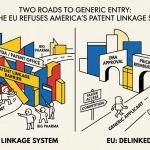
The European Medicines Agency has no equivalent to the Orange Book or the Patent Register. The EMA’s marketing authorization process for generic medicines is entirely a scientific and regulatory assessment. It determines whether the proposed generic is bioequivalent to the reference product and whether the manufacturing process meets EU quality standards. The status of the innovator’s patents is completely outside the EMA’s assessment.
This deliberate decoupling means that a generic company can receive EU marketing authorization for a product even while the innovator’s European patents remain in force. The EMA will grant the authorization if the scientific requirements are met. Whether the generic can then actually sell the product without infringing those patents is a question for national courts (or now the UPC), not the EMA.
The practical consequence for generic launch planning is profound. In the U.S., the Orange Book-based Paragraph IV process and the resulting 30-month stay tie regulatory approval to patent status. In the EU, regulatory approval and patent clearance are entirely separate tracks. A generic company can run both tracks simultaneously and enter the European market the moment both the regulatory authorization and a court-cleared patent position are in place, without waiting for a unified regulatory-patent clearance event.
Key Takeaways: Part 8
The FDA’s ministerial role in Orange Book listing creates the structural incentive for brand evergreening. Generic companies must challenge each listed patent through Paragraph IV certification and, where appropriate, concurrent PTAB IPR petitions.
Canada’s PMNOC regime operates on a compressed timeline relative to U.S. district court. Brand companies must bring their case quickly or the stay dissolves, creating a different risk-reward structure than the U.S. 30-month stay.
The EU’s decoupled EMA regulatory process means marketing authorization and patent clearance are independent. Generic companies obtain EU authorization and litigate patent issues separately, with the ability to enter markets immediately upon clearing both tracks.
Part 9: Regulatory Exclusivity Mapped — FDA vs. EMA Side by Side
The U.S. Exclusivity Framework
The FDA administers three primary forms of non-patent regulatory exclusivity relevant to generic market entry timing.
New Chemical Entity (NCE) exclusivity provides five years of data exclusivity for drugs containing an active moiety never previously approved by the FDA. During the first four years of that period, no ANDA can be filed at all. In year five (specifically, after four years), an ANDA containing a Paragraph IV certification can be submitted, which is why many of the most contested Paragraph IV battles begin exactly at the four-year mark from brand approval. The full five-year NCE exclusivity period blocks generic approval unless the Paragraph IV challenge has been resolved in the generic’s favor.
New clinical investigation exclusivity provides three years of market exclusivity (not data exclusivity) for drugs that obtained new approval based on new clinical investigations conducted by or for the applicant, where the investigations were essential to approval. This category covers new formulations, new indications, new dosing regimens, and combination products. It runs concurrently with any listed patents but adds a market protection layer independent of patent validity. A generic might win a Paragraph IV challenge invalidating all listed patents and still be blocked from marketing for the remaining months of a three-year new clinical investigation exclusivity period.
Orphan drug exclusivity provides seven years of market exclusivity for drugs designated to treat rare diseases affecting fewer than 200,000 Americans. It blocks approval of a generic or second innovator application for the same drug in the same orphan indication, regardless of patent status. Unlike NCE and three-year exclusivity, orphan drug exclusivity is indication-specific. A generic targeting a non-orphan approved indication of the same molecule is not blocked by the orphan exclusivity.
Pediatric exclusivity adds six months to all existing patents and regulatory exclusivities when the brand company completes FDA-required pediatric studies under a Written Request. Critically, this six-month extension applies to every Orange Book-listed patent and to every outstanding exclusivity period simultaneously. For a drug with multiple listed patents expiring on different dates, the six-month pediatric extension pushes all of them out simultaneously, and it adds to the back end of any NCE or other exclusivity that is still running.
The EU ‘8+2+1’ Framework
The EMA grants data exclusivity for eight years following the first EU marketing authorization for a new active substance. During this period, a generic manufacturer cannot reference the innovator’s preclinical and clinical trial data to support its own marketing authorization application. The data exclusivity period is a data reference barrier, not a marketing barrier. The generic can obtain authorization in year eight if it has completed its own data package (which for most small molecules consists primarily of bioequivalence studies, not full clinical trials).
Market exclusivity of two years follows the data exclusivity period. During these two years, even a generic that has received marketing authorization cannot commercially market its product in EU member states. The practical total protection under the standard EU framework is ten years from first EU marketing authorization.
The ‘plus one’ extension adds a year of market exclusivity, bringing the total to eleven years, if the innovator obtains a new therapeutic indication that the EMA determines brings significant clinical benefit in comparison with existing therapies. The determination of ‘significant clinical benefit’ is made by the EMA’s Committee for Medicinal Products for Human Use (CHMP), and it requires more than incremental benefit over existing treatment options.
Orphan drug exclusivity under EU rules provides ten years of market exclusivity (versus seven in the U.S.) following authorization of an orphan medicine. This period can be reduced to six years if the orphan designation criteria are no longer met at the time of the five-year review. Pediatric extensions to Supplementary Protection Certificates (SPCs) add six months to the SPC term for medicines with a completed Pediatric Investigation Plan.
SPCs: The Bridge Between Patents and Regulatory Exclusivity in Europe
Supplementary Protection Certificates deserve specific attention in any comparison of U.S. and EU exclusivity frameworks, because they have no precise U.S. equivalent. An SPC extends the effective life of a specific patent, the one that protected the active substance at the time of first EU marketing authorization, by a period equal to the time between the patent filing date and the first EU marketing authorization date, minus five years. The maximum SPC extension is five years, with a possible additional six months for pediatric compliance.
The SPC system compensates innovators for the regulatory review time that consumed part of the patent’s twenty-year term before the product could be marketed. It is mechanistically similar to U.S. Patent Term Extension under 35 U.S.C. Section 156, but it is administered at the national level in each EU member state and has been the subject of substantial ECJ jurisprudence on eligibility criteria, particularly regarding combination products and new formulations.
For generic companies planning EU entry, the SPC expiration date is often the more operationally relevant date than the underlying patent expiration date, and SPC validity is independently challengeable. A number of EU member states have seen SPC invalidity litigation that resulted in earlier-than-expected generic entry, and the UPC now handles SPC validity disputes for opted-in SPCs alongside European patent disputes.
Feature
United States (FDA)
European Union (EMA)
NCE / New Active Substance Data Exclusivity
5 years (ANDA can file at year 4 with Paragraph IV)
8 years (no generic application can reference data)
Market Exclusivity (beyond data exclusivity)
3 years (for new clinical studies)
2 years (following data exclusivity)
Total Standard NCE Protection
5 years regulatory + patents
10 years (8 + 2) regulatory + SPCs + patents
Optional Extension
None for standard NCE
+1 year for new indication with significant benefit
Orphan Drug Exclusivity
7 years
10 years (reducible to 6 at year-five review)
Pediatric Extension
+6 months to all patents and exclusivities
+6 months to SPC (or +2 years for orphan SPC)
Patent Term Extension Mechanism
Patent Term Extension under 35 U.S.C. 156
Supplementary Protection Certificate (national)
Patent Linkage
Yes (Orange Book system)
No (EMA process decoupled from patent status)
Key Takeaways: Part 9
U.S. NCE exclusivity blocks ANDA filing for four years and ANDA approval for five. The four-year filing window, combined with Paragraph IV certification, is why the most contested challenges begin at exactly the four-year mark.
Pediatric exclusivity adds six months to every listed patent and every outstanding exclusivity simultaneously. For a drug with a complex Orange Book listing, this can be a more commercially significant protection than the pediatric indication itself.
The EU’s 8+2 framework provides ten years of fixed regulatory protection, predictable and formulaic. The U.S. system’s effective protection period is far more variable, determined by the interplay of shorter regulatory exclusivity and a patent portfolio subject to Paragraph IV challenge.
SPCs are the European bridge between patent expiry and regulatory exclusivity expiry. SPC validity is independently challengeable and represents a separate litigation opportunity for generic companies targeting EU market entry.
Part 10: The ‘European Launch First’ Strategy — Funding U.S. Litigation with EU Revenue
The Strategic Logic
The financial structure of a major Paragraph IV campaign places substantial costs upfront: bioequivalence studies, API qualification, formulation development, ANDA preparation fees, notice letter preparation, litigation counsel, expert witnesses, and trial costs. The total cost of a contested Paragraph IV case from filing to resolution can exceed $15 million per side for a major drug. The revenue from a successful 180-day exclusivity period may arrive years after most of those costs have been incurred.
The EU’s decoupled regulatory system, combined with the predictability of the 8+2 exclusivity framework, creates an opportunity to generate commercial revenue from European market entry before the U.S. litigation resolves. Where the EU data exclusivity expires in, for example, year ten post-EU-authorization, and the EU patents and SPCs expire at approximately the same time, a generic company can plan a firm European launch date with a high degree of confidence, even while the U.S. Paragraph IV litigation is in early stages.
Revenue generated from Germany, the UK, France, Italy, and other major European markets during the period of U.S. litigation is direct cash flow available to fund ongoing legal costs. For a drug generating €100 million annually across covered EU markets, even a 30% market share capture with a 20% price discount produces €24 million per year in additional revenue. Over a two-year U.S. litigation period, that is €48 million, substantially exceeding the litigation cost for most cases.
Signaling and Commercial Credibility
A European launch accomplishes something beyond cash flow: it demonstrates commercial readiness. A generic company that has successfully launched a complex specialty drug in five or more European countries has a validated manufacturing process, a functioning cold chain or specialized distribution network, and a regulatory compliance record that is directly relevant to the FDA’s assessment of its manufacturing capabilities.
Brand companies and their litigation counsel are well aware that a generic manufacturer with a live European commercial operation is a more credible and better-financed adversary than one whose entire commercial future depends on winning the U.S. case. This credibility differential affects settlement dynamics. A brand that knows the generic can sustain a three-year U.S. litigation on European revenue without financial distress is more likely to settle on terms that the generic finds acceptable.
Pharmacy Benefit Manager and Payer Signaling
Large U.S. pharmacy benefit managers (PBMs), hospital group purchasing organizations (GPOs), and integrated health systems follow European generic market activity for drugs where U.S. patent litigation is pending. A generic manufacturer’s European launch demonstrates that the product works, that the supply chain functions, and that the manufacturer is a credible commercial entity. PBM procurement teams may begin pre-qualification discussions with a generic company based on its European track record, positioning the generic for rapid formulary placement immediately upon U.S. launch.
Key Takeaways: Part 10
The EU’s predictable 8+2 regulatory exclusivity timeline allows generic companies to plan firm EU launch dates while U.S. Paragraph IV litigation is ongoing. EU revenue funds U.S. litigation costs.
A successful European commercial launch demonstrates validated manufacturing, supply chain reliability, and commercial credibility to U.S. payers and to brand litigation counsel, improving U.S. settlement dynamics.
For financial modeling purposes, EU revenue during the U.S. litigation period should be included as a positive cash flow that reduces the effective net cost of the U.S. legal campaign, improving the risk-adjusted return on the full investment.
Part 11: The India-China API Nexus — Supply Chain Risk as a Paragraph IV Variable
The Structural Concentration Problem
The global pharmaceutical supply chain for generic drugs runs through two primary geographies. India produces approximately 35% of the APIs consumed by the U.S. generic market and accounts for the majority of finished dosage forms shipped to the U.S. from foreign manufacturers. China is the world’s dominant producer of key starting materials (KSMs) and chemical intermediates that Indian API manufacturers depend upon. Indian API production is estimated to source 70-80% of its raw material inputs from Chinese manufacturers.
This India-China nexus is the pharmaceutical supply chain’s single greatest structural vulnerability. A disruption at either node, from factory shutdowns, regulatory failures, geopolitical friction, or export restrictions, propagates rapidly through the system. The COVID-19 pandemic provided a full-scale demonstration: Chinese factory closures in early 2020 created API shortages at Indian manufacturers within weeks, which in turn threatened U.S. generic drug supplies months later. The opacity of supply chains at the KSM level means that many U.S. generic manufacturers did not know their products were exposed until shortages materialized.
The Regulatory Dimension: FDA GMP Compliance as a Launch Variable
Every foreign manufacturing facility producing API or finished dosage forms for the U.S. market must be registered with the FDA and is subject to Current Good Manufacturing Practice (cGMP) standards. FDA inspections of foreign facilities, which have historically occurred less frequently than inspections of domestic facilities (a gap that COVID travel restrictions extended further), can result in Warning Letters or Import Alerts that block products from a cited facility from entering the U.S. market.
An Import Alert targeting a generic company’s primary API supplier converts a patent litigation win into a commercial failure. The generic’s ANDA is approved, the 180-day clock is running, and the product cannot be sold because the API cannot clear U.S. customs. By the time the facility issues are resolved and a Prior Approval Supplement to change API suppliers is reviewed and approved, the 180-day exclusivity period may be exhausted.
This is not a hypothetical risk. The FDA has cited multiple major Indian API manufacturers with Warning Letters in recent years, including facilities that were primary API sources for pending Paragraph IV filers. In at least several documented cases, API supplier GMP failures have materially delayed or prevented generic launches that were commercially ready from a patent litigation perspective.
Tariff Risk: A New Variable in the Financial Model
The ongoing U.S.-China trade tension and the broader political pressure to reduce dependence on Chinese pharmaceutical inputs has introduced tariff risk into the supply chain calculus. Executive orders and legislative proposals addressing pharmaceutical API sourcing have periodically included tariff provisions on imported pharmaceuticals or their ingredients. A tariff on Chinese-origin KSMs would increase API production costs for Indian manufacturers, which would translate directly into higher raw material costs for generic finished-product manufacturers.
Generic drugs, particularly those with multiple competitors, operate on margins that can be compressed to 5-15% of revenue. A tariff-driven cost increase of even 10-15% on API inputs can eliminate profitability for certain products entirely. For a generic company evaluating a Paragraph IV target, the financial model must include a scenario analysis for the margin impact of potential tariff escalation, particularly for APIs with high Chinese KSM dependence.
Building Supply Chain Resilience: Operational Requirements
Dual sourcing of APIs is the primary operational defense against supply chain disruption. For a major Paragraph IV target, qualifying two independent API suppliers from different geographic regions before the launch date is not optional; it is a basic risk management requirement. The FDA must approve each supplier’s drug master file (DMF) and the generic’s ANDA must reference the approved DMF for each source. Qualifying a backup supplier in parallel with the primary, and filing a PAS to add the backup to the approved ANDA before launch, ensures that a GMP failure at the primary source does not create a forfeiture event.
Upstream due diligence at the KSM level requires understanding where each API supplier sources its own critical inputs. A generic company with dual API sources both depending on the same Chinese KSM manufacturer has not actually achieved supply chain independence. Genuine resilience requires geographic diversity at both the API and KSM levels, which is logistically complex but commercially essential for protecting the 180-day exclusivity period.
Integrating Supply Chain into the Litigation Timeline
The launch readiness milestone schedule must be built in parallel with the litigation timeline from the first day of Paragraph IV planning. For a case expected to resolve by settlement or judgment in year three, the API qualification and FDA approval process must be complete by year two. A PAS filing for a backup API supplier takes four to eight months to receive FDA review, depending on complexity. If the primary supplier fails an inspection in month 33 of a 36-month litigation, there is no time to qualify a backup before the 180-day clock starts.
Launch readiness reviews should occur quarterly throughout the litigation period, assessing FDA inspection status at each manufacturing facility, DMF status for each API source, PAS status for any pending manufacturing changes, and inventory levels of validated API sufficient to cover the first 90 days of commercial supply.
Key Takeaways: Part 11
The India-China API nexus is the pharmaceutical supply chain’s structural chokepoint. 70-80% of Indian API manufacturing depends on Chinese KSM inputs. Disruption at either level propagates to U.S. generic drug supply.
FDA cGMP compliance failures at API manufacturing facilities are a documented, recurring cause of generic launch failures despite patent litigation wins. API supplier GMP status is a material variable in the financial model.
Tariff risk on Chinese-origin KSMs is a quantifiable financial scenario that must be stress-tested in the Paragraph IV investment case, particularly for APIs with high Chinese raw material dependence.
Dual sourcing of APIs with geographic diversity at both the API and KSM level is the operational minimum for protecting the 180-day exclusivity right. Build the supply chain qualification timeline in parallel with the litigation timeline from day one.
Part 12: IRP and the Financial Model — How International Reference Pricing Reframes the ROI Calculus
The U.S. Price Premium: The Foundation of the Para IV Business Case
The financial case for investing in a Paragraph IV challenge rests entirely on one underlying fact: the U.S. pharmaceutical market prices brand drugs at a substantial premium above every other major market on earth. A 2024 HHS ASPE analysis using 2022 data found that U.S. brand drug gross prices averaged 422% of prices in 33 comparable OECD countries. Even after applying estimates of U.S. rebates and discounts, U.S. net brand drug prices remained above 300% of international comparisons. For generic drugs, the relationship inverts: U.S. generic prices averaged 67% of international comparables, reflecting a highly competitive U.S. generic market.
The first-filer generic captures value from the gap between brand and generic pricing during the 180-day duopoly window. That gap is a direct function of the brand’s U.S. list price. A brand drug priced at $50,000 per year in the U.S. and €15,000 per year in Germany generates a 180-day generic revenue opportunity that is almost entirely a U.S. phenomenon. The financial model for a Paragraph IV challenge is therefore almost entirely a U.S. financial model, with EU revenue serving as supplementary litigation financing rather than a comparable commercial opportunity.
International Reference Pricing: Definition and Current Status
International reference pricing (IRP) is a pricing policy in which a government sets or negotiates its domestic drug prices by benchmarking against the prices paid for the same drug in a defined basket of reference countries. Most EU member states already use some form of IRP or cross-national price comparison in their reimbursement negotiations. Germany, despite having one of the more market-oriented systems (through AMNOG), monitors European prices and adjusts its own net prices accordingly over product lifecycle.
U.S. IRP proposals, which have resurfaced repeatedly in legislative negotiations since at least 2019, typically propose tying Medicare Part B or Part D drug reimbursement to prices in a basket of OECD countries. The most ambitious proposals would reduce U.S. drug reimbursement for the targeted drugs to international average or to the price paid in the lowest-cost reference country. The Inflation Reduction Act of 2022 introduced mandatory Medicare price negotiation for selected high-spend drugs, which is conceptually adjacent to IRP though technically distinct from it. Ongoing political pressure to reduce drug costs suggests that further price control mechanisms remain on the legislative agenda.
The Financial Model Impact of IRP Implementation
The financial impact of IRP on the Paragraph IV business model depends on which drugs are covered, what the reference country basket includes, and what discount from current U.S. prices results. Using the HHS ASPE data as a baseline, a policy that reduced U.S. brand drug prices to OECD average levels would imply reductions of approximately 50-65% from current U.S. gross prices for most brand drugs. Even assuming that U.S. rebates already reduce the net price by 20-30%, the net reduction from current levels would still be in the range of 30-50% for affected products.
A 40% reduction in the brand’s U.S. net price reduces the generic’s 180-day exclusivity revenue by approximately 40%, since the generic’s price is set as a percentage discount from brand. For a drug currently generating $200 million in generic 180-day revenue, a 40% brand price reduction cuts that to $120 million. Against litigation costs of $10-15 million and development costs of $5-10 million, the challenge remains financially viable. But the margin is substantially compressed, and the risk-adjusted return falls from, say, 10x to 5x the investment. For a smaller drug where the current 180-day opportunity is $50 million, a 40% reduction to $30 million may reduce the risk-adjusted return below the threshold required to justify the capital and management attention a Paragraph IV case demands.
The practical consequence of broad IRP implementation would be a contraction in the universe of financially viable Paragraph IV targets. Challenges would remain highly rational for the very largest blockbuster drugs, where the absolute revenue opportunity remains enormous even at reduced price levels. The middle tier of drugs currently generating $200-600 million in annual U.S. sales, which represents a significant portion of the current Paragraph IV pipeline, would see reduced challenge activity as the financial math becomes less compelling.
Scenario Analysis in the Target Selection Model
Incorporating IRP risk into Paragraph IV target selection requires explicit scenario modeling rather than a point-estimate financial projection. The standard approach is to run three parallel scenarios: a baseline scenario using current U.S. pricing with no IRP, a moderate scenario applying a 25-30% net price reduction to the brand for the relevant drug, and an adverse scenario applying a 45-50% reduction consistent with alignment to a broad OECD basket average.
The weighted average of the three scenarios, using probability weights based on the political and legislative assessment of IRP implementation likelihood for each specific drug (taking into account the drug’s therapeutic class, its presence on the Medicare spending list, and whether it is a likely early target for negotiation), produces an IRP-adjusted expected value. This adjusted expected value is the correct denominator for the ROI calculation, not the current-price revenue projection.
Drugs in therapeutic classes that are both high-spend and politically salient (oncology, diabetes, cardiovascular, respiratory) face higher IRP targeting probability than drugs in niche specialty categories or rare diseases. The IRP risk adjustment should be highest for the most commercially attractive targets, which is a structural tension in the target selection process: the drugs with the largest nominal financial opportunity are also the drugs most likely to face pricing reform.
Key Takeaways: Part 12
The U.S. Paragraph IV financial model depends on the U.S. brand price premium. U.S. brand net prices are approximately 300% of international comparables after rebates. IRP would compress this premium toward international levels.
A 40% U.S. brand price reduction from IRP implementation translates directly to a 40% reduction in 180-day exclusivity revenue. The financial model must scenario-test this impact for each target.
High-spend, politically salient therapeutic classes (oncology, diabetes, cardiovascular) carry the highest IRP targeting probability and should be assigned higher scenario weights for the adverse pricing case.
Mid-tier drugs with annual U.S. sales of $200-600 million are the most financially sensitive to IRP-driven price reduction. The challenge calculus for this tier requires the most rigorous scenario modeling.
Part 13: Integrated Target Selection — The Weighted Scoring Framework
Why a Scoring Matrix Outperforms Intuition
Paragraph IV target selection is typically a committee decision influenced by the patent counsel’s assessment of legal strength, the business development team’s view of market size, and the commercial team’s assessment of competitive dynamics. Each of these inputs is valid. The problem is that they are not naturally commensurable, and they omit the international variables that this analysis has demonstrated are material: EU patent vulnerability, Canadian legal exposure, API supply chain risk, and IRP financial impact.
A weighted scoring matrix converts these disparate inputs into a single composite score, forcing explicit probability-weighted assessment of each variable and enabling direct comparison across candidate targets. The matrix does not replace judgment; it disciplines it. A drug that scores poorly on international legal vulnerability but extremely high on U.S. market opportunity will still rank high in the matrix if the weights appropriately reflect the importance of U.S. revenue. A drug that scores high on all international dimensions but has a weak U.S. patent challenge will rank accordingly.
Variable Definitions and Scoring
The matrix uses seven primary variables scored on a 1-5 scale, where 5 represents the most favorable outcome for the generic challenger (most attractive target).
U.S. patent challenge strength scores the probability of prevailing on invalidity or non-infringement arguments for the key Orange Book-listed patents, based on prior art quality, claim scope, prosecution history, and PTAB track record in the relevant technology cluster. A score of 5 represents a patent with strong invalidity arguments on multiple grounds; a score of 1 represents a composition-of-matter patent with no credible invalidity or non-infringement arguments.
U.S. market revenue attractiveness scores the size of the 180-day revenue opportunity, incorporating current brand revenue, projected launch timing, and estimated market share capture during the duopoly period. A score of 5 represents a drug generating over $1 billion annually with a 60%+ first-year market share capture precedent from analogs.
EU and UPC patent vulnerability scores the probability of successful invalidity or non-infringement arguments in European proceedings, based on European patent family analysis, opposition history, and any existing European court rulings. A score of 5 represents a patent that has been amended significantly in EPO opposition or revoked in national proceedings.
Canadian legal vulnerability scores the probability of Canadian invalidity arguments succeeding, with particular weight on utility and disclosure doctrine vulnerabilities. A score of 5 represents a patent with clear disclosure insufficiency or promise of the patent issues based on the specification structure.
API supply chain risk scores (inversely, for ease of interpretation) the operational risk of supply chain disruption before or during the 180-day exclusivity period. A score of 5 represents a drug with a readily available API from multiple FDA-approved suppliers in stable geographic locations with no history of GMP citations. A score of 1 represents a drug with a single-source API from a manufacturer with recent FDA Warning Letter history located in a geopolitically high-risk jurisdiction.
IRP financial impact risk scores (inversely) the probability and magnitude of U.S. pricing reform reducing the 180-day revenue opportunity. A score of 5 represents a drug in a niche therapeutic class with low political salience and no presence on published Medicare spending lists. A score of 1 represents a top-ten Medicare spend drug in oncology or diabetes with pending IRA negotiation.
Strategic value beyond the 180-day period scores longer-term portfolio value, including the potential for volume-based revenue after multi-source entry, licensing value of the first-filer position, and platform value of the ANDA filing as a foundation for formulation lifecycle products. This variable prevents the matrix from optimizing solely for the 180-day prize at the expense of broader portfolio strategy.
Illustrative Target Comparison
Drug Target
U.S. Sales (Annual)
U.S. Patent Challenge Strength (1-5)
EU/UPC Patent Vulnerability (1-5)
Canadian Legal Vulnerability (1-5)
API Supply Chain Risk Score (1-5)
IRP Impact Risk Score (1-5)
Strategic Value Score (1-5)
Weighted Composite
Drug Alpha
$2.4B
2
1
2
5
1
3
2.4
Drug Beta
$850M
4
4
5
2
4
3
3.8
Drug Gamma
$1.3B
3
3
2
4
2
4
3.2
Drug Delta
$550M
5
5
4
4
5
2
4.1
Scoring: 1 = most challenging for generic; 5 = most favorable for generic. Weights applied: U.S. Patent Challenge Strength 25%, U.S. Sales 20%, EU/UPC Vulnerability 15%, Canadian Vulnerability 10%, API Supply Chain 15%, IRP Impact 10%, Strategic Value 5%.
Drug Alpha, despite the largest nominal U.S. revenue opportunity at $2.4 billion, ranks last on the weighted composite. Its U.S. patents are strong, its European portfolio is robust, its API supply is single-sourced in a high-risk jurisdiction, and its therapeutic class is a primary IRP target. Drug Delta, at $550 million in annual sales, ranks first because it has the most vulnerable U.S. patents, confirmed European invalidity, low API supply risk, and minimal IRP exposure. Drug Beta ranks second, with a well-supported U.S. challenge, confirmed Canadian disclosure vulnerabilities, and manageable supply chain risk.
The matrix reveals that nominal revenue is a poor stand-alone proxy for challenge attractiveness. Drug Alpha requires nine times the litigation risk for a prize that is simultaneously exposed to API supply failure and IRP price reduction. Drug Delta offers a cleaner, lower-risk path to a smaller but more reliably capturable prize.
Key Takeaways: Part 13
Nominal U.S. revenue is a necessary but insufficient criterion for Paragraph IV target selection. Supply chain risk, international patent vulnerability, and IRP exposure are material variables that must be explicitly scored.
A weighted scoring matrix forces commensurable comparison across heterogeneous variables and prevents the common failure of selecting targets based on the largest revenue opportunity without adjusting for the full risk profile.
The matrix should be updated quarterly as new information becomes available: foreign court rulings, FDA inspection outcomes, legislative developments on IRP, and updated brand sales data all affect the variable scores.
Drug Delta-type targets, with multiple favorable characteristics and manageable revenue expectations, consistently outperform Drug Alpha-type targets on a risk-adjusted basis, even though they receive less internal attention because of their smaller nominal size.
Key Takeaways by Section: Quick Reference
The Hatch-Waxman Act created structured adversarial dynamics with defined timelines, specific legal constructs (artificial infringement, 30-month stay), and a concentrated financial prize (180-day exclusivity) that defines the competitive logic of generic pharmaceutical entry in the U.S.
The 180-day exclusivity right is a contingent IP asset with quantifiable probability-weighted value. Forfeiture events, particularly the 75-day commercial marketing trigger, link supply chain readiness directly to exclusivity retention. Model first-filer positions as contingent assets, not binary pipeline items.
Foreign litigation performs four functions in a U.S. Paragraph IV campaign: generating persuasive authority, surfacing brand arguments in advance, creating estoppel risk for the brand, and producing settlement pressure. Each function requires deliberate resourcing and coordination with U.S. counsel.
The UPC created pan-European patent jurisdiction in 2023, concentrating both the opportunity (a single revocation clears seventeen EU markets) and the risk (a single UPC injunction blocks them all) in ways that fundamentally alter the strategic calculus of European patent litigation for pharmaceutical companies.
Germany’s bifurcated system produces a structural injunction gap. Brands exploit it by seeking infringement injunctions before validity is determined. The generic counter requires parallel nullity filings and aggressive suspension applications at the regional infringement court.
UK Patents Court judgments travel internationally because of their technical rigor and analytical depth. Favorable UK findings on obviousness and enablement should be actively briefed to U.S. litigation counsel for deployment as persuasive authority.
Canadian patent law’s utility and disclosure doctrines invalidate patents that are valid in the U.S. The Supreme Court of Canada’s Teva v. Pfizer ruling on the sildenafil patent is the template. Canadian proceedings cost far less than U.S. litigation and can serve as a validation platform for invalidity theories before full U.S. investment is committed.
The EU’s decoupled EMA regulatory process separates marketing authorization from patent clearance. Regulatory approval and patent litigation run on independent tracks, enabling earlier EU launch than the U.S. patent linkage system allows.
EU regulatory exclusivity follows a fixed 8+2+1 framework. U.S. exclusivity is shorter in its regulatory component but highly variable in its patent component. SPCs bridge EU patent expiry and regulatory exclusivity expiry and are independently challengeable.
The ‘European Launch First’ strategy uses the EU’s predictable exclusivity timeline to generate commercial revenue that funds ongoing U.S. litigation. European revenue reduces the effective net cost of the U.S. campaign and demonstrates commercial credibility to U.S. payers and brand litigation counsel.
The India-China API nexus is the supply chain’s structural chokepoint. FDA GMP compliance failures at foreign API facilities are a documented cause of generic launch failures despite patent wins. Dual sourcing with geographic diversity at both the API and KSM level is the operational minimum for protecting first-filer exclusivity.
IRP at U.S. implementation would reduce the 180-day revenue opportunity in proportion to the brand price reduction. High-spend therapeutic classes face the highest IRP targeting probability. Scenario analysis across a baseline, moderate, and adverse pricing case is required for accurate financial modeling.
The weighted scoring matrix converts heterogeneous international risk variables into a commensurable composite score, correcting the systematic bias toward large nominal revenue opportunities that obscures the full risk profile of Paragraph IV target selection.
FAQ for IP Teams and Portfolio Analysts
What is the legal standard for what must be included in an Orange Book patent listing?
Under 21 U.S.C. Section 355(b)(1)(A)(viii), an NDA applicant must submit patent information for any patent that ‘claims the drug for which the applicant submitted the application or claims a method of using such drug and with respect to which a claim of patent infringement could reasonably be asserted if a person not licensed by the owner of the patent engaged in the manufacture, use, or sale of the drug.’ The FDA does not substantively review whether submitted patents meet this standard before listing them. The consequence is a listing process that brand companies manage strategically, with predictable results for the density of Orange Book listings on commercially important drugs. Generic challengers who believe specific patents were improperly listed can challenge the listing through the FDA’s dispute resolution process or, post-America Invents Act, through PTAB IPR proceedings, in addition to Paragraph IV litigation.
How does a PTAB IPR proceeding interact with a concurrent Paragraph IV district court case?
An IPR petition filed on the same patents being challenged in Paragraph IV litigation creates parallel proceedings with important interaction effects. The district court has discretion to stay the Hatch-Waxman litigation pending the IPR outcome. A stay can be advantageous for the generic if the 30-month stay has already consumed most of its period, since the IPR timeline (typically 12-18 months from institution) may resolve the validity question faster than the district court trial. The principal risk is estoppel: under 35 U.S.C. Section 315(e)(2), a party who has filed an IPR petition is estopped from arguing in subsequent district court proceedings any ground that was raised or reasonably could have been raised in the IPR. This estoppel does not apply to grounds that PTAB declined to institute. Careful petition drafting to preserve district court options while maximizing IPR scope is a specialized skill that requires coordination between PTAB and district court litigation teams.
Can the brand company launch an authorized generic to diminish the first-filer’s exclusivity advantage?
Yes. An authorized generic (AG) is a generic product marketed by the brand company itself, or by a licensee, under the brand’s NDA rather than an ANDA. Because an AG is not an ANDA product, it is not subject to the 180-day exclusivity restriction. The brand can launch an AG on the same day the first-filer generic enters the market, converting the theoretical duopoly into a three-way competition. AG launches by brand companies in response to first-filer generic entry are common and materially reduce the first-filer’s revenue during the exclusivity window. Settlement agreements in Paragraph IV cases frequently include provisions governing whether the brand will or will not launch an AG during the 180-day period, making the AG commitment or non-commitment a core element of settlement value.
How should a generic company assess the risk of launching ‘at risk’ before appellate resolution?
An ‘at risk’ launch occurs when the generic launches commercially immediately upon winning a district court judgment invalidating or finding non-infringement of the challenged patents, before the brand’s appeal is resolved. The financial upside is capturing commercial revenue during the appellate period, which can run 18-24 months from district court judgment to Federal Circuit resolution. The financial downside is the potential damages liability if the Federal Circuit reverses and the generic had been selling an infringing product throughout the appeal. Damages in that scenario are measured against the brand’s lost profits or a reasonable royalty on the generic’s sales during the at-risk period. For a drug with $2 billion in annual sales and a two-year appellate period, at-risk launch exposure could represent hundreds of millions in potential damages. The decision to launch at risk requires a rigorous assessment of the Federal Circuit reversal probability, the damages exposure, the insurance or indemnity coverage available, and the impact of further market delay on the 180-day forfeiture clock.
What due diligence should a generic company conduct on a target drug’s European patent position before committing to a U.S. Paragraph IV campaign?
The European patent due diligence should cover at minimum the following: a full European patent family search using the EPO’s Espacenet database and DrugPatentWatch, identifying all granted European patents corresponding to the U.S. Orange Book-listed patents; a review of EPO opposition and appeal proceedings for each European patent, including any claim amendments made during opposition that affect the patent’s scope; national court decisions in Germany, the UK, France, the Netherlands, and other major markets on European equivalents; UPC opt-out status for each patent (indicating the brand’s own assessment of UPC vulnerability); SPC status in key EU markets and the expiry dates for each SPC; and EMA data and market exclusivity expiry dates for the reference product. This due diligence package enables the generic to assess whether the ‘European Launch First’ strategy is viable, which European markets offer the earliest entry opportunity, and which European patents present the strongest invalidity arguments that can be developed for both European proceedings and U.S. persuasive authority.
Primary data sources referenced in this analysis: DrugPatentWatch (Orange Book listings, ANDA certification status, patent portfolio data, litigation tracking, European patent family data). FDA (Orange Book, ANDA approval database, GMP inspection records). EPO Espacenet (European patent family search). EMA (marketing authorization records, exclusivity dates). HHS ASPE international price comparison report, 2024 (U.S.-OECD price premium data). Supreme Court of Canada, Teva Canada Ltd. v. Pfizer Canada Inc., 2012 SCC 60 (Canadian disclosure doctrine). Unified Patent Court Agreement (UPC jurisdictional framework, effective June 2023). 35 U.S.C. Sections 271(e)(2), 315(e)(2), 355(j) (Hatch-Waxman statutory framework). 21 U.S.C. Section 355(j)(5)(D) (first-filer forfeiture provisions).