A deep-dive strategy guide for pharmaceutical IP teams, portfolio managers, R&D leads, and institutional investors navigating the full lifecycle of drug patent defense.
Patent portfolios are not legal formalities. In branded pharmaceuticals, they are the single largest category of intangible asset on the balance sheet, the primary variable in revenue forecasting models, and the target of near-constant adversarial pressure from generic manufacturers, biosimilar developers, and post-grant petitioners. A single Paragraph IV filing can erase billions in projected cash flow; a well-executed patent thicket can hold those same billions in place for a decade beyond what the primary composition-of-matter patent would have allowed.
This guide goes well past the surface-level overview. It maps the full architecture of pharmaceutical patent defense, from the mechanics of building a multi-layer IP stack through ANDA litigation tactics, PTAB trial strategy, evergreening technology roadmaps, the BPCIA patent dance, and the financial signals analysts should extract from all of it.
Part 1: The Patent Portfolio Architecture
The IP Stack: Beyond the API
Every pharmaceutical patent discussion starts with the active pharmaceutical ingredient. That is where composition-of-matter claims live, and those claims carry the highest legal weight. A composition-of-matter patent on a novel chemical entity (NCE) typically provides the broadest coverage because it protects the molecule itself, independent of how it is formulated or used. But composition-of-matter protection runs for twenty years from the filing date, and accounting for the time consumed by clinical development and regulatory review, the effective market exclusivity period is often twelve to fourteen years at best, and sometimes shorter.
The commercial lifespan of a blockbuster drug, however, is rarely constrained to that window. Sophisticated IP strategy extends protection across a second tier of patents covering: specific crystal polymorphs and amorphous forms of the API, individual enantiomers and stereoisomers where a racemate was originally disclosed, salt forms and co-crystal structures with improved stability or bioavailability, prodrug configurations that confer pharmacokinetic advantages, and active metabolites with independent therapeutic relevance. Beyond the molecule itself, a complete IP stack includes pharmaceutical formulations specifying excipient compositions, controlled-release matrices, particle size ranges, and coating chemistries; dosage regimens defining specific dose amounts and administration frequencies that yield superior clinical outcomes; methods of use covering new therapeutic indications that expand the prescribing universe; and manufacturing processes, particularly synthesis routes and purification protocols for complex small molecules, that generic entrants cannot easily design around.
Each layer of this stack carries a different IP valuation. Composition-of-matter patents anchor the portfolio but expire first. Formulation and method-of-use patents typically file later in the development timeline and therefore expire later, often extending into the period when generic competition would otherwise be most aggressive.
Orange Book Listing: The Strategic Gatekeeper
The FDA’s ‘Orange Book’ (Approved Drug Products with Therapeutic Equivalence Evaluations) is the mechanism through which a brand-name company communicates its patent claims to potential generic entrants. Under 21 U.S.C. Section 505(b)(1) and FDA regulations, a new drug applicant must submit information on patents that claim the drug substance, the drug product, or methods of use for which approval is sought. The FDA lists those patents in the Orange Book without evaluating their validity.
This creates a strategic opportunity. A brand-name company that lists aggressively, including formulation patents, metabolite patents, and method-of-use patents, forces every subsequent ANDA filer to address each listed patent with one of four certifications. A company that lists narrowly reduces the number of Paragraph IV triggers it can fire. The listing decision is, in practice, a financial engineering choice as much as a legal one. Listing a formulation patent filed eight years after the API patent may extend the 30-month stay window by the difference in expiration dates. Whether that stay will survive a validity challenge is a separate question, but the stay itself buys time and negotiating leverage.
IP Valuation Snapshot: Eliquis and Jardiance Secondary Patent Architecture
Eliquis (apixaban, Bristol-Myers Squibb / Pfizer): The core apixaban composition-of-matter patent (U.S. Patent 6,967,208) was set to expire in 2022, and generic challengers filed Paragraph IV certifications years in advance. BMS and Pfizer litigated successfully, but the deeper financial story lies in the secondary patent layer. Multiple formulation patents covering the specific tablet composition, the polymorph of apixaban used in the commercial product, and methods of treatment for specific dosing regimens extended Orange Book coverage meaningfully. At peak, Eliquis generated approximately $12 billion in global net sales annually. Every additional month of effective exclusivity from a successfully defended secondary patent translates to approximately $1 billion in retained revenue at that run rate. Generic entry ultimately was resolved through settlement agreements with authorized-generic provisions, giving first-filer generic manufacturers limited marketing windows rather than immediate open-market competition.
Jardiance (empagliflozin, Boehringer Ingelheim / Eli Lilly): The SGLT2 inhibitor’s composition-of-matter protection was originally filed by Boehringer Ingelheim in 2002, but the commercial product (launched 2014) benefited from layered protection across the empagliflozin polymorph, the specific tablet formulation, and methods of use covering its cardiovascular indication added following the EMPA-REG OUTCOME trial. The cardiovascular methods-of-use patent is particularly valuable because it covers the prescribing behavior for a significant portion of the patient population. Generic challengers must either design around that indication or challenge the patent on obviousness grounds, typically arguing that the therapeutic benefit was predictable from the mechanism.
Key Takeaways: Part 1
The API patent is necessary but not sufficient. Portfolio teams should plan secondary patent filing timelines concurrently with clinical development milestones, not retrospectively. A formulation patent filed at NDA submission can expire five to eight years later than the composition-of-matter patent, and that gap is where much of the terminal-exclusivity value concentrates. Orange Book listing decisions should go through both IP counsel and commercial finance teams, because the choice of which patents to list directly shapes the litigation trigger landscape and the leverage available in future settlement negotiations.
Part 2: Hatch-Waxman Mechanics
The ANDA Pathway: What Generic Manufacturers Actually Do
The Drug Price Competition and Patent Term Restoration Act of 1984, universally called the Hatch-Waxman Act, created the Abbreviated New Drug Application process. An ANDA filer does not need to run its own preclinical or clinical studies. Instead, it demonstrates bioequivalence to the reference listed drug (RLD) and manufacturing adequacy. The FDA evaluates whether the generic product produces the same pharmacokinetic profile in healthy volunteers, generally using single-dose crossover studies measuring Cmax and AUC within an 80 to 125 percent confidence interval of the RLD parameters.
The Hatch-Waxman Act gave generic manufacturers a way to challenge patents proactively. Before the Act, a generic company had no mechanism to clear the patent landscape without launching at-risk and inviting an infringement suit. The Act’s Paragraph IV certification created a formal adversarial process that, while expensive, gives generic companies a defined path to early entry.
Paragraph IV Certification: The Legal Trigger in Detail
When a generic company files an ANDA referencing a brand-name product, it must certify with respect to each Orange Book patent in one of four ways. Paragraph I certifies no patent exists; Paragraph II that the patent has expired; Paragraph III that it will not market until the patent expires; and Paragraph IV that the patent is invalid, unenforceable, or will not be infringed. Only the Paragraph IV route allows early market entry before patent expiration, and it is the only route that triggers patent litigation.
The Paragraph IV certification is classified as an act of ‘artificial infringement’ under 35 U.S.C. Section 271(e)(2). The statute does not require a product on the market; the act of filing the ANDA itself constitutes the infringement trigger. This legal construction is what allows brand-name companies to sue for patent infringement before a single generic tablet has been manufactured commercially.
Within 20 days of receipt of the Paragraph IV notice, the ANDA filer must notify each patent owner and NDA holder of its certification, providing a detailed statement of the legal and factual bases for its invalidity or non-infringement assertion. That detailed statement functions as an early preview of the generic’s litigation theory, which gives IP counsel an immediate window to assess the strength of the portfolio and identify which patent claims carry the most exposure.
The 30-Month Stay: Mechanics and Strategic Limitations
If the brand-name company files an infringement suit within 45 days of receiving the Paragraph IV notice, the FDA is automatically barred from granting final approval of the ANDA for 30 months from the date the patent owner received the Paragraph IV notice, unless the court rules in favor of the generic company first. The stay does not require showing any probability of success on the merits; it is automatic.
The strategic significance of the stay is substantial but bounded. Thirty months buys time for district court litigation, which typically takes two to four years to reach trial. In practice, many cases settle before trial, often in the form of a reverse-payment settlement (also called a ‘pay-for-delay’ agreement) in which the brand-name company pays the generic challenger to delay market entry to an agreed-upon date. The Supreme Court’s 2013 decision in FTC v. Actavis held that reverse-payment settlements are subject to antitrust rule-of-reason analysis, which introduced meaningful legal risk to that settlement structure.
The stay can be shortened. If the court enters a final judgment of invalidity or non-infringement before 30 months, the FDA can approve immediately. Courts can also shorten the stay on motion if the court finds that either party is not reasonably cooperating in expediting the action.
First-Filer 180-Day Exclusivity: The $1 Billion Window
The first generic company to file a substantially complete ANDA with a Paragraph IV certification earns 180 days of marketing exclusivity once it launches. During that window, the FDA will not approve any subsequent ANDA for the same product. Because first-filer generics typically price at 10 to 30 percent below the brand, they capture enormous market share before second- and third-wave generics collapse pricing further.
The 180-day exclusivity period has been valued at hundreds of millions to over a billion dollars for major drug products. Generic manufacturers have organized entire litigation strategies around earning and protecting first-filer status. The Hatch-Waxman amendments introduced by the Medicare Prescription Drug, Improvement, and Modernization Act of 2003 addressed ‘parking’ of 180-day exclusivity by defining specific forfeiture events, including a failure-to-market provision triggered if the first filer does not launch within a set period of its eligibility date.
From the brand-name perspective, the 180-day exclusivity creates a perverse dynamic. Even after losing patent litigation, the brand retains the ability to launch an authorized generic during the 180-day window, competing directly with the first-filer on price and effectively splitting the generic market during the period when the first-filer expected to operate as the sole lower-cost option.
Orange Book Listing: Anti-Evergreening Scrutiny
The FDA’s authority to review Orange Book listings has grown in regulatory significance. The FTC and certain federal courts have pushed back on listings that appear designed to generate unwarranted 30-month stays. Under the MMA’s provisions and subsequent regulatory guidance, patents that do not actually claim the approved drug or method of use are not eligible for listing. Metabolite patents, for instance, are generally not listable unless they claim the drug substance itself. Polymorph and salt form patents are listable only if the commercial product actually incorporates that form.
IP teams need to conduct Orange Book eligibility analysis for every candidate patent before listing. An improper listing triggers not just litigation risk but potential antitrust exposure under Walker Process Equipment, Inc. v. Food Machinery & Chemical Corp., which allows a party to bring an antitrust claim based on a fraudulently obtained patent listed in a way that monopolizes a market.
Key Takeaways: Part 2
The 45-day window to file suit after receiving a Paragraph IV notice is not negotiable. Miss it and the 30-month stay is lost. Brand-name IP teams should have pre-packaged litigation readiness protocols for every patent on every Orange Book listing, including identified outside counsel, preliminary claim-construction positions, and identified expert witnesses, so that the decision to file is a strategic choice rather than a scramble. For analysts, the number and timing of Paragraph IV certifications against a given brand is the single clearest leading indicator of imminent patent litigation and potential revenue risk.
Part 3: Pre-Litigation Preparedness
Prosecution History as a Defense Asset
The prosecution history, also called the file wrapper, is the complete administrative record of every communication between an applicant and the USPTO during patent examination. It includes original claims, office actions from the examiner, amendments the applicant made in response, and arguments submitted to distinguish the claims from prior art. Under the doctrine of prosecution history estoppel, an applicant cannot later argue for claim scope that it surrendered during prosecution to secure allowance.
A clean prosecution history, free of unnecessary amendments and inconsistent arguments, is a defensive asset. Every amendment narrows claim scope at the margins; every argument made to distinguish prior art potentially forecloses equivalent coverage in future infringement litigation. Patent prosecutors working on pharmaceutical applications should be managed by IP counsel who are simultaneously tracking the competitive generic pipeline. The objective is to write claims broad enough to capture generic design-arounds, while avoiding the amendments that will later be weaponized to narrow those same claims.
Conversely, prosecution history review is one of the first tasks generic litigation counsel performs after receiving a Paragraph IV notice. They search for inconsistencies, places where the brand-name applicant argued one thing to the examiner and then asserts a different position in court, and for specific prior art that was distinguished in ways that leave validity exposed.
Freedom-to-Operate Analysis and Prior Art Mining
Freedom-to-operate (FTO) analysis is typically conducted to confirm that a product can be commercialized without infringing third-party patents. In the context of brand-name patent defense, however, the same analytical framework runs in reverse: IP teams conduct ongoing prior art searches not to find existing patents that block their own commercialization but to identify prior art that a generic challenger would likely deploy in an IPR or district court invalidity case.
This preemptive prior art audit should cover the scientific literature predating the filing date, including foreign patent publications, conference abstracts, theses, and internal disclosures that may have created prior art events. Any compound disclosed in the literature before the composition-of-matter filing date that falls within the claimed genus creates anticipation risk under Section 102. Any teaching that would have led a skilled formulator toward the claimed formulation creates obviousness risk under Section 103.
Patent watch programs, commercially available through providers like DrugPatentWatch, Clarivate, and Derwent, track ANDA filings, Paragraph IV notices, and PTAB petitions in near-real time. A brand-name company should have automated alerts configured for every patent in its portfolio, covering new PTAB petitions filed by any party (because third-party IPRs are not limited to ANDA filers) and new district court actions.
Key Takeaways: Part 3
Pre-litigation preparedness is not a one-time project. It requires continuous investment. Portfolio teams should treat prior art mining as an ongoing research function with quarterly reviews against each key Orange Book patent, updating their assessment of validity risk as new scientific publications emerge. The pharmaceutical literature moves fast; a 2024 paper disclosing synthesis of a polymorph structurally identical to a claimed form can retroactively create anticipation risk for a patent filed in 2018, if the publication predates any continuation filing.
Part 4: Litigation Strategies
Markman Hearings and the Claim Construction Battlefield
Claim construction, the judicial interpretation of disputed patent claim terms, is often the most outcome-determinative phase of Hatch-Waxman litigation. The Markman hearing (named for Markman v. Westview Instruments, Inc., 517 U.S. 370 (1996)) established that claim construction is a matter of law for the court, not a factual question for the jury. This means appeal courts give de novo review to claim construction rulings, creating opportunities to reverse unfavorable district court interpretations.
Pharmaceutical patent claims frequently turn on technical terms with contested scope. ‘Substantially free of,’ ‘effective amount,’ ‘comprising,’ ‘consisting essentially of,’ and specific numerical ranges are common battlegrounds. A claim construction that reads ‘comprising a dissolution rate of at least 80% at 30 minutes’ broadly, to cover any formulation achieving that dissolution endpoint regardless of mechanism, is worth far more than one construed narrowly to a specific excipient combination.
IP litigation teams should develop their claim-construction positions during prosecution, not after a Paragraph IV notice arrives. The internal record of how the invention was understood at filing, the inventor notebooks, the formulation development reports, and the clinical rationale for specific claim parameters all contribute to the intrinsic record that courts consult in claim construction.
Proving Infringement: Literal Coverage and the Doctrine of Equivalents
To sustain an infringement finding, the patent holder must show that the accused generic product meets every element of at least one asserted claim. Courts conduct this analysis element by element, comparing the claim language against the accused product’s actual composition and properties.
Literal infringement exists when the accused product falls squarely within the written language of every claim element. In pharmaceutical cases, this is established through analytical chemistry: the generic’s ANDA submission itself contains the composition data that the brand-name company obtains through discovery. Dissolution profiles, particle size distributions, crystallographic data, and HPLC spectra from the ANDA package become the evidentiary core of the infringement case.
The doctrine of equivalents extends infringement beyond literal claim scope to cover products that perform substantially the same function in substantially the same way to achieve the same result. In pharmaceutical cases, doctrine-of-equivalents arguments are common in formulation patent disputes, where a generic may substitute one controlled-release polymer for another and achieve bioequivalence while technically avoiding the literal claim. Courts scrutinize prosecution history estoppel carefully in these cases; if the applicant amended to limit claim coverage to a specific polymer during prosecution, the doctrine of equivalents may be unavailable for the surrendered scope.
Invalidity Defenses: The Challenger’s Full Arsenal
A generic challenger attacking patent validity has four primary avenues: anticipation (lack of novelty under Section 102), obviousness under Section 103, failure of written description or enablement under Section 112, and inequitable conduct.
Section 102 Anticipation. Anticipation requires that a single prior art reference discloses every element of the challenged claim. In pharmaceutical patent practice, anticipation arguments most commonly target formulation patents, where a challenger points to a prior formulation in the scientific literature or a prior patent that disclosed the same excipient combination, and polymorph patents, where the challenger argues that the prior art synthesis of the API would have inherently produced the claimed polymorph.
Section 103 Obviousness. The obviousness analysis asks whether a person of ordinary skill in the art (POSITA) would have been motivated to combine prior art teachings to arrive at the claimed invention, with a reasonable expectation of success. The Supreme Court’s 2007 decision in KSR International Co. v. Teleflex Inc. (550 U.S. 398) rejected a rigid ‘teaching, suggestion, or motivation’ (TSM) test and endorsed a flexible, common-sense analysis. Post-KSR, obviousness challenges to pharmaceutical secondary patents, particularly formulation patents and dosing regimen patents, became substantially more viable, because courts have accepted arguments that skilled formulators routinely optimize excipient concentrations and dose levels without inventive insight.
Brand-name companies counter obviousness arguments with objective indicia of non-obviousness: unexpected results (particularly when the clinical data showed an effect magnitude that the prior art would not have predicted), long-felt but unmet need, failure of others to achieve the formulation goal, and commercial success (though the nexus between the claimed feature and commercial success must be established, not merely assumed from high sales).
Section 112 Written Description and Enablement. The written description requirement demands that the patent specification demonstrate that the inventors actually possessed the claimed invention at the time of filing. Broad claims covering genus-level chemical structures or wide ranges of formulation parameters are vulnerable to written description challenges if the specification contains only a narrow set of examples. Enablement requires that the specification teach a skilled person to make and use the full scope of the claims without undue experimentation; for biologics and complex formulations, this standard is demanding.
Inequitable Conduct. To prevail on inequitable conduct, a challenger must prove by clear and convincing evidence that a material reference was withheld from the USPTO with specific intent to deceive. The 2011 Federal Circuit decision in Therasense, Inc. v. Becton, Dickinson & Co. raised the bar significantly, requiring proof of both materiality (the but-for standard: the examiner would not have allowed the claim had the reference been disclosed) and deceptive intent as independent, high-proof elements. Inequitable conduct findings are relatively rare post-Therasense but remain a litigation tool in cases where internal documents reveal awareness of a material prior art reference.
Expert Witnesses and the Battle of Credentials
Pharmaceutical patent litigation is heavily expert-witness driven. The standard for relevant technical opinions is the POSITA, a hypothetical person with the education and experience typical in the relevant field, not a leading academic or the specific inventors. Courts evaluate expert testimony on the POSITA’s level of skill, and parties typically fight over whether the POSITA is a medicinal chemist with pharmaceutical formulation experience, a clinical pharmacologist, or a specialist in the therapeutic indication.
Brand-name companies should identify and retain expert witnesses during the pre-litigation phase. Academic clinicians who authored the key clinical studies establishing a dosing regimen’s superiority are natural experts on non-obviousness for method-of-use patents. Physical chemists with polymorph and solid-state expertise are needed for crystal form patents. Manufacturing process patents typically require process chemistry or chemical engineering experts.
Key Takeaways: Part 4
Claim construction is where many pharmaceutical patent cases are effectively decided, often before a single piece of trial evidence is presented. Brand-name IP teams should invest in Markman preparation with the same intensity they invest in claim drafting. Hire the best claims construction brief writers available. Obviousness, post-KSR, is the most common ground on which pharmaceutical secondary patents are invalidated, and the counter-strategy requires building an objective indicia record early, ideally during development, with documented head-to-head comparisons against the closest prior art formulations.
Part 5: Post-Grant Challenges at PTAB
Inter Partes Review: Mechanics, Timeline, and Statistics
The America Invents Act of 2011 created the Patent Trial and Appeal Board (PTAB) and with it a new class of administrative trial proceedings. Inter Partes Review (IPR) allows any third party to petition for review of an issued patent on grounds of anticipation under Section 102 or obviousness under Section 103, using only patents and printed publications as prior art. IPR petitions must be filed within one year of service of a complaint alleging infringement.
The PTAB’s threshold for instituting an IPR is whether there is a ‘reasonable likelihood’ that the petitioner would prevail on at least one challenged claim. Institution rates for pharmaceutical patents have varied across technology centers but have generally run in the 60 to 70 percent range for petitions filed through recent reporting periods. Once instituted, the PTAB reaches a final written decision within one year.
The evidentiary standard in IPR is a preponderance of the evidence, lower than the ‘clear and convincing evidence’ standard required to prove invalidity in district court. This asymmetry matters: a patent that survives an invalidity challenge in district court may still be invalidated in a concurrent or subsequent IPR proceeding based on the same prior art.
The most strategically significant PTAB rule for pharmaceutical companies is estoppel. Under 35 U.S.C. Section 315(e), after a final written decision in an IPR, the petitioner is estopped from asserting in district court any ground of invalidity that it raised or reasonably could have raised in the IPR. Petitioners who use IPR must therefore commit to their prior art theory early and comprehensively, because the estoppel effect forecloses later district court invalidity arguments on the same grounds.
Post-Grant Review: The Broader Attack
Post-Grant Review is available within nine months of a patent’s issuance and covers a wider range of invalidity grounds than IPR: in addition to Section 102 and Section 103, a PGR petitioner can challenge on Section 112 written description and enablement, double patenting, and indefiniteness. The threshold for institution is whether the petition demonstrates that it is ‘more likely than not’ that at least one challenged claim is unpatentable.
PGR is particularly relevant for pharmaceutical companies monitoring competitors’ continuation patents and newly issued secondary patents. A formulation or dosing-regimen patent that issues with broad functional claims, the kind that a skilled drafter writes to maximize coverage, is most vulnerable to PGR on written description grounds in the first nine months.
Parallel Proceedings: District Court and PTAB Simultaneously
Generic challengers routinely pursue IPR petitions in parallel with district court invalidity defenses. The two proceedings move on different timelines, use different evidentiary standards, and allow different types of prior art, creating a multi-front strategic environment for both sides.
Brand-name companies should anticipate parallel proceedings and develop coordinated strategies. A favorable IPR outcome, upholding claims over the petitioned prior art, can strengthen the patent’s validity presumption in parallel district court litigation. An adverse IPR final written decision, canceling claims, terminates the district court case as to those claims. Some brand-name companies have sought district court stays pending PTAB resolution; courts have discretion over these requests and generally weigh the stage of litigation, whether the IPR covers the same claims, and the burden on the non-moving party.
Key Takeaways: Part 5
PTAB is now a permanent feature of pharmaceutical patent defense, not an exceptional tool. Every patent in an Orange Book listing should be analyzed for IPR vulnerability before a generic filer does that analysis. Where vulnerability exists, brand-name companies should consider proactive continuation filing strategies to present claims in pending applications that are written to the prior art landscape, ensuring that if a parent patent falls in IPR, a continuation with defensible claims can still anchor the portfolio. Parallel PTAB and district court proceedings require coordinated IP counsel who communicate directly and regularly to avoid inconsistent claim-construction positions.
Part 6: Evergreening and Life Cycle Management
The Evergreening Technology Roadmap: Small Molecules
Evergreening describes a set of product development and patent prosecution strategies through which a branded pharmaceutical company systematically extends its period of market exclusivity beyond the original composition-of-matter patent’s expiration. Critics frame this as rent extraction; the more accurate description is that it reflects rational exploitation of the full patent system across a product’s commercial lifecycle.
The typical small-molecule lifecycle management roadmap follows a staged sequence. In Phase I and Phase II development, the IP team files patents on the compound itself (composition-of-matter), its synthesis routes, key intermediates, and identified polymorphic forms. If a salt form or co-crystal improves stability or bioavailability, those are filed as soon as characterized. During Phase III, as dosing and formulation become defined, patents are filed on the specific tablet or capsule composition, the dissolution rate profile, the specific polymorph that commercial manufacturing will use, and the method of treatment for the approved indication.
Post-approval, the roadmap continues. As Phase IV studies generate clinical data on new indications, method-of-use patents file on those indications. If the drug’s use in pediatric populations is studied under a Pediatric Research Equity Act requirement or voluntarily, the FDA grants six months of pediatric exclusivity attached to any existing patent or exclusivity period. That six-month addition does not sound transformative, but on a product with $10 billion in annual sales, six months of additional exclusivity is worth approximately $5 billion in gross revenue.
New dosage forms, extended-release formulations, fixed-dose combinations with a second agent, and topical or injectable variants of an orally administered drug each generate new intellectual property and new regulatory exclusivity periods. A new chemical form of the same drug may qualify for a separate New Chemical Entity (NCE) exclusivity period of five years from FDA approval. An orphan drug designation for a narrowly defined patient subpopulation confers seven years of orphan drug exclusivity (ODE) from approval.
These strategies are legal and well-established. The FTC has scrutinized some of their commercial implementations, particularly product hopping, and the FDA has occasionally raised concerns about Orange Book listing strategies. But the strategies themselves are built into the regulatory framework; patent reform advocates who want to limit them must change statute, not practice.
Product Hopping: The Commercial Mechanics
Product hopping is the strategy of transitioning commercial prescriptions from a formulation whose patents are expiring to a newer formulation that carries fresh patent protection. The transition can be ‘hard,’ where the company discontinues the older product, effectively forcing patients and prescribers to the new formulation; or ‘soft,’ where the older product remains nominally available but promotion, co-pay card support, and formulary contracting shift entirely to the new version.
The economic logic is straightforward: generic manufacturers who filed ANDAs against the older formulation have no generic version of the newer formulation approved. By the time the commercial prescription base has migrated to the new formulation, a generic of the old formulation enters a market where few prescriptions remain to be substituted. Cephalon’s modafinil-to-armodafinil transition (Provigil to Nuvigil) is a frequently cited example. AstraZeneca’s omeprazole (Prilosec) to esomeprazole (Nexium) shift is another.
Product hopping faces antitrust exposure in some circumstances. Courts have applied a rule-of-reason analysis, asking whether the product transition has a legitimate pro-competitive justification (genuinely improved clinical performance) or is designed primarily to foreclose generic competition. The Second Circuit’s 2015 decision in New York ex rel. Schneiderman v. Actavis PLC addressed hard switching from Namenda (memantine immediate-release) to Namenda XR, and found that discontinuing a prior product to force conversion could constitute an antitrust violation. The case settled, but it established that hard product hopping is legally riskier than soft product hopping.
Authorized Generics: The Dual-Track Revenue Strategy
An authorized generic (AG) is a generic version of a brand-name product marketed by the brand-name company itself (or through a licensing partner) under the brand’s NDA rather than an independent ANDA. The brand can launch an AG at any time, including during a first-filer’s 180-day exclusivity window.
The AG strategy accomplishes two things. First, it allows the brand-name company to capture a portion of the generic market revenue rather than ceding it entirely to independent generic manufacturers. Second, it disrupts the first-filer’s economics during the 180-day window by splitting the generic market, reducing the pricing premium the first-filer can sustain, and weakening the first-filer’s incentive to challenge future patents.
Major branded pharmaceutical companies, including Pfizer (through Greenstone), AstraZeneca, and Sanofi, maintain authorized generic subsidiaries or licensing programs as standard practice. FTC analysis has documented that AG competition during the 180-day window reduces the first-filer’s profits substantially, in some cases by 50 percent or more.
Key Takeaways: Part 6
Life cycle management is a planning discipline, not a reactive one. The optimal window to file a formulation patent on the commercial product is during late-stage development, when the commercial composition is defined but before the NDA is approved. Filing too early, before the commercial composition is locked, creates prosecution risk if the filed claims must be amended to cover the actual marketed product. Filing too late, post-approval, narrows the patent expiration timeline and reduces the total exclusivity extension available. Portfolio finance teams should map total exclusivity duration as a modeled output, incorporating all stacked exclusivities and patent expiration dates, for every product in the portfolio.
Part 7: Blocking Patents and Patent Thickets
The Mechanics of a Blocking Patent
A blocking patent is a patent that prevents a competitor from commercializing its product or technology even though the blocking patent does not cover the blocking patent holder’s own commercial product. Blocking patents are built around competitor development programs, not the holder’s own pipeline.
The most common form in pharmaceutical practice involves a company obtaining patents on a broad class of compounds or a structural genus that encompasses a competitor’s development candidate. If Company A is developing a JAK3 inhibitor and Company B holds a broad patent on JAK3 inhibiting compounds, Company B can use that patent to block or delay Company A’s commercialization regardless of whether Company B has its own JAK3 drug on the market.
The IP valuation of a blocking patent differs from that of a product patent. A product patent’s value is measured against the net present value of the product’s revenue stream. A blocking patent’s value is measured against the competitive market share it protects, or against the licensing fees it commands, or both. In some cases, blocking patents are maintained precisely because the threat of enforcement is more valuable than actual enforcement.
Patent Thicket Architecture: Construction and Maintenance
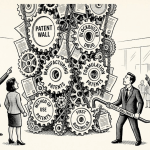
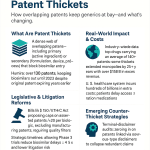
A patent thicket is a collection of overlapping patents on a single commercial product that collectively creates a barrier to generic or biosimilar entry far more formidable than any single patent could. Building an effective thicket requires filing on different aspects of the product with staggered expiration dates, so that as each patent expires, others remain in force and each new challenger must address the current set.
AbbVie’s adalimumab franchise (Humira) is the most extensively studied patent thicket in the pharmaceutical industry. By 2023, when U.S. biosimilar competition finally began to materialize, the Humira patent estate encompassed more than 130 U.S. patents covering adalimumab itself (the monoclonal antibody), its manufacturing cell line, the purification process, the citrate-free formulation, the autoinjector device, dosing regimens for multiple indications, methods of treating rheumatoid arthritis, psoriasis, Crohn’s disease, and ulcerative colitis, among others. No single patent was impenetrable; the thicket as a whole made litigation risk prohibitively high.
IP Valuation: The Humira Patent Estate
Humira’s IP estate represents the clearest case study in patent thicket financial value. Global Humira net revenues peaked at approximately $21.2 billion in 2022. European biosimilar competition began in 2018, when AbbVie’s European patents were narrower and fewer in number, and European biosimilar entrants rapidly captured market share. U.S. biosimilar competition was delayed until 2023 through a combination of the broader U.S. patent estate and settlement agreements with biosimilar manufacturers.
The delta between European biosimilar entry in 2018 and U.S. biosimilar entry in 2023 represents approximately five additional years of substantial U.S. market exclusivity. At peak U.S. net revenues of approximately $15 billion annually (Humira’s U.S.-specific share of global revenues), five years of incremental exclusivity generated an estimated $75 billion in cumulative U.S. revenues that would have been significantly eroded by earlier biosimilar competition. The patent thicket’s net present value, discounted to 2018 entry date at a pharmaceutical-sector weighted average cost of capital, was north of $40 billion. No single formulation patent or device patent in the thicket comes close to that value in isolation; the aggregate barrier effect is what creates the financial return.
Antitrust Exposure: Walker Process, Actavis, and Beyond
Patent thickets and blocking patents create antitrust exposure when they are built on patents of questionable validity or are deployed in settlement structures that divide markets. The Walker Process doctrine allows a defendant in a patent infringement case to counterclaim for antitrust violations if it can prove the patent was procured through fraud on the USPTO. Walker Process claims require proof of subjective intent to deceive, but they are increasingly common as generic challengers recognize that antitrust damages (including trebling) can dwarf what they could recover in patent litigation alone.
The Actavis doctrine, originating from FTC v. Actavis, Inc. (2013), created antitrust exposure for reverse-payment settlements in which a branded company pays a generic challenger to accept a delayed entry date. The FTC has continued active enforcement against such settlements, and the European Commission has pursued similar cases under EU competition law. IP teams should counsel the commercial side on Actavis risk before any settlement term sheet is finalized.
Key Takeaways: Part 7
A patent thicket is only as strong as its weakest patent. Generic manufacturers have learned to identify the most vulnerable patents in a thicket and sequence their challenges strategically, starting with IPR petitions against patents most susceptible to obviousness attacks and using early district court victories to build negotiating leverage. Brand-name companies maintaining large patent thickets should conduct annual ‘red team’ exercises in which internal or outside counsel attacks the portfolio from the generic challenger’s perspective, ranking patents by vulnerability and recommending continuations or reexamination strategies to address identified weaknesses.
Part 8: Biosimilars and the Patent Dance
BPCIA Mechanics and Reference Product Exclusivity
The Biologics Price Competition and Innovation Act of 2009 (BPCIA) established a pathway for FDA approval of biosimilars and interchangeable biologics under Section 351(k) of the Public Health Service Act. A biosimilar is a biologic product that the FDA has determined has no clinically meaningful differences from an FDA-approved reference product in terms of safety, purity, and potency. An interchangeable biosimilar meets a higher standard, demonstrating that it can be expected to produce the same clinical result as the reference product in any given patient and, for a product administered more than once, that the risk of alternating between the reference product and the biosimilar is not greater than using the reference product alone.
Unlike the Hatch-Waxman small-molecule framework, which applies a 20-year patent term to the composition-of-matter, BPCIA provides statutory reference product exclusivity of 12 years from the date of first licensure of the reference product, entirely independent of patent status. No biosimilar can receive final FDA approval until four years after the reference product’s approval, and no biosimilar can launch until 12 years after that approval. This exclusivity period is built into statute and cannot be challenged through litigation; it is absolute.
This 12-year period means that even if a biosimilar manufacturer successfully invalidated every patent in the reference product’s portfolio, it still could not enter the market until the exclusivity period expires. From an IP valuation standpoint, the statutory exclusivity functions as a floor on biologic market exclusivity, and the patent estate functions as a ceiling potentially well above that floor.
The Patent Dance: Step-by-Step Procedure
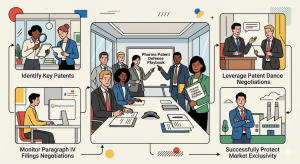
The BPCIA established a complex sequence of disclosures and negotiations between the biosimilar applicant and the reference product sponsor (RPS), colloquially called the ‘patent dance.’ The sequence works as follows:
Within 20 days of FDA acceptance of the 351(k) application, the biosimilar applicant must provide the RPS with a copy of the application and its manufacturing information. Within 60 days of receiving those materials, the RPS must identify a list of patents it believes could reasonably be asserted against the biosimilar. Within 60 days after that, the biosimilar applicant must provide its own list of patents it believes could be asserted, along with its contentions of non-infringement or invalidity for each patent on the RPS list. Within 60 days after receiving those contentions, the RPS must respond with its own infringement contentions.
From this exchange, the parties negotiate a list of patents for ‘immediate litigation’ (Phase I litigation, filed within 30 days of completing the patent list negotiations) and patents to be litigated after the biosimilar’s commercial launch (Phase II litigation). The Supreme Court’s 2017 decision in Amgen Inc. v. Sandoz Inc. clarified that the patent dance is optional for the biosimilar applicant: a biosimilar applicant that chooses not to provide its application to the RPS simply forfeits the right to limit the RPS to Phase I litigation patents, allowing the RPS to sue on any patent it believes relevant at any time before or after launch.
Biosimilar Interchangeability: The Substitution Standard
Biosimilar interchangeability determination is the highest regulatory designation available for a biosimilar in the U.S. An interchangeable product can be substituted for the reference product by a pharmacist without physician intervention in states whose pharmacy laws permit automatic substitution. As of FDA regulations finalized in 2021, any biosimilar meeting the interchangeability standard is automatically eligible for substitution in states with automatic-substitution laws, subject to state-by-state pharmacy regulations.
The commercial significance of interchangeability is primarily at the pharmacy level; it does not affect formulary contracting, PBM rebate negotiations, or hospital purchasing decisions, which are the dominant channels for biologic product selection. Nevertheless, interchangeability matters for retail pharmacy channels, particularly for self-administered biologics like adalimumab auto-injectors, insulin, and certain biosimilar insulins.
Biologic Life Cycle Defense: Technology Roadmap
Biologic life cycle management differs structurally from small-molecule life cycle management because the manufacturing process is part of the product. Regulatory agencies require that changes to a biologic’s manufacturing process be validated as not altering the product’s safety or efficacy, which means that manufacturing process patents carry direct commercial significance in a way that has no precise analog in small-molecule practice.
Stage 1 is composed-of-matter and manufacturing process patents filed at or before the IND stage. For monoclonal antibodies, this includes patents on the antibody sequence itself, its CDR regions, the cell line used for expression, the purification chromatography steps, and the fill-finish formulation.
Stage 2 covers clinical-stage IP filed during Phase II and Phase III: dosing regimen patents, method-of-use patents covering specific indications established in controlled trials, and device patents on the delivery mechanism (auto-injector, pre-filled syringe, implantable device).
Stage 3 covers post-approval secondary and tertiary patents: new indications, combination regimen patents, patient population subgroup methods (pediatric patients, patients with specific genetic variants), new formulations (subcutaneous where the original was intravenous, higher concentration formulations enabling reduced injection volume), and next-generation biologic variants (e.g., Fc-region engineered variants with extended half-life).
Stage 4 is the biosimilar defense phase, where the RPS focuses on maintaining Orange Book equivalents (the ‘Purple Book’ for biologics) listings and prosecuting patent dance proceedings to delay biosimilar launch dates beyond the statutory exclusivity floor.
IP Valuation: AbbVie Humira Biosimilar Settlements and the $200B+ Franchise
AbbVie reached settlement agreements with nine biosimilar manufacturers between 2019 and 2022, providing each a licensed U.S. market entry date of January 2023. The terms of these agreements included licenses to the Humira patent estate in exchange for royalties at an undisclosed rate and the January 2023 entry date. The delay from the first biosimilar approval (Sandoz’s Hyrimoz was approved in 2018) to the licensed U.S. launch date represents approximately 4.5 additional years of largely uncontested U.S. market dominance.
Humira’s cumulative global net revenues from 2002 through 2022 are estimated to exceed $200 billion, the highest-revenue cumulative drug franchise in pharmaceutical history as of that period. The 2023 U.S. biosimilar entry did begin eroding U.S. net revenues, with AbbVie reporting accelerating U.S. Humira sales declines through 2024 as biosimilar manufacturers competed on price and payer formulary positioning. The patent estate did not prevent eventual competition; it defined when that competition began.
Key Takeaways: Part 8
For biologic manufacturers, the 12-year reference product exclusivity is the baseline but not the ceiling. Patent strategy above that floor can add years of protected revenues, as the Humira case demonstrates conclusively. Biosimilar applicants considering whether to engage in the patent dance should consult Sandoz v. Amgen carefully: opting out forfeits the Phase I/Phase II litigation structure but does not prevent litigation; it just removes the timing framework. The biosimilar interchangeability designation matters more in retail pharmacy channels than in institutional settings, and the commercial strategy should reflect that distinction.
Part 9: Investment Strategy
Reading the Orange Book as a Financial Signal
The Orange Book is publicly available and free to search. For analysts monitoring pharmaceutical company revenue streams, it is among the most directly actionable data sources available. Every drug product with an Orange Book listing has a mapped patent expiration profile, and that profile is the primary input to any discounted cash flow model for branded pharmaceutical revenue.
The standard analytical exercise is to identify the last-expiring Orange Book patent for each major product and use that date as a conservative terminal exclusivity date. The more sophisticated analysis identifies which of the listed patents are most legally vulnerable, typically secondary patents filed late in the drug’s lifecycle with narrow claims, and applies a probability of patent challenge success to adjust the expected exclusivity duration.
Products with heavy secondary-patent reliance in their Orange Book listings, where the composition-of-matter patent has already expired or will expire within two years, carry measurably higher generic challenge risk than products where the composition-of-matter patent still has substantial life. This is not a novel observation, but the granularity available from commercial patent intelligence platforms now allows analysts to model it at the individual claim level.
PTAB Filing Rates as a Leading Indicator
A new IPR petition filed against a drug’s Orange Book patent is an actionable signal. It represents a third-party assessment that the patent is vulnerable, backed by at least the resources required to prepare and file a PTAB petition (typically $100,000 to $500,000 in legal and technical costs). Multiple IPR petitions filed against the same patent within a short window signal coordinated challenge activity and indicate that multiple generic manufacturers are preparing for market entry.
Analysts should track PTAB filing rates against branded pharmaceutical patents as a leading indicator of competitive entry pressure. A spike in IPR filings 12 to 18 months ahead of a listed patent’s expiration date is a typical pre-litigation signal preceding a Paragraph IV wave.
Paragraph IV as a Catalyst Event
A Paragraph IV notification is a disclosed, quantifiable event with predictable financial consequences. For the brand-name company, it triggers a 45-day decision window, initiates litigation costs, and sets a clock on potential generic entry. For analysts, it is a catalyst that shifts the probability distribution of revenue outcomes.
The standard market reaction to a Paragraph IV disclosure is a decline in brand-name company share price, with magnitude proportional to the revenue concentration in the challenged product and the market’s assessment of patent validity. Paragraph IV notifications are not always publicly disclosed immediately (they are not SEC-reportable events per se unless material), but they typically become public through the FDA’s patent certification database and through quarterly earnings calls.
The investment opportunity, from an analyst’s perspective, lies in the information asymmetry between the public market’s binary read of a Paragraph IV as a simple negative event and the actual probability-weighted outcome, which depends on patent validity, claim scope, litigation history of the specific patents, the track record of the involved generic companies, and the settlement dynamics specific to the product.
Key Analyst Metrics
The most useful metrics for patent defense assessment at the portfolio level are: years of remaining exclusivity weighted by product revenue (a composite score that accounts for both patent depth and commercial scale); Orange Book patent count per product (higher counts correlate with more settlement negotiating leverage but also higher litigation cost exposure); IPR petition success rate for patents in the same technology classification (predictive of future challenge risk for structurally similar patents); and the ratio of secondary patents to composition-of-matter patents by expiration date (a higher ratio signals evergreening reliance and therefore higher secondary-patent challenge risk).
Analysts should also track the FTC’s annual reports on reverse-payment settlements. These reports document the volume, structure, and settlement amounts involved in Hatch-Waxman litigation resolutions. A trend toward more settlements with cash compensation from brand to generic, relative to authorized-generic licenses, signals increasing brand-side concessions and therefore greater generic challenge effectiveness across the industry.
Master Key Takeaways
A pharmaceutical patent portfolio is a financial asset, and it should be managed with the same rigor applied to any other asset class on the balance sheet.
The composition-of-matter patent is the foundation, but secondary patents built around formulations, dosing regimens, methods of use, and polymorphs are where life cycle management creates or destroys terminal exclusivity value. Those secondary patents must be filed on a planned schedule tied to clinical development milestones, not as an afterthought.
The 45-day Paragraph IV response window is not flexible. Every Orange Book patent should have pre-built litigation readiness materials, including identified counsel, preliminary claim construction positions, and available expert witnesses, so that the litigation decision is made on strategic grounds rather than under deadline pressure.
PTAB has permanently changed the post-grant validity environment. IPR petitions are faster, cheaper, and use a lower evidentiary standard than district court invalidity challenges. Red-teaming the portfolio against the prior art landscape at least annually, with the specific goal of identifying IPR vulnerabilities before generic challengers do, is no longer optional for any company with major products in Orange Book coverage.
Evergreening is a legal practice built into the structure of both the patent system and the FDA regulatory exclusivity framework. Executing it well requires coordinated IP, regulatory, and commercial strategy over a product’s full lifecycle. The window to file the most valuable secondary patents is during late-stage clinical development, before NDA approval, not after.
The BPCIA’s 12-year reference product exclusivity is a statutory floor for biologics, not a ceiling. AbbVie’s ability to extract additional years of U.S. exclusivity through its patent thicket strategy above that floor is the clearest demonstration of the financial return on investment in a comprehensive biologic patent portfolio.
For institutional investors, the Orange Book and PTAB petition databases are primary source documents that should inform every pharmaceutical equity position. The information advantage available to analysts who work these datasets in detail is real and persistent.
Frequently Asked Questions
What is the single most consequential step in building a defensible pharmaceutical patent portfolio?
Filing a composition-of-matter patent early and broadly, before any public disclosure of the compound, is the most consequential single decision. Once the compound is publicly disclosed without a filed patent application, prior art is created that limits the scope of any subsequent claims. After the composition-of-matter filing, the second most consequential step is planning the secondary patent filing timeline concurrently with clinical development.
Is evergreening illegal?
No. Pharmaceutical companies are entitled to patent any new and non-obvious invention, including improvements on existing drugs. The practice becomes legally problematic only when it is implemented through anticompetitive commercial conduct, such as hard product hopping designed to foreclose generic competition, or through reverse-payment settlements above Actavis thresholds.
How has the PTAB changed the risk profile for pharmaceutical patents?
The PTAB reduced the cost and time of patent challenges and lowered the evidentiary standard for proving invalidity from clear and convincing evidence to a preponderance. Secondary patents, particularly formulation and dosing-regimen patents, are more exposed than composition-of-matter patents because their obviousness is easier to argue with published scientific literature. Companies should build continuation filing strategies to ensure that if a parent patent is canceled in IPR, a continuation with refined claims can take its place.
What does the patent dance mean for biosimilar launch timing?
The patent dance is optional. Biosimilar applicants who participate define the litigation schedule cooperatively with the reference product sponsor. Applicants who opt out allow the sponsor to sue on any patent at any time but are not bound by the Phase I/Phase II litigation structure. In practice, the dance’s strategic value to biosimilar applicants is in narrowing the number of patents available for immediate litigation; its value to the sponsor is in securing structured discovery into the biosimilar’s manufacturing process.
How should a small or mid-cap branded pharma company approach patent defense against a large generic challenger?
Focus resources on the patents most likely to be challenged and most commercially significant. A targeted defense of the two or three patents covering the commercial product’s specific formulation and key methods of use is more cost-effective than attempting to litigate every Orange Book listing. Authorized-generic rights are valuable negotiating currency: a small company that can credibly threaten to launch an AG during the first-filer’s 180-day window gains settlement leverage disproportionate to its litigation budget.
Data sourced from publicly available Orange Book filings, USPTO PTAB records, FDA biosimilar approvals database, company financial disclosures, and commercial patent intelligence sources including DrugPatentWatch, Clarivate, and FDA Purple Book.