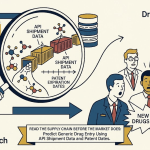
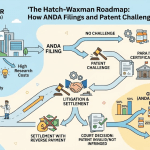
A Paragraph IV certification feels like an ambush when a generic company files it. It rarely is one for the brand. The filing date sits inside a statutory window that anyone with a calendar and an Orange Book subscription can calculate months in advance. The notice period is fixed at 20 days. The stay is fixed at 30 months. The exclusivity clock is fixed at 180 days. None of that is secret, and brand legal teams have spent three decades building playbooks around exactly how predictable the whole sequence is.
This piece walks through where that predictability comes from, the specific tactics brands have used to exploit it, and what a generic manufacturer or IP team can do once it accepts that the element of surprise disappeared around 1998. Every case cited below is real, with docket numbers, settlement figures, and court holdings drawn from FTC actions, federal appellate opinions, and SEC filings. DrugPatentWatch’s patent and litigation database is referenced throughout as one way to track these signals as they develop, since most of the tactics described here show up in Orange Book listing dates and ANDA litigation filings well before they show up in a press release.
What “Predictable” Actually Means in a Paragraph IV Filing
Short answer: A Paragraph IV filing is predictable because the Hatch-Waxman Act fixes the timing of every major event around it, from the earliest date a generic can legally file to the length of the automatic stay a brand receives once it sues. Brands do not need to guess when a challenge is coming. They model it.
Two things get confused when people talk about “predictable” Paragraph IV strategy. One is the generic side: which patents a challenger will pick, and when it will file against them. The other is the brand side: how a brand times its own conduct, patent listings, citizen petitions, product reformulations, settlement terms, to land at the exact moments generic activity is statutorily required to happen. This article is mostly about the second kind, because that is the half of the equation most content on Hatch-Waxman skips.
The Hatch-Waxman Clock: Every Filing Date Is Already on Someone’s Calendar
The Drug Price Competition and Patent Term Restoration Act of 1984, better known as Hatch-Waxman, built the generic approval pathway around a small number of fixed intervals. Once you know a drug’s approval date, its Orange Book listings, and its exclusivity codes, you can back into nearly every date that matters for the next five years.
The Day-One Filing Cluster After NCE Exclusivity Expires
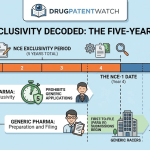
For a new chemical entity, the FDA grants five years of exclusivity during which no ANDA can even be submitted, four years if the generic includes a Paragraph IV certification. That fourth-year date is public the moment the NDA is approved. Generic companies that want first-filer status file on that exact day, sometimes within the same hour as several competitors, because being even a day late can mean sharing or losing the 180-day exclusivity prize entirely. Brand teams know this date with the same precision the generics do. A patent listed the week before that date, or a citizen petition filed the month before it, is not a coincidence.
The 45-Day Notice Window and the Automatic 30-Month Stay
Once an ANDA with a Paragraph IV certification is filed, the applicant has 20 days to notify the patent holder and the NDA holder. That notice starts a 45-day countdown. If the brand sues within those 45 days, an automatic stay of up to 30 months kicks in, and the FDA cannot approve the ANDA until the litigation resolves or the clock runs out, whichever comes first [1]. Nothing about that sequence depends on the merits of the underlying patent. A brand gets the stay by suing on time, full stop. That is why brand litigation counsel treats the 45-day window less like a deadline and more like a trigger they pull the moment notice arrives.
180-Day Exclusivity and the Race-to-File Problem
The reward for being first is 180 days during which the FDA cannot approve a second ANDA for the same product. That exclusivity period made Hatch-Waxman work as intended for years, then generic companies started filing on the exact same day to split it. FDA guidance confirms that every applicant filing a substantially complete ANDA on the earliest possible day is treated as a co-first-filer sharing the exclusivity period [1]. That guidance itself is a predictability signal: the agency had to formalize what happens when dozens of companies converge on one date, because that convergence became routine rather than exceptional.
How FDA Guidance Defines a “Same-Day” Filer
The FDA’s small business guidance on 180-day exclusivity spells out that the “first applicant” definition covers every ANDA that is substantially complete and contains a Paragraph IV certification on the first day any such application is submitted for that drug product, regardless of the hour it was received [1]. That single administrative clarification turned Day One filing into an industry event with a known date, known stakes, and, for brand teams, a known moment to have already finished loading the Orange Book.
The Four Predictable Moments a Brand Can Plan Around
Strip away the statutory language and four dates repeat across nearly every branded product approaching loss of exclusivity:
The day the four-year NCE window opens and Day One filers submit their ANDAs
The 45-day window after notice, when a brand decides whether to sue and trigger the stay
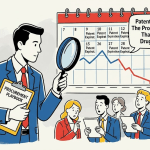
The point 18 to 30 months before an expected generic approval, when citizen petitions statistically cluster
The date a first-filer’s 180-day exclusivity is expected to begin, when authorized generic and settlement decisions get made
Every tactic covered in the rest of this article maps to one of those four moments. None of them require a brand to know something a generic does not. They require a brand to act early against a date everyone already knows.
Orange Book Listing Sprees: Loading the Thicket Before the Window Opens
Short answer: Because a properly listed Orange Book patent gives a brand an automatic 30-month stay against any generic that challenges it, brands have an incentive to list as many patents as possible before the predictable Day One filing wave, even patents regulators later find should never have been listed at all.
Listing a patent in the Orange Book is a request, not a certification of merit reviewed by the FDA at the time of listing. The agency accepts the submission and lists it. That asymmetry, list first, litigate the propriety of the listing later if anyone bothers, is what turned Orange Book listing into a volume game for some manufacturers.
Timeline: The FTC’s Junk Patent Campaign, September 2023 to Present
The Federal Trade Commission has spent the past two years building a public record of what it considers improper listings, and the pattern maps directly onto device-heavy, high-volume products where an extra 30-month stay is worth the most.
September 2023: The FTC issues a policy statement warning that listing patents which do not meet the statutory listing criteria may violate Section 5 of the FTC Act [7].
November 7, 2023: The FTC sends warning letters to 10 manufacturers, disputing more than 100 patents covering asthma inhalers, epinephrine autoinjectors, and Restasis multidose bottles [6].
Early 2024: Kaleo, Impax Labs, and GlaxoSmithKline delist patents in response; AstraZeneca, Boehringer Ingelheim, and GSK separately commit to capping inhaler out-of-pocket costs at $35 [7].
April 30, 2024: The FTC expands the campaign, disputing more than 300 additional patents across 20 branded products, including Novo Nordisk’s Ozempic [7].
June 2024: A New Jersey district court orders Teva to delist five ProAir HFA inhaler patents after Amneal challenges them.
December 20, 2024: The Federal Circuit affirms the delisting order in Teva Branded Pharmaceutical Products v. Amneal [8][9].
May 21, 2025: The FTC issues a third round of warning letters, its first since the Federal Circuit’s Teva v. Amneal decision [16].
Case Study: Teva v. Amneal and the ProAir HFA Device Patents
Amneal filed an ANDA for a generic version of Teva’s ProAir HFA albuterol inhaler and, in the same filing, a Paragraph IV certification asserting non-infringement of nine listed patents. Teva sued on six of them within the 45-day window, triggering the automatic stay exactly as the statute allows. Amneal counterclaimed, arguing that the patents covering the inhaler’s dose counter and canister mechanics did not belong in the Orange Book at all, because they never claimed albuterol sulfate, the active ingredient [8].
What the Federal Circuit Actually Decided in December 2024
The Federal Circuit agreed with Amneal. A patent must claim the drug for which the NDA was approved, and claiming the drug means claiming at least the active ingredient. Device components alone, however integral to how the product is delivered, do not satisfy that requirement [9]. The court rejected Teva’s argument that any patent covering any part of the approved product qualifies for listing. The FTC filed an amicus brief supporting delisting and, after the ruling, publicly endorsed the outcome [9].
The commercial mechanics matter more than the legal reasoning for anyone modeling filing strategy. Teva’s inhaler patents bought it a 30-month stay against Amneal’s ANDA the moment Teva sued, regardless of whether the patents would eventually survive scrutiny. Amneal had to litigate the delisting question for roughly two years to get the stay lifted early. That gap between “list now, get the stay now” and “defend the listing in court over the following two years” is the entire point of a listing spree. The 30-month clock starts on filing suit, not on winning the underlying patent argument.
What Counts as a Listable Patent Now
After Teva v. Amneal, device-only patents that never mention the active ingredient are much harder to defend in the Orange Book, at least within the Federal Circuit’s jurisdiction. Combination product manufacturers, inhalers, autoinjectors, prefilled syringes, are the group most exposed, since their patent portfolios often include claims on delivery mechanisms separate from the drug substance claims. The FTC’s ongoing letter campaign specifically targets that category: inhalers, epinephrine autoinjectors, and injectable pens for weight-loss and diabetes drugs [7].
Which Manufacturers Delisted Patents After the FTC’s Letters
Kaleo, Impax Laboratories, GlaxoSmithKline, and Glaxo Group delisted patents following the FTC’s November 2023 letters [7]. Others held their ground. When the FTC sent a second round of warning letters in April 2024 targeting over 300 additional patents, none of the original ten recipients delisted anything further, and several affirmatively recertified that their existing listings were proper [40]. That split response is itself informative: some brand teams treat an FTC dispute letter as a signal to fold quickly, and others treat it as a cost of doing business worth absorbing for as long as the listing keeps generating stays.
Citizen Petitions Filed on a Predictable Countdown to Generic Approval
Short answer: Citizen petitions targeting generic drugs are denied by the FDA roughly 92 percent of the time, yet brands keep filing them, because a petition does not need to succeed on the merits to delay an approval date that everyone already knows is coming.
Any person can file a citizen petition asking the FDA to take or refrain from taking an action. Section 505(q) of the FDCA specifically addresses petitions that could delay approval of a generic, biosimilar, or 505(b)(2) application, and gives the FDA up to 150 days to respond [13].
The 505(q) Petition Clock and the 150-Day Response Deadline
A petition filed close to a generic’s expected approval date forces the FDA to work through the substance of the petition, or at minimum document why it does not need to, before it can act on the ANDA. Researchers Michael Carrier and Carl Minniti found that the FDA denies 92 percent of petitions targeting drugs pending generic approval, and that finding has become the standard reference point for how ineffective these petitions are on the merits [10]. The same research base shows the FDA overwhelmingly resolves these petitions right around the time it acts on the associated generic application, which is exactly what you would expect if petitions are timed to that date rather than to any independent safety concern [12].
Research on citizen petitions filed between 2000 and 2012 found that nearly half of the petitions capable of delaying generic entry were submitted within eighteen months of the FDA’s expected generic approval date, and roughly forty percent were filed within a single year of that date [12].
That clustering is the tell. A petition raising a genuine, newly discovered safety issue would not correlate so tightly with a competitor’s regulatory timeline. A petition designed to buy time would correlate with almost nothing else.
Case Study: Ambien’s 1,225-Day Delay and Sanofi’s $3.1 Billion
One frequently cited study found that citizen petitions targeting generic versions of Sanofi’s insomnia drug Ambien delayed generic entry by a combined 1,225 days across the petitions filed against it, during which Sanofi generated an estimated $3.1 billion in additional branded sales [11]. Every one of those petitions had to be resolved before the associated ANDAs could move forward, and the resolution windows lined up with the FDA’s 150-day statutory clock rather than with any new clinical data becoming available mid-review.
Case Study: AstraZeneca’s Crestor Petition and ViroPharma’s Vancocin Campaign
AstraZeneca petitioned the FDA over generic versions of its statin Crestor as patent protection wound down; the review process the petition triggered led to litigation that ultimately delayed all but one authorized generic launch by several months [13]. ViroPharma took a more sustained approach with its antibiotic Vancocin, filing a sequence of citizen petitions and related lawsuits that the FTC later characterized as a coordinated campaign to keep generic competition off the market for years [12]. Neither company needed its petitions to succeed. Both needed the review clock to run.
Why Brands File Petitions the FDA Will Almost Certainly Deny
A 150-day maximum response window, applied against a generic approval date the brand already knows within a few weeks, is worth more in delayed competition than the petition costs to prepare and file. Even the FDA’s own 2019 final guidance on Section 505(q), issued specifically to curb this behavior, concedes the agency has rarely delayed a specific approval solely because of a pending petition, while acknowledging the practice still burdens the review process [13][53]. The economics only make sense if you assume the filer already knows the timeline it is trying to interrupt, which, again, is public information.
Product Hopping: Moving the Target Before the Generic Can Substitute
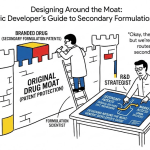
Short answer: A generic version only threatens the branded product it was designed to match. If the brand discontinues that exact formulation and shifts prescribing volume to a new one before the patent expires, state substitution laws can no longer automatically route patients to the generic, even after it launches.
Namenda IR to XR: What the Second Circuit Actually Ruled in 2015
Forest Laboratories, later Actavis, held a twice-daily Alzheimer’s drug, Namenda IR, generating roughly 1.5 billion dollars a year, with generic entry expected in July 2015 [24]. Rather than compete on the merits of a once-daily reformulation, Namenda XR, the company announced it would discontinue Namenda IR entirely before generics arrived, then lobbied Medicare and Medicaid formularies to drop IR and pushed prescribers to move patients to XR. Internally, the company projected that only 30 percent of patients would switch voluntarily if IR stayed on the market, which is why it chose withdrawal instead [21].
New York’s attorney general sued, and the Second Circuit upheld a preliminary injunction requiring Actavis to keep Namenda IR available at least through the generic’s July 2015 launch [23]. The court drew a clear line: persuading prescribers to switch voluntarily, a “soft switch,” is ordinary competition, while withdrawing the old product to force the switch, a “hard switch,” crosses into unlawful exclusionary conduct under Section 2 of the Sherman Act [25].
Soft Switch vs Hard Switch, Compared
Element
Soft Switch
Hard Switch
Old formulation availability
Stays on the market
Withdrawn before generic entry
Patient choice
Preserved; substitution laws still apply
Eliminated; no branded reference left to substitute against
Antitrust exposure
Generally lawful, ordinary competition
Found unlawful in New York v. Actavis
Real example
Marketing push toward a new formulation while the old one remains sold
Namenda IR discontinuation ahead of July 2015 generic launch
Suboxone Tablets to Film: A Decade of Litigation Against Reckitt Benckiser and Indivior
Before generic Suboxone tablets could reach the market, Reckitt Benckiser developed a dissolvable film version of the same buprenorphine-naloxone combination and worked to move prescriptions to it. According to the FTC, the company represented that the film was safer than the tablet because of a lower risk of accidental child exposure, a claim the agency later alleged was unsupported and part of a deliberate scheme to defeat generic tablet competition [33].
Timeline: From the 2012 Citizen Petition to the 2023 State AG Settlement
2012: Indivior submits a citizen petition to the FDA asserting that Suboxone tablets had been discontinued over safety concerns, a claim the FTC later called false [34].
July 2020: Reckitt Benckiser agrees to pay 50 million dollars to resolve FTC antitrust charges tied to the film-to-tablet product hop [33].
Shortly after: Indivior agrees to pay 10 million dollars to resolve related FTC allegations [33].
November 2020: Indivior enters a 10-year stipulated FTC order requiring advance notice of any future citizen petition, new formulation filing, or corporate restructuring, running through November 2030 [28].
May 2021: The FTC distributes more than 59 million dollars to affected consumers [29].
June 13, 2023: Indivior settles antitrust claims brought by 41 state attorneys general and the District of Columbia, agreeing to notification terms that mirror the FTC order [31].
October 22, 2023: Indivior finalizes a related settlement in the direct-purchaser multidistrict antitrust litigation [30].
What makes the Suboxone case instructive is the length of the tail. A single product hop and one supporting citizen petition, both executed years before generic tablets ever launched, generated litigation and regulatory reporting obligations that ran for more than a decade afterward. The predictability worked in both directions: the company could time its film launch and safety claims around the tablet’s known patent expiration, and once caught, its ongoing FTC order requires it to disclose the exact tactics, citizen petitions and new formulation filings, that made the original scheme work.
Pay-for-Delay Settlements Timed to the Litigation Calendar
Short answer: When a brand sues a first-filer within the 45-day window, it buys up to 30 months of stay automatically. If litigation risk still looks bad as that period runs out, a reverse payment settlement lets the brand purchase additional years of delay directly, a tactic the Supreme Court allowed to continue under antitrust scrutiny rather than banning outright.
FTC v. Actavis and the Rule of Reason Standard for Reverse Payments
Solvay Pharmaceuticals held the patent on AndroGel, a testosterone gel. Actavis and Paddock filed ANDAs with Paragraph IV certifications; Solvay sued, and litigation proceeded until the parties settled in 2006. Under the settlement, Actavis agreed not to launch its generic until August 2015, 65 months before Solvay’s patent would expire, while Solvay paid an estimated 19 to 30 million dollars annually for nine years, plus lump sums to the other generic parties [62].
The Eleventh Circuit had held such settlements immune from antitrust challenge as long as their effects stayed within the scope of the underlying patent. The Supreme Court disagreed in its 2013 decision, holding that reverse payment settlements are not presumptively lawful or unlawful but must be evaluated under a rule-of-reason analysis that weighs the payment’s size against the payor’s likely litigation costs and any independent business justification [65]. The ruling did not ban reverse payments. It made them litigable, which changed how brands structure them rather than whether they attempt them at all.
Case Study: Cephalon, Provigil, and the $1.2 Billion Disgorgement
Cephalon’s narcolepsy drug Provigil generated 475 million dollars in 2005 sales and roughly double that by 2007 [13]. Facing Paragraph IV challenges from four generic manufacturers, Cephalon paid those companies more than 200 million dollars combined in late 2005 and early 2006 to drop their patent challenges and stay off the market until 2012 [16][18]. The FTC sued in 2008. Five days before trial was set to begin in June 2015, Teva, which had acquired Cephalon in 2012, agreed to disgorge 1.2 billion dollars, the largest monetary settlement in FTC history at the time, to compensate purchasers who had overpaid [11]. Teva also agreed to a permanent injunction barring the specific type of reverse-payment settlement Cephalon had used [12].
How the 2003 Forfeiture Provisions Changed What Brands Can Offer
Congress added forfeiture provisions to the Medicare Modernization Act of 2003 specifically to close a loophole reverse payments had been exploiting: a first-filer could sit on its 180-day exclusivity indefinitely without launching, blocking every subsequent generic from entering while never actually competing itself. Under those provisions, a first filer can now forfeit exclusivity for failing to market within a set window, or for entering certain disqualifying agreements with the brand [7]. That change did not eliminate reverse payments. It changed the negotiating table, since a settlement that would trigger forfeiture is worth less to both sides than one carefully structured to avoid it, which is one reason post-2003 settlement agreements read very differently from the Cephalon-era deals that prompted the FTC’s original enforcement push.
What a “Reverse Payment” Actually Looks Like in a Settlement Term Sheet
Cash rarely changes hands labeled as payment for delay anymore. The Cephalon and Actavis-Solvay agreements instead routed value through promotion agreements, manufacturing contracts, or side licenses that generic companies would not otherwise need, structured so the independent business justification looks defensible on paper even when the practical effect is the same as a direct cash payment for staying off the market [63][65].
Authorized Generics: Diluting the Prize the First Filer Just Won
Short answer: A brand can launch its own authorized generic, an identical product sold under a generic label, the same day the first-filer’s 180-day exclusivity begins, cutting the first-filer’s exclusive market in half without violating any Hatch-Waxman provision.
The 180-day exclusivity statute protects the first-filer from other ANDA holders. It does not protect the first-filer from the brand’s own authorized generic, which is not an ANDA at all but a version of the branded NDA product sold without the brand name. Brands that expect to lose a Paragraph IV challenge, or that settle rather than litigate to judgment, frequently negotiate the right to launch an authorized generic on the same day the first-filer’s exclusivity starts. That single move turns a temporary duopoly the statute intended to reward the risk-taking first-filer into a three-way split from day one, since the brand’s authorized generic captures volume the first-filer expected to have entirely to itself.
What Happens If a Brand Launches an Authorized Generic on Day One of Exclusivity
The financial model changes immediately. A first-filer that priced its 180-day launch expecting to be the only generic alternative to the brand instead faces a second, often lower-cost competitor from day one, backed by the brand’s own manufacturing and supply relationships. Because the decision to launch an authorized generic can be made unilaterally and does not require FDA approval of a new application, brands can hold that decision until the exact date exclusivity is set to begin, which is, again, a date fixed well in advance by the statutory clock rather than by anything the first-filer controls.
Paragraph IV Predictability vs the Biosimilar Patent Dance
Small-molecule generics operate under Hatch-Waxman. Biologics operate under the Biologics Price Competition and Innovation Act, and the two frameworks create very different predictability profiles.
Hatch-Waxman vs BPCIA: A Side-by-Side Comparison
Element
Hatch-Waxman (small molecule)
BPCIA (biosimilar)
First-mover incentive
180-day exclusivity for first Paragraph IV filer
No equivalent first-filer exclusivity
Filing clustering
Strong; Day One filings common
Weak; no single trigger date rewards being first
Patent disclosure process
Orange Book listing, public and searchable
Confidential “patent dance” exchange between parties
Automatic litigation stay
Up to 30 months once brand sues within 45 days
No automatic stay; injunctive relief litigated case by case
Predictability driver
Fixed statutory dates known to both sides in advance
Negotiated disclosure timeline, less externally visible
Because the patent dance keeps early disclosures between the parties rather than in a public database, brands defending biosimilars cannot pre-position Orange-Book-style listing sprees the way small-molecule brands do. The predictability that drives so much small-molecule gamesmanship is largely a function of Hatch-Waxman’s public, dated statutory triggers, not something inherent to pharmaceutical patent litigation generally.
Why the Patent Dance Removes the Race-to-File Incentive
Without a 180-day exclusivity prize reserved for a single first mover, biosimilar applicants have less reason to cluster filings on one specific day, and correspondingly less predictable timing for brands to plan defensive listings or petitions against. The tradeoff is a slower, more negotiated disclosure process that keeps more information out of public view until later in the timeline.
Building a Filing Strategy That Does Not Assume the Brand Is Asleep
Every tactic above depends on the brand knowing a date the generic side also knows. That symmetry is the opening. A generic manufacturer that treats its own filing date as strategic information, not just a compliance deadline, can blunt several of these tactics before they start.
Diversifying Filing Dates Instead of Clustering on Day One
Being first matters for 180-day exclusivity, but chasing Day One on every single product is not always the highest-value move, particularly against a brand with a documented history of listing sprees or citizen petition campaigns on similar products. Modeling the brand’s prior behavior on comparable drugs, inhalers, autoinjectors, extended-release reformulations, before committing legal spend to a Day One race can reveal whether the fight is worth the predictable resistance waiting on the other side.
Monitoring Orange Book Changes and Patent Listing Disputes in Real Time
A late-added patent, filed weeks before an expected Day One filing wave, is a visible signal once you know to look for it. Tracking listing dates against known exclusivity expiration dates, rather than just tracking the drug itself, surfaces listing sprees before they turn into litigation. The same applies to citizen petitions: a petition filed 12 to 18 months before an expected ANDA action date fits the pattern documented across the Ambien, Crestor, and Vancocin cases far more than it fits a genuine, newly surfaced safety concern [11][12][13].
Red Flags That a Patent Thicket Was Built for Litigation, Not Protection
Device-only claims added to a drug-substance patent portfolio shortly before a predictable filing window, patents with priority dates clustered around known competitor development timelines rather than the original NDA approval, and listings that survive an FTC dispute letter unchanged while comparable listings elsewhere get quietly withdrawn are three patterns worth flagging in any pre-filing patent landscape review.
What This Means for Generic Manufacturers
None of this is about avoiding predictable dates altogether, since the statute does not allow that. It is about entering those dates with a documented view of how a specific brand has behaved on comparable products before, so a listing spree, a citizen petition, or a settlement offer with hidden forfeiture triggers gets recognized for what it is on day one instead of six months into litigation.
What This Means for Brand Teams Managing Loss of Exclusivity
The FTC’s escalating Orange Book enforcement, the Teva v. Amneal precedent, and the growing willingness of courts to scrutinize reverse payments under Actavis all point the same direction: tactics that relied on predictability being one-sided are becoming more expensive to run. A listing that generates a 30-month stay today can generate an antitrust counterclaim and years of litigation tomorrow, as Teva discovered. A citizen petition timed to a known approval date is now filed against a regulatory backdrop where the FDA has publicly committed to scrutinizing exactly that pattern [13][58].
Why Predictability Cuts Both Ways for Brand Teams
The same fixed statutory calendar that lets a brand plan a listing spree also lets the FTC, state attorneys general, and generic litigants plan their response. Indivior’s 10-year FTC reporting obligation and Teva’s two-year fight to keep patents it ultimately lost both show that a tactic built entirely around known dates is, by definition, visible to regulators working from the same calendar.
Where Enforcement Is Headed: FTC Action and Pending Legislation
The FTC issued its third round of Orange Book warning letters in May 2025, its first since the Federal Circuit’s Teva v. Amneal ruling, signaling the agency intends to keep using the case as precedent for future listing disputes [16]. Congressional proposals have circulated for several years without passage, aimed at closing the gaps this article has walked through.
The Drug Competition Enhancement Act and Pending Product-Hopping Bans
Proposed legislation including the Drug Competition Enhancement Act would give the FTC explicit statutory authority to challenge product hopping directly, rather than relying on Sherman Act Section 2 monopolization theory case by case as New York did against Actavis, and would direct the FDA to request evidence of incremental clinical value before certain patents can be listed at all [59]. None of these proposals have been enacted as of this writing, which means the current toolkit, FTC policy statements, Federal Circuit patent-listing decisions, and Actavis-era antitrust theory, remains the primary check on the tactics described above.
How DrugPatentWatch Data Changes the Predictability Calculus
Everything described in this article leaves a paper trail before it becomes a headline: an Orange Book listing dated weeks ahead of a Day One filing wave, a citizen petition filed inside the 18-month window the research literature flags, a settlement filing that specifies a launch date years past patent expiration. DrugPatentWatch aggregates that trail, patent listings, ANDA litigation dockets, exclusivity codes, and FDA correspondence, into a single searchable record, which is the practical version of what this article has been arguing in the abstract: none of these tactics require inside information to see coming.
What Predictive Monitoring Actually Looks Like
In practice, that means setting alerts against a specific drug’s exclusivity expiration date rather than checking the Orange Book periodically, cross-referencing new patent listings against the litigation history of the same brand on comparable products, and treating a citizen petition’s filing date, not just its content, as the first piece of evidence worth evaluating.
Key Takeaways
Every major Paragraph IV date, the Day One filing window, the 45-day notice period, the 30-month stay, and the 180-day exclusivity clock, is fixed by statute and calculable by both sides in advance.
Brands exploit that shared calendar through Orange Book listing sprees, citizen petitions timed to known approval dates, product hops executed before generic entry, reverse payment settlements, and authorized generics launched on day one of a competitor’s exclusivity.
The FTC’s Orange Book enforcement campaign, running from September 2023 through at least May 2025, and the Federal Circuit’s December 2024 ruling in Teva v. Amneal, are actively narrowing what patents can generate an automatic stay.
Citizen petitions targeting pending generics are denied roughly 92 percent of the time, yet remain common because the delay value does not depend on the petition succeeding.
Generic manufacturers can blunt these tactics by modeling a specific brand’s prior behavior on comparable products rather than treating every Day One filing as a fresh, unpredictable event.
FAQ
Is it illegal for a brand to list a patent in the Orange Book that later turns out to be improper? Listing itself is not automatically illegal, but the FTC has taken the position since September 2023 that listing patents which do not meet statutory criteria can violate Section 5 of the FTC Act, and the Federal Circuit’s Teva v. Amneal decision gives generic challengers a clearer path to force delisting and bring antitrust counterclaims [7][9].
How long does a 30-month stay actually last in practice? Up to 30 months from the date the brand files suit within the 45-day notice window, though it can end earlier if the litigation resolves in the generic’s favor or the patent is delisted before then, as happened in Teva v. Amneal.
Can a brand file more than one citizen petition against the same generic application? Yes, and campaigns involving multiple sequential petitions, as seen with ViroPharma’s Vancocin, are part of what prompted the FDA’s 2019 final guidance targeting petitions filed primarily to delay approval [12][13].
Does winning a Paragraph IV lawsuit guarantee a generic company will actually launch its product? No. A first-filer can still forfeit its 180-day exclusivity under the 2003 Medicare Modernization Act forfeiture provisions if it fails to market within the required timeframe or enters certain disqualifying settlement terms with the brand.
What is the difference between a soft switch and a hard switch in product hopping? A soft switch keeps the old formulation on the market while marketing a new one, which courts generally treat as ordinary competition; a hard switch withdraws the old formulation entirely before generic entry, which the Second Circuit found unlawful in New York v. Actavis when applied to Namenda IR.
Are authorized generics regulated the same way as ANDA-approved generics? No. An authorized generic is the branded NDA product sold under a generic label, not a separately approved ANDA, so it is not subject to the 180-day exclusivity provisions that protect a first Paragraph IV filer from other ANDA holders.
Did the Supreme Court ban reverse payment settlements in FTC v. Actavis? No. The Court held such settlements are not presumptively lawful or unlawful, and must be evaluated under a rule-of-reason antitrust analysis weighing the payment’s size against the payor’s litigation costs and any independent justification [65].
Why did the FTC target inhalers and autoinjectors specifically in its Orange Book campaign? Combination drug-device products carry patent portfolios that often include claims covering the delivery device separately from the active ingredient, which is exactly the category the Federal Circuit found improper for Orange Book listing in Teva v. Amneal, since a listable patent must claim at least the active ingredient [7][9].
How much did citizen petitions cost consumers in the Ambien case? Research estimates the petitions filed against generic Ambien delayed entry by a combined 1,225 days, during which Sanofi generated an estimated 3.1 billion dollars in additional branded sales [11].
What happened to Indivior after the Suboxone product-hopping case? Indivior paid 10 million dollars to resolve FTC charges in 2020, entered a 10-year FTC stipulated order requiring advance notice of citizen petitions and new formulation filings through November 2030, and separately settled antitrust claims from 41 state attorneys general and the District of Columbia in June 2023 [28][31][33].
Sources
U.S. Food and Drug Administration. (2023). Small Business Assistance: 180-Day Generic Drug Exclusivity. FDA.gov.
Federal Trade Commission. (2015). Statement of the Federal Trade Commission: FTC v. Cephalon, Inc. FTC.gov.
Mintz. (2015). Second Circuit Holds a Hard Switch Between Drugs Is an Unlawful Product Hop Under Section 2. Mintz.com.
Federal Trade Commission. (2021). Indivior Inc. Case proceedings summary. FTC.gov.
Indivior PLC. (2024). Form 20-F, Fiscal Year 2023. U.S. Securities and Exchange Commission, EDGAR database.
Wilson Sonsini Goodrich & Rosati. (2023). FTC Disputes Patent Listings of 10 Brand Drug Makers as Improperly Listed in FDA’s Orange Book. WSGR.com.
Federal Trade Commission. (2024). FTC Expands Patent Listing Challenges, Targeting More Than 300 Junk Listings for Diabetes, Weight Loss, Asthma and COPD Drugs. FTC.gov.
Cooley LLP. (2025). Teva v. Amneal Ruling Interprets Orange Book Listing Statute, Affirms Delisting of Device Patents. Cooley.com.
Teva Branded Pharmaceutical Products R&D, Inc. v. Amneal Pharmaceuticals of New York, LLC, No. 24-1936 (Fed. Cir. Dec. 20, 2024). Justia U.S. Law.
Columbia Law Review. (2018). Five Actions to Stop Citizen Petition Abuse, citing Carrier, M. A., & Minniti, C. J. (2016). Citizen Petitions: Long, Late-Filed, and At-Last Denied. American University Law Review, 66, 305.
Healthcare Brew. (2023). Citizen Petitions Can Curb Generic Drug Competition, Costing Billions. Healthcare-brew.com.
Arnold Ventures. (2024). Anticompetitive Behaviors Policy Brief. ArnoldVentures.org.
Fierce Pharma. (2018). FDA Revamps Citizen Petition Reviews to Streamline Generic Approval Process. FiercePharma.com.
Quimbee. (2023). New York ex rel. Schneiderman v. Actavis PLC, 787 F.3d 638 (2015): Case Brief Summary. Quimbee.com.
FreOpp. (2025). How Drug Companies Stifle Competition With ‘Product Hopping’. FreOpp.org.
Haug Partners. (2025). FTC Issues a Third Round of Warning Letters Over Improper Orange Book Listings. HaugPartners.com.
Justia U.S. Supreme Court Center. (2013). FTC v. Actavis, Inc., 570 U.S. 136.
Wilson Sonsini Goodrich & Rosati. (2013). FTC v. Actavis: “Reverse Payments,” Not Presumptively Lawful, Not Presumptively Unlawful, But Subject to a Rule-of-Reason Analysis. WSGR.com.