Last updated: August 2, 2026
Prednisolone is a mature, multisource corticosteroid with low unit pricing, broad therapeutic use, and limited remaining intellectual-property protection for the active ingredient. Its market is fragmented across oral tablets, oral solutions, orally disintegrating tablets, ophthalmic suspensions, and combination products. Financial performance is driven by prescription volume, supply reliability, hospital and retail contracts, and formulation differentiation rather than exclusivity.
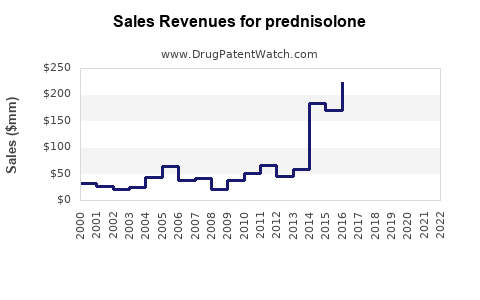
No single public source reports global prednisolone revenue across all dosage forms. Public company filings generally include prednisolone within broader generic pharmaceuticals or ophthalmic portfolios. The commercial outlook is therefore best assessed through product-level competition, FDA approvals, generic penetration, pricing, and manufacturing concentration.
What is prednisolone used for and which products compete with it?
Prednisolone is a synthetic glucocorticoid used to suppress inflammation and immune activity. Its indications include allergic, dermatologic, rheumatologic, respiratory, ophthalmic, gastrointestinal, and hematologic conditions. It is closely related to prednisone, which is converted in the body to prednisolone.
The main competitive products are:
| Product category |
Active ingredient or form |
Typical market role |
| Oral tablets |
Prednisolone |
Systemic corticosteroid treatment |
| Oral solution |
Prednisolone or prednisolone sodium phosphate |
Pediatric and liquid-dose use |
| Orally disintegrating tablets |
Prednisolone sodium phosphate |
Pediatric and swallowing-sensitive patients |
| Ophthalmic suspension |
Prednisolone acetate |
Postoperative and inflammatory eye conditions |
| Ophthalmic solution |
Prednisolone sodium phosphate |
Ocular inflammation |
| Combination ophthalmics |
Prednisolone plus an anti-infective |
Inflammation with suspected or established infection |
| Related corticosteroids |
Prednisone, methylprednisolone, dexamethasone, hydrocortisone |
Therapeutic substitution and formulary competition |
Prednisolone has advantages in pediatric dosing and certain hepatic conditions because it does not require conversion from prednisone. Ophthalmic prednisolone acetate remains commercially important because suspension-based ocular delivery is difficult to replicate consistently and competes within a specialized prescription market.
How large is the prednisolone market?
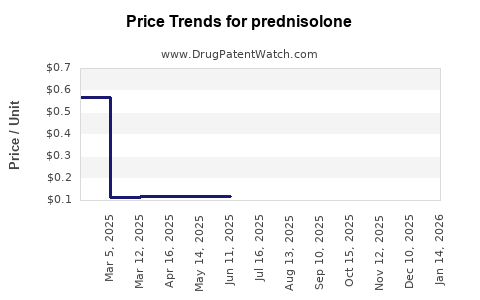
The total market is divided across products that do not share one commercial channel. Oral prednisolone is primarily a low-cost generic. Ophthalmic prednisolone has higher value per prescription because branded and authorized-generic products compete in a more specialized market.
Public market-research estimates vary widely because analysts use different scopes. Some count only prednisolone active pharmaceutical ingredient sales. Others include all finished oral and ophthalmic products, combination products, hospital supply, and international sales. These estimates should not be treated as directly comparable.
The most defensible market conclusions are:
- Prednisolone is a high-volume, low-price generic molecule.
- Ophthalmic products generate greater value per unit than standard oral tablets.
- Liquid formulations have a smaller patient population but higher manufacturing and distribution complexity.
- The market has no single dominant global supplier across every formulation.
- Revenue growth is more likely to come from volume, tenders, geographic expansion, or product reformulation than from price increases.
In the United States, prednisolone products are commonly reimbursed through generic pharmacy benefits, Medicaid, Medicare Part D, hospitals, and institutional purchasing contracts. Pricing pressure is strongest for standard tablets and oral solutions with multiple approved suppliers.
What is the FDA regulatory status of prednisolone?
Prednisolone is an FDA-approved prescription corticosteroid available through multiple approved drug applications and abbreviated new drug applications. FDA-listed products include oral and ophthalmic dosage forms. Product-specific labeling determines indications, strength, route of administration, contraindications, warnings, and approved age groups.
The FDA regulatory framework differs by product:
Oral prednisolone
Oral tablets and solutions are generally approved as systemic corticosteroids. Generic versions are typically approved through abbreviated new drug applications when they demonstrate pharmaceutical equivalence and bioequivalence to a reference product.
Liquid products may face greater regulatory and commercial complexity because they must meet requirements for:
- Concentration uniformity
- Taste and excipient acceptability
- Stability after opening
- Dosing-device compatibility
- Microbial quality
- Pediatric administration
Ophthalmic prednisolone
Prednisolone acetate ophthalmic suspension products must demonstrate quality attributes associated with suspensions, including particle size, uniformity, redispersibility, sterility, and delivery consistency. These requirements can create greater manufacturing barriers than standard immediate-release tablets.
FDA labeling for prednisolone ophthalmic products includes warnings concerning elevated intraocular pressure, glaucoma, delayed healing, infection risk, and prolonged use. Product labels also restrict use in certain untreated ocular infections. [1]
Combination products
Prednisolone ophthalmic combinations with antibiotics compete in a separate product segment. These products may have different reference-listed drugs, generic substitution rules, and regulatory requirements from single-ingredient prednisolone products.
What patents protect prednisolone products?
The basic prednisolone molecule is an old corticosteroid and is no longer protected by an active composition-of-matter patent in the United States. The core commercial market is therefore generic.
Relevant patent categories historically included:
| Patent category |
Current commercial relevance |
| Active pharmaceutical ingredient |
Expired |
| Basic oral dosage forms |
Generally expired |
| Standard ophthalmic prednisolone formulations |
Core protection is generally expired |
| Suspension technology |
May have applied to specific branded products, but does not create molecule-wide exclusivity |
| Preservative systems and excipients |
Product-specific and generally limited in duration |
| Device or delivery systems |
May protect a particular container, dispenser, or formulation |
| Method-of-use claims |
Possible for specific indications, but limited practical effect for an old, broadly used corticosteroid |
A patent search must distinguish prednisolone from prednisolone acetate, prednisolone sodium phosphate, and combination products. These are not interchangeable patent subjects. A patent covering a specific ophthalmic suspension does not necessarily block oral prednisolone or another ophthalmic salt.
The FDA Orange Book should be checked by exact product and reference-listed drug because listings may differ among oral, ophthalmic, and combination products. A product may have no listed patents even if a manufacturer owns non-Orange-Book intellectual property, such as manufacturing know-how, trade secrets, device rights, or process claims. [2]
When does prednisolone lose exclusivity?
Prednisolone lost practical market exclusivity decades ago. The molecule is widely available from generic manufacturers, and standard oral products have no meaningful remaining regulatory exclusivity.
The commercial exclusivity timeline is best summarized as follows:
| Milestone |
Commercial effect |
| 1950s |
Prednisolone introduced as an established corticosteroid |
| 1970s-1990s |
Generic and multisource competition expands |
| 2000s |
Oral and ophthalmic generic supply becomes entrenched |
| 2010s |
Formulation-specific and branded ophthalmic competition continues |
| 2020s |
Market remains mature, fragmented, and price-sensitive |
Any remaining exclusivity would be product-specific rather than molecule-wide. A newly approved formulation could receive limited regulatory protection or patent protection, but that would not restore exclusivity to prednisolone as an active ingredient.
How many patents cover prednisolone products?
There is no meaningful single patent count for prednisolone. The count depends on:
- The exact salt or ester
- The route of administration
- The reference-listed drug
- The jurisdiction
- Whether expired patents are included
- Whether formulation, process, device, and method-of-use claims are counted
- Whether patents are family-counted or publication-counted
For standard oral prednisolone, the practical blocking-patent count is effectively zero in the United States. For specialized ophthalmic products, historical patent families may cover formulation characteristics, suspension systems, preservatives, packaging, or delivery technologies. Those rights must be assessed claim by claim and by expiration status.
Patent ownership also changes through acquisitions, product divestitures, and licensing. A search based only on the current labeler can miss patents filed by a former brand owner or acquired subsidiary.
Are there Paragraph IV challenges to prednisolone?
Paragraph IV litigation is not a central current market issue for standard prednisolone because the major dosage forms have been generic for many years. Paragraph IV certifications are most commercially relevant when a generic applicant challenges an unexpired patent listed for a branded formulation.
Potential litigation exposure is higher for:
- New ophthalmic suspension products
- Combination products
- Modified-release or specialized delivery systems
- Products with recently approved formulation patents
- Branded products with device or container claims
For an established oral prednisolone tablet or solution, the principal competitive question is usually abbreviated new drug application approval and supply economics, not patent litigation.
A generic launch may still be delayed by regulatory deficiencies, manufacturing remediation, shortage controls, contractual arrangements, or commercial decisions. Patent litigation is only one possible barrier.
What formulations are protected by prednisolone patents?
Formulation protection is most relevant to ophthalmic and pediatric products.
Ophthalmic suspensions
Prednisolone acetate ophthalmic suspension requires control of suspended particles and dose uniformity. Commercially relevant intellectual property may cover:
- Particle-size distribution
- Suspension stability
- Preservative systems
- Surfactants and wetting agents
- Container closure systems
- Drop delivery
- Reduced shaking requirements
- Improved ocular residence time
These claims may protect a particular product architecture without preventing competitors from selling other prednisolone ophthalmic formulations.
Oral liquids
Oral prednisolone solutions and suspensions can be differentiated through:
- Sugar-free vehicles
- Flavored formulations
- Concentration
- Preservative selection
- Unit-dose packaging
- Dosing syringes
- Stability and storage characteristics
The commercial value of these features is constrained by substitution and payer pressure. Pediatric acceptability can support volume retention, but it rarely produces durable pricing power without patent or regulatory differentiation.
Which companies compete in the prednisolone market?
Competition varies by geography and dosage form. In the United States, suppliers have included large generic manufacturers, specialty ophthalmic companies, branded ophthalmic companies, and contract manufacturers.
Relevant competitor groups include:
- Large generic manufacturers supplying oral tablets and liquids
- Ophthalmic specialists supplying prednisolone acetate suspensions
- Brand owners and authorized generics
- Regional manufacturers serving government tenders
- Contract development and manufacturing organizations
- API suppliers in India, China, Europe, and other production centers
Companies may hold a strong position in one formulation while having little presence in another. A supplier of oral tablets should not be assumed to compete directly with a branded ophthalmic suspension manufacturer.
The market is vulnerable to supplier exits because low-priced generic products can become economically unattractive when production costs, regulatory compliance costs, and quality-system requirements rise. FDA drug-shortage data should be reviewed for product-specific supply disruptions rather than for prednisolone as a single category. [3]
What is the financial trajectory for prednisolone?
Prednisolone has a mature, low-growth financial profile.
| Financial driver |
Expected effect |
| Prescription volume |
Stable to modest growth from chronic and acute inflammatory use |
| Generic price erosion |
Reduces revenue per prescription |
| Ophthalmic specialization |
Supports higher margins than standard oral tablets |
| Pediatric liquid demand |
Supports niche value but adds manufacturing complexity |
| Hospital tenders |
Increase volume while compressing price |
| Supplier consolidation |
Can improve pricing temporarily but increases shortage risk |
| New delivery technology |
May create limited premium opportunities |
| Regulatory remediation |
Can materially reduce profitability or cause product withdrawal |
For manufacturers, standard oral prednisolone is usually a scale and utilization product rather than a growth asset. Profitability depends on high manufacturing efficiency, dependable API sourcing, low defect rates, and broad customer access.
Ophthalmic products are more attractive from a margin perspective because they require specialized sterile manufacturing and may have fewer qualified competitors. That advantage is offset by higher quality-control costs, sterility risks, product recalls, and regulatory scrutiny.
Public filings from large pharmaceutical companies rarely disclose prednisolone revenue separately. Revenue exposure must therefore be estimated through product lists, prescription data, tender awards, shipment information, and segment commentary. A company with a broad ophthalmic portfolio may have meaningful prednisolone exposure without reporting it as a separate line item.
What generic launch risks exist for prednisolone?
A new generic entrant would face limited patent risk but substantial commercial and operational risk.
The main risks are:
- Established suppliers already serve most major channels.
- Standard oral products have limited price headroom.
- Pharmacy benefit managers and wholesalers favor reliable low-cost suppliers.
- Ophthalmic products require sterile manufacturing and validated suspension performance.
- Product recalls can damage a supplier’s position quickly.
- Shortage-driven price increases may be temporary.
- Hospitals may require extensive vendor qualification.
- International markets have different reference products, labeling standards, and procurement systems.
A generic company can still succeed by targeting a shortage-prone formulation, an underserved concentration, a preservative-free product, a pediatric presentation, or a market with few registered suppliers.
How does prednisolone compare with prednisone and dexamethasone?
| Attribute |
Prednisolone |
Prednisone |
Dexamethasone |
| Core use |
Broad anti-inflammatory and immunosuppressive therapy |
Broad systemic corticosteroid therapy |
Potent systemic corticosteroid |
| Bioactivation |
Active drug |
Converted to prednisolone |
Active drug |
| Pediatric use |
Strong liquid and dosing presence |
Also widely used |
Used where high potency or specific duration is needed |
| Generic competition |
Extensive |
Extensive |
Extensive |
| Commercial pricing |
Low for oral products; higher in specialty ophthalmics |
Low |
Low to moderate depending on formulation |
| Differentiation |
Ophthalmic suspension and pediatric liquid formats |
Familiar systemic standard |
Potency, dosing convenience, and clinical preference |
| Patent position |
Mature and largely unprotected |
Mature and largely unprotected |
Mature and largely unprotected |
Clinical substitution limits pricing power across the systemic corticosteroid class. Physician preference, indication, dose equivalence, tolerability, formulation availability, and formulary status determine product selection.
What licensing deals and manufacturing barriers affect prednisolone?
Prednisolone is not generally associated with major recent molecule-level licensing transactions. Licensing activity is more likely to involve:
- Branded ophthalmic product rights
- Regional commercialization agreements
- Authorized-generic arrangements
- Contract manufacturing
- API supply
- Combination-product rights
- Device or packaging technology
Manufacturing barriers are more important than patent barriers. Oral tablets are relatively straightforward to manufacture at scale. Oral liquids require formulation and stability controls. Ophthalmic suspensions require sterile production, validated particle characteristics, aseptic processing, and container-closure integrity.
Geographic supply chains often depend on a limited number of API and finished-dose manufacturers. Regulatory inspections, import alerts, quality failures, geopolitical disruption, or plant shutdowns can affect supply even when demand remains stable.
What patent litigation affects prednisolone?
There is no broad, molecule-level patent litigation trend comparable to newer specialty drugs. Litigation risk is product-specific and may arise from:
- A branded ophthalmic formulation
- A combination product
- A delivery device
- A formulation patent
- Trade-secret allegations involving manufacturing
- Antitrust claims concerning authorized generics or supply arrangements
Any litigation assessment should identify the exact National Drug Code, reference-listed drug, labeler, patent family, and court docket. Aggregating all prednisolone litigation would overstate the risk to standard generic products.
What is the outlook for prednisolone revenue and market share?
The base-case outlook is stable volume with low or negative price growth for standard oral products. Ophthalmic products should retain better value density because of formulation complexity and specialized manufacturing.
The most likely revenue pattern is:
- Oral tablets: stable demand, continued price pressure
- Oral liquids: stable niche demand with occasional supply volatility
- Ophthalmic suspensions: comparatively stronger margins and product-level differentiation
- Combination ophthalmics: competition based on clinical positioning, availability, and reimbursement
- New formulations: limited opportunity unless they solve a meaningful administration or adherence problem
The strongest commercial opportunities are not in basic prednisolone tablets. They are in reliable supply, difficult-to-manufacture ophthalmic products, pediatric presentations, preservative-free formulations, and markets with weak generic penetration.
Key Takeaways
- Prednisolone is a mature generic corticosteroid with no meaningful molecule-level exclusivity.
- Standard oral products are volume-driven and highly price-sensitive.
- Ophthalmic prednisolone products have higher manufacturing complexity and stronger margin potential.
- Patent risk is formulation-specific, not molecule-wide.
- Current commercial barriers are manufacturing quality, sterile capacity, supply reliability, and channel access.
- Paragraph IV litigation is generally limited to specific branded or specialized formulations.
- Public companies rarely disclose prednisolone revenue separately.
- The financial trajectory is stable to modestly declining for basic oral products, with better prospects in specialized ophthalmic and pediatric formulations.
- Generic entrants face low patent barriers but significant pricing and supply-chain competition.
FAQs About Prednisolone Market and Patent Risk
Is prednisolone still under patent in the United States?
The active prednisolone molecule is not under meaningful U.S. composition-of-matter protection. Specific formulations, combinations, devices, or manufacturing processes require separate patent review.
Can a generic company launch prednisolone without a Paragraph IV challenge?
Yes. If no unexpired, relevant patent is listed for the reference product, an applicant may use another applicable ANDA certification pathway. The exact filing strategy depends on the product and Orange Book record.
Why are prednisolone eye drops more commercially valuable than tablets?
Ophthalmic suspensions require sterile manufacturing, particle-size control, dose uniformity, and container-closure validation. These requirements limit the number of qualified suppliers and support higher value per prescription.
Is prednisolone a shortage-prone drug?
Shortage risk is product-specific. Oral tablets, oral liquids, and ophthalmic suspensions can experience different supply conditions because they use different manufacturing processes and supplier networks. FDA shortage records should be reviewed by exact product and strength.
What is the best commercial entry point for a prednisolone manufacturer?
The strongest entry opportunities are typically specialized ophthalmic products, pediatric liquids, preservative-free presentations, shortage-prone strengths, and jurisdictions with limited registered competition. Basic oral tablets usually offer lower margins and stronger incumbent competition.
References
- U.S. Food and Drug Administration. (n.d.). Prednisolone acetate ophthalmic suspension prescribing information. https://www.accessdata.fda.gov
- U.S. Food and Drug Administration. (n.d.). Approved drug products with therapeutic equivalence evaluations: Orange Book. https://www.accessdata.fda.gov/scripts/cder/ob/
- U.S. Food and Drug Administration. (n.d.). Drug shortages. https://www.accessdata.fda.gov/scripts/drugshortages/
- National Library of Medicine. (n.d.). DailyMed: Prednisolone drug labels. https://dailymed.nlm.nih.gov/dailymed/
- National Center for Biotechnology Information. (n.d.). PubChem compound summary: Prednisolone. https://pubchem.ncbi.nlm.nih.gov/compound/Prednisolone