Last updated: April 24, 2026
What is Allergan’s market position across core therapy areas?
Allergan (now part of AbbVie) is a scaled global specialty-pharma player with concentrated strength in immunology, aesthetics, neuroscience, and eye care, anchored by legacy brands and an acquisition-led portfolio buildout. Its competitive position is defined by (1) brand strength in revenue pools that have strong payer familiarity, (2) a high share of branded or proprietary products in mature indications, and (3) recurring demand drivers in aesthetics and eye care.
Core commercial footholds by portfolio theme (high-level)
| Theme |
Representative products/segments |
Competitive implication |
| Immunology |
Humira history (post-AbbVie transition), pipeline assets around inflammation |
Exposure to biologic competitive intensity and biosimilar erosion dynamics (legacy) |
| Aesthetics |
Botox franchise, other aesthetic injectables |
Durable brand equity; repeat-use payer and provider relationships |
| Neurology/pain |
Botox franchise use in chronic migraine and spasticity |
Brand-led expansion; procedure-centric adoption |
| Ophthalmology |
Eye care franchise (historically strong within Allergan’s footprint) |
Longer device-and-treatment pathway; slower switching once embedded |
Source context: AbbVie completed Allergan acquisition (see [1]).
Where does Allergan face the highest competitive pressure?
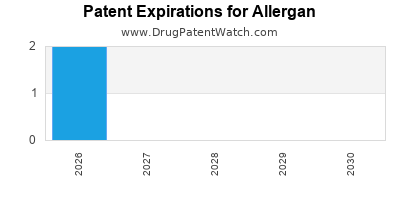
Competitive pressure peaks in areas with (a) biologic/biosimilar replacement risk, (b) patent cliffs for blockbusters, and (c) rapid innovation cycles in modalities that shift standard of care.
| Pressure vector |
Where it hits hardest |
What it changes for competitors |
| Biosimilar substitution |
Large biologic franchises (legacy exposure via Humira era) |
Pricing compression, payer formulary tightening |
| Patent cliff dynamics |
High-revenue single-molecule franchises |
Increases incentives for line extensions, delivery improvements, and new mechanisms |
| Modality switching |
Immunology and inflammatory pathways |
Biologics vs small molecules vs next-gen targeted approaches competing on endpoints and safety |
Source context: AbbVie’s Allergan acquisition is the structural anchor for how Allergan portfolio assets sit inside a larger competitive platform (see [1]).
What are Allergan’s structural strengths that defend share?
Allergan’s competitive strengths track directly to how the company built and defended product franchises prior to and after the AbbVie combination: strong brand equity, concentrated sales and reimbursement know-how, and a broad base of clinical evidence supporting differentiated labels.
Strength profile by franchise mechanics
-
Brand and procedural adoption
- Aesthetics and certain neurology indications (notably Botox-led demand) rely on provider behavior and patient repeat treatment cycles. Competitors must overcome switching barriers with differentiated clinical endpoints and payer coverage.
-
Clinical differentiation and labeling density
- Allergan-origin products historically expand indications over time through clinical development programs, increasing total addressable prescribing and reducing dependence on a single indication.
-
Portfolio scaling under a larger commercial engine
- Post-acquisition, Allergan’s product lines operate inside AbbVie’s scale distribution, payer contracting leverage, and manufacturing footprint, which can blunt discounting intensity versus smaller specialty players (see [1]).
Which competitors define the “battlefront” by category?
Competitive sets differ by modality and patient pathway. Below are the most relevant competitor groups that typically contest the same purchasing decisions, prescriber behavior, and payer coverage.
Immunology (biologics and inflammation management)
- Large global biologic innovators with next-gen pipeline and biosimilar response capability.
- Biosimilar entrants positioned on payer-driven substitution.
Aesthetics and neurology injectables
- Specialty aesthetics and neurology-focused pharma targeting the same injector networks and reimbursement codes.
- Adjacent-device or combination-therapy brands aimed at improving outcomes and extending patient lifetime value.
Ophthalmology (eye care)
- Ophthalmology-focused innovators offering differentiated efficacy, dosing schedules, and patient adherence advantages.
- General specialty pharma with eye care portfolios using bundling and payer relationships.
Source context: AbbVie’s integration of Allergan defines the commercial reality of the competitive battlefield (see [1]).
How does the Allergan portfolio create a defensive moat versus lower-cost entrants?
Allergan’s defense is less about manufacturing cost leadership and more about clinical and reimbursement embeddedness.
Moat elements
| Moat element |
Competitive edge |
Where it matters most |
| Evidence-backed labeling |
Reduces payer and prescriber risk |
Established chronic disease use cases |
| Provider-led administration |
Limits rapid switching without a clinical trigger |
Injectables and procedure-driven care |
| Payer contracting relationships |
Maintains access during competitor launches |
Mature branded categories |
| Indication expansion |
Broadens prescriptions and reduces single-indication risk |
Mature product franchises |
Source context: acquisition-driven integration affects contracting and access scale (see [1]).
What does Allergan’s acquisition by AbbVie imply for strategy and competitive behavior?
AbbVie’s acquisition of Allergan changes the competitive posture in three direct ways: (1) scale, (2) portfolio breadth, and (3) resource reallocation toward pipeline and lifecycle management.
Strategic implications for competitor analysis
-
More aggressive lifecycle management
- Larger R&D and commercial budgets can sustain development programs and line extensions to extend franchise lifecycles through label expansion or formulation improvements.
-
Stronger payer leverage
- Consolidated negotiating power can sustain preferred formulary status even when biosimilars or “me-too” competitors enter.
-
M&A-style portfolio complementarity
- Competitors face the likelihood that AbbVie will prioritize assets and indications that fill gaps in the immunology and neuro-aesthetics adjacency network (see [1]).
Where are the highest-value strategic opportunities for challengers?
Challengers win when they attack one of the decision drivers: clinical outcomes, safety, convenience (dosing), or payer economics. For an Allergan-led competitive landscape, the best entry points depend on whether the target is immunology, aesthetics, neurology, or eye care.
Opportunity map for competitive entrants
| Entrant strategy |
Best-fit targets in an Allergan-linked landscape |
| Outcome differentiation |
Indications where label-based switching is clinically justified |
| Dosing and adherence |
Chronic-use treatments where patient convenience affects persistence |
| Safety/tolerability |
Refractory populations and patients with comorbidity constraints |
| Economic access |
Indications with strong payer pressure and formulary leverage |
Source context: portfolio integration shifts how economic access is negotiated (see [1]).
What should investors and R&D leaders watch in the Allergan landscape now?
Competitive risk and opportunity cluster into a small set of observable signals: regulatory milestones, payer coverage behavior, biosimilar uptake rates (where relevant), and execution on lifecycle programs.
Watchlist items
-
Regulatory and label changes
- Evidence of label expansions or safety clarifications that can increase total prescriptions.
-
Payer formulary and contracting behavior
- Whether Allergan-origin franchises maintain preferred status at similar net prices or see increased contracting concessions.
-
Biosimilar and competitive entry rates
- Where biosimilar substitution accelerates, net revenue pressure rises and lifecycle programs become more urgent.
-
Pipeline transitions
- Milestones that replace aging revenue with new mechanisms or next-generation formulations.
Source context: AbbVie’s ownership and portfolio management govern these dynamics (see [1]).
Key Takeaways
- Allergan’s competitive profile is defined by franchise durability in procedure-anchored categories (notably aesthetics/neurology) and by brand-embedded reimbursement behavior across core indications.
- Competitive pressure concentrates in biologic substitution dynamics and patent cliff exposure; strategy pivots toward lifecycle management, label density, and payer access maintenance.
- The AbbVie acquisition is the core structural change: it increases commercial leverage, supports portfolio complementarity, and shifts the competitive pace by enabling larger lifecycle and pipeline investment budgets (see [1]).
- For challengers, winning routes are focused on clinical differentiation, dosing convenience, safety advantages, and economic access aligned to payer contracting behaviors.
FAQs
1) Is Allergan still an independent company for competitive analysis?
No. Allergan is integrated under AbbVie following AbbVie’s acquisition completion (see [1]).
2) What is Allergan’s main competitive advantage in aesthetics and neurology categories?
Brand-led adoption tied to provider behavior and reimbursement familiarity, supported by clinical evidence and label breadth (see [1]).
3) Where is the highest market-share risk for Allergan-linked franchises?
Biosimilar substitution and patent cliff-related erosion in high-revenue categories, which increases payer-driven price pressure (see [1]).
4) How does AbbVie’s scale affect Allergan’s competitive posture?
It increases payer and contracting leverage and supports sustained lifecycle and pipeline investment to protect franchise value (see [1]).
5) What should competitors target to displace Allergan-related products?
Compelling clinical endpoints, improved safety/tolerability, dosing convenience that affects persistence, and payer access strategies aligned to formulary decision-making.
References
[1] AbbVie. (2019). AbbVie completes acquisition of Allergan. AbbVie Newsroom. https://news.abbvie.com/news/abbvie-completes-acquisition-of-allergan.htm