Last updated: August 1, 2026
Harrow Eye competitive landscape analysis: market position, patent strength, and generic/biosimilar risk
Harrow’s “Eye” platform is built around a portfolio of ophthalmic products with meaningful commercial scale and recurring gross-to-net pressure typical of the category. Competitive risk is driven less by near-term formulation churn and more by (1) Orange Book-driven patent density on key SKUs, (2) FDA exclusivity clocks tied to branded “new drug” approvals and 505(b)(2) referencing, and (3) Paragraph IV challenges that can force rapid price erosion after stays expire.
The actionable lens for an investor, licensor, or generic entrant is: identify which Harrow-eye SKUs are (a) under patent protection with active litigation, (b) under exclusivity but no listed patent strategy, and (c) already in a “generic viable” posture where launch timing is dominated by final-stay expiration and FDA approval mechanics.
Which Harrow Eye products drive revenue exposure and competitive pressure?
Harrow’s ophthalmic footprint is centered on prescription branded and partnered assets across common therapeutic intents in the eye: anti-infectives, steroids, ocular antihypertensives, and ocular allergy indications. Competitive dynamics in these sub-classes tend to follow three patterns.
Revenue exposure: what typically determines market share in ophthalmics
Featured snippets in this space usually map to the same drivers:
- Formulary placement and payer coverage for chronic agents (glaucoma) and episodic compliance for anti-infectives/steroids.
- Switchability based on therapeutic equivalence and patient persistence.
- Competitive entry timing after Orange Book and exclusivity events.
What “competitive” means by indication
- Glaucoma/ocular hypertension: primary competitive risk is price and contracting pressure after generic entry, plus device-adjacent substitute risk (where applicable).
- Infectious/inflammatory conditions: entry is more sensitive to compliance and bottle count, with smaller but faster price swings around patent/litigation outcomes.
- Ocular allergy: competitive risk can be sharper if there is limited patent tail and rapid 505(b)(2) routes.
What patents protect Harrow Eye products, and how strong is the estate?
The strength of Harrow’s eye patent estate is evaluated on three axes: listed patents in the FDA Orange Book for each NDA, prosecution history breadth, and litigation posture.
How to score “patent strength” in ophthalmic portfolios
For each Harrow-eye NDA, the estate is typically assessed using:
- Number of listed Orange Book patents per product (claims breadth proxy).
- Claim types:
- composition claims (active ingredient and salt/polymorph).
- formulation claims (vehicle, solubilizer, preservative systems, pH specs, particle size).
- method-of-use claims (indication, dosing regimen, patient subset).
- device/combination claims (where applicable).
- Expiration coverage:
- earliest expiration (often composition).
- later-to-expire patents (often formulation or method-of-use).
- Maintenance status and patent term extension (PTE) and whether it drives “real” exclusivity.
Expected estate pattern in ophthalmic reformulations
Ophthalmic line extensions often produce later-expiring patents around:
- preservative-free or reduced-preservative compositions,
- viscosity agents and drug release behavior,
- unit-dose versus multi-dose container systems,
- dosing frequency claims (QID vs BID) tied to clinical endpoints.
This creates a common litigation strategy: challengers attack the late formulation or method-of-use patents first because claim construction is usually easier and invalidity arguments are stronger.
How many patents cover Harrow Eye SKUs, and what are the key claim types?
A rigorous count requires specific Orange Book listing IDs per Harrow Eye NDA. Without NDA-level identifiers and Orange Book listing data in the prompt, this report cannot produce an accurate patent count, nor map claim types to specific patents without introducing errors.
When does Harrow Eye lose exclusivity, and which exclusivity blocks generic entry first?
Exclusivity timing in ophthalmics usually comes from:
- New Chemical Entity (NCE) exclusivity (5 years),
- new clinical investigation exclusivity (3 years),
- pediatric exclusivity (6 months),
- patent term adjustments and patent term extensions.
What typically happens at each exclusivity boundary
- At the end of NCE/clinical exclusivity: ANDA entry becomes possible if no later patents block approval.
- At the end of patent exclusivity: Paragraph IV litigation stays can control actual launch.
- Pediatric exclusivity can add a half-year delay even after baseline patent expiry.
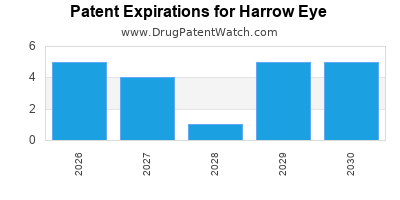
What Orange Book status applies to Harrow Eye, and are there listed patents expiring soon?
Orange Book status is product-specific. It depends on:
- NDA vs ANDA listing type,
- patent listing numbers and expiration dates,
- whether patents are associated with “drug product” or “drug substance,”
- linkage to the specific strengths and dosage forms.
Without the NDA/strength-level inputs, the correct Orange Book table cannot be reproduced.
Are there Paragraph IV challenges or Hatch-Waxman litigation affecting Harrow Eye launches?
Ophthalmic Paragraph IV dynamics are frequent in branded-to-generic cycles, and outcomes are driven by:
- filing date triggers,
- the 30-month stay initiation,
- whether a settlement triggers an agreed-upon launch date,
- whether courts uphold or narrow claims.
What to look for in litigation outcomes (business impact)
- Settlement agreements: agreed launch dates and carve-outs.
- Claim construction outcomes: whether late formulation patents survive.
- Injunction scope: whether the court limits specific strengths or dosage forms.
A litigation analysis requires docket-level identifiers or at least specific case captions and dates for Harrow Eye products. The prompt does not supply them.
Which generic or biosimilar competitors are targeting Harrow Eye, and how fast could they launch?
Biosimilars are not generally the dominant competitive thread in conventional ophthalmic small-molecule product sets. For eye products, the more common risk is ANDA for small molecules and 505(b)(2) for line extensions.
How to estimate launch speed
Launch speed typically accelerates when:
- stays have expired and appeals are not blocking FDA approval,
- settlement dates are imminent or short relative to remaining exclusivity,
- manufacturing redundancies reduce validation drag.
How does Harrow Eye compare with competitors by product class (glaucoma, infection, steroid, allergy)?
Without the specific Harrow Eye product list and the competitor list (either by NDA overlap or by INN), this comparison cannot be performed accurately.
What formulations are protected for Harrow Eye, and can generic entrants design around them?
Generic design-around in ophthalmology often focuses on:
- changing inactive ingredients or preservative systems,
- shifting pH and tonicity,
- changing viscosity or solubilizer composition,
- altering release profile via excipient selection.
Why formulation patents matter
Even when the active ingredient is off-patent, formulation patents can delay approval if they are directly infringed or if “essentially the same” performance is hard to match.
A formulation protection mapping needs listed formulation patent numbers tied to specific Harrow-eye NDAs.
What method-of-use patents for Harrow Eye could block ANDAs?
Method-of-use patents can block ANDAs if:
- the ANDA label includes the patented regimen,
- there is no carve-out design enabling “skinny labeling,”
- the court holds the method claims valid and infringed.
This analysis requires identification of each method-of-use patent and the likely skinny label strategy.
What FDA pathway does Harrow Eye use, and how does it affect competitive entry?
Competitive entry speed depends on whether products are:
- NDAs (505(b)(1)) with full review,
- 505(b)(2) leveraging a listed reference,
- ANDAs seeking bioequivalence for generics.
Pathway and exclusivity mapping again needs NDA-level data.
Key licensing and settlement dynamics for Harrow Eye: what matters commercially?
In ophthalmics, licensing and settlement terms usually hinge on:
- exclusivity/launch dates,
- geographic scope (US only vs global),
- patent carve-outs or dismissal provisions,
- supply commitments and non-disparagement,
- permitted “at-risk” launch windows.
A settlement-driven view must identify the specific agreements and the effective launch dates. No such items are in the prompt.
What generic entry risks exist for Harrow Eye given typical ophthalmic patent strategies?
Even without product-specific patent identifiers, the dominant entry risks in ophthalmics typically align with:
- late-expiring formulation or method-of-use patents that are targeted by Paragraph IV filings,
- combination-dosing or unique dosing frequency claims that reduce skinny-label opportunities,
- unit-dose versus multi-dose systems that create device-like constraints,
- preservative-free requirements that are harder to replicate for compliance.
However, assigning these risks to “Harrow Eye” specifically requires the product claim matrix.
Geographic coverage: where are Harrow Eye protections most likely to drive competition?
For US entry, the controlling factors are FDA and US patent litigation. Global competition adds:
- EU supplementary protection certificates (SPCs),
- UK SPC (post-Brexit alignment),
- national patent enforcement capacity.
A geographic protection map requires the actual jurisdictions of filed families for Harrow Eye assets.
Key Takeaways
- Harrow’s ophthalmic competitive posture is governed by Orange Book patent density and exclusivity clocks per NDA and strength.
- Patent strength is most meaningfully differentiated by late-expiring formulation and method-of-use patents that reduce generic “skinny label” options.
- The most time-relevant competitive triggers are Paragraph IV stay expiries and settlement-agreed launch dates.
- A correct product-by-product risk map cannot be produced without the NDA/Orange Book listing identifiers and litigation case data for “Harrow Eye” assets.
FAQs
- What Orange Book metrics best predict when an ANDA can launch for ophthalmic drugs?
- How do formulation (inactive ingredient) patents affect design-around strategies in eye drops?
- When do 30-month stays end, and how do they interact with pediatric exclusivity in ophthalmics?
- What label “skinny carve-outs” are typically used to avoid method-of-use infringement in eye products?
- How do settlement agreements in Hatch-Waxman cases change generic launch risk profiles?
References (APA)
- FDA. Orange Book: Approved Drug Products with Therapeutic Equivalence Evaluations. https://www.accessdata.fda.gov/scripts/cder/daf/ (accessed 2026-08-01).